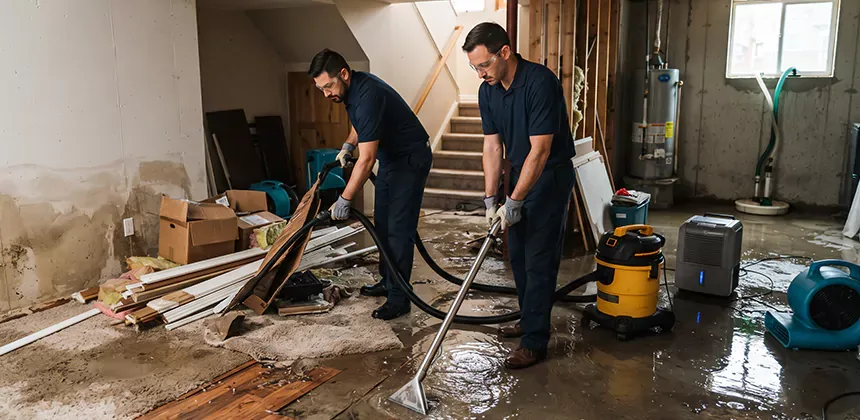
Quick answers
The Short Version: Standing at the Top of the Basement Stairs
Most people arrive on this page standing at the top of a staircase, looking down at water. So the short version comes first, and its first rule is not about water at all. Do not go down. If the water below may be touching outlets, appliances, cords or the breaker panel, treat the whole room as unsafe until a licensed electrician has looked at it. Water and electricity settle their argument through whoever steps in, and no box, boiler or photograph is worth that. From the top of the stairs, dry and safe, you can still do almost everything that matters in the first hour of basement water damage restoration NYC.
The short version works because it is ordered: safety first, then the source, then the calls, then the evidence. That order is the skeleton of basement water damage restoration NYC.
From the stairs you can see more than you think. You can see the depth of the water against the steps. You can see whether it is clear or cloudy, still or moving, and whether anything is floating that should not float. You can smell it, and the smell matters: clean rain water, heating oil and sewage announce themselves differently, and the crew you call will ask. You can listen for running water, which means the source is still live. Take the photograph from the doorway, with the flash on, before anyone touches anything. That single picture, taken dry shod from the top of the stairs, is often the best evidence a claim ever gets, because it shows the loss as it was found.
- One: do not enter the basement until the power question is answered; water near electrics is a stop sign, not a challenge.
- Two: if the source is a burst pipe or a failed appliance and you can reach its shutoff without entering the water, close it; otherwise call for help and say the water is still running.
- Three: photograph everything from the doorway before anything is moved, and keep photographing as the work proceeds.
- Four: call a restoration crew, your insurer, and 311 if a sewer is involved, all in the first hour.
- Five: get the scope in writing, with a moisture map and daily drying logs promised, before the heavy work starts.
- Six: keep every record, because a basement claim is proven on paper like any other, and the basement has extra rules of its own.
None of the six steps needs you to stand in the water. They need a phone, a camera and the discipline to stay at the top of the stairs until the room is safe, which is why they open this guide to basement water damage restoration NYC.
Notice what the short version does not contain: any talk of price. That is deliberate, and it follows the rule this whole site works by. This is a page for people who will act by phone, and the honest comparison between companies is made on written scopes for the same work, not on figures quoted blind to someone standing over a flooded room. A number given before inspection is not information; it is bait or a guess. Compare the work, compare the paper, compare the readings you will be shown each day. The rest of this page explains each step of basement water damage restoration NYC in full, with the city rules, the insurance limits and the plumbing code that stand behind it.
One more quick answer belongs here, because people ask it in a whisper: is it normal to feel shaken by a flooded basement? It is entirely normal. The basement is where a house keeps its memory: the boxes, the tools, the boiler, the freezer, sometimes a bedroom, sometimes the whole of someone's home. Water in that room feels personal in a way water in a kitchen does not. The trade knows it. A serious crew will explain its plan in plain words, write it down and show its readings daily, and will not rush you past the doorway photograph or the inventory of what was lost. Plain words and patience are the first professional standards in basement water damage restoration NYC, and you are entitled to both from the first call.
People who run the first hour well rarely describe the day as chaos afterwards. They describe a sequence, and the sequence is what they bought when they chose a crew for basement water damage restoration NYC.
Keep this short version open on your phone while the calls are made. Under stress, sequences are easy to lose, and the order here protects you, the building and the claim at the same time. Safety, source, photographs, calls, scope, records. Six beats. Everything else on this page is commentary on those six beats, written for the hours and days that follow, when the water is out and the longer questions arrive: why basements flood first, what the city says about the room, what the flood policy will and will not pay for below ground, and how the room is kept dry next time.
In one line: the first hour decides the size of the loss, and the first rule of that hour is to stay out of the water.
A flooded basement has two clocks running, the water's and the insurer's. The short version respects both, which is why photographs sit beside shutoffs in any honest account of basement water damage restoration NYC.
If you remember nothing else from this page, remember the doorway. Photograph from it, call from it, and let nobody past it until the power is proven safe. That one habit is the difference between a bad day and a tragedy, and it costs nothing.
Plain meaning
What Basement Restoration Means, and Why the Lowest Room Is Its Own Trade
Restoration in a basement shares its physics with restoration anywhere else. Water is pumped and extracted, materials are dried, moisture is measured, and what cannot be saved is removed. What changes, completely, is the room itself. A basement sits below the street, below the sewer, and in much of this city below the water table. Every drain in the house ends above it or in it. Every pipe in the building passes over it. Rain that falls on the roof, the yard and the street all want, by gravity, to visit it. That is why basement water damage restoration NYC is its own discipline and not simply the downstairs version of the general job.
The basement difference is not the water. It is the depth. Depth decides how the water arrives, how long it stays, what it touches on the way, and what the insurance will say about it afterwards, and working with depth is part of basement water damage restoration NYC.
Start with arrival. Water reaches a basement by more roads than it reaches any other room. It falls from above, through burst pipes, failed water heaters, split washing machine hoses and overflowing fixtures on the floors overhead. It rises from below, as groundwater pressing through floor cracks and wall joints when the soil is saturated. It returns from the street, when a storm surcharges the city sewer and the lowest fixtures in the building become the sewer's overflow. And it walks in at ground level, under the basement door and through window wells, when the street outside becomes a river. Four roads, four different kinds of water, four different insurance stories, all ending in the same room. A crew that asks which road your water took, before it asks how deep it is, understands the room.
Then there is the staying. A kitchen floor sheds water to its edges and dries in the open air of the house. A basement holds water like a bowl. Its floor is a slab on soil, cold and slow to give moisture back. Its walls are masonry or concrete, drinking water inward and releasing it over weeks. Its air is still, cool and already humid before a single drop arrives, which slows evaporation precisely where evaporation is needed most. Drying a basement is therefore a longer, more deliberate business than drying any room above it, and it is proven by readings taken over days, not by a dry feeling under one shoe on day one.
A kitchen dries in the weather of the house. A basement dries against the weather of the earth, and basement water damage restoration NYC has to win that argument with machines, readings and patience.
The contents differ too, and so does the grief. Above ground, rooms hold furniture. Below ground, the basement holds the building's machinery and the family's archive at the same time: the furnace, the water heater, the breaker panel, the washer and dryer, the freezer, and beside them the boxes of photographs, documents, tools and inherited things that were stored in the one room with space for them. A flood downstairs is therefore two losses in one room, the mechanical and the personal, and the restoration plan has to serve both: the boiler made safe and the boxes inventoried before they are thrown away. Crews that understand basements ask about the boxes. Crews that do not, learn about them from the skip.
Scale completes the picture. A basement flood is rarely a puddle. The room is the largest single space in most houses, it is usually unfinished or lightly finished, and water spreads across the whole slab before it is noticed, because nobody lives in the room to notice it early. By the time the smell or the step on the stairs gives it away, the water may have had hours or days to wick into walls, spoil stored goods and start the mold clock. That is why this page treats discovery time honestly: in a basement, the loss you find is almost never the loss as it began, and the moisture map, not the visible waterline, tells the true size of the job.
None of this makes the other pages of this site irrelevant to a basement reader. The claim rules, the drying science and the mold law are shared with the whole house. But a reader who stops at the general guidance will miss the power rule, the sewer road, the flood insurance limits that apply only below ground, and the legal line between a basement and a cellar that decides whether anyone may lawfully sleep in the room at all. This page exists to answer the basement questions directly, in basement terms, for the city's lowest rooms.
When a crew describes your loss, listen for the basement words: depth, source, sewer, slab, readings, coverage limits. Their presence marks a firm that understands basement water damage restoration NYC.
The general pages of this site will teach a basement reader the drying. This page exists because basement water damage restoration NYC was never only the drying.
The research
What the Search Data Says About This Service in This City
This page was researched before it was written, with two tools, and the first finding is one this page will state as plainly as the tools stated it: neither tool holds any search volume data for the exact phrase behind basement water damage restoration NYC. SEMrush, checking United States desktop results on November 24, 2026, reports the volume as not available. Moz reports no results found for volume at all. So there is no honest number of monthly searches to print here, and this page prints none. Anyone who quotes you a tidy monthly figure for this exact search is inventing it. What the tools do agree on is the difficulty: SEMrush puts keyword difficulty at sixteen percent and classes it as easy, Moz puts difficulty at nineteen and classes it as low. A hard search to rank for, this is not. A search real New Yorkers make from wet staircases, it plainly is.
Two tools agreeing that a phrase has no tracked volume is not a failure of research. It is research, reported honestly, and householders should expect the same honesty from any firm quoting figures about basement water damage restoration NYC.
| Measure | SEMrush (US, desktop) | Moz (US) |
|---|---|---|
| Monthly volume | Not available | No results found |
| Difficulty | 16 percent, easy | 19, low |
| Intent | Commercial | Transactional |
| Minimum domain authority | Not reported | 7 |
| SERP features | Reviews, video, local pack | People Also Ask only |
The results themselves tell a story a householder should know. In SEMrush's results for this search there are nine organic rows and no tenth: a Manhattan directory listing first, two pages from a national restoration network, then a run of local firms, a category page from a home services marketplace, a Facebook video and a Manhattan flood site. In Moz's nine results, last updated on November 18, 2026, a national home improvement site sits first and a city restoration group second, and neither national network from the other list appears at all. The two lists share only the directory. And through both lists runs the finding that shaped this page: almost nobody ranking for this search has written a page that is actually about basements. The results are general water pages, directory pages and category pages wearing a basement title. A page that treats the basement as its own subject, its own physics, its own law and its own insurance, is the gap in the results, and it is the gap this page was built to fill.
The questions people ask around this search are recorded by Moz in its People Also Ask box, and all four are answered in this page's thirty questions, in the search engine's own words: how to tell if water damage is permanent, what a tenant's rights are when a ceiling leaks, how long apartment repairs take, and the price question, which this page answers the way this whole site answers it, by explaining what decides the figure instead of inventing one.
The neighbouring searches with real volume behind them are worth naming, because they show how people actually talk about this room. In the keyword gap research between the two national networks, the basement questions with volume are plain spoken ones: what to do when the basement floods, searching at seven hundred and twenty a month; a sump pump for a flooded basement, at four hundred and eighty; water in the basement after rain, at three hundred and ninety. The big shared terms are basement water damage and basement flood, each at nine thousand nine hundred, and basement flooding at six thousand five hundred. This page answers those questions inside its own sections, as related questions under one roof, rather than pretending each deserves a separate page. One roof, one room, one complete answer: that is the structure the research supports.
One gap in the research should be stated as plainly as the findings. Domain level figures and backlink data could not be obtained in this research round; the tools stalled behind loading screens, and this page does not recycle older numbers in their place. What the research does establish is enough: the difficulty is low and agreed, the ranking pages are generalists, the questions people ask are known word for word, and the facts that decide a basement loss, the power rule, the sewer route, the flood insurance limits and the basement and cellar line, are documented by the city and the federal flood program in their own words. Those documents, not search tools, are the spine of what follows, and they are the sources basement water damage restoration NYC is judged against on this page.
No tracked volume, low difficulty, generalist results and four recorded questions. That is the whole search picture for basement water damage restoration NYC, and it is printed here without decoration.
A note on reviews, because the search results carry them and readers ask. The directory listing that leads one set of results shows a real rating built from hundreds of real reviews, and those numbers belong to the businesses reviewed there. This page carries no reviews of its own and invents none. When the hiring section below teaches you to judge a company, it teaches method: written scopes, moisture maps, daily logs and licence positions you can check. A method survives contact with your own basement. A borrowed star count does not.
Where the tools stalled, this page says so. A research gap admitted is worth more than a figure recycled, in keyword work and in basement water damage restoration NYC alike.
The first steps
The First Hour at a Flooded Basement, Step by Step
The six steps below are the spine of this page. They are written for the person who finds the water, and they assume nothing except a phone, a torch and a staircase to stand on. They are also the six steps recorded in this page's structured data, in the same words, so that what a search engine shows and what a reader finds here cannot drift apart. Take them in order. Each one protects the next: the power rule protects you, the photographs protect the claim, the scope protects the drying, and the drying protects the room. Basement water damage restoration NYC begins, every time, with these six moves made calmly from dry ground.
The steps are written for the finder of the water, not for the crew. Your job is safety, sequence and evidence; the pumping side of basement water damage restoration NYC is theirs.
1Do not enter a flooded basement until the power is safe
Stay at the top of the stairs. If the water may be touching outlets, appliances, cords or the panel, do not go down and do not reach into the water for anything. The city's own storm guidance is blunt: do not enter a flooded basement if the water could be in contact with electrical outlets, appliances or cords, do not enter until a licensed electrician has inspected, and do not turn the power back on until that inspection has happened. If lines are down outside, call 911. If you smell gas, leave the building without touching switches, get clear and call 911 from outside.
2Call for help and tell the insurer
Make the calls in the same hour. The restoration company, so pumping and drying can start while the loss is still as small as it will ever be. Your insurer, so the claim is opened and the New York clocks on deciding and paying it run from a known date. And 311, if a sewer backup is involved or suspected, because the city's inspection clock runs from your report. Write down the time of each call and the name of the person you spoke to. Those lines are the first page of your claim file.
3Photograph everything before anything is moved
From the doorway, dry shod, photograph the room as it was found: the depth of the water against the stairs, the waterline on the walls, the appliances standing in it, the stored boxes before they collapse. Film the source if you can see it: the split pipe, the failed heater, the drain that overflowed. Then keep photographing at the same spots as the work proceeds, each day. Insurers decide claims on documents, and a dated sequence of photographs is the document every other document refers back to.
4Get a written scope with drying logs before work starts
Before the heavy work, the job should exist on paper: where the water came from, what will be pumped, extracted, dried, cleaned or removed, what equipment will be placed, and how dryness will be proven. The proof is a moisture map drawn at the start and readings taken at the same points every day, shared with you as drying logs. A firm that will not write its scope down is asking you to buy the job twice, once in water and once in argument. The scope section of this page lists what a complete scope for basement water damage restoration NYC contains.
5Keep the basement dry with a sump pump and backwater valve
Once the room is dry, basement water damage restoration NYC turns to keeping it that way. A sump pump moves the water that gathers below the floor out of the building before it can rise through the slab. A backwater valve closes the door against the city sewer when the sewer surcharges in a storm. Neither device is magic and neither maintains itself, and the sections below explain what each one does, what the plumbing code says about valves, and the honest limit that no sump pump requirement in city code could be verified for this page.
6Keep every record for the insurance claim
Open one file, paper or digital, and put everything in it: the photographs, the scope, the drying logs, the invoices, the claim number, every letter from the insurer, the 311 report number if there is one, and the inventory of what the water took. In basement water damage restoration NYC, claims meet limits that upstairs claims never see, especially under flood insurance, so the file is where the argument is won. Keep it after the claim closes. It becomes your building's water history, and the next adjuster, buyer or crew who reads it will start from facts instead of memory.
Read the steps again and notice what they assume: that the person finding the water is not a restoration professional and should not act like one. Nothing in the six steps asks you to judge water category, wade to a breaker panel or decide what can be saved. Those judgements belong to the crew and, for the power question, to a licensed electrician. Your job in the first hour of basement water damage restoration NYC is safety, sequence and evidence. A householder who does those three things well has done more for the final outcome than a householder who heroically mops. The trade has a saying worth borrowing: pump the room, but document the loss. The steps above are that saying turned into a checklist.
Notice that the first step is a refusal. Every other guide on this site opens with an action; this one opens with staying put, and that difference is the whole character of basement water damage restoration NYC.
There is a second audience for these steps, and it is worth naming: everyone else who lives in the building. The steps work only if the people who might find the water know them before the water arrives. Print the short version of basement water damage restoration NYC from the top of this page and keep it with the torch by the basement door. Note where the main water shutoff is, where the panel is, and which number answers at night. A household that has rehearsed the first hour loses less in it, and the rehearsal costs an afternoon. Floods do not book appointments, and the middle of the night is a poor classroom.
Print the steps. A checklist taped inside a dry cupboard beats a perfect memory at the top of a wet staircase, every time basement water damage restoration NYC is needed.
Finally, a word about the step people resent: waiting for the electrician. It feels like lost time while water sits in the room. It is not. The pumping cannot safely begin in a room whose power state is unknown, the crew will make the same call when it arrives, and the hour spent waiting is an hour spent on the photographs, the inventory and the insurer, which are not lost time at all. In basement water damage restoration NYC, the households that fare worst are rarely the ones where the water was worst. They are the ones where somebody went down the stairs too early, or where the first day was spent arguing about whose fault the flood was while the water made the decision for everyone.
Step three, the photographs, is the one people regret skipping. Evidence taken late is a story; evidence taken first is proof, and proof is the currency of basement water damage restoration NYC.
The six steps travel well. They work in a brownstone cellar floor and in a suburban style basement under a detached house, because the order of basement water damage restoration NYC does not change with the architecture.
Safety first
The Power Rule, and the Other Ways a Flooded Basement Can Hurt You
Every room in a house can be damaged by water. The basement is the one room where the water can damage you back, quickly and in several distinct ways, and this section exists because the city's own guidance puts safety language around basements that it puts around no other room. The Department of Buildings publishes post storm tips for flooded basements, and their order is instructive: electricity first, then gas, then the building itself. Read this section before you need it. In the event, you will not have the temper to read it then, which is exactly why basement water damage restoration NYC starts with a rule instead of a technique.
The hazards are electrical, chemical, structural and biological, in that order of speed. A crew fluent in basement water damage restoration NYC will recite them unprompted.
Electricity and water
The rule, in the city's terms: do not enter a flooded basement if the water may be in contact with electrical outlets, appliances or cords. Do not enter until a licensed electrician has inspected the space. Do not turn the power on until that inspection has happened. Do not use submerged equipment. The reasoning needs no decoration. A basement concentrates the building's electrical life at exactly the height the water reaches first: outlets near the floor, the furnace controls, the water heater, the washer and dryer, extension cords, power strips and, in many houses, the breaker panel itself. Water that looks still and harmless may be energised, and there is no test you can perform from the stairs that makes wading safe. The electrician's visit is not a formality in the paperwork of the job. It is the gate the whole job waits at, and any crew that waves you past it has disqualified itself from basement water damage restoration NYC on the spot.
Downed lines outside belong to a different number: 911. Treat every fallen line as live, keep people and animals away from it, and let the emergency services and the utility own the problem. The restoration can wait an hour. It cannot unhappen a contact.
Gas, flames and engines
If you smell gas in or near a flooded basement, the city's guidance is a sequence, not a suggestion: do not touch switches or appliances, leave the building, and call 911 from outside. Flood water can shift appliances, stress connections and drown pilot lights while gas continues to flow, so the smell of gas after a flood is an evacuation, full stop. Two smaller rules travel with it. Do not use candles for light in a flooded building, because an open flame in a space that may hold gas or fuel vapour is a hazard wearing a remedy's clothes; a torch is the tool. And never run a generator, a fuel powered pump or any engine inside the basement or in an attached space: carbon monoxide from engines run in the wrong places is a known killer in flood cleanups, silent in exactly the room where people are working hardest. Engines live outside, exhausting away from windows, or they do not run. That rule, like the power rule, admits no exceptions in basement water damage restoration NYC.
Gas smell means out, then 911, from outside. There is no version of basement water damage restoration NYC in which that sequence is negotiable.
What is in the water
Basement water is rarely clean, and some of it is dangerous to touch. Storm water that has crossed streets and yards carries whatever the street held. Sewer backup water carries sewage, and it is treated by the trade as the most contaminated category of loss there is: skin contact is avoided, protective equipment is worn, porous materials it touches are generally removed rather than cleaned, and children and pets are kept away from the room until it is cleaned and cleared. Heating oil is its own hazard where a tank or a line has failed. The practical household rules are simple. Keep out of the water where you can. Wash thoroughly after any contact. Keep food, however well packaged it looks, that flood water has reached. And tell the crew plainly what you believe the water is, because in basement water damage restoration NYC the category decides the method, the protection and the pace of everything that follows.
The building itself
Deep or fast water can weaken what it stands against. A flooded basement wall holds back saturated soil, and pumping the room out very fast, in rare cases, can leave the pressure unbalanced; crews who work basements know to watch walls for bowing, cracking and movement, and householders should know the signs too. Stairs and floors soaked for days can soften and fail underfoot. Ceilings below a flooded floor above can sag and drop. None of this is a reason for fear; it is a reason for the order basement water damage restoration NYC teaches. Look first, from safety. Let the people with meters, lights and experience go first into the room. The basement will still be there when it is safe, and everything in it that matters can be photographed from the doorway in the meantime.
Hold the section together and a single principle emerges, the one the city's tips are built on: in a flooded basement, the order of rescue is people, then power, then property. Every hour of basement water damage restoration NYC that respects that order goes well. Every shortcut through it is borrowed luck.
The causes
Why Basements Flood First: The Four Roads Water Takes Downstairs
Ask a city crew what floods basements and you will hear a list so regular it sounds rehearsed. Pipes burst above. Heaters and hoses fail inside. Sewers come back. Groundwater rises. Storms walk in under the door. The list is short because a basement has only so many ways to fill, and each way leaves the water with a different character, a different coverage story and a different fix. Knowing which road your water took is not academic. It decides the category of the cleanup, the conversation with the insurer, and whether the lasting answer is a plumber, a pump, a valve or a mason. In basement water damage restoration NYC, the first technical question is never how deep. It is from where.
Every road on the list has a coverage consequence, a category consequence or a prevention consequence. That is why the first technical question in basement water damage restoration NYC is always from where.
From above: the building's own plumbing
The commonest basement flood in the city begins upstairs. A supply line lets go on the first floor, a water heater splits in the basement itself, a washing machine hose fails in the night, a radiator or its valve gives way in winter. The water does what water does: it finds the floor's low paths, the pipe chases and the stairwell, and it arrives downstairs in volume. These are the cleanest losses a basement suffers, in category and in paperwork, because the source is the building's own plumbing and the failure is usually visible and provable. They are also the losses where minutes matter most: a supply line at mains pressure delivers a swimming pool's worth of water on a schedule nobody chose. Knowing your main shutoff, and being able to reach it without entering the water, is the whole prevention plan for this road, and it costs nothing. Half of basement water damage restoration NYC on this road is a shutoff reached in time.
The heater deserves its own sentence, because it fails in the room it floods. A water heater is a tank of hot water under pressure standing in the basement, ageing quietly for a decade. When it goes, it goes at home. Basement water damage restoration NYC meets this loss constantly, and the householder's part in it is simple: know the age of the tank, watch for rust at its base and the sound of a struggling burner, and shut its supply and its fuel off, from dry ground, the moment it leaks.
From the street: the sewer comes back
The second road is the one householders least expect and least forgive. In heavy rain, the city's combined sewers carry storm water and sewage together, and when the system surcharges, the pressure looks for relief. The lowest fixtures in a building, the basement floor drain, the basement toilet, the laundry sink, are where relief arrives. Water that was supposed to leave the building returns to it, through the owner's own drains, carrying the street and the sewer with it. The restoration treats this water with the greatest respect of any category, and the insurance treats the event with a distinction householders must learn before the storm, not after: a sewer backup is a different event from a burst pipe, answered by different parts of a policy, and the section below on sewers and valves is devoted to the city's own procedure for it.
A basement is the building's lowest door, and the sewer knows it. Of all the roads, this is the one basement water damage restoration NYC can do the most to prevent, with a valve described in full below.
From below: groundwater and the saturated earth
The third road has no pipe to blame. Rain soaks the soil, the water table rises, and the earth around the foundation becomes a slow reservoir pressing on every crack, joint and pore in the floor and walls. Water enters as seepage: at the seam where wall meets floor, through floor cracks, up through the slab itself, sometimes so slowly that the first sign is a musty smell and a tide line on stored boxes rather than standing water. This is the loss that returns every wet season until its road is closed, and its fixes are the unglamorous ones: a sump pit and pump to collect and discharge the water, exterior grading that sends rain away from the walls, downspouts discharged well away from the foundation, and cracks and joints sealed by people who understand which side of the wall the water is on. Drying a groundwater basement without addressing the road is a subscription, not a repair, and basement water damage restoration NYC refuses to sell subscriptions.
From the doorway: storms at street level
The fourth road is the simplest and, in this city, the most remembered. When rain falls faster than the streets can carry it, water ponds at the lowest entrances: under the basement door, through window wells, down the areaway steps of a brownstone, through a garage ramp. The hurricane and storm names attached to the city's worst basement losses belong to this road, and so do the deaths that made basement apartments a matter of law and public warning, a subject the legality section of this page treats with the seriousness it deserves. For the householder, the defences are modest and real: door seals and thresholds kept sound, window well covers and drains kept clear, an areaway drain that actually drains, and a household rule, rehearsed before the storm, about what rises off the floor first when the warning comes. The questions section of this page carries the storm preparation question New Yorkers themselves ask online, answered in full.
Hold the four roads together and a pattern emerges that should shape how a household prepares. Two of the roads begin inside the building's own systems. One begins in the street's sewer and one in the sky and the soil, and even those two do their worst through the building's weakest details: the unguarded drain, the failed pump, the unsealed doorway. Preparation for basement water damage restoration NYC is therefore mostly inspection and access. Know your shutoff. Know your sump pump's age and test it. Know whether a backwater valve guards your line, and if not, ask a licensed plumber why not. None of that requires a restoration expert. It requires one afternoon and a notebook, and it is the cheapest loss reduction a basement owner in this city can buy.
The work itself
Pumping, Extraction and Drying at Basement Scale
Stand in a basement on day three of a proper drying job and the thing you notice is the sound: air movers talking across the slab, dehumidifiers breathing wet air in and sending water down a drain line, cables run like a temporary nervous system along the walls. Getting there follows the same order as any room in the house, at the basement's own scale and against the basement's own physics. Pump first, because every gallon lifted out as water is a gallon the machines do not have to evaporate. Map second, because equipment placed against a guess dries the wrong walls beautifully. Then dry, measure daily, and adjust. Basement water damage restoration NYC is a managed process with readings at its centre, and this section walks it in that order.
Pumping first, mapping second, drying third, proof last. The order is the method, and the method of basement water damage restoration NYC holds from a cellar floor to a full footprint basement without changing its mind.
Pumping and extraction: the heavy hour
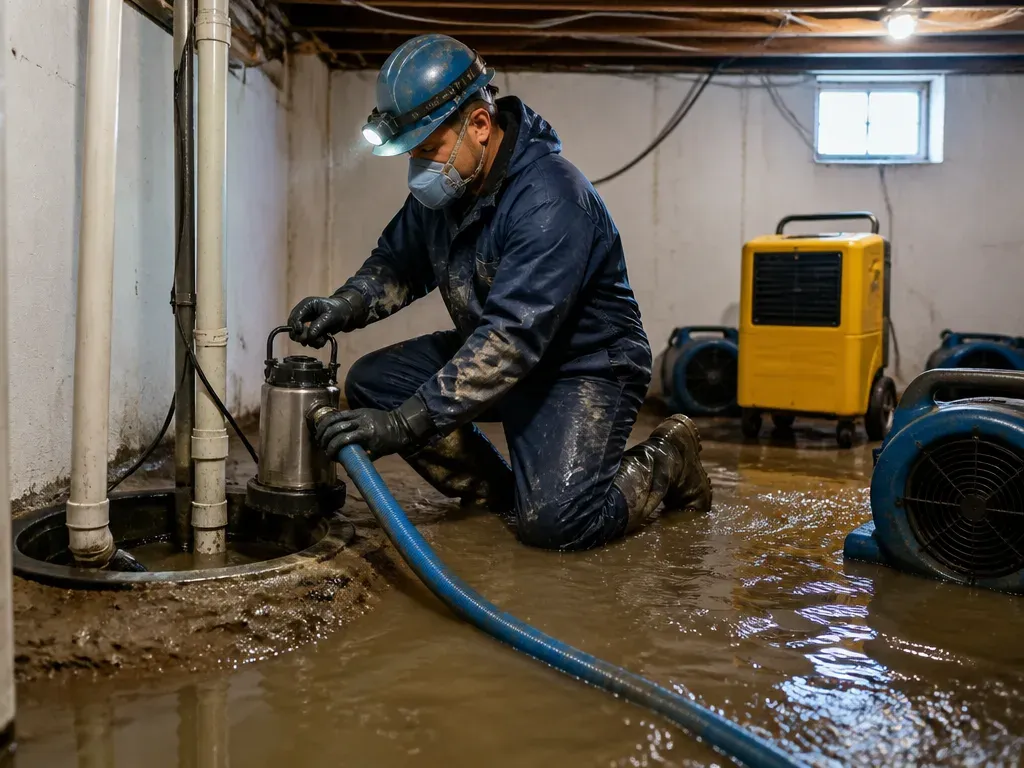
A flooded basement is measured in depth, and depth is removed by pumps before it is removed by anything else. Submersible pumps set into the deepest water move the bulk of it out through discharge hoses, to a safe point outside or a working drain, while the crew watches the walls and the waterline as the level falls. As the depth drops, extraction takes over: truck mounted and portable extractors, weighted tools that squeeze water from carpet and pad, squeegees and wet vacuums for the slab. The aim is unglamorous and absolute: remove the water as water, in bulk, before asking electricity to remove it as vapour. This is also the stage where the protection plan shows itself: what was lifted onto blocks, what was carried up, what was photographed and left, and what, having met contaminated water, is honestly finished. A good crew chief can tell you at the end of the first visit how much water came out and what happens next, in numbers.
Gallons out through a hose are gallons the dehumidifiers never have to chase. That is why the heavy hour of pumping is the best value inside basement water damage restoration NYC.
Moisture mapping: the job on paper
Once the bulk water is out, the real extent of a basement loss is invisible, and the moisture map is how it becomes visible. A technician works the room with meters, testing the slab, the wall bases, the framing and the stored materials on a grid, and records where the water travelled: up the masonry, into the wall cavities, along the floor to rooms the flood never visibly reached, and into the soil side of the foundation where no eye can follow. The map does three jobs at once. It tells the crew where to place equipment. It tells you which parts of the basement are truly affected, as opposed to merely splashed. And it becomes the baseline the daily readings are compared against, the before picture in numbers. Ask to see the map on the first day. A firm that dries a basement without one is not being traditional. It is being unaccountable, at your expense and your insurer's.
A moisture map is a promise made visible: here is where the water went, and here is where we will measure until it is gone. Demand one on every basement water damage restoration NYC job.
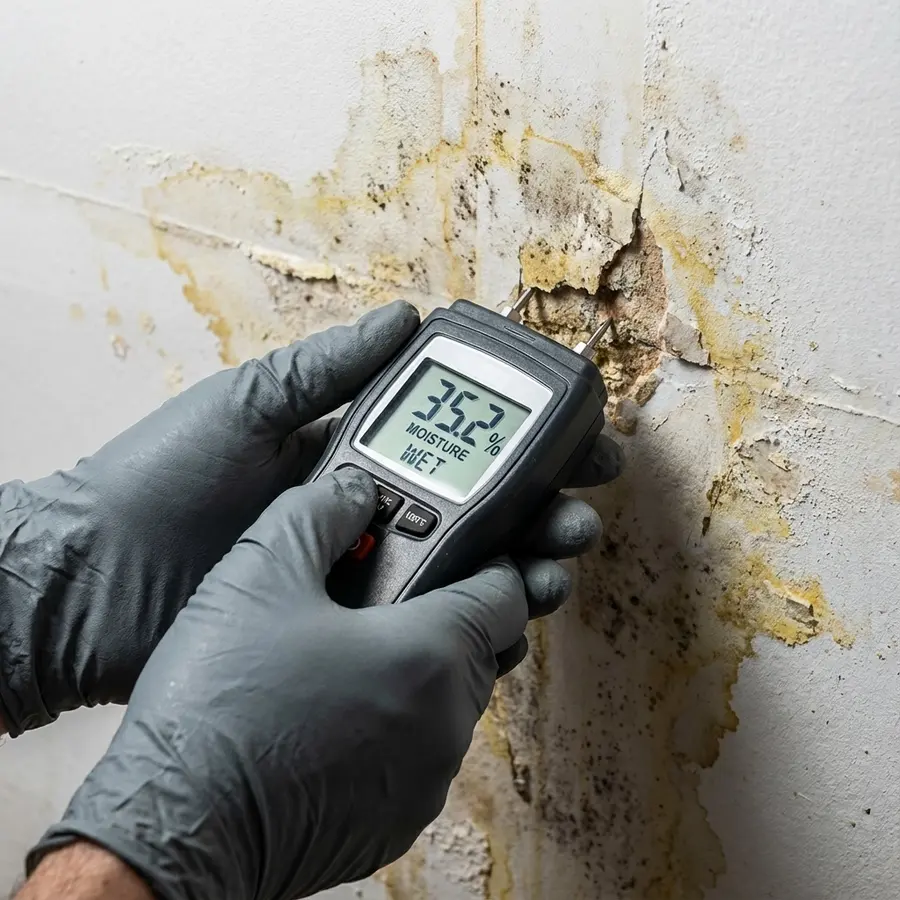
Drying a room that does not want to dry
Drying a basement is an exercise in controlled weather, fought against the room's own climate. The air downstairs is cool, and cool air holds less water and evaporates surfaces more slowly. The slab is cold and gives its moisture back over weeks. Masonry walls drink deeply and release slowly. So the equipment plan for a basement is heavier than for the same area upstairs: air movers driving evaporation from floor and wall surfaces, dehumidifiers sized for the volume and the temperature, sometimes ducted systems that exhaust moist air out of the building entirely, and time, which is the ingredient no machine replaces. The crew returns daily, takes readings at the same mapped points, writes them into the drying log and moves or removes equipment as the numbers fall. The log is not bureaucracy. It is the instrument panel of the job, and it is the document your insurer will trust most, because numbers written daily are hard to invent afterwards.
Daily readings turn drying from an opinion into a record. If a firm cannot show you yesterday's numbers, ask what today's basement water damage restoration NYC is being compared against.
Cleaning, removal and the honest line
Not everything in a wet basement can be saved, and the honest line between saving and removing is part of the trade. Porous materials that met sewage are removed, not cleaned; that is the category rule and it does not bend for sentiment, though the inventory and the photographs come first, always. Drywall that has wicked water and lost its strength is cut at the flood line and removed so the cavity behind it can dry, the flood cut visible in the photograph in this section. Carpet and pad are judged by the water that reached them and the time they sat in it. Boxes that have collapsed into the floor are documented and let go. What can be saved, masonry, framing, metal, glass, solid wood, most appliances once inspected, is cleaned and dried in place or carried up to dry. The scope should say, room by room and material by material, which side of the line each thing falls on, and a householder is entitled to ask why, item by item, before anything is thrown away.
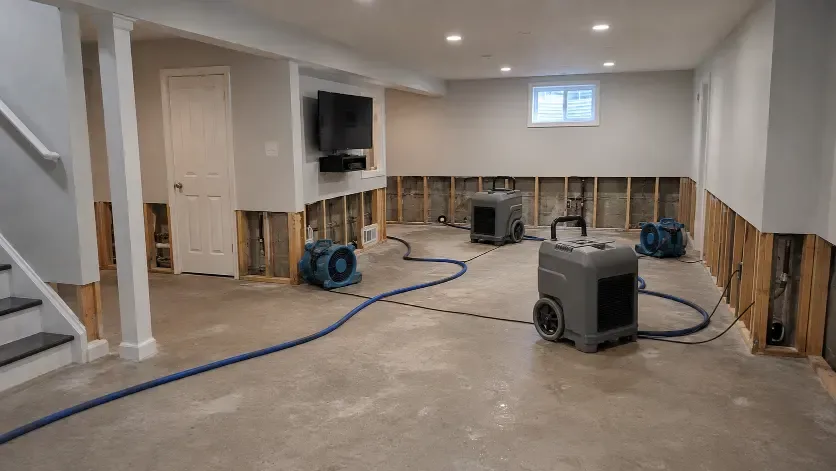
Dry is a reading, not a feeling, and the final readings are the document the rebuild, the insurer and the future all stand on after basement water damage restoration NYC.
Sewers, pumps and valves
When the Sewer Comes Back: 311, Backwater Valves and Sump Pumps
Of the four roads water takes into a basement, the sewer road is the one with a city procedure attached to it, a plumbing code behind it and a device that can close it. This section takes the three in order: what the city does when you report a backup, what a backwater valve is and what the code actually requires, and what a sump pump does, including the honest limit on what this page could verify about pumps. Between them they form the working machinery of basement water damage restoration NYC, the part of the subject that is plumbing rather than drying.
Report first, valve second, pump third. That is the order the city, the code and the water itself impose on basement water damage restoration NYC.
The 311 call and the six hour inspection
When a sewer backs up into a basement, the city's Department of Environmental Protection, DEP, is the first call after safety, made through 311. The department's published guidance promises an inspection within six hours of the report, with the honest caveat that heavy rain and snowmelt can stretch that time, which is to say it stretches exactly when backups are commonest. The inspection decides the question the whole event turns on: where the blockage or the failure sits. If the cause is in the city's sewer, the city repairs it. If the cause is in the private service line serving your building, that line, and its repair, belong to the owner. Keep the report details and the inspector's finding in your claim file, because the sentence that assigns the cause is a sentence two insurers and a city claims office may all read later.
The claim to the city, where one is made, runs through the Comptroller, and it carries a clock: ninety days. One practical mercy in the department's guidance deserves repeating: where a backup happened during heavy rain, no special claim reference number is needed to make the report, which removes the excuse for delay. Report it while the water is still telling its story. The department's own research report on basement backups adds a finding every basement owner should know: wet weather backups can begin inside the property itself, where a downspout, a foundation drain, a sump pump or a floor drain is connected into the sanitary sewer, loading the house's own line at the worst moment. The correct discharge for a sump pump is to the ground outside or to the storm sewer, never to the sanitary sewer. If your pump discharges into a sink or a house drain, that connection is part of your flood risk, and fixing it is prevention in its purest form.
Backwater valves: the door that closes itself
A backwater valve is a fitting in a drain line that lets water flow out of the building and physically blocks it from flowing back in. When the street sewer surcharges and pushes toward the house, the valve's gate, ball or flapper is pressed shut by the returning water itself. It is a simple device with a specific job: it does not stop groundwater, it does not stop a burst pipe, and it does not pump anything. It guards one road, the sewer road, and on that road it is the difference between a storm outside and a storm in the basement.
The plumbing code behind the device is real and citable. The 2022 New York City Plumbing Code, at section 1101.9, requires storm drainage systems to be protected with backwater valves in accordance with section 715, and section 1101.9.1 applies the requirement in flood hazard areas by reference to the flood standard. Section 715.1 places valves in drain lines that are subject to overflow and in building drains subject to backwater. Section 715.2 goes further: premises in a flood hazard area are deemed subject to backwater, whether or not a backup has ever happened there. And section 715.3 requires the valve to sit in an accessible location, because a valve that cannot be reached cannot be maintained, and a valve that is not maintained is a decoration. Installation belongs to a licensed plumber, and keeping the valve clear and working belongs to the homeowner. One more honest note: a city program that once installed these valves without charge, run through FloodHelpNY, is no longer accepting applications, and a valve, whatever it saves you in water, has no effect on flood insurance premiums. It protects the room, not the rate.
A valve in an accessible place, fitted by a licensed plumber and kept clear by the owner: that is the code's whole recipe, and it is the cheapest sentence in basement water damage restoration NYC.
Sump pumps: what they do, and what this page will not claim
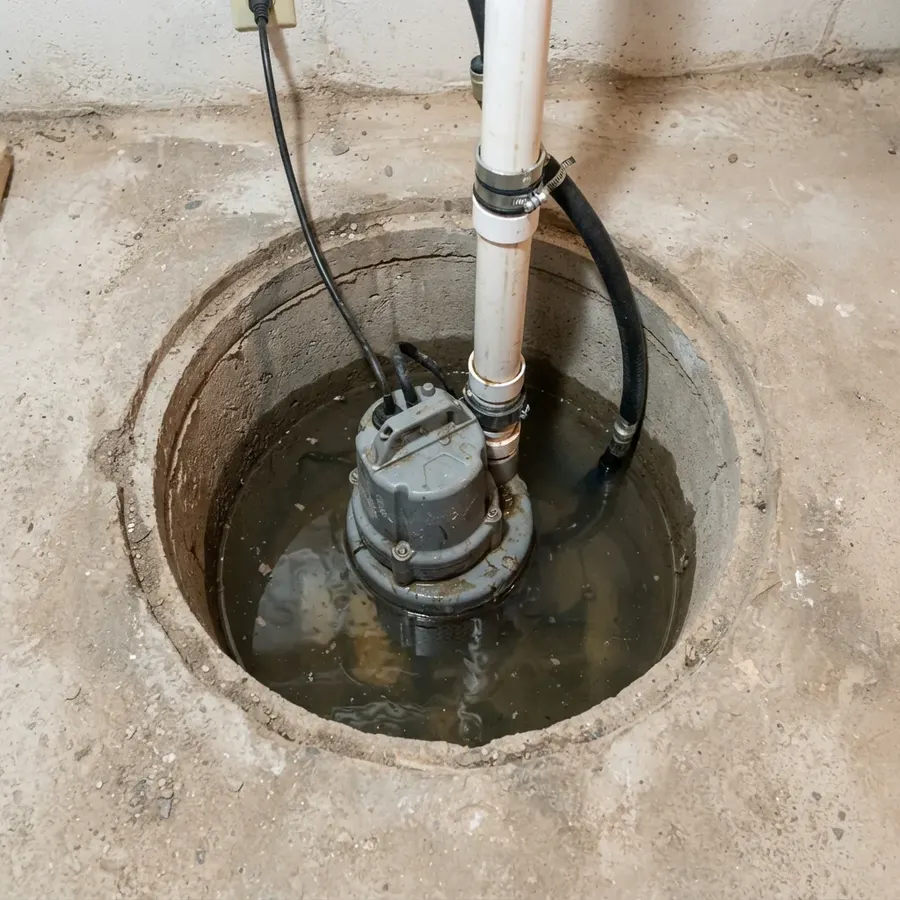
A sump pump answers the groundwater road. Water collecting below the slab is gathered in a pit, the sump, and the pump lifts it out of the building through a discharge line when the level rises, before the water can come up through the floor. It is the working heart of most dry basements in wet ground, and like every heart it has a lifespan, failure modes and a need for occasional testing: a float that sticks, a motor that ages out, a power cut in exactly the storm that fills the pit. Battery backup pumps and water powered backups exist for the power cut problem, and a householder whose basement depends on a pump should know which kind is in the pit and when it last ran.
Here is the honesty this page owes you about pumps. Research for this page could not verify any New York City code requirement that a sump pump be installed in a basement. So this page states none. You will find sources elsewhere that speak as if such a rule exists; this page prints only what it could check, and what it could check is the backwater valve code above and the discharge rule from the city's own report. A pump is, on the verified record, a wise device rather than a mandated one in this city. That distinction, between what is required and what is merely sensible, is one this page maintains everywhere, because a householder making decisions about basement water damage restoration NYC deserves to know which kind of statement they are hearing.
Water in the basement now?
Stay at the top of the stairs if the power is in question, photograph from the doorway, and call. Pumping, drying, readings and a written scope, started today.
Insurance below ground
Flood Insurance and the Basement: The Limits Nobody Reads Until the Water
Every insurance conversation changes at the basement stairs, and it changes because of one sentence in the federal flood program's own fact sheet, which this page quotes exactly because paraphrase would soften it: "Flood insurance coverage is limited for basements, regardless of whether the basement is used for living, storage, or other purposes." That is the National Flood Insurance Program, NFIP, describing its own policy. The program defines a basement as a floor below ground level on all sides, and then limits what it will pay for down there, in both the building cover and the contents cover, in ways that surprise almost every householder who meets them for the first time with wet feet. This section sets out the verified lists, because basement water damage restoration NYC is planned better by people who know, before the flood, what the flood policy thinks a basement is.
Limited, in writing, in advance, regardless of use. Those are the terms on which flood insurance meets basement water damage restoration NYC, and no adjuster's sympathy amends them afterwards.
What the building cover reaches in a basement
Under the flood program's basement fact sheet, the building coverage does reach the machinery of the house: the furnace, the water heater, the sump pump itself, the electrical breaker boxes, the washer and dryer, and a freezer together with the food in it, among the building items listed. The pattern is plain once you see it: the program covers the basement as a utility space, the plant room of the building, and pays to restore the plant. What it does not treat the basement as, for coverage purposes, is a finished room of the house, however beautifully it was finished.
What is not covered down there
The exclusions are the part to memorise. Finished walls, floors and ceilings are not covered in a basement. Neither is the furniture. Clothing, books and electronics stored or used down there are outside the building cover, and the contents cover, as the next part explains, is narrower still. The list of excluded items in the fact sheet runs to the ordinary contents of a lived in lower floor: stoves, fridges and dishwashers are not covered, generators are not covered, and a dehumidifier that is not an integral part of the building's systems is not covered, a detail with a certain irony on a page about drying. None of this makes a finished basement a mistake. It makes it a self insured room, and a householder who knows that in advance stores the irreplaceable things upstairs, keeps the inventory and the photographs current, and hears the adjuster's answer, when it comes, as the policy working as written rather than as a betrayal.
Contents: the power source rule
The contents cover in a basement follows a rule so specific it deserves its own paragraph: contents are covered only if they are connected to a power source. The washer counts because it is plugged in and plumbed to work; the box of winter clothes does not, because it merely sits there. Read the fact sheet's two lists side by side and the philosophy is unmistakable. The flood program insures the working machinery of a basement and a short list of powered equipment, and declines the basement as a place where a household keeps its life. For the inventory in your claim file, the lesson is mechanical: photograph the powered items in place, plugged in, with their model plates legible, before any flood, because after one you will be asked to prove what the water took, item by item. The inventory is part of basement water damage restoration NYC, not an errand after it.
The thirty day wait, and the authorisation clock
Two dates govern the flood program and both are routinely misunderstood. The first is the waiting period: coverage under a new flood policy generally starts thirty days after purchase, a verified rule that defeats the natural human plan of buying insurance with the storm already on the radar. Flood cover is bought in dry weather or it is not bought in time. The second date belongs to the program itself: its current authorisation is scheduled to run to December 11, 2026, after which the program depends on Congress acting again, and no long term reauthorisation could be verified when this page was researched. That date is an authorisation deadline, not the expiry of existing policies, which run to their own terms. This page will also decline to print one number you may see elsewhere: a sixty day deadline for submitting proof of loss is often quoted, but the explicit deadline could not be verified from the program's handbook in this research, so it is not stated here as a rule. What your own policy documents say governs your claim, and reading them in dry weather is, once again, the entire trick.
Thirty days to start, limited below ground, machinery yes and furniture no. Learn the flood policy's basement rules in dry weather, and basement water damage restoration NYC holds no surprises on the money side.
A final distinction, because it decides which policy answers at all. The limits in this section belong to flood insurance, the cover for water that rises from outside. A burst pipe inside the building is a different event, answered by the ordinary homeowners policy under its own terms, and a sewer backup sits between the two, commonly needing its own endorsement. The restoration records should therefore state plainly where the water came from and how it entered, in the first day's paperwork, because that sentence chooses the policy, the limits and the argument. Source is destiny in a basement claim, which is why this page has asked from where since its first section.
Claim clocks
The New York Clocks: How Long an Insurer Has to Decide and to Pay
Once a claim exists, New York law puts clocks on it, and a basement claim runs on the same clocks as any other in the state. Regulation 64, at section 216.6(c), gives the insurer fifteen business days to accept or reject the claim after proof of loss. Section 216.6(f) then requires payment within five business days once the claim is agreed. Between those two sits a protection householders rarely know exists: under section 216.6(e), the parts of a claim that are not in dispute must be paid even while other parts are still argued, so a large basement claim should not sit entirely frozen behind one contested line about a freezer or a floor.
Fifteen business days to decide, five to pay, and the undisputed parts paid along the way. Those clocks govern basement water damage restoration NYC claims like every other claim in the state.
After a declared disaster, a second statute wakes up. Section 2618 of the Insurance Law applies only to disaster claims, and it shortens the payment clock: once a claim is accepted, payment is due within four business days. Its extension rules are the part most often misquoted, so this page states them in their shape rather than as a single number: an insurer that needs more time may request fifteen business days, with a further period available for commercial claims, and a further fifteen where access to the property is prohibited by law or by an authority's order, with the requests made in writing. Any summary that offers you one extension figure as the whole rule is leaving most of the rule out. Storm losses, which are the losses basements suffer most, are exactly the claims this statute was written for, so the written notices and the dates belong in your file from the first letter.
Two state phone numbers belong in that file as well, and they are the Department of Financial Services' own, not this site's: the department can be reached at (800) 342-3736, and its disaster hotline at (800) 339-1759. The department is the regulator householders call when a claim's clocks seem to have stopped, and citing the regulation and the dates, calmly, from a complete file, is how such a call is made to count.
Keep the date you submitted proof of loss the way you keep the photographs: dated, filed and findable. Every clock in this section runs from a date, and basement water damage restoration NYC claims are argued on dates as much as on damage.
Basement law
Basement or Cellar? The Legal Line Under the City's Homes
No page about New York basements is complete without the distinction the city's housing agency, HPD, draws in its own guidance, because it decides whether the room you are drying is a room anyone may lawfully live in. The line is drawn by height above ground. A basement is a storey in which at least half of its height stands above ground level. A cellar is a storey in which less than half of its height stands above ground. From that single measurement, consequences flow that reach into leases, bedrooms and, after the storm deaths this city remembers, into criminal and civil liability. Basement water damage restoration NYC works in both kinds of room, but it works differently in each, because only one of them can lawfully be a home.
Half above ground or less than half: one measurement decides what the room is, what it may be used for and what basement water damage restoration NYC is restoring it to.
The cellar rule
For cellars, the agency's sentence is absolute, and this page quotes it exactly: "Cellars can never be legally rented or occupied for living purposes." Never is a strong word in a housing document, and it is the word the city chose. A cellar may store, it may hold the boiler, it may be dried and kept sound as a working space, but it may not be a bedroom, a rental or a home, whatever its owner wishes and whatever rent it could command. When water fills a cellar that has been quietly used as living space, the restoration question doubles: the room must be dried, and its use must be confronted, because putting the beds back is not a lawful option the drying can restore. Basement water damage restoration NYC restores rooms, not permissions, and the cellar is where that sentence is sharpest.
When a basement may be lived in
A basement, standing at least half above ground, may be lived in only under conditions, and the agency lists them. There must be a separate way out, an egress, at street level. The space may be used for living purposes only. A room used for living must be at least eight feet high, and its ceiling must stand at least four feet above the adjoining ground level. Two further rules cut across the city's housing stock: no basement or cellar living is allowed in a one or two family house unless it connects with a lawful dwelling unit above it, and no basement living is allowed at all in a one family house. And beneath all of them sits the rule the storms wrote: no sleeping in a flood prone area. One measurement warning belongs here, because the numbers are easily confused. The general minimum ceiling height for these below ground rooms is seven feet, for basement and cellar alike. The eight foot figure applies only to a basement room used for living. Pages that merge the two numbers into one rule are merging two different rules, and this page keeps them apart.
The conversion pilot, and its honest present status
New York has been trying, lawfully and carefully, to bring some existing basement homes into legality. Local Law 126 of 2024 created a conversion pilot, and the Department of Buildings proposed rules for it on November 10, 2025, built around a permit for units that already existed on or before April 20, 2024, in fifteen community districts: four in the Bronx, four in Brooklyn, six in Manhattan and one in Queens. The design, as proposed, allowed application until April 20, 2029, with ten years to bring a unit into line with Local Law 127 and to rent it legally in the meantime. Buildings in the special flood hazard area, in flood prone areas as the city defines them, or under a vacate order were excluded from the start.
Now the status, stated as plainly as the department states it, because this is the point on which outdated pages will mislead you. The Department of Buildings' own page says that basement and cellar conversion pilot applications are not currently being accepted. The proposed rule for the permit was withdrawn, with its comment period ending December 11, 2025, and no final rule could be verified when this page was researched. So the lawful position today is the old position: the basement and cellar rules above, unamended by any open application route. Anyone who tells you the pilot is open for applications is working from an old announcement. Check the department's page before believing any of it, including this page, because this is a moving subject and the department's own words are the only version that counts.
Not currently being accepted: four words from the department itself that outweigh every hopeful summary of the pilot, and the reason this page prints the status beside the scheme whenever basement water damage restoration NYC touches a lived in basement.
Tenants, leaks and the room below
The questions recorded by the search research for this page include one from the tenant's side of the ceiling: what are my rights as a tenant in NYC if my ceiling is leaking? It is answered in the thirty questions below in full, but its heart belongs in this section. A leak into a home is a habitability matter, reported to the landlord in writing, and to 311 when writing fails, and a basement tenant's position is strengthened, not weakened, by the legality rules above: a room that may not lawfully be lived in cannot be made lawful by a lease. Tenants in below ground homes should also hold the storm rule from this section as their own: no sleeping in a flood prone area is not advice, it is the city's line, and a forecast of dangerous rain is a reason to sleep elsewhere that night, arranged before the water makes the arrangement for you.
The law of the lowest room is unusually plain, once it is read from the city's own pages: a cellar is never a home, a basement is a home only on conditions, and basement water damage restoration NYC restores rooms, not permissions.
Mold after water
The 24 to 48 Hour Clock: Mold in a Wet Basement
A dried basement is a finished job. A basement left wet is a mold job under construction, and the federal Environmental Protection Agency states the timetable in a sentence this page quotes exactly: "In most cases, mold will not grow if wet or damp items are dried within 24-48 hours." Read the sentence carefully and it gives the whole strategy of this page away. The race is not against visible mold. It is against dampness itself, in the first two days, and it is won by pumping, extracting and drying on the schedule the earlier sections describe. The agency's guidance on carpet follows the same clock: carpet dried within forty eight hours, or removed and discarded. In a basement, where the air is cool and still and the walls are thirsty, the clock runs no slower for being underground. It runs faster, because the room starts damp on its best day.
Dry it in two days or meet the mold: the agency's window is the deadline inside every basement water damage restoration NYC job, whether the crew says it aloud or not.
Why basements grow it so well
Mold asks for moisture, food and time, and a wet basement offers all three in bulk. The food is ordinary: the paper face of drywall, wood framing, carpet and pad, cardboard boxes, stored fabric, even dust. The moisture is the flood, and after the flood, the slab and the masonry giving their water back for weeks. The time is whatever the drying leaves unused. This is why the flood cut matters, why wall cavities are opened rather than trusted, and why the final moisture readings, not the calendar, declare the job dry. A basement can look dry, smell dry and feel dry while the bottom plate of a wall is still wet enough to feed a colony nobody will see until the smell returns in a month. Readings are how that sentence is prevented from being written about your house.
The licensing law, applied downstairs
When growth is found, New York's mold law governs who may deal with it, and it applies in basements exactly as it applies upstairs. Article 32 of the Labor Law defines a mold project, at section 930(6), as work on an area greater than ten square feet. Section 931 requires the people who assess and remediate mold for others to hold Department of Labor licences of the right type. And section 936 states the separation rule in one sentence, quoted exactly: "No licensee shall perform both mold assessment and mold remediation on the same property." The person who measures your basement's mold may not be the person paid to remove it. One more piece of vocabulary protects householders from a common sales line: the department issues licences, and there is no state document called a mold remediation certificate for a firm to wave. Ask for licence numbers, and check them. The department's system is the same one described on this site's state mold page, and it reaches the lowest room of the house with the same force as the highest.
Licensed to assess or licensed to remediate, never both on your property, and no certificate exists to be waved at you. That is the mold law a wet basement meets, and basement water damage restoration NYC crews should be able to recite it.
The practical order on a real job follows from all of this. Dry first, fast, inside the two day window, and most basements never need the licensing conversation at all. Where growth is already present, or the area passes the ten square foot line, the licensed assessment comes before remediation, the work plan is written by the assessor, and a post remediation assessment closes the file. A crew that proposes to assess and clean in one visit, one invoice and one licence is proposing something the statute forbids, and the householder who knows section 936 can end that conversation in one sentence of their own.
By building type
Brownstones, Houses and Apartment Buildings: How the Stock Shapes the Flood
New York's basements sit under three broad kinds of building, and the water behaves differently in each. This section walks the three, with the particular way water hurts each one and the particular question each owner should ask first. The types differ, but notice the thread that runs through all of them: in every case the restoration plan is built around how the room is used and who else the water can reach. Basement water damage restoration NYC is planned around the building, not just the room, and the drying follows the building's logic, not the other way round.
Brownstones, detached houses and apartment buildings share one room under three different pressures, and basement water damage restoration NYC follows the pressure, not the postcode.
Brownstone and row house basements
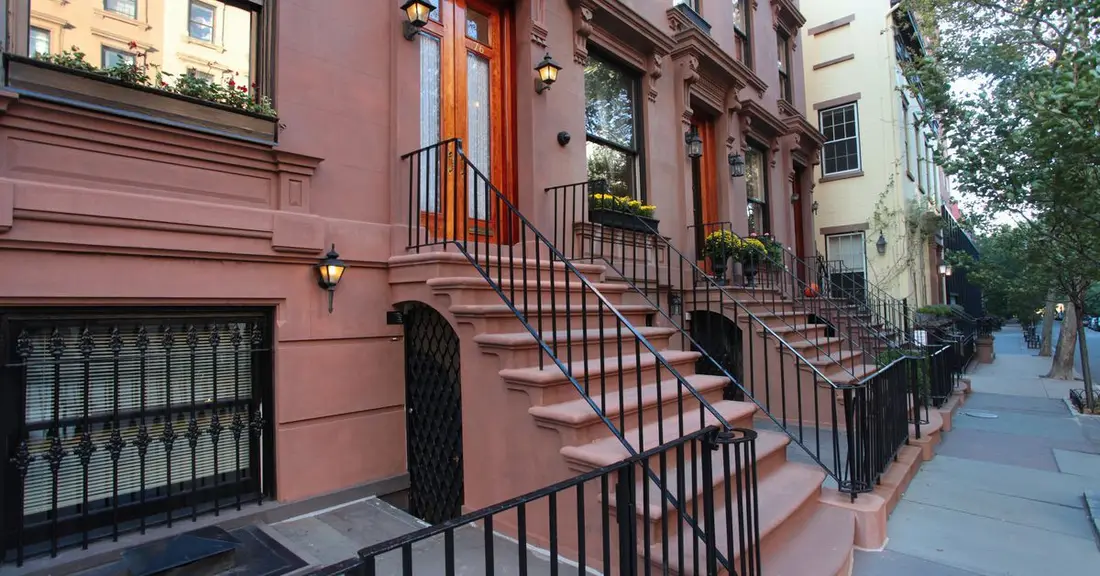
The classic city arrangement: a garden level or basement floor under the stoop, entered from the areaway, holding the boiler, the laundry and often a rented or family flat. Party walls are shared with the neighbours on both sides, so water and damp can travel laterally as well as down. Ask first about the areaway drain and the shared walls, and about the basement and cellar line, because so many of these rooms live near it.
Detached and semi detached houses
The Queens, Staten Island and suburban pattern: a full footprint basement under a house that stands in its own soil. Groundwater and grading rule these losses, the sump pump is the house's hardest working appliance, and the yard's slope is part of the plumbing whether the owner thinks of it that way or not. Ask first where the land sends its rain, and when the pump last ran.
Apartment building basements
The shared underworld of the city's housing: boiler rooms, storage cages, laundry rooms, meter banks and, in some buildings, lawful or unlawful living space. A flood here is a building event with duties running to every tenant, and the coordination sits with the owner or the managing agent. Ask first who holds the building's response, because five separate responses serve nobody's insurer and nobody's lease.
Two of these types deserve a longer word. The first is the brownstone, because its basement is so often a home. The garden level flat is one of the city's characteristic dwellings, and basement water damage restoration NYC begins exactly where the water arrives: below the stoop, behind the areaway, at the level of the street's worst hour. Everything in the legality section bears on these rooms, and so does the storm preparation question in this page's thirty questions, asked by a basement tenant in the city's own online forums. Owners of such buildings carry a double duty after a flood: dry the room, and answer honestly for its status. The drying is a week. The status is the building's future.
Ask the first question for your building type before you ask any other. It focuses the crew, the scope and the insurer on what your building actually stands to lose from basement water damage restoration NYC.
The second is the apartment building, where the surprise is coordination. A basement flood in a multi unit building touches the boiler that heats every flat, the meters that bill them, the storage that holds their belongings and sometimes the homes of the tenants who live at that level. The owner who treats it as one building event, documented once, with one scope and one set of readings, serves every insurer and every tenant better than the owner who lets each interest hire its own account of the same water. In these buildings the restoration file is also a legal file, and it should be built like one from the first photograph.
Across all three types, the management lesson is the same, and it decides outcomes more than the depth of the water does. The buildings that recover fastest are the ones where somebody senior owned the loss from the first hour: one person who held the file, took the calls, kept the photographs in one place and could answer the insurer, the tenants and the crew from the same set of facts. Appoint that person before you need them, the way you appoint a fire warden. In a basement loss, coordination is not administration. It is half the restoration.
A crew fluent in your building type will name its risks unprompted. A crew that describes every basement the same way will dry every basement the same way, and that sameness is the enemy of basement water damage restoration NYC.
Whatever the type, one person owning the loss remains the strongest predictor of a fast recovery in basement water damage restoration NYC.
Keeping it dry
After the Drying: The Habits and Hardware That Keep a Basement Dry
Every restoration ends with the same question, asked over a dry floor: how do we not meet here again? The honest answer is a list of unglamorous habits and two pieces of hardware, most of it cheap, all of it boring, and boring is the highest praise a basement can earn. This section is written for the dry weeks, when there is time to do the work properly. Basement water damage restoration NYC is the trade you call when prevention has failed; this section is about making that call rarer.
Prevention in a basement is not a product. It is a short list of inspections, kept on a schedule, plus a pump and a valve kept in working order, and basement water damage restoration NYC is what fills the gap when the list lapses.
The hardware: pump and valve, maintained
The sump pump is tested, not trusted. Pour water into the pit until the float lifts and the pump runs, twice a year and before any forecast storm, and note the date on a card taped to the wall above it. Know the pump's age; pumps are consumables with a working life, not fixtures with a lifetime, and replacing one in dry weather is an errand while replacing one in a flood is an emergency. Check where its discharge goes: to the ground away from the house or to the storm sewer, never into the sanitary line, for the reasons the city's own basement report sets out. The backwater valve, where one is fitted, gets the same respect: it sits in an accessible place because the code requires it to, so use the access. Have it looked at, keep its mechanism clear of the grease and debris that the sewer sends to test it, and remember that the homeowner, not the city, owns its upkeep.
The house around the hardware
Most basement water begins as yard water and roof water that was sent to the wrong place. Downspouts should discharge well away from the foundation, not at its foot. Soil and paving should slope away from the walls, however slightly, so that rain's first instinct is to leave. Window wells should be covered and their drains clear. The areaway drain in front of a brownstone basement door should be rodded and proven before the season, not discovered blocked during it. Inside, the washing machine hoses that fail in the night are a known item with a known lifespan; braided replacements on a schedule cost less than one flood. The water heater gets an annual glance for rust at its base. None of this requires a tradesperson's visit. It requires a walk around the building, twice a year, with the basement in mind.
What lives downstairs, arranged for water
The cheapest protection in this whole section costs nothing and is done in an afternoon: arrange the basement as if water were a regular visitor. Storage on shelving or pallets, never in cardboard on the slab. The irreplaceable things, the photographs, the documents, the inherited paper, stored upstairs or in sealed plastic bins, because the flood program's basement limits, set out in the insurance section, mean the policy will not make those losses good. A photographic inventory of the room and its powered equipment, taken in dry weather and kept with the insurance file. And the household storm rule, agreed in advance: when dangerous rain is forecast, the things on the floor go up, the basement sleepers sleep upstairs, and nobody negotiates with the weather at midnight. Households that run that rule describe storm nights as inconvenient. Households that improvise them describe them in the other vocabulary this page began with.
Test the pump, clear the valve, send the yard's water away, lift the boxes, and sleep upstairs in the storm. Five habits, and basement water damage restoration NYC becomes a page you read rather than a number you call.
Scope and records
The Written Scope and the Claim File: Paper That Works as Hard as the Pumps
Two documents decide how a basement loss ends, and neither of them is a pump. The first is the scope, written before the heavy work, which fixes what will be done and how dryness will be proven. The second is the claim file, assembled from the first hour, which fixes what can be proven to the insurer afterwards. This section describes both in full, because in basement water damage restoration NYC the paper is not the record of the work. On the days the adjuster reads it, the paper is the work.
Scope before work, file from the first hour. Between those two habits sits most of the difference between a basement claim that is paid and one that is argued, and basement water damage restoration NYC is judged on both.
What a complete scope contains
A complete scope for a basement job names, in writing: the source of the water and confirmation that it is stopped or controlled; the category the crew assigns to the water and why; the areas affected, room by room, with what will be pumped, extracted, dried, cleaned or removed in each; the equipment to be placed and where; a moisture map drawn at the start, with readings at named points; a promise of daily readings and drying logs, shared with you; how stored contents will be protected, moved or inventoried; the safety position on power, and the electrician's clearance where it was needed; and the documentation the insurer will receive. Read that list against any scope you are offered. What is missing from the paper will be missing from the job, or present in the argument. The scope is also where the flood insurance reality belongs in writing: a good firm will tell you, in the scope conversation, which parts of a finished basement the flood program will not pay to restore, so that the rebuild decisions are made with the coverage known rather than discovered.
The claim file, assembled once
The file itself is a folder, paper or digital, with a fixed population: the doorway photographs and the daily sequence that follows them; the written scope and the signed agreement; the moisture map and the drying logs; the invoices; the claim number and every letter and email from the insurer, with dates; the 311 report details and the inspector's finding where a sewer was involved; the inventory of losses, with the powered contents photographed in place for the flood program's rule; and the policy documents themselves, read at last, in the dry weeks after, with the basement pages marked. Keep the file after the claim closes. It becomes the building's water history, and it is the first thing a future buyer, adjuster or crew should be handed, because the next flood, if there is one, will be argued against the record of this one.
A file that can be handed over whole, in one motion, is the loudest evidence a householder can offer. Build it from the first hour of basement water damage restoration NYC and it argues for you while you sleep.
Choosing the crew
How to Choose a Basement Company in New York City
There is no official ranking of restoration companies, and this page will not invent one. What it offers instead is a method: a short list of tests any householder can run from the doorway of a wet basement, each of which separates the firms that dry by numbers from the firms that dry by confidence. The method is the same one this whole site teaches, tuned here to the lowest room. Basement water damage restoration NYC is bought under stress, at night, with water rising; the tests below are designed to be run in exactly those conditions.
Judge by evidence you can test: the power rule respected, the scope in writing, the map drawn, the logs promised, the licences named. A firm that passes those tests has earned the basement water damage restoration NYC contract.
- The phone test: a person answers, around the clock, and asks about safety and the source before asking about the address.
- The power test: the firm treats the electrical question as the gate to the job, and will wait for an electrician's clearance rather than wade in.
- The paper test: a written scope before heavy work, with a moisture map and daily drying logs promised in the document, not in the sales talk.
- The category test: the firm names the water's likely category and explains what it changes about method and protection.
- The licence test: for any mold work past the small threshold, licence positions are stated plainly, with the assessment and remediation separation respected.
- The coverage test: the firm speaks honestly about what flood insurance does and does not cover in a basement, instead of promising the insurer will take care of everything.
- The records test: references from other basement jobs you can actually call, and drying logs from those jobs that the firm is willing to show.
Read reviews of basement water damage restoration NYC, where you find them, for detail rather than stars. A review that names the kind of basement, the road the water took, whether the power rule was respected, whether readings and logs were shared and how the insurer was handled is evidence. A row of short, glowing, interchangeable reviews is decoration. Read the poor reviews with the same care, and note how the company answered them: a firm that answers criticism with facts and dates is showing you how it will answer yours.
One warning belongs to this room in particular. A basement is out of sight, and work done out of sight invites a specific kind of overselling: the unnecessary removal, the inflated drying day, the mold scare built on a smell. The defences are the ones this page has repeated until they are a refrain. The moisture map fixes the true extent. The daily logs fix the true duration. The licensed assessor, separate by law from the remediator, fixes the true size of any mold work. A householder armed with those three documents does not need to trust anyone's adjectives, which is precisely the position basement water damage restoration NYC should be bought from.
The best company for your basement is not a title. It is the firm that passes these tests on your job, in your borough, with paperwork in your hand, and basement water damage restoration NYC rewards the householder who insists on exactly that.
Case studies
Two Case Studies on Video, Labelled for Exactly What They Are
This page links to two videos and embeds neither of them. Both are watched on YouTube, in a new tab, and both are labelled here with the same care this page applies to scopes and licences, because a page about evidence should show its own working. Both films are short, both show real New York City basements rather than stock footage, and both were confirmed on their own video pages during this page's research. What they offer is narrower and more useful than a sales film: two real basement losses, filmed by the firms that worked them, against which the method taught on this page can be tested. Watch them with the six steps in mind and notice what the cameras show and what they leave out.
Watch the first film for the mold lesson: what a wet basement becomes when the drying window is missed, filmed in this city, in under a minute of basement water damage restoration NYC reality.
The first video is by Crown Mold Specialists, titled Basement Water Damage and Mold Remediation in NYC, with the subtitle Full Restoration Process, published on February 17, 2026, running thirty nine seconds, and viewed about one thousand and ninety nine times at the time of research. It shows a real mold damaged basement in New York City, tagged for New York on its own page. Its value here is as the after picture of this page's mold section: the growth that the 24 to 48 hour drying window exists to prevent, established on real walls in a real city basement. One honest note of record: the same film is also linked from this site's state mold page, because it is the same genuine New York basement footage and it serves both subjects truthfully. It is labelled as shared, here, rather than passed off twice as exclusive.
The second video is by SOS Mitigation, titled Flooded Basement Restoration, published on July 2, 2020, running fifty eight seconds, and viewed sixty two times at the time of research. It shows a real flooded basement in Brooklyn, tagged for Brooklyn on its own page, with standing water in the room as the work proceeds. Where the first film is the after, this one is the during: water on the floor, the job in motion, the room in the state every reader of this page is trying to leave behind. Between the two of them, under two minutes of film, a householder can see both ends of the subject of this page: the flooded room and the moldy one, and the whole argument for drying fast that connects them.
Watch the Brooklyn film for the during picture: standing water, real room, real work. Then reread the first steps, because basement water damage restoration NYC is the distance between that film and a dry floor.
- Watch: Basement Water Damage and Mold Remediation in NYC, Full Restoration Process, Crown Mold Specialists, February 17 2026, 0:39 (linked below).
- Watch: Flooded Basement Restoration, SOS Mitigation NYC, July 2 2020, 0:58 (linked below).
- Basement Water Damage and Mold Remediation in NYC (Crown Mold Specialists, YouTube)
- Flooded Basement Restoration (SOS Mitigation NYC, YouTube)
Neither film is evidence about your building. Both are training in what the two ends of a basement loss look like, and in the distance between them, which is the distance this entire page exists to shorten. A third film was considered for this section and rejected during research, because its own page carries a disclosure that it was made with artificial intelligence. A page that teaches evidence does not illustrate itself with fabrications, however convenient, and the rejection is recorded here for the same reason the inclusions are: the labelling is the lesson.
Two videos were the limit this page set itself, and the limit is deliberate. A page that embeds a wall of other people's films is borrowing authority it has not earned. These two earn their place as the before and the after of the same argument, and the question they leave behind is the question this page trains a householder to ask of every scope, review and claim: what would the full record show?
Borough by borough
The Basement in Five Boroughs: Same Room, Different Water
The basement is the same room in every borough, but the building over it, the soil under it and the street in front of it change the flood's character enough that a crew reads the address before it reads the waterline. This section walks the five boroughs in the order a storm visits them. Basement water damage restoration NYC is one trade with five local dialects, and the dialect matters to the drying plan, the prevention plan and the insurance conversation alike.
Five boroughs, five versions of the same room. The differences below are the differences a good crew prices into its plan before it prices anything else in basement water damage restoration NYC.
Brooklyn: the brownstone belt and the garden level
Brooklyn holds the city's deepest stock of brownstone and row house basements, and with them the garden level flat, the areaway entrance and the shared party wall. Water here arrives through the areaway when its drain blocks, through the front wall when the street ponds, and sideways, through party walls, from a neighbour's flood that becomes yours through the masonry. The borough's older combined sewers serve street after street of these houses, and the backwater valve conversation is a Brooklyn conversation as much as a plumbing one. Cellars in the older stock press hard against the legal line drawn in this page's law section, and more than one Brooklyn flood has ended with a drying crew upstairs and a housing question downstairs. It is no accident that one of this page's two case study films was shot in a Brooklyn basement: the borough's basements are where basement water damage restoration NYC does some of its most characteristic work.
Party walls share water as faithfully as they share sound. In Brooklyn, basement water damage restoration NYC asks about the neighbours' basements as early as it asks about yours.
Queens: detached houses, high water and long driveways
Queens holds the city's broadest stock of detached and semi detached houses, and its basements are full footprint rooms under houses standing in their own ground. The borough's flood character is groundwater and grading: rain that soaks gardens and driveways, a water table that rises after wet weeks, and sump pumps that carry whole houses through the season. The low lying neighbourhoods near the borough's creeks and bays add the storm road on top, and the borough's basement apartments, lawful and otherwise, are numerous enough that the legality section of this page is read in Queens with particular attention. For a Queens house, the prevention walk is outdoors as much as in: downspouts, grading, the driveway's slope toward or away from the house, and a pump tested before the season. Basement water damage restoration NYC in Queens is won in the yard as often as in the room.
A Queens basement answers to its garden. Send the yard's water away and half of basement water damage restoration NYC in the borough never gets called.
The Bronx: apartment houses and the shared underworld
The Bronx basement is most often an apartment building basement: the boiler room, the meter bank, the laundry, the storage cages and the superintendent's domain, under a building whose tenants all depend on what the room holds. A flood here is a building event from the first minute, and the coordination duty described in this page's housing section sits with the owner and the managing agent. The borough's stock of older multi unit buildings means shared risers, shared drains and failures that begin in the building's own systems and announce themselves downstairs. The response that serves the Bronx best is the single documented response: one scope, one set of readings, one file that every tenant's and the owner's insurers can read. Basement water damage restoration NYC in the Bronx is building management under pressure, with pumps.
One building, one flood, one file. The Bronx teaches that lesson to basement water damage restoration NYC more clearly than any other borough.
Manhattan: towers, vaults and the basement under the sidewalk
Manhattan basements sit under towers and tenements alike, and the borough adds a feature the others mostly lack: the vault, the space under the sidewalk in front of older buildings, which extends the basement toward the street and gives street water a shorter road in. In the towers, the basement is a plant floor, holding the machinery of a vertical city, and a flood there is measured in systems rather than rooms. In the tenements and brownstones of the upper borough, the pattern is closer to Brooklyn's, with garden level homes under stoops. Everywhere in Manhattan the coordination runs through building staff and managing agents, access runs through service entrances and freight elevators, and the crew that works the borough knows that the drying plan begins with the building's rules. Basement water damage restoration NYC in Manhattan is logistics first, and the water second.
Vaults, plant floors and freight elevators: Manhattan adds architecture and administration to basement water damage restoration NYC in equal measure.
Staten Island: houses, hills and the shore
Staten Island is the borough of houses, and its basements flood the way suburban basements flood, with two local intensifiers: the shore, where storm water and surge have written the borough's modern flood history, and the hills, where runoff finds the low houses at their feet. Detached stock means the groundwater and grading rules of Queens apply with shore weather added, and the borough's post storm rebuilding has made its householders some of the city's most practised readers of flood insurance documents, including the basement limits this page sets out. The island's distance from the rest of the city also makes the first hour more self reliant: the photographs, the shutoffs and the safety rules matter more where help travels further. Basement water damage restoration NYC on Staten Island rewards the household that has rehearsed, because the rehearsal is what the first hour is made of.
Shore weather and self reliance define the island's version of the subject, and basement water damage restoration NYC there begins, more than anywhere, with the householder's own first hour.
Read the five together and the constant shows through the differences. The room is below ground in every borough; the power rule holds in every borough; the sewer, the soil and the sky conspire in every borough; and the flood program's basement limits are written in the same words in every borough. Local knowledge tunes the response. It does not change the order: safety, source, photographs, scope, readings, records. That order is basement water damage restoration NYC, from the areaway to the shore.
After the drying
The Rebuild: Putting the Lowest Room Back Together
Drying is the middle of a basement loss, not the end of it. When the readings reach the dry standard and the equipment leaves, the room that remains is a shell of its former self: flood cut walls, a bare slab, stored life in bins upstairs, and a set of decisions to make about what the room becomes next. This section covers the rebuild in the order it should happen, because a basement rebuilt in the wrong order seals moisture into new work and repeats the loss in slow motion. Basement water damage restoration NYC ends, properly, with a room that is not only dry but defensible against its own history.
Rebuild in the wrong order and the new work inherits the old water. The order below is the difference between a restored basement and a repeated one in basement water damage restoration NYC.
First: proof of dry, then permission to close
No wall is closed and no floor is laid until the readings say the structure behind it is dry. That sentence is the whole law of the rebuild, and everything else is commentary. The final drying log, with its last readings at the mapped points, is the document that authorises the rebuild, and a householder should hold it the way they held the scope. Where the rebuild involves construction beyond drying, the city's building rules enter: opening and replacing structure and systems is permit territory in a way that pumping and drying are not, and the firm doing the repairs should name the permits the work needs, with the answer confirmed rather than assumed. Basement water damage restoration NYC hands over to the building trades at this point, and the quality of the handover is measured in documents.
The final log is the rebuild's starting gun. Without it, closing a wall is a guess, and guesses are what basement water damage restoration NYC exists to replace.
Second: rebuild for the room's real future
The rebuild is the one moment when a basement's defences can be improved rather than merely restored, and the improvements are the ones this page has already met. The backwater valve fitted while the drains are exposed. The sump pit and pump installed or renewed while the slab work is open. The discharge lines corrected to the ground or the storm sewer. Finishes chosen with the room's nature in mind: materials at floor level that tolerate water better than the ones the flood just removed, storage built as shelving rather than floor piles, and the irreplaceable things rehoused upstairs for good. None of this is extravagance. It is the loss, converted into design, and it is cheaper in the rebuild week than in any week before or after. Basement water damage restoration NYC that ends without this conversation has done the drying and skipped the lesson.
A rebuilt basement should be harder to flood than the one that flooded. If the plan only restores, it has wasted the one advantage a loss confers, which is knowledge, and basement water damage restoration NYC counts that as a missed step.
Third: the room returned, and the file closed last
The end of the job looks like this: the room clean and dry, the machinery inspected and running, the contents that were saved returned to shelving, the contents that were lost accounted for in the inventory, and the claim file complete, with the final log, the invoices and the insurer's settlement in their places. The file closes last, after the room, and it stays in the house as the building's water history. Walk the room once with the crew before the final paperwork, meter in hand if you wish, and ask the questions the readings invite. A firm that has dried by numbers will welcome the walk. Basement water damage restoration NYC, done properly, has nothing to hide from a householder with a meter and a file.
And then the room goes back to its ordinary life: the laundry, the boiler's hum, the stored seasons, the occasional guest or tenant where the law allows. The measure of the whole job is how forgettable the basement becomes again. Boring, as this page said at the start of its prevention section, is the highest praise the lowest room can earn, and earning it is the entire purpose of basement water damage restoration NYC.
Hour by hour
A Basement Loss, From the First Smell to the Final Reading
Every section of this page so far has taken one subject at a time. This one takes one loss, whole, in the order it actually happens, because householders do not experience a flood as topics. They experience it as a smell on the stairs on a Tuesday, a week of noise, and a room that slowly becomes theirs again. The loss below is a composite, built from the common run of city basement floods: a storm in the night, a surcharged sewer, a failed hour for the pump. Nothing in it is a promise about your building. Everything in it is the shape basement water damage restoration NYC takes when it is done in the order this page teaches.
A loss told whole teaches what the topics cannot: the order. Read it once, and the six steps at the top of this page stop being a list and become a memory of basement water damage restoration NYC.
The night: discovery
It begins, as basement losses usually begin, with a smell and a sound that is wrong. The rain has been falling since evening. Somewhere below, water is moving that should not move. From the top of the stairs, torch in hand, the householder sees the reflection where the floor should be matte, and does the hardest and best thing of the whole week: nothing. No descent, no rescue of boxes, no hand toward the panel on the far wall with water standing between. The photograph is taken from the doorway. The calls are made from the kitchen. The insurer hears the words sewer backup and storm in the same sentence and opens the claim. The crew hears the words water at the panel and says the sentence that marks it as a crew worth hiring: stay out of the room until the electrician has been. That restraint, in the first twenty minutes, is basement water damage restoration NYC at its most valuable, and it has not moved a single gallon.
Discovery is where losses are won quietly. The doorway photograph and the refused staircase decide more than any machine in basement water damage restoration NYC.
The first day: safety, pumping and the map
The electrician comes first, in the morning, and the room is made safe in the only order it can be: power isolated where the water reached it, the rest proven sound, the clearance given in words the file can quote. The 311 report from the night has already started the city's clock, and the inspector's finding, city sewer surcharge in the storm, goes into the file beside the photographs. Then the pumps go in, the discharge runs out to the street side, and the water level falls past the stair treads it had climbed. As the floor appears, the map is drawn: readings at the wall bases, the slab, the boiler's plinth, the storage corner where the boxes stood. The map says what the eyes could not, that the water travelled further along the north wall than it ever showed, and the scope is written from the map, in the room, with the householder reading it before a single wall is opened. Day one of basement water damage restoration NYC ends with the room empty of water and full of machines, which is exactly the right way round.
Safety, source, pumping, map, scope: the first day in one breath, and the breath is the method of basement water damage restoration NYC.
The middle days: the drying, proven daily
The middle of the loss is not dramatic, and that is its virtue. The crew returns each day, takes the readings at the same marked points, writes them into the log and moves the machines as the numbers fall. The flood cut is made where the map said the wicking went, and the cavities behind it dry in the open. The contents triage is finished: the powered appliances photographed in place for the file, the saved things carried up, the sewage touched porous things inventoried and let go without argument, because the argument was settled by the category on day one. The householder's part in the middle days is small and real: keep the file, keep the photographs coming, keep the questions coming too. A drying job that cannot survive a householder's daily questions is not drying; it is waiting. By the fourth day the slab readings have begun their slow fall, and the log, not optimism, says so. This is basement water damage restoration NYC in its working clothes: unglamorous, numerical and honest.
The middle days reward the householder who reads the log. Numbers falling on paper are the sound of basement water damage restoration NYC working.
The last day: dry standard, handover, lesson
The job ends when the readings reach the dry standard taken from the unaffected part of the same building, and not a day before, however ready everyone is to be finished. The final log is signed into the file. The rebuild conversation happens over the dry floor: the backwater valve that would have closed the road this water took, fitted now while the line is exposed; the pump renewed rather than trusted for another season; the storage rebuilt as shelving. The claim, when it settles, settles against the file the week produced, photographs, scope, logs, the inspector's finding and the inventory, and the parts of it the flood program will not pay for in a basement were known from the insurance section of this page before they were met in a letter. The room goes back to its ordinary life. The file goes into a drawer, where it becomes the building's memory of the week the water came, kept against the day, if it ever comes, when basement water damage restoration NYC is needed again and starts, as it always starts, from facts.
A loss that ends in a file, a valve and a dry standard has been answered completely. That completeness, more than speed, is what basement water damage restoration NYC is for.
Questions and answers
Thirty Questions Basement Owners Ask, Answered From the Verified Facts
Every answer below is drawn from the sources this page was researched against: the housing agency on basements and cellars, the Department of Buildings on the conversion pilot, the Department of Environmental Protection on sewer backups, the plumbing code on backwater valves, the federal flood program's basement fact sheet on coverage, the Environmental Protection Agency on the mold clock, Article 32 of the Labor Law on mold licensing, and Regulation 64 and section 2618 of the Insurance Law on claim clocks. Where the sources could not verify a claim, the answer says so instead of filling the gap. Where a figure would be a price, there is none, because this site gives no prices and judges companies on scopes instead. Search the thirty questions with the box, or read them in order; they follow the shape of a basement loss, from the stairs to the statute book.
What does basement water damage restoration NYC mean?
It means the emergency trade that gets a flooded basement pumped out, dried, cleaned and safe to use again. When water enters the lowest room of a New York City building, the work runs in a set order: make the room safe where power is concerned, stop or report the source, pump and extract the standing water, map the moisture, dry the structure with air movers and dehumidifiers, clean what the water touched, and document every step for the insurer. The word basement matters because the room is unlike any other in the building. It floods first, it holds the furnace, the heater, the panel and the family's stored life, and its insurance rules are different from the rooms above it. The phrase covers the whole job, from the doorway photograph to the final dry reading.
Water is standing in my basement right now. What do I do first?
Stay at the top of the stairs and work from dry ground. If the water may be touching outlets, appliances, cords or the breaker panel, do not go down and do not reach into it for anything. Photograph the room from the doorway, with the flash on, before anything is moved: the depth against the steps, the waterline on the walls, the appliances standing in it. If a pipe has burst and its shutoff can be reached without entering the water, close it. Then make three calls in the same hour: a restoration crew, your insurer, and 311 if a sewer is involved. Write down the time of each call and the name of the person you spoke to. Those photographs, times and names are the first page of your claim file, and they cost you nothing but the discipline to take them before the cleanup rearranges the evidence.
Is it safe to enter a flooded basement in New York City?
Not until the power question is answered, and the city's own storm guidance is the authority here. The Department of Buildings advises householders not to enter a flooded basement if the water may be in contact with electrical outlets, appliances or cords, not to enter until a licensed electrician has inspected the space, and not to turn the power on until that inspection has happened. The reason is the room itself: a basement concentrates outlets near the floor, the furnace controls, the water heater, the washer and dryer and often the breaker panel at exactly the height flood water reaches first. Water that looks still may be energised, and there is no test from the stairs that makes wading safe. If lines are down outside, call 911 and treat every line as live. The pumping can wait for the electrician. Nothing in the room is worth the alternative.
When can I turn the power back on after a basement flood?
After a licensed electrician has inspected the flooded space and cleared it, and not before. That is the sequence in the city's post storm guidance for flooded basements: do not enter while water may be touching outlets, appliances or cords, do not use submerged equipment, and do not restore power until the inspection has happened. The inspection matters because flood water reaches the parts of an electrical system that householders cannot judge from the doorway: outlet boxes at floor level, appliance controls, furnace wiring and, in many houses, the panel itself. Water inside those components does not become safe because the floor has dried around them. A restoration crew will work to the same gate and will not ask you to waive it. If a firm suggests powering the room up to run its own equipment before the clearance, treat that suggestion as the answer to whether it should be working in your basement at all.
Why do basements flood first in New York City?
Because of where the room sits. A basement is below the street, below most of the sewer, and in much of the city close to or below the water table, so water reaches it by four roads that no upstairs room faces together. It falls from above, through burst pipes, failed water heaters and split hoses on the floors overhead. It returns from the street, when heavy rain surcharges the combined sewer and the lowest fixtures in the building become the overflow. It rises from below, as groundwater presses through floor cracks and wall joints in saturated soil. And it walks in at street level, under the basement door and through window wells, when the street ponds. Every drain in the house ends above the basement or in it, and gravity works for the water on all four roads at once. That is why the lowest room fills first, fills deepest and is found last.
What is the difference between a basement and a cellar in New York City?
The city's housing agency, HPD, draws the line by height above ground. A basement is a storey in which at least half of its height stands above ground level. A cellar is a storey in which less than half of its height stands above ground. The measurement sounds like a surveyor's detail, but the consequences are large, because the two rooms have different legal lives. A basement may, under strict conditions, be lived in. A cellar may not, ever, as the next answers explain. Two measurements are easily confused and this page keeps them apart: the general minimum ceiling height for these below ground rooms is seven feet, for basement and cellar alike, while the eight foot figure applies only to a basement room used for living, together with the rule that its ceiling must stand at least four feet above the adjoining ground. If you are unsure which room your building has, measure the height above ground first. Everything else follows from that one number.
Can a cellar be rented out as a basement apartment in New York City?
No. The housing agency's sentence on the point is absolute, and it is quoted here exactly: "Cellars can never be legally rented or occupied for living purposes." A cellar, meaning a storey with less than half its height above ground, may be used for storage and for the building's machinery, and it may be dried and kept sound as a working space after a flood. What it may not be is a bedroom, a rental or a home, whatever the rent it could command and however comfortably it has been fitted out. This matters after water damage in a particular way: drying a cellar restores the room, but it does not restore any right to put beds back in it, because that right never existed. Owners who discover, during a flood, that a cellar has been quietly used as living space are facing two problems, the water and the use, and the honest order is to solve the water first and the use immediately after, with advice taken on the second.
When can a basement be legally rented for living in New York City?
Only when every condition in the housing agency's guidance is met at once. The room must be a true basement, with at least half its height above ground level. It must have a separate way out, an egress, at street level. It may be used for living purposes only. A room used for living must be at least eight feet high, and its ceiling must stand at least four feet above the adjoining ground level. Two further rules cut across the housing stock: no basement or cellar living is allowed in a one or two family house unless it connects with a lawful dwelling unit above it, and no basement living is allowed at all in a one family house. Beneath all of them sits the rule the storms wrote: no sleeping in a flood prone area. A basement that fails any one of these tests is not a lawful dwelling, and a lease cannot make it one. Owners letting below ground rooms should test theirs against the list before the next tenant, not after the next flood.
What is the basement apartment conversion pilot program in New York City?
It is the city's attempt, under Local Law 126 of 2024, to bring some existing below ground homes into legality on conditions. The Department of Buildings proposed rules for the scheme on November 10, 2025, built around a permit for basement and cellar units that already existed on or before April 20, 2024, in fifteen community districts: Bronx districts 9, 10, 11 and 12, Brooklyn districts 4, 10, 11 and 17, Manhattan districts 2, 3, 9, 10, 11 and 12, and Queens district 2. As proposed, owners could apply until April 20, 2029, bring the unit into line with Local Law 127 within ten years, and rent it legally while complying. Buildings in the special flood hazard area, in flood prone areas as the city planning and environmental agencies define them, or under a vacate order were excluded from the scheme from the start. The design is generous. Its present status, covered in the next answer, is the part that decides what anyone can actually do today.
Are basement apartment applications being accepted right now in New York City?
No, and the authority for that answer is the Department of Buildings' own page, which states that basement and cellar conversion pilot applications are not currently being accepted. The proposed rule for the permit has been withdrawn, with its public comment period ending on December 11, 2025, and no final rule could be verified when this page was researched. So the position today is the older position: the basement and cellar rules in the housing agency's guidance apply unamended, a cellar can never be lived in, and a basement can be lived in only on the conditions listed in this page's earlier answers. This subject is moving, and it attracts summaries written from old announcements. Before acting on anything you read about the pilot, including this answer, check the department's own page for the current status, because that page, and not any guide, is the version that counts.
What should I do when a sewer backs up into my basement?
Keep out of the water, protect people first, and report it. Sewage is the most contaminated category of water a basement meets, so children and pets stay out of the room, skin contact is avoided, and porous materials the water has touched are generally removed rather than cleaned. Call 311 straight away to report the backup to the Department of Environmental Protection, because the city's inspection clock runs from your report, and photograph everything from the doorway before anything is moved. Then call your insurer and a restoration crew, and tell both plainly that the water is a sewer backup, because the category decides the cleanup method and the event's name decides which part of a policy answers. Keep the report details in your claim file. Where a backup happened during heavy rain, the department's guidance notes that no special claim reference number is needed to make the report, so there is no paperwork excuse for delay.
How fast does DEP inspect a sewer backup in New York City?
The Department of Environmental Protection's published guidance promises an inspection within six hours of the report, made through 311. The guidance carries its own honest caveat: during heavy rain or snowmelt the wait can run longer, which is to say it stretches at exactly the moments when backups are commonest and the whole city is calling at once. The inspection's job is to locate the cause, and its finding is the document the whole event turns on afterwards, so be available for it and keep what the inspector tells you in writing in your claim file. If the cause sits in the city's sewer, the city repairs it. If the cause sits in the private service line serving your building, that line is the owner's responsibility, as the next answer explains. Either way, the six hour promise runs from the report, which is why the report belongs in the first hour, alongside the photographs and the call to the insurer.
Who pays when a sewer backup floods my basement?
It depends on where the cause sits, and the city's inspection is what decides it. If the problem is in the city's sewer, the Department of Environmental Protection repairs the city side. If the cause is in the private service line serving your building, that line, and its repair, belong to the property owner. Separately, a claim against the city runs through the Comptroller and carries a clock: it must be filed within ninety days. On the insurance side, the event's name matters as much as its size. A sewer backup is not the same event as a burst pipe, and under ordinary homeowners cover it commonly needs its own endorsement, which is a question to settle with your own policy documents rather than with anyone's summary. The department's own research adds one finding owners should check in dry weather: backups in wet weather can begin inside the property, where a downspout, a foundation drain, a sump pump or a floor drain is connected into the sanitary sewer, and a sump pump's proper discharge is to the ground outside or the storm sewer, never the sanitary line.
What is a backwater valve and how does it protect a basement?
A backwater valve is a fitting installed in a drain line that lets water flow out of the building and physically blocks it from flowing back in. Its moving part, a gate, a ball or a flapper depending on the type, sits open for the house's own drainage and is pressed shut by returning water when the street sewer surcharges in a storm. It guards one road into the basement, the sewer road, and on that road it is the difference between a storm outside and sewage inside. It does not stop groundwater, it does not stop a burst pipe and it does not pump anything, and it is not a fit and forget device: it must sit in an accessible place, it must be installed by a licensed plumber, and keeping it clear and working is the homeowner's job. One honest note from the research for this page: a city program that once installed these valves without charge, run through FloodHelpNY, is no longer accepting applications, and a valve has no effect on flood insurance premiums. It protects the room, not the rate.
Does the plumbing code require a backwater valve in New York City?
In the situations the code names, yes, and the sections can be cited exactly. The 2022 New York City Plumbing Code, at section 1101.9, requires storm drainage systems to be protected with backwater valves in accordance with section 715, and section 1101.9.1 applies the requirement in flood hazard areas by reference to the flood resistant construction standard. Section 715.1 places valves in drain lines subject to overflow and in building drains subject to backwater. Section 715.2 goes further: premises in a flood hazard area are deemed subject to backwater, whether or not a backup has ever happened there. Section 715.3 requires the valve to be installed in an accessible location, because a valve that cannot be reached cannot be maintained. Whether your own line falls under a requirement is a question for a licensed plumber reading your building's drainage against the code, but the shape of the rule is clear: where backwater is a known risk, and everywhere the flood map says it is one, the code treats the valve as part of the building, not as an optional extra.
What does a sump pump do in a basement?
It answers the groundwater road into the basement. Rain soaks the soil, the water table rises, and water gathers in the ground below the slab. A sump pit set into the floor collects that water at the lowest point, and the pump, switched by a float as the level rises, lifts it out of the building through a discharge line before it can come up through the floor. The discharge destination matters as much as the pump: the city's own basement backup research states that a sump pump should discharge to the ground outside or to the storm sewer, and not into the sanitary sewer, where it loads the house's own line during exactly the storms that cause backups. A pump is also a machine with a lifespan, failure modes and a power supply that storms like to interrupt, which is why backup pumps exist and why the pump should be tested, by filling the pit until the float lifts and the motor runs, twice a year and before any forecast storm.
Is a sump pump required by New York City code?
No such requirement could be verified in the research for this page, and this page will not state one. The code provisions that research could verify concern backwater valves, in sections 1101.9, 1101.9.1 and 715 of the plumbing code, and they are quoted in this page's other answers with their numbers attached. For sump pumps, no equivalent city code mandate was found. You may meet sources that speak as if a pump is legally required in every basement; treat them the way this page treats every unverified claim, as sales weather rather than law. The accurate statement is narrower and still useful: a sump pump is a wise and very common device in any basement troubled by groundwater, it is the working heart of most dry basements in wet ground, and the city's own guidance regulates where its water may be discharged. Wise and required are different words, and a householder spending money on a basement deserves to know which of the two they are hearing.
Does flood insurance cover a basement in New York?
Yes, but in limited form, and the limit is stated by the National Flood Insurance Program in its own fact sheet, quoted exactly: "Flood insurance coverage is limited for basements, regardless of whether the basement is used for living, storage, or other purposes." The program defines a basement as a floor below ground level on all sides, and then treats it, for coverage purposes, as the building's utility space rather than as a finished room of the house. The building cover reaches the machinery down there, and the contents cover is narrower still, as the next two answers set out. Two practical consequences follow. A finished basement is, in large part, a self insured room under a flood policy, however it was decorated. And the thirty day waiting period before a new flood policy takes effect means the cover has to be bought in dry weather. Homeowners cover for a burst pipe inside the building is a separate matter, answered by the ordinary policy under its own terms; the limits in this answer belong to flood, meaning water that rises from outside.
What does flood insurance cover in a basement?
Under the National Flood Insurance Program's basement fact sheet, the building coverage reaches the working machinery of the house: the furnace, the water heater, the sump pump itself, the electrical breaker boxes, the washer and dryer, and a freezer together with the food in it, among the building items the fact sheet lists. The pattern is plain once the list is read whole. The program insures the basement as a plant room, and pays to restore the plant. The contents coverage follows a rule of its own, so specific that householders should memorise it: contents in a basement are covered only if they are connected to a power source. The washer counts, because it is plugged in and plumbed to work. The box of winter clothes does not, because it merely sits there. For your own claim file, the lesson is mechanical: photograph the powered items in place, plugged in, with their model plates legible, in dry weather, because after a flood you will be asked to prove, item by item, what the water took.
What does flood insurance not cover in a basement?
The exclusions are the part of the flood program's basement fact sheet that surprises householders most, so they are set out plainly. Finished walls, floors and ceilings in a basement are not covered. Furniture is not covered. Clothing, books and electronics kept down there fall outside the building cover, and the contents cover reaches only items connected to a power source, as the previous answer explains. The fact sheet's list of uncovered items runs to the ordinary contents of a lived in lower floor: stoves, fridges and dishwashers are not covered, generators are not covered, and a dehumidifier that is not an integral part of the building's systems is not covered, a detail with a certain irony on a page about drying. None of this makes a finished basement a mistake. It makes it a room whose risks the owner carries personally, which is a reason to store the irreplaceable things upstairs, keep the inventory and photographs current, and hear the adjuster's answer, when it comes, as the policy working exactly as it was written.
How long after buying flood insurance does coverage start?
Generally thirty days. The waiting period is a verified rule of the National Flood Insurance Program: coverage under a new flood policy starts thirty days after purchase, with limited exceptions that your own policy documents will name. The rule defeats the most natural plan in the world, which is to buy flood cover with a storm already on the radar, and it is the reason this page repeats one piece of advice in several sections: flood insurance is bought in dry weather or it is not bought in time. Two neighbouring dates deserve separating, because they are often confused. The thirty day wait governs your new policy. Separately, the flood program's own authorisation by Congress is scheduled to run to December 11, 2026, with no long term renewal verified when this page was researched; that is a deadline for the program's authority, not the expiry of your policy, which runs to its own term. Read your documents for your dates, and file them where the claim file can find them.
How to tell if water damage is permanent?
By measurement and material, not by appearance. Water damage is heading toward permanent when the materials themselves have changed: drywall that has softened, swollen or lost its strength, wood that has warped, cupped or begun to rot, masonry and mortar that are crumbling, metal that has rusted through its surface, and any material where mold has established itself inside the structure rather than on it. The test a restoration crew runs is a moisture reading against a dry standard from an unaffected part of the same building, taken at the wall, the floor and the framing, repeated over the drying days. Materials that return to the dry standard and hold their strength have been damaged and recovered. Materials that cannot reach the standard, or reach it ruined, are removed, and the scope should say which, item by item, before anything is thrown away. Stains alone prove little: a tide line on a wall is a record of where water stood, not a verdict on the wall. The honest answer to this question is a meter, a map and a written scope, in that order.
What are my rights as a tenant in NYC if my ceiling is leaking?
A leak into your home is a habitability problem, and the working sequence is report, document and escalate. Report the leak to your landlord promptly and in writing, keeping your copy, because the written record is what every later step stands on. Photograph the leak, the staining and anything the water damages, with dates. If the landlord does not act, a report to 311 puts the city into the conversation, and housing inspectors can record the condition officially. Where the home is a basement, one further set of rules stands behind you, set out in this page's legality answers: a cellar can never be legally rented or occupied for living purposes, and a basement can be lived in only on strict conditions, so a lease cannot make an unlawful room lawful, and discovering water in such a room is a reason to raise its status as well as its drying. This page gives the shape of the position rather than legal advice on any individual tenancy; for a live dispute, the city's housing agencies and a tenants' advice service can speak to your facts.
How much does basement flood restoration cost?
This page does not publish figures, and the reason is a rule of the whole site rather than a dodge: the site is reached by phone, its work is won on written scopes, and a figure quoted blind, before inspection, is bait or a guess rather than information. What can honestly be said is what decides the figure on a real job. The depth and area of the water, and how long it stood. The category of the water, with sewage at the demanding end. How much material must come out, from carpet and pad to flood cut drywall and spoiled contents. The drying days the readings actually require, which the daily logs prove. The machinery involved, from the furnace and heater to the panel. And the rebuild that follows the drying. Two companies quoting the same written scope for the same room can be compared line by line, and should be. A company quoting a number for a basement it has not entered is telling you, in that number, how it will treat the rest of the job.
How long does it take to fix water damage in an apartment?
The honest answer divides the job into its two clocks. The drying clock is measured by readings: a straightforward apartment loss, extracted promptly and dried with equipment placed against a moisture map, commonly reaches its dry standard in days, while a loss that sat wet, reached wall cavities or involved a basement slab takes longer, and the daily drying logs, not a promise made on day one, are what prove the room is dry. The repair clock runs after the drying and answers to different masters: materials, trades, and, where the work is construction rather than drying, the building's and the city's paperwork. What a tenant or owner can hold a company to is not a date invented at the door but a sequence with evidence: extraction and equipment placement at the start, readings shared daily, a dry standard named in the scope, and the rebuild begun only when the readings say the structure is ready to be closed. A firm that will commit to the sequence in writing is offering something checkable. A firm that commits only to a date is offering a mood.
How long does mold take to grow in a wet basement?
The Environmental Protection Agency's sentence is the one to work by, quoted exactly: "In most cases, mold will not grow if wet or damp items are dried within 24-48 hours." Read it as a deadline rather than a description. The race after a basement flood is against dampness itself in the first two days, and it is won by pumping, extracting and drying at the pace this page describes. The agency's guidance on carpet follows the same clock: dried within forty eight hours, or removed and discarded. A basement makes the window feel shorter, because the room starts cool and still and humid on its best day, its slab and masonry give moisture back for weeks, and its stored cardboard and fabric are ready food. Growth that is already established, or that covers more than a small area, changes the job's legal shape: past ten square feet it is a mold project under Article 32 of the Labor Law, needing licensed assessment and remediation as separate roles. The full mold section of this page sets out both the clock and the law.
I live in a basement apartment. How do I prepare for a storm?
Prepare on the assumption that your room is the first in the building to meet the water, because it is. Agree the household rule in advance: when dangerous rain is forecast, the things on the floor go up onto furniture, shelving or pallets, documents and photographs move upstairs in sealed bins, and you know where you will sleep if the night turns, because the city's rule for below ground rooms is plain that there must be no sleeping in a flood prone area. Know your building: where the shutoffs are, whether a sump pump guards the floor and when it was last tested, whether a backwater valve guards the drain, and which number in the building answers at night. Keep a torch, not candles, by the bed, and a phone charged. During the storm, stay out of any water that may be near outlets or appliances, and treat a rising floor as a signal to leave upward, early, while the stairs are still dry. This question was asked by a New York basement tenant in the city's own online forums before a storm, and the city has since made the same point in its own safety campaigns: the preparation is the protection.
What should a written scope of work include before basement restoration starts?
It should describe the whole job in writing, area by area, before the heavy work begins. Look for: the source of the water and confirmation it is stopped or controlled; the category the crew assigns to the water, and why; each area affected and what will be pumped, extracted, dried, cleaned or removed in it; the equipment to be placed and where; a moisture map drawn at the start, with readings at named points; a promise of daily readings and drying logs, shared with you; how stored contents will be protected, moved or inventoried; the safety position on power, including the electrician's clearance where one was needed; and the documentation the insurer will receive, including an honest word on what flood insurance will not restore in a finished basement. Read any scope you are offered against that list. What is missing from the paper will be missing from the job, or present in the argument afterwards. If it is not in the scope, ask why not, in writing.
What records should I keep for a basement water damage insurance claim?
Keep the whole file, because a basement claim is proven on paper and meets limits upstairs claims never see. The file should hold: the doorway photographs from before anything was moved, and the daily sequence that follows them; the written scope and the signed agreement; the moisture map and the daily drying logs; the restoration company's invoices; your claim number and every letter and email the insurer sends, with dates; the 311 report details and the city inspector's finding where a sewer was involved; and an inventory of what the water took, with the powered contents photographed in place and plugged in, because the flood program's basement contents rule turns on exactly that. Add your policy documents, with the basement provisions marked, and the date you submitted proof of loss, because the state's decision clock runs from it. Keep the file after the claim closes. It is your building's water history, and the next adjuster, buyer or crew who reads it will start from facts instead of memory.
How do I choose a company for basement water damage restoration in New York City?
Choose by evidence you can test, because there is no official ranking of restoration companies and this page will not invent one. Run the tests from the doorway of the wet room. The phone test: a person answers around the clock and asks about safety and the source before the address. The power test: the firm treats the electrical question as the gate to the job and waits for an electrician's clearance rather than wading in. The paper test: a written scope before heavy work, with a moisture map and daily drying logs promised in the document. The category test: the firm names the water's likely category and what it changes. The licence test: for mold work past the small threshold, licence positions stated plainly, with assessment and remediation kept separate as the law requires. The coverage test: the firm speaks honestly about what flood insurance does and does not pay for in a basement. Pass those, and the references and the logs can be checked like any other evidence. The best company for your basement is the one that passes on your job, with paperwork in your hand.
All pages on this site
All Fifty-Six Pages, in One Place
This page is the forty-fifth page of this site. The forty-four pages that came before it, together with this one, are the whole of it: the home page, the borough and city pages, the region pages, and the topic pages on process, claims, hidden water, fire, flood, mold and extraction. Each was researched and built on its own, with its own keyword, its own headings and its own Schema.
Water Damage Restoration New York
The home page of this site: the full guide for the main New York search, with the boroughs, the services and the claim help gathered in one place.
Water Damage Restoration Brooklyn
Borough coverage for Brooklyn homes, brownstones and basements, from Park Slope to Williamsburg.
Water Damage Restoration Queens
Borough coverage for Queens, from Astoria and Long Island City to Flushing and Jamaica.
Water Damage Restoration Bronx
Borough coverage for the Bronx, including Riverdale and the Grand Concourse apartment stock.
Water Damage Restoration Staten Island
Borough coverage for Staten Island homes, where detached houses and storm water shape the work.
Water Damage Restoration Long Island
Coverage for Long Island homes and the commuter belt east of the city line.
Water Damage Restoration Manhattan
Borough coverage for Manhattan towers, co-ops and pre war apartments, Harlem to the Upper West and Upper East Sides.
Water Damage Insurance Claim New York
The claim page: how New York water claims are documented, filed and defended, event by event.
Water Damage Behind Walls NYC
The hidden water page: finding moisture inside walls and floors before it turns into mold and rot.
Fire Damage Restoration NYC
Fire recovery in the city: smoke, soot, water from the hoses, and the order the work must follow.
Flood Cleanup NYC
City flooding explained: storm water, sewer backups and the cleanup sequence for flooded homes.
Water Damage Remediation NYC
The remediation page: removing damaged material safely and returning rooms to a clean, dry state.
Fire Damage Cleanup NYC
Fire cleanup in the city: debris, soot and odour removal after the fire is out.
Water Damage Restoration Rochester
City coverage for Rochester homes, lake effect snow, thaw and the Genesee River.
Water Damage Restoration Albany
City coverage for Albany, the capital district's older housing stock and Hudson River weather.
Water Damage Restoration Buffalo
City coverage for Buffalo, lake effect winters, frozen pipes and spring thaw.
Water Damage Restoration Syracuse
City coverage for Syracuse homes, snow load, thaw and basement water in central New York.
Water Damage Restoration Yonkers
City coverage for Yonkers, hillside homes and Hudson waterfront neighbourhoods.
Water Damage Restoration New Rochelle
City coverage for New Rochelle homes along the Long Island Sound shore.
Water Damage Restoration Mount Vernon
City coverage for Mount Vernon, dense housing and the Bronx River corridor.
Water Damage Restoration Schenectady
City coverage for Schenectady, Mohawk River weather and older mill era housing.
Water Damage Restoration Utica
City coverage for Utica homes in the Mohawk Valley, snow, thaw and heavy rain.
Water Damage Restoration White Plains
City coverage for White Plains, the Westchester county seat and its mixed housing stock.
Water Damage Restoration Troy
City coverage for Troy, Hudson River hillsides and nineteenth century housing.
Water Damage Restoration Niagara Falls
City coverage for Niagara Falls homes, river weather and hard winters.
Water Damage Restoration Binghamton
City coverage for Binghamton, where two rivers meet and flood history runs deep.
Water Damage Restoration Westchester County
County coverage for Westchester: suburbs, Sound shore towns and commuter villages.
Water Damage Restoration Hudson Valley
Region coverage for the Hudson Valley, river towns from Westchester to Albany.
Water Damage Restoration Capital Region
Region coverage for the Capital Region around Albany, Troy and Schenectady.
Water Damage Restoration Western New York
Region coverage for Western New York, lake effect country from Buffalo to Rochester.
Water Damage Restoration Finger Lakes
Region coverage for the Finger Lakes, lakeside homes and wine country towns.
Water Damage Restoration Central New York
Region coverage for Central New York around Syracuse and Utica.
Water Damage Restoration Southern Tier
Region coverage for the Southern Tier along the Pennsylvania line.
Water Damage Restoration NYC
The city hub page joining the five boroughs and Manhattan coverage in one place.
How Long Does Mold Take to Grow After Water Damage
The mold timeline page: the 24 to 48 hour window, what grows where, and how drying prevents it.
Mold Removal NYC
The city mold page: finding growth, licensed assessment and safe removal, explained plainly.
Water Damage Restoration Process
The step by step page: inspection, extraction, drying, cleaning and repair in order.
What Is Water Damage Restoration
The definition page: what the work is, what it is not, and when each stage applies.
Mold Remediation New York
The state mold page: Article 32 licensing, assessment and remediation across New York.
Water Removal NYC
The extraction page: pumps, vacuums and standing water removal across the city.
Water Damage NYC
The citywide explainer: what water damage means in New York, borough by borough.
Water Damage Cleanup Nyack NY
Water damage cleanup in Nyack explained plainly, with fast help for every home.
How to Choose a Water Damage Restoration Company in New York
How to choose a water damage restoration company in New York, with every check that protects your home.
Commercial Water Damage Restoration NYC
Commercial water damage in NYC explained plainly, with fast help for every business.
Water Damage Repair New York
Water damage repair in New York explained plainly, with fast help for every home.
Water Damage Restoration Poughkeepsie New York
Water damage restoration in Poughkeepsie explained plainly, with fast help for every home.
Emergency Water Damage NYC
Emergency water damage in NYC explained plainly, with fast help when every minute counts.
Water Damage Cleanup in NYC
Water damage cleanup in NYC explained plainly, from torn-out materials to dry rooms again.
Flood Damage Restoration NYC
Flood damage restoration NYC explained plainly, from flood events and NFIP claims to dry rooms and a flood-resistant rebuild.
How Long Does Water Damage Restoration Take
How long does water damage restoration take explained plainly, from extraction and drying timelines to repairs and when rooms are ready again.
Flood Damage Cleanup Washington Heights
Flood damage cleanup in Washington Heights explained plainly, from flooded basements and burst pipes to dry rooms again.
Does Insurance Cover Water Damage Restoration
Whether insurance covers water damage restoration, explained plainly, by cause and New York rule.
Water Damage Mold Remediation
Mold that grew after a leak or flood, remediated the New York way, by licensed assessor and remediator.
Water Damage Restoration Companies New York
Compare the companies serving New York: national franchises, regional firms and local independents, and how to verify licences and certification before you hire.
Water Damage From Upstairs Neighbor
Water damage from an upstairs neighbor in New York City: who pays, what to do in the first hour, and how to document, report and claim.