Water Damage Restoration in Schenectady: Mohawk River Floods, Stockade Ice Jams and Flooded Basements in the City That Lights and Hauls the World
The short version, with sources
Seven Facts That Decide a Schenectady Water Loss
Seven facts decide most water damage restoration schenectady jobs, and each one below is stated with the source it comes from, so it can be checked and quoted exactly as it stands.
Last updated: November 2026
- Schenectady holds 67,047 people and is the ninth largest city in New York State, according to the 2020 census, and its oldest neighbourhood stands on low ground beside the Mohawk River.
- Hurricane Irene produced a 500 year flood on the Mohawk River on 28 and 29 August 2011, with a crest expected at least six feet above the 1914 record, according to WAMC Northeast Public Radio.
- The March 1914 flood remains the worst in Schenectady history, reaching 23.5 feet by 11:45 in the morning with 300 to 400 homes evacuated, according to the Grems Doolittle Library local history collection.
- A miles long ice jam clogged the Mohawk River in the winter of 2017 and 2018, forcing water into the Stockade and evacuations from historic homes, according to WAMC Northeast Public Radio.
- The Federal Emergency Management Agency (FEMA) made about nine million dollars available in October 2018 for Stockade flood mitigation, according to Mayor Gary McCarthy, who tied the award to Irene and Lee in 2011.
- Mold can begin growing within 24 to 48 hours on material that stays wet, according to the U.S. Environmental Protection Agency (EPA).
- New York Insurance Law Section 3404 gives a policyholder 24 months from the date of a loss to sue the insurer over the claim, and Section 2618 requires payment of an agreed, undisputed amount within 4 business days after a natural disaster.
How a job is run
Paper Before Promises: The Record Behind Every Schenectady Drying Job
A water damage restoration schenectady job stands or falls on its record. Moisture readings, dated photographs and a written scope are what an adjuster pays from, what a landlord or a co-op board accepts, and what proves a home is actually dry when the fans leave.
Measured from hour one
The first visit on a water damage restoration schenectady job maps moisture with meters and thermal imaging and records a dry standard from an unaffected room in the same home, so every later reading has something honest to be compared against.
Licensed where the law asks
Mold assessment and mold remediation in New York are separate licensed jobs under Article 32 of the state Labor Law, and this page explains that split plainly instead of hiding it inside a drying quote.
One standard, in writing
Drying follows the ANSI/IICRC S500 standard, the same reference insurers and adjusters use, and the scope names what will be dried, opened, cleaned or removed before work starts.
Business details are placeholdersLocal facts, checked
The storm dates, river history and flood figures on this page come from named public sources, stated in the same sentence as the figure they support, so a reader can check every one of them.
Water standing in a Schenectady basement right now?
Extraction started today is a water damage restoration schenectady drying job. Extraction started next week is a drying job plus a mold job plus a harder claim. The first call is the cheapest decision in the whole loss.
The geography of the problem
One River, One Old City: How the Mohawk Gets Into Schenectady Homes
Schenectady was founded by Dutch colonists in the 17th century on the south bank of the Mohawk River, and that single siting decision shapes every water damage restoration schenectady job in the city to this day.
The Mohawk runs along the north and east of the city on its way to the Hudson River, and the Erie Canal was dug along the same corridor in the 1820s. The Stockade, the oldest neighbourhood in the city, stands on the low ground closest to the river, because that is where a trading settlement needed to be. Three centuries later the same ground is where the river comes visiting. When the Mohawk is low, the city drains quietly toward it through its storm system and its tributary creeks, the Binne Kill and the Poesten Kill among them. When the river is high, those same drains slow down, groundwater rises under the whole city, and the lowest openings in the lowest homes begin to admit water.
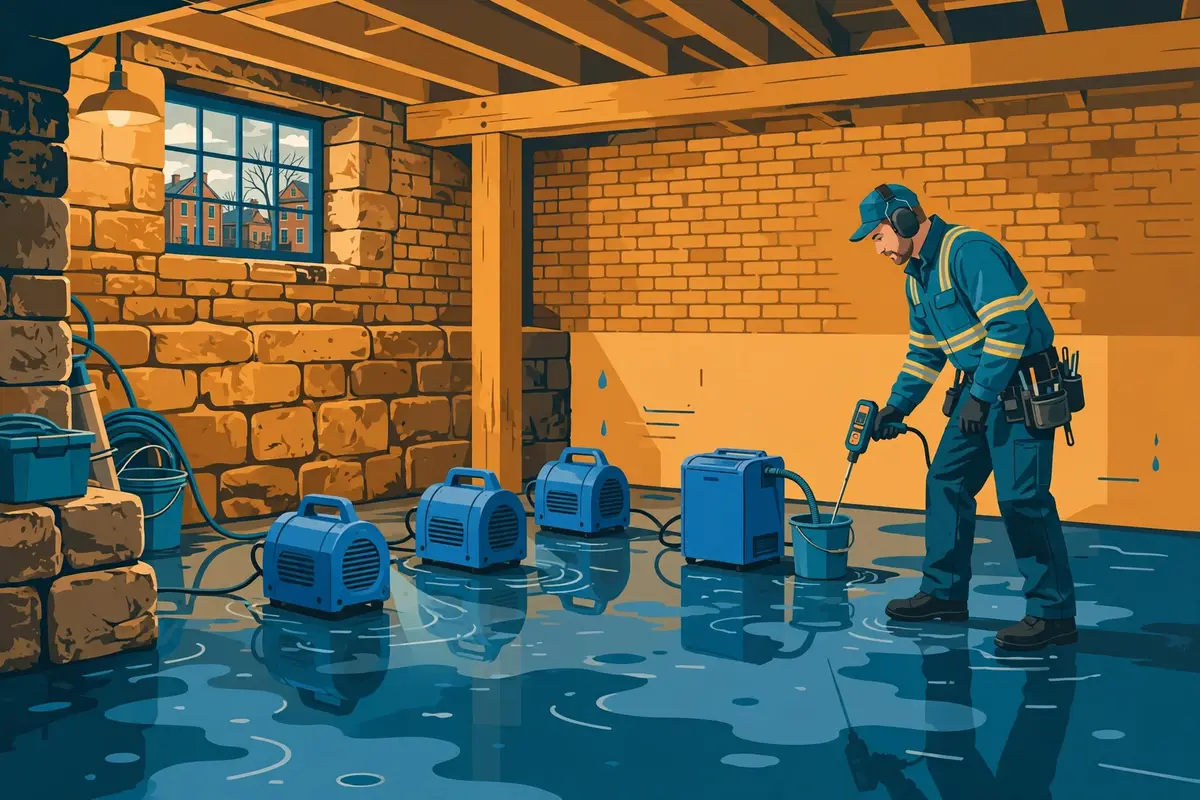
That is the first thing to understand about flooding here. A Schenectady basement does not need rain falling on its own street to flood. It needs the river high enough, long enough, that the water table under the house rises above the basement floor. Water then comes up through the joint where the floor meets the wall, through cracks that were dry for a decade, and through the sump pit faster than a tired pump can move it. Homeowners describe it as the floor sweating, then weeping, then standing an inch deep by morning. It is river water arriving from below, and it behaves differently from a burst pipe: it does not stop when a valve closes, and it keeps coming until the river falls. Telling groundwater from pipe water in the first ten minutes is one of the first skills of water damage restoration schenectady work.
The second route is the sky. Schenectady takes nor'easters, warm wet summers and the remnants of tropical storms that track up the Hudson Valley, and Hurricane Irene proved in August 2011 what a slow tropical system can do to this river basin. Heavy rain on saturated ground runs off the hills of Glenville and Rotterdam, fills the creeks, and pushes the Mohawk up its banks into the Stockade and the river side streets. The third route is winter ice, covered in its own section below: a jam can dam the river in January and flood homes that the summer river never reaches. Each route ends in the same phone call, but each is dried and documented differently by any water damage restoration schenectady crew worth hiring.
Inside the house, the routes are more ordinary and far more common. Frozen pipes split in January cold. Water heaters fail at the bottom of basement stairs. Washing machine hoses let go on second floors. Radiators and their valves weep for months behind furniture. Every one of those is a plumbing loss, not a river loss, and together they make up most of the work in this trade in Schenectady. The river writes the history of the city. The pipes write the weekly call log. Most water damage restoration schenectady calls start with one of those ordinary failures, not with the river.
What ties the two together is the age of the stock. Schenectady holds 67,047 people, according to the 2020 census, in about 10.9 square miles of land, and a large share of its homes were built when the General Electric works and the locomotive works were filling whole neighbourhoods at speed. Stone and brick foundations, plaster and lath walls, galvanised supply lines and cast iron drains are normal here, not exceptions. Those materials change how a loss behaves and how it must be dried, and they are the reason a generic drying plan written for a new suburb fails in a Stockade colonial or a Mont Pleasant triple decker.
So the working picture is simple. One river sets the flood risk. One old housing stock sets the drying difficulty. Everything else on this page, the storm history, the insurance clocks, the neighbourhood notes and the prevention walkthrough, hangs off those two facts.
The storm everyone measures against
Hurricane Irene in Schenectady: 28 and 29 August 2011 on the Mohawk
Hurricane Irene reached Schenectady on 28 and 29 August 2011, and it remains the storm that every water damage restoration schenectady flood plan in this city is quietly written against.
As the storm tracked up the coast and into New York, rain fell across the whole Mohawk basin at once, which is the one pattern this river cannot shrug off. The Stockade area was evacuated amid flooding fears, and Schenectady was placed under a state of emergency. WAMC Northeast Public Radio reported the Mohawk River in a 500 year flood, expected to crest at least six feet higher than the record mark set in 1914. Gauges on the Schoharie River were washed away entirely, and Albany sat about four feet above normal. Nearly 200 people were rescued by emergency workers across the Mohawk River communities, including Rotterdam Junction, Schoharie and Schenectady's Stockade district, according to the Times Union on 30 August 2011. Those rescues were region wide, across a whole river system in flood, and honesty about that geography matters on a page that asks to be trusted.
What Irene taught Schenectady homeowners is specific. First, evacuation orders for the Stockade are not theatre: the district floods from the river side and the ground side at once, and waiting to see costs the hours in which belongings could have been lifted. Second, a tropical storm does not need to be a hurricane at landfall here to be the worst flood of a lifetime, because the damage is done by basin wide rain on a river with a long memory. Third, the water that enters in a river flood is not clean water. It carries silt, fuel, sewage and farm runoff, and every porous thing it touches has to be treated as contaminated, which changes the cleanup from a drying job into a cleaning and removal job first.
Tropical Storm Lee followed Irene in September 2011, dropping more rain on ground that had not dried, and the pair of storms together reshaped how the city thinks about the Stockade. Seven years later the Federal Emergency Management Agency (FEMA) made about nine million dollars available for Stockade flood mitigation, in October 2018, and Mayor Gary McCarthy said plainly that the money was the result of Irene and Lee in 2011. The mitigation section below covers that award in full.
For a homeowner reading this page during a modern storm warning, the Irene lessons compress into four moves. Watch the river forecast, not just the rain forecast. Lift what matters in the basement before the water arrives, not after. Photograph the house in its dry state on a calm day, so a claim never has to argue about what was there. And know now, while it is dry, whether your cover answers river water at all, because a standard homeowners policy usually does not, and the middle of a state of emergency is the worst classroom in the world for insurance.
Crews who worked the Irene recovery in this county still describe the same pattern street by street: the homes that dried fastest were the ones where extraction started as the water fell, where contaminated material came out in the first two days, and where the claim file was opened with photographs while the silt was still on the floor. The homes that suffered longest were usually not the deepest flooded. They were the ones where help arrived after the mold did. That order of events, speed first and mold never, is the whole creed of water damage restoration schenectady work.
The record on the wall
March 1914: The Flood Every Schenectady Flood Is Still Measured Against
The worst flood in Schenectady history came in March 1914, and its numbers still anchor every serious water damage restoration schenectady conversation about the Stockade.
Flood levels reached 23.5 feet by 11:45 in the morning, according to the Grems Doolittle Library local history collection, and between 300 and 400 homes were evacuated. Residents used boats in the Stockade, travelling streets that had been dry pavement days before. About 30,000 people came to watch the ice chunks, which tells you something about both the scale of the event and the era: the flood was the spectacle of the decade in a city that built locomotives. The March floods of 1893 and 1913 had reached a high mark of 21 feet and were thought to be the worst the river could do. The flood of 1914 passed that mark by two and a half feet and reset the city's imagination of what the Mohawk is capable of.
March is the dangerous month in the old record for a reason that still applies. A late winter flood combines snowmelt, rain on frozen ground that cannot absorb it, and river ice breaking up and jamming, all in the same week. The ground sheds water instead of drinking it. The river carries both the melt and the ice. A modern Schenectady winter can still assemble the same ingredients, which is why the prevention walkthrough on this page treats late winter as a season of its own rather than the tail of January.
The 1914 flood also explains the Stockade's building habits. Homes there stand in a district that has flooded, on and off, for three centuries, and the oldest construction shows it: stone foundations that tolerate wetting and drying in a way modern block does not, ground floors that were built expecting water now and then, and a neighbourhood culture that treats a river forecast the way other neighbourhoods treat a snow forecast. When Irene was expected to crest at least six feet above the 1914 record in August 2011, that comparison landed on a city that knew exactly what the 1914 mark meant, because the mark was part of local memory, not just local records.
There is a practical lesson in the 1914 numbers for anyone buying or renovating on the low ground today. A flood mark is not a curiosity. It is a design input. Electrical panels, furnaces, water heaters and stored belongings placed below the known flood levels of your own street are placed there on borrowed time. The cheapest flood work is the work done on a dry day: raising what can be raised, moving what can be moved, and knowing the level your street has already seen.
And there is a second lesson, about records. The reason this page can state the 1914 figures precisely, the hour, the height, the homes evacuated, is that people wrote them down at the time and a library kept them. A modern claim file works the same way. The households that document a loss as it happens, with dates, photographs and readings, are the households whose claims are argued from evidence a century from now would still respect. The same respect for the written record runs through every water damage restoration schenectady claim file today.
The winter flood nobody forecasts well
The Winter of 2017 and 2018: When a Miles Long Ice Jam Pushed the Mohawk Into the Stockade
River flooding in Schenectady is not only a summer event, and the ice jam of the winter of 2017 and 2018 is the proof every water damage restoration schenectady crew in this county keeps in the front of the file.
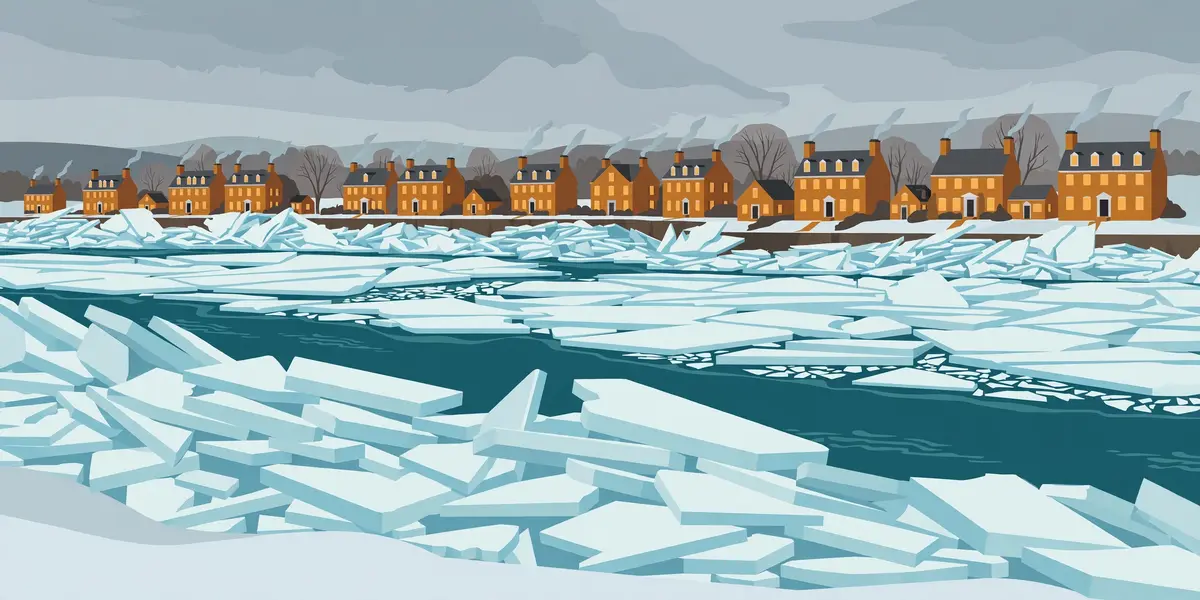
An ice jam begins innocently. A hard freeze skins the river with thick ice. A thaw or a rain event breaks that ice into slabs and sets them moving. The slabs raft against a bend, a bridge pier or a shallow reach, stack on each other, and form a dam of broken ice across the channel. The river, still flowing underneath and behind, has nowhere to go. Water backs up behind the jam, rises, and spills sideways into the low ground, which on this stretch of the Mohawk means the Stockade and the river side streets. When the jam finally releases, the water can drop as fast as it rose, and a second surge runs downstream.
In the winter of 2017 and 2018, a miles long ice jam clogged the Mohawk River, forcing water into the Stockade and the evacuation of some residents from historic homes, according to WAMC Northeast Public Radio. Miles long is the detail to sit with. This was not a localised pile of ice at one bridge. It was a frozen dam measured in miles, holding back a river, in the middle of a Capital Region winter, against a neighbourhood of 17th and 18th century homes that cannot be sandbagged the way a modern slab house can.
Ice jam water does a particular kind of damage. It arrives cold, carrying silt and debris, and it often arrives when the ground is frozen and the house is heated, so wet material meets warm indoor air and the drying problem begins immediately. It also arrives at the season when pipes are already at risk, so a Stockade home can take river water in the basement and a burst pipe on the second floor in the same cold snap, two losses with two different causes that have to be documented as two different stories for the claim.
The honest difficulty with ice jams is forecasting. Rain forecasts are good and getting better. Jam forecasts are local, sudden and physical: a jam forms where the ice decides to stop. The practical defences are therefore boring and effective. Know whether your street has taken jam water before. Keep the basement's valuable and vulnerable things raised as a permanent habit, not a storm project. Keep the sump pump serviced and backed up, because jam water that cannot enter as a flood will still arrive as groundwater. And when the river ice starts moving in a thaw, treat the Stockade the way you would treat it under a flood watch, because functionally that is what it is.
After the water drops, jam flooding is handled like any river flooding: contaminated material out, hard surfaces cleaned and disinfected, structure dried to readings, and the claim documented with the dates and the cause stated plainly. The cause matters. Ice jam flooding is river flooding for insurance purposes, which is why the flood insurance section of this page exists. Stating the cause plainly in that file decides which policy answers, a distinction water damage restoration schenectady crews are trained to protect.
The public money that followed the storms
Nine Million Dollars for the Stockade: The October 2018 FEMA Mitigation Award
In October 2018 the Federal Emergency Management Agency (FEMA) made about nine million dollars available to the city for Stockade flood mitigation, the largest single public answer to the flooding this page describes.
Mayor Gary McCarthy left no doubt about where the award came from, saying the money was the result of Irene and Lee, the two storms of 2011. Residents were invited to submit ideas through StockadeResilience.com, because mitigation in a historic district cannot be designed from a desk in Washington or Albany alone. The Stockade is listed on the National Register of Historic Places, and by virtue of being a historic district, work there must maintain its integrity and character. A flood wall that saves the houses and ruins the district saves nothing the city actually values, so the engineering and the preservation have to be solved together.
Mitigation money moves slowly by design, and a homeowner should understand what it can and cannot do. It can fund studies, drainage work, property level protection and, in some programmes, elevations or buyouts over years. It cannot dry your basement this winter. The gap between public mitigation and private readiness is exactly where a household's own prevention work lives: the serviced sump pump, the raised furnace, the flood vents, the belongings kept off the floor, and the insurance cover checked on a dry day.
There is also a lesson in the seven year gap between the storms of 2011 and the award of 2018. Public help after a disaster is real, and it is slow, and it arrives in programmes with applications and deadlines rather than in trucks with pumps. The households that came through Irene best were the ones whose own first week did not depend on any programme at all: extraction fast, documentation complete, claim opened immediately, and drying finished before mold could turn a water loss into a health loss. That remains the correct order of operations in Schenectady, mitigation award or no mitigation award. That order of operations is the one every water damage restoration schenectady crew in this county still works to.
For the Stockade specifically, the award confirmed on the record what residents already knew from 1914, from Irene and from the ice jam winter: this neighbourhood's flood risk is permanent, structural and worth spending serious money on. A buyer charmed by the district's beauty should read its flood history with the same attention, and a seller's disclosures, the FEMA flood maps and the street's own memory will all tell the same story. The homes are worth protecting. They simply must be protected with open eyes.
Flood water in the house changes the job, not the urgency.
River and jam water is contaminated water: porous material comes out, hard surfaces are cleaned and disinfected, and drying follows cleaning. A water damage restoration schenectady crew treats the category of the water as the first decision on site.
Where the water gets in
Flooded Basements in Schenectady: Six Ways the Water Gets In
Almost every water damage restoration schenectady call in this city ends in a basement, but the water arrives by six different roads, and the road decides the repair.
1. Groundwater through the floor
When the Mohawk runs high or rain saturates the ground for days, the water table rises under the house and pushes up through the floor and wall joint, through cracks and through the sump pit. This is the signature Schenectady basement flood: no pipe broken, no appliance failed, just the river arriving from below. It is also the loss a standard homeowners policy most often excludes, which is why it gets its own honest treatment in the insurance sections of this page.
2. The failed sump pump
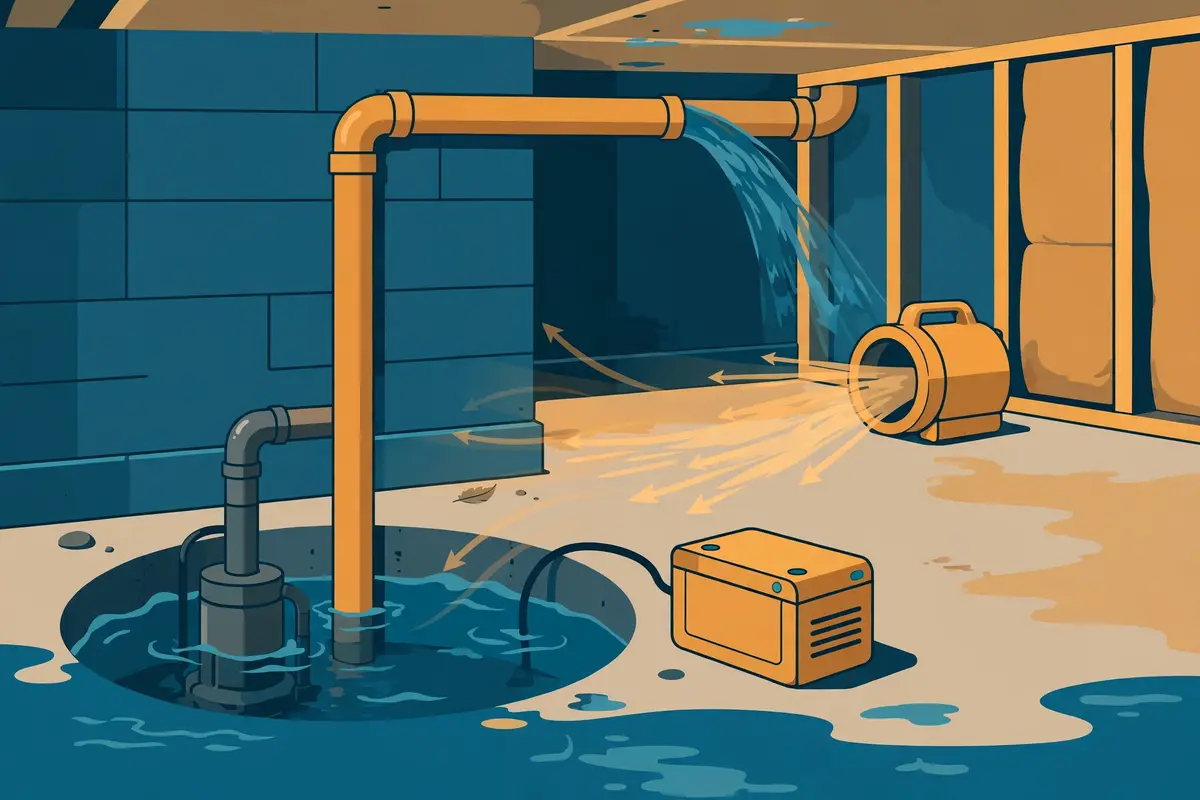
A sump pump is a small machine asked to do its most important work during the worst hour of the year, often while the power is out. Pumps fail from age, from stuck floats, from tripped breakers and from storms that cut electricity at the moment of peak inflow. A basement that bets everything on one pump with no battery backup is a basement one outage away from a flood, and the sump section below treats that machine with the seriousness it deserves.
3. Sewer and drain backup
Heavy rain can surcharge drains and push water, sometimes sewage, back through the lowest opening in the house, usually a floor drain, a basement toilet or a laundry sink. Backup water is contaminated water and is cleaned as a health job first. Cover for it is commonly a separate endorsement with its own limit, bought on a dry day or not at all.
4. Burst and leaking pipes above
The basement is where water from the whole house ends up. A split pipe in a second floor wall, a failed water heater, a washing machine hose: gravity delivers all of it to the lowest level, and the basement ceiling, walls and floor take the damage. Finding the true source, rather than just the wettest room, is the first skill in this trade.
5. Foundation and window well leaks
Rain against the house finds the paths that grading and gutters were supposed to deny it: the window well that fills like a fish tank, the crack behind the downspout that discharges at the wall, the soil that has settled toward the foundation over thirty years. These losses are usually smaller and slower, which makes them more dangerous to finishes and framing, because they can run for months behind stored boxes before anyone sees them.
6. Appliance failures at basement level
Water heaters, boilers, laundry pairs and water softeners live in Schenectady basements, and each holds or moves enough water to flood the floor it stands on. A water heater that lets go at the seam releases its whole tank and then keeps refilling until someone closes the valve. The shutoff for each appliance should be known, labelled and reachable in the dark, a sentence that sounds obvious until the night it is not.
Every one of these six roads leads to the same first hour: stop what can be stopped, extract what is standing, map what is wet, and dry to readings. What differs is the cause written in the claim file, the category of the water, and the prevention that actually prevents a repeat. A crew that treats all six as the same flood will dry your basement and teach you nothing. The diagnosis is half the job. It is the half that water damage restoration schenectady firms are actually hired for; the pumps are the other half.
The response, in order
The First Hour in a Schenectady Home: Six Steps While the Water Is Still Moving
The first hour decides whether a water damage restoration schenectady job is a drying job or a demolition and mold job, and the order of the steps matters as much as the steps themselves.
Call and shut off the water
Phone (518) 555-0147 (placeholder) and, if a pipe or appliance is feeding the water, close the main shutoff valve where the service enters the basement. In a rental or a multi family home, phone the landlord or building contact at the same time so upper floor lines can be closed too.
Safety check
Keep clear of rooms where water has reached outlets, a panel or ceiling lights. Sewage, river water and ice jam water are treated as contaminated from the first minute, so keep children and pets out and do not run fans or a household vacuum on them.
Inspection and moisture mapping
The crew traces the water path with pin and pinless moisture meters and thermal imaging, marks the wet line on each wall and records the starting readings that the whole drying plan and the insurance file are built on.
Water extraction
Truck mounted and portable extractors lift standing water from floors, carpet and padding, and furniture is blocked or moved so finishes and legs are not stained or swollen while the room dries.
Structural drying setup
Air movers, dehumidifiers and cavity drying systems are placed from the moisture map, sized to the rooms and the materials, and set to follow the ANSI/IICRC S500 drying approach from the first day.
Insurance documentation
Photographs, the moisture map, daily reading logs and the list of removed material are assembled into one dated record, so the adjuster sees the loss, the response and the dry standard proof in a single file.
Notice what is not on the list: tearing out walls, throwing belongings away, or signing a rebuild contract in a wet kitchen at midnight. Demolition decisions come from readings, and readings need the map first. The six steps above are deliberately unglamorous. They are also the difference between a home that dries in place, keeping its plaster, its hardwood and its claim intact, and a home that gets gutted because the first hour was spent admiring the damage. Homeowners who want the filmed version of this order of work will find two checked videos in the case study section below, and the rest of the first day, hours 2 to 24, has its own section further down this page.
Not all water is the same water
Three Kinds of Wet: Category 1, 2 and 3 Water in a Schenectady Home
The trade sorts water into three categories by contamination, and the category, more than the depth, decides what a water damage restoration schenectady crew may dry in place and what must come out.
Category 1: clean water
Water from a supply line, a split pipe, a failed water heater or a melting ice maker line. It starts clean, and material it touches can usually be dried in place if the response is fast. Left standing, clean water does not stay Category 1: within days it picks up contamination from the materials it soaks and is treated as a higher category.
Category 2: gray water
Water with significant contamination: washing machine and dishwasher discharge, toilet overflow with urine, sump water that has sat, and clean water that has stood too long. Porous material it soaks, especially carpet padding, usually comes out, and cleaning and disinfection join drying in the plan.
Category 3: black water
Sewage, drain backup and all flood water from outside the home, including Mohawk River water and ice jam water, which carry silt, fuel, chemicals and sewage from everything upstream. Porous material it touches is removed, hard surfaces are cleaned and disinfected, and the work is done in protective gear as a health job first.
The category call is made on site, from the source of the water and how long it has been standing, and it should be explained to you in plain words, because it drives both the scope and the claim. River water an inch deep is a bigger job than pipe water a foot deep, and any crew that prices or plans by depth alone has not understood your loss. Ask which category your water is, and what that means for each room. The answer is a small test of the firm, and the good ones answer it without hesitating. Ask it of every water damage restoration schenectady firm you phone, and weigh the pause before the answer.
Old materials, gentle methods
Stone, Plaster and Patience: Drying the Historic Homes of the Stockade
The Stockade is the oldest neighbourhood in Schenectady, listed on the National Register of Historic Places, and drying its homes is the most specialised work a water damage restoration schenectady crew does in this city.
Start with the foundations. Stockade homes stand on stone and brick laid centuries before damp proof courses, and those walls pass moisture in both directions by design and by age. A stone foundation that has been wetted by river water or groundwater holds that water deep in the wall and releases it slowly into the basement air for weeks. Drying it is a patience exercise measured in daily readings, not a weekend with a fan. Crews who understand the district set expectations accordingly: the equipment runs longer, the readings move slower, and the dry standard is judged against the same wall in a dry season, not against a number copied from a new build.
The walls above are plaster and lath, and plaster behaves nothing like drywall. It can absorb a great deal of water and, if it has not crumbled or separated from the lath, it can often be dried in place and saved, which matters enormously in a home where the plaster is original fabric. But plaster dried too fast or with aggressive heat can crack, and plaster dried too slowly can feed mold on the paper and wood behind it. The craft is in the controlled middle: measured humidity, gentle air movement, cavity drying where the map shows trapped water, and daily readings that say whether the wall is winning.
Original timber, wide plank floors and early millwork raise the same point in wood. Hardwood that gets wet will cup and crown as it dries, and boards replaced in a panic in week one are often boards that would have settled flat by week four. The disciplined answer is to dry first, read the final numbers, and only then decide what truly needs repair. In a district where the floors may be two centuries old, that discipline is the difference between restoration and slow demolition.
There is also a regulatory and neighbourly layer. Work in the Stockade must respect the district's historic character, and exterior changes can involve review. Interior drying and careful repair rarely change a facade, but any rebuild that touches the visible fabric of the house should be planned with the district's rules in mind from the start, not discovered at the end. A crew that works the district knows to ask about it before the first wall is opened.
None of this makes Stockade homes fragile. They have survived the flood of 1914, Irene, ice jams and three centuries of Mohawk winters, which is more than any new build can claim. It makes them specific. The right crew for a Stockade loss is the one that talks about your walls the way a conservator would, reaches for the meter before the hammer, and treats the age of the house as information, not as a problem. That temperament, more than any machine, is what water damage restoration schenectady means inside the Stockade.

The cold months
Frozen Pipes and Radiator Failures: Schenectady Water Damage in the Cold Months
Summer belongs to the river, but winter belongs to the pipes, and a hard Schenectady cold snap can keep a water damage restoration schenectady crew moving from freeze call to freeze call for a week.
A pipe bursts not when the water in it freezes, exactly, but when ice blocks the line and the pressure behind the blockage builds until the pipe wall gives way, often at a joint or a weakened run. The cruel detail is timing: the split frequently releases its water when the thaw comes and the ice plug melts, which can be hours after the freeze and sometimes when nobody is home. Pipes on outside walls, in crawlspaces, above unheated garages and in the cold corners of old Schenectady homes are the repeat offenders, and galvanised lines narrowed by decades of corrosion split more readily than new copper or PEX.
Radiators write the second winter story. Steam and hot water heating systems are everywhere in the older stock, and a failed valve, a cracked radiator or a furnace that stops on the coldest night can put water through ceilings and into the rooms below. The case study further down this page, the homeowner with two burst hydronic radiators after a furnace failure, is the full length version of a story every Schenectady heating contractor knows by heart. The lesson inside it is that a heating failure in January is a water emergency in waiting: a house that loses heat in a cold snap needs the water drained or the pipes watched, hour by hour, until the heat is back.
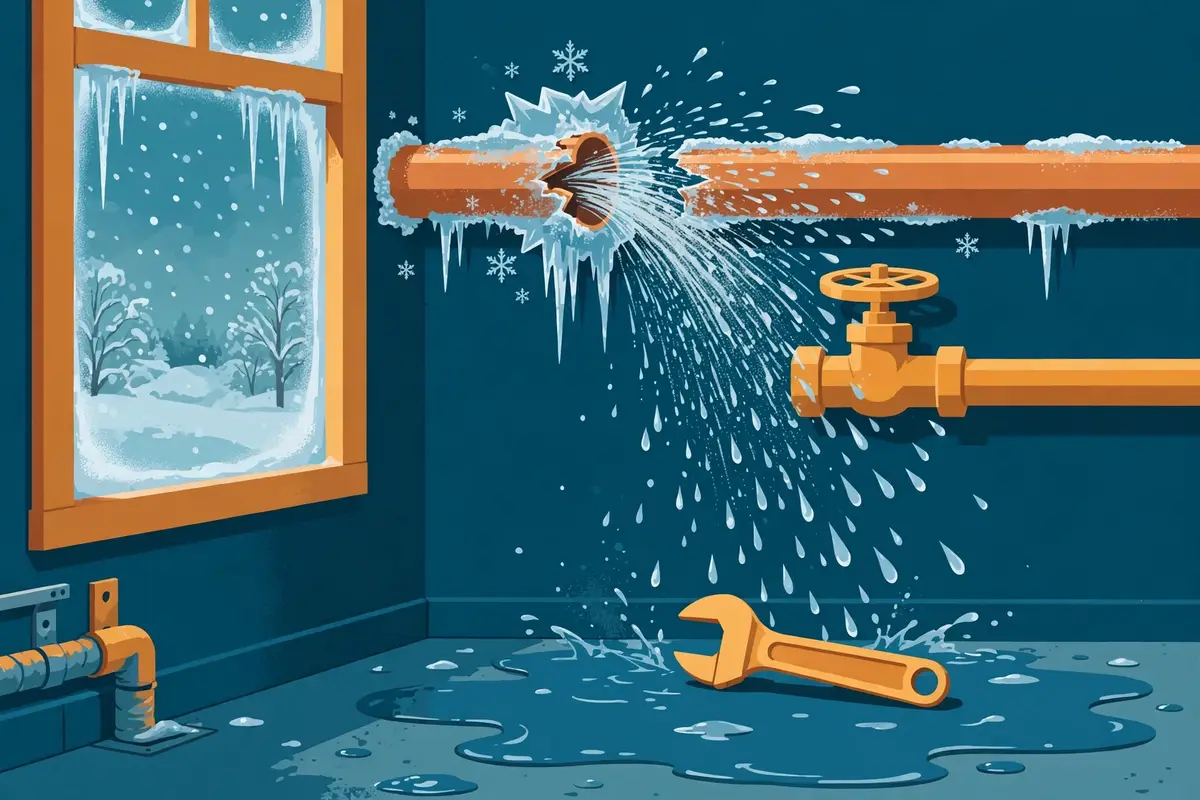
Ice dams write the third. Snow melts on the warm upper roof, runs down to the cold eave, freezes into a dam, and the next melt pools behind it and works under the shingles into the wall below. The stain appears on a bedroom ceiling in February and the argument starts about whether it is plumbing or roof. A moisture map settles it: dam water enters at the eave line and tracks the outside wall, and the fix pairs interior drying with the unglamorous exterior work of ventilation, insulation and, in season, careful dam removal.
Prevention for all three is the same short list, and it is cheap in October and expensive in January. Insulate the vulnerable runs. Seal the drafts that pour cold air onto pipes. Service the furnace before the season, and treat a heating failure in a cold snap as an emergency with a plumbing chapter. Keep the heat on in every room. Let the far faucet drip on the coldest nights. And know, tonight, in the warm, where your main shutoff is and whether it turns. The winter section of the prevention walkthrough below turns this list into a room by room routine. Run it once each autumn and most winter water damage restoration schenectady calls never happen.
Three stocks, three plans
GE Realty Plot Colonials, Mont Pleasant Triples and Downtown Flats: Three Drying Plans
Schenectady housing is not one stock but several, and a water damage restoration schenectady plan written for one fails in the others.
The GE Realty Plot colonial
Large early twentieth century homes built for General Electric executives: plaster walls, hardwood throughout, finished basements, steam or hot water heat. Losses lean toward radiator and pipe failures and ice dams. The plan protects original material first, dries plaster in place where readings allow, and treats the finished basement as the high value room it is.
The Mont Pleasant triple
Multi family wood frame homes where one leak can be three households' problem. A second floor bathroom failure wets the flat below and the basement under both. The plan coordinates access across units, documents each household's loss separately for separate claims, and dries the shared structure once, properly, instead of three times badly.
The downtown flat and rental
Apartments and smaller rentals near State Street and Erie Boulevard, where the tenant finds the water but the landlord owns the structure. The plan runs on paperwork as much as pumps: written notice the same day, belongings documented for the renters policy, structure documented for the building policy, and habitability kept at the centre of every decision.
Around those three sit the ranch and split level streets of Woodlawn and Bellevue, the older workers' homes of Hamilton Hill, and the single family streets of Northside, each with its own plumbing age and basement habits. The point of naming the stocks is not local colour. It is that drying is materials science applied to a specific house, and a crew that can say how your stock behaves when wet, before it opens a single wall, is a crew that has dried it before. In a city of this many housing stocks, that local memory is the real credential behind water damage restoration schenectady work.
Neighbourhood by neighbourhood
Schenectady by Neighbourhood: The Stockade, Mont Pleasant, Woodlawn and the River Streets
Pick a neighbourhood or a service town. Each one has its own water pattern, and a water damage restoration schenectady dispatch is planned around the pattern, not just the address.
Inside the city, ZIP codes run 12301 to 12309, with 12325 and the famous General Electric ZIP 12345 completing the set, all in the 518 area code. Beyond the city line, the service towns ring the city on every side: Niskayuna to the east along the river, Rotterdam to the west and south, Scotia and Glenville across the Mohawk to the north, and Rexford, Duanesburg, Pattersonville and East Glenville completing the county coverage. When you call, the most useful sentence you can say after your address is which of these patterns you are standing in: river water, groundwater, a backup, or a pipe. The crew will take it from there. That one sentence routes the right equipment, the right crew size and the right water damage restoration schenectady plan to your door.
What one call covers
What One Call Covers: Fifteen Schenectady Services From Extraction to Rebuild
One call to a water damage restoration schenectady crew should be able to carry a loss from the first extraction to the last coat of paint, and these are the fifteen services that promise is made of.
Water Extraction
Truck mounted and portable extractors lift standing water from floors, carpet and padding, the single fastest way to shrink a loss.
Structural Drying
Air movers and dehumidifiers placed from a moisture map, drying walls, floors and framing to a recorded dry standard.
Flood Cleanup
River, storm and groundwater cleanup: silt and debris out, hard surfaces washed and disinfected, structure dried.
Sewage Cleanup
Category 3 work in protective gear: extraction, removal of touched porous material, cleaning, disinfecting and drying.
Burst Pipe Response
Freeze splits and failed lines: source isolated, water extracted, cavities dried, and the failed part kept for the claim.
Basement Drying
The Schenectady speciality: stone and block foundations, finished basements and sump failures dried to readings.
Moisture Detection
Pin and pinless meters and thermal imaging that find the water the eye cannot see, before any wall is opened.
Dehumidification
Commercial dehumidifiers holding the air dry enough that old plaster, timber and stone give up their water safely.
Mold Remediation
Licensed mold work under Article 32 of the Labor Law, with assessment and remediation kept separate as the law requires.
Contents Cleaning
Furniture, rugs and belongings cleaned, dried, packed out and stored where a room cannot be dried around them.
Storm Damage Repair
Wind and water together: roof openings tarped, water extracted, and the interior dried before repairs begin.
Roof Leak Response
Ice dam and storm leaks traced to their true entry point, with the wall and ceiling dried from the map.
Odor Removal
The musty smell of a wet house treated at its source, the damp material, not masked with fragrance.
Reconstruction
Drywall, flooring, trim and paint: the rebuild that returns the room, done by the same firm that dried it.
Insurance Claim Documentation
Photographs, moisture maps, daily logs and inventories assembled into the dated file an adjuster pays from.
Not sure which service your loss needs?
That is normal, and it is the crew's job to diagnose, not yours. Describe what you see, where it is and how long it has been wet, and a water damage restoration schenectady dispatcher will send the right first visit.
The science in the middle of the job
Drying by Numbers: Moisture Maps and Daily Readings in a Schenectady Home
Drying is the part of water damage restoration schenectady work that separates a measured trade from a fan rental, and it runs on numbers from the first hour to the last.
It starts with the map. On the first visit the technician walks the water's path with a pinless meter for broad scans and a pin meter for confirmed readings in wood and plaster, and a thermal imaging camera that shows cold, wet areas as shapes on a screen. Every wet point is marked, photographed and logged with its starting number. In the same visit, readings are taken in an unaffected room of the same house, in the same materials, and those numbers become the dry standard: the definition of dry for your home, not for a textbook. That map is the first working document on every water damage restoration schenectady job.
Equipment is then placed from the map. Air movers are aimed to sweep wet surfaces and keep a film of moving air where evaporation happens. Dehumidifiers, refrigerant or desiccant depending on conditions, pull that evaporated water out of the air so the room's humidity keeps falling instead of stalling. Where water is trapped inside a wall cavity, a cavity drying system feeds dry air into the wall through small holes placed where they will never be seen, behind baseboards or inside closets. In a stone foundation basement, the plan leans on dehumidification and time, because stone gives up water slowly and punishes impatience with surface mold.
Then comes the discipline: daily readings at the same marked points, logged against the dry standard, with equipment moved, added or removed as the map changes. A wall that is not moving gets a new tactic, an opened section, a different machine, a containment change, not just another day of rent on the same fans. The log is also the claim document. An adjuster who receives a dated series of readings showing a wall travelling from wet to dry standard has very little left to argue about, and a homeowner who receives the same log knows the job ended because the numbers said so.
The job is declared dry when every marked point meets the dry standard on two visits in a row. Surfaces feeling dry to a hand proves nothing; a hand cannot feel the moisture inside a plaster wall or a sill plate. This is why the filmed case study further down this page, about testing before tearing, is required viewing on this page: the meter is the whole argument. Drying done this way takes three to five days in most Schenectady homes once extraction is finished, longer in stone, plaster and finished basements, and every extra day is justified by a number you can ask to see.
If a firm cannot show you yesterday's readings, there were no readings. If it cannot name your dry standard, it does not have one. Those two questions, asked on day two of any job, will tell you more about the crew in your house than any badge on its website. It is the fastest audit of a water damage restoration schenectady firm ever devised, and it costs two questions.
Save or remove, decided by readings
What Survives a Schenectady Flood: Floors, Furniture and the Contents Decision
The question every homeowner asks on day one is what can be kept, and the honest answer a water damage restoration schenectady crew gives is that the water's category and the readings decide, room by room and board by board.
Hardwood is the most argued over material in the trade. Clean water caught fast usually lets hardwood dry in place; the boards may cup as they take on moisture and crown as they release it, and a floor that looks ruined in week one can settle back close to flat by the final readings. The discipline is to wait. Sanding or replacing a floor before it reaches the dry standard builds the decision on a moving target. Laminate is the opposite story: its core swells permanently, and wet laminate almost always comes up. Carpet can often be dried and cleaned after clean water; its padding, cheap and absorbent, usually cannot, and after gray or black water both carpet and pad are documented and removed.
Drywall and plaster split along age lines, as the Stockade section explains. Modern drywall that has wicked water a few inches can be dried in place if it stays firm, or cut at a clean line above the wet line if it has gone soft. Plaster that has not crumbled or pulled from its lath is a candidate to save, and in a historic home saving it is the whole point. Insulation inside a wet wall is the quiet decider: fiberglass that has slumped wet rarely dries in a sealed cavity and often has to come out with the wall section, which is one more reason the moisture map, not optimism, writes the scope.
Contents follow the same logic with a human layer on top. Upholstered furniture that sewage or river water reached cannot be cleaned to a safe standard and is documented for the claim, then removed. The same chair after a clean water leak can be extracted, dried and cleaned. Books, papers and photographs are time sensitive: drying within the first day or two, or freezing to halt mold until they can be treated, saves what a week of damp destroys. A pack out, covered in its own section below, moves the contents of a room to a facility where each piece is inventoried, cleaned and stored while the room dries, and the inventory doubles as the claim's contents list.
What never helps is the rushed throw out. Belongings discarded before they are photographed and listed are belongings the claim cannot pay for, however real the loss. The order is always photograph, list, then decide, and a good crew enforces that order even when the homeowner, standing in a wet room, wants everything gone by supper. The room will be emptied either way. The file decides whether it is emptied at the insurer's expense or the family's. Protecting that file is a core part of water damage restoration schenectady work, not an administrative extra.
The 48 hour clock and the licence
Mold After Water Damage in Schenectady: The 48 Hour Clock and Article 32
Mold is the reason water damage restoration schenectady work is timed in hours, and New York law is the reason mold work itself is split into two licensed trades.
The clock first. Mold can begin growing within 24 to 48 hours on material that stays wet, according to the U.S. Environmental Protection Agency (EPA). The spores are already in every house; what a flood adds is the moisture they were waiting for. That is why extraction and drying start the same day, why wet padding and soaked porous material come out early rather than after a debate, and why a room dried to readings is a genuinely different outcome from a room that was mopped and left smelling damp. Every day of delay converts a drying job into a drying job plus a mold job, at mold job prices of time and disruption.
The law second. Since 1 January 2016, Article 32 of the New York Labor Law has required state licences for mold assessment and for mold remediation, and it keeps the two roles apart on the same project: the assessor who inspects, tests and writes the remediation plan cannot be the firm that profits from carrying it out, and clearance at the end is assessed independently. The structure exists because the old arrangement, one firm finding exactly as much mold as it would be paid to remove, failed homeowners too often to survive. In Schenectady this is state law, the same as in Albany or Buffalo; no city rule replaces it, and no firm's promise replaces the licence.
What this means in practice on a wet job is a clean sequence. Drying proceeds immediately, because stopping moisture is always first and needs no licence debate. If growth is found or suspected beyond a small area, a licensed assessor inspects and writes the plan. A licensed remediator then works to that plan under containment, with negative air and HEPA filtration so spores are not spread through the house by the cleanup itself. The assessor returns to clear the work. Homeowners should ask, of any firm mentioning mold, two questions: who assesses, and who remediates, and if the answer is the same name twice, the arrangement does not comply with Article 32.
Health honesty belongs here too. Mold exposure bothers people differently; those with asthma, allergies or weakened immune systems are affected most, and a page like this one is not a medical source. What the trade can say plainly is that the risk is managed by speed and by containment: dry fast, do not run household fans on visible growth, keep children and sensitive family members out of affected rooms, and let licensed people handle growth beyond a small patch. The rest is a conversation for your doctor, armed with the assessor's report. Speed, containment and licensed separation: that is the mold chapter of water damage restoration schenectady practice in one line.
The clocks that govern the claim
New York Claim Clocks That Govern a Schenectady Loss: Regulation 64, Section 2618 and the Two Year Suit Limit
Three New York rules decide how a water damage restoration schenectady claim is timed, and every homeowner in the state is better off knowing them before the loss, not after it.
| Rule | What it requires | Source |
|---|---|---|
| Acknowledge, reply, investigate | The insurer must acknowledge the claim, answer communications and begin and complete its investigation within clocks measured in 15 business days | Regulation 64, under Insurance Law Section 2601 |
| Accept or reject after proof of loss | Once proof of loss is received, the insurer has 15 business days to accept or reject the claim, with written reasons required if more time is taken | Regulation 64 |
| Pay after settlement | Once a claim is settled, payment must follow within 5 business days | Regulation 64 |
| Pay after a natural disaster | After a declared natural disaster, an agreed and undisputed amount must be paid within 4 business days | Insurance Law Section 2618 |
| Deadline to sue the insurer | A lawsuit over the claim must be started within 24 months of the date of the loss | Insurance Law Section 3404, standard fire policy |
| Public adjuster fee cap | A public adjuster may charge no more than 12.5 percent of the recovery | 11 NYCRR 25.7 |
Two of these are misquoted often enough that this page states them slowly. The disaster pay clock in Section 2618 is 4 business days. Not 3, not 5: 4, and it runs on the agreed, undisputed amount, which is why getting the scope agreed early is worth real money to a flooded family. And the suit limit in Section 3404 runs 24 months from the date of loss, the day the water did the damage, not from the day a claim was denied. A slow claim can therefore be quietly eating its own deadline, and a homeowner who knows the date can refuse to let it drift.
The clocks also explain the paperwork style of this whole page. Regulation 64 clocks run from documents: the day the claim was reported, the day proof of loss was received, the day a letter was sent. A claim handled by phone alone leaves the homeowner with memories where the file should be. Send the important things in writing or by a method that proves the date, keep the crew's dated moisture logs and photographs with them, and keep your own simple log of every call, with the name of the person you spoke to. If a dispute ever reaches a lawyer or the state Department of Financial Services, that log is the case.
One more distinction matters in Schenectady. These are New York State rules, and they are the rules here. Homeowners who have lived in New York City sometimes arrive with city agencies and city local laws in mind, and those do not govern a Schenectady loss. The state insurance clocks, the state mold licence and the county and city building rules are the framework, and the law section below separates what applies from what does not in full. Those state clocks frame every water damage restoration schenectady claim in the Capital Region.
River water needs its own policy
River Water Needs Its Own Policy: Flood Insurance for Schenectady Homes
The hardest sentence in water damage restoration schenectady work is that a standard homeowners policy usually excludes the flood this city is famous for, and the National Flood Insurance Program (NFIP) exists to fill exactly that gap.
The distinction insurers draw is the source of the water. A burst pipe inside the home is a homeowners claim. Water that rises from outside, from the Mohawk, from storm runoff, from groundwater pushed up by a high river, is flood, and flood needs a flood policy. Sewer backup sits between the two and is usually handled by a separate endorsement on the homeowners policy, with its own limit. A Schenectady household therefore holds, or fails to hold, three different answers to three different kinds of wet, and the time to learn which is which is a dry afternoon, not a wet night.
The NFIP, run by the Federal Emergency Management Agency (FEMA), sells policies through ordinary insurers, and its terms carry two features every buyer should know in advance. The first is the waiting period: a new flood policy typically takes 30 days to take effect, so the policy bought during a storm warning is a policy for the next storm. The second is the basement rule: flood cover for a basement is limited, focused on the building's systems and structure rather than on finished rooms and stored belongings, which surprises families who finished a basement in a flood zone and assumed it was covered like the rooms upstairs.
Who needs it here is a street by street question. Stockade homes and river side streets carry the obvious risk, and mortgage lenders require flood cover in the mapped high risk zones. But groundwater and runoff losses happen well outside the famous streets, and Irene put water into Mohawk basin homes that had never flooded in living memory. The FEMA flood maps, your street's own history and the 1914 and 2011 marks in this page's history sections are the honest inputs. A household that has taken water once, from any source that rose outside the walls, should treat flood cover as a live question every renewal, not a closed one.
None of this is a sales pitch, and this page sells no policies. It is the arithmetic of a river city: the cover that answers your most likely catastrophic loss is the cover worth understanding precisely, including its waiting period and its basement limits, while the river is low and the basement is dry. It is the driest eyed homework water damage restoration schenectady professionals ask of river city homeowners.
AEO: direct answers
Schenectady Quick Answers: Six Questions From a Wet Basement Door
Short questions get short, complete answers first, then the long sections of this page behind them. Each answer below stands on its own.
How fast should help arrive after water damage in Schenectady?
Help should be called the same hour and extraction should start the same day. Mold can begin within 24 to 48 hours, according to the EPA, so a crew that starts today is running a drying job, while one that starts next week is running a drying job plus a mold job.
Why does my Schenectady basement flood when it has not even rained here?
Because the Mohawk River can do it without local rain. A high river raises the water table under the whole city, and groundwater pushes up through your floor and wall joint and your sump pit. Basin wide rain and ice jams both raise the river while your own street stays dry.
Does insurance cover Mohawk River flooding in Schenectady?
Usually not under a homeowners policy, which normally excludes water that rises from outside the home. River flooding is answered by a separate flood policy, most often through the National Flood Insurance Program. Check your cover on a dry day, because new flood policies carry a waiting period.
How long does drying take in a Schenectady home?
Most homes dry in three to five days once extraction is done, and plaster, stone foundations and finished basements in the older Schenectady stock can take longer, because those materials hold water deep inside. Drying ends when daily readings meet the dry standard, not when a set number of days passes.
What made the Stockade flood in the winter of 2017 and 2018?
An ice jam. Broken river ice piled into a dam miles long on the Mohawk, the water backed up behind it, and the river spilled into the Stockade, forcing evacuations from historic homes. Ice jam flooding counts as river flooding for insurance, which is why flood cover matters there.
How fast must an insurer pay after a disaster in New York?
Within 4 business days for an agreed and undisputed amount, under Insurance Law Section 2618, once a natural disaster has been declared. The wider Regulation 64 clocks give insurers 15 business days for the main claim steps and 5 business days to pay after a settlement is reached.
The numbers, in one table
Schenectady Key Facts: The Numbers Every Homeowner Asks For
Every figure below is stated with its source, and the same figures run through the sections of this page in full sentences.
| Fact | Figure | Source |
|---|---|---|
| City population | 67,047, ninth largest city in New York | 2020 census |
| ZIP codes | 12301 to 12309, plus 12325 and 12345 | USPS ZIP code areas for Schenectady |
| Area code | 518 | New York State area code map, Capital Region |
| Hurricane Irene | 28 and 29 August 2011, Stockade evacuated, state of emergency | WAMC Northeast Public Radio, 29 August 2011 |
| Worst flood in city history | March 1914, 23.5 feet by 11:45 in the morning, 300 to 400 homes evacuated | Grems Doolittle Library local history collection |
| Ice jam | Winter of 2017 and 2018, miles long jam, Stockade flooding and evacuations | WAMC Northeast Public Radio, 25 October 2018 |
| FEMA Stockade mitigation | About nine million dollars, October 2018 | Mayor Gary McCarthy, reported by WAMC |
| Mold growth window | 24 to 48 hours on material that stays wet | U.S. Environmental Protection Agency (EPA) |
| Regulation 64 claim clocks | 15 business days for the main acknowledge, investigate and decision steps | Regulation 64, under Insurance Law Section 2601 |
| Disaster pay clock | 4 business days for an agreed, undisputed amount after a natural disaster | Insurance Law Section 2618 |
| Suit limit | 24 months from the date of loss | Insurance Law Section 3404 |
Figures are stated as their sources state them. The about 200 rescues during Irene were region wide across the Mohawk River communities, according to the Times Union, and are never credited to Schenectady alone on this page.
Asked out loud
Voice Answers: What Schenectady Homeowners Ask Out Loud
Five questions people ask a phone or a speaker in a wet kitchen at midnight, answered the way they were asked: directly, briefly and without a sales speech.
Who do I call for water damage in Schenectady right now?
Call (518) 555-0147 (placeholder) at any hour. Say which part of Schenectady you are in, where the water is coming from if you know, and how long it has been running. You will be told what to shut off, what to photograph and what to stay out of while the water damage restoration schenectady crew travels.
Is the Mohawk River flooding the Stockade again?
Check the river forecast and the city's emergency notices first, and treat an ice jam report in a thaw the same as a flood watch. The Stockade was evacuated during Irene in August 2011 and again saw flooding and evacuations in the ice jam winter of 2017 and 2018, so local warnings there are written from experience.
How long until mold grows after a flood?
Mold can begin within 24 to 48 hours on material that stays wet, according to the EPA. That is why extraction and measured drying start the same day, and why a room dried to readings is a different outcome from a room mopped and left to air.
Will insurance pay for my flooded basement?
It depends on the water. A burst pipe is usually covered by a homeowners policy. Sewer backup usually needs its own endorsement. River and groundwater flooding needs a separate flood policy. Photograph everything first, report the same day, and let the dated record make the argument. That is the short version of how water damage restoration schenectady claims are won.
My sump pump stopped in the storm. What now?
Stay out of water that has reached outlets or the panel. If you can reach the pump safely, check the plug, the float and the breaker. Then call for extraction, because a failed pump in a rising storm is a pumping job, not a repair project, and photograph the water line as it rises for the claim.
Watch the work
Two Filmed Drying Jobs Worth Watching Before You Hire a Crew in Schenectady
Two filmed jobs, watched and checked for this page, teach more about water damage restoration schenectady standards than any brochure. Both open on YouTube in a new tab. Nothing is embedded here.
Home RenoVision DIY, "Water Damage? Do This BEFORE Mold Takes Over." A working renovator walks a real water loss in the order this page teaches: find the source, stop it, get the wet material decision right early, and respect the mold clock instead of admiring the damage. Watch the sequence he gives the first hours, because it matches the first hour section of this page step for step, and notice how much of a water damage restoration schenectady job is decisions, not machines. Watch on YouTube
Certified Restoration, "Test Before You Tear." A restoration firm demonstrates the habit that separates measured drying from demolition: test and map the moisture before removing material, so walls are opened where readings demand it and left alone where they do not. For a Schenectady homeowner facing a plaster wall decision, this is the single most useful half hour of viewing on this page, because it shows what a meter led first visit looks like from the homeowner side of the room. Watch on YouTube
No Schenectady specific filmed case with a verified transcript was found for this page, and this page will not pretend otherwise. What the city offers instead is a written record most cities cannot match: a dated flood history running from 1914 to the ice jam winter, and named local cases, told in the next two sections, that show what this work looks like when it is done on real Schenectady homes and businesses.
A case the neighbourhood tells
Two Radiators, One Frozen House: The Hydronic Case Schenectady Homeowners Pass Around
Some cases teach more than a manual, and the radiator case retold across Schenectady heating and water damage restoration schenectady circles is one of them. It is an undated case, and this page tells it without inventing a date for it.
The outline is stark. A Schenectady homeowner, named in the telling as Bob M., lost his furnace, and the house froze. Two upstairs bedroom hydronic radiators burst. When the water came, it came through ceilings and walls, the way second floor water always does, and the home needed ceilings and walls removed where the water had travelled, moisture tested and removed throughout, and mold prevented before it could start, ending with the home restored to new. The homeowner's verdict on the crew, recorded with the case, was that they were professional in all ways, showed up early, worked hard all day, communicated well, provided a very detailed scope of work, and produced no surprises.
Read the case slowly and it teaches three lessons. The first is that the water loss began as a heating loss. The furnace failure was the emergency; the radiators were the consequence. In a Schenectady cold snap, a home that loses heat needs a plan for its water within hours: drain the system, or keep someone in the house watching temperatures room by room, because a hydronic system is a house full of water waiting for a freeze to give it orders.
The second lesson is the detailed scope. The detail the homeowner praised, a written scope with no surprises, is the same discipline this page preaches in its trust section: what will be removed, what will be dried, what the readings say, stated before the work, so the end of the job can be checked against the beginning. Ceilings and walls did come out in this case, because the readings and the water path required it. The point is not that demolition was avoided. The point is that every removed piece was named in advance.
The third lesson is the mold sentence: moisture tested and removed, mold prevented. A frozen house thaws into a wet house, and the thaw starts the 24 to 48 hour clock the EPA describes, in a building whose owners may still be dealing with the heating failure. The crew that treats the thaw as the start of the water job, not as a problem for next week, is the crew that keeps a radiator burst from becoming a remediation project. If your furnace fails this winter, this case is the one to remember while you still have time to act on it. Remembering it in time is the cheapest water damage restoration schenectady advice on this page.
Two jobs, no dates attached
A Store Reopened, A Home Rebuilt: Two Undated Jobs and What They Teach
Two more Schenectady jobs circulate in local water damage restoration schenectady accounts, a flooded store and a burst pipe home, and both are undated, so this page tells them as undated, because a case without a date is still a case, and a date invented for it would be a lie.
The commercial job is a Dollar Tree store in Schenectady that took water damage and needed extraction, drying and flooring replacement, carried out with the aim every retail loss shares: minimise the downtime and reopen. Commercial water work runs on a different clock from residential work. A home can be dried around a family's patience. A store loses money every closed day, its stock and flooring decisions are made against a reopening date, and the drying plan is built backwards from that date with the insurer's business interruption file running alongside the moisture log. The case is a clean example of the type: get the water out, get the floor decision made early, because flooring is the long pole in most retail reopenings, and keep the documentation tight enough that the interruption claim argues itself.
The residential job is a Schenectady home after a major pipe burst, which needed full mitigation, mold remediation and full reconstruction, carried through with the homeowner's insurance. That three part shape, mitigation, remediation, reconstruction, is the complete anatomy of a serious loss, and it is worth seeing whole. Mitigation stopped the damage spreading. Remediation dealt with the mold the water fed, under the licensed structure New York law requires. Reconstruction put the home back. Jobs that skip the middle stage, or blur it into the first, are the jobs that come back as smell complaints and health worries a season later.
Set beside the radiator case above, the two jobs show the range of the trade in one small city: a store dried against a reopening date, a home rebuilt in three licensed stages, and a frozen house saved from mold by speed. What they share is the unglamorous core this page keeps returning to. Water out fast. Decisions from readings. Paperwork from hour one. The rest is commentary.

Hiring, without the sales fog
Choosing a Crew in Schenectady: Questions That Separate Real Firms From Templates
Seven firms compete for water damage restoration schenectady searches, and ten minutes of questions will sort them faster than an hour of reading their websites.
- Ask what happens on the first visit. The right answer names moisture mapping, a dry standard and a written scope. A firm that starts by counting rooms has skipped the science.
- Ask who writes the readings down, and whether you get the log. Daily readings, shared with the homeowner, are the difference between drying and renting fans.
- Ask how mold is handled. In New York the assessor and the remediator must be separate licensed parties under Article 32, and a firm that offers to test its own work has told you something important.
- Ask what the crew knows about your street. A Schenectady firm should be able to talk about the Mohawk, the Stockade, ice jams and your neighbourhood's stock without reaching for a script.
- Ask how the claim is documented. Photographs before cleanup, a moisture map, daily logs and an inventory are the file an adjuster pays from, and the firm should describe building it as part of the job.
- Ask what is not covered, out loud. A firm that will say plainly that river flooding usually needs a flood policy, before it starts work, is a firm whose other statements you can weigh.
- Ask for the scope in writing before demolition. Every removed wall and floor should be named, with the reading that condemned it. Surprises in this trade are almost always scope failures, not bad luck.
Notice what is not on the list: asking for a price over the phone for a loss nobody has seen. A number invented in an office, for a wet house the firm has never entered, is marketing, not estimating, and the firms worth hiring will refuse to give it and explain why. The honest sequence is visit, map, scope, then numbers, and any firm that reverses it is telling you how the rest of the job will go.
The field, read closely
Reading the Other Schenectady Pages Closely: Templates, Thin Pages and One Real Local Story
This page was built after reading every serious water damage restoration schenectady competitor page in full, and what they show, and hide, is worth a section of its own.
The strongest local content in the field belongs to the firm ranking first for the keyword, a Capital Region company whose Schenectady page is genuinely written for this city: Stockade historic homes and their stone foundations, Mohawk River floodplain intrusion and ice jams, basement and sump work, commercial extraction, and frozen pipe response, with a five step process, named insurance carriers it works with, and the only visible frequently asked questions in the entire field, three of them. It also carries two named homeowner accounts, including the radiator case retold above. That page ranks first with no backlinks to speak of, which tells you how much of this contest is simply about writing for the actual city.
The strongest local page by links belongs to a regional firm with a real Schenectady office on Erie Boulevard, a 60 minute dispatch promise, certified technicians, direct insurance billing and a five step process of its own. It is a serious page. It also carries no frequently asked questions at all, and its listing shows two different phone numbers in two places, a small crack in the consistency that search engines and customers both notice.
The national franchises show the opposite pattern: enormous brands, thin local pages. One leans on the city nickname and a paragraph about ice dams and nor'easters, serves the same four towns as everyone else, and answers no questions. Another's Schenectady presence is a single generic paragraph routed to an office in another town. A regional firm's page for a neighbouring county town contains no Schenectady content at all, and one firm's Schenectady page repeats its basement paragraph with the wrong city name left in the copy, praising its basement work in Albany on a page sold as Schenectady's. One firm in the field has no structured data on its page whatsoever, and only one firm in seven puts any rating in its structured data, attached to a product listing rather than to the business itself.
The structured data comparison, run page by page through the Schema.org Validator for this research, found one error and one warning across the whole field: an invalid legacy type on the strongest page, and a price range placed on a service type where the schema does not accept it, on the second strongest. Best frequently asked questions in schema anywhere in the field: three. HowTo guidance: none, on any page. The gaps are not subtle, and this page was built directly into them: thirty questions answered in full and carried in the schema identically, a six step HowTo with text, a complete local business record, and a page whose every section is about this city because it was researched in this city.
None of that is said to sneer at competitors, several of whom do good work in real houses. It is said because a homeowner choosing under stress deserves to know what the marketing in this market is actually made of, and because the standard this page sets for itself, local facts sourced in the same sentence, questions answered in full, schema that validates clean, is easier to trust when you can see the field it was measured against. Measured against that field, this water damage restoration schenectady page was built to be the one a homeowner can check.
The dry day work
Before the Next Flood: A Schenectady Prevention Walkthrough, System by System
Prevention is the cheapest water damage restoration schenectady work there is, and it is done on dry days, system by system, in about the order below.
The sump system
Test the pump by lifting the float or pouring water into the pit until it cycles. Fit a battery backup sized for a storm outage, because the pump is needed most exactly when the power fails. Add a high water alarm that can wake the house. Check the discharge line leaves the house and ends away from the foundation, and confirm the pit cover is sealed against the debris that jams floats.
The roof and the gutters
Clean gutters and downspouts twice a year and extend downspout discharge well away from the walls. On the roof itself, the Schenectady enemies are ice dams and wind lifted shingles: attic insulation and ventilation that keep the roof deck cold are the long term dam prevention, and a roof near the end of its life is a leak scheduled for a storm. Every ceiling stain, however small, gets metered and explained, never just painted.
The plumbing
Know the main shutoff and exercise it once a year so it turns when it must. Replace washing machine hoses on a schedule, not after a burst, and consider braided steel. Insulate pipes on outside walls and in crawlspaces, and fit water sensors at the water heater, the washer and under the sinks: a sensor that shouts at 2 in the morning converts a flood into a puddle. Water heaters get a pan, a drain path and a replacement date written on the tank in marker.
The shell and the ground
Grade soil to fall away from the foundation, fill the settled trench along the walls, and keep window wells clean and covered. Seal visible foundation cracks, and note where water has entered before: the floor and wall joint that wept in the last high river is the joint to watch in the next one. In the Stockade and the river streets, keep the basement's stored life raised on shelving as a permanent habit.
The paper
Walk the house with a phone camera on a dry day and photograph every room, every appliance label and every serial plate; store the set outside the house. Read the policy for the three waters: pipe, backup and flood, and fix the gaps you find, remembering that a new flood policy typically waits 30 days to take effect and a backup endorsement has its own limit. Keep the emergency number, the shutoff location and the insurer's claim line in the same note in your phone. Preparation is not pessimism in a river city. It is local knowledge, written down. Written down and done in October, it prevents more loss than any water damage restoration schenectady crew can undo in January.
The Schenectady water calendar
Month by Month in Schenectady: River Water, Ice Water and Freeze Water
A water damage restoration schenectady year has a rhythm, and knowing it lets a homeowner prepare a season ahead instead of a day behind.
No month on this calendar is safe, which is not a counsel of fear but of scheduling. Each season's disaster is the previous season's neglected maintenance arriving on time. The households that come through a Schenectady year driest are not the luckiest. They are the ones whose October looked like the prevention walkthrough above.
Businesses, landlords and institutions
Commercial Water Damage in Schenectady: State Street, Erie Boulevard and the Institutions
A flooded business loses money by the day, so commercial water damage restoration schenectady work is planned backwards from the reopening, with the building's people and paperwork in the room from hour one.
Downtown Schenectady concentrates the pattern: State Street and Erie Boulevard retail, offices above storefronts, restaurants whose kitchens cannot run wet, and the institutions that anchor the city, from Union College to the hospitals and the casino district by the river. The losses are the familiar ones at larger scale: sprinkler and riser failures, flat roof ponding, ground floor river and street water, and supply lines that run all weekend into an empty building. The weekend leak is the commercial signature loss, discovered Monday at opening with two days of water behind it, which is why monitored water sensors in commercial basements and mechanical rooms pay for themselves the first time they phone somebody on a Sunday.
The response differs from a home in three ways. First, life safety and compliance lead: electrical rooms, fire systems and health code surfaces are assessed before trading resumes, and a restaurant or care facility answers to inspectors as well as insurers. Second, contents are inventory with a balance sheet attached: stock, equipment and records are documented piece by piece, because the business interruption claim will be built from exactly that list. Third, phasing is normal: dry the trading floor and reopen in sections while the back rooms finish, rather than holding the whole business hostage to the slowest wall.
Landlords and property managers carry their own version of the job. In a multi tenant building one unit's pipe is every unit's problem, access runs through leases and notices, and the documentation must separate the building's loss from each tenant's contents loss cleanly enough for several insurers to read at once. The firms that do this well in Schenectady are the ones that treat the paper as a trade in itself, which is why the insurance sections of this page are written for managers as much as for homeowners.
Water in a Schenectady business tonight?
Every closed day is revenue gone. Call (518) 555-0147 (placeholder) now for a water damage restoration schenectady first visit that plans extraction and the reopening in the same conversation.
Where it goes inside the house
Room by Room in a Schenectady Home: Where the Water Goes and What to Watch
Water obeys gravity and plumbing, in that order, and a room by room walk is how a water damage restoration schenectady crew, and a homeowner doing a dry day audit, learns a house's true risk map.
The basement
The collector of every loss and the source of several of its own: sump, water heater, furnace, laundry, floor drain and the floor and wall joint that admits groundwater. Watch for the tide line of silt after any high river, efflorescence on the walls that betrays slow moisture, and the musty smell that means something has been wet longer than anyone admits. Everything stored here lives on shelving, in plastic, or in the knowledge that it is expendable.
The kitchen
The densest plumbing in the house: sink supplies and traps, the dishwasher line, the refrigerator ice maker line, and cabinets that hide slow leaks for months against the wall. A warped cabinet floor or a soft toe kick is a leak that has been running a long time. The ice maker line, thin and pressurised around the clock, is the smallest pipe in the house with a flood's ambitions.
The bathrooms
Toilet seals, tub overflows, shower pans and supply lines, stacked in multi family homes so one bathroom's failure is the ceiling of the room below. Soft flooring around a toilet base and a ceiling stain that grows after showers are the two classic tells. In the older Schenectady stock, galvanised drains narrow with age until a slow drain becomes a backed up one.
The laundry
A washing machine moves more water than any other appliance and its hoses are its weak point, especially on a second floor, where a burst hose runs until somebody hears it. Hoses are consumables with a replacement date, the machine belongs in a pan with a drain where the layout allows, and the shutoffs behind it should be reachable without moving the machine.
The attic and the roof line
Ice dam country in winter and storm leak country in summer. The attic tells the truth about the roof: daylight at the eaves, stained decking, and insulation that has been wet and dried in place more than once. A ceiling stain is read from the attic down, not from the ladder up, because water travels along structure before it drops.
Walked once a season with this list in hand, a house confesses its risks while they are still cheap. That walk, plus the shutoff knowledge and the sensor at the water heater, is most of what separates the homes that call with a puddle from the homes that call with a flood. That seasonal walk is the homeowner's share of water damage restoration schenectady work.
After the first hour
The Rest of the First Day: Hours 2 to 24 on a Schenectady Job
The first hour stops the loss getting worse; the rest of the first day decides what the water damage restoration schenectady job will actually be, and it deserves its own account.
Hours 2 to 4 belong to extraction and triage. Standing water comes up with truck mounted and portable extractors, and as each room clears, its materials are judged against the category rules: what dries in place, what comes out, what gets documented and removed. Furniture is blocked on pads or moved to a dry room, because a wooden leg standing in an inch of water for a day takes a stain and a swell that no drying reverses. The failed part, the split pipe, the burst hose, the dead sump pump, is photographed and kept, because the claim will ask what failed and memory is not evidence.
By hour 6 the moisture map is complete and the drying plan is placed from it: air movers counted and aimed, dehumidifiers sized to the load, cavity drying set where walls are trapped wet, containment built where contamination or dust demands it. The homeowner hears the plan in plain words, including the honest ranges: how many days the readings suggest, what will be opened and why, what the claim steps are and who phones whom. A job that cannot be explained at the kitchen table on day one will not be understood on day four either.
Hours 6 to 24 are the claim's foundation day. The insurer is notified with the date, the cause and the scope; the adjuster's visit is scheduled against the drying, not instead of it; the contents inventory begins while belongings are being moved anyway, which is the only efficient time to write it. If the home cannot be lived in, the additional living expense conversation happens now, with receipts kept from the first hotel night. By the end of the first day the house should be dryING, in the active sense: water out, machines placed, readings logged, file opened, and every person in the story, homeowner, crew and insurer, working from the same written account of what happened.
What the first day is not is a rebuild negotiation. Prices for reconstruction agreed in a wet house, before the readings say what survived, are guesses wearing a contract's clothes. The sequence that protects the homeowner is dry first, decide from the final numbers, then scope the rebuild on facts. Firms that respect that order are easy to recognise: they are the ones in no hurry to sell you the last stage of the job on the first day of it. Patience about the rebuild, urgency about the drying: that is water damage restoration schenectady sequencing done right.
Which rules actually apply here
Capital Region Rules, State Law: What Governs a Schenectady Job, and What Does Not
A water damage restoration schenectady job is governed by New York State law and Schenectady's own building rules, and part of doing the job honestly is saying which familiar rules do not apply here.
What applies starts with the insurance framework already covered in full above: Regulation 64 under Insurance Law Section 2601, with its 15 business day clocks; Section 2618 and its 4 business day disaster pay rule; Section 3404 and its 24 month suit limit; and the public adjuster fee cap of 12.5 percent of the recovery under 11 NYCRR 25.7. It continues with Article 32 of the Labor Law, the state mold licensing scheme in force since 1 January 2016, which is statewide and applies in Schenectady exactly as it applies in Albany, Rochester or Buffalo. Building work after a loss answers to the state building code as locally administered, and rental housing answers to the state warranty of habitability, which is what makes serious water damage a landlord's repair duty rather than a tenant's misfortune.
What does not apply is equally worth stating, because many Schenectady homeowners arrive from downstate carrying New York City's framework in their heads. The city agencies that govern housing and water in the five boroughs do not govern here, and the city local laws written for New York City apartments, however famous, have no force in Schenectady County. A renter's rights here are state rights. A mold job here is licensed by the state scheme, not a city one. Advice that imports downstate agencies into a Capital Region loss sends people phoning offices that cannot help them, and a local page that repeats it has not done the local work.
The practical effect is a short list of authorities that matter: your insurer under state claim clocks, the state Department of Financial Services if a claim dispute needs a referee, the state Department of Labor's licensing for mold work, the city's code and building officials for the rebuild, and FEMA's flood programme for the river's share of the risk. Five authorities, all named, all reachable, and not one of them a day's drive down the Hudson. Keeping those five straight is part of practising water damage restoration schenectady honestly.
The inspection, unhurried
The First Visit, Minute by Minute: What a Schenectady Inspection Actually Looks Like
Homeowners often ask what the crew is actually doing for the first hour on site, and a water damage restoration schenectady inspection is easier to trust when it is described in advance.
The visit opens with two questions and a walk: where is the water coming from, and is it stopped. If the source is still running, stopping it outranks everything. Then the safety pass: breakers and outlets in wet rooms, the category of the water, any ceiling that is bulging with held water and must be drained in a controlled way rather than left to choose its own moment. Only then do the instruments come out.
The middle of the visit is the map, and it looks unhurried from the outside: a technician moving wall to wall with a pinless meter, confirming with pins, sweeping the thermal camera across ceilings and the bases of walls, marking readings in a grid and photographing each one. The marks travel further than the visible water almost every time, up the wall by wicking, along the floor under cabinets, into the room behind the wet one. The dry standard readings, taken in an untouched room, close the mapping, because without them the wet numbers are just numbers.
The visit ends at the kitchen table, which is a deliberate choice. Scope, sequence, days, claim steps and the honest unknowns are stated in plain words and left in writing. The homeowner should finish the first visit knowing what is wet, what happens next, when the crew returns, and what the readings will have to say before the job can be called done. An inspection that ends in a signature but not in understanding has failed at its real job, which is to convert a frightened household into an informed one while the fans are still being unloaded.
One small machine, one whole basement
The Sump Pump: The Small Machine a Schenectady Basement Bets On
More water damage restoration schenectady basement calls trace back to this one machine than to any other single cause, and it earns a section of its own.
A sump pump does one job: it sits in the lowest pit in the basement and throws groundwater out of the house faster than the water table can push it in. Everything about its failure pattern is unfair. It is needed most during storms, which are when power fails. It fails silently, in a pit, under a cover, in a room nobody visits daily. And its failure announces itself only when the water it was hired to remove is already standing on the floor it was hired to protect.
The defences are layered, and none of them is expensive next to a flooded basement. A primary pump serviced and tested on a schedule, by pouring water into the pit and watching it cycle. A battery backup pump that takes over when the power or the primary fails, sized honestly for the inflow your pit sees in a storm. A high water alarm, ideally one that can reach a phone, because an alarm that only shouts in an empty basement is a diary, not a warning. A discharge line that leaves the house, stays clear in winter, and ends far enough from the foundation that the pump is not recycling its own water back through the floor.
Know too what the pump cannot do. It cannot hold back a river that has come over the floor from the street side. It cannot help with a burst pipe upstairs. It manages groundwater, one road of the six in the basements section, and it manages it superbly when it is maintained. The Schenectady basements that flood from groundwater in 2026 are, in the main, basements whose pump was a rumour: present, ancient, untested and alone. Test yours this week, while the test is still boring. It is the single most valuable ten minutes in water damage restoration schenectady prevention.
A job, day by day
A Drying Diary: Five Days in a Flooded Stockade Basement
Composite, and honestly labelled as such: this diary follows the shape of a typical water damage restoration schenectady Stockade basement job, so a homeowner can see what the days are supposed to feel like.
Every real job bends this shape: a plaster wall that dries in three days, a stone foundation that takes seven, a floor saved that looked lost. What does not bend is the grammar: extract, map, dry, read, verify, and let the numbers, not the calendar and not the equipment invoice, say when it is over.
When the room must empty
Pack Out Day in Schenectady: Where Your Belongings Go While the House Dries
Some rooms cannot be dried around their contents, and a pack out, done properly, is the water damage restoration schenectady process that protects both the belongings and the claim.
A pack out begins with the inventory, and the inventory is the point. Every item leaving the room is photographed, listed and labelled before it is wrapped, because that list becomes three documents at once: the chain of custody for the homeowner, the cleaning manifest for the facility, and the contents schedule for the insurer. Items are then cleaned and dried by the method their material demands, textiles, wood, electronics and paper each having their own handling, and stored in a facility until the room is ready to receive them.
The decisions inside a pack out are the save or remove decisions of the materials section, taken piece by piece. Clean water furniture usually cleans and returns. Sewage or river touched upholstery usually cannot be made safe and is documented for the claim instead. Paper and photographs are the urgent class: dried fast or stabilised by freezing, they survive; left damp in a box for a week, they become a single object. A good crew says which class each piece is in while it is still in your hands, not after it has gone.
What a homeowner should expect to sign is a clear authorisation with the inventory attached, and what they should expect to receive at the end is the same inventory back, item by item, checked off at the door. If a firm wants to haul first and list later, decline the order: the list is the protection, and it takes an hour, not a day. In a loss where almost everything feels out of control, the pack out is the part that should feel most controlled of all.
When the home is not yours
Renters in Schenectady: Drying, Duties and Paperwork When the Home Is Not Yours
A large share of water damage restoration schenectady calls come from renters, and the renter's version of a loss runs on duties and documents as much as on drying.
New York's warranty of habitability puts the structure and its systems on the landlord: a home must be fit to live in, and serious water damage that takes rooms out of use is the landlord's repair, not the tenant's. The renter's duties are speed and notice. Report the leak the moment it is found, in writing that can be proved later, and keep reporting if the response lags, because a slow notice is the one argument a landlord can fairly make. Photograph everything, including your own belongings before anything is moved or thrown away, and keep the photographs with the messages.
The money splits along ownership lines. The building's policy answers for the structure. The renter's own policy, where one exists, answers for belongings and for extra living costs when the home cannot be lived in, and renters who discover they needed that policy during a flood join a long and sympathetic line. Where there is no renters policy, the belongings loss usually stays with the renter unless the landlord's negligence caused it, which is a legal question this page will not pretend to decide. What the page can say is that the dated record, notice, photographs, inventory, is what any of those arguments stands on, and building it costs nothing but attention on the worst day of the year.
Practically, expect the drying crew to be the landlord's hire for the structure and your own advocate for access and belongings. Insist, politely and in writing, on knowing the drying plan and its readings if your rooms are affected, and on the pack out inventory for anything of yours that is moved. A renter who keeps the paper is a renter the process cannot quietly pass by.
Small devices, large mercies
Small Hardware, Big Saves: Valves, Alarms and Sensors for Schenectady Homes
The cheapest water damage restoration schenectady call is the one prevented by thirty dollars of hardware and ten minutes of attention, and this is the shelf it lives on.
- A labelled main shutoff that every adult in the house can find and turn, exercised once a year. More flood damage is done by water that ran for hours because nobody could close a valve than by any other single cause.
- Water sensors at the water heater, the washing machine, under the kitchen sink and in the sump pit, with at least one that can alert a phone. A sensor converts a flood into a puddle by stealing back the hours.
- An automatic shutoff valve on the main line for homes that stand empty for stretches, which closes the water when flow patterns say a line has burst. It is the closest thing plumbing has to a circuit breaker.
- A sump high water alarm and a battery backup, covered in full in the sump section, because the pit is the one place in the house where water arriving is normal and water winning is disaster.
- Braided steel supply lines and washing machine hoses with a replacement date, written on a tag at the valve. Rubber hoses are consumables pretending to be fixtures.
- A water heater pan with a drain path, and the replacement year written on the tank. Heaters rarely leak politely for long; the pan buys the gap between the first drip and the discovery.
None of this requires a contractor's visit to begin. Walk the house with this list, photograph what you find, and fix the gaps in the order of the water they guard: shutoff first, sensors second, hoses and pans third. The list is short because the failures are not creative. Houses flood the same half dozen ways, in Schenectady as everywhere, and the hardware that answers them has been sitting in the plumbing aisle all along.
The month after
After the Fans Leave: The Thirty Days After a Schenectady Drying Job
A water damage restoration schenectady job ends on readings, but a household's recovery runs about thirty days longer, and knowing the shape of that month prevents most of its disappointments.
The first week after drying is the rebuild decision week. With the final reading set in hand, the scope of reconstruction can finally be honest: which walls were opened and must be closed, which floors were saved and which were not, what the claim covers and where the gaps are. Homeowners who held off signing rebuild terms during the wet days now negotiate from facts, and the difference shows in the paperwork. Keep the final readings and the scope together; they are the two halves of the same argument. Keeping them together is the last paperwork habit of a well run water damage restoration schenectady job.
Weeks two and three are the watch weeks. Dried homes occasionally confess a missed pocket: a smell that returns in one corner, a baseboard that swells, a stain that blooms on a ceiling thought dry. Report any of it immediately, in writing, while the file is open and the crew's responsibility is warm. A reputable firm would rather re-read one wall in week three than remediate it in month six, and the readings culture this page describes makes that conversation easy rather than adversarial.
By day thirty the claim should be converging: the drying file complete, the contents settled or scheduled, the rebuild underway or contracted, and the household's own prevention list, the one written in the diary of what this loss taught, converted into the walkthrough habits of the prevention section. The homes that flood twice in Schenectady usually flood the second time through the same door as the first. The thirty days are when that door gets closed, on the ground and on the paper alike. That is how one water damage restoration schenectady loss becomes the last one through that door.
No price list, on purpose
Written Down Before Work Starts: How a Schenectady Scope Is Built on Site
This page publishes no prices, because a water damage restoration schenectady scope is built in the wet house, from readings, and any number named before that visit is a guess with a signature line.
Here is what a real scope contains, so a homeowner can recognise one. The source of the water and its category. The rooms affected, with the moisture map attached. The material decisions, save or remove, each tied to a reading. The equipment plan and the expected drying window, stated as a range the readings control. The licensed mold pathway, if growth is involved, with assessor and remediator named separately as Article 32 requires. The documentation the insurer will receive, and when. And the exclusions, stated as plainly as the inclusions, because the sentence about what a job does not cover is the sentence that prevents the argument in week three.
The site wide rule behind this section is simple: this is a call first service, and its leads come through the phone, where a dispatcher who knows the city can ask the questions a web form cannot: which street, which water, how long, who else is affected. A scope built that way, on a visit, from a map, is the only kind this page will put its name near. If a firm offers you a firm price for an unseen flood, you have learned the most important fact about that firm, and it cost you nothing.
Ready for the visit that writes the scope?
Call (518) 555-0147 (placeholder). A water damage restoration schenectady first visit ends with the map, the plan and the scope in writing, before any work beyond the emergency steps begins.
The 2 AM standard
Phoning at 2 AM: How a Schenectady Night Call Is Supposed to Go
Most water damage restoration schenectady calls happen at the worst hour of the night, and a homeowner deserves to know what a good one sounds like before they have to make it.
A person answers, or a dispatcher who behaves like one. The first questions are about safety and source: is anyone standing in water near electrics, is the water still running, do you know the shutoff. You are talked to the valve if you do not. Then the triage questions that plan the visit: which part of the city, what kind of water, how long, which rooms, is it a house, a flat or a business. You are told plainly what to do while you wait: what to photograph, what to move, what to stay out of, and what not to throw away.
What you should not hear is a price for the whole job, a promise the evidence cannot support, or pressure to sign anything before a human being has stood in your wet room with a meter. What you should hear is a time, a name, and the sound of a firm that has taken this exact call, on this exact river, before. Save the number now, in the dry, next to the shutoff location and the claim line: (518) 555-0147 (placeholder). The best 2 AM call is the one whose number was already in the phone.
Thirty questions
Schenectady Water Damage: Thirty Questions, Answered in Full
The thirty questions Schenectady homeowners ask most, drawn from competitor question sets, search data and the calls this trade takes in this city, each answered in full and carried in this page's structured data in identical words.
How fast should I call after water damage in Schenectady?
Call the same hour you find the water. Mold can begin growing within 24 to 48 hours on material that stays wet, according to the U.S. Environmental Protection Agency (EPA), and every hour of standing water pushes moisture deeper into plaster, hardwood and the framing behind them. A water damage restoration schenectady crew called in the first hour can usually extract, set drying equipment and start the insurance record the same day. Waiting until morning rarely saves anything. It usually adds a mold question to the water damage restoration schenectady job, a swollen floor and a harder conversation with the adjuster, so treat the first call to a water damage restoration schenectady crew as part of the repair itself.
How long does it take to dry a flooded basement in Schenectady?
Most Schenectady basements dry in three to five days once extraction is finished, following the drying approach in the ANSI/IICRC S500 standard used across the trade. Stone foundations, plaster and lath walls and finished basements in older Schenectady stock can take longer, because those materials hold water deep inside and release it slowly. Drying ends on readings, not on a calendar. A technician takes moisture readings every day, compares them with a dry standard from an unaffected part of the same home, and removes equipment only when the numbers meet that standard two visits in a row. A water damage restoration schenectady drying plan is written around your basement, not around a fixed number of days.
What should I do in the first hour after a burst pipe in Schenectady?
Shut off the water at the main valve where the service line enters the home, usually in the basement near the front wall. Turn off power to any room where water has reached outlets or a panel. Move what you can off the wet floor, photograph everything before you clean, and keep the split section of pipe, because insurers ask to see the failed part. Then call a water damage restoration schenectady crew and open the insurance claim the same day. Do not tear out wet drywall yourself before it is documented, and do not run a household vacuum on standing water. The first hour decides how much of the home can be dried in place.
Does homeowners insurance cover water damage in Schenectady?
A standard homeowners policy in New York usually covers sudden and accidental water damage, such as a burst pipe, a failed water heater or an appliance line that lets go, and it usually excludes flood water that rises from outside the home. Sewer and drain backup cover is commonly a separate endorsement with its own limit. The deciding questions are where the water came from and how fast it was reported. Photograph everything before cleanup, keep the failed part, and open the claim the same day so the record starts while the damage is fresh. A water damage restoration schenectady crew that documents the loss from hour one gives the adjuster a file that is hard to argue with.
How fast does mold grow after water damage in Schenectady?
Mold can begin growing within 24 to 48 hours on material that stays wet, according to the U.S. Environmental Protection Agency (EPA). That clock is why extraction and measured drying start the same day in Schenectady, and why a room dried to readings is a different outcome from a room mopped and left to air. Growth that has already started is a separate question from drying. In New York, mold assessment and mold remediation are licensed jobs under Article 32 of the Labor Law, in force since 1 January 2016, and a water damage restoration schenectady crew should tell you plainly when a job crosses from drying into licensed mold work.
What does the Mohawk River mean for flood risk in Schenectady?
The Mohawk River runs along the north and east of Schenectady, and the city was founded on its south bank, so the oldest neighbourhoods sit closest to the water. When the river rises, low ground near the Stockade takes water first, outfalls drain slowly, and groundwater pushes up through basement floors across the city. The river has produced the worst flood in city history in March 1914 and a 500 year flood during Hurricane Irene on 28 and 29 August 2011, according to WAMC Northeast Public Radio. A water damage restoration schenectady plan for a river side home starts with that history, not with the weather forecast alone.
Why does the Stockade District flood, and what is special about drying its homes?
The Stockade is the oldest neighbourhood in Schenectady and sits on low ground beside the Mohawk River, so river water, ice jam water and groundwater all reach it early, and it was evacuated during Hurricane Irene on 28 and 29 August 2011. Its homes are also the oldest in the city, with stone foundations, brick, plaster and original timber that cannot be dried the way modern drywall is dried. Aggressive heat or fast demolition can crack plaster and damage historic fabric, and the district is listed on the National Register of Historic Places, so work must respect its character. A water damage restoration schenectady crew dries Stockade homes gently, with non destructive extraction, controlled humidity and daily readings.
What causes ice jams on the Mohawk River, and how do they flood homes?
An ice jam forms when river ice breaks up in a thaw and the moving slabs pile against a bend, a bridge or a shallow stretch until they dam the channel. Water then backs up behind the jam and spills into low ground, sometimes streets away from the open channel, and it can rise fast when the jam shifts. In the winter of 2017 and 2018 a miles long ice jam clogged the Mohawk River, forcing water into the Stockade and the evacuation of some residents from historic homes, according to WAMC Northeast Public Radio. Ice jam flooding is river flooding, so a standard homeowners policy usually excludes it and a separate flood policy is the cover that answers. Call a water damage restoration schenectady crew as soon as the water drops, because jam water carries silt and debris into every room it touched.
How did Hurricane Irene flood Schenectady in 2011?
Hurricane Irene reached Schenectady on 28 and 29 August 2011. The Stockade area was evacuated amid flooding fears, the city was placed under a state of emergency, and the Mohawk River produced what WAMC Northeast Public Radio called a 500 year flood, expected to crest at least six feet higher than the record mark set in 1914. Nearly 200 people were rescued by emergency workers across the Mohawk River communities, including Rotterdam Junction, Schoharie and the Stockade district, according to the Times Union on 30 August 2011. Irene is the storm modern Schenectady flood planning is built on, and a water damage restoration schenectady crew working a river side home still plans against it.
What was Schenectady's worst flood?
The worst flood in Schenectady history came in March 1914, when flood levels reached 23.5 feet by 11:45 in the morning, 300 to 400 homes were evacuated, and residents used boats in the Stockade, according to the Grems Doolittle Library local history collection. The March floods of 1893 and 1913 had reached 21 feet and were thought the worst possible until 1914 passed them. About 30,000 people came to watch the ice chunks in 1914. Hurricane Irene in August 2011 was expected to crest at least six feet above that 1914 record mark. Every water damage restoration schenectady flood plan for the Stockade is written in the shadow of those two events.
Who pays when a neighbour's leak damages my Schenectady home?
Usually your own homeowners policy pays first for sudden and accidental water damage, even when the water came from next door or the home above, and your insurer may then pursue the neighbour or their insurer to recover what it paid. What matters most is the record: photographs before cleanup, the date and hour you found the water, and a written notice to the neighbour and to building management where there is one, sent the same day. Keep every receipt and the crew's moisture map. A water damage restoration schenectady crew that documents where the water entered and how far it travelled gives both insurers the facts they need, and the claim moves on evidence instead of argument.
What are my rights as a renter after water damage in Schenectady?
A renter in New York is entitled to a home that is fit to live in, and serious water damage that makes rooms unusable is the landlord's repair duty, not the tenant's. Report the leak in writing the same day, photograph your belongings before anything is moved, and keep the messages. Your own renters policy, if you hold one, covers your belongings and extra living costs in many cases, while the building policy covers the structure. Do not stop paying rent on your own decision, and do not throw damaged belongings away before they are documented. A water damage restoration schenectady crew can dry the unit, but the paper trail is what protects the renter.
How long does an insurer have to pay a water damage claim in New York?
New York Regulation 64, which sits under Insurance Law Section 2601, sets the working clocks: the insurer must acknowledge your claim, begin investigating and reply to communications within set periods measured in business days, and once a claim is settled it must pay within 5 business days of the settlement. Separately, Insurance Law Section 2618 sets a faster pay clock after a declared natural disaster, covered in the next answer. Keep your own dated log of every call and letter, because the clocks run from documents, not memories. A water damage restoration schenectady file with dated photographs and daily moisture logs makes those clocks easy to enforce.
What is the 4-business-day pay rule after a natural disaster in New York?
Insurance Law Section 2618 says that after a natural disaster, once an amount is agreed and undisputed, the insurer must pay it within 4 business days. The rule exists so a flooded family is not left waiting on paperwork while a home sits wet. It is 4 business days, not 3, and it applies to the agreed, undisputed part of the claim, so getting the scope agreed early is what makes the rule useful. Send the crew's documentation promptly, answer adjuster questions in writing, and keep proof of when each document was sent. A water damage restoration schenectady crew that finishes its file fast is helping you use this rule, not just drying the house.
How long do I have to sue my insurer over a water damage claim in New York?
The standard fire policy written into Insurance Law Section 3404 gives a policyholder 24 months from the date of the loss to start a lawsuit against the insurer over the claim. That is two years from the day the water did the damage, not from the day the claim was denied, and policies can be enforced as written, so the date on your own policy is the one to check. Do not let a slow claim drift toward that line. Keep the claim moving in writing, keep every letter, and take legal advice well before the deadline if a dispute is growing. A water damage restoration schenectady record that is dated from hour one is the evidence any later argument stands on.
Do I need a licensed mold assessor in Schenectady?
If the job is mold assessment or mold remediation above a small area, yes. Since 1 January 2016, Article 32 of the New York Labor Law has required state licences for mold assessment and for mold remediation, and the assessor and the remediator on the same job must be separate, so the firm that tests is not the firm that profits from the cleanup. Drying a wet home quickly is restoration work. Deciding how much mold is present, writing the remediation plan and clearing the finished job are licensed assessment work. A water damage restoration schenectady crew should explain that split before work starts and never sell you a clearance test it performed on its own job.
What should I do if my sump pump fails during a storm?
Stay out of the water if it has reached outlets or the panel, and do not wade in to wrestle a pump in the dark. If you can reach the pump safely, check that it is plugged in, that the float is not stuck against the pit wall, and that the breaker has not tripped. A portable pump or a wet vacuum on shallow water buys time, but a failed pump in a rising storm is a call, not a project. Photograph the water line as it rises, move belongings up, and call a water damage restoration schenectady crew with extraction pumps. After the storm, the honest fix is a serviced pump, a battery backup and a water alarm, because pumps fail most often in the storms that need them most.
How do I stop a frozen pipe from bursting in a Schenectady winter?
Most bursts happen in pipes on outside walls, in crawlspaces and above unheated garages during the coldest nights. Insulate those runs, seal the drafts that let cold air reach them, and keep the heat on in every room, including rooms nobody sleeps in. On the coldest nights, a slow drip at the far faucet keeps water moving, and cabinet doors under sinks stand open so warm air reaches the pipes. Know where your main shutoff is before you need it. If a pipe does split, shut the water off first and call a water damage restoration schenectady crew second, because a thawing burst can release more water in an hour than a family uses in a week.
What is hidden water damage behind walls, and how is it found?
Water travels. A leak at a second floor bathroom can wet the wall cavity, the floor structure and the ceiling below while the painted surface still looks dry, and that trapped moisture is where mold starts and timber softens. Crews find it with pin and pinless moisture meters, thermal imaging cameras that show cold wet patches, and readings taken through small test points where the map demands them. The rule is test before you tear: open only where readings prove water is present, and dry in place where readings prove it is not. A water damage restoration schenectady first visit should leave you with a moisture map of your own walls, not a guess and a demolition bill.
Can wet drywall and flooring be saved, or must they be replaced?
Often it can be saved, and the readings decide. Clean water that is caught fast can usually be dried in place in drywall, plaster and hardwood using air movers, dehumidifiers and cavity drying systems. Material that has soaked up sewage or river water, drywall that has gone soft or crumbled, swollen laminate and padding under soaked carpet usually come out, because they cannot be cleaned or dried to a safe standard. Hardwood that cups may settle as it dries, which is why a drying plan waits for final readings before sanding or replacing boards. A water damage restoration schenectady crew should show you the reading behind every save or remove decision on your job.
How is sewage backup cleaned up in a Schenectady home?
Sewage is Category 3 water, the most contaminated class, and it is handled as a health job first. Keep children and pets out, do not run fans that can spread contamination through the air, and do not use a household vacuum on it. The crew works in protective gear: extraction, removal of porous material the sewage touched, cleaning and disinfecting of hard surfaces, and drying once the area is sanitised. Carpet, padding and soft furnishings that sewage reached usually cannot be cleaned to a safe standard and are documented for the claim, then removed. A water damage restoration schenectady sewage job ends with the area cleaned, disinfected, dried to readings and recorded for the insurer, because backup cover is commonly a separate endorsement with its own limit.
What documents should I keep for my insurance claim?
Keep the claim number, the name of every adjuster you speak to, and a dated log of every call. Keep photographs and video taken before cleanup, the failed pipe or appliance part, the crew's moisture map and daily reading logs, the written scope, receipts for emergency work and for any hotel or meals if you had to leave, and an inventory of damaged belongings with their age and condition. Send documents in ways that prove the date they were sent. New York claim clocks under Regulation 64 run from documents, so the file is not paperwork for its own sake. A water damage restoration schenectady crew builds that file as part of the job, from the first visit onward.
What areas around Schenectady do you serve?
The service area covers the City of Schenectady and the towns around it in Schenectady County: Niskayuna, Rotterdam, Scotia, Glenville, Rexford, Duanesburg, Pattersonville and East Glenville, along with the neighbourhoods inside the city, from the Stockade and the GE Realty Plot to Mont Pleasant, Hamilton Hill, Woodlawn, Bellevue and Northside. ZIP codes served run 12301 to 12309, plus 12325 and 12345, all in the 518 area code. When you call, say your street and your neighbourhood or town, because a water damage restoration schenectady dispatch is planned around the river, the bridges and which side of the city the water is on.
Do you work in Niskayuna, Rotterdam, Scotia and Glenville?
Yes. Niskayuna, Rotterdam, Scotia and Glenville are core service towns, not edge cases, and each has its own water pattern. Niskayuna brings basement and river side losses along the Mohawk. Rotterdam brings sump failures and storm water in its lower streets. Scotia sits across the river on low ground of its own. Glenville spreads from the river flats up into larger homes with finished basements. A water damage restoration schenectady crew plans the drive, the equipment and the drying approach around the town the call comes from, and the same documentation standard applies in every town: moisture map first, extraction, measured drying and a claim file built from hour one.
What happens during the first visit after I call?
The first visit follows a set order. The crew confirms the water source is stopped, checks the rooms for electrical and contamination hazards, then maps the moisture with meters and thermal imaging and marks how far the water travelled. Standing water is extracted, furniture is blocked or moved, and drying equipment is placed from the map, not by habit. Before leaving, the crew photographs everything, records the starting readings and the dry standard from an unaffected room, and explains the scope and the claim steps in plain words. A water damage restoration schenectady first visit should end with you knowing what is wet, what happens next, and when the crew returns to read the numbers again.
How is drying monitored, and when is a home declared dry?
Drying is monitored with readings, taken daily. A technician measures moisture in walls, floors and framing at marked points, logs the temperature and humidity the dehumidifiers are holding, and compares every number with the dry standard recorded from an unaffected part of the same home on day one. Equipment is adjusted or moved as the map changes. A home is declared dry when the readings at every marked point meet the dry standard on two visits in a row, not when the surfaces feel dry to a hand. A water damage restoration schenectady job closes with that final reading set in the file, which is the proof your insurer and any future buyer can rely on.
What should I do if water comes up through my basement floor?
Water rising through the floor is groundwater, pushed up when heavy rain or a high Mohawk River raises the water table under the house. It usually enters at the joint where the floor meets the wall, at cracks and at the sump pit. Do not seal those joints while water is still coming in, and do not finish a basement again until the pattern is understood. Photograph where the water enters, keep belongings off the floor, and call for extraction and drying once the inflow slows. A water damage restoration schenectady crew will map how the water moves through your floor, dry the structure, and talk honestly about sumps, interior drainage and flood cover, because groundwater is usually excluded from a standard homeowners policy.
Are older homes in Schenectady more vulnerable to water damage?
In most cases, yes, and Schenectady has a great deal of older stock, from Stockade homes that predate the republic to the early twentieth century homes of the GE Realty Plot and Mont Pleasant. Older homes carry older plumbing, galvanised and cast iron drains, stone or brick foundations that pass groundwater, plaster that holds water deep inside, and electrical panels that were never placed with floods in mind. None of that makes a loss inevitable. It makes the response different: gentler drying, more readings, and care with original material that cannot be replaced. A water damage restoration schenectady crew that works the old stock daily plans for those materials from the first visit.
What is the difference between water damage restoration and remediation?
Restoration is the whole job of returning a home to how it was before the loss: stopping the water, extracting, drying, cleaning, repairing and rebuilding. Remediation is one part of that job, the controlled removal of something harmful, most often mold, and in New York mold remediation is licensed work under Article 32 of the Labor Law. The words are used loosely in advertising, which is why the scope matters more than the label. Ask any firm to state in writing what it will extract, dry, remove, clean and rebuild on your job. A water damage restoration schenectady scope should read like a plan for your rooms, not a slogan.
What do I do to prevent the next flood in my Schenectady home?
Start with the water you can control. Service the sump pump and add a battery backup and a water alarm. Clean gutters and extend downspouts away from the foundation. Grade soil so it falls away from the walls, and seal the cracks you can see in the basement. Insulate the pipes that froze last winter, and fit water sensors at the water heater, the washing machine and under sinks. Then check the paper: confirm your sewer backup endorsement and consider a flood policy if the Mohawk or groundwater has ever reached your street, remembering flood policies carry a waiting period before they take effect. A water damage restoration schenectady prevention walkthrough covers each of these at your own home, system by system.
Plain English, and where the facts live
Glossary and Sources: Schenectady Water Words in Plain English
The trade's vocabulary, translated once, and the sources this page's water damage restoration schenectady facts stand on, named so any reader can check them.
Dry standard
The moisture level of the same materials in an unaffected part of your own home, recorded on day one. Every later reading is judged against it, and the job ends when the wet points meet it twice in a row.
Moisture map
The marked, photographed record of where water travelled and how wet each point is, drawn with meters and thermal imaging on the first visit and updated with daily readings.
Category 1, 2 and 3
The trade's contamination scale for water, from clean supply water to sewage and river flood water. The category decides what may be dried in place and what must be removed.
Pack out
The inventoried removal of a room's contents for cleaning and storage while the room dries, with the inventory doubling as the insurance contents list.
Sources used on this page
Storm and river history: WAMC Northeast Public Radio reporting on Hurricane Irene, 29 August 2011, and on the ice jam and FEMA mitigation award, 25 October 2018; the Times Union, 30 August 2011, on region wide rescues; the Grems Doolittle Library local history collection on the March 1914 flood. City facts: the 2020 census. Health timing: the U.S. Environmental Protection Agency (EPA) on mold growth within 24 to 48 hours. Law: New York Insurance Law Sections 2601, 2618 and 3404, Regulation 64, 11 NYCRR 25.7, and Article 32 of the Labor Law. Drying method: the ANSI/IICRC S500 standard. Competitor and market facts: SEMrush and Moz research dated 20 November 2026. PageSpeed scores are unverified because the site has no public address yet.
The whole site
Every Page on This Site: The City Pages and Topic Guides
Schenectady is the twenty-first page on this site, and this water damage restoration schenectady page links out to every one of the twenty pages that came before it. Every page below owns its own city or topic, with no shared headings and no shared keywords, so each one can rank for its own search.
Water Damage Restoration New York
The state hub page: the main keyword, the whole service area and the map of every local page.
Water Damage Restoration NYC
All five boroughs, the Hudson and East rivers, one fast response.
Water Damage Restoration Brooklyn
Brownstones, basements and burst pipes across Brooklyn.
Water Damage Restoration Queens
Queens homes, co ops and flood prone low ground.
Water Damage Restoration Bronx
Bronx apartment buildings, houses and winter pipe work.
Water Damage Restoration Staten Island
Staten Island homes, coastal water and basement flooding.
Water Damage Restoration Long Island
Nassau and Suffolk: coastal storms, basements and second homes.
Water Damage Restoration Manhattan
High rise water damage, upstairs leaks and building rules in Manhattan.
Water Damage Restoration Rochester
Rochester and the Finger Lakes edge: lake snow, old stock and frozen pipes.
Water Damage Restoration Albany
Albany and the Capital Region: the Hudson, freeze and thaw, and state claim clocks.
Water Damage Restoration Buffalo
Lake effect snow, frozen pipes and flooded basements across Erie County.
Water Damage Restoration Syracuse
Syracuse and Central New York: snow, old stock and flooded basements.
Water Damage Restoration Yonkers
Yonkers and the Saw Mill River: river floods, hills and pre war stock.
Water Damage Restoration New Rochelle
New Rochelle and the Sound shore: storm surge, river floods and shore basements.
Water Damage Restoration Mount Vernon
Mount Vernon: two rivers, century old sewers and the densest blocks in Westchester.
Water Damage Restoration Utica
Mohawk River floods, Sauquoit Creek overflows and frozen pipes across Oneida County.
Water Damage Restoration White Plains
Bronx River floods, Mamaroneck River overflows and frozen pipes across Westchester County.
Water Damage Restoration Troy
Hudson River floods, Poesten Kill overflows and frozen pipes across Rensselaer County.
Water Damage Restoration Niagara Falls
Niagara River ice jams, Cayuga Creek floods and frozen pipes across Niagara County.
Water Damage Restoration Binghamton
Susquehanna and Chenango River floods, burst pipes and frozen pipes across Broome County.
Water Damage Restoration Westchester County
Mamaroneck River floods, Bronx River and Saw Mill River flash floods, frozen pipes across Westchester County.
Water Damage Restoration Hudson Valley
Hudson River and creek floods, tidal surge, frozen pipes across the Hudson Valley.
Water Damage Restoration Capital Region
Hudson and Mohawk floods, burst pipes, ice jams across the Capital Region.
Water Damage Restoration Western New York
Lake effect snowmelt, ice jams and creek floods across the eight county region.
Water Damage Restoration Finger Lakes
Eleven lakes, Genesee River floods and canal towns across the fourteen county region.
Water Damage Restoration Central New York
Syracuse and Utica, Oneida Lake and the Mohawk River, across two state regions.
Water Damage Restoration Southern Tier
Binghamton and Elmira, Susquehanna and Chemung rivers, across eight counties.
Water Damage Insurance Claim New York
The claim guide: documentation, deadlines and the New York clocks in depth.
Water Damage Behind Walls
Hidden water: finding and drying what the walls are holding.
Fire Damage Restoration
Fire and smoke damage restoration, cleanup and rebuild.
Flood Cleanup
Flood cleanup for homes and buildings after storms and surges.
Water Damage Remediation
Remediation explained: assessment, removal and verification.
Fire Damage Cleanup
Fire damage cleanup: debris, soot and the water the hoses left behind.
How Long Does Mold Take to Grow After Water Damage?
The 24 to 48 hour mold timeline, warning signs, and what stops it.
Water Damage Restoration Process
The full restoration process, step by step, from first call to dry home.
What Is Water Damage Restoration
What restoration really is, what it includes, and when to call.
Mold Remediation New York
New York's licensed remediation system, from assessment to clearance.
Water Removal NYC
Standing water pumped out fast, then dried safe, for every NYC home.
Water Damage NYC
Water damage in NYC explained plainly, with fast help for every home.
Water Damage Cleanup Nyack NY
Water damage cleanup in Nyack explained plainly, with fast help for every home.
How to Choose a Water Damage Restoration Company in New York
How to choose a water damage restoration company in New York, with every check that protects your home.
How to Choose a Water Damage Restoration Company in New York
Commercial Water Damage Restoration NYC | 24/7 Emergency Help
Commercial water damage in NYC explained plainly, with fast help for every business.
Commercial Water Damage Restoration NYC | 24/7 Emergency Help
Basement Water Damage Restoration NYC
Basement water damage in NYC explained plainly, with fast help for every basement.
Water Damage Repair New York
Water damage repair in New York explained plainly, with fast help for every home.
Water Damage Restoration Poughkeepsie New York
Water damage restoration in Poughkeepsie explained plainly, with fast help for every home.
Emergency Water Damage NYC
Emergency water damage in NYC explained plainly, with fast help when every minute counts.
Water Damage Cleanup in NYC
Water damage cleanup in NYC explained plainly, from torn-out materials to dry rooms again.
Flood Damage Restoration NYC
Flood damage restoration NYC explained plainly, from flood events and NFIP claims to dry rooms and a flood-resistant rebuild.
How Long Does Water Damage Restoration Take
How long water damage restoration takes, phase by phase, from the first call to a dry, rebuilt home.
Flood Damage Cleanup Washington Heights
Flood damage cleanup in Washington Heights explained plainly, with fast help for every flooded home.
Does Insurance Cover Water Damage Restoration
Whether insurance covers water damage restoration, explained plainly, by cause and New York rule.
Water Damage Mold Remediation
Mold that grew after a leak or flood, remediated the New York way, by licensed assessor and remediator.
Water Damage Restoration Companies New York
Compare the companies serving New York: national franchises, regional firms and local independents, and how to verify licences and certification before you hire.
Water Damage From Upstairs Neighbor
Water damage from an upstairs neighbor in New York City: who pays, what to do in the first hour, and how to document, report and claim.
One call, day or night
Water in Your Schenectady Home Right Now?
Stop the source if you safely can, photograph what you see, and call. Every hour of standing water is moisture travelling into plaster, hardwood and framing, and the 24 to 48 hour mold clock is already running.
Call (518) 555-0147 (placeholder)
Serving the City of Schenectady and Niskayuna, Rotterdam, Scotia, Glenville, Rexford, Duanesburg, Pattersonville and East Glenville, across ZIP codes 12301 to 12309, 12325 and 12345, in the 518 area code. The phone number on this page is a placeholder until the real business line is supplied.