Quick answers
The short answers before the long page
Most people land here with one of three questions: is this dangerous, can I clean it myself, and who do I call. These three cards answer them in plain words. Everything after them is the full working detail, sourced to the EPA, the CDC, New York State and New York City agencies, in the same spirit as the rest of this site.
Asked: is the mold in my home dangerous?
Health agencies treat all indoor mold as worth removing, whatever its colour. The EPA and the CDC link mold exposure to sneezing, coughing, wheezing, rashes and irritated eyes, with stronger effects for people with asthma or mold allergy. There is no home test that proves a symptom came from mold, and no list of ten warning signs from any authority. The practical answer is to remove the growth and fix the moisture, then talk to a doctor about symptoms.
Asked: can I clean it myself?
Up to a point. The EPA and the New York State Department of Labor both draw the home cleanup line at about 10 square feet, roughly a three foot by three foot patch on a hard surface. Below that, detergent, water, gloves and a full dry will do. Above it, or inside a wall, or over carpet and ceiling tile, you need containment, filtration and licensed people. That line is also where New York licensing law starts.
Asked: who do I call first?
If you rent, your landlord gets written notice today, and 311 is your backup if nothing moves. If you own, or the patch is large, spreading or over a child's room, call for mold removal nyc help on (212) 555-0147 at any hour. NYCHA residents have their own route, the Mold Busters program, covered in full further down. One call should never be to a bleach bottle and a fan: both can spread the problem further than the patch you can see.
Read the cards as headlines. The sections below carry the working detail behind each one: the removal process the EPA sets out, the containment sizes, the state license that makes the work legal, the two city local laws, the tenant rules that actually hold up, and the insurance wording from the Department of Financial Services. Nothing on this page quotes a price, because no honest crew prices mold work sight unseen; what it gives you instead is the knowledge to read any quote and know whether it is complete.
Reading the signs
How to tell the patch you found needs a crew, not a cloth
Mold announces itself in four ways: you see it, you smell it, your body reacts to it, or you find the water that feeds it. Any one of the four is enough to act on. Waiting for all four is how a bathroom patch becomes a wall cavity colony.
Visible growth is the obvious sign, and the one people underestimate. A spot the size of a saucer on the surface can be the edge of a much larger colony behind the paint, because mold grows through porous material, not just across it. Drywall, plaster, wood and ceiling tile are food as well as surface. When a crew opens a wall for mold removal nyc work, the growth inside is routinely several times the area of the stain outside, which is why the assessment measures and probes rather than guessing from the photograph you took.
Smell is the second sign, and often the first. A musty, earthy odour that is strongest when a room has been closed, near a baseboard, inside a closet or around a window air conditioner, usually means growth somewhere you cannot see yet. People describe it as old books or a damp basement. Trust it. The nose finds colonies behind baseboards and under flooring that the eye misses, and a good assessor starts a hidden mold inspection by walking the home slowly and smelling each room before any instrument comes out of the bag.
The third sign is the building itself: peeling paint, bubbling plaster, warped baseboards, a ceiling stain that keeps coming back after repainting, condensation that never clears from windows, a bathroom ceiling that spots again every few months. Each one says water is arriving regularly. Mold is the symptom; the leak, the failed grout, the sweating pipe or the unvented dryer is the disease. Removing growth without fixing its water source is the single most common reason mold returns, and any quote that skips the moisture question is incomplete on its face.
The fourth sign is timing. Mold follows water on a short clock. After a flood, a burst pipe, an overflowing washing machine or a roof leak, growth can begin on damp material within days and turn visible within one to two weeks if the structure was never truly dried. This site has a full page on that timeline, linked at the end of this one. For this page the working rule is enough: if the area got wet, stayed wet, and now smells or spots, treat it as mold until an assessment says otherwise.
A note on colour. Black, green, white, orange and pink growth all appear in New York homes. Colour does not tell you the species, and species does not change the work. The CDC advises treating all molds the same way for health risk and for removal. The black mold section below covers what is actually known about Stachybotrys, including the claims that did not hold up.
Where it hides
The rooms and cavities where NYC mold actually grows
New York housing stock is old, dense and plumbed in stacks, which gives mold a repeatable set of hiding places. These are the ones crews open most often, borough by borough, building by building.
Bathrooms without real ventilation
The classic. A bathroom with a painted over vent, a fan that hums but moves no air, or no fan at all stays humid for hours after every shower. Growth starts on grout and painted ceilings, then moves into the ceiling cavity from the unit below's plumbing. Brownstone and pre-war bathrooms retrofitted into former closets are the worst offenders, because they were never designed to dry.
Behind walls on plumbing stacks
In apartment buildings, kitchens and bathrooms stack vertically, and a slow leak on the eighth floor feeds the wall cavity down to the fifth before anyone sees a stain. By the time paint bubbles, the cavity can hold growth across several homes. This is why a patch in a multi family building is a building problem, not just an apartment problem, and why the licensed assessment matters.
Basements and cellars
Below grade rooms in Queens, Brooklyn and Staten Island houses sit against damp soil, flood in heavy rain, and dry slowly. Cardboard boxes, carpet and stored furniture against an outside wall are a mold farm. After any basement flood, porous material that stayed wet is removed, not dried in place, and the room is dried with real dehumidification rather than a fan pointed at the puddle.
Closets on outside walls
A packed closet against a cold exterior wall collects condensation all winter. Shoes, leather and stored clothes spot first; the wall behind them follows. It is the most common small job in Manhattan co-ops and the Bronx pre-war buildings, and the fix includes airflow and insulation as much as cleaning, or the spots return by February.
Around windows and air conditioners
Window units tilted the wrong way drain into the wall. Old window frames sweat in winter and rot quietly. Growth around a window is rarely just at the window: the cavity below it has usually been drinking condensation for seasons. Crews probe the wall under every moldy window frame before deciding the scope.
Kitchens, laundries and utility rooms
Dishwasher and washing machine hoses fail slowly and silently under cabinets and behind machines, wetting subfloors for months. The first sign is often a soft spot in the floor or a smell when the machine runs. In houses across Long Island City, Astoria and Jamaica, the laundry leak is the mold job nobody knew they had until the floor gave it away.
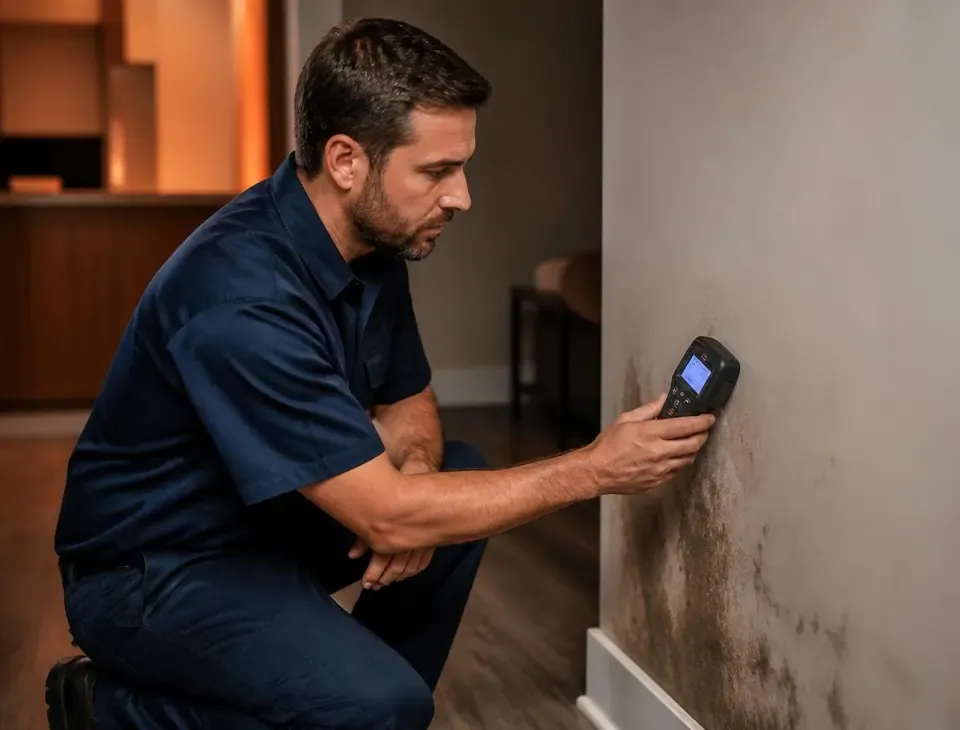
The pattern across all six places is the same: water arriving slowly, material staying damp, and no airflow. That is why the removal process below always starts with the moisture source. A crew that begins by spraying and wiping, without a meter in hand and a plan for the leak, is treating the wallpaper. The growth will be back on the new paint within the season, and you will have paid twice for the same wall.
The process
How professional mold removal works, stage by stage
The method on this page follows the EPA mold guidance used across the industry, Chapter 3 and its Table 2, adapted to New York licensing law. Six stages, in order, every time. Skipping a stage is how spores end up in clean rooms and growth ends up back by spring.
Stage one: assessment and the work plan
A licensed mold assessor, independent of the crew that will do the removal, inspects the property. The assessor identifies the moisture source, measures the affected area, probes walls and floors with moisture meters, and writes the work plan: what material comes out, what gets cleaned in place, what containment level the job needs, how the air will be filtered, and how the finished work will be verified. In New York this separation is not a courtesy; Labor Law Article 32 forbids the same licensee from assessing and removing on the same property. The plan protects you twice: the scope is written by someone who does not profit from making it bigger, and your insurer, landlord or buyer gets a document instead of a sales pitch.
Stage two: fix the water first
No removal holds while the material stays wet. The leaking riser, the failed shower grout, the sweating cold water line, the roof detail above the ceiling stain: the source is repaired or isolated before or alongside the removal. The EPA guidance puts moisture control at the centre of every job for a plain reason. Mold spores are everywhere, indoors and out, all the time. What turns them into a colony is a damp surface that stays damp. Dry the surface and keep it dry, and the colony cannot restart.
Stage three: containment and negative air
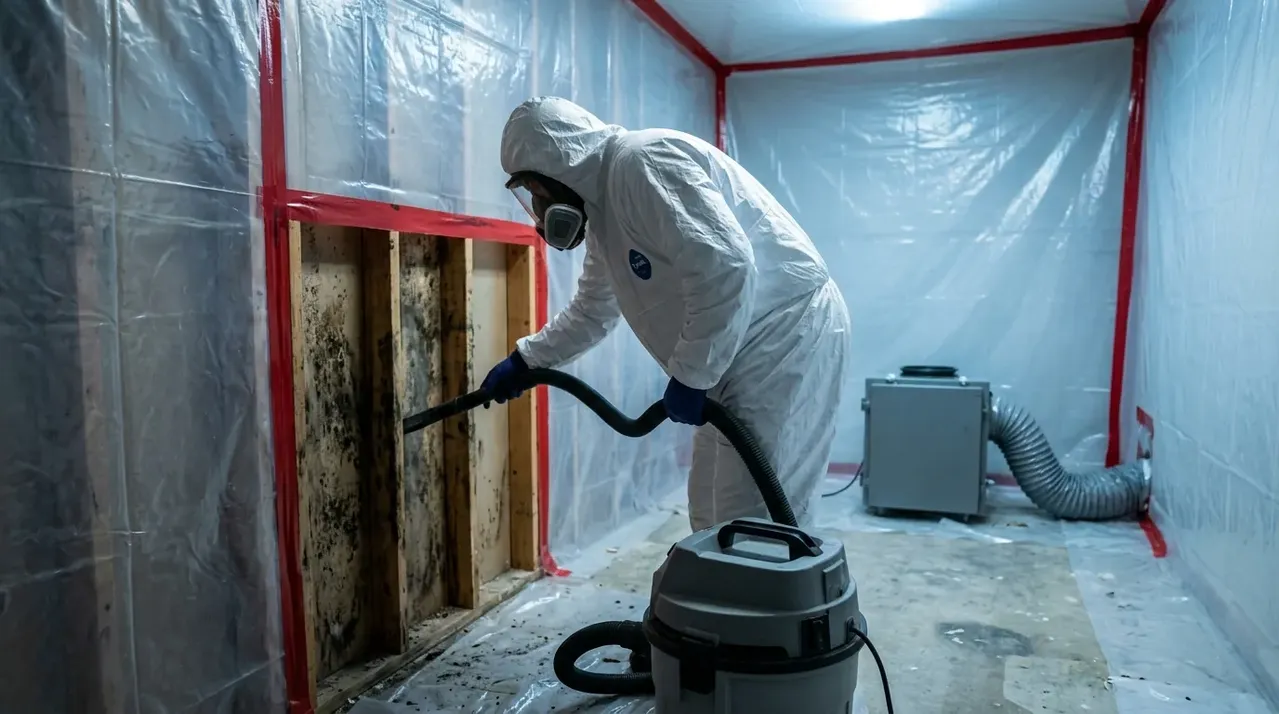
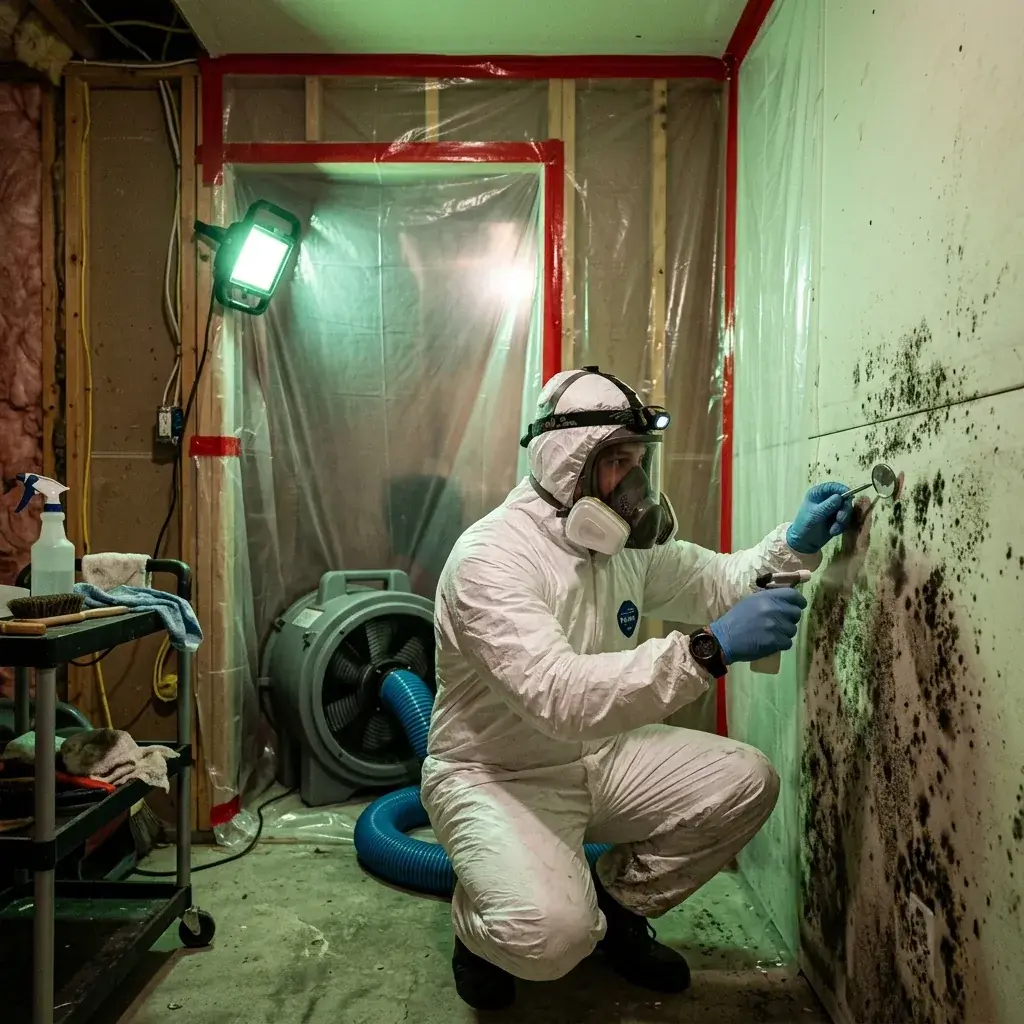
The work area is sealed with polyethylene sheeting. Doorways and vents are blocked, and a negative air machine with HEPA filtration pulls air out of the sealed zone so that air always flows inward and spores released by cutting and bagging are captured by filters instead of drifting through your home. The EPA sets two containment levels by area: limited containment for 10 to 100 square feet, full containment above 100 square feet, with the details in the table below. Workers inside wear gloves, eye protection and respirators, and material leaves the zone bagged, never carried loose through clean rooms.
Stage four: removal of what cannot be saved
Porous material that mold has grown into is not cleaned; it is removed. Carpet and padding, drywall, insulation, ceiling tiles and swollen fibreboard come out inside the containment, cut in manageable sections, misted or handled to keep dust down, and sealed in heavy bags. This is the stage homeowners resist and the stage that decides whether the job works. Washing the surface of moldy drywall leaves the growth inside the sheet untouched, feeding on the paper backing, ready to spot through fresh paint. Out is out; there is no honest shortcut.
Stage five: cleaning what can be saved
Hard and semi porous surfaces, framing timber, concrete, masonry, metal and tile, are cleaned in place: HEPA vacuuming to lift spores and fragments, scrubbing with detergent and water, and careful drying. The aim is physical removal, not chemical warfare. Most household products marketed as mold killers are unnecessary for this stage, and strong chemicals inside a sealed work zone add fumes without adding results. Where bleach has a role at all, it is the narrow one the CDC describes, covered in the cleaning section below.
Stage six: drying and verification
With removal and cleaning done, the structure is dried with dehumidifiers and air movement until moisture readings show each material back at its dry standard. Then the job is verified against the EPA closing points: the moisture problem is fixed, no visible mold remains, there is no mold smell, any sampling compares indoor results with outdoors, a revisit finds no new growth, and the occupants report no ill effects from the area. Only then does containment come down and the room go back to normal use. The verification is written down, and that paper closes the job.
| Job size | Containment | What it involves |
|---|---|---|
| About 10 square feet or less | Home cleanup range | Detergent and water on hard surfaces, gloves and eye protection, fix the moisture source, dry fully. No containment normally needed. |
| 10 to 100 square feet | Limited containment | Polyethylene sheeting seals the work area, vents and doorways blocked, negative air with HEPA filtration, surfaces covered, bagged waste out. |
| More than 100 square feet | Full containment | Full sealed enclosure with airlock style entry, negative pressure maintained and monitored, full protective equipment, decontamination on exit. |
Those bands are why two quotes for the same apartment can describe different amounts of plastic, machinery and labour and both be honest: they may be written for different measured areas. It is also why the measured area in the assessor plan is the most important number in the whole job. Everything, containment, crew size, disposal, drying time, hangs off it.
Services
What a complete mold removal service includes
Fifteen services make up the full offer behind this page. Some jobs need three of them; a flooded floor of a building can need all fifteen. Each one is described the way it should appear in a written scope, so you can check any quote against it line by line.
Emergency mold removal
Fast response when growth follows a flood, a burst pipe or a sewage backup, at any hour. The first visit secures the area, stops the spread and starts drying; the full removal follows the assessor plan.
Mold inspection and assessment
The licensed assessor visit: moisture mapping, area measurement, source identification and the written work plan that New York law builds every larger job on.
Black mold cleanup
Removal of dark Stachybotrys type growth from drywall, ceiling tile and other high cellulose material, with the same containment and verification as any other mold, because the law and the CDC treat all molds alike.
Mold containment and negative pressure
Polyethylene enclosures sized to the job, limited or full containment by area, with negative air machines holding inward airflow from first cut to final clean.
HEPA air filtration and cleaning
HEPA filtered air scrubbing during the work and HEPA vacuuming of surfaces after it, so spores and fragments are captured rather than redistributed around the home.
Porous material removal and disposal
Carpet, padding, drywall, insulation and ceiling tile cut out inside containment, double bagged in 6-mil polyethylene and carried out as ordinary construction waste.
Hard surface mold cleaning
Detergent scrubbing and drying of framing, concrete, masonry, metal and tile that can be saved, the cleaning stage that follows removal in every complete scope.
Structural drying and dehumidification
Commercial dehumidifiers and air movers run until every material reaches its dry standard, the stage that decides whether the mold can come back.
Moisture mapping with daily readings
Meter readings across walls, floors and cavities, recorded daily during drying, so progress is a number on paper and not a guess at the door.
Wet wall and ceiling drying
Targeted drying of wall cavities and ceiling assemblies, including controlled opening where a cavity cannot dry closed, always measured against the dry standard.
Carpet and padding removal
Flooded or moldy carpet and pad lifted, bagged and removed, with the subfloor beneath cleaned, dried and read with a meter before any new floor is discussed.
Contents cleaning and sanitizing
Hard contents cleaned and HEPA vacuumed; honest advice on the soft furnishings that stayed wet too long to save, item by item, in the work plan.
Antimicrobial treatment
Surface treatment of cleaned framing and cavities where the assessor plan calls for it, as a finishing step on clean, dry material, never as a substitute for removal.
Insurance claim documentation
The paper trail insurers actually read: dated photos, the assessor report, moisture logs, scopes and invoices, assembled as the job runs rather than reconstructed later.
24/7 emergency response
Crews on call around the clock across the five boroughs, because the burst riser and the flooded basement do not wait for business hours, and neither does mold.
When you compare companies for mold removal nyc work, hold their scope against this list. The missing lines are where the trouble hides: no containment, no drying readings, no verification, no disposal. A cheaper quote that skips three stages is not cheaper; it is a second job waiting to be sold to you in the spring.
Not sure which of these your home needs?
Describe what you see and where it is, and you will be told plainly which stage your job starts at and whether it sits above or below the 10 square foot line. The assessment sorts the rest.
Do it yourself, or call
The 10 square foot line: when home cleaning is enough and when it is not
Both the EPA and the New York State Department of Labor draw the same line at about 10 square feet. Below it, a healthy adult with detergent and patience can handle a patch. Above it, the job changes kind: containment, filtration, licensing and disposal all come into play.
Home cleaning done well looks like this. Fix the leak or the condensation first, or accept that you will be cleaning the same spot monthly. Ventilate the room. Wear gloves and eye protection, and a dust mask if the patch is near the top of the range. Scrub hard surfaces with detergent and water, rinse, and dry the area completely, with a fan and time, not just a towel. Throw away sponges and cloths afterwards. Never paint over a patch to hide it; paint seals moisture in and feeds the growth behind the film, and the next person to open that wall inherits a worse problem.
Home cleaning done badly is worse than none. Dry brushing or sanding a patch launches spores across the room. A fan pointed at the growth does the same with enthusiasm. Spraying bleach across a large area fills the room with fumes while the growth inside the drywall stays untouched. And the most common failure of all: cleaning the visible spot while the pipe inside the wall keeps dripping, so the colony regrows from the inside out and the stain returns darker.
Call a professional when any of these are true. The area is bigger than about 10 square feet, or it keeps coming back after cleaning. The growth is inside a wall, a ceiling, heating ducts or under flooring. The material is carpet, drywall or ceiling tile that has stayed wet. Anyone at home has asthma, a mold allergy, a weak immune system, or is a baby or an older person. The mold followed a flood or a sewage backup. Or the property is a rental, a co-op or a building where New York licensing and city rules apply, which in practice means most apartment buildings in the city. Professional mold removal nyc crews exist for exactly this side of the line.
One more boundary worth knowing: the 10 square foot line is also a legal line in New York. A mold project larger than that, done for hire, is work under Labor Law Article 32 and needs licensed people, with the assessor and the removal company independent of each other. The licensing section below explains the five licenses and what they mean for you as the person signing the scope.
Black mold
Black mold, without the panic and without the myths
Black mold removal nyc searches spike after every flood, usually driven by fear. The facts from the CDC are calmer and more useful than the headlines: the dark mold people mean is usually Stachybotrys, it needs constant moisture, and it is removed exactly the way every other mold is removed.
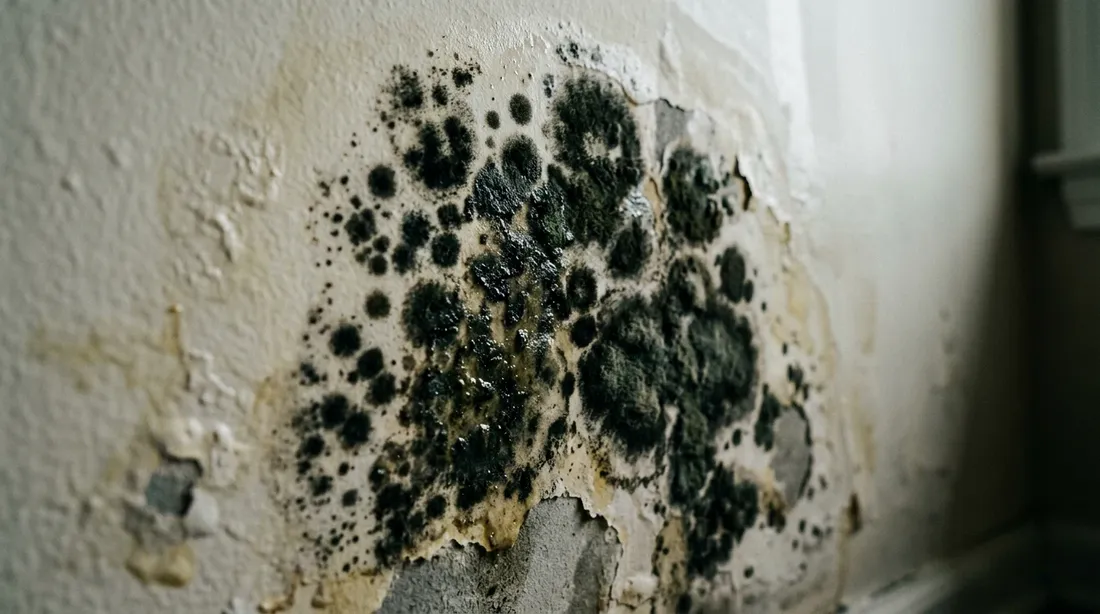
Stachybotrys grows on material with high cellulose content, the paper facing of drywall, ceiling tiles, wood and fibreboard, and only where that material stays wet for a long time: a chronic leak, a flooded wall never dried, a condensation problem measured in months. It is not the mold behind most bathroom grout spots, which are usually faster growing species on damp surfaces. A lab can name the species from a sample, but the name changes nothing about the work, which is why agencies do not build their guidance around testing.
Two claims need correcting plainly, because they frighten people and sell bad services. The first is that black mold has been proven to cause bleeding lung disease in infants. The CDC reviewed that reported link and found it not proven. The second is that a blood or urine test can prove your symptoms come from mold in your home. No such test does that, and the Institute of Medicine review found the evidence for many claimed effects insufficient. What is established is the everyday list: allergic and irritant reactions, worse asthma, and respiratory symptoms in sensitive people. That is reason enough to remove it, without inventing worse.
The practical conclusion the CDC itself draws: treat all molds the same, for health precautions and for removal. There is no separate black mold rule in New York law, no special chemical, and no reason to pay a fear premium. What a Stachybotrys colony does tell you is that the material has been wet for a long time, so expect the scope to include finding and fixing that long running moisture, and expect more porous material to come out than the surface patch suggests.
Health
What mold does to health, from the agencies that study it
This page uses the EPA and CDC lists and nothing else. Where a popular claim has no authority behind it, the page says so, because frightened people make rushed decisions and rushed decisions are expensive.
The EPA describes mold exposure reactions as allergic responses: sneezing, a runny nose, red eyes and skin rash, along with irritation of the eyes, skin, nose, throat and lungs in both allergic and non allergic people. The CDC adds coughing, wheezing and upper respiratory symptoms, and notes stronger effects in people with asthma, where mold can trigger attacks, and in people with weakened immune systems, where certain molds can infect the lungs. Symptoms usually ease away from the exposure, which is one reason a holiday can feel like a cure and the first night home is the diagnosis.
Now the correction this page owes you. A popular search asks for the ten warning signs of mold toxicity. No such list exists from the EPA, the CDC, the state health department or the city health department. The phrase lives on commercial blogs. One state source, the Department of Labor mold FAQ, lists severe symptoms reported in high exposure cases, including headache, fatigue, nausea, memory problems, mood swings and fever, while the EPA notes that symptoms beyond allergic and irritant effects are not commonly reported. Both things can be read honestly: heavy, prolonged exposure is miserable and worth ending fast, and a numbered list of ten signs is marketing, not medicine.
What to do with symptoms is simple. See a doctor or clinician about the symptoms themselves, especially breathing trouble, asthma that is worsening, or any symptom in a baby or an immune compromised person. Tell the clinician about the mold and the timeline. Then remove the exposure: the growth and its moisture source. Medicine treats the person; removal treats the cause; neither substitutes for the other, and any company that offers to diagnose your health from a wall patch should be shown the door.
Children, asthma and older homes. New York City health rules treat mold as an indoor allergen hazard in homes with children, which is why Local Law 55 puts yearly inspection duties on owners of buildings with three or more apartments. If a child in the home has asthma, treat any visible growth as urgent, keep the child out of the affected room, and push the landlord in writing the same day.
Cleaning and disposal
Bleach, detergents and the bin: what actually leaves the building
Cleaning chemistry is where mold advice goes wrong most often. The agency guidance is narrower and duller than the internet version, and it works better.
Detergent and water do most of the honest work. On hard surfaces, scrubbing with detergent physically lifts and removes growth and the film it lives in; rinsing and complete drying finish the job. The EPA guidance for small areas is built on exactly this. Antimicrobial products have a finishing role on cleaned framing and cavities when the assessor plan calls for one, but no spray replaces removal of moldy porous material, and no spray fixes a leak.
Bleach has one narrow, specific place. The CDC gives a household solution of no more than 1 cup of household laundry bleach in 1 gallon of water, for hard, non porous surfaces, with the area ventilated, gloves and eye protection worn, and one rule in capital letters in everything but typeface: never mix bleach with ammonia or with other household cleaners, because the fumes can injure or kill. On porous material, bleach is the wrong tool: its water soaks in, its active part stays near the surface, and the growth deeper in the drywall or wood survives to reappear. That is a chemistry limit, not a brand limit.
Disposal is unglamorous and regulated by common sense rather than ceremony. Moldy porous material, carpet, padding, drywall, insulation, ceiling tiles, is bagged inside the containment, the EPA guide specifies double bagging in 6-mil polyethylene for larger work, sealed, and carried out through the building as ordinary construction waste. It is not hazmat; it does not need a special truck; it does need to leave sealed, not loose in the chute or the hallway. In apartment buildings, a good crew books the service elevator, protects the route, and leaves the common areas cleaner than the job found them, which is a detail your neighbours and your board will judge the whole company by.
What stays is cleaned, not just wiped. Framing and hard surfaces are HEPA vacuumed to capture spores and fragments, scrubbed, and dried. Contents get the same honest sorting: hard furniture usually cleans up well; mattresses, sofas and soft furnishings that stayed wet and grew mold usually cannot be made trustworthy again, and a straight assessor will tell you that in the plan instead of charging you to store them and telling you in a month.
Your six steps
What to do, in order, from the moment you find it
No competitor page in this city lays out the homeowner side as a clear sequence, so here it is. Six steps, in the order they actually happen, matching the way a job runs from your first phone call to the final verification.
1Call now and describe the mold you see
Call (212) 555-0147 and describe where the growth is, roughly how large the area looks, when you first noticed it, and whether water is still arriving from a leak, a flood or condensation. Say whether anyone at home has asthma or breathing trouble. That description sets the urgency, the crew size and whether containment gear comes on the first visit, and it costs you nothing but the call.
2Stop the water at its source and keep the area closed
Turn off the valve feeding a leaking pipe or appliance, or call your super or landlord to do it, and shut the door of the affected room. Keep children and pets out. Do not aim a fan at the patch and do not start ripping material out; both spread spores through the home. Photograph everything, including the leak, before anyone cleans, because those dated photos anchor insurance claims and landlord disputes alike.
3Get a licensed assessor to map the mold area
A licensed New York mold assessor inspects the property, takes moisture readings across walls and floors, measures the affected area and writes the work plan. The assessor is independent of the removal crew by law, so the scope you are given is a measurement, not a sales document. The plan states what comes out, what is cleaned, what containment the job needs and how the result will be verified.
4Contain the area and set negative air pressure
The crew seals the work zone with polyethylene sheeting, blocks vents and doorways, and runs a negative air machine with HEPA filtration so air flows into the zone and out through filters. Limited containment covers jobs from 10 to 100 square feet; larger jobs get full containment. This is the stage that protects the rest of your home while the moldy material is disturbed.
5Remove moldy materials and clean every hard surface
Inside containment, porous material that cannot be saved, carpet, drywall, insulation and ceiling tile, is cut out, double bagged in 6-mil polyethylene and carried out sealed. Framing, concrete, masonry and tile are HEPA vacuumed, scrubbed with detergent and dried. Workers wear gloves, eye protection and respirators throughout, and nothing leaves the zone loose.
6Dry the structure and verify the mold is gone
Dehumidifiers and air movers dry the structure until moisture readings show every material at its dry standard, with readings recorded as the job runs. The finished work is then checked point by point: source fixed, no visible mold, no smell, any sampling in line with outdoors, no regrowth on revisit, and no ill effects reported. You get that verification in writing, and the room goes back to normal use.
Emergencies
Emergency mold removal in NYC, at the hours mold actually happens
Emergency mold removal nyc work starts with water at the worst hour: the riser that bursts at two in the morning, the basement found flooded on a Sunday, the ceiling that starts spotting over a nursery the night before a holiday. The response is built for those hours, not for office hours.
The first emergency visit has four jobs, in this order. Stop the water, or confirm it has stopped. Close off and, where growth is already present or material is saturated, contain the affected area so spores and dust stay put. Set air filtration if the area is occupied nearby. And start drying, because every hour of drying in the first day is worth several later. Full removal then follows the assessor plan in normal stages. Splitting the work this way is not a delay tactic; it is the sequence that keeps a bad night from becoming a bad month.
Callers in an emergency usually ask two things: how fast, and what will it take. How fast depends on where you are in the five boroughs and what is already on the road, and you will be told honestly on the call rather than promised a number that sounds good. What it takes depends on the measured area and the material involved, which is why the assessor visit follows the emergency work as soon as the scene is stable. What never changes is the order: water, containment, air, drying, then removal to the plan.
Mold emergency right now?
Crews answer around the clock for emergency mold removal nyc calls across Brooklyn, Queens, Manhattan, the Bronx and Staten Island. Stop the water if you safely can, close the room, and make the call.
Borough by borough
Mold removal across the five boroughs and the neighbourhoods between
The service area is the whole city: Brooklyn, Queens, Manhattan, the Bronx and Staten Island, plus the neighbourhoods where calls cluster, Long Island City, Flushing, Jamaica, Harlem, the Upper West Side, the Upper East Side, Astoria, Williamsburg, Park Slope and Riverdale. Each borough grows mold its own way.
Brooklyn: brownstones, basements and garden levels
Park Slope and Williamsburg calls lean heavily on garden level and cellar flooding, brownstone plumbing stacks, and bathrooms added where no bathroom was designed to be. Old joists and plaster hold moisture for weeks. Brooklyn jobs often start as a smell in a basement apartment and end as a stack leak three floors up, which is why the assessment walks the whole line of the building, not just the room that called.
Queens: the most varied housing stock in the city
From Astoria pre-war apartments to Flushing and Jamaica houses, Queens mixes every building type the city has. Basement flooding after heavy rain, laundry leaks in converted spaces, and flat roof leaks over top floor bedrooms dominate. Detached and semi detached houses give crews easier containment and drying than apartment stacks, but the below grade rooms need the same discipline: porous material out, real dehumidification, readings on paper.
Manhattan: co-ops, stacks and board rules
Harlem, the Upper West Side and the Upper East Side work runs through co-op and condo rules: board notification, licensed and insured crews, service elevator bookings, work hour limits. The mold itself follows the stacks, bathroom over bathroom, kitchen over kitchen, in pre-war plaster that hides growth well. Manhattan jobs reward paperwork as much as plastic: the assessor plan and the verification note are what the board and the managing agent will ask for.
The Bronx: pre-war risers and steam heat
Riverdale houses and the borough's big pre-war apartment buildings share a pattern: riser leaks, steam system condensation, and closet growth on cold outside walls through the heating season. Large buildings mean Local Law 55 duties are squarely in play, and tenants here should know the 311 route cold. Crews plan Bronx apartment work around occupied neighbouring units, with containment that respects a hallway full of families.
Staten Island: storm water and raised houses
The Island's mold story is water from outside: coastal storms, heavy rain on below grade rooms, and the long damp that follows in houses near the shore. Post storm work follows the flood rules: saturated porous material out, structure dried to standard, verification before rooms close up again. Staten Island homeowners also meet the insurance documentation question more than most, which the insurance section below answers in full.
Long Island City and the growth corridors
New towers in Long Island City grow a newer kind of mold problem: construction moisture, tight modern envelopes, and HVAC condensate in buildings where a single system serves many homes. Growth shows around vents, in closets and behind built in joinery. The fix leans on the building systems as much as the apartment, and the documentation goes to building management as a matter of course.
Wherever the call comes from, the method does not change: assess, fix the water, contain, remove, clean, dry, verify. What changes is the building wrapped around the method, its age, its rules, its neighbours, and a good crew plans for the building before it plans for the wall.
Drying and proof
Drying to a standard, and the verification that closes the job
Removal is the visible half of the work. Drying is the half that decides whether you ever see the crew again. A room can look finished and still hold a wet wall cavity, and a wet cavity is a colony on a timer.
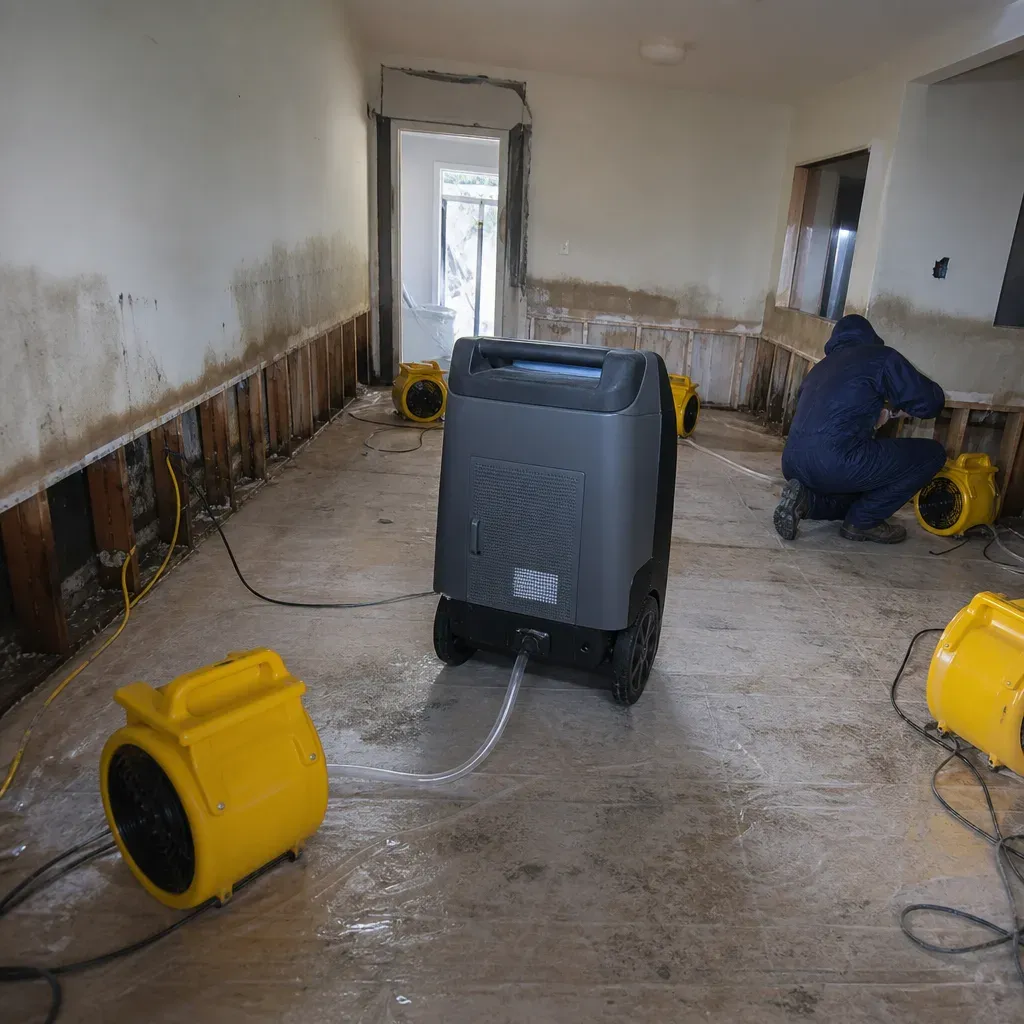
Drying is measured, not timed. Each material has a dry standard, the moisture level it sits at in a normal, unaffected part of the same building, and the crew dries until readings match it. Wood framing, drywall, plaster and subfloor each read differently, and a wall cavity can lag days behind the room air. Daily readings go on paper. That log is not bureaucracy: it is the evidence that the structure was dry when the walls closed, the document your insurer wants, and the baseline if anyone disputes the job later. Industry drying practice, including the IICRC S500 and S520 standards the trade works to, is built on this same principle of measured dryness; S520 is an industry standard, not a government rule, and this page treats it that way.
Verification then closes the loop. The six checks from the EPA guide are applied one by one and written down: moisture source fixed, no visible mold, no mold odour, sampling in line with outdoors where sampling was done, no regrowth at revisit, and no ill effects reported by the people who live with the result. If a check fails, the job is not finished, whatever the calendar says. When you hire for mold removal nyc work, ask on the first call what the company hands you at the end. The answer should be the readings and the verification, in writing, without you having to chase them.
New York mold law
Article 32: the state license behind every legal mold job
New York regulates mold work more tightly than most states, and the rules protect the customer as much as the worker. If you hire mold work in this state, this is the law your job runs under.
Mold licensing sits in Labor Law Article 32. The statute took effect on 28 July 2015, and licensing has applied since 1 January 2016. It covers mold projects, defined as work on an area of mold larger than 10 square feet, and it defines the regulated work broadly: assessment, removal, cleaning, sanitizing, containment and the handling of mold contaminated material all fall inside it. If the job you are hiring passes that size line, the people doing it need state licenses. Ask for them, and check them; a legitimate company expects the question.
The law creates five licenses across the trade: mold assessor, mold removal supervisor and mold worker among them, covering the people who inspect and plan, the people who run jobs, and the people who do the hands on work. Licenses are valid for two years. Licensees must carry liability insurance of at least fifty thousand dollars. None of this is decoration. It means the person measuring your wall has passed a state process, the company carries insurance you can claim against, and there is a regulator to complain to if the work goes wrong.
The rule with the sharpest teeth is separation. Under section 936 of the law, no licensee may perform both mold assessment and mold removal on the same property. The assessor who measures your job and writes the work plan cannot be the company that profits from carrying it out. That single rule kills the oldest trick in the trade, the free inspection that always finds the biggest possible job, and it is why this page keeps returning to the independent assessor plan. When a company offers to assess and remove in one visit with one signature, it is offering you a process the state has banned.
There are exemptions, mainly for owners working on their own property, including owner occupied homes in defined circumstances. Those exemptions cover do it yourself work; they do not license a handyman to run unlicensed mold jobs for paying customers. If you are a landlord, a co-op board or a property manager, the exemption talk is a risk, not a saving: your duties under city law, covered next, assume licensed professionals on any job past the small patch line.
Local Law 55: the landlord's yearly duty in buildings with three or more homes
Local Law 55 of 2018 made mold an indoor allergen hazard under city housing law. Owners of buildings with three or more apartments must inspect every home each year for allergen hazards including mold, and correct what they find, together with the moisture condition underneath it. A paint over does not satisfy the law; the leak, the condensation, the failed seal behind the growth is part of the correction.
Where the building has 10 or more homes and the mold covers 10 square feet or more, the law steps up: the assessment and the removal must be carried out by licensed mold professionals, and the assessor and the removal company must be independent of each other, mirroring the state rule. Tenants enforce all of this through 311. A complaint brings a Department of Housing Preservation and Development inspector, and a confirmed problem becomes a violation against the owner. Violations are classed by severity, class A, B and C, with correction windows of 90 days, 30 days and 21 days respectively. The classes and clocks are why written notice plus a 311 paper trail moves landlords who ignore phone calls.
Local Law 61: the building level paperwork for large properties
Local Law 61 of 2018 is the Department of Environmental Protection side of the system. It applies to buildings with 10 or more dwelling units, and to non residential buildings of 25,000 square feet or more. For covered mold work, a work plan is filed with the department before the job starts and a completion form after it ends. The department enforces that paperwork; it does not inspect your bathroom or clean your walls, and tenants should not wait for it to do so. Penalties under the law run from eight hundred to ten thousand dollars. For owners and managers of large buildings, Local Law 61 is the reason the assessor plan and the completion record exist as formal documents rather than emails: they are filings, and they should be kept like filings.
NYCHA homes: the Mold Busters program
Public housing runs on its own track. NYCHA's Mold Busters program was created under the 2018 Baez consent decree and the 2019 federal housing agreement, and it covers NYCHA residents only. If you live in NYCHA housing, report mold through the MyNYCHA app or website, or call NYCHA on 718-707-7771. Keep the ticket number. If the response stalls, the independent Ombudsperson for NYCHA mold matters can be reached on 1-888-341-7152 or through ombnyc.com, and 311 also accepts NYCHA complaints. Private tenants should not be sent down this route; it will not reach their landlord. Your route is the tenant section next.
Tenants and landlords
Mold in a rental: your rights, in the order to use them
Tenant questions are the most common ones this page answers, and the most myth ridden. The rules below are the verified ones, including the rent question, where the honest answer is narrower than the internet version and stronger for being true.
Step one: written notice, kept
Tell your landlord or management company about the mold in writing, email is fine, and keep a copy with the date. Describe where it is, how big, when you noticed it, and any leak or water event connected to it. Attach your photos. Written notice starts every clock that matters: the landlord's duty to act, your 311 complaint, and any court proceeding later. A phone call starts none of them, which is why so many mold disputes turn on a letter one side swears it sent.
Step two: 311 and the inspection
If the response is slow, vague or a promise to paint over it, call 311 and file a complaint. The housing department can inspect and issue a violation that orders the owner to correct the mold and its moisture source, with the correction windows described in the Local Law 55 section. In buildings of 10 or more homes with 10 or more square feet of mold, the correction itself must use licensed, independent assessor and removal professionals. Rent regulated tenants have an additional route: a decrease in services complaint to the state housing agency, Homes and Community Renewal.
Step three: Housing Court, the HP action
If the violation does not move the work, tenants can start an HP proceeding in Housing Court, asking a judge to order the repairs. It begins with an Order to Show Cause and a Verified Petition, and the court can set deadlines and consequences that a complaint cannot. Legal help matters here; the Legal Aid Society and the court help centres exist for exactly this. Many landlords settle the repairs once an HP case is filed, because a judge's order is a different conversation from a tenant's request.
The rent question, answered straight
There is no blanket right to refuse to pay rent because there is mold. Anyone who tells you otherwise is handing you a court case. The real rules are these. The warranty of habitability, Real Property Law 235-b, guarantees safe and livable conditions and cannot be waived in a lease, so the duty to fix mold and its moisture sits with the owner. A different section, Real Property Law 227, is about surrender: rent is excused only where a tenant actually gives up an untenantable home, which is a moving out rule, not a withholding rule. Between those poles, the Legal Aid Society advises that a tenant may withhold rent after giving notice, but must keep the withheld money set aside and unspent, and must expect the landlord to start a non payment case, where the missing repairs are raised as a defence and a rent reduction, called an abatement, can be sought. That is a legal strategy with real risk, to be run with a lawyer's advice, not a slogan. Note also that no standalone rent escrow procedure was verified for New York City in the research behind this page, so this page does not offer you one.
For landlords and property managers
Owners reading this page usually arrive after a complaint, which is already late. The economics are plain: a contained patch handled under Local Law 55 with licensed professionals is a maintenance line; the same patch after a violation, an HP action or a child's asthma claim is a legal file. Build the boring system instead. Yearly inspections done and documented. Leaks treated as mold prevention, with drying verified by meter rather than by touch. A standing relationship with an assessor and a removal company that are independent of each other, so a scope can be written the day a complaint lands. And a rule for your own staff: nobody paints over mold, ever, because the photograph of the paint over is the exhibit that loses the argument. Managers of buildings with 10 or more homes should treat mold removal nyc compliance as a calendar discipline: Local Law 55 duties yearly, Local Law 61 filings per job, records kept like tax records.
Insurance
Insurance and mold in New York: what the regulator actually says
Insurance answers online are usually written by people selling something. The answer below is the one from the New York State Department of Financial Services, the agency that regulates insurers in this state, quoted in substance and without decoration.
The department's position, from its own guidance to homeowners, is that mold damage is covered when it results from a covered event, that many policies contain a mold limitation, and that you should review your policy language to understand what applies to you. Read that slowly, because every word is load bearing. The covered event is the burst pipe, the storm, the appliance failure that your policy insures. Mold that follows from it rides on that event. Mold from a leak that dripped for a year, from humidity nobody managed, or from a flood in a home with no flood cover, is a different and harder conversation.
Two common claims do not survive contact with the source. The first is a universal dollar figure for mold cover in New York. The department states no such figure; limitations are written into individual policies, in different amounts and forms, which is why this page prints none. The second is the idea of a regulator opinion that blesses mold claims whenever mold follows water. The department opinion sometimes cited for that, from 2003, concerns mold exclusions, not a causal link promise, and it should not be quoted as one. Your policy, your event, your paperwork: those three decide your claim.
Which brings the practical part. Insurers pay documented claims. Dated photographs of the mold and of the water source, taken before cleanup. The assessor report tying the growth to the event, with dates. Moisture readings during drying. The removal scope and invoices. Your own log of calls, with names and times. The final FAQ on this page lists the folder in full. Build it from day one, because reconstructing it in month three is how covered events turn into denied claims.
Two more regulator details worth your time. On testing: the department does not treat a mold test as a separate benefit, and as the health section notes, the CDC does not recommend routine testing anyway; spend the money on removal and drying, and let the assessor report carry the evidentiary weight. And if a claim is denied or stalls, the department itself is your escalation route: consumer help on (800) 342-3736, and the disaster hotline on (800) 339-1759 after storms and floods. Those are the correct New York numbers, and they are staffed for exactly your situation.
Claim running alongside the cleanup?
Ask for the documentation package as part of the job, not after it: photos, assessor plan, daily moisture readings, verification note. Crews who do mold removal nyc work for insured homes assemble it as they go.
Choosing a company
How to choose a mold removal company in NYC without getting sold
The research behind this page read the companies ranking for this search, their pages and their structured data. The strongest competitor marks up 20 frequently asked questions; most mark up none, and not one of the fifteen pages checked offers a step by step HowTo. You cannot see their licenses from a search result, though. These are the checks that separate a licensed operation from a marketing one.
- Ask for the license. New York mold work past 10 square feet needs Article 32 licensed people. Ask which license the company holds and who the licensed assessor on your job will be. Hesitation here ends the conversation.
- Ask who assesses. The assessor must be independent of the removal crew on your property. A company that inspects, scopes and removes in one motion is describing a banned arrangement, not a convenience.
- Read the scope for the stages. Containment level, negative air and HEPA filtration, porous material out and bagged, hard surfaces cleaned, drying with daily readings, verification in writing. Missing stages are not savings; they are the sequel.
- Ask about the moisture source. A company that quotes removal without asking what leaked, and how it will be fixed, is selling you a recurring subscription to the same wall.
- Ask how waste leaves. Sealed bags, a protected route, the service elevator booked. In a co-op or a large rental, this answer tells you whether the company has actually worked in buildings like yours.
- Ask what you hold at the end. Readings and a verification note, in writing, as part of the job. If the paperwork costs extra or does not exist, price that into your decision.
- Refuse the fear pitch. Pressure built on worst case health claims, a discount that expires today, or a firm price quoted before any assessment: each one is a reason to call the next company. The agencies' actual health guidance is on this page; compare the pitch against it.
Cost questions deserve their own word here, because they dominate the searches this page answers. Three of the questions people ask Google most about this service are price questions, and this page answers them in the FAQ without figures, on purpose. A price for mold work is real only when it is attached to a measured area and a written scope. Companies that publish a confident figure for your unmeasured wall are telling you what their marketing costs, not what your job does. Judge quotes against each other scope by scope, stage by stage, and the honest one usually identifies itself.
Case studies on video
Two filmed jobs, and what to watch for in each
Reading about containment is one thing; watching a crew build it is another. These two short videos, the same pair used on this site's mold timeline page, show real removal work. They are linked, not embedded, so this page stays fast; each opens on YouTube.
Case study one: the quick look
This short film, under a minute, shows a contained removal in progress: plastic up, protective suits on, material coming out. Watch the edges of the frame. The containment is sealed before any wall opens, the worker's protection is full suit and respirator rather than a paper mask, and the waste is bagged inside the zone. Those three details, visible in seconds, are the difference between removal and redistribution.
Case study two: the fuller walkthrough
The longer video walks through a job with commentary, from the state of the room at arrival to the cleaned, drying structure. Listen for how the crew talks about the moisture source and the drying readings, not just the removal. Jobs narrated around water and measurement are run by people who expect the mold to stay gone; jobs narrated around sprays and fogging usually are not.
Use both films as a measuring stick when a crew describes its own process on the phone. If the description you hear matches what the camera shows, sealed containment, protected workers, bagged waste, measured drying, you are talking to people who do the work the standard describes. If it does not, you have learned something worth the price of the call.
From real threads
What New Yorkers actually ask each other about mold
Beyond the search data, the research for this page read the questions people post to each other on Reddit, Quora, WikiHow and community forums, and the gaps in the answers given by the big AI assistants. The same worries recur, in the asker's own words, paraphrased here with the answers this page stands behind.
My landlord keeps painting over the bathroom mold. Is that legal?
It is the single most common rental complaint in the threads, and no: painting over growth without fixing the moisture does not meet the owner's duty under the warranty of habitability or Local Law 55. Photograph the patch each time it returns, keep your written notices, and let a 311 inspection create the record. Paint is not remediation, and inspectors know the look of it.
The mold is in my closet and on my shoes. Do I throw everything out?
Not everything. Hard items clean and HEPA vacuum well. Leather and fabric that spotted lightly often clean up once the room is dry and the wall behind the closet is dealt with. What usually cannot be saved is soft material that stayed wet and grew through, mattresses, padding, stuffed items. Fix the closet's cold wall condensation problem too, or the spots return next winter on whatever you buy to replace them.
Our co-op board wants certificates before any work. What should exist?
A licensed assessor, a licensed removal company independent of the assessor, liability insurance of at least fifty thousand dollars under the state mold law, and in practice the larger cover buildings require, plus the written work plan and, at the end, the verification note. Boards ask because buildings carry the risk; a company used to Manhattan work produces the packet without being chased.
The patch is small but my baby sleeps in that room.
Then treat small as urgent. Keep the baby out of the room, close the door, and get the assessment done now rather than after a home cleaning experiment. Small patches in nurseries are often the visible edge of a window or stack leak that has been feeding the wall for months. The agencies' health guidance is calm about mold in general and clear that infants and people with breathing problems are the reason not to wait.
Can I break my lease over mold?
Threads ask this constantly, and the honest answer is that it is a legal question with facts attached: how bad, how long, what notice you gave, what the landlord did. Real Property Law 227 covers surrender of a truly untenantable home; most situations resolve earlier, through violation, HP action or negotiation backed by that paper trail. Get housing advice before you sign or break anything, and build the written record either way.
How do I stop it coming back in a damp basement?
Basements recur in the threads because they recur in life. The durable answers are unglamorous: gutters and grading that move roof water away from the foundation, a dehumidifier that actually holds the room dry through summer, no carpet or cardboard against below grade walls, and a meter check after heavy rain. Removal clears the colony; water management is what retires it.
The AI assistants, tested against these same questions during research, mostly answer with national generalities: bleach recipes, generic warnings, and rent advice that would be wrong in New York. The New York answers are narrower and more useful: a 10 square foot line, a license with five categories, two local laws, a 311 inspection, and a rent rule with conditions. That gap is exactly why this page exists at the length it does.
After the job
Keeping the room mold free after the crew leaves
Verification day is not the end of the story; it is the start of the part you control. Mold needs moisture, a food surface and time. Removal took away the colony. Prevention takes away the other three ingredients, permanently.
Hold indoor humidity down. Bathrooms get real ventilation, run during the shower and for a while after, with the door routine your household will actually keep. Kitchens vent cooking steam. Dryers vent outside, full stop; a dryer dumping into a utility room is a mold machine with a lint filter. In basements and garden levels, a dehumidifier sized for the room, draining to a sink or pump rather than a bucket nobody empties, holds the line through the humid months when Queens and Brooklyn below grade rooms otherwise sit damp for weeks.
Treat every leak as a mold appointment. A dripping trap, a sweating toilet tank line, a window that weeps in January: each is small plumbing and large prevention. Dry anything that gets wet within a day or two, because the growth clock on damp material starts immediately, as this site's timeline page sets out in detail. Materials that cannot dry in that window after a real flood, carpet pad, soaked drywall, are removed rather than hoped over.
And keep the habit of looking. Once a season, walk your own home the way an assessor would: smell each room, look behind the bathroom vanity and under the kitchen sink, check the closet on the outside wall, glance at the ceiling below every bathroom. Five minutes, four times a year. Every large job in this city began as a small patch somebody meant to look at later. The whole economics of mold removal nyc work, for owners and tenants alike, is that the early version is a patch and the late version is a project.
Found something on your seasonal walk?
A photo and a phone call now is the cheapest version of this problem you will ever be offered. Crews would rather measure a patch than open a wall, and so would your wall.
Jobs we see
Sixteen jobs we see every week in this city
Patterns repeat across the boroughs. These sixteen short accounts are the calls that come in again and again, each with the detail that decided the job. Names and addresses are left out; the plumbing, you will notice, is identical everywhere.
The bathroom ceiling that spotted again
A tenant had cleaned and repainted the same ceiling patch three times. The assessor meter found the ceiling cavity wet from the shower drain one floor up. This mold removal nyc job removed one ceiling section, dried the cavity, and closed only after the upstairs drain passed a water test. The patch has not returned, because the water has not.
The closet wall in a pre-war six
Shoes spotted, then the wall behind them. A cold outside wall, a packed closet, a winter of condensation. The mold removal nyc scope here was small: clean the wall, treat the framing, and fit insulation and airflow so the wall stops sweating. The clothes were cleaned; the closet door now stays open on cold nights.
The garden level after the storm
Rain came under the door and through the foundation in the same night. Carpet, pad and the bottom of every wall stayed wet for a week before the call. This mold removal nyc job took out the porous material, dried the slab and studs to standard, and verified before the tenant moved her furniture back in.
The dishwasher that leaked for a year
The kitchen floor felt soft near the sink. Under the cabinets, the subfloor was black and the joists were growing. Slow leaks make patient mold. The mold removal nyc crew removed two cabinets, the ruined subfloor section, cleaned the joists, and dried the bay while the owner finally replaced a hose worth less than the floor.
The nursery wall under the window unit
A window air conditioner tilted inward had drained into the wall all summer. The parents found spots behind the crib. This mold removal nyc job opened the wall below the window, removed the wet drywall, and treated the room as urgent from the first call: baby out, containment up, verification in writing before the crib went back.
The stack leak nobody could locate
Three apartments, one stain each, different floors. The assessor read moisture floor by floor and found the riser joint leaking on the sixth. One mold removal nyc plan served the whole line: three contained openings, one plumbing repair, three verifications. Building problems need building answers, not three separate arguments.
The laundry room behind the machines
The smell arrived when the washer ran. Behind it, a supply hose had misted the wall for months. This mold removal nyc job pulled both machines, removed the wet wall section, cleaned the framing and dried the floor. The owner fitted steel braided hoses and a leak pan the same week.
The office that smelled on Mondays
A small commercial tenant noticed the odour after weekends. Growth was inside the wall under a roof drain that overflowed when it rained hard. The mold removal nyc work ran at night and on a Sunday: containment, removal, cleaning, drying with readings the landlord received each morning. Local Law 61 paperwork followed for the building file.
The brownstone bathroom with no vent
A beautiful old bathroom, tiled in the twenties, vented never. The ceiling spotted every spring. This mold removal nyc scope cleaned and treated the ceiling cavity, and the real fix was a fan vented outside, fitted by the owner's contractor before the ceiling closed. Beauty kept; humidity evicted.
The basement boxes against the wall
Cardboard stored tight against a below grade wall came out green. The wall behind it was growing through the paint. The mold removal nyc crew removed the ruined boxes and the affected wall section, dried the room, and left the owner with shelving, airflow and a dehumidifier that drains itself. Storage survived; the farm did not.
The co-op sale that found a surprise
A buyer's inspector flagged a smell in a rear bedroom. The seller called before the deal wobbled. The mold removal nyc assessment found a contained closet wall problem, fixed in days with paperwork the board and both lawyers could read. The sale closed on the strength of documents, not assurances.
The ceiling that fell on a Sunday
Water weighted plaster lets go without asking permission. The family called from a hotel. This mold removal nyc job began as emergency work: debris out, area contained, the flat roof leak found and patched by the roofer, then removal and drying in stages. The ceiling that went back up sits under a dry roof.
The rental the super kept painting
Four paint overs in two years, each photographed by the tenant. The 311 inspection produced a violation, and the correction required licensed hands. The mold removal nyc crew worked from an independent assessor plan while the tenant stayed in the other rooms. The file, not the paint, is what finally closed the case.
The gym locker room wall
Showers on one side, lockers on the other, and a wall that drank steam for years. The mold removal nyc plan for this commercial job phased the work around opening hours, with full containment because the area passed 100 square feet. Ventilation corrections went into the same project, or the wall would have been back within the year.
The attic nobody entered
A roof leak at a ridge line wet the attic insulation for a whole winter before a stain showed downstairs. This mold removal nyc job removed the soaked insulation, cleaned the decking and framing, and dried the space before new insulation went in. Attics forgive nothing; they just delay the evidence.
The second floor bathroom, first floor ceiling
The downstairs neighbour reported the stain; the upstairs tenant reported nothing, because their floor was dry. A failed wax ring had fed the ceiling cavity for months. One mold removal nyc plan, two homes, and a building that learned to treat the downstairs ceiling as the upstairs bathroom's alarm bell.
Room by room
Ten rooms, ten different mold habits
Every room in a New York home has its own water supply, its own materials and its own way of hiding growth. A short tour, room by room, of what crews look for first.
Bathrooms
Steam, grout, and plumbing in every wall. The mold removal nyc bathroom check starts at the ceiling, the grout lines and the vanity base, then goes behind the access panel if the readings say so. A fan that vents into the ceiling cavity instead of outside is treated as a moisture source, not a fixture.
Kitchens
Sinks, dishwashers and refrigerator lines fail quietly under cabinets. Any mold removal nyc kitchen visit pulls the toe kicks, reads the subfloor with a meter, and checks the wall behind the range hood for the condensation nobody sees. Soft flooring near the sink is a sentence, not a symptom.
Basements
Below grade rooms collect the building's water and the soil's damp. The mold removal nyc basement routine removes porous material that stayed wet, dries slab and studs to standard, and ends with a humidity plan, because a dried basement with no dehumidification is a scheduled repeat.
Bedrooms
Bedrooms grow mold at windows, in closets and behind furniture pushed tight to cold walls. A mold removal nyc bedroom call checks the wall behind the bed first when a child or an asthmatic sleeps there, and treats any growth over a sleeping space as urgent until proven small.
Living rooms
The living room usually reports somebody else's leak: the bathroom above, the facade outside, the radiator valve in the corner. Mold removal nyc work here is detective work first, following stains and readings back to a source that is rarely in the room itself.
Laundry rooms
Hoses, standpipes and dryer vents in one small space. Every mold removal nyc laundry inspection checks behind both machines and inside the vent run. A dryer venting indoors is corrected on the spot in the plan, because no cleaning survives a daily steam bath.
Attics
Roof leaks and bathroom fans venting into the space keep attics damp and dark. The mold removal nyc attic job removes wet insulation, cleans decking and framing, and dries before anything new is laid. The downstairs stain that led there is usually months younger than the growth.
Hallways and entry closets
Wet coats, umbrellas and boots feed entry closets all winter. A mold removal nyc hallway check looks at the closet ceiling for the bathroom leak above and the baseboards for the radiator weep nobody noticed. Small spaces, frequent findings.
Home offices
Converted bedrooms and basement offices hide growth behind bookcases and filing cabinets. The mold removal nyc office visit moves the furniture early, because the wall behind a full bookcase can hold the largest colony in the home while the visible room looks clean.
Commercial spaces
Shops, gyms and offices add foot traffic, paperwork and hours to the same science. A mold removal nyc commercial job plans containment around trading hours, files the building paperwork the local laws require, and verifies in writing so the space can reopen with documents, not hopes.
From the phones
Fourteen things callers ask before they book
Shorter than the FAQ, closer to the phone call. These are the questions that arrive in the first two minutes, with the answers given on the line.
Can you come today?
Usually, for the emergency stage: water stopped, area closed, drying started. Full mold removal nyc work follows the assessor plan, which is arranged on that first visit. You will be told the real arrival window on the call, not a pleasing fiction.
Do I have to move out?
Rarely for the whole job. Sealed containment lets most households stay, using other rooms. A mold removal nyc crew will say plainly when a night or two out is the honest answer, usually for one bathroom homes or a baby in the affected room.
Will it smell?
The work itself smells of plastic, detergent and dust control, not chemicals. Strong chemical fogging is not part of a standard mold removal nyc job. The musty odour you started with should be gone at verification; if it is not, the job is not finished.
What about my cat?
Pets stay out of the work area and ideally out of the home during active cutting and cleaning days. A mold removal nyc plan notes pets on the first call, because containment doors and curious cats are natural enemies.
Can you test the air first?
An assessor can sample where sampling has a purpose, a dispute, a medical request, verification. Routine testing before mold removal nyc work rarely changes the plan, which is why the CDC does not recommend it as a default. The meter and the eyes lead; the lab follows when needed.
My landlord sent his handyman. Is that enough?
For a tiny patch, perhaps. Past 10 square feet, New York law wants licensed professionals, and city law wants them independent. If the handyman visit worries you, a mold removal nyc assessment gives you a licensed document to put next to his opinion.
How messy is it?
Less than you fear, if containment is real. Dust stays in the zone, waste leaves bagged, and the route is protected. A mold removal nyc crew that cannot describe its containment in one breath will show you the messy version instead.
Will you deal with my insurer?
You get the documentation package insurers read: photos, assessor plan, moisture logs, invoices, verification. Claims are argued by paper, and a mold removal nyc job that generates the paper as it runs saves you the month three reconstruction.
Can you just fog it?
Fogging a room does not remove growth inside a wall, and no agency guidance builds a job on it. Mold removal nyc work is physical: material out, surfaces cleaned, structure dried. Anyone selling fog as the whole cure is selling the smell of a cure.
What if it is in the ducts?
Then the scope grows a stage: the system is inspected, affected sections cleaned or replaced under containment, and the moisture that fed the ducts found. Duct growth is one of the clear cases where mold removal nyc callers should not attempt home cleaning at any size.
Do you work in co-ops?
Yes, with the packet boards expect: licenses, insurance, work plan, elevator booked, hours respected. Mold removal nyc work in Manhattan buildings is half logistics, and the companies that do it often carry the paperwork ready.
How soon can I repaint?
After verification, when readings show the material at its dry standard and the assessor check is signed off. Painting early traps moisture and voids the point of the job. A mold removal nyc crew will give you the date from the readings, not the calendar.
Is the work guaranteed?
Ask what the guarantee covers: regrowth in the treated area where the moisture source was fixed and readings were met. A mold removal nyc guarantee that promises a mold free home forever is marketing; spores are in every room on earth. The honest promise is about the treated area and the fixed source.
What should I do until you arrive?
Stop the water if you can, close the room, keep children and pets out, photograph everything, and do not spray, sand or fan the patch. Those four moves protect both your home and your claim, and they make the mold removal nyc visit faster when it comes.
Neighbourhood notes
Twelve neighbourhood notes from the road
The service area list is easy to print. Harder, and more useful, is what differs street by street: building age, water source, and the rules of the house. Notes from the neighbourhoods named in the service area.
Long Island City
New towers, tight envelopes, shared HVAC. Mold removal nyc calls here cluster around vents, condensate lines and built in joinery. Building management gets the documentation as a matter of course, and access planning matters as much as containment.
Flushing
One and two family houses, many converted, with laundry and bathroom additions of every vintage. The mold removal nyc pattern in Flushing is the added bathroom: vented late or never, plumbed bravely. Assessments here walk the additions first.
Jamaica
Basements and below grade rooms after heavy rain lead the Jamaica call list. Mold removal nyc work leans on flood discipline: porous material out, slab and studs dried to standard, humidity held afterwards. Sump and drainage conversations finish most jobs.
Harlem
Brownstones and big pre-war elevators buildings, with stack plumbing older than the tenants' grandparents. Harlem mold removal nyc jobs often serve two homes at once, the one that leaked and the one that reported it, under one assessor plan.
Upper West Side
Co-op country: boards, alteration files, and bathrooms stacked since the twenties. A mold removal nyc job here arrives with its paperwork in order or it does not arrive at all. The growth itself follows the stacks like everywhere else.
Upper East Side
Staff buildings, service entrances, and strict work windows shape the Upper East Side version of the job. Mold removal nyc crews plan around the building day, and the verification note goes to the managing agent as routinely as to the owner.
Astoria
Pre-war apartments over, and houses behind, with flat roofs that announce themselves one ceiling at a time. Astoria mold removal nyc calls spike after storms, and the assessor's ladder work on the roof edge is part of the diagnosis.
Williamsburg
Warehouse conversions and new builds share the Williamsburg list. Converted industrial floors hide plumbing in creative places; the mold removal nyc assessment in a loft reads like archaeology, layer by layer, until the wet layer confesses.
Park Slope
Brownstone garden levels and family bathrooms retrofitted into history. Park Slope mold removal nyc work respects the fabric: openings are surgical, plaster is probed before it is cut, and the moisture fix is designed to outlast the listing photos.
Riverdale
Houses and garden apartments on the hill, with finished basements that meet the water table politely until a wet spring. Riverdale mold removal nyc jobs pair removal with drainage and dehumidification plans more often than any other neighbourhood on this list.
Staten Island neighbourhoods
From St. George to the South Shore, the Island's calls follow the water: coastal damp, storm surge history, below grade rooms. Mold removal nyc work here documents for insurers as carefully as it dries, because storm claims run alongside so many jobs.
The Bronx beyond Riverdale
Grand Concourse pre-wars and Co-op City scale buildings bring the Bronx its volume. Mold removal nyc tenants here should know the 311 route cold; owners should know Local Law 55 by heart. The buildings are big, and so is the paper trail when it works.
Plain words
A short glossary, so the paperwork reads like English
Assessor plans and violation notices use trade words without apology. Fourteen of them, translated once, here, so every document in your folder makes sense the first time you read it.
Assessor
The licensed professional who inspects, measures and writes the work plan. In any mold removal nyc job over 10 square feet, the assessor is independent of the crew, by law. Their report is the document every other party, insurer, landlord, board, reads first.
Containment
The sealed plastic enclosure around the work area. Containment is what turns mold removal nyc work from a dust event into a controlled process. Limited containment covers 10 to 100 square feet; full containment covers larger areas, with stricter entry control.
Negative air
A fan and filter setup that keeps air pressure inside containment lower than outside it, so air leaks in, never out. Negative air is the engine of every professional mold removal nyc job, running from the first cut to the final clean.
HEPA
High efficiency particulate air filtration, fine enough to capture mold spores and fragments. HEPA machines scrub the air in containment, and HEPA vacuums finish the surfaces. When a mold removal nyc scope says HEPA, it should name both uses.
Porous material
Material mold grows into, not just onto: drywall, carpet, insulation, ceiling tile. Porous material is removed, not cleaned, in any honest mold removal nyc scope. Semi porous framing and non porous tile and metal are the clean in place categories.
Dry standard
The moisture level a material sits at when it is normally dry in that building. Drying ends when readings reach the dry standard, not when a set number of days passes. Every mold removal nyc drying log is a march toward that number.
Moisture mapping
Meter readings taken across a room and inside cavities to draw the true edge of the damp. Moisture mapping is why a mold removal nyc scope sometimes covers a wall twice the size of the visible stain, and it is measurement, not upselling.
Verification
The closing check: source fixed, no visible mold, no smell, sampling in line where done, no regrowth at revisit, no ill effects reported. Verification is the signature moment of a mold removal nyc job, and you should hold it in writing.
Work plan
The assessor's written instructions for the job: what comes out, what is cleaned, what containment, what verification. In large New York buildings the work plan is also a city filing. A mold removal nyc job without one is improvisation.
Article 32
The section of New York Labor Law that licenses mold work: five licenses, two year terms, liability insurance of at least fifty thousand dollars, and the ban on one firm assessing and removing on the same property. It is the legal spine of mold removal nyc hiring.
Local Law 55
The city law making mold an indoor allergen hazard: yearly owner inspections in buildings with three or more homes, correction of mold and its moisture, licensed independent professionals at the larger sizes. It is the tenant's strongest lever in mold removal nyc disputes.
Local Law 61
The companion city law for large buildings, run by the environmental department: work plan filed before covered jobs, completion form after, penalties from eight hundred to ten thousand dollars. Mostly an owner's concern, it is why big building mold removal nyc work generates filings.
Stachybotrys
The dark mold usually meant by black mold. It needs constant moisture on high cellulose material like drywall paper. Health agencies treat it like other molds for removal: the species name changes nothing in a mold removal nyc scope, and no separate rule exists for it.
HP action
A Housing Court proceeding a tenant starts to force repairs, begun with an Order to Show Cause and a Verified Petition. It sits at the end of the notice, 311, violation road, and it is often the step that finally schedules the mold removal nyc work a tenant has chased for months.
Buildings and seasons
Eight building types, six seasons of water
Two shorter tours to finish the field notes: the building types that shape the work, and the calendar that schedules it.
Pre-war apartment buildings
Plaster, stacks and steam. Mold removal nyc work here is cavity work: growth hides behind hard plaster that looks innocent, and readings, not stains, set the openings. Neighbours above and below are part of every plan.
Brownstones and townhouses
Garden levels, cellars and retrofitted bathrooms. A brownstone mold removal nyc job balances fabric and health: surgical openings, careful drying of old timber, and moisture fixes that respect a house built before indoor plumbing was normal.
Co-ops and condos
The building is a government as well as a structure. Mold removal nyc work in co-ops runs on board packets, insurance certificates and booked elevators. The science is identical; the choreography is not, and experience in these buildings shows quickly.
New construction towers
Tight envelopes and shared systems grow modern mold: condensate, construction moisture, joinery that never dried. Tower mold removal nyc jobs coordinate with building engineers, because the source is often a system, not a pipe.
One and two family houses
Basements, attics and additions carry the risk in the city's houses. A house mold removal nyc assessment walks the whole envelope, roof to slab, because the owner owns every layer of the problem and every part of the fix.
Rental buildings, large
Scale turns mold into a compliance calendar: yearly inspections, violation clocks, filings per job. Large landlord mold removal nyc work is a system, standing assessor, standing crew, records kept like accounts, or it becomes a court hobby.
NYCHA developments
Public housing follows the Mold Busters track described in the law section, with its own reporting lines and an ombudsperson. Private mold removal nyc crews do not run these jobs; residents use the program, and keep their ticket numbers.
Shops, gyms and offices
Commercial tenants trade by the day, so commercial mold removal nyc work phases around hours, contains tightly, and documents for landlords and insurers at once. A closed week costs more than the removal; planning is the saving.
Winter
Steam heat, sealed windows and cold walls: winter grows closet and window mold across the city. Mold removal nyc winter calls are condensation calls, and the fix includes insulation and airflow or the spots keep their February appointment.
Spring
Snowmelt, rain and rising water tables test every basement. Spring mold removal nyc work is flood discipline repeated house by house: porous material out, structures dried, drainage finally discussed while the memory is fresh.
Summer
Humidity season. Air conditioners drain, basements sweat, and growth doubles its pace in the heat. Summer mold removal nyc jobs lean on dehumidification during and after the work, because drying against August air takes real machinery.
Storm season
Late summer and autumn storms write the year's biggest chapter: flooded ground floors from the Rockaways edge to the Bronx. Storm mold removal nyc work runs on triage, water first, containment fast, drying measured, documents ready for the claims that follow.
Autumn
Heating restarts, radiators weep at valves untouched since spring, and the first cold walls collect their first condensation. Autumn mold removal nyc calls are small and numerous, which is exactly when catching them is cheapest.
The holiday weeks
Guests, cooking steam, full houses and pipes under holiday load. The holiday mold removal nyc call is usually an emergency one, and it is answered the same way as any other night of the year: water, containment, air, drying.
Read across all of these notes and one sentence survives every version: the mold is never the first problem. Water arrived first, stayed too long, and found food. Every durable fix, in every building and every season, is the same fix wearing different clothes: find the water, stop it, take out what it ruined, clean what it touched, dry what remains, and prove it. That is the whole trade, and it is enough.
On the day
What a day on a real job looks like, hour by hour
For readers who have never watched the work, a composite day drawn from ordinary jobs: a two bathroom apartment, one wall to open, a family staying in the home around the containment.
The crew arrives inside the building's work window with the assessor plan in hand, signs in with the super, and walks the route from the service elevator to the apartment door, laying protection as they go. A mold removal nyc day starts with this unglamorous half hour more often than with any cutting, because buildings judge crews by their hallways, and supers remember everything.
Containment goes up next: sheeting sealed at the ceiling and floor lines, the doorway fitted with a zippered entry, vents inside the zone blocked, and the bathroom's own exhaust isolated. The negative air machine starts before a single tile is touched, and the crew checks the inward pull at the zipper with the back of a hand. That small gesture, air moving the right way, is the moment a mold removal nyc job becomes a controlled space instead of a dusty room.
Removal fills the middle of the day. Sections of wet drywall come out in pieces sized to bag, each bag sealed inside the zone and walked out on the protected route. Framing that stays is HEPA vacuumed as it is exposed, so the cleaning keeps pace with the opening. When the cavity is fully open, the assessor's predicted map is checked against reality, and on most mold removal nyc jobs the reality is a little larger and a little older than the stain promised.
Cleaning and the first drying readings close the working day. Hard surfaces are scrubbed and rinsed, the zone is HEPA vacuumed top to bottom, and dehumidifiers are placed and started with their first readings logged. The family gets the day's numbers in plain words: what came out, what the meters say, what tomorrow checks. A mold removal nyc job that reports daily rarely becomes a dispute, because surprises need silence to grow in.
The following days are quieter: readings each morning, equipment adjusted, the moisture curve bending toward the dry standard. Then verification, the six checks walked one by one, the containment struck, the route protection lifted, and the room handed back with its paperwork. From the family's side of the plastic, a good mold removal nyc job feels almost boring. Boring is the sound of the standard working.
Set that day against the alternative the threads describe: a man, a spray bottle, a fan, and a promise. No containment, no readings, no verification, and a stain returning through fresh paint by the next season. The difference between the two is not effort or goodwill. It is method, the same method this page has laid out from the EPA table to the glossary, and it is available on one phone call whenever you are ready to use it.
The science, briefly
Spores, colonies and why dry always wins
You do not need a biology degree to make good decisions about a moldy wall, but four facts from the agencies do most of the work. Everything else on this page is these four facts, applied.
First: spores are everywhere. Every home in this city, cleaned daily or never, carries mold spores in its air and dust, because spores travel in from outdoors on air, clothing, pets and deliveries. This is why sterilising a home is not a goal any serious professional will sell you, and why a test that finds spores has found the ordinary. The problem is never the presence of spores. The problem is a surface that stays wet enough, long enough, for spores to germinate and build a colony.
Second: a colony is a living structure, not a stain. What you see is the fruiting surface; beneath it, filaments work through the material, digesting paper, wood, dust and paint. That hidden half is why surface treatments disappoint, why porous material is removed rather than washed, and why a colony can keep spreading inside a wall that looks merely discoloured. It is also why the musty smell can be strong when the visible patch is small: the colony is bigger than its window.
Third: growth needs moisture more than it needs anything else. Food is everywhere in a building. Warmth helps but New York mold is patient in the cold. Moisture is the one ingredient you control completely. The EPA guidance repeats this in every chapter because it is the whole strategy in one line: fix the moisture, and the colony stops; miss the moisture, and no cleaning schedule, chemical or guarantee survives contact with the next wet month.
Fourth: drying has a finish line, and it is measured. A material is dry when its moisture reading matches the same material in an unaffected part of the building. Not when it feels dry, not when a week has passed, not when the paint looks fine. The finish line matters because walls closed over damp cavities are how small jobs become large ones, and because the reading, written down, is what lets a later buyer, tenant or insurer trust that the work ended where it claimed to end.
Hold those four facts and the rest of the page reads as common sense: assess before acting, because colonies hide; contain before cutting, because disturbance spreads spores; remove porous material, because colonies live inside it; clean hard surfaces physically, because removal beats poisoning; dry to a standard, because moisture is the cause; verify in writing, because trust should have paperwork. A mold removal nyc job is those four facts with a crew attached.
Whose problem is it
When the mold belongs to the building, not the apartment
A large share of city mold grows from shared systems: risers, roofs, facades, and the plumbing that serves a whole line of homes. Telling a building problem from an apartment problem early saves months of arguing with the wrong party.
The signs of a building problem are repetition and position. The same stain in the same corner of several stacked homes. Growth along an exterior wall where the facade has failed. A ceiling patch directly under a shared roof or a neighbour's bathroom. Basements that flood building wide in the same storms. In each case the water source sits in a common element, and the repair duty sits with the owner or the cooperative, whatever any individual lease says about the inside of one home.
The practical route differs by tenure. Tenants document, notify in writing, and use 311, because the violation lands on the owner and orders the common repair. Shareholders in a co-op work through the board and the managing agent, with the assessor report as the common language; boards that see readings and a plan tend to fund the riser repair that ends five apartments' worth of patches. Condo owners split the difference: the unit owner handles the interior, the association the common elements, and the assessor report draws the line between them with measurements instead of opinions.
Money follows the same line. Interior removal in one home is one bill; the riser, roof or facade repair behind it is the building's. This is where the independent assessment earns its fee twice over, because a licensed report that ties five patches to one failed joint converts five arguments into one capital decision. Buildings that learn this early treat a mold removal nyc assessment the way they treat an engineer's report: as the cheapest way to find out what they actually own.
And when the building will not move, the paper moves it. Violations carry clocks. HP actions carry judges. Insurers carry their own engineers and their own opinions about neglected common elements. None of that machinery starts without the first two steps every section of this page returns to: dated photographs, and written notice, kept. The city's system for mold is imperfect and slow, but it is built to respond to documents, and documents are free.
Buying and selling
Mold at the closing table: buyers, sellers and the honest middle
New York property changes hands with mold in the story more often than the brochures admit. Handled with documents, it is a repair item. Handled with silence, it becomes the dispute that outlives the closing.
Sellers in New York complete a property condition disclosure or offer the statutory credit alternative, and known water and mold history is exactly the kind of fact that belongs in the open. A seller who has completed a proper removal holds the best possible answer: an assessor plan, invoices, moisture logs and a verification note. That packet converts a buyer's fear into a priced, finished item, and brokers who work the older housing stock will tell you it saves deals rather than sinking them.
Buyers should read a home the way an assessor does during the inspection: smell first, then the bathrooms, the basement, the closets on outside walls, the ceilings under bathrooms. Fresh paint in exactly one room of an otherwise tired apartment is a question, not a finish. Where the inspector flags moisture or growth, the remedy is a licensed assessment before closing, with the scope priced from measurements, and the negotiation conducted over that document rather than over guesses traded through brokers.
Renters moving into a new place have a smaller version of the same moment. Photograph every room at move in, note any smell or staining in writing to the landlord that week, and keep the move in record with your lease. If growth appears later, that record separates your tenure from the previous one, and it takes twenty minutes. The cheapest mold removal nyc document in existence is a dated photograph taken before there was a problem.
Paper that protects you
The folder: every document a mold job should leave behind
The FAQ closes with the insurance version of this list. This is the full folder, the one that serves landlords, boards, buyers and your future self as well as any insurer.
Keep the assessor report and work plan, the document that says what was found, where, how large, and what the job was supposed to do about it. Keep the removal company's scope and contract, and check them against each other before work starts: the scope should implement the plan, line by line, and any difference should be explained in writing by someone licensed. Keep every invoice and proof of payment. Keep the daily moisture readings and the drying log. Keep the verification note. Keep your photographs, before, during if you can, and after, with their dates intact. Keep the correspondence: landlord notices, board emails, 311 complaint numbers, violation copies, insurer letters and claim numbers, and your own dated notes of every phone call, with the name of the person you spoke to.
Store it twice, once on paper if the job was large, once in the cloud, and keep it for years rather than months. Label the folder with the address and the year, and tell one other person in the household where it lives, because the day it is needed is usually a stressful day involving water, a telephone and a deadline, and a folder nobody can find protects nobody at all. Mold questions return at refinancing, at sale, at lease renewal, at the next leak in the same wall. The household that can produce the folder answers those questions in an afternoon. The household that cannot starts the argument again from memory, against counterparties who kept their copies. A professional mold removal nyc job generates most of this folder as a matter of routine; your only task is to ask for it, file it, and not lose it.
The maintenance calendar
A year of small checks that keep the big job away
Prevention has a calendar. None of these checks takes more than a few minutes, and every one of them exists because a specific, ordinary failure in a specific month is how the jobs on this page begin. Tape this list inside a kitchen cabinet; it is the cheapest page of the whole site.
January and February: the condensation months
Heating season is condensation season. Walk the outside walls with the back of your hand and look for the cold, damp patches where indoor air gives up its moisture. Check the closet on the exterior wall and move stored clothes a hand's width off the plaster. Look at window frames for the blackening that starts in the corners, and wipe frames dry on the coldest mornings rather than letting the water sit in the joint. Feel radiator valves for the first weep of the season. A bucket under a valve in January is a story; the same leak found in April, after a winter of feeding the wall, is a job.
March and April: water from above and below
Spring rain tests roofs, parapets and grading all at once. After the first heavy rain, look at every ceiling, especially below bathrooms and below the roof line, and check the basement walls for new damp lines and the floor drain for slowness. Outside, confirm that soil and paving still slope away from the foundation and that downspouts discharge clear of the walls. In houses, this is the month to service the sump pump rather than to meet it during a storm. In apartments, it is the month to report the ceiling stain while it is still a stain.
May and June: machines and humidity
Air conditioners go back in, and each one is a small plumbing system aimed at your wall. Set units to drain outside, check the tilt, and look at the wall beneath after the first week of running. Start the basement dehumidifier before the room smells like summer, and confirm it drains somewhere that is not its own bucket. Service hoses get their annual look now: washing machine and dishwasher supply lines, refrigerator water lines, the trap under every sink. Rubber hoses older than anyone can remember are replaced on suspicion, because their failure mode is a flood plus a season of hidden damp.
July and August: the growth months
Heat and humidity double the speed of everything alive in a wall. Keep bathroom fans running longer than feels necessary, and leave interior doors open where you can so air moves. Check below grade rooms weekly in a wet summer; a musty smell in August is a colony announcing itself while it is still small. If the family travels, leave the dehumidifier running and a neighbour with a key and this page's phone number, because the flooded homecoming is a genre of its own in this city.
September and October: storm season discipline
The storm months ask for the flood routine: know where your water shutoff is, keep documents and photographs of your rooms current, and move storage off basement floors and away from below grade walls before the forecast, not during it. After any storm water entry, the clock rules apply: porous material that stays wet is a removal decision within days, and drying is measured, not assumed. Owners of buildings with many homes should treat the season as the audit point for their inspection records, while the evidence of the year's leaks is still visible.
November and December: heat returns, guests arrive
The heating restart brings back radiator weeps and the first cold wall condensation, so repeat the January walk in November while the season is young. Holiday cooking loads bathrooms and kitchens with steam for hours; run the fans, crack the routine open, and dry the bathroom properly after the big days rather than letting a week of celebration humidity settle into the grout. And when the year closes, file the year's paper: inspection notes, repair invoices, photographs. The folder described on this page grows by a few sheets a year, and it is worth more than it weighs.
That is the whole calendar: six short walks a year, a handful of hoses and valves, and a habit of looking. Every professional will tell you the same thing the calendar implies. The homes that never need a large mold removal nyc job are not luckier homes. They are homes where somebody looked, early and often, and fixed water while it was still plumbing.
How this page was built
Sources, method, and the claims this page refuses to make
A service page that asks for your trust should show its working. This one was researched the way this site researches every page: competitor pages and their structured data read one by one, keyword tools run fresh, and every load bearing fact checked against the agency that owns it.
The demand figures behind the page come from SEMrush and Moz, run on 23 November 2026 through RankyTools, and the two tools disagree in a way readers deserve to know. SEMrush reports volume of 1,000 searches a month for this keyword with a difficulty of 57 percent, classed Difficult. Moz reports volume of 102, in a range of 101 to 200, with a difficulty of 22, classed Low, and a click through rate of 78 percent. This page reports both and averages neither. Planning follows the lower traffic end and treats the SEMrush difficulty as the pessimistic case. What both tools agree on matters more: the commercial results are beatable, with weak pages, thin links and directory filler throughout, while the government results, the city and state mold pages, are strong because they are the law itself, quoted here rather than competed with.
The competitor structured data was checked on the live Schema validator across fifteen loaded pages. One carried a FAQPage, with twenty questions. None carried a HowTo. Three carried offer catalogues, the largest with eighteen offers of which one was mold specific. Four government and program pages carried no structured data at all. This page answers with thirty questions, a six step HowTo with full text, and a fifteen item catalogue in which every offer is a mold service, and it publishes those numbers here so the comparison can be checked rather than believed.
Three refusals run through the page, and they are deliberate. No prices, because the research found no honest basis for a figure and the service is booked by phone after assessment. No ten warning signs list, because no health authority publishes one. No promise that rent can simply be stopped, because New York law does not say that. Each refusal costs the page a little drama and buys it the only asset a mold removal nyc page cannot fake: the reader's justified belief that the rest of it is true too.
Where a fact could not be verified, the page says so in place: the full text of the industry S520 standard is a paid document and only its published summary was checked; no standalone rent escrow procedure for the city was verified; the state health department's mold publication could not be loaded live during research and its facts were taken from the county hosted copy read during the companion timeline research. Facts carried here are the ones that survived that filter, attributed to the EPA, the CDC, the Department of Labor, the Senate's published law text, the city housing and environmental departments, NYCHA, the Department of Financial Services and the Legal Aid Society. If any agency updates its guidance, this page's next revision starts from their text, not from this one.
FAQ
Thirty questions about mold removal in New York City, answered straight
These thirty answers are drawn from the same sources as the rest of the page: the EPA, the CDC, the New York State Department of Labor, the state Senate text of Article 32, the city housing and environmental departments, NYCHA, the Department of Financial Services and the Legal Aid Society. Both sets of questions Google shows for this search, the cost questions included, are answered here in full, without published prices, because honest mold pricing follows a measured assessment. Search the list, or read it whole.
I found mold in my NYC apartment. What do I do first?
Close the door to the room and keep children and pets out. If water is still coming in, shut it off at the valve or call your super, because mold keeps growing while the material stays wet. Take clear photos of the patch and of anything leaking above or behind it, with the date on your phone. Do not rip the wall open and do not spray bleach over a large area, since both spread spores. Then call for mold removal nyc help if the patch is bigger than about 10 square feet, and tell your landlord in writing the same day if you rent.
What should I do if I have mold in my apartment in NYC?
Start with written notice to your landlord or management company, and keep a copy. New York City tenants can also call 311 and ask the Department of Housing Preservation and Development to inspect; an inspector can issue a violation that orders the owner to fix the moisture problem and remove the mold safely. Photograph everything, note when you first saw or smelled it, and keep the room closed and ventilated if you can do that without spreading dust. If the area is over 10 square feet in a building with 10 or more homes, the work needs licensed mold professionals under city and state rules.
How much does it cost to get mold removed?
No honest crew can price mold work from a photo or a phone description, which is why this page carries no price list. The size of the area, how deep the growth runs inside the wall, the containment the job needs, and how much material has to come out and be dried all change the work involved. What you can do is get the area measured by a licensed assessor, ask for the scope in writing, and compare like with like. Call (212) 555-0147 and describe what you see; the quote follows the inspection, not the other way round.
How much does it cost to professionally remove mold?
Professional removal is priced by the job, not by the hour or by a citywide rate, and any firm quoting a firm figure sight unseen is guessing with your money. Crews weigh the square footage, whether drywall or plaster must be opened, the level of containment, negative air equipment, disposal, and the drying that follows. Two apartments on the same floor can need very different work. The safe route is a licensed assessment first, then a written scope you can hold the crew to. Call and book the assessment; that is where a real number comes from.
What is the average cost of mold remediation in New York City?
There is no official city average, and no New York agency publishes one, so any single figure you read online is marketing, not data. Jobs range from a small contained bathroom patch to a full floor after a flood, and averaging those tells you nothing about yours. What drives the work is the area involved, how far growth has spread behind surfaces, the containment and air filtration required, and the drying and verification at the end. Get your own area measured and scoped in writing. That document, not an average, is what a fair quote is built on.
What are the 10 warning signs of mold toxicity?
No health authority publishes a list of ten warning signs. That phrase comes from commercial blogs, not from the EPA, the CDC or the New York City health department. What the authorities do list are the reactions mold exposure is known to cause: sneezing, a runny or blocked nose, coughing, wheezing, skin rash, sore throat and irritated eyes, with stronger effects in people with asthma or mold allergy. The CDC also notes that no blood or urine test can prove your symptoms came from mold. Treat the patch and the moisture behind it, and see a doctor about symptoms.
Does black mold have to be removed professionally?
Colour alone does not set the rule. The CDC advises treating all molds the same way for health risk and removal, and no New York rule gives black mold its own removal process. What decides professional help is size and setting: growth over about 10 square feet, growth inside walls or heating ducts, or a home with asthma, a baby or anyone with a weak immune system all point to a licensed crew. The dark mold people call black mold, Stachybotrys, needs constant moisture on material like drywall or ceiling tile, so the leak behind it matters as much as the patch.
Will insurance pay for a mold test?
The New York State Department of Financial Services does not deal with mold tests as a separate benefit, and it gives no promise either way. The CDC does not recommend routine mold testing, and the State Department of Labor says sampling is unnecessary in most cases, because the fix is the same whatever the species: remove the growth and dry the material. If an insurer asks for documentation, photos, moisture readings and the assessor report usually carry more weight than a lab result. Questions about your own policy go to the Department of Financial Services on (800) 342-3736.
Can I refuse to pay rent if there is mold?
There is no blanket right to stop paying rent because mold is present. New York law gives you the warranty of habitability under Real Property Law 235-b, which a landlord cannot make you waive, and the Legal Aid Society advises that a tenant who withholds rent must first give the landlord notice, keep the money set aside and unspent, and be ready for a non-payment case where the missing repairs are the defence and a rent reduction can be asked for. Many tenants use a Housing Court HP action instead. Talk to a housing lawyer before you withhold anything.
How large an area can I clean myself before I need a professional?
The EPA and the New York State Department of Labor both put the home cleanup line at about 10 square feet, roughly a patch three feet by three feet. Below that, on a hard surface, a healthy adult can scrub with detergent and water, dry the area fully, and fix the leak that fed it. Above that line, or whenever growth is inside a wall, on heating ducts, or over carpet and ceiling tiles that must come out, call a professional. In New York, a mold project over 10 square feet also falls under the state licensing law described on this page.
What does a mold removal crew actually do on the job?
The crew seals the work area with plastic sheeting, sets a negative air machine with HEPA filtration so air flows into the zone and out through filters, and then removes what cannot be saved: moldy drywall, insulation, carpet and padding. Hard surfaces such as framing, concrete and tile are scrubbed with detergent, HEPA vacuumed and dried. Everything removed leaves in sealed bags. The crew then dries the structure with dehumidifiers, takes moisture readings, and checks the finished work against the verification points before containment comes down.
What is containment, and why does it matter?
Containment is the sealed plastic barrier that keeps mold spores inside the work area while material is being cut out and bagged. The EPA guide for mold work sets two levels: limited containment for areas from 10 to 100 square feet, and full containment for anything larger, with vents and doorways blocked and the area kept under negative pressure. Without it, the dust from one moldy wall can seed growth in clean rooms and inside heating ducts. If a quote has no containment line in it, ask why before you sign anything.
What is negative air pressure and HEPA filtration?
A negative air machine is a fan unit with HEPA filters that pulls air out of the sealed work area and exhausts it safely, so the pressure inside the containment sits lower than the rooms around it. Air then leaks inward, never outward, and spores released by cutting and bagging are captured by the filters instead of drifting through your home. HEPA filtration is the same filter class hospitals use for fine particles. It runs from the first cut until the final cleaning is done, and it is standard on every professional mold removal nyc job on this page.
Does bleach kill mold on walls?
Bleach has a narrow place in mold cleanup. The CDC gives a household mix of no more than 1 cup of laundry bleach in 1 gallon of water for hard, non-porous surfaces, with windows open, gloves and eye protection on, and a hard rule: never mix bleach with ammonia or other cleaners. On porous material such as drywall, wood and ceiling tile, bleach mostly wets the surface while the growth runs deeper, which is why those materials are removed instead of washed. Detergent and water handle most small hard surface patches without the fumes.
Can I stay in my home during mold removal?
Often yes, if the work stays inside sealed containment and your household can use other rooms, a separate entrance and a working bathroom. The crew will tell you honestly when that is not realistic: a single bathroom apartment with a large patch, a baby or an asthmatic in the home, or work that opens ceilings over living space can all mean a night or two elsewhere. Ask before the job starts, not after the plastic goes up. People with asthma or immune problems should stay out of the work area until verification is complete either way.
How long does mold removal take?
A small contained patch can be removed, cleaned and set to dry in a day. Larger jobs run in stages: assessment and containment first, removal and cleaning next, then drying that continues until moisture readings reach the dry standard for each material, which can take several days. Verification closes the job. Anyone promising a fixed finish time before opening a wall is guessing, because hidden growth sets the real schedule. What you should get in writing is the sequence of stages and a daily update on the moisture readings until the structure passes.
Do I need a license to remove mold in New York?
For work you hire out, yes, once the project passes 10 square feet. New York Labor Law Article 32, in force for licensing since 1 January 2016, created five mold licenses covering assessment, removal work, supervisors and workers. The company that assesses your mold cannot be the company that removes it on the same property; the law keeps those roles separate so the scope is honest. Licenses run for two years, and licensees must carry liability insurance of at least fifty thousand dollars. Owners working on their own home have exemptions, but hired work over the line needs licensed people.
What is the difference between a mold assessor and a mold remediator?
The assessor is the licensed professional who inspects, measures the affected area, finds the moisture source and writes the work plan that says what must be removed, what containment is needed and how the finished job will be checked. The remediator is the licensed company that carries out that plan: containment, removal, cleaning, drying and disposal. New York law forbids the same licensee doing both jobs on one property, which protects you from a scope written to suit the crew selling it. You get two sets of eyes and a paper trail your insurer can read.
What does Local Law 55 require my landlord to do?
Local Law 55 of 2018 covers buildings with three or more apartments. Owners must inspect homes every year for indoor allergen hazards including mold, and fix what they find along with the moisture behind it. Where a building has 10 or more homes and the mold covers 10 square feet or more, the assessment and the removal must be done by licensed professionals who are independent of each other. If your landlord does not act, call 311. The housing department can issue a violation, classed A, B or C with correction windows of 90, 30 and 21 days by class.
What does Local Law 61 add for large buildings?
Local Law 61 of 2018 is the Department of Environmental Protection side of the city mold rules. It applies to buildings with 10 or more homes, and to non-residential buildings of 25,000 square feet or more. For covered mold work, a work plan goes to the department before the job and a completion form follows it. The department enforces the paperwork; it does not inspect or clean your apartment itself. Penalties under the law run from eight hundred to ten thousand dollars. For tenants, Local Law 55 and the 311 route remain the practical lever; Local Law 61 is the building level record.
I live in NYCHA housing. Who do I call about mold?
NYCHA runs its own program, Mold Busters, created under the 2018 Baez consent decree and the 2019 federal housing agreement, and it covers NYCHA residents only. Report mold through the MyNYCHA app or website, or call NYCHA on 718-707-7771. If the response stalls, the independent Ombudsperson can be reached on 1-888-341-7152 or at ombnyc.com, and 311 also takes NYCHA complaints. Keep your ticket numbers and photos. Private tenants should not use Mold Busters; your route is written notice to the landlord, then 311 and the housing department.
Will my landlord have to fix mold, or can I be charged for it?
In New York, keeping a home free of mold and the leaks behind it sits with the owner. The warranty of habitability in Real Property Law 235-b covers safe, livable conditions and cannot be signed away in a lease. Owners of buildings with three or more homes also carry the Local Law 55 duties to inspect yearly and correct mold with its moisture source. A landlord may argue a tenant caused a problem, for example by never ventilating a bathroom, but the repair duty itself is not a charge that can simply be passed to you. Put every request in writing and keep the replies.
Does homeowners insurance cover mold removal in New York?
The Department of Financial Services answers this one directly: mold is covered when it results from a covered event, many policies carry a mold limitation, and you should review your own policy language to see what applies. There is no single statewide figure for that limitation; it is written policy by policy. A slow leak that ran for months is treated differently from a burst pipe last night, which is why dates, photos and fast drying matter. For help with a claim or a denied claim, call the department on (800) 342-3736 or its disaster hotline on (800) 339-1759.
Is mold testing worth it?
Usually the money is better spent on removal and drying. The CDC does not recommend testing as a routine step, and the State Department of Labor says sampling is unnecessary in most cases, because every mold is treated the same way: take out the growth, clean what can be cleaned, and dry the structure. A test names a species; it does not change the work plan. Testing has a place in a few settings, such as a dispute, a medical request in writing, or post work verification sampling, where indoor and outdoor results are compared by the assessor.
What happens to moldy carpet, drywall and furniture?
Porous material that mold has grown into does not get cleaned; it gets removed. Carpet and padding, drywall, insulation and ceiling tiles are cut out inside containment, sealed in heavy bags, the EPA guide uses double bagging in 6-mil polyethylene, and carried out as ordinary construction waste, not dumped in the building chute loose. Hard furniture can often be cleaned and HEPA vacuumed; soft furnishings that stayed wet and moldy usually cannot be saved, and the assessor will say so plainly in the work plan rather than let you pay to store them.
How do I know the mold is really gone when the work ends?
The EPA guide closes a job with a six point check: the moisture problem is fixed; no visible mold remains; there is no mold smell; any sampling done shows indoor results in line with outdoors; a later revisit finds no new growth; and the people living there report no ill effects tied to the area. On top of that, moisture readings should show every material back at its dry standard before walls are closed. Get the readings and the check in writing from the assessor. That paper is your proof for the landlord, the buyer or the insurer.
Can mold come back after removal?
Yes, if the water comes back. Removal takes out the growth that is there; it does not waterproof a wall. Mold returns when a pipe still seeps, a bathroom never dries out, a basement stays humid through the summer, or a roof leak is patched on the inside only. The protection is boring and it works: fix the source, dry to the standard, keep indoor humidity down, and check the spot again after the next heavy rain. If growth reappears in the same place, treat it as a plumbing or building problem first and a mold problem second.
What should I ask a mold removal company before I hire one?
Ask for the New York mold license and check the number. Ask who the independent assessor is, because the same firm cannot assess and remove on your property. Ask what containment level the job gets, whether negative air and HEPA filtration are in the written scope, how waste leaves the building, and what verification closes the job. Ask how drying is measured and how often you get readings. A straight company answers all of that in writing before work starts. Vague answers, pressure to sign today, or a firm price with no assessment are your warnings to walk away.
Can I get emergency mold removal at night or on a weekend?
Yes. Mold emergencies do not keep office hours: a burst riser at midnight, a flooded basement found on a Sunday, a ceiling patch spreading over a nursery. Call (212) 555-0147 at any hour. The first visit secures the scene: stop the water if it is still running, close off the area, set containment and air filtration if growth is already present, and start drying. Full removal then follows the assessor plan in daylight stages. Fast containment and drying in the first hours is what keeps a weekend leak from becoming a whole wall by Friday.
What records should I keep for my insurance claim?
Keep one folder, paper or digital, with five things: dated photos and video of the mold and the water source before anyone cleans; the assessor report and work plan; the removal company scope, invoices and proof of payment; daily moisture readings and the final verification note; and every letter, email and claim number from your insurer, plus your own notes of calls with dates and names. The Department of Financial Services advises reading your policy language on mold early, and this folder is what connects the mold to the covered event that caused it.
Sources: EPA Mold Course Chapter 3 and Table 2; CDC mold and health guidance; NY Labor Law Article 32 (Senate Open Legislation); NYC Local Laws 55 and 61 of 2018; NYCHA Mold Busters; NY Department of Financial Services homeowner guidance; Legal Aid Society tenant guidance. Figures for search demand and competitor structure are from SEMrush and Moz via RankyTools, 23 November 2026, reported in the research behind this page and never averaged.
All pages on this site
All Fifty-Six Pages, Listed Together
This mold removal service page is the thirty-sixth page of this site. The thirty-five pages below are the rest of it: the state home page, the NYC hub, the borough, city and region pages, and the specialist guides, including the mold timeline page that pairs with this one. Start where your problem lives.
Water Damage Restoration New York
The home page: the full New York water damage guide, from the first 60 minutes to the last drying check.
Water Damage Restoration NYC
All five boroughs, the Hudson and East rivers, one fast response.
Water Damage Restoration Brooklyn
Brownstones, pre-war pipes, sewer backups and basement flooding across 20 Brooklyn neighbourhoods.
Water Damage Restoration Queens
Queens water systems, storm flooding and drying for the borough most varied housing stock.
Water Damage Restoration Bronx
Pre-war risers, steam heat, Co-op City and Ida lessons for Bronx apartment buildings.
Water Damage Restoration Staten Island
Sandy, the seawall, raised houses and three source flooding on the Island.
Water Damage Restoration Long Island
Nassau and Suffolk, sewers against cesspools, Sandy and the nor'easter record, town by town.
Water Damage Restoration Manhattan
Stack leaks, co-op boards and pre-war plaster in the borough of apartment buildings.
Water Damage Insurance Claim New York
The claim clocks, the denial ladder and the paper trail, for water and fire losses alike.
Water Damage Behind Walls NYC
Moisture meters, hidden leaks and the tests that find water before the wall comes open.
Fire Damage Restoration NYC
The full road back after a fire: cleanup, repair, permits and rebuild, with the same New York fire record.
Flood Cleanup NYC
Storm, sewer and coastal flooding cleanup, flood zones and the basement rules that keep people safe.
Water Damage Remediation NYC
Mold remediation under IICRC S520 and New York mold law, with clearance testing explained.
Fire Damage Cleanup
Debris, soot cleaning and odor removal after a fire, before the rebuild begins.
Rochester
Lake Ontario shoreline, Genesee River flooding and frozen pipes across Monroe County.
Albany
Hudson River flooding, frozen pipes and historic homes across the Capital Region.
Buffalo
Lake-effect snow, frozen pipes and basement floods across Erie County.
Water Damage Restoration Syracuse
Lake-effect snow, frozen pipes and creek floods across Onondaga County.
Water Damage Restoration Yonkers
Saw Mill River floods, burst pipes and pre-war buildings across Westchester County.
Water Damage Restoration New Rochelle
Long Island Sound storms, Hutchinson River floods and pre-1980 homes across Westchester County.
Water Damage Restoration Mount Vernon
Hutchinson River floods, century-old sewers and basement backups in Westchester's most densely packed city.
Water Damage Restoration Schenectady
Mohawk River floods, Stockade ice jams and frozen pipes across the Capital Region.
Water Damage Restoration Utica
Mohawk River floods, Sauquoit Creek overflows and frozen pipes across Oneida County.
Water Damage Restoration White Plains
Bronx River floods, Mamaroneck River overflows and frozen pipes across Westchester County.
Water Damage Restoration Troy
Hudson River floods, Poesten Kill overflows and frozen pipes across Rensselaer County.
Water Damage Restoration Niagara Falls
Niagara River ice jams, Cayuga Creek floods and frozen pipes across Niagara County.
Water Damage Restoration Binghamton
Susquehanna and Chenango River floods, burst pipes and frozen pipes across Broome County.
Water Damage Restoration Westchester County
Mamaroneck River floods, Bronx River and Saw Mill River flash floods, frozen pipes across Westchester County.
Water Damage Restoration Hudson Valley
Hudson River and creek floods, tidal surge, frozen pipes across the Hudson Valley.
Water Damage Restoration Capital Region
Hudson and Mohawk floods, burst pipes, ice jams across the Capital Region.
Water Damage Restoration Western New York
Lake effect snowmelt, ice jams and creek floods across the eight county region.
Water Damage Restoration Finger Lakes
Eleven lakes, Genesee River floods and canal towns across the fourteen county region.
Water Damage Restoration Central New York
Syracuse and Utica, Oneida Lake and the Mohawk River, across two state regions.
Water Damage Restoration Southern Tier
Binghamton and Elmira, Susquehanna and Chemung rivers, across eight counties.
How Long Does Mold Take to Grow After Water Damage?
The 24 to 48 hour mold timeline, warning signs, and what stops it.
Water Damage Restoration Process
The full restoration process, step by step, from first call to dry home.
What Is Water Damage Restoration
What restoration really is, what it includes, and when to call.
Mold Remediation New York
New York's licensed remediation system, from assessment to clearance.
Water Removal NYC
Standing water pumped out fast, then dried safe, for every NYC home.
Water Damage NYC
Water damage in NYC explained plainly, with fast help for every home.
Water Damage Cleanup Nyack NY
Water damage cleanup in Nyack explained plainly, with fast help for every home.
How to Choose a Water Damage Restoration Company in New York
How to choose a water damage restoration company in New York, with every check that protects your home.
How to Choose a Water Damage Restoration Company in New York
Commercial Water Damage Restoration NYC | 24/7 Emergency Help
Commercial water damage in NYC explained plainly, with fast help for every business.
Commercial Water Damage Restoration NYC | 24/7 Emergency Help
Basement Water Damage Restoration NYC
Basement water damage in NYC explained plainly, with fast help for every basement.
Water Damage Repair New York
Water damage repair in New York explained plainly, with fast help for every home.
Water Damage Restoration Poughkeepsie New York
Water damage restoration in Poughkeepsie explained plainly, with fast help for every home.
Emergency Water Damage NYC
Emergency water damage in NYC explained plainly, with fast help when every minute counts.
Water Damage Cleanup in NYC
Water damage cleanup in NYC explained plainly, from torn-out materials to dry rooms again.
Flood Damage Restoration NYC
Flood damage restoration NYC explained plainly, from flood events and NFIP claims to dry rooms and a flood-resistant rebuild.
How Long Does Water Damage Restoration Take
How long water damage restoration takes explained plainly, from the first drying day to the last repair.
Flood Damage Cleanup Washington Heights
Flood damage cleanup in Washington Heights explained plainly, with fast help for every home.
Does Insurance Cover Water Damage Restoration
Whether insurance covers water damage restoration, explained plainly, by cause and New York rule.
Water Damage Mold Remediation
Mold that grew after a leak or flood, remediated the New York way, by licensed assessor and remediator.
Water Damage Restoration Companies New York
Compare the companies serving New York: national franchises, regional firms and local independents, and how to verify licences and certification before you hire.
Water Damage From Upstairs Neighbor
Water damage from an upstairs neighbor in New York City: who pays, what to do in the first hour, and how to document, report and claim.