
The Region
What Water Damage Restoration Central New York Covers From Syracuse to Utica
Two cities, two state regions, five counties on one side of the line and a sixth across it, and a single standard of work: extraction first, measured drying second, and a claim file that starts in the first hour. That is the whole promise of water damage restoration central new york on this page.
This is the thirty-second page of this site, and the sixth of seven region pages. It is the hub that joins the Syracuse city page to the Utica city page, and the only page here that treats the corridor between them as one water problem. Syracuse anchors the west end in Onondaga County, one hundred forty eight thousand six hundred twenty people at the twenty twenty census. Utica anchors the east end in Oneida County, sixty five thousand two hundred eighty three people. Between them run Oneida Lake, the Erie Canal corridor and the head of the Mohawk Valley.
The map needs one honest sentence before anything else. Central New York, as the state itself draws it, is five counties: Cayuga, Cortland, Madison, Onondaga and Oswego, about seven hundred ninety one thousand five hundred residents across four thousand one hundred forty six square miles, per the Central New York Regional Planning and Development Board. Oneida County is not on that list. Empire State Development places it in the Mohawk Valley. So this hub spans two state regions, and the page says so wherever it matters, because flood records, gauges and county files all keep their own geography. None of it is optional in water damage restoration central new york in Syracuse.
Coverage on this page means the full sequence, not a pump and a fan. Emergency call and dispatch, stopping the source, pumping and extraction, moisture mapping, opening only what the readings condemn, structural drying with air movers and dehumidifiers, daily readings in a drying log, cleaning and sanitizing, mold prevention, and final readings with the documented claim file. Burst pipes, sewage backups, sump failures, appliance leaks, roof leaks and upstairs neighbour leaks sit inside the same sequence as lake and river floods, because the drying science does not change with the source. The standard for water damage restoration central new york in Utica is set by work like this.
Key Takeaways
Seven Facts That Shape Central New York Water Work
Seven sourced facts explain most of the water damage between Syracuse and Utica. Each one is stated with its source, because a fact you cannot trace is just a rumour with good posture. Last updated November 2026.
Central New York is five counties on the state map
Administratively, Central New York is Cayuga, Cortland, Madison, Onondaga and Oswego counties, about seven hundred ninety one thousand five hundred residents across four thousand one hundred forty six square miles, with Syracuse the largest city and the economic center of the region, per the Central New York Regional Planning and Development Board. The standard for water damage restoration central new york in Syracuse is set by work like this.
Utica sits across the line in the Mohawk Valley
Empire State Development places Oneida County in the Mohawk Valley, a six county region at the geographic center of upstate New York. This hub therefore joins two state regions, and it says so on its face, because a crew that cannot read a map honestly will not read a moisture meter honestly either. The standard for water damage restoration central new york in Utica is set by work like this.
Oneida Lake is the largest lake wholly inside New York
At fifty thousand eight hundred ninety four acres, twenty one miles long and fifty five feet deep at most, Oneida Lake is the largest lake lying wholly within New York State, per the Department of Environmental Conservation. It sits ten miles north of Syracuse, and its seventy seven point two miles of shoreline carry thousands of homes within a few feet of its level. The standard for water damage restoration central new york in Cicero is set by work like this.
The Mohawk peaked at Utica higher in 2019 than ever recorded there
During the Halloween flood of twenty nineteen, the Mohawk River near Utica peaked at nineteen point two two feet and twelve thousand eight hundred cubic feet per second on November second, ranked first of the six peaks in its record, per the United States Geological Survey. The previous maximum at that gauge was eight thousand two hundred ten cubic feet per second, set only two years earlier. The standard for water damage restoration central new york in Whitesboro is set by work like this.
Oneida Creek holds a record crest inside major flood stage
Oneida Creek at Oneida crested at a record seventeen point two three feet on June twenty eighth, twenty thirteen, more than two feet above its major flood stage of fifteen feet, per the National Weather Service gauge record. The flooding ran several feet deep into the City of Oneida, which sits in Madison County on the county line the creek forms. The standard for water damage restoration central new york in Oneida is set by work like this.
The Erie Canal was finished in 1825
The canal was completed on October twenty sixth, eighteen twenty five, three hundred sixty three miles long, four feet deep and forty feet wide, after construction began on July fourth, eighteen seventeen. Syracuse, Rome and Utica all grew on its line, and its corridor still shapes low ground in both hub cities. The standard for water damage restoration central new york in Rome is set by work like this.
New York caps public adjuster fees at twelve point five percent
Under title eleven of the state rules, part twenty five point seven, a public adjuster may charge no more than twelve point five percent of the recovery. Claim clocks run fifteen business days to accept or reject after proof of loss, disaster payments run four business days, and suit on a policy must be brought within twenty four months of the loss. The standard for water damage restoration central new york in Auburn is set by work like this.
Quick Answers
Quick Answers for a Wet Central New York Home
Short answers, written to be read aloud by a voice assistant or a worried homeowner, each one complete on its own.
Water is in my home right now. What do I do first?
Keep clear of water near outlets, panels or appliances, move people and pets to dry ground, and shut a pipe source off at the main valve. Photograph every room wide before moving anything, then call (315) 555-0147 (placeholder). Early extraction decides whether the job ends as drying or demolition.
What does the definition on this page actually promise?
It promises a sequence, not a slogan: removal of water, drying of structures and repair of homes and businesses across Syracuse, Utica and nearby counties after floods, burst pipes and storms, worked around the clock until every room is safe, fully dry and ready to use again, proven by a drying log.
Is Utica in Central New York or the Mohawk Valley?
On the state map, Utica and Oneida County belong to the Mohawk Valley, while Central New York proper is five counties around Syracuse: Cayuga, Cortland, Madison, Onondaga and Oswego. Everyday speech blurs the two, and this hub serves both cities under one standard, with the line kept visible.
Does my homeowners policy cover a river or lake flood?
Generally no. Standard homeowners policies cover sudden water from inside the home and exclude rising water from outside, which is what a lake or river flood is. The federal flood programme exists for that gap. Let the documented source diagnosis from the first visit route the claim to the right policy.
How long will my home take to dry?
Most homes dry in days once extraction is finished. The range depends on the water, the materials and the season: concrete and open framing dry fast, plaster, hardwood and insulated cavities dry slowly. Your crew should give a range from the first day readings and narrow it daily in the log.
When does mold become a legal matter in New York?
Growth can begin within one to two days on wet material, and New York licenses the response: under Labor Law Article thirty two, work over ten square feet (10 sq ft) needs a licensed assessor and a separate licensed remediator. Fast, documented drying keeps most floods below that line.
Key Facts
Central New York Water Facts, With Sources
The numbers this page relies on, in one table, each with the source a reader can check.
| Subject | Fact | Source |
|---|---|---|
| Region, administrative | 5 counties: Cayuga, Cortland, Madison, Onondaga, Oswego; about 791,500 residents; 4,146 sq mi | Central New York Regional Planning and Development Board |
| Region, other tellings | 784,283 residents (2020 census basis) and 3,715 sq mi in the encyclopedia telling; both figures printed, not averaged | Census and Wikipedia, as compared in research |
| Oneida County | In the Mohawk Valley region, 6 counties with Fulton, Herkimer, Montgomery, Otsego, Schoharie | Empire State Development |
| Syracuse | 148,620 people, April 1, 2020 Census count | Census QuickFacts |
| Utica | 65,283 people, April 1, 2020 Census count | Census QuickFacts |
| Onondaga County | 476,516 people, April 1, 2020 Census count | Census QuickFacts |
| Oneida County population | 232,125 people, April 1, 2020 Census count | Census QuickFacts |
| Oneida Lake | 50,894 acres, 21 mi long, max depth 55 ft, mean depth 22.3 ft, elevation 370 ft, shoreline 77.2 mi; largest lake wholly within New York State | NYSDEC |
| Onondaga Lake | 4.6 sq mi, average depth 35 ft, max depth 63 ft, about 1 mi wide and 4.6 mi long; watershed 285 sq mi | NYSDEC |
| Mohawk River | 149 mi per NYSDEC; 140 mi per Britannica; longest tributary of the Hudson River | NYSDEC and Britannica, both printed |
| Oneida River length | Unresolved: 18 mi vs 23 mi in the sources found; no single length is published on this page | Research conflict, flagged |
| Erie Canal | Completed October 26, 1825; construction began July 4, 1817; 363 mi long, 4 ft deep, 40 ft wide | GovInfo canal record |
| Area codes | 315 for Syracuse and Utica, with the 680 overlay in service since March 11, 2017; 315 is not exclusive | NANPA and NY Public Service Commission |
| Onondaga Creek gauge | Near Nedrow, USGS 04239000; stages Action 4.5 ft, Minor 5 ft, Moderate 5.5 ft, Major 6 ft; record crest 6.5 ft | NWS National Water Prediction Service |
| Onondaga Creek, March 2014 | Crest 5.21 ft on March 30, 2014, just above Minor stage | NWS gauge record |
| Onondaga Creek, Agnes | Crest 6.12 ft on June 23, 1972, third highest at the Nedrow gauge | NWS gauge record |
| Hurricane Agnes totals | 117 lives and three point one billion dollars across 12 states; never Central New York figures | NWS Binghamton, quoting USGS |
| Halloween flood 2019 | October 31 to November 3, 2019; Mohawk River near Utica peak 19.22 ft and 12,800 cfs on November 2, 2019, rank 1 of 6 | USGS Scientific Investigations Report (2023, number 5126) |
| Halloween flood, regional toll | At least 1 fatality, 18 homes destroyed, about thirty three million dollars in public infrastructure damage, state of emergency in 13 counties; Mohawk Valley and southern Adirondack regional figures | USGS Scientific Investigations Report (2023, number 5126) |
| Sauquoit rainfall 2019 | 4.19 in in 24 hours near Sauquoit, Oneida County, a 25 to 50 year recurrence | USGS Scientific Investigations Report (2023, number 5126) |
| Oneida Creek record | Record crest 17.23 ft on June 28, 2013; Major stage 15 ft; City of Oneida is in Madison County | NWS gauge page, USGS 04243500 |
| June 2006 flood | June 26 to 29, 2006 (USGS); Mohawk near Little Falls 35,000 cfs and East Canada Creek 31,500 cfs, both records until 2019 | USGS and NWS Binghamton |
| Public adjuster fee cap | 12.5 percent of recovery, 11 NYCRR 25.7 | New York State rules |
| NFIP clocks | Proof of loss 60 days; new policy wait 30 days; appeal 60 days; suit within 1 year of first denial | NFIP programme rules |
| NFIP authorisation | Through December 11, 2026, 11:59 p.m., rechecked November 19, 2026; authorisation deadline, not policy expiry | Programme authorisation record |
Where sources disagree, the disagreement is printed rather than averaged: the Mohawk River is 149 miles in the Department of Environmental Conservation telling and 140 miles in Britannica’s, Onondaga Lake is 63 feet deep at most in the Department telling and 66 feet in a non official one, and the length of the Oneida River is left unpublished because the sources found give 18 miles against 23.
Last updated: November 2026
Voice Answers
Voice Answers: Two Cities in Four Replies
Four questions people ask their phones about this corridor, answered in the length a voice can carry.
What is water damage restoration in Central New York?
It is the removal of water, the drying of structures and the repair of homes and businesses across Syracuse, Utica and the nearby counties after floods, burst pipes and storms, proven by drying logs and documented for insurance from the first hour onward, around the clock.
How big is Oneida Lake?
Oneida Lake covers fifty thousand eight hundred ninety four acres and runs twenty one miles long. It is the largest lake lying wholly within New York State, and it sits ten miles north of Syracuse, per the Department of Environmental Conservation.
Is Utica in Central New York?
On the state map, no: Utica is in Oneida County, which New York places in the Mohawk Valley. Central New York proper is the five counties around Syracuse. This hub serves both cities and keeps the line honest.
How long do I have to sue on a New York property policy?
Twenty four months (24 months) from the date of loss, under Insurance Law section thirty four oh four. The federal flood programme allows one year (1 year) from the first written denial. Keep the folder complete and both clocks stay easy.
First Response
First Sixty Minutes After Water Enters a Syracuse or Utica Home
The first hour decides whether a flood becomes a drying job or a demolition job. This is the order that protects people, buildings and claims, in that sequence, in either city.
Minute one is about people, not property. Keep everyone out of water that touches outlets, a power panel, a furnace or plugged in appliances. Do not wade through water whose bottom you cannot see; creek water carries soil and debris, and a flooded basement can hide a floor drain, a sump pit or a dropped stair tread. Children and pets go to dry ground first, then medicines, then the documents and photographs that no drying can replace. If water is rising outside and the road is still open, leaving early beats leaving late. The standard for water damage restoration central new york in Baldwinsville is set by work like this.
Next, stop what can be stopped. A burst pipe answers to the main shutoff valve, and every adult in the house should know where that valve lives before a January night proves why. An appliance leak answers to its own valve and its plug, if both can be reached dry. Lake, creek and river water cannot be shut off, and pretending otherwise wastes the minutes that matter; for outside water, the work is moving up, not holding back. Photograph the source if there is one, and the water where it stands, before anything is touched. None of it is optional in water damage restoration central new york in New Hartford.
Then make the record. Photograph every affected room from its doorway, wide enough to show the full extent, then the high water line on walls, stair treads and furniture legs. These photographs, taken in the first hour with their dates intact, open the claim file and settle arguments months later about how far the water went. Move what you can lift to dry ground after the wide shots, and photograph anything valuable in place before it moves. Paper, photographs and electronics go up, never out into a wet garage. Water damage restoration central new york in Fayetteville begins with this same discipline.
The Map
One Hub, Two State Regions: Central New York and the Mohawk Valley
Most region pages get to draw one boundary. This one has to draw two, and say plainly where they meet, because the state draws Utica and Syracuse into different regions.
Start with the administrative map, because it is the one the records use. The Central New York Regional Planning and Development Board defines Central New York as five counties: Cayuga, Cortland, Madison, Onondaga and Oswego. The same five counties appear in the State Comptroller's Central New York report. The Board counts about seven hundred ninety one thousand five hundred residents and four thousand one hundred forty six square miles, and calls Syracuse the largest city and the economic center of the region. Other tellings differ, and this page prints the difference rather than averaging it: a census based count gives seven hundred eighty four thousand two hundred eighty three residents, and an encyclopedia telling gives three thousand seven hundred fifteen square miles. The standard for water damage restoration central new york in Oswego is set by work like this.
Across the line, Empire State Development defines the Mohawk Valley as six counties at the geographic center of upstate New York: Fulton, Herkimer, Montgomery, Oneida, Otsego and Schoharie, naming Utica and Rome among its cities. Oneida County, all two hundred thirty two thousand one hundred twenty five residents of it at the twenty twenty census, is a Mohawk Valley county. So when this page says Central New York and means the hub, it means the five counties plus the Utica end of the Mohawk Valley, and it never quietly files Oneida County under the wrong region. None of it is optional in water damage restoration central new york in Rome.
Why does a restoration page care about a planning boundary? Because everything else in the trade files by county. Flood gauges sit in counties. County drainage studies, like the Oneida County study of Sauquoit Creek, speak for their own ground. Insurance adjusters, permit offices and court venues all organise by county. A page that tells a Whitesboro homeowner she lives in Central New York has already misread her county's own flood study. Precision about the map is the first precision, and the water readings are the second. Water damage restoration central new york in Fulton begins with this same discipline.
The Lakes
Oneida Lake Shoreline Homes and Their Water Risk
The largest lake lying wholly within New York State sits ten miles north of Syracuse, and thousands of homes sit within a few feet of its level along seventy seven miles of shoreline.
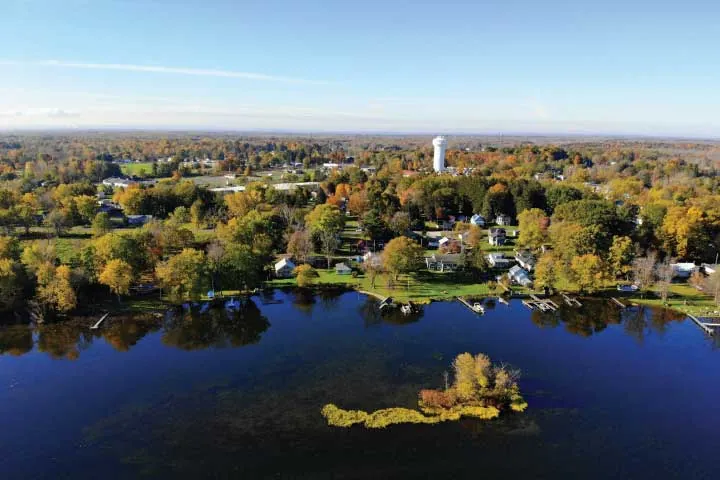
Oneida Lake is a big, shallow working lake: fifty thousand eight hundred ninety four acres of surface, twenty one miles long, five point five miles at its widest, fifty five feet at its deepest and twenty two point three feet on average, at an elevation of three hundred seventy feet, per the Department of Environmental Conservation. The Department's own page title lists four counties around it, Madison, Onondaga, Oswego and Oneida, while its text speaks of Oneida and Oswego counties; the four county list is the fuller statement, and the shoreline towns on this page's service map, Cicero among them, sit on the south shore facing Syracuse. The standard for water damage restoration central new york in Cicero is set by work like this.
A shallow lake behaves differently from a deep one. With a mean depth of twenty two feet, Oneida Lake answers quickly to wind: a hard blow from the west can pile water against the east shore, and a blow from the northwest works the south shore where the Syracuse suburbs reach the water. Shoreline homes here rarely meet a slow, stately rise. They meet wind driven water over a lawn, through a crawl space vent, and across a ground floor in an afternoon, followed by a fall just as fast once the wind drops. Drying plans on this shore assume speed at both ends. None of it is optional in water damage restoration central new york along Oneida Lake.
The Lakes
Onondaga Lake and the Watershed Above Syracuse
A four point six square mile lake at the edge of the city, fed mostly by two creeks, draining north to the Seneca River and on to Lake Ontario.
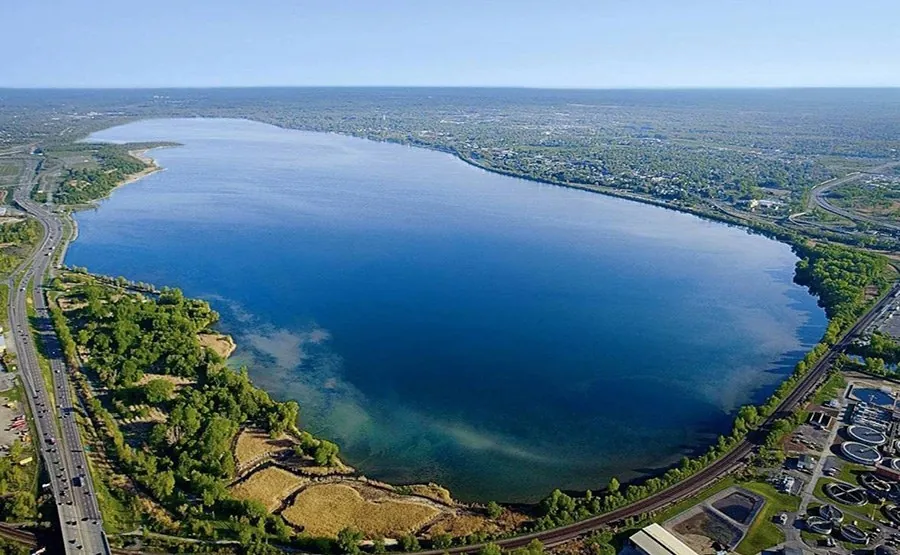
Onondaga Lake covers four point six square miles along the edge of the City of Syracuse, about one mile wide and four point six miles long, with an average depth of thirty five feet and a maximum depth of sixty three feet, per the Department of Environmental Conservation. A non official source gives sixty six feet for the maximum; the Department's sixty three is the figure this page uses, and the disagreement is printed rather than hidden. Its watershed runs to two hundred eighty five square miles, mostly in Onondaga County with the southern tip in northern Cortland County. The standard for water damage restoration central new york in Liverpool is set by work like this.
Two tributaries do most of the work: Nine Mile Creek and Onondaga Creek together provide about seventy percent of the lake's inflow. That single fact explains the Syracuse water map. What falls on the hills south of the city rides Onondaga Creek down through the valley, past the gauge near Nedrow, through the city itself, and into the lake. Water flows north out of the lake to the Seneca River and eventually to Lake Ontario, so the lake is a bowl the whole southern watershed pours through. Homes near the creek, the lake shore and the low ground between them share one plumbing system drawn by geology. None of it is optional in water damage restoration central new york in Syracuse.
The Creeks
Onondaga Creek Flood Stages and the Nedrow Gauge
One gauge, kept by the Geological Survey and read by the Weather Service, holds the creek's whole modern memory: stages, record crest and the March day in 2014 when Syracuse watched the water climb.
The gauge is titled Onondaga Creek near Nedrow, station zero four two three nine zero zero zero, in Onondaga County, though another Weather Service page titles the same gauge at Syracuse; the Nedrow title is the one this page uses, because the instrument sits there, in the Syracuse area and not inside the city. Its flood stages are action at four point five feet, minor at five feet, moderate at five point five feet and major at six feet. The record crest is six point five feet. At five feet, the gauge notes say, flooding begins to affect Kirk Park and neighbourhoods along Marginal Street, Hovey Street, Midland Avenue and others in Syracuse. The standard for water damage restoration central new york in Syracuse is set by work like this.
On March thirtieth, twenty fourteen, the creek crested at five point two one feet at that gauge, just above minor flood stage and below moderate. It was not the record, and this page will not dress it as one. It was a working flood: water into the low streets the gauge notes name, basements along the valley floor taking seepage and worse, and a reminder that the creek does its damage in Syracuse at levels a big river town would shrug at. A creek that floods a city neighbourhood at five feet does not need a record to ruin a finished basement. None of it is optional in water damage restoration central new york in Onondaga County.
The gauge's historic list also holds the storm this whole state remembers: six point one two feet on June twenty third, nineteen seventy two, during Hurricane Agnes, the third highest crest on record at Nedrow. Agnes is told in full on its own section of this page, with its totals attributed to the twelve states they cover. Here it is enough to note that the creek through Syracuse has carried a flood of that rank within living memory of the housing stock, and that the houses along the valley are the same houses, with the same foundations, that stand there today. Crews doing water damage restoration central new york along Onondaga Creek plan around exactly this.
The River
The Mohawk River at Utica, Longest Tributary of the Hudson
One hundred forty nine miles of working river, per the Department of Environmental Conservation, running east past Utica to the Hudson at Cohoes.
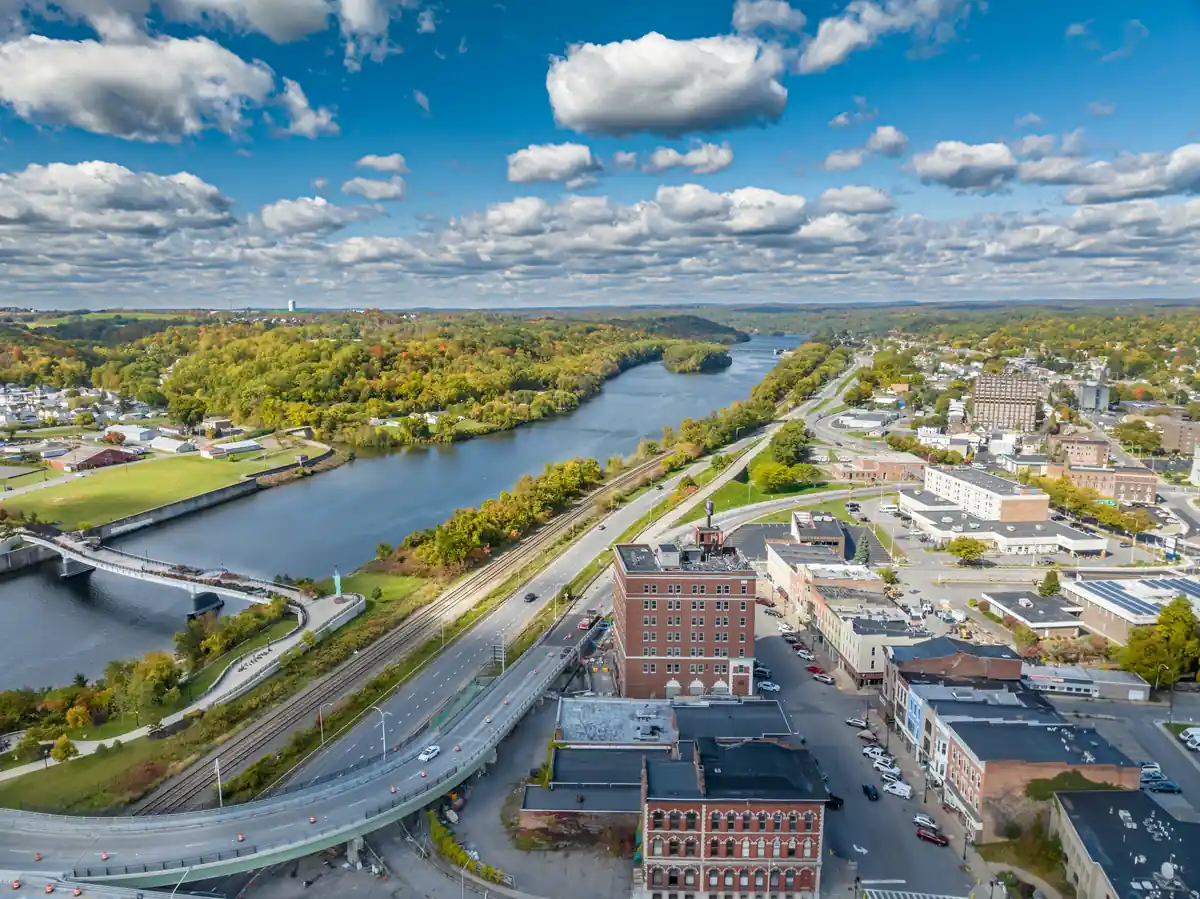
The Mohawk River begins at the meeting of its West Branch and East Branch in north central Oneida County and flows eastward for one hundred forty nine miles until it enters the Hudson River at Cohoes, per the Department of Environmental Conservation, which calls it the longest tributary of the Hudson. Britannica gives one hundred forty miles; both figures stand in this page's fact table, and the Department's is the one used in the text. The river is the spine of the Mohawk Valley, and Utica sits on its south bank where Sauquoit Creek and the valley floor meet it. The standard for water damage restoration central new york in Utica is set by work like this.
A river this size floods on a watershed's schedule, not a street's. Rain across the southern Adirondacks and the valley hills gathers into the West Canada and East Canada creeks and a dozen smaller runs, and the main stem at Utica answers a day or more later, high and staying high. The gauge titled Mohawk River near Utica, station zero one three four two six zero two, drains five hundred fifty three square miles. When that gauge speaks, it is summarising weather that fell across a small province of hills. Restoration staging in Utica follows the gauge the way Syracuse staging follows the creek: read early, stage before the crest, and never promise a dry basement on a rising river. None of it is optional in water damage restoration central new york along the Mohawk River.
The river also built the city it floods. Utica grew where the river, the old canal and the valley road ran together, which put its oldest housing, its mills and its downtown on the flat beside the channel. That is the recurring bargain of river cities, and the flood record on the next three sections of this page is its ledger: twenty nineteen, twenty thirteen and twenty oh six, each with its gauges and its lessons. The work of a restoration crew here is to know which streets take the river, which take the creeks, and which take both in the same night. Water damage restoration central new york in New Hartford begins with this same discipline.
Flood Cases
The Halloween Flood of 2019 in the Mohawk Valley
Three days of rain over the Mohawk Valley and the southern Adirondacks, a federal study to document it, and the highest flow ever recorded on the Mohawk at Utica.
Between October thirty first and November third, twenty nineteen, heavy rain produced historic flooding in localized areas of the Mohawk Valley and the southern Adirondack region. The event is documented in United States Geological Survey Scientific Investigations Report twenty twenty three to five one two six, published in cooperation with the Department of Environmental Conservation and first posted on January seventeenth, twenty twenty four. The regional toll, stated for the whole study region and never for Utica alone: at least one fatality, eighteen homes destroyed, an estimated thirty three million dollars in damage to public infrastructure, and a state of emergency declared across thirteen counties. The standard for water damage restoration central new york in Utica is set by work like this.
The gauge numbers are the spine of the event. The Mohawk River near Utica peaked at nineteen point two two feet with a flow of twelve thousand eight hundred cubic feet per second on November second, ranked first of the six peaks in its record; the previous maximum there was eight thousand two hundred ten cubic feet per second, set on July second, twenty seventeen. Near Little Falls the river ran thirty six thousand nine hundred cubic feet per second, beating the thirty five thousand of June twenty eighth, twenty oh six. West Canada Creek at Kast Bridge ran twenty seven thousand five hundred on October thirty first, and East Canada Creek at East Creek ran thirty thousand three hundred on November first. None of it is optional in water damage restoration central new york in Oneida County.
The rain itself explains the violence. Near Sauquoit in Oneida County, four point one nine inches fell in twenty four hours across October thirty first and November first, a twenty five to fifty year recurrence at that spot. The highest rainfall in the study, seven inches near Speculator in Hamilton County, carried a two hundred to five hundred year recurrence. The study basins were East Canada Creek, West Canada Creek and the Sacandaga River; Sauquoit Creek, which did so much damage beside Utica, was not one of the study basins, and its story is told separately on this page from the county's own study. Every one of those steps belongs to water damage restoration central new york in Whitesboro.
Flood Cases
Sauquoit Creek and Whitesboro, the Village Beside Utica
The hardest residential story of the Halloween flood belongs not to Utica but to its neighbour across the creek, and this page keeps the two names separate on purpose.
Whitesboro is a village in Oneida County directly adjacent to Utica, close enough to share a street grid and a school run, and it is not part of the city of Utica. Sauquoit Creek runs through it on its way to the Mohawk, with a Geological Survey gauge, station zero one three three nine zero six zero, keeping its record. Oneida County's own Sauquoit Creek drainage study, written after the Halloween storm, records that Whitesboro has experienced multiple flood events in five years, and that the most recent, on October thirty first, twenty nineteen, was particularly intense. The standard for water damage restoration central new york in Whitesboro is set by work like this.
Particularly intense has a specific meaning in the county's words: damage to multiple residential foundations, severe enough to result in orders of condemnation. That is the far end of water damage, where drying is no longer the question and structure is. Foundations move when saturated soil, fast water and repeated events work together, and Whitesboro's recent history gave it all three. For a restoration crew, a Whitesboro call after a Sauquoit event starts with a structural eye, not a moisture meter: are the walls plumb, are the footings scoured, is this a drying job at all, or a shoring and engineering job first. None of it is optional in water damage restoration central new york in Oneida County.
Flood Cases
June 2013 and the Record Crest on Oneida Creek
A single day of heavy rain, a creek on a county line, and a record crest that stood more than two feet into major flood stage over a Madison County city.
On June twenty eighth, twenty thirteen, heavy rainfall caused flooding across the Mohawk Valley that damaged homes, in the Geological Survey's summary. The day's sharpest number came from a smaller stream: Oneida Creek at Oneida crested at seventeen point two three feet, the record flood at that gauge, per the National Weather Service gauge page for station zero four two four three five zero zero. The stages there run action at ten feet, minor at eleven, moderate at thirteen and major at fifteen, so the creek stood two point two three feet above the top of the scale. The gauge notes describe flooding several feet deep extending well into the City of Oneida. The standard for water damage restoration central new york in Oneida is set by work like this.
Now the geography, because this creek manufactures confusion. The City of Oneida is in Madison County. Oneida Creek forms the county line there, and the gauge's county listing reads Oneida County, which is how a Madison County city flood gets retold as an Oneida County event. It is not. The water fell on the line, the city that flooded sits on the Madison side, and the record belongs to both counties' shared creek. A discharge figure for the creek in twenty thirteen circulates in summaries, but it was not verified from an opened source behind this page, so this page does not print it. The crest, which is verified, says enough. None of it is optional in water damage restoration central new york in Madison County.
Flood Cases
June 2006, the Mohawk Valley Flood Before the Records Fell
The storm that set the marks the 2019 flood would break: three days of tropical moisture on a stalled front, from the Susquehanna headwaters to the Mohawk.
From June twenty sixth through June twenty eighth, twenty oh six, the combination of tropical moisture and a stalled cold front produced flash and river flooding across the Upper Susquehanna, Delaware and Chenango basins of central New York and northeast Pennsylvania, per the National Weather Service at Binghamton. The Geological Survey's later study gives the storm period as June twenty sixth to twenty ninth and records plainly that the Mohawk Valley was also affected by major flooding from it. Both date ranges stand in the research behind this page; the difference is one of bookkeeping, not of fact. The standard for water damage restoration central new york in Herkimer County is set by work like this.
The valley's gauges kept the receipts. On June twenty eighth, twenty oh six, the Mohawk River near Little Falls ran thirty five thousand cubic feet per second and East Canada Creek at East Creek ran thirty one thousand five hundred, and both stood as the peaks of record at those gauges for thirteen years, until the Halloween flood of twenty nineteen broke them. That is the rhythm of this valley's flood history: a mark is set, a generation of homeowners is told it was the big one, and then a wet autumn rewrites it. Any drying or rebuilding decision that treats a past record as a ceiling is betting against the gauges' own behaviour. None of it is optional in water damage restoration central new york along the Mohawk River.
Flood Cases
Hurricane Agnes in June 1972 and What Its Totals Really Cover
The greatest flood disaster in New York State history, in the Geological Survey's words, and the most misquoted numbers in the state's flood record.
Hurricane Agnes crossed the Florida Panhandle coast on June nineteenth, nineteen seventy two, and its rain ran from the Carolinas northward to New York. Record breaking floods followed across the Middle Atlantic states in late June and early July. Many streams saw peak discharges several times their previous maxima, with recurrence intervals at many gauges beyond one hundred years, per the Weather Service summary of the Geological Survey's report on the storm. A federal summary calls it the greatest flood disaster in the history of New York State, with flooding beginning in Westchester County on June nineteenth and widespread flooding in the Southern Tier and Finger Lakes by June twenty third. The standard for water damage restoration central new york in Syracuse is set by work like this.
Now the numbers, with their borders drawn. The storm claimed one hundred seventeen lives and caused damage estimated at three point one billion dollars across twelve states, with damage particularly high in New York, Pennsylvania, Maryland and Virginia. Those are twelve state totals. They are not Central New York figures, not Syracuse figures and not Utica figures, and any page that lets a reader take them as local is inflating its own history. What is local, and verified, is the gauge on Onondaga Creek near Nedrow: six point one two feet on June twenty third, nineteen seventy two, the third highest crest in that gauge's record. None of it is optional in water damage restoration central new york in Onondaga County.
The Canal
The Erie Canal, Finished in 1825, Still Moving Water Past Both Cities
Three hundred sixty three miles, four feet deep and forty feet wide when it opened, and the reason Syracuse, Rome and Utica stand where they stand.
The dates first, because they are the ones most often gotten wrong. Construction of the Erie Canal began on July fourth, eighteen seventeen. The canal was completed on October twenty sixth, eighteen twenty five: three hundred sixty three miles long, four feet deep and forty feet wide. Eighteen twenty, sometimes printed as the completion year, is wrong; no source behind this page supports it. The canal tied the Hudson to Lake Erie, and along its line through this corridor it made three cities: Syracuse at the salt and the junction, Rome where the digging began, and Utica on the Mohawk flats. The standard for water damage restoration central new york in Rome is set by work like this.
A canal is managed water, and managed water teaches a city habits. Locks, levels, towpaths and feeder channels organised how water moved through these streets for two centuries, and the modern map still follows the old one: the low corridors, the filled and built over stretches, the neighbourhoods that sit a few feet below their neighbours because a prism ran there. When creeks rise in Syracuse or Utica, the water still finds the grades the canal age drew. Restoration crews learn those grades street by street, the same way they learn which basements take the creek and which take the street. None of it is optional in water damage restoration central new york in Utica.
Winter and Thaw
Lake Effect Snow, Spring Thaw and Basement Water Around Syracuse
The Syracuse end of the hub lives under lake effect snow, and its wettest basement season is not a storm at all: it is the thaw, when a winter lets go all at once.
Lake effect snow is the region's signature weather: cold air crossing the open water of Lake Ontario and Oneida Lake picks up moisture and drops it in bands that can bury one town and spare the next. For water work, the snow itself is only the storage form. The damage arrives when the storage melts, in a March warm spell or a rain on snow event, and a season of water tries to leave through frozen ground that cannot take it. Basements around Syracuse take that water through foundation walls, floor joints and window wells, in houses that stayed dry through every summer storm. The standard for water damage restoration central new york in Syracuse is set by work like this.
The pattern repeats on a calendar a homeowner can plan around. Deep winter brings the burst pipe risk, told on its own section. Late winter and early spring bring the thaw: sump pits that ran dry for months cycling every few minutes, floor drains backing up where street lines run full, and the first warm rain finding every crack the frost opened. A crew staging for the thaw pre positions pumps and generators the way a crew staging for a river crest watches a gauge, because the calls arrive in the same compressed window and the queue discipline is identical. None of it is optional in water damage restoration central new york in Onondaga County.
Plumbing Failures
Burst Pipes in Central New York Winters
The most common flood in the hub is not a river. It is a pipe in a wall, in a cold snap, in a house that was warm everywhere except the one bay that mattered.
A burst pipe is a physics problem with a mailing address. Water expands as it freezes, the ice plug forms where the pipe runs coldest, often an outside wall bay, a crawl space run or a garage ceiling, and the pressure splits the pipe at its weakest point, which is not always where the ice is. The flood then waits for the thaw inside the pipe, which is why so many Syracuse and Utica pipe floods are discovered as a waterfall at the warmest hour of the coldest day. The split itself may leak a bathtub's worth a minute. Shutting the main off is the whole first response, and it is why this page keeps repeating where the valve lives. The standard for water damage restoration central new york in Utica is set by work like this.
The buildings at risk share a profile: plumbing in exterior walls, additions built over unheated space, vacation gaps where the heat was lowered, and older homes where a remodeled kitchen moved a sink line into a cold wall. Wind matters more than the thermometer; a moderate cold with a hard northwest wind through a vent or a gap finds pipes that a still, colder night spared. Crews read the wind side of the house first. Insulation blown away from a bay, a dryer vent near a run, a rim joist gap: the cause is usually visible once the wall is open, and naming it in the file is what keeps the same bay from bursting again next January. None of it is optional in water damage restoration central new york in New Hartford.
Plumbing Failures
Sump Pump Failure When Thaw and Rain Arrive Together
The pump is a small machine asked to do a heroic job on the worst night of the year, and its failures cluster exactly when the whole street needs it most.
A sump system fails in a short list of ways: the pump dies, the switch sticks, the discharge line freezes or blocks, the pit overflows faster than the pump's capacity, or the power goes out in the storm that brought the water. That last failure is the cruel one, and it is common across both counties, because the rain that fills pits is the rain that drops trees on lines. A battery backup or a water powered backup is not an accessory in this region; it is the difference between a wet pit and a wet basement on the one night the street goes dark. The standard for water damage restoration central new york in Liverpool is set by work like this.
The insurance angle deserves plain words, because it surprises people every spring. A sump failure during a storm is usually a homeowners claim, where a rising river is a flood claim, and the same wet basement can be argued either way if the record is sloppy. The crew's first visit notes are where that argument is won: the state of the pump, the pit, the power, and the water's entry points, photographed and written before anything is moved. A pump that failed mechanically tells one story; a pit overwhelmed while the pump ran tells another; both are documentable if someone looks before they pump. None of it is optional in water damage restoration central new york in Baldwinsville.
Contaminated Water
Sewage Backups in Older Syracuse and Utica Housing
Clay lines, cast iron lines, combined streets and a century of roots: the oldest plumbing in the hub backs up in the oldest houses, and it is handled as contamination from the first minute.
Both hub cities carry housing stock from the canal and mill eras, plumbed in clay and cast iron, much of it still in the ground. Those lines crack, offset at the joints and fill with roots, and in a heavy rain the street side can push back toward the house. The result arrives through the lowest opening, usually a basement floor drain or a ground floor fixture, and it is the one flood a homeowner should never wade into or try to mop alone. Sewage carries bacteria and viruses that change every rule of the job: what can be dried, what must be removed, and who can be in the room while it happens. The standard for water damage restoration central new york in Syracuse is set by work like this.
The working method is strict. The area is closed off, protective equipment goes on, and porous material the water touched, carpet and pad, the bottom of drywall where readings show wicking, soft furnishings that cannot be sanitized, comes out rather than being dried in place. Hard surfaces are cleaned and then sanitized, and the space is dried only after the contamination work is done. A camera run through the line after the cleanup tells the homeowner whether the cause was a street surcharge, which is the city's story, or a private line failure, which is theirs to fix before the next storm tests it. None of it is optional in water damage restoration central new york in Utica.
The Housing Stock
Basement Flooding in the Older Homes of Two Working Cities
Stone foundations, brick foundations, floor drains older than the furnace: the basements of Syracuse and Utica were built for coal and storage, and they meet modern water on their own terms.
Walk down the stairs of a pre war home in either city and the construction tells you how it will flood. Stone or brick foundation walls breathe water through mortar joints under pressure. The floor is often thin concrete over earth, with a drain that ties to a line as old as the house. The furnace and the panel sit at basement level because that is where they have always sat. Water in such a basement is rarely a single event with a single entry; it is a system responding to a wet week, and the drying plan has to treat the system: walls read at several heights, the floor read across its whole span, and the cavities above the foundation line checked for what wicked up. The standard for water damage restoration central new york in Syracuse is set by work like this.
Finished basements raise the stakes without changing the science. Paneling and drywall hide the water's true extent, carpet pad holds it against the floor, and the moisture map has to be drawn through finishes that were never meant to be read. The honest crew says early what the readings later prove: some finishes over a flooded floor cannot be dried in place and saved, and the choice is between opening the bottom of a wall now, on evidence, or opening the whole wall later, on mold. Photographs before anything is cut, and readings recorded wall by wall, are what keep that conversation factual instead of theatrical. None of it is optional in water damage restoration central new york in New Hartford.
The Housing Stock
Crawl Space Water on Low Ground Around Oneida Lake
The space nobody enters is the space that stays wet longest, and around the lake shore it is where a flood goes to hide.
Shoreline homes and camps around Oneida Lake, and plenty of older houses across both counties, sit over crawl spaces: low, vented, earth floored voids that collect water from every direction. A crawl space floods quietly. Lake water or groundwater fills it, the floor system above it wicks moisture for weeks, and the first sign upstairs is a smell, a cupping floor or a furnace that starts short cycling because its base sat in water nobody saw. By the time the symptom shows, the space below has often been wet long enough for mold to colonise the joists. The standard for water damage restoration central new york in Cicero is set by work like this.
Working a crawl space is slow, physical and methodical: pump the standing water, remove wet insulation that has fallen or matted, read the joists and the subfloor from below, and dry with directed air and dehumidification sized to a space that exchanges air with the outdoors. Plastic ground cover, where it exists, traps water under it as readily as it sheds it, and the crew notes its state for the file. Photographs in a crawl space are miserable to take and invaluable to the claim, because no adjuster is crawling under a lake house to verify what the meter said. None of it is optional in water damage restoration central new york along Oneida Lake.
Materials
Hardwood Floor Drying in Older Syracuse and Utica Homes
Both cities are full of oak and maple floors that have survived a century of winters. A flood is the first thing that can kill them quickly, and fast drying is what saves them.
Solid hardwood is the most forgiving fine material in a flood and the most dramatic about it. Wet boards cup, each edge rising as the underside takes more water than the face, and a room can look ruined on day one and read nearly flat by the end of a proper drying. The tools are surface drying mats that pull air through the board joints, dehumidification sized to the room, and readings taken through the floor system, not just at the surface. Engineered and laminate floors are a different story, told honestly in the claim file: swollen seams and a fibre core rarely come back, and drying money spent on them is usually wasted. The standard for water damage restoration central new york in Syracuse is set by work like this.
The decision window is short. A floor reached within the first day, with clean water, stands a strong chance. A floor that sat under river water or under furniture in a closed house for a week has usually crossed into replacement, and the readings will say so: moisture that will not move toward the dry standard after days of correct drying is the floor's own verdict. Crews owe the homeowner that verdict early, because the insurer's scope and the family's plans both hang on it, and because a floor removed on evidence can sometimes be matched and patched, while a floor removed in panic cannot be unremoved. None of it is optional in water damage restoration central new york in Utica.
Mold
Mold Growth After Flooding and the New York Licensing Line
Mold is the second disaster inside the first one, and New York is one of the states that decided who may fight it, in statute, with licences.
Growth begins fast: on wet drywall paper, wood and insulation, mold can establish within one to two days, which is why the drying clock on this page is measured in hours at the front end. Most floods that are extracted and dried on schedule never become mold jobs at all. The ones that do, a closed seasonal home, a slow leak behind a wall, a claim argued over while the house sat wet, cross a legal line as well as a biological one. New York's line is bright, and every homeowner in the hub should know where it runs before they need it. The standard for water damage restoration central new york in Syracuse is set by work like this.
Since January first, twenty sixteen, Labor Law Article thirty two has licensed mold work statewide. For a job covering more than ten square feet (10 sq ft), a licensed mold assessor must assess the work and produce the plan, and a separate licensed mold remediator must carry it out; the same company cannot hold both roles on the same job. The separation is deliberate: the party who says how much growth there is may not profit from removing it. New York City has its own local rules for its own buildings, and they do not travel upstate; the statute that governs Syracuse and Utica is Article thirty two. None of it is optional in water damage restoration central new york in Auburn.
The Method
Moisture Mapping and Drying Logs, the Paper Trail of a Dry House
Anyone can rent a fan. The profession is knowing where the water is, proving where it went, and writing down the day it left.
A moisture map is drawn on the first visit: every wall, floor and cavity in the affected area read with meters, the wet boundary marked, and the readings recorded room by room. Pin meters read inside wood and drywall; pinless meters scan surfaces; a thermal camera shows the cold shapes that suggest water behind a finish, and the meters confirm or clear what the camera suspects. The map is what turns demolition from a habit into a decision. Only the cavities the readings condemn get opened, and the map is the evidence, kept in the file, that the choice was measured rather than theatrical. The standard for water damage restoration central new york in Liverpool is set by work like this.
The drying log is the map's diary. Each day, the same points are read again and entered, the equipment in place is listed, and the numbers either fall toward the dry standard or they do not. A stall is information: it means a hidden reservoir, a cavity that needs opening, or equipment that needs resizing, and the log is where the stall is caught on day two instead of day six. The dry standard itself is not invented per job; it is set from the readings of unaffected material in the same house, the dry oak in the dry room, so the target is the building's own normal. None of it is optional in water damage restoration central new york in Baldwinsville.
The Method
How We Dry a Flooded Basement in Onondaga County
The same six steps as every job on this page, bent around stone walls, an old floor drain and a Syracuse winter outside the door.
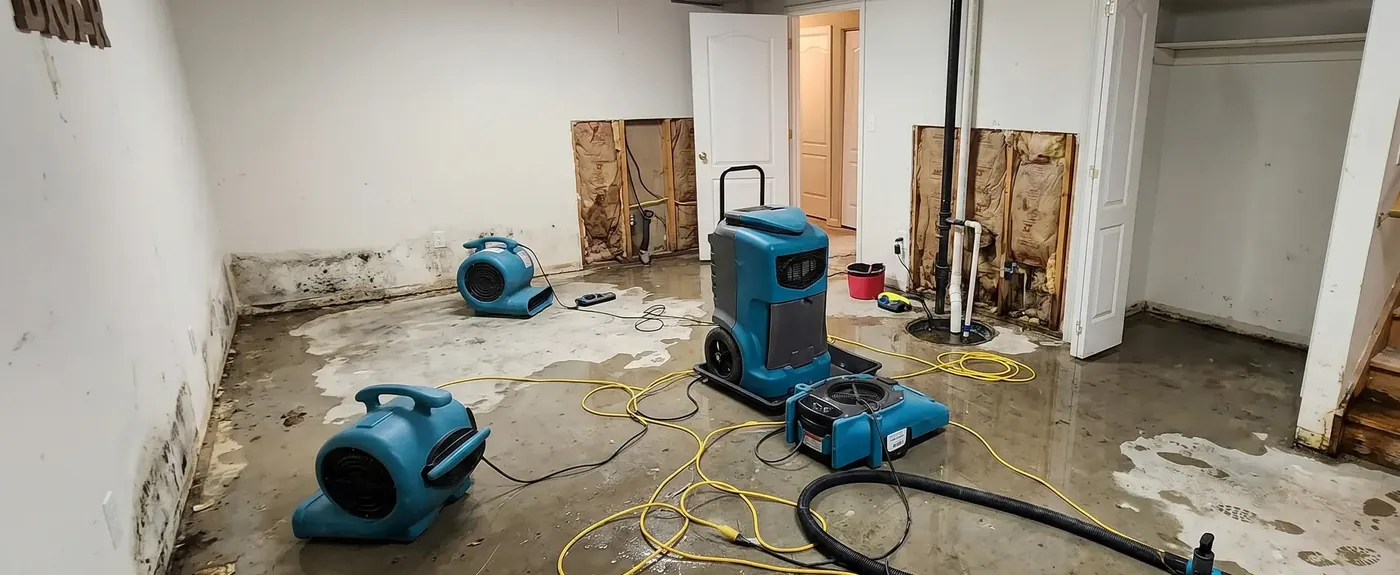
Step one and two arrive together: the call, the dispatch, and on arrival the safety pass. In an Onondaga County basement that means eyes on the panel, the furnace and the water heater before feet in the water, power isolated from anything wet, and the source named: pipe, sump, wall, drain or door. Step three is extraction, pumps and wands until the floor is a wet surface instead of a shallow pond, with the high water line photographed against the foundation wall and the stair treads before it fades. The photographs carry the date, and the file opens. The standard for water damage restoration central new york in Syracuse is set by work like this.
Step four is the map and the openings. Stone and brick foundation walls are read at several heights, because they store water like a sponge and give it back for days. The floor is read across its span. A finished section is opened at the base only where the readings condemn it, and the cavity is dried with directed air. Air movers and dehumidifiers are then set to a written plan that accounts for the basement's coolth: cold air holds less water, so the dehumidification is sized up, and in winter the incoming dry house air is part of the system. None of it is optional in water damage restoration central new york in Onondaga County.
The Method
How We Dry Oneida Lake Shoreline Homes and Camps
A camp converted to a year round home, a crawl space over earth, and water that came in with the wind: the lake shore job has its own shape.
The lake job starts with access and honesty about time. Shoreline homes sit at the end of lanes that flood before the houses do, and a seasonal place may have sat wet for weeks before anyone opened the door. The first visit therefore reads like an investigation: when did the water come in, how high, and what has been growing since. The moisture map reaches under the house as a matter of course, because the crawl space section of this page explains what hides there, and the floor system is read from above and below before any promise is made about saving it. The standard for water damage restoration central new york in Cicero is set by work like this.
Drying on the shore fights the lake's own humidity. Air off the water is wet air, so the dehumidification is closed and sized generously, and the structure is sealed against the shore breeze that a landsman would call fresh and a drying log calls a moisture source. Camps built in layers, a porch enclosed in one decade, a bedroom added in another, hide cavities between the layers where water sits out of sight of any surface reading. The meters go hunting for those layers deliberately, around every addition line. None of it is optional in water damage restoration central new york along Oneida Lake.
Commercial
Commercial Water Damage in Syracuse and Utica Workplaces
A flooded shop, office or warehouse runs on the same drying science as a house, with two differences: the clock is money, and the file has more readers.
The sequence does not change: dispatch, safety, extraction, mapping, drying to readings, a log, final readings. What changes is everything around it. A restaurant in Syracuse or a warehouse in Utica loses revenue by the day, so staging bends around trading hours where the building allows, with the wettest and loudest work pushed to the night. Stock, records and equipment get triaged with the owner in the first hour, because the claim values them and the water does not wait for an inventory. Power in a commercial space is three phase, panels are bigger, and the safety pass is longer; it is still first, and it is still not negotiable. The standard for water damage restoration central new york in Syracuse is set by work like this.
The claim file for a business serves the insurer, a landlord or a tenant depending on the lease, a health or licensing inspector where the trade has one, and the business's own lender or franchisor. It is built to be read by all of them: source diagnosis with photographs, the drying log, the list of what was removed and the readings that condemned it, and the clearance readings that let the doors reopen. Business interruption claims live or die on dates, so the file's dates are exact: when the call came, when extraction began, when each area reached the dry standard. None of it is optional in water damage restoration central new york in Utica.
Rentals and Law
Rental Homes, Landlords and the Warranty of Habitability
A flooded rental is a three party problem: the tenant who lives with the water, the owner who holds the policy, and a New York warranty that cannot be signed away.
New York's Real Property Law, section two thirty five b, writes a warranty of habitability into every residential lease: the home must be fit for living, and the warranty cannot be waived by any lease language. A flood that leaves a rental without heat, with sewage in the basement or with walls growing mold is therefore not only a drying problem; it is a legal condition with a clock on it. Section two twenty seven adds the tenant's side: if a casualty leaves the premises untenantable, the tenant may surrender the lease under its terms. Neither section replaces a lawyer, and this page is not one; they are the frame every flooded rental in the hub is handled inside. The standard for water damage restoration central new york in Syracuse is set by work like this.
The practical order protects everyone. The tenant's safety and belongings come first, with the same first hour photographs any owner would take, because the tenant's phone is usually the first camera on the scene. The owner is notified at once and the insurer right behind, and the crew's file is written so both parties can read it: source, extent, readings, and what was removed. Condominium owners should know the line runs differently for them: an owner cannot raise the habitability warranty against the condominium association itself, per the courts' reading in Frisch against Bellmarc. Who pays for which wall in a condo flood is a documents question, answered from the declaration, not from habit. None of it is optional in water damage restoration central new york in Utica.
Insurance
Insurance Claims After a Central New York Flood
The water leaves in days. The claim lives for months, and it is won or lost on the paper created while the floor was still wet.
Every claim on this page starts with the same fork: where did the water come from. Sudden water from inside the home, a burst pipe, a failed appliance, a sump that died in a storm, belongs to the homeowners policy. Rising water from outside, Oneida Lake over the lawn, the Mohawk over the road, Onondaga Creek through the door, belongs to flood insurance. The fork decides the policy, the adjuster, the deadlines and the proof required, which is why the crew's first job is a source diagnosis with photographs, not a pump. A file that names the source wrongly on day one spends months being reargued. The standard for water damage restoration central new york in Syracuse is set by work like this.
The file itself is a kit, and its contents are listed in full on the records section of this page: the first hour photographs, the drying log with daily and final readings, the moisture map, the list of removed materials with the readings that condemned them, invoices, and a note of every conversation with the insurer. In a region where a single storm can flood two counties at once, adjusters arrive late and read fast; the complete file is the one that does not wait for a second visit. Homeowners who keep the folder from the first day, rather than assembling it from memory in month two, close claims that other households are still arguing. None of it is optional in water damage restoration central new york in Utica.
Two warnings from the region's own record belong here. First, the Halloween flood of twenty nineteen produced claims across thirteen counties under a state of emergency, and the households that documented earliest were not always the ones flooded worst; they were the ones photographed best. Second, never let a claim conversation delay the drying. The policies require reasonable steps to limit the loss, the mold clock runs regardless of paperwork, and a house dried on schedule with a complete log is a stronger claim than a house left wet while its owner waited for permission. Dry first, document everything, argue from the file. Water damage restoration central new york in Auburn begins with this same discipline.
Insurance
What New York Insurance Law Says About Deadlines and Disclaimers
Statutes, not slogans: the clocks an insurer runs on, the one rule that does not apply to your flooded house, and the two phone numbers worth keeping.
The working clocks are these. Under Insurance Law section twenty six oh one and Regulation sixty four, title eleven of the state rules part two sixteen, an insurer must acknowledge a claim, begin its investigation, and accept or reject within fifteen business days (15 business days) after proof of loss, and must pay within five business days (5 business days) of settlement. Enforcement runs through the Department of Financial Services, not through the courts in the first instance. For natural disasters, Insurance Law section twenty six eighteen tightens the payment clock to four business days (4 business days), with fifteen business days (15 business days) to accept or reject, thirty if arson is suspected, and one fifteen day extension available. The standard for water damage restoration central new york in Syracuse is set by work like this.
Two more rules frame every dispute. Suit on a property policy must be brought within twenty four months (24 months) of the date of loss, under Insurance Law section thirty four oh four; miss it and the claim dies on the calendar, however wet the house was. And a rule often quoted at homeowners does not apply to them: the timely disclaimer rule in section thirty four twenty (d), which forces fast disclaimers, covers liability claims for death and bodily injury only. It does not govern property damage, as the courts confirmed in the KeySpan case in twenty fourteen. A page that quotes thirty four twenty (d) at a flooded basement is quoting the wrong statute, and this page does not. None of it is optional in water damage restoration central new york in Utica.
Keep the Department's numbers with your policy: the Department of Financial Services answers at (800) 342-3736, and its separate disaster hotline is (800) 339-1759. Call them when an insurer will not answer, when a deadline in this section has passed without the required response, or when a denial arrives without reasons. The Department cannot dry your house, and this page cannot argue your claim; what both can do is keep the clocks visible. The drying log your crew hands you, with its dates, is written to be read against exactly these deadlines. Crews doing water damage restoration central new york in Oneida plan around exactly this.
Insurance
NFIP Flood Insurance From Oneida Lake to the Mohawk
The federal programme is the only flood cover most homes in the hub can buy, and its clocks are shorter and stricter than the homeowners policy beside it.
The National Flood Insurance Program writes the flood policies for both counties, sold through insurers, for owners and for renters covering contents. Its first clock starts before any water: a new policy generally waits thirty days (30 days) before it takes effect, so the time to buy cover for a Oneida Lake shoreline or a Mohawk bottoms home is a calm week in a dry month, not the day the gauge starts rising. Lender required purchases and a few other cases have their own exceptions, which your agent can read off your file; the thirty day rule is the one that surprises everyone else. The standard for water damage restoration central new york in Cicero is set by work like this.
After a loss, the programme's clocks run in days, and they are counted from documents. A proof of loss is due within sixty days (60 days). An appeal of a denial or a payment runs sixty days (60 days). A suit must be filed within one year (1 year) of the first written denial. The crew's file, photographs, drying log, final readings, is built to feed the proof of loss, which is why this page treats documentation as a trade skill rather than a courtesy. A flood claim assembled from the folder kept since the first hour meets these clocks without panic. None of it is optional in water damage restoration central new york in Whitesboro.
Insurance
Public Adjusters and the Twelve Point Five Percent Cap in New York
On a large loss, a homeowner may hire their own adjuster. New York fixes the fee by rule, and the rule is the first thing to check in the contract.
A public adjuster represents the policyholder, not the insurer: preparing the claim, documenting the loss and negotiating the settlement. In New York the fee is capped by law at twelve point five percent (12.5 percent) of the recovery, under title eleven of the state rules, part twenty five point seven. The cap is what makes the hire calculable on a big loss: the contract must state the fee plainly, the adjuster must be licensed in New York, and the fee comes out of the recovery it helps produce. Any contract that will not show the percentage on its face is a contract to walk away from. The standard for water damage restoration central new york in Syracuse is set by work like this.
When does the hire make sense between Syracuse and Utica? On the losses where the file is the fight: a whole house flood on the lake shore, a commercial loss with interruption, a sewage loss with three parties reading the same documents, or a denial that needs a documented answer. On a single room pipe flood with a cooperative insurer, the crew's log and a complete folder usually carry the claim without help. The honest crews say so, because the same file serves either route: photographs, readings, and an inventory built from the first day are what a public adjuster works from, and they are what this page's crews produce as standard. None of it is optional in water damage restoration central new york in Utica.
Before the Crew Arrives
What to Photograph Before the Crew Reaches Your Street
Ten minutes with a phone, in the right order, builds the spine of the claim file. This is the order, for a lake house, a creek side street or a burst pipe at midnight.
Start with the source, if there is one and it is safe to approach: the split pipe, the silent sump, the water heater with its puddle, the floor drain with its dark ring. Then the outside, if the water came from outside: the yard, the street, the creek or shore as it stood, because the outside shots are what prove a rising water claim against an insurer's first instinct. Then every room from its doorway, wide, before a single object moves. A claim file is read by someone who was never in your house; the wide shots are how they learn its shape. The standard for water damage restoration central new york in Liverpool is set by work like this.
Then the details that carry numbers: the high water line on walls, stair treads, furniture legs and the foundation, photographed close with something in frame for scale. Serial plates on the furnace, the water heater and appliances. The panel, only if dry and safe. The sump pit and the pump's cord and switch as found. Contents that will have to be thrown away, photographed in place before they move, because a thing in a skip is a thing an adjuster can discount, and a thing photographed in a flooded room is a fact. None of it is optional in water damage restoration central new york in Baldwinsville.
Timelines
How Long Drying Takes in a Central New York Home
Days, usually. Which days, and how many, is decided by the water, the materials and the season, and it is read off a log rather than promised off a doorstep.
The honest answer starts with the variables. Clean water from a pipe, extracted the same day, in a frame house with drywall and carpet: the short end of the range. River or lake water that stood for days, in plaster and lath over stone, with hardwood and insulated cavities: the long end. Bare concrete and open framing dry fastest of all, and a Central New York January, with the house heated and the indoor air dry, can dry a structure faster than a humid August when every cubic foot of air arrives pre loaded with the lake. Any crew that gives a single number before the first readings is selling, not drying. The standard for water damage restoration central new york in Syracuse is set by work like this.
The range narrows daily, and that narrowing is the service. First day readings set the starting line and the dry standard, taken from unaffected material in the same house. Each day's readings then show the slope: materials falling on schedule keep the original estimate; a material that stalls moves the estimate and triggers a decision, open the cavity, add dehumidification, or accept a longer run, made from the log in front of the homeowner. By the middle of the job the end date is a reading or two away from certain, and the crew should say it plainly. None of it is optional in water damage restoration central new york in Utica.
The Method
When Walls Open and When They Stay Shut
The loudest argument on any flood job is whether to cut. The meters settle it, and this page's rule is simple: readings decide, habits do not.
A wall opens for one of four reasons, each of them measurable. The cavity behind it reads wet and cannot be dried through the surface at a pace the log accepts. Insulation inside has taken water and matted, holding moisture against the framing. The water was contaminated, and the cavity holds what the room cannot be allowed to keep. Or the readings stall above the dry standard day after day, which means a hidden reservoir the surface work cannot reach. Where none of those four holds, the wall stays shut and is dried in place with directed air and patience, and the log proves that choice too. The standard for water damage restoration central new york in Syracuse is set by work like this.
Both errors are common in the trade, and both leave damage of their own. The crew that opens everything sends rooms that readings would have cleared to demolition and rebuild, and leaves a family with months of construction after days of water. The crew that opens nothing leaves wet cavities to grow mold behind fresh paint, and the bill arrives later with interest, sometimes with a licensing problem attached under Article thirty two. The homeowner's protection is to ask one question of either crew: show me the readings behind that wall. A number can be argued with; a shrug cannot. None of it is optional in water damage restoration central new york in Utica.
Hidden Water
Hidden Water Behind the Walls of Century Old Houses
The leak you cannot see is the one that has been running longest, and the old houses of both cities hide them in the same few places.
Hidden water announces itself indirectly: a musty smell that cleaning does not move, paint that bubbles in one patch, a floor that feels soft by one wall, a water bill that crept up across a winter. In a century old Syracuse or Utica house the suspects line up in a familiar order: the supply runs in the exterior walls, the bathroom above the kitchen ceiling, the radiator lines through the floor system, and the wall where a porch roof dies into the siding. A thermal camera finds the cold shapes; meters confirm which shapes are water and which are only missing insulation. The search is a reading exercise before it is a demolition one. The standard for water damage restoration central new york in Syracuse is set by work like this.
What the search usually finds is time. A pinhole leak in a copper line can wet a cavity for a season before it shows, and by the time the paint bubbles, the insulation is matted, the framing is stained and mold has had its one to two days many times over. That is why hidden water so often crosses the Article thirty two line described on the mold section: the growth area is wide by discovery day, and the licensed assessor and remediator sequence applies. The crew that finds it should say so plainly, photograph the cavity as opened, and stop treating the job as a simple dry out. None of it is optional in water damage restoration central new york in Utica.
Plumbing Failures
Appliance Leaks in Syracuse and Utica Homes
Water heaters, washers, dishwashers and refrigerator lines: the slow leaks and the sudden ones, and why the room below the appliance is part of the job.
The appliances that hold water fail on two schedules. The sudden failures, a burst washer hose, a split supply line, a water heater tank that lets go, are pipe floods with a brand name, and they answer to the same first moves: shut the valve or the main, keep clear of the electrics, photograph, call. The slow failures are the destructive ones: a dishwasher that weeps at every cycle into the cabinet floor, a refrigerator line that drips behind the unit for months, a heater that sweats its tank rust onto the basement concrete. Slow leaks are discovered by their damage, not their water, and the moisture map has to run backward from the stain to the source. The standard for water damage restoration central new york in Liverpool is set by work like this.
The room below is the appliance section's main lesson. Water from a first floor washer crosses the floor system and reads in the ceiling and walls of the room beneath, sometimes rooms away from where it entered, following joists and pipes. A crew that dries only the laundry room has dried the source and left the loss. The map therefore starts at the appliance and follows gravity through every level, and the log lists each level's readings separately. In the hub's older housing, where a washer may sit in a converted pantry over a plaster ceiling, that discipline is the difference between a dried house and a ceiling that comes down in a month. None of it is optional in water damage restoration central new york in Baldwinsville.
Shared Buildings
Upstairs Neighbour Leaks in Syracuse and Utica Apartments
In a shared building, your flood starts in someone else's home, and the drying is the easy part: the paperwork has two front doors.
The call usually comes from the ceiling: a stain that grows, a drip into a light fitting, paint that sags into a blister. The source is upstairs, a neighbour's washer, tub, radiator or supply line, and the first moves are the same as any flood with one addition: knock, or call the building's manager, at once, because the source will run until someone upstairs stops it. Keep clear of wet light fittings and the panel, photograph your rooms as they are, and move what the drip threatens. Your own claim file starts with your photographs, even though the water is not yours. The standard for water damage restoration central new york in Syracuse is set by work like this.
Responsibility follows the source, and the file has to show it. The crew documents both units where access allows: the appliance or line that failed upstairs, and the damage path down through the floor system into the rooms below. Two insurers may read that file, the upstairs policy and yours, plus a landlord's where the building is rented, and the warranty of habitability frame from the rentals section applies to the tenant's side. Dates and times matter more than usual, because the argument in a shared building flood is almost always about who knew what, when. None of it is optional in water damage restoration central new york in Utica.
Winter and Thaw
Roof Leaks and Ice Dams Under Lake Effect Snow
The roof flood arrives from above in the middle of winter, melts into the warmest walls in the house, and is usually blamed on the roof when the cause is the attic.
An ice dam is a heat problem wearing a snow costume. Heat escaping from the house warms the roof's lower edge unevenly, meltwater runs down to the cold eave, freezes there, and the ridge of ice ponds the next melt behind it, under the shingles and into the wall tops. The leak then appears inside, at exterior walls and ceilings, often rooms away from the dam itself. Syracuse and Utica roofs carry the snow load for this every winter, and the older housing stock, with its thin attic insulation and a century of small air leaks, manufactures dams reliably. The standard for water damage restoration central new york in Syracuse is set by work like this.
The restoration work follows the water down: ceilings and wall cavities read, wet insulation in the attic floor identified, and drying that treats the wall top as the source room. A stain on a ceiling is mapped, not assumed; the cavity above it may be wet across several bays while the stain shows one. Where the readings condemn insulation, it comes out, because matted wet insulation against a ceiling is a mold farm with a head start. The roof itself, and the attic's air sealing and insulation, are the fix that ends the pattern, and the file names the dam as the cause so the claim and the roofer are arguing about the same event. None of it is optional in water damage restoration central new york in Utica.
Prevention
Gutters, Downspouts and Grading on Sloped Syracuse Lots
Half the basement water in the western hub is roof water delivered to the wrong place, and the fix is a ladder, a shovel and an afternoon, not a pump.
A roof is a catchment the size of the house, and in a hard rain it delivers a remarkable volume to its edges. Where the gutters clog, the water sheets over the edge and lands at the foundation. Where a downspout discharges at the base of the wall, it delivers the whole roof to one corner of the basement. Syracuse's sloped lots add the third act: a yard graded toward the house walks every storm's runoff to the same wall. The moisture map of a basement with a gutter problem reads like a diagram of the roof, wettest under the failed corner, and the crew names it in the file because no drying survives the next storm otherwise. The standard for water damage restoration central new york in Syracuse is set by work like this.
The remedies are old and unglamorous. Gutters cleaned and pitched to their outlets. Downspouts extended to discharge well away from the foundation, downhill where the lot allows. Soil graded to fall away from the walls, with the low corner that ponds against the house filled and regraded. Window wells drained or covered. None of it requires a permit, a loan or a machine bigger than a wheelbarrow, and together it retires the class of basement flood that returns every spring to the same addresses on the same streets. A crew that dries your basement and does not walk the gutters with you has done the wet half of the job. None of it is optional in water damage restoration central new york in Liverpool.
Choosing a Crew
Choosing a Restoration Crew Between Syracuse and Utica
Every crew sounds identical on a calm day. These are the questions that separate them on a wet one, asked before the water rises.
Ask for the log. Not a promise of one: a log, from a finished job, with the names removed if they like, showing daily readings falling to a dry standard. A crew that measures can show you measurement. Ask who decides when a wall opens, and listen for the word readings; a crew that answers with a habit, always or never, has told you its method. Ask what happens on day three, because day one is extraction and theatre, and day three is where drying is actually managed. And ask for the licence position on mold, plainly: if the job crosses ten square feet (10 sq ft) of growth, who assesses, who remediates, and may I see both licences. The standard for water damage restoration central new york in Syracuse is set by work like this.
Local knowledge is the second test, and it is specific. A crew for this hub should be able to talk about the Nedrow gauge, Sauquoit Creek, the Oneida Lake shore and the difference between the five counties and the Mohawk Valley without reaching for a phone. It should know which Syracuse streets the creek touches at five feet and which Whitesboro streets the county study names, because staging, access and honest arrival estimates all come from that knowledge. The out of town franchise model sends a call centre's promise and a subcontractor's van; the questions above are how a homeowner tells the difference before signing anything. None of it is optional in water damage restoration central new york in Utica.
Choosing a Crew
Why Local Knowledge Matters on a Two Region Map
A moisture meter works the same in any state. Everything that decides the job around the meter, the map, the gauges, the counties and the housing, is local or it is wrong.
Consider what a crew needs to know before the truck rolls in this hub. Which gauge governs the caller's street, and what it read this morning. Which county the caller is actually in, because the Syracuse to Utica corridor crosses a regional line that changes the records, the studies and the offices. Which housing era the street belongs to, stone foundation or block, clay line or plastic, camp conversion or post war ranch. And which roads close first when Sauquoit or Onondaga Creek rises, because the fastest route on a dry map is a rumour on a wet night. None of that knowledge ships in a franchise manual. The standard for water damage restoration central new york in Whitesboro is set by work like this.
The two region map is the sharpest example. A distant operator hears Utica, files it under the region name on the caller's search, and sends a crew briefed for the wrong county's record. The local operator hears the street, knows the county, knows the creek, and knows that the village beside the city has its own flood study and its own foundation history. The same gap shows in Syracuse, where the difference between a creek street and a hill street is the difference between a drying job and a sandbag line. Local knowledge is not a slogan about caring; it is a filing system, built flood by flood. None of it is optional in water damage restoration central new york in Oneida.
The Hub Cities
Syracuse, the Western Anchor of This Hub
The largest city in Central New York, the economic center of the five counties, and the staging ground for the western half of this page.
Syracuse carries one hundred forty eight thousand six hundred twenty people at the twenty twenty census, inside an Onondaga County of four hundred seventy six thousand five hundred sixteen. It is the city the region's own planning board calls the economic center of Central New York, and it is where this hub stages its western crews. The city's own page on this site carries its deep record: its neighbourhoods, its snow, its housing street by street. This hub page deliberately does not repeat that record. What it adds is the connective tissue: how Syracuse's water, Onondaga Creek, Onondaga Lake, the thaw and the lake effect sky, behaves as part of a corridor that runs east to Utica. The standard for water damage restoration central new york in Syracuse is set by work like this.
The working facts a Syracuse homeowner needs from this page are gathered in its sections: the Nedrow gauge and its five foot neighbourhood list, the creek's twenty fourteen crest and its Agnes line, the lake's seventy percent tributary fact, and the thaw calendar that fills basements without any storm at all. Read with the city page, they give the full picture: the city page for the streets, this page for the systems the streets sit in. When you call, the dispatch stages from the city, and the inner suburbs, Liverpool, Cicero, Baldwinsville, Manlius and Fayetteville, are the short runs. None of it is optional in water damage restoration central new york in Onondaga County.
One Syracuse habit is worth exporting to the whole hub: the city reads its creek. The gauge near Nedrow is public, its stages are plain, and a homeowner along the valley can know by breakfast whether the creek is at action stage. The sections of this page that quote the gauge are written so a reader can use it, stages and record crest included. A city that reads its own water floods less by surprise, and surprise, in this trade, is most of the damage. Water damage restoration central new york in Liverpool begins with this same discipline.
The Hub Cities
Utica, the Eastern Anchor Across the Regional Line
Sixty five thousand people on the Mohawk, a Mohawk Valley city by the state's own map, and the reason this hub crosses a regional boundary on purpose.
Utica carries sixty five thousand two hundred eighty three people at the twenty twenty census, inside an Oneida County of two hundred thirty two thousand one hundred twenty five. It stands on the Mohawk River where the valley widens, with Rome up the corridor and Whitesboro and New Hartford at its shoulder. Its own city page on this site carries its deep record, the river gauges, the Sauquoit story, its housing and its streets, and this hub page does not repeat it. What the hub adds is the join: Utica read alongside Syracuse, one corridor, one standard of work, and an honest line between their two state regions. The standard for water damage restoration central new york in Utica is set by work like this.
The Utica facts this page relies on are the valley's: the Mohawk gauge near the city and its nineteen point two two foot peak in twenty nineteen, the Little Falls and Canada Creek numbers that frame the main stem's moods, the county's own Sauquoit study, and the June records of twenty thirteen and twenty oh six. Together they describe a city whose flood risk arrives from the river on a watershed's delay and from the creeks on no delay at all, sometimes in the same night. Staging in Utica means watching both clocks, and the dispatch section of this page explains how the calls are ordered when both ring at once. None of it is optional in water damage restoration central new york in Oneida County.
Utica also anchors the hub's east in a practical sense: it is the last city of the corridor before the valley narrows toward Herkimer and Little Falls, and its crews are the ones who know the valley floor's roads when the crossings close. A homeowner in Utica, Whitesboro or New Hartford who calls this hub gets a crew staged from their own city, reading their own gauges. That is the whole design: two anchors, honestly placed, and a corridor of towns between them that no longer has to choose which city's page to borrow. This is where water damage restoration central new york earns its keep in Utica.
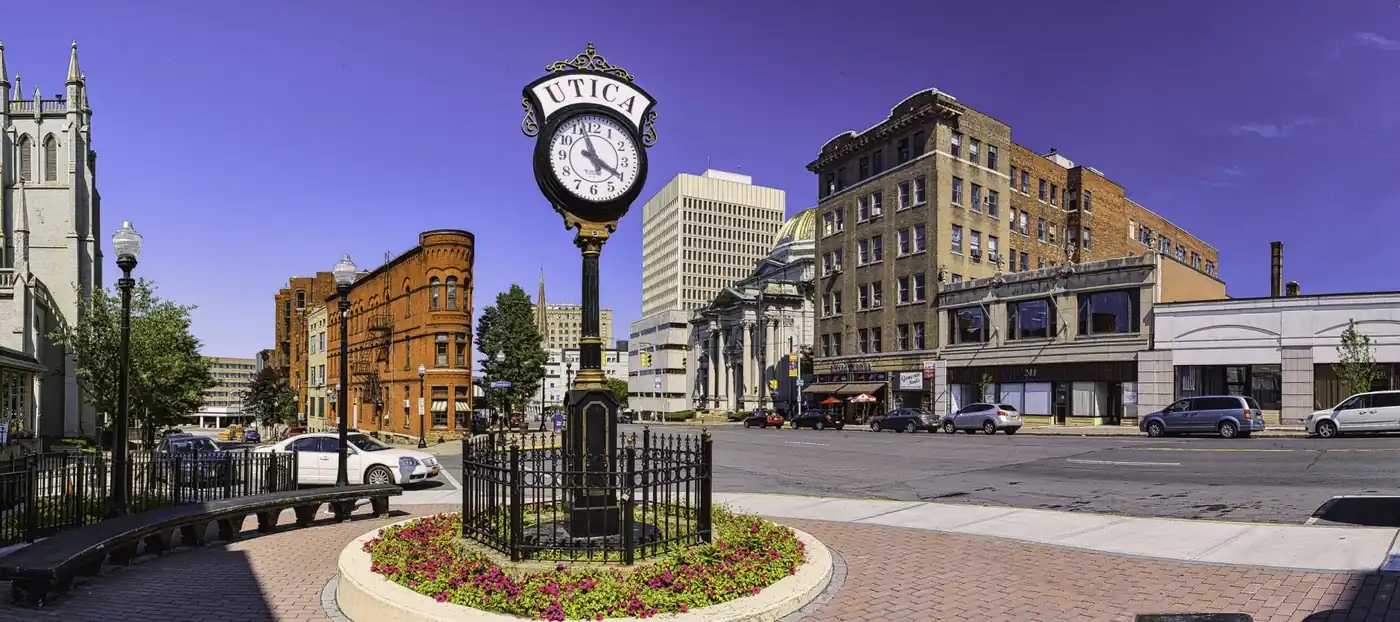
Service Areas
Onondaga and Madison County Towns on the Service Map
West of the line the hub draws through the corridor: the Syracuse suburbs, the lake shore towns and the Madison County city on its record holding creek.
Onondaga County is the hub's home county, and its towns divide by water. Liverpool sits where Onondaga Lake meets its outlet toward the Seneca River, low and lake minded. Cicero stands on the road to Oneida Lake's south shore, close enough that its weather is the lake's weather. Baldwinsville rides the Seneca River itself, a river town with a lock and a long memory of high water. Manlius and Fayetteville climb the eastern hills, where the calls run to burst pipes, roof leaks and the creeks that drop off the escarpment. Syracuse itself is covered on its own section and its own city page. The standard for water damage restoration central new york in Baldwinsville is set by work like this.
Madison County contributes the city of Oneida, and with it the creek that holds a record. Oneida's flood story is told in full on the June twenty thirteen section: seventeen point two three feet on Oneida Creek, several feet of water into a city that sits, whatever its name suggests, in Madison County. The county's rural towns between Oneida and the hills share the pattern of the whole corridor: small creeks, fast rises, and housing that predates the gauges. For the hub, Madison is the proof that the service map follows water rather than county pride, because the creek that floods Oneida rises in one county, is gauged under another's name, and is dried by a crew that has to hold all three facts at once. None of it is optional in water damage restoration central new york in Oneida.
Service Areas
Oneida and Oswego County Towns on the Service Map
East and north of the line: the Mohawk corridor towns, the Whitesboro shoulder, and the Oswego County river towns that close the five counties.
Oneida County's map is the corridor itself. Rome stands up the line on the Mohawk and the old canal, a city with its own river flats and its own flood memory. Utica anchors the county's east from its own section. Whitesboro and New Hartford sit at Utica's shoulder, the first carrying Sauquoit Creek's documented history, the second climbing the hills south of the city where the calls run to pipes, roofs and the creek's upper reaches. Yorkville and the smaller valley villages share the Sauquoit and the river bottom between them. The standard for water damage restoration central new york in Rome is set by work like this.
Oswego County closes the five counties to the north. Oswego city stands where the Oswego River meets Lake Ontario, the end of the drainage that begins at Oneida Lake: the lake's outlet becomes the Oneida River, whose length the sources behind this page could not settle, eighteen miles against twenty three, and so no length is printed for it here. The river joins the Seneca to form the Oswego, and Fulton sits on that river between the lake and the city. River towns both, with the low ground, the old mill housing and the sump calendars that river towns everywhere share. None of it is optional in water damage restoration central new york in Oswego.
Response
Response Across Five Counties, and a Sixth Across the Line
No honest crew quotes minutes across six counties of hills and lake weather. What it can quote is a system: staging, a queue ordered by danger, and a call when the truck rolls.
The hub stages from two anchors, Syracuse in the west and Utica in the east, because the corridor between them is the service map's spine. Towns near the anchors, the Syracuse suburbs and the Utica shoulder, are the short runs. The lake shore, the Madison County city, the Oswego river towns and the valley floor are the longer ones, and their length is measured in roads, not miles: a shore lane, a creek crossing or a valley underpass decides the run on the night it matters. Any arrival promise that ignores the night's water is a promise made to be broken, and broken promises in a flood are remembered longer than honest queues. The standard for water damage restoration central new york in Syracuse is set by work like this.
The queue is ordered by danger, and the order is published here so a caller can test it. Water near electrical systems and water that is rising come first. Sewage comes before clean water of the same depth, because its clock is biological. A home with someone medically vulnerable to cold, damp or air quality moves up. Standing water that is stable and clean waits behind all of those, and is told so, with its position and the reason. In a thirteen county emergency like Halloween twenty nineteen, that ordering is the difference between a system and a scramble, and it is why the dispatch line asks its questions in the order the next section describes. None of it is optional in water damage restoration central new york in Utica.
Response
What the Twenty Four Seven Dispatch Line Asks First
Four questions, in a fixed order, because the answers stage the right truck, the right equipment and the right place in the queue.
First: is anyone at risk. Water near a panel, a furnace or a fallen ceiling, a household member who cannot manage stairs, a smell of gas or sewage: the safety answers come before the address is even written down, because they decide whether the first call the dispatcher makes is to the crew or to emergency services. Second: what is the water and where is it coming from. A pipe, a pump, a creek, a lake, a drain: the source names the equipment, the contamination rules and the likely claim route in one answer. The standard for water damage restoration central new york in Liverpool is set by work like this.
Third: what is wet, and how much of it. Rooms, levels, finishes, whether the water is standing or soaked in, whether it is rising, steady or falling. Those answers size the extraction and the dehumidification on the first truck rather than the second. Fourth: what has been photographed and what has been shut off. A caller who has done the first hour's work, valve closed, photographs taken, people safe, has already shortened her own job, and the dispatcher says so. The number itself, (315) 555-0147 (placeholder), is answered around the clock, every day of the year, in both area codes' worth of towns the hub serves. None of it is optional in water damage restoration central new york in Baldwinsville.
Response
Your First Call, First Visit and Written Drying Plan
From the phone call to the signed plan, this is the shape of the beginning of every job on this page, so a homeowner can hold the crew to it.
The first visit opens with the safety pass and the source, in that order, and then the map. The crew reads the building before it dries the building: moisture readings across every affected material, the wet boundary marked, photographs matched against the ones the homeowner took in the first hour. Only then is equipment placed, and it is placed against a written drying plan that names the areas, the equipment, the dry standard drawn from the house's own unaffected material, and the expected range of days. The homeowner signs the plan and keeps a copy. A job that begins without one begins as an argument waiting for a topic. The standard for water damage restoration central new york in Syracuse is set by work like this.
The plan also opens the claim file properly. It records the source diagnosis that routes the claim, the photographs, the first readings, and the list of anything already removed, with the reason. Insurers, adjusters and, where the loss is large, a public adjuster all read that opening document, and its quality decides how much of the rest of the claim is conversation and how much is verification. The crew's obligation is to write it as if the strictest of those readers were standing in the room, because one of them eventually will be, on paper.
Water on the floor now?
Extraction first, drying second, paperwork from the first hour. The dispatch line answers day and night.
Questions From the Region
Questions Syracuse Homeowners Ask After a Flood
Gathered from the calls the western anchor actually gets: the creek, the thaw, the lake and the panel at the bottom of the stairs.
The creek questions come first, because Syracuse is a creek city that thinks of itself as a lake city. How high did it get at Nedrow, is my street on the five foot list, and how fast does the valley drain after a crest: the gauge section of this page answers all three from the Weather Service record, and the honest summary is that a minor crest on Onondaga Creek is a major event for the streets it names. Homeowners along the valley floor learn to read the gauge the way farmers read the sky, and the ones who do are photographed, pumped and drying while the rest of the street is still watching the water rise.
The thaw questions follow every March. Why is my basement wet when it never rained, why is the sump running every two minutes, and is the water coming through the wall a foundation failure or a season: the snowmelt section answers them, and the short version is that a winter's snow leaving through frozen ground is a flood delivered by the calendar. Syracuse homeowners also ask the panel question more than most, because so many of the city's basements carry the panel at the stair foot: the answer is always the same, nobody enters water near it, and the crew's safety pass comes before everything.
Questions From the Region
Questions Utica and Whitesboro Homeowners Ask After a Flood
From the eastern anchor: the river's delay, the creek's speed, and the question about the village line that this page answers every time it is asked.
Utica asks about time. The river gauge is up, the rain has stopped, why is the water still rising: because the Mohawk at Utica drains five hundred fifty three square miles, and the watershed is still delivering yesterday's rain from hills the homeowner cannot see. The Halloween section's numbers make the point permanently: the crest at Utica came on November second, a full day after the worst of the rain. River streets plan on the watershed's clock, creek streets on the sky's, and a house that fronts both, as parts of the valley floor do, has to watch two clocks at once.
Whitesboro asks about the line, and deserves the straight answer this page gives wherever it comes up: the village is its own municipality in Oneida County, beside Utica and not inside it, with its own creek, its own gauge and its own county drainage study. When coverage of the twenty nineteen flood filed Whitesboro's foundation damage under a Utica dateline, it misfiled the record, and a homeowner searching her village's history is owed the correction. The same care runs the other way: Utica's river record is Utica's, and the regional totals of the federal study belong to the region, not to either name alone.
Insurance
Records to Keep From the First Photograph to the Final Reading
One folder, started in the first hour, added to daily, and closed at the handover. This is its table of contents, and the reason for every item in it.
The folder opens with the homeowner's own evidence: the first hour photographs with their dates intact, the note of when the water was found and when the call was made, and any neighbour photographs or footage of the street at the crest. It continues with the crew's record: the written drying plan, the moisture map, the daily log, the final readings, the photographs matched to the homeowner's set, and the list of everything removed with the readings that condemned it. Neither set is complete alone. Together they are the event, documented by the two parties who were actually there.
The paper layer sits on top of the evidence layer: the policy itself, the claim number, every letter and email from the insurer, and a dated note of every phone call, with the name of the person spoken to and what was said. Receipts for everything, including the homeowner's own purchases and any emergency work by others, go in as they happen, because a receipt reconstructed in month three is a story and a receipt filed in week one is a fact. Where the job involved an assessor, an engineer or a public adjuster, their reports join the folder, with the licences copied where the law required them.
Services
Fifteen Services Under One Written Standard
Every service below is delivered inside the same sequence: dispatch, safety, extraction, mapping, drying to readings, and a complete claim file.
Emergency Water Extraction
Pumps and extraction wands on the first truck, staged from Syracuse or Utica, until standing water is a wet surface.
Structural Drying and Dehumidification
Air movers and dehumidifiers set to a written plan, read daily, and closed on final readings.
Oneida Lake Flooding Cleanup
Shore homes and camps dried from the crawl space up, with the lake's own humidity sealed out.
Mohawk River Flood Cleanup
River street work staged on the gauge, from the crest through the log's final readings.
Erie Canal Flooding Cleanup
Low corridor ground along the old canal line in Syracuse, Rome and Utica, dried to readings.
Basement Flood Drying
Stone, brick and block basements read at several heights and dried as a system, not a surface.
Sewage Cleanup and Sanitizing
Contaminated water handled under strict rules: removal, cleaning, sanitizing, then drying.
Burst Pipe Water Damage Repair
The split found, the path of the water mapped down every level, and each level dried on the log.
Mold Prevention and Remediation Support
Drying fast enough to stay below the licensing line, and honest referral when a job crosses it.
Water Removal and Pumping
Standing water out of basements, crawl spaces and ground floors, with the high water line recorded.
Moisture Mapping and Drying Logs
The map and the daily log: the documented proof that every material reached the dry standard.
Hardwood Floor Drying
Drying mats and daily readings for the oak and maple floors of the hub's older homes.
Commercial Water Damage Restoration
Shops, offices and warehouses dried around trading hours, with a file every reader can use.
Insurance Claim Documentation
Source diagnosis, photographs and readings assembled into the claim file from the first hour.
Sump Pump Failure Cleanup
The failure documented for the right policy, the water out, and the system left better than found.
Water on the floor now?
Extraction first, drying second, paperwork from the first hour. The dispatch line answers day and night.
The Process
How the Work Runs in Central New York: Six Steps in Order
The same six steps on every job, from a Syracuse sump failure to a Mohawk River flood in Utica.
Call and dispatch
Call (315) 555-0147 (placeholder) day or night. The dispatcher records the water source, the rooms involved and the safety picture, and stages the nearest crew from Syracuse or Utica.
Stop the source and make safe
Shut off the water at the main for pipe failures, isolate power from wet areas, and keep people clear of water near panels, outlets or furnaces.
Pump out and extract
Standing water is pumped and extracted from floors, carpets and cavities, and the high water line is photographed and recorded for the claim file.
Open, map and dry
Moisture is mapped with meters, only the cavities the readings condemn are opened, and air movers and dehumidifiers are set to a written drying plan.
Daily readings and mold watch
Readings are taken daily and entered in the drying log, equipment is adjusted as numbers move, and wet material is watched for mold growth.
Final readings and the claim file
Drying ends when final readings meet the dry standard. The complete log, photographs and records are handed over as the insurance claim file.
Gazetteer
A Central New York Gazetteer: Fifteen Places and Their Water
Every place on the service list, with the water that defines its risk. Read your town line before you need it.
Syracuse, 13202
The western anchor on Onondaga Creek, 148,620 people at the 2020 Census, staging city for the hub.
Utica, 13501
The eastern anchor on the Mohawk River, 65,283 people at the 2020 Census, a Mohawk Valley city on the state map.
Oneida, 13421
Madison County city on Oneida Creek, which holds its record crest of 17.23 ft from June 28, 2013.
Rome, 13440
Up the corridor on the Mohawk and the old canal line, with its own river flats.
Oswego, 13126
Where the Oswego River meets Lake Ontario, the end of the drainage that begins at Oneida Lake.
Fulton, 13069
On the Oswego River between Oneida Lake and the city of Oswego, a river town with mill housing.
Auburn, 13021
Cayuga County city inside the five counties, on its lake outlet at the edge of the Finger Lakes story.
Cortland, 13045
In the southern hills of the five counties, where the Tioughnioga River runs.
Liverpool, 13088
On the north shore of Onondaga Lake, where the lake drains toward the Seneca River.
Baldwinsville, 13027
A Seneca River town with a lock, northwest of Syracuse on the river road.
Cicero, 13039
On the road to the south shore of Oneida Lake, close enough to share the lake's weather.
Manlius, 13104
Eastern hill suburb of Syracuse, where creeks drop off the escarpment.
Fayetteville, 13066
Beside Manlius on the eastern hills, in Limestone Creek country.
Whitesboro, 13492
Beside Utica on Sauquoit Creek, with the county drainage study and the 2019 foundation record to its name.
New Hartford, 13413
At Utica's shoulder, climbing the hills south of the valley floor.
Case Studies on Video
Two Case Studies Worth Watching Before Your Crew Arrives
Video belongs on the platform that hosts it, so this page describes two case studies and links out rather than embedding players.
The first case study walks a flooded home from the first call to the final readings, and its value is the order of operations: source stopped, water extracted, cavities opened on readings, and a drying log that any viewer can pause and compare with the six steps on this page. Watch it at youtube.com/watch?v=Ouqk4b54oBo.
The second follows the drying days themselves, the part of the work that looks like nothing happening, and shows the daily readings falling toward the dry standard. It is the best short education in why a crew asks for days after the water is gone. Watch it at youtube.com/watch?v=MMqjBUTEVJI.
The Whole Site
The Rest of This Site: Thirty One Pages of Cities, Regions and Topics
This hub page is one of thirty two. Every other page of the site is listed here, because a region page that hides its neighbours is a dead end wearing a map.
Start with the two cities this hub joins: the Syracuse page carries the western anchor in full, and the Utica page carries the eastern anchor in full, and this page deliberately does not repeat either record. The other region pages, Finger Lakes, Western New York, Westchester County, Hudson Valley and Capital Region, are built to this same pattern, so a reader crossing the state can navigate by water the whole way. The topic pages carry the statewide method in full.
Water Damage Restoration New York
The state hub: the home page for the whole of New York, its research and its full service map.
Water Damage Restoration Brooklyn
The Brooklyn page: brownstones, basements and the borough's own flood record.
Water Damage Restoration Queens
The Queens page: the borough's neighbourhoods, housing and water risks, street by street.
Water Damage Restoration Bronx
The Bronx page: river ground, old housing stock and the borough's dated flood cases.
Water Damage Restoration Staten Island
The Staten Island page: an island borough's storm, surge and basement record.
Water Damage Restoration Long Island
The Long Island page: Nassau and Suffolk, coast, creeks and sump country.
Water Damage Restoration Manhattan
The Manhattan page: high rise water, old pipes and vertical drying.
Water Damage Behind Walls NYC
The hidden water page: leaks inside walls, the signs, the meters and the fix.
Water Damage Insurance Claim New York
The claim page: New York insurance clocks, documents and deadlines in full.
Fire Damage Restoration NYC
The fire restoration page: fire, smoke and the water that follows the hoses.
Flood Cleanup NYC
The flood cleanup page: city flood water, cleanup order and drying proof.
Water Damage Remediation NYC
The remediation page: what remediation means, and how it differs from drying.
Fire Damage Cleanup NYC
The fire cleanup page: debris, soot and water after a fire, handled in order.
Water Damage Restoration Rochester
The Rochester page: Monroe County and the Lake Ontario shore, on its own figures.
Water Damage Restoration Albany
The Albany page: the capital city, the Hudson and its river record.
Water Damage Restoration Buffalo
The Buffalo page: the lake Erie city in full, storm by storm and creek by creek.
Water Damage Restoration Syracuse
The Syracuse page: the western anchor's own record, its snow, creeks and housing in full.
Water Damage Restoration Yonkers
The Yonkers page: Westchester's largest city, its rivers and its housing.
Water Damage Restoration New Rochelle
The New Rochelle page: Sound shore water and suburban basements.
Water Damage Restoration Mount Vernon
The Mount Vernon page: a small city with a full size water record.
Water Damage Restoration Schenectady
The Schenectady page: the Mohawk at the door of the Stockade.
Water Damage Restoration Utica
The Utica page: the eastern anchor's own record, the river, Sauquoit Creek and its streets in full.
Water Damage Restoration White Plains
The White Plains page: the Westchester county seat and its river ground.
Water Damage Restoration Troy
The Troy page: the Hudson, the Poesten Kill and the collar city's record.
Water Damage Restoration Niagara Falls
The Niagara Falls page: river ice, creek floods and frozen pipes.
Water Damage Restoration Binghamton
The Binghamton page: two rivers, one valley and its flood record.
Water Damage Restoration Westchester County
The Westchester County page: the Sound shore to the Hudson, one county region.
Water Damage Restoration Hudson Valley
The Hudson Valley page: the river region from the Highlands north.
Water Damage Restoration Capital Region
The Capital Region page: where the Hudson meets the Mohawk.
Water Damage Restoration Western New York
The Western New York page: where Lake Erie meets the Niagara River.
Water Damage Restoration Finger Lakes
The Finger Lakes page: eleven lakes, the Genesee River and the canal towns, on their own figures.
Water Damage Restoration Southern Tier
Binghamton and Elmira, Susquehanna and Chemung rivers, across eight counties.
Water Damage Restoration NYC
All five boroughs, the Hudson and East rivers, one fast response.
How Long Does Mold Take to Grow After Water Damage?
The 24 to 48 hour mold timeline, warning signs, and what stops it.
Water Damage Restoration Process
The full restoration process, step by step, from first call to dry home.
What Is Water Damage Restoration
What restoration really is, what it includes, and when to call.
Mold Remediation New York
New York's licensed remediation system, from assessment to clearance.
Water Removal NYC
Standing water pumped out fast, then dried safe, for every NYC home.
Water Damage NYC
Water damage in NYC explained plainly, with fast help for every home.
Water Damage Cleanup Nyack NY
Water damage cleanup in Nyack explained plainly, with fast help for every home.
How to Choose a Water Damage Restoration Company in New York
How to choose a water damage restoration company in New York, with every check that protects your home.
How to Choose a Water Damage Restoration Company in New York
Commercial Water Damage Restoration NYC | 24/7 Emergency Help
Commercial water damage in NYC explained plainly, with fast help for every business.
Commercial Water Damage Restoration NYC | 24/7 Emergency Help
Basement Water Damage Restoration NYC
Basement water damage in NYC explained plainly, with fast help for every basement.
Water Damage Repair New York
Water damage repair in New York explained plainly, with fast help for every home.
Water Damage Restoration Poughkeepsie New York
Water damage restoration in Poughkeepsie explained plainly, with fast help for every home.
Emergency Water Damage NYC
Emergency water damage in NYC explained plainly, with fast help when every minute counts.
Water Damage Cleanup in NYC
Water damage cleanup in NYC explained plainly, from torn-out materials to dry rooms again.
Flood Damage Restoration NYC
Flood damage restoration NYC explained plainly, from flood events and NFIP claims to dry rooms and a flood-resistant rebuild.
How Long Does Water Damage Restoration Take
How long water damage restoration takes explained plainly, from the first extraction visit to the final dry readings.
Flood Damage Cleanup Washington Heights
Flood damage cleanup in Washington Heights explained plainly, from extraction and drying to a clean, dry home again.
Does Insurance Cover Water Damage Restoration
Whether insurance covers water damage restoration, explained plainly, by cause and New York rule.
Water Damage Mold Remediation
Mold that grew after a leak or flood, remediated the New York way, by licensed assessor and remediator.
Water Damage Restoration Companies New York
Compare the companies serving New York: national franchises, regional firms and local independents, and how to verify licences and certification before you hire.
Water Damage From Upstairs Neighbor
Water damage from an upstairs neighbor in New York City: who pays, what to do in the first hour, and how to document, report and claim.
FAQs
Central New York Water Damage Questions, Answered Straight
Thirty questions, the ones this corridor actually asks, answered in the same words the structured data on this page carries.
Water is pouring into my Central New York home right now. What do I do first?
Stay out of any water that touches outlets, a power panel or plugged in appliances, and never wade through water when you cannot see the bottom. If the source is a pipe or an appliance, shut the water off at the main valve. If the water is rising outside, from a creek, a lake shore or a street, move people, pets and medicines upstairs first, then documents and photographs. Photograph every room before you move anything else. Then call a water damage restoration central new york crew at (315) 555-0147 (placeholder). Extraction in the first hours is what keeps a wet floor from becoming a gutted room, and the first photographs anchor your claim.
How to tell if water damage is permanent?
Some water damage reverses with drying and some does not, and the difference shows in the materials. Hardwood that has cupped and stayed cupped after full drying, laminate that has swollen at every seam, drywall that crumbles at a touch, and insulation that has matted down have usually crossed the line. Solid wood framing, concrete and masonry almost always dry back to sound. The honest test is a meter, not an opinion: a crew maps moisture, dries to a written standard, then reads again. What returns to the dry standard was temporary. What cannot reach it, or what has lost strength or grown mold through its depth, is the permanent part.
When to call water restoration?
Call as soon as you find standing water, a soaked floor, a ceiling stain that is growing, or a basement that smells wet after a storm, and call before you start tearing anything out yourself. The first hours decide the size of the job: water extracted the same day usually means drying only, while water left for two days can mean opened walls and mold work. Call also when the source is unclear, because a crew with meters finds leaks that eyes miss. If water is near anything electrical, keep out of it and make the call the first thing you do, from dry ground.
What does water damage restoration include?
It includes the full sequence, in order: emergency call and dispatch, stopping the source and making the building safe, pumping and extraction, moisture mapping, opening only the cavities the readings condemn, structural drying with air movers and dehumidifiers, daily readings in a drying log, cleaning and sanitizing, mold prevention, and final readings with a documented claim file. Repair of what drying could not save follows the same file. A service that offers only a pump and a fan is offering the middle of the sequence. The measure of the work is the log: dated readings that prove each material reached the dry standard.
What is water damage restoration called?
The trade uses three words that people mix up. Mitigation is the emergency work that stops the loss from growing: extraction, drying and protection. Restoration is the wider job of returning the building to its condition before the loss, drying plus repair. Remediation is the word used when a contaminant is being removed, most often mold or sewage, under its own rules and, in New York, its own licences for mold. When you search, the phrases describe the same first phone call. What matters is not the label on the truck but whether the crew runs the full sequence and documents it.
Is Utica really in Central New York?
Honestly, it depends which map you use, and this page says so. Under the New York State administrative definitions, Central New York is five counties: Cayuga, Cortland, Madison, Onondaga and Oswego, per the Central New York Regional Planning and Development Board. Oneida County, where Utica sits, belongs to the Mohawk Valley region under Empire State Development, with Fulton, Herkimer, Montgomery, Otsego and Schoharie. In everyday use, people fold Utica into Central New York all the time, and this hub page serves both cities under one roof. It just refuses to redraw the state map to do it.
How big is Oneida Lake, and why does its size matter for shoreline homes?
Oneida Lake covers fifty thousand eight hundred ninety four acres, runs twenty one miles long, reaches fifty five feet at its deepest and averages twenty two point three feet deep, at an elevation of three hundred seventy feet with seventy seven point two miles of shoreline, per the New York State Department of Environmental Conservation. It is the largest lake lying wholly within New York State, and it sits ten miles north of Syracuse. Size matters because a lake this broad pushes water at low shoreline lots from more than one direction in a blow, and because its level answers to the whole watershed, not to one afternoon of rain.
What did Onondaga Creek do on March 30, 2014?
Onondaga Creek crested at five point two one feet on March thirtieth, twenty fourteen, at the gauge near Nedrow in Onondaga County, United States Geological Survey station zero four two three nine zero zero zero, per the National Weather Service gauge record. That crest sits just above the minor flood stage of five feet and below the moderate stage of five point five feet. At five feet, the gauge notes say, flooding begins to affect Kirk Park and neighbourhoods along Marginal Street, Hovey Street, Midland Avenue and other Syracuse streets. The record crest at that gauge is six point five feet, so twenty fourteen was a real flood, not the worst the creek can do.
What happened near Utica during the Halloween flood of 2019?
Between October thirty first and November third, twenty nineteen, historic flooding struck localized areas of the Mohawk Valley and the southern Adirondacks, documented in United States Geological Survey Scientific Investigations Report twenty twenty three to five one two six. The Mohawk River near Utica peaked at nineteen point two two feet with a flow of twelve thousand eight hundred cubic feet per second on November second, the highest of the six peaks in its record there. Across the study region, at least one person died, eighteen homes were destroyed, and damage to public infrastructure was estimated at thirty three million dollars in words the report attaches to the whole region, not to Utica alone. A state of emergency covered thirteen counties.
Was Whitesboro flooded in 2019, and is Whitesboro part of Utica?
Whitesboro is its own village in Oneida County, directly beside Utica, and it is not part of the city. Oneida County's Sauquoit Creek drainage study records that Whitesboro has flooded repeatedly, and that the October thirty first, twenty nineteen event was particularly intense there, damaging multiple residential foundations badly enough to bring orders of condemnation. Rain measured near Sauquoit reached four point one nine inches in twenty four hours, a twenty five to fifty year recurrence. When you read that Utica flooded on Halloween twenty nineteen, much of the hardest residential damage in the county record is Whitesboro's, and the distinction matters for whose history it is.
What is the record flood on Oneida Creek?
The record crest on Oneida Creek at Oneida is seventeen point two three feet, set on June twenty eighth, twenty thirteen, per the National Weather Service gauge page. The stages there are action at ten feet, minor at eleven, moderate at thirteen and major at fifteen, so the twenty thirteen crest stood more than two feet into major flood stage. The gauge notes describe flooding several feet deep extending well into the City of Oneida. One geography point this page keeps straight: the City of Oneida is in Madison County, not Oneida County. The creek forms the county line there, which is how the confusion starts.
When was the Erie Canal completed?
The Erie Canal was completed on October twenty sixth, eighteen twenty five. Construction began on July fourth, eighteen seventeen, and the finished canal ran three hundred sixty three miles, four feet deep and forty feet wide. The year eighteen twenty is sometimes quoted, and it is wrong for the completion: eighteen twenty belongs to the middle section's opening, not the finished waterway. The canal matters to this page because Syracuse, Rome and Utica all grew up on its line, and the low ground along the old canal corridor still shapes where water goes in both cities when the creeks and the river run high.
How fast can a crew reach my Syracuse home?
It depends on where in Onondaga County you are and what the weather is doing, and any crew that quotes you a minute count before hearing your street is guessing. Syracuse is the staging city for this hub, so city addresses and the inner suburbs, Liverpool, Cicero, Baldwinsville, Manlius and Fayetteville, are the shortest runs. In a county wide event, the honest answer is a queue ordered by danger: water near power first, then rising water, then standing water that is stable. What the dispatch line owes you is a real position in that queue and a call back when the truck rolls, not a promise invented to keep you on the line.
How fast can a crew reach my Utica or Whitesboro home?
Utica is the eastern anchor of this hub, and crews stage for Oneida County from the city itself, so Utica, Whitesboro and New Hartford are the home ground, with Rome the next run west. In a Mohawk Valley wide event like the Halloween flood of twenty nineteen, roads decide more than distance: a closed crossing over Sauquoit Creek or a flooded underpass can double a run that looks short on the map. The dispatch answer you should accept is the same one Syracuse gets: your place in the queue, the reason for it, and a call when the crew is moving.
What should I do when my basement floods in an older Syracuse home?
Keep out of the water until you know it is clear of the panel, the furnace and anything plugged in, because older Syracuse basements often carry the panel at the bottom of the stairs. If the water came from a pipe, shut the main off. If it came through the walls or the floor drain, do not try to pump it dry while water is still pushing in from outside; photograph it, note the time, and move what you can carry to the stairs and up. Photograph the high water line before anything dries. Then call. In a house with plaster, stone foundation walls and an old floor drain, the drying plan is written around the house, not from a template.
How do you dry a flooded basement step by step?
First the source is stopped and the space is made safe, with power isolated from anything wet. Standing water is pumped and extracted, and the high water line is photographed for the claim file. Moisture is then mapped with meters across the floor, the walls and the cavities behind them, and only the sections the readings condemn are opened. Air movers and dehumidifiers are set to a written plan, readings are taken daily and entered in the drying log, and equipment is adjusted as the numbers move. Drying ends on final readings that meet the dry standard, and the log, photographs and readings become your claim file.
How long does drying take in a Central New York home?
Most homes dry in days once the water is out, and the honest range depends on the water, the materials and the season. Bare concrete and open framing dry fastest. Plaster and lath, hardwood over sleepers, and insulated cavities dry slowly, and a Central New York winter helps the air indoors while a humid August works against it. Lake and river water that stayed for days adds time at the front end. Your crew should give you a range from the first day readings and narrow it daily in the log. A drying job with no log and no range is a job being run on hope.
When do walls have to be opened, and when can they stay closed?
Walls open when the meters say the cavity behind them is wet and cannot be dried through the surface, when insulation inside has taken water and matted, when the water was dirty, or when readings stall above the dry standard day after day. Walls stay closed when the moisture map shows the wet line stopped low, the cavity is empty or can be dried with directed air, and daily readings fall on schedule. The decision belongs to the readings, not to habit: some crews open everything, some open nothing, and both are wrong on the houses that needed the opposite. Ask to see the numbers behind the choice.
Can hardwood floors be saved after flooding?
Often, yes, if the water was clean, the floor was reached quickly, and the drying starts from both the surface and, where the construction allows, below it. Solid hardwood tolerates a flood far better than laminate or engineered boards with a fibre core, which swell at the seams and rarely come back. Cupping, where each board edges up, frequently relaxes as the floor dries evenly; crowning and boards that have lifted or split usually do not. The measure is time and readings: a floor under drying mats and dehumidification, read daily, tells you within days whether it is recovering. Floors left wet while a claim is argued over are the ones that get replaced.
When does mold start growing after a flood, and who may remove it in New York?
Mold can begin growing on wet material within one to two days, which is why extraction and drying run on a clock. For the removal itself, New York has licensed the work since January first, twenty sixteen, under Labor Law Article thirty two: for jobs covering more than ten square feet (10 sq ft), a licensed mold assessor must assess the job and a separate licensed mold remediator must do the remediation, and the two roles cannot be the same company on the same job. Fast, documented drying is what keeps most floods below that line entirely. If growth is already visible across a wide area, ask for licences before anyone starts.
What is a drying log, and why does my insurer want one?
A drying log is the dated record of the job: the moisture readings for each material and room, the equipment placed and moved, the readings taken each day, and the final readings that closed the work. Your insurer wants one because it is the difference between a claim and an argument. The log proves the water reached where the file says it reached, that the drying was done to a standard rather than to a guess, and that any material removed was removed because a reading condemned it. Keep your copy with your policy papers. If a crew cannot show you a log from its last job, it will not produce one for yours.
Does homeowners insurance cover flooding from Oneida Lake or the Mohawk River?
Generally, no. A standard homeowners policy covers sudden water from inside the home, a burst pipe or a failed appliance, and excludes rising water that comes from outside, which is what lake and river flooding is. That exclusion is exactly why the federal flood programme exists. The practical point for your claim is the source diagnosis: the same wet basement is a homeowners claim if the sump failed during a storm and a flood claim if the river came through the door. A good crew documents the source from the first visit, with photographs and readings, so the claim lands on the right policy the first time.
Does NFIP flood insurance cover homes between Syracuse and Utica?
Yes. The National Flood Insurance Program writes flood policies across both counties, through insurers, for owners and renters. The clocks matter: a new policy usually waits thirty days (30 days) before it takes effect, a proof of loss is due within sixty days (60 days) of the loss, an appeal runs sixty days (60 days), and a suit must be filed within one year (1 year) of the first written denial. The programme's authorisation currently runs through December 11, 2026 (11 Dec 2026), at 11:59 p.m.; that date is the authorisation deadline, not a policy expiry, and policies in force stay in force to their own terms.
What does New York Insurance Law say about claim deadlines?
Several clocks run at once. Under Insurance Law section twenty six oh one and Regulation sixty four, title eleven of the state rules part two sixteen, an insurer must acknowledge your claim, begin investigating, and accept or reject within fifteen business days (15 business days) after proof of loss, and pay within five business days (5 business days) of settlement; enforcement runs through the Department of Financial Services. For natural disasters, Insurance Law section twenty six eighteen sets payment at four business days (4 business days). Suit on the policy must be brought within twenty four months (24 months) of the loss, under section thirty four oh four. The timely disclaimer rule in section thirty four twenty (d) covers death and bodily injury liability claims, not property damage.
What is the public adjuster fee cap in New York?
A public adjuster representing a policyholder in New York may charge no more than twelve point five percent (12.5 percent) of the recovery, under title eleven of the state rules, part twenty five point seven. The cap is the whole point of hiring one on a large loss: the fee is fixed by rule, agreed in a written contract, and paid from the recovery. Watch for two things. The contract must state the fee plainly, and the adjuster must be licensed in New York. For questions or complaints, the Department of Financial Services answers at (800) 342-3736, and its disaster hotline is (800) 339-1759.
What should I photograph before the crew arrives?
Photograph the source if there is one, a burst pipe, a failed sump, a water heater, before anything is moved. Then stand in each doorway and take a wide shot of every affected room, followed by the high water line on walls, stair treads and furniture legs. Photograph serial plates on appliances, the panel if it is dry and safe to approach, and the street or yard if the water came from outside, because the outside shots prove the source. Keep the originals with their dates intact and send copies, never the only files. These photographs, taken in the first hour, are the spine of your claim file.
Can I stay in my home while it dries?
Usually, yes, if the water was clean, the electrical system stayed dry or has been checked, and at least part of the home is dry and usable. Drying equipment is loud and it warms the rooms it runs in, so most families sleep in the dry end of the house and live around the machines for a few days. You should leave if sewage came in, if the panel or furnace got wet and has not been cleared, if ceilings are sagging, or if anyone in the house has breathing trouble that the dust and air movement stir up. The crew should give you a straight answer for your house, not a general one.
How do you handle a sewage backup in an older Utica home?
Sewage is treated as contaminated water from the first minute. The area is closed off, porous material the water touched, carpet, pad, the bottom of drywall where readings show it wicked, is removed rather than dried, and hard surfaces are cleaned and sanitized. Protective equipment is not optional, and neither is keeping children and pets out until the space is cleared. Older Utica housing adds two wrinkles: clay and cast iron lines that can be cracked or root filled, which a camera inspection will show, and floor drains that tie the house to a street line that surcharged. Drying a sewage room without removing what the water touched is not restoration; it is storage of the problem.
Do you handle commercial water damage in Syracuse and Utica?
Yes. Shops, offices, restaurants and warehouses across both cities run on the same sequence as homes, extraction, mapping, drying to readings, documented in a log, with two differences. The first is hours: work is staged around trading where the building allows, with the wettest work done overnight. The second is paperwork: the claim file serves the insurer, the landlord or tenant split, and the reopening inspection at once, so it is built to be read by all three. A flooded stockroom in Syracuse and a flooded dining room in Utica are the same science with different neighbours, and the log is what lets a business reopen on evidence rather than on a smell test.
What records should I keep for my insurance claim?
Keep everything, in one folder, from the first hour. The photographs you took before anything moved, with dates intact. The crew's drying log and final readings. Every invoice and receipt, including anything you bought or rented yourself. Your policy and the claim number. Every letter and email from the insurer, and a note of every phone call with the date, the name and what was said. Any inspection reports, mold assessments and contractor estimates. The clocks in New York run from documents: proof of loss within the policy's time, suit within twenty four months (24 months) of the loss. A complete folder is what makes those deadlines easy to meet.