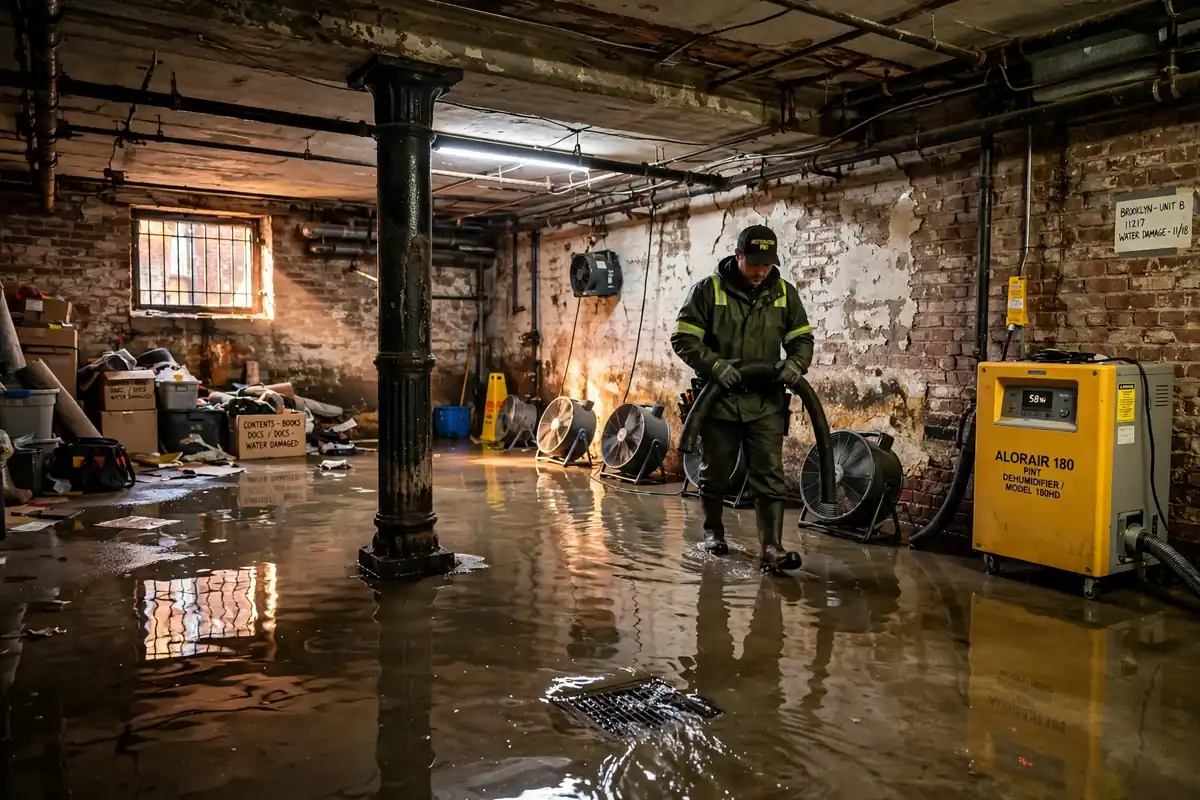
Quick answers
First Answers for a Wet Home, Borough by Borough
Most people land on this page with water on the floor and a phone in one hand. The full evidence fills the rest of the page, but these short answers are the ones callers ask for first, each stated the way the city agencies and the drying standard state it. Read the six cards, make the call if you need to, and come back for the long version when the floor is dry.
What do I do first?
Keep people safe, stop the source if you safely can, photograph every room, and call. If you rent, tell the owner or the super the same hour you find it, then put it in writing the same day.
How fast does mold start?
The Environmental Protection Agency says to dry water damaged areas within 24 to 48 hours to prevent mold growth. That two day window shapes everything a good crew does on day one.
Sewer water in the basement?
Call 311 at once. The Department of Environmental Protection inspects within six hours, and the most common cause it finds is pipes blocked by grease and wipes. Stay out of the water itself.
Is the tap water safe?
Yes. The Department of Environmental Protection says city tap water is safe to drink, tested hundreds of times a day, and the 2025 report found it meets or exceeds all federal and state standards.
Whose pipe is it anyway?
The street main belongs to the city. The service line from your building to that main, and every pipe inside, belongs to the owner, and repairs need a Licensed Master Plumber.
Will insurance cover it?
It follows the source. A burst pipe and a flooded street are different claims, and flood water usually needs its own policy. The photographs and logs you keep decide how smoothly either one runs.
One habit protects you through everything that follows: paper. Photograph the water before anyone pumps it. Keep every reading log, invoice, and letter you are handed. Write down names, dates, and the hour you called. When water damage in NYC turns into a claim, a housing case, or an argument between neighbours, the household with the paper is the household that gets believed. That holds in every water damage case this page covers, on every floor of every borough.
One expectation is worth setting now. Even when help starts within the hour, this work is measured in days. The pumping is loud and fast. The drying is quiet and patient, checked with meters every day. Callers who understand that shape on day one, a loud day first, then measured days, then a final set of readings, make calmer and better decisions at every step after. That calm is worth as much as any machine in water damage work.
Water in your home right now?
Say where the water is, how deep it looks, and what caused it if you know. The crew that answers brings the pumps and drying equipment the call describes, so the first trip is a working trip.
The meaning
What the Words Mean in a City of Old Pipes and Tall Buildings
The definition at the top of this page is short on purpose. Water damage in NYC is the harm that burst pipes, leaks, floods, sewer backups, and storms do to homes and businesses across all five boroughs. But the short version hides what makes this city different from a suburb with the same problem. Here, the building is rarely yours alone. Your ceiling is someone else's floor. Your pipes run through someone else's walls. A leak is a shared event before it is a private one, and that single fact shapes the law, the insurance, and the repair.
Age is the second difference. Much of the city was plumbed before anyone now living was born. Cast iron stacks crack. Galvanized lines narrow to a thread of rust. Radiator valves that have turned ten thousand times begin to weep. None of this is neglect on its own; it is what a century does to metal and water. It does mean that a large share of the calls in this city start small, a stain, a smell, a soft patch of paint, weeks before the ceiling finally gives way.
Density is the third difference. When a pipe bursts in a detached house, one family dries out. When a pipe bursts on the ninth floor of a Manhattan tower, gravity delivers the water to eight more homes, the elevator shaft, and the lobby. Crews who work here plan for the stack, not the unit: who lives below, which walls are shared, where the shutoffs for the whole line sit. The phrase on this page always means that wider event, not just the room where the water was first seen.
It also helps to know what the words do not mean. A damp smell in a basement is not yet damage. A stain that has been dry for five years is a record of damage, not damage in progress. Damage means material that is wet now, or material that water changed: swollen, softened, stained through, rusted, or grown over. Sorting the live problem from the old scar is the first job of any honest assessment, and it is why meters matter more than eyes on the first visit.
The trade sorts water itself into three kinds, and the kind decides the method. Clean water from a supply line is a drying problem. Water from an appliance or a drain carries soap, soil, and chemicals, and needs cleaning as well as drying. Water that came through a sewer or up from the ground outside is treated as contaminated, and porous material it soaked usually comes out rather than drying in place. When someone describes water damage in NYC without saying which kind, they have skipped the fact that decides half the job. Naming the kind is the first line of every water damage report.
Finally, the words cover a timeline, not a moment. There is the event, the hour the pipe burst or the rain came in. There is the spread, the hours water spends travelling along joists and down wall cavities. There is the drying, days of measured work. And there is the repair, the plaster, paint, and flooring that make the home whole. Pages on this site each take one part of that timeline as their whole subject. This page holds the map of all four, so you always know which part you are standing in. Every water damage job walks the same four stages, in the same order.
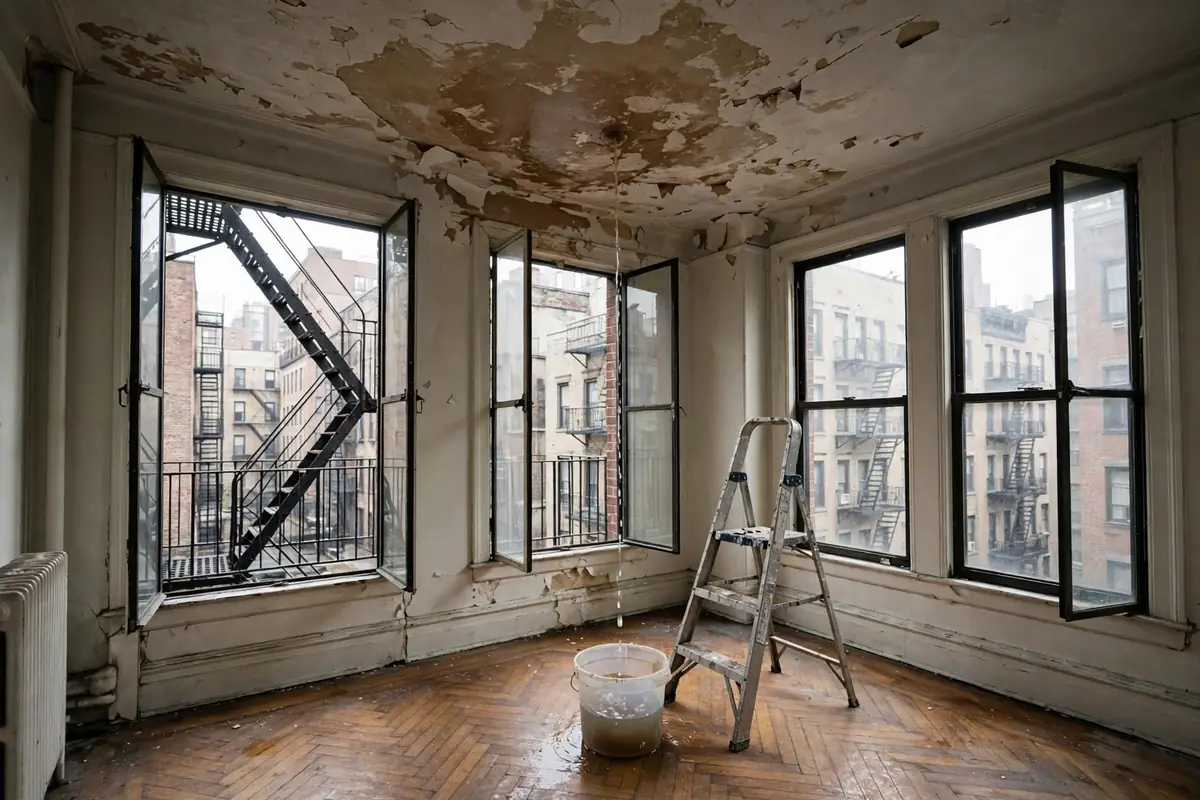
Causes
How Water Gets Into New York Homes, Cause by Cause
Every wet home has a source, and the source decides who pays, how the cleanup runs, and what stops it happening again. These are the causes crews meet in this city, stated the way the agencies state them. Two of them, the upstairs leak and the roof leak, are listed as commonly cited causes without any ranked share, because no authoritative city count of their frequency exists, and this page will not invent one.
Burst and leaking pipes
The everyday cause. Supply lines split in cold snaps, old joints let go under pressure, and pinhole leaks in copper spray a fine mist inside a wall for weeks before anyone knows. A burst pipe is loud and obvious. A pinhole is the opposite: it is found by the stain, the smell, or the water bill. Both end the same way, with the water shut off, the wet material mapped, and the drying started inside the two day window the Environmental Protection Agency sets for keeping mold out of the story. Pipe failures are the everyday opening of a water damage file.
Sewer backups
The Department of Environmental Protection is plain about the leading cause: blocked pipes, most often blocked by grease poured down sinks and wipes flushed down toilets, whatever the packet claims. When the line blocks, the water has nowhere to go but back into the lowest homes on the line. Report a backup to 311 immediately; the department inspects within six hours. If the blockage sits in the city sewer, the city clears it. If it sits in the private service line, that line is the owner's responsibility, and the cleanup of contaminated water is a different, stricter job than drying clean water. Sewer backups are where water damage stops being a drying problem and becomes a health problem first.
Storms and street flooding
Heavy rain overwhelms drains, and water that cannot get away finds basements, underpasses, and ground floors. The city's own history, covered later on this page, shows how fast this turns serious. Storm water is treated as dirty water once it has crossed streets and soil, and sand, silt, and whatever the street carried come in with it. After a storm, the order of work is safety first, then removal, then cleaning, then drying, and the claim route runs through flood cover rather than a standard home policy. Storm claims are the branch of water damage nyc where the policy wording matters most.
Frozen pipes
When a hard freeze settles on the city, pipes in unheated basements, crawl spaces, and outside walls freeze, expand, and split, then pour when the thaw comes. The Department of Environmental Protection treats frozen pipes as the owner's responsibility. The defence is dull and effective: keep the heat on, insulate exposed runs, let a tap drip on the coldest nights, and know where the main shutoff sits before the night you need it. A tenant who loses heat should report it at once, because heat is an emergency item in the housing rules. Frozen pipes fill the coldest weeks of the water damage nyc calendar.
The flat above, and the roof
Ask any super in the city and these two come up at once: the leak from the home above, from a bath, a hose, a radiator, or a failed seal, and the roof leak that travels down through flats that have no idea the roof is even involved. Both are commonly cited causes of water damage in NYC apartments, and both are usually found by the person underneath rather than the person at the source. There is no authoritative city ranking of how often each one happens, so this page lists them plainly, without shares or counts, and deals with the route instead: find the source, stop it, write it down, and repair from the top down.
Appliances and small hoses
The cheapest parts in the home cause an outsized share of the mess: washing machine hoses, dishwasher lines, ice maker feeds, and water heater tanks at the end of their lives. A rubber hose that costs little can run for hours into a sleeping home. Braided steel hoses, shutoff valves you can reach, and a pan with a drain under the heater are the standard defences. When a heater lets go, it rarely leaks politely; the tank empties at once, which is why its age matters more than its appearance. Appliance water is among the most preventable kinds of water damage nyc.
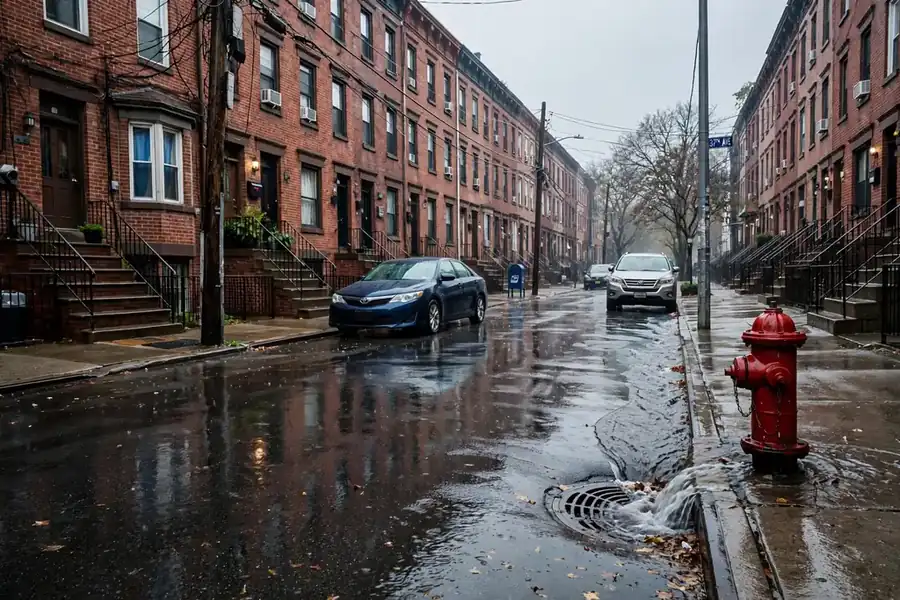
First steps
Six First Moves When Water Shows Up
The order matters as much as the actions. Safety before property, source before cleanup, records before drying. These six steps are the order crews and agencies agree on, written for the person standing in the wet room, whether that room is a Bronx walk up, a Brooklyn brownstone, or a Staten Island house. Each step is short enough to do with a phone in one hand.
1Call now and say where the water is
Call (212) 555-0147 and say where the water is, which room, which floor, and how deep it looks. Say what caused it if you know, whether it is still coming in, and whether anyone in the home is elderly, very young, or unwell. Those details decide what the crew brings on the first trip, so the first trip is a working trip and not a look around.
2Stop the water at its source if it is safe to do so
If a pipe has burst, close the shutoff valve for that fixture, or the main valve where the water line enters the home. If a toilet is overflowing, turn the small valve behind it. If the source is a city main break in the street, do not try to stop it yourself; call 311 and keep people away from the water until the city crew arrives.
3Stay out of deep or dirty water and turn off power if water nears outlets
Water and wiring do not mix. If water is near outlets, appliances, or a breaker box, stay out of the room and keep children and pets out too. If water came up through a toilet or a drain, treat it as dirty water, wear boots and gloves if you must cross it, and wash well afterwards. A flooded basement with live wires is a room to leave, not to work in.
4Tell your landlord or building super right away if you rent
If you rent, call the owner or the super as soon as you find the water, then follow up in writing the same day so there is a dated record. Owners carry the duty to repair the home and keep it fit to live in, and a leak left unreported can spread into the homes below and beside yours. A short written note with photographs protects you and speeds the repair.
5Get the water removed and the rooms mapped with meters
Standing water comes out with pumps and extraction equipment, and while that happens the crew walks every room with moisture meters and marks how far the water travelled. Rooms that look dry are checked too, because water runs along joists and inside walls. The map made on this visit is the plan for drying and the backbone of any insurance claim that follows.
6Dry the structure with daily readings and keep records for your claim
Air movers and dehumidifiers run until meter readings, taken daily and written down, show the structure has reached its dry standard. Keep every photograph, reading log, invoice, and letter in one folder from the first day. The Department of Financial Services ties cover to the event that caused the loss, and the folder that proves the event and the sequence is the folder that gets a claim settled.
Notice what is not on the list: ripping out wet material yourself, spraying bleach around, or running fans on water that may be contaminated. Fans on a moldy wall spread the problem. Bleach on a deep soak treats the surface and leaves the cavity wet. Demolition before mapping destroys the evidence your claim stands on. The six steps above are deliberately plain, because the first hour of a call is won by order and calm, not by effort. The order was built from long experience of water damage nyc calls, and it has not needed changing.
There is also a seventh, unwritten step: keep the phone charged and the notes in one place. Every call, every name, every promise, written down with the hour. Weeks later, when the adjuster, the owner, and the neighbour each remember the night differently, the notebook is the version that holds.
Boroughs
Five Boroughs, Five Versions of the Same Wet Problem
The water is the same everywhere. The buildings are not, and the building decides how the water behaves. This is the short tour crews carry in their heads, borough by borough, with the fuller treatment on each borough's own page of this site.
Manhattan
Height is the story. Water released on an upper floor visits every home beneath it, and the building's staff, risers, and shutoffs decide how fast it stops. Pre war buildings bring thick plaster that dries slowly and hides wet cavities well. Doorman buildings add a layer of help: a super who knows which valve serves which line is worth more in the first hour than any machine. The borough page for Manhattan carries the tower by tower detail.
Brooklyn
Brownstones and basements. The borough's beautiful housing stock stands on cellars that were never meant to be living space, and its gardens slope toward its foundations. Limestone and brick drink water and give it back slowly, which makes for long, careful drying. Party walls mean your neighbour's burst pipe can present in your parlour. The Brooklyn page covers the brownstone cases in full.
Queens
The most varied housing in the city: detached houses, garden apartments, and whole neighbourhoods of basement homes. Queens takes street flooding hard, because so much of it sits low and its drains carry whole blocks at once. The borough also holds the city's clearest lesson about basement living space and storm water, written in its hardest nights. See the Queens page for the house by house picture.
The Bronx
Grand old apartment houses, many of them a century into service, with original stacks and radiators still working. The Bronx version of the problem is the slow one: ageing risers, weeping valves, and leaks that travel along the pipe runs and appear two rooms away from their source. Finding the true source, rather than the visible stain, is the skill this borough demands most. The Bronx page goes into the pipe work.
Staten Island
The most suburban borough, with the most detached houses, and the one where the homeowner most often owns the whole problem, roof to service line. Storm surge and creek flooding join the ordinary pipe work here, and long driveways and big basements mean bigger volumes of water when things go wrong. The Staten Island page covers the house and grounds together.
Sixteen named areas appear in this site's service list, from Riverdale to Park Slope, and each has its own housing mix. The point of the borough tour is not that one borough has it worst. It is that water damage in NYC is always local: the same burst pipe is a different job in a tower, a brownstone, and a detached house, and the crew that treats them as one job dries none of them properly. Local knowledge is not a luxury in water damage nyc; it is the method.
Apartments
Living Stacked: Water in Apartments, Co-ops and Condos
Most New Yorkers live stacked, and stacking changes everything about a leak. The search data behind this page shows it plainly: water damage nyc apartment is one of the steady subtopics people look up, because the apartment version of the problem comes with neighbours, boards, supers, and rules that a house never has.
Start with the physics. Your bathroom sits on someone's bedroom. The pipes that serve you run inside walls you share. When water escapes, it follows the building's skeleton, along joists, down pipe chases, through the light fittings of the home below. The first stain a downstairs neighbour sees may be three metres sideways from the pipe that caused it. This is why apartment leaks are traced, not guessed at, and why the super's memory of the building's stacks is evidence, not gossip.
Then the people. In a rental, the owner carries the duty to repair the building and keep homes fit to live in, and the tenant carries the duty to report promptly and let the repair happen. In a co-op, the corporation owns the structure and the shareholder owns the interior, and the proprietary lease draws the line between them. In a condo, the unit owner and the board split duties along lines set in the bylaws. The water does not care about any of this. The paperwork does, and the claim will follow the documents, so read yours while the drying runs.
The super is the hinge figure in all three tenures. The super knows the shutoffs, holds the keys, and writes the incident note that insurers ask for. Tell the super early, be exact about what you saw and when, and ask for the note. Buildings that log leaks well settle claims faster, because the first written account, made on the day, beats every later reconstruction.
Access is the quiet difficulty. Drying your ceiling may require opening the floor above. Checking the flat below may require a neighbour who works nights. Good buildings handle this with notice and courtesy; the repair duty in the housing rules backs it up when courtesy runs out. If you are the upstairs home, letting the crew in quickly is not just neighbourly. The longer water sits in the shared structure, the more of the building, including your own floor, it harms.
One more apartment truth: noise and time. Air movers run for days, and they are not quiet. Buildings set work hours, elevators get booked, and a job that would take three days in a house can take five in a tower for reasons that have nothing to do with water. Plan for it, warn the neighbours, and keep the building staff on your side. Water damage in NYC apartments is a building event, and it goes best when the building is treated as part of the crew. Treating the building as part of the crew is the apartment rule of water damage nyc.
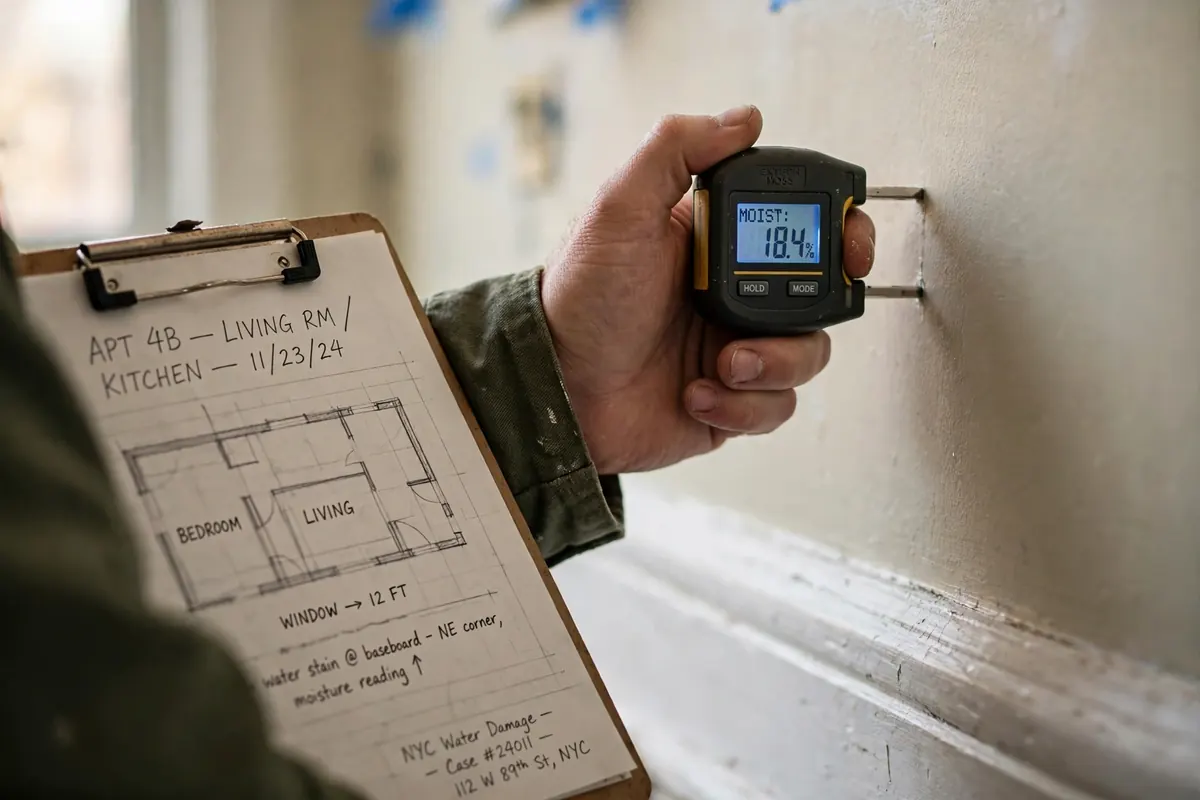
Emergencies
When It Counts as an Emergency, and When Morning Is Soon Enough
Emergency water damage nyc is its own search for a reason: at two in the morning, nobody wants a lecture, they want to know whether to call now or at dawn. Here is the honest sorting, the way a crew chief sorts it on the phone.
Call now, whatever the hour
Water still flowing from a burst pipe, a failed heater, or a broken line you cannot shut off. Water rising in a basement, or any water near wiring, outlets, or a breaker box. Sewage coming up through a drain or toilet. A ceiling that is bulging or sagging under pooled water. A home that cannot be lived in tonight, a lost water supply, or a leak in a home with a baby, an elderly person, or anyone whose health standing water puts at risk. These are the calls the 24/7 line at (212) 555-0147 exists for.
Call first thing, and act tonight
A slow drip into a bucket from a ceiling stain that is growing. A supply line that weeps but holds when the fixture valve is closed. A wet patch at a wall base that a meter shows is spreading. Tonight: shut the fixture valve, move belongings, photograph, and set a bucket. In the morning: the call, the mapping, and the drying plan, because the two day mold window is already running even when the water is polite.
Book it, do not panic
An old dry stain. A musty smell with no wet reading behind it. A floor that cupped in a flood last year and never got checked. These deserve a proper assessment, not a siren. They also deserve not to be forgotten, because the smell with no reading sometimes sits next to the cavity with a very real one, and the floor from last year is either stable or still quietly wet, and only a meter knows.
Two city emergencies sit outside this sorting because they are not yours to grade. A sewer backup goes to 311 at once, at any hour, because the Department of Environmental Protection inspects within six hours and the clock starts with your call. A burst street main, water bubbling through the pavement, is also a 311 call, and a stay back situation until the city crew closes it down.
The through line is simple. Flowing, rising, dirty, or dangerous means now. Slow and contained means tonight's precautions and the morning's call. Old and dry means a booked assessment. What never helps is waiting to see whether a live leak improves on its own. In the whole history of water damage in NYC, no active leak has ever fixed itself. Waiting is the one strategy water damage nyc always punishes.
Assessment
A Real Assessment: Meters, Maps and Readings That Mean Something
Water damage assessment nyc is a small search with a large meaning, because the assessment is where a wet home becomes a plan instead of an opinion. People who look it up are usually standing between two quotes that disagree, or holding an insurance letter that asks for proof. Here is what a real assessment contains, so you can tell one from a walk through with a torch.
It starts at the source. The assessor identifies where the water came from, whether it is stopped, and which of the three kinds of water it is, clean, used, or contaminated, because that sorting decides what can dry in place and what must come out. An assessment that skips the source is a guess with a clipboard: drying a room while the pipe above still weeps is the most common wasted week in this trade.
Then the map. With pin and pinless meters, the assessor walks every room the water could have reached, including the rooms that look untouched, and records readings at floors, wall bases, and ceilings. Water travels inside structures, and the wettest part of a home is often a wall cavity in a room with no stain at all. The readings become a moisture map: the shape of the loss, drawn in numbers. That map aims the equipment, sets the drying plan, and later proves to the insurer what was wet and when it stopped being wet.
Thermal cameras have a place in this work, and an honest assessor states its limit. A camera reads surface temperature, and damp areas often show cooler, so it is a fine tool for finding where to test. It does not measure moisture. Every cool patch the camera finds gets confirmed or cleared by a meter before it goes on the map. Pages and crews that present a camera picture as proof of dryness, or of damage, are showing you a photograph of temperature and calling it something else.
The assessment ends in writing: the source, the kind of water, the map, the materials affected, what must be removed and what can dry, the equipment the plan needs, and the readings that will end the job. In a rented home, that document also serves the housing paper trail, because it dates the condition of the home on a professional's letterhead. Keep your copy with the photographs from the first hour.
What should it cost you to get one? This site does not publish prices, on this page or any other, because the site's leads come by phone and every building differs. What an assessment should never cost you is the truth about its limits. If the assessor cannot yet see inside a wall, the report should say the wall is untested, not dry. The value of the document is exactly its honesty, to you, to the insurer, and to the next person who reads it. Demand that honesty in every water damage nyc assessment you are handed.
Drying
Drying to a Standard, Not to a Guess
Drying is the part of the job nobody photographs and everybody lives with. The pumps leave in an afternoon. The air movers stay for days, and whether they stay the right number of days is the difference between a home that was dried and a home that was abandoned while still wet inside its walls.
The standard behind the work is the IICRC S500, the restoration industry's reference for water damage work. Its central idea is simple enough to state plainly: each material has its own dry standard, the moisture level it sits at in a normal, undamaged building, and drying ends when readings reach that standard. There is no single magic percentage for a whole home. Wood, plaster, concrete, and masonry each hold and release water differently, and a crew that quotes one number for all of them has not understood the document it claims to follow.
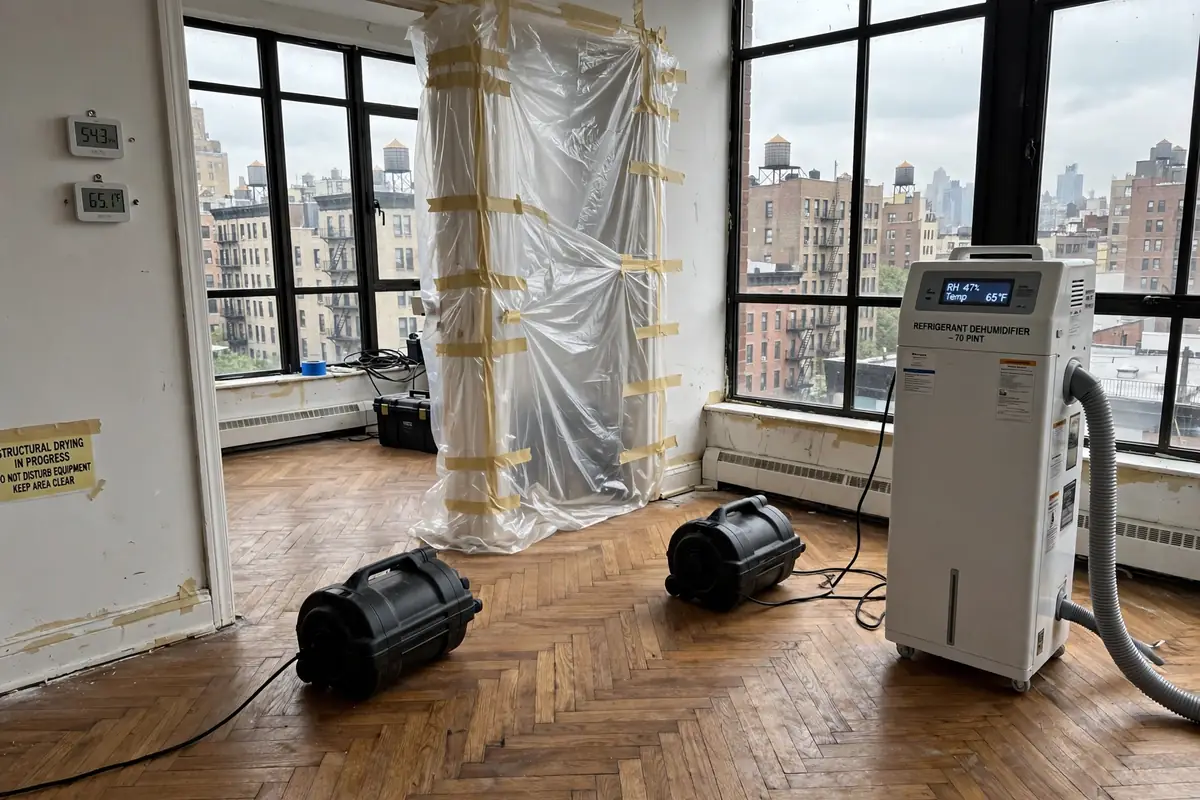
In practice the work looks like this. Air movers push air across wet surfaces so moisture leaves the material. Dehumidifiers pull that moisture out of the air so the cycle keeps moving. Where water sits inside a wall, small openings at the base let air into the cavity, which is why baseboards so often come off on day one. Every day, the crew returns, takes readings at the same marked points, and writes them down. The graph of those readings, falling day by day, is the drying made visible.
The Environmental Protection Agency adds the clock. Dry water damaged areas within 24 to 48 hours to prevent mold growth, the agency says, while also noting honestly that full drying can take several days to weeks. Both things are true at once: start inside two days, finish when the meters say so. The first rule is about beginning. The second is about not stopping early.
Homeowners can help more than they think. Keep the equipment running; switching it off at night for quiet undoes the day's work and stretches the job. Keep interior doors open where the crew asks. Do not pile belongings against drying walls. And ask for the readings. A crew doing this properly will show you the log without being asked twice, because the log is their work made visible too.
When the last readings meet the standard, the job is not over, it is proven. The final log joins your claim file, the openings made for drying get closed in the repair stage, and the home goes back to being a home. Water damage in NYC homes is remembered by how it ends: a clean, dry, documented finish, or a smell that comes back in August. The meters decide which. That is the standard this page holds for water damage nyc drying, without exception.
Tap water
The Drinking Water Question, Answered From the City's Own Reports
It surprises people that one of the most asked questions around this subject has nothing to do with leaks. Is the tap water safe to drink in NYC? It sits in the search data for this page's topic, verbatim, because a home full of water trouble makes people think about all the water in their lives. The answer comes from the Department of Environmental Protection, the agency that runs the supply, and it is a clear yes.
The scale helps the answer land. The system delivers one billion gallons a day to 8.5 million residents of the city. It gathers that water from 19 reservoirs and 3 controlled lakes, across a watershed of nearly 2,000 square miles, in three great systems: Catskill, Delaware, and Croton. Most of it travels to the city by gravity. It is, by any measure, one of the largest and most watched water supplies on earth.
The watching is the point. The department tests the water hundreds of times each day, 365 days a year, drawing samples from 1,000 street side sampling stations across the boroughs as well as upstate. In 2025 it ran over 573,300 analyses on 36,600 samples. The 2025 drinking water report found the supply meets or exceeds all federal and state standards. And in November 2026, when the facts behind this page were checked, no boil water advisory for the city was found on the department's pages.
Why does a page about leaks carry all this? Because the two subjects meet inside your walls. The water that arrives at your building is clean and tested. The water that bursts from a forty year old riser, sits in a ceiling void for a week, and drips through plaster is a different substance by the time it lands in your bucket. The city's part of the system ends at the property line. Everything after that, the service line, the risers, the tank on the roof, belongs to the building, and its condition is the owner's side of the bargain.
So if your tap water tastes odd or runs discoloured after building work, the cause almost always sits inside the building: disturbed sediment, an old tank, a corroding line. Run the tap, check with the super, and if it persists, the building's plumbing is where the answer lives. The supply itself is the one part of water damage in NYC that is not, in fact, damaged at all. The supply is the one part of a water damage nyc story that arrives blameless.
Rights and duties
Renters, Owners and Supers: Who Owes What When Water Comes In
More argument follows a leak than follows the water. This section sets out the duties as the city's housing agency and the state's law state them, so that the argument at least starts from the rules. It is information, not legal advice, and hard cases belong with a housing lawyer or the city's own help lines.
The owner's duty
The owner must repair the leak and what it damaged, in a timely manner, and keep the home fit to live in. That duty sits in the warranty of habitability, Real Property Law section 235-B: the landlord warrants the home fit for human habitation, and a tenant's waiver of these rights is void, so no lease clause can sign it away. Where a leak or mold affects several homes, the housing department expects a professional to investigate, not just the nearest mop.
The route when a repair does not come
Owner first, in writing, with photographs and dates. Then 311, and the Department of Housing Preservation and Development, which inspects and sets a correction deadline. If the owner misses the deadline, the consequences can be fines, Housing Court, or the department's Emergency Repair Program doing the work and billing the owner. A tenant may also take the owner to Housing Court directly, even without a violation on file. That last point matters: you do not have to wait for an inspector to have your day in court.
The deadlines, stated exactly
When the department cites a violation, the correction time runs by class. Class A: 90 days. Class B: 30 days. Class C: 21 days for mold, 21 days for lead paint, 14 days for a self closing door, immediately for heat or hot water, and 24 hours for all other Class C items. Read that table carefully, because this page will not do what weaker pages do: the department does not assign a leak a specific class, so no honest page can promise you a leak specific deadline. Anyone who quotes you one has invented it.
| Violation class | Correction time set by HPD |
|---|---|
| Class A | 90 days |
| Class B | 30 days |
| Class C, mold | 21 days |
| Class C, lead paint | 21 days |
| Class C, self closing door | 14 days |
| Class C, heat or hot water | Immediately |
| Class C, all other items | 24 hours |
Correction times as published by the Department of Housing Preservation and Development. The department does not assign leaks a class of their own.
The tenant's side of the bargain
Duties run both ways. Report the leak at once, in writing. Let the repair crews in. Do not ignore a slow drip until it becomes the downstairs neighbour's ceiling collapse, because a tenant who knew and stayed silent can share in the harm that followed. And keep the paper: the dated note, the photographs, the 311 reference. In water damage in NYC housing disputes, the side with the dated paper usually turns out to be the side that was telling the truth. Keep the paper, and the water damage nyc argument is half over before it starts.
Pipes and mains
From the Street Main to Your Tap: Who Owns Which Pipe
Stand on any street in this city and there are two water systems under your feet, owned by two different parties, and knowing which is which settles half the phone calls a leak produces. This section draws the line where the Department of Environmental Protection draws it.
The city's part: the mains
The department owns and repairs the water mains in the street, and the sewers beneath them. When a main breaks, the street fills, the city crew closes the water, and the repair is the city's job and the city's bill. The department shuts water off in a short list of cases: for city agencies, for fire emergencies, or for a broken city main. A city main break is a 311 call and a spectacle; keep back and let the crew work.
The owner's part: the service line and everything after
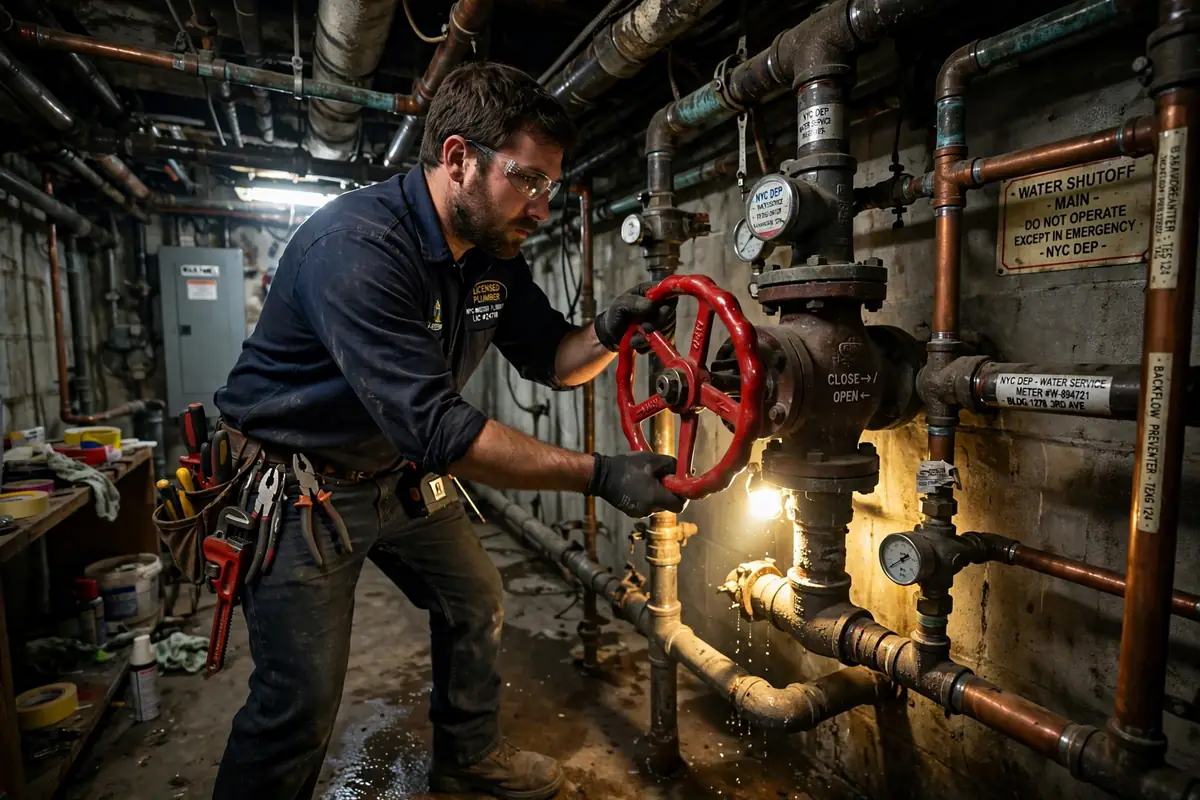
The service line, the pipe that runs from the property to the main, belongs to the owner of the property. The owner maintains it, pays for its repair, and must hire a Licensed Master Plumber to do the work. The same goes for frozen pipes on the property, which the department treats as the owner's responsibility, and for every pipe inside the building. This is the single most misunderstood line in the city's water rules, and it is why a leak between your house and the street can be both invisible to the city and entirely your repair.
The sewer side of the line
Sewers follow the same split. The city sewer in the street is the department's. The private line from your building to that sewer is the owner's. When a backup happens, the department inspects within six hours of a 311 report and finds the blockage; the most common cause it reports is pipes blocked by grease and wipes. City blockage, city clears it. Private line blockage, owner's plumber clears it. Either way, the water that came into your basement is your cleanup, which is why the call to 311 and the call about drying belong in the same hour.
Finding your shutoff before you need it
Every home has a main shutoff, usually where the service line enters the building, and fixture valves at sinks, toilets, and appliances. Learn them on a dry day. In the first minutes of a burst, the person who knows the valve saves the floor, the ceiling below, and a good part of the claim. If your home has no working shutoff, that is a plumbing job to book now, at leisure, rather than during the flood it exists for. A leak here is often decided by a valve: found in time, or not. Learn yours this week, while the floor is dry and the water damage nyc call is still hypothetical.
Insurance
The Claim After the Leak, and the Paper That Carries It
This page gives the short version on purpose. The full claim guide on this site, the insurance claim page, walks the whole road from first notice to settlement. What follows is the map of that road, and the rules that hold everywhere on it.
Rule one: cover follows the source. A burst pipe inside the building is one kind of claim. Rain through a failed roof is another. Street flooding and storm water generally need a separate flood policy, a point the Department of Financial Services, the state regulator, makes to New Yorkers after every major storm. The same wet room can be fully covered, partly covered, or not covered at all depending on which door the water came through, which is why identifying the source, in writing, on day one, is worth more than any argument later.
Rule two: the record is the claim. Photographs of the water in place. The moisture map and daily drying log. Invoices. The 311 reference for a sewer backup. The super's incident note. Adjusters do not pay for water; they pay for documented loss, and the crew that maps and logs properly is, without exaggerating, doing half your claim work while they dry your home. The last question in the thirty below lists the full file, item by item.
Rule three: the state will talk to you. The Department of Financial Services runs a disaster hotline at (800) 339-1759 and its main line at (800) 342-3736. After declared disasters the department sets up help for exactly the questions this page cannot settle for your policy: what your wording covers, what your deadline to file is, and what to do when an insurer stalls. Keep your claim number, your adjuster's name, and every letter in the same folder as the drying log.
One honest warning. Nothing on this page, or any page, can tell you what your own policy will do; only the policy and the regulator can. What this page can promise is the order of operations that gives any claim its best chance: source identified, photographs taken, drying documented, paper kept. Water damage in NYC becomes a fair claim the same way it becomes a dry home, by measurement and record, not by memory and hope. That order holds in every water damage nyc claim, large or small.
Sorting a claim while the floor is still wet?
Call and describe the source as exactly as you can. The documentation starts with the first visit: map, readings, and photographs, kept for your file from day one.
Storm history
Sandy, Ida and One October Night: What Storms Taught This City
New York's relationship with water is written in three dates, and every crew that works here carries them. They are worth setting out plainly, because they explain the city's building rules, its warnings, and the seriousness with which basement water is treated on this page.
In October 2012, Hurricane Sandy pushed the sea into the city. Forty four people died in New York City, and the damage ran to about 19 billion dollars. The water did not only take the waterfront. It filled basements and mechanical rooms miles inland, drowned electrical systems that took months to replace, and left whole buildings dark long after the streets dried. Sandy is why flood zones, flood insurance, and the height of electrical equipment above grade are ordinary conversation in this city's building departments now.
In September 2021, the remnants of Hurricane Ida dropped rain faster than the drains of Queens and Brooklyn could carry it. Thirteen people died in the city, most of them in basement homes that filled in the dark, faster than the people inside could get out. Ida changed the city's weather warnings for good: flash flood emergencies are now declared for rain, not just for rivers and coasts, and the danger of a basement flat in a cloudburst is stated in the warnings in so many words.
And on 31 October 2025, it happened again at street scale. PIX11 reported two deaths in flooded city basements during that night's flash flooding: one man who died saving a pet in a flooded building, and one man electrocuted in a basement while helping neighbours with a sump pump. This page cites PIX11 for those deaths because that is the source that confirmed them. Two lessons sit inside that one night, and both are on this page already: basement water can kill, and electricity in floodwater is the quiet way it does it.
The thread through all three dates is the same. In this city, storm water is not a mop and bucket event. It is a life safety event first, a building event second, and a property event third. That order, people, building, property, is the order this page teaches for every leak, because the habit formed on small water is the habit that holds on the bad night. Respect for that order is the deepest lesson in water damage nyc.
Videos, reviewed
Two Videos About This City and This Work, Labelled Honestly
This site does not embed video. It studies it, in text, and links out. For this page, the search results offered two videos, and both were reviewed in full. Neither shows a verified New York restoration job, and this page will not pretend otherwise. Here is what each one actually is, with its label stated the way the label will stay.
A Manhattan firm's promotional slideshow
Published 13 February 2025, one minute and 47 seconds, 18 views at review, on the channel "Animoto Videos - Grow Your Business", which is not the firm's own channel. Promotional slideshow for a Manhattan restoration firm; shows no actual job. Usable only as an example of how such a firm advertises its services, not as evidence of work performed. Watch it, if you like, as a lesson in reading adverts: the claims in a slideshow are the firm's own words about itself, and the absence of a single real room, real crew, or real reading is the most honest thing in it. Watch the video
PIX11: the city's flood response, 31 October 2025
PIX11 News, published 31 October 2025, six minutes and 54 seconds, 2,164 views at review. An interview with the New York City Emergency Management Commissioner after that night's flash flooding, the same night covered in the storm section above. News interview about the city's flood response, not footage of restoration work; do not present it as a restoration job. Its value here is different and real: it is verifiably this city, on the record, about the night two residents died in flooded basements, and it shows how the city's own emergency leadership talks about basement water. Watch the video
Why print the caveats so loudly? Because the honest state of the record is that no recent video showing an actual New York City restoration job, with a verifiable city location, was found for this page. Other pages of this site carry video studies of extraction and drying method from elsewhere, labelled the same way. Method travels. Locations do not. A page about water damage in NYC that dressed up a slideshow as a case study would be lying to exactly the readers who can least afford it, people standing in water, choosing who to trust. Honest labels are this site's rule for every water damage nyc video it reviews.
The research
Two Research Tools, Two Different Answers, Both Printed Here
This page was researched the way every page on this site is researched: with the two standard tools of the trade, SEMrush and Moz, checked fresh on 24 November 2026 for the United States. They disagree about this search, as they often do, and the disagreement is printed rather than smoothed over. The figures are never averaged. Averages of two honest measurements are a third, invented measurement.
| Measure | SEMrush | Moz |
|---|---|---|
| Monthly search volume, US | 110 | 11 |
| Difficulty | KD 19%, Easy | Difficulty 41, Moderate |
| Cost per click | 26.26 US dollars | Not reported here |
| Search intent | Commercial | Informational |
| Click through rate | Not reported here | 92% |
| Weakest link to rank | Most top ten pages score authority 0 | Minimum domain authority 10 |
Older figures for this search exist in old notes, a four figure volume from one gap report and a three figure one from an earlier check. Neither could be found anywhere in the fresh checks of 24 November 2026, in either tool, so neither is quoted on this page as current. Where this page states a volume, it states 110 from SEMrush or 11 from Moz, with the tool named. That is the whole of the honest position.
The results themselves are the weakest top ten this site has researched. In SEMrush the highest page authority score in the top ten is 33, held by a directory listing, and most ranking pages score zero. In Moz, the top result is a Reddit thread from a home maintenance forum, followed by directories, a video, and local firm pages. No dedicated page for this exact subject ranks at the top of either list. The seat, in other words, is empty. This page was built to fill it properly: a full explainer, with the city's own facts, rather than a directory card or a forum thread.
The markup behind the results tells the same story. When the top competitor pages for this search were run through the Schema validator for this page's research, only one page in thirteen carried a FAQ section in its markup, with five questions. None carried step by step how to markup. The largest service catalogue found held seven offers, from a marketplace listing several different businesses. This page carries thirty questions, six steps, and fifteen services in its markup, matching its visible text exactly, because that is the standard this site holds on every page: say it on the page, prove it in the code.
Two honest exceptions belong in this section. This page carries no star rating in its markup, because ratings belong to real, countable reviews, and none are claimed here. And it carries no map coordinates, because the business address behind this site is a placeholder until the site goes live. A competitor with a genuine rating and a real pin has those two things and this page does not. Everything else, depth, structure, freshness, and the city's own facts, this page was built to win outright. That is the bet this water damage nyc page was built on.
Answer engines
Asking the Answer Machines: Where the Four Big Answers Fall Short
Plenty of readers now meet this subject through an answer engine before they meet a page like this one. As part of this page's research, the answers given by ChatGPT, Perplexity, Gemini, and Claude to the plain questions behind this topic were read side by side. They are fluent, fast, and mostly right about the universal parts. Where they fall short is the same place every national answer falls short: this city.
The universal parts they get right. All four will tell you to stop the source, stay out of water near wiring, photograph everything, and dry within 24 to 48 hours to prevent mold. All four know that sewer water is treated as contaminated. If that is all you needed, the machines would be enough, and this page would not need to exist.
The gaps start with responsibility. Asked who must fix a ceiling leak in a rented flat here, the answers lean on general landlord language and miss the machinery that actually moves a New York repair: the written notice, the 311 complaint, the housing inspection, the class based correction deadlines, and the tenant's right to go to Housing Court even without a violation. None of the four produced the housing department's correction table. One stated a single deadline for leaks, a number that does not exist, because the department assigns no class to leaks as such.
The gaps continue with the pipes. Asked who owns the water line from the street to the house, the machine answers split, and the confident ones were not reliably the right ones. The city's rule is specific: the department owns the mains, the owner owns the service line and must use a Licensed Master Plumber. That is a local fact, printed on a city page, and it is exactly the kind of fact a general answer smooths into a guess.
And the gaps end with scale and proof. The engines quote national cost ranges this site does not publish at all, national timelines stated as fact where the honest position is that no single timeline exists, and mold windows quoted without the city's licensing and housing rules that sit behind them. Fluency is not sourcing. When an answer about water damage in NYC cannot name the agency behind its claim, treat the claim as a draft, and check it against the city's own pages or a page, like this one, that prints its sources as it goes. Check every confident claim about water damage nyc against a named source.
Real questions
What New Yorkers Type Into Forums at Night
Before this page was written, the places where real people ask real questions were read: Reddit, Quora, WikiHow, and Behance among them. The questions repeat, and they are better questions than the ones most service pages answer, because they were written by people standing in the actual water.
Reddit: the new flat problem
The top result in one of the two research tools for this very search is a Reddit thread in a home maintenance forum: water damage in a new apartment, in New York, and a renter asking the internet what on earth to do. The thread is this city's story in miniature. The answers that help are the practical ones: photograph everything, write to the landlord, call 311 if nothing moves, do not sign anything in a hurry. The answers that harm are the confident legal claims with no source. This page's rights section exists because that thread, and hundreds like it, show renters meeting the housing rules for the first time at the worst moment.
Quora: the blame questions
Quora's version of the subject is the argument after the event. Who is liable when the flat above floods mine? Can a landlord charge a tenant for a burst pipe? Does a renter need insurance for their own things? The honest shape of every one of those answers is the shape used on this page: liability follows the source, duties follow the documents, and the dated written record decides arguments that memory cannot. Where Quora answers state a single rule for all buildings, they are wrong in the way general answers are always wrong here, because rentals, co-ops, and condos split the duties differently.
WikiHow: the hands on version
WikiHow carries the practical guides: how to dry a wet wall, how to find a leak, how to clean up after one. Read them for the household scale of the work, the buckets, the towels, the fans a home already owns, and read this page for the line where household work stops: contaminated water, water inside structures, and anything where a meter, not a hand, has to call the finish. The two fit together. A home that starts the WikiHow steps in the first hour and calls for measured drying inside the first day has done the whole job in the right order.
Behance: what finished looks like
Behance is where designers post finished interiors, and its place in this research is the after picture. Restored New York flats, photographed whole and calm, are what every reader of this page is actually trying to get back to. The gap between those photographs and a wet ceiling is the whole subject: source, removal, drying, repair, in that order, documented as it goes. When a portfolio shows a parlour that flooded two winters ago and gives no hint of it, that invisibility is the standard. Drying done properly is invisible in the end. That is the point of it. The after picture is the goal of every water damage nyc job on this site.
Signs
Reading a Wet Home: Stains, Smells, Paint and Floors
Water announces itself quietly before it announces itself loudly. The households that catch it in the quiet stage pay for a repair. The ones who meet it loudly pay for a renovation. These are the signs, in the order people usually notice them, and what each one is trying to say.
The stain that grows
A ceiling or wall stain with a tideline edge is water's signature. The edge darkens as the wet area spreads, and a stain that changes between Monday and Friday is a live leak until proven otherwise. Note the pattern before anything else: growth after rain points up, at the roof or the facade. Growth on dry days points sideways, at a pipe, a radiator, or the home above. Photograph it with a coin beside it for scale, date the photograph, and repeat in a few days. You have just done the first page of the assessor's job.
The smell that will not leave
A musty smell is the nose reading what the eyes cannot: moisture held somewhere out of sight, feeding growth in a cavity, under a floor, or behind a cabinet run. A smell that strengthens when the heating runs is drawing air from inside the walls. A smell after every shower points at the bathroom's waterproofing, not its plumbing. Smell alone does not prove damage, and this page will not pretend it does. It proves a question worth a meter.
Paint, plaster and baseboards
Paint bubbles where water pushes from behind. Plaster softens and powders. Baseboards swell, gap at the mitres, and come away from the wall. Each of these is a material keeping a diary of its wet weeks. The diary matters for the claim, because it dates the problem: fresh damage looks different from a season of soaking, and adjusters read the difference at a glance.
Floors that move
Hardwood talks early. Boards cup at the edges, crowns in the middle, darken in patches, and begin to sound hollow or creak in new places. A floor that was flat in spring and rippled by autumn has been drinking from somewhere. Vinyl lifts at seams. Tile grout darkens in lines that map the wet path under it. Floors are the most honest surface in the home, because they cannot hide water and they cannot lie about how long it stayed.
None of these signs needs panic, and all of them deserve a date in a notebook and a meter reading within days, not months. Water damage in NYC homes is cheapest in the week it is a stain and dearest in the season it becomes a structure. Reading the signs early is not expertise. It is just paying attention while the problem is still small enough to be boring. Early reading is the cheapest skill in water damage nyc.
Permanence
When Damage Turns Permanent, and How Anyone Can Tell
How to tell if water damage is permanent is one of the questions the research tools record people asking in exactly those words, and it deserves a straight answer rather than a sales pitch in either direction. Some of what water does can be undone by drying. Some cannot, and the line between them is physical, not commercial.
Drying reverses wetness. It does not reverse change. Hardwood that swelled and then dried flat has recovered; hardwood that split along the grain, or cupped so hard the fasteners tore, has changed for good. Plaster that dried firm has recovered; plaster that crumbled has not, and no dehumidifier will reconstitute it. Particle board, the hidden core of most modern cabinets and much furniture, swells like a sponge and never returns to size. Once it has blown, the unit is finished whatever the meter says.
Time is the multiplier. Clean water in a wall for two days is a drying job. The same water for two months is rot in the framing, corrosion on the fasteners, and growth through the cavity, and rot and rust do not dry out, they are cut out. This is the deep reason behind the Environmental Protection Agency's 24 to 48 hour rule: the window is not really about mold alone. It is about catching materials while their damage is still just wetness.
The tests are plain ones. A meter tells you whether material is still wet. A screwdriver tells you whether wood is still sound; it should resist, not sink. Your nose, after drying is proven complete, tells you whether a smell has outlived its cause, which points at hidden growth or soaked material nobody opened. And a straightedge across a floor tells you whether flat came back. A good crew runs all four in front of you and writes down what each one said.
There is a paperwork sense of permanent too. Damage that was never documented can become permanent in the claim even when the home recovers, because an undocumented loss is an unpaid one. Damage that was never dried becomes permanent in the building even when the claim pays. The two failures look similar from the outside and are opposites inside: one loses money, the other loses the home's fabric. The defence against both is the same habit this page keeps returning to, in every section: measure it, photograph it, write it down, while it is happening. Measure, photograph, write: the three working verbs of water damage nyc.
Prevention
Keeping the Next Leak Small
Nothing in this section is exciting, which is exactly why it works. The homes that suffer least from water are not the luckiest homes in the city. They are the homes where a short list of dull things got done on a dry weekend.
Know your valves
Find the main shutoff and every fixture valve, turn each one to prove it still moves, and label them. A valve that has not turned in fifteen years will not turn during the flood either; it will round, weep, or snap. Replacing a dead valve is an hour of plumbing at leisure. Discovering it is dead is a story told to an adjuster.
Retire the rubber hoses
Washing machine and dishwasher supply hoses are the cheapest pressurized parts in the home and among the commonest sources of a serious flood. Braided steel replacements, fitted before the old ones blister or crack, cost little and remove a whole category of two in the morning disasters. While you are there, check the water heater's age plate. A tank past its expected life is not a bargain being stretched; it is a flood being scheduled.
Respect the drain
The Department of Environmental Protection names the leading cause of sewer backups plainly: blocked pipes, from grease and wipes. Grease goes in a tin, not the sink. Wipes go in the bin, whatever the packet says about flushing. In a multi unit building your drain habits are your neighbours' basement, and theirs are yours. The six hour inspection the department runs is a fine service. Not needing it is finer.
Prepare for the freeze and the storm
Before winter: insulate the exposed runs, keep heat in every room, and know the drip drill for the coldest nights. Before storm season: clear the yard and area drains, test the sump pump, move what matters off the basement floor, and photograph the home as it stands, dry and whole. Those photographs, taken in calm weather, are the before pictures every future claim wishes it had.
Prevention has a ceiling, and honesty requires naming it. Pipes age inside walls where no inspection reaches. City mains break. Storms outgrow drains. The goal of this section is not a home water can never touch. It is a home where water, when it comes, meets valves that turn, drains that run, alarms that sound, and owners who know the first six steps by heart. Small leaks stay small in homes like that. That is the whole aim of prevention in water damage nyc.
Choosing help
Picking Help in a City Full of Listings
The research behind this page read the same listings you will read in a panic: directories, marketplaces, and firm pages, most of them thin, several of them claiming ratings and ranges they do not document. Choosing well in that noise is a skill, and it reduces to asking for the artefacts of real work.
Ask for the map. A firm that dries by measurement will talk about moisture mapping, daily readings, and a dry standard without prompting, and will show you a sample log. A firm that dries by feel will talk about big fans and fast finishes. The first conversation tells you which firm you are speaking to inside two minutes.
Ask what happens with the water's kind. If the water came through a sewer or off a street, the plan should change out loud: protection, cleaning, removal of soaked porous material. A firm that gives the same answer for every kind of water has one plan, and it is the wrong plan two times out of three.
Ask who writes it down. The moisture map, the drying log, the photographs, the invoice that matches the work: this paper is your claim, your housing record, and your proof at resale that the home was dried properly. Firms that treat paperwork as a favour are telling you how your claim will go. And ask the question this site's own pages are built to answer honestly: what can you not do, and what can you not promise? The firm that names its limits, no ratings it cannot show, no timelines it cannot know, is the firm whose other statements you can weigh.
This page is itself an exhibit in that test. It prints its research figures with the tools named, states the facts it could not verify as unverified, labels its two videos with their limits, and publishes no prices and no star ratings, because none were earned in a form it can show you. Judge every firm you call by the same standard, including this one. The number, when you are ready, is (212) 555-0147, answered around the clock. Judge this page's water damage nyc work by the same tests it sets for everyone else.
Building stock
Pre War Bones, Post War Systems, New Towers: How Age Changes the Job
Ask a crew chief what kind of job a call will be and the first question back is never about the water. It is about the building: how old, how tall, what is it made of. Age decides where the pipes run, what the walls are built from, and how the drying will behave. In water damage nyc work, the building is half the diagnosis, and this city holds a century of building types within a single block.
The pre war stock, the walk ups, tenements, and grand apartment houses built before the Second World War, carries the oldest plumbing in the city. Cast iron stacks, galvanized supply lines, and steam radiators with valves that have turned for a hundred winters. These buildings also carry plaster walls an inch thick over wood or metal lath, and that plaster is a blessing and a curse in any water damage nyc job: it resists a passing splash, but once it soaks through, it holds the water like a sponge and gives it back over weeks, not days.
The post war stock, the brick towers and slabs of the fifties through the eighties, traded plaster for gypsum board and cast iron for copper and later plastics. Gypsum dries faster than plaster and fails faster too; a soaked board loses its strength in days and often has to come out where a plaster wall would have dried in place. Crews plan a water damage nyc job in a post war tower around replacement as much as drying, and the buildings' risers and compactor chutes give water ready made highways between floors.
The newest towers add their own chapter. Sprinkler lines, fan coil units, and long runs of pressurized pipe above finished ceilings mean that a modern water damage nyc call often starts with a small, hidden, high pressure leak spraying inside a ceiling void for days before a stain shows. The finishes are finer and the cavities are tighter, so the mapping matters more, not less: the meter finds what the eye cannot, behind stone, millwork, and acoustic ceilings that show nothing until they show everything at once.
Then there is the house stock: the brownstones, the row houses, the detached homes of the outer boroughs. Timber joists, brick party walls, and cellars dug before waterproofing was a trade. A water damage nyc job in a house is the building owner's whole problem, roof to service line, with no super and no board to share it, but it is also the simplest chain of command in the city: one owner, one crew, one set of decisions, made at one kitchen table.
None of these buildings is the easy one. Each fails in its own dialect, and each dries in its own time. The honest promise a crew can make in any water damage nyc case is not a number of days. It is that the building will be read for what it is, the plan will fit its materials, and the readings, not the calendar, will say when the work is done.
Basements
Basements and Cellars, the Rooms That Fill First
Every kind of water in this city ends up in the same place: the lowest room. Burst pipes drain down to it, street water runs in at its windows and doors, sewer backups rise into it, and groundwater presses at its walls all year. Any honest account of water damage nyc has to spend time below grade, because below grade is where the damage, and the danger, concentrates.
The first truth about a flooded basement is the safety rule this page has already stated and will state again: water and electricity meet there. Panel boxes, outlets, appliances, and furnace controls all live at basement height. The man PIX11 reported electrocuted on 31 October 2025 was in a basement, helping neighbours with a sump pump. No water damage nyc emergency is improved by entering a flooded basement before the power question is settled, and no possession stored in one is worth the risk.
The second truth is about what the water carries. Basement water is rarely clean for long. It crosses soil, street runoff, stored chemicals, paint tins, and whatever the lowest drain brings up with it. In water damage nyc practice, basement flooding is handled as dirty water from the first hour: protected crews, cleaning before drying, and porous material, carpet, board, stored cardboard, that usually leaves the building rather than drying in place.
The third truth is mechanical. A basement is a box built to be pumped: the work runs from submersible pumps on the deep water, to extraction at the surfaces, to dehumidifiers sized for a space that sits cold and damp even in a normal week. Sump pumps earn their keep here, and their failure earns its own paragraph in many a water damage nyc report: a pump that sat untested for three dry years is a decoration, and the night it is needed is the wrong night to learn that.
The fourth truth is about use. Across the city, basements hold boilers, laundry rooms, storage, workshops, and, in too many buildings, people sleeping in rooms never meant for it. Ida wrote that lesson in the hardest terms. After any water damage nyc event, a basement bedroom deserves the most serious conversation in the building: alarms, egress, and a plan for the night the rain outruns the drains, discussed before the season, not during the storm.
Handled right, a basement also recovers well. Concrete and masonry forgive what timber cannot. A pumped, cleaned, dried, and documented basement, with its readings on file, goes back to work and stays back. The difference between the basement that recovers and the one that smells forever is rarely the water. It is the order of the response, which is why this room gets its own section in any complete account of water damage nyc.
From above
Water From Above: Roofs, Parapets and Facades
Not all water arrives under pressure. Some of it falls on the building for years, looking for the one seam, crack, or failed flashing that lets it in, and then travels so far inside the structure that the room it stains has no idea a roof exists above it. In the catalogue of water damage nyc causes, the roof leak is the great impersonator: it presents as a plumbing problem in a top floor flat and confesses only when the pattern is read properly.
The pattern is the tell. Roof water follows the weather. A stain that grows after rain and rests between storms, in a city where pipes leak on their own schedule, is pointing up. Parapets, the low walls around flat roofs, crack at their caps and joints. Flashing around drains, vents, and bulkheads lifts and splits. Ponding water, the flat roof's puddle that never drains, sits for days testing every seam beneath it. A water damage nyc assessment that ignores the roof because the stain is indoors has skipped the first suspect.
Facades leak too, and in a city of brick they leak often. Mortar joints weather open, lintels rust and crack the brick above windows, and wind driven rain finds paths that a calm day never reveals. The water then runs inside the wall and appears at a ceiling line or a window head floors below its entry. This is why experienced water damage nyc crews read the outside of the building with the same care as the inside, and why the repair so often belongs to a roofer or a mason rather than a plumber.
The repair order matters as much as the repair. Source first, always: repoint, reflash, recoat, or rebuild the failed detail, and prove it with a hose test or the next rain before anyone replasters. Drying and decorating a ceiling while the parapet above still drinks every storm is the most common wasted money in the whole water damage nyc field, and it is wasted in the open, one rainstorm at a time, while the stain blooms again over fresh paint.
For renters under a leaking roof, the duties run the way the rights section of this page sets out: the roof is the owner's structure, the repair is the owner's duty, and the route is written notice, then 311 and the housing department if the repair does not come. For owners, the dull arithmetic rules: a roof inspected on a schedule and repaired at the first failed seam is the cheapest water damage nyc policy ever written, and it is written in tar, mortar, and flashing rather than in premiums.
Wet rooms
Kitchens and Bathrooms, Where the Water Lives
Two rooms in every home are plumbed like small factories, and they produce a steady share of the calls. The kitchen and the bathroom hold the densest pipe work, the most appliances, the most seals and hoses, and the only floors in the home designed, in theory, to meet water daily. When water damage nyc begins indoors, it begins in one of these two rooms more often than anywhere else.
The bathroom's quiet enemy is not the dramatic burst. It is the failed seal: grout lines opened, caulk parted from the tub, a wax ring under the toilet slowly giving up. Each shower then sends a little water into the floor build up, day after day, until the ceiling below stains or the floor beside the tub goes soft. In water damage nyc assessments, the bathroom floor that feels spongy at the tub's edge is a classic finding, and the repair is a rebuild of layers, not a tube of sealant over a soaked base.
The kitchen's enemy is the appliance line. Dishwasher feeds, ice maker lines, filter housings, and the sink's own trap and supplies all live hidden behind cabinets, where a slow drip can run for a month inside a cabinet carcass before it shows at the toe kick. The particle board those cabinets are built from swells at the first soaking and never returns, which is why kitchen water damage nyc jobs so often become cabinet jobs, and why a small leak detector alarm under the sink is among the cheapest insurance in the home.
Both rooms share one defence that costs nothing: looking. A monthly glance under every sink with a torch, a hand run along every supply line and trap, a look at the ceiling of the room below the bathroom after a week of showers. Five minutes, four times a year. The households that do this meet their leaks as drips. The households that do not meet them as water damage nyc events, with crews, maps, and drying logs, which is the expensive way to learn the same information.
And when the wet room does fail, the order from the rest of this page applies unchanged: stop the source at the fixture valve, photograph before touching, get the mapping done, and dry the floor build up, not just the tile. Tile and stone forgive almost anything. What they stand on does not, and in kitchen and bathroom water damage nyc work, the floor beneath the finish is the job.
Seasons
The City's Wet Calendar: Freeze, Rain, Storm and Thaw
Water keeps a calendar in this city, and crews can tell the month by the calls. Reading the year the way they do is a prevention tool in itself, because every season's water damage nyc has its own cause, its own warning signs, and its own week in which a small job prevents a large one.
Winter is the pipe season. Hard freezes split lines in unheated spaces, radiators and their valves fail under the year's hardest work, and the thaw that follows a cold snap produces the busiest burst pipe days of the year, because frozen pipes announce themselves when the ice lets go. The water damage nyc defences are the dull ones from the prevention section: heat on, exposed runs insulated, a tap dripping on the worst nights, and every household member knowing where the main valve sits before the night it is needed.
Spring is the roof and facade season. The freeze and thaw cycle has spent three months prising at mortar, flashing, and parapet caps, and the spring rains arrive to test every opening winter made. This is the season of the growing ceiling stain in top floor homes and the damp wall in the brownstone's garden level. A spring water damage nyc assessment is half a roof inspection, and the owners who book the roofer in April are not the ones calling about ceilings in June.
Summer is the storm and appliance season. Cloudbursts drop rain faster than drains were built to carry, air conditioners add condensate lines to the list of things that can leak unnoticed for weeks, and holiday empty homes let small leaks run long. The summer water damage nyc file holds the city's flash flood nights, its sewer backups after the heaviest cells, and a quiet run of washing machine hoses that chose the hottest week to give up.
Autumn is the preparation season, and the city treats it that way: hurricane season runs into the fall, heating systems wake up and show their leaks in the first cold week, and the households that will come through winter dry do their unglamorous work now. Gutters and area drains cleared, sump pumps tested, valves turned and labelled, the home photographed whole and dry. Every water damage nyc veteran will tell you the same thing about autumn: it is the only season in which you get to choose your water story in advance.
The calendar does not excuse the off season surprise. Pipes burst in July and roofs leak in January, and the six steps on this page do not check the date. But a household that thinks in seasons meets most of its water on schedule, in its mild form, which is the whole quiet ambition behind this page's account of water damage nyc: fewer emergencies, more appointments.
The week after
Seven Days With a Wet Building, Day by Day
People ask what the week after a flood actually looks like, usually because they are trying to plan work, school, and sleep around it. Every job differs, but the shape of a well run water damage nyc week is steady enough to describe honestly, and knowing the shape lowers the temperature of the whole event.
Day one is the loud day. The source is stopped, the standing water comes out, the mapping is done, and the equipment goes in: air movers placed, dehumidifiers running, baseboards lifted where the readings demand it. Belongings are moved, listed, and photographed. By the end of day one, a water damage nyc home should be safe, dry floored, humming, and documented, with a named person who will call tomorrow and a log already started.
Day two is the verdict day. The crew returns, takes readings at the same marked points, and the numbers give the first real news: falling as hoped, holding where a cavity is feeding the wall, or rising where a source was missed. Day two is when honest water damage nyc work adjusts the plan in the open, more equipment here, an opening there, and when the 24 to 48 hour mold window the Environmental Protection Agency sets is either beaten or honestly reported as missed.
Days three and four are the quiet middle. The machines run, the readings fall, and the home settles into the strange routine of living around the work: towels at thresholds, furniture stacked, one room given over to the drying. This is also when the paper catches up, the claim number issued, the adjuster's visit booked, the building's incident note filed. In a well run water damage nyc week, the middle days are boring, and boring is the goal.
Days five to seven are the proof days. Readings approach the dry standard material by material: the floor first, usually, the thick plaster or masonry last. Equipment leaves room by room as each space proves dry, and the final log is written. Where material failed, the repair list is agreed while the evidence is fresh. A water damage nyc job that reaches day seven with falling readings, a complete log, and a dated repair plan has done everything the trade knows how to do.
Some weeks run longer, and the honest reasons are known in advance: thick pre war plaster, masonry that drank deep, a source that ran for weeks before it was found, or a building where access between homes slowed every step. Length is not failure. Failure is a week with no readings, no log, and no one who can say what happens next. Judge any water damage nyc week by its paper and its numbers, and you will judge it the way the trade judges itself.
Workplaces
Water at Work: Shops, Offices, Restaurants and Schools
Homes are most of this page because homes are most of the city, but water does not respect the line between living and working. A burst line over a shop, a flooded restaurant basement, a school with a soaked gym floor: the physics is identical and the stakes rearrange themselves around stock, equipment, and the hours a business can afford to be closed. Water damage nyc in a workplace is the same event wearing a different clock.
The first difference is scale of system. Workplaces hold bigger water: larger heaters, sprinkler lines, commercial kitchens, rooftop units, and long runs above ceilings full of other people's property. The shutoffs are fewer, larger, and sometimes known to exactly one member of staff. The single most valuable page in any workplace water damage nyc plan is the one that says where the valves are, written before the event, kept where the night staff can find it.
The second difference is the paper. A business claim runs on records the way a home claim does, with stock lists and equipment inventories in place of furniture and clothes. The moisture map and drying log matter just as much, and they share the file with the incident report the insurer and, in a rented commercial space, the landlord will both ask for. Water damage nyc in a leased shop splits duties along the lease, structure to the owner, interior and stock to the tenant, and the lease, like the co-op documents in a home, is read most carefully in the worst week to be reading it.
The third difference is people. Staff, customers, patients, and pupils all raise the safety bar, and a flooded workplace closes first and argues later. Food premises add health rules of their own, and any space open to the public adds the duty to keep wet floors, trailing cables, and open wall cavities away from everyone but the crew. A water damage nyc response in a workplace is choreography as much as plumbing, and the businesses that rehearse it, even on paper, reopen days earlier than the ones that improvise.
The borough pages and the service catalogue on this page carry the working detail for business callers. What belongs here is the principle: the same six steps, the same two day window, the same measured drying, run on a bigger stage with more witnesses. Water damage nyc does not become a different subject at the shop door. It becomes the same subject with the lights on.
Daily life
Living Through the Drying: Noise, Dust and Daily Life
Between the emergency and the repair sits an interval nobody warns households about: the days of living in a home that is also a worksite. Air movers hum through the night, one room is stacked to the ceiling, and the kettle lives in the bathroom. A plain account of water damage nyc owes readers this interval, because it is where tempers, and sometimes claims, are lost.
The noise is real and it is temporary. Air movers are fans built for work, not comfort, and a drying home sounds like a windy day indoors. Households cope the way crews suggest: equipment concentrated in the worst rooms, doors used as sound breaks where the plan allows, and the honest knowledge that switching machines off at night doubles back on the schedule. In a water damage nyc job, the family that can stand the hum for four nights gets its home back sooner than the family that cannot, and there is no use pretending otherwise.
The disruption has a shape worth planning around. Kitchens and bathrooms under drying take the most patience, because they are the rooms a home cannot skip. Washing moves to a neighbour's machine or a laundromat for a week. Showers get scheduled around crew visits. Children and pets need a dry room that is theirs, kept shut and normal on purpose. Every water damage nyc crew chief has watched a household's week improve the day someone declares one room off limits to the disaster.
Money worries ride along, and the honest answer is the one this whole site gives: no prices are published here, because the work is led by phone and every building differs, but the paper that protects you is free and it starts on day one. Photographs, the log, the invoices, the letters. A household living through water damage nyc with its file growing daily is a household whose claim, housing case, or resale conversation is already half won, whatever the week felt like.
And then, one ordinary morning, the machines leave. The readings are final, the log is signed, the rooms are quiet, and the home smells like itself again. What remains is the repair list and the strange gratitude people feel for a dry floor. Living through it is not the part anyone chooses. It is the part that proves the rest worked, and it belongs in any complete account of water damage nyc.
Records
The Paper Trail, Document by Document
The last question in the thirty below asks what records to keep, and its answer is short. This section is the long version, because the paper trail is the one part of water damage nyc entirely in the household's own hands, and it is built document by document, each with its own job to do.
The photographs come first, and they are two sets, not one. The before set: water in place, rooms as found, the source if it can be seen, taken before anything is moved or pumped. The during set: equipment in place, walls opened, material removed. Together they fix the size of the event in a way no memory can argue with. In water damage nyc claims, the before set is the one adjusters ask for first and the one most often missing, because nobody photographs a flood before they fight it, unless someone told them to. This page just told you.
The moisture map and the drying log are the technical heart of the file. The map states what was wet and where. The log states the readings, day by day, and the final readings that prove the dry standard was met. These two documents convert a drying job from a claim about work into a record of work, and they are the papers a future buyer, a housing inspector, or a second crew will ask for when the next question about this home's water damage nyc history is raised.
The money paper is plain and should stay plain: the invoices, the equipment record, any disposal list for material or belongings removed, and receipts for emergency spending, from the plumber's valve to the laundromat. Keep the insurer's letters with them, the claim number on top, the adjuster's name and every promise written down with its date. Water damage nyc files fail on gaps, not on totals, and a gap is just a document nobody kept.
The city paper completes the set where it exists: the 311 reference number for a sewer backup or a street main, the housing department's inspection note and any violation with its class and deadline, the super's incident report in a multi unit building. These papers carry the city's own timestamps, and timestamps are the spine of every later argument about who knew what, and when, in any water damage nyc dispute.
Keep the whole file after everything closes. Scan it, back it up, and let it live with the home's other papers. A complete file is the difference between a home with a water history it can prove was handled, and a home with a stain and a story. In a city where homes change hands and memories do not transfer, the file is the memory, and it is the last deliverable of water damage nyc done properly.
Starting a file tonight?
Photograph every room before anything moves, then call and say where the water is. The map and the log start with the first visit, and your file grows from there.
Building systems
The Building's Own Water: Tanks, Risers, Pumps and House Lines
Between the city main and your tap sits a private waterworks that most residents never see: the service line, the house pumps, the risers climbing floor by floor, and on thousands of older buildings, the wooden or steel tank on the roof that gravity feeds the whole building from. When water damage nyc starts at building scale, it starts inside this hidden system, and the super's knowledge of it is the difference between a stopped leak and a flooded stack.
The rooftop tank is the emblem of the city's water. It stores the building's supply above the top floor so gravity does the work pumps would otherwise do. Tanks are inspected and cleaned on a city schedule, and their fittings, floats, and overflow lines are building equipment, maintained by the owner. A stuck float or a failed overflow can pour tank water down a bulkhead for a weekend. In water damage nyc files, the tank appears rarely but memorably, because a tank does not leak in cups. It leaks in hundreds of gallons.
Risers are the building's vertical rivers: the supply and drain stacks that serve every floor in a line. A riser failure is never one home's event. The water enters the stack's chase and visits each floor the chase touches, which is why water damage nyc in a tower is mapped by line and stack, not just by unit, and why the first question a crew asks the super is which stack the home sits on. Buildings that keep a riser map on the basement wall shorten every emergency they will ever have.
House pumps and pressure systems do the opposite work, pushing water up where gravity and street pressure cannot. Their failures are usually failures of supply rather than floods, a dry tap rather than a wet ceiling, but a burst pump housing or a failed seal in a basement pump room puts water exactly where the building's electrical heart also lives. Water damage nyc crews treat the pump room with the same caution as any flooded basement: power first, water second, always in that order.
The lesson of the hidden system is about knowledge, not hardware. Every building should be able to answer three questions at three in the morning: where does our water enter, where are the shutoffs for each riser, and who holds the keys and the map. Buildings that can answer them turn water damage nyc events into incidents. Buildings that cannot turn them into sagas, and the difference is a clipboard, a labelled valve, and a super whose knowledge was written down before it was needed.
Services
Fifteen Kinds of Help, and Where Each One Lives on This Site
The catalogue below is the service list behind this page, all fifteen items, each with its home on this site where one exists. This hub explains; the linked pages do the deep work. Start here to find the right door, then go through it.
Emergency water damage help
The round the clock first response: source stopped, water out, drying started, the front door of water damage nyc help. Begin with the six steps above, or call (212) 555-0147.
Burst pipe water damage
Split lines, failed joints, and pinhole sprays, shut off, mapped, and dried. The causes section of this page covers the pipe cases.
Ceiling leak water damage
Stains, bulges, and drips from the home above or the roof. The rights section covers the duties; the signs section covers the reading. Ceiling cases are the daily bread of water damage nyc in stacked buildings.
Basement water damage
Pumping, cleaning, and drying below grade, with the safety rules the storm section of this page sets out in full. Basements carry the highest stakes in water damage nyc.
Flood water damage
Street and storm water, handled as dirty water from the first hour. The flood cleanup page carries the full method.
Sewer backup water damage
Contaminated water, handled strictly: 311 first, the department's six hour inspection, then protected cleanup and removal of soaked material.
Apartment water damage
The stacked building version: supers, stacks, neighbours above and below, and the paperwork of rentals, co-ops, and condos. The apartment is the classic water damage nyc setting.
Storm water damage
Wind driven rain, failed drains, and surge, dried and documented for the flood claim route the insurance section describes. Storm work is water damage nyc at city scale.
Water removal and extraction
Pumps, truck mounted extraction, and portable units that take standing water out fast. The extraction page is devoted to it.
Structural drying and dehumidification
Air movers and dehumidifiers run to a measured standard, the subject of the drying section of this page.
Moisture mapping with daily readings
The map and the log: where the water went, and the daily proof that it left. The map is the document water damage nyc claims stand on. See the assessment section above.
Contents drying and cleaning
Furniture, documents, and belongings, dried, cleaned, and listed for the claim, with honest calls on what cannot be saved. Contents work is the personal side of water damage nyc.
Mold prevention after water damage
Drying inside the 24 to 48 hour window so growth never starts. Where growth is already present, the site's mold pages take over.
Insurance claim documentation
The map, the logs, the photographs, and the invoices, assembled as the job runs. The claim guide walks the whole route.
24/7 emergency response
One number, every hour: (212) 555-0147. Flowing, rising, dirty, or dangerous water should never wait for office hours. One number for water damage nyc, day and night.
For the full service hub that joins the boroughs together, go to the city hub page. For the order a complete job runs in, from first call to final repair, the step by step page lays it out. This page stays what it was built to be: the explainer that helps you choose the right door, and understand what is behind it before you knock.
Questions and answers
Thirty Questions About Water in New York Homes, Answered in Full
Every answer below is built from the sources this page stands on: the Department of Environmental Protection, the Department of Housing Preservation and Development, the Environmental Protection Agency, the Department of Financial Services, the state housing law, and the PIX11 reporting cited in the storm section. Where no authoritative answer exists, the answer says so rather than filling the gap.
What does water damage NYC mean?
It means the harm that burst pipes, leaks, floods, sewer backups, and storms do to homes and businesses across the five boroughs of New York City: soaked floors, walls, and ceilings that need fast water removal, drying, and repair before mold grows and the harm turns permanent. On this page the phrase covers the whole event, from the first drip through the ceiling to the last dry reading, and it covers every kind of home the city has, from a Manhattan high rise flat to a detached house in Staten Island.
Is the tap water safe to drink in NYC?
Yes. The Department of Environmental Protection, the city agency that runs the water supply, says New York City tap water is safe to drink. The supply delivers one billion gallons a day to 8.5 million city residents from 19 reservoirs and 3 controlled lakes in the Catskill, Delaware, and Croton systems, across a watershed of nearly 2,000 square miles. The water is tested hundreds of times each day, 365 days a year, from 1,000 street side sampling stations, and the 2025 report found it meets or exceeds all federal and state standards, based on over 573,300 analyses run on 36,600 samples that year.
How long does it take to fix water damage in an apartment?
No single authoritative timeline exists, and any page that gives you one neat number is guessing. Two real anchors exist. The Environmental Protection Agency says to dry water damaged areas within 24 to 48 hours to prevent mold growth, and that full drying can take several days to weeks. Separately, when the Department of Housing Preservation and Development cites an owner for a housing violation, it sets a correction deadline by class: 90 days for Class A, 30 days for Class B, and for Class C, 21 days for mold, 21 days for lead paint, 14 days for a self closing door, immediately for heat or hot water, and 24 hours for all other Class C items. The department does not assign a leak its own class, so no honest leak specific deadline can be quoted.
What are my rights as a tenant in NYC if my ceiling is leaking?
You have the right to a home that is fit to live in, and the owner has the duty to fix the leak and repair what it damaged. Start with the owner or the super, in writing, with photographs and dates. If the repair does not come, call 311 and file with the Department of Housing Preservation and Development, which inspects and sets a deadline for the owner. If the owner misses that deadline, the results can be fines, Housing Court, or the department's Emergency Repair Program. You may also take the owner to Housing Court yourself, even without a violation on file. Under Real Property Law section 235-B, the warranty of habitability, a landlord warrants the home fit for human habitation, and a tenant's waiver of those rights is void.
Who is responsible for the water line from street to house in NYC?
The owner is. The Department of Environmental Protection owns and repairs the water mains in the street, but the service line that runs from the property to the main belongs to the property owner, who must maintain it and pay for its repair, and the work must be done by a Licensed Master Plumber. The department shuts water off only for city agencies, for fire emergencies, or for a broken city main, so a leak on the house side of the line will not be fixed by a city crew. If you are unsure which side of the property line a leak sits on, a licensed plumber can trace it before anyone digs. In water damage nyc cases, that one line on the map decides who gets the bill.
how to tell if water damage is permanent?
Look at what the water changed for good. Damage tends to be permanent when hardwood has cupped and split rather than just darkened, when plaster has crumbled instead of drying firm, when particle board cabinets have swollen and come apart, when metal has rusted through, or when a musty smell stays after the materials test dry. A stain alone is not proof of permanent harm, and a dry reading alone is not proof of safety. The honest test is a meter reading plus a look inside the material: if the structure dried to its standard and the material kept its strength and shape, it usually recovers. If it warped, rotted, or lost strength while wet, that part is done. Crews who handle water damage nyc every week make that call with meters, not opinions.
what is the current water problem in new york city?
As of the checks behind this page, there is no single current water problem in New York City: no citywide crisis, outage, or boil water advisory could be verified on the Department of Environmental Protection's live pages on 24 November 2026, and no boil water advisory was found for the city that month. The city's drinking water report for 2025 found the supply meets or exceeds all federal and state standards. What the city does have, every week of the year, is the ordinary local kind of trouble: a burst main on one street, a sewer backup on one block, a frozen pipe in one building. Those are real emergencies for the homes they hit, but they are not a citywide water crisis, and this page will not dress them up as one.
is a ceiling leak covered by insurance?
Often, yes, when the leak comes from a sudden event inside the building, such as a burst pipe or a failed appliance line in the flat above, because cover usually follows the event that caused the loss. A slow leak that ran for months, wear and tear, and outside flood water are treated differently, and flood water generally needs its own flood policy. The Department of Financial Services is the state regulator for these questions, and its disaster hotline takes calls at (800) 339-1759, with the main line at (800) 342-3736. Whatever the source, photograph the ceiling, the room below, and the source if you can find it before anything is dried or opened, because that record is what the adjuster works from.
who is liable for water damage in an apartment?
It depends on where the water came from and whose duty the broken thing was. The owner is responsible for the building's own pipes, roof, and structure, and for keeping the home fit to live in. A neighbour whose appliance, hose, or overflowing bath sent the water is generally responsible for the harm that followed. A tenant who caused the event, for example by leaving a tap running or ignoring a leak they knew about, can be liable for that. In a co-op or condo, the building's own documents split duties between the unit owner and the corporation or board. Get the source identified in writing early, because liability follows the source, and memories of a wet night fade fast. Most water damage nyc arguments between neighbours are settled by exactly that written record.
how to find a water leak in an apartment building
Start with the pattern. A stain that grows after rain points at the roof or the facade. A stain that grows on dry days points at a pipe, a radiator line, or the flat above. Check under every sink, behind the toilet, and around the tub in the unit above the stain, and look for soft baseboards and bubbling paint. A meter that keeps turning when every tap is off means water is moving somewhere it should not. In a multi unit building the super's knowledge matters, because the same stack of pipes serves every floor, and a leak two floors up can show on your ceiling. If the source stays hidden, a crew with moisture meters and a thermal camera can trace the wet path without opening every wall. That tracing work is a standard part of water damage nyc assessment in older buildings.
What should I do first when I find water in my home?
Protect people first, then the building. Stay out of deep water and away from outlets and breaker boxes, and treat water that came through a drain as dirty. Stop the source if you safely can, at the fixture valve or the main valve. If you rent, tell the owner or super at once and follow up in writing. Photograph every room before anything is moved or pumped, because those photographs are your claim record. Then call for help and say where the water is, how deep it looks, and what caused it if you know. The six steps on this page lay the order out in full. They are the same six steps every water damage nyc crew chief repeats on the phone.
How fast can mold start after a leak or flood?
Fast enough that the federal guidance is built around two days. The Environmental Protection Agency says to dry water damaged areas and items within 24 to 48 hours to prevent mold growth, and that if a home is dried inside that window, mold will in most cases not grow. The state labor department's mold guidance uses the same window, saying mold can begin growing on a damp surface within 24 to 48 hours. That is why the first two days after water damage in NYC homes matter so much: extraction and drying started inside the window usually prevent the second problem, while a wet week almost guarantees it.
Who do I call for a sewer backup in New York City?
Call 311 first, right away. The Department of Environmental Protection inspects sewer backups within six hours of the report, and the most common cause the department finds is blocked pipes from grease and wipes flushed or poured where they do not belong. If the blockage is in the city sewer, the city clears it. If it is in your private service line, that line is the owner's responsibility, and a licensed plumber does the work. While you wait, keep people and pets out of the water, do not run taps or flush, and photograph the rooms for your records and any claim that follows. Sewer cases are the strictest branch of water damage nyc, because the water is never treated as clean.
My upstairs neighbour's leak is coming through my ceiling. What now?
Knock first, because the fastest fix is the neighbour or the super shutting off the source in the flat above. Move what you can out from under the drip, set a bucket under it, and photograph the ceiling, the walls, and anything the water has touched. Tell your owner or managing agent in writing the same day, with the photographs attached. If the flat above is empty or no one answers, the super can usually get in for an active leak that is damaging the building. Keep every message and date. Sorting out who pays is a later step, and it goes far better with a written record made while the ceiling was still dripping. Upstairs leaks are among the most common water damage nyc calls in stacked buildings.
Is a burst pipe my problem or the city's?
Almost always the property's problem, not the city's. The Department of Environmental Protection owns and repairs the mains in the street. The pipes inside your building, and the service line from the building to the main, belong to the owner, and repairs need a Licensed Master Plumber. The city steps in when its own main breaks, and it shuts water off for city agencies, fire emergencies, or a broken city main. So if a pipe bursts inside your walls in the middle of the night, the call is to a plumber and a drying crew, not to the city, though a 311 call never hurts if you suspect the street main is involved. Sorting city pipes from private pipes is basic water damage nyc knowledge in this city.
What happens if my landlord will not fix a leak?
Put the request in writing if you have not already, with dates and photographs, so there is a record. Then call 311 and ask the Department of Housing Preservation and Development to inspect. The department sets a correction deadline based on the class of the violation: 90 days for Class A, 30 days for Class B, and for Class C, 24 hours for most items, 21 days for mold or lead paint, 14 days for a self closing door, and immediately for heat or hot water. If the owner misses the deadline, the city can fine the owner, do the work through its Emergency Repair Program and bill the owner, or you can take the owner to Housing Court, which you may do even without a violation on file.
Can a tenant be charged for a leak they did not cause?
Not for the building's own failures. Pipes, roofs, and the structure belong to the owner, and the warranty of habitability in Real Property Law section 235-B means the landlord warrants the home fit for human habitation, with any waiver of those rights void. A tenant can be responsible for harm they actually caused, such as an overflowing bath left running or a leak they knew about and never reported while it spread. That is one more reason to report every leak in writing the day you see it: the dated note is the proof that you did your part, and it keeps someone else's pipe from becoming your bill. A dated report is the cheapest protection in all of water damage nyc.
How long does drying take after the water is out?
Longer than most people expect, and it is measured, not guessed. The Environmental Protection Agency notes that drying can take a long time, usually several days to weeks, depending on how much water got in and what it soaked. Hardwood, plaster, and masonry each give up water at their own pace, and the IICRC S500 standard works from each material's own dry standard rather than one fixed number for everything. A proper crew takes readings daily and runs the equipment until the readings meet the standard, then proves it with a final log. A room that feels dry to your hand on day two can still be wet at the wall base, which is why the meter, not the hand, ends the job.
What is a moisture map, and why does it matter?
A moisture map is the written record of where the water went: which rooms, which walls, how high, and how wet, taken with meters on the first visit and updated as drying runs. It matters for three reasons. First, it aims the equipment, so fans and dehumidifiers sit where the water actually is. Second, it catches the rooms that look dry but are not, because water travels inside walls and under floors. Third, it is the document your insurer reads to see the size of the loss and the proof that drying finished. When you choose help for water damage in NYC, ask to see the map and the daily readings; a crew that cannot show them is asking you to take the drying on faith. Ask for the map on any water damage nyc job, however small.
Does a renter need their own insurance for this kind of damage?
For your own belongings, yes, in practice. The owner's policy covers the building, not your furniture, clothes, and electronics, and the owner's duty to repair the home does not replace your soaked sofa. A renters policy is the usual way tenants cover their contents and the cost of staying elsewhere when a home cannot be lived in during repairs. After an event, the Department of Financial Services can explain what a policy should respond to; its disaster hotline is (800) 339-1759 and its main line is (800) 342-3736. Whatever cover you hold, the photographs and the written timeline you keep are what any claim, yours or the owner's, will stand on. Renters are half the callers in water damage nyc, and their paper matters as much as any owner's.
What does the city test its drinking water for, and how often?
The Department of Environmental Protection tests the supply hundreds of times each day, 365 days a year, drawing from 1,000 street side sampling stations across the five boroughs, on top of testing upstate at the reservoirs and along the aqueducts. In 2025 the department ran over 573,300 analyses on 36,600 samples, and its annual report found the water meets or exceeds all federal and state standards. The supply itself is large: one billion gallons a day for 8.5 million residents, gathered from 19 reservoirs and 3 controlled lakes across a watershed of nearly 2,000 square miles in the Catskill, Delaware, and Croton systems. A home with a leak should still test its own plumbing if water tastes or looks off, because building pipes are the owner's side of the system.
Are frozen pipes the owner's responsibility in this city?
Yes. The Department of Environmental Protection treats frozen pipes on the property as the owner's responsibility, like the service line itself. When a hard freeze comes, the defence is boring and effective: keep heat on in every room, let a tap drip on the coldest nights, insulate exposed pipes in basements and crawl spaces, and know where your main shutoff valve is before you need it. A frozen pipe that bursts is two problems at once, a plumbing repair and a drying job, and both land on the owner. Tenants should report a flat that has lost heat at once, because heat is a Class C item the housing department treats as an emergency. Frozen lines are the winter peak of water damage nyc work.
What did Sandy and Ida do to homes in this city?
They showed what storm water does to a city built at sea level. Hurricane Sandy killed 44 people in New York City and did about 19 billion dollars in damage, much of it water in basements, ground floors, and mechanical rooms. The remnants of Hurricane Ida killed 13 people in the city, most of them in basement homes that filled faster than anyone expected. More recently, on 31 October 2025, PIX11 reported two more deaths in flooded city basements during flash flooding: one man who went into the water saving a pet in a flooded building, and one man electrocuted in a basement while helping neighbours with a sump pump. The lesson the city keeps relearning is that basement water is a life safety problem first and a property problem second.
How do I know if a ceiling stain is old or still active?
Touch and time tell you. An active stain feels cool or damp, grows after rain or after the flat above uses water, and often has soft or bubbling paint at its edge. An old stain is dry, firm, and unchanged for weeks, a map of a leak that was fixed. A moisture meter settles the argument in seconds, which is why crews carry them. If the stain is new to you, photograph it with a coin or a dated note beside it for scale, then photograph it again a few days later. Growth means the source is still live, and a live source means the repair starts with the pipe or the roof, not with paint. Reading stains well is the first skill in water damage nyc assessment.
Should I open a wall that feels damp?
Not blindly, and not first. A damp feeling can come from a wet cavity behind the wall, from condensation on a cold pipe, or from humidity in the room, and each cause has a different fix. The order that works is: find the source, stop it, take meter readings through the wall, and only then open the smallest area that lets the cavity dry or be checked. Walls in older city buildings can hide surprises, including old wiring and, in pre war buildings, materials that need care in handling. A crew that maps first and opens second will usually open less wall than a worried owner with a hammer, and the readings decide where.
What paperwork does an insurance adjuster ask for first?
Proof of the event and proof of the sequence. Photographs and video of the water in place before pumping, pictures of the source if it can be identified, and a note of when you found it and when you called. Then the working records: the moisture map, the daily drying log with readings, the equipment record, the invoices, and the final readings that show the structure reached its dry standard. Add any city paper that exists, such as a 311 reference number for a sewer backup or a department inspection note. The Department of Financial Services ties cover to the covered event and the policy wording, so the folder that proves what happened, in order, is the folder that gets paid. Adjusters read water damage nyc files every day, and the complete ones move first.
Can a soaked hardwood floor be saved?
Often, yes, if drying starts fast and the water was clean. Hardwood gives up water slowly, and crews dry it with air movers, dehumidifiers, and sometimes drying mats that pull moisture through the boards. Cupping, where the board edges rise, often settles as the floor dries to its standard. What cannot be saved is a floor that sat wet for a week, a floor soaked with sewer water, or boards that have split, lifted off the subfloor, or grown mold underneath. The meter readings at the boards and the subfloor decide, not hope and not habit. This is one of the clearest cases where the 24 to 48 hour drying window the Environmental Protection Agency sets is worth real money. Floors are where fast water damage nyc drying pays for itself most visibly.
Who pays when a washing machine hose bursts in a co-op?
Usually the unit owner whose hose it was, for the harm to their own unit and to the units the water reached, with the co-op corporation responsible for the building's own structure and common pipes. In practice the building's documents and each side's insurance sort out the shares, and the super's report on where the water started carries a lot of weight. Hoses are cheap and bursts are common, which is why many buildings ask owners to fit braided steel hoses and shutoff valves. Photograph the failed hose before anyone throws it away; it is the single best piece of evidence in the whole claim. Co-op boards keep their own water damage nyc rules, and the failed hose is exhibit one.
Where does New York City's drinking water come from?
From upstate, by gravity, through one of the largest surface water systems in the world. The Department of Environmental Protection gathers it from 19 reservoirs and 3 controlled lakes across a watershed of nearly 2,000 square miles, in three systems: Catskill, Delaware, and Croton. The system delivers one billion gallons a day to 8.5 million residents in the city, and the water is tested hundreds of times each day, 365 days a year, from 1,000 street side sampling stations in the city and at points upstate. The 2025 water quality report found the supply meets or exceeds all federal and state standards. Knowing this helps in a leak, too: the water arriving at your building is clean, so discoloration at your tap usually points at your building's own pipes.
What records should I keep after water damage in NYC?
Keep the file that proves four things: what happened, when it happened, what it did, and what was done about it. For what happened, photographs and video of the water in place, a picture of the source, and your dated note of when you found it and who you called. For what it did, the crew's moisture map, room by room readings, and a list of damaged belongings with photographs. For what was done, invoices, the daily drying log, and the final readings showing the dry standard was met. Add city paper where it exists, a 311 reference, a housing inspection note, and every letter from your insurer with your claim number. Keep the bundle after the claim closes; it is also your home's water history, and the next leak, the next buyer, or the next adjuster will ask for it.
All pages on this site
All Fifty-Six Pages, in One Place
This page is the forty-first page of this site. The forty pages below are the rest of it: the home page and the city hub, the borough and city pages, the region pages, and the topic pages on process, claims, hidden water, fire, flood, mold, and extraction. Each was researched and built on its own, with its own keyword, its own headings, and its own Schema.
Water Damage Restoration New York
The home page of this site: the full New York restoration guide for the main keyword, with the boroughs, the process and the claim help in one place.
Water Damage Restoration NYC
The city hub page joining the five boroughs and Manhattan coverage, the page this removal service hangs from.
Water Damage Restoration Brooklyn
Borough coverage for Brooklyn homes, brownstones and basements, from Park Slope to Williamsburg.
Water Damage Restoration Queens
Borough coverage for Queens, from Astoria and Long Island City to Flushing and Jamaica.
Water Damage Restoration Bronx
Borough coverage for the Bronx, including Riverdale and the Grand Concourse apartment stock.
Water Damage Restoration Staten Island
Borough coverage for Staten Island homes, where detached houses and storm surge shape the work.
Water Damage Restoration Long Island
Coverage for Long Island homes and the commuter belt east of the city line.
Water Damage Restoration Manhattan
Borough coverage for Manhattan towers, co-ops and pre-war apartments, Harlem to the Upper West and Upper East Sides.
Water Damage Insurance Claim New York
The claim page: how New York water claims are documented, filed and defended, event by event.
Water Damage Behind Walls NYC
The hidden water page: finding and drying water trapped inside walls, cavities and ceilings.
Fire Damage Restoration NYC
Restoration after fire in the city: smoke, soot, structure and the water the hoses leave behind.
Flood Cleanup NYC
Cleanup after flooding in the city, from storm water entry to the full clean and dry.
Water Damage Remediation NYC
Remediation coverage for city homes: making damaged structures safe, clean and sound again.
Fire Damage Cleanup
The cleanup page for fire damaged homes, and the page that counts this site as it grows.
Rochester
City coverage for Rochester homes and lake effect weather water damage.
Albany
City coverage for Albany and the state capital's older housing stock.
Buffalo
City coverage for Buffalo, where freeze and thaw drive winter water damage.
Water Damage Restoration Syracuse
City coverage for Syracuse homes in the snow belt.
Water Damage Restoration Yonkers
City coverage for Yonkers, the city's closest Westchester neighbour.
Water Damage Restoration New Rochelle
City coverage for New Rochelle homes and waterfront properties.
Water Damage Restoration Mount Vernon
City coverage for Mount Vernon homes just north of the Bronx line.
Water Damage Restoration Schenectady
City coverage for Schenectady and its historic districts.
Water Damage Restoration Utica
City coverage for Utica and the Mohawk Valley.
Water Damage Restoration White Plains
City coverage for White Plains homes and businesses.
Water Damage Restoration Troy
City coverage for Troy and its riverfront streets.
Water Damage Restoration Niagara Falls
City coverage for Niagara Falls homes at the western edge of the state.
Water Damage Restoration Binghamton
City coverage for Binghamton, where two rivers meet and flood risk is real.
Water Damage Restoration Westchester County
County coverage for Westchester homes north of the city.
Water Damage Restoration Hudson Valley
Regional coverage for the Hudson Valley towns and river communities.
Water Damage Restoration Capital Region
Regional coverage for the Capital Region around Albany.
Water Damage Restoration Western New York
Regional coverage for Western New York, from Buffalo to the lake plains.
Water Damage Restoration Finger Lakes
Regional coverage for the Finger Lakes towns and lake houses.
Water Damage Restoration Central New York
Regional coverage for Central New York around Syracuse.
Water Damage Restoration Southern Tier
Regional coverage for the Southern Tier along the Pennsylvania line.
Mold Removal in New York City
The city mold removal service page: hands on removal for homes across the five boroughs.
Mold Remediation in New York
The licensed remediation page: the Article 32 system of separate assessment and remediation under New York law.
How Long Does Mold Take to Grow After Water Damage?
The mold timeline page: the 24 to 48 hour window and what grows when drying is late.
Water Damage Restoration Process
The full end to end process page, all six steps from first call to final readings.
What Is Water Damage Restoration?
The definition page: what restoration means, in plain words, with the terms of the trade explained.
Water Removal NYC
The extraction page of this site: standing water pumping, truck mounted and portable extraction, and drying to a measured standard across all five boroughs.
Water Damage Cleanup Nyack NY
Water damage cleanup in Nyack explained plainly, with fast help for every home.
How to Choose a Water Damage Restoration Company in New York
How to choose a water damage restoration company in New York, with every check that protects your home.
Commercial Water Damage Restoration NYC | 24/7 Emergency Help
Commercial water damage in NYC explained plainly, with fast help for every business.
Commercial Water Damage Restoration NYC | 24/7 Emergency Help
Basement Water Damage Restoration NYC
Basement water damage in NYC explained plainly, with fast help for every basement.
Water Damage Repair New York
Water damage repair in New York explained plainly, with fast help for every home.
Water Damage Restoration Poughkeepsie New York
Water damage restoration in Poughkeepsie explained plainly, with fast help for every home.
Emergency Water Damage NYC
Emergency water damage in NYC explained plainly, with fast help when every minute counts.
Water Damage Cleanup in NYC
Water damage cleanup in NYC explained plainly, from torn-out materials to dry rooms again.
Flood Damage Restoration NYC
Flood damage restoration NYC explained plainly, from flood events and NFIP claims to dry rooms and a flood-resistant rebuild.
How Long Does Water Damage Restoration Take
How long water damage restoration takes explained plainly, from the first extraction to the last dry reading and the rebuild after.
Flood Damage Cleanup Washington Heights
Flood damage cleanup in Washington Heights explained plainly, from flood water removal to dry rooms again.
Does Insurance Cover Water Damage Restoration
Whether insurance covers water damage restoration, explained plainly, by cause and New York rule.
Water Damage Mold Remediation
Mold that grew after a leak or flood, remediated the New York way, by licensed assessor and remediator.
Water Damage Restoration Companies New York
Compare the companies serving New York: national franchises, regional firms and local independents, and how to verify licences and certification before you hire.
Water Damage From Upstairs Neighbor
Water damage from an upstairs neighbor in New York City: who pays, what to do in the first hour, and how to document, report and claim.