Quick answers
The Short Version: A Business Standing in Water
Most people arrive on this page with water on the floor, stock getting wet and a trading day collapsing. So the short version comes first. Stop the water if you can do it safely, or get building management to stop it at the riser. Keep people away from water that is near anything electrical. Move stock, records and equipment out of the wet area if it can be done without standing in the water. Then make three calls in the same hour: to a restoration crew, to your insurer, and to your landlord or building manager. Photograph everything before anything else moves. That sequence, done in order, is what commercial water damage restoration NYC looks like in its first hour, before a single fan is placed.
The short version works because it is ordered: each step makes the next one possible, and that order is the skeleton of commercial water damage restoration NYC.
The reason speed matters is not panic; it is physics and paperwork. Standing water spreads through flooring, wicks up walls and finds the unit below, so every hour of delay enlarges the area that must be dried and argued over. At the same time, the paper trail that decides your claim starts now, not when the adjuster visits. The photographs you take in the first hour, the times you write down, the names of the people you spoke to: these become the spine of the file. Businesses that treat the first hour as documentation time as well as drying time come out of claims better than businesses that treat it as a mop and a hope.
- One: make the space safe, and keep people out of water near electrics.
- Two: stop the source, at the fixture, at the unit shutoff or at the building riser.
- Three: protect what the water has not reached yet, stock first, records and equipment next.
- Four: call the restoration company, the insurer and the landlord in the same hour.
- Five: photograph and film everything before anything else is moved.
- Six: get the scope in writing before the heavy work starts, with drying logs promised.
- Seven: keep every record, because the claim and the interruption are both proven on paper.
None of the seven steps needs permission, a purchase or a qualification. They need a phone, a camera and the decision to start, which is why they open this guide to commercial water damage restoration NYC.
Notice what the short version does not contain: any talk of price. That is deliberate, and it follows the rule this whole site works by. This is a page for businesses that will act by phone, and the honest comparison between companies is made on written scopes for the same work, not on figures quoted blind over a wet floor. A number given before inspection is not information; it is bait or a guess. Compare the work, compare the paper, compare the logs you will be shown each day. The rest of this page explains each step of the short version in full, with the New York law, the insurance clocks and the building rules that stand behind it.
One more quick answer belongs here, because owners ask it with embarrassment: is it normal for a business to need help this urgently and know so little about the trade? It is entirely normal. A restaurateur knows kitchens, a retailer knows stock, a hotelier knows guests. None of them was trained in extraction rates or moisture mapping, and the trade knows it. A serious firm will explain its plan in plain words, write it down and show its readings daily. A firm that hides behind jargon while your floor is wet has told you, in that hiding, most of what the checks on this page would have found. Plain words are the first professional standard in commercial water damage restoration NYC, and you are entitled to them from the first call.
Businesses that run the first hour well rarely describe the day as chaos afterwards. They describe a sequence, and the sequence is what they bought when they chose a crew for commercial water damage restoration NYC.
Keep this short version open on your phone while the calls are made. Under stress, sequences are easy to lose, and the order here is the order that protects the building, the claim and the business at the same time. Safety, source, stock, calls, photographs, scope, records. Seven beats. Everything else on this page is commentary on those seven beats, written for the hours and days that follow, when the water is out and the longer questions arrive: who pays, who permits, who is responsible, and how the business trades again.
In one line: the first hour decides the size of the loss, and the first day decides the strength of the claim.
A flooded business has two clocks running, the water's and the insurer's. The short version respects both, which is why photographs sit beside shutoffs in any honest account of commercial water damage restoration NYC.
If you remember nothing else from this page, remember the calls. Three calls in the first hour set up everything commercial water damage restoration NYC can do for you afterwards.
Plain meaning
What Commercial Restoration Means, and How It Differs from Work in a Home
Restoration in a home and restoration in a business share the same physics. Water is extracted, materials are dried, moisture is measured, and what cannot be saved is removed. What changes, completely, is everything around the physics. A flooded home displaces a family. A flooded business displaces income, staff, customers and obligations all at once, and it does so inside a building the business usually does not own, under a lease it did not write, insured by a policy with parts a homeowner never meets, like business interruption cover. That is why commercial water damage restoration NYC is its own discipline and not simply a bigger version of the residential job.
The commercial difference is not the water. It is the web of leases, policies and neighbours the water falls into, and working that web is part of commercial water damage restoration NYC.
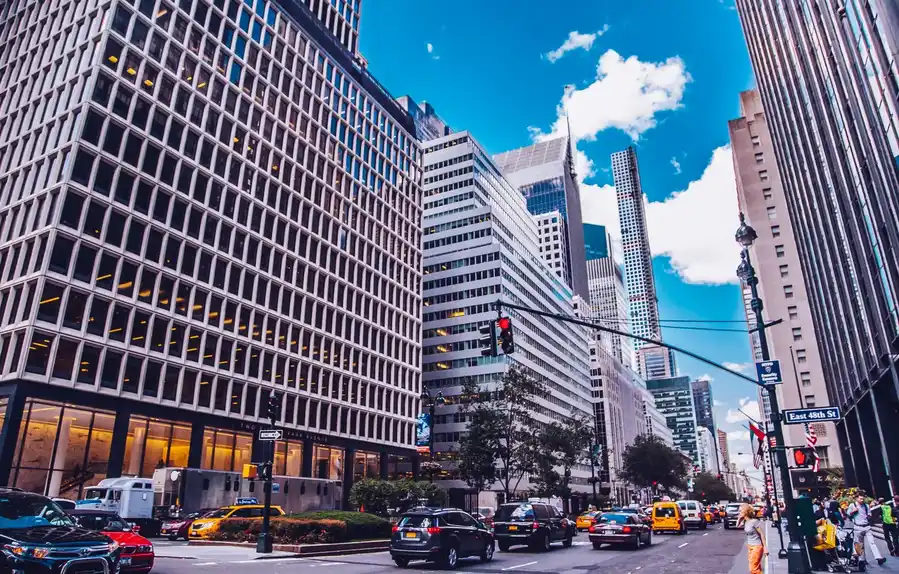
Start with the building. A home has one owner and one set of pipes. A commercial building has a landlord, a managing agent, neighbours above, below and beside, shared risers, shared drains and a sprinkler system that belongs to the building as a whole. The water in your unit may have started two floors up. The shutoff you need may be behind another tenant's locked door. The ceiling you must open may be your ceiling and someone else's floor. Every commercial job is therefore also a coordination job, with building management, neighbouring tenants and sometimes the fire alarm and sprinkler contractors all in the same conversation. A crew that only knows how to dry will struggle. A crew that knows how buildings are run will not.
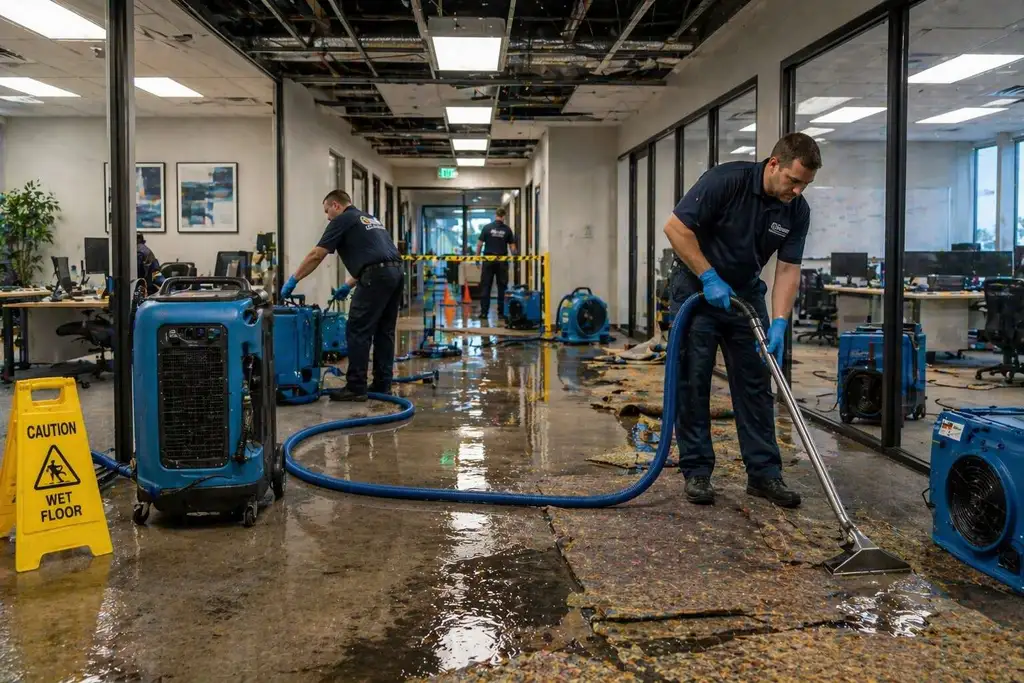
Then there is the trading question, which has no equivalent in a home. A family can leave a wet house and stay with relatives. A business that closes loses the day, and the day after, and the customers who found the door locked and went elsewhere. So commercial drying is planned around a question residential work never asks: which parts of these premises can keep trading, safely and legally, while the rest are dried? Sometimes the answer is most of the floor. Sometimes it is none of it, because the water is contaminated or the electrics are involved. Either way, the answer must come from the moisture map and the hazard assessment, not from optimism. Keeping a business partly open is a skill. Keeping it open unsafely is a liability, and the difference is measurement.
A home dries for its family. A business dries for its customers, its staff, its landlord and its insurer at once, and commercial water damage restoration NYC has to satisfy all four.
The paperwork differs too, in weight and in audience. A homeowner's claim is read by one insurer. A commercial loss can be read by the tenant's insurer, the landlord's insurer, the neighbour's insurer and the building's managing agent, all looking for the sentence that moves the loss onto someone else's policy. The restoration file, the scope, the moisture map, the daily logs, the photographs with times on them, has to survive all of those readings at once. That is why this page treats documentation as a service in its own right, listed among the services offered and demanded in the written scope. In commercial work, the drying is half the product. The record of the drying is the other half.
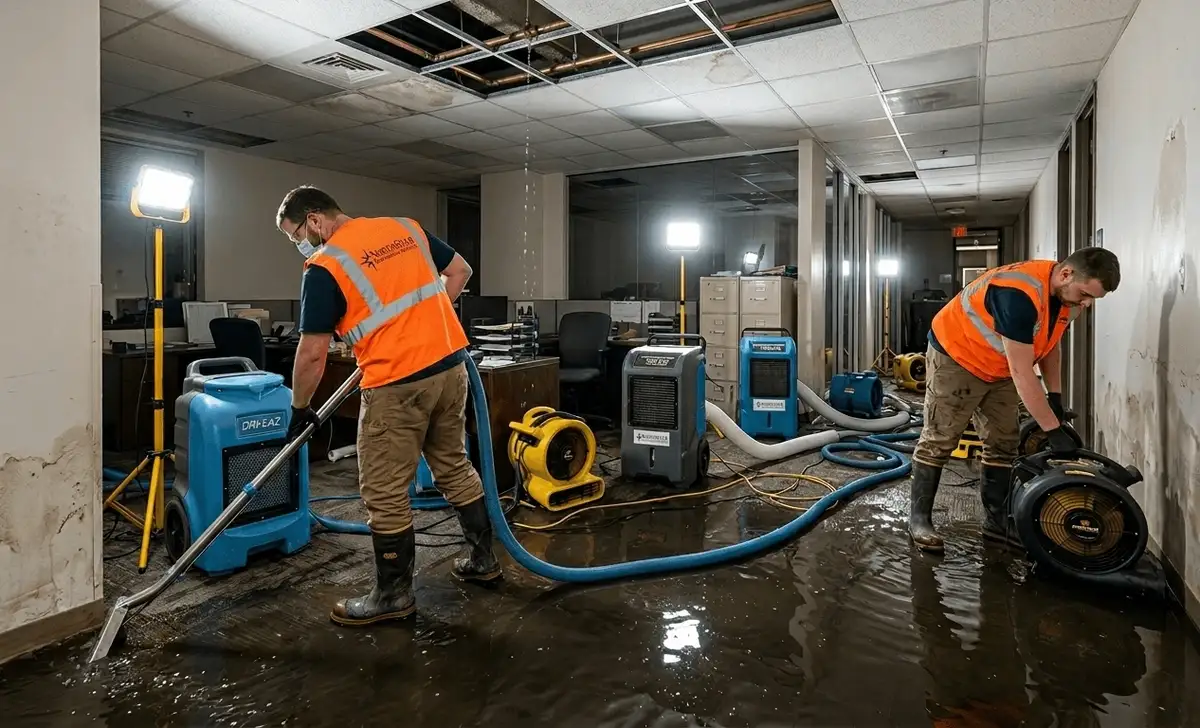
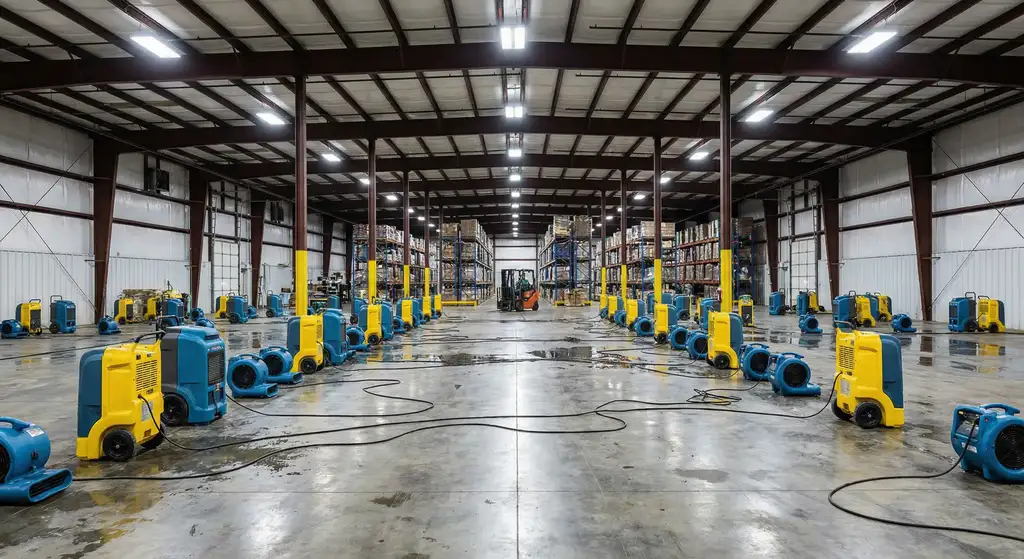
Scale is the last difference, and the most visible one. A home takes a handful of air movers and one or two dehumidifiers. A flooded warehouse floor, a hotel corridor or a supermarket can take dozens of machines, truck mounted extraction, desiccant dehumidifiers the size of wardrobes and power distribution to run them all. The planning changes with the scale: drying is zoned, readings are taken on a grid, and progress is reported like a project, because it is one. When you read the section of this page on drying at commercial scale, hold on to that picture. The principles are the home principles. The logistics are closer to a construction site than to a callout, and the firm you hire should talk about your job in those terms.
Scale changes the management, not the science. The readings still rule; there are simply more of them, across more rooms, for more readers, in commercial water damage restoration NYC.
None of this makes the residential pages of this site irrelevant to a business reader. The extraction, the drying science and the mold law are shared. But a business that reads only the home guidance will miss the lease question, the interruption question and the coordination question, and those are the questions that decide whether a commercial loss is a bad week or a bad year. This page exists to answer the commercial questions directly, in commercial terms, for the city's businesses.
When a crew describes your loss, listen for the commercial words: zones, trading, interruption, landlord, scope. Their presence marks a firm that understands commercial water damage restoration NYC.
The residential pages of this site will teach a business reader the drying. This page exists because commercial water damage restoration NYC was never only the drying.
The research
What the Search Data Says About This Service in This City
This page was researched before it was written, with two tools that disagree with each other in ways worth reporting honestly. SEMrush, checking United States desktop results on November 24, 2026, found the search behind this page carrying a volume of seventy searches a month and a keyword difficulty of nineteen percent, which it classes as easy, with a commercial intent. Moz found a volume of thirty one, inside a range of eleven to fifty, and a difficulty of nineteen, which it classes as low, with a transactional intent. The difficulty agrees exactly. The volume does not, and this page quotes both rather than picking the larger. An older planning figure in our own sheet, seventy at nineteen percent, matches the fresh SEMrush reading exactly this time.
Two tools disagreeing is not a failure of research. It is research, reported honestly, and businesses should expect the same honesty from any firm quoting figures about commercial water damage restoration NYC.
| Measure | SEMrush (US, desktop) | Moz (US) |
|---|---|---|
| Monthly volume | 70 | 31 (range 11 to 50) |
| Difficulty | 19 percent, easy | 19, low |
| Intent | Commercial | Transactional |
| Click through rate | Not reported | 82 percent |
| Minimum domain authority | Not reported | 7 |
The results themselves tell a story a business should know. In SEMrush's top ten for this search, dedicated commercial pages already rank: a national network's commercial services page sits eighth and another network's commercial page tenth, behind a city hub page in first place and a Manhattan office of a national firm in third. Moz's nine organic results, last updated on November 18, 2026, also carry dedicated commercial pages, including a commercial blog from a city waterproofing firm in second place. In plain terms, businesses searching for this service are already being answered by pages written for businesses. A generic page would not do, and that finding shaped everything that follows here.
The single keyword finding matters beyond marketing. It means businesses ask for commercial water damage restoration NYC in one plain phrase, and deserve a plain, complete answer to it.
The keyword data holds a second lesson in restraint. In SEMrush's keyword tool, exactly one keyword exists for this service: the exact term itself. There are no city variants, no company variants and no near me variants with data behind them. Moz adds only two related searches, one built on the word reviews and one on the word best, and both return no keyword data of their own. This page therefore answers those two searches as questions, how to read reviews and how best is judged, in its hiring section and its questions, and it does not pretend a family of searches exists where the tools show one. A neighbouring Moz suggestion, water damage repair contractors, is answered as a question too, because the difference between repairing and restoring is a real confusion worth clearing up.
One gap in the research should be stated as plainly as the findings. Domain level figures and backlink data for the large networks could not be obtained in this research round; the tools stalled behind loading screens and upgrade prompts, and this page does not recycle older numbers in their place. What the research does establish is enough: the search is real, its difficulty is agreed by both tools at nineteen, dedicated commercial pages are what rank for it, and the businesses asking it need commercial answers, about leases, interruptions, permits and scale, that the general pages do not give. That gap is the reason this page runs to the length it does.
Dedicated commercial pages ranking for the search tells its own story: the city's businesses are already being answered by specialists, and a general page about commercial water damage restoration NYC would be a step backwards.
A note on what the search results show about reviews, because it returns later in this page. Moz's local pack for this search lists real city firms with real review counts, the largest in the hundreds. Those numbers belong to those firms and are reported here only as a description of what a searcher sees. This page carries no reviews of its own and invents none. When the hiring section below teaches you to read reviews, it teaches a method, not a ranking, because a method is what survives contact with your own building and your own loss.
Volume figures describe searchers, not losses. Seventy or thirty one searches a month still means a real business standing in real water, which is the reader commercial water damage restoration NYC was written for.
Where the tools stalled, this page says so. A research gap admitted is worth more than a figure recycled, in keyword work and in commercial water damage restoration NYC alike.
The first steps
The First Hour in a Flooded Business, Step by Step
The six steps below are the spine of this page. They are written for the manager, owner or senior staff member who finds the water, and they assume nothing except a phone and a torch. They are also the six steps recorded in this page's structured data, in the same words, so that what a search engine shows and what a reader finds here cannot drift apart. Take them in order. Each one protects the next: the photographs protect the claim, the claim protects the drying, and the drying protects the reopening. Commercial water damage restoration NYC begins, every time, with these six moves made calmly in a wet room.
The steps are written for the finder of the water, not for the crew. Your job is safety, sequence and evidence; the drying side of commercial water damage restoration NYC is theirs.
1Shut off the water and protect stock and equipment
If the source is inside your premises and you can reach the shutoff safely, close it. If the water is coming from above or from a shared line, call building management and ask for the riser to be closed. Keep everyone away from water near electrics. Then move what the water has not reached: stock off the floor, records and equipment to dry ground, perishables to refrigeration if the power is safe. Do not stand in deep or contaminated water to save goods. Stock can be claimed. People cannot be replaced.
2Call for help and tell the insurer and the landlord
Three calls, in the same hour. The restoration company, so extraction and drying can start while the loss is still small. Your insurer, so the claim is opened and the New York clocks on deciding and paying it can run from a known date. Your landlord or managing agent, because the source, the access and the structure are usually theirs, and because your lease will expect prompt notice. Write down the time of each call and the name of the person you spoke to. Those three lines are the first page of your claim file.
3Photograph everything before anything is moved
Walk the premises slowly with a phone camera before the cleanup rearranges the evidence. Film the source if you can see it: the split pipe, the sprinkler head, the drain that overflowed. Photograph water lines on walls, damaged stock in place, equipment sitting in water, and the readings on any meter you pass. Then keep photographing as the work proceeds, at the same spots, each day. Insurers decide claims on documents, and a dated sequence of photographs is the document every other document refers back to.
4Get a written scope with drying logs before work starts
Before the heavy work, the job should exist on paper: which areas are affected, what will be extracted, dried, cleaned or removed in each, what equipment will be placed, and how dryness will be proven. The proof is a moisture map drawn at the start and readings taken at the same points every day, shared with you as drying logs. A firm that will not write its scope down is asking you to buy the job twice, once in water and once in argument. The scope section of this page lists what a complete scope contains.
5Keep the business running where it is safe to do so
Ask the question directly: which parts of these premises can trade while the rest dry? The answer comes from the moisture map and the hazard assessment, not from hope. Clean water in one corner of a large floor may allow most of the business to continue behind a barrier. Sewage, electrical involvement or a failed ceiling may close everything, and should. Partial trading protects income and gives the interruption claim a honest shape: a business that traded where it safely could, and closed only where it had to.
6Keep every record for the insurance claim
Open one file, paper or digital, and put everything in it: photographs, the scope, the logs, invoices, the claim number, every letter from the insurer, the hours the business was closed or restricted, and the financial records an interruption claim will need. Add your lease and the landlord correspondence. Keep the file after the claim closes. It becomes your building's water history, and the next adjuster, buyer, landlord or crew who reads it will start from facts instead of from memory.
Read the steps again and notice what they assume: that the person finding the water is not a restoration professional and should not act like one. Nothing in the six steps asks you to judge water category, open a ceiling or decide what can be saved. Those judgements belong to the crew, made with meters and training. Your job in the first hour is safety, sequence and evidence. A manager who does those three things well has done more for the final outcome than a manager who heroically mops. The trade has a saying worth borrowing: dry the building, but document the loss. The steps above are that saying turned into a checklist.
Notice that no step asks you to judge the water. Category, salvage and drying targets belong to trained people with meters, and commercial water damage restoration NYC pretends otherwise at nobody's benefit.
There is a second audience for these steps, and it is worth naming: your staff. The steps work only if the people on shift know them before the water arrives. Print the short version from the top of this page and keep it with the shutoff key and the insurer's number. Note where your unit shutoffs are, where the building riser is, and who in building management answers at night. A business that has rehearsed the first hour loses less in it, and the rehearsal costs an afternoon. Floods do not book appointments, and the middle of the night is a poor classroom.
Print the steps. A checklist that lives on a phone in a flooded room beats a perfect memory in a dry one, every time commercial water damage restoration NYC is needed.
Finally, a word about the step people skip: the landlord call. Tenants delay it out of embarrassment or out of fear that the loss will be blamed on them. Delay helps nobody. The landlord controls the structure, the risers and often the insurance that covers the building itself, and early notice is usually a lease duty as well as a practical need. Make the call, make it factual, and follow it with the same account in writing. In commercial losses, the businesses that fare worst are rarely the ones where the water was worst. They are the ones where the first day was spent deciding whose problem it was, while the water made the decision for them.
Step three, the photographs, is the one people regret skipping. Evidence taken late is a story; evidence taken first is proof, and proof is the currency of commercial water damage restoration NYC.
The six steps travel well. They work in a two room office and in a distribution warehouse, because the order of commercial water damage restoration NYC does not change with the square footage.
The causes
What Lets Water Into New York Commercial Buildings
Ask a city restoration crew what floods businesses and you will hear the same short list until it sounds like a chant. Plumbing fails. Sprinklers discharge. Flat roofs pond. Sewers back up. Storms push water through doorways. Heating and cooling equipment leaks. Pipes freeze in winter. The list is short because commercial buildings are machines with a limited number of wet systems, and every wet system has a limited number of ways to fail. Knowing the list matters for a practical reason: the cause decides the coverage, the category of the water, the neighbours involved and often the landlord's share. In commercial water damage restoration NYC, the first technical question is never how wet. It is from where.
Every cause on the list has a coverage consequence, a category consequence or a neighbour consequence. That is why the first technical question in commercial water damage restoration NYC is always from where.
Plumbing and the floor above
The commonest commercial loss in the city begins in someone else's space. A supply line lets go in the unit above, a drain stack cracks inside a shared wall, a toilet or a sink overflows through a ceiling that was never waterproof. The tenant below finds the water; the tenant above owns the cause; the landlord owns the structure both of them are standing in. This is why the first hour's calls include the landlord and why the photographs matter so much: they fix the direction the water travelled while the evidence is still dripping. Restoration in a multi tenant building is partly detective work, and the trail of stains, readings and times is what separates a shared building problem from a single unit's accident.
Plumbing, sprinklers, roofs, sewers, storms and plant: six doors water uses, and a prepared business has looked at all six before any of them opens onto commercial water damage restoration NYC.
Sprinklers, standpipes and fire suppression
Sprinkler systems protect buildings and occasionally flood them. A head is knocked by a ladder or a delivery, a fitting corrodes, a pipe freezes in an unheated stairwell, or the system discharges doing its job on a fire two rooms away and leaves a floor of clean water behind it. The city's building department counts repairs to standpipe and sprinkler parts among its own examples of emergency work, which tells you how routine these failures are. The coverage news is comparatively good: sprinkler leakage is named in the state's own description of the basic commercial property form. The restoration news is volume. A sprinkler releases water at pressure until somebody closes a valve, so these losses are measured in thousands of gallons and in floors, plural.
The floor above is the city's commonest source of commercial water. Know your upstairs neighbour the way you know your own shutoffs, because commercial water damage restoration NYC so often starts one floor up.
Flat roofs and the ponding problem
Most city commercial buildings wear flat roofs, and flat roofs hold water by design until the drains take it away. When a drain blocks with leaves and grit, or a seam ages open, the roof becomes a shallow lake looking for a way down, and it finds one through the top floor ceiling, usually above the most expensive stock or the server cabinet. Roof water is patient water: it may travel along beams and appear rooms away from the entry point, which is why moisture mapping matters more than eyesight on these jobs. The repair side belongs to the structure, which in most commercial leases means the landlord, and the non structural roof repair exemption in the permit rules is narrow. A ponding roof is a building problem that visits a tenant, and the paperwork should say so.
Quiet leaks reward the observant and punish the busy. A monthly look at plant rooms and ceiling tiles is the cheapest cover against commercial water damage restoration NYC a business can buy.
Sewers, storms and the ground floor
Ground floor and basement businesses live closest to the city's drainage, and the city's drainage is old, combined and busy. In heavy rain the system can surcharge, and water that was supposed to leave a building comes back into it through the lowest fixtures. Storm water also enters the simple way, under doors, down loading ramps and through areaways, when the street outside becomes a river. The two waters are treated differently by insurers: a sewer backup needs its own endorsement, and rising storm water is flood, outside the standard property forms. The restoration treats them with equal respect, because both can carry contamination. A crew that cannot tell you which water it is dealing with, and why it believes so, has not finished its first assessment.
Cause decides the paperwork. Get the cause named, photographed and agreed early, and half the claim behind commercial water damage restoration NYC argues itself.
Heating, cooling and the quiet leaks
The losses that cost the most are often the quietest. A fan coil drips into a ceiling void for a season. A rooftop unit's condensate line blocks and overflows into the ductwork. A water heater in a storage room weeps, then splits, on a Sunday. Quiet leaks trade volume for time, and time is what mold and rot feed on. By the discovery date, the drying is the small part of the job and the removal of spoiled material is the large part. This is the strongest argument for the boring virtues: routine inspection of plant rooms, a walk of the ceiling tiles looking for stains, and a staff habit of reporting a musty smell as a building symptom rather than a cleaning issue. Most quiet leaks announce themselves politely, months before they become claims.
Hold the whole list together and a pattern emerges that should shape how a business prepares. Four of the six causes begin inside the building's own systems. One begins in the sky and one in the street, and even those two do their worst damage through the building's weakest details: the blocked drain, the unsealed doorway, the basement fixture without a backwater valve. Preparation is therefore mostly inspection and access. Know your shutoffs. Know your risers. Know which neighbour is above your stock room. Know whether your policy carries the sewer endorsement. None of that requires a restoration expert. It requires one afternoon with the building manager and a notebook, and it is the cheapest loss reduction a city business can buy.
By property type
Offices, Shops, Restaurants, Hotels, Warehouses and Multi-Unit Buildings
Commercial is a portfolio word. It covers a law office with twelve desks and a warehouse with twelve loading bays, and the water behaves differently in each. This section walks the main property types a city crew meets, with the particular way water hurts each one and the particular question each owner should ask first. The types differ, but notice the thread that runs through all of them: in every case the restoration plan is built around what the premises do for a living. Commercial water damage restoration NYC is planned around trading, sleeping, cooking, storing and housing people, and the drying follows the use, not the other way round.
Offices, shops, restaurants, hotels, warehouses and landlords share one trade under six different pressures, and commercial water damage restoration NYC follows the pressure, not the postcode.
Offices
Desks, cabling, servers and paper. The office loss turns on electronics and on the floors above and below, because office buildings stack the same tenant mix vertically. Ask first about the riser and the neighbours, and get IT into the room before equipment is moved.
Shops and retail
Stock is the business. Water reaches it from above, from the street and from the shop's own plumbing, and the difference between a claim and a catastrophe is how fast stock leaves the wet zone. Ask first what can be moved, what can be dried and what must be photographed in place.
Restaurants and food premises
Water meets food safety. Contamination questions close kitchens faster than drying questions open them, and stock that has met flood or sewer water is finished whatever it looks like. Ask first what the health rules require to be discarded, and plan the reopening around inspection, not optimism.
Hotels
Guests cannot be dried around. The hotel loss is measured in rooms out of service and in the corridor and riser logic of a building that stacks wet rooms deliberately. Ask first which rooms share the stack with the failure, and map the loss vertically before promising any floor back.
Warehouses and storage
Scale and stock again, with racking, forklifts and concrete that drinks water slowly and gives it back slowly. Ask first about the inventory records, because the claim will be built from them, and about drainage, because a warehouse floor moves water a long way before it pools.
Multi-unit buildings
The landlord's version of every loss above. A failure in one unit is a building event, with duties running to tenants who never saw water. Ask first who coordinates: one building response, documented once, serves every insurer and every lease better than five separate ones.
Two of these types deserve a longer word, because their losses behave in ways owners do not expect. The first is the restaurant. Food premises carry a second regulator into the room: health rules about contaminated food, surfaces and water quality do not bend for a drying schedule, and a kitchen that reopens on a restoration company's say so alone is exposed. Build the health conversation into the first day, keep the discard decisions documented, and let the reopening date be set by the slowest of the three clocks that govern it: the drying, the rebuild and the inspection. Owners who plan that way reopen once. Owners who rush reopen twice, the second time after a closure they did not choose.
Ask the first question for your property type before you ask any other. It focuses the crew, the scope and the insurer on what your premises actually stand to lose from commercial water damage restoration NYC.
The second is the warehouse, where the surprise is the floor. Concrete looks like the one material water cannot hurt, and for a short loss that is nearly true. But a slab drinks water and releases it over weeks, and stock stored directly on it wicks moisture long after the surface looks dry. Racking complicates extraction, inventory complicates the claim, and the sheer area complicates the drying maths: a warehouse loss is planned in zones with their own readings, like a small town being dried street by street. The firms that do this work well talk about your building in zones and grids without being asked. The firms that talk about it as one big room are telling you how they will measure it, which is to say, not at all.
Stock, guests, covers, tenants, inventory, desks: each type keeps its wealth in a different form, and water finds the form first, which is why commercial water damage restoration NYC is planned around the use.
Across all six types, the management lesson is the same, and it is worth stating plainly because it decides budgets. The businesses that recover fastest are not the ones with the least water. They are the ones where somebody senior owned the loss from the first hour: one person who held the file, took the calls, kept the photographs in one place and could answer the insurer, the landlord and the crew from the same set of facts. Appoint that person before you need them, the way you appoint a fire warden. In a commercial loss, coordination is not administration. It is half the restoration.
A crew fluent in your property type will name its risks unprompted. A crew that describes every building the same way will dry every building the same way, and that sameness is the enemy of commercial water damage restoration NYC.
Whatever the type, one senior person owning the loss remains the strongest predictor of a fast recovery in commercial water damage restoration NYC.
The work itself
Extraction and Drying at Commercial Scale
Stand in a dried commercial job on day three and the thing you notice is the noise: rows of air movers talking to each other across a floor, dehumidifiers breathing in wet air and breathing out water into drains, cables run like a temporary nervous system. Getting there follows the same order as a home job, at ten times the logistics. Extract first, because every gallon pumped out is a gallon the machines do not have to evaporate. Map second, because equipment placed against a guess dries the wrong rooms beautifully. Then dry, measure daily, and adjust. Commercial water damage restoration NYC at scale is a managed process with readings at its centre, and this section walks it in that order.
Extraction first, mapping second, drying third, proof last. The order is the method, and the method of commercial water damage restoration NYC scales from a kiosk to a warehouse without changing its mind.
Extraction: the heavy hour
Extraction is where commercial work shows its muscle. Truck mounted units and portable extractors pull standing water from carpet, tile and concrete; weighted extraction tools squeeze water out of carpet and pad in place; squeegees and pumps handle the slab areas and the loading bays. The aim is unglamorous and absolute: remove the water as water, in bulk, before asking electricity to remove it as vapour. Crews measure this stage in gallons and in hours, and a good crew chief can tell you both numbers at the end of the first visit. If your premises hold stock, this is also the stage where the protection plan shows itself: what was lifted, what was blocked up on battens, what was moved to dry ground and what was photographed and left.
Gallons out through a hose are gallons the dehumidifiers never have to chase. That is why the heavy hour of extraction is the best value inside commercial water damage restoration NYC.
Moisture mapping: the job on paper
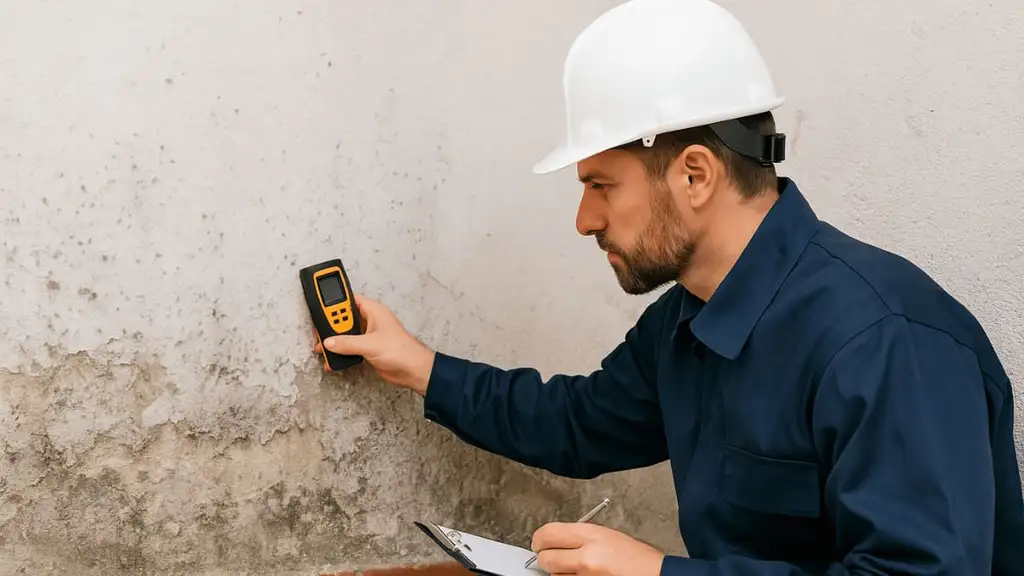
Once the bulk water is out, the real extent of the loss is invisible, and the moisture map is how it becomes visible. A technician works the premises with meters, testing walls, floors and ceilings on a grid, and records where the water travelled: up the drywall, along the slab, into the unit below, inside the cavity nobody can see. The map does three jobs at once. It tells the crew where to place equipment. It tells you which areas can trade and which cannot. And it becomes the baseline the daily readings are compared against, the before picture in numbers. Ask to see the map on the first day. A firm that dries without one is not being traditional. It is being unaccountable, at your expense and your insurer's.
A moisture map is a promise made visible: here is where the water went, and here is where we will measure until it is gone. Demand one on every commercial water damage restoration NYC job.
Drying: machines, zones and daily readings
Daily readings turn drying from an opinion into a record. If a firm cannot show you yesterday's numbers, ask what today's commercial water damage restoration NYC is being compared against.
Drying a commercial space is an exercise in controlled weather. Air movers drive evaporation from surfaces. Dehumidifiers, refrigerant for most work and desiccant for large or stubborn spaces, pull the vapour out of the air so the cycle can continue. Large losses add ducted systems that treat whole zones and exhaust moisture outside the building. The craft is in the balance: too little airflow wastes days, the wrong dehumidification wastes electricity, and both waste the one thing a business cannot spare, which is time closed. So the crew returns daily, takes readings at the same mapped points, writes them into the drying log and moves or removes equipment as the numbers fall. The log is not bureaucracy. It is the instrument panel of the job, and it is the document your insurer will trust most, because numbers written daily are hard to invent afterwards.
Cleaning, removal and the honest line
Dry is a reading, not a feeling, and the final readings are the document the rebuild, the insurer and the future all stand on after commercial water damage restoration NYC.
Not everything wet can be dried back to service, and commercial work draws that line in the open. Porous materials that met contaminated water come out. Saturated ceiling tiles come down. Drywall that has wicked dirty water is cut at a measured height, a flood cut, so the cavity can be dried and inspected. Clean water losses are kinder: carpet can often be dried in place, and many contents respond to cleaning and drying by specialists. The scope should name, room by room, what is being dried, what is being cleaned and what is being removed, with the reasons in plain words. Where mold is found or suspected beyond a small area, the work crosses into the state's licensing system, and the mold law section of this page explains how that changes who may do what.
The end of drying should be as documented as the start. Dry is not a feeling; it is a reading, compared against a dry standard taken from an unaffected part of the same building in the same material. When the mapped points reach that standard and hold it, the equipment comes out and the file gains its closing readings. Insist on seeing them. Those final numbers are what the rebuild will be built on, what the insurer will close the mitigation file with, and what protects you if a smell or a stain appears in a month and someone asks whether the building was ever really dry. In commercial work, the answer to that question should never be a memory. It should be a page in a log you hold.
Need a crew in your building today?
Call (212) 555-0147. Ask for the moisture map, the written scope and the daily drying logs by name, and judge the answers the way this page teaches.
Insurance
What a Commercial Property Policy Actually Covers
Every commercial claim begins with a document most owners have never read: their own property policy, and specifically the form it is written on. New York's Department of Financial Services describes the standard forms in plain terms, and the differences between them decide real claims. This section follows the department's own account, because the department is the regulator and its wording is the safest map available. Read it before a loss if you can. Read it today if you cannot. The form name on your policy is the single most valuable sentence in this section, and finding it takes one phone call to your broker. Commercial water damage restoration NYC is documented the way it is because claims are decided on exactly these distinctions.
The form name on your policy is worth one phone call to your broker today. No sentence on this page is worth more to a flooded business than that one, because commercial water damage restoration NYC is claimed under that form.
The Basic Form and the Broad Form
The Basic Form is the narrower of the standard commercial property forms. For water, its named reach includes sprinkler leakage, which is why a sprinkler loss in a basically insured building is not automatically a disaster of coverage. The Broad Form adds more perils, and among them is water damage from the accidental discharge or leakage of water or steam, where a system or appliance containing water or steam has cracked or broken. In ordinary language: the burst pipe and the failed appliance, the two commonest indoor losses, sit inside the Broad Form's description. Neither form is a promise about every wet event. Each is a list, and claims are the art of matching your event to the list, with the restoration records as the evidence of what the event actually was.
Sprinkler leakage covered, burst pipes covered on the broader form, sewer backup by endorsement only, flood not at all: four lines that decide most claims for commercial water damage restoration NYC.
| Question | What the standard forms say |
|---|---|
| Sprinkler leakage | Covered under the Basic Form as a named water peril. |
| Burst pipe or failed appliance | Covered under the Broad Form, as accidental discharge or leakage from a cracked or broken system or appliance. |
| Sewer backup | Not in the standard forms. Covered only if a sewer backup endorsement is bought, and that endorsement is not available with the Basic Form. |
| Flood from outside | Not covered under a standard commercial property policy. Flood insurance is separate, most often through the National Flood Insurance Program. |
| Lost income while closed | Business interruption coverage, where bought, responds to loss of income and continuing expenses, proven from financial records. |
Two exclusions deserve to be read twice, because they are the ones that ambush city businesses. The first is sewer backup. It arrives through your own drains, it wrecks ground floor and basement premises, and it feels exactly like the plumbing losses that are covered. It is not covered unless the endorsement was bought, and the endorsement cannot be attached to the Basic Form at all. If your premises sit low, that one line of your policy deserves a conversation with your broker this week, in writing. The second is flood. Water rising from outside the building is outside the standard forms entirely, however it got in. After a storm, the source sentence in the restoration report, where the water came from and how it entered, can decide which policy, if any, responds. Make sure that sentence is written carefully and truthfully.
Exclusions ambush the unready. The sewer endorsement question, asked while the floors are dry, is the cheapest sentence in commercial insurance, and it decides whether commercial water damage restoration NYC gets paid for after a backup.
Business interruption: the cover that keeps firms alive
Property cover repairs the premises. Interruption cover, where it is bought, addresses the quieter catastrophe: the income that stops while the premises are repaired. The Department of Financial Services describes it as covering loss of income or profits, worked out from your financial records, together with the operating expenses that continue during the closure. Two practical truths follow. First, the cover is only as good as the records: the department names detailed financial records, extra expenses, accountant's statements and tax returns as the proof. Second, the restoration file and the interruption file are the same story told twice, once in moisture readings and once in money, and they must agree. The dates the logs say you were closed are the dates the accounts must show. The next sections of this page give interruption its own room, because for many businesses it is the difference between a claim and a survival.
Coverage follows the source of the water, so the source sentence in the restoration report deserves the care this page keeps asking for on behalf of commercial water damage restoration NYC.
A closing word of discipline about this section. Insurance pages on the internet love certainty, and certainty is the one thing an honest page cannot sell you. Forms differ, endorsements differ, and your policy's own language governs your claim. What this page can do, and has done, is give you the regulator's own framework: the form names, the named perils, the two great exclusions and the proof an interruption claim needs. Take that framework to your broker and your policy, and get your building's answers in writing while the floors are dry. That conversation, held early, is worth more than any sentence written here, including this one.
Read your own policy against the regulator's framework, and get your building's answers in writing. That is the whole of the insurance method behind commercial water damage restoration NYC.
Claim clocks
The Clocks on a Commercial Claim in New York
New York runs insurance claims on written clocks, and a business that knows them holds an advantage no adjuster can argue with. The clocks live in two places: Regulation 64, which governs claims handling generally, and section 2618 of the Insurance Law, which tightens the rules after a declared disaster. This section sets both out as the texts were verified for this page, including the places where the texts refuse to be simplified. Where a summary elsewhere gives you one tidy number, be suspicious. The real rules have branches, and the branches are where commercial claims live.
Fifteen business days to decide, five to pay, undisputed parts paid along the way: a business that can quote the clocks holds its commercial water damage restoration NYC claim differently.
Regulation 64: the everyday clocks
Regulation 64, at section 216.6(c), gives an insurer fifteen business days to accept or reject a claim after proof of loss. Read the text looking for a commercial exception and you will not find one: the regulation draws no line between a shop's claim and a household's, and this page asserts no carve out that the text does not contain. If the insurer needs more time, it must say so in writing, with reasons. Around that central clock sit two rules that matter as much in practice. Under section 216.6(a), where coverage is not in dispute the insurer must make a fair and reasonable offer. Under section 216.6(e), the parts of a claim that are not in dispute must be paid even while other parts are argued. And under section 216.6(f), once a claim is agreed, payment follows within five business days. A large commercial claim should therefore move in pieces, with the undisputed core paid while the edges are negotiated, and a business that knows section 216.6(e) exists can ask for that movement by name.
Clocks need a start date, and the start date needs proof. Submit in writing, keep the dated copy, and note it in the file the same day your commercial water damage restoration NYC claim opens.
| Clock | Rule | Source |
|---|---|---|
| Accept or reject after proof of loss | 15 business days | Regulation 64, section 216.6(c) |
| Pay after the claim is agreed | 5 business days | Regulation 64, section 216.6(f) |
| Undisputed parts of a claim | Must be paid while the rest is argued | Regulation 64, section 216.6(e) |
| Disaster claims, commercial extension | One extension of 30 business days, in writing with reasons | Insurance Law, section 2618(c)(2) |
| Disaster claims, payment after acceptance | 4 business days | Insurance Law, section 2618(d) |
Section 2618: after a declared disaster
After a declared disaster the rules change and the commercial extension doubles the household one. Summaries that miss that branch miss the part of the law written for commercial water damage restoration NYC.
Section 2618 applies only where a disaster has been declared, by the governor or by a presidential declaration of emergency, and only to claims arising from that disaster. Inside that scope it draws the distinction Regulation 64 does not. A non commercial claim works to fifteen days, with a single extension of fifteen days available. A commercial claim works to fifteen business days, and the insurer may take a one time extension of thirty business days, given in writing with reasons stated. If the claim is still open after that, notice must be given every thirty business days. And once the claim is accepted, section 2618(d) requires payment within four business days. Notice what this means for a business reading summaries after a storm: any account that speaks of one extension figure for everyone is incomplete, and the figure that applies to you depends on the commercial character of your claim.
Why does this page spend so long on clocks? Because clocks change behaviour on both sides of the claim. An insurer working to a written deadline organises its file differently. A business that submits a complete proof of loss, with the restoration scope, the logs and the interruption records in one bundle, starts the fifteen business days from a position of strength. And a restoration firm that knows the clocks documents like a firm that expects to be read by a deadline: promptly, completely and without being chased. When you interview companies, ask what they know about the claim clocks on a commercial job in this state. The answer separates the firms that merely dry buildings from the firms that understand what the drying is for.
Ask any firm you interview what it knows about these clocks. The answer grades the firm's paperwork before you have seen a single log from its commercial water damage restoration NYC.
One honest caution closes the section. Clocks have triggers, and triggers have arguments. Fifteen business days from proof of loss sounds simple until the parties disagree about when proof was complete. Protect yourself the plain way: submit in writing, keep the dated copy, and note the date in the claim file the same day. If more time is demanded of your insurer, the demand should arrive in writing with reasons, and that letter joins the file too. Paper is not a formality in a New York claim. Paper is the mechanism by which the clocks are enforced, and the businesses that keep it are the businesses the clocks work for.
Paper enforces the clocks. Every letter, every written demand for time, every dated submission belongs in the file from the day it exists, for as long as commercial water damage restoration NYC is being argued over.
Business interruption
Business Interruption: Proving the Days You Could Not Trade
Ask owners what nearly finished them after a flood and few will name the water. They name the weeks: the weeks of rent on a closed shop, wages promised to staff who could not work, regulars who drifted to a competitor and did not drift back. Property insurance speaks to the building. Business interruption coverage speaks to the weeks, and for many city firms it is the more important of the two. This section explains what the cover is, on the regulator's own description, and what a business must be able to prove to use it. Commercial water damage restoration NYC earns its keep in this section as much as in the drying, because the restoration file is where the interruption is measured.
Property cover repairs the room. Interruption cover defends the weeks, and for many firms the weeks are the wound that matters after commercial water damage restoration NYC.
The Department of Financial Services describes the cover in two parts. It responds to loss of income or profits, worked out from the business's financial records. And it responds to the operating expenses that continue while the business is closed or restricted: the costs that do not stop just because the trading has. The department then names the proof: detailed financial records, records of extra expenses, statements from your accountant and your tax returns. Read that list as a design brief for your filing system. The claim will be built from the business's own books, which means the quality of the claim was decided, in part, by bookkeeping habits formed years before the flood. Tidy books are an insurance asset. If yours are not tidy, the honest time to fix them is now, while nothing is wet.
The restoration records give the interruption its skeleton. The moisture map shows which parts of the premises were affected. The scope shows what had to close and what could trade. The drying logs date the closure day by day, and the final readings date the reopening of each zone. Lay those beside the accounts and the interruption stops being an estimate and becomes a measurement: these rooms, these dates, this much lost trade, these continuing costs. This is why this page insists that the scope address the trading question explicitly, which areas stay open and which close, in writing, from the first day. A scope that treats the premises as one undifferentiated wet box makes the interruption claim harder than it needs to be, however good the drying is.
The claim is built from your own books, which means tidy bookkeeping in a dry year is an insurance asset in the wet year when commercial water damage restoration NYC interrupts trading.
Extra expenses deserve their own sentence, because businesses forget to keep them. The temporary premises, the rented equipment, the overtime, the delivery charges to serve customers from a borrowed counter: these are the costs of trading through a loss, and the department's list names extra expenses as part of the proof. Keep every receipt, however small, in the claim file, with a note of what it was for. Small numbers gathered daily beat large numbers reconstructed later, and reconstruction is where claims go to be doubted. The same habit covers the closure record itself: a simple dated note, each day, of whether the business opened, partly opened or stayed shut, signed by whoever managed the day. Thirty seconds a day, worth real money in the argument that follows.
A last point of honesty about interruption cover: it responds to a covered loss. If the water event itself falls outside the policy, because it was flood without a flood policy or a sewer backup without the endorsement, the interruption that follows it usually falls outside too. The chain matters, which is why the insurance section of this page comes before this one and why the source of the water is documented so carefully from the first photograph. Interruption cover is powerful, but it is a link in a chain, and the chain is only as strong as its first link: a covered event, promptly reported, professionally dried and completely recorded.
Restoration records give the interruption its dates; accounts give it its numbers. The two files must tell the same story, day for day, about commercial water damage restoration NYC.
Keep the small receipts. Extra expenses gathered daily are believed; extra expenses reconstructed in a lump are doubted, in interruption claims as in commercial water damage restoration NYC itself.
Interruption follows the event's coverage. A flood without a flood policy interrupts nothing the insurer will pay for, which is why the chain behind commercial water damage restoration NYC starts with the source.
Landlord and tenant
Landlord or Tenant: Who Fixes What in a Commercial Lease
In a home, the law wraps the tenant in duties owed by the landlord. In a commercial lease, nearly all of that falls away, and the written agreement between the parties governs almost everything. That single fact surprises more flooded businesses than any other in this field, and it arrives at the worst moment: standing in water, phone in hand, discovering that the duties they assumed existed were residential duties. This section sets out the usual shape of commercial responsibility as the city's own lease guidance describes it, so that a business can read its position before the argument starts. Commercial water damage restoration NYC is booked by whoever holds the duty, and the lease is where the duty lives.
In a commercial building, the lease is the law between the parties. Read yours while the floors are dry and the reading is free, because commercial water damage restoration NYC will be booked under it.
Begin with what the law does not do. A commercial landlord is not required by statute to make repairs to the premises, nor to provide heat and hot water, in the way residential landlords are. Those duties exist in a commercial building only if the lease creates them. What landlords and tenants actually owe each other is therefore a reading exercise, and the lease's repair, maintenance, services and insurance clauses are the text. Two businesses in the same building can hold genuinely different positions, because they signed different leases in different years. Anyone who gives you a confident answer about your duties without reading your lease is guessing, and guesses are expensive in a flooded building.
The usual shape of the split
Structure leans landlord, interior leans tenant, services exist only where the lease promises them: a pattern to test against your own clauses before commercial water damage restoration NYC tests it for you.
With that warning given, commercial leases do follow a recognisable pattern, and the city's commercial lease guidance describes it. The landlord typically carries the structure of the building: the roof, the exterior walls, the foundations, the columns, beams and slabs, the subflooring and the footings. The tenant typically carries the interior of the premises: non structural work inside the unit, the heating and cooling equipment that serves only that unit, and the plumbing and electrical runs within the premises, together with matters like security and cleaning. And the landlord provides only those utilities and services the lease expressly requires. Read that pattern against the causes section of this page and the practical map appears: the roof and the risers lean landlord, the unit's own plumbing and equipment lean tenant, and the argument lives in the leases that split things differently.
Insurance follows the same written logic. A commercial building commonly carries the landlord's policy on the structure and the tenant's policy on the fit out, the stock and the trading, and a serious loss can touch both, plus the policy of the neighbour where the water started. This is why the first day's calls include all three parties and why the restoration file must be written to survive being read by several insurers at once. It is also why the photographs and the source evidence matter beyond your own claim: the direction the water travelled, fixed early and honestly, is what allows three insurers to divide a loss without a court dividing it for them.
Give the lease's notice, in writing, on the first day, however friendly the relationship. Friendliness is not a filing system, and commercial water damage restoration NYC runs on filings.
Practical habits close the section. Keep your lease where you can reach it at midnight, and read its repair and notice clauses once while the floors are dry. Know the notice the lease requires after a loss and give it, in writing, on the first day, however friendly the landlord is; friendliness is not a filing system. If your business sits below another, ask at signing, not at flooding, what the building's history of leaks is and what the riser layout looks like. And when the loss comes, let the restoration proceed on the emergency logic of the first hour while the lease argument proceeds on paper behind it. Drying delayed by a responsibility dispute is damage chosen, and no lease ever written refunds it.
Three insurers can read one loss. The file that survives all three readings is the one written honestly, with the water's direction fixed early in the commercial water damage restoration NYC record.
Let the drying proceed on emergency logic while the responsibility argument proceeds on paper. Water does not wait for the argument to finish, and neither does commercial water damage restoration NYC.
Permits
Building Permits and Emergency Work in the City
Drying a building needs no one's permission. Rebuilding it usually does. Most construction work in New York City requires approval and permits from the Department of Buildings before it proceeds, and the repairs that follow a commercial flood, new drywall, replaced systems, altered layouts, restored storefronts, are construction work once they pass the minor and the cosmetic. This section explains where the line sits, what the recognised exceptions are, and how the emergency route works, including the one point on which the published wordings disagree and on which this page therefore takes no position. In commercial water damage restoration NYC, permits are the hinge between the drying and the reopening, and they are the hinge businesses most often discover late.
Drying needs no permit. Rebuilding usually does. Knowing which side of that line your repairs sit on is the first permit skill inside commercial water damage restoration NYC.
The minor work that needs no permit
The department recognises a list of minor work that can proceed without a permit, and parts of a flood repair genuinely live on it: painting, plastering, hanging cabinets, replacing plumbing fixtures, resurfacing floors and non structural roof repair. A business whose damage is truly at that level, finishes spoiled, fixtures to swap, surfaces to make good, may lawfully rebuild without entering the permit system. But read the list narrowly, the way the department wrote it. The moment the work opens structures, replaces systems or changes the premises, it has left the minor list. When a contractor waves at the whole rebuild and calls it minor, that wave is a red flag, and the hiring section of this page lists it among them.
The minor work list is real and narrow: paint, plaster, cabinets, fixtures, floor surfaces, non structural roof repair. Read it as narrowly as the department wrote it when you plan the rebuild after commercial water damage restoration NYC.
Emergency work and the notification
The city's Administrative Code, at section 28-105.4.1, recognises that genuine emergency work cannot always wait for a permit: a burst riser at midnight is not improved by an office opening at nine. Emergency work may therefore proceed ahead of the permit, with an Emergency Work Notification as the accompanying filing, and the department's own examples of emergency work include repairs to standpipe and sprinkler parts, two of the commonest commercial failures. What this page will not give you is a filing deadline for that notification. The city's public guidance and the text of the code as published in a mirror of the code do not agree about when the clock runs, and the official publisher's text could not be read directly during this page's research. Printing one wording as the rule would be inventing a deadline, and an invented deadline helps nobody. Ask the department for your job's requirement, and keep the answer with the permit papers.
Emergency work has its own route because burst pipes do not keep office hours. The route exists; the deadline wording conflicts, and this page invents neither, on commercial water damage restoration NYC or anything else.
The practical sequence for a business is therefore threefold. First, let the emergency work and the drying proceed; neither waits for paper. Second, scope the rebuild honestly with your contractor and your architect or expediter if the job needs one, and establish which permits it requires. Third, file, and keep the filings with the claim file, because insurers and landlords both read permit papers as evidence that the rebuild was real and lawful. A reopened business trading behind unpermitted work has not finished its flood. It has merely moved the problem from the floor to the filing cabinet, where it will wait, patiently, for a sale, an inspection or an insurer to find it.
One more audience for permit discipline deserves naming: the next tenant, the buyer and the lender. Commercial premises change hands, and the paper trail of a flood, permits pulled, work signed off, drying proven, is either an asset in that transaction or a hole in it. Owners sometimes ask why a page about emergency drying spends a section on municipal paperwork. The answer is that in this city the paperwork is part of the building. Treat the permit file with the same care as the drying log and the claim file, because in the long life of a commercial building, all three are chapters of the same book.
File the permit papers with the claim file. Insurers, landlords, buyers and lenders all read them as the same evidence: that the rebuild after commercial water damage restoration NYC was real and lawful.
A business reopened behind unpermitted work has moved its flood from the floor to the filing cabinet. Finish the paper and commercial water damage restoration NYC is actually finished.
Mold law
Mold Law for Commercial Premises in New York
Water that is not dried becomes mold, and mold in New York is licensed territory. Many business owners assume the state's mold law is a housing law, because they hear about it from tenants and landlords of apartments. It is not. Article 32 of the Labor Law governs mold assessment and remediation as licensed work, and it reaches commercial premises on the same terms as homes. This section sets out the parts of Article 32 that a business needs: when the law engages, the separation rule at its centre, the owner's exemption and its limits, and the two local laws that do not apply to commercial buildings however often they are quoted at them.
Article 32 is not a housing law. It reaches the office, the shop and the warehouse on the same terms, past the same ten square foot threshold, whenever commercial water damage restoration NYC leaves growth behind.
When Article 32 engages
The law's own definitions set the threshold. Under section 930(6), a mold project means mold work on an area greater than ten square feet. Under section 931, the people who perform mold assessment and mold remediation for others must hold licences issued under the article, of the type matching the work. Below the threshold, ordinary cleaning and drying proceed as part of restoration. Above it, in an office as in an apartment, the job changes legal character: assessment by a licensed assessor, a work plan, remediation by a licensed remediator, and a post remediation assessment to confirm the work succeeded, with the process repeated if it did not. A restoration firm that finds growth beyond the threshold should stop and explain this to you unprompted. A firm that offers to simply clean a large area and move on is offering to break the shape of the law, quietly, in your building.
One licensee, one role: assessor or remediator, never both on the same property. The sentence is short because the conflict it prevents is obvious, in commercial water damage restoration NYC as anywhere.
The separation rule
At the centre of Article 32 sits one sentence, section 936, and it is worth reading exactly as written: "No licensee shall perform both mold assessment and mold remediation on the same property." The logic is the logic of honest measurement everywhere. The party who sizes the problem must have no financial interest in the size. On a commercial job this means two licensed parties where a homeowner might have expected one firm: the assessor who investigates, writes the work plan under section 946 and returns afterwards to judge the result, and the remediator who works to that plan. If a single company offers to assess your building's mold and then to remediate it on the same property, the offer itself answers the question of whether to hire them for either role. The rule has no commercial exception, because the conflict it prevents has no commercial exception either.
The owner's exemption belongs to owners on their own buildings. It does not travel to a hired firm, however the invoice is worded, so check it whenever commercial water damage restoration NYC involves mold.
The owner's exemption, and its edge
Article 32 does leave room for owners to work on their own buildings. Section 933(3) exempts a commercial property owner, the owner's managing agent, and a full time employee of the owner or the managing agent, where the work is done on property that the owner owns or manages, and the Department of Labor's guidance speaks in the same direction for owners working on their own properties. Read the exemption's edge carefully, though. It does not cover a business whose trade is mold work for the public, and it does not extend to a contractor you hire, however the invoice is worded. The exemption belongs to the owner on the owner's own property. A facilities team maintaining its own building stands inside it. A hired firm, however small, stands outside it and needs the licence.
Local Laws 55 and 61 govern homes. Quoting them at a commercial building is a sign the adviser is reading from the wrong map of commercial water damage restoration NYC.
The two local laws that do not apply
Local Law 55 and Local Law 61 are quoted at commercial tenants with confidence and are, for commercial premises, simply the wrong laws. They are residential measures, sitting in the city's housing framework and administered for homes. They do not set the mold duties for an office, a shop or a warehouse. A commercial occupier's mold position comes from the lease, from Article 32 where licensed work is concerned, and from workplace safety duties where staff are concerned. Knowing which law actually governs your building is not pedantry. It decides who you can compel, what you can demand and which deadlines exist. Anyone advising a business who reaches first for the housing laws has shown you their map, and their map is of a different city.
Ask the three questions early: how large is the area, who assesses, and are they separate from who remediates? The answers organise the whole mold side of commercial water damage restoration NYC.
Bring the section together into one habit. When mold enters a commercial loss, ask three questions in order. Is the affected area greater than ten square feet? Who is the licensed assessor, and are they separate from whoever will remediate? And does anyone on this job claim an exemption, and if so, which one, in the statute's words? Those questions, asked early, keep a water job from becoming a licensing problem laid on top of it. The drying sections of this page explain how water is removed. This section exists because what grows after water, in this state, is regulated, and a business deserves to know the regulation before it needs it.
Worker safety
Safety, Protective Equipment and the Rules That Guard the Crew
A flooded business is a workplace twice over: yours, interrupted, and the restoration crew's, begun. The safety rules that govern the second workplace are federal, they are specific, and a business owner benefits from understanding them, because the firm you hire will be working inside your premises, around your staff and your customers, under duties the law places on it as an employer. This section sets out those duties as the regulator states them: hazard assessment, protective equipment at no cost to the worker, training, and the particular hazards of flood cleanup. Commercial water damage restoration NYC is heavy, wet, electrical work, and the firms worth hiring talk about safety in the same plain terms as they talk about drying.
Protective equipment is the employer's purchase, never the worker's. A firm that fails that test has graded its own safety culture for you before its commercial water damage restoration NYC begins.
The employer's duties come first
The framework starts with the employer, not the equipment list. An employer must assess the workplace to determine what hazards are present, select protective equipment that fits the work, provide it at no cost to the employee, and train the people who will use it. Behind the specific standards stands the General Duty Clause, section 5(a)(1) of the Occupational Safety and Health Act, which requires employers to furnish employment free from recognised hazards. The no cost rule is written into the protective equipment standard itself, at 29 CFR 1910.132, and it makes a clean test of any firm: protective equipment is the employer's purchase. A company that charges its own workers for their gloves and respirators has shown you its safety culture in one invoice, and you may draw the obvious conclusion about the rest of its standards.
A respirator without fit testing is decoration. The rules require the test and the medical examination because the seal is the protection, on commercial water damage restoration NYC jobs as on any other.
Respirators, fit testing and medical examinations
Where the work involves mold growth or contaminated water, respirators enter the picture, and the rules around them are stricter than handing out masks. Respirator use requires fit testing, so the device seals to the wearer's face, and medical examinations, so the wearer is fit to work in one. A respirator worn loosely by an untested worker is decoration, and decoration is worse than honesty because it looks like protection. When you watch a crew work in your building, the visible signs of a compliant job are unglamorous: gloves, eye protection, boots suited to wet and contaminated floors, and respirators where the assessment calls for them, worn by people who have plainly been trained to wear them. Ask the firm how it handles fit testing. The answer, fluent or evasive, tells you most of what you need.
Electrical hazards lead the flood cleanup list. A wet area near live equipment stays closed until it is made safe, whoever is impatient for commercial water damage restoration NYC to start.
The known hazards of flood cleanup
The safety regulator's own account of flood cleanup names a hazard list every business should recognise, because several items on it belong to the building, not the crew. Electrical hazards lead it: water and building electrics are a combination that kills, and a flooded area near live equipment is closed until it is made safe. Debris follows: floodwater moves sharp, heavy and contaminated material into places nobody expects. Mold exposure grows as the hours pass, which is one more reason the drying clock matters. And carbon monoxide completes the list, from generators and engines run in or near enclosed spaces, a hazard that appears when well meaning people bring the wrong equipment indoors. Your part in crew safety is mostly honesty and access: tell the firm what you know about the building's electrics, its chemicals, its asbestos era and its odd corners. The assessment they must make is only as good as the information it starts from.
Categories belong to an industry standard; duties belong to the law. A firm that keeps the two straight in its talk about commercial water damage restoration NYC will keep them straight in its work.
Categories are a standard, not a statute
One confusion is worth clearing while safety is on the table, because firms blur it in both directions. The categories used to describe water, from clean to heavily contaminated, come from the IICRC's S500 and S520 standards, which are the industry's own documents. The federal safety regulator lists those standards on its mold guidance page under other resources and adds, in terms, the note: "These are NOT OSHA regulations." So a firm may honestly say it works to the IICRC standards, and that is a meaningful claim about training and method. What it may not honestly say is that the categories are a government rule. This page has not reproduced the standards' internal tables, which are paid professional texts. But the boundary between an industry standard and a law is free to state, and a firm that respects the boundary in its talk will usually respect it in its work.
Tell the crew what you know about your building: its electrics, its chemicals, its odd corners. Their assessment is only as good as the information commercial water damage restoration NYC starts from.
Sewers, pipes and sprinklers
Sewer Backups, Frozen Pipes and the City's Own Systems
Some commercial water arrives from the city's systems rather than the building's, and those losses run on the city's rules. This section gathers the three system failures a business is likeliest to meet: a sewer backup, where the environmental protection department is the responding agency; a frozen and burst pipe, where ownership and protection duties decide the argument; and the sprinkler and standpipe failures already introduced in the causes section, which the building department itself treats as emergency work. Each has its own first call and its own paper trail, and mixing them up costs time at exactly the moment time is the loss.
Call 311 when the sewer backs up. The six hour inspection and the ninety day claim window both start with that call, not with the cleanup that follows commercial water damage restoration NYC.
Sewer backup: call 311 first
When a sewer backs up into a business, the first call after the restoration company is to 311. The Department of Environmental Protection responds to backup reports, and its published guidance for property owners says an inspection follows within six hours of the report. What the inspection decides is responsibility. If the cause is in the city's sewer, the city repairs it. If the cause is in the private line serving the building, that line is the owner's to repair. A claim against the city runs through the Comptroller and must be filed within ninety days, a deadline worth writing on the claim file's first page. The department also publishes the scale of what it operates, about seven thousand five hundred miles of sewer lines and about one hundred forty eight thousand catch basins, and names the commonest cause of blockages plainly: pipes blocked by grease and wipes. One limit must be stated honestly: the department's guidance is written for property owners generally, framed around homes, and no commercial specific sewer rule was found in it during this page's research. This page reports the general rule as the general rule, and a business with a large or repeated backup should confirm its position with the department directly.
City sewer, city's repair; private line, owner's repair. The inspection decides which, which is why it must happen before the evidence is disturbed by commercial water damage restoration NYC.
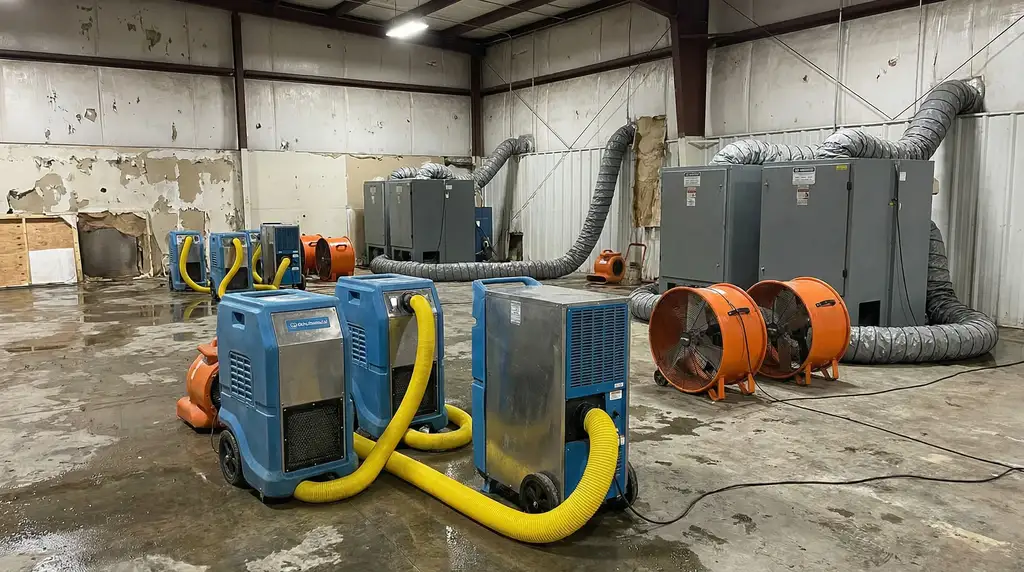
Frozen pipes: the owner's duty and the plumber's repair
Grease and wipes block more city pipes than any storm. What a building pours and flushes is part of its flood risk, and kitchens should hear that plainly before commercial water damage restoration NYC teaches it expensively.
Winter writes its own chapter in this city. The rule the city's guidance states is simple: the owner is responsible for protecting the building's pipes and meters from freezing. When protection fails and a pipe bursts, the sequence is stop the water, then repair by the right hands: a burst service line is the work of a licensed master plumber, not of the drying crew, whose job begins once the water is off. Frozen pipe claims attract a particular argument, because insurers ask whether the building was heated and its pipes protected, and the answers live in records: heating arrangements, occupancy dates, the photographs of insulation or its absence. A building that closes for a winter break without draining down or maintaining heat has made a decision, whether it knew it or not, and the claim will be read in that light. Protect the pipes, keep the heating records, and the argument never starts.
Sprinklers and standpipes: the building's own water
Protect the pipes and keep the heating records. A frozen pipe claim is an argument about care, and records are how care is proven when commercial water damage restoration NYC follows a burst.
The third system is the building's own fire protection, and it fails in the building's own ways: a head struck by stock or a ladder, a fitting corroded through, a line frozen in an unheated shaft, a discharge after a real fire elsewhere. Two facts from earlier sections meet here. The building department counts repairs to standpipe and sprinkler parts among its examples of emergency work, so the repair route is the emergency route. And sprinkler leakage is a named peril in the state's description of the basic commercial property form, so the coverage conversation starts from firmer ground than most. What decides the size of these losses is almost always time to the valve. Every commercial tenant should know where the sprinkler shutoffs for their floor are, and every landlord should be able to answer for them at midnight. Ask both questions this week, while the answer is still free.
Know your floor's sprinkler shutoffs and be able to reach the landlord at midnight. In a sprinkler loss, time to the valve is the size of the commercial water damage restoration NYC claim.
Choosing and checking
Judging the Best, Reading Reviews and Spotting Red Flags
Every commercial page on the internet claims to be the best, and the searches recorded during this page's research show why: businesses search for this service with the word best attached, and with the word reviews attached, in numbers large enough to bend what gets written. This section refuses the easy version of both words. There is no official ranking of restoration companies, and this page will not invent one, for itself or for anyone else. What it offers instead is a method: how best can honestly be judged, how reviews can honestly be read, and which red flags, gathered from bad weeks across this trade, should end a hiring conversation on the spot.
Best is a verdict, not a slogan. It is earned on your job, with licences checked, a scope in writing and logs on the table, and that is the only sense of best commercial water damage restoration NYC honours.
How best is judged
Judge the word the way this page judges everything: by evidence you can test yourself. A phone answered by a person, around the clock, who asks about the source, the rooms and the safety before asking for the insurer's name. A written scope before heavy work, naming what will be extracted, dried, cleaned and removed, area by area. A moisture map and daily drying logs promised in writing, and then actually shared. Technicians whose IICRC certification can be looked up by name. Licence positions for mold work stated plainly, with the assessor and the remediator separate, as the law requires. References from other businesses, of your kind and your scale, that you are free to call. A firm that passes those tests in your building, on your job, has earned the word best in the only sense that will matter in six months. A firm that asks you to take the word on trust has asked you to skip the judging, and the skipping is the tell.
Read reviews for the details that are hard to fake: premises, cause, speed, readings shared, trading protected. Stars are the headline; details are the article, for commercial water damage restoration NYC as for anything.
How reviews should be read
Reviews are evidence, but they are evidence of a particular kind: unsworn, uneven and written by people whose losses were not your loss. Read them the way an adjuster reads a file, for the details that are hard to fake. A useful review names the kind of premises, the cause of the water, how fast the crew arrived, whether readings and logs were shared, how the work fitted around trading, and how the insurer and the landlord were handled. A useless review, however many stars sit on it, could be pasted under any company in any trade. Read the poor reviews too, and weigh the company's answers to them; a firm that replies to criticism with facts is showing you its paperwork habits in public. And hold the whole exercise in proportion: reviews inform the shortlist. The scope, the licences and the logs decide the hire.
Repair rebuilds, restoration mitigates, and the border between them is a set of final readings. Hire both halves knowingly and commercial water damage restoration NYC has no gaps.
Repair contractors and restoration companies
One neighbouring search deserves its own answer because the confusion behind it is real: the search for water damage repair contractors. Repair and restoration are the two halves of a loss. The restoration company mitigates: extraction, drying, cleaning, removal of what cannot be saved, and documentation for the insurer. The repair contractor rebuilds: drywall, flooring, ceilings, cabinetry and finishes, usually under the permits the rebuild requires. Some firms do both halves; many restoration companies coordinate the rebuild or hand over to contractors they work with. The order between the halves is not negotiable. Rebuilding over a structure that has not been proven dry seals moisture into new work and buys the whole problem twice. When you hire, ask which half the firm covers, who covers the other, and what document, the final drying readings, will mark the border between them.
One flag is a question. Three flags together are an answer, and the answer is to call the next firm on the list for your commercial water damage restoration NYC.
Red flags in a commercial hire
- A figure quoted before inspection, offered as if it were information.
- No written scope, or a scope that will be written after the work starts.
- Drying promised without a moisture map or daily readings.
- One firm offering to assess and remediate the same mold on the same property.
- Pressure to sign tonight, before the insurer or the landlord can be consulted.
- The whole rebuild described as minor work that needs no permits.
- Safety questions brushed aside, or protective equipment treated as the workers' own problem.
- A promise that mold will never grow, which no honest firm can make.
Speed earns the interview, never the job. The checks take the same hour as the first call, and a serious firm in commercial water damage restoration NYC expects them.
One flag deserves a sentence of its own, because it hides inside a virtue. Speed is the first thing a flooded business wants, and the first thing a poor firm sells. A fast answer earns a company the interview; it does not excuse it from the other questions. The licences, the scope and the logs can all be checked in the same hour as the first call, while the crew is on the road, and a serious firm expects exactly that. Urgency and diligence are not enemies. In a well run commercial hire they happen at the same time, and a firm that treats your diligence as an inconvenience has graded its own homework for you.
Prevention
The Preventive Walk: One Hour a Month That Saves a Business
Everything on this page so far has been about the day the water comes. This section is about the eleven months when it does not, because most commercial losses are not acts of God. They are maintenance debts coming due: the drain nobody cleared, the valve nobody exercised, the stain nobody reported, the shutoff nobody could find. A building manager or an owner who walks the premises once a month with a short list will catch most of them while they are still cheap. Commercial water damage restoration NYC begins, on the good jobs, a year before the flood, in a plant room, with a torch and a notebook.
Most commercial losses are maintenance debts coming due. The monthly walk is how a business pays them while they are still small, long before commercial water damage restoration NYC is a phone call.
Water you can see coming
Start where water lives. In the plant room, look at the water heater, the pumps and the pipe runs for the green and white crust that marks a slow leak, and put a hand on the floor for damp that eyes miss. Under sinks and behind fixtures in washrooms, look for swollen board and dark rings. In the ceiling, read the tiles: a brown stain is a written report from the floor above, and it should be answered like one, by finding the source rather than painting the tile. On the roof, clear the drains and look at the seams, because ponding water is a flood in rehearsal. In the basement, check the lowest fixtures and ask when the drains were last tested. None of this needs a tradesman. It needs a person who treats a stain as a sentence in a language the building speaks.
A stain is a sentence in a language the building speaks. Answer it by finding the source, never by painting over the words, and commercial water damage restoration NYC stays a story about somebody else.
Valves, shutoffs and the midnight test
The second part of the walk is about the day itself. Find every shutoff that serves your premises: the unit valves, the fixture valves, the sprinkler controls for your floor, and the route to the building riser. Label them. Then apply the midnight test: could a member of your staff, alone, at 2 a.m., in a panic, find the right valve and close it? If the honest answer is no, the walk has found its most valuable item. Write the valve map on the same card as the insurer's number and the restoration number, and keep the card where the night staff actually are. In commercial water damage restoration NYC, the difference between a bad morning and a bad month is very often one valve, closed one hour earlier.
The midnight test is the standard: a valve that cannot be found at 2 a.m. by the person on shift does not exist, for practical purposes, when commercial water damage restoration NYC is needed.
Paper that should exist before it is needed
The third part of the walk is paper, and it is the part businesses skip because paper feels like administration rather than protection. Confirm that the lease is reachable and that somebody has read its repair and notice clauses this year. Confirm the policy's form name, and whether the sewer backup endorsement is on it, in writing from the broker. Confirm the interruption records are being kept in the ordinary course of business, because they cannot be invented afterwards. Photograph the premises as they are, room by room, stock in place, equipment in place, on an ordinary day. Those photographs, dull as they seem, are the before pictures every claim wishes it had, and they cost one walk with a phone.
Before photographs of an ordinary day are the pictures every claim wishes it had. Take them on a dull afternoon and file them with the policy that stands behind commercial water damage restoration NYC.
- Plant room: crust, damp floors, pump condition, heater age noted.
- Washrooms and kitchens: under sink boards, fixture seals, floor edges.
- Ceilings: every stain answered with a source, never with paint alone.
- Roof: drains clear, seams sound, ponding marks noted after rain.
- Basement: lowest fixtures, drain history, backwater protection asked about.
- Valves: found, labelled, and findable by night staff under the midnight test.
- Paper: lease read, policy form confirmed, sewer endorsement answered in writing.
- Photographs: the whole premises, ordinary day, filed with the insurance papers.
Close the walk by writing it down: date, findings, actions, owners. A walk that lives in memory protects nothing, because the person who remembers leaves, and the building stays. Kept monthly, the log becomes something more than a checklist. It becomes evidence of a maintained building, which is a sentence insurers, landlords and buyers all read with respect, and it becomes the first exhibit in any argument about whether a loss was fate or neglect. One hour a month is the whole price. Set against a single avoided flood, or a single claim that runs smoothly because the paper existed, it is the cheapest hour in the building's year.
Praise the person who reports the smell, the stain, the slow drain. Early warnings are a culture before they are a system, and they are the cheapest defence against commercial water damage restoration NYC there is.
There is a cultural point underneath the checklist, and managers who run good buildings make it deliberately. Staff report water early when reporting water is praised. The cleaner who mentions a musty smell, the cook who flags a slow drain, the security guard who notices a stain growing: these people are the building's early warning system, and they work only if the last person who reported something was thanked rather than blamed for the cost of what they found. Build that habit and the preventive walk stops being one person's hour. It becomes the whole building, watching its own pipes, which is the only watch that never sleeps.
Scope and records
The Written Scope and the Records File
Two documents decide how a commercial loss ends: the scope written before the work, and the file assembled during it. Everything else, the drying, the claim, the interruption, the reopening, is built on those two. This closing section of the guide gathers what each should contain, drawing together threads from the whole page, so that a business can hold any firm, including the one behind this page, to a single visible standard. Commercial water damage restoration NYC is, in the end, a paperwork discipline with machines attached, and this is the paperwork.
The scope promises; the file proves. A loss with both documents written properly has very few arguments left in it, which is the quiet goal of commercial water damage restoration NYC.
What the scope must say
A complete written scope names the source of the water and confirms it is stopped. It lists each room or zone affected and states, for each, what will be extracted, dried, cleaned or removed. It places the equipment on the moisture map and promises readings at named points, daily, shared with you as drying logs. It states how stock, equipment and records will be protected or moved, which parts of the premises can trade and which cannot, and what documentation the insurer will receive. One competitor in this market compresses its whole promise into a sentence worth borrowing as a standard: the scope it writes is the scope it bills. Hold every firm to that sentence. If work is not in the scope, ask why not, and get the answer in writing before the work begins.
If it is not in the scope, ask why not, in writing, before the work begins. That single habit prevents most of the disputes commercial water damage restoration NYC is known for.
What the file must hold
The claim file is the scope's partner: where the scope promises, the file proves. Photographs and film from before anything moved, and at the same points each day. The signed scope and agreement. The moisture map and the daily logs, ending in the final readings that prove dry. Invoices, licences and certificates you verified. The claim number and every letter the insurer sends, including any written demand for more time, with its reasons. The dated record of closure and partial trading. The interruption evidence the financial regulator names: detailed financial records, extra expenses, the accountant's statements and the tax returns. The lease and the landlord correspondence. The permit papers for the rebuild. Assembled in one place, that file answers every question a commercial loss can ask, from every direction it can be asked.
Final readings are the dullest page in the file and the most valuable. Keep them with the building's papers, not the business's clutter, after commercial water damage restoration NYC ends.
Water in your business now?
Call (212) 555-0147 and ask for the first hour to be run the way this page describes it: safety, source, stock, photographs, a written scope and daily drying logs from the first day.
Keep the file after the claim closes, and keep it with the building's papers rather than the business's clutter. A commercial building outlives its tenants, its managers and its claims. The file is the building's water history: what failed, where the water went, how it was dried, who rebuilt it and under what permits. The next owner, the next tenant, the next adjuster and the next crew will all start from that history if it exists, and from rumour if it does not. Businesses spend real money creating this record and then throw it away in a clear out. Do not. The most valuable page in the file, years later, is usually the dullest one: the final drying readings, proving that once, in a bad month, the building was dried properly and someone wrote it down.
Stop the water, prove the loss, dry by numbers, paper everything. Four lines, and the whole method of commercial water damage restoration NYC fits on the card by the shutoff key.
That is the whole discipline, and it is not complicated, which is precisely why it works. Stop the water. Prove the loss. Dry by numbers. Paper everything. A business that holds those four lines through a flood will come out of it with a building that is dry, a claim that is documented and a trading record that can be defended. The rest of this page, the questions, the videos and the links to the other forty three pages of this site, exists to fill in the detail. The four lines are the detail's skeleton, and they will fit on the card by the shutoff key where they belong.
After the reopening
After the Doors Open: The First Month Back
The day the equipment leaves feels like the end of the story, and for the building it nearly is. For the business it is the start of a quieter month in which the flood finishes happening on paper. The claim is still open. The interruption figures are still being assembled. The rebuild may still be waiting on permits or materials. And the premises, dried and proven dry, have to be watched with a lighter but real attention, because the first month back is when the last surprises, a smell in a warm room, a stain returning on a painted wall, announce themselves while they are still small enough to be somebody else's problem under warranty and record.
The first month back is the flood finishing on paper. Keep the file open, watch the rooms, and let the record close the loss properly.
Keep the drying file open on the desk, literally or digitally, for that month. If a smell develops, the first call is to the restoration firm, and the first document consulted is the final readings: if the building was proven dry at those points, new moisture means a new event, and the hunt starts again at the sources. If a stain returns, photograph it against the earlier photographs at the same spot, which exist because this page insisted on them. The discipline of the first month is the discipline of the first hour at a slower tempo: observe, record, compare against the file. Businesses that do this close their floods completely. Businesses that declare the flood over on reopening day sometimes meet it again in the spring.
The claim's tail deserves the same order. Submit the interruption figures while the closure is still easy to evidence, chase the undisputed parts if they have not moved, and answer the insurer's questions from the file rather than from memory. If a deadline in the regulations is approaching without a decision, say so in writing, politely, with the dates attached; the clocks section of this page exists so that sentence can be written accurately. When the final payment arrives, reconcile it against the scope and the invoices line by line before signing anything that closes the claim, and keep the whole bundle afterwards. A closed claim with a complete file is an asset. A closed claim with a scattered file is a rumour.
A returning smell or stain is a question for the file first and the phone second. The final readings decide whether you are looking at an old loss or a new one.
Finally, spend one hour, no more, turning the loss into the building's memory. Update the valve map with anything the flood taught you. File the photographs, the scope, the logs and the permits together, where the next manager will find them. Note what you would do in the first hour next time, while you still remember what you actually did. Then go back to trading, which was the point of every page of this guide. A flood survived well leaves two things behind: a dry building, and a business that is measurably harder to flood the second time. The second of those is worth more than the first, and it costs exactly one honest hour.
Write down what the flood taught the building while the lesson is fresh. That single page is the cheapest improvement commercial water damage restoration NYC can leave behind.
Case studies
Two Case Studies on Video, Labelled for Exactly What They Are
This page links to two videos and embeds neither of them. Both are watched on YouTube, in a new tab, and both are labelled here with the same care this page applies to scopes and licences, because a page about evidence should show its own working. Neither video was made in New York. Neither shows this site's crews. What they offer is narrower and genuinely useful: two real commercial losses, filmed by the firms that dried them, against which the method taught on this page can be tested. Watch them with the six steps in mind and notice what the cameras show and what they leave out.
Watch the gym film for the category lesson: contaminated water changes everything about method, protection and pace in commercial water damage restoration NYC.
The first video is by Incredible Restorations, titled BLACK WATER, the film of a full gym restoration (its full title adds: Full Gym Affected!!), published on July 30, 2020, running seven minutes and two seconds, and viewed about twenty thousand six hundred and two times at the time of research. It follows a flooded gym, a full commercial premises, where the water came from a drain stack backup and was black water, the most contaminated category of loss. That is its value to a business reader: most commercial films show clean water and quick drying, while this one shows the unglamorous end of the trade, contaminated water in a trading business, with the protection, removal and cleaning that category demands. Read against this page, it is the causes section and the safety section with the sound on: the category of the water decided the method, and the method was protection first.
The second video is by a SERVPRO franchise in Texas, SERVPRO of Lake Travis and NW Austin, titled Commercial Water Damage Cleanup & Restoration, published on January 12, 2021, running one minute, with twenty six views at the time of research. It is a silent montage of a flooded office being cleaned and restored. And here this page must be as honest about a video as it has been about everything else: the film has no captions and no transcript, so nothing in it can be quoted, checked or learned from except the pictures themselves. It is included because the pictures do show the shape of an office job, the extraction, the equipment and the cleared floor, and because naming its limits plainly is the same discipline as naming the limits of a scope. A one minute montage is a postcard, not a case study, and it is labelled as one.
Watch the office montage for the shape of a job, and for the questions a sixty second film cannot answer. The questions are the lesson commercial water damage restoration NYC keeps teaching.
- Watch: BLACK WATER, the flooded gym film, Incredible Restorations, July 30 2020, 7:02 (linked below).
- Watch: Commercial Water Damage Cleanup & Restoration, SERVPRO of Lake Travis and NW Austin, January 12 2021, 1:00, silent montage with no transcript (linked below).
- BLACK WATER, the flooded gym film (Incredible Restorations, YouTube)
- Commercial Water Damage Cleanup & Restoration (SERVPRO of Lake Travis and NW Austin, YouTube)
Neither film is evidence about your building. Both are training in what a full record looks like, and in how thin a thin one is, which is the judgement commercial water damage restoration NYC runs on.
Two videos were the limit this page set itself, and the limit is deliberate. A page that embeds a wall of other people's films is borrowing authority it has not earned. These two earn their place for opposite reasons: the gym film because it shows the hardest category of commercial loss handled as a process, and the office montage because its very thinness teaches the reader to ask what a fuller record would look like. That question, what would the full record show, is the question this entire page trains a business to ask: of a video, of a scope, of a review and of a claim. Ask it everywhere and the water, when it comes, will find you harder to hurt.
Questions and answers
Thirty Questions Businesses Ask, Answered From the Verified Facts
Every answer below is drawn from the sources this page was researched against: the Department of Financial Services on coverage and interruption, Regulation 64 and section 2618 of the Insurance Law on claim clocks, the Department of Buildings on permits, Article 32 of the Labor Law on mold, the federal safety rules on cleanup work, and the Department of Environmental Protection on sewer backups. Where the sources disagree, the answer says so instead of picking one. Where a figure would be a cost, there is none, because this site gives no prices and judges companies on scopes instead. Search the thirty questions with the box, or read them in order; they follow the shape of a loss, from the first hour to the final file.
What does commercial water damage restoration NYC mean?
It means the emergency trade that gets a flooded business dry, clean and safe to reopen. When water enters an office, a shop, a restaurant, a hotel or a warehouse in New York City, the work runs in a set order: stop the source, extract the standing water, map the moisture, dry the structure with air movers and dehumidifiers, clean what the water touched, and document every step for the insurer and the landlord. The word commercial matters because the stakes differ from a home. Stock, equipment, trading hours and staff safety are all in the room, and every closed day is lost income. The phrase covers the whole job, from the first call to the doors opening again.
What should I do first when water floods my office or shop in NYC?
Start with safety and the source. If water is near anything electrical, keep people away from it and treat the area as unsafe until it is checked. If you can reach the shutoff safely, close the water at the main or at the fixture. Move stock, records and equipment out of the wet area if that can be done without standing in the water. Then make three calls: to a restoration company so extraction and drying can start, to your insurer to open the claim, and to your landlord or building management, because in a commercial building the source is often above or beside you. Photograph everything before anything else is moved, and keep photographing as the work proceeds.
Who do I call first, the restoration company, my insurer, or my landlord?
Call all three, and quickly, but understand what each call does. The restoration company stops the damage growing: extraction and drying are time work, and every hour of standing water spreads the loss. The insurer opens the claim and starts the clocks that New York law sets for deciding and paying it, and your policy will expect prompt notice. The landlord or building manager controls the parts of the building you do not: the risers, the roof, the unit above and the shutoffs you cannot reach. In practice, make the calls in that order on the same morning. A business that waits for permission before drying usually ends up with a bigger loss and a harder argument about it.
Our office flooded from above and we have no insurance. What do we do first?
Do the same first things, because they protect you whether or not a policy exists. Stop the water if you safely can, or get building management to stop it at the riser. Get the water extracted and the space dried anyway: leaving a unit wet invites mold, damages the structure and can make you responsible for harm spreading to neighbours. Photograph everything, keep every invoice, and write down when the water was found and what was said by whom. Water that came from above usually began in someone else's space or in the building's own systems, so the written record is what any later conversation with the landlord, the neighbour or their insurers will stand on. This question is asked often by small businesses, and the honest answer is that drying first and arguing second is almost always the cheaper order.
Our office flooded. What is the landlord responsible for?
In a commercial lease, the written agreement governs almost everything, and there is no statute that makes a commercial landlord repair the premises or provide heat and hot water the way residential law does. As a rule of thumb drawn from standard commercial leases, the landlord typically carries the structure: the roof, the exterior walls, the foundations, the columns, beams and slabs, the subflooring and the footings. The tenant typically carries the interior: non structural work inside the unit, the heating and cooling equipment that serves only that unit, and the plumbing and electrical runs inside the premises. The landlord provides only the utilities and services the lease expressly promises. Read your own lease before assuming either list, because the lease, not habit, decides.
Does a standard commercial property policy cover water damage in New York?
It depends on which form the policy is written on, and the Department of Financial Services sets out the difference. A Basic Form policy covers a short list of perils, and for water it reaches sprinkler leakage. A Broad Form policy adds more, including water damage from the accidental discharge or leakage of water or steam from a system or appliance that has cracked or broken. What neither standard form does is cover everything wet. Sewer backup needs its own endorsement, and flood is outside the standard forms altogether. The practical lesson is to read the form name on your own policy before a loss, not after one, because the same burst pipe can be a covered event on one form and a much smaller claim on another.
Does commercial insurance cover sprinkler leakage?
Yes. Sprinkler leakage is one of the water perils named in the Department of Financial Services description of the Basic Form, which is the narrower of the standard commercial property forms. That matters in New York City, where so many commercial buildings are sprinklered and where a single damaged head or a failed fitting can release a great deal of water very quickly. Coverage for the leakage is not the same as coverage for everything that follows, though. The drying, the damaged stock and any interruption to trading each stand on their own parts of the policy. Photograph the failed part if it is safe to do so, keep it if your insurer asks, and make sure the restoration paperwork names the sprinkler as the source, because the source is what the coverage turns on.
Is sewer backup covered under a commercial property policy?
Not under the standard forms on their own. The Department of Financial Services is plain about it: coverage for sewer backup is not part of the standard commercial property forms and is bought as an endorsement, and that endorsement is not available with the Basic Form. This catches businesses out, because a sewer backup is one of the dirtiest and most disruptive losses a ground floor or basement business can suffer, and it arrives looking exactly like the burst pipe losses that are covered. If your premises sit at or below street level, or your building has a history of drain trouble, check for the endorsement by name and keep the answer in your file. A restoration crew can clean a backup either way. Whether anyone pays for it is decided by that one line in the policy.
Is flood damage covered under a commercial property policy?
No. Flood is not covered under a standard commercial property policy, and the Department of Financial Services directs businesses to flood insurance instead, which is a separate purchase, most often through the National Flood Insurance Program. The distinction that decides claims is the source of the water. Water that escapes from a pipe, a sprinkler or an appliance inside the building is one kind of event. Water that rises from outside, from storm water, overwhelmed drains or a swollen waterway entering at ground level, is flood, and it belongs to the flood policy if you hold one and to nobody if you do not. After any storm loss, the restoration records should state plainly where the water came from and how it entered, because that sentence will be read closely by two different insurers.
What is business interruption coverage and what proof does my business need?
Business interruption coverage is the part of a commercial policy that responds when a covered loss closes or restricts your business. According to the Department of Financial Services, it covers loss of income or profits, worked out from your financial records, together with the operating expenses that continue while you are closed or reduced. The proof is paperwork, and the department names it: detailed financial records, the extra expenses you incurred, statements from your accountant and your tax returns. That list is why this page keeps returning to records. A business that can hand over clean books, a dated closure record and the restoration logs can prove an interruption claim. A business reconstructing its income from memory, months later, usually cannot.
How long does the insurer have to accept or reject a commercial water damage claim in New York?
New York's Regulation 64, at section 216.6(c), gives the insurer fifteen business days to accept or reject the claim after proof of loss. The text of the regulation draws no line between commercial and residential claims, and this page asserts no commercial exception, because none was found in the text. If the insurer needs more time, it must say so in writing and give its reasons, and a claim left unresolved must be updated as the regulation requires. Two companion rules matter alongside the clock. Where coverage is not in dispute, the insurer must make a fair and reasonable offer, and parts of a claim that are not in dispute must be paid even while other parts are argued. Keep the date you submitted proof of loss in your file; the clock runs from it.
How long does the insurer have to pay a commercial claim once it is agreed?
Five business days. Regulation 64, at section 216.6(f), requires the insurer to pay within five business days once the claim is agreed. The same regulation protects the undisputed parts of a claim along the way: under section 216.6(e), elements that are not in dispute must be paid even while the rest is still being argued, so a large claim should not sit entirely frozen behind one contested line. After a declared disaster, a different and shorter payment clock can apply under section 2618 of the Insurance Law, which the next answer covers. In ordinary times, hold the two numbers together: fifteen business days to accept or reject after proof of loss, five business days to pay after agreement.
What is different about commercial claims after a declared disaster in New York?
Section 2618 of the Insurance Law applies only to claims arising from a declared disaster, and it treats commercial claims differently from household ones. For a commercial claim, the insurer works to fifteen business days, and if it needs longer it may take a one time extension of thirty business days, given in writing with reasons. After that, notice must be given every thirty business days while the claim remains open. For a non commercial claim the matching extension is fifteen days, which is why summaries that quote a single extension figure are incomplete. Once a claim is accepted, section 2618 requires payment within four business days. The lesson for a business is practical: after a declared disaster your claim runs on written notices and shorter payment clocks, and the firm drying your premises should document as if those clocks were ticking, because they are.
Do I need a DOB permit for commercial repairs after water damage in NYC?
Often, yes. Most construction work in New York City needs approval and permits from the Department of Buildings before it proceeds, and rebuilding after water damage is construction work once it goes beyond drying. There is a recognised list of minor work that does not need a permit, which includes painting, plastering, hanging cabinets, replacing plumbing fixtures, resurfacing floors and non structural roof repair. Drying itself, the extraction, the air movers and the dehumidifiers, is not construction. Opening walls, replacing systems and rebuilding usually is. Genuine emergency work has its own route, covered in the next answer. Ask the firm doing your repairs which permits the rebuild needs, then confirm the answer with the department rather than taking any contractor's word for it.
What is an Emergency Work Notification?
It is the filing that accompanies the emergency route in the city's building rules. Section 28-105.4.1 of the Administrative Code recognises that genuine emergency work, the kind a burst pipe or a failed sprinkler demands, cannot always wait for a permit to be issued before it begins, and the Department of Buildings' own examples of emergency work include repairs to standpipe and sprinkler parts. What this page will not do is state a filing deadline for the notification, because the published wordings disagree with each other: the city's public guidance and the code text as published in a mirror of the code do not say the same thing about when the clock runs. Rather than print one wording as the rule, this page states no deadline. Ask the Department of Buildings directly for your job, and keep the answer with your permits.
Does New York mold licensing apply to commercial buildings?
Yes. Article 32 of the Labor Law is not a housing law; it applies to mold work on commercial premises as well as homes. Under section 930(6), a mold project means work on an area greater than ten square feet. Under section 931, the people who assess and remediate mold for others must hold Department of Labor licences of the right type. So a shop, an office or a warehouse with growth beyond that small threshold is inside the same licensing system as an apartment, and the firm offering to clean it should be able to show the licence position for the people doing the work. Local Law 55 and Local Law 61, which tenants often hear about, are a separate matter and are covered two answers down.
Can the same company assess the mold and clean it up in my building?
No, and New York law says so in a single sentence. Article 32, section 936, states: "No licensee shall perform both mold assessment and mold remediation on the same property." The reason is the same in a commercial building as in a home: the person who measures the problem should have no financial reason to make it larger or smaller. In practice this means two separate licensed parties on a commercial mold job, one assessing and writing the work plan, the other remediating to it, with a post remediation assessment afterwards. If one firm offers to assess your building's mold and then to remediate it on the same property, that offer is itself the answer to whether you should hire them for either role.
Can a commercial property owner do mold work on their own building without a licence?
Within limits, yes. Section 933(3) of Article 32 exempts a commercial property owner, the owner's managing agent, and a full time employee of the owner or the managing agent, when the work is done on property the owner owns or manages. The Department of Labor's own guidance speaks the same way about owners working on their own properties. There is an important edge to the exemption: it does not cover a business that is in the mold business for the public, and it does not turn an unlicensed contractor you hire into an exempt person. The exemption belongs to the owner working on the owner's own building. The moment the work is done for someone else, for pay, the licensing requirement returns in full.
Do Local Law 55 and Local Law 61 apply to commercial buildings in NYC?
No. Local Law 55 and Local Law 61 are residential laws. They sit in the city's housing framework and are administered for homes, and the housing department's own material treats them that way. A commercial tenant or owner who is told that these laws set the mold duties for an office, a shop or a warehouse is being given the wrong map. Commercial premises are governed instead by the lease between the parties and by state law, including Article 32 of the Labor Law where licensed mold work is concerned, and by workplace safety rules where employees are concerned. Knowing which body of law actually applies to your building is not a technicality. It decides who you call, what you can demand and which deadlines, if any, exist.
What safety rules protect workers during commercial water damage cleanup?
The federal workplace safety framework, administered by OSHA, and it starts with the employer's duties rather than the worker's gear. An employer must assess the workplace for hazards, provide the protective equipment the work requires at no cost to the employee, and train the people doing the work. Behind the specific rules stands the General Duty Clause, section 5(a)(1) of the Occupational Safety and Health Act, which requires employers to keep workplaces free of recognised hazards. Flood cleanup has a known hazard list: electrical dangers in wet buildings, debris, mold exposure and carbon monoxide from engines and generators run in the wrong places. A restoration firm working in your premises should be able to explain its assessment and its equipment in those terms, because its duties to its crew apply inside your building too.
What PPE must workers wear during commercial flood cleanup?
The equipment the hazard assessment calls for, provided by the employer at no cost to the employee. That no cost rule is written into the federal standard at 29 CFR 1910.132, and it is a useful test of a firm's seriousness: protective equipment is the employer's purchase, never a charge passed to the worker. Where respirators are used, and moldy or sewage affected work is where they appear, the rules require more than handing out masks. Fit testing and medical examinations are part of the respirator requirements, because a respirator that does not fit its wearer is decoration. When you watch a crew work in your building, gloves, eye protection, suitable footwear and, where the water or the growth demands it, properly fitted respirators are what a compliant job looks like.
Are water damage categories an OSHA rule?
No. The categories used to describe water, from clean water through to the most contaminated class, come from the IICRC, the industry's own standards body, and are set out in its S500 and S520 standards. OSHA's own mold guidance lists those standards under a heading of other resources and adds the note in terms: "These are NOT OSHA regulations." The distinction matters when a firm explains its methods. A crew may properly say it works to the IICRC standards, and that is a real claim about training and method. What it may not honestly say is that the categories are a government rule or an OSHA requirement. This page has not reproduced the standards' internal tables, which are paid professional texts, but the boundary between industry standard and law is free to state and worth knowing.
What causes water damage in NYC commercial buildings?
The same short list appears again and again in city buildings. Plumbing fails: supply lines, drain stacks and ageing joints let go, often in the unit above. Sprinkler and standpipe systems fail or discharge. Flat roofs pond water until a seam or a drain gives way and the top floor wears the result. Heating and cooling equipment leaks, from rooftop units to fan coils. Sewers back up into ground floor and basement premises. Storms drive flash flooding through doorways and loading bays. Fire suppression discharges after an incident elsewhere in the building. And in winter, unprotected pipes freeze and burst. The pattern to notice is that most commercial losses arrive from inside the building or from the floor above, which is why the first questions on any commercial job are about risers, shutoffs and neighbours, not about the weather.
What does DEP do when a sewer backs up into a business?
Call 311 straight away. The city's environmental protection department, DEP, responds to sewer backup reports, and its published guidance for property owners says an inspection follows within six hours of the report. The boundary of responsibility is the cause. If the problem is in the city's sewer, the city repairs it. If the cause is in the private line serving your building, that line is the owner's responsibility. A claim to the city goes through the Comptroller and must be filed within ninety days. DEP also publishes the scale of the system it runs: about seven thousand five hundred miles of sewer lines and about one hundred forty eight thousand catch basins, and it names the most common cause of blockages as pipes choked with grease and wipes. One honest limit: the department's guidance is written for property owners generally, and no commercial specific sewer rule was found in it, so this page reports the general rule as the general rule.
What happens if a pipe freezes and bursts in my commercial building?
The repair begins with the same truth as the prevention: the owner is responsible for protecting the building's pipes and meters from freezing, and a burst service line is repaired by a licensed master plumber. Stop the water at the main if you can do it safely, because a burst pipe in a heated building can release water at mains pressure for as long as it runs. Then treat the loss like any other commercial flood: extract, map, dry and document, and tell your insurer and your landlord promptly. Frozen pipe claims are argued over more than most, because insurers ask whether the building was heated and the pipes protected. Your records answer that argument: heating records, the dates the building was occupied or closed, and photographs of the failed pipe all belong in the claim file from the first day.
How do I judge the best commercial water damage restoration company in NYC?
Judge it the way this page judges everything: by evidence you can test, because there is no official ranking of restoration companies and this page will not invent one. The word best is searched for often, and research for this page found it attached to this very service in the city's related searches, which is why so many pages claim it and so few define it. Testable evidence looks like this: a phone answered by a person around the clock, a written scope before heavy work, a moisture map and daily drying logs promised in writing, technicians whose IICRC certification can be looked up, licence positions stated plainly for any mold work, and references from other businesses you can actually call. The best company for your building is the one that passes those tests on your job, in your borough, with paperwork in your hand.
How should I read reviews for a commercial water damage restoration company in NYC?
Read them for detail, not for stars. A review that names the kind of premises, the cause of the water, how fast the crew arrived, whether readings and logs were shared and how the insurer was handled is evidence. A row of short, glowing, interchangeable reviews is decoration. Look for the commercial pattern specifically: did the firm work around trading hours, protect stock, keep the business partly open where it was safe, and communicate with a landlord or a building manager as well as the tenant? Read the poor reviews with the same care, and note how the company answered them. Searchers look for reviews of this service in this city in large numbers; the related searches recorded during this page's research put reviews alongside the service name itself. What those searchers need is not a higher star count. It is the habit of reading past it.
Who are water damage repair contractors and how do they differ from a restoration company?
They are the rebuild side of the same loss. A restoration company mitigates: it extracts the water, dries the structure, cleans and sanitises what was affected, removes what cannot be saved and documents the whole job for the insurer. A repair contractor rebuilds: replacing damaged drywall, flooring, cabinetry, ceilings and finishes, and doing the permitted construction work that puts the premises back together. Some firms do both, and many restoration companies coordinate the rebuild or hand over to contractors they work with. The distinction matters for two practical reasons. The drying must finish and be proven dry before the rebuilding covers it, or moisture is sealed into the new work. And the rebuild is where building permits usually enter the picture. When you hire, ask plainly which side of that line the firm covers, and who does the other side.
What should a written scope of work include before commercial restoration starts?
It should describe the whole job in writing, area by area, before the heavy work begins. Look for: the source of the water and confirmation it is stopped; each room or zone affected and what will be extracted, dried, cleaned or removed in it; the equipment to be placed and where; a moisture map drawn at the start, with readings at named points; a promise of daily readings and drying logs, shared with you; how stock, equipment and records will be protected or moved; the parts of the premises that can stay open and the parts that cannot; and the documentation the insurer will receive. One competitor in this market puts its whole promise in a single sentence, that the scope it writes is the scope it bills. Hold every firm to that standard, including this one: if it is not in the scope, ask why not, in writing.
What records should I keep for a commercial water damage insurance claim?
Keep the whole file, because a commercial claim is proven on paper twice over: once for the damage, and once for the interruption. The file should hold photographs and video from before anything was moved and throughout the work; the written scope and the signed agreement; the moisture map and the daily drying logs; the restoration company's invoices and any licences or certificates you verified; your claim number and every letter and email the insurer sends; the dates and hours your business was closed or restricted; and, for the interruption side, the financial records the Department of Financial Services names, meaning detailed records, the extra expenses you incurred, your accountant's statements and your tax returns. Add your lease and any landlord correspondence, and your permit papers for the rebuild. Keep the file after the claim closes. It is your building's water history, and the next adjuster, buyer or crew who reads it will start from facts instead of memory.
All pages on this site
All Fifty-Six Pages, in One Place
This page is the forty-fourth page of this site. The forty-three pages that came before it, together with this one, are the whole of it: the home page, the borough and city pages, the region pages, and the topic pages on process, claims, hidden water, fire, flood, mold and extraction. Each was researched and built on its own, with its own keyword, its own headings and its own Schema.
Water Damage Restoration New York
The home page of this site: the full guide for the main New York search, with the boroughs, the services and the claim help gathered in one place.
Water Damage Restoration Brooklyn
Borough coverage for Brooklyn homes, brownstones and basements, from Park Slope to Williamsburg.
Water Damage Restoration Queens
Borough coverage for Queens, from Astoria and Long Island City to Flushing and Jamaica.
Water Damage Restoration Bronx
Borough coverage for the Bronx, including Riverdale and the Grand Concourse apartment stock.
Water Damage Restoration Staten Island
Borough coverage for Staten Island homes, where detached houses and storm water shape the work.
Water Damage Restoration Long Island
Coverage for Long Island homes and the commuter belt east of the city line.
Water Damage Restoration Manhattan
Borough coverage for Manhattan towers, co-ops and pre war apartments, Harlem to the Upper West and Upper East Sides.
Water Damage Insurance Claim New York
The claim page: how New York water claims are documented, filed and defended, event by event.
Water Damage Behind Walls NYC
The hidden water page: finding moisture inside walls and floors before it turns into mold and rot.
Fire Damage Restoration NYC
Fire recovery in the city: smoke, soot, water from the hoses, and the order the work must follow.
Flood Cleanup NYC
City flooding explained: storm water, sewer backups and the cleanup sequence for flooded homes.
Water Damage Remediation NYC
The remediation page: removing damaged material safely and returning rooms to a clean, dry state.
Fire Damage Cleanup NYC
Fire cleanup in the city: debris, soot and odour removal after the fire is out.
Water Damage Restoration Rochester
City coverage for Rochester homes, lake effect snow, thaw and the Genesee River.
Water Damage Restoration Albany
City coverage for Albany, the capital district's older housing stock and Hudson River weather.
Water Damage Restoration Buffalo
City coverage for Buffalo, lake effect winters, frozen pipes and spring thaw.
Water Damage Restoration Syracuse
City coverage for Syracuse homes, snow load, thaw and basement water in central New York.
Water Damage Restoration Yonkers
City coverage for Yonkers, hillside homes and Hudson waterfront neighbourhoods.
Water Damage Restoration New Rochelle
City coverage for New Rochelle homes along the Long Island Sound shore.
Water Damage Restoration Mount Vernon
City coverage for Mount Vernon, dense housing and the Bronx River corridor.
Water Damage Restoration Schenectady
City coverage for Schenectady, Mohawk River weather and older mill era housing.
Water Damage Restoration Utica
City coverage for Utica homes in the Mohawk Valley, snow, thaw and heavy rain.
Water Damage Restoration White Plains
City coverage for White Plains, the Westchester county seat and its mixed housing stock.
Water Damage Restoration Troy
City coverage for Troy, Hudson River hillsides and nineteenth century housing.
Water Damage Restoration Niagara Falls
City coverage for Niagara Falls homes, river weather and hard winters.
Water Damage Restoration Binghamton
City coverage for Binghamton, where two rivers meet and flood history runs deep.
Water Damage Restoration Westchester County
County coverage for Westchester: suburbs, Sound shore towns and commuter villages.
Water Damage Restoration Hudson Valley
Region coverage for the Hudson Valley, river towns from Westchester to Albany.
Water Damage Restoration Capital Region
Region coverage for the Capital Region around Albany, Troy and Schenectady.
Water Damage Restoration Western New York
Region coverage for Western New York, lake effect country from Buffalo to Rochester.
Water Damage Restoration Finger Lakes
Region coverage for the Finger Lakes, lakeside homes and wine country towns.
Water Damage Restoration Central New York
Region coverage for Central New York around Syracuse and Utica.
Water Damage Restoration Southern Tier
Region coverage for the Southern Tier along the Pennsylvania line.
Water Damage Restoration NYC
The city hub page joining the five boroughs and Manhattan coverage in one place.
How Long Does Mold Take to Grow After Water Damage
The mold timeline page: the 24 to 48 hour window, what grows where, and how drying prevents it.
Mold Removal NYC
The city mold page: finding growth, licensed assessment and safe removal, explained plainly.
Water Damage Restoration Process
The step by step page: inspection, extraction, drying, cleaning and repair in order.
What Is Water Damage Restoration
The definition page: what the work is, what it is not, and when each stage applies.
Mold Remediation New York
The state mold page: Article 32 licensing, assessment and remediation across New York.
Water Removal NYC
The extraction page: pumps, vacuums and standing water removal across the city.
Water Damage NYC
The citywide explainer: what water damage means in New York, borough by borough.
Water Damage Cleanup Nyack NY
Water damage cleanup in Nyack explained plainly, with fast help for every home.
How to Choose a Water Damage Restoration Company in New York
How to choose a water damage restoration company in New York, with every check that protects your home.
Basement Water Damage Restoration NYC
Basement water damage in NYC explained plainly, with fast help for every basement.
Water Damage Repair New York
Water damage repair in New York explained plainly, with fast help for every home.
Water Damage Restoration Poughkeepsie New York
Water damage restoration in Poughkeepsie explained plainly, with fast help for every home.
Emergency Water Damage NYC
Emergency water damage in NYC explained plainly, with fast help when every minute counts.
Water Damage Cleanup in NYC
Water damage cleanup in NYC explained plainly, from torn-out materials to dry rooms again.
Flood Damage Restoration NYC
Flood damage restoration NYC explained plainly, from flood events and NFIP claims to dry rooms and a flood-resistant rebuild.
How Long Does Water Damage Restoration Take
How long water damage restoration takes explained plainly, from the first drying day to the finished repair timeline.
Flood Damage Cleanup Washington Heights
Flood damage cleanup in Washington Heights explained plainly, with fast help for every home.
Does Insurance Cover Water Damage Restoration
Whether insurance covers water damage restoration, explained plainly, by cause and New York rule.
Water Damage Mold Remediation
Mold that grew after a leak or flood, remediated the New York way, by licensed assessor and remediator.
Water Damage Restoration Companies New York
Compare the companies serving New York: national franchises, regional firms and local independents, and how to verify licences and certification before you hire.
Water Damage From Upstairs Neighbor
Water damage from an upstairs neighbor in New York City: who pays, what to do in the first hour, and how to document, report and claim.