Nassau County and Suffolk County, New York
Water Damage Restoration Long Island
Water in the basement, a cesspool backing up, a pipe burst at 2 in the morning, or surge water coming over the bulkhead: when a Long Island home gets wet, the clock starts at once. This page walks you through the first hour, the real causes we see from Great Neck to Montauk, how professional drying works, and how the insurance claim fits together, so you can act fast and act right.
Phone number shown is a placeholder while the business line is being set up. Call hours, service area, and the inspection offer on this page describe the service as it will run.
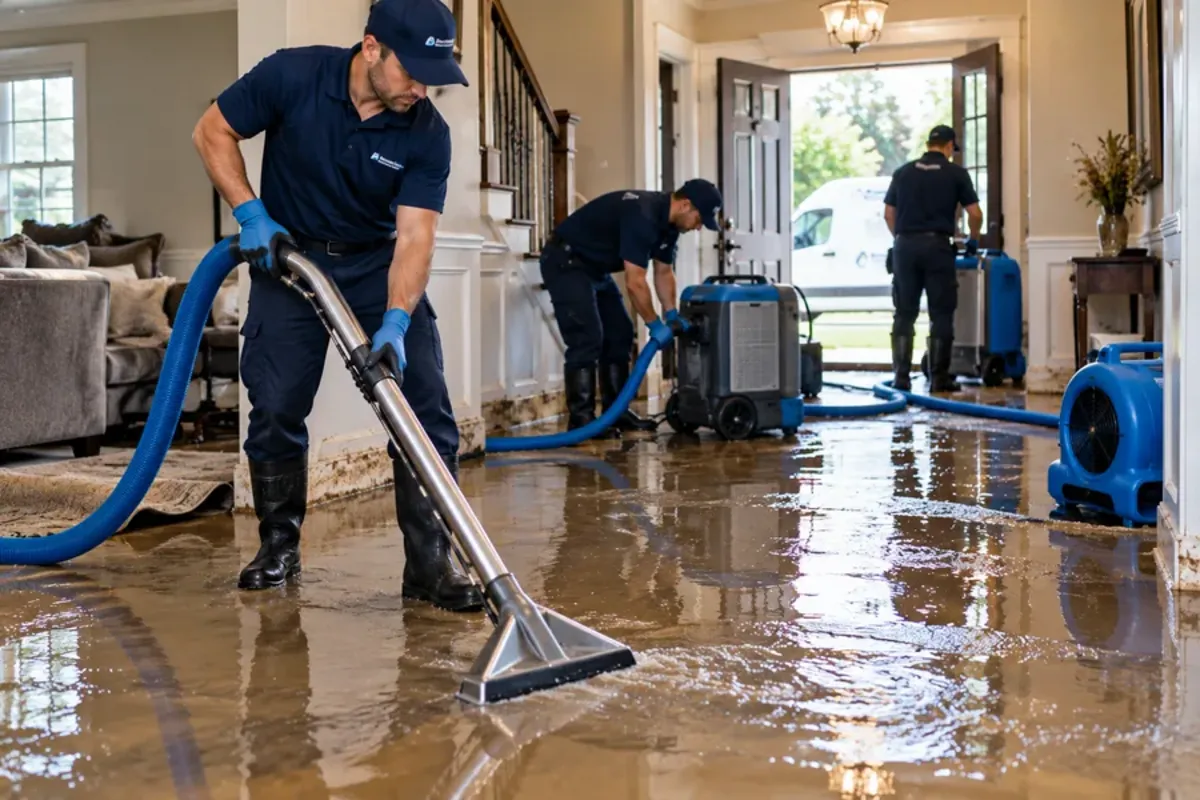
The short answer, for anyone standing in water right now
Water damage restoration on Long Island means stopping the source, extracting the standing water, removing materials that cannot be saved, drying the structure with air movers and dehumidifiers until meter readings prove it is dry, cleaning and disinfecting what the water touched, and then repairing the home back to how it was. For a burst pipe or an appliance leak, call a restoration crew first and your insurer the same day. For rising water from a storm, a bay, or the ocean, that is flood damage and a different insurance policy. For a cesspool backup, stop using water in the whole house and treat everything the sewage touched as contaminated. The free inspection at the start sets the scope, the moisture map, and the claim record, so the rest of the job runs on facts instead of guesses.
What is water damage restoration?
Water damage restoration is the professional process of stopping a water loss, extracting standing water, drying the structure to proven moisture readings, cleaning and disinfecting what the water touched, preventing mold, and repairing the home so it returns to its pre loss condition across Long Island.
Key takeaways: the Long Island facts that matter most
Seven facts carry most of what a Long Island homeowner needs from this page, and each one names its source in the same sentence, so it can be quoted exactly as it stands.
- About 85 percent of Nassau County sewage moves through the public sanitary sewer system, according to Nassau County Sewage District figures, and the remaining share is handled by smaller independent districts.
- Nearly 70 percent of Suffolk County homes use cesspools or septic systems instead of sewers, according to Suffolk County, which gave the figure in its August 2026 septic program announcement.
- Mold can begin growing on wet building materials within 24 to 48 hours, the window the United States Environmental Protection Agency (EPA) gives for drying water damaged areas to prevent mold growth.
- A standard room loss typically dries in 3 to 5 days, the Class 2 range in the Institute of Inspection, Cleaning and Restoration Certification (IICRC) S500 standard, and drying is proven by meter readings, not by the calendar.
- The Federal Emergency Management Agency (FEMA) defines a basement as any area with its floor below ground level on all sides, so the sunken lower level of a split level counts as a basement under a National Flood Insurance Program (NFIP) policy.
- Under New York Insurance Law 2601 and Regulation 64, enforced by the New York State Department of Financial Services (DFS), an insurer must acknowledge a property claim and begin its investigation within 15 business days.
- Superstorm Sandy damaged or destroyed nearly 100,000 homes and businesses across Nassau and Suffolk counties, according to the Stony Brook University summary of the storm.
Last updated: November 2026
On this page
- Key takeaways
- Quick answers
- First 60 minutes
- First 48 hours after a storm
- Long Island water systems
- What Sandy taught Long Island
- Drying times and targets
- Test before you tear
- The split level basement trap
- All pages on this site
- Why Long Island homes flood
- Water categories and classes
- Services
- The 8 step process
- Basements and sump pumps
- Coastal and storm surge
- Cesspool and septic backups
- Behind walls and mold
- Insurance claims
- Real job walkthroughs
- Questions homeowners ask
- Towns we cover
- Prevention
- FAQs
Quick answers about water damage restoration on Long Island
Six questions come up on almost every first call from Nassau and Suffolk homeowners. Here are the straight answers, each in one short block, with the full detail in the sections that follow.
How much does water damage restoration cost on Long Island?
There is no honest figure before an inspection, because the scope is set by how much water got in, how far it spread, and which materials it touched. Start with the free inspection: moisture readings, a written scope, and a defined job you approve before paid work begins, with the same scope document supporting your insurance claim.
How long does water damage restoration take?
Drying usually takes 3 to 5 days for a standard room loss, the Class 2 range in the IICRC S500 standard, proven by meter readings rather than the calendar. A contained leak can dry in 2 to 3 days, a flooded finished basement in 5 to 10 days, and hardwood or plaster in 7 to 14 days or longer, all inside the class ranges of the IICRC S500 standard. The rebuild after drying commonly runs 1 to 3 weeks.
Does homeowners insurance cover water damage?
Usually, yes, when the damage is sudden and accidental: a burst pipe, a split washing machine hose, or a water heater that lets go. A standard policy usually does not cover flood water from outside, slow leaks that ran for months, or sewer and cesspool backups without a specific endorsement. Flood cover is a separate policy.
How fast does mold grow after water damage?
Mold can begin growing on wet drywall, wood, and carpet padding within 24 to 48 hours while the material stays damp, the window the EPA gives for drying water damaged areas to prevent mold growth. That short window is why extraction and professional drying start the same day whenever possible. Drying proven by meter readings, not by how the surface feels, is what stops growth before it starts.
What should I do first when water damage happens?
Stay clear of water near outlets or the electrical panel. Stop the source if you can do it safely: close the main shutoff for a burst pipe, or check the sump pump during a storm. Move valuables off the floor, photograph the water line for your claim, and call a restoration crew for extraction the same day.
What is the difference between flood damage and water damage?
Water damage comes from inside the home: a burst pipe, an appliance leak, or a roof leak during a storm. Flood damage is water that touches the ground outside before it enters, like storm surge, bay water, or heavy rain pooling against the foundation. Homeowners policies cover the first kind; flood damage needs a separate flood policy.
Long Island water facts, in short
- Mold can start on wet materials within 24 to 48 hours, the drying window the EPA sets to prevent mold growth.
- Most Long Island homes dry in 3 to 5 days with professional equipment, the Class 2 range in the IICRC S500 standard.
- A flood policy generally takes 30 days to take effect, the standard NFIP waiting period.
- Nearly 70 percent of Suffolk County homes use cesspools or septic systems, according to Suffolk County.
- Roughly 85 percent of Nassau County sewage moves through public sewers, according to Nassau County Sewage District figures.
- FEMA counts a split level lower floor that sits below ground on all sides as a basement.
One line answers, for asking out loud
- Who do I call for water damage on Long Island? A local restoration crew that answers day or night and starts with a free inspection.
- How long does drying take? Most homes dry in 3 to 5 days, the Class 2 range in the IICRC S500 standard, proven by meter readings.
- Does insurance cover a burst pipe? Yes, sudden and accidental damage is usually covered; flood water from outside is not.
- How fast does mold start? Within 24 to 48 hours on wet materials, the EPA window for drying them, so drying starts the same day.
The first 60 minutes: what to do before the crew arrives
In the first 60 minutes after you find water in a Long Island home, stop the source if you safely can, keep clear of water near electricity, photograph the water line, and move valuables off the floor. The first hour after you find water decides how big this job gets. Water does not sit still. It wicks up drywall, runs under flooring, soaks insulation, and finds the low corner of every room. A spill that is a drying job on day one can turn into a demolition and mold job by day three. The steps below are the same ones our crews talk callers through on the phone, in the order that matters for Long Island homes.
- Put safety before property. If standing water is anywhere near outlets, a space heater, the furnace, or the electrical panel, keep everyone out of it. Water and electricity are the one combination in this work that can kill. If you can reach the breaker panel on dry ground, switch off the circuits for the wet rooms. If you cannot reach it dry, wait for the crew or the fire department non emergency line. In a sewage or cesspool backup, treat the room the same way: keep children and pets out until it is cleaned and disinfected.
- Stop the water at the closest valve. A toilet, sink, or washing machine has its own shutoff behind or under it. A burst pipe, a split water heater, or a leak you cannot find calls for the main shutoff. In most Long Island houses the main valve sits in the basement on the wall that faces the street, near the water meter. In homes without a basement it is often in a utility closet or where the line enters from the street. Turn it clockwise and confirm the flow stops. Knowing this valve before an emergency is the single most useful piece of home knowledge there is.
- Check the two Long Island wildcards: the sump pump and the cesspool. If the basement is filling during or after rain, look at the sump pit. Is the pump running? Is the float stuck? Did the power go out, which is when most storm flooding happens? If drains all over the house are gurgling, if a basement toilet bubbles when an upstairs shower runs, or if the lowest drain in the house is pushing water up instead of taking it down, suspect the cesspool or septic system and stop running water everywhere in the house until it is checked.
- Get the fast losses off the floor. Cardboard boxes go first: wet cardboard is mold food within a day. Then rugs, photo albums, documents, electronics, and anything upholstered. Lift solid furniture onto wood blocks, aluminium foil squares, or plastic tubs so the legs stop wicking water. Move what you can to a dry room or the garage. Do not haul heavy soaked furniture alone and do not tear out carpet or drywall yet: what gets removed, and in what order, affects both the drying and the insurance record.
- Photograph and video everything, before you touch it. Walk the whole wet area slowly with your phone. Take wide shots of each room, close shots of the water line on the walls, the failed pipe or appliance, the model plate on a water heater, and the contents sitting in water. Open the failed part up to the camera if you can do it safely. This five minute record is what your insurance adjuster will rely on weeks later, and it is the part of the claim that cannot be recreated once cleanup starts.
- Start removing water if it is safe and simple. A wet and dry vacuum, towels, and a mop on a hard floor all help. Open windows if the outside air is drier than the inside air; on a humid Long Island summer day, keep them shut and let the dehumidifiers do the work when they arrive. Do not use your household vacuum on standing water, and do not turn on ceiling fixtures in a room with a wet ceiling: a water logged ceiling can come down, so keep out from under a bulging one.
- Call for extraction and the free inspection. Tell the dispatcher what happened, where the water is, whether the source is stopped, and whether sewage or outside flood water is involved. That decides what the crew loads on the truck. While you wait, find your insurance policy number and, if you have one, your flood policy. Both matter on Long Island, because the source of the water decides which policy responds.
One warning that saves homes: do not wait until morning, until the weekend ends, or until the adjuster visits to start drying. Your policy expects you to limit further damage, and mold can start inside 24 to 48 hours, the window the EPA gives for drying wet materials. Emergency extraction and drying first, paperwork right behind it, is the order insurers themselves recommend.
The first 48 hours after a storm: the September and November 2026 nor'easters
After a storm flood on Long Island, the first 48 hours decide both the mold risk and the insurance claim: photograph everything before you move it, report the claim the same day, and start drying inside two days. Long Island has had a hard storm season, and its lessons belong at the front of any honest guide to water damage restoration long island work. Between 25 and 28 September 2026, a nor'easter hit the downstate coast with gale force winds reported over 80 miles per hour, rainfall of 2 to 4 inches and over 6 inches in some locations, and more than 3 feet of flood inundation in several areas across multiple high tide cycles. Portions of the coast lost 4 feet or more of sand, and more than 1,150 trees came down across Nassau County and Suffolk County. WLIW, citing Newsday, reported that more than 124,000 PSEG Long Island customers lost power, with 3.32 inches of rain recorded at Islip on 26 and 27 September. In late October 2026, Governor Hochul requested a federal Major Disaster Declaration for the communities hit by that storm, and on 5 November 2026 the state asked the U.S. Army Corps of Engineers for federal help to repair four damaged coastal protection projects: East Rockaway Inlet to Rockaway Inlet, Jones Inlet to East Rockaway Inlet at Long Beach, Fire Island to Montauk Point, and Fire Island Inlet and Shores Westerly, working with partners that include Suffolk County, the City of Long Beach, and the Towns of Hempstead, Babylon, Islip, Brookhaven, Southampton, and East Hampton.
Two honest points about that federal help. First, the Major Disaster request was aimed at FEMA Public Assistance, which repays eligible local governments and nonprofits for debris removal, protective measures, and repairs to public buildings and infrastructure. It does not pay to repair private homes. Second, the 5 November request was about repairing beaches, dunes, and coastal storm risk projects, not household claims. Your home claim still runs through your own homeowners policy and, for rising water, your own flood policy, which is why the documentation steps below matter more than any headline about federal money.
Then, on 12 November 2026, a second nor'easter came through. The National Weather Service record report set a record rainfall of 3.56 inches at Kennedy Airport for that day, breaking the old record of 2.11 inches set in 1975; early news reports said 3.32 inches, and the final Weather Service figure is the one to use. Kennedy sits in Queens, not in Nassau or Suffolk, so treat it as the nearest major gauge, not as a Long Island rainfall total. The same storm brought coastal flood advisories for the south shore of Nassau and Suffolk and, as reported that day, a tornado warning for southern Queens and southwestern Nassau County. July had already warned the Island: a flood watch covered Nassau and Suffolk from 5 to 6 July 2026, with 2 to 4 inches of rain possible, localized totals up to 5 inches, and rainfall rates of 1 to 2 inches per hour.
What to do in the first 48 hours after a storm flood
- Photograph and video everything first. Before you move a single item, walk the property slowly: the water line inside and outside, every wet room, the mechanicals, the yard, and the street if it is still flooded. After Sandy, thousands of Long Island flood claims were reopened in a federal review because the paperwork did not match the house, and the homeowners with their own dated photos and video were the ones who could prove their case. Your own record is the one document no adjuster or engineer can rewrite.
- Keep people safe and keep generators outside. Stay out of standing water near the electrical panel, and never run a generator in a garage, a basement, or near an open window. Carbon monoxide kills more people after storms than water does in many events. If the panel, the furnace, or the water heater sat in salt water, have them checked by the right trade before they are run again.
- Stop the water you can stop, and pump the rest slowly. Close the main shutoff for any plumbing failure. For a basement full of groundwater, follow the FEMA guidance passed on by Long Island restoration sources: if several feet of water are in the basement and the ground outside is still saturated, pump out about one third of the water per day and wait until floodwater outside has gone down. Draining a basement fast against saturated ground can crack or collapse foundation walls, because the water outside is pressing on them.
- Report the claim the same day and keep every receipt. Call your homeowners carrier and, if water rose from outside, your flood carrier as well. Keep receipts for pumps, fuel, hotel nights, and emergency work, and do not throw damaged items away until the adjuster has seen them or your insurer agrees in writing. Start a simple claim diary: dates, names, claim numbers, and what was promised.
- Get extraction and drying started inside the 48 hour window. The Environmental Protection Agency (EPA) guidance is to dry water damaged areas and items within 24 to 48 hours to prevent mold growth, and the Centers for Disease Control and Prevention (CDC) gives a wider window of 48 to 72 hours. Both point the same way: a storm flooded home that waits a week for drying is a mold job as well as a water job, on every street at the same time, which is another reason to call early rather than after the weekend.
Why Long Island homes flood: the causes we actually see
Long Island homes flood mainly because the water table sits only a few feet below many basement floors, much of Suffolk County still drains to cesspools and septic systems instead of sewers, and South Shore homes sit exposed to storm surge behind the barrier islands. Long Island is a 118 mile long sand and gravel bar sitting between Long Island Sound and the Atlantic Ocean, and its water problems follow from that geography. The water table is high, in places only a few feet below the basement floor. Much of Suffolk County still runs on cesspools and septic systems instead of sewers. The South Shore sits behind barrier beaches and bays that push water into streets and ground floors during storms, while the North Shore deals with bluffs, harbours, and older housing stock. Here are the causes behind most of the calls, in the order they show up across Nassau and Suffolk.
High water table and groundwater seepage
In low lying parts of the Island, Massapequa, Merrick, Lindenhurst, Patchogue, and much of the South Shore plain, the groundwater sits close to the surface. After days of rain or a wet spring, that water pushes up through the joint where the basement floor meets the wall, through floor cracks, and around pipe penetrations. It looks like the floor is sweating or a slow leak with no pipe anywhere near it. This water is clean as it enters, but it arrives under pressure and keeps arriving until the water table drops, which is why seepage jobs need a sump system and a drainage answer, not just a mop and a fan.
Sump pump failure
The sump pump is the hardest working appliance in a Long Island basement and the one nobody thinks about until it stops. Pumps die of old age, floats stick on debris, check valves fail, and, most often of all, the power goes out in the same storm that is flooding the basement. A pump without a battery backup or a water powered backup is a single point of failure. When a pump quits mid storm, a basement can take on inches of water in an hour, soaking the furnace, the water heater, stored belongings, and any finished space down there.
Cesspool and septic backups
Roughly three quarters of Suffolk County homes are not connected to sewers. Their wastewater goes to a cesspool or a septic tank and leach field in the yard. When a cesspool is full, when the leach field is saturated after heavy rain, or when the line from the house is blocked by roots or grease, the sewage has nowhere to go but back into the house through the lowest drain. These backups are Category 3 events, the most contaminated class of water damage, and they need a cesspool service and a restoration crew working together: one fixes the system, the other makes the house safe again.
Coastal flooding and storm surge
From Long Beach and Freeport on the western South Shore to Lindenhurst, Babylon, and the bay side of Fire Island, and out to Hampton Bays, the South Shore lives at the edge of Great South Bay and a chain of inlets. A strong nor'easter or a tropical storm pushes bay water over bulkheads and into streets, and ground floors and basements in the lowest streets take it in. Superstorm Sandy taught the whole Island what surge does: it arrives fast, it carries sand, salt, fuel oil, and sewage, and it hits every home on the street at the same time. North Shore harbours flood less often, but low roads around Huntington Bay, Northport, Port Jefferson, and Glen Cove see tidal flooding in the same storms.
Burst and frozen pipes
Winter on the Island brings the pipe season. Pipes in crawl spaces, garages, and outside walls freeze during cold snaps, especially in North Shore homes exposed to wind off the Sound and in East End summer houses that sit empty. A frozen pipe often bursts at a fitting and then runs for hours or days before anyone finds it, because the break only starts flowing when the ice thaws. Copper pipes in older homes also fail from corrosion, and a pinhole leak inside a wall can run quietly for weeks, showing up first as a musty smell or a stain on the ceiling below.
Water heater failure
The water heater is a tank of water under pressure sitting in the basement or a utility closet, connected to a supply line that never stops feeding it. When the tank corrodes through or a fitting lets go, the leak runs until someone closes a valve. Heaters also leak slowly from the drain valve, the pressure relief line, or the base, soaking the floor and the bottom plates of nearby walls for days before the puddle is noticed. In finished basements, a failed heater is one of the most destructive single appliance events we see.
Washing machines, dishwashers, and ice maker lines
The rubber supply hose behind a washing machine is a known weak point, and machines on a first or second floor laundry room turn a burst hose into a whole house event, with water running down through ceilings and walls. Dishwasher leaks hide under the unit and rot the kitchen subfloor quietly. The thin plastic line to a refrigerator ice maker splits, pinches, and leaks behind the fridge for weeks. Braided steel hoses, leak sensors, and an automatic shutoff valve are cheap insurance against all three, and the prevention section at the end of this page covers them.
Roof leaks, ice dams, and window wells
Heavy rain finds every weak point in a roof: lifted shingles, failed flashing around chimneys and skylights, and gutters that overflow against the fascia. In winter, ice dams form at the eaves of North Shore and inland homes, melt water backs up under the shingles, and the leak appears on the top floor ceiling, often far from where the water entered. At ground level, clogged window wells and grading that slopes toward the house pour surface water straight into basements during downpours.
Foundation cracks and bulkhead doors
Basement bulkhead doors, the angled steel doors so common on Long Island homes, leak at the seams and at the threshold in driving rain. Foundation cracks from settling let groundwater in along predictable paths. These are slow, repeat leaks: the same corner gets wet in every storm. They cause a particular kind of damage, because the homeowner gets used to them, puts storage in the corner anyway, and finds the mold later.
Standing in water right now?
Stop the source if you safely can, take photos, then call. The inspection is free and the drying plan is set on the first visit.
Water categories and damage classes, in plain English
Water damage is sorted into three categories by how contaminated the water is and four classes by how much of the building got wet and how hard it will be to dry, the classification system set out in the ANSI/IICRC S500 standard. Restoration crews talk about categories and classes, and adjusters use the same words in claim files. Knowing what they mean helps you understand why one job is a simple drying visit and another needs walls opened and materials removed. The category describes how dirty the water is. The class describes how much of the building got wet and how hard it will be to dry.
| Category | What it means | Long Island examples | What it changes |
|---|---|---|---|
| Category 1: clean water | Water from a sanitary source that does not pose a health risk at the start. | Burst supply pipe, water heater leak, sink or tub overflow of clear water, rain through a roof leak. | Most materials can be dried in place. Speed still matters, because clean water left sitting picks up dirt and microbes and degrades into Category 2. |
| Category 2: grey water | Water with chemicals, detergents, or waste that can cause discomfort or sickness. | Washing machine and dishwasher discharge, toilet overflow with urine only, sump water that sat and stagnated, aquarium failure. | Carpet padding usually comes out, soft furnishings are cleaned or removed, and crews use protective gear and antimicrobial treatment. |
| Category 3: black water | Grossly contaminated water carrying bacteria, viruses, and chemicals. | Cesspool and septic backups, sewer line backups, storm surge, bay and ocean flooding, river and ground surface water entering the home. | Porous materials the water touched are removed, the structure is cleaned and disinfected, and drying follows decontamination, never the other way round. |
| Class | How much is wet | Typical Long Island job | Drying effort |
|---|---|---|---|
| Class 1 | A small area, little water absorbed into materials. | A supply line leak caught within the hour, wetting part of one room. | Fastest. Often 1 to 2 days of drying. |
| Class 2 | A whole room or more, water wicked up walls less than 2 feet. | A flooded basement laundry area, a washing machine hose failure on the first floor. | Moderate. Carpet, pad, and wall bases all hold water. |
| Class 3 | Water from overhead, ceilings and upper walls wet, large area. | A second floor bathroom leak, a burst pipe in an attic or top floor, surge water across a ground floor. | Heavy. Ceilings, wall cavities, and insulation dry slowly and need directed air. |
| Class 4 | Water trapped inside materials that barely release it. | Water under hardwood floors, inside plaster and lath walls in older North Shore homes, in crawl spaces and concrete. | Longest. Needs specialist drying, floor mat systems, and patience measured in meter readings. |
One honest note: these labels describe the starting point. A clean water leak in a home where nobody was present for a week is not a small job anymore, because time moves water deeper and lets mold take hold. That is why every section of this page comes back to the same advice: the earlier the extraction and drying start, the more of the home can be saved as it is.
Services: what a full restoration covers on Long Island
A full water damage restoration service on Long Island covers nine linked jobs: emergency water extraction, structural drying and dehumidification, flooded basement cleanup, sewage and cesspool backup cleanup, storm and flood recovery, mold remediation, leak detection and hidden moisture inspection, burst pipe and appliance cleanup, and rebuild and repair. Water damage restoration long island work is not one job, it is a chain of jobs, and skipping a link is how homes end up with mold in the walls or a floor that buckles a month later. These are the services that make up the full chain, and what each one actually involves when it is done properly.
Emergency water extraction
Standing water comes out first, with truck mounted extractors and portable pumps for depth, and weighted extraction wands that pull water out of carpet and padding, not just off the surface. In a flooded basement, submersible pumps run until the water is low enough for wands and squeegees. Every hour of standing water is an hour of soaking into drywall, subfloor, and framing, so extraction is the service that sets the ceiling on how bad the whole event gets. Crews also move and block furniture during extraction to stop legs and finishes wicking water while the floor is still wet.
Structural drying and dehumidification
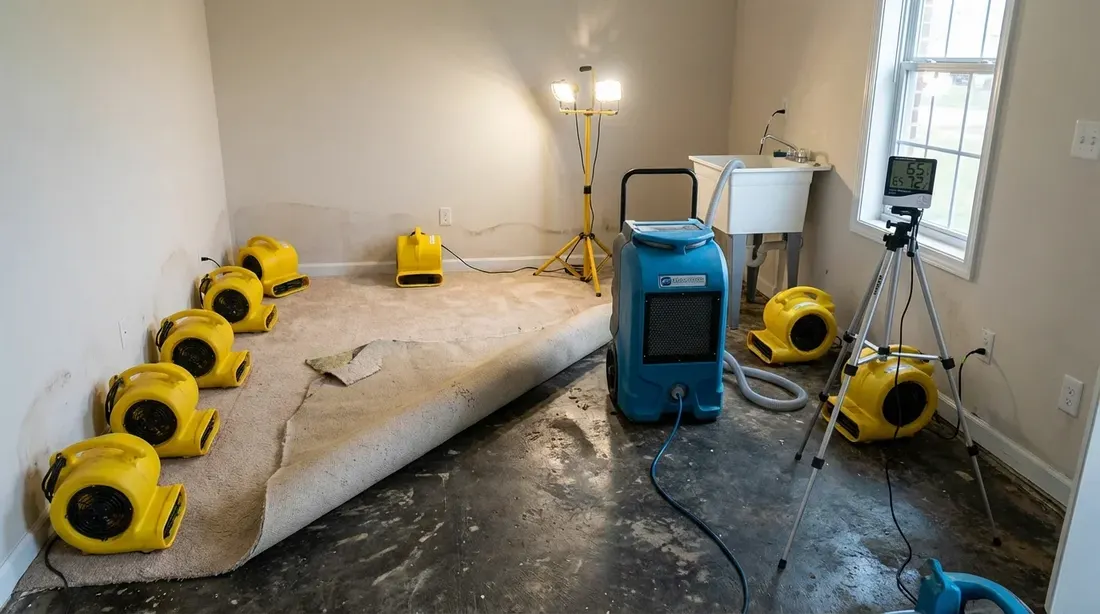
Drying is a measured process, not a fan left in a corner. Air movers push air across wet surfaces to lift moisture into the air, and commercial dehumidifiers pull that moisture out and drain it away. The crew calculates how much equipment the volume of the room and the class of loss needs, aims air into wall cavities and under cabinets, and returns to take moisture readings in the materials each day. Equipment comes out when the readings match a dry standard taken from an unaffected part of the same house, which is the only honest finish line.
Flooded basement cleanup
Basements are where Long Island water damage lives. This service covers pumping and extraction, removing ruined contents and finishes, cleaning silt and debris off concrete, drying framing and any finished sections, and disinfecting after groundwater or storm water. Just as important, the crew reports on the cause: the pump, the water table, the grading, or the cesspool, because a basement dried without a cause fixed is a basement that floods again. That cause first habit is what separates water damage restoration long island work from simple cleanup. Finished basements get the flood cut and cavity drying treatment described in the basement section below.
Sewage and cesspool backup cleanup
Category 3 work runs on containment and removal. The crew seals off the affected area, wears full protective equipment, removes porous materials the sewage touched, including carpet, padding, and the lower drywall where it wicked, then cleans and disinfects the structure with hospital grade products before drying begins. Contents are sorted into what can be sanitised and what cannot. This is the service where doing it yourself is genuinely risky: sewage carries bacteria and viruses that household cleaners and a shop vacuum do not make safe.
Storm and flood recovery
After a nor'easter or a tropical storm, whole streets need help at once. Storm recovery covers surge and rain flooding: extraction, muck out of silt and sand, removal of soaked materials, rinsing salt water residue from framing and metal, corrosion checks on panels and appliances, and drying the shell of the house so repairs can start. Crews also document the high water line inside the home, which matters for both flood insurance and any disaster assistance paperwork that follows a declared storm.
Mold remediation
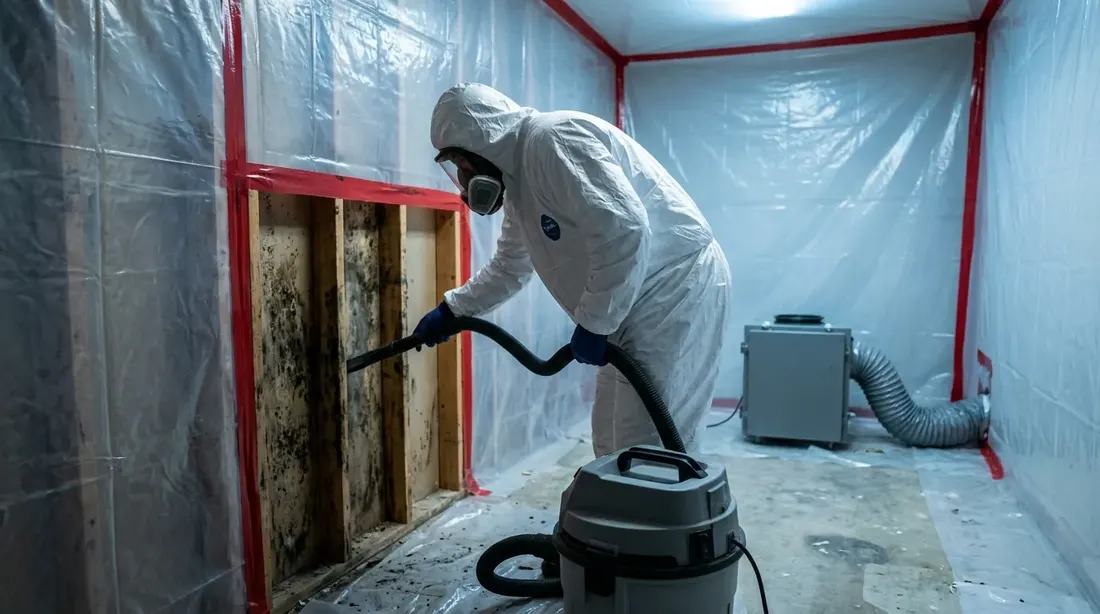
Where water sat, mold follows. Remediation starts with finding the full extent of growth with moisture meters and, where needed, opening small inspection points. The work area is sealed in plastic containment with negative air machines that filter the air and stop spores spreading to clean rooms. Moldy porous material comes out in sealed bags, hard surfaces are HEPA vacuumed and cleaned, and the structure is dried so the mold has nothing left to live on. Killing mold without fixing the moisture is a temporary cosmetic job, and any company that offers only a spray treatment is selling you one.
Leak detection and hidden moisture inspection
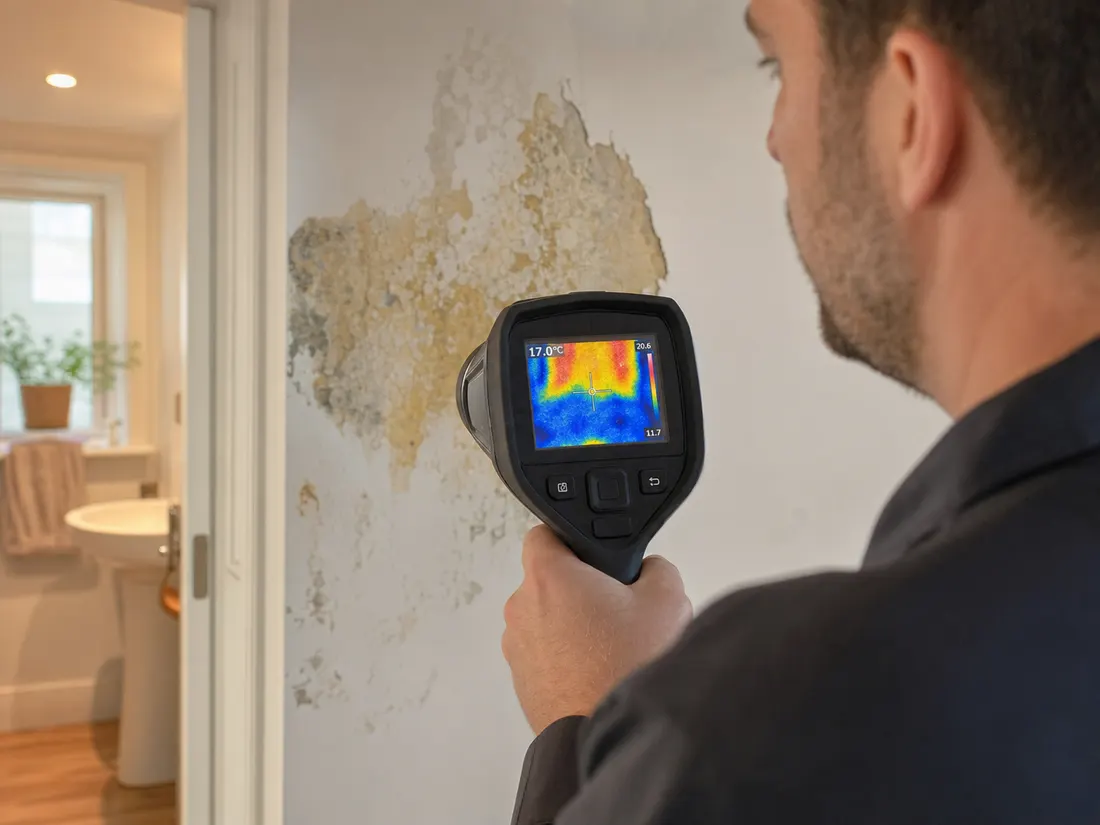
Not every job starts with a flood. A stain that keeps growing, a musty room, a floor that feels soft, a water bill that jumped: these need finding, not drying. Pin and pinless moisture meters read water content inside drywall, studs, and subfloors without tearing the room apart. A thermal imaging camera shows the cool signature of wet material and traces where water travelled from a leak. Borescopes look inside wall cavities through a hole the size of a coin. The output is a moisture map of the home, which turns a suspicion into a scope of work.
Burst pipe and appliance cleanup
Plumbing failures are the most common call in winter and the most preventable damage the rest of the year. This service covers the cleanup after the plumber has fixed the pipe: extraction, drying ceilings and walls below the break, and checking the rooms the water passed through on its way down, because a second floor leak wets three floors of building on the way to the basement. It also covers water heater, washing machine, dishwasher, and ice maker line failures, including the slow hidden ones that rot subfloors quietly.
Rebuild and repair
When drying is proven complete, the home goes back together: insulation, drywall and plaster repair, trim and baseboards, flooring from hardwood to tile to carpet, cabinets where they were removed, and paint. Handling the rebuild with the same team that did the mitigation keeps one record for the insurer, one schedule, and no gap where a drying company blames a builder and the builder blames the drying. The rebuild section near the end of this page explains how that phase runs and what to check before it starts.
The restoration process, step by step
Water damage restoration long island jobs follow the same eight steps: the call and dispatch, inspection and moisture mapping, water extraction, removal of what cannot be saved, cleaning and antimicrobial treatment, monitored drying, final verification, and the rebuild. Every professional job follows the same eight steps, whether it is a one room pipe leak in Syosset or a whole ground floor of surge water in Long Beach. Knowing the steps lets you judge any company you call, including us: if a step is missing from their plan, ask why. This is the sequence water damage restoration long island jobs are judged against, by homeowners and by adjusters alike.
- The call and the dispatch. A real person answers, takes the details that matter (source, area affected, sewage or flood water involved, power status), and talks you through stopping the water if it is still running. The truck is loaded for your specific job: pumps for a deep basement, containment gear for a cesspool backup, floor drying mats for hardwood.
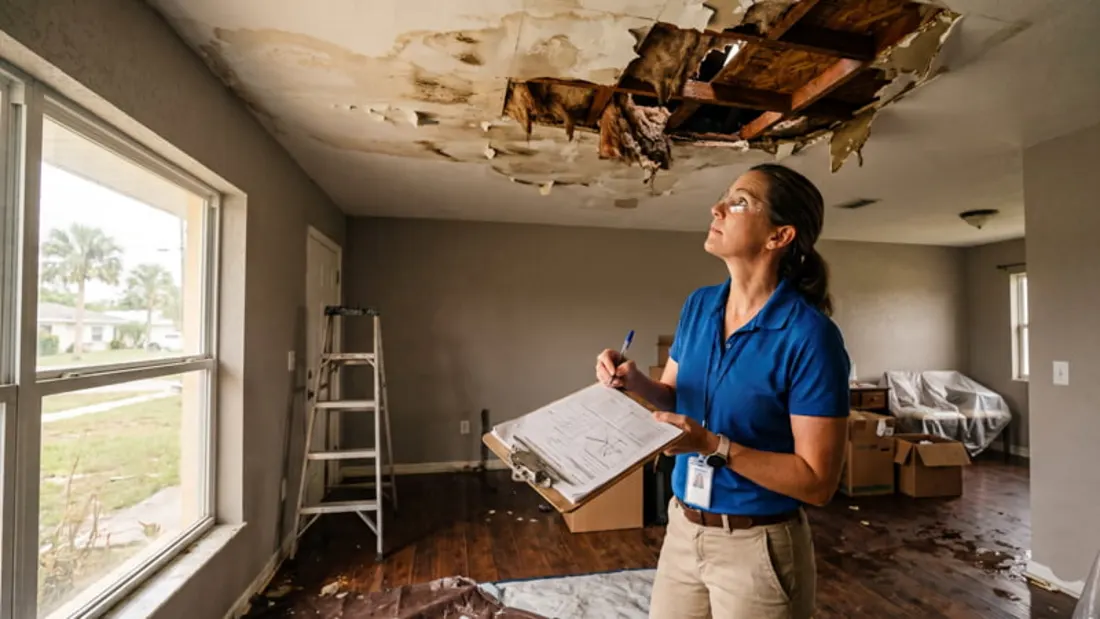
- Inspection and moisture mapping. The crew leader walks the whole property, not just the wet room, because water travels. Meters read the moisture in floors, walls, and ceilings; the thermal camera traces the spread; photos document everything. The result is a moisture map and a written scope: what will be extracted, what removed, what dried in place, and how long drying should take. This scope is also the backbone of your insurance claim.
- Water extraction. Standing water comes out with pumps and extractors. Furniture is moved or blocked up. Carpet is extracted with weighted wands, and where the padding is saturated or the water was dirty, the pad comes out so the subfloor can dry. The goal is simple: no standing water left anywhere, including inside closets, under cabinets, and in the low corner every basement has.
- Removal of what cannot be saved. Some materials dry fine. Others do not: soaked carpet padding, wet insulation inside a closed wall, drywall that wicked sewage or sat wet for days, particle board cabinets that swelled. Removing them is controlled demolition: clean cuts, bagged debris, and the structure left open to dry. After Category 3 water, this step is bigger, and it is not optional, because contaminated porous material cannot be cleaned to a safe standard.
- Cleaning and antimicrobial treatment. Hard surfaces are cleaned, and an antimicrobial is applied to the affected structure to hold down microbial growth while drying runs. After sewage or flood water, disinfection is a full step of its own with dwell time for the products to work, before any drying equipment is placed.
- Drying, monitored daily. Air movers and dehumidifiers are placed by calculation, not guesswork, and aimed at the wettest materials: wall cavities through small drilled holes where the wall can be saved, under flooring with mat systems, into ceiling cavities from below. Each visit, the crew records moisture readings and humidity, moves or adds equipment, and updates the drying log. That log is proof for you and your insurer that the building dried on a schedule.
- Final verification. Drying ends when readings in the wet materials match the dry standard from an unaffected area, walls and floors included, not when the surface feels dry to a hand. The crew does a final walk through with you, and where mold was a concern, a clearance check confirms the area is clean and dry before rebuild begins.
- Rebuild and hand back. Repairs put the home back together, and the final walkthrough compares the result against the pre loss photos from step two. One file, from the first photo to the last coat of paint, closes the claim and the job together.
A drying diary: what the days actually look like
Homeowners often ask what happens between the dramatic first day and the finish, so here is a typical clean water basement job, day by day. Day one is noise and activity: extraction, the flood cut if one is needed, equipment placed, and the house full of moving air. Day two is quieter: a monitoring visit, readings down across most materials, one stubborn wall still high, equipment adjusted to aim at it. Day three, the fastest materials, concrete and framing, hit their targets, and the crew may pull some air movers. Day four or five, the last readings come in line, equipment comes out, and the room smells like a room again. Sewage and surge jobs add days at the front for removal and disinfection; hardwood and plaster jobs add days at the back, because those materials release water slowly. Anyone who promises an exact finish date before the first readings is guessing; anyone who shows you the readings each day is drying.
Not sure how far the water spread?
The free inspection includes moisture readings in walls and floors, so you decide with a map in hand, not a guess.
Long Island water systems: sewers in Nassau, cesspools in Suffolk, and water under everything
What comes back up through a Long Island floor is decided below ground, by the sewer, the cesspool, and the water table under the street. Nassau County and Suffolk County run on two different answers. The Nassau County sanitary sewer system handles roughly 85 percent of the sewage in Nassau County, according to Nassau County Sewage District figures, through approximately 3,000 miles of pipe and two treatment plants, Bay Park and Cedar Creek, with the other 15 percent handled by smaller independent districts. Even in Nassau, large portions of the North Shore remain unsewered, and the Nature Conservancy notes that about 35,000 residents of the City of Long Beach still rely on an aging, storm exposed treatment plant, while Point Lookout still depends on cesspools. Suffolk County is the opposite picture: the county said in August 2026 that nearly 70 percent of Suffolk County homes use cesspools and septic systems. The Suffolk County Wastewater Plan adopted in 2020 estimated about 365,000 residential onsite systems, of which about 252,530 were cesspools only, while a 2026 Newsday based count put roughly 360,000 standard cesspools and septic systems still in use across the county.
Under all of it sits the water table. Long Island is built on sand, clay, and glacial deposits, and the water table is high in most areas, in some neighborhoods only a few feet below the surface. Clay heavy soil holds water against foundation walls and builds hydrostatic pressure; sandy soil drains faster but can shift over time. Documented high groundwater areas include the low lying Town of Hempstead communities, Merrick, Bellmore, Wantagh, Seaford, and Massapequa, built on former wetlands with the water table near the surface, plus the Nissequogue River Basin around Smithtown and Hauppauge, the Lake Ronkonkoma area, and Amityville, Copiague, and Lindenhurst, where persistent basement flooding is tied to high tides and shallow aquifers. In low lying neighborhoods near the bays, after heavy rain, especially when a storm pushes high tides into the bays, groundwater rises and pushes up through the slab and in at the floor and wall joint. A sump pump is often the main line of defense in these homes, which is why the sump pump section below is not a minor detail.
The same groundwater is also the Island's drinking water, the sole source for nearly 3 million people, which is why Suffolk County pushes nitrogen reducing wastewater systems so hard. One responsibility line matters in every sewered street: in most Long Island sewer districts, the pipe from your house to the street main, called the lateral, is the homeowner's responsibility, and the main is the district's. When a backup happens, the first question is which side of that line the blockage sits on. At the far end of the Island the ground itself explains the risk: East Quogue sits at an average elevation of just 13 feet above sea level, bordered by Shinnecock Bay, and low hamlets like it feel every tide and every saturated week in their drains first.
Nassau sewers and Suffolk cesspools, side by side
The county line changes what a backup means, who repairs the system underneath it, and which insurance question decides the cleanup, so the two systems are worth setting side by side.
| Question | Nassau County, mostly sewered | Suffolk County, mostly cesspools and septic |
|---|---|---|
| How wastewater leaves the home | About 85 percent moves through the public sanitary sewer system, per Nassau County Sewage District figures; parts of the North Shore and Point Lookout still rely on cesspools. | Nearly 70 percent of homes use a cesspool or septic system, per Suffolk County; the county wastewater plan counted about 365,000 onsite systems, about 252,530 of them cesspool only. |
| What a backup usually is | A blockage in the lateral from your house to the street main, or a failure of the district main itself. | A full or failing cesspool, a leach field saturated by rain and a high water table, or a blocked line between the house and the tank. |
| Who pays for the system repair | You pay for your lateral; the sewer district pays for its main. | You pay; the cesspool or septic system is private and sits on your own land. |
| The insurance question | Cleanup inside the home is usually covered only when your policy carries a water backup endorsement. | The same endorsement question, and some policies exclude cesspool failures even with an endorsement, so the wording has to be read before a backup, not after one. |
| The first move in a backup | Stop running water, call the district if the whole street is affected, and call a restoration crew for the cleanup. | Stop all water use at once, call a cesspool service to pump and diagnose the system, and call a restoration crew for the cleanup. |
Ida and the August 2014 Islip storm: the floods that came from the sky, not the sea
Two of Long Island's worst modern floods, the remnants of Hurricane Ida in September 2021 and the Islip storm of August 2014, arrived as extreme rainfall rather than storm surge. South Shore homeowners plan for surge, but two of the Island's worst modern floods arrived as rain. The remnants of Hurricane Ida crossed the region on 1 and 2 September 2021. A National Weather Service case study recorded 24 hour rainfall of up to 8 inches in New York City and Long Island, and a U.S. Geological Survey alert described 4 to 9 inches with rates up to 3 to 4 inches per hour, on soils already saturated by Hurricane Henri. Totals fell sharply from west to east: one NOAA record list gives Islip only 1.53 inches. Ida halted or delayed Long Island Rail Road service across most branches, and the state of emergency declared on 1 September 2021 included Nassau and Suffolk among its 14 counties. On deaths: the final tally lists 18 deaths in New York State, while early reports said 15 and a later summary said 16. No Long Island specific Ida death count was found in the sources checked for this page, so none is claimed here.
The older lesson is the August 2014 storm that set the New York State rainfall record at Islip. That storm flooded homes across central Suffolk, well inland, and Ida did the same years later: each one flooded thousands of homes, many of them outside the areas people thought of as flood zones. For water damage restoration long island planning, the meaning is direct. A home does not need a bay at the end of the street to flood. It needs a saturated water table, a hard hour of rain, a sump pump that cannot keep up, and a finished basement, and it is why this page treats groundwater and sump failure with the same seriousness as storm surge.
Basements and sump pumps: the Long Island front line
Most water damage on Long Island happens in the basement, because nearly every ranch, cape, split level, and colonial on the Island has a basement sitting close to the water table. Ask where water damage happens on Long Island and the honest answer is: the basement, most of the time. The Island's housing stock is full of ranches, capes, split levels, and colonials built from the 1940s through the 1970s, and nearly all of them have a basement sitting close to the water table. Many are finished, with a family room, a bathroom, and the laundry downstairs, which turns a plumbing or groundwater event into a whole floor loss.
How basement water gets in
Groundwater enters at the cove joint, the seam where the floor slab meets the foundation wall, because that joint is the weakest point in the box. It enters through floor cracks, around the sump pit, and along the holes where pipes and conduits pass through the wall. Surface water enters at bulkhead doors, window wells, and stairwells. Plumbing water arrives from above: the water heater, the laundry, the basement bathroom, and every pipe that runs overhead. A good inspection sorts out which door your water used, because the fix for groundwater is drainage, the fix for surface water is grading and seals, and the fix for plumbing is a wrench.
The sump pump system, done right
A working defence looks like this: a pit at the lowest point, a primary pump sized for the inflow your basement actually gets, a check valve so pumped water cannot run back, a sealed cover, and a backup that works when the power is out, battery powered or driven by municipal water pressure where the supply allows it. Test the pump twice a year by pouring a bucket of water into the pit and watching it cycle. Replace a pump that is older, louder, or slower than it used to be before it fails in a storm. If your basement takes water faster than one healthy pump can move it, that is a drainage and water table problem, and it needs an interior drainage system conversation, not a bigger shop vacuum.
Drying a finished basement
Finished basements are dried two ways. When the water was clean, shallow, and caught within a day, crews can often dry in place: baseboards come off, small holes are drilled at the base of the wall, and warm dry air is pushed into the cavity until the studs and plates read dry, then the holes are patched behind new baseboard. When water sat, rose high, came from the ground or a cesspool, or soaked insulation, the lower wall comes off in a flood cut so the cavity can be cleaned, disinfected, and dried in the open. Insulation that got wet inside a closed wall is the main reason basements smell musty months after a flood that was supposedly handled: the surface dried, the cavity did not.
Why sump pumps fail, in the order Long Island crews find them
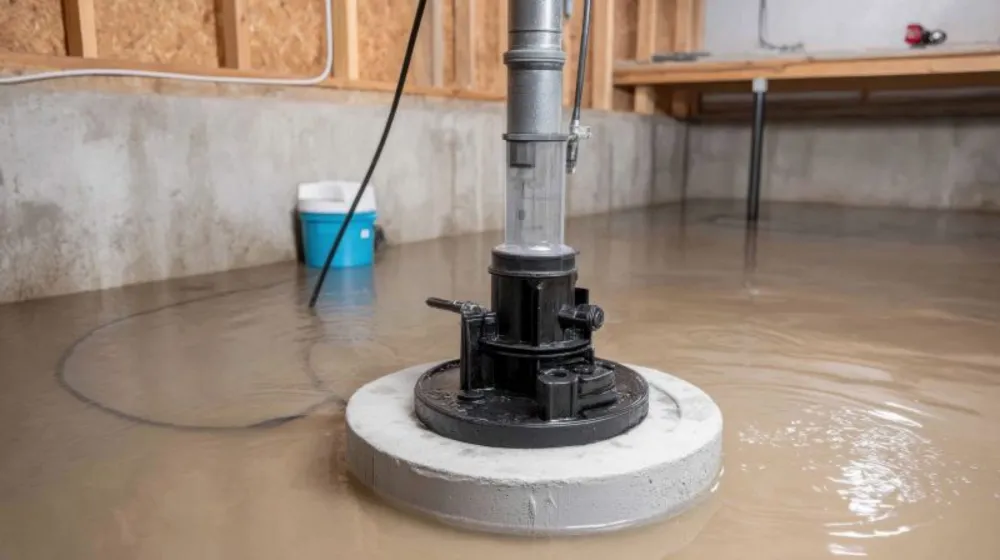
When a crew walks into a flooded basement after a storm, the pump post mortem usually lands on one of five causes, and Long Island restoration sources name the same list. First, power outage: the September 2026 storm alone left more than 124,000 PSEG Long Island customers without power, and a pump without power is a hole in the floor. Second, a tripped ground fault circuit interrupter (GFCI) outlet, which can silence a pump for weeks unnoticed. Third, a stuck or debris blocked float switch. Fourth, age: pumps live roughly 7 to 10 years. Fifth, a pump that runs but cannot keep up, because inflow beats its capacity or its discharge line is blocked. The defences match the causes: a battery backup pump, a tested outlet, a twice yearly bucket test, a high water alarm, and a replacement budget before the pump chooses its own retirement night.
Coastal flooding and storm surge: the South Shore reality
On Long Island, coastal flooding and storm surge hit the South Shore hardest, where barrier islands, Great South Bay, Hempstead Bay, and a web of canals put whole neighbourhoods within reach of ocean water pushed inland by a storm. Long Island has two coasts with two personalities. The North Shore faces Long Island Sound with bluffs and harbours. The South Shore faces the Atlantic behind a ribbon of barrier islands, with Great South Bay, Hempstead Bay, and a web of canals behind them. It is the South Shore, from Atlantic Beach and Long Beach through Freeport, Merrick, Massapequa, Lindenhurst, Babylon, Bay Shore, and Patchogue, and the low streets of the Rockaways facing Jamaica Bay, where storm water enters homes as a neighbourhood event, not a household accident.
How surge damage behaves
Surge water is Category 3 from the moment it crosses the threshold. It carries sand and silt that settle into every low space, salt that keeps corroding wiring, appliances, and HVAC equipment after the water leaves, and contamination from fuel tanks, vehicles, and overwhelmed septic systems. It usually wets the lowest level of the home evenly, which means the furnace, the water heater, the laundry, and the electrical panel are all in the loss together. Furnaces and panels that sat in salt water are safety questions, not cleaning questions, and they get inspected by the right trades before they are run again.
What recovery looks like after a storm
The order of work after surge is: safety and power first, then muck out, extraction, removal of wet porous materials, a fresh water rinse of framing and concrete to pull salt out of surfaces, disinfection, and then a longer dry than a plumbing job, because the whole shell of the house is wet. Contents sorting is a big part of storm work: what can be cleaned, what the salt and contamination ruined, and what needs photographing for the flood claim before it goes to the curb. After declared disasters, curbside debris rules and documentation requirements come from the town and from FEMA, and they change from storm to storm, so the crew helping you should know the current local rules rather than last storm's.
Flood zones, elevation, and the paperwork side
Most South Shore homes sit in FEMA mapped flood zones, commonly AE zones and, closest to open water, VE zones, and lenders require flood insurance there. Homes built or substantially improved after the maps carry elevation requirements, and after major damage, a town can require the repair to bring the home into compliance with flood resistant standards. This is not red tape for its own sake: a house raised or hardened after Sandy floods less in the next storm, and water damage restoration long island crews who work the South Shore plan around these rules on every rebuild. If you are buying or renovating on the South Shore, ask for the elevation certificate and the flood claim history of the property. Both exist, and both tell you more than the listing will.
What Superstorm Sandy taught Long Island, with the numbers stated carefully
The lesson Superstorm Sandy taught Long Island is that storm surge is the Island's worst case: it flooded South Shore ground floors, knocked out sewage infrastructure, and set recovery timelines measured in years, not weeks. Superstorm Sandy struck Long Island on 29 October 2012, and the numbers from that night deserve care, because sources count Sandy differently. On deaths, a Stony Brook University summary citing the National Hurricane Center report counts 13 deaths on Long Island, while LongIsland.com counts 14, so this page gives the range: 13 to 14 Long Island deaths, from sources that agree on the scale and differ by one. On homes, the sources converge: nearly 100,000 homes and businesses across Nassau County and Suffolk County were damaged or destroyed, and more than 900,000 customers across the two counties lost power. One early report, published on 30 October 2012, counted only 4 Long Island deaths; that was a first day figure, not a final one, and it should never be quoted as the toll.
On water levels, the honest version carries both figures. Long Beach's storm surge was reported as high as 17.48 feet, while the later official U.S. Geological Survey maximum was 12.45 feet at Kings Point; this page treats the Survey figure as the official one. The Survey's peak storm tide table gives 10.12 feet at Hudson Bay in Freeport, against a previous historical peak of 7.35 feet. On the ground: in Long Beach, the ocean literally met the bay and submerged almost the entire community, Freeport's Nautical Mile was completely swamped, Merrick and Bellmore saw thousands of homes flooded, and Lindenhurst, where 1,600 families south of Montauk Highway lived the storm firsthand according to a local restoration company's account, needed rescues by boat and truck. No verified town by town surge table for Merrick, Massapequa, Oceanside, or Island Park was found in the sources checked, so this page does not invent one.
Bay Park: when the sewage plant itself flooded
Sandy also flooded the infrastructure. The Bay Park Sewage Treatment Plant, which serves 500,000 Nassau residents, was shut down for two days after 9 feet of saltwater entered the facility. The Nature Conservancy records what that meant downstream: about 2.2 billion gallons of partially treated sewage and about 2 million gallons of raw sewage were released into the Western Bays. For homeowners, the lesson is that a big enough surge turns every water source on the coast into Category 3 water at once, which is why post storm cleanup on the South Shore always starts from contamination, not from clean water assumptions.
The 50 percent rule and the raised house
Two rebuilding rules came out of Sandy and still shape South Shore work. The first is the FEMA 50 percent rule, a live concern for Long Beach properties in the AE flood zone: if the cost of repairs to a flood zone structure equals or exceeds 50 percent of its market value, the entire structure must be brought into compliance with current flood elevation standards, and a good contractor flags that threshold before work begins. The second is the pattern Long Island actually built: rebuilding in Long Beach, Freeport, and Island Park now means elevating, with substantially damaged homes lifted on pilings. Salt water is the other lasting teacher: as one Long Beach restoration page puts it, salt water carries contaminants, accelerates material deterioration, and saturates structural components in ways fresh water does not, and any crew pricing surge work without a corrosion plan has not understood the job.
Cesspools and septic systems: Suffolk County's hidden half
Nearly 70 percent of Suffolk County homes rely on cesspools or septic systems instead of public sewers, according to Suffolk County, and a backup from one of those systems sends grossly contaminated Category 3 water into the home. Drive through most of Suffolk County and you are driving over cesspools and septic systems. Older homes often have a simple cesspool, a lined pit that both holds and leaches wastewater. Newer systems separate the jobs: a septic tank that settles solids, then a leach field or cesspool that disperses the liquid. Suffolk County has been pushing nitrogen reducing advanced systems for new and replacement installs near the water, because the same groundwater that floods basements also carries septic nitrogen into the bays. For water damage purposes, what matters is simpler: when the system cannot take water away, the water comes back into the house.
Why backups happen
The classic causes are a cesspool that is full or whose walls have clogged with years of biomat, a leach field saturated by heavy rain and a high water table, a blocked or root filled line between the house and the tank, and a house that suddenly uses far more water than the system was sized for, for example guests, a new high flow laundry routine, or a leaking toilet that runs day and night into the system. Backups often start as warnings: slow drains, gurgling, a basement toilet that bubbles, a wet or unusually green patch of lawn over the cesspool, and odours near drains. Those warnings are the cheap stage of the problem.
What to do in the first hour of a backup
Stop all water use in the house: no flushing, no laundry, no showers. Every gallon you send down a drain comes back up through the lowest one. Keep people and pets out of the affected rooms. Do not try to mop sewage into another drain, and do not run a shop vacuum over it. Call a cesspool or septic service to pump and diagnose the system, and call a restoration crew for the building: the two jobs are different trades, and you need both. Coordinating them on day one is standard practice for water damage restoration long island cesspool jobs. If the backup followed heavy rain and the whole street is having trouble, the system may recover as groundwater drops, but the cleanup inside the house is still Category 3 work that should not wait.
How the cleanup runs
Containment first, then removal of contaminated porous material, then cleaning and disinfection of the structure, then drying, in that order. Carpet and pad in the affected area come out. Drywall is cut above the highest point the sewage wicked. Hard surfaces, concrete, framing, tile, are cleaned and disinfected with products rated for sewage, with real dwell time, not a quick spray. Only then does drying equipment go in. The crew also documents the loss carefully, because whether insurance helps with a cesspool backup depends on your policy's specific endorsements, and the record is what an adjuster works from.
The Suffolk rules that changed in 2019 and 2021
Suffolk County has been rewriting its wastewater rules, and homeowners feel them the moment a system fails. Effective 1 July 2019, you can no longer install a cesspool only system as a replacement for a failing one. Since 1 July 2021, the county code has required nitrogen reducing advanced treatment systems for new residential construction, and the same requirement is triggered by a replacement dwelling, added bedrooms, an expansion needing a larger system, and major reconstruction, defined as work costing 50 percent or more of the home's market value. Existing working cesspools are grandfathered. Money help changed recently: in August 2026, Suffolk County Executive Ed Romaine launched a streamlined Septic Improvement Grant Program application, with grants of up to 45,000 dollars for advanced treatment technology. Older county pages showing a much smaller ceiling are outdated. Maintenance matters just as much: most Long Island cesspools need pumping every 1 to 2 years, against 3 to 5 years for septic tanks, and one local source notes that on Suffolk's shallow aquifer, pumping every 2 to 3 years is closer to reality than the national 4 to 5 year recommendation, contractor guidance rather than a county rule, but worth hearing before a backup teaches it.
Prevention that actually works
Pump the system on the schedule your cesspool company recommends for your household size, and keep the records. Keep wipes, grease, and garbage disposal overload out of the system; a cesspool is not a trash can. Know where your cesspool or tank is, keep vehicles off it, and keep its cover accessible rather than buried under a deck or a patio, because the emergency pump out you need at midnight starts with finding it. If your system is old and the yard allows it, ask about the county's advanced treatment options when replacement time comes: they protect the bays, and a modern system with a proper leach field backs up less often than a tired cesspool at the end of its life.
How long does drying actually take? Times, targets, and the meter readings that decide
Most Long Island homes dry in 3 to 5 days with professional equipment, the typical range under the IICRC S500 standard, and a drying job ends when meter readings meet the dry standard, not when the calendar says so. No competitor page read for this guide publishes a drying timeline table, which is strange, because how long will this take is the second question every homeowner asks. The professional framework is the IICRC S500, the Standard for Professional Water Damage Restoration, in its fifth edition from 2021. It is an industry standard, not a federal regulation, and it sorts losses by class, meaning how much of the building is wet and how tightly the materials hold water. Published drying times for the same class differ by source, so the table below uses the wider range that covers both, and no honest crew will promise you a single exact day count before the first readings.
| S500 class | What is wet | Drying time range |
|---|---|---|
| Class 1 | Part of one room, low porosity materials, little water absorbed. | 2 to 4 days with standard low grain refrigerant (LGR) dehumidifier drying. |
| Class 2 | A whole room, carpet and pad saturated, water wicked 12 to 24 inches up the walls. | 3 to 5 days. |
| Class 3 | Saturation from above: ceilings, walls, insulation, and flooring all wet. | 5 to 10 days. Flood cuts and insulation removal are often required. |
| Class 4 | Bound water in hardwood, concrete, plaster, or a crawl space. | 7 to 21 days or longer, with specialty drying. |
| Situation | Typical drying time | What changes it |
|---|---|---|
| Contained clean water leak | 2 to 3 days | Caught early, hard surfaces, source fixed on day one. |
| Standard room loss | 3 to 5 days | Carpet, pad, and wall bases wet; matches the average situation the big franchises quote. |
| Flooded finished basement | 5 to 10 days | Insulation in walls, groundwater still arriving, or sewage removal at the front of the job. |
| Hardwood and plaster | 7 to 14 days or longer | Dense materials release water slowly; North Shore plaster and lath sits at the long end. |
Dry is a reading, not a feeling, and the targets are worth knowing so you can read a drying log yourself. Under the S500 dry standard framing, wood framing is dry at or below 19 percent moisture content and drywall at or below about 17 percent, while field crews often work to a tighter target of roughly 12 to 16 percent for wood. Do not let anyone quote the tighter field number as if it were the standard. Drying is complete when wet materials read at the dry standard on two consecutive readings, not when the surface feels dry. Under the IICRC S500 dry standard, crews aim below 50 to 55 percent relative humidity in the affected space, because above 60 percent mold germination risk begins within 48 to 72 hours. The equipment has names you can ask about: Dri-Eaz LGR dehumidifiers and Velo air movers, Phoenix R250 and DryMAX XL dehumidifiers, Injectidry floor drying systems, and Delmhorst moisture meters. A company doing water damage restoration long island work to standard should show you the log, the targets, and the meter, every day of the job.
Test before you tear: the wet test, the flood cut, and why older Long Island homes get tested first
In an older Long Island home, nothing wet is torn out before it is tested: a screwdriver wet test shows how far the drywall is soaked, and materials from before 1978 are tested for asbestos and lead before they are cut. Two filmed lessons from working restoration educators have shaped how good crews handle a wet finished basement, and both are linked at the end of this section. The first comes from a basement that took a sewer backup and heavy rain. The teacher's rule is the wet test: push a screwdriver at the drywall. Wet drywall gives almost no resistance, in his words a 10 year old should be able to punch through a wet wall, and you keep testing upward, past even the visible stain, until the screwdriver meets real resistance and you have found dry material. Only then do you cut, and the flood cut is made as a straight line around the height of the doorknob, so one clean patch line repairs the wall later. Baseboards, casings, and jambs that sat in sewage water come off and go in the garbage. He warns that wet drywall screws rust and telegraph stains through new mud work, and that after cleaning you give the framing days before rebuilding: in his words, give it a week, and if the basement still smells, bacteria is still there. One caution: his bleach spray advice is a presenter's do it yourself advice, not the professional standard for Category 3 sewage water, which is removal, cleaning, and disinfection with rated products.
The second lesson matters even more on Long Island, where Nassau's median house was built in 1955 and much of the stock predates 1978. Before anyone tears into a water damaged home, test what is in the materials. Asbestos hides in drywall joint compound, flooring, vinyl tile, and mastics; lead paint is a 1978 and older question. The testing educator puts it plainly: if it is not raw wood, metal, or glass, it may contain asbestos, and her case study is a home built in 2000 where the owner insisted no testing was needed, and testing still found black mastic positive for asbestos. Looks dry is not dry either: moisture hides behind walls and under flooring. New York adds its own rule: under the state Mold Law in Labor Law Article 32, mold assessment and remediation must be done by separately licensed professionals, an assessor who is not the remediator, for mold work over 10 square feet. The order is extraction and drying, testing, safe mitigation, clearance testing, and only then rebuild. Watch both lessons here: the wet test and flood cut walkthrough and test before you tear, explained by a testing professional. No video is embedded on this page; both links open on YouTube.
The split level trap: when your family room is a basement in the eyes of flood insurance
The split level is Long Island's signature house, and it carries a trap most owners discover inside a flood claim. FEMA defines a basement as any area with its floor below ground level on all sides, and the lower level of a split level meets that definition under a National Flood Insurance Program policy, even when it is the room with the sofa and the good rug in it. That definition decides what gets paid for. NFIP building coverage in a basement pays for the furnace, water heater, central air equipment, electrical panel, sump pump, and foundation elements, plus pumping and structural drying. It does not pay for finished walls and floors, carpeting, bathroom fixtures, or most personal property below grade, and basement contents coverage is limited to clothes washers and dryers, portable air conditioners, and food freezers, only when connected to a power source. A homeowner who finishes a split level lower level to the standard of the rooms above it, without knowing this, has built the least insured room in the house.
The practical answers are boring and effective. Keep irreplaceable items out of the lower level, photograph what is down there before storm season, and ask your agent in writing how your policy treats the lower level. And when that lower level floods with groundwater, pump it the slow way described in the storm section: about one third of the water per day while the ground outside is still saturated, because the fastest way to turn a drying job into a foundation repair is to empty the basement against a wall of wet earth. Water damage restoration long island crews see this trap from both sides, the insurance side and the structural side, and a good first visit covers both.
Filing a water damage insurance claim on Long Island, step by step
On Long Island, a water damage claim belongs on the homeowners policy when the water came from a sudden event inside the home, and on a separate flood policy when the water rose from outside the home. Two different policies live in a Long Island home, and water damage sits right on the border between them. Homeowners insurance covers many sudden events inside the home. Flood insurance covers rising water from outside. Knowing which one you are claiming on, and documenting for it from the first hour, is the difference between a smooth claim and a fight. Nothing here is legal advice or a promise about your policy; it is how the process works in practice, so you can run it in the right order. On water damage restoration long island claims, that order, mitigation first and paperwork right behind it, is what adjusters expect to see.
- Stop the damage first. Every policy requires you to take reasonable steps to prevent further loss. Shut off the water, start emergency mitigation, and keep the receipts. Insurers expect this and reimburse reasonable emergency work on covered claims; what they question is damage that grew because nothing was done for a week.
- Document before, during, and after. Your first hour photos and video, the failed part itself (keep the split hose or the burst section of pipe if you can), the crew's moisture map and drying log, and photos of every item you throw away. For flood claims, a photo showing the high water line inside the home, with something of known size beside it, is worth a great deal.
- Report the claim the same day. Call your insurer or agent, or file in their app, and note the claim number, the date, and the name of everyone you speak with. If the water came from outside, the claim goes to your flood policy, which is often serviced by a different company than the one on your homeowners policy. If both are involved, a burst pipe during a storm is not rare, report both and let the adjusters sort the border.
- Know the usual coverage lines. Sudden and accidental discharge, a burst pipe, a failed water heater, a split appliance hose, is the core of homeowners water coverage. Sewer and drain backup, and cesspool backup, are usually covered only if you bought the specific endorsement, which many Long Island homeowners do not know they lack until the day they need it. Rising water, surge, and overflow of a body of water belong to flood insurance. Slow leaks, long term seepage, and maintenance failures are generally not covered by either, which is why the inspection report's wording about when the damage started matters.
- Meet the adjuster with the file ready. Walk the adjuster through the home with your photos, the crew's scope, and the list of damaged contents. Point out the hidden areas: the wall cavity readings, the subfloor, the basement mechanicals. Adjusters write what they can see and what is documented; a good restoration company gives them both, and can meet them on site to go through the scope line by line.
- Understand the money flow without surprises. Claims are usually paid in stages, with the deductible applied, and repair payments may be split between an initial amount and a later amount released when the work is shown complete. Keep every invoice, and do not sign a final release until the work is done and the drying is verified. If the scope and the settlement disagree badly, a licensed public adjuster is an option some homeowners use; they work for you, for a percentage, and they are regulated in New York.
- Keep the mitigation and rebuild paperwork together. One file: policy, claim number, photos, crew scope and logs, contents list, invoices, and the completion photos. If a future buyer, a future claim, or a dispute ever asks what happened in this house, that file is the answer.
The claim clock: the deadlines New York law actually sets
Homeowners ask two clock questions: how fast must the insurer move, and how fast must I move. One common claim about the answer is wrong. The 15 business day clocks do not come from Insurance Law 3420(d), which is a timely disclaimer rule for liability claims involving death or bodily injury and does not set the property claim clock at all. The property clocks come from Insurance Law 2601, which bans unfair claims settlement practices, together with Regulation 64, codified at Title 11, Part 216 of the New York Codes, Rules and Regulations (NYCRR). Under Regulation 64, an insurer must acknowledge a claim within 15 business days, begin its investigation within 15 business days, respond to pertinent communications within 15 business days, and tell you in writing that the claim is accepted or rejected, or that more time is needed and why. Inquiries from the New York State Department of Financial Services (DFS) must be answered within 10 business days. Insurance Law 2618 adds a disaster clock: within 15 business days of receiving a properly executed proof of loss and everything requested, the insurer must advise you in writing whether a non commercial claim is accepted or rejected, with one extension of 15 business days allowed on written notice. Calendar these dates from the day you file, and your dated claim diary is the evidence.
The flood policy clock runs on different numbers. A National Flood Insurance Program policy generally takes 30 days to take effect, with narrow exceptions such as a policy required at a mortgage closing, so it cannot be bought as a storm approaches. The standard NFIP limits are 250,000 dollars for the building and 100,000 dollars for contents, contents are paid at actual cash value, and the policy pays no additional living expenses. After a flood, your signed Proof of Loss is due within 60 days unless FEMA extends the deadline for that disaster, and missing it can cost you the right to recover under the policy at all. A denial can be appealed to FEMA within 60 calendar days of the denial letter, and a lawsuit is generally subject to a one year deadline from the first written denial, which an appeal does not extend. File early, document everything, and let the moisture map, the drying log, and the dated photos carry the claim while the clocks run.
The flood insurance points South Shore homeowners repeat to each other
Flood insurance through the National Flood Insurance Program is a separate policy with its own rules: there is typically a 30 day waiting period before it takes effect, building and contents coverage are separate choices, and basements have limited coverage under the standard form, which surprises people whose finished basement was the main loss. After Sandy, many South Shore homeowners also learned about Increased Cost of Compliance coverage, which can help with elevation or flood proofing when a home is substantially damaged. The lesson the Island took from that storm is plain: if your home is in a mapped flood zone, or near one, the time to review flood coverage is a calm spring afternoon, not the week a storm is in the forecast.
Claim coming up?
Our scopes, moisture maps, photos, and daily drying logs are written the way adjusters read them. Start with the free inspection.
Three Long Island jobs, walked through honestly
Three typical Long Island jobs, a sump pump that died in a March storm in Massapequa, a cesspool backup found on a Sunday in Smithtown, and a summer house pipe that ran all winter in East Hampton, show how water damage restoration long island work plays out in real houses. Case studies teach this trade better than brochures do. Restoration channels on YouTube, including long running drying and flood cut walkthroughs from working crews, hammer the same lessons: test before you tear, dry by the meter, and respect the water you cannot see. These three walkthroughs are typical Long Island jobs, with the details changed, showing how those lessons play out in real houses here.
Job one: the sump pump that died in a March storm, Massapequa
A nor'easter knocked out power on a South Shore street at the same hour the rain peaked. The sump pump in this raised ranch stopped with the power, and the basement, finished as a family room with a full bathroom, took on several inches of groundwater before the homeowner came down in the morning. The water was clean groundwater at entry, but it had sat overnight under furniture and inside the bottom of the walls. Extraction and a check of the wall bases showed wicking into the drywall and wet insulation, so the crew made a flood cut, pulled the insulation, and dried the framing in the open over four days of monitored drying. The bathroom tile and the framing survived; the carpet, pad, and lower drywall did not. The lasting fix was not the drying, it was the battery backup pump and high water alarm fitted afterward, so the next outage is an inconvenience instead of a claim.
Job two: the cesspool backup found on a Sunday, Smithtown
The first sign was a basement toilet gurgling when the upstairs shower ran. By Sunday afternoon, the lowest drain in the house was pushing sewage up onto the concrete. The family stopped all water use, the move that kept a bad job from becoming a whole house job. The cesspool service pumped the system and found a tired, full cesspool at the end of its working life. The restoration crew sealed the basement, removed the affected carpet and the lower drywall where sewage had wicked, disinfected the concrete and framing, and dried the structure. The claim turned on a detail worth remembering: their policy carried a backup endorsement, which they had not known about until the adjuster read the policy with them. Check yours before you need it.
Job three: the summer house pipe that ran all winter, East Hampton
A seasonal home, closed up in October, had a pipe freeze and split in a January cold snap. The break was above the kitchen, and water ran, froze, thawed, and ran again for weeks. A caretaker found it in March: ceilings down, hardwood buckled, and mold across the ground floor. The work ran in full containment: contents sorted and documented for the claim, moldy material removed, framing cleaned and dried, then a full rebuild. Two lessons come out of every one of these jobs. First, houses that sit empty need their water shut off and drained, or a monitored leak sensor with an automatic shutoff. Second, a neighbour or caretaker walking the house after every cold snap is worth more than any single product you can buy.
The wet test, the flood cut at doorknob height, and the test before you tear rule used in these walkthroughs are explained in full, with links to both filmed lessons, in the Test Before You Tear section above.
Real questions Long Island homeowners ask online
The questions Long Island homeowners ask most online are whether a musty basement smell means damage, whether hardware store fans can dry a real loss, why a wood floor cups after the water is gone, and what to do about an old cesspool. Browse the homeowner forums, the question sites, and the how to libraries, and the same worries come up again and again, from Reddit threads about wet basements to Quora questions about insurance to WikiHow searches about what to do tonight. Here are the ones we hear most, answered the way we would answer a neighbour. Together they cover most of what water damage restoration long island homeowners search for at 2 in the morning.
My basement smells musty every summer but I never see water. Is that damage?
It is a warning. A Long Island basement near the water table can run humid enough, from concrete and soil moisture alone, to feed mold on stored cardboard, wood, and the back of drywall without a single flood. Start with a hygrometer: if the basement sits above 60 percent relative humidity for weeks, it needs a properly sized dehumidifier and a check for slow leaks and seepage paths. If the smell is strong in one spot, get a moisture reading there before you store anything else against that wall.
Can I just dry it myself with fans from the hardware store?
For a small, clean, surface spill caught in the first hours, on tile or concrete, careful DIY drying can work. The limits are real: household fans move air but remove almost no moisture, so a closed room stays humid and the water migrates deeper instead of leaving. Anything inside a wall, under flooring, larger than a small room, or involving sewage or flood water is past the DIY line. The meter is the judge: if you cannot measure the moisture inside the materials, you cannot know you dried them, and finding out you did not, three months later, costs far more than the crew would have.
The water is gone but the wood floor is cupping. Did we fail?
Not necessarily. Cupping, where the edges of each board rise, is what hardwood does while it dries unevenly, and boards often settle back toward flat as moisture equalises, which can take weeks after the room reads dry. What floors cannot survive is being sanded flat while still wet, because when they finish drying they crown the other way. A floor drying mat system and patience save more hardwood than any quick fix. If the water came from below, through the subfloor, the outlook is harder, and the readings from under the floor decide.
Our cesspool is old. Should we connect, convert, or just keep pumping it?
That is partly a money question and partly a county question. Where sewers exist, connecting ends the backup risk from the system itself. Where they do not, Suffolk County incentives have made advanced nitrogen reducing systems more reachable at replacement time, and a new system with a sound leach field is far less backup prone than a tired cesspool. What does not work is ignoring the warnings: slow drains and gurgling are the system asking for attention while the fix is still a service visit rather than a cleanup.
We are buying a house on the South Shore. What water questions should we ask?
Ask for the flood insurance claim history and the elevation certificate. Ask whether the basement has ever taken water, then look for the evidence yourself: a tide line on the foundation, a newer sump pit, flood vents, raised mechanicals, water stains behind the basement stairs. Ask what the cesspool or septic is and when it was last pumped. A good home inspector with a moisture meter earns their fee on a South Shore purchase more than anywhere else on the Island.
How do I keep my pipes from freezing if I winter away from the Island?
The full answer is winterising: water off at the street side valve, lines drained, traps protected, heat set low but on, and someone local with a key. The partial answers all fail in the coldest week, which is the only week that matters. If draining is not practical, a monitored system that senses leaks and temperature and can close the main valve on its own is the modern substitute, and it should be tested before you leave, not discovered in March.
Towns and neighbourhoods covered across Nassau and Suffolk
Water damage restoration long island coverage on this page means the whole Island, end to end. The water problems shift as you travel: sewered streets and older housing in western Nassau, cesspool country through most of Suffolk, surge exposure all along the South Shore, and big seasonal homes at the East End that sit empty in winter. Local knowledge matters, because the crew that knows your town knows which of those problems your street usually has.
Towns and ZIP codes, grouped the way the water behaves
No competitor page read for this guide lists a single ZIP code, which is a gap, because ZIP codes are how Long Island homeowners actually search. ZIP codes below come from a Long Island ZIP directory built on U.S. Census Bureau 2020 geography covering 177 ZIP areas across the two counties, 69 primarily in Nassau and 108 primarily in Suffolk. A ZIP code is a postal routing tool, not a legal boundary, and a few, including 11758 for Massapequa and 11735 for Farmingdale, cross the county line.
| Group | Town and ZIP code | Local water note |
|---|---|---|
| Nassau south shore and barrier islands | Long Beach 11561, Atlantic Beach 11509, Island Park 11558, Oceanside 11572, Freeport 11520, Merrick 11566, Bellmore 11710, Wantagh 11793, Seaford 11783, Massapequa 11758, Massapequa Park 11762, Baldwin 11510, Lawrence 11559, Point Lookout 11569 | Canal and bay communities, surge and bay flooding risk, high water table, former wetlands. Point Lookout still depends on cesspools. |
| Nassau north shore and central | Port Washington 11050, Glen Cove 11542, Manhasset 11030, Great Neck 11020, 11021, 11023 and 11024, Roslyn 11576, Oyster Bay 11771, Syosset 11791, Hicksville 11801, Levittown 11756, East Meadow 11554, Garden City 11530, Mineola 11501 | Long Island Sound and harbour bluff risk with steep runoff on the north shore; flat terrain, poor drainage, and high water tables in East Meadow and Levittown. |
| Suffolk south shore, Babylon and Islip | Amityville 11701, Lindenhurst 11757, Copiague 11726, Babylon 11702, West Babylon 11704, Bay Shore 11706, Islip 11751, Oakdale 11769, Sayville 11782, Patchogue 11772, Mastic Beach 11951, Shirley 11967 | South shore bay communities. Lindenhurst and Copiague carry a documented note of persistent basement flooding tied to high tides and shallow aquifers. |
| Suffolk north shore, central, and East End | Huntington 11743, Northport 11768, Smithtown 11787, Stony Brook 11790, Port Jefferson 11777, Riverhead 11901, Southampton 11968, East Hampton 11937, Montauk 11954, Greenport 11944, Mattituck 11952, Shelter Island 11964 | Harbour and bluff runoff on the north shore, groundwater rebound risk around Lake Ronkonkoma and the Nissequogue basin in central Suffolk, and Atlantic surge with dune erosion on the East End, the coast named in the Fire Island to Montauk Point repair project. |
Nassau County
- Hempstead
- Freeport
- Long Beach
- Rockville Centre
- Baldwin
- Oceanside
- Merrick
- Bellmore
- Wantagh
- Seaford
- Massapequa
- Massapequa Park
- Levittown
- East Meadow
- Uniondale
- Valley Stream
- Lynbrook
- Malverne
- Franklin Square
- Elmont
- Garden City
- Mineola
- Westbury
- Hicksville
- Plainview
- Syosset
- Jericho
- Woodbury
- Bethpage
- Farmingdale
- Great Neck
- Manhasset
- Port Washington
- Roslyn
- Glen Cove
- Oyster Bay
- Glen Head
- Sea Cliff
- Locust Valley
- Bayville
- Island Park
- Point Lookout
- Atlantic Beach
- Floral Park
- New Hyde Park
- Williston Park
- Carle Place
Suffolk County
- Huntington
- Melville
- Dix Hills
- Commack
- Northport
- Smithtown
- Hauppauge
- Nesconset
- St. James
- Lake Grove
- Centereach
- Stony Brook
- Port Jefferson
- Setauket
- Miller Place
- Mount Sinai
- Rocky Point
- Ridge
- Medford
- Patchogue
- Bayport
- Blue Point
- Sayville
- West Sayville
- Oakdale
- Bohemia
- Ronkonkoma
- Holbrook
- Islip
- East Islip
- West Islip
- Bay Shore
- Brightwaters
- Deer Park
- Wyandanch
- Babylon
- West Babylon
- North Babylon
- Lindenhurst
- Copiague
- Amityville
- Brentwood
- Central Islip
- Shirley
- Mastic
- Center Moriches
- Riverhead
- Wading River
- Calverton
- Mattituck
- Southold
- Greenport
- Orient
- Shelter Island
- Hampton Bays
- Westhampton
- Quogue
- Southampton
- Bridgehampton
- Sag Harbor
- East Hampton
- Amagansett
- Montauk
The incorporated villages run their own building departments and sometimes their own rules for permits and flood compliance, and there are more than a hundred of them across the two counties. When rebuild work needs a permit, the village or town hall of the property is the authority, and the permit section in the FAQs below explains how that is handled.
Room by room: how water behaves in each part of the house
Water hides differently in every room of a Long Island house: under kitchen cabinets, around a toilet wax ring, inside a finished basement wall, and across a crawl space nobody opens for months.
Kitchens
Kitchen water hides. A dishwasher or ice maker line leak runs under cabinets and into the subfloor, and the first visible sign is often a toe kick swelling, a floor that feels soft in front of the sink, or a stain on the ceiling below. Drying a kitchen usually means pulling the toe kicks or the cabinets on the wet run, checking the subfloor with a meter from above and below, and drying under the cabinet boxes with directed air. Particle board cabinet bases that soaked and swelled do not recover; solid wood often does.
Bathrooms
Bathrooms leak at the toilet wax ring, the tub overflow, the shower valve, and the caulk lines everyone means to redo. A wax ring failure is the quiet destroyer: every flush sends a little water under the tile, and the subfloor rots until the toilet starts to rock. Bathroom jobs often involve the ceiling of the room below as much as the bathroom itself. Tile over a sound, dryable backer can be dried in place; tile over rotted wood cannot, and no drying plan should pretend otherwise.
Finished basements and family rooms
These rooms combine every risk: plumbing overhead, mechanicals in the corner, groundwater below, and finishes that hide all of it. Carpet and pad, drywall, paneling, and built in shelving all slow drying and hide moisture. The room by room rule here is that the finishes come second: the inspection reads the structure behind them, and the plan is honest about which finishes can be dried and which have to come off to save the framing.
Garages, crawl spaces, and attics
Garages flood from the driveway side when grading and drains fail, and they hold the things families forget they stored. Crawl spaces collect plumbing leaks and groundwater out of sight, and a wet crawl space feeds humidity and mold into the floor above. Attics take roof leaks and the occasional frozen pipe, and attic water announces itself on the ceiling below, sometimes a full season after it started. Each of these spaces needs its own access, ventilation, and drying plan, and each is skipped by a rushed inspection. A full water damage restoration long island inspection walks all of them, every time.
The Long Island water damage calendar
Long Island water damage follows a calendar: spring snowmelt and rain flood basements, summer brings downpours and humidity driven mold, autumn brings peak storm and nor'easter season, and winter brings frozen and burst pipes. Water damage restoration long island work follows a calendar, and planning against it is cheaper than reacting to it.
| Season | What floods | What to do before it |
|---|---|---|
| Spring | Snowmelt and spring rain on a high water table: basement seepage, sump pumps running non stop, cesspools struggling in saturated ground. | Test the sump pump, clear gutters and window wells, and walk the basement after the first heavy rain of the year. |
| Summer | Thunderstorm downpours, humidity driven mold in basements, air conditioner condensate lines clogging and overflowing, and the start of hurricane season on the coast. | Service the condensate drain, run basement dehumidification, check the flood policy is in force, and photograph the home's condition for your records. |
| Autumn | Peak tropical storm and nor'easter season: surge on the South Shore, wind driven rain, and leaf clogged gutters pouring water at the foundation. | Clear gutters after the leaves, check bulkhead door seals, raise low storage in surge streets, and review the storm plan before the forecast, not during it. |
| Winter | Frozen and burst pipes, ice dams leaking into top floor ceilings, and water heater failures in cold basements. | Insulate exposed pipes, winterise empty houses properly, keep the heat on in cold snaps, and know the main shutoff by heart. |
Renters, landlords, condos, and co-ops: who is responsible for what
On Long Island, the landlord owns the structure and carries the duty to repair water damage and keep a rental home habitable, while a tenant's belongings are the tenant's own responsibility. Not every Long Island home is a single family house with one owner, and water does not care about the paperwork. In a rental house or apartment, the landlord owns the structure and carries the duty to repair it and keep it habitable; the tenant's belongings are the tenant's, covered by a renters policy if they have one. The practical rule for both sides is speed: the tenant reports the leak the moment it is found and moves belongings out of the water, and the landlord authorises mitigation the same day. Most landlord and tenant fights about water damage are really fights about a leak that was reported late or a repair that was authorised late, and both are avoidable.
| Situation | Who pays, and why |
|---|---|
| Your own pipe, hose, or water heater fails | You claim on your own homeowners policy under its sudden and accidental water coverage, and you carry the duty to mitigate at once. The structure and your belongings are both your claim. |
| You rent the home | The landlord repairs the structure. New York Real Property Law 235-b gives every residential tenant a warranty of habitability that cannot be signed away, and landlords must fix leaks the renter did not cause. Your belongings are covered by your own renters policy, if you carry one. The Long Island tenant whose rented house flooded with sewage from a failing system, and who had paid for the service twice, was advised on a legal question site to bring a landlord and tenant action for breach of that warranty. |
| Co-op apartment | Start with the proprietary lease. Co-ops are more likely than condos to see the building shoulder the bulk of the cost, inside and outside the apartment, and co-op tenant shareholders can rely on the warranty of habitability against the co-operative corporation, alongside the Housing Maintenance Code and the Multiple Dwelling Law. |
| Condo unit | The declaration of condominium draws the line: everything inside the unit is the unit owner's, everything outside it is a common element for the board of managers. A New York appeals court held in Frisch v Bellmarc Management that the warranty of habitability does not apply to condominiums, because condo ownership is fee ownership, not a lease. Without proof of someone else's negligence, the unit owner fixes the unit and then pursues the party at fault. |
| An upstairs neighbour leaks into your home | The negligent party ultimately pays: a neighbour who fails to maintain a tub, a hose, or an appliance and damages the home below is responsible under standard negligence law. In practice, your own homeowners, HO-6, or renters policy usually covers your interior damage first, regardless of fault, and your insurer then pursues the responsible party through subrogation. Risers that run floor to floor are the building's; branch pipes serving only one unit are that unit owner's, even inside a wall. |
| The sewer backs up | It turns on the lateral. In most Long Island sewer districts the pipe from your house to the street main is yours, and the main is the district's. A blockage in your lateral is your repair; a failure of the district main is the district's problem. Cleanup inside the home is usually covered only if your policy carries a water backup endorsement. |
| A cesspool or septic system backs up in Suffolk | The system is yours, and so is the cleanup, unless your policy carries a sewer or drain backup endorsement, and some policies exclude cesspool failures even then. A slow drain in cesspool country is often not a drain problem at all: it is a full cesspool announcing itself, and pumping it early is the cheapest version of this row in the table. |
For a Long Island condo or homeowners association community, the declaration, bylaws, and offering plan control that unit versus common element line, the association generally maintains common elements and shared systems, and negligence by a neighbour or by the association shifts the cost to the negligent party. Most single family homes on Long Island have no association at all, so these rows matter mainly in the Island's co-op and condo buildings, not in its detached houses.
Condos and co-ops, which are common across Nassau and in Suffolk's denser communities, split the building differently. The association's master policy covers the structure and shared systems: the roof, the shared stacks, the common pipes. The unit owner's policy covers the inside of the unit: finishes, fixtures, and belongings. The exact border is written in the association's documents, and it differs from one community to the next. When a leak starts in a shared stack or a neighbour's unit, document whose pipe failed and when, because that record is what the two insurers use to settle between themselves. Report to the association and to your own carrier the same day, and do not let a dispute about whose claim it is delay the drying: wet drywall does not wait for paperwork.
For estate homes, second homes, and homes in probate or between owners, the same logic applies with one addition: name one person who can authorise emergency work and give the crew their number. More than one East End job has grown from a drying visit into a mold remediation because the house sat wet while a family decided who was allowed to say yes.
Prevention: the cheapest restoration is the one you never need
The cheapest water damage restoration job on Long Island is the one prevention makes unnecessary, and it starts with one annual check of the sump pump, gutters, supply hoses, and shutoff valves. None of this list is glamorous, and all of it together costs less than one flooded basement. Work through it once a year, ideally in spring, and after any job we do together, because a home that has flooded once has told you exactly where it is weak. Prevention is the quiet half of water damage restoration long island work, and it is the half entirely in your hands.
- Know your main shutoff and tag it. Show every adult in the house where it is and how it turns. Test it once a year so it is not seized solid on the day you need it.
- Test the sump pump twice a year. Pour water into the pit, watch it cycle, listen for strain, and check the discharge line outside is clear. Budget for a backup pump or a battery system if the basement has ever taken water.
- Replace washing machine hoses with braided steel, and replace them again on the maker's schedule. Add a leak sensor with an automatic shutoff behind the machine if the laundry is on a living floor.
- Put leak sensors under the water heater, behind the refrigerator, under sinks, and by the sump pit. A sensor that shouts on day one turns a month of hidden rot into a towel and a phone call.
- Service the cesspool or septic on schedule and keep the pumping records. Know where the cover is and keep it reachable.
- Grade and gutters: soil should slope away from the foundation, downspouts should discharge well away from the house, and window wells should be covered and clear.
- Insulate pipes in the crawl space, garage, and outside walls, and seal the gaps where wind reaches them. Winterise any house that will sit empty.
- Check the water heater's age and pan. A heater past its expected life, with rust at the base or a damp floor around it, is a scheduled replacement, not a surprise waiting for a date.
- Keep the basement honest: plastic bins instead of cardboard, shelving instead of floor piles, and nothing irreplaceable at floor level.
- Review both policies once a year: homeowners, including whether you carry the sewer and backup endorsement, and flood, if your home is in or near a mapped zone. The review takes an hour and is the only item on this list that pays out in paperwork instead of prevention.
After the drying: the rebuild, done in the right order
The rebuild starts only when the drying verification says the structure is ready, because new drywall over a damp stud is a mold farm with fresh paint on it. From there the order is steady: framing repairs if any are needed, insulation, drywall hung and finished, trim and baseboards, flooring, cabinets and fixtures reinstalled, then paint, then the final walkthrough against the pre loss photos. In flood zone homes, the rebuild may also carry compliance work, flood vents, raised mechanicals, or materials rated for wet locations at the lowest level, and the town or village building department confirms what applies before the work starts, not after.
Two habits make rebuilds go well. First, one point of contact: the same team that holds the mitigation file should hold the rebuild schedule, so nothing falls between two companies. Second, decisions in writing: flooring, paint, and fixture choices recorded as they are made, so the finished room matches what you expected and the claim file shows what was replaced with what. That single file habit runs through every water damage restoration long island job on this page, from the first photo to the last invoice. The goal of the whole process, from the first extraction wand to the last coat of paint, is boring in the best way: a house that looks, smells, and reads on a moisture meter exactly as it did before the water came in.
Ready when you are, day or night
Free inspection, moisture map, and a written scope before any work is agreed. Nassau and Suffolk, both shores.
How the house is built changes the job: Long Island housing stock
How a Long Island house was built decides how it takes water: the postwar cape and ranch, the split level, colonials and newer construction, and the older plaster and lath North Shore home each hand the crew different materials and weak points. Two homes on the same street can take the same water completely differently, because water damage restoration on Long Island is always working on a specific building, not a generic one. The Island was built in waves, and each wave left its own materials, its own floor plans, and its own weak points. A crew that reads the house before it reads the water makes better decisions in the first hour, and those decisions decide what survives.
The postwar cape and the ranch
Levittown and the hundreds of developments that copied it filled Nassau and western Suffolk with capes and ranches in the late 1940s and 1950s. These houses are the backbone of water damage restoration long island work. Many have been expanded up and out over the decades, and the additions are where the trouble hides: a bathroom added over a slab with pipes in the concrete, a dormer whose flashing has been patched for years, a laundry moved to the first floor with hoses nobody has looked at since. Original plumbing in these homes is now old enough that corrosion failures are a steady source of calls, and original cesspools, where they survive, are older still. These are simple, honest structures, and they dry predictably when the crew knows where the additions changed the plan.
The split level
The split level, the Island's signature 1960s and 1970s house, puts its lowest living level half below grade. That lower level, usually the family room with the laundry and a half bath nearby, sits with its floor close to the water table and its walls buried on the outside. Groundwater pressure, cove joint seepage, and sump failures all land in the room the family actually lives in. Split levels also stack plumbing oddly, so a leak in the mid level bathroom can wet the lower level ceiling and the garage in the same event. Anyone pricing water damage restoration on Long Island without asking whether the house is a split level has not pictured your basement correctly.
Colonials, high ranches, and newer construction
Later building waves brought centre hall colonials and high ranches with full basements and two full floors of plumbing. More bathrooms means more wax rings, more shower valves, and more supply lines, and a second floor leak wets the ceiling, walls, and floor of the rooms below in one path. Newer construction adds its own twist: tighter building envelopes dry more slowly once water gets inside the walls, and engineered flooring and manufactured cabinet materials tolerate water worse than the solid wood they replaced. Modern does not mean immune; it means the inspection has to be more careful, because the damage hides better.
Plaster, lath, and the older North Shore home
Head to the older villages of the North Shore, and to the pre war housing scattered through both counties, and the walls change. Plaster over wood lath holds far more water than modern drywall and gives it back far more slowly. These are Class 4 drying jobs: the wall looks solid while it is quietly saturated, and it needs longer, gentler, well monitored drying rather than demolition as a first resort, because original plaster is worth saving and hard to match. The same homes often have cast iron drains and galvanised supply lines at the end of their working lives, and fieldstone or early concrete foundations that pass groundwater in wet springs. Water damage restoration long island crews who work the North Shore plan for patience: meter readings over days, not hours, and demolition only where the readings prove the material is lost.
Waterfront and raised homes
After Sandy, the South Shore rebuilt differently. Homes were raised on new foundations, mechanicals moved up out of the flood level, flood vents fitted, and the lowest spaces rebuilt with materials chosen to survive getting wet. These houses change the restoration plan completely: the ground level is designed to drain and dry, the living space starts a full storey up, and a surge event that would have been a whole house loss in the old house becomes a wash out and dry out of a sacrificial level. If your home was raised, tell the crew when you call, and tell them where the mechanicals now sit, because the first hour plan for a raised home is a different plan, and a better one.
Frequently asked questions about water damage restoration on Long Island
How fast can a crew reach my Long Island home?
Crews cover Nassau County and Suffolk County around the clock, and most calls are answered live, day or night. Travel time depends on where you are on the Island: western Nassau is close to the city, while the East End adds road time on the Long Island Expressway or Sunrise Highway. When you call, you get a straight answer about timing for your town, and the first jobs, stopping the water and starting extraction, are talked through on the phone so work begins before the truck arrives.
What should I do first when my basement floods?
Keep clear of the water if it is anywhere near outlets or the electrical panel. Then stop the source if you can: close the main shutoff for a burst pipe, or check whether the sump pump has power during a storm flood. Move boxes, rugs, and anything cardboard off the floor, take photos and video of the water line, and call for extraction. A flooded basement on Long Island often points to a high water table or a failed pump, so the cause matters as much as the cleanup.
Does homeowners insurance cover water damage on Long Island?
A standard homeowners policy usually covers sudden and accidental water damage, like a burst pipe, a split washing machine hose, or a water heater that lets go. It usually does not cover flood water that comes in from outside, slow leaks that ran for months, or a cesspool backup unless you carry a specific endorsement. Storm surge and rising bay or ocean water fall under flood insurance, which is a separate policy. Document everything, report the loss early, and keep receipts for emergency work.
Is flood insurance different from homeowners insurance?
Yes. Flood insurance is a separate policy, most often through the National Flood Insurance Program, and it covers damage from rising water outside the home: storm surge, overflowing bays and inlets, and heavy rain that pools and enters at ground level. Homeowners insurance covers many inside sources, like burst pipes. South Shore towns on Long Island sit in mapped flood zones where lenders often require flood insurance, and there is usually a waiting period before a new flood policy takes effect, so it cannot be bought the week a storm is coming.
How long does drying take after water damage?
Most Long Island homes dry in 3 to 5 days with professional air movers and dehumidifiers, but the honest answer depends on what got wet. A clean water spill on tile can dry in 2 days. Wet hardwood, plaster walls, and a finished basement with insulation inside the walls take longer, and water that sat for days before anyone called takes longest of all. Drying is finished by meter readings, not by the calendar: the crew checks moisture in the materials daily and removes equipment only when readings match a known dry standard.
How quickly can mold start growing after a leak?
Mold can start growing on wet drywall, wood, and carpet padding within 24 to 48 hours when the material stays damp and the room is warm. That clock is why extraction and drying on day one matter so much. On Long Island, humid summer air slows drying and speeds mold up, especially in basements that already run damp. If water has been sitting for more than a day or two, or you can smell a musty odour, ask for a moisture inspection behind the walls as part of the visit.
Why does my Long Island basement flood every time it rains hard?
Repeat basement flooding usually has one of four causes: a high water table pushing groundwater up through the floor and the cove joint where the floor meets the wall, a sump pump that is undersized, dead, or without backup power, gutters and grading that dump roof water against the foundation, or a cesspool and septic system that cannot keep up in saturated ground. A good inspection checks all four, because mopping up without fixing the cause just books the same flood again for the next storm.
What happens when a cesspool backs up into the house?
A cesspool or septic backup pushes sewage into the lowest drains first, usually a basement toilet, tub, or floor drain. Treat that water as contaminated: keep people and pets out of the room, do not run more water anywhere in the house, and call both a cesspool service for the system and a restoration crew for the cleanup. The affected materials, especially carpet, padding, and drywall that soaked up sewage, normally have to come out, and the structure is cleaned and disinfected before drying.
Can hardwood floors be saved after water damage?
Often, yes, if drying starts fast. Solid hardwood can be dried in place with floor mat systems that pull moisture out through the boards, and cupped boards often settle back as they dry. The risk cases are water that sat for days, water that came up from below through the subfloor, and engineered floors whose layers separate when wet. A moisture reading of the boards and the subfloor decides it, which is why the inspection matters before anyone promises the floor will survive.
What is the difference between water mitigation and restoration?
Mitigation is the emergency half: stopping the water, extracting it, removing materials that cannot be saved, and drying the structure so the damage does not grow. Restoration is the second half: putting the home back together with new drywall, flooring, trim, and paint. Some companies only mitigate and hand you off to a separate contractor for the rebuild. This page covers both halves, so one crew dries the house and the same team manages the repairs that follow.
Do I need to leave my home during drying?
Usually not for clean water damage. Drying equipment is loud and the rooms being dried get warm, so many families sleep away from the work area but stay in the house. You should plan to stay elsewhere when sewage is involved, when a large part of the home is affected, when the power has to stay off, or when anyone in the home has breathing problems that dust and disruption would aggravate. Your crew should tell you plainly which case yours is on the first visit.
Will insurance pay for a hotel if I cannot stay in the house?
Many homeowners policies include loss of use coverage, sometimes called additional living expense coverage, which pays for a hotel and extra food costs when a covered loss makes the home unfit to live in. It applies to covered causes, so a burst pipe claim often qualifies while a flood without flood insurance may not. Keep every receipt, and ask your adjuster early, before you book a long stay, so the limits on your policy are clear.
How do I know if water got behind my walls?
Signs include paint that bubbles or peels days after the event, baseboards that swell or separate, a musty smell that will not clear, floors that feel spongy near a wall, and stains that keep growing after the surface looks dry. The certain way to know is a moisture inspection: pin and pinless meters read the water inside drywall and studs, and a thermal camera shows the cold pattern of a wet area. Water travels along framing and pipes, so the wet area is often wider than the stain you can see.
What does a free inspection include?
A proper free inspection covers the source of the water, moisture readings in floors, walls, and ceilings around the damage, a check for hidden water behind walls and under flooring, photos for your records and your claim, and a written scope of what needs extraction, removal, drying, or repair. On Long Island it should also cover the likely cause, like a failed sump pump or a cesspool problem, so the same damage does not come back with the next storm.
Can you dry a finished basement without tearing it apart?
Sometimes. If the water was clean, shallow, and caught early, crews can dry finished basements by pulling baseboards and drilling small holes to move air inside the wall cavities, then patching the holes afterward. If water sat for days, came from a cesspool or the ground, or wicked high into insulation, the lower drywall usually has to come off in a clean flood cut so the cavity can be cleaned and dried properly. The moisture readings and the water source decide, not a guess.
What should I throw away after a flood?
After any flood, throw away food that touched water, soaked cardboard, and medicine or cosmetics that got wet. After sewage or outside flood water, add carpet padding, stuffed toys, and upholstered furniture that soaked through, because they cannot be cleaned to a safe standard. Photograph everything before it goes out, and keep a list with rough values for your claim. Solid wood furniture, metal, and glass usually clean up fine, and clothing and linens can often be laundered or dry cleaned.
Does my town need a permit for the repair work?
Emergency mitigation, extraction, drying, and removing wet material, does not need a permit. Rebuild work can: the Town of Hempstead, Town of Babylon, Town of Islip, Town of Brookhaven, and the incorporated villages each run their own building departments, and rules differ on electrical, plumbing, and structural repairs. Homes in mapped flood zones may also have to meet flood resistant construction rules when repairs are extensive. Your contractor should confirm with your town or village before the rebuild starts.
How is storm surge damage different from a burst pipe?
Surge water comes from outside, carries sand, salt, fuel, and sewage with it, and is treated as contaminated, so porous materials it touches usually come out. It also tends to affect the whole ground floor or basement at once, along with the furnace, water heater, and electrical panel, which a pipe leak rarely does. Insurance treats it differently too: surge is flood, covered by flood insurance rather than a standard homeowners policy. Salt water also keeps corroding metal and wiring after the water leaves, so the cleanup includes rinsing and corrosion checks.
Should I call my insurance company or a restoration crew first?
Call the restoration crew first if water is still spreading, because your policy requires you to limit further damage and every hour of soaking makes the loss bigger. Start extraction and drying, document as you go, and report the claim the same day. Adjusters expect emergency mitigation to begin before they visit. What you should not do is sign a large rebuild contract or throw away damaged items before the claim is documented.
What areas of Long Island do you cover?
All of Nassau County and Suffolk County: the Town of Hempstead, North Hempstead, and Oyster Bay in Nassau, and Babylon, Islip, Brookhaven, Smithtown, Huntington, Riverhead, Southampton, and East Hampton in Suffolk, plus the incorporated villages and the East End. That runs from Great Neck, Garden City, and Rockville Centre in the west to Montauk, Greenport, and Orient at the far end, and both shores, the South Shore bay towns and the North Shore harbour towns.
Can a water heater leak really do that much damage?
Yes, because it rarely announces itself. A water heater in a basement or utility closet can leak slowly for days, soaking the floor and the bottom of the walls, or fail all at once and release its full tank plus the supply line feeding it until someone closes the valve. Heaters near the end of their working life, and tanks with corroded fittings, are a steady source of Long Island basement claims. If the floor around your heater is damp or the pan is rusted, treat it as urgent, not as a someday job.
What is a flood cut and why do crews make one?
A flood cut is a straight, level cut that removes the bottom section of wet drywall, usually 2 feet up from the floor or just above the highest moisture reading. It lets the crew pull wet insulation, clean and disinfect the wall cavity, and dry the studs and plates completely. It sounds drastic, but one clean cut and one patch line repairs faster and straighter than chasing soft, mouldy drywall in patches, and it is the standard approach after sewage, surge, or water that wicked up inside a wall.
Do you work with renters and landlords on Long Island?
Yes. In a rental, the landlord owns the structure and is responsible for repairing it, while the tenant's belongings fall under the tenant's own renters policy. The fastest jobs happen when both sides talk early: the tenant reports the leak at once and moves belongings out of the water, and the landlord authorises mitigation so drying starts the same day. Crews document the work so both the owner's claim and the tenant's claim have the records they need.
How do I stop my pipes from freezing and bursting in winter?
Insulate pipes in the crawl space, garage, and outside walls, and seal the gaps where cold air reaches them. On the coldest nights, keep the heat on, open cabinet doors under sinks on outside walls, and let a tap drip slowly. Know where your main shutoff is before you need it. North Shore homes exposed to wind off the Sound and summer homes on the East End that sit empty in winter are the classic burst pipe cases on Long Island, and empty houses should be winterised or checked after every cold snap.
What is the musty smell in my basement after the water is gone?
A musty smell that lingers after the visible water is gone almost always means something is still wet: the bottom of a wall cavity, carpet padding that never fully dried, insulation, or the soil and concrete of a damp basement feeding humid air. On Long Island, basements sit close to the water table, so a dehumidifier that only ran for a day often is not enough. A moisture recheck finds the wet spot; drying it out properly is what actually ends the smell, not sprays or candles.
Can you save wet documents, photos, and keepsakes?
Often, if they are handled quickly and kept wet rather than allowed to half dry and stick together. Papers and photos can be air dried in small batches or frozen to stop mold and buy time, then dried properly later. Books with coated pages and items that sat in sewage are harder. Tell the crew on the first call that keepsakes are involved, because the first hours decide what survives, and keep family photos and documents at the top of the list of things to move out of a wet room.
What does Category 1, 2, and 3 water mean?
The categories describe how contaminated the water is. Category 1 is clean water from a supply line, a sink overflow of clear water, or a broken pipe. Category 2 carries chemicals or waste that can make people sick, like dishwasher or washing machine discharge and toilet overflow with urine. Category 3 is grossly contaminated: sewage, cesspool backups, and flood water from outside, including storm surge. The category decides what protective gear the crew wears, what materials can be dried, and what has to be removed.
Will the drying equipment raise my electric bill a lot?
Drying equipment does draw power for a few days, and on Long Island, where PSEG Long Island rates are not cheap, homeowners notice it. The increase is real but modest next to the damage that slow drying causes, and many insurers treat the extra electricity as part of the loss when it is documented. Keep your bill and the one from the same month last year; the crew's drying log shows exactly which days the equipment ran, which supports the claim.
How do I choose a water damage company I can trust?
Look for a company that answers the phone at night with a real person, gives a free inspection with moisture readings rather than a quote over the phone, explains what will be removed and why, documents the job with photos and daily drying logs for your insurer, and can handle the rebuild so you are not handed off mid job. Be wary of anyone who demands a large cash payment up front, pressures you to sign before the inspection, or cannot explain how they will prove the house is dry when they finish.
What if the damage is in a condo or co-op on Long Island?
Condo and co-op water damage splits responsibility. The association's master policy usually covers the structure and shared systems, while your own policy covers your unit's finishes and belongings, and the exact line between them sits in the association documents. Leaks from a neighbour's unit, a shared stack, or a roof are common in Long Island condo communities. Report the loss to the association and your own carrier the same day, and let the restoration crew document whose pipe or appliance failed, because that record decides which policy pays.
How much does water damage restoration cost on Long Island?
There is no honest single figure, because the scope is set by how much water got in, how far it spread, which materials it touched, and how long it sat, and any company that quotes a firm price over the phone has not seen your home. What you can hold every company to is this order: a free inspection first, moisture readings that show the real extent of the damage, and a written scope before paid work begins, so you approve a defined job rather than an open ended one. If the loss is covered, the documented scope is also what your insurer works from. Call for the free inspection and judge the company on the readings and the scope it puts in front of you.
What should I do in the first 48 hours after a storm floods my Long Island home?
Photograph and video everything before you move it, including the water line inside and out. Keep clear of water near the electrical panel, keep generators outside, and report the claim to your homeowners carrier and your flood carrier the same day, keeping every receipt. If the basement holds several feet of groundwater and the ground outside is still saturated, pump out about one third of the water per day rather than emptying it at once, because draining fast against saturated ground can crack foundation walls. Then get extraction and drying started inside the window the Environmental Protection Agency sets: dry water damaged areas within 24 to 48 hours to prevent mold growth.
Who pays if the sewer backs up, me or the town?
It turns on where the blockage sits. In most Long Island sewer districts, the pipe from your house to the street main, called the lateral, is the homeowner's responsibility, and the street main is the district's. A blockage or a break in your lateral is your repair; a failure of the district main is the district's problem, and your first call in a street wide event is the district, not a plumber. Cleanup inside the home is a separate question: standard homeowners policies usually exclude sewer backup unless you carry a specific water backup endorsement, so check your policy for that endorsement before you need it.
Is a failed sump pump covered by homeowners insurance?
Usually only if your policy carries a water backup or sump pump overflow endorsement. A standard policy commonly excludes sump overflow and sewer backup, which surprises Long Island homeowners because the failed pump is the single most common storm loss here: pumps die in power outages, on tripped outlets, on stuck floats, and at the end of a working life of roughly 7 to 10 years. If you do carry the endorsement, document the failure, keep the failed pump, and photograph the water line. If you do not carry it, the drying still needs doing at once, and adding the endorsement afterward is a calm weather job worth the conversation with your agent.
Does flood insurance treat a split level lower level as a basement?
Yes, and it is the most expensive surprise in Long Island flood claims. FEMA defines a basement as any area with its floor below ground level on all sides, and the sunken lower level of a split level meets that definition even when it is a finished family room. Under a National Flood Insurance Program policy, basement building coverage pays for items like the furnace, water heater, electrical panel, and sump pump, plus pumping and structural drying, but not for finished walls and floors, carpeting, or most contents stored below grade. Contents coverage down there is limited to washers, dryers, portable air conditioners, and food freezers connected to a power source.
Is a clogged drain in my Suffolk home actually a cesspool problem?
Often, yes. Nearly 70 percent of Suffolk County homes run on cesspools or septic systems rather than sewers, so a backed up drain is frequently not a drain problem at all: it is a full or failing cesspool announcing itself through the lowest drain in the house. The warning signs are slow drains across the house, gurgling, a basement toilet that bubbles when an upstairs shower runs, and a wet or unusually green patch of lawn over the system. Stop running water, because every gallon sent down a drain comes back up, and call a cesspool service to pump and diagnose the system alongside the restoration crew who makes the house safe.
What is the FEMA 50 percent rule and could it change my repair?
It can, on the South Shore. If the cost of repairs to a structure in a mapped flood zone equals or exceeds 50 percent of the structure's market value, the whole structure must be brought into compliance with current flood elevation standards. It is a real and active concern for Long Beach properties in the AE flood zone, and it can turn a repair that looks like drywall and flooring into an elevation project. A good contractor flags the threshold before work begins, checks it with your town or village building department, and plans the scope with the rule in view, rather than discovering it halfway through the job.
How long does the full restoration take, including the rebuild?
Drying is only the first half. A contained clean water loss typically dries in 2 to 3 days and a standard room loss in 3 to 5 days, while a flooded finished basement can take 5 to 10 days and hardwood or plaster 7 to 14 days or longer, with drying proven by meter readings rather than the calendar. The rebuild that follows, drywall, flooring, trim, cabinets, and paint, commonly runs 1 to 3 weeks depending on scope, permits, and material choices. Severe flooding or sewage losses stretch both halves. Anyone who gives you one exact finish date before the first moisture readings is guessing; the readings, updated daily, are the schedule you can trust.
How quickly should I call for water damage restoration on Long Island?
Call the same day you find the water, and call right away if it is still spreading. Water wicks up drywall, runs under flooring, and soaks insulation within hours, and mold can start within 24 to 48 hours on wet materials. Your policy also expects you to limit further damage, so a fast call protects both the home and the claim. Crews answer day or night, and the first steps can start on the phone.
What happens during a water damage restoration visit?
The crew starts by finding the source and stopping it, then maps the moisture with meters and thermal imaging so hidden water is found, not guessed at. Standing water is extracted, materials that cannot be saved are removed, and air movers and dehumidifiers are set for the rooms affected. Readings are checked daily until the structure proves dry, and every reading is documented for your claim.
What are the most common causes of water damage on Long Island?
The calls crews see most are sump pump failures during storms, burst and frozen pipes, water heater leaks, washing machine and dishwasher hose failures, cesspool and septic backups in Suffolk, groundwater pushing through basement floors where the water table is high, roof leaks and ice dams, and storm surge along the South Shore. The full causes section above walks through each one and how it behaves.
Do you work with my insurance company?
Yes. The crew documents the loss the way adjusters need it: dated photos, moisture readings, a written scope, and daily drying records. That file goes to your carrier, the crew meets the adjuster on site when needed, and covered emergency work is billed through the claim. You stay the policyholder in charge; the paperwork is built so the adjuster can say yes without a second visit.
All pages on this site
Water damage restoration long island coverage is one part of a wider New York site. The home page covers the whole New York area, each borough page is written for its own housing stock, and the service pages go deep on one problem at a time: a claim, water behind walls, fire, flood, remediation, and cleanup. Every page carries the same free inspection offer and the same claim documentation standard.
Water Damage Restoration Syracuse
Lake-effect snow, frozen pipes and creek floods across Onondaga County.
Water Damage Restoration Yonkers
Saw Mill River floods, burst pipes and pre-war buildings across Westchester County.
Water Damage Restoration New Rochelle
Long Island Sound storms, Hutchinson River floods and pre-1980 homes across Westchester County.
Water Damage Restoration Mount Vernon
Hutchinson River floods, century-old sewers and basement backups in Westchester's most densely packed city.
Water Damage Restoration Schenectady
Mohawk River floods, Stockade ice jams and frozen pipes across the Capital Region.
Water Damage Restoration Utica
Mohawk River floods, Sauquoit Creek overflows and frozen pipes across Oneida County.
Water Damage Restoration White Plains
Bronx River floods, Mamaroneck River overflows and frozen pipes across Westchester County.
Water Damage Restoration Troy
Hudson River floods, Poesten Kill overflows and frozen pipes across Rensselaer County.
Water Damage Restoration Niagara Falls
Niagara River ice jams, Cayuga Creek floods and frozen pipes across Niagara County.
Water Damage Restoration Binghamton
Susquehanna and Chenango River floods, burst pipes and frozen pipes across Broome County.
Water Damage Restoration Westchester County
Mamaroneck River floods, Bronx River and Saw Mill River flash floods, frozen pipes across Westchester County.
Water Damage Restoration Hudson Valley
Hudson River and creek floods, tidal surge, frozen pipes across the Hudson Valley.
Water Damage Restoration Capital Region
Hudson and Mohawk floods, burst pipes, ice jams across the Capital Region.
Water Damage Restoration Western New York
Lake effect snowmelt, ice jams and creek floods across the eight county region.
Water Damage Restoration Finger Lakes
Eleven lakes, Genesee River floods and canal towns across the fourteen county region.
Water Damage Restoration Central New York
Syracuse and Utica, Oneida Lake and the Mohawk River, across two state regions.
Water Damage Restoration Southern Tier
Binghamton and Elmira, Susquehanna and Chemung rivers, across eight counties.
Water Damage Restoration NYC
All five boroughs, the Hudson and East rivers, one fast response.
How Long Does Mold Take to Grow After Water Damage?
The 24 to 48 hour mold timeline, warning signs, and what stops it.
Water Damage Restoration Process
The full restoration process, step by step, from first call to dry home.
What Is Water Damage Restoration
What restoration really is, what it includes, and when to call.
Mold Remediation New York
New York's licensed remediation system, from assessment to clearance.
Water Removal NYC
Standing water pumped out fast, then dried safe, for every NYC home.
Water Damage NYC
Water damage in NYC explained plainly, with fast help for every home.
Water Damage Cleanup Nyack NY
Water damage cleanup in Nyack explained plainly, with fast help for every home.
How to Choose a Water Damage Restoration Company in New York
How to choose a water damage restoration company in New York, with every check that protects your home.
How to Choose a Water Damage Restoration Company in New York
Commercial Water Damage Restoration NYC | 24/7 Emergency Help
Commercial water damage in NYC explained plainly, with fast help for every business.
Commercial Water Damage Restoration NYC | 24/7 Emergency Help
Basement Water Damage Restoration NYC
Basement water damage in NYC explained plainly, with fast help for every basement.
Water Damage Repair New York
Water damage repair in New York explained plainly, with fast help for every home.
Water Damage Restoration Poughkeepsie New York
Water damage restoration in Poughkeepsie explained plainly, with fast help for every home.
Emergency Water Damage NYC
Emergency water damage in NYC explained plainly, with fast help when every minute counts.
Water Damage Cleanup in NYC
Water damage cleanup in NYC explained plainly, from torn-out materials to dry rooms again.
Flood Damage Restoration NYC
Flood damage restoration NYC explained plainly, from flood events and NFIP claims to dry rooms and a flood-resistant rebuild.
How Long Does Water Damage Restoration Take
How long does water damage restoration take explained plainly, from drying times and rebuild stages to what slows a job down.
Flood Damage Cleanup Washington Heights
Flood damage cleanup in Washington Heights explained plainly, with fast help for every home.
Does Insurance Cover Water Damage Restoration
Whether insurance covers water damage restoration, explained plainly, by cause and New York rule.
Water Damage Mold Remediation
Mold that grew after a leak or flood, remediated the New York way, by licensed assessor and remediator.
Water Damage Restoration Companies New York
Compare the companies serving New York: national franchises, regional firms and local independents, and how to verify licences and certification before you hire.
Water Damage From Upstairs Neighbor
Water damage from an upstairs neighbor in New York City: who pays, what to do in the first hour, and how to document, report and claim.