NYC Water Damage Pages Call (212) 555-0147
Home  /  NYC Hub  /  Washington Heights

Flood Damage Cleanup Washington Heights, From Flooded Rooms to Dry Again

This is the fifty-second page of this site, and it is the first one written for this neighbourhood alone: flood work in the pre-war buildings of Washington Heights, from West 155th Street to Dyckman Street, where the water that matters comes from hard rain, surcharged sewers, broken mains and the flat above, and where the flooded rooms are the cellars, boiler rooms and garden apartments below the sidewalk. Every rule on this page carries its source, every figure its origin, and the corrections the research turned up are printed, not buried.

Flood damage cleanup in Washington Heights means removing flood water quickly from a home in upper Manhattan, drying every wet wall and soaked floor, throwing away what cannot be saved, and cleaning what remains so the home is safe to live in again after a flood.

Illustration of a cleanup crew carrying extraction hoses down the stoop stairs of a pre-war brick building in Washington Heights, with the Hudson River far below the ridge

A crew rigging hoses into a below grade entrance on the ridge: the shape of most flood work in this neighbourhood.

Water in your home right now?

Stop the source if you can do it safely, photograph everything before you move it, and call (212) 555-0147. The line is answered around the clock, every day. If the water is coming from a sewer, a drain or the street, call 311 as well and keep the tracking number for your claim file.

The Short Answer: Get the Water Out Today, Dry for Days, Rebuild When the Readings Say So

If your home has just flooded, the shape of flood damage cleanup washington heights work is simple to say and strict in its order. The standing water comes out first, usually on the first visit. The rooms are then dried with machines for days, not hours, and nothing is rebuilt until moisture readings say the walls and floors are dry again. Everything else on this page is detail: your building, your water source, your paperwork. But the order never changes, and skipping a step is how a one week job turns into a season of mold, smell and repeat work.

This is the fifty-second page of this site, and it exists because no page before it owned this neighbourhood. The earlier pages cover flood events across the whole city, cleanup steps in general, and basements in general. This page is narrower and, for that reason, more useful: it is about flood damage cleanup washington heights residents actually live through, in pre-war walk ups and elevator buildings, in garden apartments and cellar boiler rooms, on a high ridge in upper Manhattan where the water problems are rain, sewers, mains and neighbours, in that order.

Start with the two phone numbers that matter in the first hour. If the water is still coming in and it is yours to stop, stop it, then call (212) 555-0147 and describe the water and the rooms. If the water is coming from the street, a sewer or a city main, call 311 as well and keep the tracking number with your claim papers. Everything after that, the photographs, the extraction, the drying log, builds on those first calls.

What Counts as a Flood in Washington Heights

Ask ten neighbours what a flood is here and you will hear ten different waters. The garden apartment that takes street water under the door in a hard rain. The cellar that fills from a floor drain when the sewer surcharges. The kitchen rained on for a weekend by a split pipe two floors up. The boiler room standing in water after a main break on the avenue. Flood damage cleanup washington heights crews treat all of these as flood work, because the cleanup order is the same even when the source is not: safety, stop, document, extract, sort, dry, clean, rebuild.

What changes with the source is the dirt. Clean water from a supply pipe is one kind of job. Water that has sat, picked up soil and building grime, or come through a drain is another. Street floodwater and sewage are treated as contaminated from the first minute, and porous material they touch, carpet, padding, insulation, soaked drywall, comes out rather than being dried in place. That sorting decision, made in the first hour, is the single biggest fork in any flood damage cleanup washington heights job: it sets what can be saved, how the crew dresses and works, and how much rebuilding follows.

The other local truth is that most floods here are shared. A tenement stack serves a line of kitchens or bathrooms from the cellar to the roof, so one failed riser can wet four homes on four floors. A boiler room flood is the whole building problem, not one tenant problem. Good flood damage cleanup washington heights work is therefore part building diplomacy: the super, the managing agent, the upstairs neighbour and sometimes the co-op board are all part of the job, whether anyone planned it that way or not.

The Neighbourhood: A High Ridge with Low Rooms

Washington Heights runs from West 155th Street north to Dyckman Street, with the Hudson River on its west side and the Harlem River on its east. The ZIP codes are 10032, 10033 and 10040, and about 151,000 people live in roughly a square mile and two thirds of dense, mostly pre-war housing. A note on the map, because it matters for anyone reading older guides: Dyckman Street, around 200th Street, is the northern edge. Streets above it, up to 220th Street, are Inwood, a different neighbourhood with its own pages and its own problems. Flood damage cleanup washington heights work stops at Dyckman, whatever a directory listing claims.

The land itself explains the flooding pattern. Bennett Park, between West 183rd and 185th Streets on Fort Washington Avenue, is the highest natural point in Manhattan, 265 feet above the sea. Most of the neighbourhood sits on that ridge, far above both rivers. So the classic coastal picture, river water climbing street by street, is not the risk on the ridge. The risk is water falling from the sky faster than drains can take it, water rising through sewers and floor drains, water bursting out of mains and pipes, and all of it collecting in the lowest rooms of every building: the cellars, boiler rooms, garden apartments and basement shops that sit below the sidewalk.

That is why flood damage cleanup washington heights jobs cluster where they do. The low edges of the neighbourhood, along Riverside Drive and the Henry Hudson Parkway on the west, around Dyckman Street at the north, and down the Harlem River side on the east, see street water and drain problems first. And inside every building on the ridge, the below grade rooms live with the same risk as a basement anywhere: they are where all the building water, from every source, ends up. A flood plan for this neighbourhood is mostly a basement plan, and a flood crew here spends most of its life below the first floor.

One more boundary worth printing, because directories get it wrong in both directions: the Dyckman Houses sit north of Dyckman Street, which puts them in Inwood, not in this neighbourhood, whatever a listing says. Flood damage cleanup washington heights pages that claim them are claiming another neighbourhood housing, and the error is a fair test of how carefully the rest of such a page was put together. Local knowledge is not a decoration in this work. It is how a crew knows which super to call, which agency route applies, and which promises the city has actually made to the people on your block.

The Night of 30 October 2025, and What It Proved

On 30 October 2025, a record burst of rain hit New York City. Central Park recorded 2.55 inches of rain in a single hour, the third highest hourly total there, and a flash flood emergency was in effect. Two men died in flooded basements that day. One of them, a man of 43, was found dead in a flooded basement boiler room in Washington Heights. The second man died in a flooded basement in Brooklyn. Reporting by ABC News and the Associated Press fixed those facts within the day, and they are the reason this page talks about basement water the way it does: as a safety problem first, and a cleaning problem second.

Be careful with the history here, because the internet often is not. That October death was not Hurricane Ida. Ida struck on 1 September 2021, and citywide 13 people died in New York, 11 of them in basement apartments, most of them in Queens. No Washington Heights specific Ida death or damage figure has been verified, and this page will not borrow one. The 2025 death stands on its own record, and it is enough: in this neighbourhood, in living memory, a man died in a flooded boiler room a few blocks from the highest ground in Manhattan.

The lesson the crews take from that night is built into every flood damage cleanup washington heights call. Do not enter a flooded basement if the water is above the outlets or the power state is unknown. Assume floodwater is contaminated. Get the city involved early when the water is public water, from a sewer, a drain or a main. And dry fast once it is safe, because the same below grade rooms that fill first also stay wet longest.

Flood Zones Are Set by Address, Not by Neighbourhood

People ask whether Washington Heights is in a flood zone, and the honest answer is that the question has no neighbourhood sized answer. Flood maps in New York are drawn address by address. FloodHelpNY, the city backed help site run with the Center for New York City Neighborhoods, explains the two zones you will meet most. Zone AE is the 1 percent annual chance floodplain, the land expected to flood in a so called 100 year storm, also called the Special Flood Hazard Area. Zone X sits outside that line but inside the 0.2 percent, or 500 year, floodplain, or in a moderate risk area. New York also builds to a Design Flood Elevation, which is the Base Flood Elevation plus 2 feet of freeboard.

So the right move for any owner or renter here is to look up the building, not the neighbourhood. FloodHelpNY and the city Flood Hazard Mapper at nyc.gov/floodhazardmapper both take an address and show what applies to that address. The mapper shows the federal preliminary flood maps from 2015 alongside the city interim flood risk map, which adds areas expected to flood in heavy rainfall, and heavy rainfall is the risk this ridge actually lives with. Flood damage cleanup washington heights crews cannot tell you your zone from the sidewalk, and you should be suspicious of anyone who tries.

One more piece of zone honesty, because it comes up after every wet basement. FloodHelpNY lists areas where city backed help with backwater valves is available: Lower Manhattan and parts of the Rockaways, Queens, Brooklyn and Staten Island. Washington Heights is not on that list. A backwater valve may still be the right plumbing answer for a building whose drains back up, and a plumber can price and fit one, but nobody should promise a subsidy for it here. Flood damage cleanup washington heights advice that starts with a promise the city never made is advice to walk away from.

The Buildings: Pre-War Brick, Shared Stacks, Plaster and Lath

The housing stock decides how a flood behaves, and this stock is old. The building boom of the 1920s filled the Heights with New Law tenements, and the wider stock is pre-war brick: six storey elevator buildings and walk ups, with Hudson Heights adding Art Deco towers like Castle Village, built in 1938 and 1939, five buildings and 544 homes above the Hudson. Inside the walls: plaster on wood lath, three coats thick. Underfoot: wood floors over wood joists. Running through it all: shared plumbing stacks, one vertical line of pipe serving a column of kitchens or baths, floor after floor.

Each of those facts bends a cleanup job. Plaster and lath drinks water deeply and dries slowly, and it can feel hard and dry on the face while the lath behind it is still wet. Shared stacks mean the source of your flood is often someone else flat, and the fix has to happen in their rooms before yours can stay dry. Cellars hold the boiler, the oil or gas lines, the electrical service and the house pumps, so a cellar flood is a building systems event. Garden and basement apartments put people sleeping at the level where water collects. Flood damage cleanup washington heights work is old building work, and crews who mostly dry suburban drywall learn that in the first hour.

Access is the other quiet fact. Hoses run down stoops and through basement doors, or up stairwells in walk ups. Elevators are small, and in many buildings the freight route is the passenger car with pads and the super permission. Drying equipment lives in hallways and spare rooms for days, on building power, under building rules about hours and noise. None of this is a reason a job cannot be done well. It is a reason flood damage cleanup washington heights estimates are written after a walk through, not from a photograph of one wet corner.

Illustration of a plaster and lath wall being dried with the baseboard removed, air movers along the wall and a dehumidifier draining into a sink
Plaster and lath: the face can feel dry while the wall behind it is still wet, which is why readings, not fingertips, run the job.

The First Hour: Safety, the Source, and the Camera

Every good outcome starts in the first hour, and the first hour has a strict order. Safety first: keep people and pets out of the flooded rooms, and stay out yourself if water has reached outlets, appliances or the panel, or if you cannot tell whether it has. Floodwater and live current are the worst pair in this work. If the building has a super, the super is your second call, because the valves, the riser shutoffs and the basement keys live with them.

Stop the water if it is yours to stop. A fixture valve under a sink or behind a toilet, an apartment shutoff, the building main in the cellar: any of them beats a pump. If the water is public, from a sewer surcharging, a drain backing up or a main broken in the street, call 311, describe it plainly, and write the tracking number on the first page of your claim file. For a sewer backup, city law, Administrative Code Section 24-503.1, requires the sewer segment named in a complaint to be inspected within six hours of the complaint being filed. That number is paper an insurer respects.

Then the camera, before the mop. Flood damage cleanup washington heights crews and adjusters both live on the same evidence: wide photographs of every wet room, close photographs of the water line, the source, the damaged things, and a short video walk through while the water is still standing. Keep damaged items until the adjuster has seen them. Keep samples of carpet, pad, flooring and finishes even when the rest must go out. The first hour feels slow to a person standing in water. It is the cheapest hour of the whole job.

The Six Steps, in the Order They Happen

The work itself follows six steps, and the order is not a matter of taste. Each step makes the next one possible, and the list below is the same sequence published in this page structured data, so what you read here is what the search engines are told.

  1. Stay safe and stop the water

    Keep people and pets out of the flooded rooms until you know the water is safe to stand in. If water has reached outlets, appliances or the electrical panel, stay out and let the power question be settled first, because floodwater and live current are a bad mix. Shut off the water at the fixture, the apartment valve or the building main if you can reach it without wading through deep water. If the water is coming from the street, a sewer or a city main, call 311 and get a tracking number. Stopping the source is the first job in every cleanup, because no pump can win against water that is still arriving.

  2. Document everything before cleanup

    Photograph and film every flooded room before anything is pumped, moved or thrown away: wide shots from each doorway, close shots of the water line on walls, legs of furniture and appliances, and the source itself if you can see it. Keep damaged items until the adjuster has seen them, and keep a sample of carpet, flooring and finishes even when the rest has to go out. Write down when the water came in and when you found it. These pictures and notes are the backbone of an insurance claim, and they take minutes before cleanup and cannot be retaken after it.

  3. Extract standing water

    Pumps and extraction equipment take the standing water out, starting at the deepest point and working toward the door or the drain. In an apartment building this also means planning the hose run, the elevator or the stairs, and where the water can be discharged. Extraction is usually finished inside the first visit, in hours rather than days. Speed matters because every hour of standing water is another hour of wicking into walls, floors and furniture, and the mold clock is already running. Extraction ends the flooding. It does not dry anything, and the next steps are what save the home.

  4. Remove soaked materials that cannot be saved

    Some materials survive a flood and some do not, and this step is where that sorting happens out loud. Soaked carpet padding, wet insulation, crumbled drywall and anything the dirty water soaked through are removed, bagged and taken out. Solid wood, tile, stone and metal usually stay. The rule crews work by is simple: porous material that floodwater or sewage touched cannot be cleaned to a safe standard, so it goes, and keeping it only feeds mold behind the new paint. Everything removed is photographed first, and samples are kept for the adjuster.

  5. Dry with air movers and dehumidifiers

    Air movers push air across wet surfaces so moisture leaves the material, and dehumidifiers pull that moisture out of the air and drain it away. The correct second machine is a dehumidifier, never a humidifier, which adds moisture back. Equipment runs around the clock, and readings are taken every day and written into a drying log, compared against readings from the same materials in a dry part of the home. A typical drying run is three to five days, and plaster, hardwood and concrete run longer. The machines come out when the readings say the materials are back to their normal dry state, not when the surface feels dry to a hand.

  6. Rebuild only when dry

    The rebuild puts back what was removed: drywall and plaster, flooring, trim, paint and finishes. It starts only when the moisture readings say the structure is dry, because closing a wall or laying a floor over damp material traps the moisture that starts the next problem. In a rental, the building may need to approve work that opens walls, and in a co-op or condo the board paperwork can add days before the first board goes up. The last reading in the drying log, matched against the dry readings from the same building, is the sign off that lets this step begin.

Two things about the list are worth saying out loud. First, drying is step five of six, not step one: homes that are dried before they are documented, extracted and sorted end up dried twice. Second, the rebuild is deliberately last and deliberately gated. Flood damage cleanup washington heights jobs that close walls early are the jobs that get reopened, at twice the trouble, when the smell comes back.

Extraction in an Apartment Building Is a Logistics Job

In a house, extraction is a pump and a hose out of a window. In a Washington Heights tenement, it is a route: from the flooded cellar or garden flat, up or down the stairs, past the super store room, out of the basement door or the front stoop, to a legal place for the water to go. Crews plan that route before the first machine starts, because a hose run that crosses a neighbour doorway or blocks the only stairs makes enemies the job does not need.

Volume is the other difference. A boiler room or a cellar corridor can hold water across thousands of square feet, fed by a main or a surcharged sewer for hours. Pumps run in sequence, the deep end first, and extraction can stretch across a long first day on the biggest jobs. Through all of it, the rule from the first hour still holds: nobody stands in water near live electrics, and the boiler and panel get checked before they are trusted again. Flood damage cleanup washington heights extraction ends when the floors are bare, not when they are dry, and confusing those two finish lines is a beginner error.

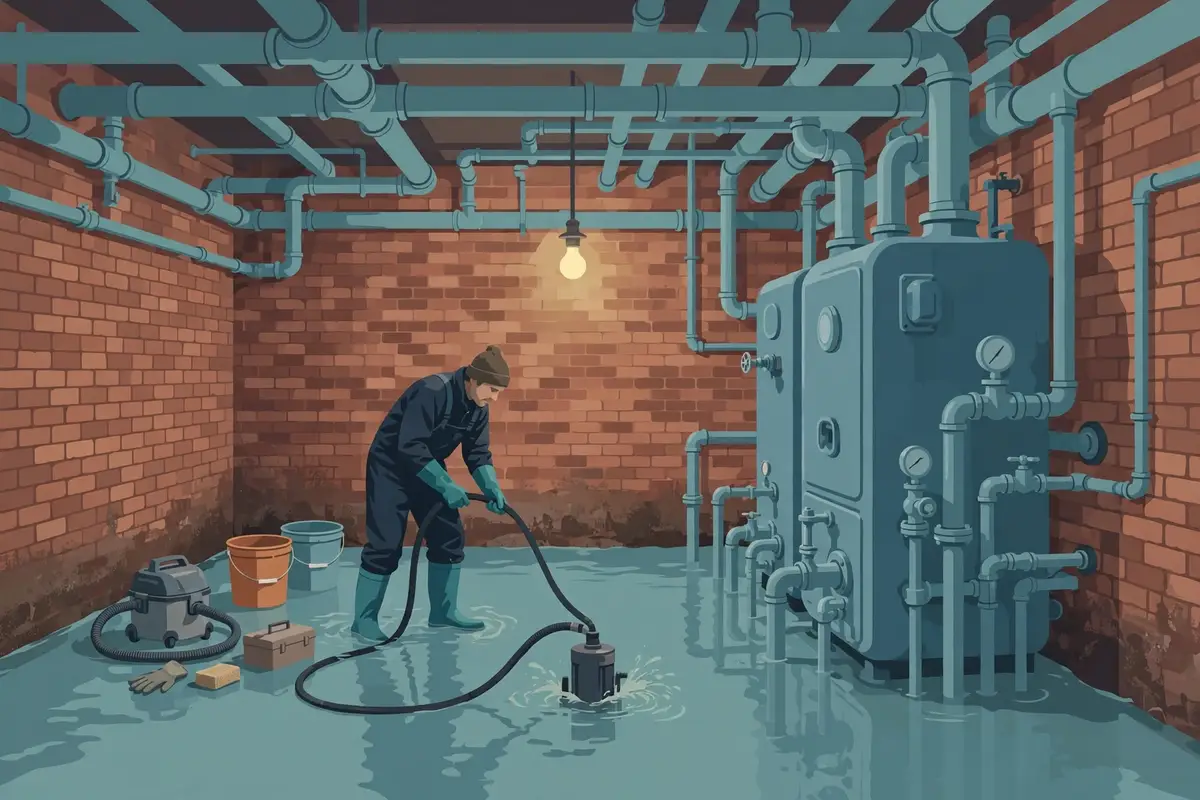
Illustration of a worker running a submersible pump in a flooded brick boiler room, with pipes overhead and a wet vacuum nearby
A cellar boiler room under water: extraction here is pumps, hoses and patience, with the building boiler and electrics checked before they are trusted again.

Drying Plaster, Hardwood and Concrete Without Guesswork

Drying is a measurement job wearing a machine costume. The machines are simple: air movers push air across wet surfaces so moisture leaves the material, and dehumidifiers pull that moisture out of the air and drain it away. What makes the work professional is the log. On the first visit the crew takes baseline readings from the same materials in a dry part of the home. Every drying day, readings are taken again at the same points and written down with dates. The equipment comes out when the wet readings have come down to match the dry baseline, which is another way of saying the material is back to the moisture it held before the flood.

The materials here set their own pace. Drywall, where it survives at all, is quick. Plaster and lath is slow, because the wall is thick and the lath hides water. Hardwood can often be dried in place with mats that pull moisture up through the boards, and cupped boards frequently flatten as the floor dries evenly. Concrete, the cellar and basement floor under everything, is the slowest of all: it drinks water deep and gives it back through a small surface, long after the top looks pale and hard. Flood damage cleanup washington heights drying runs of three to five days are typical, and a plaster and concrete job should be planned at the long end without apology.

One error deserves its own paragraph because it is printed in a popular guide and repeated everywhere. A widely read WikiHow page on cleaning up water damage tells readers to run fans alongside a humidifier. A humidifier adds moisture to the air. It is the opposite of the machine this work needs. The same site basement guide gets it right: fans and a dehumidifier. If you remember one equipment fact from this page, make it that one, because running the wrong machine in a wet Washington Heights flat can undo a day of drying overnight.

Basements, Cellars and Boiler Rooms: Where the Water Ends Up

Every building in the neighbourhood has a lowest room, and every flood in the building eventually visits it. In tenements that room is usually a cellar: boiler, water heaters, laundry, storage cages, the super workshop, and the house drains all in one below grade space. Water arrives from above through stairwells and pipe chases, from outside through walls and window wells, and from below through the floor drains when the sewer surcharges. Flood damage cleanup washington heights cellar work therefore starts with building systems, not belongings: is the boiler safe, is the panel dry, are the pumps running, is the water still coming.

Storage is the heartbreak down there. Tenants keep the overflow of small apartments in cellar cages: boxes, clothes, books, furniture in pieces. Porous storage soaked by dirty water is mostly lost, and the honest crew says so early, photographs it thoroughly, and keeps the insurance paper strong, because the claim is often all that can be saved from a storage cage. What can be saved is what is hard, washable and dried fast: metal, solid wood, tools, sealed plastic.

The drying shape is different below grade too. A cellar has few windows, cool walls and one stairwell breathing the air of the whole building. Concrete floors and masonry walls hold water for a long time. Crews close what can be closed, run more dehumidification than the same water would need upstairs, and take readings on the masonry as well as the wood. Flood damage cleanup washington heights basement jobs are measured in weeks on the calendar when the rebuild of finished basement rooms is counted, and anyone who promises days for the whole story has not dried much masonry.

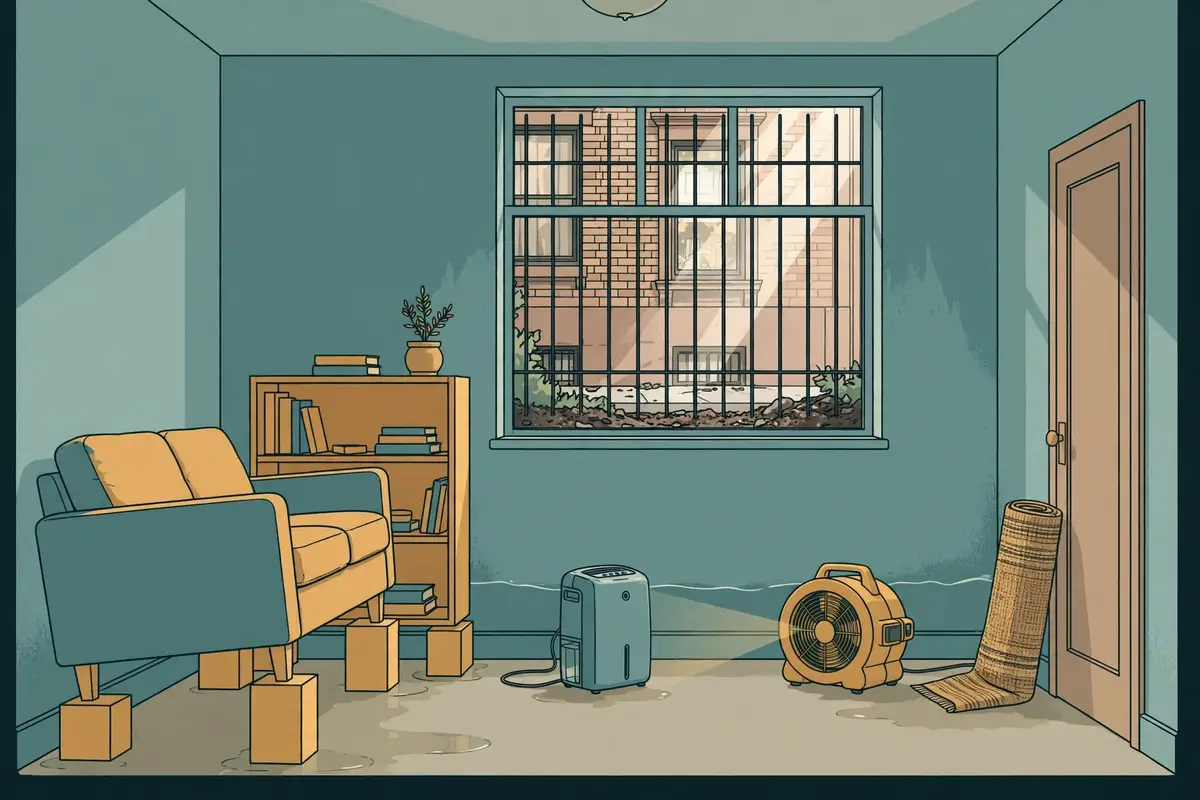
Illustration of a garden level apartment being dried after a flood, furniture raised on blocks and a dehumidifier on the bare floor
A garden apartment mid drying: furniture up on blocks, rug out, machines on the bare floor, and readings taken daily until the walls match the dry rooms.

Garden Apartments and Basement Homes

The riskiest homes in the neighbourhood are the ones people sleep in below the sidewalk. Garden apartments and basement flats sit at the level where street water, drain water and burst pipe water all collect, and many of them have the classic local layout: a door a few steps down from the street, small windows at pavement level, and a bathroom and kitchen plumbed into the lowest drains in the building. In a hard storm these homes can take water from three directions in one night: under the door, up the drain, and down the walls from the flats above.

Cleanup in a lived in basement home is also a housing problem, not just a drying problem. The family needs somewhere to sleep while machines run and walls are opened. Belongings are not storage cage overflow, they are the whole household. A good crew works room by room where the water allows it, keeps one room livable where that is honestly possible, and says plainly when it is not. Flood damage cleanup washington heights garden flat jobs live or die on that honesty, because a family that is told the truth on day one can plan; a family that is told a story discovers it on day four, in the rain, with the machines still running.

The Ida record belongs in this section, stated carefully. On 1 September 2021, 13 people died in New York City and 11 of them died in basement apartments, most in Queens. No verified Washington Heights figure for that night exists, and this page does not invent one. The citywide lesson is local enough: below grade homes flood fastest and forgive least, and the time to move documents, medicines and a go bag upstairs is before the storm, not during it.

Sewer Backups: The Dirtiest Water and the Six Hour Rule

A sewer backup is the flood nobody chooses and everybody remembers. In a storm, the city sewer can surcharge: more water arrives than the pipe can carry, and the pressure looks for the lowest openings in the lowest buildings, which are the floor drains, toilets and tubs of cellar and garden level homes. The water that comes up is category 3, sewage, and it changes the whole job. Porous material it touches comes out. The crew works in protective gear. Cleaning and sanitizing come before drying, not after.

The city route matters here, and it has a clock. File with 311 the moment you see drain water rising, and keep the tracking number. Under Administrative Code Section 24-503.1, the Department of Environmental Protection must ensure the sewer segment named in a complaint is inspected within six hours of the complaint being filed, though a bad storm can stretch real world response. That inspection record, with your photographs and the crew drying log, is the paper spine of a sewer claim. Flood damage cleanup washington heights sewer jobs fail on paperwork more often than on drying, because the water is dramatic and the forms are not, and people remember the wrong one.

Inside the building, the super and a plumber share the next questions. Is the house drain clear? Is the trap holding? Did the building line or the city line surcharge? A camera inspection of the building drain answers most of it, and the answer decides whose problem the fix is. Until that is known, the cleanup does not wait: extraction, removal, sanitizing and drying proceed, because sewage in a warm cellar is a health problem on a short clock.

Water Main Breaks and Street Water

The other public water here arrives under pressure. A broken main on an avenue can send a river down a side street, under doors, into areaways and down cellar stairs, and it can run for hours before the city valves close. The water starts clean and does not stay that way: it carries street dirt, silt and whatever the gutter held, so by the time it is standing in your cellar it is treated as dirty water for cleanup purposes.

Your route is 311, again, and it is worth saying what this page will not tell you. Some pages in this city print response times and special hotline numbers for main breaks. The research behind this page could not verify an official response time figure or a dedicated water emergency hotline on a primary city source, so this page does not print one. What is verified is the front door: 311, on the phone or at portal.311.nyc.gov, with a tracking number for your file. Flood damage cleanup washington heights advice should be built on numbers that check out, and a tracking number you hold beats a hotline nobody can source.

While the street is still running, the building work is defensive: sandbags or boards at the areaway, belongings up, the cellar door watched, photographs taken from dry ground. Do not wade in street water near a broken main: the pavement itself can be undermined, and manholes and vaults hide drops. Once the city closes the main, the job becomes a normal, if muddy, extraction and drying job, with silt removal added at the front of it.

Water From Upstairs: The Most Common Flood on the Ridge

For all the drama of storms and mains, the flood that fills the most Washington Heights homes comes from the flat above. A washing machine hose, a toilet supply line, a cracked trap, a radiator valve: in a building of shared stacks and shared ceilings, one flat leak is the downstairs neighbour flood. The water is usually clean at the source and dirty by the time it has crossed a ceiling of plaster, lath and a century of dust, and it arrives at the worst hours, because pipes do not keep office hours either.

The human record of this is easy to find. On r/AskNYC, a poster described an apartment flooded four times in a single year by the unit above: brown, smelly water, the whole flat wet, a chunk of the bathroom ceiling on the floor, and a landlord estimating more than a week to fix it. Read the thread and you can watch the real problem form: not the water, which any crew can dry, but the loop, a source upstairs that never quite gets fixed, in a building that answers slowly. Flood damage cleanup washington heights work on an upstairs leak therefore starts with the source flat, and a crew that dries your ceiling while the pipe above still drips is selling you a subscription, not a repair.

The practical order is: tell the neighbour and the super at once, in writing as well as at the door. Photograph your rooms before anything moves. Get the source fixed and prove it is fixed, a dry reading over days, not a wave from the doorway. Then dry, then repair. Your own insurer covers your belongings and can chase the upstairs policy; the building covers the building parts; and if the building will not move, a 311 complaint puts the housing agency on the record. Ceiling first, paperwork always, patience where you can find it.

Renters, Landlords and the Housing Route

Most homes in Washington Heights are rentals, so most floods here are also a landlord and tenant story. The working order, which city housing guidance backs, is simple: contact the landlord or the super first, in writing, with photographs, and keep copies. Owners are responsible for the building systems, the pipes, the roof, the drains, and for restoring the apartment itself after building water. Tenants are responsible for their belongings, which is what a renters policy is for.

When the building does not act, the city route is 311. A leak or flood complaint filed with 311 goes to the Department of Housing Preservation and Development, and an inspection creates the official record: dates, conditions, violations if they are issued. That record is what turns a phone argument into a paper fact, and it is free. Flood damage cleanup washington heights renters should file early rather than politely late: a complaint made during the flood describes a flood; a complaint made a month later describes a memory.

Two habits protect renters more than any argument. First, everything in writing, even when the super is standing in your kitchen being helpful: a short message after the visit, saying what was agreed, is enough. Second, keep the damaged things until the insurer or the building has seen them, however much you want them gone. A thrown away sofa is a story. A photographed, kept, adjuster seen sofa is a claim.

Co-ops, Condos and Building Rules

In the co-ops and condos of Hudson Heights and the avenue buildings, a flood adds a second landlord: the board and its managing agent. Emergency work, stopping water, extracting it, setting drying machines, goes ahead, because no board expects a flooded flat to wait for a meeting. Work that opens walls, changes finishes or alters plumbing usually needs the building paperwork: an alteration agreement, contractor insurance certificates, and work kept inside building hours with building rules on elevators and noise.

This is not red tape for its own sake, and owners who have lived through a neighbour renovation-gone-wrong rarely argue with it. It does stretch calendars, though, and it is one of the two reasons apartment rebuilds run longer than house rebuilds. The other reason is sequencing: in a stack building, your rebuild waits on the flat above being fixed and proven dry, and sometimes on the flat below being checked, because water that crossed your floor is in their ceiling. Flood damage cleanup washington heights co-op jobs are planned with the managing agent from day one, and the drying log becomes a building document, shared up and down the line.

What Gets Thrown Away and What Gets Saved

The hardest conversation in any flood is the sorting, and it follows rules that are older than any company. The Environmental Protection Agency flood guidance gives the frame: floodwater may carry bacteria and chemicals, non absorbent items can be cleaned and dried, and absorbent items that cannot be washed and dried properly generally have to go. Crews apply it like this. Hard surfaces, tile, stone, metal, sealed wood, glass, survive and are cleaned. Porous materials soaked by clean water and caught fast, some carpet, some upholstery, are judged case by case. Porous materials soaked by floodwater or sewage are removed, because what is inside them cannot be cleaned to a safe standard.

The list that usually goes out of a Washington Heights flood: carpet padding almost always, carpet often, soaked drywall and plaster that has gone soft, wet insulation, swollen particleboard furniture, mattresses that took water, and paper, books and photographs that sat in dirty water, though photographs and documents can sometimes be frozen and treated if they matter enough and the call is made fast. The list that usually stays: solid wood furniture dried promptly, tile and stone, metal shelving, appliances judged one by one by a technician, and the building bones themselves, framing, masonry, real hardwood, which drying exists to save.

Everything that goes out goes out photographed, listed and, where the claim matters, sampled. A strip of the carpet, a piece of the flooring, the model plate of the appliance. Flood damage cleanup washington heights sorting is emotional work, and the crews who do it well say the quiet part out loud: the goal is a safe home, not a saved everything, and the things that cannot be made safe are not a loss the crew chose. They are a loss the water chose, on the day it came in.

Getting the Debris Out: Curbside, Bulk Pickup and Carters

A flood produces a small mountain: bagged plaster, rolled carpet, a ruined sofa, a dead refrigerator. Getting it out of a fifth floor walk up is half the battle, and getting it off the curb legally is the other half. The city Sanitation Department collects bulk items, furniture, mattresses sealed in plastic, rugs rolled and tied, by appointment, up to six large items per collection day. Small scale debris from your own do it yourself cleanup can go out with regular residential collection. Read that sentence carefully, because it is where the simple version of the rule ends.

Contractor scale tear out is different. When a crew removes walls, floors and fixtures by the roomful, that volume is professional debris, and it cannot simply be left as household trash: the building or the contractor arranges a dumpster or a private carter, and private haulers in this city are certified by the Business Integrity Commission. Asbestos containing material, which pre-war buildings can hold in pipe insulation, floor tile and mastic, is never trash and never recycling, and suspect material stops work until it is assessed. Flood damage cleanup washington heights debris planning sounds dull until the alternative is a ticketed pile on the sidewalk and a super who will not open the basement door again.

Illustration of sealed bags, a wrapped mattress and a rolled carpet set neatly at the curb in front of a brick tenement after a flood cleanup
Out the door is only half the job: bulk pickup by appointment for the big pieces, and a private carter when the tear out is contractor scale.

Mold: The Two Day Window and the Ten Square Foot Line

Mold is the reason the whole cleanup runs on a clock. The Environmental Protection Agency says to dry water damaged areas and items within 24 to 48 hours to prevent mold growth, and its flood guidance adds the sentence every crew quotes: when things remain wet for more than two days, they usually get moldy. The Centers for Disease Control and Prevention, on its live flood safety hub, says the same in its own words: clean and dry your home within 24 to 48 hours to prevent mold. Two agencies, one message. The first two days are the mold decision, and everything else is commentary.

Size draws the second line. The Agency guidance is that a homeowner can clean mold themselves when the area is less than 10 square feet, with detergent, water and care, never mixing bleach with ammonia or other cleaners. Bigger than that, or sewage contaminated, is professional work. New York law then takes over: mold assessment and remediation over 10 square feet are licensed work under Article 32 of the Labor Law, Sections 930, 931 and 936 among them, and Section 936 is plain that no licensee shall perform both mold assessment and mold remediation on the same property. Assessor and remediator are different people by law, so the person who tells you the size of the problem is never the person selling you the fix.

For flood damage cleanup washington heights homes, the practical read is: dry inside the window and mold is usually a page you never have to read. Miss it, in a plaster wall cavity or under a floor where nobody looked, and the job grows a second, licensed act. That is why the drying log records readings inside walls and under floors, and why a crew that finds growth over the line stops, says so, and brings in the licensed sequence rather than wiping and hoping.

Cleaning and Sanitizing After Dirty Water

Once the water and the ruined material are out, the rooms that remain have to be made clean, and dirty water sets the standard. The Agency flood guidance is practical: fix the water problem first, scrub hard surfaces with hot water and detergent, and disinfect only surfaces that are already clean and non absorbent, because disinfectant on dirt is theatre. Bleach, where it is used, is used diluted, ventilated, and never, ever mixed with ammonia or other cleaners. Sewage jobs add protective equipment, sealed work areas where the building allows it, and disposal of everything porous the water touched.

In a tenement the cleaning has a geography. The flooded flat, yes, but also the hallway the hoses crossed, the stairs the bags came down, the basement door and the cellar floor, because the building shares those spaces with every other family. Supers notice who cleans the common parts without being asked. Flood damage cleanup washington heights crews that leave a clean hallway get called back by the building, and buildings, in the end, are where most of the work in this neighbourhood comes from.

Belongings: Furniture, Rugs, Papers and Machines

Ask anyone who has flooded what they actually lost and they rarely say drywall. They say the rug from a grandmother, the photographs in the low drawer, the books on the bottom shelf, the sofa that was new in the spring. Contents work is where flood cleanup becomes personal, and it has its own order. What can be washed and dried fast is separated first. Upholstery and rugs that took clean water briefly can often be cleaned and dried. The same pieces after sewage or street water are usually a claim, not a cleaning job, and a straight answer early saves a family weeks of false hope.

Paper is the race. Wet documents and photographs stick, bleed and mold within days, and the freezer is the pause button: bagged and frozen, paper can wait for proper treatment instead of dying on the radiator. Electronics are simpler and sadder: do not power them, do not charge them, let them be assessed dry, and photograph serial numbers for the claim either way. Appliances that stood in water, washers, dryers, refrigerators, need a technician eye before they run again, and a flood policy, where one exists, covers a basement freezer and its food under its limited basement rules, which is a detail worth knowing before you throw the contents away unphotographed.

In practice, flood damage cleanup washington heights contents work happens on the sidewalk and in the hallway as much as in the flat: sorting tables, drying racks where the super allows them, and a steady traffic of bags. The crews who do it well label everything, because a box marked with a room and a name comes back to the right family, and in a building where three flats flooded the same night, that labelling is the difference between help and a second disaster of mixed up belongings.

Insurance: Two Policies, Two Different Floods

The single most expensive misunderstanding in this work is the word flood itself. A homeowners policy and a flood policy cover two different waters. Homeowners cover is built around sudden accidents inside the home: the burst pipe, the failed hose, the heater letting go. Water that rises outside and comes in at ground level is flood in the legal sense, and it sits in a separate flood policy, most often through the National Flood Insurance Program. Sewer and drain backup usually sits in neither until a rider is added. Homeowners comparing notes after a storm discover this in the worst order: first the water, then the definitions.

The sudden and gradual line runs through everything. Sudden and accidental is the language policies are written around. Gradual leaks, slow seeps and worn out plumbing are treated as maintenance. Trade and consumer guidance agrees on that shape, and it is why the date of loss and the state of the pipe matter so much in a claim file. Flood damage cleanup washington heights documentation exists to prove the sudden part: photographs of the burst, the failed hose kept, the timeline written the same day.

New York adds two clocks once a proof of loss is in, and they are worth keeping straight because pages often merge them. Under Regulation 64, Section 216.6, an insurer has 15 business days to accept or reject a claim after proof of loss, and 5 business days to pay after agreement. Separately, Insurance Law Section 2618 sets a pay clock of four business days that applies only in declared disasters, and it belongs to that statute. If a claim stalls, the Department of Financial Services consumer line is (800) 342-3736 and the disaster hotline is (800) 339-1759. Keep both numbers with the claim file, not in a drawer across town.

The Flood Program: Thirty Days, Limited Basements and a Lapsed Clock

For homes with a flood policy, the National Flood Insurance Program writes the rules, and three of them surprise people every time. First, the wait: a new flood policy normally takes 30 days to take effect, with narrow exceptions such as a loan closing or a map change, so cover bought during a storm warning is cover bought for the next storm. Second, the basement: flood cover treats basements narrowly, and the contents it covers down there are limited, the washer and dryer, a freezer and the food in it being the classic list, not finished rooms and furniture. Third, mold: the program does not refuse mold flatly. Its wording is conditional, and it matters: the program will not cover mold damage when the policyholder fails to take reasonable action to prevent the growth or spread of mold. Dry fast, document the drying, and that condition is one you have met.

The claim clocks are plain. The proof of loss is due within 60 days of the flood, that is the program standard rule, and FloodSmart gives the planning figure that a claim can take four to eight weeks to be finalized and paid. Photograph before cleanup, keep damaged items until the adjuster sees them, and keep the drying log: in a flood claim, the paper is not bureaucracy, it is the claim.

And one fact about the program itself, stated exactly because older pages and older advice get it wrong. Under the federal statute, 42 U.S.C. Section 4026, no new contract for flood insurance under the program shall be entered into after September 30, 2026. The program lapsed briefly on 30 January 2026 during a federal shutdown and was extended by Congress on 5 February 2026 through 30 September 2026, and no later extension was found in the research for this page. Policies already in force stay in force to the end of their own term. If you are reading this while shopping for cover, check the program current status first, because the authority question is a live one and this page snapshot was taken on 24 November 2026.

How Long the Whole Job Takes, Honestly

People want a number, and the honest answer is a set of ranges with the reasons attached. Extraction: hours, usually inside the first visit, a long day on a big cellar. Drying: three to five days on a typical home job with machines running around the clock, longer, seven days and beyond, where plaster, hardwood and concrete are saturated or the water was dirty and removal came first. Cleaning and sanitizing: a day or two on most jobs. Rebuild: days for patch and paint, weeks for rooms, months when heavy removal, ordered materials, permits or board approvals stack up. The research behind the timeline page of this site found the same shape everywhere it looked, and flood damage cleanup washington heights jobs are not an exception to it.

What stretches a job here is rarely the water. It is the building around the water: the source flat that must be fixed first, the board packet that must be approved, the elevator booked by the hour, the pre-war wall that dries at its own pace, the licensed mold sequence that starts when growth over 10 square feet is found. A crew that names those factors on day one is not making excuses. It is reading the building, which is the job.

Illustration of a technician taking a pin meter reading at the base of a hallway wall, with a hand drawn moisture map on a clipboard
Moisture mapping: readings at the same points, every day, against the dry baseline of the same building. The log is the schedule, written in numbers.

Why This Page Prints No Prices

Every few pages in this search promise a figure, and the figures never survive contact with a real flat. This page prints none, on purpose, and the reason is the building stock above you: the same two inches of water is a mop and a machine in a tiled garden flat, a plaster and hardwood epic in a 1920s six storey, and a building systems event when it reaches a boiler room. What decides the bill is visible and listable: how much water, how dirty, how far it spread, what can be dried and what must come out, how much rebuilding follows, and how long the machines run.

The fair route to a real number never changes. An on site inspection with moisture readings. An itemized written estimate that separates extraction, removal, drying, cleaning and rebuild. Your insurer confirming, in its own words, what the policy covers. Anything quoted whole, over the phone, from a photograph of one corner, is a guess wearing a uniform. Flood damage cleanup washington heights callers should also know the flip side: a crew that will not discuss money at all until the machines are already running is not protecting you either. The written scope, before non emergency work begins, is the protection, and it costs nothing to ask for.

Choosing a Crew When the Search Results Are This Weak

Look at what a search for this neighbourhood actually returns, because the research for this page did, line by line. Social media answer pages. Directory listings. A restoration company whose Washington Heights page turns out to be about a neighbourhood of the same name in Wisconsin. A Brooklyn company page with strong reviews and no Manhattan content at all. A national brand storm page for a Brooklyn district. There is, at the time of writing, no dedicated local page for this neighbourhood from any working competitor, which is precisely the gap this page was built to fill, and it tells you something about how much local knowledge the average result is carrying.

So judge by evidence you can touch. A phone answered by a person who asks about your building, your floor and your water source. Meters and a drying log, offered before you ask. A written, itemized scope. Straight talk about what cannot be saved. Knowledge of 311, of the housing complaint route, of the sanitation rules for debris, of the licensed mold line at 10 square feet. And consistency: one well known brand page in this search promises response in minutes, on site in two hours, and a 30 minute response in its own header, three numbers that cannot all be true. Flood damage cleanup washington heights work is too wet and too expensive for arithmetic like that.

Real Jobs on Video, With the Locations Stated Plainly

This site links real job videos where they exist, and states where they were filmed, because a cleanup video teaches the order of the work better than any paragraph. The honest finding for this page is that no real job flood cleanup video filmed in New York City and longer than a minute could be verified in the research. The city results are short adverts, under a minute each. So the two videos linked here are real jobs from elsewhere, labelled as such, and they are here for the process, not the postcode.

First, a full walk through of one job from first look to finished drying, filmed by Service Team of Professionals in Spokane, Washington: extraction, removal and drying in the order this page describes. Watch it here: Water Mitigation: Full Process Explained, Spokane, Washington. Second, a flooded basement job by Prime Restoration, a burst water heater, with extraction, demolition and drying shown plainly; the film does not state its location, and this page will not guess one: Water Damage Restoration Job in a Flooded Basement, location not stated. Neither film is New York. Both show the same six steps, in the same order, that a Washington Heights job follows.

What People Actually Ask Online

The questions behind this page were read where people really ask them. On Reddit, the upstairs leak that flooded a flat four times in a year, and the threads asking how to stop a basement flooding every time it rains and how to proceed when the flood damage comes from a neighbour. On Quora, the fallen ceiling and the legal scramble after it, the adjuster who cannot find the cause of the leak and will not pay, and the basement apartment risk question, asked by people deciding whether to sign a lease. On WikiHow, two guides pull in opposite directions: the basement drying guide, read by tens of thousands, which correctly says dehumidifier at every step, and the general cleanup guide which prints the humidifier error this page has already corrected. Read guides the way you would read a neighbour advice: gratefully, and with the meter in your hand.

The pattern across all of it is the same, and it shaped this page structure. Nobody asks about flood cleanup in the abstract. They ask about their ceiling, their landlord, their adjuster, their basement, their neighbour. Flood damage cleanup washington heights information that does not answer those five doors is decoration. The questions section at the foot of this page is built from those real questions, in the order people ask them, including the cost questions, which are answered the only honest way they can be: without invented figures, and with the drivers named.

The Keyword Research Behind This Page

Because this site shows its working, here are the numbers this page was built on, checked fresh on 24 November 2026. SEMrush, United States database: the phrase this page is built for is searched 480 times a month, with a keyword difficulty of 13 percent, rated Very easy, and commercial intent. An older worksheet figure of 720 searches at 12 percent is stale and is not used. Related phrases are small and local: the shorter flood cleanup variant at 30 searches and 5 percent difficulty. The results page itself is weak: directories, social pages and out of borough companies, with the strongest page authority score at 13 and most at zero, and no dedicated page for the neighbourhood anywhere in the top ten.

Moz, checked the same day, mostly failed on this phrase: its overview cards returned errors, its results view would not load, and its questions tool held no data, across three attempts, with plenty of query quota left and a control phrase loading fine in the same session. The one figure Moz did give, a suggestions volume of 153, is reported here as exactly that and nothing more. The two tools disagree in general, this site reports both rather than averaging them, and on this page the honest summary is: SEMrush says a small, very winnable, commercial search; Moz could not be made to answer. Flood damage cleanup washington heights is, by the evidence, a phrase a careful page can own, which is why this one runs to the length it does.

Doing It Yourself: What Works and Where It Stops

A small clean water flood, caught in the first hours, in one room, is a job a careful homeowner can start and sometimes finish: stop the water, lift the belongings, wet vacuum the floor, pull the rug and pad back, run fans and a rented dehumidifier, and check with a borrowed meter over the following days. The basement drying guide on WikiHow, for all the faults of its sister page, walks through much of this correctly, and the Agency guidance backs the shape of it: clean what is non absorbent, dry fast, throw away what cannot be cleaned and dried properly.

The stops are just as clear. Dirty water, sewage or street flood, is professional work. Water inside walls, under floors or into insulation is professional work, because the drying you cannot see is the drying that matters. An area of mold over 10 square feet is licensed work in this state. A flooded electrical panel, boiler or oil line is trades work. And a rented flat or a co-op is paperwork work, where the building and the insurer need documents a home drying cannot produce. Flood damage cleanup washington heights do it yourself efforts fail most often at the same place: the surface dries, the wall cavity does not, and the first sign is the smell, three weeks later, in a closed room.

A Worked Example: One Garden Apartment, Day by Day

Put the pieces together on the kind of job this neighbourhood produces. A garden flat near Dyckman Street takes water in a night storm: in under the door from the areaway, and up through the bathroom drain as the sewer surcharges. The tenant wakes to two inches across the kitchen and hall, the bedroom rug soaked, the bathroom floor awash. Day one runs on the first hour rules: nobody touches the panel, the super is called, 311 takes the sewer complaint and issues a tracking number, photographs are taken from the doorway, and the crew extracts by midday. The rug and pad come out, bagged and photographed. The bathroom, which took drain water, is treated as contaminated: cleaned, sanitized, and its swollen vanity base removed.

Days two to five are machines and readings. Air movers run along the plaster walls, their bases opened where the readings demand it. A dehumidifier drains to the kitchen sink. The daily log shows the hall wall falling toward baseline and the bedroom wall lagging, because its cavity held insulation, which comes out on day three through a low opening, after which the readings move. The tenant sleeps at a sister apartment upstairs in the same building, which the landlord arranges, because the flat has no working bathroom for two of those days. By day five the readings match the dry front room, the machines leave, and the claim file holds photographs, the 311 number, the drying log and the sample strip of carpet.

Weeks two and three are the rebuild: plaster patch and skim, the low wall sections repainted, new pad and carpet in the bedroom, the vanity replaced. The board is not involved, this is a rental, but the managing agent signs off the scope because the building is paying for the building parts. Total: five days of drying inside a three week story. That ratio, a fast wet week and a slower dry one, is the honest shape of flood damage cleanup washington heights work, and any schedule that promises the whole story in the wet week alone should be read as marketing, not planning.

A Worked Example: The Boiler Room on the Avenue

The second example is the building job. A main break on the avenue sends street water down a side street and into the cellar of a six storey elevator building: boiler room, laundry and storage cages under three inches of silty water, still rising when the super calls it in. The first decisions are building decisions. The boiler is shut down before the water reaches it. The panel is treated as live and off limits. 311 logs the street water. The managing agent is called before the tenants wake, because by morning the building has no hot water and forty flats of questions.

Extraction takes the long first day, pumps in sequence, silt shovelled and bagged ahead of the hoses. Storage cages are photographed cage by cage before anything is moved, because ten families claims live in that room. The boiler is inspected by the building heating contractor before it is fired again, and it runs by the second night, which is the moment the job turns from emergency to project in the tenants minds. Drying the masonry and concrete takes the rest of the week and into the next, readings on brick and slab, dehumidifiers running in a closed cellar, and the laundry room is last back, because its floor is the lowest and its machines stood deepest.

What the building gets at the end, besides dry rooms, is a file: the 311 record, the photograph set, the drying log, the contractor invoices, and a short report the agent can send the board and the insurer. In a co-op or a rental with a professional owner, that file is not a bonus. It is half the product. Flood damage cleanup washington heights building jobs are remembered twice, once in the cellar and once in the meeting, and the crews who understand both rooms get the second call.

Before the Next Storm: A Short, Honest List

Prevention advice for this neighbourhood has to survive contact with a tenement, so here is the short version that does. Know your shutoffs: the flat valves, the building main, and who holds the cellar keys at 2 a.m. Keep the lowest rooms honest: documents, photographs and electronics stored up high or in sealed plastic bins, never in cardboard on a cellar or garden floor. Put a water alarm, a small battery device that screams when it gets wet, behind the washing machine, under the water heater and by the cellar drain. Replace appliance hoses on a schedule, not on a failure.

For owners and boards, the building list: keep the house drains and traps inspected, clear the areaway and window well drains before storm season, and walk the cellar after every hard rain while the evidence is still wet on the walls. Ask a plumber about backwater protection on the building drain if backups repeat, with the honest caveat from the zones section: the city backed help FloodHelpNY lists for backwater valves does not include this neighbourhood, so the valve is a building expense, weighed against the building flood history. And keep the insurance honest: flood cover and a sewer backup rider are bought on a calm day, with the 30 day wait in mind, or they are not bought at all.

None of this makes a home flood proof, and this page will not use that phrase about a below grade room in a century old building. What it does is change the size of the event: the flood that is found by an alarm in ten minutes, in a room where the papers are in plastic and the rug is the only casualty, is a different flood from the one found at dawn. Flood damage cleanup washington heights prevention is not about stopping the water. It is about meeting it early, small and documented.

Season by Season in the Heights

Winter brings the pipe season: radiators, risers and supply lines in exterior walls, in buildings where heat cycles hard and windows sit open over radiators in the old local style. A frozen pipe in a top floor flat is a flood for every flat beneath it, delivered through the stack chase. Spring brings rain on saturated ground and the first sewer surcharges. Summer brings the violent hour: the short, enormous downpours, like the one on 30 October 2025, that put more water on the ridge in an hour than the drains were built for, and send it looking for every low door and drain in the neighbourhood. Autumn is hurricane season proper, when the city watches the coast, and when Ida arrived in September 2021.

The cleanup calendar follows the same rhythm. Drying is slower in a cold flat and faster in a heated one, and summer humidity fights the dehumidifiers in any unconditioned cellar. Storm season jobs arrive in clusters, which is the practical reason this page keeps saying call early: on the worst nights, every crew in the city is spoken for by midnight, and the difference between the first call and the fifth is measured in days of standing water. Flood damage cleanup washington heights readiness is mostly a phone charged, a number saved, and belongings already off the lowest floor.

Room by Room: Where Floodwater Goes and What It Ruins First

Kitchens flood from within: dishwasher and refrigerator lines, sink traps, and the washing machine in buildings that allow them, plus whatever the flat above sends down the stack. The enemies are the cabinet bases, which are particleboard more often than not and swell beyond saving, and the floor layers, where water sits between the finish floor and the subfloor, invisible and patient. Bathrooms flood from toilets, tubs and the same stacks, and their tile forgives more than any other room finish, though the ceiling of the flat below forgives nothing. Bedrooms and living rooms are usually the victims, not the sources: their damage is rugs, hardwood, plaster and everything stored at floor level, which in a small flat is a large share of a life.

Hallways carry water between rooms and, in tenements, between flats: a hall flood in one home is often the first sign of the neighbour flood next door. Closets are the quiet disaster, because a wet closet is discovered late and everything in it has wicked water upward for days. Cellar rooms have their own list, covered in the basement section. The room by room habit that matters is inspection order: after any flood, check the rooms below and beside the source, the closet floors, and the bases of every wall the water crossed, with a meter, not a glance. Flood damage cleanup washington heights inspections that stop at the visibly wet room are how second floods, the hidden ones, get started.

Two Checklists Worth Keeping

The first night list

Print it, photograph it, or just remember its shape: safety, source, building, camera, crew, belongings, evidence. Seven moves, in that order, and the night is as handled as a flooded night can be. Tape the short version inside a kitchen cabinet door, next to the super number and the shutoff note, because the night it is needed is not a night for searching drawers, remembering passwords or finding a pen that works in a wet kitchen at midnight.

One last item belongs on the fridge rather than in a drawer: the name of the neighbour upstairs and the neighbour downstairs, with phone numbers, exchanged on a calm day. In a stack building, your first warning of a flood and your first pair of hands both usually live one floor away, and a building where the line of flats knows each other dries out faster than a building of strangers, every single time.

The claim file list

A claim file is not paperwork for its own sake. It is the difference between a flood that is paid for and a flood that is argued about, and it is assembled in the first week or it is assembled never. Flood damage cleanup washington heights crews build half of it as a matter of routine. The other half, the receipts and the letters, is yours, and an envelope on the kitchen counter is all the system it needs.

The Services on This Page, Listed Plainly

This page covers the full run of flood work in the neighbourhood, and the list below is the same service list published in its structured data. Each item is a real part of real jobs here, and most jobs use five or six of them in sequence.

If the job in front of you does not appear on that list in those words, describe it on the phone anyway. Floods do not read service menus: the odd jobs, the flooded elevator pit, the archive room, the flooded daycare, the church basement, are the normal texture of flood damage cleanup washington heights work, and the sequence of safety, extraction, sorting, drying and documentation fits all of them.

Why This Page Is This Long

A word about the page itself, because a flooded reader deserves the respect of an explanation. The search this page answers is small, weak and, until now, unowned: no dedicated local page, no local answers, directories and distant companies filling the space. A short page would have joined them. So this page was built the other way: every route verified against its primary source, every figure carrying its origin, every correction the research turned up printed where it belongs, including the ones that make the page less convenient, the unverified hotline left out, the subsidy that does not cover this neighbourhood, the death that belongs to 2025 and not to a more famous storm.

That standard costs words. It is also the whole point. Flood damage cleanup washington heights readers are standing in water, reading on a phone, deciding whom to trust with their home and their claim. They do not need a slogan. They need the six hour rule, the two day window, the ten square foot line, the thirty day wait, and a phone number that is answered. Everything on this page is here because it passed one test: would this help the person in the wettest room of the building, tonight.

A Walk Around the Neighbourhood, Corner by Corner

Start at the top, literally. Around Bennett Park and Fort Washington Avenue the ground is the highest in Manhattan, and the flood damage cleanup washington heights jobs up here are almost never about street water. They are about roofs, risers and the flat above, because rain that falls on the ridge leaves by the drains or not at all, and a drain that fails at this height sends water looking for a stairwell.

Drop west toward Riverside Drive and the Henry Hudson Parkway and the picture changes. The streets fall away, the areaways sit low, and storm water on the move looks for every basement door. Flood damage cleanup washington heights calls along the western edge spike during the short, violent rains, when an hour of water arrives faster than the catch basins can swallow it.

Broadway is the working spine: shops at street level, flats above, and service entrances that step down below the pavement. A flooded Broadway basement is often a business and three flats at once, which is why flood damage cleanup washington heights commercial calls here run on two clocks, the drying clock and the reopening clock, and the second one shouts louder.

At the north end, Dyckman Street is both a place and a boundary. Below it, the neighbourhood; above it, Inwood. The low ground near the Harlem River side collects water from both directions in a storm, and flood damage cleanup washington heights garden flats near Dyckman know the pattern by heart: door first, drain second, walls third.

The Harlem River side, the east, is the quiet side of the ridge, and its floods are quiet too: seepage through old foundation walls after long rain, cellar floors damp for days, storage quietly ruined. Flood damage cleanup washington heights seepage jobs are diagnosis jobs, because the water has no single dramatic entry and the fix starts with finding the path, not pumping the puddle.

Around West 168th Street the big medical buildings change the housing around them: more rooming style flats, more turnover, more tenants who do not know where their shutoff is. Flood damage cleanup washington heights first visits there spend longer on the basics, the valve, the super number, the 311 route, because the building knowledge a long term tenant carries is missing.

The side streets between the avenues hold the classic stock: five and six storey walk ups, stoops over areaways, cellar doors under the steps. Every stoop is a small dam and every areaway a small pond in the making. Flood damage cleanup washington heights crews read a street the way a plumber reads it: where the water stands, where it runs, and which door it reaches first.

None of this geography needs a map to use. It needs one habit: when the rain starts, think about your own lowest door, your own lowest drain, and your own below grade rooms, in that order. Flood damage cleanup washington heights outcomes are decided less by the storm than by which of those three a household had already thought about on a dry day.

The Stack: Why One Pipe Wets Five Homes

Stand in a tenement basement and look up, and you can read the building. The stacks rise in straight lines, one for each column of kitchens, one for each column of bathrooms, carrying water down from the roof flats to the house drain. Flood damage cleanup washington heights veterans start every upstairs leak by naming the stack, because the stack is the map of who is wet, who will be wet next, and whose flat the plumber has to enter.

A stack fails in friendly ways and rude ones. A trap cracks slowly and wets a ceiling over months, showing as a stain that grows a ring at a time. A supply riser splits and delivers the rude version: a waterfall through three ceilings in an hour. Flood damage cleanup washington heights drying cannot begin in earnest under either until the stack is repaired, which is why the plumber and the crew are booked in the same phone call.

The shared stack also explains the diplomacy. The flat with the failed pipe may be dry. The flat with the damage may have done nothing wrong. The building owns the pipe, the neighbour owns the morning, and the tenant below owns the ruined rug. Flood damage cleanup washington heights paperwork sorts those three owners out, which is why the photographs and the written notices matter as much as the machines.

Old stacks hide one more trick: a partial blockage low in the line can push waste water out of the lowest fixtures in the building during a storm or a heavy use hour. The garden flat tub that fills on its own is telling that story. Flood damage cleanup washington heights crews who hear it ask for a camera in the line before they promise the problem is solved, because drying a flat whose stack still surcharges is drying it for the next tenant meeting.

Reading a Wet Wall

A wet wall lies politely. The face feels dry, the paint looks sound, and two inches behind it the lath is soaked and the cavity is growing a garden. Flood damage cleanup washington heights reading starts with a pin meter pushed at the base, a pinless scan across the face, and readings at rising heights until the numbers fall to the dry baseline of the same wall in a dry room.

The map that comes out of those readings is the job in one picture. Here the water reached, here it wicked, here it never went. Openings are cut where the map says the cavity is wet and the insulation is soaked, and nowhere else, because every opening is a repair. Flood damage cleanup washington heights work that opens walls by habit rather than by map is charging you for plaster it never needed to touch.

Readings also settle arguments that voices cannot. The neighbour who swears the leak stopped last week, the landlord who thinks the wall is dry, the tenant who can still smell it: the meter answers all three without taking sides. Flood damage cleanup washington heights logs keep those answers dated, which is why the log, and not anyone memory of a damp Tuesday, is what the adjuster reads.

The last reading is the one that matters most. When the wet points match the dry baseline, the wall is what it was before the flood, and the rebuild can close it with a clear conscience. Flood damage cleanup washington heights crews that skip the last reading to save a day are borrowing that day from your future, at interest, in mold.

The Super: The Most Important Person in the Building

Every flood in a tenement has two first responders, and one of them lives in the basement. The super holds the keys, the valves, the boiler knowledge and the building memory: which stack was replaced in 2019, which cellar corner took water in the last storm, which tenant upstairs never answers the door. Flood damage cleanup washington heights crews who treat the super as a partner finish jobs. Crews who treat the super as an obstacle finish arguments.

Call the super early and in writing where you can. Say what happened, where, and what you need: the shutoff, the cellar access, the elevator padded, the agent informed. Flood damage cleanup washington heights tenants sometimes skip the super to call the management office first, and lose an hour learning that the office calls the super anyway, from a desk, in another borough.

The super also sees the flood you did not. Your flat is wet from above; the cellar, the super will tell you, took water at the same hour from the areaway. Flood damage cleanup washington heights inspections that start at the super door catch the second flood while it is still a puddle, which is the cheapest moment any flood ever offers.

Walk Ups and Elevator Buildings Dry Differently

In a walk up, everything arrives by shoulder: machines up four flights, bags down four flights, hoses through windows and along the stairs. The work is slower per room and the crews are smaller, and the neighbours know your business by the second trip. Flood damage cleanup washington heights walk up jobs are won on courtesy as much as drying, because five households share your only corridor.

Elevator buildings trade muscle for rules. The car must be padded and booked, the service entrance used, the hours kept, the agent papered. Once rigged, though, volume moves fast, and a cellar job can run hoses and machines at a scale a walk up cannot match. Flood damage cleanup washington heights elevator jobs live or die on the managing agent paperwork, started on day one, not day four.

The buildings also fail differently. Walk ups flood flat by flat, from roofs and stacks. Elevator buildings flood by system: one riser, one boiler room, one pump failure, many flats at once. Flood damage cleanup washington heights triage in a big building is therefore a building meeting, with a list, a order of floors, and one drying log per line of flats.

What a Drying Log Actually Looks Like

It is not much to look at: a page per room, dates down the side, and columns of numbers, each one a meter reading at a marked point. Day one carries the baseline, the readings from the same materials in the dry part of the home. Flood damage cleanup washington heights logs are written at the wall, in pencil weather, by the person holding the meter, and that plainness is exactly why insurers trust them.

The story the log tells is the schedule. Numbers falling evenly: the room is on plan. A point that stops falling: water is still feeding it, and the plan changes that day, a cavity opened, a source hunted. Flood damage cleanup washington heights crews read the log the way nurses read a chart, and a homeowner can learn to read it in five minutes. Ask, on any visit, to be shown it.

At the end, the log is the receipt for the whole drying stage. It proves the home was wet, proves the work that dried it, and proves the day it reached baseline, which is the day the rebuild was allowed to start. Flood damage cleanup washington heights claim files with a clean log settle faster than files with a story, because numbers do not need to be believed. They need to be read.

The Power Question Comes Before Every Other Question

Water and electricity share every flooded room, and the order of operations respects that. If water has reached outlets, a panel, a boiler control or an appliance, the room is treated as live until someone qualified says otherwise. Flood damage cleanup washington heights crews carry that rule into garden flats and boiler rooms alike, because the water that looks harmless in daylight is the water that bites in the dark corner by the panel.

The signs are plain. Water above the outlets. A panel with water inside or below it. Extension leads and power strips on a wet floor. A boiler whose controls got wet. Any one of them stops the job at the door and turns the first call into an electrician or the building engineer. Flood damage cleanup washington heights safety is not a poster. It is a sequence, and the sequence starts with not stepping in.

Once the power is proven safe or made safe, the rest of the job can use it: machines need circuits, and a flooded flat often has fewer working circuits than the drying plan wants. Crews split loads across rooms and floors, and tell you which breakers are doing what. Flood damage cleanup washington heights drying plans are quietly electrical plans too, and a tripped breaker at 3 a.m. is a drying day half lost.

Boilers, Burners and the Rooms That Heat the Building

A boiler room flood is a heating event wearing a plumbing costume. The boiler, its burner, its controls and its circulators sit at the lowest point of the building by design, which is also where the water goes by gravity. Flood damage cleanup washington heights boiler jobs therefore run two recoveries at once: the room, and the heat and hot water of every flat above it.

The order is strict. Water out, controls assessed by the heating contractor, nothing fired until it is judged safe and dry. A boiler lit with wet controls is a second emergency applying for the job. Flood damage cleanup washington heights experience says the building forgives a cold night. It does not forgive a fired boiler that should have waited.

Oil lines, where the building still burns oil, add their own care: a floating tank, a compromised line, a spill risk that turns a water job into an environmental one. Gas lines get checked, not assumed. Flood damage cleanup washington heights cellar work always ends with the trades signing off their own systems, because a dry room with an untrusted boiler is a job half finished.

The Adjuster Visit, and How to Be Ready for It

The adjuster visit is a short meeting that decides a long argument, and readiness is a pile of paper, not a speech. Photographs from before cleanup. The drying log. The itemized scope. The damaged things, kept. The samples. The 311 number, where the water was public. Flood damage cleanup washington heights files that arrive in that shape get read in that shape: quickly, and in your favour where the facts allow.

Walk the adjuster through the water path, not just the damage: where it entered, how it travelled, what it touched, in the order it happened. The meter readings make the invisible parts visible on paper. Flood damage cleanup washington heights adjusters have heard every story; what they fund is documentation, and the crew that documents as it works is doing your claim as surely as it is drying your walls.

If the visit goes badly, the route is known and it is printed in the insurance section of this page: the claim clocks in Regulation 64, the disaster clock in Section 2618, and the Department of Financial Services lines, (800) 342-3736 for consumers and (800) 339-1759 for disasters. Flood damage cleanup washington heights readers should use them without embarrassment. They exist for exactly the week you are having.

The Smell Question: Odours After the Water Leaves

Every flood leaves a smell behind for a while, and the smell is information. The clean, woody smell of a drying room fades as the readings fall. The sour, closed room smell that strengthens as things dry is telling you something is still wet somewhere: a cavity, a pad left under a floor, a closet base nobody read. Flood damage cleanup washington heights odour work is therefore detective work first and deodorising second, in that order, always.

The fixes follow the finding. The hidden wet spot is opened, dried or removed. Soft furnishings that hold the smell after dirty water are cleaned properly or they go out, because scenting a room over a dirty carpet is a lie told to a nose. Flood damage cleanup washington heights crews use odour removal as a finishing step on a dry, clean room, where it works, and refuse it as a substitute for drying, where it does not.

Give a clean, dry room time and air. Open windows on the ridge catch a real breeze, and a room that was dried to baseline and cleaned honestly loses its flood smell in days. Flood damage cleanup washington heights tenants should treat a smell that survives two dry weeks as a finding, not a nuisance, and get a meter back on the walls before they get a candle.

Hardwood Floors in Pre-War Flats

The oak floors of the Heights have survived a century of tenants, and a flood is not automatically their end. Dried promptly, with mats that pull moisture up through the boards and air moving across the surface, even cupped floors often settle flat again as they dry evenly. Flood damage cleanup washington heights hardwood work is patient work, measured in weeks of readings, and it begins with not sanding, not refinishing, and not tearing out on day one.

The enemies are haste and dirty water. Sanding a floor that still reads wet seals the moisture in and crowns the boards. Floodwater and sewage under a floor turn the question from drying to removal, because what is under the boards cannot be cleaned in place. Flood damage cleanup washington heights floor decisions are made board by board with a meter, and the honest answer on day one is usually: give it the drying run, then judge.

Under the finish floor sits the subfloor, and it keeps its own calendar. A finish floor can read dry while the boards beneath it are still wet, which is why readings are taken through and under where the design allows. Flood damage cleanup washington heights rebuilds that lay new floor over a wet subfloor buy the same job twice, and the second purchase comes with interest in the form of buckling.

Renters Insurance, in Plain Words

In a neighbourhood of renters, the most common insurance surprise is not a denial. It is the discovery, mid flood, that the landlord policy covers the building and not one single thing the tenant owns. The sofa, the rug, the laptop, the clothes: those ride on a renters policy or they ride on nothing. Flood damage cleanup washington heights first visits hear this story weekly, usually standing in the water it is about.

A renters policy is also the tenant route to a dry week: many carry cover for additional living expenses, the hotel or the short stay while the flat is unlivable, which turns a disaster into an inconvenience with paperwork. Flood damage cleanup washington heights tenants should photograph the policy declarations page into their phone today, next to the super number, because the week you need it is the week the paper copy is in a wet drawer.

And the boundary runs both ways. The building owes the tenant a repaired apartment and working systems; the tenant owes prompt notice and access. Flood damage cleanup washington heights rental floods go best when both halves are done early and in writing, and worst when each side waits for the other to move first, in a building that is quietly growing mold in the meantime.

After the Machines Leave

The day the equipment goes is not the end of the story, and treating it as the end is how small problems get a second act. The rooms should be at baseline, the log closed, the rebuild scheduled or done. What remains is a watch: for the smell that returns, the paint that bubbles, the floor board that lifts. Flood damage cleanup washington heights crews would rather take one call in week two than read about the problem in a review in month three, so call.

Keep the file. The drying log, the scope, the photographs and the claim papers belong in one folder, kept dry this time, because the building history you just lived is now part of the home record. The next buyer, the next insurer, the next super will all ask. Flood damage cleanup washington heights homes that flood twice are dried faster the second time when the first file survives, because the water paths are already mapped.

And do the calm day jobs the prevention section lists, while the memory is fresh: the alarm behind the washer, the documents in plastic, the hoses replaced, the cover checked. Flood damage cleanup washington heights readiness is not fear. It is the ordinary respect a household pays to a building that has shown it exactly where the water goes.

A Short Glossary for a Wet Week

Words are tools here. A tenant who can say surcharging, baseline and proof of loss in one phone call gets a different hearing from a building, an adjuster and a city agency alike. Flood damage cleanup washington heights work rewards the household that learns the vocabulary early, which is a low and slightly unfair truth about every system this page describes.

A Storm Night, Hour by Hour

Six in the evening: the rain arrives sideways and the areaway drains start their argument with the sky. The households that fare best do the small things now, bins off the garden floor, the cellar door checked, the phone charged. Flood damage cleanup washington heights outcomes are often decided in this hour, before a drop has entered the building.

Nine: the first calls come in, drains gurgling on the low streets, a garden flat taking water under the door near Dyckman. The 311 queue grows. Flood damage cleanup washington heights crews roll toward the known buildings first, the ones whose cellars they have dried before, because a crew with a map of your basement is worth two without one.

Midnight: the worst hour, the one the October 2025 storm made infamous. Water finds the boiler rooms, the storage cages, the sleeping rooms below grade. The safety rules on this page exist for this hour. Flood damage cleanup washington heights work at midnight is pumps, torches, wet boots and no heroics around electrical panels.

By morning the rain has moved on and the city is wringing itself out: silt lines on cellar walls, bags on sidewalks, supers with mops, and the first adjusters being booked. Flood damage cleanup washington heights drying starts in earnest now, machines in rows, logs opened, and the long, measurable week begins, the one this whole page exists to describe.

Laundry Rooms, Washers and the Humble Hose

More flats in this neighbourhood flood from a washing machine hose than from any river. The hose is a five year part asked to do fifteen years of work, behind a machine nobody moves, under full pressure day and night. When it lets go in a fifth floor flat, the water tours every kitchen below it. Flood damage cleanup washington heights crews can often name the hose as the source from the doorway, by the pattern of the wet ceilings down the stack.

The fix list is embarrassingly cheap. Braided hoses, replaced on a schedule. A pan under the machine with a water alarm in it. Shutoff valves that actually turn, exercised once a year. Flood damage cleanup washington heights prevention does not get simpler than this section, and the ratio of cost to consequence is the best on the whole page.

Building laundry rooms carry the same risk at building scale, with older drains and machines that run all day. A laundry room flood is a cellar flood with witnesses, and it spreads into storage cages and the super workshop before anyone upstairs notices. Flood damage cleanup washington heights laundry jobs start with the drain, because a room built to use water all day must be able to lose it all day too.

If your building has just fitted new machines, ask what happened to the old hoses and the old valves. New machines on old plumbing is the local special. Flood damage cleanup washington heights experience says the machine is rarely the failure. The failure is the last two feet of rubber and brass that nobody budgeted for.

Papers, Photographs and Books: The Race Against the Freezer Clock

Paper dries badly and molds quickly, and the first decision about a wet archive is not how to dry it but how to pause it. Bagged loosely and frozen, wet documents and photographs can wait weeks for proper treatment. Left in a warm wet box, they are compost in days. Flood damage cleanup washington heights contents crews ask one question about paper before all others: does it matter enough to freeze? Birth certificates and family photographs answer themselves.

Books are judged by the water and the binding. A clean water soaking, caught fast, can sometimes be dried with interleaving and air. A sewage soaking ends the discussion, however rare the book, because the book cannot be made safe to handle and shelve. Flood damage cleanup washington heights honesty about paper hurts, and it is kinder on day one than on day twenty, when the box is opened and the smell makes the decision for everyone.

The claim side of paper is photographs of the paper. A shelf of ruined books, a drawer of fused photographs: film them before they move, list what you can, and keep a sample. Insurers pay for documented loss, not for described loss. Flood damage cleanup washington heights files that include the contents photographs settle the contents argument that otherwise eats the whole claim.

Working With the Managing Agent

In most buildings here, the owner is a name on a lease and the managing agent is the government: they hold the insurance, book the trades, answer the board or the owner, and file the paper. After a flood, the agent is the switchboard through which the building half of the job flows. Flood damage cleanup washington heights crews send the agent the same pack the adjuster gets: photographs, scope, drying log, invoices, because an agent who is informed is an agent who approves.

Tenants sometimes treat the agent as the opposition. The better reading is that the agent is a professional with a file to close, and your flood is one line in it. Give them dates, photographs and written notice, and their file starts working for you. Flood damage cleanup washington heights rental jobs stall most often on a missing piece of agent paper, an unsigned scope, an insurance certificate not sent, and those are five minute problems on day one and five day problems on day nine.

Owners reading this page should know the mirror image: the agent can only defend a building whose own house is in order. Drains inspected, hoses and risers maintained, a super who is equipped and believed. Flood damage cleanup washington heights buildings that flood well, and some do, are buildings where the boring maintenance was done in the boring months.

Keep your own copy of everything the agent gets. Agents change, files migrate, and the household that holds its own complete set of photographs, letters and logs never has to ask anyone permission to prove its own history. Flood damage cleanup washington heights paperwork has a half life, and the copy in your drawer is the one that survives.

Radiators, Risers and the Winter Flood

The winter flood in a pre-war building rarely looks like a flood at first. It looks like a stain spreading across a ceiling in January, a radiator valve weeping behind a couch, a riser sweating inside a wall. By the time it announces itself, the water has been travelling for days. Flood damage cleanup washington heights winter work is leak hunting as much as drying, because the source is small, hot and hidden.

Steam and hot water systems punish delay in a particular way: the leak only runs when the heat runs, so the damage grows in daily pulses, and a flat can be rained on every morning and dry every afternoon while the cavity behind the wall never dries at all. Flood cleanup in Washington Heights readings in winter are taken with the heat on and off, because the wall tells two different stories.

The repair order matters here too. The valve, the riser section or the radiator is fixed and proven through a full heat cycle before ceilings are closed. Flood cleanup in Washington Heights tenants learn to ask the question that ends arguments: has it run hot, under pressure, for a day, with the ceiling still open? If not, the ceiling stays open.

Frozen pipes close the winter list. A top floor flat, a cold snap, a pipe in an exterior wall: the split is silent until the thaw, and then it is a waterfall through every flat below. Flood cleanup in Washington Heights thaw days are among the busiest of the year, and the households that fare best are the ones whose super knows, in advance, which flats stand empty in January.

Documentation Is Half the Product

It is worth saying plainly, once, near the end of this page: on a modern flood job, the paperwork is not the record of the product. It is half the product. The drying saves the home. The documentation saves the claim, the deposit, the board approval, the next buyer confidence, and the building memory. Flood cleanup in Washington Heights crews are hired, in the end, for both halves, and a crew that is brilliant with a pump and careless with a camera is half a crew.

The standard is not high, which is what makes failing it so common. Photographs before, during and after. Readings dated. A scope in writing. Samples kept. Numbers saved: the 311 number, the claim number, the policy number. Flood cleanup in Washington Heights households can hold a professional to that list out loud, on the first call, and the professional will respect the call more for it.

This page has tried to work the same way it asks crews to work: every load bearing fact sourced, every gap named as a gap, every correction printed where a reader can use it. If a fact here has aged, the sources named in the text are the route to its successor. Flood cleanup in Washington Heights readers deserve nothing less than a page that can be checked, and checking it is invited.

Shops, Clinics, Churches and Schools Below the Sidewalk

Not every flooded room here is a home. The neighbourhood ground floors and basements hold bodegas and bakeries, clinics and daycare rooms, church halls and school stores, and their floods carry a second loss on top of the water: the closed door. Flood cleanup in Washington Heights commercial work runs on the drying clock and the reopening clock together, and the plan is built backwards from the morning the doors can honestly open again.

The differences are practical. Stock and food follow health rules, not drying rules, and anything floodwater touched in a food business is judged by the sanitary code, not by optimism. Records in a clinic basement, archives in a church hall, follow the paper rules from the contents section: freeze what matters, photograph everything, mourn the rest in writing for the claim.

Congregations and school communities also bring the neighbourhood best asset through the door: people. A church hall flood in the Heights is dried by professionals and cleaned by half the parish, and the building is back to weddings and meetings while a lonelier building is still arguing with an insurer. Flood cleanup in Washington Heights community jobs are a reminder that recovery is a social event as much as a technical one.

For the owner of any small business on the ridge, the calm day list is short: stock up off the floor, records in plastic or in the cloud, the drain and the door checked before storm season, and cover that actually names flood and sewer backup, bought with the waiting period in mind. The rest is the same six steps, in the same order, at commercial speed.

Questions People Ask After a Flood

These thirty questions are the ones the research for this page found people actually asking: in the search results for this neighbourhood, in the question boxes under them, in the forums where New Yorkers describe their own flooded flats, and on the competitor pages that rank here today. They are answered in that order, and the cost questions are answered without figures, for the reasons the pricing section gives.

How to clean up after a house flood?

Work in order and do not skip the early steps. First make the rooms safe: keep out of water that may be carrying electrical charge, and shut off the source if you can reach the valve without wading. Photograph everything before anything is moved. Then get the standing water out with pumps and extraction, sort what can be saved from what cannot, clean the hard surfaces that remain, and dry the structure with air movers and dehumidifiers until moisture readings match the dry parts of your home. In Washington Heights, tell the super what happened the same day, because the source is often a shared pipe, and call 311 if the water came from a sewer or the street.

Will homeowners insurance cover a flooded basement?

It depends on where the water came from, and that one fact decides most basement claims. A sudden burst pipe or a failed water heater inside the home is the kind of loss a homeowners policy is built for. Water that rose outside and came in over the ground is flood water, and that is covered by a separate flood policy, not by a standard homeowners policy. A sewer or drain backup usually needs its own added rider. Flood cover for a basement is limited even under a flood policy: the washer and dryer, a freezer and the food in it are the classic covered contents, not finished rooms full of furniture. Photograph everything, keep damaged items for the adjuster, and report the loss on day one.

Who is the best water restoration company?

No honest ranking of companies exists, and this page will not invent one. Judge any crew by what you can check on the phone and at the door. Do they answer around the clock? Do they arrive with moisture meters, not just mops? Do you get a written scope, daily readings and a drying log you can hand to your insurer? Do they know pre-war buildings, supers, boards and city agencies, or are they reading a script? The search results for this neighbourhood are weak: directories, social pages and crews based in other boroughs, with no dedicated local page at all until this one. A company that can explain your building, your water source and your paperwork in plain words is the one to hire.

How much does clean up after a flood cost?

This page publishes no prices, and it answers the way the honest companies in this search do: the figure depends on the job in front of you, not on a chart. What decides it is plain. How much water came in and how far it spread. Whether the water was clean, gray or sewage. Which materials it touched, and whether they can be dried or have to come out. How much has to be rebuilt. How long the drying equipment runs. The fair route to a real number is an on site inspection with moisture readings, then an itemized written estimate, with your insurer confirming what it covers. Call (212) 555-0147, describe the water and the rooms, and the first visit can be scoped from there.

How long does it take to clean up a flood?

Split it into three clocks. Extraction is hours: on most home jobs the standing water is out inside the first visit. Drying is days: a typical run is three to five days with air movers and dehumidifiers running around the clock, and plaster, hardwood and concrete take longer because they hold water deep. Rebuilding is the long tail: days for a patch and paint, weeks when walls, floors and finishes have to go back, and longer again when a board or a permit is involved. The readings, not the calendar, end the drying stage. Anyone who gives you a finish date before the first moisture reading is guessing.

How long does it take to fix water damage in an apartment?

Longer than the same water in a house, because the building is part of the job. The drying itself runs on the same clock as anywhere: days of extraction and machine drying, set by readings. Around it sit the apartment facts. The source may be in the unit above, and your ceiling cannot stay dry until that leak is fixed. The super controls access to valves, risers and the basement. A co-op or condo board may need to approve work that opens walls. Building work hours cut each day short. A contained bathroom leak can be dried and repaired inside two weeks. A flooded garden apartment with board paperwork can run well past that, and the honest answer comes from the first visit, not a phone guess.

How much does it cost to repair flood damage?

Again, this page publishes no figures, because a repair bill is built out of your rooms, not out of a price list. The drivers are the same ones every adjuster uses. How much material had to come out: a baseboard and a patch, or whole walls and a floor. What goes back: plaster or drywall, real hardwood or laminate, tile or paint grade trim. Whether the water was dirty, which turns drying work into removal and rebuilding work. And how much of the bill your policy covers, which is a coverage question, not a contractor question. Get the scope in writing, item by item, after the drying readings are known, and let the insurer see the same paper you see.

How long for mold after flooding?

The window is short and two authorities put it in nearly the same words. The Environmental Protection Agency says to dry water damaged areas and items within 24 to 48 hours to prevent mold growth, and its flood guidance puts it plainly: when things remain wet for more than two days, they usually get moldy. The Centers for Disease Control and Prevention, on its live flood safety hub, says to clean and dry your home within 24 to 48 hours to prevent mold. Read together, the first two days decide the mold question. That is why extraction and real drying on day one matter more than any spray or wipe later.

Is it safe to live in a house after flooding?

Sometimes yes, sometimes no, and the water decides. A small clean water flood in one room, dried at once, is a room you work around. Floodwater from the street and sewage from a backup are different: treat them as contaminated, keep children and pets out of the affected rooms, and do not use electrical equipment standing in water. If water reached outlets, the panel or the boiler, have those checked before you rely on them. If the home has no working bathroom, no heat or no safe power, staying elsewhere for a few nights is the sensible call. When in doubt, ask the crew on site to say plainly which rooms are safe and which are not, and why.

How to get rid of mold after flooding?

Dry first, because mold on wet material is a symptom, not the problem. The Environmental Protection Agency draws the do it yourself line at size: if the moldy area is less than 10 square feet, a careful homeowner cleanup with detergent and water can be enough, and you should never mix bleach with ammonia or other cleaners. Larger areas need a professional. In New York, mold work over 10 square feet falls under Article 32 of the Labor Law: a licensed assessor works out what is there, a separate licensed remediator does the work, and the same licensee may not do both jobs on the same property. Throw away porous material that cannot be cleaned, and fix the water source, or the mold simply comes back.

What do you spray after a flood to prevent mold?

Less than the adverts suggest. No spray makes a wet wall safe, and drying is the real prevention: the Environmental Protection Agency window is 24 to 48 hours, and material dried inside it usually never grows mold at all. Where spraying has a place, it is after cleaning, on hard nonporous surfaces that are already clean: a disinfectant used as its label directs. The Agency is clear that disinfecting belongs on clean, non absorbent surfaces, and that bleach must never be mixed with ammonia or other cleaners. Porous material soaked by floodwater is not saved by spraying. It is removed. If a product promises to seal in or kill mold inside a wet wall, put your money into drying instead.

How to tell if water damage is permanent?

There is no official test with that name, and any page that gives you one is making it up. What owners and adjusters actually look at is a set of signs: boards warped or buckled and staying that way as they dry, plaster soft, crumbling or separated from the lath, stains that keep spreading after the source is fixed, a musty smell that survives cleaning and drying, and mold returning in the same place. One legal line does exist. Under the flood program, a building counts as substantially damaged when the cost of repair reaches 50 percent or more of its market value, not counting the land, and that label brings rebuilding rules with it. Short of that, permanent is a judgment made room by room, with readings, once the home is dry.

Is Washington Heights at risk of flooding?

Yes, but not in the way a map of the coastline suggests. The neighbourhood sits on a high ridge: Bennett Park, at West 183rd to 185th Streets, is the highest natural point in Manhattan at 265 feet. Homes on the ridge are not waiting for the Hudson to climb to them. The real risks are heavy rain that overwhelms drains, sewer backups, water main breaks, and flooding in the places that sit low: basements, cellars, boiler rooms and garden apartments, and the streets along Riverside Drive, Dyckman Street and the Harlem River side. Flood zones here are set address by address, so check your own building on FloodHelpNY or the city Flood Hazard Mapper instead of trusting any neighbourhood wide label.

What are the first things I should do after water damage?

Five things, in this order. Keep everyone safe: stay out of water near outlets or the panel, and keep children and pets out of flooded rooms. Stop the water at the fixture, the apartment valve or the main if you can do it safely. Photograph and film everything before you move it, wide shots and close shots, because those pictures carry your claim. Call for help: a cleanup crew on (212) 555-0147, your landlord or super if you rent, and 311 if the water came from a sewer, a main or the street, keeping the tracking number. Then lift what you can: furniture up on blocks, rugs rolled, documents and electronics up high and dry.

How long will water damage restoration take in Washington Heights?

For a flooded home in this neighbourhood, plan in stages. The standing water usually comes out on the first visit. Drying then runs three to five days on a typical job, with plaster, hardwood and concrete at the slow end, and the equipment has to run around the clock to hold those numbers. Cleaning and sanitizing add a day or two on dirty water jobs. The rebuild is where the calendar stretches: a contained room can be finished inside two or three weeks, while a job with heavy removal, ordered materials or board approvals runs weeks to months. The drying log, with daily readings matched against the dry parts of your own home, is what tells you where your job really stands.

Can I stay in my home while restoration is underway?

On a small clean water job, usually yes. The equipment is loud, the wet room is out of use, and the rest of the home carries on. Three situations change the answer. The water was sewage or street floodwater, and the affected area stays closed until it is cleaned. The job is big enough that the home has no working bathroom or kitchen, or the power or heat is off. Or the rebuild stage, dust, demolition and trades working building hours, makes the home hard to live in even though the drying stage was manageable. Ask the crew to tell you plainly which stages are stay at home stages in your building, because in a walk up or a co-op the answer is partly the building rules, not just the water.

Does homeowners insurance cover water damage restoration?

For sudden accidents inside the home, that is the loss these policies are built around: a burst pipe, a failed hose, a water heater letting go. The exclusions are just as consistent. Slow leaks that ran for weeks, wear and poor upkeep are treated as maintenance, not accidents. Water that came in from outside at ground level is flood, and needs a flood policy. Sewer and drain backup usually needs an added rider. Two habits protect any claim: report the loss at once, because policies expect you to stop further damage, and keep the paper: photos before cleanup, the crew drying log, and samples of what was thrown away. If a claim stalls, the state Department of Financial Services consumer line is (800) 342-3736.

How long does it take for mold to grow after water damage?

The authorities give a window, not a birthday. The Environmental Protection Agency says dry water damaged areas and items within 24 to 48 hours to prevent mold growth, and that things left wet for more than two days usually get moldy. The Centers for Disease Control and Prevention says to clean and dry within 24 to 48 hours after a flood. So the working answer is: growth can be under way inside two days on wet drywall, carpet pad, insulation and wood, which is why the first two days of a job are spent on extraction and drying rather than on finishes. Miss the window and a drying job can turn into a licensed mold job, with its own rules and its own calendar.

What should I do if my basement floods?

Treat a flooded basement as a safety problem first and a cleaning problem second. Do not go down if the water is above the outlets or the power is on, and assume floodwater is contaminated. If the water is rising from a drain or coming in during a storm, call 311 and keep the tracking number: under city law the sewer segment named in a complaint must be inspected within six hours. Photograph the water line before anything is pumped. Call a crew for extraction, and tell your landlord or building management the same day if you rent, because the boiler, the panel and the other tenants are part of the same basement. Then dry hard, and throw away porous material the dirty water soaked.

What is the difference between water damage restoration and water damage repair?

Restoration is the work that makes the home dry, clean and safe: stopping the water, extracting it, removing what cannot be saved, drying the structure with machines and readings, and cleaning what remains. Repair is the work that puts the rooms back: new drywall or plaster, flooring, trim, paint and finishes. The order matters. Repair done before restoration has finished, paint over a damp wall, a floor laid over a wet slab, fails from underneath and has to be done twice. On paperwork you will see the two stages billed and scheduled separately, and a good crew will not start the second until the readings close the first.

How can I prevent future water damage in my home?

Most prevention is dull, cheap and done before the rain. Know where your apartment or building shutoff valves are, and make sure they turn. Replace washing machine and water heater hoses before they look tired, and put a pan and a water alarm under the heater. Keep the super number and 311 in your phone. If your basement has flooded before, ask a plumber about the drain and the house trap, and keep storage up on shelves and pallets, never on the floor. Before a big storm, move documents, rugs and electronics out of the lowest rooms. And check your cover once a year: flood cover and a sewer backup rider are bought on a calm day or not at all.

Do you offer free inspections or estimates?

Call (212) 555-0147 and describe the water, the rooms and the building, and the first visit can be arranged from that call. What that visit should always include, from any company, is a walk through with moisture readings, a clear statement of what can be dried and what has to come out, and an itemized written estimate before work beyond the emergency extraction begins. This page publishes no prices, because a fair figure is built from your rooms and your readings, not from a web page. If a company will only quote a single lump sum on the phone and will not put the scope in writing, that is your answer about the company.

How quickly can you respond to a flood damage emergency in Washington Heights?

The line at (212) 555-0147 is answered around the clock, every day, because flooding in this neighbourhood does not keep office hours: the worst recent night here, 30 October 2025, filled basements while the rain was still falling. When you call, say the building type, the floor, where the water is coming from and whether the power is safe, because those answers decide what the crew loads. This page will not promise a number of minutes: a crew coming from another job across the city is slower than one already in upper Manhattan, and a company that prints three different response times on one page is telling you something. What you should hold any crew to is a real arrival window, given on the phone, and a call if it slips.

Do you work directly with insurance companies?

The paperwork side of the job is built for it. The crew photographs the damage before cleanup, keeps damaged items and samples for the adjuster, writes a drying log with dated moisture readings, and scopes the work item by item, which is the paper an adjuster works from. Your insurer gets the same documents you get. Two things stay yours: the claim itself, because the policy is in your name, and the coverage decisions, because only the insurer can say what the policy pays. If the claim stalls or a payment clock is missed, the state Department of Financial Services consumer line is (800) 342-3736, and its disaster hotline is (800) 339-1759.

What types of water damage do you handle?

The full local list. Rain flooding in basements, cellars and garden apartments. Sewer and drain backups, treated as contaminated from the first minute. Water main breaks and street water coming under the door. Burst pipes and failed risers in pre-war stacks. Leaks from the apartment above, which are the most common flood in a tenement. Appliance failures: water heaters, washing machines, dishwashers and air conditioner drains. Crews sort every job by the water itself: clean water from a pipe, gray water from an appliance or a long standing leak, and category 3 water, sewage and floodwater, where porous material comes out instead of being dried.

My apartment flooded from the apartment above me. What can I do?

This is the most common flood story in New York tenements, and a much discussed one: one widely read r/AskNYC post describes an apartment flooded four times in a year by the unit above, brown smelly water, a fallen bathroom ceiling, and a landlord saying the fix would take over a week. The working route is this. Tell the landlord and super at once, in writing, and keep the messages. Photograph everything, including the ceiling and the water line. The source upstairs has to be fixed first, or your rooms will never stay dry. If the building does not act, file with 311 and the complaint goes to the housing agency. Claim on your own renters or homeowners policy for your belongings, and keep every receipt.

My basement floods every time it rains. How do I prevent it?

Start by finding the door the water uses, because the fix follows the entry. Water through the walls or the floor joint points to drainage and grading outside, or to a high water table after long rain. Water up through a drain points to the sewer surcharging in a storm, and that is a 311 complaint as well as a plumbing question: the city must inspect the sewer segment named in a complaint within six hours. A plumber can talk you through check valves and backwater protection for your own drain line. One honest warning: the city backed help with backwater valves that FloodHelpNY lists covers Lower Manhattan and parts of the Rockaways, Queens, Brooklyn and Staten Island. Washington Heights is not on that list, so do not plan around a subsidy here.

My upstairs neighbour caused flood damage. How do I proceed?

Politely, in writing, and with paper at every step. Knock first if it is safe and the leak is still running, because stopping the water helps you both. Then document: photographs and video of the water, the ceiling, your damaged things, with dates. Tell your landlord or building management the same day, and tell your own insurer, who can pursue the neighbour or the neighbour insurer for you. Keep damaged items until an adjuster sees them, and keep receipts for cleaning, drying equipment and anything you had to replace or stay elsewhere for. If the building will not fix the pipe or the neighbour will not cooperate, a 311 complaint puts the housing agency on the record. Most of these cases are settled between insurers once the paper is in order.

The insurance adjuster cannot find the cause of the leak. Will insurance pay?

This worry fills whole question threads online, and it is a real one: coverage usually turns on the cause, so an unknown cause makes an adjuster cautious. Your answer is evidence. A good crew report names the source or narrows it: moisture mapping shows where the water is and how it travelled, readings and photographs fix the pattern, and samples of failed pipe or hose can be kept. If the first inspection is inconclusive, ask for a leak detection visit or a licensed plumber report, and put your own account in writing while it is fresh: when you found it, what you saw, what you did. If the claim is denied or stalls without a clear reason, the state Department of Financial Services consumer line, (800) 342-3736, is the next call.

My ceiling fell out because of a leak and my apartment is flooded. What do I do legally?

Safety before law: a fallen ceiling means the room above the plaster was soaked for a while, so keep out from under any ceiling that is bulging or still dripping, and treat fallen wet plaster as heavy and dirty. Then build the record. Photograph and film everything before cleanup, keep a piece of the failed material if you can do it safely, and notify the landlord in writing the same day, keeping a copy. If repairs drag, file with 311: housing complaints go to the city housing agency, and an inspector visit creates the paper trail that matters later. Claim your damaged belongings on your own policy. This page is not legal advice, and a housing clinic or a tenants association can look at your exact facts, but every one of them will ask for the same thing first: dates, photos and written notice.

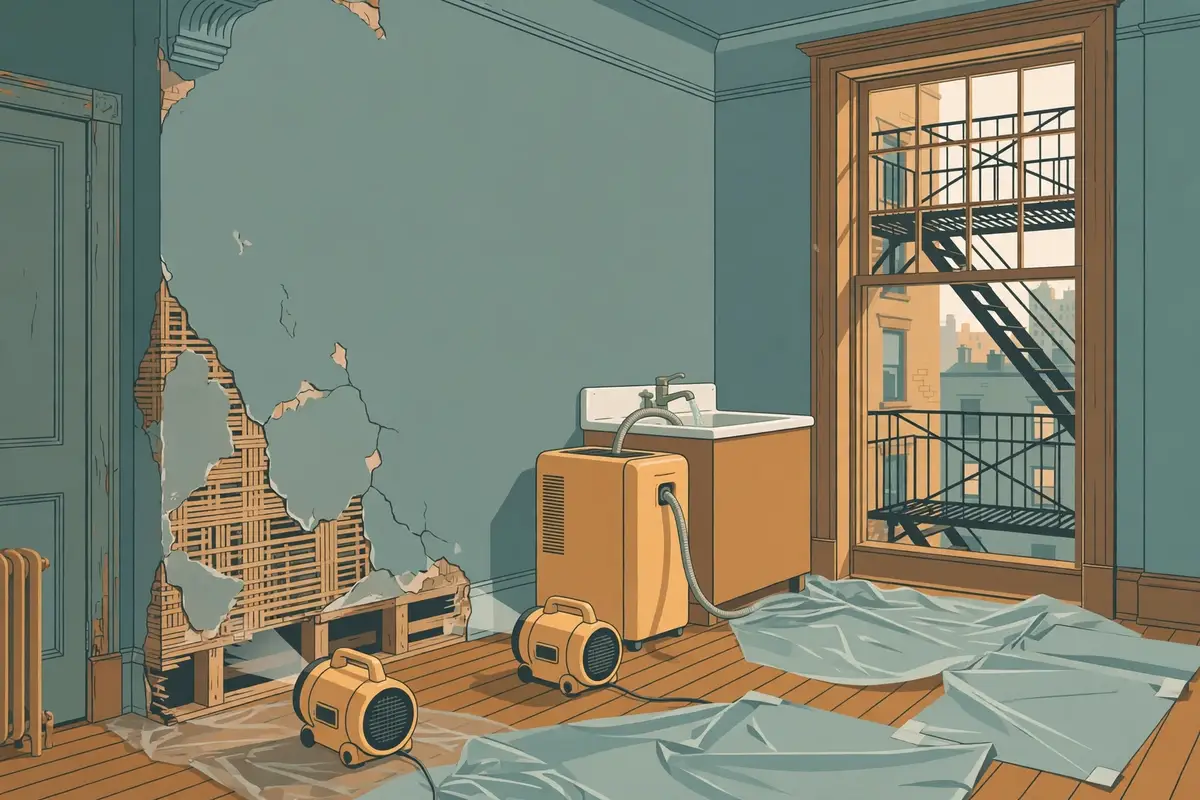
All Fifty-Six Pages, in One Place

Every page on this site, in the order it was built. The other fifty-five each take one question, one place or one stage of the work. This page, the fifty-second, takes one neighbourhood: its ridge, its buildings, its basements and its water.

Site Home

Home page for restoration help across New York

Brooklyn

Borough page for Brooklyn homes hit by leaks and floods

Queens

Borough page for Queens homes, from Astoria to Far Rockaway

The Bronx

Borough page for Bronx homes and buildings

Staten Island

Borough page for Staten Island homes

Long Island

Regional page for Nassau and Suffolk homes

Manhattan

Borough page for Manhattan apartments and buildings

Insurance Claims in New York

How claims work in New York, step by step

Water Behind Walls in NYC

Finding and fixing hidden water inside walls

Fire Damage in NYC

Help after fire, smoke and the water that put it out

Flood Cleanup in NYC

Cleanup after flood events, street water and storms

Remediation in NYC

The remediation stage explained for city homes

Fire Cleanup in NYC

Cleaning up after a fire, room by room

Rochester

City page for Rochester homes

Albany

City page for Albany homes

Buffalo

City page for Buffalo homes

Syracuse

City page for Syracuse homes

Yonkers

City page for Yonkers homes

New Rochelle

City page for New Rochelle homes

Mount Vernon

City page for Mount Vernon homes

Schenectady

City page for Schenectady homes

Utica

City page for Utica homes

White Plains

City page for White Plains homes

Troy

City page for Troy homes

Niagara Falls

City page for Niagara Falls homes

Binghamton

City page for Binghamton homes

Westchester County

County page for Westchester homes

Hudson Valley

Regional page for Hudson Valley homes

Capital Region

Regional page for Capital Region homes

Western New York

Regional page for the western end of the state

Finger Lakes

Regional page for Finger Lakes homes

Central New York

Regional page for Central New York homes

Southern Tier

Regional page for Southern Tier homes

NYC Hub

The city hub page tying the borough pages together

How Fast Mold Grows

The timeline of mold growth after water gets in

Mold Removal in NYC

Removing mold from city homes, safely and legally

The Full Process

The whole restoration process, step by step

What Restoration Means

A plain definition of the whole trade

Mold Remediation in New York

Licensed mold work under New York rules

Water Removal in NYC

Extraction only: pumps, vacuums and standing water

Water Damage in the City

The broad city page for water problems at home

Nyack Cleanup Page

Cleanup help for Nyack homes in Rockland County

Choosing a Company

How to pick a restoration company you can trust

Commercial Properties in NYC

Water problems in shops, offices and buildings

Basements in NYC

Basement water problems, from seepage to floods

Repairs in New York

The repair stage that follows cleanup and drying

Poughkeepsie

City page for Poughkeepsie homes

Emergencies in NYC

The emergency page: speed, safety and the first hour

Cleanup After Water in NYC

The cleanup stage after water is out, room by room

Flood Restoration in NYC

The flood event page: storm water, basements, claims and rebuilding

The Timeline Page

How long each stage takes, from first call to dry rooms

Does Insurance Cover Water Damage Restoration

Whether insurance covers water damage restoration, explained plainly, by cause and New York rule.

Water Damage Mold Remediation

Mold that grew after a leak or flood, remediated the New York way, by licensed assessor and remediator.

Water Damage Restoration Companies New York

Compare the companies serving New York: national franchises, regional firms and local independents, and how to verify licences and certification before you hire.

Water Damage From Upstairs Neighbor

Water damage from an upstairs neighbor in New York City: who pays, what to do in the first hour, and how to document, report and claim.