Water Damage Restoration Queens: Fast Help for Flooded Homes in Queens, NY
A burst pipe in Astoria, a sewer backup in Jamaica, a flooded basement apartment in Corona, or surge water in Far Rockaway: whatever the water did, this page walks you through the first hour, the full restoration process, who pays, and how the claim works, in plain language.
Last updated: November 2026
The short answer
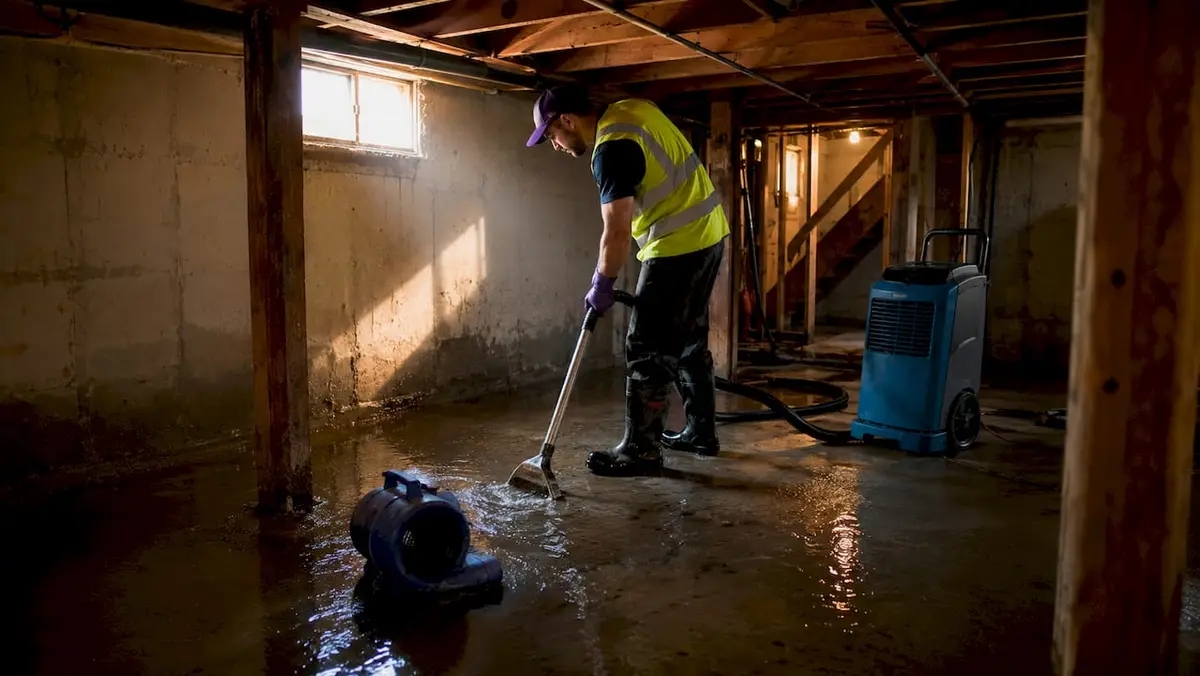
Stop the water, stay safe around electricity, photograph everything, and get extraction and professional drying started the same day. In Queens, most clean water jobs dry in three to five days. Sewage and rising flood water are handled as contaminated from the first minute. Mold can start within 24 to 48 hours, the window the United States Environmental Protection Agency gives for drying wet areas before growth begins, so the first day decides whether you have a drying job or a demolition job.
What is water damage restoration? Water damage restoration is the process of removing standing water, drying the structure and contents of a building, cleaning what the water touched, and repairing what cannot be saved, so a Queens home is safe, dry, and back to how it was before the water came.
Key takeaways
- The United States Environmental Protection Agency (EPA) advises drying water damaged areas and items within 24 to 48 hours to prevent mold growth.
- A typical Queens basement dries in three to five days with the right equipment, the figure All Star Restoration gives on its Queens page, while saturated pre-war plaster and lath can take five to ten days.
- The New York City Department of Environmental Protection (DEP) says in its published sewer backup guidance that it inspects within six hours of a 311 complaint, though heavy rain can delay the visit.
- A claim against New York City for sewer backup or water main damage must be served on the City Comptroller within 90 days of the incident, under General Municipal Law section 50-e.
- A flood policy from the National Flood Insurance Program (NFIP) typically takes effect only after a 30 day waiting period, so cover bought when a storm is already forecast will not pay for that storm.
- In a New York co-op, the corporation is responsible for the apartment envelope, the walls, floor, and ceiling, while the shareholder pays for finishes, fixtures, and furnishings inside, the split set out in Habitat Magazine's Board Talk column.
- Water that enters through a facade or a roof is the board's responsibility in both co-ops and condos, according to attorney Steve Wagner of Adam Leitman Bailey, quoted in Habitat Magazine.
Quick Answers to the Questions Queens Asks Most
These are the questions Queens homeowners, renters, and co-op shareholders ask first, answered in one short block each, the way a water damage restoration Queens crew would answer at your door. Every answer below also appears in the full questions section at the end of this page, word for word.
How do I know if the water damage in my Briarwood home is covered by insurance?
Coverage turns on the cause and the timing. Adjusters look for a sudden and accidental event, like a burst pipe or a failed appliance, reported fast and documented well. Photograph everything before cleanup, keep the failed part, and note when you first saw water. Slow leaks and rising outdoor water are the most common reasons Queens claims are denied.
My Fresh Pond basement flooded after a storm. Is that covered differently than a pipe burst?
Yes. A pipe burst is sudden and accidental damage inside the home, and a standard homeowners policy usually covers it. Storm water that enters through a window well, a foundation crack, or saturated ground is classed as flood damage, and flood damage needs a separate flood policy, usually through the National Flood Insurance Program.
The sump pump quit during a storm. What now?
Call for extraction and drying first, because a failed pump lets groundwater keep rising while the rain lasts. Stay out of standing water near outlets or the breaker panel. Once the basement is dry, have the pump checked or replaced and fit a battery backup, because pumps fail during storms, exactly when the power cuts and groundwater is highest.
Do you work in condo buildings with strict management rules?
Yes. The crew provides a certificate of insurance before work starts, follows the building work hours, books the service elevator, and protects hallways and other common areas. Management gets the scope in writing on day one, and equipment is placed to meet building noise rules, so access stays simple and the job does not stall at the front desk.
If a leak destroys an apartment, is a co-op board responsible for the repairs?
In most Queens co-ops, the corporation is responsible for the structure of the apartment: the floors, walls, ceilings, and wiring conduits, and for stopping a leak that starts in a shared pipe or riser. The shareholder is responsible for furnishings, fixtures, cabinets, and finishes inside the unit. Your proprietary lease sets the split, so check it against the board answer.
Who pays when water comes through the facade or the roof of a co-op or condo?
The board pays. The building envelope is a common element in both co-ops and condos: the facade, the roof, and window frames belong to the building, not to you. Water entering through them is the board responsibility, including repairs inside your unit where it damaged walls and ceilings. Report it in writing, and keep reporting until the source is fixed.
I rent my Queens home. How do I claim for my belongings after water damage?
Tell your landlord in writing the same day, then photograph and video each damaged item before anything is thrown away. Open a claim on your renters policy for your belongings, keep receipts for emergency spending, and start cleanup right away, because your policy expects you to limit further loss. Do not dispose of damaged items until your adjuster confirms it.
Does the source of the water matter?
Yes, because the source decides which policy pays, or whether any policy pays. A burst pipe inside the building, a water main break, a sewer backup, and outside flooding each fall under different coverage, or under none. Get the cause documented in writing on day one, by the crew, the plumber, or the inspector, before repairs erase the evidence.
How do I file a water damage insurance claim in Queens?
Stop the water source first, then photograph and video everything before you move anything. Call your insurer to open the claim the same day, and start mitigation right away, because your policy requires you to prevent further damage. Keep every receipt, ask for the adjuster estimate in writing, and never throw away damaged materials before they are documented.
My basement apartment flooded. Can you help fast?
Yes. Flooded basement apartments are among the most common Queens calls, and a crew extracts the water, dries the unit, and checks walls and floors for hidden moisture before mold starts. If water is still rising during a storm, get out and go to higher ground first, and never handle belongings that sewage water touched.
Queens water damage facts at a glance
| Fact | The short version |
|---|---|
| Typical drying time for clean water | 3 to 5 days for a typical basement, per All Star Restoration's Queens guidance, with daily moisture checks |
| Mold can start | Within 24 to 48 hours on wet materials, per the EPA |
| Sewage coming up through a drain | Call 311. The Department of Environmental Protection inspects within six hours of the complaint by its own published guidance, though heavy rain can delay it |
| Claim against the City | A notice of claim goes to the Comptroller within 90 days, under General Municipal Law section 50-e |
| Flood policy waiting period | Typically 30 days before cover takes effect, the standard NFIP waiting period |
| Emergency response | 24 hours a day, 7 days a week |
Short answers, the way you would ask out loud
- What is water damage restoration in Queens? It is the process of removing standing water, drying the home, cleaning what the water touched, and repairing what cannot be saved.
- How long does water damage restoration take in Queens? Most clean water jobs dry in three to five days, with moisture checks every day until readings reach the dry standard.
- Who do I call first for water damage in Queens? Call a local restoration crew first for extraction and drying, and call 311 if sewage is coming up through a drain.
- Does homeowners insurance cover water damage in Queens? Most policies cover sudden and accidental damage like a burst pipe, but rising flood water needs a separate flood policy.
- When does mold start growing after a leak? Mold can start within 24 to 48 hours on wet drywall, wood, and carpet, which is why drying starts the same day.
- Who pays when the apartment above leaks into mine? Usually the person whose pipe or appliance failed, or their insurer, while the building pays for shared pipes and the structure.
The First 60 Minutes After You Find Water in a Queens Home
The first hour after you find water in a Queens home should go to three things in order: safety around electricity, stopping the water at its source, and photographing the damage before anything moves. The first hour decides how big this job becomes. Water does not sit still. It spreads under flooring, climbs into drywall by capillary action, and finds the seams around tubs, cabinets, and door frames. A calm, ordered first hour keeps a bad morning from turning into a month of demolition. Work through these steps in order, and skip any step that is not safe.
- Make the space safe. If water is near outlets, a space heater, a boiler, or the breaker panel, stay out of it. Water and electricity together are the one real danger in most home flooding. If you cannot tell whether the area is safe, treat it as unsafe and wait for help.
- Stop the water. Every fixture has a shutoff. Toilets and sinks have valves at the wall. A washing machine has valves behind it. If you cannot find the fixture valve, or the pipe itself has burst, close the main shutoff for the house or unit. In Queens houses the main is usually in the basement near the front wall, where the water service enters from the street. In apartments, ask the super before you need it, because finding it during a flood is the wrong time to learn.
- Call DEP if the water is coming from the street or the sewer. If water is pushing up through a floor drain or a basement toilet, or the whole block is flooding, the problem may be the city main or the city sewer. New York City residents can call 311 to report it, and the Department of Environmental Protection handles water main and sewer complaints. Tell your restoration crew too, because sewage category water changes how the whole job is handled.
- Document before you touch anything. Walk through with your phone. Photograph the source, the standing water, the water line on the walls, and every damaged item. Take one slow video of each room. This takes ten minutes and it is the strongest thing you can do for your insurance claim.
- Get belongings up and out. Lift furniture onto blocks or foil wrapped wood if you have it. Move rugs, boxes, books, and electronics out of the wet area. Cardboard on a wet floor is lost within hours, so anything stored in cardboard in a Queens basement should come up first.
- Start removing water you can reach safely. A wet vacuum, towels, and a mop will not dry a structure, but removing surface water while you wait for the crew slows the spread. Do not tear out walls or flooring yourself before the crew and the adjuster have seen and recorded the damage, unless leaving it would cause more harm.
- Call a restoration crew and your insurer. Report the loss to your insurer the same day. Then get the crew moving. Insurers expect you to limit further damage, and a fast mitigation record supports your claim instead of hurting it.
People in Queens ask about this hour constantly, in building group chats, on neighbourhood forums, and in question and answer threads online. The same worries come up again and again: is it safe to touch the breaker, will the landlord have to pay, can I be charged for the neighbour's ceiling, and how long until mold starts. This page answers each of those questions in the sections below, in plain language, because the first hour is no time to decode fine print. It is also the moment when good water damage restoration Queens work begins.
The First 48 Hours After a Coastal Storm in Queens
In the first 48 hours after a coastal storm floods a Queens home, the order is fixed: get people out of below grade rooms, report the damage to your insurer and to the City as two separate steps, then start extraction and drying. Queens learned the storm version of the first hour the hard way, and November 2026 taught it again. On 12 November 2026 a nor'easter dropped just over 3.32 inches of rain at JFK Airport, the airport's second wettest November day on record, according to Fox Weather reporting of National Weather Service figures. A tornado warning was issued for southern Queens and JFK that afternoon, hail pounded Breezy Point and Rockaway Beach, flash flood warnings covered Jamaica and the Rockaways, and cars were stuck in floodwater on Beach Channel Drive and near 177th Street in Jamaica. A week earlier, on 5 November 2026, Governor Hochul announced that New York State was requesting federal assistance for coastal storm damage on Long Island and in New York City. When a storm like that puts water in your home, the first 48 hours follow a set order, and the order matters.
Hour zero: get people out of below grade rooms first
If water is rising in a basement or cellar apartment, get out and get to higher ground. Do not wait for the rain to stop, and do not go back down while water is still coming in. Hurricane Ida in September 2021 is the reason this rule is stated so bluntly: the Associated Press reported that at least 13 people were killed in New York City, 11 of them in flooded basement apartments, while the NYC Health Department count is 14 deaths, 10 of them drownings in unregulated basement apartments. The counts differ by source, but the pattern does not: below grade rooms in a fast storm are the most dangerous rooms in Queens. No belongings, no documents, and no pump are worth staying down there.
Report twice: the insurer, and the City
These are two separate steps, and Queens homeowners mix them up after every storm. First, report the claim to your insurance company or agent. If you hold a separate flood policy, report the flood loss to the company that sold you that policy. Second, report the damage to the City: call 311 and submit a damage report at reportdamage.nyc.gov. The city report is not an insurance claim and the insurance claim is not a city report. If sewage came up through a floor drain or a basement toilet, say so on the 311 call: the Department of Environmental Protection handles sewer backups and, by its own published guidance, inspects within six hours of receiving the complaint, though heavy rain can delay that. Keep the 311 tracking number, which begins with 311, and any DEP customer service request number you are given. Those numbers become part of your claim file.
If you believe the City was at fault, the clock is 90 days
When a surcharged city sewer or a broken city water main damaged your home, a claim against the City runs on its own track. The DEP sewer backup page directs homeowners who believe the City was at fault to the New York City Comptroller, and General Municipal Law section 50-e requires a notice of claim to be properly served within 90 days of the date of the incident. For a sewer backup or water main break, the Comptroller uses a Water Damage Claim Form, notices cannot be filed by email, and you must wait 30 days after filing the notice before filing a lawsuit, which itself must be filed within one year and 90 days of the incident. This is general information, not legal advice, but the 90 day deadline is real and it does not pause while you argue with an insurer.
Then start the drying, and write everything down
Once people are safe and both reports are filed, the work is the same as any water event, only bigger: photograph and video every room before cleanup moves anything, get extraction started the same day, and keep every receipt for emergency spending. Storm jobs in Howard Beach, Broad Channel, and the Rockaways are treated as category 3 from the first minute, because water that crossed streets, yards, and sewers on its way in is contaminated by definition. Inland, in Jamaica, Flushing, Woodside, and Corona, a storm backup through a floor drain is category 3 for the same reason. The storm sections below explain why Queens water behaves this way, and the insurance section explains how the claim clock runs. Storm work is where water damage restoration Queens crews earn their reputation, because the first 48 hours decide the next four weeks.
Water on the floor right now? Talk to a Queens crew before it spreads.
Call (212) 555-0147 (212) 555-0147: placeholder number, replace with your real number before publishing. Replace it with the real business number before this page goes live.Why Queens Floods the Way It Does
Queens floods the way it does because the borough was built on marsh, creek, and meadowland, and its combined sewers, buried streams, and rising groundwater still follow that old geography. Queens is the largest borough in New York City by land, and much of it was not dry land to begin with. The borough was built across marshes, creeks, and meadowland: Flushing Meadows was a tidal marsh and ash dump before it was a park, Jamaica Bay's edges were wetlands, and the streams that once ran through Elmhurst, Maspeth, and Springfield Gardens were buried in culverts and sewers as the streets went down. The water remembers. In a hard storm, it returns to the low lines where it always ran, which is why two houses on the same block can have completely different flood histories.
Layer the infrastructure on top of that geography. Much of the borough drains through combined sewers built for a smaller, less paved city. Every driveway, extension, and paved yard added over a century sends more rain into the same pipes, faster. The result is a borough where the flood map is only the beginning of the story: the real risk map is written street by street, in the memory of supers, long time owners, and the water lines inside basement walls.
This is also why local knowledge is not a marketing line in Queens restoration work. A crew that knows which streets surcharge first, which buildings share stacks, which neighbourhoods sit on the high water table, and which blocks took surge in Sandy reads a new job faster and scopes it better. When you interview a company, ask them about your street. The answer tells you whether their Queens coverage is a map pin or a working knowledge.
Honest limits: what restoration cannot do
Restoration is powerful and it is not magic. It cannot unswell a particle board cabinet, unwarp a laminate floor, or make sewage soaked upholstery safe to keep. It cannot dry a wall that is still being fed by a live leak, and it cannot outrun a claim deadline you have already missed. It cannot replace a backwater valve that was never installed, and it cannot turn rising flood water into a covered loss under a policy that excludes floods. What it can do, done early and measured properly, is stop a bad event at the smallest version of itself: fewer materials lost, fewer days displaced, fewer arguments with better paper. Every honest crew in this trade will tell you the same thing, because the physics does not negotiate: the earlier the call, the smaller the job.
A note on older homes and hidden conditions
Queens homes hide their history. Behind the basement paneling there may be three generations of repairs. Inside the bathroom wall there may be a pipe replaced in 1962 with whatever was on the truck. A flood opens these walls and shows the truth, and sometimes the truth includes conditions nobody caused this week: old termite damage in a sill, a corroded pipe that was always going to fail, wiring that predates modern code. A good crew separates the flood damage from the pre-existing condition in the documentation, because insurers pay for the event, not the archaeology, and because you deserve a clear picture of your own house. Expect surprises in any home over fifty years old, which in Queens is most of them, and judge the crew by how calmly and clearly they explain what the wall revealed.
Water on the floor right now? Talk to a Queens crew before it spreads.
Call (212) 555-0147 (212) 555-0147: placeholder number, replace with your real number before publishing. Replace it with the real business number before this page goes live.What Causes Water Damage in Queens Homes
The causes of water damage in Queens homes fall into six groups: combined sewer backups in heavy rain, tidal and storm flooding near the bays, ageing pipes in older buildings, failed heaters, machines, and supply lines, roof and parapet leaks on attached houses, and groundwater rising where sump pumps fail. Queens is not one housing stock. It is pre-war apartment buildings in Astoria and Jackson Heights, attached brick houses in Ridgewood and Glendale, detached homes with big basements in Bayside and Fresh Meadows, garden apartments in Forest Hills, high-rises in Rego Park and Flushing, and low coastal streets in the Rockaways, Broad Channel, and Howard Beach. Each building type fails in its own way, and a crew that works the borough daily reads those patterns fast. Pattern knowledge is what separates local water damage restoration Queens crews from a national call centre script.
Combined sewer backups during heavy rain
Large parts of Queens drain into combined sewers. One pipe carries rainwater from the street and wastewater from homes. In a cloudburst, that pipe fills beyond capacity. The pressure has to go somewhere, and the lowest opening in the lowest home on the line is where it shows up: a basement floor drain, a laundry sink, a cellar toilet. The water that comes up is not rain. It is a mix, and it is treated as the most contaminated category of water on any job. Neighbourhoods that sit low, including parts of Flushing, Corona, Woodside, Maspeth, and the streets around Flushing Meadows Corona Park, see this pattern again and again after summer storms.
Tidal flooding and storm surge near Jamaica Bay and the bays
Howard Beach, Broad Channel, the Rockaway peninsula, and the southern edges of Jamaica sit at the edge of Jamaica Bay. Hamilton Beach and the low streets near the bay flood on tides alone during certain moon phases, before any rain falls. Far Rockaway and Arverne face the ocean side as well. Hurricane Sandy rewrote the ground floors of this whole coastline in 2012, and the lesson stayed: in these neighbourhoods, water comes from outside and rises, which makes it flood water in insurance terms, and it needs flood coverage, raised utilities, and a ground floor plan that assumes water will visit again.
Basement and cellar apartments taking water first
Queens has thousands of basement and cellar units, in legal conversions, in two family houses, and in informal arrangements that everyone in the borough knows exist. These units sit below street level, often below the sewer line, and they take water first in every storm and every backup. A burst pipe on the ground floor ends up in the basement unit. A surcharged sewer enters through the basement unit. The human side matters here: people sleep in these rooms. Any flooding in a below grade unit should be treated as urgent, the occupants moved out until the water category is known, and the landlord notified in writing the same day.
Ageing pipes in pre-war and post-war buildings
Galvanised supply pipes in older Queens buildings corrode from the inside. Flow slows, pressure drops, and one winter morning the pipe lets go inside a wall. Cast iron drain stacks crack and leak at the joints. In the big pre-war buildings of Jackson Heights, Astoria, Sunnyside, and Forest Hills, one stack serves many homes, so one failure can wet a vertical line of apartments from the sixth floor to the first. Steam heat adds its own failures: radiator valves weep, air vents spit, and a stuck valve can push water through a ceiling slowly enough that the first sign is a stain, not a drip.
Water heaters, washing machines, and supply lines
The most common clean water losses in Queens are boring ones. A water heater in a basement closet rusts through at the base. A rubber washing machine hose, ten years old and never replaced, splits at two in the morning. A refrigerator ice maker line works loose. A dishwasher leaks under a cabinet for weeks, quietly, until the floor gives under your foot. These are sudden events in insurance language when the failure is abrupt, and they are the jobs where fast extraction saves floors, cabinets, and walls that would otherwise be lost.
Roof leaks and parapet failures on attached houses
Attached houses in Ridgewood, Glendale, Middle Village, and Woodhaven share rooflines and party walls. A failed parapet cap, a cracked bulkhead, or a clogged roof drain sends water down inside the party wall, and it can appear in either home, or both. Because the wall is shared, the repair conversation involves the neighbour whether anyone wants it to or not. The drying work should not wait for that conversation. Wet framing does not care whose insurance is paying.
Groundwater and sump pump failures
Parts of eastern Queens, including Hollis, Queens Village, Springfield Gardens, and the streets near the old Jamaica Bay tributaries, sit on a high water table. Basements there rely on sump pumps during wet seasons. A pump that fails during a storm, or a power outage that stops it, lets groundwater rise through the floor slab joints and the cove joint where the floor meets the wall. The water is usually clean, the volume can be large, and the fix includes the pump and a battery backup, not just the drying.
Water Categories and Damage Classes, in Plain Language
Every water damage job is described two ways under the Institute of Inspection, Cleaning and Restoration Certification (IICRC) S500 standard, the professional standard for water damage restoration: by the category of the water, and by the class of the damage. Knowing both helps you understand the crew's scope and the adjuster's questions.
| Category | What it means | Typical Queens examples | What it changes |
|---|---|---|---|
| Category 1, clean | Water from a sanitary source that has not sat or mixed with contaminants | Burst supply pipe, water heater failure, rainwater through a roof leak caught early | Most materials can be dried in place; fastest, least invasive jobs |
| Category 2, grey | Water with significant contamination that can cause discomfort or illness | Washing machine discharge, dishwasher leaks, water that sat in carpet for a day or more | Carpet pad usually removed; antimicrobial treatment; more material comes out |
| Category 3, black | Grossly contaminated water that can carry bacteria, viruses, and chemicals | Sewer backup, rising water from outside, tidal flooding, toilet overflow with waste | Porous materials removed, containment set, protective gear, disinfection; safety leads the scope |
| Class | How much is wet | What drying looks like |
|---|---|---|
| Class 1 | A small area, little absorption into materials | One or two air movers, short drying time, daily check |
| Class 2 | A whole room or more, water wicked up walls | Multiple air movers and a dehumidifier, readings logged daily |
| Class 3 | Water from overhead, ceilings and walls saturated | Wall cavity drying, possible flood cuts, longer schedule |
| Class 4 | Deep water in materials that release moisture slowly, like plaster, masonry, and hardwood | Specialty drying, heat or directed systems, patience measured in days |
Queens housing stock produces a lot of Class 4 work. Plaster and lath walls, brick party walls, and concrete cellar floors hold moisture and give it back slowly. A crew that only owns a moisture meter with pins will misread these materials. Proper testing uses pinless meters, pin meters, and thermo-hygrometers together, compared against a dry standard taken from an unaffected part of the same home. Ask any water damage restoration Queens company you interview how they take a dry standard.
Water Damage Restoration Queens Services for Homes and Buildings
Water damage restoration Queens services cover the whole job under one scope: emergency extraction, structural drying, sewage cleanup, basement and cellar drying, leak detection and moisture mapping, mold remediation support, floor and hardwood recovery, contents pack out and cleaning, and rebuild coordination.
Emergency water extraction
Standing water removal with truck mounted and portable extractors, weighted extraction for carpet, and submersible pumps for deep basement water. Extraction is the highest value hour of the whole job: every gallon removed by machine is water the dehumidifiers never have to pull out of the air.
Structural drying
Air movers placed by calculation, not by guess, with commercial dehumidification sized to the class of loss. Wall cavity drying systems push dry air into closed walls through small holes at the baseboard line, saving walls that older methods would have opened.
Sewage backup cleanup
Containment, protective equipment, removal of contaminated porous material, cleaning and disinfection of hard surfaces, and proper disposal. In Queens this is most often a storm driven combined sewer event, and it is handled as a health job first and a building job second.
Basement and cellar drying
Pumping, extraction, and drying for below grade spaces, with attention to the cove joint, stored belongings, oil burner and boiler rooms, and the electrical panel. Includes sump pump failure cleanup and groundwater intrusion drying.
Leak detection and moisture mapping
Thermal imaging and meter surveys that find the true edge of the wet area, including water that travelled under flooring or inside a party wall. A written moisture map becomes part of the claim file and the drying plan.
Mold remediation support
Where water has sat long enough for growth, containment with negative air, HEPA filtration, removal of colonised material, and cleaning under the work practices New York City requires for larger jobs. In rental buildings, this work connects directly to the duties in Local Law 55 of 2018, the Indoor Allergen Hazards law.
Floor drying and hardwood recovery
Floor mat systems that draw moisture from hardwood through the board seams, tenting, and controlled drying that can save floors a less equipped crew would tear out. Every floor is tested before a save or remove decision is made.
Contents pack out and cleaning
Inventory, packing, and removal of belongings to a dry area or storage, with cleaning for salvageable items. The inventory list doubles as claim documentation, item by item, with photographs.
Rebuild and repair coordination
After drying is verified, the repair stage: drywall, plaster, flooring, trim, paint, and cabinet work, coordinated with the building management rules that Queens co-ops and condos enforce. Drying sign off comes first, in writing, with final readings.
Odour removal
Musty and sewage odours are treated at the source, by removing the material that holds them and cleaning the cavity, not by masking them with fragrance. If an odour survives proper drying, something is still wet or colonised, and it gets found.
The 8 Step Restoration Process, and a Drying Diary
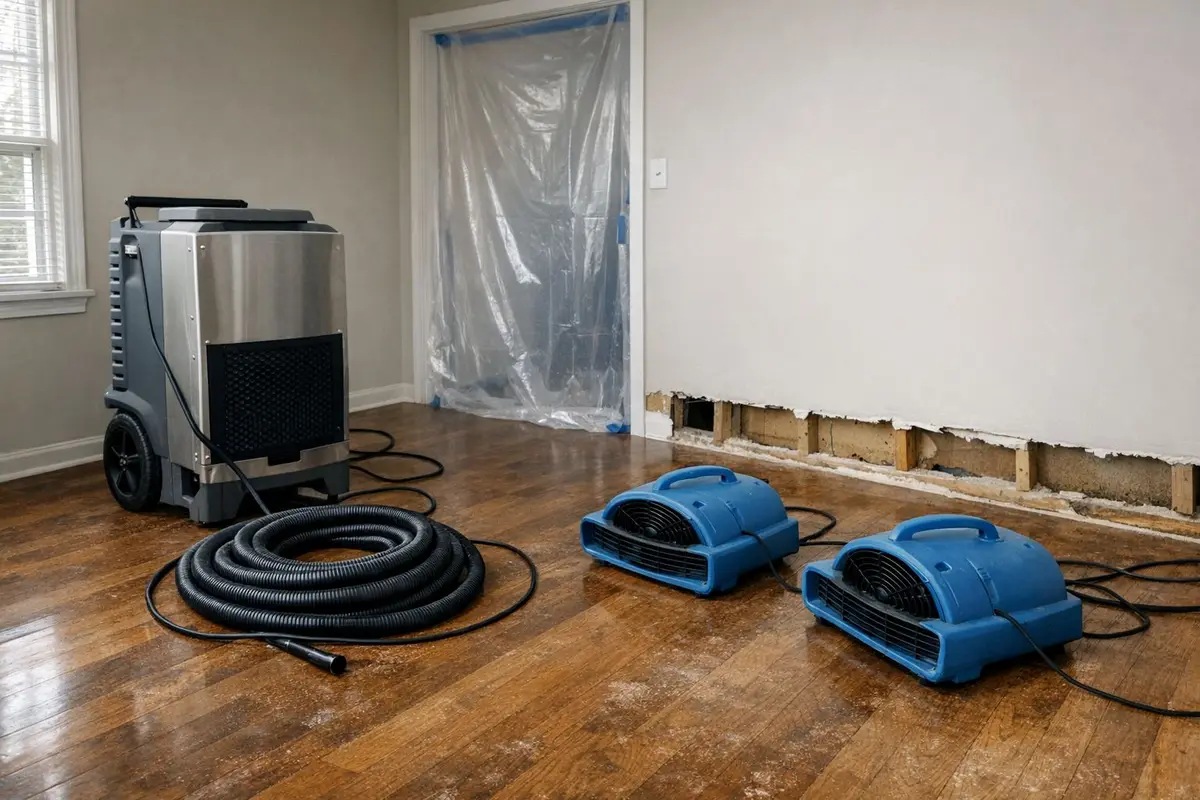
Water damage restoration Queens work runs in eight steps, from the first inspection and moisture survey to a verified dry handback, and the drying diary written along the way is the record your insurance claim stands on.
- Inspection and moisture survey. The crew walks the whole property, not just the wet room, testing with meters and a thermal camera, and writes down the dry standard from an unaffected area.
- Water source control. If the source is still active, it is stopped or isolated. A restoration crew is not a plumber, but no drying plan survives a live leak.
- Extraction. Standing water comes out by machine. Furniture is blocked or moved. Wet carpet is extracted in place or lifted, depending on category.
- Removal of unsalvageable material. Wet carpet pad, soaked insulation, contaminated drywall, and swollen particle board come out. Sound material stays. The wet test guides every one of these calls.
- Cleaning and antimicrobial treatment. Affected surfaces are cleaned, and treatment is applied where the category of water calls for it.
- Drying setup. Air movers and dehumidifiers are placed and the setup is photographed and logged for the claim file.
- Daily monitoring. Readings are taken every day, equipment is adjusted, and the log grows. This diary is what proves the home actually dried.
- Verification and handback. Final readings are compared to the dry standard, equipment comes out, and you get the documentation pack for your records and your insurer.
What a real drying diary looks like
Day one is noise and water: extraction, equipment in, the first set of readings written down. A living room wall might read deep into the wet range while the hallway sample, the dry standard, sits far lower. Day two readings should move. If they do not, the setup changes: more dehumidification, cavity drying added, or a section of baseboard removed to let the wall breathe. Day three is usually the turn, when hardwood readings fall and the plaster starts giving up its moisture. Days four and five are verification: readings at the dry standard on two checks, equipment out, and the rebuild conversation begins. A crew that cannot show you this diary is asking you to take dryness on faith, and faith is not a moisture reading. Keep that diary from your water damage restoration Queens crew with your claim papers.
Drying time by situation: the Queens table
Every competitor page in Queens says drying takes three to five days, and stops there. That figure is true for one kind of job and wrong for several others. The honest answer depends on what got wet, what the water carried, and what the walls are made of. Use this table to read any crew's estimate, including ours. It is the table water damage restoration Queens estimates should be judged against.
| Situation | Typical drying time | What decides it |
|---|---|---|
| Contained clean water leak, caught the same day | 2 to 3 days | Small wet area, tile or sealed floors, no water inside wall cavities |
| Standard clean water room, carpet and drywall wet | 3 to 5 days | Extraction done on day one, air movers and dehumidification sized to the room |
| Flooded basement, clean or groundwater | 3 to 6 days | Concrete and masonry release moisture slowly; a typical Queens basement with the right equipment dries in about three to five days, deep water runs longer |
| Pre-war plaster and lath walls, saturated | 5 to 10 days | Plaster holds a large volume of water and gives it back slowly; daily readings at depth, not surface feel, set the end date |
| Wet apartment stack, several units on one line | 7 to 14 days | Each unit dries to its own readings, access runs on building hours, and the source repair has to finish before cavities can close |
| Sewage backup or Rockaway salt water job | Removal and disinfection first, then 5 to 10 days of drying | Contaminated porous material comes out before drying starts, and salt water work adds a rinse of the framing before the drying clock begins |
Drying is finished when the meter says so, not when the calendar does. The equipment that produces these numbers is professional grade and named on good invoices: Dri-Eaz and Phoenix dehumidifiers, Injectidry wall cavity drying systems, B-Air air movers, and Tramex moisture meters with FLIR thermal cameras to find the wet edge. The targets are just as specific. Wood framing and flooring are dried to roughly 15 to 16 percent moisture content, the trade target restoration sources use, and every material is compared against a dry standard reading taken from the same material in an unaffected part of your home. If a crew cannot name its equipment, its meter, and its target number, the three to five day promise is a guess.
Lessons from real restoration case study videos
Watch the working videos that restoration trainers post and the same three habits appear on every good job. First, test before you tear: the technician checks the wall with a meter, marks the wet line, and only then talks about cutting. Second, the flood cut is measured, straight, and no higher than the water actually reached. Third, the wet test at the end decides whether material stays, using a dry sample from the same home as the target. These habits sound small. Together they are the difference between a dried home and a demolished one. The clearest worked example online is a finished basement case, the exact Queens pattern: a sewer backup or heavy rain overwhelms the city system, water works its way back into the home, and the presenter walks the wet test and the flood cut step by step: watch the Home RenoVision DIY basement water damage walkthrough on YouTube, then ask your crew the same questions that video raises.
Test Before You Tear: The Wet Test, the Flood Cut, and Older Building Materials
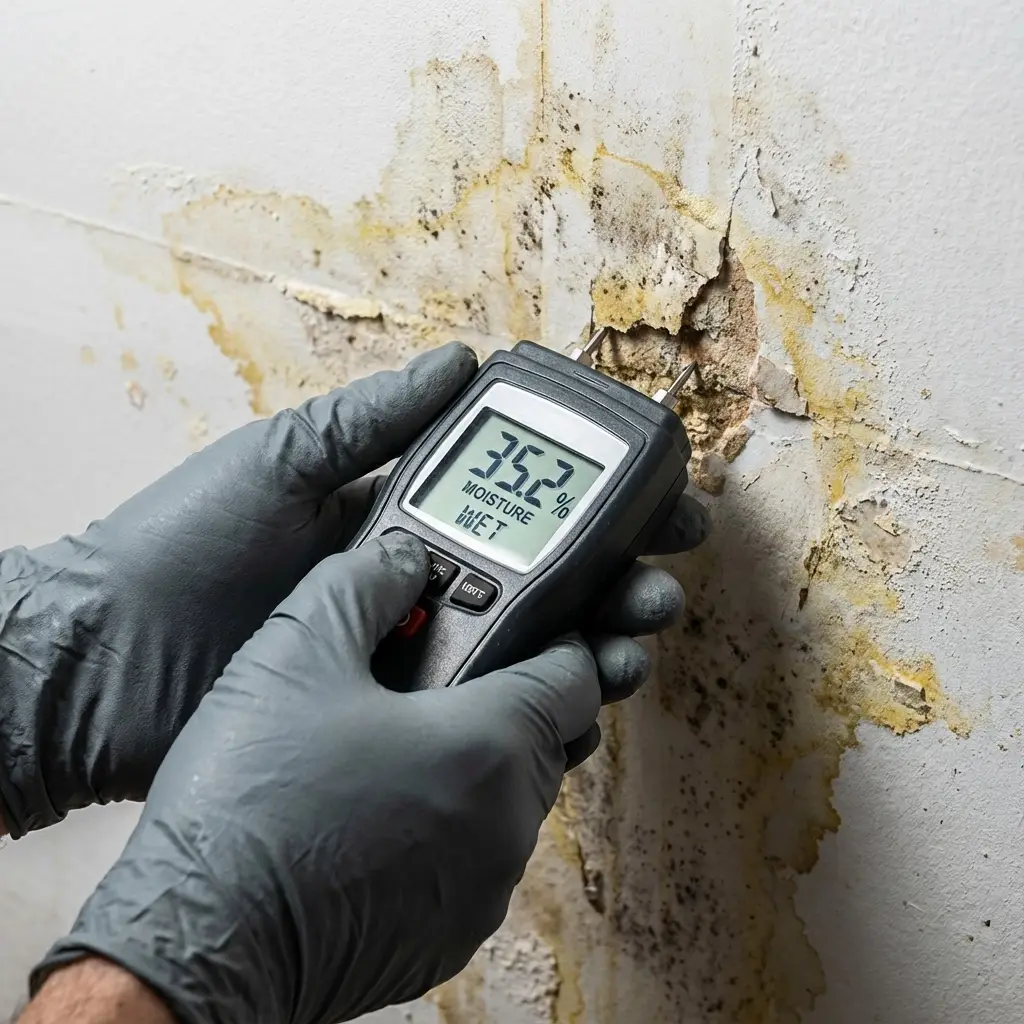
Before any wet material is cut out of a Queens home, it is tested first, because the wet test and meter readings show where sound material starts and what can safely dry in place. The cheapest sentence in restoration is the one said before any demolition starts: let us test it first. In the Home RenoVision basement walkthrough, the wet test is disarmingly simple. The presenter takes a screwdriver and punches it through the wet drywall, and it pops through easily, the way a ten year old could push it through. He keeps punching upward until the drywall resists. That point, where sound material starts, is the real cut line, and it sits above the visible stain, because moisture readings stay too high well above the water line even where the wall looks clean. The stain line is not the cut line. Guessing instead of testing either leaves wet material in the wall or throws away sound wall that took a week to rebuild.
The flood cut, measured
When the test says the lower wall has to open, the cut follows the measurement. In the same walkthrough, a full sheet of drywall is 48 inches tall, and the cut is made at about the height of a doorknob, scored twice through the paper, cut clean, and worked loose stud by stud. The screws come out too: drywall screws have low shear strength, they rust after a wetting, and a rusty screw telegraphs its stain through new paint and compound later. The point of the whole exercise is narrow and practical: get the wet material out so the cavity can dry, treat the framing, and then wait. The presenter gives the basement about a week and uses his nose as a second instrument: if it still smells, bacteria are still active and the treatment is not finished. Professional crews do the same job with meters instead of noses, and with disinfection suited to the category of water. One caution matters here: the video's do it yourself bleach spray is the presenter's own advice for a small case. It is not the professional standard for category 3 sewage water, which calls for extraction, removal of porous material, proper disinfection, and meter verified drying.
Asbestos and lead: the pre-war Queens question
Queens adds a step that newer suburbs rarely face. Jackson Heights alone holds the largest garden apartment historic district in the United States, more than 200 original Queensboro Corporation buildings built between the 1910s and 1940s, and Astoria, Sunnyside, and Forest Hills are full of buildings from the same decades. Floor tiles, pipe insulation, joint compounds, and old paints in these buildings can contain asbestos or lead, and cutting into them can release both. The order taught in the Test Before You Tear training material is the order a careful Queens crew follows: extraction and drying first, then testing, then safe mitigation, then clearance testing, and only then the rebuild. Clearance matters before anyone moves back into a room that was opened up, and the principle underneath all of it is the one worth memorising: looks dry does not always mean is dry, and looks clean does not always mean is safe. Ask your crew, before the first cut, what testing the building's age calls for. In a pre-war Queens building, that question is not caution. It is the job, and it is what separates careful water damage restoration Queens work from demolition by guesswork.
Water on the floor right now? Talk to a Queens crew before it spreads.
Call (212) 555-0147 (212) 555-0147: placeholder number, replace with your real number before publishing. Replace it with the real business number before this page goes live.Neighbourhood by Neighbourhood: How Water Behaves Across Queens
Water behaves differently in every Queens neighbourhood, because the housing stock, the sewer pattern, and the water table change from one area to the next. A borough this size cannot be served with one paragraph of local colour. The water problems of a Forest Hills garden apartment and a Far Rockaway bungalow have almost nothing in common. Here is how the work actually breaks down across Queens. It is the daily map of water damage restoration Queens wide.
| Neighbourhood | ZIP | Neighbourhood | ZIP |
|---|---|---|---|
| Long Island City | 11101 | Astoria | 11103 |
| Sunnyside | 11104 | Corona | 11368 |
| Jackson Heights | 11372 | Elmhurst | 11373 |
| Rego Park | 11374 | Forest Hills | 11375 |
| Woodside | 11377 | Ridgewood | 11385 |
| Flushing | 11354 | Whitestone | 11357 |
| Bayside | 11361 | Howard Beach | 11414 |
| Kew Gardens | 11415 | Richmond Hill | 11418 |
| Jamaica | 11432 | Broad Channel | 11693 |
| Rockaway Park | 11694 | Far Rockaway | 11691 |
Twenty neighbourhoods, twenty different water stories, one borough, and one standard: water damage restoration Queens homeowners can verify with a meter, a drying diary, and a written scope. The sections below group them the way crews actually work them.
Astoria, Long Island City, Sunnyside, and Woodside
The northwest corner mixes pre-war walk-ups, newer high-rises along the Long Island City waterfront, and one and two family houses on the side streets. Apartment stack leaks dominate: one bathroom failure wets the units below it, floor by floor. In the older buildings, galvanised pipes and tired radiator valves are the repeat offenders. In the new towers, the failures are appliance lines and sprinkler or standpipe events, and the building management paperwork starts immediately.
Jackson Heights, Elmhurst, and Corona
The historic garden apartment complexes of Jackson Heights are beautiful and old, with plumbing that matches their age. Stack leaks, roof and parapet leaks over top floor units, and slow bathroom leaks between floors are the daily work here. Elmhurst and Corona add a large stock of one and two family homes with finished basements, many of them housing extended families, where a sewer backup during a storm is a household emergency, not an inconvenience. Corona sits low near Flushing Meadows, and its basements feel every hard rain.
Flushing, College Point, Whitestone, and Bayside
Flushing mixes high-rise condos, co-ops, and dense commercial streets with single family neighbourhoods at its edges. Condo stack leaks and restaurant or store water events that reach homes above them are common. College Point sits on the bay and takes tidal and storm water on its low streets. Whitestone and Bayside are detached house country: big basements, water heaters working hard, sump pumps in the wet corners, and tree roots in old sewer laterals that turn a heavy rain into a backup.
Forest Hills, Rego Park, Kew Gardens, and Middle Village
Garden apartments, Tudor style attached homes, and large co-op buildings define this band. The water stories here are roof leaks through complex rooflines, parapet and terrace leaks, boiler room events, and bathroom leaks between stacked units in the big buildings. Forest Hills Gardens has strict exterior rules that shape the rebuild stage, so planning the repair paperwork early saves weeks later.
Ridgewood, Glendale, Maspeth, and Woodhaven
Attached brick houses, block after block. Party wall leaks, shared roof drainage, and cellar flooding lead the list. Maspeth sits near Newtown Creek and has industrial neighbours, low ground, and a long memory of storm flooding. Woodhaven and the streets below the Jackie Robinson corridor see combined sewer pressure in hard rain. In these neighbourhoods the neighbour conversation is part of the job, because the water so often arrives through a shared structure.
Jamaica, Richmond Hill, Ozone Park, and South Ozone Park
A huge stock of one and two family homes, many with basement units, many owned by families who have held them for decades. Sewer backups, water heater failures, and groundwater are the pattern. Richmond Hill and South Ozone Park took repeated storm flooding in recent years, including the remnants of Hurricane Ida in 2021, which filled basements across this band with deadly speed. That history is why basement sleeping areas here deserve a hard, honest conversation about alarms, backwater valves, and escape routes.
Hollis, Queens Village, Cambria Heights, Springfield Gardens, Laurelton, and Rosedale
Southeast Queens is detached homes, high water table, and a drainage system that residents have fought to improve for years. Groundwater intrusion, sump failures, and street flooding that reaches garages and basements are the recurring calls. Springfield Gardens sits near the bay tributaries and feels tidal pressure as well. These are the streets where a battery backup for the sump pump and a maintained backwater valve pay for themselves in one storm season.
Howard Beach, Broad Channel, and the Rockaways
This is surge country. Howard Beach and Broad Channel live with Jamaica Bay, and the Rockaway peninsula, from Far Rockaway and Arverne to Rockaway Park, Belle Harbor, and Breezy Point, lives with both the bay and the ocean. Ground floors here are planned around water: raised utilities, flood vents in some homes, materials chosen to survive a wetting. After any coastal storm, the work is category 3 by default, the documentation burden is high, and flood insurance questions lead every conversation.
Queens Water Systems: Flushing Creek, Jamaica Groundwater, and What Ida Proved
Three systems explain most Queens flooding: Flushing Creek and its combined sewer overflows, the rising groundwater under Southeast Queens, and the storm record set by Hurricane Ida in September 2021. Most restoration pages talk about your pipes. This one also talks about the city's, because in Queens the two systems meet in your basement. Three verified pieces of the borough's water story explain most of the flooding patterns above, and every number below carries its source, because these figures are quoted loosely all over the internet.
Flushing Creek and the combined sewer overflow problem
About 60 percent of New York City drains through combined sewers, with 398 combined sewer overflow outfalls discharging roughly 18 billion gallons of combined sewage a year, according to the New York State Department of Environmental Conservation. Flushing Creek is the Queens case study. The joint DEC and DEP Flushing Creek factsheet, October 2025 edition, puts the older baseline at approximately 2 billion gallons of combined sewer overflow per year into Flushing Creek in an average rainfall year, and the newer Long Term Control Plan baseline at approximately 1.2 billion gallons per year. Both numbers are real; they belong to different baselines, and any page that quotes the 2 billion figure as today's discharge is using the older one. The same factsheet records a watershed of about 9,954 acres, three active overflow outfalls into the creek, and 403.8 million dollars invested or committed by DEP, cutting the creek's overflow by 68 percent, including a completed 28 million gallon storage tank with a further 15 million gallons of in system storage. Guardians of Flushing Bay puts the local sensitivity plainly: in the Flushing waterways it takes only a tenth of an inch of rain to overwhelm the sewer system. That is why Flushing, Corona, Elmhurst, and the streets around Flushing Meadows flood in storms that other neighbourhoods shrug off, and why a Flushing basement backup is a city systems event as much as a household one.
Jamaica and Southeast Queens: the groundwater that came back
Southeast Queens has a second water source that no storm is required for. A New York State Assembly bill directing the city to analyse Southeast Queens stormwater and groundwater, with a report due by 30 June 2027, records the history in its memo. From 1897 to 1996 the private Jamaica Water Supply Company pumped drinking water from 69 wells at about 60 million gallons a day. The city bought the company in 1996 and stopped pumping, and in 2007 testimony the DEP Commissioner stated that the groundwater level in Jamaica had risen 35 feet since the pumping stopped. The standing water level is now higher than many basements. York College pumps hundreds of thousands of gallons a day out of its lower levels, the Parsons Boulevard subway station and the Jamaica bus depot flood, and schools, churches, and housing complexes across Jamaica, St. Albans, Hollis, and Springfield Gardens run electric pumps in their basements 24 hours a day, 7 days a week, in dry weather as well as wet. A City Council resolution adds the shape of the problem: low lying depressions, a high water table, and inadequate storm sewers, with groundwater leaking into the sewer pipes themselves and reducing their capacity before the rain even starts. If your Southeast Queens basement seeps in a dry week, this is why, and the fix conversation starts with the water table, not with your plumbing.
Hurricane Ida, September 2021: the night the borough's basements filled
On the night of 1 September 2021 the remnants of Hurricane Ida dropped rain on Queens faster than any system in the borough could carry it. A peer reviewed study in Scientific Reports records a peak intensity of 3.47 inches per hour at Central Park and the first Flash Flood Emergency in New York City history. The NYC Health Department figures, as summarised in Queens flood reporting, put the storm at up to 3.5 inches of rain an hour against a sewer capacity of 1.75 inches an hour. The death counts conflict by source and should always be quoted with one attached: the Associated Press reported at least 13 people killed in New York City per the NYPD, 11 of them in flooded basement apartments; the Health Department counts 14 deaths, 10 of them drownings in unregulated basement apartments; and the Scientific Reports study counts 10 deaths in Queens basement apartments and one in Brooklyn. The named Queens losses show the geography: a family of three, parents and a two year old, in a Woodside basement apartment on 64th Street; a family of three in a basement near Kissena Boulevard and Peck Avenue in Flushing, found the next day; a mother and son on 183rd Street in Jamaica; an 86 year old woman on 84th Street in Jackson Heights. State Senator Jessica Ramos described East Elmhurst as shaped like a bowl, with rivers running through the alleyways and six to nine feet of water standing in some of them. The Regional Plan Association notes that central Queens, home to about 570,000 people, had only about three acres devoted to stormwater management. Ida is the reason this page treats basement sleeping areas, water alarms, backwater valves, and escape routes as safety equipment rather than upgrades, and the reason the first 48 hours section above starts with getting people up and out. It is also why water damage restoration Queens wide treats storm readiness as part of the trade itself, not an extra sold after the fact.
An older precedent: the Astoria water main break, 2005
City water failures in Queens have a claims history too. In February 2005 a 20 inch water main under 70th Street and Ditmars Boulevard in Astoria broke and sent more than a million gallons of water into dozens of homes, filling some basements to the ceiling. The Queens Gazette reported that the Mayor later acknowledged the city was in part responsible, claims had to be filed within 90 days of 16 February, and a state bill provided grant relief per application. The event is two decades old, but the lesson is current: when the water is the city's, the 90 day notice clock in the storm section above is the whole game, and it starts on the day of the break, not the day you finish arguing about it.
Who Pays: Owners, Renters, Landlords, Co-ops, and Condos in Queens
Who pays for water damage in a Queens home depends on the building type and on where the water started, and the table below gives the working split for owners, renters, landlords, co-ops, and condos. More arguments start over this question than over any other part of a water job. The answer depends on the building type and on where the water started. This section gives the working rules. It is general information, not legal advice, and a serious dispute deserves a lawyer or a call to 311 for city guidance. Crews doing water damage restoration Queens wide get asked this on almost every apartment job.
| Your situation | Who normally pays for what | What decides it |
|---|---|---|
| Owner of a house | Your homeowners policy responds to sudden events inside the home; your flood policy responds to rising water from outside; wear and neglect are yours | The source of the water and how fast you acted to limit the damage |
| Renter | The landlord repairs the structure, the building plumbing, and the systems inside the walls; your renters policy covers your furniture, clothing, and electronics | The warranty of habitability, Real Property Law section 235-b, which a lease cannot waive |
| Landlord | You pay for building systems, the structure, and restoring the unit to a habitable condition, including fixing the moisture source behind any mold | Habitability duties and Local Law 55; a tenant's negligence can shift their own damage back to them |
| Co-op shareholder | The corporation usually covers the building envelope and common plumbing, down to the unfinished surface of the walls; you cover finishes, fixtures, and your belongings | The proprietary lease; where a negligent shareholder caused the leak, the corporation can pursue them for the repair costs |
| Condo unit owner | The association covers common elements; you cover everything inside your unit unless someone else's negligence caused the leak | The Declaration of Condominium, which defines where the unit ends and the common elements begin |
| Upstairs neighbour's leak | The neighbour, usually through their liability coverage, pays for damage their leak caused; your own policy can pay you first and then pursue theirs | Proof of source and negligence: dated photos, written notice to management, and the crew's moisture report |
One verified case shows how these splits work in practice. In a CooperatorNews legal question and answer column, a shareholder described years of bathroom ceiling leaks worsened by the upstairs couple's son running a bath for as long as two hours at full force, while the board said nothing could be done. The attorney's answer: there is no law limiting how long someone may run a bath, but plumbing outside a shareholder's apartment is the cooperative corporation's responsibility, the corporation is also responsible for repairing walls down to the unfinished surface of the sheetrock, the shareholder is responsible for painting and decorating, and where one shareholder's negligence caused the leak, the cooperative may hold that shareholder responsible for the repair costs. Report significant damage to your own insurer promptly, the attorney added, because your carrier may pursue the neighbour's carrier. The board saying nothing can be done was not the end of that story, and it is rarely the end of yours. Keep that split in mind before any water damage restoration Queens job starts inside a co-op, because the paper trail begins on day one.
If you rent
In a New York City rental, the landlord owns the structure and the systems inside the walls. A burst building pipe, a failed building water heater, or a roof leak is the landlord's repair. Your furniture, clothing, and electronics are yours, and renters insurance is what covers them. The landlord must also keep the home habitable: no heat because the boiler room flooded, no working bathroom, or mold left growing after a leak are habitability problems, and the city can enforce them through the Department of Housing Preservation and Development (HPD). Report the leak to the landlord in writing the same day, keep a copy, and photograph everything. If repairs stall, a 311 complaint creates the official record.
If you own a house
The simple case. Your homeowners policy responds to sudden events inside the home, your flood policy responds to rising water from outside, and maintenance failures are yours alone. A pipe that froze and burst is usually a claim. A pipe that corroded over ten years while you ignored the warning signs becomes an argument. The practical rule: fix sudden damage fast, document it well, and keep up with the boring maintenance that keeps insurers on your side.
If you own a co-op or condo
Here the line runs through your unit walls. The co-op corporation or condo association covers the building structure, common pipes, and common areas. You cover the inside of your unit: your floors, cabinets, fixtures, and finishes, usually under your own HO6 style policy. When your pipe wets the neighbour below, their damage often runs through your liability coverage, and the building management will want incident reports from everyone. Read your proprietary lease or bylaws once, before you need them at midnight with water on the floor.
Co-op vs condo: where the line falls
| The question | In a co-op | In a condo |
|---|---|---|
| The building structure: walls, floor, and ceiling down to the unfinished surface | The corporation repairs it | The association repairs common elements, and the Declaration of Condominium sets where the unit ends |
| Finishes inside the unit: paint, wallpaper, cabinets, fixtures, flooring | The shareholder pays | The unit owner pays |
| Water entering through the facade or the roof | The board is responsible | The board is responsible |
| A leak from your own appliance or a pipe inside your unit | You pay, and your liability cover answers for the neighbour below | You pay, and your liability cover answers for the neighbour below |
| The document that decides a dispute | The proprietary lease | The Declaration of Condominium and the bylaws |
The split above is the general rule New York attorneys give for co-ops and condos, and the governing documents of your own building have the final word. One rule does not change between the two: where someone's negligence caused the leak, that person is ultimately responsible for the damage it caused, whoever paid first.
The leak from upstairs
The most searched question in Queens apartment living. The working answer: the building fixes building systems, the upstairs neighbour's insurance addresses damage their leak caused, and your own policy covers your belongings and can pursue the neighbour's insurer for you. What decides it in practice is documentation: your dated photos, your written notice to management, and the crew's moisture report showing where the water entered. Feelings run hot in these cases. Paper wins them.
Local Law 55 and mold duties in rental buildings
Local Law 55 of 2018, the Indoor Allergen Hazards law, requires owners of buildings with three or more units to inspect every occupied unit and all common areas at least once a year, respond to complaints, and keep homes free of mold and the moisture conditions that feed it, using the safe work practices set out in section 27-2017.9 and 28 RCNY section 54-04. Mold sits in the same legal category as cockroaches, mice, and rats: an indoor allergen hazard the owner must remediate along with its underlying defect, whether that defect is a plumbing leak, water coming through defective masonry pointing, or another moisture condition. After a leak, a landlord cannot simply paint over mold and call it done. Tenants in Queens can call 311 to report mold or a leak that is not being fixed, and HPD can inspect and issue violations. The scale of enforcement is not small: summaries of HPD data put the 2024 totals at more than 47,000 violations for mold and more than 57,000 for water leaks across the city.
| HPD mold violation class | Size in the room | Time to correct |
|---|---|---|
| Class A, non-hazardous | Less than 10 square feet in a room | 90 days |
| Class B, hazardous | 10 to 29 square feet in a room | 30 days |
| Class C, immediately hazardous | 30 square feet or more in a room | 21 days for mold |
Two details in that table catch people out. First, the general Class C deadline in New York housing law is 24 hours, and mold is the exception: a Class C mold violation carries 21 days. Second, a Class B violation that is not certified as corrected on time can be upgraded to Class C after re-inspection, and a falsely certified correction is its own violation. For scale, the EPA puts 10 square feet at roughly a 3 by 3 foot patch, which is also the line below which the EPA says most homeowners can handle cleanup themselves.
Local Law 61 and New York State mold licensing
Local Law 61 of 2018, which puts larger mold jobs in the hands of independent New York State licensed assessors and remediators, covers the bigger jobs. In buildings with 10 or more units, or 25,000 or more square feet of non-residential floor area on the lot, mold work on areas larger than 10 square feet must be done by independent, New York State licensed mold assessors and remediators, not by the owner, the managing agent, or their employees. The remediation contractor files a Mold Remediation Notification Form with the Department of Environmental Protection before work begins, and the assessment contractor files a Mold Post-Remediation Assessment Form at completion. Underneath both city laws sits New York State Labor Law Article 32, in force since 1 January 2016, which requires a licensed assessor and a separate licensed remediation contractor, a written plan, containment, and a clearance notice for mold work over 10 square feet anywhere in the state. Where an HPD Class B or Class C violation exists in a building of 10 or more units, the HPD guide requires the owner to hire those licensed firms. Any crew offering to handle a big mold job with a spray bottle and a coat of paint is telling you who they are.
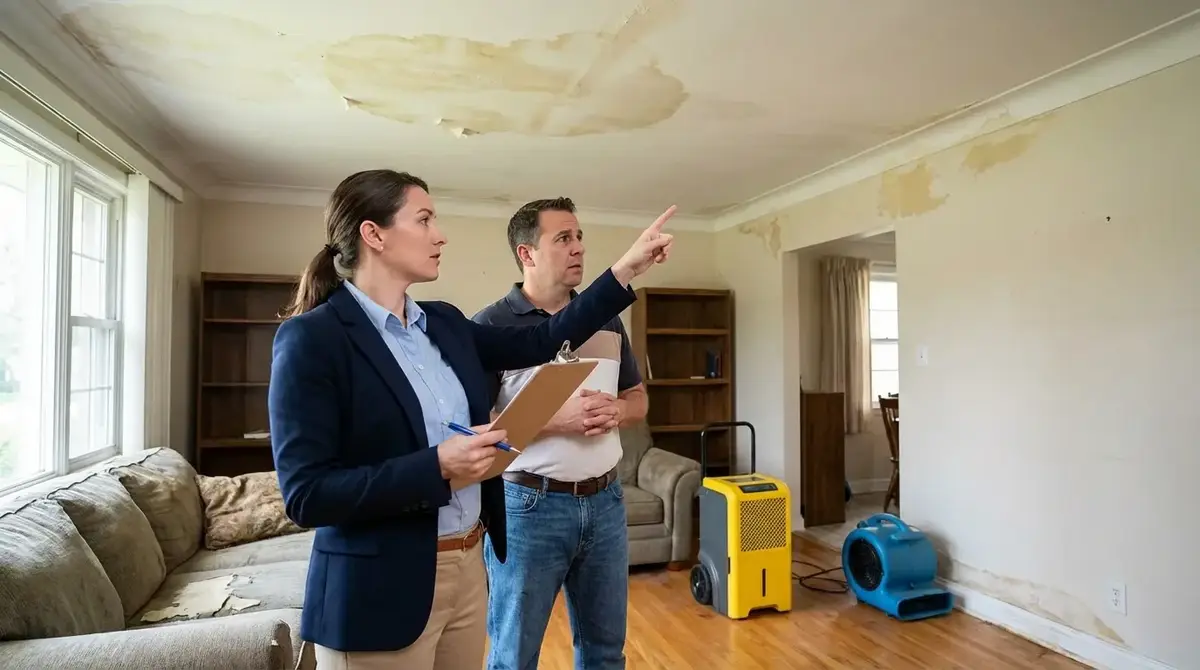
Filing a Water Damage Insurance Claim in Queens, Step by Step
Filing a water damage insurance claim in Queens runs in ten steps, and the order matters: stop the damage, document everything before cleanup moves it, report the claim the same day, and keep every receipt until the claim closes.
- Stop the damage. Shut off the water, and get mitigation started. Policies require reasonable steps to limit further loss.
- Document the scene. Photos and video of the source, the water, and every damaged item, before cleanup moves anything.
- Report the claim the same day. Call your insurer or agent, get a claim number, and write down the name of everyone you speak with.
- Know your category. Sudden pipe failure, appliance failure, sewer backup, and rising flood water are four different coverage conversations. Say exactly what happened, with dates and times, and do not guess at causes you have not confirmed.
- Keep the damaged evidence. Do not discard damaged flooring, pipe sections, or belongings until the adjuster has seen them or approved disposal in writing. Health hazards are the exception, after photos.
- Host the adjuster with paperwork ready. The crew's scope, moisture map, drying diary, and your contents list should be printed and on the table.
- Review the estimate line by line. Adjusters work from estimating software. If a line is missing, like wall cavity drying or a flood cut and patch, ask for it to be added with the documentation attached.
- Track additional living expenses. If you had to leave, keep hotel and food receipts. This coverage is part of most homeowners policies for covered losses.
- Do not sign away your benefits. Read any assignment of benefits carefully. You can authorise a crew to be paid without handing them your whole claim.
- Close the loop. When the work is done, send the final invoice, the drying verification, and the completion photos, and keep your own copies of everything for at least a few years.
Two Queens specific notes. First, sewer backup: many policies only cover it through a specific endorsement with its own limit, and storm driven backups are exactly when it matters, so check your declarations page this week, not during the next storm. Second, flood: a standard homeowners policy does not cover rising water, full stop. Homes near Jamaica Bay, Flushing Bay, Newtown Creek, and the Rockaway coast should treat a National Flood Insurance Program policy, or a private equivalent, as a basic household bill.
Pipe burst, storm flooding, and sump pump failure: three different claims
| What happened | Where the water came from | Which cover usually responds | First move |
|---|---|---|---|
| Pipe burst | Inside the home: a supply line, water heater, or appliance fails suddenly | A standard homeowners policy, as sudden and accidental damage | Shut off the water, keep the failed part, photograph everything, report the claim the same day |
| Storm flooding | Outside the home: rain, surge, or saturated ground enters through a window well, a door, or a foundation crack | A separate flood policy, usually through the NFIP; a standard homeowners policy excludes it | Get people out of below grade rooms, report to the flood policy company, and report the damage to the City through 311 |
| Sump pump failure | Groundwater rises through the floor slab when the pump fails or the power cuts during a storm | Often only where a water backup or sump pump endorsement was bought; check the declarations page | Call for extraction and drying, then have the pump checked or replaced and a battery backup fitted |
The same basement can hold all three events in one year, and each one is a different claim with a different answer. That is why the crew's written record of the source, made on day one, matters more than any later argument about what the water was.
The claim clock: every deadline on one list
Insurance deadlines are the part of water damage restoration Queens homeowners most often learn about too late, usually from a denial letter. Every clock that can run on a Queens claim is gathered here, so none of them has to be a surprise.
- Report within 24 to 48 hours. Most policies require prompt notification, and late reporting is a documented denial reason. The same day is better.
- 15 business days to acknowledge. That clock comes from New York Insurance Law section 2601 and Regulation 64 (11 NYCRR Part 216), the state rules on fair claim handling, with Insurance Law section 2618 adding insurer duties after a natural disaster. Insurance Law section 3420(d) is different: it is the timely disclaimer rule for bodily injury claims under liability policies, as soon as is reasonably possible, with no 15 day figure, and it does not apply to property damage claims.
- 30 days before a flood policy protects you. National Flood Insurance Program (NFIP) policies typically take effect after a 30 day waiting period, the standard wait the Federal Emergency Management Agency (FEMA) sets for new flood cover. A policy bought when a storm is already forecast will not cover that storm.
- 90 days for a claim against the City. Sewer backup or water main damage you believe is the City's fault goes to the Comptroller as a notice of claim under General Municipal Law section 50-e, served within 90 days, on the Water Damage Claim Form, never by email.
- If the settlement is wrong, escalate in writing. Appeal with the documentation pack first. A complaint to the New York State Department of Financial Services (DFS) at dfs.ny.gov is the next lever, and a public adjuster is an option on large disputed losses.
What a flood policy does and does not pay for in a basement
Flood insurance surprises basement owners more than any other buyers, because NFIP coverage below ground is deliberately narrow. An NFIP policy covers certain building equipment in a basement: furnaces, water heaters, washers and dryers are the standard examples. It does not cover finished basement walls, flooring, or most belongings stored below grade. That means the finished Jamaica or Springfield Gardens basement that took storm water may be a homeowners claim argument, a flood policy equipment claim, and an out of pocket rebuild all at once, and knowing that before the storm is worth more than learning it from an adjuster after one. One more co-op and condo trap: boards do not always carry flood insurance at all, unless a lender or a flood zone rule requires it, even though many flood losses happen outside the mapped high risk zones. If you own in a Queens co-op or condo near Jamaica Bay, Flushing Bay, or Newtown Creek, ask your board, in writing, whether the building holds a flood policy. The answer decides whose problem a surge really is.
And keep the source straight from the first phone call. A burst pipe inside the building, a water main break in the street, a sewer backup through a floor drain, and rain driven flooding through a window well can each fall under different coverage, or none. Insurers decide on cause and timing, so the crew's written record of where the water came from, made on day one, is the document the whole claim stands on. Get the cause documented in writing early, before cleanup erases it.
Water Behind Walls, and the Mold That Follows It
Water damage behind walls is the hidden half of most Queens water jobs, because water travels inside wall cavities, along joists, and under floors long after the visible surface looks dry. The damage you can see is rarely the whole job. Water travels: along the top of a ceiling joist, down inside a stud bay, under a floor that looks dry, and across a party wall into the neighbour's closet. The signs are subtle at first. A paint blister. A baseboard that has swollen a quarter inch. A smell like a wet basement in a room that has no basement under it. A floor that has started to feel springy near the bathroom wall.
Finding it takes method, not demolition. A thermal camera shows temperature differences where evaporation is cooling a wet surface. A pinless meter scans the wall for moisture without leaving holes. A pin meter then confirms the reading at depth. The crew compares every reading to a dry standard from the same wall material in a dry part of the home. Only then does anyone talk about opening the wall, and the opening is sized to the measured wet area, not to fear.
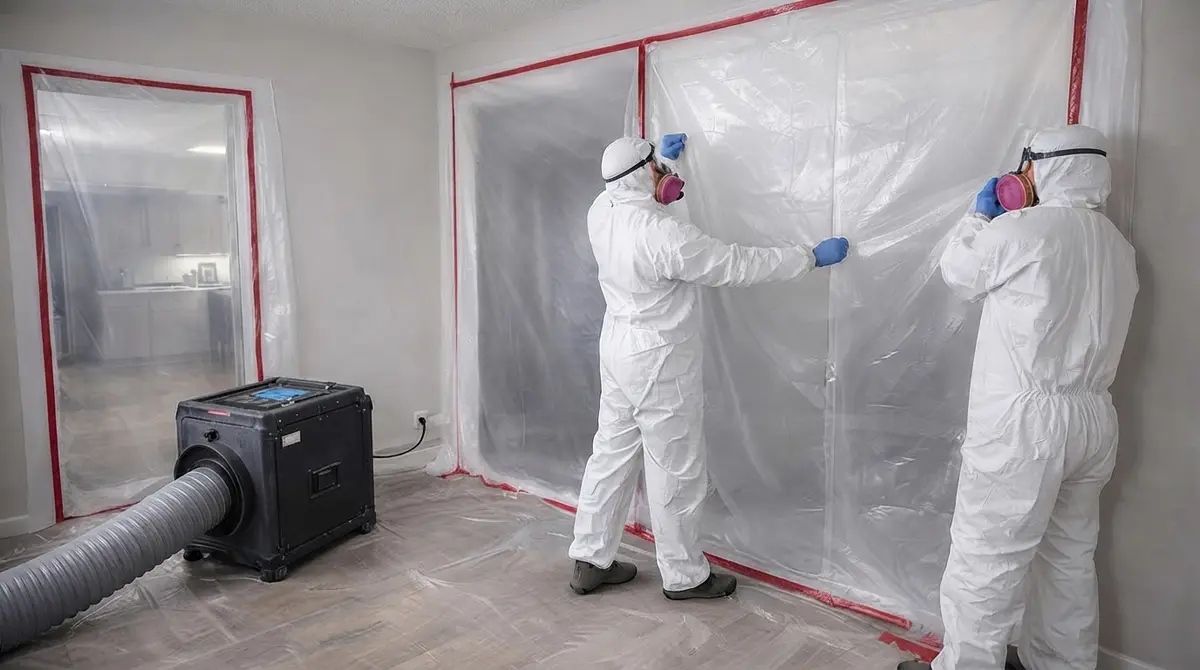
Mold is the reason this matters. Given moisture, warmth, and a food source like the paper face of drywall, growth can begin within one to two days and establish itself over the following week. By the time a stain blooms through paint, the cavity behind it may have been wet for a month. In Queens rentals, this is where Local Law 55 duties begin. In owned homes, it is where a small drying job becomes a remediation job with containment, negative air machines, and HEPA filtration. The cheap moment to act is always the first day, when the wall is wet but nothing is growing yet. Catching that moment is the cheapest water damage restoration Queens homeowners ever buy.
Black mold questions, answered straight
People ask whether the black growth in their bathroom or basement is the dangerous kind. Colour alone cannot answer that; many common molds are dark, and only laboratory testing names a species. What matters practically is simpler: mold of any kind inside a home means moisture is feeding it, it should be removed with proper containment, and the moisture source must be fixed or it returns. Large areas, growth inside heating and cooling systems, and any growth in a home where someone has asthma or a weakened immune system are jobs for licensed professionals under New York State mold law, with an assessment and a written remediation plan.
A Queens Water Damage Calendar: What Each Season Brings
Queens water damage follows a calendar: frozen pipes, radiator leaks, and ice dams in winter, heavy rain and sewer backups through the storm seasons, and coastal surge risk whenever a nor'easter or the remnants of a hurricane reach the borough.
Winter
Frozen pipes in unheated cellars, crawl spaces, and exterior walls, especially during the cold snaps that hit in January and February. Radiator and steam system leaks peak as heating runs hard. Ice dams on the complex rooflines of older homes push melt water under shingles and into top floor ceilings. The defences: keep heat on in every room, insulate exposed pipes, and know where your main shutoff is before you need it in the dark.
Spring
Snowmelt and spring rain raise the water table across eastern Queens. Sump pumps that sat idle all winter fail on their first hard night of work. Roof leaks hidden by winter show themselves as ceiling stains. Test the sump pump in March: pour in a bucket of water and watch it run.
Summer
Thunderstorm season. The combined sewer backups, the flooded underpasses, the basement units taking water in an hour of violent rain: this is the Queens summer pattern, and the remnants of tropical systems have made it worse in recent years. Air conditioning condensate lines clog and overflow into ceilings and closets, a quiet leak that runs for weeks. Check the backwater valve, clear the floor drains, and lift what you store on the basement floor.
Autumn
Hurricane season peaks, and the coastal neighbourhoods watch the forecasts. Inland, the work is gutters: one clogged gutter over a party wall can soak two homes. Water heaters that survived the summer give up as heating season loads the system. Autumn is the maintenance season: hoses replaced, valves exercised, pumps tested, and the flood policy renewed before the water, not after.
For Queens Landlords and Property Managers
For Queens landlords and property managers, the duties after a leak are set by law rather than by the lease: keep the home habitable, fix the moisture source behind any mold, and meet the Local Law 55 mold deadlines. A water event in a rental building is a legal clock as much as a plumbing problem. Habitability duties start when the tenant reports the leak. Mold duties under Local Law 55 follow the moisture. HPD complaints and housing court cases are built out of the records created, or not created, in the first week.
The working standard that keeps owners out of trouble is simple to state and harder to fake: respond the same day, stop the source, get professional drying started, document the readings, fix the cause rather than the stain, and keep the tenant informed in writing at every step. For mold areas beyond a small patch, use the licensed assessment and remediation process New York State requires. Keep the file: the tenant's notice, your work orders, the crew's moisture log, the completion photos. In a dispute two years later, the file is the argument.
Small owners in Queens, the two and three family houses that house much of the borough, often carry the hardest version of this problem: the flooded unit is a relative's home, or the rent that pays the mortgage. The duties are the same. So is the practical advice: a backwater valve, a maintained sump pump with a battery backup, water alarms under every heater and behind every washing machine, and a standing relationship with a restoration crew you have vetted before the emergency, not during it.
Prevention: The Cheapest Restoration Job Is the One That Never Happens
The cheapest water damage restoration job in Queens is the one that never happens, and most prevention is a short list of habits: replace hoses on schedule, fit water alarms, know the main shutoff, and keep the sump pump and backwater valve maintained.
- Replace washing machine hoses every five years, and choose braided steel over rubber. This one habit prevents one of the most common floods in Queens homes.
- Install water alarms under the water heater, behind the washing machine, under kitchen and bathroom sinks, and near the sump pit. A small alarm that shouts at two in the morning is worth more than a truckload of drying equipment.
- Know your main shutoff and exercise it once a year so it turns when you need it. Label it. Teach everyone in the home where it is.
- Maintain the sump pump, test it each spring, and add a battery backup if your basement has ever taken groundwater.
- Fit a backwater valve if your street has a backup history, installed by a licensed plumber with the correct permit, and have it inspected and cleaned on schedule.
- Raise what you store in the basement: shelving instead of floor piles, plastic bins instead of cardboard, and nothing irreplaceable at floor level in a flood prone home.
- Service the water heater and replace it on schedule rather than on failure. A heater that is past its rated life is a flood with a date on it.
- Walk your roof and gutters twice a year if you own an attached home, and clear the drains before the summer storm season.
- Photograph your home once a year, room by room, belongings included. If a claim ever comes, that calm afternoon of photos is the best evidence you will ever own.
None of this is glamorous. All of it is cheaper than one flooded basement, and most of it takes a single weekend. Queens rewards the prepared: the borough's water is patient, and it finds every home that is not.
Water on the floor right now? Talk to a Queens crew before it spreads.
Call (212) 555-0147 (212) 555-0147: placeholder number, replace with your real number before publishing. Replace it with the real business number before this page goes live.Three Typical Queens Jobs, Start to Finish
A typical Queens water damage job runs from first call to handback in the same shape: stop the source, extract the water, dry to verified readings, then rebuild what the water ruined. Every water job has its own details, but the shape of the work repeats. These three walkthroughs show how a well run job unfolds in the housing stock Queens actually has. They are teaching examples built from the borough's most common loss patterns, the same patterns restoration trainers use in their case study videos. Each one is a fair picture of water damage restoration Queens crews perform weekly.
Job one: a sewer backup in a Jamaica two family house
A summer thunderstorm drops several inches of rain in an hour. The combined sewer on the street fills, and water comes up through the basement floor drain of a two family house, bringing sewage with it. The basement unit's tenant calls the owner, the owner calls the crew, and the first decision is category: this is category 3 water, and the unit is not safe to occupy until it is cleaned.
The crew sets containment at the basement door, wears full protective gear, and pumps out the standing water. Porous belongings that touched the water, including a sofa, carpet, and stored cardboard boxes, are photographed for the claim and then bagged and removed. Hard surfaces are washed and disinfected. The lower section of the bathroom drywall, which wicked water and sewage up inside the cavity, is flood cut so the wall can be cleaned and dried. Drying runs four days with readings logged twice daily at first. The tenant stays with family under the owner's arrangement, the claim runs through the sewer backup endorsement the owner had the sense to buy, and the lasting fix is a backwater valve fitted by a licensed plumber before the next storm season. The lesson this job teaches: the valve, fitted in a calm week, would have prevented the entire loss.
Job two: a stack leak in a Jackson Heights co-op
A fourth floor shareholder notices a brown stain spreading on the bathroom ceiling. The building's super opens the ceiling and finds the cast iron stack leaking at a joint, wetting the vertical line of bathrooms below the sixth floor. Nobody's floor is flooded. Nobody even has standing water. And yet three homes have wet walls, and the top one has the beginnings of mold behind the paint.
The co-op's plumber repairs the stack first, because drying against a live leak is wasted work. The restoration crew then maps moisture in all three bathrooms with pin and pinless meters, opens a small inspection area where readings stay high, and dries the cavities with directed air through baseboard level ports. Two bathrooms dry without demolition beyond the plumber's opening. The third needs a section of tile backer removed where water sat longest. Management receives the moisture report for the building file, each shareholder's insurer receives their unit's documentation, and the question of who pays is settled by the paper: the corporation for the stack and the common repair, the unit policies for the finishes inside each home. The lesson: in a stacked building, one leak is a building event, and the moisture map is what keeps it from becoming a neighbour war.
Job three: a burst pipe in a Bayside detached house
A January cold snap. A supply pipe in an exterior wall of a detached house freezes during the night and bursts at dawn, running for two hours before anyone wakes. The kitchen and the basement below it take the water. This is clean category 1 water, caught fast, and it is the kind of job where good equipment saves expensive material.
Extraction starts within the first hours. The hardwood kitchen floor is tested, and because the water was clean and the response fast, it is dried in place with floor mats that pull moisture through the seams, monitored daily as the cupping slowly settles. Baseboards come off the wet walls so the cavities can dry through the gap. The basement ceiling below the kitchen is opened where the plaster is saturated, and the rest dries with air movement and dehumidification. Five days of logged readings bring every material to its dry standard. The repair stage is then small: plaster patch, baseboards back, paint. The lesson: speed is a material saving technology. The same burst pipe discovered after a holiday weekend would have cost the floor, the ceiling, and possibly a mold remediation.
Room by Room: Where Water Hides in a Queens Home
Water hides in the same places in almost every Queens home: behind kitchen cabinets, around bathroom traps and risers, and at the basement floor drain and the cove joint where the floor meets the wall.
Kitchens
The kitchen hides water better than any other room. Dishwasher and refrigerator lines leak behind cabinets that are never moved. Sink traps drip into cabinet bases that soak quietly. The first signs are a cabinet floor that has swollen, a toe kick that feels soft, or flooring that has started to lift at the sink line. Crews test under cabinets with meters through the toe kick space and check the floor in a grid, because kitchen water often travels under vinyl or tile and shows up in the room below instead.
Bathrooms
Wax rings fail under toilets and leak into the floor structure with every flush, sometimes for a year before the floor feels spongy. Tub and shower grout and caulk lines open with age and feed water into the wall at every shower. In Queens apartment buildings, the bathroom is the stack room, so a bathroom stain on a ceiling is treated as a building plumbing question until testing proves it is a one unit problem.
Basements and cellars
The borough's workhorse room and its most flooded one. Water enters from above through plumbing, from outside through walls and the cove joint, from below through the slab, and backwards through the sewer. A proper basement survey checks all four directions, tests the sump, reads the walls at several heights, and looks at how belongings are stored. In a finished basement, the bottom of the drywall is the diary of every flood the room has had: read the water lines and you know the history.
Laundry areas
Washing machines concentrate risk: supply hoses under constant pressure, a drain that can overflow, and a machine that vibrates connections loose over years. In Queens homes the laundry often sits in the basement or a closet on an upper floor of a two family house, where a hose failure runs through the ceiling of the home below. A drain pan, braided hoses, an automatic shutoff valve, and a water alarm turn this room from a top loss cause into a minor one.
Attics and roofs
Top floor water in Queens usually starts at the roof details: parapet caps, bulkhead doors, scupper drains, and the flashing where additions meet the main roof. Attic and top floor ceiling stains should be read with the weather. A stain that grows after rain is a roof question. A stain that grows in a cold snap is a pipe question. The crew's job is to prove which one before anyone patches the ceiling and paints over an active leak.
Questions Queens Homeowners Ask Online, Answered Properly
The questions Queens homeowners ask online return to the same five worries: who pays, whether insurance covers the damage, how fast mold grows, whether a flooded basement apartment is safe to stay in, and how long drying takes. Spend time in the places where Queens homeowners actually talk, the neighbourhood forums, the question and answer sites, the renter threads, the co-op boards, and the same questions surface after every storm and every burst pipe. Here are the honest answers, gathered in one place. They are the questions water damage restoration Queens teams hear at kitchen tables after every storm.
My landlord is ignoring the leak. What can I actually do?
Put the complaint in writing with dates, keep proof you sent it, and photograph the condition weekly. If the leak or the mold that follows is not fixed, call 311 and file a complaint. That creates an official record, and HPD can inspect and issue violations that carry deadlines and fines. Local Law 55 obliges the owner to fix mold and its moisture source using safe work practices. If conditions become dangerous, housing court and a rent escrow action are the heavier tools, and a tenant association or legal aid clinic in Queens can walk you through them. What does not work is stopping all communication and hoping. Paper, dates, and the city record are what move a reluctant landlord.
The unit above flooded mine twice. Is this just bad luck?
Twice is a pattern, and patterns have causes: a failing supply line nobody replaced, a tub overflow habit, a washing machine with no pan and old hoses, or a building stack problem that management has not accepted yet. Insist, in writing, that management and the upstairs owner identify the source and fix it, not just repair your ceiling. Your insurer can pursue the responsible party's coverage for repeat losses. Keep every document from the first event; the second claim is much stronger with the first one's paper behind it.
Can I refuse to let the landlord's contractor do the drying?
The landlord has the right to repair their building, and you generally cannot block necessary mitigation. What you can do is insist the work is done properly: licensed and insured workers, containment where mold or sewage is involved, and documentation of the drying. If the work is being done badly, with mold sprayed and painted over, a 311 complaint and photos are again the lever. For your own belongings, your own policy and your own chosen help apply.
Is a finished basement in Queens ever a good idea?
It can be, with honest design. Assume the room will meet water one day and build for that day: no carpet pad to soak, tile or sealed floors instead of hardwood, drywall held up off the slab, belongings on shelving, a backwater valve, a sump with battery backup, and water alarms in the low corners. The basements that flood badly are the ones finished as if they were living rooms on the third floor. The ones that recover in a weekend were designed by someone who respected the borough's water table.
Should I buy a home moisture meter?
A basic pin meter is a reasonable tool for a homeowner who wants to check a suspect wall or compare a stain month to month. Its limits matter: it reads only where the pins touch, cheap meters drift, and a number without a dry comparison sample means little. Use it to decide when to call a professional, not to declare a wall dry. The crew's meters, thermal camera, and dry standard method exist because single readings mislead.
What is the one upgrade you would make first in a flood prone Queens home?
For sewer prone streets, the backwater valve. For groundwater streets, the sump system with battery backup. For everyone else, water alarms and braided hoses, because they are cheap and they catch the losses that actually happen most. The right first upgrade is the one aimed at the water your street has already shown you.
What Decides the Size of a Restoration Job
The size of a restoration job is set by how much water came in, how long it sat, what category the water is, and how many materials it reached, not by the size of the first puddle. Two homes can take the same pipe burst and end up with very different jobs. The variables are consistent, and knowing them helps you read any crew's scope with clear eyes.
How long the water ran
Time is the master variable. Water found in twenty minutes wets surfaces. Water that ran for a weekend saturates structure, wicks two feet up walls, and starts the mold clock with a head start. Discovery time is why alarms, neighbours who have your number, and a super who answers the phone are worth real money in this borough.
The category of the water
Clean water jobs dry material. Contaminated water jobs remove it. The same square footage can be a three day drying job or a demolition, disinfection, and rebuild job depending on what was in the water. Category is decided by source and by time: clean water left sitting in carpet for two days is no longer treated as clean.
The materials involved
Tile on concrete dries fast and forgives. Hardwood can often be saved if the response is quick. Plaster and lath dry slowly but surely. Particle board cabinets and laminate floors swell and rarely recover. Carpet can be dried; its pad, after grey or black water, cannot. A good scope explains the decision for each material, and the explanation should match the wet test readings.
Access and building rules
A garden level unit with a private entrance is simple to work in. A sixth floor co-op unit means elevator reservations, building work hours, insurance certificates filed with management, and neighbours on every side. None of that changes the science of drying. All of it changes the schedule, and a crew that works Queens buildings plans for it instead of complaining about it.
How drying equipment is actually sized
Professional drying is calculated, not improvised. The crew measures the affected space, classifies the loss, and works out how much water the dehumidifiers must remove per day and how much air movement the wet surfaces need. Air movers are placed to sweep every wet wall at an angle, not parked in the middle of the room. Dehumidifier capacity is matched to the load, and the daily readings prove whether the maths was right. When a homeowner asks why there are four machines in one room and one in another, the answer should be a calculation, and a good crew can show it.
City Agencies and Records That Matter in a Queens Water Event
Three city agencies matter most in a Queens water event: the Department of Environmental Protection (DEP) for water mains and sewer backups, the Department of Housing Preservation and Development (HPD) for repair enforcement in rental buildings, and the Department of Buildings (DOB) for structural safety, basement occupancy, and permits.
311 and the Department of Environmental Protection
Water main breaks, sewer backups affecting a street, and water quality complaints go to the city through 311, and the Department of Environmental Protection responds. If the backup came from a surcharged city main, the DEP record of the event matters for your claim and for any city claim process, so file the report even if the water has already gone down.
HPD and housing complaints
For renters, the Department of Housing Preservation and Development is the enforcement path when a landlord will not fix a leak, restore a service, or address mold. Complaints made through 311 feed the HPD record for the building, and inspectors can issue violations with correction deadlines.
The Department of Buildings
Structural questions after serious flooding, illegal basement occupancy, and permit questions for the rebuild stage run through the Department of Buildings. Converting or finishing a basement in New York City has strict rules about ceiling height, windows, and egress, and a flood is often the moment an illegal unit's problems become official. Owners should understand that before rebuilding a flooded basement unit exactly as it was.
FEMA flood maps and your flood zone
Your home's flood zone decides mortgage requirements and shapes insurance decisions. Coastal Queens, the Jamaica Bay shoreline, Flushing Bay, and low inland pockets all carry mapped risk, and maps understate the rain driven flooding that combined sewers produce. Treat the map as the floor of your risk, not the ceiling.
Your claim documentation pack
Keep one folder, paper or digital, per event: the dated photos and videos, the insurer's claim number and correspondence, the crew's scope, moisture map, and drying diary, the adjuster's estimate, receipts for emergency spending and any hotel stay, and the written notices you sent to the landlord, neighbour, or management. Two years from now, in any dispute, that folder is the whole game.
Plain Language Glossary for Water Damage Terms
This glossary defines, in plain language, the terms a Queens homeowner will hear from a restoration crew, an insurance adjuster, and a city inspector during a water damage job.
- Mitigation: The emergency work that stops damage from growing: extraction, drying, and protection. It comes before repair.
- Extraction: Removing standing water by machine, the first and highest value step.
- Dehumidification: Pulling water vapour from the air so wet materials can release their moisture into it.
- Air mover: A fan built to push air across wet surfaces at speed, driving evaporation.
- Moisture mapping: A measured survey, usually drawn on a floor plan, showing exactly what is wet and how wet it is.
- Dry standard: The moisture reading of the same material in an unaffected part of the home, used as the target for drying.
- Flood cut: A straight removal of the lower section of a drywall wall, sized to the height the water reached inside the cavity.
- Containment: Sealed plastic barriers, often with negative air pressure, that keep dust and spores inside the work area.
- Backwater valve: A valve in the sewer line that blocks city sewage from flowing back into the home during a storm surge in the pipes.
- Sump pump: A pump in a basement pit that lifts groundwater out before it can spread across the floor.
- Additional living expense: The part of a homeowners policy that pays hotel and extra food costs when a covered loss makes the home uninhabitable.
- Assignment of benefits: A document that hands your insurance claim rights to a contractor. Read it with great care, or do not sign it.
- IICRC: The Institute of Inspection, Cleaning and Restoration Certification, the body whose S500 standard and technician certifications anchor professional practice.
- Party wall: The shared wall between two attached homes, and the path water often takes from one home into the next.
Words shape expectations. When a crew uses these terms the way this glossary defines them, and shows you the readings behind them, you are dealing with professionals. When the language is all urgency and no measurement, keep asking questions until the measurements appear.
Water on the floor right now? Talk to a Queens crew before it spreads.
Call (212) 555-0147 (212) 555-0147: placeholder number, replace with your real number before publishing. Replace it with the real business number before this page goes live.Water Damage in Queens Shops, Restaurants, and Small Buildings
Water damage in a Queens shop, restaurant, or small commercial building is a business interruption problem as well as a building problem, because every day the doors stay closed is a day of lost trade. Queens runs on small businesses: restaurants on Roosevelt Avenue and in downtown Flushing, groceries and bakeries along Jamaica Avenue and Queens Boulevard, bodegas on every third corner, warehouses and light industry in Maspeth, College Point, and Long Island City. Water does not care that the space earns money. It cares even less about business hours.
The commercial difference is the clock. A flooded home is a misery. A flooded restaurant kitchen is a health department problem, a flooded stockroom is inventory loss, and a flooded office is staff who cannot work. Commercial jobs run on a written plan agreed in the first visit: what reopens first, what the health and building rules require, what documentation the commercial insurer and the landlord each need, and how the work is staged so part of the business can trade while the rest dries.
Grease traps, floor drains, and commercial refrigeration lines add failure modes a home never sees. A walk-in cooler condensate failure can wet a stockroom for weeks before anyone smells it. A sprinkler event in a mixed use building wets the shop below and the homes above at the same time, and three insurance policies meet in one wet ceiling. The documentation habit that saves homeowners saves businesses twice over, because commercial claims are read by professionals who look for gaps.
Landlord and tenant duties in commercial leases differ from homes. The lease, not habitability law, usually decides who repairs what, and many Queens shop leases put interior systems on the tenant and structure on the owner. Read the lease during the emergency, not after the argument. And photograph the stock before it is moved: for a business, the inventory record is often worth more than the building repair.
Health and Safety While Your Home Is Wet
The health risks in a wet Queens home come from three things: contaminated water, electricity in standing water, and mold that can begin within 24 to 48 hours on materials that stay damp. Most water damage is a building problem. Some of it is a health problem, and knowing which is which keeps a stressful week from becoming a dangerous one.
Electricity
The rule has no exceptions: do not walk into standing water that may be in contact with live wiring, outlets, or appliances, and do not touch a breaker panel with wet hands or while standing in water. If the panel itself is wet or the water is deep, the safe move is to leave and let the utility, an electrician, or the fire department make it safe. In a true emergency, call 911.
Sewage and flood water
Treat all sewer backup water and all water that entered from outside at ground level as contaminated. Keep children and pets out until the space is cleaned and cleared. Wash any skin contact with soap and clean water. Soft furnishings and stored food that touched this water are not worth an argument with your health.
Mold and breathing
People with asthma, allergies, or weakened immune systems should stay out of rooms with visible mold growth or heavy musty odour until containment and air cleaning are running. New York City treats mold in rental homes as a health hazard under Local Law 55 for a reason. Disturbing a large colony without containment spreads spores through the home on the air currents your own fans create, which is why the do it yourself instinct to aim a fan at a moldy wall makes the problem bigger.
Chemicals and old buildings
Older Queens buildings can contain lead paint and asbestos in floor tiles, pipe insulation, and joint compounds. Flood cuts and demolition in these materials have rules. A professional crew tests or assumes and works accordingly. If your home predates 1978, ask the question out loud before any wall is opened.
The stress of it
A flooded home disrupts sleep, work, school runs, and the feeling that your own rooms are safe. That stress is real, and it is worse at three in the morning with machines running. The practical comforts help: a clear written plan, a crew that explains each day's readings, one folder where every paper lives, and a realistic date for the next milestone. Ask for those things. They are part of the service.
After Drying: The Rebuild, Done in the Right Order
Rebuilding after water damage starts only when moisture readings verify that the structure is dry, and the work then runs in a fixed order so no damp cavity gets closed in. Drying ends with verified readings. Rebuilding begins with patience, because closing a wall over a cavity that is still damp is how a restoration job becomes a mold job with better paint. The order below is the order that works.
- Verify dryness in writing. Final readings at the dry standard, signed off, with the drying diary attached. This document protects you with the insurer and with any future buyer.
- Agree the repair scope. Like for like is the insurance baseline: the same materials and finishes that were there. Upgrades are possible, priced separately, and agreed before work starts.
- Handle building paperwork. Co-op alteration agreements, condo contractor rules, and any Department of Buildings filings for work that needs them. Emergency drying never waited for this. Rebuild work sometimes must.
- Repair in sequence. Framing and rough work first, then wallboard and plaster, then flooring, then trim, cabinets, and paint last. Floors go in after walls are closed and the room's moisture has been stable, not before.
- Test as you close. A last meter check of cavities before they are sealed is cheap insurance against trapping a problem.
- Close the claim. Final invoices, completion photos, and the sign off pack go to the insurer, and copies stay in your folder.
In Queens, the rebuild is also the moment to make the home harder to flood next time: the backwater valve that should have been there, the water heater pan and drain, braided hoses, alarms, basement storage raised on shelving, and finishes at floor level chosen for a room that has already met water once. A good crew raises these options while the walls are open, because that is the cheapest moment in the life of the building to do them.
Storm Readiness Checklist for Queens Homes
Storm readiness in Queens means finishing the checks before the forecast arrives: test the sump pump, service the backwater valve, clear the drains, and photograph every room while it is still dry.
- Before the season: test the sump pump, service the backwater valve, clear roof drains and gutters, replace tired washing machine hoses, and photograph every room and its contents.
- When a storm is forecast: lift basement storage off the floor, move vehicles off the lowest streets if you are in a surge zone, charge phones, and know where the flashlights and the main shutoff are.
- During the storm: never walk or drive through flooded streets or underpasses, keep out of a basement that is taking water quickly, and treat any water near electrical equipment as a reason to leave the space alone.
- After the water: document before cleanup, report city sewer or main problems to 311, start extraction and drying the same day, and report the claim with dates, times, and the city record number if you have one.
- For coastal homes: keep the flood policy current, keep utilities and the furnace raised, store documents and photos high, and have a ground floor plan that assumes water will stand there again.
- For basement units: agree an evacuation route with everyone who sleeps there, keep a water alarm at the lowest point, and treat a fast rising basement flood as a leave now event, because the Ida storm taught this borough what minutes mean in a below grade room.
Readiness is not fear. It is the calm knowledge that your home has a plan and your family knows it. Queens will keep sending water. The homes that come through best are the ones that met it prepared.
Water on the floor right now? Talk to a Queens crew before it spreads.
Call (212) 555-0147 (212) 555-0147: placeholder number, replace with your real number before publishing. Replace it with the real business number before this page goes live.Deep Dives: Hardwood, Plaster, and the Apartment Stack Leak
Hardwood floors, plaster walls, and apartment stack leaks are the three Queens cases where drying decisions are hardest, because each material holds water differently and each wrong call is expensive to undo.
Saving a hardwood floor, honestly
Hardwood is the material homeowners beg crews to save, and the answer is a genuine maybe that depends on three things: the category of the water, how long the floor sat wet, and what is under the boards. A solid oak floor over a wood subfloor, wet with clean water for a few hours, is a strong candidate for in place drying. Floor mats sealed to the surface pull moisture out through the seams while dehumidifiers keep the room air dry enough to receive it. Cupping, where board edges rise higher than their centres, looks alarming on day one and often relaxes as the moisture equalises. Crowning, the opposite shape, appears when a floor is sanded before it is fully dry, which is why no honest refinisher will touch a flood floor until the readings say so.
Engineered and laminate floors are less forgiving. Laminate's fibre core swells and does not come back. Engineered boards can delaminate if the water reached them from below. Under every floor, the crew checks the subfloor and the ceiling of the room beneath, because saving the visible floor while the structure under it stays wet is no saving at all. When a floor cannot be saved, the removal is documented board by board for the claim, and sound matching material is often available for older Queens homes through the city's salvage and millwork suppliers.
Plaster and lath: the slow, patient walls of old Queens
The pre-war buildings of Astoria, Jackson Heights, Sunnyside, and Forest Hills are full of plaster on wood or metal lath. Plaster is heavy, strong, and slow: it absorbs a great deal of water and releases it over days, not hours. That patience cuts both ways. A plaster wall rarely needs demolition for clean water, because it can dry in place with enough time and air movement. But a crew in a hurry will misread it twice, first calling it dry because the surface feels hard, then calling it ruined because the deep readings stay high on day two. The method is daily readings at depth, compared to the dry standard of the same plaster in a dry room, and a drying plan measured in a week when the wall is saturated. Brick party walls behave the same way, holding storm and plumbing water long after the rooms feel normal.
The apartment stack leak playbook
Because it happens so often in Queens, here is the full sequence for a leak that runs down a line of apartments. The tenant who sees the stain calls the super and management the same day, in writing. The building finds and stops the source: a stack joint, a tub drain, a toilet seal, a radiator valve. Management notifies every affected unit, because the home two floors down may be wet and not know it. The restoration crew maps moisture in each unit on the line and dries each one to its own readings. Each household documents its own belongings for its own policy. The building keeps the master file. Where this playbook is followed, the event is a bad month. Where each unit is left to argue alone, it becomes a bad year, and the moisture keeps moving while the arguments run.
Your first week, day by day
Day one is assessment, extraction, and equipment. It is loud, it is disruptive, and the house looks worse before it looks better because baseboards come off and wet material comes out. Day two is the first full drying day, with a monitoring visit and readings that should be moving. Day three is adjustment day: equipment repositioned, a cavity opened if a wall is not responding, the plan updated in the log. Days four and five are the verification window for most clean water jobs, when readings reach the dry standard and equipment starts leaving. Days six and seven belong to the handoff: final documentation, the repair scope agreed, and the building paperwork started. Sewage and category 3 jobs run longer at the front end, because removal and disinfection come before drying can even begin. A crew that gives you this shape on day one, and then follows it, is a crew that has done the work before.
Choosing a Restoration Crew in Queens: The Full Checklist
A restoration crew worth hiring in Queens measures before it demolishes, writes its moisture readings down, names the standard it dries to, and produces its insurance certificate for your building management without drama.
- Licensing and insurance: a real business, insured for work in New York City, able to produce a certificate for your building management without drama.
- Certified technicians: IICRC certification for the people doing the work, not just a logo on the truck.
- Measurement before promises: meters and a thermal camera out of the bag in the first visit, readings written down, a dry standard taken.
- A written scope: what will be dried, what will be removed and why, what happens each day, and what the verification looks like.
- A drying diary: daily readings you can see, kept for your claim file.
- Insurance fluency without pressure: help with documentation, and no demand that you sign your claim rights away at the door.
- Local knowledge: a crew that knows what a Jackson Heights stack leak, a Ridgewood party wall, and a Howard Beach surge job each demand, because they have dried all three.
- References with addresses: recent work in Queens neighbourhoods you can recognise, not a wall of anonymous praise.
- Honest limits: a crew that tells you what cannot be saved, what will take a week, and what is outside their trade, is a crew telling the truth about the rest too.
The midnight version of this checklist is shorter: are they calm, are they measuring, and are they writing things down. Water emergencies attract pressure selling because frightened people sign things. Slow the conversation down, ask for the scope in writing, and remember that the first crew to arrive does not have to be the crew that finishes the job.
Queens gives you one more advantage: the borough talks. Supers, porters, building managers, and neighbours have all watched crews work, and their opinions are specific. Ask the super who dried the last stack leak in the building and how it went. That answer is worth a page of online reviews. It is the most reliable review in water damage restoration Queens has.
Water on the floor right now? Talk to a Queens crew before it spreads.
Call (212) 555-0147 (212) 555-0147: placeholder number, replace with your real number before publishing. Replace it with the real business number before this page goes live.Before You Call: What to Have Ready
Before you call a restoration crew in Queens, have five things ready: your exact address and the best entrance for a crew, where the water is coming from if you know it, photographs of the damage, your insurance policy details, and a note of when you first saw the water. A two minute preparation makes the call and the first visit far more effective. Have your exact address and the best entrance for a crew, especially in large Queens buildings where the service entrance and the freight elevator decide how fast equipment reaches your floor. Know where the water is coming from, or say honestly that you do not know. Say whether the water is still running, whether the power is on in the wet area, and whether anyone in the home has breathing difficulties that the crew should plan around. If there are pets, say so, because doors will be opening all day. If you have already called your insurer, have the claim number ready. If you rent, have the landlord or management company's number ready too.
Then take a breath. The water feels like an emergency because it is one, but it is a managed kind of emergency, handled in this borough every single day, in houses and buildings just like yours. The homes that come through best are not the ones that never flooded. They are the ones where someone stopped the water, documented the scene, started the drying the same day, and kept the paper. You have now read how every part of that works. The next step is the call. When you make it, you are hiring water damage restoration Queens help that starts with measurement, not pressure.
Frequently Asked Questions About Water Damage in Queens
These are the questions homeowners ask before, during, and after a job, answered the way a water damage restoration Queens crew would answer them at your door.
What should I do first when I find water damage in my Queens home?
Stop the water at the source if you can do it safely. Turn the shutoff valve for the fixture, or close the main water valve for the house. Keep clear of standing water near outlets, appliances, or a breaker panel. Move documents, photos, and small valuables up and off the floor. Then call a restoration crew and start taking photos and short videos of every wet room before anything is moved or dried. Those first pictures are the record your insurance claim will stand on.
How fast can a crew reach me in Queens?
Response time depends on where in the borough you are and what the traffic is doing. A crew based in or near Queens can usually reach Astoria, Long Island City, Sunnyside, Jackson Heights, and Elmhurst faster than the far edges of the Rockaways or the Nassau County border. When you call, give the exact address, say whether water is still running, and say whether the power is on. That lets the dispatcher send the right truck and the right extraction gear the first time.
Is water damage in a basement apartment handled differently?
Yes. A basement or cellar apartment in Queens collects water first and dries last, and many of these units sit below the level of the street sewer. The crew checks whether the water is clean, grey, or sewage before anyone handles belongings. Belongings that touched sewage water are usually not salvageable. If the unit is your home, tell the crew and your landlord right away, because a flooded basement unit can become a habitability issue under New York City housing rules, not just a cleanup job.
Who pays when the leak comes from the apartment above me in Queens?
It depends on where the water started and what your lease, proprietary lease, or condo bylaws say. In a rental, the landlord is normally responsible for the building structure and the plumbing inside the walls, while your own belongings fall under your renters insurance. In a co-op or condo, the corporation or association usually covers common elements and the unit owner covers the inside of the unit. Document everything, notify the building in writing the same day, and let the insurers sort out liability between themselves.
Does homeowners insurance cover water damage in Queens?
Most policies cover sudden and accidental water events, like a burst pipe, a failed water heater, or an appliance supply line that lets go. Most policies do not cover water that rises from outside the home, and they usually exclude slow leaks that went on for weeks. A separate flood policy covers rising water. Sewer backup is often an add-on endorsement, not part of the base policy. Read your declarations page, and file quickly, because late reporting is a common reason claims get reduced or denied.
How long does drying take after water damage?
Most clean water jobs in Queens homes dry in three to five days once extraction is done. Hardwood, plaster, and thick masonry walls can take longer because they hold moisture deep inside. Sewage jobs take longer still because contaminated material has to come out first. The crew should take moisture readings every day and write them down. Drying is finished when the readings reach the dry standard for that material, not when the surface feels dry to your hand.
When does mold start growing after a leak?
Mold can start growing on wet drywall, wood, and paper within 24 to 48 hours in warm conditions. That is why the first day matters so much. Getting standing water out and air moving across wet surfaces inside the first day is the single best way to keep a water job from turning into a mold job. If a leak has been running quietly for weeks behind a wall, mold may already be established by the time you see a stain or smell a musty odour.
What is the difference between flood damage and water damage?
Insurers draw a hard line here. Water damage usually means water that escaped inside the home, from a pipe, an appliance, a roof leak, or a fixture. Flood damage means water that came from outside at ground level, rising water, storm surge, or an overflowing body of water. The first is normally handled under a homeowners policy. The second needs a separate flood policy. Sewer backup sits in its own category and is often covered only if you bought the backup endorsement.
Can hardwood floors be saved after water damage in a Queens home?
Often yes, if the water was clean and the crew gets to it quickly. Hardwood can be dried in place with floor drying mats that pull moisture out through the boards. Cupping that looks bad on day one often settles back as the floor dries evenly. Floors that sat in water for days, or that took sewage, are a different story. The crew will test moisture under the boards before promising anything, because trapping moisture under a refinished floor leads to mould and buckling later.
What does a restoration crew do on the first visit?
The first visit is about stopping the damage from getting worse. The crew confirms the source is shut off, tests what the water touched with moisture meters and a thermal camera, extracts standing water, moves or blocks furniture, and sets up air movers and dehumidifiers. They photograph and log everything for the claim file. Demolition, if any is needed, is limited to material that cannot be dried or that is contaminated. You should get a written scope before major removal starts.
Do I need to leave my home during water damage restoration?
For a small clean water job, usually not. The equipment is loud and the rooms being dried are hard to use, but most families stay. For sewage backups, heavy mold, or jobs where the only bathroom or the kitchen is out of service, staying elsewhere for a few nights is more realistic. If you have asthma, allergies, or small children, ask the crew honestly whether you should stay out until containment and air scrubbing are in place.
What is a flood cut and why do crews make one?
A flood cut is a straight cut in drywall, usually about two feet up from the floor, that removes the wet lower section of the wall. Crews make it when water has wicked up inside the wall cavity or when insulation inside the wall is soaked. Wet insulation holds water against the framing and will not dry in place. Removing the lower drywall lets the cavity dry, lets the crew treat the framing, and makes the later repair a clean, straight patch instead of a wavy, stained wall.
How do I know if water got behind my walls?
Signs include paint that bubbles or peels, baseboards that swell or pull away, a musty smell that does not clear, floorboards that feel soft near a wall, and stains that keep growing after the leak is fixed. A crew confirms it with a pin moisture meter pressed into the wall and a thermal camera that shows cold, wet areas as darker patches. Guessing wrong here is costly, because a wall that looks dry on the surface can be wet inside for weeks.
Will my insurance pay for a hotel if I cannot stay at home?
Many homeowners policies include additional living expense coverage, which can pay for a hotel and extra food costs when a covered loss makes the home uninhabitable. Keep every receipt. This coverage comes from the same claim as the damage itself, so it only applies when the underlying water event is covered. Ask your adjuster to confirm the limit and the time window before you book a long stay.
What should I photograph for a water damage claim?
Photograph the source of the water, every wet room from the doorway, close shots of damaged flooring, walls, and belongings, and the water line on walls or furniture if there is one. Take short videos walking through the space. Photograph model and serial plates on damaged appliances. Keep going during the work: photos of extraction, of opened walls, and of the drying equipment in place all support the file. Back the photos up the same day so they are not lost with a damaged phone.
Is sewage backup cleanup safe to do myself?
No. Sewage water carries bacteria and viruses, and it soaks into porous material in a way that surface cleaning cannot fix. Porous items that touched sewage, like carpet pad, upholstered furniture, and cardboard, normally have to go. Hard surfaces can be cleaned and disinfected with the right products and protective gear. A crew working a sewage job wears protective clothing, sets containment, and disposes of contaminated material properly. Keep children and pets out of the area until it is cleared.
Why does my Queens basement flood when it rains hard?
Much of Queens sits on low ground with a high water table, and large parts of the borough drain into combined sewers that carry both rainwater and household wastewater. In a hard storm those sewers fill up, and water looks for the lowest opening, which is often a basement floor drain, a toilet, or a laundry sink. Homes near Jamaica Bay, Flushing Bay, and the low ground around Flushing Meadows also deal with tidal and storm surge pressure. A backwater valve and a maintained sump pump are the two defences that actually work.
What is a backwater valve and should I install one?
A backwater valve sits in your sewer line and lets water flow out of the house while blocking it from flowing back in. When the city sewer surcharges in a storm, the valve closes and keeps that water out of your basement. It needs occasional cleaning to keep working, and it should be installed by a licensed plumber with the right permit. For Queens homes that have backed up more than once, it is usually the single most effective fix, far better than mopping up after every storm.
Do Queens co-ops and condos need board approval for restoration work?
Drying and emergency mitigation usually cannot wait for approval, and buildings expect you to act fast to limit damage. Repairs and rebuild work are different. Many co-ops require an alteration agreement for work beyond like-for-like repair, and condos have their own rules about contractors, insurance certificates, and work hours. Tell your management company what happened on day one, in writing, and ask what paperwork they need before the rebuild stage starts.
What is Local Law 55 and why does it matter after a leak?
Local Law 55 is the New York City law that requires owners of buildings with three or more units to keep homes free of mold and the leaks that cause it, and to fix indoor allergen hazards in a specific, safe way. After a leak in a rental building, the landlord must fix the source and remediate mold using required work practices, and tenants can report unresolved conditions to 311. If you rent in Queens and a leak is being ignored, a 311 complaint creates an official record and can trigger an HPD inspection.
How is water damage classified and why does it matter?
Crews classify water by how contaminated it is and by how much of the room it soaked. Category 1 is clean water from a supply line. Category 2 carries significant contamination, like dishwasher or washing machine discharge. Category 3 is grossly contaminated, including sewage and rising outdoor water. The category decides what can be dried, what must be removed, and what protective measures the crew takes. It also shapes the insurance scope, so it is worth asking which category your job is and why.
Can I run fans and a home dehumidifier instead of calling a crew?
For a small spill caught in minutes, like a sink overflow onto tile that you dry the same hour, home equipment can be enough. For water that reached drywall, flooring seams, cabinets, or carpet, a household fan moves air but does not pull moisture out of wall cavities or under floors. Rental and professional dehumidifiers remove far more water per day, and the crew verifies dryness with meters instead of guessing. The risk of the do it yourself route is a job that looks dry and grows mold three weeks later.
What happens if I wait a week before dealing with water damage?
Every day of delay makes the job bigger. Water keeps wicking into drywall and framing, hardwood keeps cupping, and mold gets a head start. Odours set into soft furnishings. Insurers also ask hard questions about late action, because policies require you to take reasonable steps to limit further damage. A small extraction and drying job in the first two days can become a demolition and mold job by the end of the week. If money is the worry, at least get the water extracted and the drying started.
Do restoration crews work with my insurance company directly?
Most established crews document their work in the format adjusters expect, with moisture logs, photos, and a written scope, and many will bill the insurer directly once the claim is approved. You still own the claim. The policy is in your name, the decisions are yours, and you should read every document before signing. Be careful with any paper that assigns your insurance benefits away. A good crew explains the paperwork in plain language before asking for a signature.
How do I choose a water damage company in Queens?
Ask whether they are licensed and insured to work in New York City, whether their technicians hold IICRC certification, and whether they will give you a written scope and daily moisture readings. Ask who actually does the work, their own crew or a subcontractor. Check recent reviews that mention Queens neighbourhoods, not just a star average. Avoid anyone who demands a large cash payment up front or pressures you to sign an assignment of benefits at the door at midnight.
What areas of Queens do you cover?
Coverage runs across the borough: Astoria, Long Island City, Sunnyside, Woodside, Jackson Heights, Elmhurst, Corona, Flushing, Forest Hills, Rego Park, Kew Gardens, Jamaica, Richmond Hill, Woodhaven, Ridgewood, Glendale, Middle Village, Maspeth, Bayside, Whitestone, College Point, Fresh Meadows, Hollis, Queens Village, Cambria Heights, Springfield Gardens, Laurelton, Rosedale, Far Rockaway, Howard Beach, Ozone Park, South Ozone Park, and Broad Channel. When you call, your address decides which crew is dispatched and how the arrival window is set.
Why does my attached house in Ridgewood or Glendale get water from next door?
Attached and semi-attached houses share more than a wall line. A neighbour's burst pipe, overflowing tub, or failed roof valley can send water along shared framing and into your side of the building. Gutters that overflow at the party wall line soak both homes. If the source is next door, document your side carefully, speak to the neighbour the same day, and notify your insurer, because recovery often runs through the neighbour's liability coverage. The drying work in your home should not wait for that argument to finish.
Are Rockaway and Howard Beach homes at higher flood risk?
Yes. The Rockaway peninsula, Broad Channel, and Howard Beach sit low, between the ocean and Jamaica Bay, and they took severe surge flooding during Hurricane Sandy. Ground floors, garages, and basements there face rising water risk that most of inland Queens does not. Homes in these areas should carry flood insurance even when the mortgage does not require it, keep utilities and storage raised, and treat any storm forecast with surge warnings as a reason to prepare the ground floor early.
What is the wet test I hear about in restoration videos?
The wet test is a simple check crews use before tearing anything out. After drying equipment has run, the technician re-tests the wall or floor with a moisture meter and compares the reading with a dry sample of the same material from an unaffected part of the home. If the numbers match the dry standard, the material stays. If the reading is still high, drying continues or the material comes out. It is the habit that separates careful restoration from demolition by guesswork, and it is worth asking your crew to show you the readings.
Should I throw away wet belongings right away?
Do not throw away damaged belongings before they are documented, unless they are a health hazard. Photograph each item, list it with its approximate age, and keep the list for your claim. Sewage soaked porous items are the exception: those should be bagged and removed for health reasons, after photos. Your insurer may want to inspect high value items. When in doubt, move items to a dry area, photograph them, and ask the adjuster before disposing of anything valuable.
What does water damage restoration cost in Queens?
There is no honest fixed price for this work, because the size of the job is set by how much water got in, what it carried, and which materials it reached, and none of that can be known from a phone call. Anyone who quotes a firm figure before testing your walls with a meter is guessing with your money. The right first step is a free inspection: the crew measures the wet area, names the category of the water, and gives you a written scope before major work starts, so you and your insurer are deciding from the same document. Call and book the inspection, and judge every company you speak to by whether they measure first and price second.
Should I call 311 about a basement sewer backup in Queens?
Yes, if sewage is coming up through a floor drain, a toilet, or a laundry sink. The Department of Environmental Protection handles sewer backups, and by its own published guidance it inspects within six hours of receiving the 311 complaint, though heavy rain can delay that. Keep the 311 tracking number and any DEP customer service request number you are given, because both belong in your claim file. If the problem turns out to be in your own sewer line rather than the city main, DEP can issue a notice to repair, and if you believe the City was at fault, a claim goes to the Comptroller within 90 days.
My basement flooded in the November 2026 nor'easter. What should I do in the first 48 hours?
Start with people, not property: if water is rising in a basement room, get out and get to higher ground, and do not go back down while it is still coming in. The 12 November 2026 nor'easter dropped just over 3.32 inches of rain at JFK Airport, its second wettest November day on record, and Queens basements filled the way they did in that storm. Then report twice: to your insurer, and to the City by calling 311 and submitting a damage report at reportdamage.nyc.gov, because those are two separate steps. Photograph and video every room before cleanup, get extraction and drying started the same day, and keep every receipt.
Does my building have flood insurance, and what does a flood policy cover in a basement?
Not always. Many co-op and condo boards do not buy flood insurance unless a lender or a flood zone rule requires it, even though many flood losses happen outside the mapped high risk zones, so ask your board in writing. Where a National Flood Insurance Program policy does exist, its basement coverage is narrow: furnaces, water heaters, washers and dryers are covered, while finished basement walls, flooring, and most belongings below ground are not. Flood policies also typically take effect after a 30 day waiting period, so cover bought when a storm is already forecast will not pay for that storm.
How long does water damage restoration take in Queens, start to finish?
Separate the two clocks. Drying is the first: a contained clean water leak can dry in two to three days, a standard room in three to five, a flooded basement in three to six, saturated pre-war plaster in five to ten, and a wet apartment stack in seven to fourteen, because each unit dries to its own meter readings. The full job, through repairs and rebuild, commonly runs one to four weeks depending on scope, materials, and building paperwork. A crew should give you the drying estimate from measurements on day one and update it at every monitoring visit, in the drying diary you can read yourself.
The shareholders above me run a bath for two hours and my ceiling keeps leaking. What can I do?
More than the board may have told you. In a published CooperatorNews legal answer on this exact pattern, the attorney explained that there is no law limiting how long someone may run a bath, but plumbing outside a shareholder's apartment is the cooperative corporation's responsibility, the corporation is also responsible for repairing walls down to the unfinished surface of the sheetrock, and the shareholder is responsible for painting and decorating. If the leak is caused by one shareholder's negligence, the cooperative may hold that shareholder responsible for the repair costs. Report significant damage to your own insurance carrier promptly, because your carrier may pursue the neighbour's carrier for what it pays out.
Why did my basement flood when my home is mapped in Flood Zone X?
Because FEMA flood maps describe river, coastal, and surge flooding, and most Queens basement flooding is none of those. It is rain driven: combined sewers surcharge, groundwater rises, and water enters through floor drains, window wells, and foundation joints on streets the map calls low risk. Around Flushing Creek it takes only about a tenth of an inch of rain to overwhelm the sewer system, and Southeast Queens basements can take groundwater in dry weather because the water table rose after pumping stopped in 1996. Zone X describes one kind of risk. Your basement answers to several others.
Is it safe to go into my basement after a sewage backup?
Treat it as unsafe until it is cleaned and cleared. Sewage backup water is category 3, grossly contaminated, and it can carry bacteria and viruses into everything porous it touches. Keep children and pets out, do not walk through it near live electrical equipment, and wash any skin contact with soap and clean water. Porous belongings that touched it, including carpet pad, upholstered furniture, and cardboard, normally have to be bagged and removed rather than cleaned. A professional crew works the space in protective gear, under containment, and clears it only after disinfection and drying are verified.
How do I know if the water damage in my Briarwood home is covered by insurance?
Coverage turns on the cause and the timing. Adjusters look for a sudden and accidental event, like a burst pipe or a failed appliance, reported fast and documented well. Photograph everything before cleanup, keep the failed part, and note when you first saw water. Slow leaks and rising outdoor water are the most common reasons Queens claims are denied.
My Fresh Pond basement flooded after a storm. Is that covered differently than a pipe burst?
Yes. A pipe burst is sudden and accidental damage inside the home, and a standard homeowners policy usually covers it. Storm water that enters through a window well, a foundation crack, or saturated ground is classed as flood damage, and flood damage needs a separate flood policy, usually through the National Flood Insurance Program.
The sump pump quit during a storm. What now?
Call for extraction and drying first, because a failed pump lets groundwater keep rising while the rain lasts. Stay out of standing water near outlets or the breaker panel. Once the basement is dry, have the pump checked or replaced and fit a battery backup, because pumps fail during storms, exactly when the power cuts and groundwater is highest.
Do you work in condo buildings with strict management rules?
Yes. The crew provides a certificate of insurance before work starts, follows the building work hours, books the service elevator, and protects hallways and other common areas. Management gets the scope in writing on day one, and equipment is placed to meet building noise rules, so access stays simple and the job does not stall at the front desk.
If a leak destroys an apartment, is a co-op board responsible for the repairs?
In most Queens co-ops, the corporation is responsible for the structure of the apartment: the floors, walls, ceilings, and wiring conduits, and for stopping a leak that starts in a shared pipe or riser. The shareholder is responsible for furnishings, fixtures, cabinets, and finishes inside the unit. Your proprietary lease sets the split, so check it against the board answer.
Who pays when water comes through the facade or the roof of a co-op or condo?
The board pays. The building envelope is a common element in both co-ops and condos: the facade, the roof, and window frames belong to the building, not to you. Water entering through them is the board responsibility, including repairs inside your unit where it damaged walls and ceilings. Report it in writing, and keep reporting until the source is fixed.
I rent my Queens home. How do I claim for my belongings after water damage?
Tell your landlord in writing the same day, then photograph and video each damaged item before anything is thrown away. Open a claim on your renters policy for your belongings, keep receipts for emergency spending, and start cleanup right away, because your policy expects you to limit further loss. Do not dispose of damaged items until your adjuster confirms it.
Does the source of the water matter?
Yes, because the source decides which policy pays, or whether any policy pays. A burst pipe inside the building, a water main break, a sewer backup, and outside flooding each fall under different coverage, or under none. Get the cause documented in writing on day one, by the crew, the plumber, or the inspector, before repairs erase the evidence.
How do I file a water damage insurance claim in Queens?
Stop the water source first, then photograph and video everything before you move anything. Call your insurer to open the claim the same day, and start mitigation right away, because your policy requires you to prevent further damage. Keep every receipt, ask for the adjuster estimate in writing, and never throw away damaged materials before they are documented.
My basement apartment flooded. Can you help fast?
Yes. Flooded basement apartments are among the most common Queens calls, and a crew extracts the water, dries the unit, and checks walls and floors for hidden moisture before mold starts. If water is still rising during a storm, get out and go to higher ground first, and never handle belongings that sewage water touched.
Water on the floor right now? Talk to a Queens crew before it spreads.
Call (212) 555-0147 (212) 555-0147: placeholder number, replace with your real number before publishing. Replace it with the real business number before this page goes live.All Pages on This Site
This Queens page is one part of a New York water damage library built page by page, borough by borough, with no page repeating another page's job. Start from the state hub, or go straight to the page that matches your problem. Every page is held to the same standard this one is: measured drying, honest timelines, and water damage restoration Queens readers can check against the facts on the page.
- Water Damage Restoration New York: the home page and state hub for the main keyword, with the full first hour guide for the whole city.
- Water Damage Restoration NYC: All five boroughs, the Hudson and East rivers, one fast response.
- Water Damage Restoration Brooklyn: brownstones, pre-war buildings, and Brooklyn sewer backups.
- Water Damage Restoration Bronx: Bronx homes, apartment buildings, and basement flooding.
- Water Damage Restoration Staten Island: detached homes, coastal streets, and surge risk.
- Water Damage Restoration Long Island: Nassau and Suffolk homes, sump pumps, and groundwater.
- Water Damage Restoration Manhattan: high-rises, co-ops, condos, and stack leaks.
- Water Damage Restoration Rochester: Rochester homes, Lake Ontario shoreline and Genesee River flooding.
- Water Damage Restoration Albany: Albany homes, Hudson River flooding and frozen pipes in the Capital Region.
- Buffalo: Lake-effect snow, frozen pipes and basement floods across Erie County.
- Water Damage Restoration Syracuse: Lake-effect snow, frozen pipes and creek floods across Onondaga County.
- Water Damage Restoration Yonkers: Saw Mill River floods, burst pipes and pre-war buildings across Westchester County.
- Water Damage Restoration New Rochelle: Long Island Sound storms, Hutchinson River floods and pre-1980 homes across Westchester County.
- Water Damage Restoration Mount Vernon: Hutchinson River floods, century-old sewers and basement backups in Westchester's most densely packed city.
- Water Damage Restoration Schenectady: Mohawk River floods, Stockade ice jams and frozen pipes across the Capital Region.
- Water Damage Restoration Utica: Mohawk River floods, Sauquoit Creek overflows and frozen pipes across Oneida County.
- Water Damage Restoration White Plains: Bronx River floods, Mamaroneck River overflows and frozen pipes across Westchester County.
- Water Damage Restoration Troy: Hudson River floods, Poesten Kill overflows and frozen pipes across Rensselaer County.
- Water Damage Restoration Niagara Falls: Niagara River ice jams, Cayuga Creek floods and frozen pipes across Niagara County.
- Water Damage Restoration Binghamton: Susquehanna and Chenango River floods, burst pipes and frozen pipes across Broome County.
- Water Damage Restoration Westchester County: Mamaroneck River floods, Bronx River and Saw Mill River flash floods, frozen pipes across Westchester County.
- Water Damage Restoration Hudson Valley: Hudson River and creek floods, tidal surge, frozen pipes across the Hudson Valley.
- Water Damage Restoration Capital Region: Hudson and Mohawk floods, burst pipes, ice jams across the Capital Region.
- Water Damage Restoration Western New York: Lake effect snowmelt, ice jams and creek floods across the eight county region.
- Water Damage Restoration Finger Lakes: Eleven lakes, Genesee River floods and canal towns across the fourteen county region.
- Water Damage Restoration Central New York: Syracuse and Utica, Oneida Lake and the Mohawk River, across two state regions.
- Water Damage Restoration Southern Tier: Binghamton and Elmira, Susquehanna and Chemung rivers, across eight counties.
- Water Damage Insurance Claim New York: the full claim guide, deadlines, and documentation.
- Water Damage Behind Walls: hidden moisture, wet cavities, and the mold that follows.
- Fire Damage Restoration: fire, smoke, and the water damage that firefighting leaves behind.
- Flood Cleanup: storm flooding, rising water, and cleanup order.
- Water Damage Remediation: how remediation differs from restoration, step by step.
- Fire Damage Cleanup: soot, odour, and cleanup after a fire.
- How Long Does Mold Take to Grow After Water Damage?: The 24 to 48 hour mold timeline, warning signs, and what stops it.
Water Damage Restoration Process
The full restoration process, step by step, from first call to dry home.
What Is Water Damage Restoration
What restoration really is, what it includes, and when to call.
Mold Remediation New York
New York's licensed remediation system, from assessment to clearance.
Water Removal NYC
Standing water pumped out fast, then dried safe, for every NYC home.
Water Damage NYC
Water damage in NYC explained plainly, with fast help for every home.
Water Damage Cleanup Nyack NY
Water damage cleanup in Nyack explained plainly, with fast help for every home.
How to Choose a Water Damage Restoration Company in New York
How to choose a water damage restoration company in New York, with every check that protects your home.
How to Choose a Water Damage Restoration Company in New York
Commercial Water Damage Restoration NYC | 24/7 Emergency Help
Commercial water damage in NYC explained plainly, with fast help for every business.
Commercial Water Damage Restoration NYC | 24/7 Emergency Help
Basement Water Damage Restoration NYC
Basement water damage in NYC explained plainly, with fast help for every basement.
Water Damage Repair New York
Water damage repair in New York explained plainly, with fast help for every home.
Water Damage Restoration Poughkeepsie New York
Water damage restoration in Poughkeepsie explained plainly, with fast help for every home.
Emergency Water Damage NYC
Emergency water damage in NYC explained plainly, with fast help when every minute counts.
Water Damage Cleanup in NYC
Water damage cleanup in NYC explained plainly, from torn-out materials to dry rooms again.
Flood Damage Restoration NYC
Flood damage restoration NYC explained plainly, from flood events and NFIP claims to dry rooms and a flood-resistant rebuild.
How Long Does Water Damage Restoration Take
How long does water damage restoration take, explained plainly, from the first emergency call to a dry, repaired home.
Flood Damage Cleanup Washington Heights
Flood damage cleanup in Washington Heights explained plainly, with fast help for every home.
Does Insurance Cover Water Damage Restoration
Whether insurance covers water damage restoration, explained plainly, by cause and New York rule.
Water Damage Mold Remediation
Mold that grew after a leak or flood, remediated the New York way, by licensed assessor and remediator.
Water Damage Restoration Companies New York
Compare the companies serving New York: national franchises, regional firms and local independents, and how to verify licences and certification before you hire.
Water Damage From Upstairs Neighbor
Water damage from an upstairs neighbor in New York City: who pays, what to do in the first hour, and how to document, report and claim.