Quick answers
Quick Answers While the Water Is Still Standing
Most people find this page standing in water, or looking at it. The long answers fill the rest of the page. These short ones are the ones callers ask for first, each stated the way the agencies and the standard state it, with the full evidence in the sections and the thirty questions below.
What do I do first?
Stay out of deep water and away from breaker boxes, stop the source at the valve if you safely can, photograph every room, then call. Safety, source, photographs, call, in that order.
How fast does mold start?
The Environmental Protection Agency says to dry water damaged areas and items within 24 to 48 hours to prevent mold growth. That window is why extraction speed matters more than anything else on the job.
Sewer water in my basement?
Call 311 first. The Department of Environmental Protection sends a crew that arrives within six hours, and the city clears the blockage only if the city sewer is the cause. Your own cleanup is still yours.
Removal or extraction?
Same job, two words. Extraction is the trade name for the step itself, pulling liquid water out with pumps and vacuum systems. Removal is the service word for the whole visit.
When is a room dry?
When the moisture readings meet the dry standard, logged daily. The IICRC S500 works from moisture content readings, not from how a floor feels to a hand.
Will insurance cover it?
It depends on the source. Flood water needs a separate flood policy, per the Department of Financial Services. A burst pipe is a different claim. The records you keep decide how smoothly either one runs.
One habit protects you through every step that follows: paper. Photograph the water before anyone pumps it, keep every reading log and invoice you are handed, and write down names, dates and the hour you called. The household that keeps the paper is the household whose claim never stalls for lack of proof.
And one expectation is worth setting now, before the machines arrive: this work is measured in days, not hours, even when it starts within the hour. The pumping is fast. The drying is patient, and its patience is the difference between a home that was dried and a home that was merely emptied. Callers who understand that shape on day one, loud day first, quiet measured days after, final readings at the end, make better decisions at every step and argue with nobody, because the log argues for them. Settle in for the sequence, hold the crew to the readings, and let the standard do the talking. That is the whole method of water removal NYC, and it begins with the call below, whenever that call needs to happen, day or night.
Water standing now?
Call and describe where the water is, how deep it looks, and what caused it if you know. The crew that answers brings the pumps and extraction equipment the call describes, so the first trip is a working trip.
The service, plainly
What Water Removal Is, and What It Is Not
Water removal is the emergency step inside the larger restoration trade: the removal of liquid water from a structure, in bulk, as fast as equipment and safety allow. It begins the moment a crew walks in and ends when no standing water remains and the structure has been handed over to drying with a map and a set of readings. Everything after that, the days of drying, the repairs, the rebuilding, belongs to the wider restoration work covered elsewhere on this site. Keeping the boundary clear helps you buy the right thing in a bad hour. When you call for this service, you are buying speed, extraction power, measurement and documentation, in that order.
The trade word for the core of the work is extraction, and the two words run together throughout this page because homeowners and technicians use them for the same visit. Extraction matters out of proportion to its time on site because of a simple physical fact: drying equipment removes water slowly, as vapour, a pint or two at a time per machine per hour, while extraction removes it as liquid, by the gallon. A room that is thoroughly extracted can dry in days. The same room, pumped only until it looks empty and then left to the dehumidifiers, can take twice as long, because the water hiding in carpet padding, under flooring and inside wall bases has to evaporate through the room before the machines can catch it. Crews who take extraction seriously, repeated wand passes, weighted tools on carpet, squeegees and vacuums on hard floors, baseboards checked one by one, are not being slow. They are buying back your drying days at the cheapest moment of the job.
Searchers type this service several ways, and the variants describe the same intent at different hours of the day. The plain reversed form, nyc water removal, is the second most searched version of the phrase in the SEMrush data gathered for this page on 24 November 2026, at 90 searches a month against 260 for the main form. The emergency forms tell you the hour they are typed at: emergency water removal nyc at 40 a month, and the smaller hours of the night variants, 24 hour water removal and basement water removal, at 10 each. This page answers all of them with one service, because the job does not change with the word order. What changes is the building, the water and the hour, and those are the questions the first phone call asks.
It is also worth saying what this service is not, because the search results for it are crowded with pages that promise everything. It is not the full restoration, and a crew that pumps your basement has not thereby rebuilt it. It is not mold work, though fast removal is the single best mold prevention there is, and the mold pages on this site cover what happens when removal comes too late. It is not plumbing: the crew stops the damage, and a plumber fixes the pipe, though the two trades often work the same day in the same room. And it is not a quote on a screen. No honest figure for your job exists until your rooms are mapped, a point the cost question in the FAQ section takes up in full.
How this page was researched
The keyword figures on this page come from two tools checked on 24 November 2026, and they disagree, so both are reported and neither is averaged. SEMrush, United States database, gives the main phrase 260 searches a month, keyword difficulty 23 percent, rated Easy, with commercial intent. Moz gives 70 searches a month in a range of 51 to 100, difficulty 18, rated Low, with transactional intent and a click through rate of 96 percent. The two tools also show different results pages: SEMrush lists a SERVPRO East Village page first with a page authority score of 13, one referring domain and nine backlinks, which is a weak number one by any measure, while Moz lists a dedicated extraction page from a national directory first. The honest summary is that no strong, dedicated page holds this search in New York, which is why this page exists and why it is built to the standard the rest of this site is built to.
The first hour
The First Hour: Safety, Source, Photographs, Call
The first hour of a water event decides more than any other. Water spreads along floors, climbs wall bases by capillary action, and finds the ceiling of the room below, all while staying politely invisible from the doorway. The order of operations in that hour is not a matter of taste. Safety comes first because water and electricity are the dangerous pair in every flooded home, and because contaminated water is a health hazard that looks exactly like clean water. The Department of Buildings post storm safety tips are the city's own rules, and this page follows them word for word in substance: stay away from breaker boxes in flooded basements, do not enter a flooded basement if wires are present, and turn off electricity at the main breaker or fuse box even if power is already out in the community.
Second, stop the source if you can do it without entering the water. Most New York apartments and houses give you three chances: the fixture valve under the sink or behind the toilet, the apartment shutoff, and the main valve where the line enters the building. A burst pipe with the main closed is a finite amount of water. The same pipe left open while you mop is an unlimited amount, and no pump crew wins against an open line for long. If the source is the sky or the street, there is no valve, and the job becomes pumping against the inflow until the rain stops, which crews do, but you should know that is the shape of that job before it starts.
Third, photograph. Every room, from the doorway, then closer: the water line on the wall, the source if you can see it, the contents sitting in water, the ceiling below. Video with the sound on catches dripping and running water that stills miss. Do this before anything is moved or pumped, because the water in place is the single most persuasive evidence your insurer will ever be shown, and it exists only in this hour. Fourth, call, and make the call carry information: where the water is, how deep, what caused it, which floor, elevator or walk up, and whether the source is stopped. That call is step one of the formal process in the next section, and the detail in it decides what arrives at your door.
The basement exception. Everything above assumes shallow, clean water in living space. A flooded basement gets the stricter treatment: treat entry as unsafe until power, depth and water type are known, keep children and pets upstairs, and let the crew make the first entry with pumps and protective equipment. The basement section below gives the full picture, including the city's sewer backup route through 311.
The process
Six Steps From Standing Water to a Dry Standard
Every job on this page runs the same six steps, in the same order, whether it is a studio in Astoria or a townhouse in Park Slope. The steps are written out here in full because a homeowner who knows the sequence can spot a skipped step through a doorway, and skipped steps are where water jobs fail.
1Call now and describe where the water is
Call (212) 555-0147 and say where the water is standing, how deep it looks, what caused it if you know, and whether the water is still rising. Say which floor you are on, whether the building has an elevator, and whether anyone in the home has a health condition that standing water could make worse. Those details decide which pumps and how many technicians come on the first trip.
2Stop the water at its source and stay out of deep water
If a pipe burst, close the shutoff valve for that fixture or the main valve for the home. If the water is deep, if it may be touching wiring or outlets, or if it came up through a drain, stay out of it and wait for the crew. The New York City Department of Buildings warns people to stay away from breaker boxes in flooded basements and not to enter a flooded basement when wires are present.
3Get the water mapped with meters before pumping starts
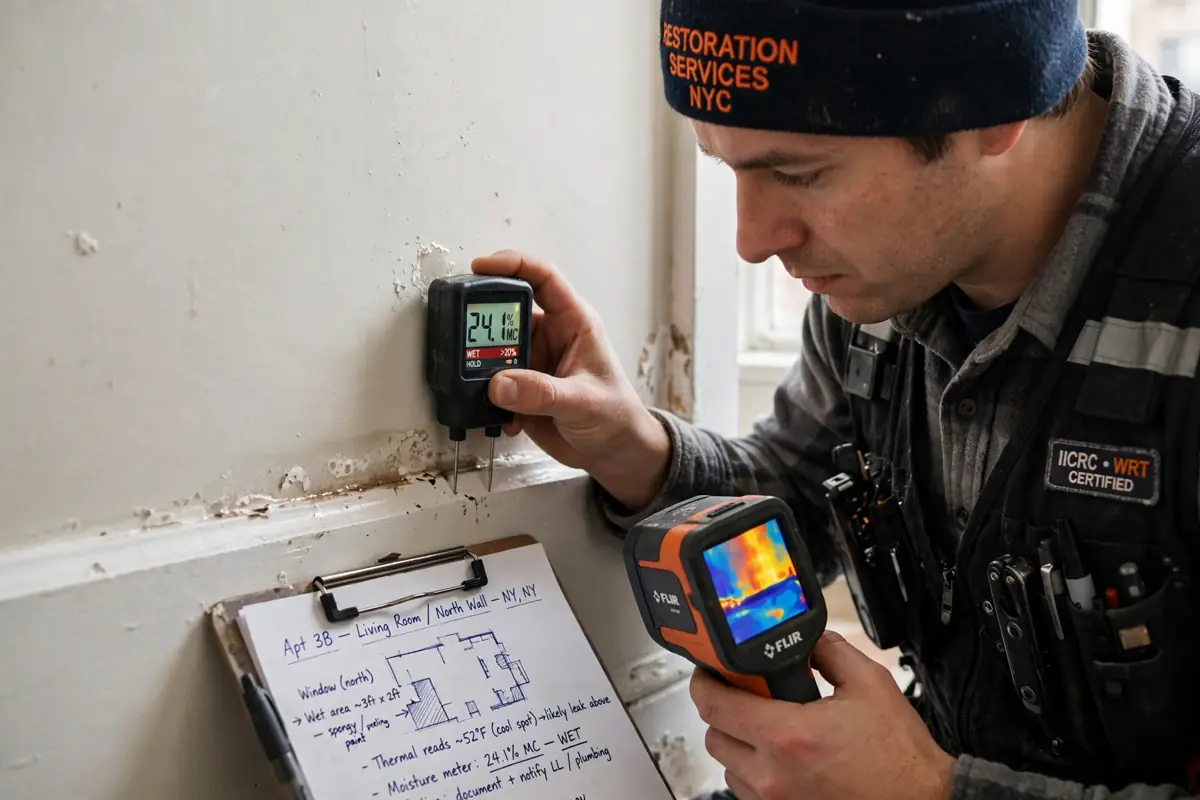
Before pumping, the crew walks the home with moisture meters and marks how far the water has travelled: which rooms, how high on the walls, and whether it has crossed into rooms that look dry. A thermal camera can help show where cool, damp areas sit, but a camera reads temperature differences only and does not measure moisture, so meter readings confirm every wet area before extraction begins.
4Pump out standing water with submersible and truck-mounted extraction
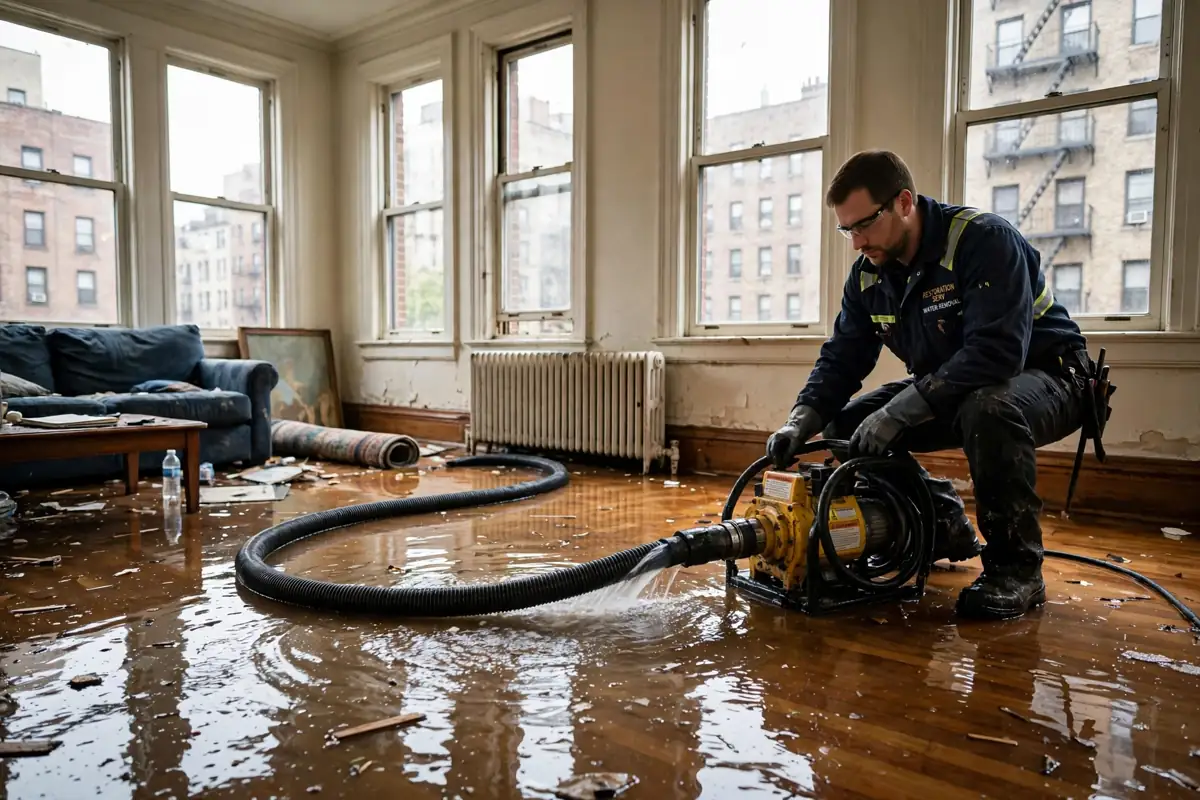
Deep water comes out first with submersible pumps. Then truck-mounted extraction and portable flood pumpers pull the bulk of the remaining water out of the rooms. A portable flood pumper such as the Dri-Eaz HVE 3000 is rated by its maker at 50 gallons per minute through a 1.5 inch hose. The goal of this step is simple: no standing water left anywhere in the home.
5Extract water from carpets, floors and walls
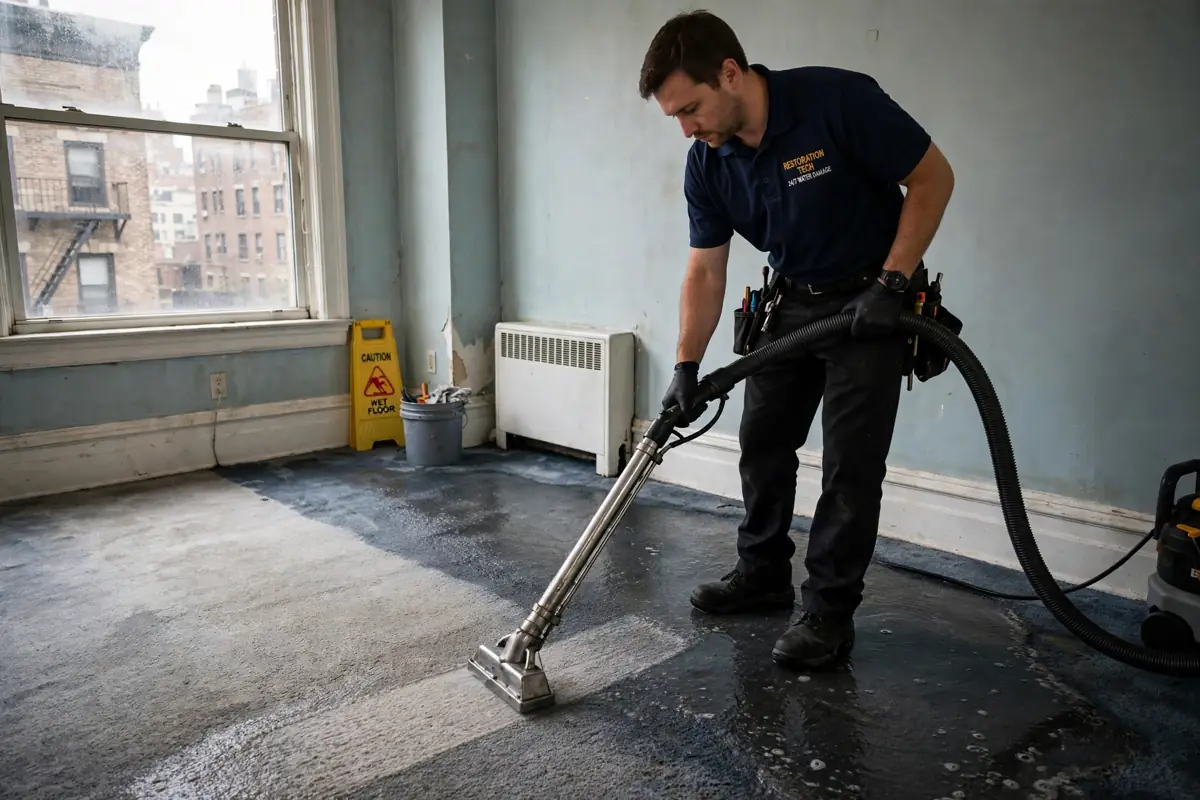
Once the rooms are pumped, extraction continues at the surface level: weighted wands draw water out of carpet and padding, hard floors are squeegeed and vacuumed, and wet baseboards, wall bases and ceiling edges are checked and opened where the readings say water is trapped. Water left inside a wall cavity at this stage is the water that causes the damage people discover weeks later.
6Dry the structure with daily readings until it is safe again
Air movers and dehumidifiers then dry the structure, and the crew returns to take moisture readings every day. The IICRC S500 standard, fifth edition 2021, works from moisture content readings used to establish a dry standard for each material. Drying ends when the readings meet that standard, not when the surfaces merely feel dry to a hand.
Two features of the sequence deserve emphasis. The first is that mapping comes before pumping, not after. A crew that pumps first and measures later has thrown away the evidence of how far the water travelled, and the rooms that looked dry, the wall cavity that drank through the baseboard, the ceiling one floor down, are exactly the places that produce next month's damage. Meters before pumps is a discipline, and it costs minutes, not hours. The second is that the last step has no fixed length. Drying ends at a standard, not on a schedule, and the daily readings are the only honest clock. The standard behind the readings is the IICRC S500, the Standard for Professional Water Damage Restoration, now in its fifth edition of 2021. Its published scope covers the restoration of water damaged structures and contents, and its method, as the IICRC states it publicly, works from moisture content readings used to establish a dry standard for the materials in front of you.
A note on honesty belongs in this section, because the standard is often quoted as saying more than its public text says. The free IICRC pages for the S500 do not publish a list of extraction equipment, and they do not print a step by step extraction then drying sequence in the standard's own words. The equipment and the sequence on this page are professional practice, stated as practice, and the figures attached to the equipment are the manufacturers' figures, stated as such in the next section. Where this page quotes the standard, it quotes what the IICRC actually publishes. That discipline, claim only what the source carries, runs through every section below.
Equipment, with real figures
The Machines That Move the Water, Figures Included
Equipment talk in this trade is full of numbers that dissolve when you ask where they came from. This section uses only figures a manufacturer publishes, names the maker next to the figure, and says plainly where no figure exists.
| Equipment | What it does | Published figure |
|---|---|---|
| Submersible pumps | Sit in deep water and move bulk volume out through a discharge hose. The first machines into a flooded basement. | Varies by unit. A residential benchmark: a Zoeller third horsepower sump unit is rated up to 42 gallons per minute, but that is a sump pit rating, not a flood extraction rate. |
| Portable flood pumper, Dri-Eaz HVE 3000 | A portable extraction and pumping unit for floors a truck cannot reach. Pumps and extracts, with a waste tank for the recovered water. | Maker rated at 50 gallons per minute through a 1.5 inch hose and 12 gallons per minute through a 0.75 inch hose. Twelve gallon tank, handles solids up to half an inch, HEPA filtration stated by the maker to conform to the 2015 IICRC S500. |
| Truck-mounted extraction, HydraMaster Titan H2O | The street based heavy unit: engine driven vacuum that pulls water from carpet and floors down long hose runs to a recovery tank in the truck. | Maker lists a 32.5 horsepower engine, airflow above 400 cubic feet per minute, a 100 gallon recovery tank and dual wand capacity. No gallons per minute figure is published for truckmounts, by any maker, and this page will not invent one. |
| Portable extractors and wet vacuums | The shallow water and surface tools: weighted wands for carpet, squeegee wands for hard floors, wet vacuums for the last film of water. | Rated by tank size and lift rather than flow. Their real measure is the meter reading of the carpet and floor after they pass. |
| Moisture meters and thermal camera | Pin and pinless meters measure moisture content in materials. The camera scans for cool patches that suggest damp. | The camera measures temperature differences only, per its maker FLIR. It does not measure moisture. Every camera finding is confirmed by meter. |
| Air movers and dehumidifiers | The drying half of the job: airflow across wet surfaces, refrigerant dehumidifiers pulling the moisture out of the air and draining it away. | Sized and placed on the daily readings, and removed when the dry standard is met, not before. |
The pattern in the table is the lesson. Pumping equipment carries flow figures because pumping is simple displacement. Extraction equipment carries airflow figures because extraction is vacuum work, and its speed depends on the material being extracted, the hose run and the operator. Any salesperson who converts a truckmount into a single gallons per hour promise is converting marketing into arithmetic. Judge the equipment by whether it matches your building, portable power for towers and walk ups, truck power where the street allows it, and by the readings it leaves behind.
Know your water
Clean, Dirty and Grossly Contaminated: Why the Water Decides the Method
Two floods can look identical from a doorway and require opposite jobs. The difference is what is in the water. The IICRC system classifies water by contamination, and the classification at the serious end is stated in the IICRC position statement on the S500 in terms this page will repeat carefully: Category 3 water is grossly contaminated water, the class that includes sewage and other water carrying harmful contaminants. The same statement corrects the mistake repeated on half the pages in this trade: water that comes through a ceiling from the floor above is not automatically Category 3. Direction is not the test. Contamination is the test.
At the other end of the scale, water from a burst supply line, a split washing machine hose or a failed water heater starts clean, and the work is extraction and drying with materials saved wherever readings allow. Between the two sits the broad middle of water that has picked up contamination on its way through a building or across a floor, and the honest treatment of the middle is caution: crews judge it on source and travel, and protective measures rise with doubt. This page does not print definitions of the first two categories as if they were verbatim standard text, because the free public IICRC sources do not carry them in that form, and printing them anyway is how error becomes tradition. The labels clean and gray are industry shorthand. The Category 3 wording above is the verified standard language, and it is the one that changes jobs.
The Environmental Protection Agency guidance lines up with the same caution from the health side. For contaminated water, the EPA table calls for OSHA protective equipment and containment, advises removing water with a water extraction vacuum on carpet, upholstery, concrete and block, and warns in plain words: do not use fans before determining that the water is clean or sanitary. A fan aimed at contaminated water aerosolises what you least want in the air of your home. That single sentence is worth more than most equipment lists, and it is why the first judgement on every job, before any machine starts, is what the water is.
Services
Fifteen Ways the Water Gets Out
One service, fifteen working parts. Each card below is a real line of work that appears on real jobs in this city, and together they are the full catalogue this page offers and its Schema describes.
Emergency water removal
The around the clock service: answered day and night, crewed for pumping and extraction on the first trip, for burst pipes, floods and backups anywhere in the city.
Standing water pumping
Submersible pumps take the deep water down fast, discharging safely outside the home or to an approved drain, until only the shallow layer remains.
Truck-mounted water extraction
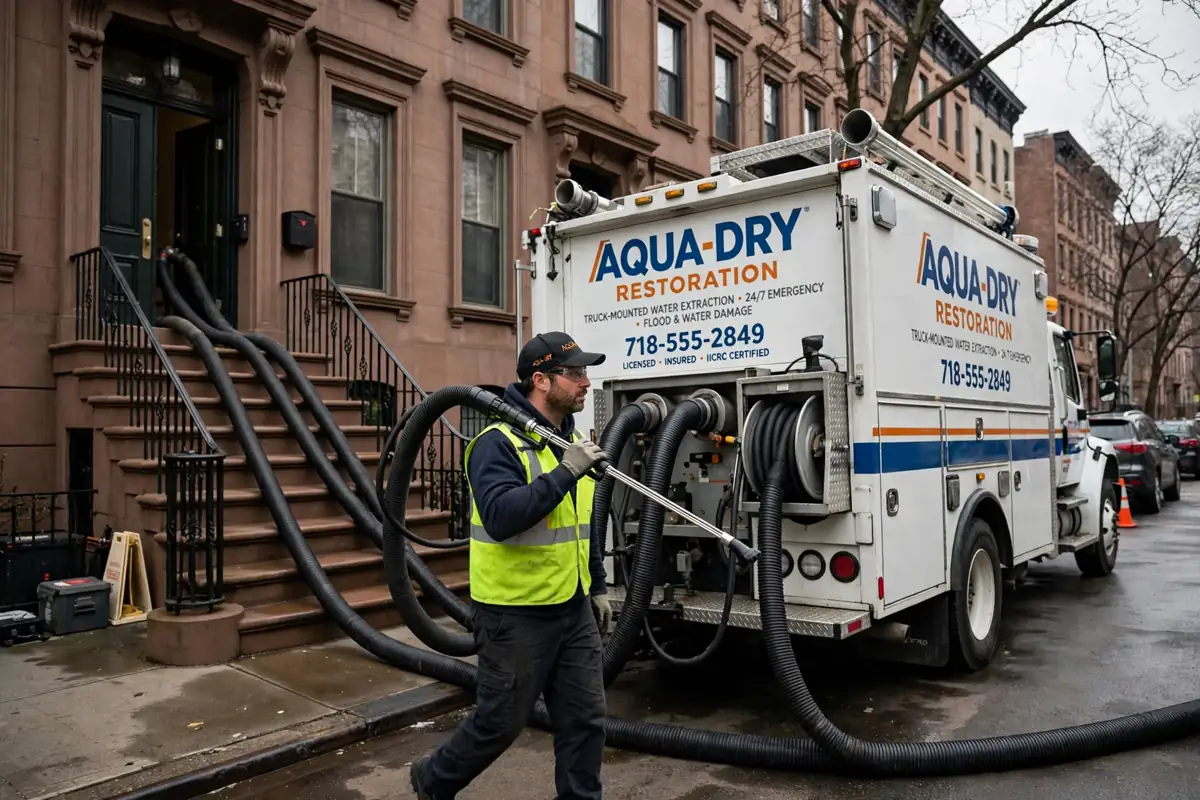
High airflow truckmounts pull water out of carpet, padding and floors where a hose run from the street is practical, with a 100 gallon recovery tank on the Titan H2O class of unit.
Portable extraction and wet vacuums
The high rise and walk up kit: portable flood pumpers rated up to 50 gallons per minute, portable extractors and wet vacuums carried to any floor.
Submersible pump water removal
Pumps that work under water, sized for basements and deep flooding, moving the bulk volume so extraction can finish the job.
Basement water removal
The basement specialism: safety checks first, then pumping, extraction at the wall base, and drying planned for the room that floods first and dries last.
Flood water removal
Storm and surge water handled as the contaminated work it often is, with containment, disposal and sanitising built into the plan.
Sewage water removal
Grossly contaminated water removed under protective equipment and containment, with saturated porous material removed and hard surfaces sanitised.
Carpet and padding water extraction
Weighted wand extraction that pulls water from carpet and pad together, with a save or replace decision for the pad made on readings and time.
Wet wall and ceiling water removal
Water chased where it hides: baseboards off, cavities vented or opened, ceilings read and dried or removed before stains become collapses.
Moisture mapping with daily readings
Every job mapped before pumping and read daily during drying, so the state of the structure is a log of numbers, not an opinion.
Structural drying and dehumidification
Air movers and refrigerant dehumidifiers set on the readings, adjusted daily, and removed only when the dry standard is met.
Contents drying and cleaning
Furniture, rugs, documents and belongings moved, cleaned and dried where they can be saved, and documented where they cannot.
Antimicrobial treatment and sanitizing
Surfaces left clean after extraction are treated and sanitised, so the rooms are handed back safe, not merely dry.
Insurance claim documentation
The paper deliverable: moisture maps, daily logs, photographs, invoices and final readings, filed in the order an adjuster reads them.
Not sure which of these your home needs?
Nobody is, from a doorway. The mapping answers it: meters first, then the plan names the services your rooms actually require, and only those.
Basements
Basement Water in the City That Lives Below Street Level
New York is a city that lives in its basements, legally and otherwise, and water knows it. The Department of Buildings and the Department of Housing Preservation and Development said it plainly in a press release of 10 November 2025, announcing the basement legalisation pilot under Local Law 126 of 2024: thousands of New Yorkers currently live in unsafe, illegally converted basement and cellar spaces, in a city with a 1.4 percent vacancy rate. Those homes are the first to flood and the last to dry, and they are where this service does its most consequential work.
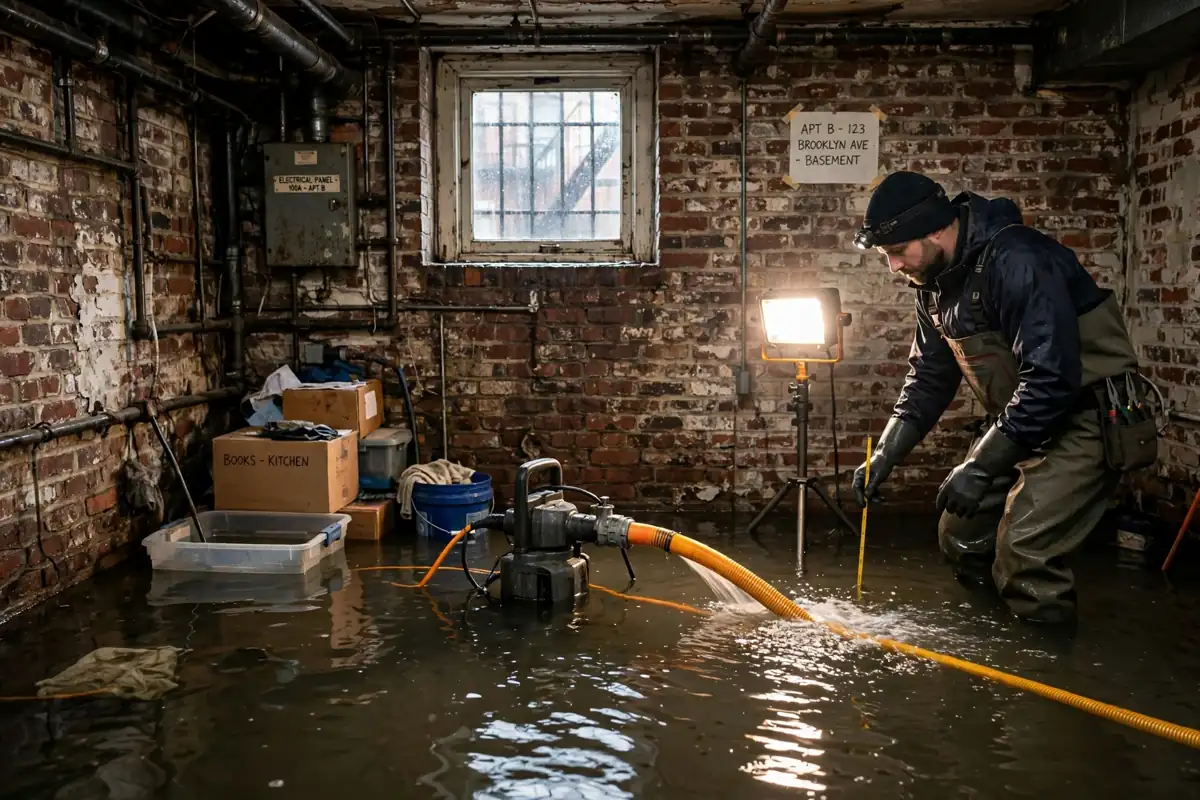
The city's two great basement floods frame the risk honestly. Hurricane Sandy killed 44 people in the city and caused damage the city puts at 19 billion dollars, with 300 homes destroyed and more than 69,000 residential units damaged, figures carried on the city's live recovery pages. Hurricane Ida killed 13 people in the city, on sewer capacity the city states as 1.75 inches of rain an hour, a rate Ida's rain exceeded. Of Ida's dead, 11 died in basement apartments, a figure reported at the time by ABC News and the New York Times. Those numbers are why a flooded basement in this city is treated as a life safety problem first and a property problem second, on this page and on every job.
The sewer backup route, step by step
When basement water comes up through a drain, the city's own process runs alongside ours. Call 311 immediately and report the backup. The Department of Environmental Protection states that a crew arrives within six hours to investigate. The crew decides where the blockage sits. If the city's sewer is the cause, the city clears it. If your private service line is the cause, clearing it is the owner's responsibility. The Department does not send a crew for a backup reported only as due to heavy rain. If you believe the city is responsible for your damage, a claim to the City Comptroller runs on a 90 day clock from the event. None of that cleans your basement. Pumping, extraction, disposal of saturated porous material, sanitising and drying remain yours, and they should start the same day, in parallel with the city's investigation, not after it.
Permits and the emergency rule
Extraction and drying are emergency response, and no Department of Buildings page lists them as permit work. The filing that does exist for emergency work is the Emergency Work Notification under Administrative Code section 28-105.4.1, filed within two business days after the work is completed. Work first, filing immediately after: that is the city's own rhythm for genuine emergencies, and it means a permit question should never delay a pump.
Where we work
Five Boroughs, Sixteen Named Areas, One Standard
The service covers New York City as a whole and names the areas where the work concentrates: Brooklyn, Queens, Manhattan, the Bronx and Staten Island, and within them Long Island City, Flushing, Jamaica, Harlem, the Upper West Side, the Upper East Side, Astoria, Williamsburg, Park Slope and Riverdale. The building stock changes by neighbourhood, pre-war walk ups in Harlem, towers on the Upper East Side, brownstones in Park Slope, garden apartments in Astoria, detached houses in Riverdale and on Staten Island, and the equipment plan changes with it. What does not change is the sequence: safety, source, mapping, pumping, extraction, drying to a measured standard, with the paperwork kept whole.
Each borough also has its own page on this site with its own research, linked in the all pages section below, because a borough is not a keyword variation. The housing, the water risks and the search data differ, and the pages were built one by one to match. This page is the service page that sits across all of them: whichever borough page brought you here, the removal work itself is the work described above.
Coverage also means honesty about the edges of the map. The sixteen named areas are where the work concentrates and where response is organised around standing crews and stocked vehicles. Calls from beyond the named areas are answered the same way, with the same questions, and if a job sits far enough out that another arrangement would serve the caller faster, the caller is told so on the phone rather than after a wait. A service area drawn on a page is a promise about logistics, not a decoration, and this one is drawn where the logistics hold. Within it, the promise is uniform: the phones answered around the clock, the first trip a working trip, the sequence unbroken and the standard measured, from the northern edge of Riverdale to the southern shore of Staten Island. That uniformity, kept across sixteen areas and five boroughs, is what makes water removal NYC one service rather than sixteen small ones sharing a name.
After the pumps
Drying Is a Measurement, Not a Waiting Room
The most common failure in this trade is not bad pumping. It is a room closed up too early, smelling of nothing, quietly wet inside the walls. Drying done properly looks boring from the doorway: air movers aimed at wall bases, dehumidifiers draining to a sink, and a technician with a meter and a log sheet once a day. The boredom is the point. The log is the job.
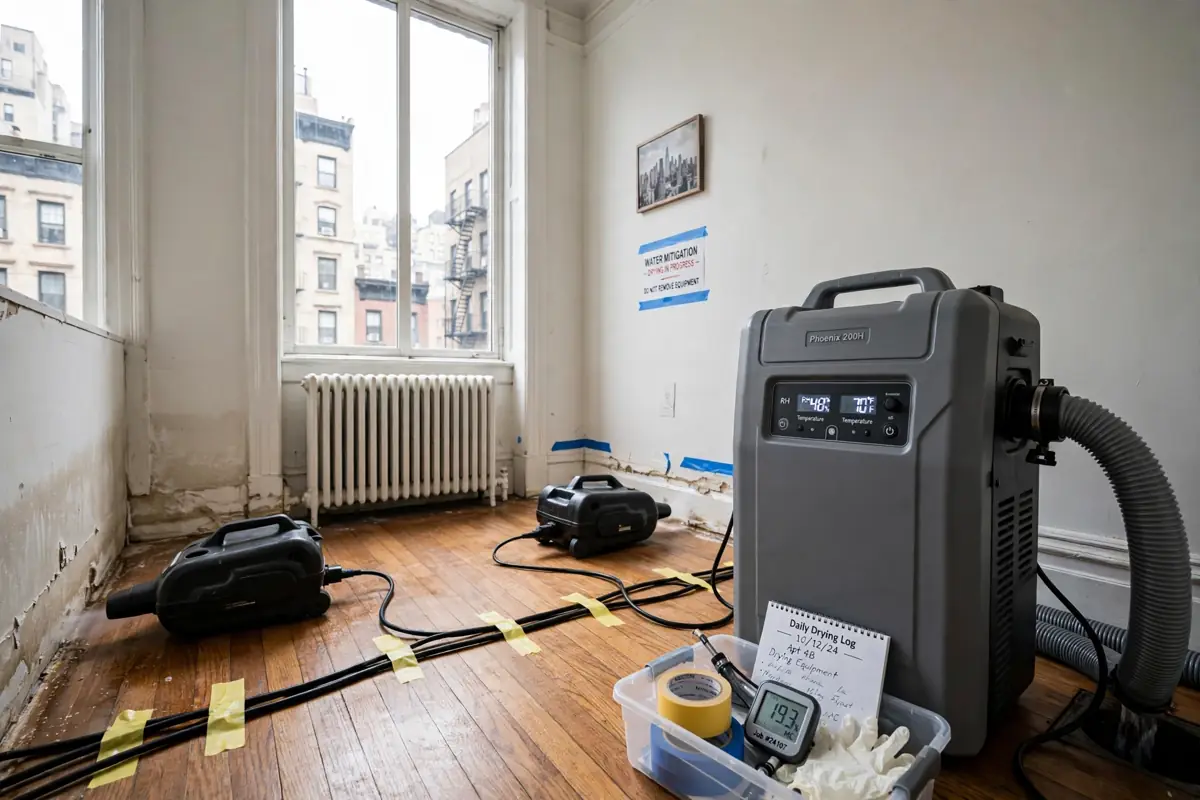
The standard behind the log, the IICRC S500 in its fifth edition of 2021, frames the work around moisture content readings used to establish a dry standard. This page states that the way the IICRC states it publicly, and no further. A rule you will read elsewhere, that drying ends when a wet material matches an unaffected sample of the same material, is sensible practice and is how many crews judge their readings, but it is not wording this page could verify in the free IICRC sources, so it is not printed here as the standard's text. The distinction sounds fussy. It is the same distinction that keeps every other figure on this page honest, and it costs the reader nothing.
The clock on drying is the one the Environmental Protection Agency sets: dry water damaged areas and items within 24 to 48 hours to prevent mold growth. Extraction is what buys the structure its place inside that window, which is why this page treats removal and drying as one continuous job with one log, not two visits sold separately. When the readings meet the standard, the equipment leaves and the final round of readings is recorded. That record, with the map from day one, is the proof that the room was dried rather than abandoned, and it goes into your claim file.
Case studies on video
Two Extraction Jobs on Video, Labelled Honestly
This site does not embed video. It studies it. Two extraction videos were reviewed for this page, played in full, and they are written up here as case studies with their limits stated on the page, because neither one is a verified New York City job and this page will not present them as one.
Basement apartment flood, pumped and extracted
Rest Assured Mitigation, published 5 October 2026, fifty seconds, 61 views at review. A basement apartment flood handled with pumping and extraction, useful as a compact look at the order of work in a below grade home: water down first, then surface extraction, then drying set. The location is not stated as New York City in the video, and the business shows a 516 area code, which is Long Island and Nassau County. Watch it for the method, not the map. Watch the video
Water extraction explained on a working job
Roto-Rooter, published 5 September 2014, four minutes and seven seconds, 189,481 views at review. A longer, older walkthrough of extraction work on a real job, valuable for the equipment handling and the sequence from standing water to drying. Its location tag is Camden, not New York. The method travels even though the job does not, and the write up here claims nothing more for it than that. Watch the video
What both videos teach, and what this page's process section states, is that extraction is unglamorous, repetitive and decisive: pumps, passes, readings, drying. No genuinely New York located extraction video was found in the research for this page, and rather than borrow one and imply otherwise, the gap is stated here. When a verified city job is published, this section is where it will be added.
Insurance
The Source of the Water Decides the Claim
Insurers do not ask how wet your home got. They ask where the water came from, and the Department of Financial Services wording draws the lines where the policies draw them. Flood, meaning water from outside the home, overflow of inland or tidal waters or rapid runoff of surface water in the federal definition the Department works with, is excluded from standard homeowners policies and needs its own flood policy, through the National Flood Insurance Program or a private flood insurer. Under that program the standard limits run to 250,000 dollars for the home and 100,000 dollars for contents, basement cover is limited to a listed set of building items rather than finished living space, and a new policy normally waits 30 days before it takes effect.
Water from inside the plumbing, a burst pipe, a split hose, a failed heater, sits on the other side of the line, the sudden and accidental kind of event standard policies are built around. The Department ties mold cover to the same logic: mold damage is covered if it is due to a covered event, and many policies carry a mold limitation, so the covered event carries or sinks the consequences that follow it. One thing this page will not print is a promise that extraction is covered whenever the event is covered, because no Department wording to that effect was found in the research. What can be said is practical: mitigate promptly, because policies expect it, document everything, and let the paperwork prove the event, the sequence and the standard the work was done to. The last question in the FAQ below lists the full file.
The city's water itself, for the record, is in good shape, which is worth knowing when a search suggests otherwise. The Department of Environmental Protection delivers about one billion gallons a day to about 8.5 million residents from 19 reservoirs and three controlled lakes, and on 23 November 2026 reservoir storage stood at 81.2 percent against a normal 80.8 percent for the date. The water issues that flood New York homes are building issues, not supply issues, and they are solved at the scale of the building, by the work on this page.
Choosing a crew
What Good Looks Like When You Are Standing in Water
Choosing under pressure is the whole difficulty of this purchase, so here is the short test this page would apply to any crew, including the one behind it. The phones are answered around the clock by someone who asks about the water, not just the address. The first trip is a working trip, with pumps and extraction equipment matched to your building. The crew maps with meters before pumping and shows you the readings without being asked twice. The water is categorised on evidence, and contaminated water gets containment, protective equipment and disposal, not a fan. Drying is a log, ending at a standard, with daily visits you can set your watch by. The paperwork arrives in the order an adjuster reads it. And the figures the crew quotes, for equipment or for the job, are figures it can source. water removal services nyc is a crowded search, and the crowd sorts itself quickly once you ask for readings, categories and sources.
Ask also about the building you live in, because the city is the job. A crew that works New York knows about freight elevators and doorman buildings, about walk ups and their stairwell hose runs, about supers and management notice, about the 311 route for sewer backups and the Department of Buildings rules for flooded basements and submerged wiring. That local knowledge is not decoration. It is the difference between a crew that starts pumping in the first hour and one that spends the first hour solving your building. The borough pages on this site carry the local detail borough by borough; this page carries the standard the work is held to in all of them.
Ready when you are
Call, describe the water, and hold the crew that answers to the test above, starting with this one.
The usual disasters
Six Ways Water Gets In, and How Each One Is Handled
Almost every call this service takes is one of six stories. Naming yours on the first call tells the crew which kit to load and which rules apply, so the stories are worth learning before you need them.
The burst pipe in winter
A frozen pipe splits quietly, often in an outside wall or an unheated basement corner, and announces itself as a ceiling stain, a hissing wall or a floor that has become a shallow lake. The water is clean at the source and the clock is generous by the standards of this trade, but the volume is not: an open split can run for hours before anyone home notices. The job is valve first, then mapping that follows the pipe run and every room below it, because pipe water travels along joists and drops where it pleases. Extraction is usually thorough and saving is usually high: carpets extracted, walls dried in place where readings allow, and the plumber's repair running alongside the drying. Winter pipe work is the most routine form of water removal NYC, and also the most preventable, with insulation and a dripping tap on the coldest nights worth more than any pump.
The failed water heater
A water heater fails two ways: slowly, as a rust weep that soaks a closet floor for weeks, or all at once, when the tank lets go and delivers its whole contents plus everything the open supply line adds until the valve is closed. The sudden failure is a clean water flood with a hard edge, because the heater sits among electrics and, in many basements, near the furnace. The slow failure is worse than it looks, because weeks of damp under a tank grow exactly the hidden damage the behind walls page on this site exists to describe. Crews treat the two differently: bulk extraction and fast drying for the sudden flood, careful opening and material judgement for the slow one, where the floor under the tank may already be soft. Either way the appliance itself is replaced, not dried, and the readings around its footprint decide how much of the room around it is saved. Heater failures are a staple of water removal NYC in the city's older housing, where tanks outlive their warranties in basement corners.
The leak from the apartment upstairs
The most New York story on this list begins with a stain spreading across your ceiling and a neighbour who does not know their bath overflowed, their radiator valve wept or their washing machine hose split. Your job starts in someone else's home, which makes the source step social as well as technical: the building staff and the neighbour are part of the fix, and a good crew helps you make that call stand up, with photographs and readings that show direction and timing. The water itself is usually clean at origin and dirtier by arrival, having crossed a ceiling of plaster, dust and decades. Your ceiling and walls are mapped and dried, the neighbour's floor is the source document, and the paperwork matters doubly because two insurers and a building can all be parties. Handled early, this is a drying job. Handled after weeks of diplomacy, it is a demolition and mold job. The technical name for the difference is time, and it is why upstairs leaks deserve same day water removal NYC even when the drip looks small.
The storm that comes through the basement
Heavy rain floods New York basements three ways at once: up through drains when the sewers surcharge, in through window wells and door thresholds as street water rises, and down through foundation walls that were never waterproof, only dry by habit. Storm water is treated as contaminated until evidence says otherwise, because street and sewer water carry whatever the street and sewer held. The work follows the basement pattern in full: safety and power first, the 311 call for any drain backup, pumping against the inflow while rain lasts, then extraction, disposal of saturated porous material, sanitising and a long, logged dry. Storm jobs also carry the city's memory with them. Sandy and Ida, covered in the basement section above, are the reason no one in this trade treats a forecast of extreme rain as a drill. When the sky is the source, water removal NYC is partly a race against the next band of rain, and the crew will tell you honestly if the pumping has to pause and resume.
The appliance flood on a weekday morning
Washing machines and dishwashers fail at family scale: a hose, a pump seal, a door gasket, and a kitchen or laundry corner under an inch of water that is already migrating under cabinets and into the floor build up. The volume is modest and the spread is sneaky, because modern floors are layered, and water that vanishes at the surface has usually gone between the layers rather than away. The extraction is quick; the mapping is the job, with meters at cabinet bases, toe kicks removed where readings demand it, and the floor layers read one by one. Appliance water is clean at the source, so saving rates are high and drying is usually a matter of days, provided the under floor water is actually found. The failure that fills this category with repeat business is the five minute mop and the closed door, after which the floor dries on top and rots beneath. Appliance floods are small water removal NYC jobs that reward exactly the same discipline as large ones: map, extract, dry, prove it.
The sprinkler and standpipe event in a commercial space
Businesses meet water at larger scale: a sprinkler head knocked or frozen, a standpipe test gone wrong, a roof drain blocked in a downpour over a stockroom. The volumes are bigger, the floors are often concrete, which forgives more than wood, and the losses are counted in stock, records and trading days rather than furniture. Commercial extraction runs on the same six steps with heavier portable gear and more of it, plus two additions the home jobs rarely need: contents triage at scale, with wet stock and records separated, photographed and moved in a planned order, and a drying plan written around reopening, so the rooms that earn are dried and handed back first. Buildings also bring their own rules, freight elevator hours, certificate requirements for contractors, and management sign off on discharge routes, all of which belong in the first call. None of it changes the physics. Commercial water removal NYC is the home discipline with more water, more paper and a clock measured in trading hours.
The building is the job
Five New York Buildings, Five Different Extractions
Ask a crew what decides their equipment list and they will not say the water. They will say the building. These are the five buildings this city is made of, and the way the same job changes shape inside each.
The high rise tower
In a tower, water obeys management before it obeys physics. The freight elevator is booked, the doorman is briefed, the discharge route is agreed, usually a slop sink or a designated drain, and only then does the portable kit come up: flood pumpers, portable extractors, wet vacuums, meters and drying gear, floor by protected floor. The flood itself behaves differently thirty storeys up. It spreads across one level, finds the pipe chases and the elevator shaft's edges, and visits the neighbours below with a precision that makes mapping a diplomatic exercise as much as a technical one. Every affected unit gets readings, and the building gets a paper trail it can hand to its own insurer. Tower work is where portable extraction earns its keep, and where a crew's building manners, floor protection, quiet hours, hallway discipline, are worth as much as its pumps. Water removal NYC in a tower is a logistics exercise wrapped around an extraction.
The brownstone and the townhouse
The townhouse is the truckmount's home ground: hose runs from the street, up the stoop, through parlour and garden levels, with the cellar below taking whatever the upper floors spill. Brownstone water has its own habits. It follows the original wood structure, hides in the pocket doors and the plaster, and pools in a cellar that may have a dirt or old concrete floor and a century of stored family history in boxes. The garden level, often a rental, floods from the yard side in heavy rain, through doors and area drains that were designed for a gentler climate. Crews work these houses level by level, cellar first for safety, and treat the historic fabric with a care the readings still govern: original plaster and old timber dry slowly and punish haste, so drying plans run longer and gentler than in modern construction. A brownstone dried to a standard keeps its fabric. A brownstone dried to a deadline loses it. That patience is priced into good water removal NYC for the city's townhouse stock.
The pre-war walk up
Five floors, no elevator, narrow stairs, and a landlord who may be a phone number rather than a company: the walk up is where extraction becomes mountaineering. The kit is chosen for the carry, compact pumpers and extractors that climb well, hose runs laid up the stairwell with corners padded, discharge into a tub or sink on the same floor. The buildings themselves are honest structures, thick plaster, real wood floors, steam radiators with valves that weep on schedule, and they dry predictably when the water is found. The recurring walk up story is vertical: one radiator leak, three ceilings, and a chain of neighbours who each need readings and a share of the drying plan. Crews who work these buildings carry tenant diplomacy in the same bag as the meters, because access to the flat below is arranged on doorsteps, not through management portals. None of it is exotic. It is simply water removal NYC at its most physical, and the standard at the end, readings met and logged, is identical to the tower's.
The basement apartment
The basement apartment concentrates every risk on this page into one address: it floods first, from drains, window wells and walls; it dries last, below grade with little sun and less air; its wiring sits low, where the water arrives; and its residents, as the city's own legalisation pilot acknowledges, are often living in spaces the city calls unsafe even when dry. The work here follows the strictest version of the sequence, power treated by the Department of Buildings rules, contaminated assumptions until the water is characterised, contents triaged with the knowledge that everything at floor level has been in the water, and drying planned for a space that fights it. The human side matters as much as the technical: these are homes, often the most affordable homes in their neighbourhoods, and the crew that treats a flooded basement flat with the same ceremony as a penthouse is the crew this page would send. Basement water removal NYC is the conscience of the trade, and it is done properly or it is not done at all.
The shop, the office and the restaurant
Commercial water arrives with an audience and a deadline. A restaurant with a flooded kitchen, a shop with a soaked stockroom, an office with a ceiling letting go over the servers: each one needs the extraction the homes get, plus triage, security and a reopening plan. Stock and records are photographed where they stand, moved in an order the owner agrees, and separated into drying, cleaning and documented loss. Concrete and tile forgive; fitted joinery, raised floors and cabling do not, and the mapping follows the money as well as the moisture. Work often runs at night by choice, so the drying day counts against closure as little as possible, and the log doubles as the business interruption record the insurer will ask for. The physics is identical and the standard is identical. What changes is that every hour of drying has a price in trade, which makes the fastest safe extraction the cheapest line on the whole invoice. That is the commercial case for water removal NYC done at full discipline from the first hour.
Day by day
What the Week After the Flood Should Look Like
Homeowners judge a water job by its first day and lose it in the following four. Here is the honest shape of the week, so you can hold any crew, including this one, to it.
Day one is the loud day: safety checks, the source stopped, the map drawn, the deep water pumped, the surfaces extracted, the drying equipment set and the first readings logged. By the end of it your home should be free of standing water, loud with air movers, and documented well enough that the claim could be filed that evening. If day one ends with water still standing anywhere, something has gone wrong that you should be told about plainly. Day one is the day water removal NYC earns its name.
Days two and three are the measurement days described in the questions below: daily visits, readings against the first day's numbers, equipment moved to where the water remains, and trapped water hunted wherever a reading refuses to fall. A cavity that will not dry gets opened in these days, not in week two. Contents decisions also land here: what is drying well, what needs cleaning, what is honestly lost and gets documented for the claim with your agreement. The summary you receive each visit should be short, numerical and forward looking: what is dry, what is wet, what happens tomorrow.
Days four and five are where good jobs finish and vague jobs drift. Readings should be converging on the dry standard material by material. Equipment comes out room by room as rooms pass, not all at once on a hopeful morning. If a material is still short of the standard at day five, the crew owes you a reason with evidence: a hidden source still feeding, a material that dries slowly by nature, a cavity opened late. Reasons exist. Silence is not one of them, and a job that reaches day five without a clear account of itself needs harder questions from you.
The final visit closes the loop the first visit opened. A full round of readings confirms the standard has been met, the log is completed, the equipment leaves, and the rooms are handed back with the sanitising and any antimicrobial treatment done where the water category required it. You receive the file: map, logs, photographs, invoices, disposal notes. Keep it with the claim. That file is also the baseline for the rest of your home's life: if a stain or a smell ever appears in those rooms again, the final readings are how you prove what was dry and when. A complete final file is the signature of water removal NYC finished properly.
Your belongings
Contents: What Gets Saved, What Gets Dried, What Gets Documented
Structures get the readings, but homes are made of contents, and the contents decisions in the first day echo for years. The order is always the same: move what can be moved out of the water, photograph everything where it stands first, and let the water category and the material make the save or lose call, not sentiment and not haste.
Hard furniture, metal, glass and most plastics forgive water almost completely: cleaned, dried, done. Solid wood furniture usually recovers if it is dried promptly and evenly, though finishes can bloom and joints can swell, and honest crews say so before the drying starts rather than after. Upholstered furniture is a judgement call with clean water and a short soak, and a loss with contaminated water, because what is inside the upholstery cannot be cleaned to a standard anyone can verify. Rugs follow the carpet logic: extracted and dried if the water was clean, documented and released if it was not. Paper is the heartbreak category. Documents, photographs and books can sometimes be dried if they are reached within hours, and freezing can pause damage for later treatment, but a soaked archive left at room temperature for two days is usually a record of loss rather than a rescue. Say plainly on the first call if paper matters in the flooded rooms; it changes the triage order. Contents triage, photographed and agreed, is part of water removal NYC that homeowners remember longest, because it is where the job touches their lives rather than their walls.
Electronics deserve one firm rule: water and powered devices do not mix, and nothing that went under water gets plugged in to see if it works. Devices are dried externally, left unpowered, and assessed by people who repair them, with the insurer's process running alongside. The flooded basement rule from the Department of Buildings, inspection by a licensed electrician for submerged wiring and equipment, extends in spirit to everything with a plug. A crew that respects that boundary is protecting both your home and your claim, because an insurer looks kindly on documented caution and poorly on a second, electrical, incident inside the first one.
Health, stated carefully
Breathing Easy: The Health Side of a Wet Home
The health questions after a flood deserve the same discipline as the equipment figures: say what the agencies say, no more and no less. The Centers for Disease Control and Prevention states that mold can grow within 48 hours on surfaces that stay wet, which is the health case for the drying window this page repeats. The Environmental Protection Agency's guidance runs the same way: dry within 24 to 48 hours to prevent growth, fix the moisture problem first, and check after cleanup that no visible mold and no moldy odor remain, revisiting shortly after to confirm nothing has returned.
Contaminated water is the sharper hazard, and it is handled as one: protective equipment and containment per the EPA table, no fans on water that has not been determined clean or sanitary, porous materials saturated with grossly contaminated water removed rather than cleaned, and hard surfaces washed and sanitised. Children, older people and anyone with asthma or a weakened immune system should be kept out of affected rooms until that work is done, a precaution the crew should state without being asked. Beyond those points, this page makes no medical claims, offers no testing advice and diagnoses nothing. If anyone in the home feels unwell after a flood, that is a conversation for their doctor, armed with the facts of what the water was and how long it stayed, which the job file records. Careful health language, sourced and bounded, is part of water removal NYC you can rely on.
Borough by borough
Sixteen Areas, Sixteen Versions of the Same Job
The standard does not change across the city. The buildings, the water and the access do. These notes are the local knowledge the crews carry, area by area.
New York City, whole
One service area, five boroughs, every building type in this page within a few miles of each other. The citywide promise is the sequence and the standard; everything else is local detail, and water removal NYC holds both at once.
Brooklyn
Brownstones, garden levels and a generation of basement apartments carry Brooklyn's water work. Truckmounts earn their keep on the townhouse streets, and the cellar checks come first, as they should in Brooklyn water removal NYC.
Queens
The most varied housing in the city, detached homes, garden apartments and towers sharing a borough. Storm water and sewer surcharge write many of the calls, and the 311 route is well worn in Queens water removal NYC.
Manhattan
Towers, co-ops and pre-war rentals stacked to the sky. Freight elevators, management rules and neighbours below define the work, and portable extraction is the default kit for Manhattan water removal NYC.
The Bronx
Grand apartment houses, older plumbing and radiator country. Vertical leaks through stacked flats are the signature job, handled with readings in every unit the water visited, the Bronx pattern of water removal NYC.
Staten Island
Detached houses, real basements and a shoreline that remembers Sandy. Storm and surge planning runs deeper here than anywhere in the city, and Staten Island water removal NYC plans for the next storm while drying the last one.
Long Island City
New towers beside old warehouses beside low houses, three building eras on one street. The access plan changes block by block, which is exactly the puzzle Long Island City water removal NYC is set up to solve.
Flushing
Dense, hardworking housing with many multi family homes and basement units. Drain backups and shared lines feature often, and careful categorisation of the water matters in Flushing water removal NYC.
Jamaica
Detached and semi detached homes with finished basements that families actually live in. Pumping speed and honest contents triage carry the day when Jamaica water removal NYC is called.
Harlem
Pre-war walk ups and landmarked brownstones, steam heat and tall windows. Radiator leaks and vertical spread are the local classics, dried gently in old plaster by Harlem water removal NYC.
Upper West Side
Classic apartment houses with doormen, service entrances and neighbours of long standing. Building manners and below unit mapping are the craft here, and Upper West Side water removal NYC is fluent in both.
Upper East Side
Co-ops with boards, rules and freight elevator timetables. The paperwork starts before the pumps do, and a complete job file is the local currency of Upper East Side water removal NYC.
Astoria
Garden apartments, two family houses and a lively rental stock. Shared walls and shared ceilings mean shared readings across homes, handled neighbour to neighbour in Astoria water removal NYC.
Williamsburg
Converted warehouses, new developments and old frame houses in one flood plain of styles. Loft floors and modern build ups hide water in their layers, and Williamsburg water removal NYC maps layer by layer.
Park Slope
Brownstone Brooklyn at its most itself: parlour floors, garden rentals and cellars full of family history. Fabric first, readings always, is the Park Slope water removal NYC rule.
Riverdale
Houses on hillsides, co-op towers and real weather off the Hudson. Slope changes drainage, drainage changes flooding, and Riverdale water removal NYC reads the hill before it reads the basement.
Myths and mistakes
Seven Mistakes That Turn a Flood Into a Demolition
Every experienced technician carries the same list, learned from arriving a week late at other people's floods. Here it is, free, in the hope that your flood never joins it.
Waiting to see if it dries by itself
It does not, not where it matters. Surfaces dry; structures stay wet. The water inside the wall base, under the floor build up and inside the carpet pad evaporates on a schedule of weeks, while mold works on a schedule of hours, and the EPA window of 24 to 48 hours closes while the room still looks innocent. The homes that dry by themselves are the ones that were barely wet. Everything else is drying on borrowed time, and the interest is demolition. If you take one sentence from this page, take this one: the decision to call is worth more in the first day than every decision after it combined, in water removal NYC and everywhere else water gets in.
Mopping the middle and ignoring the edges
Water damage lives at the edges: the wall base, the cabinet toe kick, the threshold, the closet that shares a wall with the bathroom. A heroic mop of the open floor, followed by closed doors and rising confidence, leaves every edge exactly as wet as it was. Crews read edges with meters because edges are where the readings stay high after the middle has passed. Homeowners can borrow the principle without the meters: if you handle a small spill yourself, spend your effort at the perimeter, lift what sits against the walls, and check the room below and the closet behind over the following days. The middle of the floor is the one place water removal NYC rarely has to rescue.
Running every fan you own, on any water
The EPA warning bears repeating in this list because the mistake is so natural: do not use fans before determining that the water is clean or sanitary. Fans on clean water help. Fans on contaminated water distribute the contamination through the home with mechanical enthusiasm, and fans on a room where growth has already started do the same for spores. The other fan error is aim: a fan blowing across a wet room's open floor while the wall bases stay still and wet is theatre, not drying. Air movement in a real drying plan is aimed at wet materials, paired with dehumidification that actually removes the moisture from the air, and verified by readings. Anything less is weather. Weather is not a service, and it is not water removal NYC.
Throwing things away before photographing them
The skip outside a flooded home fills fast, and every unphotographed item in it is a small donation to your insurer. The rule is absolute and costs nothing: nothing leaves the home unrecorded. Photograph it where it stood, photograph the damage, note what it was, and only then let it go, with the crew's disposal list matching your photographs item for item. The same rule protects you in the other direction: a crew that photographs before it disposes is a crew whose invoice you can defend line by line. In the adrenaline of a flood, disposal feels like progress. Documentation is progress. Disposal is just tidiness, and tidiness can wait an hour in water removal NYC.
Closing the room and turning the heat up
The instinct to bake a wet room shut is understandable and wrong twice. Warmth without extraction and dehumidification raises the moisture load the materials hold and feeds exactly the growth the EPA window warns about, and a closed room hides the smell and the spread until both announce themselves through the paint. Drying is a controlled exchange: moisture out of materials, into air, out of the air by machine, out of the home by drain. Heat plays a managed part in professional drying, set by technicians against readings, not a homeowner part played by thermostat. Leave the room open to the crew's plan. The plan is the point of water removal NYC.
Trusting the nose over the meter
A room that smells fine can be wet, and a room that smells musty can be dry and merely remembering. Smell is a lagging, unreliable instrument, and the trade's decisions, save or remove, dry or open, done or another day, are too expensive to rest on it. Meters are cheap certainty by comparison, which is why this page returns to readings the way a pilot returns to instruments in cloud. If a crew's verdicts arrive without numbers, ask for numbers. If the numbers arrive, the nose can retire. Instruments over instincts is a fair summary of professional water removal NYC.
Fixing the finish before the structure is dry
Paint, flooring and plaster are patient; moisture is not. The repainted wall that bubbles in a month, the new floor that cups by spring, the closet rebuilt over a wet stud: each is a finish installed over an unfinished drying, and each has to come off again at twice the price. The sequence protects you only if it is completed: the final readings first, the handback file second, the decorators third. Any tradesperson who wants to start finishing while the log is still open should be asked to wait, in writing if necessary. Finishes are the reward for a dry structure, not a substitute for one, and holding that line is homeowner side water removal NYC discipline.
Tenants, owners, buildings
Who Does What When the Home Is Rented
Half the water in this city falls in homes the occupant does not own, and the first confused hour of a rental flood is usually spent on a question of roles. The roles are simpler than the hour makes them feel. The tenant's job is speed: stop what can be stopped safely, protect belongings, photograph everything, and tell the landlord or management immediately, in a form that leaves a record. The owner's job is the structure: the source repair, the extraction and drying of the building fabric, and the filings and claims that belong to the property. The building's job is access and infrastructure: the risers, the mains, the freight elevator, the neighbours above and below.
Where the water started decides who chases whose insurer, which is why the photographs and the crew's map, showing direction and origin, matter even more in a rental. A leak from the flat above is the upstairs neighbour's event visited on your ceiling. A burst riser is the building's. A hose on your own washing machine is yours. Each produces the same wet rooms and three different paper trails, and the crew's documentation is written to serve whichever trail the facts support. Tenants should also know the city's ear exists: housing complaints in New York run through 311, and a landlord who will not act on water in a home is a complaint the city is built to hear. None of that replaces the practical order: mitigate first, argue second. Water does not wait for liability to be settled, and neither does water removal NYC.
For owners and managers reading this page over a tenant's shoulder, the mirror image advice holds. Your tenant's photographs are your evidence too; ask for them rather than reshooting a pumped room. Your insurer wants the same file the tenant's does, and one crew producing one complete file serves both. And the cheapest sentence in landlording is the one that sends extraction today rather than a handyman next week, because the difference between those two decisions, measured in wall cavities, is the difference between a drying log and a renovation. Buildings that learn that once rarely pay to learn it twice, which is why so much repeat water removal NYC work arrives through supers and managing agents who have seen both versions.
Before the next one
An Hour of Preparation That Saves a Week of Drying
Nothing in this section requires a purchase beyond a torch and a notebook, and all of it pays out on the worst day of your home's decade. Know your shutoffs. Find the main valve, the fixture valves and the water heater valve on a calm afternoon, turn each one to prove it moves, and label them. A valve that has not moved in fifteen years may not move in the fifteenth minute of a flood, and discovering that in advance costs a plumber's visit rather than a basement. Photograph your rooms as they are, furnished and dry, once a year; those calm photographs, paired with the flood day ones, are the before and after every claim quietly wishes it had.
Know your building. Where does the super live, what does management want before a crew enters, which drain in your basement connects to the street and which to the house line, where does the water line enter and the sewer leave. Know your policy: which water it covers, whether a sewer backup endorsement exists, what the flood position is, and keep the claim number route somewhere that survives a wet phone. Lift what lives on the basement floor onto shelves and pallets before the storm season rather than after the forecast, and keep the irreplaceable paper, the photographs and documents whose loss no settlement repairs, above the ground floor entirely. None of this is fear. It is the same respect for sequence the crews practise, moved earlier in time. Preparation is water removal NYC performed in advance, at leisure, for free.
And keep the number. The households that fare best in this trade are not the luckiest; they are the ones whose first call happens in the first hour, to a crew whose questions they are ready to answer: where the water is, what caused it, which floor, what building. You now know the questions, the sequence, the standard and the paperwork. If the day never comes, the hour of preparation cost an afternoon. If it comes, it buys back your home. Either way, this page and the thirty-nine before it remain here, researched and sourced, for the next reader standing in water at 3 a.m., looking for exactly what you found.
Materials science, briefly
How the Materials in Your Home Drink, Hold and Release Water
A water job is a negotiation with materials, and each material at the table has its own terms. Drywall is the thirstiest common material in the city: its gypsum core and paper faces wick water upward from a wet base far above the visible line, which is why readings climb a wall the eye calls dry, and why the bottom of a soaked wall is sometimes cut away in a clean horizontal line, the flood cut, so the cavity behind can be dried and inspected. Plaster, the older wall of the pre-war stock, drinks more slowly and releases more slowly, forgiving short events and punishing long ones, and it is read and dried with more patience and fewer cuts. Wood floors swell across the grain as they take water, cupping at the board edges; dried early and evenly, many settle back, while floors left wet lift, stain and split. Engineered and laminate floors hide water beneath a surface that cannot breathe, so the top can look perfect over a saturated core, and meters, again, are the only honest witnesses. Concrete drinks deep and dries slow, which is why basements and commercial slabs run the longest logs. Knowing which material you are standing on tells an experienced crew most of the drying plan before the first reading, and the readings then confirm or correct the guess. Materials knowledge, verified by measurement, is the quiet expertise inside water removal NYC.
Underneath them all sits the hidden architecture water loves most: the cavity. Wall cavities, floor build ups, the void under a bath, the space behind a kitchen run: these are enclosed, unventilated and often insulated, and insulation that has taken water holds it against every surface it touches. A room can pass every surface reading while a cavity behind it stays wet for weeks, which is why stubborn readings are investigated physically, baseboards off, inspection holes drilled where they will be hidden by the replaced board, borescope cameras sent in to look. The behind walls page on this site exists because this single fact generates so much of the trade's late discovered damage. On a well run job the cavities are not a surprise category. They are a checklist, worked through on the map from day one, opened where the evidence points and closed only on readings. Cavity discipline is the difference between a dried home and a home with dry surfaces, and it is non negotiable in water removal NYC done to this page's standard.
After the handback
Living in a Dried Home: The First Month After
The crew leaves, the log is closed, and the home goes back to being a home. The first month after a proper dry deserves a little of the same attention as the drying itself, at a slower tempo. Walk the dried rooms weekly with your eyes and nose open: new stains, bubbling paint, a returning smell, a floorboard that has changed its mind. The EPA's own advice after cleanup is to revisit and confirm that nothing has returned, and a homeowner version of that revisit costs ten minutes a week. Most well dried homes show nothing, which is the point of the exercise: the checks are how you catch the rare exception while it is still a conversation rather than a claim.
Keep the file where you can find it, and let it change how the home is run. The flood has told you things about your building that no survey would: which valve sticks, which corner takes the storm, which appliance is living on borrowed time, which ceiling hides which pipe. Act on the information while it is fresh. Replace the hose, service the heater, clear the area drain, label the valve. Insurers, buildings and future buyers all read a home's water history in its documents, and a home with one flood, fully dried, fully documented and visibly learned from, is a stronger property than a home whose history is a rumour. That is the last service the paperwork performs, and it is why this page treats documentation as a deliverable rather than a byproduct. A flood survived properly becomes part of the home's records, not its reputation, and that transformation is the true end of water removal NYC.
One page, one promise
Standing water out fast, measured honestly, dried to a standard, documented completely. If that is the job your home needs, the number is below, around the clock.
Asked across the city
What New Yorkers Ask Online at 3 A.M.
The questions below are the ones that recur, in different words, on the city's forums, question sites and building message boards whenever the rain is heavy or a pipe lets go: Reddit threads from flooded tenants, Quora questions from first time homeowners, WikiHow readers halfway through a mop. They are answered here in the same spirit as the formal questions above, from the same sources, because a question does not stop mattering for being typed in panic.
My landlord says the wet wall will dry out on its own. Will it?
The surface will. The wall may not. A painted wall face dries to the touch in a day or two while the cavity behind it, and the insulation inside that cavity, can hold water for weeks, invisible from the room. That is the precise gap the EPA window of 24 to 48 hours is aimed at, and it is why the answer to a drying claim is a reading, not a reassurance. If the wall was wetted through, by a leak inside it or a flood against it, ask for meter readings at the base, in writing. A landlord presented with readings usually discovers a willingness to dry properly that adjectives could not produce, and a tenant holding readings has something 311 and any later proceeding can use. Walls in this city are dried by measurement or not at all, and that holds for water removal NYC in rentals exactly as in owned homes.
The water is gone but the smell is not. What now?
Smell after a flood is information, and it usually means one of three things: a material that stayed wet longer than the surfaces did, most often carpet padding or the wall base; a contaminated residue that pumping removed the water from but not the contamination itself; or growth that started in a hidden place during a slow dry. The EPA sequence applies: confirm the moisture problem is fully fixed, check for visible growth and odor, and revisit shortly after any further cleanup to be sure it has not returned. Do not mask the smell and close the door on it; scent is the one instrument that does work in this trade, as an alarm rather than a measurement. A returning crew with meters will find the wet or contaminated spot the smell is reporting, usually within one visit. Smell is a symptom with an address, and water removal NYC treats it as a work order, not a nuisance.
Can I stay in the apartment while the machines run?
Usually, with clean water, yes: the wet rooms are closed to you and loud, and the rest of the home carries on. The honest frictions are noise, heat from the equipment, and the loss of the rooms under drying, which in a studio can mean the whole home and a hotel conversation worth having with your insurer early. With contaminated water the answer narrows: stay out of the affected area until cleaning and sanitising are complete, full stop. Either way the decision should be made explicitly, on the first visit, with the crew naming which rooms are yours and which are theirs for the duration. Households that plan the nights, food, pets, work calls, around that map get through drying with far less misery than households that improvise it daily. Livability planning is a small, real part of water removal NYC service.
How do I know the crew is not inventing work?
By the same instruments that prove the necessary work: the map and the log. Invented work cannot survive readings. A room a crew calls wet should produce numbers, a cavity they want to open should be pointed to by a reading that will not fall, and a material they want to remove should be named with its category reasoning. Ask for the numbers at every stage and the invention problem solves itself, because honest work generates evidence as a byproduct and invented work generates only adjectives. Keep the photographs rule as well: everything removed was photographed first, in place, by you or by them. A crew comfortable with that level of daylight is a crew whose invoice will read the same in your insurer's office as it did in your kitchen. Verification is not distrust; it is how water removal NYC on this page expects to be bought.
Questions and answers
Thirty Questions, Answered the Way the Evidence Runs
Every question below is answered from the sources this page is built on: the IICRC and its S500 standard, the Environmental Protection Agency, the Department of Buildings, the Department of Environmental Protection, the Department of Financial Services, and the manufacturers' own published figures. Where a source does not exist, the answer says so instead of filling the gap.
Water is standing in my NYC home right now. What do I do first?
First, protect people, then protect the building. If the water is deep, if it is anywhere near outlets, appliances or a breaker box, or if it came up through a toilet or drain, stay out of the room. The Department of Buildings post storm safety guidance is plain on this point: stay away from breaker boxes in flooded basements, and do not enter a flooded basement if wires are present. If a pipe is still feeding the water, close its shutoff valve, or the main valve where the water line enters the home. Move what you can carry to dry ground, lift curtains and furniture legs out of the water if it is shallow and clean, and take photographs and a short video of every room before anything is moved or pumped, because those images are your insurance record. Then call. Tell the crew where the water is, how deep it is, and what you think caused it. Every hour that standing water sits, it climbs walls, swells floors and feeds the growth the Environmental Protection Agency warns about when it says to dry water damaged areas and items within 24 to 48 hours. Acting in that order, safety, source, photographs, call, is how a bad hour stays a bad hour instead of becoming a bad month, and it is the right first move for water removal NYC in any borough. Keep that order taped to the fridge until the crew arrives; it is the whole of water removal NYC first aid in one line.
How long does it take to fix water damage in an apartment?
Honest answer: the water part is fast, and the repair part depends on what the water touched. The ranges most often quoted for apartments come from restoration company guidance, and they should be read as vendor ranges, not as a standard. On those ranges, extracting the standing water itself usually takes one to three days, and drying the structure typically takes three days to a week, with daily moisture readings deciding when the equipment can come out. A shallow clean water leak caught in the first hour can sit at the short end of both ranges. A basement apartment that took storm water, or an apartment where water ran down through ceilings and walls for a weekend, sits at the long end, because walls may need opening and materials that stayed wet may need to come out. What no honest crew can give you on the phone is a single fixed number of days for the full repair and rebuild, because that timeline is not verified by any standard and depends on materials, approvals and the building itself. What you can hold a crew to is the sequence: pumping first, extraction second, drying with daily readings third, and a clear statement of what is dry and what is not. That sequence is the core of water removal NYC, and the readings, not the calendar, should end it. Ask for those vendor ranges in writing, with the readings attached, whenever a crew quotes you a timeline for water removal NYC.
What are the current water issues in NYC?
This question appears in search results for this topic, so it deserves a straight answer rather than a sales pitch. On the live Department of Environmental Protection pages checked on 24 November 2026, there was no current citywide water crisis, outage or emergency advisory to report, and this page will not invent one. What the Department does publish is the state of the supply itself. New York City delivers about one billion gallons of drinking water a day to about 8.5 million residents, drawn from 19 reservoirs and three controlled lakes. On 23 November 2026 the reservoirs stood at 81.2 percent of total storage against a normal level of 80.8 percent for that date, so storage was a touch above normal. October precipitation was 1.90 inches against a historical average of 4.06 inches, which is a dry month, but a dry month with reservoirs above normal is not a shortage, and this page will not call it one. The water issues that actually fill our call log are not supply issues at all. They are building issues: burst pipes, failed water heaters, sewer backups after heavy rain, and leaks from the apartment upstairs. If your issue is one of those, it is already urgent at the scale of your home, whatever the reservoirs are doing, and that is exactly the scale water removal NYC works at. If a new advisory ever does appear, it will be on the Department pages first, and this page will be rebuilt to carry it, because water removal NYC guidance is only worth what its sources are worth.
How much does water abatement cost?
This page does not publish a figure for that question, and you should be careful with any page that does. No authoritative source, not the city, not the state, and not the IICRC, publishes a set price for water abatement or extraction, because the work is never the same twice. A studio apartment with an inch of clean water from a burst supply line is a different job from a basement that took sewage in a storm, and a single advertised number would be wrong for both. What decides the real figure on a real job is knowable, even if the number is not: how many rooms are wet, how deep the water stands, what category the water is, whether walls and floors must be opened, how many days of drying the readings require, and whether contents must be moved, cleaned or stored. The honest way to handle the money question is to get the scope in writing after the water is mapped, with the extraction, the drying days and the documentation itemised, and to have your insurer claim number attached from the start so the paperwork supports the claim. This site is built for calls, not quotes on a screen, so call and describe the water. A crew that has mapped your rooms can talk figures with a straight face; a web page cannot, and water removal NYC quoted blind is how homeowners end up paying twice. A written scope, priced against your actual rooms after mapping, is the only version of that number worth having in water removal NYC.
How to tell if water damage is permanent?
No agency publishes a simple checklist that sorts water damage into permanent and repairable, so be wary of any page that hands you one. What the Environmental Protection Agency does give is a set of signs and a sequence. First, the moisture problem itself must be fixed, because damage assessment means little while water is still arriving. After cleanup, the EPA advises checking that there is no visible mold and no moldy odor, and revisiting the site shortly after cleanup to confirm the growth has not returned. Material that stayed wet for more than 48 hours falls under the EPA guidance that points you to its response tables and, for larger areas, to professional help. Some losses really are permanent in a practical sense. The Department of Buildings rules that wiring and equipment submerged in salt water must be removed and replaced, not dried and reused, and porous materials saturated with grossly contaminated water are usually removed rather than cleaned. Other damage only looks permanent: a swollen door or a stained ceiling may dry back, or may not, and only readings and time tell. The reliable method is unglamorous. Map the water, dry to a measured standard, then judge each material on evidence. That evidence based judgement is part of water removal NYC done properly. When in doubt, dry first and judge after the readings; reversible caution beats irreversible damage in water removal NYC every time.
What is the difference between water removal and water extraction?
In everyday speech the two phrases mean the same job, and homeowners use them interchangeably. Inside the trade, extraction is the name of the step itself: the physical act of pulling liquid water out of a structure and its contents with pumps, truck-mounted vacuum systems, portable extractors and wet vacuums. Removal is the wider service word, the one on the van and in the search box, covering that extraction step plus the pumping, the mapping and the handover into drying. There is a practical reason the trade keeps the word extraction. Drying equipment can only remove moisture slowly, as vapour, so every gallon pulled out as liquid is a gallon the dehumidifiers never have to chase. A thorough extraction shortens drying by days. That is why a good crew spends real time on wands, weighted extraction tools and repeated passes over carpet long after the room looks empty of water. When you compare companies, ask what extraction equipment they bring and how they confirm a floor or carpet is fully extracted. The answer tells you more than any promise about speed. Whether you search for the service word or the trade word, you are looking for the same thing, and on this page both words describe the same water removal NYC service. Crews that use the two words precisely tend to do the work precisely, which is why this page keeps both in water removal NYC.
How fast can an emergency crew reach my home?
The honest answer is that it depends on where you are in the city, the hour, and what else the weather is doing, and any page that promises you an exact number of minutes is guessing. What a prepared service can promise is the shape of the response. The phones are answered around the clock, every day, because burst pipes and sewer backups keep no office hours. The first call sorts the job: how much water, what kind, which floor, elevator or walk up, and whether the source is stopped. Crews then travel with the pumps and extraction equipment the call described, so the first trip is a working trip, not an inspection visit that books a second one. During a citywide storm the queue is longer for everyone, which is one more reason to call early rather than after the water has finished rising. If your building has a super, a doorman or a management office, tell them a crew is coming and clear the path: freight elevator booked, hallway access open, parking sorted if the building requires it. Those small steps, done while the crew travels, are worth real minutes at the other end. Around the clock answering and a working first trip are what emergency water removal NYC should mean in practice. If the first available slot a company offers is tomorrow afternoon, keep calling; standing water does not wait, and neither should water removal NYC.
Do I need to leave my home during the work?
Usually not for clean water work, and sometimes yes for contaminated water work. When the water came from a supply line, a water heater or rain through a roof, most households stay in the home while pumping and drying run, sleeping in the dry rooms while the wet ones are closed off with the equipment inside. The machines are loud, and the rooms under drying are out of use, but the home stays liveable. Sewage and other grossly contaminated water changes the answer. The Environmental Protection Agency guidance for contaminated water calls for protective equipment and containment, and households, especially children, older people and anyone with breathing problems, should stay out of the affected area until it has been cleaned and sanitised. A flooded electrical situation also changes the answer: if wiring or equipment is submerged, the area stays off limits until a licensed electrician has inspected it, under Department of Buildings rules. Your crew should tell you plainly, room by room, where you can be and where you cannot, and should set containment so the rest of the home stays usable where that is safe. Ask the question on the first call and plan the night around the answer. Clear room by room guidance is a basic part of water removal NYC, not an extra. The crew should repeat that room by room guidance back to you before they leave the first visit; insist on it when you book water removal NYC.
Is it safe to walk through standing water in my basement?
Treat it as unsafe until you know three things: what the water is, how deep it is, and what it is touching. The Department of Buildings post storm safety tips give the electrical rules, and they are strict. Stay away from downed power lines and from breaker boxes in flooded basements. Do not enter a flooded basement if any wires are present. Turn off electricity at the main breaker or fuse box even if power is already out in the neighbourhood, because it can return without warning. Wiring and equipment that went under water must be inspected by a licensed electrician before being returned to service, and wiring or equipment submerged in salt water must be removed and replaced. The water itself is the second hazard. Basement water after heavy rain is often mixed with sewage, and you cannot judge that by looking at it. The third hazard is the floor you cannot see: open drains, sharp debris and uneven surfaces hide under cloudy water. If you must enter shallow water you believe is clean, wear boots and gloves, move slowly, and come out if anything feels wrong. In every other case, wait for the crew and let pumps do the entering. That caution is built into how water removal NYC handles every basement call. Boots, gloves and patience are the homeowner kit; everything beyond that belongs to the crew doing water removal NYC.
Who do I call if the water came from a sewer backup?
Call two numbers, in this order if the water is still coming: 311 first for the city, then your restoration crew. The Department of Environmental Protection route through 311 works like this, on the Department's own description. Report the backup immediately. A crew is sent to investigate, and the Department states that a crew arrives within six hours of the report. The city crew checks whether the blockage is in the city's sewer or in your private service line. If the city's sewer is the cause, the city clears it. If the cause is your private line, clearing it is the property owner's responsibility, which is where your own crew and a plumber come in. One limit matters: the Department does not send a crew to investigate a backup reported only as due to heavy rain. While you wait, keep people and pets out of the water, do not run taps or flush toilets, and photograph everything. Sewer water is treated as grossly contaminated, so the cleanup follows the contaminated water rules: protective equipment, containment, removal of saturated porous material and sanitising. If you believe the city is responsible for damage, the Comptroller claim route exists and runs on a 90 day clock from the event. Both calls, city and crew, are part of water removal NYC when the water came up through a drain. Keep the 311 reference number with your claim file; it timestamps the city's side of your water removal NYC job.
What happens if the city sewer caused my backup?
If the Department of Environmental Protection crew finds the blockage is in the city's sewer, the city clears its own sewer. That fixes the cause. It does not clean your basement, and the distinction matters for planning. Everything the water touched on your side of the line is still your cleanup: pumping, extraction, removal of ruined porous material, sanitising and drying, all of which your own crew does. Document the city's finding carefully. Photograph the crew's visit if you can, note the date, the time of your 311 report and any reference number, and keep the paperwork with your insurance file. If you believe the city bears responsibility for the damage, a claim can be filed with the City Comptroller, and the window is 90 days from the date of the occurrence, so the calendar matters more than the argument. Do not wait for the claim before cleaning. Contaminated water damage gets worse and less defensible with every day it sits, and a claim built on a home that was promptly and properly cleaned is stronger than one built on a home left wet. Get the cause fixed by the city, get the damage fixed by your crew, and keep the two paper trails separate and complete. That is the practical shape of water removal NYC after a public sewer backup. Two paper trails, one for the cause and one for the cleanup, is how a sewer case stays winnable in water removal NYC.
Can you pump out a flooded basement the same day?
Yes, pumping is the same day work on a basement call, because leaving deep water sitting overnight is how a flood becomes a demolition. The sequence on arrival is safety first: power checked, water category judged, entry route planned. Submersible pumps then take the deep water down, discharging to a safe point outside or to a drain that can take it. As the level falls, the crew moves stored items out of the remaining water where that can be done safely, and the last shallow layer comes out with portable extraction and wet vacuums. Two honest limits apply. If the water is still rising because rain is still falling or a line is still broken, pumping runs alongside the inflow until the source is stopped, and the crew will tell you so. And pumping is the beginning, not the end: once the floor is clear, the walls, which have been drinking the water the whole time, still need mapping, extraction at the base and days of drying with readings. A basement that is pumped today and dried properly over the following days is a saved basement. A basement pumped today and closed up wet is a mold problem with a date on it. Same day pumping is standard for basement water removal NYC; the drying plan that follows it is what separates a finished job from a first visit. Judge the visit by the drying plan you are handed at the end of it, not by the speed of the pump alone, in basement water removal NYC as everywhere.
What equipment removes standing water from a high rise apartment?
High rise work is portable work, because the truck stays thirty floors below. The kit that comes up in the freight elevator starts with a portable flood pumper. The Dri-Eaz HVE 3000 is a fair example of the class: its maker rates it at 50 gallons per minute through a 1.5 inch discharge hose and 12 gallons per minute through a 0.75 inch hose, with a 12 gallon waste tank, the ability to handle solids up to half an inch, and HEPA filtration that its maker states conforms to the 2015 IICRC S500. Alongside it come portable extractors and wet vacuums for the shallow water and the surface work, weighted wands for carpet, and the meters that map the damage before and after. Discharge is the planning question in a tower: water has to leave through a route the building approves, usually a slop sink or a designated drain, and a good crew settles that route with building staff before the first gallon moves. Truck-mounted extraction still has its place in the city, on townhouses, ground floor units and anywhere a hose run from the street is practical. The equipment follows the building, not the other way round. Matching portable power to a high rise floor is routine water removal NYC, and the freight elevator booking is part of the job. Tell the crew the floor and the elevator situation on the first call; it changes the kit list for water removal NYC in a tower more than any other detail.
How much water can a truck mounted extractor remove?
There is no honest single figure, and this page will not invent one. Manufacturers of truck-mounted units publish airflow and tank figures, not a gallons per minute extraction rate, because the real rate depends on hose length, lift, carpet, padding and how much water the material is holding. What is published can be stated exactly. The HydraMaster Titan H2O, a truckmount built for water extraction work, is listed by its maker with a 32.5 horsepower engine, airflow of more than 400 cubic feet per minute, and a 100 gallon recovery tank, and it can run dual wands. Airflow is what pulls water out of carpet and padding and carries it down the hose to that tank, and the tank size tells you how much recovered water the unit holds before emptying. Portable pumpers do carry flow ratings: the Dri-Eaz HVE 3000 is rated at 50 gallons per minute on its larger hose. A residential sump pump figure you may see quoted, such as a Zoeller third horsepower unit moving up to 42 gallons per minute, is a sump rating for a pump sitting in a pit, not a flood extraction rate, and should not be compared with extraction equipment. Judge a crew by airflow, tank capacity, hose discipline and readings, not by a gallons number nobody publishes. Straight equipment answers are part of water removal NYC you can trust. Airflow, tank size and readings are the honest spec sheet; ask for all three before you book water removal NYC.
Will my carpets and padding survive extraction?
Often the carpet can, and often the padding cannot, and the water category decides most of it. With clean water caught early, a carpet can usually be extracted in place with weighted wands that squeeze water out of both the carpet and the pad beneath, then dried with air movers, sometimes lifted at one edge so air runs underneath. Padding is cheap foam that holds water like a sponge; when it has been soaked for many hours, or when drying it in place would take too long, removing and replacing the pad while saving the carpet is the standard economic call. Grossly contaminated water changes everything. Carpet and padding saturated with sewage category water are normally removed and disposed of, because cleaning them to a safe standard is not realistic. The decision on your floor should be made on readings and on the clock: what the water was, how long it sat, and what the meters say after extraction. Ask the crew to show you the readings and to explain the save or remove call for each room before anything is thrown out, and photograph the materials either way for your claim file. A crew that explains the call room by room is doing the job right. That transparency is built into water removal NYC on this site. Photograph anything before it leaves the house, saved or removed; the claim file for water removal NYC is built on those pictures.
Does water get into walls and ceilings too?
Yes, and it travels further than the visible stain suggests. Water on a floor wicks upward into drywall and insulation, runs along joists and pipes, and finds the ceiling of the room below, which is why the apartment downstairs so often reports a leak that started two floors up. Baseboards hide the worst of it: the bottom of a wall can be soaked behind paint that looks untouched. This is why mapping matters more than eyesight. A crew reads the wall base with meters, checks inside cavities where readings point that way, and reads the ceiling below the wet room as a matter of routine. Where water is trapped, the fix is physical: baseboards come off, small flood cuts or vent holes let air reach the cavity, and extraction and drying are aimed inside the wall, not just at its face. Ceilings that took water are read and, where saturated, opened so the material can dry or be removed before it sags. The stain you see a week later is the map of the water nobody looked for on day one. Finding the hidden share of the water, in walls, ceilings and under floors, is the least visible and most valuable part of water removal NYC. The room below is part of your job whether it is yours or a neighbour's, and a good crew reads it unasked in water removal NYC.
How do you know when a room is dry enough?
By readings, compared against a standard, not by touch and not by the calendar. The IICRC S500, the standard for professional water damage restoration in its fifth edition of 2021, frames drying around moisture content readings used to establish a dry standard. In practice the crew takes readings in the wet materials, takes readings in the same materials in an unaffected part of the home where available, and dries until the wet readings come down to meet the dry ones. The readings are logged daily, room by room and material by material, which is why a drying job has paperwork: wood, drywall and concrete each hold and release water differently, and each is tracked on its own numbers. Air movers and dehumidifiers are adjusted, moved or removed as the numbers move. The job ends when the log says the structure has reached its dry standard, and a final round of readings confirms it before equipment leaves. If a crew tells you a room is dry, ask to see the readings and the comparison. It is a fair question with a factual answer, and any professional crew will show you the log without blinking. Measured drying, documented daily, is how water removal NYC on this page defines done. A crew that will not show the log has not finished the job, whatever the invoice says about water removal NYC.
What does a thermal camera actually show?
Less than most people think, and something genuinely useful when it is used honestly. A thermal camera does not measure moisture. The maker of the cameras used across this industry, FLIR, is clear that the camera shows temperature differences on surfaces. Wet areas often read cooler than dry ones because evaporation cools them, so the camera paints a picture of suspicious cool patches that deserve a closer look. That picture is a map of where to test, not a verdict. Every patch the camera flags still has to be confirmed with a moisture meter, which does measure moisture content, before anyone calls it wet or dry. Used that way, camera plus meter, the camera earns its place: it scans a whole wall or ceiling in seconds and shows the shape and spread of a problem that point by point meter work might take far longer to outline. Used alone, it misleads, because a cold patch can be an air leak, a missing patch of insulation or a pipe shadow rather than water. If a report shows you camera images, ask where the confirming meter readings are. The pairing of the two tools, image then measurement, is the professional standard this page holds to. Honest tool talk like this is part of water removal NYC done in the open. Image first, measurement second, opinion last; hold every report you receive to that order in water removal NYC.
Why does drying need to start within 24 to 48 hours?
Because that is the window the Environmental Protection Agency puts on mold prevention, in words worth quoting exactly: it is important to dry water-damaged areas and items within 24-48 hours to prevent mold growth. The Centers for Disease Control and Prevention makes the same point from the health side: mold can grow within 48 hours on surfaces that stay wet. Behind those two sentences sits a simple mechanism. Mold spores are already present in every home, all the time. What they wait for is water. A wall base, a carpet pad or the paper face of drywall that stays wet gives them everything they need, and growth that starts invisibly inside a wall cavity is a far bigger job than drying that would have prevented it. This is the practical reason extraction speed matters more than almost anything else on a water job. Every gallon pulled out as liquid in the first hours is moisture the structure does not hold into the second and third day. It is also why a crew that pumps today but cannot start drying until next week has only done half the urgent work. When you call, ask when drying equipment will be running, not only when the pumps will arrive. Beating the 24 to 48 hour window is the central promise of emergency water removal NYC. That is why the drying start time, not the pumping start time, is the appointment to press for in water removal NYC.
What is Category 3 water and why does it change the job?
Category 3 is the most serious class of water in the IICRC system, and the definition deserves care because it is often quoted loosely. In the IICRC position statement on the S500 standard, Category 3 water is described as grossly contaminated, the class that includes water from sewage and other sources carrying harmful contaminants. The same statement corrects a common mistake: water that arrives from above, for example through a ceiling, is not automatically Category 3. The classification turns on whether the water is grossly contaminated, not simply on the direction it travelled. Category decides method. Clean water work is about extraction and drying. Grossly contaminated water work adds protective equipment, containment, disposal of saturated porous materials that cannot be cleaned to a safe standard, and sanitising of the surfaces that remain. It also changes who should be in the room, and it changes the paperwork, because insurers and buildings both treat sewage events differently from supply line leaks. One honesty note belongs here: the free public IICRC sources verify the Category 3 wording above. The everyday labels clean water and gray water for the other classes are industry shorthand you will hear from every crew, but this page does not present them as verbatim standard text. Getting the category right, on evidence, is where professional water removal NYC starts. If anyone tells you ceiling water is sewage by definition, ask them for the source; the standard does not say it, and water removal NYC on this page follows the standard.
Is sewage water removal different from clean water removal?
Yes, in method, in protective equipment, in what can be saved, and in how the rooms are handed back. The pumping looks similar from the doorway: submersible pumps and extraction take the liquid out either way. Everything around the pumping differs. For sewage, the Environmental Protection Agency guidance for contaminated water calls for OSHA protective equipment and containment, and warns against using fans before the water has been determined clean or sanitary, because a fan can spread contamination through the home. Saturated porous materials, carpet, padding, upholstered furniture and the lower section of wet drywall, are generally removed and bagged rather than cleaned. Hard surfaces that remain are washed and sanitised. The crew works contained, so the rest of the home is protected while the affected rooms are dealt with. Clean water work, by contrast, saves far more material: carpets are extracted, walls are dried in place where readings allow, and contents are cleaned and dried. The cost in effort is not the point here; the point is that the two jobs only look alike. If your water came up through a drain or a toilet, make sure the crew is treating it as the contaminated job it is, with containment and disposal in the plan from the first visit. Sewage work done to the contaminated standard is non negotiable in water removal NYC. Containment and disposal in the written plan, before work starts, is the test that separates sewage work from surface cleaning in water removal NYC.
Should I run fans before the crew arrives?
It depends on the water, and the Environmental Protection Agency draws the line clearly: do not use fans before determining that the water is clean or sanitary. If your water came from a burst pipe, a supply line or a water heater, and it is plainly clean, moving air across a shallow wet area while you wait does no harm and can help surfaces. Keep the fans on the wet area itself, and stop if you see any growth already present, because blowing across mold can spread spores. If there is any chance the water came from a drain, a toilet, a sewer or the street, do not run fans at all. Contaminated water plus moving air is how one flooded bathroom becomes a whole home problem. The same caution applies to your heating and air conditioning system: if ducts or the air handler are anywhere near the water, leave the system off until the crew has looked. When in doubt, do the safe things that never backfire: stop the source, photograph everything, move dry valuables out of the wet rooms, and keep people and pets out of the water. The crew will set air movement properly, aimed and contained, as part of the drying plan. Restraint with fans is a small but real part of water removal NYC guidance. Clean source confirmed, shallow water, air moving on the wet area only; anything outside that list waits for the water removal NYC crew.
Do I need a permit to have water pumped out of my home?
Pumping and drying themselves are emergency response work, and no Department of Buildings page lists extraction or drying as work that needs a permit before it starts. The permit question that does exist after emergency work in New York is about notification and about the repair work that follows. Under the Administrative Code, section 28-105.4.1, emergency work carries an Emergency Work Notification that must be filed within two business days after the work is completed. That filing rhythm, work first in a genuine emergency, paperwork immediately after, is how the city handles urgent repairs. The repairs that follow a flood can be a different matter. Replacing wiring, altering plumbing, or rebuilding walls can each carry their own filing requirements depending on scope, and your contractor or licensed tradesperson handles those filings as part of their work. Two practical points for homeowners. First, never let a permit question delay pumping: standing water does more damage in a day than any filing fixes. Second, keep the emergency paperwork with your claim file, because insurers and building management both ask for it. If your building management wants notice before crews and equipment come through the lobby, give it, but treat it as building courtesy, not a city permit. Clear paperwork after fast action is the pattern for water removal NYC. Emergency first, filing within two business days after; never trade those two around when you arrange water removal NYC.
What about the wiring in a flooded basement?
Wiring is the part of a flooded basement to respect most and guess about least. The Department of Buildings post storm safety tips set the rules, and they belong to the Department, not to the utility. Stay away from breaker boxes in flooded basements. Do not enter a flooded basement if wires are present. Turn off electricity at the main breaker or fuse box even if power is out in the community, because restoration can be sudden. Wiring and equipment that were submerged must be inspected by a licensed electrician before being returned to service, and wiring or equipment submerged in salt water must be removed and replaced outright. In practice this means the extraction crew and the electrician work in sequence: the crew will not treat a live flooded basement as a routine pumping job, and the electrician cannot inspect what is still under water. Expect the crew to ask about the panel, to work with the power state the Department's rules require, and to flag submerged outlets, appliances and the furnace or boiler controls for the electrician's list. Do not plug drying equipment into circuits that went under water until they are cleared. The drying plan can route power from dry circuits or from a generator where needed. Electrical patience, on the Department's own rules, is built into water removal NYC for basements. Sequence is everything here: pump, clear, then the electrician's inspection, in that order, for basement water removal NYC.
Does homeowners insurance cover flood water?
For flood water specifically, the Department of Financial Services position is the one that surprises people: flood is excluded from standard homeowners policies, and flood cover comes from a separate flood policy, through the National Flood Insurance Program or a private flood insurer. The federal definition the Department works with treats a flood as a general and temporary condition of partial or complete inundation of normally dry land from overflow of inland or tidal waters or unusual and rapid runoff of surface waters. Under the National Flood Insurance Program, the standard limits are up to 250,000 dollars of cover for the home and up to 100,000 dollars for contents, basement cover is limited to a listed set of items such as furnaces, water heaters and foundation elements rather than finished living space, and a new policy normally carries a 30 day wait before it takes effect. The practical lesson is to learn which water your policy covers before the water arrives, because the source of the water, flood, burst pipe, sewer backup with or without an endorsement, decides the claim more than the damage does. If flood water has already come in, document everything, mitigate promptly, and file on whatever policy might respond. The records discipline in the last question on this page exists for exactly this moment. Insurance clarity, stated before you need it, is part of honest water removal NYC guidance. Read your own policy's flood wording tonight, before any water arrives; it is the cheapest hour in water removal NYC preparation.
What if the water came from a burst pipe instead of a flood?
Then you are usually in the stronger insurance position, and in the cleaner working position too. Water from a burst pipe, a split supply line or a failed water heater is sudden and accidental water from inside the plumbing system, which is the kind of event standard homeowners policies are generally built around, while flood water from outside is the excluded kind. The Department of Financial Services frames mold cover the same way, tied to whether the underlying event is covered, and the same logic runs through water damage generally: the covered event carries its consequences with it. Your duties are the practical ones. Stop the water at the valve, mitigate without delay, because policies expect reasonable steps to limit further damage, photograph everything before and during the cleanup, and keep every invoice, reading log and report the crew produces. Tell your insurer promptly and get the claim number onto the crew's paperwork from the first visit. One caution: slow leaks that ran for months are treated differently from sudden bursts by many policies, which is another reason the timeline in your photographs and your first call record matters. A burst pipe handled in the first hours, documented properly, is the cleanest claim in this trade. Fast mitigation plus full paperwork is how water removal NYC protects both your home and your claim. Valve, photographs, claim number on the paperwork from visit one; that trio is burst pipe water removal NYC done right.
Can a shop vac handle a flooded room on my own?
For a small, clean, shallow spill, yes, and homeowners handle those every day. A wet and dry vacuum, a mop and a fan will deal with a washing machine overflow caught in ten minutes on a tile floor. Know where the honest limits sit. A shop vacuum moves a few gallons at a time and then stops to be emptied, while a flooded room can hold hundreds of gallons in its carpet, padding and wall bases that no surface tool reaches. The vacuum does nothing for the water already inside the wall cavity or under the floor, and it gives you no readings, so you cannot know whether the room is drying or quietly staying wet. Electrical safety is the hard limit: never run a plug in appliance while standing in water, and keep the vacuum itself out of the water. Contaminated water is the other hard limit: sewage does not belong in a household vacuum or in your lungs. The sensible rule is scale and source. Clean, shallow, small and caught early: handle it, then check baseboards and the room below over the following days. Deep, spreading, contaminated, or still arriving: call. The call is free, and the mapping alone tells you what you actually have. Knowing the limit of a shop vac is part of sensible water removal NYC advice. Small, clean, shallow and early is the whole of the do it yourself territory; everything past it is water removal NYC work.
How is water removed from a building with no elevator?
By planning the carry before the water gets a vote. Walk up work runs on portable equipment chosen for stairs: compact portable extractors and flood pumpers that one or two technicians can carry flight by flight, hose runs laid up the stairwell with corners protected, and discharge routed to a sink, tub or drain on the same floor so nothing has to be carried down in buckets. The crew sizes the job honestly. Deep water in a fifth floor walk up may take more passes with portable gear than the same water at street level with a truckmount outside, and a straight crew tells you that on the phone rather than after arrival. Building realities matter as much as equipment: narrow halls, neighbours' doors, and the super's rules about stairwell use all go into the plan, and protecting the stairs and landings from hose drag and wet footprints is part of the work, not a courtesy extra. None of this makes the job impossible; half the city's older housing stock has no elevator, and the work is routine. What it changes is the first phone call, where floor, stairs and access deserve the same detail as the water itself. Walk up logistics, planned on the first call, are everyday water removal NYC. Stairs change the kit, not the standard; the readings at the end should look the same on the fifth floor as at street level in water removal NYC.
What should happen on the second and third day after pumping?
Days two and three are when a water job is won or quietly lost, and they should look like this. The crew returns, usually daily, and takes moisture readings in every material being dried: wall bases, floors, ceilings below, and any cavity opened for drying. The readings go into the log next to the first day's numbers, so progress is a trend, not an impression. Equipment is adjusted on evidence: air movers repositioned to the areas still reading wet, dehumidifiers moved, emptied or exchanged, and any area that is not drying investigated rather than ignored, because a flat reading line usually means trapped water that needs a flood cut, a removed baseboard or a different drying setup. Contents work continues in parallel: items being dried are checked, cleaned items are separated from anything still being treated, and anything that is not going to recover is documented for the claim with your agreement before disposal. You should also hear a plain spoken summary each visit: what is dry, what is still wet, what happens next and when. If day three arrives with no readings, no log and no summary, ask hard questions. The drying log is the job. Daily readings and an honest summary are the standard this page sets for water removal NYC after the pumps leave. No readings, no log and no summary by day three means the drying is being guessed, and guessed drying is failed water removal NYC.
What records should I keep for my insurance claim?
Keep the file that proves four things: what happened, when it happened, what it did, and what was done about it. For what happened: photographs and video of the water in place before pumping, pictures of the source if you can identify it, a burst pipe, a failed heater, a drain that backed up, and a written note of when you discovered it and when you called for help. For what it did: the crew's moisture map and room by room readings, photographs of every affected room including ceilings below and walls that were opened, and a list of damaged contents with photographs of each item. For what was done: the invoices, the daily drying log with its readings, the equipment record, any disposal list for materials or contents removed, and the final readings that show the structure reached its dry standard. Add the city paperwork where it exists: your 311 reference for a sewer backup, any Department findings, and emergency work filings. Keep your own claim number, adjuster name and every letter or email in the same folder. The Department of Financial Services ties cover to the covered event and the policy wording, so the documents that prove the event and the sequence carry the claim. Keep the bundle after the claim closes; it is also your home's water history. That complete file is the last deliverable of water removal NYC done properly. Build the file as the job runs, not after it ends; memory fades faster than drywall dries.
All pages on this site
All Fifty-Six Pages, in One Place
This removal page is the fortieth page of this site. The thirty-nine pages below are the rest of it: the home page and the city hub, the borough and city pages, the region pages, and the topic pages on process, insurance, hidden water, fire, flood and mold. Each was researched and built on its own, with its own keyword, its own headings and its own Schema.
Water Damage Restoration New York
The home page of this site: the full New York restoration guide for the main keyword, with the boroughs, the process and the claim help in one place.
Water Damage Restoration NYC
The city hub page joining the five boroughs and Manhattan coverage, the page this removal service hangs from.
Water Damage Restoration Brooklyn
Borough coverage for Brooklyn homes, brownstones and basements, from Park Slope to Williamsburg.
Water Damage Restoration Queens
Borough coverage for Queens, from Astoria and Long Island City to Flushing and Jamaica.
Water Damage Restoration Bronx
Borough coverage for the Bronx, including Riverdale and the Grand Concourse apartment stock.
Water Damage Restoration Staten Island
Borough coverage for Staten Island homes, where detached houses and storm surge shape the work.
Water Damage Restoration Long Island
Coverage for Long Island homes and the commuter belt east of the city line.
Water Damage Restoration Manhattan
Borough coverage for Manhattan towers, co-ops and pre-war apartments, Harlem to the Upper West and Upper East Sides.
Water Damage Insurance Claim New York
The claim page: how New York water claims are documented, filed and defended, event by event.
Water Damage Behind Walls NYC
The hidden water page: finding and drying water trapped inside walls, cavities and ceilings.
Fire Damage Restoration NYC
Restoration after fire in the city: smoke, soot, structure and the water the hoses leave behind.
Flood Cleanup NYC
Cleanup after flooding in the city, from storm water entry to the full clean and dry.
Water Damage Remediation NYC
Remediation coverage for city homes: making damaged structures safe, clean and sound again.
Fire Damage Cleanup
The cleanup page for fire damaged homes, and the page that counts this site as it grows.
Rochester
City coverage for Rochester homes and lake effect weather water damage.
Albany
City coverage for Albany and the state capital's older housing stock.
Buffalo
City coverage for Buffalo, where freeze and thaw drive winter water damage.
Water Damage Restoration Syracuse
City coverage for Syracuse homes in the snow belt.
Water Damage Restoration Yonkers
City coverage for Yonkers, the city's closest Westchester neighbour.
Water Damage Restoration New Rochelle
City coverage for New Rochelle homes and waterfront properties.
Water Damage Restoration Mount Vernon
City coverage for Mount Vernon homes just north of the Bronx line.
Water Damage Restoration Schenectady
City coverage for Schenectady and its historic districts.
Water Damage Restoration Utica
City coverage for Utica and the Mohawk Valley.
Water Damage Restoration White Plains
City coverage for White Plains homes and businesses.
Water Damage Restoration Troy
City coverage for Troy and its riverfront streets.
Water Damage Restoration Niagara Falls
City coverage for Niagara Falls homes at the western edge of the state.
Water Damage Restoration Binghamton
City coverage for Binghamton, where two rivers meet and flood risk is real.
Water Damage Restoration Westchester County
County coverage for Westchester homes north of the city.
Water Damage Restoration Hudson Valley
Regional coverage for the Hudson Valley towns and river communities.
Water Damage Restoration Capital Region
Regional coverage for the Capital Region around Albany.
Water Damage Restoration Western New York
Regional coverage for Western New York, from Buffalo to the lake plains.
Water Damage Restoration Finger Lakes
Regional coverage for the Finger Lakes towns and lake houses.
Water Damage Restoration Central New York
Regional coverage for Central New York around Syracuse.
Water Damage Restoration Southern Tier
Regional coverage for the Southern Tier along the Pennsylvania line.
Mold Removal in New York City
The city mold removal service page: hands on removal for homes across the five boroughs.
Mold Remediation in New York
The licensed remediation page: the Article 32 system of separate assessment and remediation under New York law.
How Long Does Mold Take to Grow After Water Damage?
The mold timeline page: the 24 to 48 hour window and what grows when drying is late.
Water Damage Restoration Process
The full end to end process page, all six steps from first call to final readings.
What Is Water Damage Restoration?
The definition page: what restoration means, in plain words, with the terms of the trade explained.
Water Damage NYC
Water damage in NYC explained plainly, with fast help for every home.
Water Damage Cleanup Nyack NY
Water damage cleanup in Nyack explained plainly, with fast help for every home.
How to Choose a Water Damage Restoration Company in New York
How to choose a water damage restoration company in New York, with every check that protects your home.
How to Choose a Water Damage Restoration Company in New York
Commercial Water Damage Restoration NYC | 24/7 Emergency Help
Commercial water damage in NYC explained plainly, with fast help for every business.
Commercial Water Damage Restoration NYC | 24/7 Emergency Help
Basement Water Damage Restoration NYC
Basement water damage in NYC explained plainly, with fast help for every basement.
Water Damage Repair New York
Water damage repair in New York explained plainly, with fast help for every home.
Water Damage Restoration Poughkeepsie New York
Water damage restoration in Poughkeepsie explained plainly, with fast help for every home.
Emergency Water Damage NYC
Emergency water damage in NYC explained plainly, with fast help when every minute counts.
Water Damage Cleanup in NYC
Water damage cleanup in NYC explained plainly, from torn-out materials to dry rooms again.
Flood Damage Restoration NYC
Flood damage restoration NYC explained plainly, from flood events and NFIP claims to dry rooms and a flood-resistant rebuild.
How Long Does Water Damage Restoration Take
How long does water damage restoration take explained plainly, with real timelines for drying, cleanup and rebuild.
Flood Damage Cleanup Washington Heights
Flood damage cleanup in Washington Heights explained plainly, with fast help for every home.
Does Insurance Cover Water Damage Restoration
Whether insurance covers water damage restoration, explained plainly, by cause and New York rule.
Water Damage Mold Remediation
Mold that grew after a leak or flood, remediated the New York way, by licensed assessor and remediator.
Water Damage Restoration Companies New York
Compare the companies serving New York: national franchises, regional firms and local independents, and how to verify licences and certification before you hire.
Water Damage From Upstairs Neighbor
Water damage from an upstairs neighbor in New York City: who pays, what to do in the first hour, and how to document, report and claim.