Water Damage Restoration in Buffalo: Frozen Pipes, Ice Dams and Flooded Basements, Dried Right
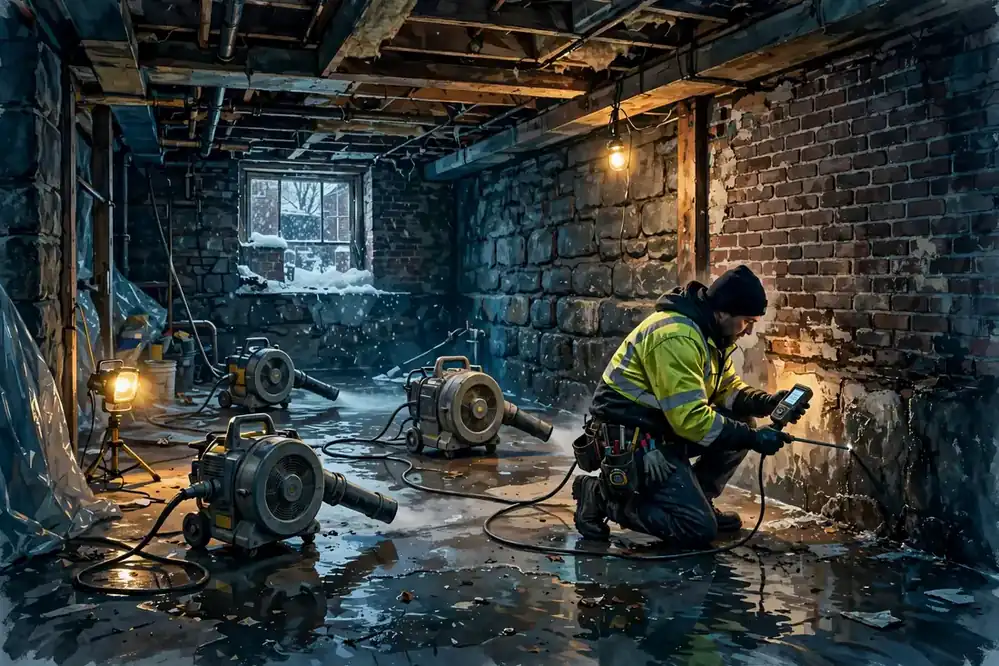
The short version, with sources
Buffalo Water Damage: The Seven Facts That Decide the Job
Seven facts decide most water damage restoration buffalo jobs, and each one below is stated with the source it comes from, so it can be checked and quoted exactly as it stands.
Last updated: November 2026
- Buffalo averages over 90 inches of snow a year, according to Roto-Rooter Buffalo, and that snowpack is a frozen reservoir that loads roofs, feeds ice dams and turns into meltwater on still frozen ground every spring.
- Basement flooding is the most frequent water problem in Buffalo homes, according to Roto-Rooter Buffalo, because combined sewers surcharge in heavy rain and push contaminated water back through floor drains into stone foundation basements.
- Mold can begin growing within 24 to 48 hours on materials that stay wet, according to the Environmental Protection Agency (EPA), which is why extraction and drying start the same day on every water damage restoration buffalo job.
- The December 2022 blizzard dropped 49.2 inches of snow at Buffalo Niagara International Airport and 56.5 inches in Snyder, according to the National Weather Service (NWS), and burst pipes during that storm left Buffalo homes without running water, according to Associated Press reporting carried by Insurance Journal on 28 December 2022.
- The November 2022 lake effect storm dropped 81.2 inches of snow on Hamburg and 80 inches on Orchard Park, according to National Weather Service cooperative observer reports, while downtown Buffalo saw far less, which is why Buffalo water risk changes street by street.
- Under Regulation 64 (11 NYCRR Part 216), a New York insurer must acknowledge a claim, begin investigating and answer a completed proof of loss, each within 15 business days, according to the regulation text, and after a declared natural disaster Insurance Law section 2618 requires payment of an agreed settlement within 4 business days.
- Article 32 of the New York Labor Law requires mold assessment and mold remediation on any project over 10 square feet to be done by separately licensed companies, according to the New York State Department of Labor, and the rule has applied statewide, including Buffalo, since 1 January 2016.
Who stands behind the work
Proof Before Promises: The Standards Behind Every Buffalo Job
Water damage restoration buffalo work is an unglamorous trade built on readings, logs and licences. This page names the standards the work is held to, states plainly which business details are still placeholders, and shows you how to check every claim before you let anyone open a wall in your home.
Work to the IICRC standards
Drying follows the Institute of Inspection, Cleaning and Restoration Certification (IICRC) S500 standard for water damage, and mold work follows S520. Those standards set the moisture targets, the equipment math and the point at which a material is honestly dry.
Standard: IICRC S500 / S520New York mold law, followed exactly
Article 32 of the New York Labor Law splits mold assessment and mold remediation between separate licensees on projects over 10 square feet. This page explains that split in full, because a company that offers to do both on one job is telling you something about itself.
Law: Labor Law Article 32Documentation your adjuster can use
Moisture maps, daily drying logs, dated photographs and line item estimates in the format adjusters work from. The paperwork is not an extra. On most water damage restoration buffalo jobs, the paperwork is what gets the claim paid.
Included on every jobPlaceholder details, stated openly
The phone number on this page, (716) 555-0147, is a placeholder, marked as one everywhere it appears. No business name, address, licence number or review count has been supplied for this site yet, so none is invented here. Real details replace the placeholders before this page is used for live calls.
Placeholder phoneStart here
What Buffalo Water Does to a House
Buffalo water arrives in more ways than almost any other New York city: off a lake, out of a creek, up through a floor drain, down through a roof buried in snow, and sideways out of a pipe that froze three days earlier.
Water damage restoration buffalo work starts with a simple truth that every local crew learns fast: the water you can see is the smallest part of the problem. A burst pipe announces itself. A slow ice dam leak does not. Water wicks up inside plaster and drywall, runs along the top of a ceiling joist and drips ten feet from the stain, hides under hardwood and vinyl, and soaks insulation that then holds it against framing for weeks. The visible puddle dries in a day with a fan. The wall cavity behind it can stay wet long enough to grow mold, rot a sill plate and ruin the paint on the other side of the wall.
That is why real water damage restoration buffalo work is measured, not guessed. A technician walks the home with pin and pinless moisture meters and a thermal camera, building a moisture map that shows where the water actually went. Extraction removes the standing water. Air movers and dehumidifiers then dry the structure to a documented dry standard for each material, and daily readings prove the numbers are falling. Cleaning and disinfection deal with what the water carried. Only then does rebuilding start, because rebuilding over a wet cavity is how a small leak becomes a second job.
Buffalo makes every part of that harder and more urgent. The housing stock is old: Allentown Victorians, North Buffalo colonials and West Side doubles carry original galvanized and cast iron plumbing that is now 80 to 100 years old. Stone and early block foundations were built to breathe rather than to seal. Dense glacial clay soil holds water against those foundations instead of draining it away. And the weather stacks the risks: over 90 inches of snow a year, according to Roto-Rooter Buffalo, deep freezes that split pipes, spring thaws that flood basements, and a lake that can push water at the shoreline when the wind turns.
None of that means a wet Buffalo home is a lost cause. It means the response has to match the city. The pages below walk through the two storms that taught Buffalo its hardest lessons, the three winter mechanisms that cause most local losses, the basement problem, the creeks, the lake, and the neighbourhoods where each risk lives. Then come the first 60 minutes, the drying science, the insurance clocks that protect you under New York law, and the 30 questions Buffalo homeowners ask most.
Water moving in your home right now?
Stop the source if you safely can, keep clear of wet electrical areas, photograph everything, and call. Every hour of delay is an hour the water spends travelling.
Dated case lesson one
The December 2022 Blizzard: What Burst Pipes Taught Buffalo
The Christmas week blizzard of 2022 is the storm Buffalo measures every other storm against, and its water damage lesson is one this city learned twice in one week: a blizzard floods a home during the freeze, and then again on the thaw.
The storm reached New York early on 23 December 2022 and blizzard conditions held in Buffalo for 37.5 consecutive hours, the longest blizzard in city history. Visibility fell to zero for long stretches, winds gusted over 60 miles per hour hour after hour, and the highest reported gust reached 79 miles per hour. Buffalo Niagara International Airport recorded 49.2 inches of snow by the morning of 26 December, according to the National Weather Service (NWS), and Snyder, next to the city, recorded 56.5 inches over five days. More than 127,000 customers lost power across the region, and 47 people died statewide, at least 39 of them in Erie County.
The water damage ran underneath the snow story. Homes that lost heat lost pipes. Associated Press reporting carried by Insurance Journal on 28 December 2022 described Buffalo resident Trisha LoGrasso, whose home fell to 42 degrees Fahrenheit indoors because of a gas leak, whose pipes burst, and who was left with no running water. Governor Kathy Hochul said on 25 December 2022 that her own home had been without power for days and was flooding with broken and frozen pipes. In Williamsville, residents went more than 72 hours without power. Every unheated hour pushed more supply lines in basements, crawl spaces and outside wall cabinets toward the freeze point, and every split line waited silently for pressure to return.
Then came the second wave, and Erie County officials named it in advance. On 27 December 2022, Erie County Emergency Services Commissioner Dan Neaverth Jr. warned that crews were watching the forecast for later that week, when warmer weather would raise the threat of flooding as the snow melted. That is the pattern every water damage restoration buffalo crew now plans around: extraction and pipe repair during the cold, then sump pumps, floor drains and foundation walls under load the moment the temperature climbs and four feet of snow starts moving as water on frozen ground.
The practical lessons are written through this page. Keep heat on in every room during a storm, even rooms you do not use. Know where your main shutoff is before you need it at 3 a.m. in the dark. If you lose power in deep cold, open cabinet doors, let faucets drip, and check the basement every few hours. And when the thaw comes, treat a running sump pump and a rising pit as the emergency they are, because the blizzard is not finished with your house when the snow stops falling.

Dated case lesson two
The November 2022 Lake-Effect Storm: Seven Feet of Snow, Then Meltwater
Five weeks before the Christmas blizzard, a lake effect storm buried the Southtowns under up to 81.2 inches of snow while parts of Buffalo saw a fraction of it, the clearest possible proof that Buffalo water risk is local down to the street.
The storm ran from 17 to 20 November 2022. Hamburg recorded 81.2 inches, the top total, from a National Weather Service cooperative observer, and Orchard Park recorded 80 inches, including 66 inches in 24 hours, close to a New York State 24 hour record. Blasdell saw 76 inches and Elma 67 inches. Buffalo Niagara International Airport recorded 36.6 inches across 17 to 19 November, its fifth highest three day snowfall on record, with a record daily 21.5 inches on 19 November. Snow fell at 3 to 6 inches per hour with thundersnow, four people died, and a federal emergency declaration followed for eleven counties including Erie and Niagara.
Lake effect bands are narrow. A band parked over Hamburg and Orchard Park can drop feet of snow while a neighbourhood ten miles north shovels inches. For water damage restoration buffalo planning, that unevenness matters twice. First, roof load and ice dam risk follow the band, not the city average: the Southtowns homes under 80 inches of snow carried the heaviest roofs and the deepest eave ice that November. Second, all of that snow is meltwater waiting for a warm day, and it melts onto ground that is already frozen, so it runs sideways to foundations, window wells and low doors instead of soaking in.
The lesson for a homeowner is to think in bands and thaws, not in citywide averages. After any major lake effect event, check the roof edges for ice building at the eaves, keep gutters and downspouts clear so meltwater leaves the foundation line, test the sump pump before the warm day arrives, and move storage off the basement floor in the low rooms. The homes that came through November 2022 and December 2022 driest were not lucky. They were the ones where somebody did those four things before the temperature turned.
Dated case lesson three
The Melt Week: How the December 2022 Blizzard Flooded Buffalo a Second Time
The blizzard ended on 26 December 2022, but the water damage did not. In the week that followed, temperatures climbed, four feet of snow began to move as water, and water damage restoration buffalo crews worked a second disaster inside the first one: pipes that had split in the freeze announcing themselves on the thaw, sump pits rising on meltwater, and basements that had stayed dry through the storm taking water in the calm after it.
The arithmetic of a melt week is simple and brutal. Snow holds roughly an inch of water for every ten inches that fall, so the 49.2 inches recorded at Buffalo Niagara International Airport and the 56.5 inches recorded in Snyder stood for several inches of water resting on every roof, yard and street in the metro area. Frozen ground cannot absorb any of it. The melt ran sideways instead, toward foundation walls, into window wells, down exterior basement stairs and toward floor drains connected to sewers already carrying the melt of the whole city. A water damage restoration buffalo dispatcher reads a thaw forecast the way a fire crew reads a wind forecast, because the thaw is the moment a snowstorm turns into a flood.
The pipes told the first part of the story. Lines that froze during the outages, in homes that fell toward 42 degrees indoors as the Associated Press account of one Buffalo household recorded, did not leak while they were frozen solid. They leaked when heat returned, pressure came back and the ice inside them cleared, and that happened house by house across the melt week rather than all at once. Owners who had come through the storm with no damage opened a cabinet or a basement door days later to find water already running across the floor. That delay is why a water damage restoration buffalo technician checks the whole run of a line after any freeze event, and not only the split that showed itself first.
Erie County officials saw the second part coming before it arrived. On 27 December 2022, Emergency Services Commissioner Dan Neaverth Jr. warned that warmer weather later that week would raise the threat of flooding as the snow melted, and the melt proved him right street by street. Sump pumps that had rested through the storm began running without pause. Pits in low homes filled faster than a single pump could clear them, and finished basements that had survived four feet of snow took their first water under a clearing sky. Every water damage restoration buffalo spring checklist written since that week carries the same lesson: the pump, the backup and the discharge line are one system, and the melt tests all three parts on the same day.
The quietest failure of the melt week happened at the outside wall. A sump pump can only move water that has somewhere to go, and discharge lines that froze at the exterior, or that ended in snow piled against the foundation, left pumps pushing against a wall of ice. The pit refilled, the pump ran until it overheated or the float stuck, and the basement flooded with the pump still humming. Homeowners who cleared the discharge outlet, dug the line end out of the snowbank and watched one full cycle before trusting it kept their basements. It is a five minute check, and on a water damage restoration buffalo call in thaw week it is the first thing the crew looks at after the shutoff.
Roofs wrote their own chapter that week. Mild afternoons melted the top of the snowpack while the eaves stayed at winter temperatures, which is the exact recipe for an ice dam, and meltwater that could not reach a gutter backed up under shingles and into the ceiling cavities below. Homes took their first ceiling stain of the season not during the blizzard but days later, under a blue sky, with the storm already a memory. Crews explain the same pattern to every January caller: the roof rarely leaks during the storm itself. It leaks during the melt, and the ceiling under it needs measured drying either way, which is why ice dam calls stay on the water damage restoration buffalo schedule long after the plows have finished.
The third act of the melt week was paper. Households across Erie County filed water claims inside the same few weeks, for burst pipes, flooded basements and ice dam leaks, and insurer catastrophe teams travelled into a city whose streets had only just reopened. Files moved slowly for reasons no single adjuster controlled: too many losses at once, too few local contractors, and homes that could not be dried until heat and power were stable. The homeowners who came out of the surge best had photographed their damage during the storm, kept a written log and filed early. New York law stood behind those who knew it, because Regulation 64 still required acknowledgement and investigation within 15 business days even in a catastrophe, and the disaster payment clock in Insurance Law section 2618 still ran once a settlement was agreed. On a water damage restoration buffalo job that week, the file built on day one, photographs, a moisture map and dated readings, was the difference between a claim that rode the surge and a claim that waited at the bottom of it.
The melt week is now part of how Buffalo prepares for winter. When a major snow event ends, the checklist turns with the temperature: walk the basement daily while the pack is melting, listen for the sump pump cycling, watch the joint where the wall meets the floor for the first dark line of seepage, and check every room that lost heat for the pipe that has not confessed yet. The storm makes the headlines. The week after it makes the water damage restoration buffalo schedule, and the homes that come through both halves driest are the ones where somebody kept watching after the snow stopped falling.
The melt week also ran on neighbours. The homes that flooded worst that week were rarely the ones with families inside them. They were the empty ones: the house whose owners were still snowed in elsewhere, the upper flat standing vacant between tenants, the property of the snowbird who had left for Florida in November. Nobody heard those pipes let go, nobody saw those pits rise, and the water ran until a neighbour, a landlord driving in from the suburbs or a meter reader finally opened a door. The standing lesson, now repeated in Erie County preparedness guidance every winter, is to arrange the melt week check before the storm: a named person, with a key, who will walk any empty property you own within two days of a thaw, basement first, and who knows the shutoff and the emergency number before they need either.
How Buffalo losses happen
Ice Dams, Frozen Pipes and Foundation Water: Buffalo's Three Winter Mechanisms
Most winter water damage restoration buffalo jobs trace back to one of three mechanisms, and each one has a different warning sign, a different first move and a different fix.
The ice dam
Heat escaping into a roof melts the underside of the snowpack. The meltwater runs down to an eave that hangs over unheated space and refreezes into a ridge of ice. Each cycle adds to the ridge and backs standing water behind it. Asphalt shingles shed water that runs downhill, not water that sits still, so the trapped water works under the shingles, into the wall top and onto the ceiling below. The February ceiling stain in a Buffalo home is usually an ice dam, not a hole in the roof. South towns with heavier snow loads grow more ice dams, and mature tree canopies in North Buffalo and Parkside shade roofs and feed the cycle.
The freeze that breaks on the thaw
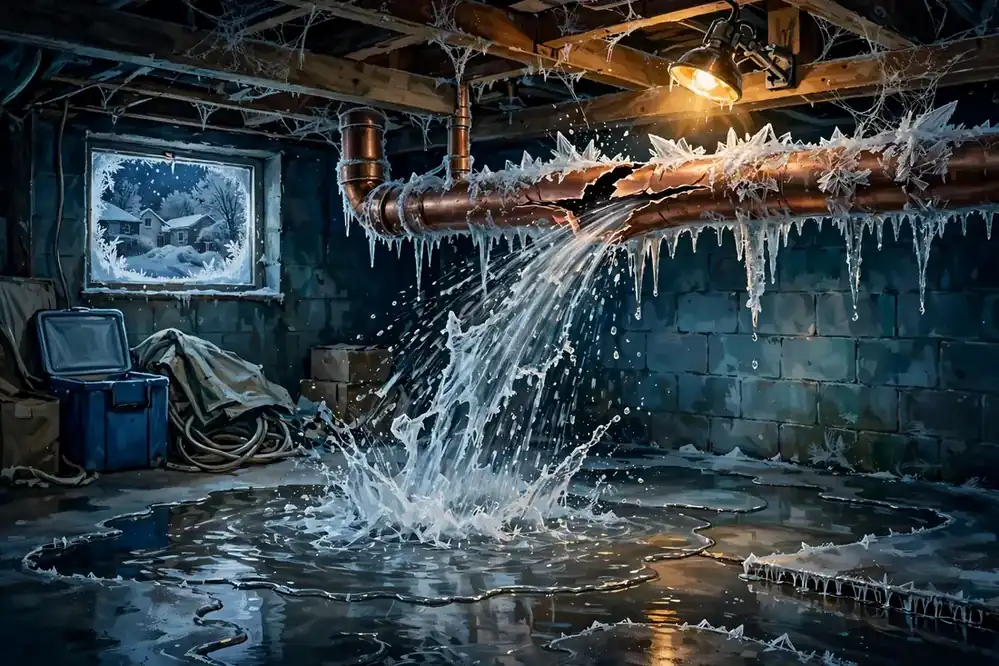
The damage from a frozen pipe arrives on the thaw, not the freeze. A line that froze while a property stood empty splits along its length, and nothing happens until the ice inside it clears and full pressure returns. Vacant uppers, unheated additions and homes standing empty over a winter are where this does real harm, because the leak runs until somebody opens the door. Supply pipes in unheated interior areas freeze first: basements, crawl spaces, attics, garages and kitchen cabinets, and pipes typically do not freeze until the air around them drops below 20 degrees Fahrenheit, according to American Red Cross guidance quoted by Buffalo heating companies.
Foundation water on frozen ground
Frozen ground sheds meltwater rather than absorbing it, so a thaw sends the whole snowpack to the footing at once. Stone and early block walls were built to breathe rather than to seal, and many Buffalo sump systems were sized for ordinary rain, not for a four foot snowpack melting in two days. The result is seepage through mortar joints, water at the wall and floor joint, and window well overflow in basements that stayed dry all winter. Dense glacial clay soil makes it worse by holding the water against the wall instead of letting it drain.
Knowing which mechanism you are looking at changes the first phone call. An ice dam needs the roof edge and the ceiling cavity dried and the heat leak found. A thaw burst needs the main shut off and the whole run of that line checked, because a pipe that split in one place often froze in several. Foundation water needs the sump, the discharge line and the grading checked before anyone blames the wall. A good water damage restoration buffalo crew names the mechanism out loud on the first visit, because the mechanism decides the drying plan.

The most common Buffalo job
Basement Flooding in Buffalo: Combined Sewers, Stone Foundations and Sump Pumps
Basement flooding is the most frequent water problem in Buffalo homes, according to Roto-Rooter Buffalo, and it is rarely one failure. It is three or four ordinary weaknesses arriving on the same wet day.
Start with the sewer. Much of Buffalo drains through combined sewers that carry storm water and household sewage in a single pipe. In heavy rain that pipe can fill beyond capacity, and when it surcharges, pressure pushes the mixed water back toward the lowest openings in the homes connected to it, which are basement floor drains. That water is sewage diluted by storm water, and it is always handled as contaminated Category 3 water, even when it looks clear. A backwater valve on the house lateral is the mechanical answer, and any basement that has backed up once deserves the conversation.
Next, the foundation. Pre war Buffalo homes sit on stone and early block foundations that absorb groundwater when the soil is saturated. Mortar joints soften and weep, the joint where the wall meets the floor opens a path, and window wells fill and spill. None of this is a defect anyone caused last week. It is a foundation doing what it was built to do in a soil that holds water against it, in a city where spring snowmelt overwhelms storm sewers and foundation drains at the same moment.
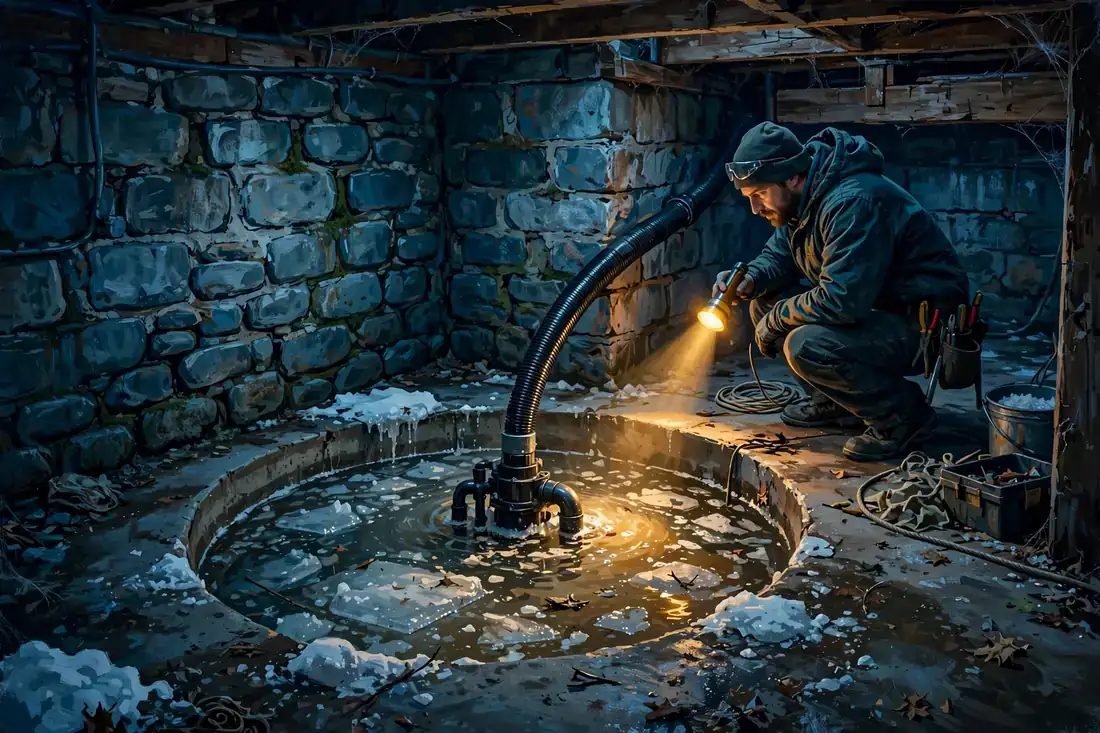
Then the sump pump, the one machine standing between groundwater and your finished basement. Sump failures compound everything else, and they cluster in power outages, exactly when storms are at their worst. Warning signs are plain: a pump running constantly, grinding noises, water pooling around the pit. Test yours by pouring a bucket of water into the pit and watching it cycle. In winter, check that the discharge line outside is not frozen shut, because a pump pushing against a frozen line is a pump that is about to lose. A battery backup pump is cheap insurance in a city with Buffalo storm history.
When a Buffalo basement does flood, the order of work matters. Safety first, because water and electrical panels share basements. Then the source: sewer, sump, foundation or plumbing each get a different response. Extraction, then removal of what the water ruined, then measured drying of walls, floors and the foundation itself, with disinfection matched to the water category. Finished basements with carpet, pad and drywall hold contaminated water the longest and need the fastest start. That is the core of water damage restoration buffalo work, repeated hundreds of times a year across Erie County.
Outdoor water
Cazenovia Creek, Scajaquada Creek and the Buffalo River: When Outdoor Water Comes In
Buffalo is a city of creeks as much as a city of snow, and when creek water crosses your threshold it changes the category of the whole job, no matter how clean it looks.
Cazenovia Creek runs through South Buffalo and West Seneca, Scajaquada Creek drains a long corridor through Cheektowaga and the city, Ellicott Creek crosses the northern suburbs, and the Buffalo River winds past the First Ward and the valley neighbourhoods. Each one floods in its own pattern: fast rises on summer storm runoff, slow rises on spring snowmelt, and a Buffalo special, the ice jam. Ice jams form when a thaw breaks up creek ice and the floes pile against a bridge or a bend until the water behind them has nowhere to go but out of the banks. Buffalo Water, a local Tonawanda based restoration company, puts the rule plainly: ice jams on Cazenovia and Ellicott creeks bring outdoor water, and outdoor water is handled as contaminated regardless of how clean it looks.
That rule protects you twice. Creek water carries soil, road runoff, animal waste and whatever the current picked up along the banks, so porous materials it touches, carpet, pad, upholstered furniture, the lower drywall, are removed rather than dried in place. It also protects your claim, because rising water from outside the home sits under flood insurance rules, not standard homeowners rules, and the documentation for a creek event has to show the source clearly: the high water line outside and in, the direction the water entered, and photographs while it is still standing.
If you live near one of these creeks, the preparation is specific. Know your floor drain and check valve situation before the season. Keep storage on shelving, not on the slab. Photograph your basement in its normal state once a year, because before pictures are the hardest evidence to argue with. And when the creek rises, do not wait for the water to reach the house before you call: a water damage restoration buffalo crew can stage pumps and barriers far more easily on a warning than on a flood.
Outdoor water, in detail
Ellicott Creek Ice Jams and the Buffalo River: Two Waterways, Two Ways to Flood
The creeks section above set the rule: outdoor water is contaminated water, however clean it looks. This section walks the two waterways that test that rule most often, because Ellicott Creek and the Buffalo River flood in opposite ways, at opposite ends of the city, and a water damage restoration buffalo plan that treats them as one risk will misread both.
Ellicott Creek is the long water of the northern suburbs. It winds through Lancaster and Cheektowaga, crosses Amherst and the Town of Tonawanda, and joins Tonawanda Creek near the Niagara River. Long stretches of Amherst sit inside its floodplain, on ground flat enough that a modest rise spreads wide instead of running deep, and the creek has put water into Amherst and Tonawanda basements in every decade anyone can remember. A water damage restoration buffalo crew working the northern towns watches the Ellicott Creek gauges during thaw season the way a city crew watches the combined sewer map, because the creek gives warning, and warning is the cheapest form of flood defence.
The Ellicott Creek flood that arrives without rain is the ice jam. Through a cold winter the creek carries a sheet of ice. A thaw, or a rise in flow under the sheet, breaks the ice into floes, and the floes ride downstream until they catch: on a bridge pier, at a bend, against ice that is still anchored to the banks. Behind the pile, the creek stops flowing and starts rising, sometimes fast enough to watch. Water leaves the banks and takes the lowest path through the neighbourhood, which is usually a street, a yard and then a basement window well. When the jam gives way, it gives way all at once, and the water behind it arrives as a small sudden flood downstream. A jam can therefore flood two places in one afternoon, one at the pile and one below it, which is why ice jam calls on the water damage restoration buffalo board often come in pairs from the same creek on the same day.
Jam flooding has a season and a signature. It belongs to late winter and early spring, when the ice is thick, the snowpack is ripe and a warm rain can lift the creek under its own ice sheet. The water that enters a home from a jam is cold creek water carrying soil, road grit and whatever the banks held, and it arrives while the ground is still frozen, so a flooded basement also faces meltwater arriving at the foundation from the yard at the same time. Crews drying an Ellicott Creek home map both sources separately, because the creek water sets the category and the removal list, while the foundation seepage sets the drying time on the walls. Homeowners along the creek learn to read the ice the way farmers read the sky: a creek that groans, lifts and cracks in a thaw is a creek asking to be watched, and on the water damage restoration buffalo calendar the call made on the warning is worth three made on the flood.
The Buffalo River works the other end of the city and the other way around. It is a short, slow, industrial river that winds past the valley neighbourhoods and the First Ward before it meets the lake at the harbour, and its level is set as much by Lake Erie as by anything that falls from the sky. A seiche or a strong northeast wind can push lake water up the river, raising it against its banks on a storm timeline, while ice at the river mouth or a jam where Cazenovia Creek joins can hold a rise in place for hours. The low streets of the First Ward, the oldest ground in the city, have lived with river water for two centuries, and a water damage restoration buffalo crew working the ward starts from the river gauge and the lake forecast, not from the rain gauge.
River water also carries the river past with it. The Buffalo River spent the twentieth century as an industrial channel, lined with grain elevators, mills and rail yards, and its sediment still holds that history. Floodwater out of the Buffalo River is handled as contaminated on every job, with the same protective equipment, removal rules and disinfection as a sewer backup, and contents that sat in river water are assessed with that history in mind. The river is cleaner than it was, and the grain elevators along it are landmarks now rather than employers, but a restoration crew does not grade floodwater on a curve. The category is set by the source, and the source here is a working urban river, which is why Buffalo River jobs sit at the careful end of the water damage restoration buffalo caseload.
| Side by side | Ellicott Creek | Buffalo River |
|---|---|---|
| Main driver | Ice jams, thaw flow and storm runoff on flat ground | Lake level, seiche push, wind and ice at the river mouth |
| Season | Late winter and spring thaw, plus summer storm rises | Autumn and winter lake storms, plus spring ice |
| Warning signs | Creek ice lifting and cracking, rising creek gauges | Northeast wind forecasts, lake level bulletins, river gauges |
| Ground most at risk | Amherst, Tonawanda and Cheektowaga creek flats | The First Ward, the valley neighbourhoods and riverfront streets |
A third waterway deserves its sentence here, because it behaves like neither. Scajaquada Creek drains Cheektowaga and the east side of the city on its way to the Niagara River, and much of its city reach is channelled, culverted or carried beneath the expressway corridor that took its name. A buried creek gives no warning you can watch: there is no ice sheet to read and no bank to walk, only a rise that announces itself in the street and at the floor drain. Cheektowaga homes along the creek corridor take fast water in summer storms, when the channel fills quicker than its culverts can carry it, and the basements nearest the old creek line learn the route the water remembers even where the map no longer draws it. If your street sits on the Scajaquada line, treat storm forecasts the way creek neighbours treat the March ice: as a personal appointment, with the pit checked, the drain clear and storage already off the floor.
Preparation differs by waterway, and getting it right starts with knowing which water is yours.
Ellicott Creek homes prepare for the thaw: shelving instead of floor storage, a sump system with backup power, flood insurance bought well outside the 30 day waiting window, and a habit of watching the creek ice in March. Buffalo River and First Ward homes prepare for the lake: grading that sheds water from the foundation, window well covers that fit, a backwater valve against a surcharging sewer when the river is high, and the same insurance conversation held in the autumn, before the lake turns. Both lists end in the same place, with the number of a water damage restoration buffalo crew saved in the phone before the season, because neither waterway negotiates once it starts to rise.When either waterway does come in, the response follows the source. Photograph the high water line outside and inside while it is still visible, name the waterway in the claim file, and expect Category 3 handling from the first hour. Drying along these corridors also runs longer than a plumbing job, because stone and block foundations that drank creek or river water give it back slowly, and the readings, not the calendar, decide when the walls are honestly dry. That patience is not a delay. On the creeks and the river, patience is the water damage restoration buffalo standard, and it is what keeps a flood from becoming a mold project in the spring.
The lake and the river
Lake Erie, the Niagara River and the Seiche: Shoreline Water in Buffalo
Buffalo sits at the eastern tip of Lake Erie where the Niagara River begins, and the lake itself is a water damage source that most inland cities never have to think about.
Strong northeast winds push lake water toward the Buffalo shoreline, flooding low lakefront ground, the Outer Harbor and properties along the Niagara River. Layered on top of the wind is the seiche: a standing wave that strong winds push across the whole lake, raising the water level at the Buffalo end quickly while it drops at the Toledo end, then sloshing back. A seiche can arrive on a storm timeline measured in hours, and the water it pushes ashore is lake water full of sediment and debris, handled as contaminated outdoor water on every job.
Shoreline and riverfront homes, and the low ground of the First Ward near the Buffalo River, carry this risk on top of the ordinary basement risks. The defences are ordinary but they have to be done in advance: grading that sheds water away from the foundation, window well covers that actually fit, a sump system with backup power, and flood insurance bought outside the 30 day waiting window that federal policies usually carry. When lake water does come in, the response follows the creek rule: document the source, treat the water as contaminated, extract fast, and dry the structure to readings.
Shoreline owners should also know the rhythm of the risk. The worst seiche and wind driven flooding tends to arrive with strong autumn and early winter storms, when the lake is still open and the winds are at their strongest, which is the same season the first lake effect snow begins loading roofs along the shore. A home near the water can therefore face shoreline flooding in November and an ice dam in January from the same lake, two different losses with two different responses, and the preparation for both belongs on the same autumn weekend list: shoreline grading and window wells checked, sump tested, hoses drained, and the emergency number where everyone in the house can find it.
The lake also reaches inland homes in a quieter way. Lake Erie water is hard, around 135 parts per million, according to Roto-Rooter Buffalo drain guidance, and calcium and magnesium deposit scale inside drain pipes and on supply hoses and fittings over years. A scaled, stiffened washing machine hose or a corroded fitting is a burst pipe waiting for a cold night. Replacing appliance hoses on a schedule, and knowing it, is one of the cheapest water damage prevention habits a Buffalo homeowner can build.
Where the risk lives
Neighbourhood by Neighbourhood: Where Buffalo Floods and Freezes
Buffalo water risk is written street by street: the high water table on the West Side, the river ground of the First Ward, the century old plumbing of North Buffalo, the shared walls of Elmwood and Allentown, and the snow bands over the Southtowns.
The pattern behind the tabs is the pattern behind this whole page. Water damage restoration buffalo work is local work: the crew that dries a Riverside basement needs to know about the water table before they open the truck, and the crew that dries a Parkside ceiling needs to know the tree canopy and the cast iron stack are part of the same story. Town level knowledge is not a marketing line here. It is the difference between drying the room and drying the building.
Service area
Buffalo ZIP Codes and Towns We Serve
One table for the city ZIP codes and the towns around them, with the water risk that defines each ground, so you can find your street and your likely problem in one pass.
| Area | ZIP codes | Defining water risk |
|---|---|---|
| Downtown, Elmwood Village and Allentown | 14201, 14202, 14203, 14222 | Shared walls, doubles and brownstones: one unit leak cascades into the next; original plumbing in historic stock |
| West Side, Riverside and Black Rock | 14207, 14213 | High water table near the Niagara River and Lake Erie: the highest basement flooding rates in the metro area |
| South Buffalo, the First Ward and Kaisertown | 14204, 14206, 14210, 14220 | Low ground near the Buffalo River and Cazenovia Creek: riverine flooding, sewer backup, century old plumbing |
| North Buffalo, Parkside and the Delaware District | 14214, 14216 | 1910s to 1940s homes: cast iron stacks, galvanized lines, tree canopy shade feeding ice dams |
| East Side and Broadway Fillmore | 14208, 14211, 14212, 14215 | Older doubles and vacant stock: freeze damage found on the thaw, sewer backup in heavy rain |
| University and Kenmore border | 14209, 14217, 14223 | Student rentals and older village homes: leaks found late, shared plumbing between units |
| Cheektowaga, Depew and Lancaster | 14225, 14227, 14043, 14086 | Scajaquada and Ellicott creek corridors: creek flooding, ice jams, sump overload in spring thaw |
| Amherst, Williamsville and Clarence | 14221, 14226, 14228, 14031, 14051 | Ellicott Creek ground and finished basements: sump failure losses, snowmelt on frozen ground |
| Tonawanda, North Tonawanda and Grand Island | 14150, 14120, 14072 | Niagara River shoreline and Tonawanda Creek: wind driven water, creek rises, older riverside stock |
| West Seneca, Lackawanna and Hamburg | 14218, 14224, 14075 | Cazenovia Creek and the lake effect snow belt: ice jams, deep snow load, ice dams, spring meltwater |
| Orchard Park and East Aurora | 14127, 14052 | The heart of the snow belt: 80 inches in the November 2022 storm, roof load, ice dams and thaw flooding |
ZIP codes compiled from Buffalo service area listings published by local restoration directories; neighbourhood risk summaries from Roto-Rooter Buffalo and Buffalo Water Damage Restoration service pages read for this guide. Calls are taken across Buffalo and Erie County, and into Niagara County for North Tonawanda and Niagara Falls, on (716) 555-0147 (placeholder).
Neighbourhood detail
Buffalo Neighbourhoods in Detail: Streets, Stock and the Water That Finds Them
The tabbed map above gives each Buffalo neighbourhood its headline risk. This section walks the same ground street by street, because water damage restoration buffalo work is won or lost on details a headline cannot hold: the age of a stack, the height of a water table, the wall a house shares with its neighbour.
Read your own neighbourhood first, then read the one next to it. Buffalo water does not respect the boundaries on a map, and a double on the West Side shares more with the First Ward than either shares with a Clarence colonial.
Riverside, Black Rock and the West Side: Life on a High Water Table
Riverside and Black Rock sit along the Niagara River at the northwest corner of the city, and their basements sit close to the river level. The water table here is high enough that a wet spring can raise groundwater into a stone foundation without any storm at all, and sump pumps in these streets run in weeks when no rain has fallen. The housing is pre war and dense: doubles, singles and small apartment buildings on stone and early block foundations, many with original clay tile drains that have been moving groundwater, or failing to, for a century. A water damage restoration buffalo crew in Riverside starts every basement job with the pit and the water table, because here the question is rarely whether groundwater is present. It is whether the system built to move it is still winning.
The West Side continues the same pattern a few streets inland, with one addition: the combined sewer. In heavy rain, West Side basements can take groundwater through the foundation and sewer water through the floor drain in the same event, and the two waters set two different jobs inside one room. The sewer water fixes the category at 3 and the removal list with it, while the groundwater sets the drying load on the walls. Crews who work these streets carry the backwater valve conversation with them, because a West Side basement that has backed up once is a basement the sewer has found, and the valve is the one fitting that answers both halves of the problem. It is the most mechanical neighbourhood in the water damage restoration buffalo caseload, and the most predictable: protect the drain, size the pump, and the river streets stay dry.
South Buffalo and the First Ward: Where River Water Meets Sewer Water
South Buffalo and the First Ward hold the city low ground, wrapped around the Buffalo River and the lower reach of Cazenovia Creek. Streets here were built for the industries along the river, and the houses that line them, workers cottages, doubles and brick singles, stand on ground that the river has visited before and remembers how to reach. When the river rises on a lake push or an ice jam, and a hard rain surcharges the sewers in the same hours, a First Ward basement can receive river water at the window well and sewer water at the floor drain together. A water damage restoration buffalo crew working Seneca Street or the streets off Ohio Street documents both sources separately, because the insurer will ask, and because the cleanup for each is written in a different column of the same file.
The quieter South Buffalo risk runs all year and wears a wrench. Much of the stock here carries plumbing a century old: galvanized supply lines narrowed by scale until the flow is a fraction of what the pipe was built for, and cast iron drains at the age where joints weep and sections crack. A failure in these streets is rarely dramatic. It is a slow weep inside a wall, a drain that gives way under a floor, a water bill that climbs for two quarters before anyone finds the cause. South Buffalo teaches the trade its most repeated lesson: in old stock, the meter and the moisture survey earn their fee long before the extractor does, and the water damage restoration buffalo jobs that end small here are the ones that started as a suspicion and a phone call.
North Buffalo, Parkside and the Delaware District: The Plumbing Is the Landmark
North Buffalo, Parkside and the Delaware District hold the grandest housing in the city: colonials, Tudors and foursquares built between the 1910s and the 1940s, on tree lined streets near Delaware Park and along the Hertel Avenue corridor. These houses were built well and plumbed for keeps, which is precisely the problem. Their cast iron drain stacks and galvanized supply lines are now 80 to 110 years old, at or past the end of the service life those materials were given, and a stack that fails in a three storey colonial wets every floor it passes on the way down. A water damage restoration buffalo crew in Parkside reads the plumbing the way a surveyor reads a boundary: the age of the stack is the first fact of the job, and the floors below it are the rest.
The canopy that makes these streets beautiful finishes the risk. Mature trees shade the roofs, slowing the melt that feeds ice dams unevenly across a roof plane, and autumn leaves fill gutters that then spill meltwater at the foundation line all winter. Clay tile sewer laterals under these streets meet tree roots at every joint, and a root bound lateral is a backup waiting for the first heavy rain of spring. The prevention list here writes itself: camera the lateral, clean the gutters before the snow, watch the stack for the rust bloom that announces its last years, and plan the repipe before the pipe plans it for you. North Buffalo water damage restoration buffalo work is preservation work as much as drying work, because the plaster, the hardwoods and the trim in these houses cannot be replaced from a catalogue.
Elmwood Village and Allentown: Shared Walls and Cascading Water
Elmwood Village and Allentown are the densest residential ground in Buffalo: Victorians, brownstones and doubles standing wall to wall, many of them divided into flats over the decades, with plumbing that crosses between units in ways no current drawing records. Water here does not stay home. A supply line that lets go in an upper flat follows the shared wall cavity down, crosses into the neighbouring unit at the ceiling line, and can wet three homes from one failure before anyone finds the shutoff. The cascade is the defining pattern of the neighbourhood, and a water damage restoration buffalo crew that dries only the unit that called has finished a third of the job.
Working the cascade takes a building habit, not a unit habit. The moisture map crosses the party wall as a matter of routine, neighbours are told early and shown the readings on their own side of the wall, and the documentation is built so that an owner claim, a tenant claim and a neighbour claim can each be drawn from the same file without argument. Landlords in these streets learn the pattern once and then keep the emergency number in the lease packet. In Elmwood and Allentown, water damage restoration buffalo work is community work in the most literal sense: the wall is shared, so the drying has to be.
The East Side and Broadway Fillmore: Vacant Stock and Late Discoveries
The East Side holds the oldest problem in Buffalo water work: the house nobody is watching. Broadway Fillmore and the streets around it carry a heavy share of the city vacant and intermittently occupied stock, doubles and singles whose owners live elsewhere or whose upper flats stand empty between tenants. Water in an empty house runs until it is found, and it is found late: by a neighbour who hears it, a meter reader who flags the usage, or a buyer walking a showing into a flooded basement. Freeze damage rules here, because an unheated vacant house in January is a pipe failure with a date on it, and the thaw delivers the news all at once. The pattern is so regular that a water damage restoration buffalo crew can often date an East Side loss from the weather alone, matching the wettest wall to the coldest week of the month before.
For owners of East Side stock, the prevention is procedural rather than mechanical. Winterise any house that will stand empty, with the water off at the street side valve and the lines drained, or keep heat verified on a schedule with a sensor that reports temperature, not just water. Walk the property after every thaw week and every major storm, and photograph the basement on each visit so a change is visible against the last picture. The water damage restoration buffalo jobs on the East Side are rarely the largest on the board. They are the saddest, because nearly all of them were small for the first week they ran.
Five neighbourhoods, five different first questions: the water table in Riverside, the river in the First Ward, the stack in Parkside, the shared wall in Elmwood, the empty house on the East Side. That is the whole argument of this page in miniature. The citywide facts, the categories, the clocks, the drying science, are the same everywhere in Buffalo. The job is decided by the local fact, and a water damage restoration buffalo crew earns its fee by knowing which local fact owns your street before the truck door opens.
Do this first
The First 60 Minutes After Water Arrives in a Buffalo Home
The first hour decides how big a water damage restoration buffalo job becomes. Water keeps moving through floors, wall bases and shared walls long after the visible spill stops, and these six moves are ordered so the loss stops growing while you stay safe.
Make the area safe
Keep clear of water that has reached outlets, panels, furnaces or appliances, and turn off power to the affected area if you can do so without standing in water.
Stop the source
Close the main shutoff valve for plumbing leaks, or the fixture valve if only one fixture is involved. For roof water, place a bucket and keep off the wet roof.
Protect what can still be saved
Move documents, electronics, rugs and furniture out of the water or up onto blocks, and lift curtains and upholstery skirts clear of wet floors.
Document before you clean
Photograph and video every affected room, the source of the water and the high water line, and start a written log with the time you found the water.
Start removing water
Mop, bail or wet vacuum standing water if it is safe to do so, and open cabinet doors under sinks so trapped water and cold air can move.
Call for professional drying
Call (716) 555-0147 (placeholder) any hour. Moisture mapping and measured drying should begin the same day, because mold can begin within 24 to 48 hours.
The science of the job
How Drying Works: Moisture Mapping, Air Movers and Verified Dry
Drying is not a fan in a wet room. It is a measured process with a map at the start, equipment sized by math in the middle, and readings at the end that prove the building is dry.
Every professional water damage restoration buffalo job opens with moisture mapping. The technician tests the visibly wet materials, then the materials next to them, then the ones nobody suspects: the wall cavity behind the baseboard, the subfloor under the vinyl, the ceiling below the bathroom. Pin meters read inside wood and drywall, pinless meters scan whole walls, and thermal imaging shows the cold signature of hidden water. The map becomes the drying plan and the first page of the insurance file.
Extraction comes before drying, because every gallon pumped or vacuumed out is a gallon the dehumidifiers never have to pull from the air. Then the equipment is set by class and category of loss, following the Institute of Inspection, Cleaning and Restoration Certification (IICRC) S500 standard: air movers drive evaporation off surfaces, dehumidifiers pull that moisture out of the air, and containment keeps the wet zone from humidifying the rest of the house. In Buffalo plaster homes, drying chambers, sealed smaller spaces with directed heat and airflow, often do in three days what an open room does in six.
The job ends on numbers, not on touch. Most Buffalo homes dry in 3 to 5 days once extraction is complete. Each day the crew re reads the map points and logs them. A material is dry when its reading reaches the dry standard for that material in that building, and the final log, with the final readings, is what closes the job and satisfies the adjuster. If a company cannot show you readings, they are not drying your house. They are renting you fans.

Know your water
Water Categories in Buffalo: Clean, Gray and Black Water
The category of the water decides the protective equipment, the cleaning chemistry and what gets saved or removed, which is why the first question on every call is where the water came from.
| Category | Buffalo sources | How it is handled |
|---|---|---|
| Category 1, clean water | Supply line leaks, burst pipes, water heater failures, melting snow and ice from a roof | Extraction and measured drying; most materials can be dried in place if the response is fast; category rises if clean water sits and picks up contamination |
| Category 2, gray water | Washing machine and dishwasher discharge, sump pit water, aquarium failures, toilet water without waste | Extraction, cleaning and disinfection; carpet pad usually removed; materials tested before they are kept |
| Category 3, black water | Sewage and combined sewer backup, creek and river flooding, lake water from a seiche, any outdoor water that entered the home | Protective equipment and containment; porous materials the water touched are removed; structure disinfected before drying and rebuild |
Two Buffalo rules of thumb follow from the table. First, outdoor water is always Category 3 in practice, whether it came over a creek bank, up a floor drain or off the lake. Second, time degrades every category: clean water left standing in a warm room for two days is no longer treated as clean. Both rules push the same direction, toward the fastest possible start to any water damage restoration buffalo job.
The clock after the water
Mold After Water Damage in Buffalo: The 24 to 48 Hour Clock
Mold is not a separate disaster that strikes unlucky homes. It is the scheduled second half of any water loss that was not dried in time.
The Environmental Protection Agency (EPA) puts the window plainly: mold can begin growing within 24 to 48 hours on materials that stay wet. Buffalo gives mold everything it needs indoors even in January, because a heated home is a warm, humid box sitting in a frozen city, and a wet wall cavity inside it never sees the cold that slows growth outside. The musty smell a week after a leak is not a mystery. It is a progress report on drying that never finished.
New York law shapes how mold work is done. Article 32 of the New York Labor Law has required since 1 January 2016 that mold assessment and mold remediation on projects over 10 square feet be performed by separately licensed companies, and the law applies statewide, including Buffalo and Erie County. The split exists so the company that profits from removing mold is never the company that decides how much mold there is. Any water damage restoration buffalo company working a mold job over that size should be able to explain the split and name the licensed assessor on the project.
Prevention is cheaper than remediation at every step: extract the same day, dry to readings, and remove material that cannot be dried rather than sealing moisture behind new paint. Where mold is already established, the work follows the Institute of Inspection, Cleaning and Restoration Certification (IICRC) S520 standard: containment, negative air, HEPA filtration, removal of colonized porous material, and cleaning of what remains. If a quote for mold work does not mention containment, it is not a mold quote. It is a cleaning quote with a mold title.
What we do
Water Damage Restoration Buffalo Services, Job by Job
Fifteen services, one standard: map it, extract it, dry it to readings, document it for the claim, and rebuild what the water ruined.
Emergency water extraction
Truck mounted and portable extraction that removes standing water fast, the single step that shrinks every job that follows it.
Structural drying and dehumidification
Air movers and dehumidifiers set by S500 math, monitored daily, and removed only when the readings reach the dry standard.
Flooded basement cleanup
Buffalo most common job: sewer, sump, foundation and creek water handled by category, with disinfection and verified drying.
Frozen and burst pipe cleanup
Thaw burst response: source control, full line checks, cavity drying and the documentation a freeze claim needs.
Sewage and black water cleanup
Category 3 work with containment and protective equipment, removal of touched porous material, and disinfection before rebuild.
Storm and flood damage cleanup
Lake effect, creek, river and seiche events: staged response, extraction at scale and drying across whole floors.
Ice dam leak drying
Ceiling and wall top drying for ice dam losses, with the heat leak and ventilation problems named so the dam does not return next winter.
Mold remediation
S520 containment and removal, coordinated with a separately licensed assessor as New York Labor Law Article 32 requires.
Fire and water cleanup
Fire jobs end wet: suppression water extraction and drying alongside soot and odor work, so the second disaster never starts.
Commercial water damage
Shops, offices, restaurants and multi unit buildings across Erie County, with after hours drying plans that keep doors open where possible.
Contents cleaning and pack out
Furniture, documents and belongings cleaned, dried, inventoried and stored while the structure is dried and rebuilt.
Reconstruction and repairs
Drywall, plaster, floors, trim and paint put back after verified dry, so one company answers for the whole job.
Moisture mapping and inspection
Meter and thermal imaging surveys that find hidden water after a leak, before a purchase, or when a musty smell has no visible source.
Dehumidification
Standalone humidity control for basements and crawl spaces that stay damp after the main drying is complete.
Emergency board up and tarping
Roof and opening security after storm and fire damage, keeping weather and trespassers out while the real work is scheduled.
Not sure which of these your home needs?
Describe where the water came from and which rooms are wet. The category and the map decide the service list, and the first visit settles both.
Your rights, in writing
Your Insurance Claim in New York: The Clocks That Protect You
New York insurance law runs on business day clocks, and a Buffalo homeowner who knows them can hold a slow claim to the timetable the state already wrote.
Most homeowners policies cover sudden and accidental water damage, a burst pipe, a failed water heater, a supply line that lets go, and exclude rising water from outside the home unless you carry flood insurance. Sewer backup usually sits in an added endorsement with its own limit. Coverage turns on the source of the water, which is why the documentation on a water damage restoration buffalo job always leads with the source, photographed and logged on day one.
| Clock | What the insurer must do | Source |
|---|---|---|
| 15 business days | Acknowledge your claim after you report it | Regulation 64, 11 NYCRR Part 216 |
| 15 business days | Begin investigating the claim | Regulation 64, 11 NYCRR Part 216 |
| 15 business days | Reply to communications about the claim | Regulation 64, 11 NYCRR Part 216 |
| 15 business days | Accept or reject in writing after your proof of loss and requested items are in, with a status letter every 90 days while undecided | Regulation 64, 11 NYCRR Part 216 |
| 5 business days | Pay once a settlement is agreed | Regulation 64, 11 NYCRR Part 216 |
| 4 business days | Pay an agreed settlement after a declared natural disaster | Insurance Law section 2618 |
| 15 business days | Accept or reject a non commercial disaster claim after proof of loss, with limited extensions the law spells out | Insurance Law section 2618 |
| 24 months | Your window to sue on the standard policy, counted from the date of loss | Insurance Law section 3404 |
| 10 business days | Respond to the Department of Financial Services when it asks about your complaint | Regulation 64, 11 NYCRR Part 216 |
Three honest notes belong next to that table. First, Regulation 64 is enforced by the Department of Financial Services; it gives you a complaint with teeth, not a private lawsuit of its own. Second, the often quoted disclaimer rule in Insurance Law section 3420(d) concerns liability policies and bodily injury, and New York courts have held it does not govern property damage claims, so it does not belong in a water claim argument. Third, flood claims under the National Flood Insurance Program (NFIP) run on federal clocks instead: a proof of loss within 60 days, an appeal within 60 days of a denial, and a lawsuit within one year of the first written denial, and federal policies usually start with a 30 day waiting period. A licensed public adjuster, if you hire one, is capped at 12.5 percent of the recovery under 11 NYCRR section 25.7. Knowing which clock is running is most of winning a slow claim, and it costs nothing but attention.
Doubles, uppers and lowers
Renters, Landlords and Doubles: Who Pays When Water Moves Between Units
Buffalo is a city of doubles, and water in a double has two addresses. The rules below decide who calls, who pays and who documents when a leak crosses a shared wall or a ceiling.
The building belongs to the landlord, and with it the plumbing, the roof, the foundation and the structural drying. The belongings belong to the tenant, and unless the lease says otherwise, the tenant loss is a tenant problem, which is exactly the gap renters insurance exists to fill. A leak caused by one side, an overflowing tub in the upper, a washing machine hose in the lower, can shift the cost argument, which is why both sides should document from the first hour and let the insurers argue with photographs instead of memories.
Shared walls and shared plumbing mean a one sided response fails. Water that enters a party wall wets both sides of it. A ceiling stain in the lower unit is a plumbing event in the upper until proven otherwise. The right pattern is one call, one moisture map of the whole path of the water, and a drying plan that treats the building as one structure, with the paperwork split cleanly between owner and tenant claims at the end. Landlords across Buffalo, from the West Side to Kensington, learn this the expensive way once: the cheap version is the phone call on day one.
Tenants have three jobs: report water immediately and in writing, photograph their own belongings where they sit, and keep receipts for anything the loss forces them to buy or any night it forces them out. Owners have three matching jobs: respond the same day, dry the structure to readings, and keep the tenant informed in writing. Water damage restoration buffalo crews who work doubles carry both documentation sets as a matter of routine, because a claim with two households in it needs cleaner paper, not louder voices.
While you wait
What to Do Before the Crew Arrives
The hour between your call and the truck is not dead time. Used well, it saves belongings, shortens the drying and strengthens the claim. Work through this list in order, skip anything that feels unsafe, and leave the rest to the crew: eight small jobs, none of them heroic, all of them worth real money by the time the adjuster reads the file.
- Keep the shutoff closed and the faucets on the burst line open, so the line drains instead of dripping into the wall.
- Photograph every affected room wide and close, the source of the water, the high water line, and each damaged item where it sits, then shoot one short video walk through.
- Start a written log: when you found the water, what you shut off, what you moved, and the name of everyone you speak to about the loss.
- Move documents, photographs, electronics and medicines out of wet rooms first; furniture can go up on blocks, cans or foil wrapped wood if floors are wet.
- Lift draperies and upholstery skirts clear of wet floors, and take wet rugs and cushions outside or to a dry room so they stop wicking water into the floor.
- Do not tear out drywall, carpet or flooring before the insurer has seen it or released it, unless it is a safety issue; removed evidence is the hardest claim problem to fix.
- Keep children and pets out of any room with sewer water, and wash hands after any contact with floodwater of any kind.
- If the heat is out and pipes may freeze, open cabinet doors, let faucets drip slowly, and check the basement every few hours until heat returns.
Learn from finished jobs
YouTube Case Studies: What Real Restorations Look Like
Two restoration walkthroughs worth your time before you let anyone open a wall, plus the lessons written case studies from real jobs keep teaching, in Buffalo language.
Start with Home RenoVision DIY, Water Damage? Do This BEFORE Mold Takes Over, a walkthrough of testing how wet a wall really is and making a clean flood cut to dry the cavity. Pair it with Certified Restoration, Test Before You Tear, on testing for asbestos and lead before cutting into pre 1980 materials, a step that matters in a city where so much of the housing stock was built before 1940. Both are linked, not embedded, so this page stays fast.
The written case studies behind recent restoration videos teach the same four lessons. In Spanish Fork, Utah, Prime Restoration traced an entryway ceiling stain to an upstairs bathtub overflow valve, the proof that water rarely shows up where the problem lives, a pattern every Buffalo double owner will recognise. Their meters read 39 percent moisture in framing and 99 percent in subfloor that looked merely damp, and the job dried for 11 days inside a sealed drying chamber until the numbers, not the calendar, said stop. In Cumming, Georgia, Homestar Group followed a roof leak that ruined a master bathroom ceiling, the ice dam pattern in southern dress: the stain is the last chapter, not the first. In Morristown, RestoPros documented a flooded basement revival, and in Hyrum, Utah, Swift Restoration and Hannah Restoration in Nolensville, Tennessee show the rebuild half, including luxury vinyl plank chosen for the new floor precisely because it tolerates moisture better than what the water took.
Read those jobs the way an adjuster would: source found and proven, readings taken and logged, category called honestly once the walls opened, drying ended on numbers, and the rebuild finished better than the room started. Any water damage restoration buffalo quote should be able to promise the same five beats for your home, in writing, before work begins.
Short answers
Buffalo Quick Answers: Six Questions Asked With Wet Socks On
Six questions Buffalo homeowners type into a phone with wet socks on, answered in one breath each. The full 30 question set, with longer answers, is in the FAQ section below.
A pipe just burst. What first?
Main shutoff off, faucets on that line open, power away from wet areas, photographs before moving anything, then call (716) 555-0147 (placeholder). In a Buffalo winter a burst pipe is usually a frozen line that split on the thaw, so check the pipes beside it too. The drying and mold clocks start when the water stops.
How long will drying take?
Most Buffalo homes dry in 3 to 5 days after extraction. Plaster walls, hardwood floors and stone foundations hold water longer and can push a job past a week, while drywall and carpet dry fastest. Daily moisture readings, not guesses, set the end date, and equipment leaves only when the numbers say the structure is dry.
Is sewer backup water dangerous?
Yes. Water from a Buffalo combined sewer backup is Category 3, contaminated by definition, full of bacteria and street runoff. Keep people and pets out, touch nothing barehanded, and do not run a fan over it. Porous material it soaked cannot be saved, and a crew in protective equipment should handle the extraction and disinfection.
My ceiling stained in February. Why?
Most likely an ice dam: snow melts on the warm upper roof, refreezes at the cold eave, and trapped meltwater behind that ice ridge works under the shingles into the ceiling. The roof may have no hole at all. The wet ceiling cavity still needs measured drying, because February water left alone becomes spring mold.
Will insurance cover this?
Usually, for sudden and accidental water. A burst pipe or a failed supply line is the covered loss homeowners know; rising outdoor water needs flood insurance, and sewer backup needs its endorsement. The source decides the claim, so document the source before anything dries and report it promptly, because New York clocks start at once.
How fast does mold start?
Within 24 to 48 hours on material that stays wet, according to the EPA. Buffalo basements help it along, cool and damp, with paper, wood and drywall to feed on. That is why same day extraction matters more than any other decision this week, and why a wall opened today is drying work, not remediation.
One page of numbers
Buffalo Key Facts: The Numbers Every Homeowner Asks For
Every water damage restoration buffalo job runs on the same short list of numbers: how fast the work starts, how long drying takes, when mold begins, and the New York claim clocks that start the day the water does. Here they are in one place.
| Fact | The number | Where it comes from |
|---|---|---|
| Homeowners searching for this service | 110 searches a month, keyword difficulty 19 percent | SEMrush, United States database |
| Emergency response | Same day extraction and drying | The mold clock below is the reason |
| Typical drying time | 3 to 5 days | Daily moisture readings set the real end date |
| Mold can begin | 24 to 48 hours on material that stays wet | US Environmental Protection Agency (EPA) |
| Insurer must acknowledge and start your claim | 15 business days | Regulation 64, 11 NYCRR Part 216 |
| Insurer must pay an agreed disaster settlement | 4 business days | Insurance Law section 2618 |
| Your window to sue your insurer | 24 months from the date of loss | Insurance Law section 3404, standard policy |
| Snow at Buffalo airport, December 2022 blizzard | 49.2 inches | National Weather Service (NWS) |
The claim clocks are explained in full in the insurance section above, and the blizzard figure is told in full in the December 2022 section above.
After the first hour
The Rest of the First Day: Hours 2 to 24 on a Buffalo Job
Once the source is stopped and the crew is rolling, the first day of a water damage restoration buffalo job settles into a rhythm: extract, open what must be opened, set the drying, and build the file your insurer will live on.
Extraction is the loudest hour. Truck mounted extractors and weighted extraction tools pull water out of carpet and pad, hard surface extractors clear tile and concrete, and the crew works room by room in the order the moisture map set. Belongings move as the water leaves: furniture onto blocks, contents out of wet rooms, and anything the water category condemns gets photographed, listed and set aside rather than quietly thrown away. On a water damage restoration buffalo job with a finished basement, this is also when the honest conversation happens about what the category of water means for the carpet, the pad and the lower drywall, because Category 3 water changes the save list completely.
Then comes controlled opening. Baseboards come off so wall bases can dry. Vent holes go in where a cavity needs air. A flood cut is made where insulation is soaked or the water was contaminated. Wet insulation that cannot dry comes out in bags, each one photographed. None of this is demolition for its own sake: every opening on a water damage restoration buffalo job is there because a meter reading said the closed version would not dry, and the readings are recorded so the adjuster can see the reasoning rather than take it on faith.
By evening the drying plan is physical: air movers placed by the map, dehumidifiers sized to the space, containment up where it earns its keep, and the first full set of readings logged as the baseline. The homeowner gets three things before the crew leaves: the drying goal in plain words, the time of the next day monitoring visit, and a copy of the documentation started that day. Sleep matters in this story too. Equipment is set to run overnight, and the house should be safe to sleep in or the crew should say so plainly and help with the alternative.
Hours 12 to 24 are quieter and just as important. The first monitoring visit checks that readings are falling at the expected rate and adjusts equipment that is not performing. A wall that is not drying gets a new plan on day one, not a shrug on day four. This daily loop, read, adjust, log, is the difference between a water damage restoration buffalo job that ends in 3 to 5 days and one that drifts into a mold conversation. If your crew is not visiting daily and showing you numbers, ask why, in those words.
A normal job, day by day
A Drying Diary: What a Normal Buffalo Job Feels Like
No two losses are identical, but a straightforward water damage restoration buffalo job, a burst supply line in a North Buffalo home, follows a shape worth knowing before you are inside one.
Day one is noise and motion. The call comes in the morning, the map is drawn by midday, extraction runs through the afternoon, and by dinner the house hums with air movers. The kitchen ceiling below the bathroom is opened at the wettest point, the bathroom floor readings are logged, and the homeowner signs the work authorisation with the documentation file already started. It feels dramatic because it is: the first day of any water damage restoration buffalo job is the day the loss stops growing.
Day two is the first proof. Readings at the map points have fallen, one wall is drying slower than the rest and gets a drying chamber built around it, and the dehumidifier output confirms the air is giving up its moisture. The adjuster receives the first package: photographs, the moisture map, the category call and the line item estimate. Nothing about day two is glamorous, and that is the point. A water damage restoration buffalo job is won on day two discipline.
Day three is the turn. Most materials are at or near the dry standard, equipment starts coming out of the dry rooms, and the conversation shifts to the rebuild list: the ceiling patch, the section of floor that cupped beyond saving, the paint. If mold was found when the ceiling opened, the Article 32 assessment has already been scheduled, because on a compliant water damage restoration buffalo job the assessor and the remediator are never the same company.
Days four and five are verification and handover. Final readings are taken at every map point and logged against the dry standard, the last equipment leaves, and the homeowner gets the complete file: maps, daily logs, photographs and the final readings. The rebuild crew walks the job with that file in hand. When people describe a water damage restoration buffalo job as painless, this diary is what they mean: loud first day, proof on the second, a turn on the third, and paper that closes the claim without an argument.
Room by room
Water Damage in Each Room of a Buffalo Home: What to Watch, What to Save
Water behaves differently in every room, and a water damage restoration buffalo crew reads a house the way a doctor reads symptoms: the room tells you where to look next.
The basement
Buffalo ground zero. Sewer, sump, foundation and plumbing losses all land here, and the floor drain is both a drain and a door. Watch the wall and floor joint, the bottom of the stairs wall, and any finished room with carpet over pad. Save the structure first; finishes are argued about after the readings.
The kitchen
Supply lines to the sink, the dishwasher and the refrigerator ice maker are the usual sources, and cabinets hide the first week of a slow leak. Watch the toe kicks, the floor at the sink run and the cabinet floors. In a water damage restoration buffalo kitchen, the cabinet boxes themselves often decide the size of the job.
The bathroom
Tub overflows, wax ring failures and supply line bursts start here and announce themselves one floor down. Watch the ceiling below before you trust the floor you are standing on. The Spanish Fork case study pattern, an upstairs tub valve wetting two floors, is the standard Buffalo double story too.
The laundry
Washing machine hoses are the highest pressure, highest regret item in the house, and Lake Erie hard water scale stiffens them faster. Braided steel hoses, a pan under the machine and a shutoff you can reach turn the worst laundry loss into a mop job. Every water damage restoration buffalo prevention list starts here.
Bedrooms and living rooms
These rooms usually receive water rather than make it: from the roof above, the bathroom beside, or the unit next door. Watch outside wall corners for ice dam leaks, ceilings for the first stain, and hardwood for cupping at the edges. Plaster in older Buffalo homes dries slowly here, and patience beats demolition.
The attic and roof space
Ice dams are born here, in the warm air leaking up from the house. Watch for frost on the underside of the roof deck in winter, wet insulation over the eaves, and daylight at the roof edge. A water damage restoration buffalo crew that dries the ceiling but ignores the attic has treated the symptom and scheduled the sequel.
Prevention, in detail
The Prevention Hardware: Sump Sizing, Battery Backup, Backwater Valves and Grading
The rooms section above showed where water lands. This section covers the hardware that decides whether it lands at all, the fittings and systems that come up on almost every water damage restoration buffalo job inside the sentence that begins, if only the house had.
Sump pump sizing
Most Buffalo basements run a pump of a third to a half horsepower, sized to move roughly two to three thousand gallons an hour against the lift from the pit to the outside grade. Sizing is a match, not a maximum: a pit that fills fast on a high water table, in Riverside or along a creek, earns the larger pump and sometimes a second pump in the same pit set a few inches higher, while an oversized pump in a small pit short cycles itself to an early death. The honest test is the bucket test in a wet week. If the pump cannot hold the pit level against a garden hose running into it, the next water damage restoration buffalo conversation about that basement is already scheduled.
Battery backup
A backup pump is a second, smaller pump powered by a deep cycle battery, installed beside the main pump and set to take over when the power fails or the main pump cannot keep up. Buffalo outages and Buffalo storms arrive together often enough that the backup is not an accessory here. It is the pump that works the night of the year the basement most needs one. The battery is the consumable: expect to replace it on a cycle of a few years, test the alarm twice a year, and treat a chirping backup unit in October as the cheapest warning a house can give. More basements on the water damage restoration buffalo call list were lost to a dead battery than to a dead pump.
The backwater valve
A backwater valve sits in the building drain where the house line leaves for the street, and its flap closes when the city sewer surcharges, holding the street water out of the basement. It is the only fitting that answers the combined sewer directly, and in the streets of the West Side, South Buffalo and the First Ward it belongs in every basement that has ever taken water at the floor drain. The valve asks two things in return: an access box you can actually open, and a cleaning once a year, because a flap held open by grit is a decoration. After any backup, a water damage restoration buffalo crew will raise the valve question, and the houses that say yes rarely star in a second backup story.
Foundation grading and downspouts
Grading is the quiet system: soil built up against the foundation so the ground falls away from the house, commonly about six inches of fall across the first ten feet, carrying roof and yard water out to the lawn instead of down the wall. Years of settling, mulch beds and landscaping quietly reverse that slope in older Buffalo homes, until the yard drains toward the foundation it was built to protect. Downspouts finish the job the grading starts, discharging several feet from the wall rather than at its base. Regrading a settled side yard is unglamorous, muddy and cheap, and it removes more foundation water than any interior coating ever sold, which is why it leads the exterior list on water damage restoration buffalo prevention visits.
Water alarms and automatic shutoffs
A leak sensor is a small disc with a loud voice, and it speaks the one language a sleeping house understands: noise. Sensors belong under the water heater, behind the washing machine, under kitchen and bathroom sinks, and beside the sump pit, with the pit alarm set to sound before the water reaches the floor. Automatic shutoff valves go one step further, closing the main when a sensor or a flow meter sees water where or when it should not be. In a city of houses that stand empty during winter trips and storm outages, an alarm that reaches a phone is the difference between a wet room and a wet house, and crews recommend them with the weariness of people who have dried the alternative. Ask any water damage restoration buffalo technician which single device they would install first, and the answer is a sensor at the water heater.
Pipe protection, room by room
The last system is the pipes themselves, read room by room. Insulate every supply line in the basement ceiling, the crawl space and the attic run. Keep cabinet doors on outside walls open in deep cold so house heat reaches the lines behind them. Know which lines serve the unheated addition and the upper flat, because those are the lines that freeze first and confess last. Heat cable, installed to its listing and checked each autumn, protects the one short run that cannot be insulated or moved. None of this is skilled work. It is an October afternoon with a list, and it is the afternoon that decides whether the water damage restoration buffalo number in your phone gets used for a survey or for an emergency.
The floor drain itself
The floor drain is the basement door to the sewer, and it deserves the same maintenance as the door to the street. Pour water into it every few months so the trap stays full and sewer gas stays out, keep its grate clear of the lint and grit that slow it, and know that a drain that gurgles during a storm is telling you the street line is full. A drain that has backed up once has introduced itself. The backwater valve above is its answer, and a water damage restoration buffalo crew would rather fit that valve on a dry Tuesday than meet the drain again on a wet one.
Hardware fails, and houses with every system on this page still flood when the river or the lake decides otherwise. The point of the hardware is narrower and more honest: it converts the common losses, the surcharge, the outage, the freeze, the slow weep, from disasters into incidents, and it buys the hours in which a small job stays small. Install what your street asks for, test it on the calendar above, and keep the number handy for the day the water wins anyway. That combination, hardware, habit and a fast call, is the whole of water damage restoration buffalo prevention.
Hire carefully
Choosing a Water Damage Company in Buffalo
Buffalo has national franchises, strong local firms and referral lines that are not contractors at all. Choosing a water damage restoration buffalo company well takes ten minutes of questions, asked before anyone starts tearing out your basement.
Ask what standard the drying follows, and listen for the Institute of Inspection, Cleaning and Restoration Certification (IICRC) S500 named without prompting. Ask how dry is decided, and listen for readings against a dry standard, logged daily. Ask who documents the job for the insurer, and listen for moisture maps, dated photographs and a line item estimate. Ask about mold, and check the answer against New York Labor Law Article 32: on a project over 10 square feet, assessment and remediation belong to separately licensed companies, and a firm that offers to do both is disqualifying itself. These four questions separate a professional water damage restoration buffalo operation from a crew with fans, faster than any review page.
Read the local field with clear eyes. The strongest Buffalo competitor on backlinks, STB Restoration, ranks on 251 referring domains with a thin page and no FAQ, which tells you authority can carry weak content for a while. SERVPRO of Central Buffalo holds the top organic spot on brand and Schema strength while showing a Florida case study on its Buffalo page. Roto-Rooter brings more than two thousand Google reviews and no FAQ section at all. Buffalo Water Damage Restoration in Tonawanda shows what real local signals look like: a street address, named staff in its reviews, town level service areas and winter mechanism depth. A water damage restoration buffalo company worth hiring should be able to beat the content of the first three and match the local honesty of the fourth.
Finally, check the basics that never make the advertisements. A real local phone number that a person answers. A willingness to explain the category of your water and what it means for your belongings. A written scope before demolition. And patience with your questions at the worst hour of your year. The companies that do water damage restoration buffalo work well treat the documentation, the drying science and the conversation as one job, because for the homeowner living through it, they are one job.
The year round calendar
Prevention: The Buffalo Freeze and Thaw Calendar
Most water damage restoration buffalo calls are scheduled by the calendar months in advance. This is the same calendar, read from the prevention side.
Two habits sit outside the seasons. First, know your main shutoff valve the way you know your front door: where it is, which way it turns, and whether it still works, tested once a year. Second, photograph your basement and utility areas in their normal state every year or so. Prevention advice on a water damage restoration buffalo page is not filler. The December 2022 blizzard filled the schedules of every crew in Erie County with homes whose owners had never been told either habit, and both habits together cost an afternoon.
The detailed calendar
Buffalo Water, Month by Month: The Freeze and Thaw Year in Full
The prevention calendar above works in seasons. This is the same year at full resolution, twelve months of what Buffalo water does and what a homeowner does back, because water damage restoration buffalo calls cluster on the same few weeks every year, and every one of those weeks can be seen coming.
Read the table as a rhythm rather than a list. Buffalo water risk breathes: it rises with the first freeze, peaks in the deep winter freeze and again in the spring thaw, sleeps through the early summer, and wakes with the storm season and the first lake effect snow. The homeowner jobs in the right hand column are small on purpose. An hour in the right month is the cheapest water damage restoration buffalo work there is, because it is the kind that never has to happen.
The claim record follows the calendar with a lag of about a week. Freeze claims arrive on the first mild day after a cold snap, thaw claims arrive as the snowpack lets go, and sewer claims arrive the morning after a heavy rain. Adjusters in Erie County staff for those weeks the way crews do, and a claim filed with photographs and a log in the first days of a surge is read while the surge is still being organised. Filing early is not impatience. On the water damage restoration buffalo calendar, it is a season of its own, and it opens the moment the water does.
| Month | What Buffalo water does | The home move |
|---|---|---|
| January | The deepest freeze of the year. Pipes in outside walls and unheated spaces are at their highest risk, and ice dams are building on every snow covered roof. | Keep heat steady in every room, open cabinet doors on outside walls in deep cold, and check the basement after any night the heat falters. |
| February | Ice dam season peaks. Ceiling stains appear under eaves, and pipes frozen in January split as brief thaws return pressure. | Watch ceilings under the eaves, listen for running water you cannot see, and treat any new stain as a drying call, not a paint job. |
| March | The thaw begins. Snowmelt on frozen ground runs to foundations, creeks rise, and ice jams form on Ellicott and Cazenovia creeks. | Test the sump pump, clear the discharge line, move storage off the basement floor, and watch the creeks if you live along one. |
| April | Peak meltwater month. Sump pits run at their annual high, window wells fill, and stone foundations weep at the mortar joints. | Check the pit daily in the first warm weeks, confirm the backup pump cycles, and photograph any seepage line before it fades. |
| May | Rain replaces melt. Combined sewers meet their first heavy storms, and clay laterals bound by roots back up into low basements. | Clean gutters and downspouts, confirm grading sheds water away from the walls, and camera any lateral that has backed up before. |
| June | Storm season. Fast summer rain overwhelms drains, and appliance failures, hoses and water heaters, fill the quiet weeks between storms. | Replace stiff washing machine hoses, check the water heater pan and drain, and test the basement floor drain with a bucket of water. |
| July | The driest month for structure, the busiest for plumbing surprises in empty houses, as vacations leave leaks running undiscovered. | Shut the main valve before long trips or arrange a house check, and leave the emergency number with whoever holds the key. |
| August | Humidity season. Basements sweat, cold water pipes drip condensation, and slow mold growth starts in rooms that never fully dry. | Run the dehumidifier, insulate cold water lines, and chase any musty smell to its source while the job is still small. |
| September | The last quiet month. Lake storms begin, gutters fill with early leaves, and the first frost can catch an undrained hose. | Service the sump and backup, review sewer backup and flood cover while changes are still possible, and photograph the basement as it should look. |
| October | Freeze preparation month. Outdoor water is shut down, pipes are insulated, and the first lake effect snow can arrive before the month ends. | Drain outdoor hoses, close interior valves to outside faucets, insulate exposed lines, and bucket test the pump one last time. |
| November | Lake effect season opens, with the November 2022 storm as its warning: feet of snow in days, roof load, and the first ice dams. | After any major snowfall, check the eaves for ice, keep roof drains and gutters clear, and know the shutoff before you need it. |
| December | The blizzard month, by recent history. Deep cold, power outages and burst pipes, followed by a melt that floods a second time. | Keep heat on in every room during storms, drip faucets in extreme cold, check the basement every few hours in an outage, and watch the thaw that follows. |
July and August look quiet in the table, and for structure they are, but they are the months when slow water does its patient work: the supply line weep that started in spring, the condensation that keeps a joist damp, the basement that never quite dries. Summer is when a moisture survey earns its keep, because a water damage restoration buffalo technician with a meter in August can find in an hour the leak that would have announced itself as a mold project in October.
Two months deserve a second look, because they are transitions, and transitions are when Buffalo homes get hurt. March and November are the hinge months, when the systems of one season meet the weather of the next: pumps sized for rain meet a snowpack, pipes insulated for autumn meet the first deep freeze, creeks carrying winter ice meet spring flow. Most water damage restoration buffalo emergencies in those months are not new failures. They are seasonal handovers that nobody attended to, which is why the calendar puts a homeowner job in every row.
Keep the calendar where the house can see it, on the inside of the basement door or beside the electrical panel, next to the shutoff location and the pump test dates. A calendar on a wall is a small thing. So is a shutoff that works, a pump that cycles and a discharge line that runs free, and together they are the difference between a Buffalo winter that makes stories and one that makes claims. When the calendar fails anyway, the number on this page reaches a water damage restoration buffalo crew in any month of the year.
One habit upgrades the calendar from advice into evidence: write the dates on it. The day the pump passed its bucket test, the autumn the hoses were changed, the spring the backwater valve was cleaned, the month the grading was rebuilt along the north wall. Insurers read maintenance the way crews read moisture, and a dated calendar beside dated photographs is a maintenance record that answers the hardest question in any claim, which is whether the loss was sudden or merely the end of a long neglect. A loss that arrives in a maintained house is a claim. The same loss in an unmaintained one is an argument. The calendar, kept honestly for a year, is what keeps yours in the first column.
Businesses and buildings
Commercial Water Damage Restoration in Buffalo
A flooded shop, restaurant or office building in Buffalo is a revenue emergency wearing a plumbing costume, and commercial water damage restoration buffalo work is planned around one question: how much of this building can stay open, safely, while it dries?
The mechanics match residential work, mapping, extraction, category calls, measured drying, but the constraints differ. Containment is built to keep customers and staff out of the wet zone without closing the whole floor. Drying runs overnight where the business allows it. Documentation expands to include business interruption records, inventory losses and the multi tenant paper trail that commercial claims run on. In the multi unit buildings of Elmwood, Allentown and downtown, a single riser leak can wet a stack of units, and the building level moisture map becomes the document every separate claim depends on.
Buffalo commercial stock adds its own wrinkles: flat roofs that pond meltwater in March, sprinkler lines in unheated warehouse ceilings that freeze in January, and lake effect snow loads that test every roof drain on the building. A commercial water damage restoration buffalo plan that names those three risks for your building, in writing, before the loss, is the difference between a bad week and a closed business. Property managers across Erie County keep the emergency number posted in the mechanical room for the same reason homeowners keep it in the phone: the first hour is worth more than the first day.
Commercial, in detail
Downtown Towers, Outer Harbor Warehouses and the Commercial Jobs Between
The commercial section above set the principle: keep what can safely stay open, open. This section walks the building types that test that principle in Buffalo, because a water damage restoration buffalo plan for an office tower shares almost nothing with the plan for a river warehouse except the meters.
Downtown, the water lives in the risers. Office towers and the converted buildings around Main Street and the Chippewa corridor stack wet rooms and mechanical spaces floor over floor, and a single failed fitting on an upper floor can send water down a riser chase through every tenancy below it before the first ceiling tile stains. The jobs here are won in the first hour by whoever finds the right valve, and building engineers who keep a current valve map are the unsung authors of small losses. Drying runs at night, containment is built to keep corridors and neighbouring suites working, and the moisture map becomes a building document that a dozen separate insurers may each rely on. It is the most paper heavy end of water damage restoration buffalo work, and the paper is the product as much as the drying is.
Restaurants, breweries and hotels, from Elmwood and Allentown dining rooms to the Canalside hotels, run water everywhere: dish machines, ice makers, bar lines, water heaters working at commercial duty, and mop sinks in rooms nobody enters until something smells wrong. A failure overnight can put an inch of water across a kitchen by morning, and the loss is measured in closed days as much as in wet drywall. Crews plan these jobs around the health inspector as much as the adjuster: categories called honestly, food contact surfaces treated as the code requires, and drying sequenced so the doors can reopen on a date the owner can print. A water damage restoration buffalo crew that has never dried a working kitchen will learn on yours, which is a sentence no owner wants to be able to say.
The warehouses tell the oldest Buffalo story. Along the Buffalo River, in the First Ward and the valley, and out toward the Outer Harbor, big industrial buildings stand with flat roofs, long drainage runs and sprinkler systems in bays that may not be heated all winter. Their water losses are large and slow: a roof drain overwhelmed by meltwater ponding over a seam, a sprinkler line frozen in an unheated bay in January, wind driven lake rain finding a dock door in a November storm. Inventory sits at floor level by the acre, so extraction speed decides whether the loss is a drying job or a stock write off. These are the jobs where water damage restoration buffalo work scales up: multiple extraction units, desiccant dehumidifiers the size of cars, and a drying plan measured in zones rather than rooms.
Schools, churches and institutional buildings form a quieter commercial class with one cruel feature: they empty on a schedule the weather does not respect. A school that closes for the Christmas break is the institutional version of the vacant house, and a supply line that fails on the first night of the holiday can run for a week across classrooms and a gymnasium floor before anyone walks the hall. Churches and halls stand empty six days a week, with boilers and water heaters working in basements nobody visits. The defence is the same folder as the towers keep, plus one addition: a named person who walks the building within a day of any storm, any deep freeze and any thaw, checking the basement before the sanctuary, because in these buildings the water always starts below the rooms everyone loves.
Between the towers and the warehouses sits the everyday commercial caseload
: medical offices, retail strips, small apartment buildings and the mixed use blocks of Hertel, Elmwood and South Park Avenue. The water is ordinary, a water heater, a toilet supply line, a roof leak over a stockroom, and the complication is never the drying. It is the coordination: three tenants, two insurers, one landlord and a lease that assigns the pipes to somebody. Property managers who do this well keep one emergency number, one building file and one rule, that the first call happens before the first mop. The managers who do it badly learn the same rule at higher tuition, usually in February, which is when water damage restoration buffalo dispatchers hear from them the second time.The cheapest commercial water programme in Buffalo is a folder. Valve locations, riser diagrams, the after hours contact tree, the insurer and broker details, and the restoration number, kept in the mechanical room and the manager phone alike. Buildings that hold that folder turn a 2 a.m. riser failure into a contained incident with photographs and a drying plan by dawn. Buildings that do not hold it spend the first night finding valves by flashlight while the water finds the floors below. A pre loss walkthrough costs an afternoon and a signature, and on the evidence of every commercial water damage restoration buffalo winter, it is the highest returning afternoon in property management.
Commercial work ends the way residential work ends, on readings and paper, but the audience is wider: tenants, insurers, inspectors and sometimes a lender, all reading the same file. The standard to hold any crew to is the one this page holds itself to. Name the source, map the building, dry to the dry standard, and write it all down as if a stranger will have to trust it, because on a commercial job, several strangers will. That is water damage restoration buffalo practice at building scale, from a Main Street tower to a warehouse on the river.
Saving what the water touched
Contents, Pack Out and Odor: The Half of the Job Nobody Photographs
Structures dry on schedules. Belongings run on sentiment, and a careful water damage restoration buffalo crew treats the contents half of the job with the same rigour as the drying half.
Pack out is the controlled removal of contents from a wet structure: inventoried, photographed, packed, and moved to a dry facility for cleaning and storage while the building is dried and rebuilt. It protects furniture from drying equipment traffic, protects documents and textiles from the humidity of a drying house, and gives the insurer a clean inventory to settle against. What can be cleaned is cleaned by category: hard goods disinfected, textiles laundered or dry cleaned by method, electronics assessed honestly rather than hopefully. What cannot be saved is documented to the standard a claim needs, because a water damage restoration buffalo contents list written from memory a month later settles for less than the loss was worth.
Odor is the last witness. A house that smells musty after drying is telling you moisture remains somewhere, and honest crews treat a lingering odor as a failed reading they have not found yet, not as a fragrance problem. Where the odor is smoke or sewage rather than damp, the treatment differs, deodorisation after cleaning, never instead of it. The standard a homeowner should hold any water damage restoration buffalo company to is simple: when the equipment leaves, the house should smell like a house, and if it does not, the job is not finished, whatever the invoice says.
Your first visit
The Inspection Walkthrough: Your First Visit, Minute by Minute
Homeowners often ask what actually happens when the truck arrives. Here is the first visit on a water damage restoration buffalo job, in the order it happens, so nothing about it is a surprise.
Minutes 0 to 10, safety and source. The lead technician walks the loss with you, confirms the source is stopped, checks that water and electricity are not sharing space anywhere, and asks the three questions that shape the job: where did the water come from, when did it start, and what has been moved or removed so far. If the source is still running, everything else waits.
Minutes 10 to 30, the map. Meters come out. The technician tests the wettest point, then works outward in every direction, marking readings on a sketch of the floor plan and photographing the meter at the key points. Thermal imaging sweeps the walls and ceilings. By the end of this pass, a water damage restoration buffalo map exists that shows the true shape of the loss, which is almost never the shape of the visible puddle.
Minutes 30 to 50, the category call and the plan. The water is categorised, the save and remove lists are explained material by material, and the drying plan is set: what gets extracted, what gets opened, what equipment goes where, and how many days the readings suggest. You hear the insurance documentation plan in the same conversation, because the estimate the adjuster receives is built from this walkthrough.
Minutes 50 onward, work begins. Authorisation signed, extraction starts the same visit on any loss that needs it, and the first readings go into the log before the crew leaves. You finish the visit knowing the category of your water, the plan for your house, the date of the next monitoring visit and the phone number that reaches a person. That is the whole shape of a professional water damage restoration buffalo first visit, and any company that skips the map in the middle of it is asking you to trust what the professionals measure.
A different New York
Buffalo Is Not Downstate: Why This Page Follows Buffalo Rules
New York State law is shared, but Buffalo water, Buffalo housing and Buffalo city process are their own world, and a water damage restoration buffalo page that imports downstate assumptions will mislead the people reading it.
Start with the law that does travel. Regulation 64 and its 15 business day clocks, Insurance Law section 2618 and its 4 business day disaster payment rule, the 24 month suit limit under section 3404, and Labor Law Article 32 mold licensing all apply in Erie County exactly as they apply in Brooklyn, because they are state law. What does not travel is the city layer. New York City Local Laws 55 and 61 on mold govern New York City buildings, not Buffalo ones. The New York City 311 and Comptroller claim route is a New York City route. A Buffalo homeowner with a city water main break or a claim against the city follows the City of Buffalo process, and any page that tells them otherwise has copied its homework from the wrong end of the state.
The water itself is different too. Downstate pages worry about coastal storm surge and nor'easters. Buffalo worries about a lake that makes its own snow, creeks that jam with ice, seiches that move a shoreline in an afternoon, and a freeze and thaw cycle that can hit the same house twice in one week. The housing stock differs as well: Buffalo doubles, stone foundations and 80 to 100 year old galvanized and cast iron plumbing shape water damage restoration buffalo work in ways a Manhattan high rise page never meets, which is why this site gives Buffalo its own page, its own headings and its own research rather than a copied template with the city name swapped.
That separation is also a ranking rule this site follows strictly: no page borrows another page headings, and no page chases another page keyword. This page owns water damage restoration buffalo and its Buffalo variants. The Rochester page owns Rochester, the Albany page owns Albany, and the service pages own their topics. Topical authority is built by depth in one place, not by repetition in sixteen, and a homeowner in Hamburg or Tonawanda deserves a page written about their creeks, their snow and their sewers, which is what the research behind this page, six competitor pages read in full and seven competitor Schemas checked one by one, was assembled to produce.
Asked out loud
Voice Answers: What Buffalo Homeowners Ask Their Phones
Most water emergencies begin as a question shouted at a phone with wet hands. These are the questions Buffalo homeowners ask out loud, answered the way a person would say them: short enough to hear, complete enough to act on.
My basement is flooding right now. What do I do?
First, protect yourself: stay out of the water if outlets or appliances are standing in it. If a pipe is the source, turn off the main shutoff. Then call (716) 555-0147 (placeholder) for same day help, photograph everything while you wait, move what you can to dry ground, and do not throw anything away yet.
How fast can someone get to my house?
A local crew should be starting the same day, and in this work same day is not a slogan. Water keeps spreading and mold can begin within 24 to 48 hours, so the first visit is extraction and drying setup, not an estimate appointment. Ask for the arrival window when you call, and hold the company to it.
Water came up through my floor drain. Is it dangerous?
Treat it as dangerous, yes. In Buffalo that usually means the combined sewer surcharged during heavy rain or melt, and that water is Category 3, contaminated by definition. Keep children and pets out of the basement, touch nothing barehanded, and let a crew in protective equipment extract and disinfect. This is the loss a backwater valve exists to prevent.
A pipe froze and burst. Will insurance pay?
Usually yes. A frozen pipe that bursts is the classic sudden and accidental loss a homeowners policy covers, provided the home was heated or the water was shut off while you were away. Photograph the split pipe and the damage, report the loss promptly, and know your insurer has 15 business days to acknowledge the claim under Regulation 64.
How long will my house take to dry out?
Plan on 3 to 5 days for most Buffalo homes once extraction is done. A water damage restoration buffalo crew checks moisture readings daily and removes equipment room by room as each space reaches the dry standard. Plaster, hardwood and stone foundations run longer, and an honest crew shows you the readings instead of promising a date.
Answers, in full
Buffalo Water Damage Restoration: Common Questions
Thirty questions, drawn from Buffalo competitor pages, local frozen pipe and basement guides, and the calls this trade takes every week, answered the way we would answer them standing in your kitchen.
How fast should I start water damage restoration in Buffalo after a leak or flood?
Start the same day, ideally within the first few hours. Standing water keeps wicking into drywall, plaster, insulation and wood long after the visible spill stops, and mold can begin within 24 to 48 hours according to the Environmental Protection Agency (EPA). In Buffalo, fast extraction also matters because a wet basement in winter can freeze, and frozen wet material is far harder to dry and save.
Will my homeowners insurance cover water damage in Buffalo?
Most Buffalo homeowners policies cover sudden and accidental water damage, such as a burst pipe or a failed water heater, and most exclude flooding from outside the home unless you carry separate flood insurance. Sewer backup is often an added endorsement with its own limit. Read your declarations page, report the loss promptly, and keep photographs and a written log, because coverage turns on the source of the water.
How long does drying take in a Buffalo home?
Most Buffalo homes dry in 3 to 5 days once extraction is complete, and complex jobs take longer. Plaster walls, hardwood floors, stone foundations and finished basements hold moisture longer than drywall and carpet. A crew should give you daily moisture readings rather than a guess, and the job is done when the readings reach the dry standard for each material, not when the surfaces feel dry.
Can you dry the space without removing drywall and floors?
Often, yes. If the water was clean and the wall cavity can be reached with directed airflow, technicians can dry drywall and plaster in place using baseboard removal and small drilled vent holes. Removal becomes necessary when insulation inside the cavity is soaked, when the water was contaminated, or when readings show the cavity is not drying. Moisture mapping, not appearance, makes that call.
What is the difference between clean water and contaminated water?
Clean water, called Category 1, comes from a supply line or a melting snow source and carries the lowest risk. Gray water, Category 2, comes from appliances, sump pits or aquariums and carries chemicals or microbes. Black water, Category 3, includes sewage and any outdoor floodwater, including creek and sewer backup water in Buffalo, and it requires protective equipment, disinfection and removal of porous material it touched.
What should I do right now before technicians arrive?
Stop the source if you safely can, using your main shutoff valve. Keep clear of any area where water has reached outlets, panels or appliances. Move valuables and documents off wet floors, photograph every affected room before you move anything else, and write down when you found the water. Then call for water damage restoration buffalo help and keep the damaged material in place until your insurer has seen it or released it.
How fast can you respond in Buffalo?
Call any hour, day or night, on (716) 555-0147 (placeholder). Water damage in Buffalo does not keep office hours, and neither does lake effect snow, a burst pipe at 3 a.m. or a sump failure during a storm outage. The crew will ask where the water came from, whether power is safe, and which rooms are wet, so the truck arrives with the right extraction and drying equipment.
Do you handle mold removal too, and when does mold start?
Yes, mold work is part of the same response, because mold is what untreated water damage becomes. The Environmental Protection Agency (EPA) notes that mold can begin within 24 to 48 hours on wet material. In New York, Labor Law Article 32 requires mold assessment and mold remediation on projects over 10 square feet to be handled by separately licensed companies, and that law has applied statewide, including Buffalo, since 1 January 2016.
Can you clean up sewage or black water?
Yes. Sewage and black water cleanup is handled as Category 3 work: protective equipment, containment, extraction, disinfection, and removal of porous materials the water touched, such as carpet pad and the lower section of drywall. Buffalo basements see this most often when a combined sewer surcharges during heavy rain and pushes water back through a floor drain. Nothing from a sewage event should be handled barehanded or saved without a professional call.
Do you bill my insurance company directly?
On most jobs, yes. The crew documents the loss with moisture maps, dated photographs and a line item estimate in the format adjusters use, and bills the insurer directly where the policy allows. You stay responsible for your deductible and for any work your policy excludes. Direct billing works best when documentation starts on the first visit, which is one more reason to call before you start tearing anything out.
Why do Buffalo basements flood so often?
Buffalo basements flood often because several risks stack in the same house. Combined sewers can surcharge in heavy rain and push water back through floor drains. Stone and early block foundations were built to breathe rather than to seal. Dense glacial clay soil holds water against the footing instead of draining it. Add spring snowmelt on frozen ground and sump pumps that stop during power outages, and the basement is where Buffalo water arrives first.
What is an ice dam and how does it damage a Buffalo roof?
An ice dam is a ridge of ice that forms at the edge of a roof when heat escaping from the house melts the underside of the snowpack. The meltwater runs down to the cold eave, refreezes, and builds a dam that traps standing water behind it. Asphalt shingles shed water that runs downhill, not water that sits still, so the trapped water works under the shingles and appears as a ceiling stain, often in February.
Why does the damage show up on the thaw, not the freeze?
A frozen pipe rarely leaks while it is frozen, because the ice inside it blocks the flow. The split in the pipe wall only announces itself when the ice clears and full pressure returns, which is why so much Buffalo freeze damage appears on the first mild day after a cold snap. Homes that stood empty over winter are hit hardest, because the leak can run until somebody opens the door.
What should I do if a pipe bursts in my Buffalo home?
Shut off the main water valve first, then turn off power to the affected area if water has reached anything electrical. Open the faucets on that line to drain what is left, move belongings out of the water, and photograph the damage before cleanup starts. Do not use an open flame or a torch on any pipe. Then call for water damage restoration buffalo help, because the drying clock and the mold clock both start when the water stops.
How do I stop a frozen pipe from bursting?
You cannot always save a pipe that has already frozen solid, and forcing it can make things worse. Open the faucet on the frozen line so pressure can escape as it thaws, keep the area as warm as you safely can, and never use an open flame, a torch or a space heater aimed at the pipe. A hair dryer on low, worked slowly along the pipe with the faucet open, is the safer home method described in Buffalo plumbing guides.
At what temperature do pipes freeze in Buffalo?
Water freezes at 32 degrees Fahrenheit, and pipes typically do not freeze until the air around them drops below 20 degrees Fahrenheit, according to American Red Cross guidance quoted by Buffalo heating companies. The pipes that freeze first are supply lines in unheated spaces: basements, crawl spaces, attics, garages and kitchen cabinets on outside walls. Wind chill against an exposed wall can freeze a line even when the room itself feels warm enough.
What is a combined sewer and why does it back up into basements?
A combined sewer carries storm water and household sewage in the same pipe. In heavy rain the pipe can fill beyond capacity, and when it surcharges, the pressure pushes the mixed water back toward the lowest openings in nearby homes, which are usually basement floor drains. That is why Buffalo sewer backup water is always treated as contaminated Category 3 water, even when it looks clear, and why a backwater valve is worth discussing after any backup.
What is a sump pump failure and how do I prevent it?
A sump pump failure means the pump that should be moving groundwater out of your basement pit has stopped, jammed, lost power or been overwhelmed, so the pit overflows into the basement. Warning signs include a pump that runs constantly, grinding noises, and water pooling around the pit. Test the pump by pouring a bucket of water into the pit and watching it cycle. A frozen discharge line is a common Buffalo winter cause.
How does lake-effect snow cause water damage?
Lake effect snow loads roofs, feeds ice dams and then becomes meltwater. Buffalo averages over 90 inches of snow a year, according to Roto-Rooter Buffalo, and a single storm can drop several feet on one part of the metro area. When that snow melts on ground that is still frozen, the water cannot soak in, so it runs to foundations, window wells and basement walls all at once, which is why spring thaw is a flood season in Buffalo.
What is a seiche and can Lake Erie flood my home?
A seiche is a standing wave pushed across Lake Erie by strong winds, and it can raise the water level at the Buffalo end of the lake quickly while dropping it at the other end. Northeast winds also push lake water toward the Buffalo shoreline and the Niagara River. Homes near the shore, the Outer Harbor and low riverfront ground can see wind driven flooding that arrives fast and is always treated as contaminated outdoor water.
How long can water sit before mold starts?
Mold can begin growing within 24 to 48 hours on materials that stay wet, according to the Environmental Protection Agency (EPA). That clock is why extraction and drying start the same day, and why a room that smells musty a week after a leak is telling you the drying never finished. Cold Buffalo winter air slows nothing indoors, because heated rooms give mold the warmth it needs even in January.
What is moisture mapping and why does it matter?
Moisture mapping is the process of measuring and recording exactly where water has travelled inside a structure, using pin and pinless meters and thermal imaging, before and during drying. It matters because water rarely stays where you see it: it wicks up wall cavities, runs under floors and hides behind plaster. A map turns drying from guesswork into a plan, and the readings become the record your insurer uses to judge the job.
What is a flood cut and when is one needed?
A flood cut is the removal of the lower section of a drywall wall, usually 12 to 24 inches above the floor, after water damage. It is needed when the wall cavity or the insulation inside it is wet or contaminated, because a closed cavity cannot be dried or cleaned properly. Cutting at a clean measured line opens the cavity for drying and inspection, and it makes the later repair faster and neater than tearing out the whole wall.
What happens to wet insulation, plaster and hardwood?
Wet fiberglass insulation loses its insulating value and holds water against framing, so it is usually removed when soaked. Plaster is denser than drywall and dries slowly, but sound plaster can often be dried in place with time and airflow. Hardwood floors cup and buckle as they absorb water unevenly; fast extraction and controlled drying save many floors, while floors left wet for days often need boards replaced. Readings, not hope, decide each material.
Can water damage in one unit affect my neighbours?
Yes. In Buffalo doubles, shared wall homes and the dense blocks of Elmwood Village, Allentown and the West Side, water from one unit routinely travels through shared walls, shared plumbing and ceiling cavities into the unit next door or below. A leak upstairs can stain a ceiling downstairs within the hour. Tell your neighbour early, document both sides of the wall, and let one crew map the whole path of the water rather than two crews guessing at halves.
I rent in Buffalo, who pays for water damage, me or my landlord?
In most Buffalo rentals the landlord is responsible for the building, its plumbing and the structural drying, while the tenant is responsible for their own belongings unless the lease says otherwise. A leak caused by a tenant, such as an overflowing tub, can shift costs, which is why documentation matters for everyone. Renters should report water immediately, photograph their belongings, and consider renters insurance, which is the policy that covers personal property in a flood or leak.
What is the 15-business-day rule for insurance claims in New York?
Under New York Regulation 64, formally 11 NYCRR Part 216, your insurer must acknowledge your claim within 15 business days, begin its investigation within 15 business days, and accept or reject the claim in writing within 15 business days after receiving your proof of loss and the items it requested. While a claim stays undecided, the insurer owes you a status letter every 90 days. Enforcement sits with the Department of Financial Services.
How long do I have to sue my insurer in New York?
You have 24 months from the date of loss to sue your insurer on a standard New York fire policy, which is the policy form most homeowners water claims sit under, according to Insurance Law section 3404. That clock is shorter than most people expect, and it keeps running while you negotiate. If a claim is dragging, get advice well before the two year mark rather than after it.
Do I need flood insurance in Buffalo?
If your home sits near the Buffalo River, Cazenovia Creek, Scajaquada Creek, Ellicott Creek, the Niagara River or the Lake Erie shore, flood insurance is worth a serious look, because standard homeowners policies exclude rising water from outside. Federal flood policies through the National Flood Insurance Program (NFIP) usually carry a 30 day waiting period before cover begins, so the time to buy is before the spring thaw forecast, not during it.
What should I photograph and document for my insurance claim?
Photograph the source of the water, the high water line on walls, every affected room from the doorway and in close up, and each damaged item where it sits before anything is moved. Shoot a short video walk through, keep receipts for emergency work and lodging, and keep a written log with dates, times and the names of everyone you spoke to. Store copies outside the home, because the phone that took the pictures can be the next casualty.
Glossary
Air mover. A fan built to drive fast air across wet surfaces so evaporation speeds up during structural drying.
Backwater valve. A one way valve on a house sewer lateral that closes when the city sewer surcharges, blocking backup water from entering the basement.
Category. The contamination class of the water in a loss, from Category 1 clean to Category 3 black water, which decides handling and removal.
Dry standard. The moisture reading of an unaffected sample of the same material in the same building, used as the target for drying.
Flood cut. Removal of the lower 12 to 24 inches of a drywall wall so a wet or contaminated cavity can be dried, cleaned and inspected.
Ice dam. A ridge of ice at a roof eave that traps meltwater behind it and forces water under shingles.
Ice jam. A pile up of broken creek ice that dams a waterway and pushes water out of its banks.
Moisture mapping. Meter and thermal imaging measurements that record exactly where water travelled inside a structure.
Seiche. A wind driven standing wave on Lake Erie that raises water at the Buffalo end of the lake quickly.
Surcharge. The condition when a combined sewer fills beyond capacity and pushes water back toward connected homes.
Sources
SEMrush Keyword Overview, Keyword Magic, Keyword Gap and Backlink Analytics for the Buffalo keyword set, and Moz Keyword Explorer difficulty and SERP data, both gathered 20 November 2026 and summarised in the research notes for this page. SEMrush is treated as the primary source where the two disagree.
Competitor pages read in full for this guide: Buffalo Mold Removal; Buffalo Water Damage Restoration (Property Services of Western New York); Roto-Rooter Buffalo; STB Restoration; SERVPRO of Central Buffalo; PuroClean of Orchard Park; ServiceMaster Recovery by Close. Their Schema was checked one by one in the Schema.org Validator on 20 November 2026.
Storm figures: National Weather Service (NWS) Buffalo snowfall reports; Wikipedia summary of the effects of the December 2022 North American blizzard in New York; Associated Press reporting carried by Insurance Journal, 28 December 2022; Fox Weather and Schumer Senate press release coverage of the November 2022 storm and the federal emergency declaration.
Law: New York Insurance Law sections 2601, 2618, 3404 and 3420(d); Regulation 64, 11 NYCRR Part 216; 11 NYCRR section 25.7; New York Labor Law Article 32; Environmental Protection Agency (EPA) mold guidance; American Red Cross pipe freezing guidance as quoted by Buffalo heating companies; National Flood Insurance Program (NFIP) policy rules. The NFIP authorisation position was last rechecked on 19 November 2026 and runs through 11 December 2026; recheck it before this page goes live.
Local practice: Buffalo frozen pipe, sump pump and basement guides published by Buffalo plumbing and restoration companies, and the two linked YouTube walkthroughs by Home RenoVision DIY and Certified Restoration, plus written restoration case studies from Prime Restoration, Homestar Group, RestoPros, Swift Restoration, ABC Environmental and Hannah Restoration.
The whole site
All Pages: Water Damage Help Across New York
Buffalo is the sixteenth page on this site. Every page below owns its own city or topic, with no shared headings and no shared keywords, so each one can rank for its own search.
Water Damage Restoration New York
The state hub page: the main keyword, the whole service area and the map of every local page.
Water Damage Restoration Brooklyn
Brownstones, basements and burst pipes across Brooklyn.
Water Damage Restoration Queens
Queens homes, co ops and flood prone low ground.
Water Damage Restoration Bronx
Bronx apartment buildings, houses and winter pipe work.
Water Damage Restoration Staten Island
Staten Island homes, coastal water and basement flooding.
Water Damage Restoration Long Island
Nassau and Suffolk: coastal storms, basements and second homes.
Water Damage Restoration Manhattan
High rise water damage, upstairs leaks and building rules in Manhattan.
Water Damage Restoration NYC
All five boroughs, the Hudson and East rivers, one fast response.
How Long Does Mold Take to Grow After Water Damage?
The 24 to 48 hour mold timeline, warning signs, and what stops it.
Water Damage Restoration Rochester
Rochester and the Finger Lakes edge: lake snow, old stock and frozen pipes.
Water Damage Restoration Albany
Albany and the Capital Region: the Hudson, freeze and thaw, and state claim clocks.
Water Damage Restoration Syracuse
Lake-effect snow, frozen pipes and creek floods across Onondaga County.
Water Damage Restoration Yonkers
Saw Mill River floods, burst pipes and pre-war buildings across Westchester County.
Water Damage Restoration New Rochelle
Long Island Sound storms, Hutchinson River floods and pre-1980 homes across Westchester County.
Water Damage Restoration Mount Vernon
Hutchinson River floods, century-old sewers and basement backups in Westchester's most densely packed city.
Water Damage Restoration Schenectady
Mohawk River floods, Stockade ice jams and frozen pipes across the Capital Region.
Water Damage Restoration Utica
Mohawk River floods, Sauquoit Creek overflows and frozen pipes across Oneida County.
Water Damage Restoration White Plains
Bronx River floods, Mamaroneck River overflows and frozen pipes across Westchester County.
Water Damage Restoration Troy
Hudson River floods, Poesten Kill overflows and frozen pipes across Rensselaer County.
Water Damage Restoration Niagara Falls
Niagara River ice jams, Cayuga Creek floods and frozen pipes across Niagara County.
Water Damage Restoration Binghamton
Susquehanna and Chenango River floods, burst pipes and frozen pipes across Broome County.
Water Damage Restoration Westchester County
Mamaroneck River floods, Bronx River and Saw Mill River flash floods, frozen pipes across Westchester County.
Water Damage Restoration Hudson Valley
Hudson River and creek floods, tidal surge, frozen pipes across the Hudson Valley.
Water Damage Restoration Capital Region
Hudson and Mohawk floods, burst pipes, ice jams across the Capital Region.
Water Damage Restoration Western New York
Lake effect snowmelt, ice jams and creek floods across the eight county region.
Water Damage Restoration Finger Lakes
Eleven lakes, Genesee River floods and canal towns across the fourteen county region.
Water Damage Restoration Central New York
Syracuse and Utica, Oneida Lake and the Mohawk River, across two state regions.
Water Damage Restoration Southern Tier
Binghamton and Elmira, Susquehanna and Chemung rivers, across eight counties.
Water Damage Remediation NYC
Remediation in depth: mold, contaminated water and IICRC S520 work.
Water Damage Insurance Claim New York
The full claim guide: Regulation 64, section 2618 and the 24 month suit limit.
Water Damage Behind Walls NYC
Hidden water: finding, mapping and drying what you cannot see.
Flood Cleanup NYC
Flood cleanup step by step, from extraction to disinfection.
Fire Damage Restoration NYC
Fire and smoke restoration, including the water every fire leaves behind.
Fire Damage Cleanup NYC
Soot, odor and cleanup order after a fire, room by room.
Water Damage Restoration Buffalo
This page: Buffalo, Erie County, lake effect snow, creeks, ice jams and the seiche.
Water Damage Restoration Process
The full restoration process, step by step, from first call to dry home.
What Is Water Damage Restoration
What restoration really is, what it includes, and when to call.
Mold Remediation New York
New York's licensed remediation system, from assessment to clearance.
Water Removal NYC
Standing water pumped out fast, then dried safe, for every NYC home.
Water Damage NYC
Water damage in NYC explained plainly, with fast help for every home.
Water Damage Cleanup Nyack NY
Water damage cleanup in Nyack explained plainly, with fast help for every home.
How to Choose a Water Damage Restoration Company in New York
How to choose a water damage restoration company in New York, with every check that protects your home.
How to Choose a Water Damage Restoration Company in New York
Commercial Water Damage Restoration NYC | 24/7 Emergency Help
Commercial water damage in NYC explained plainly, with fast help for every business.
Commercial Water Damage Restoration NYC | 24/7 Emergency Help
Basement Water Damage Restoration NYC
Basement water damage in NYC explained plainly, with fast help for every basement.
Water Damage Repair New York
Water damage repair in New York explained plainly, with fast help for every home.
Water Damage Restoration Poughkeepsie New York
Water damage restoration in Poughkeepsie explained plainly, with fast help for every home.
Emergency Water Damage NYC
Emergency water damage in NYC explained plainly, with fast help when every minute counts.
Water Damage Cleanup in NYC
Water damage cleanup in NYC explained plainly, from torn-out materials to dry rooms again.
Flood Damage Restoration NYC
Flood damage restoration NYC explained plainly, from flood events and NFIP claims to dry rooms and a flood-resistant rebuild.
How Long Does Water Damage Restoration Take
How long water damage restoration takes explained plainly, from first extraction and drying times to dry rooms and rebuild.
Flood Damage Cleanup Washington Heights
Flood damage cleanup in Washington Heights explained plainly, with fast help for pre-war homes and basements.
Does Insurance Cover Water Damage Restoration
Whether insurance covers water damage restoration, explained plainly, by cause and New York rule.
Water Damage Mold Remediation
Mold that grew after a leak or flood, remediated the New York way, by licensed assessor and remediator.
Water Damage Restoration Companies New York
Compare the companies serving New York: national franchises, regional firms and local independents, and how to verify licences and certification before you hire.
Water Damage From Upstairs Neighbor
Water damage from an upstairs neighbor in New York City: who pays, what to do in the first hour, and how to document, report and claim.
Water in Your Buffalo Home Right Now?
Shut the source off if you safely can, keep clear of wet electrical areas, photograph everything, and call. Water damage restoration buffalo crews answer around the clock, because Buffalo water never checks the time either.