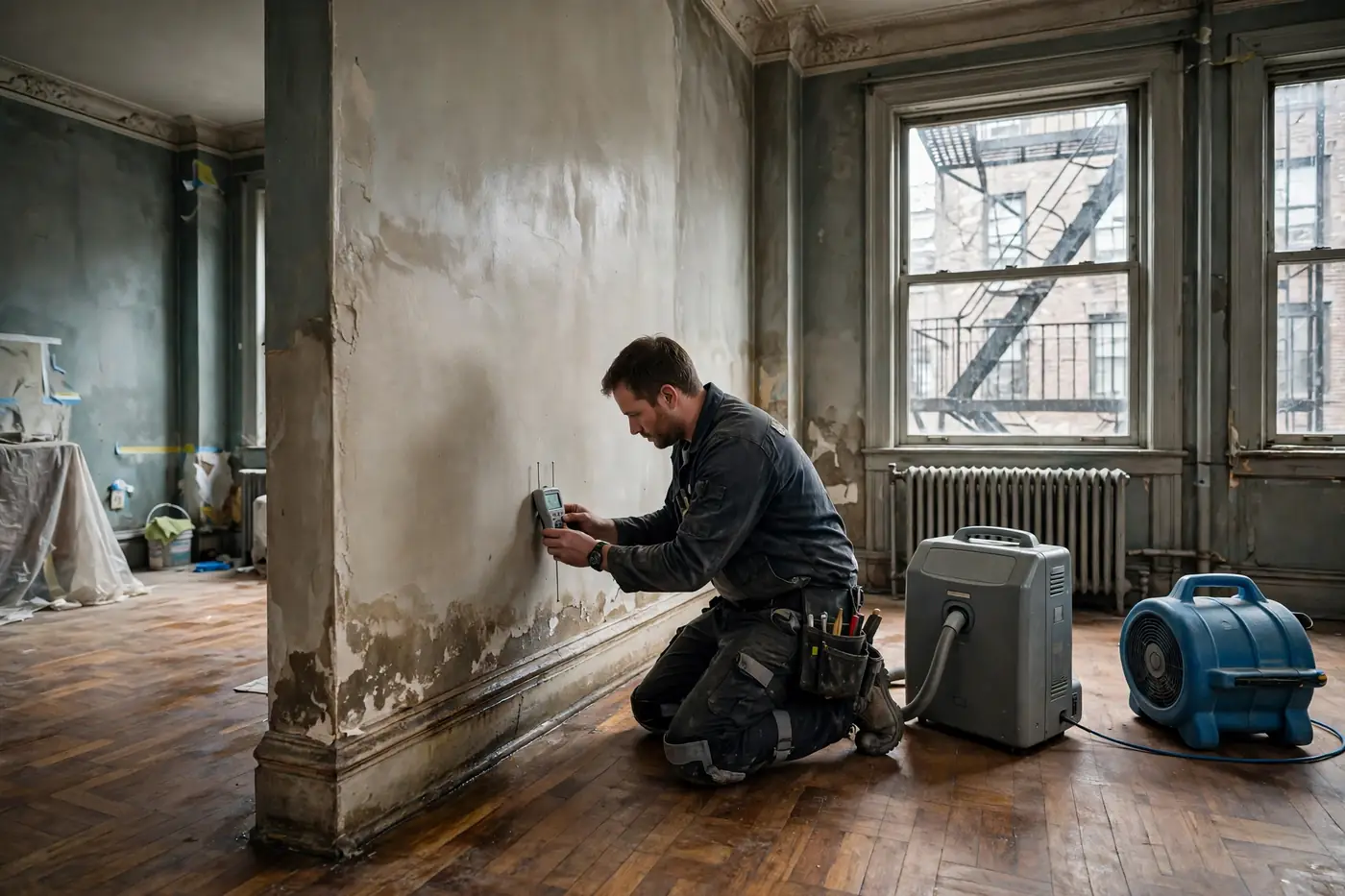
Quick answer
The short answer: 24 to 48 hours, straight from New York State
If you only read one section, read this one. Asked plainly, how long does mold take to grow after water damage, the answer given by the New York State Department of Labor in its Mold FAQ is that mold can begin to develop and grow on damp surfaces within 24 to 48 hours. That single sentence is why every drying crew in this city treats the first two days after a leak or flood as a race.
- How long does mold take to grow after water damage?
- Mold can begin to develop and grow on damp surfaces within 24 to 48 hours. That wording is from the New York State Department of Labor Mold FAQ. The growth at that stage is microscopic. You will not see it yet, which is exactly why the drying has to happen before anything shows. This is where the mold clock stops being trivia and becomes the plan for the week.
- What does the EPA say about the same window?
- The EPA guide, A Brief Guide to Mold, Moisture and Your Home, tells you to dry water damaged areas and items within 24 to 48 hours to prevent mold growth, and it adds that if a leak or spill is dried within 24 to 48 hours, in most cases mold will not grow. Note the difference: the EPA gives you the drying deadline, the Department of Labor gives you the growth timing. Keep the core fact in view while you work: how long does mold take to grow after water damage is 24 to 48 hours on a surface that stays wet.
- What does the CDC say?
- The CDC puts it in one line: mold can grow within 48 hours on surfaces that stay wet. After a flood, the CDC says to clean up and dry out your home fully and quickly, within 24 to 48 hours. Three authorities, one clock. Anyone who has asked about the timeline at two in the morning knows the answer changes what happens at nine.
- When will I actually see mold?
- Later than you would like. Seeing growth and growth starting are two different events, and the growth window is a question about the start, not the sighting. An industry timeline published by Restoration Doctor puts visible colonies at 3 to 12 days, when discoloration, fuzzy patches and a musty smell show up. By then the colony is established, not new.
- What if my home was not dried within two days?
- The joint disaster guide published by the CDC, EPA, FEMA, HUD and NIH gives the blunt rule: if a flooded home was not dried within 24 to 48 hours, assume mold growth. That does not mean panic. It means stop drying as if nothing happened and start treating the wet materials as colonized until a proper check says otherwise. That is the detail most people miss when they first ask how long it takes mold to grow.
- Does the type of water change the answer?
- The clock is about moisture, warmth and food, not about how clean the water was. Clean water from a burst pipe feeds mold on drywall paper just as well as storm water does. Dirty water adds bacteria and contamination on top, which changes the cleanup, but the growth window stays the same 24 to 48 hours. In other words, the timeline is not a riddle; it is a deadline with a paper trail.
One habit protects you more than any other in the first two days: write down when the water started, or when you found it. Every decision later, from drying choices to an insurance conversation, gets easier with a start time on paper. People ask how long does mold take to grow after water damage because they want to know how much time they have left, and you can only answer that for your own home if you know when your clock began.
Key facts
Key facts about the mold clock, in one table
Every number in this table comes from a named source, and the source is printed beside it, because how long does mold take to grow after water damage is a question where the wrong attribution has been repeated for years. The famous 24 to 48 hour growth sentence belongs to the New York State Department of Labor, not to the EPA, and this page keeps that straight throughout.
| Fact | What the source says | Source |
|---|---|---|
| Growth can begin | Mold can begin to develop and grow on damp surfaces within 24 to 48 hours | NY State Department of Labor, Mold FAQ |
| Drying deadline | Dry water damaged areas and items within 24 to 48 hours to prevent mold growth | EPA, A Brief Guide to Mold, Moisture and Your Home |
| Dried in time | If dried within 24 to 48 hours after a leak or spill, in most cases mold will not grow | EPA, A Brief Guide to Mold, Moisture and Your Home |
| Wet surfaces | Mold can grow within 48 hours on surfaces that stay wet | CDC, Mold, 26 Sep 2024 |
| Not dried in time | If a flooded home was not dried within 24 to 48 hours, assume mold growth | Joint CDC, EPA, FEMA, HUD and NIH disaster guide |
| Visible colonies | Colonies mature and become visible at about 3 to 12 days, with discoloration, fuzzy growth and a musty smell | Restoration Doctor, industry timeline, 17 Jun 2026 |
| Growth conditions | Moisture above about 55 percent indoor humidity, an organic food source such as paper, fabric or sheetrock, and temperatures typically 40°F to 99°F | NY State Department of Labor, Mold FAQ |
| Indoor humidity target | Keep indoor humidity below 60 percent, ideally between 30 and 50 percent | EPA, A Brief Guide to Mold, Moisture and Your Home |
| Do it yourself size limit | A mold problem you can usually handle yourself is less than about 10 square feet | EPA, A Brief Guide to Mold, Moisture and Your Home |
| Licensed help threshold | A licensed contractor should do the work if the mold problem is large, greater than 10 square feet, or if you are highly sensitive to mold | NY State Department of Health, publication 7287 |
| Fans after growth starts | Do not use fans if mold has already started to grow, because fans may spread the mold | Joint CDC, EPA, FEMA, HUD and NIH disaster guide |
| Federal mold limits | The EPA does not regulate mold or mold spores in indoor air, and no EPA or federal limits for mold exist | EPA, A Brief Guide to Mold, Moisture and Your Home |
Read the table as a sequence. First the Labor Department growth window, then the EPA drying deadline, then the CDC wet surface line, then the joint guide rule for homes that missed the window. Together they describe one process from four chairs, and they agree on the only number that matters at the start: two days. The agencies answer how long does mold take to grow after water damage the same way every time, and this pattern is why.
Notice what no source in the table claims. None of them gives a separate growth time for drywall, another for wood and another for carpet. People searching how long does mold take to grow after water damage often want a per material chart of visible times, and that chart does not exist in any authoritative source we could verify. The EPA table, covered in the materials section below, gives response actions per material instead, which is the honest version of the same help.
Key takeaways
Key takeaways before you scroll
This page is long because the question sits at the crossing point of drying science, health guidance and New York law. If time is short, these are the points worth carrying into the next 48 hours, starting with the plainest statement of how long does mold take to grow after water damage: 24 to 48 hours on a damp surface.
- The growth window is 24 to 48 hours. That is the NY State Department of Labor wording, and the EPA and CDC both build their drying advice around the same two days.
- Drying inside the window usually prevents growth. The EPA says that if a leak or spill is dried within 24 to 48 hours, in most cases mold will not grow.
- Visible mold is a late sign. Colonies that started on day two may not show until day 3 to day 12, so a clean looking wall on day three proves nothing either way.
- Missed the window? Assume growth. The joint federal disaster guide says a flooded home that was not dried within 24 to 48 hours should be treated as if mold has started.
- Stop fans once growth has started. Air that helps drying on day one spreads spores across rooms once colonies exist.
- Ten square feet is the line where guidance changes. Below it, careful cleaning is reasonable for many people. Above it, New York sources point you to licensed help.
- In New York, assessment and remediation are two separate companies by law. One firm cannot do both on the same property under Labor Law Article 32.
- Dead mold still counts. The EPA warns that dead mold may still cause allergic reactions, so killing growth without removing it does not finish the job.
Keep one more idea in mind while you read: the question how long does mold take to grow after water damage has a short answer and a long shadow. The short answer decides what you do today. The long shadow, health effects, tenant rights, insurance wording and the state licensing law, decides what you do this week, and those parts of the page are written to be used, not skimmed.
Voice answers
Voice answers: the mold timeline in plain words
Plenty of people ask a phone or a speaker this question while standing in a wet room, so here are three spoken style answers, each short enough to say out loud. The first one answers how long does mold take to grow after water damage in a single breath.
Asked: how long before mold starts?
Mold can begin to grow on damp surfaces within 24 to 48 hours after water damage. That is the New York State Department of Labor answer. Dry everything inside two days and, in most cases, mold will not grow at all. When neighbours ask how long does mold take to grow after water damage, this is the part of the answer worth passing on.
Asked: when will I see it?
Growth starts days before it shows. Industry timelines put visible colonies at 3 to 12 days, when you may notice discoloration, fuzzy patches or a musty smell. A wall that looks fine on day three can still be growing mold underneath the paint. It also explains why how long does mold take to grow after water damage is asked so often in this city after every storm.
Asked: what do I do right now?
Stop the water, get standing water out, and start drying today. If the wet area is bigger than about 10 square feet, or anyone at home has asthma, call for help now rather than after the weekend. In New York City, call (212) 555-0147 at any hour. File that beside the headline answer to how long does mold take to grow after water damage, because the two facts travel together.
Spoken answers have to leave out the footnotes, so treat these cards as the headline version. The sections below carry the full sourcing, including the places where the authorities disagree in wording while agreeing on the clock, and the one place, per material visible times, where no authority gives a number at all. None of it changes the central answer to how long does mold take to grow after water damage; it only changes how much room for error you have.
The timeline
The mold timeline at a glance
Before the hour by hour detail, here is the whole shape of it. When people ask how long does mold take to grow after water damage, they usually picture one moment when mold appears. The reality is a sequence: water soaks in, spores germinate, colonies spread out of sight, and only then does anything become visible on the surface.
Soaking in
Water wicks into drywall, wood, carpet pad and insulation. Materials saturate. Spores already present in every home land on wet surfaces. No mold growth yet, and everything is still winnable with fast drying.
Germination
Spores can germinate on wet organic surfaces. This is the window the Department of Labor names, the EPA drying deadline and the CDC 48 hour line, all pointing at the same two days.
Colonization
Young colonies spread through the wet material, mostly out of sight. The joint federal guide says a home not dried by now should be assumed to have mold growth underway.
Turning visible
Colonies mature and show themselves: discoloration on paint and paper, fuzzy patches, a musty smell that was not there before. This is when most people first believe there is a problem.
Established spread
Established colonies keep spreading while moisture lasts, feeding deeper into paper, wood and dust. Removal, not drying alone, is now the job, and in New York the law steps in past 10 square feet.
Drying resets the story
None of these stages is a promise. They describe what happens while surfaces stay wet. Pull the moisture out and keep indoor humidity down, and the sequence stalls at whichever stage it reached.
Stage timings for the visible and spread phases follow the industry timeline published by Restoration Doctor on 17 Jun 2026, labelled there and here as a general timeline whose actual speed depends on conditions. The 24 to 48 hour germination window is the part backed by the Department of Labor, the EPA and the CDC. That is why owners and tenants alike end up asking how long does mold take to grow after water damage, even when they start from opposite sides of the lease.
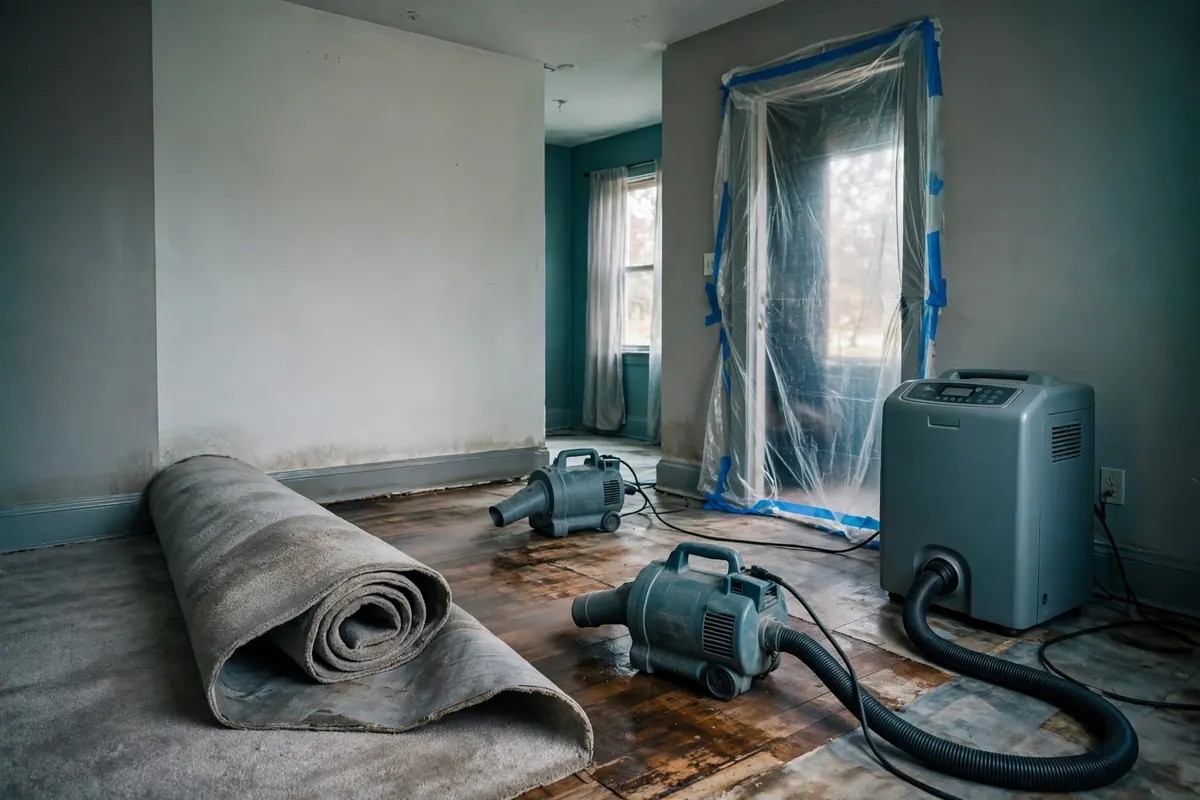
Window one
Hours 0 to 24: water soaks in, mold has not started yet
The first day after a leak or flood is the quietest part of the story, and the most valuable. Understanding how long does mold take to grow after water damage starts with understanding that day one is about water, not mold: water is moving into materials that were dry that morning, and every hour it sits there, the drying job gets longer.
Drywall drinks first. The gypsum core and its paper facing wick water upward from a wet floor line, often well above the visible water level, which is why a wall can be wet a foot or more above the puddle that caused it. Wood framing takes water more slowly but holds it longer. Carpet is deceptive: the face fibres may feel almost dry to a hand while the pad underneath stays soaked, pressed against a cold subfloor with no air at all. Insulation inside a wall cavity, once wet, can stay wet for days because the cavity has no airflow. The industry timeline describes this stage plainly: in the first 0 to 24 hours, water wicks into drywall, wood, carpet pad and insulation, materials saturate, and there is no mold yet. A homeowner who understands this rarely has to ask how long does mold take to grow after water damage twice.
Spores are not the problem in this window, because spores are never the problem on their own. Mold spores are in every home, in the air and settled in dust, and they sit harmless until they land on a wet surface with food. The CDC lists the surfaces mold grows on around a home: ceiling tiles, wood products, paint, wallpaper, insulation, drywall, carpet and fabric. A dry home carries the same spores as a flooded one. The flood changes only one thing, moisture, and moisture is the switch. The pattern repeats so often that crews hear the question how long does mold take to grow after water damage in almost these exact words, week after week.
What you do in this window decides the rest of the timeline. Standing water comes out first, because extraction removes in minutes what evaporation would need days to lift. Then air movement and dehumidification start pulling moisture out of materials before the germination window opens. Baseboards trap water against the bottom of walls, so pulling them early, where it is safe and sensible, lets the wall base dry days faster. Wet items that can move, rugs, boxes, soft furnishings, go out of the wet room so they stop feeding humidity back into the air. Treat it as the fine print under the headline answer to how long does mold take to grow after water damage.
There is also a record to start in this window, while memories are exact. Photograph every wet room before anything moves. Note the time the water started or the time you found it, the source if you know it, and the rooms affected. If the source is a neighbour, a riser, a roof or a sewer, say so in the note. That small file becomes the backbone of an insurance claim and, in a rental, the backbone of your notice to the landlord. It is a fair summary of how long does mold take to grow after water damage in real homes, as opposed to laboratory ones.
By the end of day one, a well handled home has no standing water, equipment running, wet materials identified, and a drying plan with readings. A home that got none of that is not doomed, but it is spending its margin. The germination window opens at hour 24 whether anyone acted or not, which is why the next section matters most of all. Which brings the matter back to how long does mold take to grow after water damage, and to the two days nobody gets back.
Window two
Hours 24 to 48: spores germinate on wet surfaces
This is the window the whole page is named for. When the Department of Labor answers how long does mold take to grow after water damage with the words 24 to 48 hours, this is the stretch of time it means: the second day, when surfaces that are still wet stop being merely wet and start being a place where mold is actively beginning.
Germination is a small event with large consequences. A spore that has landed on wet drywall paper, wet wood or wet carpet backing takes in water, swells, and puts out thread like growth that anchors into the material. None of this is visible. The colony at this stage is microscopic, the surface may look unchanged, and a homeowner checking the wall sees nothing at all. That invisibility is the trap of the second day: the room looks like a drying problem when it has quietly become a growth problem as well. Ask how long does mold take to grow after water damage in a room like this one and the honest answer is faster than you would like.
The EPA frames the same hours from the action side. Its guide says to dry water damaged areas and items within 24 to 48 hours to prevent mold growth, and it promises the flip side too: if you dry water damaged areas and items within 24 to 48 hours after a leak or spill, in most cases mold will not grow. Read together, the two agencies are describing one deadline from two directions. The Labor Department tells you when growth can start. The EPA tells you the last moment drying reliably prevents it. They land on the same two days. That is the human side of how long does mold take to grow after water damage, the part the charts leave out.
The CDC compresses it further. Mold can grow within 48 hours on surfaces that stay wet, the agency says, and after flooding it advises cleaning up and drying out fully and quickly, within 24 to 48 hours. The phrase that does the work in the CDC line is stay wet. A surface that got wet and dried inside the window is a different story from a surface that stayed wet through it, which is why drying speed, not the size of the original leak, is the variable that decides outcomes. Professionals plan around it daily, because how long does mold take to grow after water damage decides the shape of every job they book.
Practically, the second day is when drying stops being a fan in a doorway and becomes a measured job. Moisture readings at the wall base, the floor edge and inside any opened cavity tell you whether materials are actually falling toward dry or just feeling dry at the surface. Dehumidifiers need closed rooms to work against. Air movers need to blow across the wettest surfaces, not at the ceiling. If readings are not moving by the end of day two, the honest conclusion is that the home is entering the next window with growth likely underway, and the plan should change from drying only to drying plus a mold check. If you remember one line from this section, make it this one: how long does mold take to grow after water damage is measured from when the surface got wet.
Nothing about this window requires panic, and panic helps no one. It requires pace. The homes that come through a burst pipe with no mold at all are not lucky homes; they are homes where somebody extracted, opened, dried and measured inside two ordinary days. The homes that end up with colonies behind the baseboards are usually homes where the water looked minor, the surface felt dry, and the second day passed with the windows closed and the pad still soaked underneath the carpet. The same logic answers the renter's version of how long does mold take to grow after water damage, with the landlord's duties added on top.
Window three
Hours 48 to 72: colonies spread under the surface
Day three is where the story changes character. Anyone still asking how long does mold take to grow after water damage on day three is asking a question the timeline has already answered: on surfaces that stayed wet, growth began during day two, and day three is when young colonies start spreading through the material that hosts them.
The industry timeline calls this stage colonization, running from about 48 to 72 hours, when growth can spread beyond the first landing spots. The threads of the colony work into paper facing, into the gypsum behind it, into wood grain and carpet backing, following moisture. Because the growth is inside the material as much as on it, wiping the surface at this stage does little. The surface was never the whole colony. It is worth saying plainly, because searches for how long does mold take to grow after water damage spike after every New York downpour.
The joint disaster guide from the CDC, EPA, FEMA, HUD and NIH writes the rule for exactly this moment: if your home was flooded and you were not able to dry it within 24 to 48 hours, you should assume mold growth has occurred. Assume is the word to hold onto. It is not a diagnosis and it is not a reason to tear the home apart. It is a planning instruction. From day three onward, work proceeds as if growth is present until checking shows otherwise, which changes how you clean, how you move air, and who you call. Consider it the working footnote to how long does mold take to grow after water damage.
The fan rule flips in this window too. The same joint guide warns: do not use fans if mold has already started to grow, because fans may spread the mold. On day one, air movers are the heroes of the job. Once colonies exist, unfiltered air blasting across them can carry spores to rooms that were never wet, seeding tomorrow's problem in today's clean bedroom. Drying from day three onward still matters, moisture is still the enemy, but it is done with more care: contained areas, controlled airflow, and no household fans aimed at visible growth. That is also why the question how long does mold take to grow after water damage belongs at the top of this page and not the bottom.
Smell often arrives in this window before sight does. A musty, earthy odour that was not in the room before the water is the colony announcing itself through the air rather than the eye. Treat a new musty smell on day three as information, not atmosphere. It usually means growth is established somewhere you cannot see: behind a baseboard, under a floor, inside a wall cavity that took water and never got opened. In practice, how long does mold take to grow after water damage is the first thing a good drying plan is built around.
Day three is also the right moment to size the problem honestly. Pace out the affected area. Growth or suspect wet material covering more than about 10 square feet moves you out of the range the EPA describes as usually manageable by the homeowner, and in New York it moves you toward the licensed assessment route described later on this page. Under that size, careful cleaning of hard surfaces and removal of ruined porous material may still be reasonable for a healthy adult. Over it, get the assessment first and let the scope be set by someone with no stake in the size of the job. The science behind how long does mold take to grow after water damage is settled enough that the argument is never about the number, only about the response.
Turning visible
Days 3 to 12: when mold becomes visible
Most people meet mold with their eyes, days after it started. Knowing how long does mold take to grow after water damage includes knowing the gap between the start and the sighting, because that gap explains why a home can look fine at the weekend and show green black patches the following week.
The industry timeline puts the visible stage at 3 to 12 days: colonies mature and become visible, showing as discoloration, fuzzy growth and a musty smell. Treat those numbers as a general guide, not a schedule. The Restoration Doctor timeline itself says the actual speed depends on conditions, and conditions in a steamy August bathroom and a cool January basement are not the same conditions. Warmth, steady moisture and a rich food source pull visibility toward the early end. Cool, drying rooms push it later, or stop it altogether if the moisture leaves in time. So the answer to how long does mold take to grow after water damage carries a duty with it: dry as if the two days are real, because they are.
What you see first depends on the material. On painted drywall, look for staining that spreads, paint that bubbles or peels, and specks of green, grey, black or white clustering near the wet line. On wallpaper, growth often starts on the hidden side, so the first signs are lifting seams and a smell when you stand close. On wood, look for darkening and a fuzzy surface film in the grain. On carpet, the backing and pad hide growth longest; a smell when the room warms up is often the first honest signal. On ceiling tiles, water stains with speckled edges deserve suspicion. New Yorkers who lived through Ida and the September 2023 floods learned how long does mold take to grow after water damage the hard way.
Two honest warnings belong in this section. First, no authoritative source gives exact visible times per material, so any chart that promises drywall on day four and wood on day six is inventing precision the EPA, CDC and state sources do not claim. This page will not invent it either. Second, visibility cuts both ways: growth you can see means the colony is mature enough to show, and growth you cannot see may still be present in cavities and under floors. Sight is a late and partial instrument. Smell, moisture readings and the simple fact of how long materials stayed wet are better evidence. Set beside the Labor Department's sentence on how long does mold take to grow after water damage, it completes the picture.
When visible growth appears, the job changes category. Drying still finishes, because colonies stop spreading when moisture stops, but removal joins the plan: contaminated porous material comes out, hard surfaces get cleaned, and the area gets checked again after drying. The EPA adds a point people miss: dead mold may still cause allergic reactions in some people, so it is important to remove mold, not just kill it in place and paint over the remains. A sprayed and painted colony is still a colony in the wall, waiting for the next leak to wake it. It is the practical test of how long does mold take to grow after water damage, run in your own rooms rather than in a report.
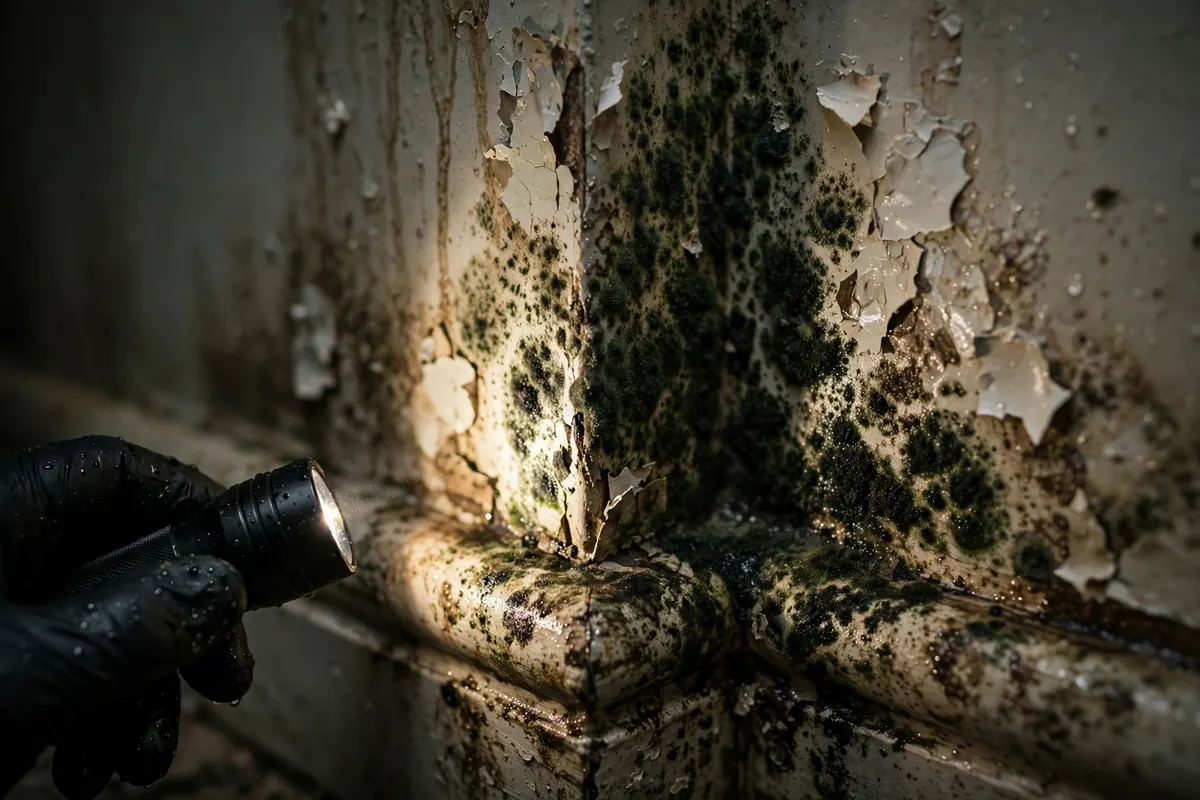
Established growth
After day 12: established colonies and hidden spread
Past the second week, the question how long does mold take to grow after water damage stops being the useful one. The useful question becomes how far it has spread, because established colonies, which the industry timeline places from about 12 to 18 days onward, behave differently from young ones: they are rooted, they are producing spores of their own, and they keep expanding as long as moisture feeds them.
Spread follows water and air. Along a wall, growth tracks the wick line upward and sideways through paper and gypsum. Under floors, it follows the wettest path between joists. Through a building, spores ride air currents from the wet room to dry ones, which is why an untouched basement flood sometimes ends with specks in a ground floor closet that never got wet. The colony does not need the second room to flood. It needs spores to land there and find enough local moisture, a cold wall, a humid corner, condensation on a pipe, to start again. And it is why how long does mold take to grow after water damage should be asked on day one, not day nine.
Established growth also hides better than young growth. By week three, the visible patch may be the smallest part of the problem. The larger part sits inside the wall cavity, on the back of the drywall, in the insulation, and under flooring, all places a surface look will never reach. This is the stage where people paint a stain, smell the room improve for a week, and then watch the stain return, because the paint covered the fruit and left the root. It is one more reason the question how long does mold take to grow after water damage deserves a sourced answer rather than a guess.
None of this makes an older problem hopeless. It makes it a removal job with a scope, and scope is what an assessment is for. In New York, once a project passes 10 square feet, the law expects licensed people and a written plan, with the assessor independent of the company that does the work. That structure exists because established growth is where guesswork gets expensive: too little removal leaves colonies behind, too much removal tears out sound material nobody needed to lose. This is where how long does mold take to grow after water damage stops being trivia and becomes the plan for the week.
If you are reading this section because your flood was weeks ago, take the practical path. Stop the moisture if it is still coming. Do not aim fans at the growth. Photograph what you can see, note when the water event happened, and get an assessment before anyone starts cutting. The clock that mattered in week one was the drying clock. The clock that matters now is simpler: every week of delay lets a rooted colony feed, so the best day to start is still today. Keep the core fact in view while you work: how long does mold take to grow after water damage is 24 to 48 hours on a surface that stays wet.
What changes the speed
What speeds the clock up, and what slows it down
The 24 to 48 hour figure is the centre of the range, not a law of physics. Ask how long does mold take to grow after water damage in a warm, humid, closed apartment in August and the honest answer is faster than the same question asked about a cool, ventilated room in January. Four conditions do most of the steering.
Moisture: the master switch
Nothing grows without it and everything grows with it. The Department of Labor FAQ describes the moisture condition as typically more than 55 percent indoor humidity, alongside a food source and suitable temperatures. A surface that stays wet, a cavity that never dries, a pad that holds water against a cold slab: each one keeps the switch on. This is why drying is not one step of the response. Drying is the response, and everything else supports it. Anyone who has asked how long does mold take to grow after water damage at two in the morning knows the answer changes what happens at nine.
Food: paper, wood, dust and glue
Mold eats what buildings are made of. The Labor Department lists organic food sources such as paper, fabric and sheetrock. Drywall paper, wallpaper paste, wood, carpet backing, ceiling tile and the ordinary dust inside a wall cavity all qualify. Homes cannot remove the food. They can only remove the moisture, which is fortunate, because moisture is the one condition fully in human control. That is the detail most people miss when they first ask how long does mold take to grow after water damage.
Temperature: the New York range
The Labor Department puts typical growth temperatures at 40°F to 99°F, a range that covers nearly every heated or summer New York interior. Warm rooms speed growth; cold rooms slow it without stopping it. A winter basement at the low end of the range buys time, not immunity, and a summer apartment with no air conditioning spends the window fast. In other words, how long does mold take to grow after water damage is not a riddle; it is a deadline with a paper trail.
Still air and closed rooms
A wet room closed up for a weekend is an incubator: warm, humid, undisturbed. The same room with air moving and a dehumidifier draining can fall below growth conditions inside the window. Ventilation is not a comfort detail after water damage. It is one of the four levers, and it is the one most often switched off by accident when people leave a flooded home closed while they stay elsewhere. The agencies answer how long does mold take to grow after water damage the same way every time, and this pattern is why.
Water type plays a smaller role than people expect in the growth question itself. Sewage and storm water demand a stricter cleanup because of what they carry, and the EPA response table in the next sections is written for damage caused by clean water. But mold does not check the pedigree of its moisture. A clean water leak left wet for a week grows colonies as surely as a dirty one, which is why small clean leaks, the dripping trap, the slow valve, cause so many of the established cases assessors find. When neighbours ask how long does mold take to grow after water damage, this is the part of the answer worth passing on.
The practical reading of this section is short. You cannot change the spores, the food or the season. You can change moisture and air, starting now, and those two levers are strong enough to decide the outcome in most homes. Every other section of this page is, in the end, instructions for pulling them. It also explains why how long does mold take to grow after water damage is asked so often in this city after every storm.
New York conditions
Why New York homes give mold a head start
The national guidance assumes a generic house. New York housing is not generic, and the local details change how long does mold take to grow after water damage in practice: older materials, shared walls, steam heat, basement living and summer humidity all lean on the clock.
Start with the building stock. Much of the city lives in pre-war buildings where plaster, lath, old wallpaper layers and decades of paint sit on top of each other. Those layers hold moisture and hide it. A modern drywall wall at least shows its wet line honestly. A plaster wall can be wet deep inside while the face feels dry, and the paper and paste layers inside old wall systems are ready food. Brownstones add their own pattern: garden level and cellar spaces sit below grade, close to the water table and the sewer line, and they flood from below as often as from above. File that beside the headline answer to how long does mold take to grow after water damage, because the two facts travel together.
Basement and ground floor apartments carry the city's sharpest mold risk, a fact written into the city's flood history. When Hurricane Ida flooded New York in September 2021, eleven of the thirteen people who died in the city were in basement apartments. Basements combine every accelerant: below grade walls that wick groundwater, cool surfaces that collect condensation, poor ventilation, stored cardboard and fabric, and, in a storm, the first and deepest water in the building. A basement that floods on Friday night and waits until Monday for help has spent its whole window underwater. None of it changes the central answer to how long does mold take to grow after water damage; it only changes how much room for error you have.
Steam heat and old risers shape the winter pattern. Radiator valves weep, riser joints sweat and drip inside walls, and a slow leak can run for weeks inside a shaft before a stain appears three floors down. Those leaks never announce a start time, so the 24 to 48 hour framing has to be applied from discovery, not from the event: the day you find the stain is day one of your response, even if the water has been moving for a month. The growth, in those cases, may already be established, which is why a found stain with a musty smell deserves an assessment rather than a coat of stain blocking paint. That is why owners and tenants alike end up asking how long does mold take to grow after water damage, even when they start from opposite sides of the lease.
Summer humidity loads the other side of the year. New York summers push indoor humidity up exactly when storm season pushes water in, and a home without air conditioning can sit above the EPA humidity guidance for weeks. Window units help the rooms they cool and leave bathrooms, closets and kitchens humid. After a summer leak, drying has to fight the weather as well as the water, which is why dehumidification, not just fans, carries the job from June to September. That, in one line, is why how long does mold take to grow after water damage is a question about hours, not weekends.
Shared buildings add a final twist: your clock may start in someone else's apartment. The bathtub overflow upstairs, the washing machine hose two doors down, the roof drain over the top floor unit, each one starts a timeline in your ceiling whether you were home or not. Building staff, supers and managing agents are part of the drying system in this city, and a fast call to the super is worth as much as a fast call to any crew, because nobody dries a ceiling properly while water is still arriving from above. Crews are trained to hear how long does mold take to grow after water damage underneath almost every other question a caller asks.
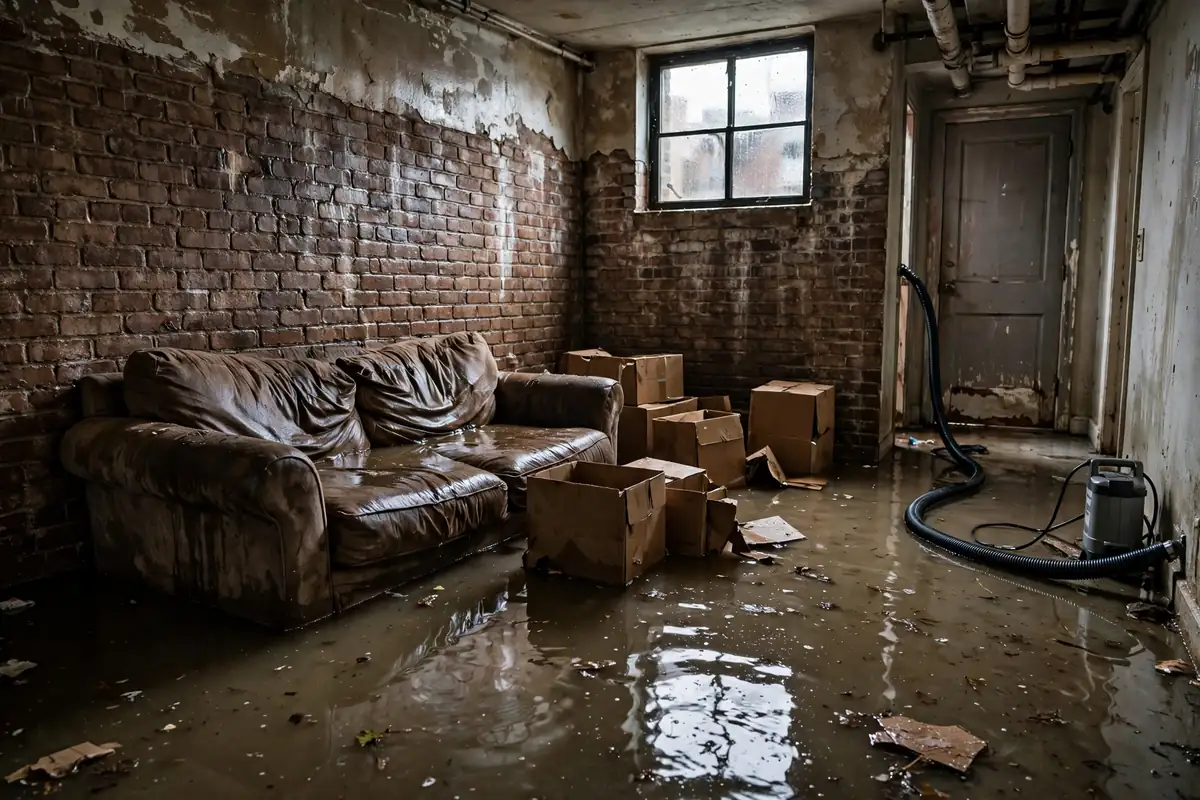
Mold by material
Mold by material: the EPA response table, material by material
Readers who ask how long does mold take to grow after water damage usually want the answer split by material: drywall, wood, carpet, concrete. No authority publishes visible growth times per material, so this page will not fake them. What the EPA does publish, in Table 1 of its mold guide, is what to do with each wet material, and that guidance is more useful than an invented timetable.
Drywall and wallboard
The EPA says wallboard may be dried in place if there is no obvious swelling and the seams are intact. If the board has swelled or the seams have opened, the answer changes: remove, discard and replace, and ventilate the wall cavity if possible. The logic is the paper. Drywall's paper facing is prime mold food, and a board that stayed wet past the window with a swollen core is a board whose inside you cannot verify. When in doubt, the cavity check matters more than the surface look: the back of the board, facing the cavity, is where growth starts first and shows last. It is the sort of fact that changes behaviour the moment it lands, which is what the answer to how long does mold take to grow after water damage is supposed to do.
Carpet and carpet backing
For carpet and backing, the EPA instruction is to dry within 24 to 48 hours, the same window as everything else, but carpet earns the urgency. The pad underneath holds water against the floor, out of the air's reach, and a carpet that feels dry on top can sit over a soaked pad for days. Lifting the carpet, removing or drying the pad, and getting air under the layers is the difference between saving a carpet and growing a colony under it. Carpet that took dirty water, or that stayed wet past the window, is usually a removal conversation, not a drying one. Say it back the way the Labor Department would: how long does mold take to grow after water damage is 24 to 48 hours, and the drying starts now.
Wood surfaces and framing
For wood surfaces, the EPA says to remove moisture immediately and use dehumidifiers, gentle heat and fans for drying. Wood is slower to wet and slower to dry than drywall, and it forgives more: solid framing that got wet and dried promptly is routinely saved, while engineered boards and particleboard swell, crumble and hold moisture in ways that often end in replacement. The drying science section below covers the moisture content targets for wood, including the point below which microbial growth is inhibited. Every experienced adjuster in the state knows how long does mold take to grow after water damage, and reads your file against that clock.
Ceiling tiles, cellulose and fiberglass insulation
Here the EPA is blunt: discard and replace. Ceiling tiles and both common insulation types hold water, hide growth and cannot be cleaned in place in any way worth trusting. Wet insulation also stops insulating, so it fails twice. The good news is that these are among the cheapest materials in the building to replace, and pulling them early opens the cavity so the framing behind them can actually dry. That is the version of how long does mold take to grow after water damage that belongs on the fridge door.
Concrete and cinder block
For concrete or cinder block surfaces, the EPA advises removing water with an extraction vacuum and accelerating drying with dehumidifiers, fans and heaters. Concrete does not feed mold the way paper does, but it stores water and releases it slowly into the room, and the paint, dust, adhesives and stored goods against a basement wall feed growth happily. A basement can pass a surface check while the block is still giving moisture back to everything touching it.
When materials stayed wet past 48 hours
The EPA table ends with the instruction that ties it to this page's whole subject: if mold growth has occurred, or materials have been wet for more than 48 hours, consult the guide's Table 2 guidance for the stronger response. In other words, the EPA's own material table treats 48 hours of wetness as the line where the standard playbook stops being enough. The guidelines are written for damage caused by clean water; sewage and storm water call for stricter handling from the first hour.
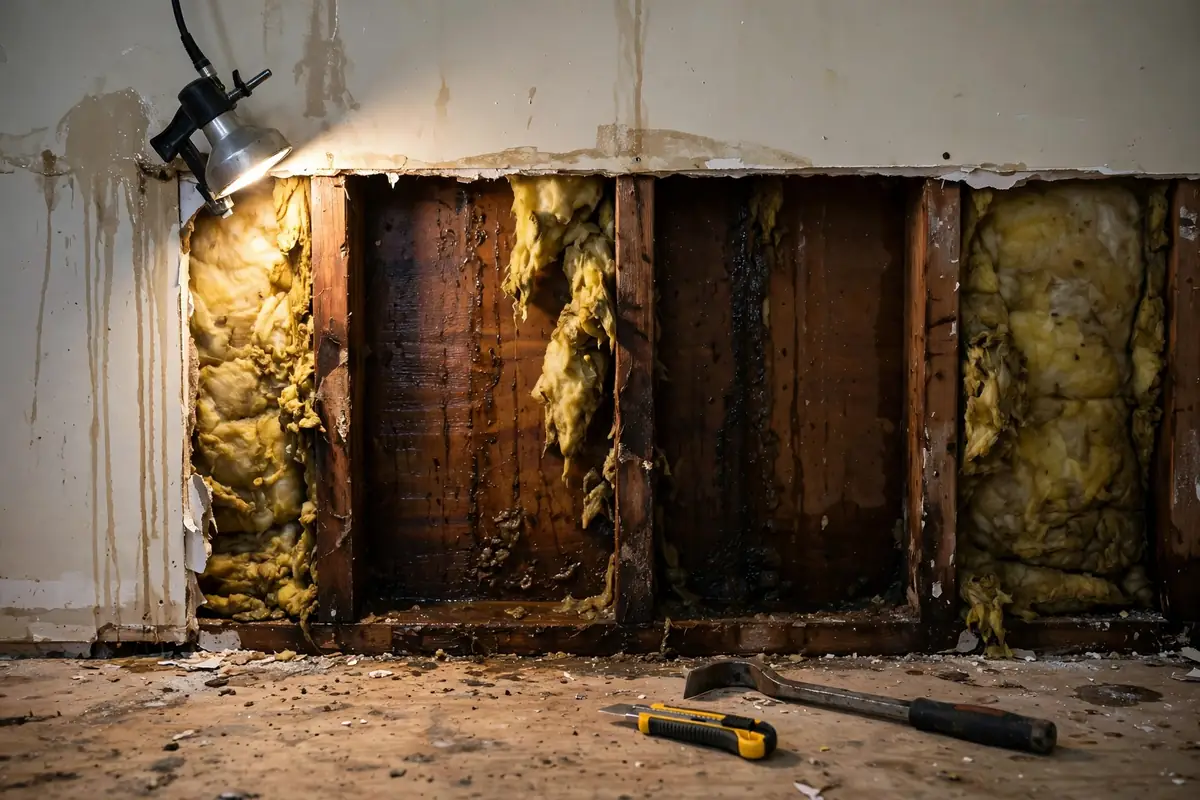
Black mold
Black mold: CDC facts and the myths the CDC corrects
No phrase in this subject carries more fear, or more bad information, than black mold. People asking how long does mold take to grow after water damage often really mean one species, Stachybotrys chartarum, so here is what the CDC actually says about it, including the claims the CDC itself corrects.
The facts first. The CDC describes Stachybotrys chartarum as a greenish black mold that grows on material with a high cellulose content, such as fiberboard, gypsum board and paper. It grows where there is moisture from water damage, water leaks, condensation, water infiltration or flooding, and the CDC states the condition it needs in one sentence: constant moisture is required for its growth. That last point cuts both ways. A home that dries stays a poor home for this species. A home with a chronic leak, a wall that never dries, a basement corner that is always damp, is exactly the home it wants.
On timing, honesty matters: no authoritative source gives a specific growth time for Stachybotrys chartarum distinct from mold generally. It is a slower, moisture demanding species that needs sustained wetness rather than a single wet weekend, but the CDC publishes no separate clock for it, and this page will not invent one. The 24 to 48 hour window remains the planning number for mold growth as a whole, and constant moisture over time is the condition that lets this particular species join in.
Now the myths, in the CDC's own corrections. The link between Stachybotrys chartarum and acute idiopathic pulmonary hemorrhage among infants has not been proven. No tests exist that can prove an association between exposure to this mold and particular health symptoms. And it is not necessary to determine what type of mold you may have: all molds should be treated the same way with respect to possible health risks and removal. That final point is the one to act on. A homeowner does not need a species name to justify removing growth, and waiting for a lab result before acting spends the one resource, time, that the whole subject runs on.
Colour is a weak guide in both directions. Plenty of dark molds are not Stachybotrys, and plenty of growth that matters is green, grey or white rather than black. The EPA and CDC both steer people away from identifying mold by look and toward the only questions that change behaviour: is it growing, how much of it is there, and is the moisture that feeds it stopped? Answer those, and the species question becomes academic in the proper sense: interesting, and not needed to do the right thing.
Health effects
Health effects: what mold exposure does to people
Health is the reason the timeline matters at all. A colony in a wall is a building problem; the spores and fragments it sheds into indoor air are a people problem, and that is why how long does mold take to grow after water damage is worth answering precisely instead of casually.
The EPA describes mold's tools plainly: all molds can produce allergens and irritants, and some can produce toxic substances called mycotoxins. Touching or inhaling mold or mold spores may cause allergic reactions in sensitive people: sneezing, a runny nose, red eyes and a skin rash. Mold can also cause asthma attacks in people with asthma who are allergic to mold. The CDC's account agrees in shape: allergic reactions and irritation are the most common effects, and asthma attacks are the serious end of the ordinary range.
New York City's own health guidance says exposure to mold can cause or worsen asthma symptoms and allergies such as hay fever, and it adds a reassuring practical note: health symptoms usually disappear after the mold has been removed. That sentence is worth remembering in a frightening week. For most people, most of the time, the path runs: remove the growth, stop the moisture, symptoms ease. It is also why removal, rather than sealing or spraying, is the goal the agencies keep returning to.
The EPA makes one more point that changes how people should think about cleanup: dead mold may still cause allergic reactions in some people, so it is important to remove mold, not just kill it. A colony sprayed dead and left in place still sheds allergenic material. This is the scientific reason behind the unglamorous truth of the trade, that mold work is mostly removal and cleaning, and only partly chemistry.
Two limits keep this section honest. First, reactions vary enormously by person: one household member sneezes for a month while another notices nothing in the same rooms. Second, neither the EPA nor the CDC offers a test that ties a specific person's symptoms to a specific mold, a point the CDC makes directly about Stachybotrys. Anyone with persistent or serious symptoms should talk to a doctor about the symptoms themselves, rather than hunting for a mold test to explain them.
Who is most at risk
Who is most at risk after water damage
The same colony does not mean the same risk to every person in the home. When you weigh how long does mold take to grow after water damage against how fast to move people out of a wet room, this is the list to weigh it with, drawn from the CDC's own account of who mold hits hardest.
The CDC names the groups most at risk from mold exposure: people with asthma or allergies, people with weakened immune systems, people with lung disease, infants and children, elderly people, and pregnant women. For a person with asthma who is allergic to mold, exposure can trigger an asthma attack, which moves a mold problem from discomfort to emergency in one step. For someone with a weakened immune system, certain molds can cause infections that a healthy body would shrug off, which is why hospitals and clinics treat water damage in their own buildings with such urgency.
Children deserve a specific mention because of how homes actually work. Infants and children breathe faster for their size, spend time on floors where settled spores concentrate, and cannot describe early symptoms well. A nursery or a child's bedroom is the wrong room to dry slowly and hope. If one room in the home gets the fastest, most careful drying and the lowest tolerance for suspect material, it should be that one.
The practical rules follow from the list. Anyone in a risk group should stay out of rooms with visible growth and out of the home during removal work on anything beyond a small patch. Cleanup of even a modest area is a job for the healthiest adult available, with ventilation and a well fitting mask, or it is a job to hand to professionals. And a household with a high risk member should treat the 10 square foot guidance conservatively: the NY State Department of Health says a licensed contractor should do the work if you are highly sensitive to mold, whatever the size of the patch.
Risk also argues for speed in a way the building science alone does not. A drying delay of two days is a materials problem for the house. For the asthmatic teenager sleeping next to the wet wall, the same delay is the difference between a home that never grew mold and a home whose air changed for a season. When the two arguments point the same way, as they do here, believe them.
Inside the 48 hour window right now?
Every hour of drying counts double today. One call starts extraction and drying across New York City, at any hour.
First hour
The first hour: what to do the moment water gets in
The first hour sets the terms for everything after it. You cannot change how long does mold take to grow after water damage, but the first hour decides how much water the clock gets to work with, and a home that spends its first hour well often never meets the mold question at all.
- Keep people safe first. Stay out of water that touches outlets, appliances or a panel, and never wade through deep water or water that may carry sewage.
- Stop the source if you safely can: the main shutoff for a burst pipe, the fixture valve for a toilet or sink, the machine off for a washer hose.
- Call the super, management or the neighbour above you if the water is not yours. Drying cannot beat a leak that is still running.
- Photograph every wet room before you move anything. Wide shots, then close shots of the source and the wet line.
- Move documents, photos, medicines and small valuables up and out of the wet zone. Cardboard on a wet floor goes first; it wicks, weakens and feeds mold.
- Start water out: towels and a wet vacuum on small spills, buckets under active drips, furniture lifted on blocks or foil under the legs.
- Write down the time. When it started or when you found it, what you think the source is, and which rooms are wet.
- Make the call. If the wet area is large, deep, dirty or still growing, call (212) 555-0147 now, not after the weekend.
Two mistakes in the first hour cost more than all the others. The first is waiting to see whether it dries on its own. Some of it will, at the surface, while the pad, the cavity and the wall base stay wet into the germination window. The second is throwing damaged things away before they are documented. Insurers pay claims on evidence, and the soaked rug in the dumpster is evidence that no longer exists. Photograph first, discard later, on advice.
Safety deserves one more line, because first hours are rushed hours. Water and electricity are the dangerous pair, and sewage is the unglamorous one: storm water and sewer backups carry contamination that changes the cleanup standard entirely. Gloves on, children and pets out of the wet rooms, and no heroics in water you cannot see the bottom of.
First day
The first day: beating the germination window
Day one is a drying contest against a deadline you now know by heart. Since the answer to how long does mold take to grow after water damage is 24 to 48 hours, day one is not the day to watch and wait; it is the day extraction, opening and measured drying either get ahead of germination or start chasing it.
Extraction first, and thoroughly. Truck mounted or portable extraction pulls water out of carpet and off floors at a rate evaporation cannot approach. Every gallon extracted is a gallon the dehumidifiers never have to lift out of the air. Carpets get lifted where the pad is wet. Furniture leaves the wet rooms or goes up on blocks. Wet soft goods that can be washed and dried fast stay in play; things already smelling sour get a harder look.
Opening second. Baseboards trap water against wall bases, so they come off in the wettest rooms. A small flood cut or inspection openings let cavity air move and let meters reach the truth. Cabinets with wet toe kicks, built ins against wet walls, and the backs of closets on wet walls all hide the same trap: still air against wet material. Opening is not demolition for its own sake. It is how drying reaches the places mold prefers.
Equipment third, placed by readings rather than habit. Air movers blow across wet surfaces, not into room centres. Dehumidifiers run in closed rooms, drained or emptied on schedule, sized to the water load rather than the room's square footage alone. The goal for the end of day one is measurable: standing water gone, the wettest materials identified and exposed, humidity falling, and the first set of moisture readings written down as the baseline every later day gets compared against.
Day one is also when the calls beyond the crew happen. The insurer gets notified, with the photos and the start time from your notes. The landlord gets written notice if you rent, the same day, not after the smell arrives. Building management gets looped in if shafts, risers or neighbours are involved. Each of those calls is easier on day one, when the story is simple and the evidence is fresh, than on day nine, when it sounds like an argument.
First week
The first week: days 2 to 7, day by day
By day two the emergency becomes a routine, and routines are where drying jobs are won or quietly lost. The question how long does mold take to grow after water damage has done its work by now; the question for the rest of the week is whether moisture readings fall every day until the structure reaches its dry standard.
Days two and three are measurement days. Equipment gets checked, moved and sometimes added to, based on readings rather than optimism. The wall base that read highest on day one should read lower today. The floor corner that is not moving gets attention: more airflow, an opened cavity, a pad removed. This is also the window where the joint federal guide's rule applies in full: a home that could not be dried within 24 to 48 hours is treated as a home where mold growth should be assumed, so inspections in these days look for growth as well as moisture, especially in cavities and under flooring.
Days four and five separate the drying jobs from the drying performances. A room can feel dry, smell better and still hold a wet wall base that will grow mold in the dark for a month. Readings decide. Materials come off equipment only when they reach their dry standard, a concept the drying science section explains properly. Rushing equipment out on day four because the room feels fine is the single most common way a handled flood becomes a mold job in week three.
Days six and seven are for closing and checking. Equipment leaves when readings say so. Opened cavities get their final check before anything is closed. Removed material gets replaced or scheduled. The file gets finished: daily readings, photos of the dry structure, notes of what was discarded and why. That file closes the insurance story and, in a rental, proves the response was prompt, which matters if a dispute about the condition of the home ever follows.
If growth was found during the week, the week ends differently: with an assessment and a written scope rather than a drying sign off. That is not a failure of the week. Finding growth on day five, while it is still young and local, is a far better outcome than finding it in month two, when it is established and spread. The week did its job either way, because the week was about looking with instruments, not hoping with fingers crossed.
The six steps
Six steps that stop mold before it starts
Everything on this page compresses into six steps. They are written for the person standing in the wet room wondering how long does mold take to grow after water damage and what, exactly, to do about it before the window closes.
Call now and stop the water at its source
One call to (212) 555-0147, at any hour, starts the response. Shut the valve, kill the machine, get the super moving. No drying plan survives a source that is still running, so the source stops first, before equipment, before paperwork, before anything.
Move wet items out and open the wet rooms
Rugs, boxes, soft furnishings and anything sitting in water leaves the wet zone or goes up high. Doors open, air starts moving, and the rooms stop acting like sealed incubators while help is on the way.
Extract standing water from floors and basements
Standing water comes out by extraction, not by evaporation. What a pump and a wand remove in an hour, a fan would need days to lift, and the clock does not grant days.
Dry every wet surface within 24 to 48 hours
This is the step the whole timeline hangs on. Air movers across the wettest surfaces, dehumidifiers in closed rooms, baseboards off where walls are wet, cavities opened where readings demand it.
Check moisture readings daily until the structure is dry
Feeling dry is not a measurement. Daily meter readings at the same points, written down, show the structure falling to its dry standard or expose the corner that is not moving while there is still time to fix it.
Watch for mold signs and call a licensed assessor if it appears
New musty smell, spreading stains, speckled patches: any of these ends the drying only plan. In New York, an assessor independent of the remediation company sets the scope, by law.
The six steps assume clean water and a home that is safe to be in. Sewage, deep flood water, structural damage or any electrical danger moves step one to a different call: get people out, then call.
Drying science
Drying science: dry standards, moisture content and meters
Drying looks like fans and noise. Underneath, it is a measurement discipline, and understanding it explains why how long does mold take to grow after water damage cannot be answered by touching a wall and guessing. Surfaces lie. Numbers, taken properly, do not.
The governing standard in the trade is ANSI/IICRC S500, and its 2021 edition sets drying goals against each material's own dry standard rather than one fixed percentage for everything. That phrase, dry standard, means the moisture level that same material sits at in the dry parts of the same building. A wood floor is dry when it matches the unaffected floor in the next room, not when it reaches a number printed on a chart. This is why a competent drying file compares wet readings against dry reference readings from the same home.
Wood has the clearest published anchors. The USDA Wood Handbook notes that softwood lumber for framing is usually targeted for drying to an average moisture content of 15 percent, not to exceed 19 percent. Drying guidance in the trade adds that getting wood materials below 20 percent moisture content inhibits microbial growth, which is the scientific version of this page's whole argument: below a moisture threshold, the mold clock stops. You may also meet the claim that wood should reach less than 17 percent to be safe. That figure is an individual author's recommendation, not a standard, and it should never be quoted as one.
Be suspicious, too, of any single percentage quoted for drywall. Most electrical moisture meters are not calibrated for drywall, plaster or concrete, so a meter's percentage on those materials is a comparative reading, useful against a dry reference area, not an absolute truth. Charts that announce a universal drywall percentage, sometimes dressed up as an S500 figure, are misquoting the standard, which deliberately refuses to set one. Professionals know this and work by comparison. Homeowners should ask anyone quoting them a drywall percentage what the number is being compared against.
The working method, then: find the dry standard in an unaffected part of the building, map the wet area against it, dry until readings converge, and hold them there on a repeat check before closing anything up. That is slower than a guess and faster than a mold job. It is also the only version of dry that survives an assessor's meter, an insurer's questions, or a tenant's lawyer.
Humidity control
Humidity: keeping indoor air below the mold line
Surfaces get the attention, but air carries half the story. Anyone researching how long does mold take to grow after water damage should leave with the EPA's humidity numbers in their pocket, because indoor air that stays humid can keep surfaces damp long after the visible water is gone.
The EPA's guidance is simple enough to tape to a fridge: keep indoor humidity below 60 percent, and ideally between 30 and 50 percent. The Department of Labor's growth conditions put the moisture side of mold growth at typically more than 55 percent indoor humidity, which lines up with the EPA ceiling from the other direction. Between them sits the working rule for a New York home after water damage: get the air under 55, aim for the EPA's ideal band, and hold it there until the structure is verified dry.
A cheap hygrometer earns its place in any home that has flooded once. Readings by room beat readings by feel, because the rooms that matter, the basement, the bathroom, the closet on the cold wall, are exactly the rooms nobody sits in long enough to judge. After a water event, check the wet rooms daily. A room whose humidity will not fall while equipment runs is telling you moisture is still feeding the air from somewhere: a cavity, a pad, a slab, a leak that never fully stopped.
Dehumidifiers do the heavy lifting, and they work best in closed rooms with the drain handled, either a hose to a sink or a bucket emptied on schedule. Air conditioning helps in summer by wringing moisture out as it cools. Bathroom exhaust fans help only if they actually vent outside and run long enough after showers, twenty minutes or more, rather than being switched off with the light. Kitchen range hoods that vent outside do the same work for cooking steam.
Long term, humidity control is mold control in this city's housing. Basements want a standing dehumidifier with a drain, not a bucket someone forgets. Bathrooms want fans that run. Cold water pipes in warm rooms want insulation so condensation stops dripping into walls and onto stored cardboard. None of it is glamorous, and all of it is cheaper than one established colony.
Air and heat
Fans, heat and dehumidifiers: moving air the right way
Air movement is the tool everyone reaches for first, and it deserves a section of its own, because the same fan that saves a room on day one can spread a colony on day four. The difference is timing, and timing is the subject of how long does mold take to grow after water damage from start to finish.
In the drying window, air movers are placed to sweep across wet surfaces, because evaporation happens at the surface and moving air carries the moisture away to where the dehumidifier can capture it. The EPA's material guidance pairs the tools together: wood surfaces get dehumidifiers, gentle heat and fans; concrete gets dehumidifiers, fans and heaters. Fans alone, with no dehumidification, mostly move moisture from the wall into the room air and then into the next absorbent thing. The pair is the system.
Gentle heat helps because warm air holds more moisture and warm materials give moisture up faster, but heat has limits. Sealed, overheated rooms are miserable to work in and hard on some materials, and heat without extraction or dehumidification just makes a warmer incubator. The trade's word gentle is doing real work in the EPA sentence.
Then the rule flips. The joint federal disaster guide says it without decoration: do not use fans if mold has already started to grow, because fans may spread the mold. Once colonies exist, blasting air across them launches spores into rooms that were never wet. From that point, air is managed, not multiplied: contained work areas, controlled exhaust, and no household fan aimed at a patch because someone wanted it to dry out. Visible growth gets removed, not ventilated.
Household fans and professional air movers are also not the same tool. A box fan moves room air pleasantly; an air mover drives a flat, fast sheet of air across a floor or wall base where the water actually is. Homeowners doing early work should use what they have, open windows when the outside air is drier than the inside air, and not mistake a pleasant breeze for drying. The readings, as always, deliver the verdict.
What goes, what stays
What to throw away after a flood, and what can be saved
Every flood ends with a pile of hard decisions at the kerb. The joint federal guide gives the rule that organises them: throw away anything wet with flood water that cannot be cleaned and dried completely within 24 to 48 hours. Notice that the rule is the same clock as the answer to how long does mold take to grow after water damage, applied to belongings instead of walls.
Porous things are the usual losses. The NY State Department of Health says it plainly in publication 7287: control the moisture, control the mold, and porous materials with extensive mold growth should be discarded, naming drywall, carpeting, paper and ceiling tiles. Mattresses that took flood water, soaked upholstered furniture, drenched cardboard and paper, wet insulation and ceiling tiles, carpet pad that stayed wet past the window: these hold water and growth inside themselves where cleaning cannot reach, and keeping them means keeping the colony.
Hard and non porous things usually survive. Metal, glass, hard plastic and solid sealed surfaces can be cleaned and dried completely, which is the guide's test. The CDC describes cleaning hard surfaces with commercial products, soap and water, or a bleach solution of no more than 1 cup of household laundry bleach in 1 gallon of water, with the safety rules that go with bleach: ventilation, gloves, never mixing it with ammonia or other cleaners. Wood furniture sits between the classes: solid pieces that got wet briefly and dry fast can often be saved, while veneered and particleboard pieces that swelled rarely come back.
Food and medicine follow stricter rules after any flood: anything that flood water touched, including canned goods with damaged seams and anything in cardboard or screw top packaging, goes out, and refrigerated food that sat warm after a long power cut goes with it. When in doubt with food, the doubt wins.
Two habits protect you inside this unhappy chore. First, photograph everything before it leaves, with the damage visible, for the insurance file. Second, bag moldy material before carrying it through clean rooms, so the trip to the kerb does not seed spores along the hallway. Discarding is part of remediation whether a crew does it or you do, and the care taken over it is the difference between removing a problem and relocating it.
Doing it yourself
Small patches you can clean yourself: the 10 square foot rule
Not every patch needs a crew, and the agencies say so. The EPA's rule of thumb is that if the moldy area is less than about 10 square feet, roughly a patch three feet by three feet, you can probably handle the job yourself. That sentence has carried a lot of weight in searches about how long does mold take to grow after water damage, because it tells people where their own case sits.
The conditions around the rule matter as much as the number. The moisture source has to be fixed first, or the patch returns. The person cleaning should not be in a high risk group; the NY State Department of Health says a licensed contractor should do the work if you are highly sensitive to mold, whatever the size. And the material matters: a small patch on tile, glass, metal or sealed wood is a cleaning job, while the same area on drywall or carpet may be a removal job, because the growth is in the material, not on it.
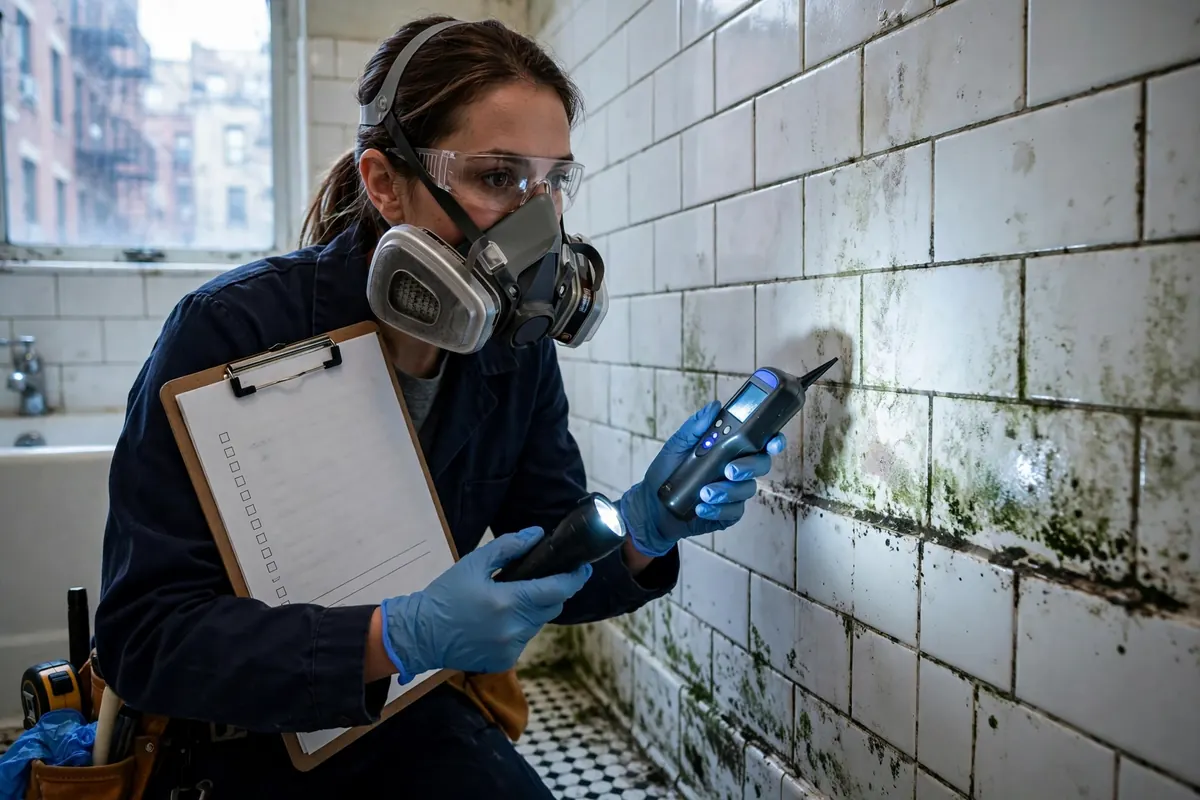
Method, briefly. Ventilate the room. Wear gloves, eye protection and a well fitting respirator mask. Scrub hard surfaces with detergent and water, or use the CDC bleach solution, no more than 1 cup of household laundry bleach in 1 gallon of water, and dry the area completely afterward. Bag removed material before it travels through the home. Never paint or caulk over mold to hide it; the EPA's dead mold warning applies here too, since covered growth still sheds allergens and keeps eating the wall behind the paint.
Know the exits from the do it yourself path. The patch is bigger than you thought once you open it up. The smell survives the cleaning. The stain returns within weeks. Anyone at home has asthma or a weakened immune system. The water came from sewage. Any one of those ends the home attempt and starts the licensed route, and recognising the moment early is a skill, not a surrender.
One more boundary deserves respect: your own home versus someone else's. Cleaning a small patch in your own bathroom is one thing. In a rental, mold is the owner's legal problem in New York, as the renters section below explains, and a tenant who quietly bleaches a landlord's wall may be volunteering for a duty the law assigns elsewhere, while destroying the evidence of the condition. Photograph, notify in writing, then decide.
Mold testing
Mold testing: why the agencies say you usually do not need it
Testing feels like the scientific response to a frightening smell, and it is the purchase the agencies most often talk people out of. Their reasoning connects straight back to how long does mold take to grow after water damage: the clock runs on moisture and time, not on lab results, and no test result changes the first correct actions.
The NY State Department of Health states it in publication 7287: mold testing is not recommended, and it is not required by any regulatory agency. The joint federal disaster guide agrees from the field: sampling for mold is not usually recommended. The EPA's framework explains why. The agency does not regulate mold or mold spores in indoor air, and no EPA or federal limits exist for mold, which means a test produces a number with no official line to compare it against. There is also no state or federal standard for mold in homes, as the Health Department notes, so a result cannot declare a home safe or unsafe against any benchmark.
The CDC adds the sharpest point in its Stachybotrys guidance: no tests can prove an association between that mold and particular health symptoms, and it is not necessary to determine what type of mold you have, because all molds should be treated the same for health risks and removal. A test that names a species answers a question the response does not depend on. Wet or dry, growing or removed, big or small: those are the variables that steer the work.
There are narrow places where sampling earns its fee: a clearance check after a large remediation, a dispute between parties who need an independent record, a medical or legal process that requires documentation. In New York those jobs belong to the licensed assessor, whose independence from the remediation company is the entire point of the law. What testing should never do is delay drying, delay removal, or substitute for either. Spores were in the home before the flood and will be after it. The flood changed the moisture. Fix the moisture, remove the growth, and the test becomes the footnote it usually is.
New York law
New York law: Labor Law Article 32 and the five mold licenses
New York is one of the few states that licenses mold work, and the law shapes what happens after the timeline runs out. When a case passes the point where how long does mold take to grow after water damage is the live question, Article 32 of the Labor Law decides who may assess it, who may remove it, and why those two people cannot work for the same company.
The basics, from the Department of Labor, which runs the Mold Program that enforces Article 32 and sets licensing and minimum work standards. It is unlawful to engage in, advertise, or hold yourself out as a mold assessor, a mold remediation contractor or a mold abatement worker without a valid mold license from the Commissioner of Labor. A project, in the law's terms, means mold remediation, assessment or abatement of an area greater than ten square feet, excluding routine cleaning and unrelated construction work. A copy of the valid license must be conspicuously displayed at the work site, a detail worth checking on day one of any job.
The separation rule is the heart of it. The same company may not perform both the assessment and the remediation on the same property. Separate companies are required, and the independent assessment is what defines the scope of the remediation work. The logic is consumer protection in its purest form: the person who decides how much mold work you need is forbidden from being the person paid to do it. Homeowners who understand this one rule are protected against the oldest abuse in the trade.
There are five licenses in the system: Mold Assessor, Mold Assessment Contractor, Mold Remediation Contractor, Mold Abatement Worker Supervisor, and Mold Abatement Worker. Applicants must be 18 or older, complete Commissioner approved coursework that includes training in personal protective equipment, pay the required fees, and submit insurance certificates, including liability insurance of at least fifty thousand dollars. The assessor license is valid for two years. The statute itself took effect on 28 Jul 2015, and the licensing requirement followed on 1 Jan 2016, two dates that are often merged and should not be.
The Department's FAQ also supplies this page's favourite piece of science, the growth conditions: moisture typically at more than 55 percent indoor humidity, an organic food source such as paper, fabric or sheetrock, and temperatures typically between 40°F and 99°F. And it supplies the sentence the whole page is built on: mold can begin to develop and grow on damp surfaces within 24 to 48 hours. When a New Yorker asks the timeline question, the most local authority in the state has already answered it.
City rules
City rules: Local Law 55, Local Law 61 and HPD violation classes
Inside the city, two local laws sit on top of the state framework, and they matter most in the buildings where most New Yorkers live. They answer a different question from how long does mold take to grow after water damage: not how fast mold grows, but how fast the building must respond once it has.
Local Law 55 of 2018 requires owners of buildings with three or more apartments to keep tenants' apartments free of indoor allergen hazards, a category that includes mold. Owners must inspect annually, respond to complaints, clean vacant apartments before new tenants move in, and provide a fact sheet and a notice with each lease telling tenants how hazards are handled. For residential properties with 10 or more units, the owner must hire a Department of Labor licensed mold assessor and a licensed remediator who are completely independent of each other, and the work must comply with section 24-154 of the NYC Administrative Code and with Article 32 of the state Labor Law.
Enforcement runs through HPD, the city's housing agency. Tenants notify the landlord first; if the landlord does not respond, the tenant files a complaint online or calls 311, and HPD inspects and issues violations. The violation classes carry correction deadlines scaled to size. Class A, less than 10 square feet in a room, or less than 30 or 50 square feet in aggregate, allows 90 days to correct. Class B, 10 to 29 square feet in a room, or equal to or greater than 30 or 50 square feet in aggregate, allows 30 days. Class C, equal to or greater than 30 square feet in a room, allows 21 days. Read those deadlines against the growth timeline and the policy writes itself: the law gives owners weeks, but mold works in days, which is why tenants should report early and in writing.
Local Law 61 of 2018 set minimum standards for mold assessment, abatement and remediation work in buildings with 10 or more dwelling units, or on a zoning lot with 25,000 square feet or more of non residential floor area. The Department of Environmental Protection oversees this side of the system, and its penalties for failure to comply range from eight hundred to ten thousand dollars. Two forms run the paperwork: the Mold Remediation Work Plan and Notification Form, filed by the remediator, and the Mold Post Remediation Assessment Form and Certification, filed by the assessor, with the DEP reachable at moldhelp@dep.nyc.gov for the process.
Between the state law and the two city laws, a pattern emerges that is worth stating once, plainly. New York regulates mold work by independence and paperwork because the city's housing is shared housing: one apartment's leak is another apartment's ceiling, one owner's delay is another family's air. The rules look bureaucratic from a distance. Up close, in a wet building in August, they are the difference between a scoped, verified job and a shrug.
Renters
Renters: your rights when mold appears in an NYC apartment
A tenant cannot shut off a riser, open a wall or hire the building's contractor, so the renter's version of how long does mold take to grow after water damage is really a question about how fast to notify, document and escalate. In New York, those three verbs are the tenant's whole toolkit, and they work when they are used early and in writing.
Notify first, and notify in a way that leaves a record. Tell the landlord or management about the leak and any growth the day you find them, by a channel you can prove later: an email, a letter you keep a copy of, a work order in the building's system with a screenshot saved. Include the date the water event happened or was found, the rooms affected, and clear photographs. A phone call is a fine first step and a poor only step, because memory disputes are how mold cases die.
Know what the law already promises you. Under Local Law 55, owners of buildings with three or more apartments must keep apartments free of indoor allergen hazards including mold, inspect annually, respond to complaints, and clean vacant apartments before re renting. In buildings of 10 or more units, the owner must use a licensed assessor and a licensed remediator who are independent of each other. A tenant does not have to arrange or pay for that structure. The tenant has to trigger it, and the trigger is notice.
If the landlord does not respond, escalate on the city's track: file a complaint online or call 311. HPD inspects and issues violations, and the violation class sets the owner's correction deadline, from 90 days for the smallest Class A conditions down to 21 days for Class C, the largest in a single room. Keep your own copies of the complaint number, the inspection date and the violation. NYC Health adds the human note that health symptoms usually disappear after the mold has been removed, which is both reassurance and argument: removal is the remedy the whole system is built to deliver.
Two cautions complete the picture. Do not stop paying rent or start a repair and deduct project on the strength of a web page; rent actions in New York have their own procedures and risks, and a housing attorney or a tenant helpline should steer anything that touches the rent. And do not quietly remediate a landlord's building yourself beyond basic cleaning of your own belongings: beyond the wasted money, home treatment can muddy the evidence of a condition the owner was legally required to fix. Document, notify, escalate, in that order, and let the deadlines do their work.
Owners and landlords
Owners and landlords: duties, deadlines and DEP forms
For an owner, the timeline question has a legal echo. Mold grows in 24 to 48 hours, violations correct in 21 to 90 days, and the distance between those two clocks is where owners get into trouble. Reading how long does mold take to grow after water damage as an owner means reading it as a maintenance deadline, not a science fact.
The duty itself is broad. Buildings with three or more apartments must be kept free of indoor allergen hazards under Local Law 55: annual inspections, prompt responses to complaints, vacant apartments cleaned before a new lease, and the required fact sheet and notice going to tenants with each lease. Owners of residential properties with 10 or more units must hire a state licensed mold assessor and remediator who are completely independent of each other, following Administrative Code section 24-154 and Labor Law Article 32. The independence rule binds owners as much as contractors: hiring one firm to assess and fix its own findings is not a shortcut, it is a violation of the structure.
Local Law 61 adds the DEP layer for buildings with 10 or more dwelling units or 25,000 square feet or more of non residential space on the lot: minimum standards for assessment, abatement and remediation, the remediator's Mold Remediation Work Plan and Notification Form, the assessor's Post Remediation Assessment Form and Certification, and penalties from eight hundred to ten thousand dollars for failure to comply. The paperwork is not decoration. The post remediation certification is the document that proves the job ended, and owners who skip it own the risk that the condition is treated as open.
The economics argue the same way as the law. A leak answered inside the drying window is a plumbing repair and a drying bill. The same leak answered after a month of complaints is an assessment, a remediation, a possible violation, a possible penalty and a tenant relationship repaired at ten times the price. Owners who build the fast response into their building routine, a super who extracts the same day, a standing relationship with a drying crew, a log of every water complaint with dates, are not being generous. They are being accurate about which clock runs the building.
Keep the log. Every water complaint, every inspection, every reading, every form filed, dated and kept. In a system enforced by deadlines, the owner's best friend is a paper trail showing the response was faster than the law required. The second best friend is a fixed leak. Everything else is commentary.
Insurance
Insurance: when mold after water damage is covered in New York
Insurance answers the mold question with a condition attached, and the condition is causation. People who ask how long does mold take to grow after water damage usually ask the coverage question in the next breath, so here is the New York regulator's own framing of when mold belongs in a claim.
The Department of Financial Services, which regulates insurance in New York, puts it in three sentences worth quoting whole: mold damage is covered if it is due to a covered event. Many policies have a mold limitation for the payment of remediation services. Your policy has to be reviewed for the specific language. Note what the regulator does not do: it states no dollar limit, because limits live in individual policies, and any page that quotes you a universal figure is inventing it. Your number, if you have one, is in your own policy's mold endorsement.
The Department's Office of General Counsel, in Opinion 02-07-20, gives the legal shape underneath: coverage for property damage from mold is generally excluded unless it is a consequence of a covered loss, such as a burst water pipe or wind driven rain. Only where there is a causal link between the mold and the covered peril would a policy provide coverage. Translated into kitchen table language: mold that grew because a covered pipe burst is part of that covered loss. Mold that grew because a bathroom was never ventilated, or a leak dripped unreported for a year, stands outside the claim.
This is where the timeline becomes a claims document. Growth that began within days of a sudden, covered event fits the causal story. Growth discovered after months of slow leaking invites the denial that the damage came from neglect rather than a peril. The dated photos, the start time note, the daily readings and the prompt notice to the carrier are not clerical habits; they are the evidence that welds the mold to the event. The site's full page on water damage insurance claims in New York walks the whole process, and it is linked in the all pages section below.
Two practical rules close the section. Notify early, because policies require prompt notice and late notice is a self inflicted wound. And mitigate: carriers expect you to stop the water and start drying rather than letting damage grow while paperwork moves, which is one more reason the drying clock and the claims clock agree. Help lines exist for the hard cases: the Department of Financial Services answers at (800) 342-3736, and its disaster hotline is (800) 339-1759.
Records
Records to keep for your insurance claim
Every section of this page quietly depends on records: the start time, the readings, the photographs. Since the science of how long does mold take to grow after water damage is a science of hours, the file you keep is what proves which hours your home actually spent wet.
- The start note: when the water began or when you found it, the suspected source, and the rooms affected, written the same day.
- Photographs and video before anything moves, then daily as drying proceeds, then of the finished dry structure.
- Moisture readings with dates and locations: wall base, floor, cavity, and the dry reference readings they were compared against.
- Every notice you sent: to the insurer, the landlord, management, the neighbour, with dates and copies kept.
- Invoices, receipts and work orders for extraction, drying, repairs and anything you had to replace or discard.
- A discard list: what was thrown away, why, and a photograph of each item before it left.
- Any assessment report, remediation plan and post remediation certification, if the job reached the licensed stage.
- Notes of symptoms and doctor visits if anyone at home was affected, dated, in case the health side is ever questioned.
Keep the file in one place, a single folder on a phone or a single envelope in a dry room, and keep it longer than feels necessary. Claims get reopened, buyers ask questions, tenants and owners dispute timelines a year later. The household that can produce a dated photograph beats the household with a confident memory every single time, in front of adjusters, inspectors and judges alike.
There is a quieter benefit too. A written drying log disciplines the drying itself. Readings that must be written down get taken. Corners that must be reported get checked. The file is the conscience of the job, and jobs with a conscience finish dry.
Growth already showing?
Visible mold past a small patch needs a licensed assessment first. Call for drying help and a straight answer on next steps.
Video case studies
Two mold timeline videos worth your time
Some people learn a timeline better by watching it than reading it. These two videos walk the same ground as this page, and both are linked as reading, not embedded, so the page stays fast. Each one circles the same question, how long does mold take to grow after water damage, from a slightly different chair.
How Fast Does Mold Grow After Water Damage? (24 to 48 Hours)
A short, plain spoken walkthrough from Mold Removal Kansas City. It explains how leaks, flooding and trapped moisture create growth conditions inside walls and drywall, why the first 24 to 48 hours after a leak matter, and how a wall can look dry on the face while moisture stays trapped inside it. Its most useful habit is a caution this page shares: the 24 to 48 hour period is a recommended drying window, not a guarantee that mold appears on a schedule, because actual growth depends on moisture, materials and conditions.
How Fast Does Mold Grow After Water Damage? The 24 to 48 Hour Rule
A longer breakdown that walks through four stages of the mold growth timeline, the conditions that compress it, and the difference between homeowner drying and professional drying with thermal imaging and meter readings. One sourcing note, offered in the spirit of this page: the video credits the 24 to 48 hour figure to the federal agencies, while the growth wording itself, as the key facts table shows, is the NY State Department of Labor's, with the EPA supplying the drying deadline. The stages and the homeowner action plan in the video's second half are the parts worth your minutes.
Read videos the way you should read this page: as guidance that sends you back to your own rooms with better questions. Is anything still wet? Has anything been wet for two days? Is air moving across the wettest surface, and is a dehumidifier capturing what the air lifts? A video that ends with you taking a moisture reading has done more for your home than a video that ends with you buying a spray.
Asked online
Questions New Yorkers ask online, answered straight
Forums and question boards fill up after every storm with the same worries, written at kitchen tables at midnight. Here are the recurring ones, gathered from the kinds of threads people post on Reddit, Quora and community boards, each answered the way this page answers how long does mold take to grow after water damage: with the source, not a shrug.
My landlord says the wall feels dry. Am I overreacting?
No. A wall face can feel dry while the cavity behind it stays wet for days, and growth starts in the cavity, not on the paint. Ask for a moisture reading at the wall base, and put your concern in writing with the date. Feel is not a measurement, in rentals or anywhere else.
The flood was a week ago and I see nothing. Am I clear?
Not necessarily. Visible colonies arrive at about 3 to 12 days on the industry timeline, and hidden growth may never show on the face at all. If materials stayed wet past 48 hours, the federal guide says to assume growth and check properly: smell, readings, a look inside the wettest cavity.
Can I just bleach it and paint over it?
Bleach solution has a place on hard, non porous surfaces, and the CDC gives the mix. On drywall and other porous material it cleans the surface while the colony lives inside, and paint seals the evidence, not the problem. The EPA adds that dead mold still causes allergic reactions, so removal, not covering, is the finish line.
My basement smells musty every summer but I never see mold. Problem?
A seasonal musty smell is moisture announcing itself. It may be growth in a hidden spot, in stored cardboard, or in a damp wall base, and it means humidity or seepage is winning part of the year. Start with a hygrometer and a dehumidifier with a drain, then hunt the smell on the coldest, lowest wall.
Is the black stuff in my bathroom the dangerous kind?
Colour cannot tell you the species, and the CDC says you do not need the species: all molds are treated the same for health risk and removal. Bathroom growth on grout and caulk is usually a surface and ventilation story. Fix the moisture, clean the small area properly, and run the fan long after showers.
The super came, looked, and left. What now?
Write it down: date, what was said, what was done. Then notify the landlord in writing with photographs. If nothing moves, the city's track is a complaint online or a call to 311, which brings an HPD inspection and, where warranted, a violation with a correction deadline.
Read enough of these threads and a pattern shows: the posts that end well share an early dated photograph and a fast first call. The posts that run for months share a wait and see beginning. The science on this page and the folklore on the forums, for once, agree completely.
The related question
The wider question: mold growth without a flood
A close cousin of this page's question gets asked even more often: how long does it take for mold to grow, with no flood mentioned at all. It belongs here rather than on a page of its own, because the answer is the same clock wearing different clothes: mold grows when a surface stays wet, and the source of the wetness matters far less than its duration.
Without a flood, the moisture arrives quietly. Condensation on a cold water pipe drips into a wall for a season. A shower surround leaks a spoonful a day into the floor. A roof flashing fails and wets one patch of insulation every rain. A basement wall wicks groundwater after every wet month. In each case the local surface crosses the same line the flood crosses: damp for days, fed by paper, wood or dust, sitting in the Department of Labor's temperature band of 40°F to 99°F and humidity above about 55 percent. Germination follows on the same 24 to 48 hour logic, repeated and sustained rather than sudden.
The difference is detection. A flood announces its start date; a slow source hides it, so the first sign is often the late sign: the smell, the stain, the soft baseboard. This is why the wider question deserves a wider habit. Once or twice a year, walk the wet rooms and the low rooms with a flashlight: under sinks, behind the washer, around the tub, at the basement wall bases, in the attic under the roof valleys. You are not hunting mold. You are hunting moisture, early enough that the mold question never has to be asked about your home at all.
For renters and owners alike, the chronic version also changes the fix. Drying a one time flood ends the story. Drying a wall fed by a failed flashing or a sweating pipe ends nothing until the source is repaired, because the clock restarts with the next rain or the next cold night. Source first, drying second, growth removal third: the order is the whole method, for the sudden case and the slow one alike.
Myths
Myths that waste the drying window
Bad advice costs the most in the first two days, when hours are worth more than money. Each myth below survives because it sounds sensible, and each one spends the window that the answer to how long does mold take to grow after water damage, 24 to 48 hours, was trying to give you.
Myth: if I cannot see mold, there is no mold
Growth begins microscopically and often inside cavities and under floors. Visibility arrives at 3 to 12 days on the industry timeline, and hidden colonies may never show on a room's face. Absence of evidence, in a wet wall, is not evidence of absence.
Myth: bleach kills it, so the job is done
The EPA warns that dead mold may still cause allergic reactions, so it must be removed, not only killed. On porous material, surface treatment leaves the rooted colony inside. Chemistry has a supporting role in this trade. Removal plays the lead.
Myth: a fan fixes everything
Fans dry surfaces in the first window and spread spores after growth starts, which is why the federal guide bans them once mold has begun. Air is a tool with a timing rule attached, not a universal solvent.
Myth: mold needs a flood
Mold needs moisture, food and time. A dripping trap, a sweating pipe or a humid basement supplies all three without a single dramatic event. Most established cases assessors open began as small, boring, fixable leaks.
Myth: the species decides everything
The CDC says it is not necessary to determine the type of mold, because all molds are treated the same for health risk and removal. Species identification is interesting. Moisture control is decisive.
Myth: a dry feeling wall is a dry wall
Faces dry first; bases, cavities and pads dry last. Moisture meters exist because hands lie. Any conclusion about a wall that matters should rest on a reading, compared against a dry reference area in the same building.
Seasons
Season by season: mold risk in New York homes
The clock runs all year, but each New York season loads it differently. Knowing how long does mold take to grow after water damage is the constant; knowing which season you are standing in tells you where the water will come from and how fast the air will fight your drying.
Spring brings the thaw and the rain together. Snowmelt and spring storms test roofs, gutters and basement walls at once, and ground that stayed frozen all winter suddenly delivers a season of water to foundations in a few weeks. Sump pumps that sat idle since autumn fail on their first busy night. The spring habit that pays: test the pump, clear the gutters, and check the basement wall bases after the first two heavy rains, not the first flood.
Summer is the accelerant season. Heat sits inside the Department of Labor's growth band at its fastest end, humidity pushes rooms toward and past the EPA ceiling, and storm season delivers the water: downpours that overwhelm drains, hurricanes and their remnants, and the September 2023 style deluge that dropped record hourly rain on the city. Summer drying fights the weather, so dehumidification matters more than raw airflow, and a flooded home closed up during a holiday week in August is the city's classic mold story.
Autumn is storm season's second act and the heating season's rehearsal. The Ida flooding of September 2021 and the record September rain of 2023 both landed in early autumn, when the ground is warm, the air is humid and basements are still in summer mode. As heating starts, radiator valves and risers that sat cold all summer begin to weep. The autumn check is two sided: gutters and drains outside, valves and traps inside.
Winter slows growth and multiplies sources. Cold rooms pull condensation onto pipes and window walls, and frozen pipes burst with a violence no summer storm matches, often in vacant or lightly heated spaces where discovery takes days. Growth runs slower at winter temperatures, but a burst pipe in an empty apartment can run the whole timeline before anyone opens the door. The winter habits are insulation on exposed pipes, heat kept on in empty units, and a neighbour or super with a key and instructions.
Basements
Basements: the room where the mold clock runs fastest
If one room deserves its own section, it is the one below grade. Ask how long does mold take to grow after water damage in a New York basement and every factor leans the wrong way at once: the deepest water, the coldest walls, the stillest air and the most stored paper and fabric in the home.
Basements collect water from every direction: over the top in a storm, through the walls by wicking and seepage, up through the floor when the water table rises, and down the stairs from a burst pipe above. Then they hold it. A basement has no sun, little cross ventilation, and cool surfaces that condense room humidity even on dry weeks, which means a basement that gets wet stays wet longer than any room upstairs, spending its germination window in the dark unless someone intervenes with extraction and a serious dehumidifier.
The contents conspire too. Cardboard boxes on the floor are the classic basement loss: they wick water, collapse, and become a food source lying against the wall base for weeks. The joint federal rule applies to them without mercy: anything wet with flood water that cannot be cleaned and dried completely within 24 to 48 hours goes out. Books, stored clothing, upholstered furniture and mattresses in a flooded basement follow the same rule, however painful the arithmetic.
Living basements raise the stakes from property to people. Basement apartments are legal homes for thousands of New Yorkers and illegal ones for thousands more, and the Ida deaths wrote the risk in the hardest possible ink. Anyone sleeping below grade deserves the fastest extraction, the most honest moisture check and the lowest tolerance for suspect material in the building. A landlord drying a basement unit slowly is not saving money. He is spending his tenants' health.
The standing defences are unglamorous and effective: a dehumidifier with a drain line rather than a bucket, storage on shelves and in plastic bins rather than cardboard on concrete, a sump pump tested twice a year, a backwater valve where the sewer has history, and gutters that carry roof water away from the foundation. None of them trend. All of them work.
Slow leaks
Slow leaks and condensation: the clock with no flood
The flood gets the headlines, but the drip builds the caseload. A slow leak never asks how long does mold take to grow after water damage out loud, because nobody notices the water damage. It simply keeps a small patch of building damp, day after day, until the growth is established enough to announce itself by smell.
The usual suspects are humble: a trap joint under a sink that weeps into the cabinet floor, a toilet wax ring passing a little water into the subfloor with every flush, a shower valve dripping inside the wall, a refrigerator line with a pinhole, an air conditioning condensate drain that overflows into a closet ceiling each summer. Each one wets a few square feet, exactly the size range people dismiss, and keeps it wet indefinitely, which is the one condition Stachybotrys and its cousins want most: constant moisture.
Condensation is the leak with no pipe at all. Warm humid room air meeting a cold surface, a water pipe, a duct, an exterior wall in winter, deposits water a film at a time. Inside a wall or above a ceiling, that film feeds growth on dust and paper as faithfully as any flood. Insulating cold pipes, venting bathrooms to the outside, and holding indoor humidity in the EPA's ideal band of 30 to 50 percent are condensation controls, which is to say mold controls.
Finding these sources is a senses and habits job. Look under every sink twice a year and actually touch the cabinet floor and the trap. Sniff closets on exterior walls. Treat any stain that grows, any paint that bubbles in a bathroom's outside corner, any floor that feels soft near a fixture, as a question to be answered with a meter and, if needed, a small opening, not with a coat of paint. The repair that ends a slow leak case is nearly always small. It is the months of not looking that make it large.
When you do find one, reset your expectations about the timeline. The 24 to 48 hour window closed long ago; what you have is established growth in a defined small area, which is the most fixable version of a mold problem there is. Stop the source, open the smallest honest area, remove what is colonized, dry what remains, and verify with readings. Done in that order, the clock with no flood stops for good.
Getting assessed
When to call a licensed mold assessor
There is a point in many cases where the question stops being how long does mold take to grow after water damage and becomes how much of it there is and what exactly should be done. That point is the assessor's doorstep, and New York law makes the visit simple to arrange and hard to fake.
Call an assessor when any of these is true. The visible or suspect area is larger than about 10 square feet, the threshold where the EPA's do it yourself guidance ends and the state's project definition begins. The growth is hidden and the smell says the visible part is the smaller part. Anyone at home is in a high risk group and the area is more than trivial. The property is a rental and the condition is disputed. The job will be claimed on insurance and an independent record will carry weight. Or you simply cannot tell, after honest checking, whether you are looking at a patch or a colony with a basement.
Choose the assessor the way the law intends: independent. Under Article 32, the assessment company and the remediation company on the same property must be separate, and the assessor's findings define the remediation scope. Ask to see the license, which must be displayed at the work site in any case, and expect a written plan: where the growth is, what comes out, what gets cleaned, how containment and air control will run, and how the finished job will be verified. In the city's larger buildings, the post remediation assessment and certification close the loop on paper with the DEP.
What you are buying is not a swab. It is a scope you can price, a standard the remediator can be held to, and a record that protects you with insurers, buyers, tenants and the city. Priced against a remediation done twice, or a dispute with no independent document in the middle of it, the assessment is the cheapest paper in the whole affair.
And if the assessment says the problem is small, drying is finished and no remediation is needed, believe that too, and keep the report. Independence cuts both ways, and an assessor with nothing to sell you is the one voice in the process whose good news you can bank.
FAQ
Frequently asked questions about mold growth timing
Thirty questions, answered from the same sources as the rest of this page: the NY State Department of Labor, the EPA, the CDC, the NY State Department of Health, the joint federal disaster guide, the NYC local laws and the Department of Financial Services. Search the list, or read it whole; it is the fastest full tour of how long does mold take to grow after water damage and everything that hangs off the answer.
Water just flooded my NYC home. How long do I have before mold starts?
You have about 24 to 48 hours before mold can begin growing on the surfaces that stay wet. That is the window the New York State Department of Labor gives in its Mold FAQ. Use the time for three things: stop the water, get standing water out, and start real drying with air movers and a dehumidifier. The EPA adds the hopeful half of the rule: if water damaged areas and items are dried within 24 to 48 hours after a leak or spill, in most cases mold will not grow. If the water is deep, dirty or still rising, call (212) 555-0147 now and dry with help. A homeowner who understands this rarely has to ask how long does mold take to grow after water damage twice.
How long does mold take to grow after water damage?
Mold can begin to develop and grow on damp surfaces within 24 to 48 hours. That sentence is the New York State Department of Labor's, from its Mold FAQ, and it is the most direct answer any authority gives. The growth in that window is microscopic, not visible. The EPA approaches the same hours from the drying side, advising you to dry water damaged areas and items within 24 to 48 hours to prevent mold growth, and the CDC compresses it to one line: mold can grow within 48 hours on surfaces that stay wet. Three sources, one clock, and the clock starts when the surface gets wet, not when you notice it. The pattern repeats so often that crews hear the question how long does mold take to grow after water damage in almost these exact words, week after week.
How long does it take for mold to grow?
The same 24 to 48 hours, because the clock does not care whether the water arrived in a flood or a drip. How long does mold take to grow after water damage and how long mold takes to grow in general are the same question with the same answer: once a surface with food on it, paper, wood, fabric, dust, stays damp, spores can germinate within 24 to 48 hours, in the Department of Labor's typical conditions of more than 55 percent indoor humidity and temperatures between 40°F and 99°F. Visible growth takes longer, usually days, which is why the start and the sighting are always days apart.
How fast does mold grow after water damage?
It starts within 24 to 48 hours on damp surfaces, and after that the speed depends on conditions. An industry timeline published by Restoration Doctor describes the pace: spores can germinate at 24 to 48 hours, colonization can spread at 48 to 72 hours, colonies mature and become visible at 3 to 12 days, and established colonies spread from about 12 to 18 days onward. Warmth, steady moisture and rich food pull every stage earlier; cool temperatures and drying push them later or stop them. The timeline is a general guide, and its own author notes that actual speed depends on conditions in the home. Treat it as the fine print under the headline answer to how long does mold take to grow after water damage.
What happens in the first 24 hours after water damage?
Water does the moving and mold does not. In the first 0 to 24 hours, water wicks into drywall, wood, carpet pad and insulation, and materials saturate. Spores that are always present in indoor air land on the wet surfaces, but growth has not begun. This is the most valuable day of the whole timeline, because extraction, opening wet cavities and starting measured drying in this window can keep the story a drying story. It is also the day to photograph everything and write down when the water started, before memories blur. It is a fair summary of how long does mold take to grow after water damage in real homes, as opposed to laboratory ones.
What happens between 24 and 48 hours after water damage?
This is the germination window. Spores on surfaces that are still wet can germinate, sending out thread like growth that anchors into paper, wood and carpet backing. Nothing is visible yet, and the wall may look unchanged, which makes day two the most deceptive day of the timeline. The EPA deadline lands here too: dry water damaged areas and items within 24 to 48 hours to prevent mold growth. A home that finishes day two with materials measurably drying has usually beaten the mold question entirely. A home that finishes it still wet should plan on growth having started. Which brings the matter back to how long does mold take to grow after water damage, and to the two days nobody gets back.
What happens between 48 and 72 hours after water damage?
Colonization. Young colonies spread through the wet material, mostly out of sight, and the problem quietly changes category from wet to growing. The joint disaster guide from the CDC, EPA, FEMA, HUD and NIH gives the planning rule for this moment: if a flooded home was not dried within 24 to 48 hours, assume mold growth. Assume does not mean panic; it means change methods. Stop aiming fans at suspect growth, because the same guide warns fans may spread mold once it has started, and size the area honestly against the 10 square foot line. Ask how long does mold take to grow after water damage in a room like this one and the honest answer is faster than you would like.
When does mold become visible after water damage?
Usually at 3 to 12 days, according to the industry timeline this page cites, when colonies mature enough to show as discoloration, fuzzy patches and a musty smell. That range is a general guide, not a promise: warm, wet, food rich conditions show growth earlier, and cool or drying rooms later or never. Two cautions matter more than the number. No authoritative source publishes exact visible times per material, so precise per material charts are invented. And growth inside wall cavities and under floors may never become visible on the surface at all, which is why smell and moisture readings outrank eyesight. That is the human side of how long does mold take to grow after water damage, the part the charts leave out.
How fast does black mold grow?
No authoritative source gives black mold, Stachybotrys chartarum, a growth clock of its own, separate from mold generally. The CDC describes it as a greenish black mold that grows on high cellulose material such as fiberboard, gypsum board and paper, where there is moisture from water damage, leaks, condensation, infiltration or flooding, and it states that constant moisture is required for its growth. In practice that makes it a species of sustained wetness rather than of one wet weekend. The safe planning number stays the general one: mold can begin within 24 to 48 hours on damp surfaces, and chronic moisture is what lets this species establish. Professionals plan around it daily, because how long does mold take to grow after water damage decides the shape of every job they book.
Does mold grow faster on drywall than on wood?
Drywall is usually the more welcoming host, because its paper facing is rich food and its gypsum core wicks water fast, but no authority publishes comparative visible growth times, so any exact day count for either material would be invented. What the EPA does publish is the response: wallboard may be dried in place if there is no obvious swelling and the seams are intact, and otherwise it should be removed, discarded and replaced, with the wall cavity ventilated if possible. Wood gets a different instruction: remove moisture immediately and dry with dehumidifiers, gentle heat and fans. Treat the materials by their condition, not by a timetable nobody verified. If you remember one line from this section, make it this one: how long does mold take to grow after water damage is measured from when the surface got wet.
How long does mold take to grow on carpet after water damage?
The clock is the same 24 to 48 hours, and the EPA's instruction for carpet and backing is to dry within 24 to 48 hours. Carpet earns extra urgency because the pad underneath holds water against the floor, out of the air's reach, so a carpet can feel dry on top while the pad stays soaked into the germination window. Lifting the carpet, dealing with the pad and getting air under the layers is what beating the clock looks like here. Carpet that took sewage or storm water, or that stayed wet past the window, is usually removed rather than dried, because the growth and contamination are inside material that cannot be cleaned in place. The same logic answers the renter's version of how long does mold take to grow after water damage, with the landlord's duties added on top.
How long does mold take to grow in a basement?
The same 24 to 48 hours on paper, and usually faster in practice, because a basement stacks every accelerant: it takes the deepest water, its walls wick moisture from the ground, its air is still and cool surfaces collect condensation, and it stores the home's cardboard, paper and fabric. A basement also dries slowest, since there is no sun and little ventilation, so it spends the whole germination window wet unless extraction and dehumidification are serious. Treat a flooded basement as the first priority in the building, and remember the joint federal rule for belongings: anything wet with flood water that cannot be cleaned and dried completely within 24 to 48 hours should be thrown away. It is worth saying plainly, because searches for how long does mold take to grow after water damage spike after every New York downpour.
Will a one-time water leak cause mold?
It can, and this is one of the four questions Moz shows people asking about this topic. A one time leak causes mold when the water it leaves behind stays in materials past the germination window. A burst pipe that is extracted and dried within 24 to 48 hours usually ends with no growth at all, which is the EPA's in most cases promise. The same pipe, mopped at the surface while the pad and wall base stay wet for a week, grows a colony from a single event. The event is not the variable. The drying is. Consider it the working footnote to how long does mold take to grow after water damage.
Can you live in a basement with mold?
That depends on the person and the amount, and it is another of the questions people ask search engines about this subject. The CDC lists the people most at risk from mold exposure: people with asthma or allergies, weakened immune systems, lung disease, infants and children, elderly people and pregnant women. For anyone on that list, living and sleeping in a basement with active growth is a bad idea until the growth is removed and the moisture fixed. For a healthy adult, a small, contained patch being dealt with promptly is a different matter from an established colony across a wall. When in doubt, sleep upstairs while the work happens, and let an assessment, not optimism, decide when the room is a bedroom again. That is also why the question how long does mold take to grow after water damage belongs at the top of this page and not the bottom.
What are signs you are sick from black mold?
The honest answer starts with a limit: the CDC states that no tests can prove an association between Stachybotrys chartarum exposure and particular health symptoms, and that the often repeated link between this mold and acute idiopathic pulmonary hemorrhage among infants has not been proven. What mold exposure in general can do, per the EPA and CDC, is cause allergic reactions such as sneezing, a runny nose, red eyes and a skin rash, irritation, and asthma attacks in people with asthma who are allergic to mold. If you have persistent symptoms, see a doctor about the symptoms. A mold test cannot do that job, and the CDC says it is not necessary to determine the type of mold, since all molds are treated the same for health risk and removal. In practice, how long does mold take to grow after water damage is the first thing a good drying plan is built around.
What health problems can mold cause?
The EPA describes molds as producers of allergens and irritants, and in some cases toxic substances called mycotoxins. The common effects are allergic reactions, sneezing, runny nose, red eyes and skin rash, plus irritation of the eyes, skin, nose, throat and lungs, and asthma attacks in people with asthma who are allergic to mold. The CDC agrees that allergic reactions and irritation are the most common effects. NYC Health adds that mold exposure can cause or worsen asthma symptoms and allergies such as hay fever, and that health symptoms usually disappear after the mold has been removed. The EPA also warns that dead mold may still cause allergic reactions, which is why removal matters as much as killing. The science behind how long does mold take to grow after water damage is settled enough that the argument is never about the number, only about the response.
Who is most at risk from mold after water damage?
The CDC names the groups: people with asthma or allergies, people with weakened immune systems, people with lung disease, infants and children, elderly people, and pregnant women. For a person with asthma who is allergic to mold, exposure can trigger an asthma attack. For someone with a weakened immune system, some molds can cause infections a healthy body would resist. Practical consequences follow: high risk household members should stay out of rooms with visible growth and out of the home during larger cleanups, and the NY State Department of Health says a licensed contractor should do the work if you are highly sensitive to mold, whatever the size of the area. Underneath the paperwork sits the same plain fact about how long does mold take to grow after water damage, unchanged by any form.
How do I know if I have mold behind my walls?
Start with the indirect evidence, because the wall will not show you the colony directly. A musty, earthy smell that appeared after a water event, especially one that strengthens when heating runs or a closet door opens, is the classic sign. Then the surface clues: paint bubbling or peeling at the wall base, wallpaper seams lifting, a stain that grows or returns, baseboards warping or separating. Moisture readings settle it: a meter at the wall base, compared against a dry reference area, shows whether the cavity zone is wet. The confirming step is a small investigation opening behind a baseboard or inside a closet. If the cavity is wet and smells, treat what is in there as growth until an assessment says otherwise. Ask a roomful of restoration workers how long does mold take to grow after water damage and the answer comes back in chorus.
What does mold smell like after water damage?
Musty and earthy, like a damp basement or wet cardboard, and the timing is the tell: it is a smell that was not in the room before the water arrived. Smell often shows up in the 48 to 72 hour window or later, ahead of anything visible, because colonies vent into the room from cavities, under floors and behind baseboards. A new musty smell after a leak is information, not atmosphere. Track where it is strongest, check that area with a moisture meter, and remember that a smell with no visible patch usually means the growth is somewhere you cannot see, not that it is nowhere. It deserves repeating, because how long does mold take to grow after water damage is the rare fact that is both simple and decisive.
How do I stop mold from growing after water damage?
Take away the one condition you control: moisture. Stop the source, extract standing water rather than waiting for it to evaporate, lift carpet and deal with the pad, pull baseboards where walls are wet, open cavities that readings say are wet, and run air movers across wet surfaces with dehumidifiers in closed rooms. The EPA's promise frames the goal: dry water damaged areas and items within 24 to 48 hours and, in most cases, mold will not grow. Then hold the line with humidity, keeping indoor air below 60 percent and ideally between 30 and 50 percent. If growth has already started, stop fanning it, remove what is colonized, and past 10 square feet, bring in the licensed route. Which is the long way of saying that how long does mold take to grow after water damage decides more than the drying schedule.
How long does drying take to stop mold?
The deadline is 24 to 48 hours to get water damaged areas and items dry enough that mold will not grow, per the EPA, but full structural drying takes longer, and the two should not be confused. Surface water and the wettest materials need to be dealt with inside the window; the structure then keeps drying for days under equipment, checked against each material's dry standard, the moisture level of the same material in the dry part of the building, under ANSI/IICRC S500 2021. Equipment comes out when readings reach that standard and hold, not when the room feels dry. Rushing that call is how handled floods become mold jobs in week three.
What humidity level stops mold from growing?
Keep indoor humidity below 60 percent, and ideally between 30 and 50 percent, per the EPA. The Department of Labor describes the moisture condition for growth as typically more than 55 percent indoor humidity, alongside an organic food source and temperatures of 40°F to 99°F, so holding your home under 55 percent, and aiming at the EPA's ideal band, keeps air on the safe side of both statements. A cheap hygrometer in the basement and the wet rooms tells you the truth room by room. If humidity will not fall while drying equipment runs, moisture is still feeding the air from a cavity, a pad, a slab or a leak that never fully stopped.
Should I use fans after water damage?
Yes early, and no later, and the switch is whether mold has started. In the first window, air movement across wet surfaces is half the drying system, paired with dehumidification; the EPA's own material guidance pairs fans with dehumidifiers and gentle heat for wood and concrete. But the joint CDC, EPA, FEMA, HUD and NIH disaster guide warns: do not use fans if mold has already started to grow, because fans may spread the mold. So fans belong to day one and day two, aimed at wet material in rooms being dried. Once growth is visible or strongly suspected, stop blowing air across it and switch to contained, managed removal.
Do I need a licensed mold assessor in New York?
If the mold project is larger than ten square feet, yes, the licensed route is what New York law builds. Under Labor Law Article 32, it is unlawful to hold yourself out as a mold assessor, remediation contractor or abatement worker without a valid license from the Commissioner of Labor, and a project means assessment, remediation or abatement of an area greater than ten square feet. You also want an assessor when growth is hidden, when anyone at home is highly sensitive, when the property is a rental in dispute, or when you need an independent scope before paying for remediation. The assessor must be independent of the company that does the work, which is the law's central protection.
What does New York law say about mold assessment and remediation?
Labor Law Article 32, enforced by the Department of Labor's Mold Program, sets licensing and minimum work standards. The same company may not do both assessment and remediation on the same property; separate companies are required, and the independent assessment defines the remediation scope. There are five licenses: Mold Assessor, Mold Assessment Contractor, Mold Remediation Contractor, Mold Abatement Worker Supervisor and Mold Abatement Worker. License holders must be 18 or older, complete approved coursework including protective equipment training, and carry insurance including liability of at least fifty thousand dollars, and a copy of the license must be displayed at the work site. The statute took effect 28 Jul 2015 and licensing began 1 Jan 2016. The assessor license is valid for two years.
What are my rights as an NYC tenant when mold appears?
Under Local Law 55 of 2018, owners of buildings with three or more apartments must keep apartments free of indoor allergen hazards, including mold, inspect annually, respond to complaints, and clean vacant apartments before new tenants. In buildings with 10 or more units, the owner must hire a state licensed mold assessor and remediator who are completely independent of each other. Your part is to notify the landlord, in writing, with photographs and dates. If the landlord does not respond, file a complaint online or call 311; HPD inspects and issues violations with correction deadlines of 90 days for Class A, 30 days for Class B and 21 days for Class C, scaled by the size of the condition. Keep copies of everything.
Does homeowners insurance cover mold after water damage?
Only when the mold traces back to a covered event. The NY Department of Financial Services says it directly: mold damage is covered if it is due to a covered event, many policies have a mold limitation for the payment of remediation services, and your policy has to be reviewed for the specific language. The Department states no universal dollar limit, so do not trust any figure that does not come from your own policy. Its Office of General Counsel, in Opinion 02-07-20, adds that mold damage is generally excluded unless it is a consequence of a covered loss, such as a burst water pipe or wind driven rain, with a causal link between the mold and the covered peril. Dated photos, a start time note and prompt notice are what prove that link.
Should I test for mold after water damage?
Usually no. The NY State Department of Health says in publication 7287 that mold testing is not recommended and is not required by any regulatory agency, and the joint federal disaster guide says sampling for mold is not usually recommended. The reasons are structural: the EPA does not regulate mold in indoor air, no federal or state standard for mold in homes exists to compare a result against, and the CDC says it is not necessary to determine what type of mold you have, because all molds are treated the same for health risks and removal. Testing has narrow uses, such as clearance after a large remediation or an independent record in a dispute, and in New York that work belongs to the licensed assessor. Never let a test delay drying or removal.
What should I throw away after a flood?
Follow the joint federal guide's rule: throw away anything wet with flood water that cannot be cleaned and dried completely within 24 to 48 hours. The NY State Department of Health names the usual losses: porous materials with extensive mold growth should be discarded, including drywall, carpeting, paper and ceiling tiles. Add soaked mattresses, upholstered furniture, wet insulation, cardboard and flood touched food. Hard surfaces are the survivors: the CDC says they can be cleaned with commercial products, soap and water, or a bleach solution of no more than 1 cup of household laundry bleach in 1 gallon of water. Photograph everything before it goes, bag moldy material before carrying it through clean rooms, and when food is in doubt, the doubt wins.
What records should I keep for my insurance claim?
Keep the file that proves your timeline. Start with the note of when the water began or when you found it, the suspected source and the rooms affected, written the same day. Add photographs and video before anything moves, then daily during drying, then of the dry structure. Keep dated moisture readings with their locations and the dry reference readings they were compared against. Save every notice you sent, to the insurer, landlord, management or neighbour, with dates. Keep invoices and receipts, a list of everything discarded with a photograph of each item, and any assessor report, remediation plan and post remediation certification. One folder, kept dry, kept longer than feels necessary: that file is what welds the mold to the covered event.
All pages on this site
All Fifty-Six Pages, Gathered in One Place
This mold timeline guide is the thirty-fifth page of this site. The thirty-four pages below are the rest of it: the state home page, the NYC hub, the borough, city and region pages, and the specialist guides. Start where your problem lives.
Water Damage Restoration New York
The home page: the full New York water damage guide, from the first 60 minutes to the last drying check.
Water Damage Restoration NYC
All five boroughs, the Hudson and East rivers, one fast response.
Water Damage Restoration Brooklyn
Brownstones, pre-war pipes, sewer backups and basement flooding across 20 Brooklyn neighbourhoods.
Water Damage Restoration Queens
Queens water systems, storm flooding and drying for the borough most varied housing stock.
Water Damage Restoration Bronx
Pre-war risers, steam heat, Co-op City and Ida lessons for Bronx apartment buildings.
Water Damage Restoration Staten Island
Sandy, the seawall, raised houses and three source flooding on the Island.
Water Damage Restoration Long Island
Nassau and Suffolk, sewers against cesspools, Sandy and the nor'easter record, town by town.
Water Damage Restoration Manhattan
Stack leaks, co-op boards and pre-war plaster in the borough of apartment buildings.
Water Damage Insurance Claim New York
The claim clocks, the denial ladder and the paper trail, for water and fire losses alike.
Water Damage Behind Walls NYC
Moisture meters, hidden leaks and the tests that find water before the wall comes open.
Fire Damage Restoration NYC
The full road back after a fire: cleanup, repair, permits and rebuild, with the same New York fire record.
Flood Cleanup NYC
Storm, sewer and coastal flooding cleanup, flood zones and the basement rules that keep people safe.
Water Damage Remediation NYC
Mold remediation under IICRC S520 and New York mold law, with clearance testing explained.
Fire Damage Cleanup
Debris, soot cleaning and odor removal after a fire, before the rebuild begins.
Rochester
Lake Ontario shoreline, Genesee River flooding and frozen pipes across Monroe County.
Albany
Hudson River flooding, frozen pipes and historic homes across the Capital Region.
Buffalo
Lake-effect snow, frozen pipes and basement floods across Erie County.
Water Damage Restoration Syracuse
Lake-effect snow, frozen pipes and creek floods across Onondaga County.
Water Damage Restoration Yonkers
Saw Mill River floods, burst pipes and pre-war buildings across Westchester County.
Water Damage Restoration New Rochelle
Long Island Sound storms, Hutchinson River floods and pre-1980 homes across Westchester County.
Water Damage Restoration Mount Vernon
Hutchinson River floods, century-old sewers and basement backups in Westchester's most densely packed city.
Water Damage Restoration Schenectady
Mohawk River floods, Stockade ice jams and frozen pipes across the Capital Region.
Water Damage Restoration Utica
Mohawk River floods, Sauquoit Creek overflows and frozen pipes across Oneida County.
Water Damage Restoration White Plains
Bronx River floods, Mamaroneck River overflows and frozen pipes across Westchester County.
Water Damage Restoration Troy
Hudson River floods, Poesten Kill overflows and frozen pipes across Rensselaer County.
Water Damage Restoration Niagara Falls
Niagara River ice jams, Cayuga Creek floods and frozen pipes across Niagara County.
Water Damage Restoration Binghamton
Susquehanna and Chenango River floods, burst pipes and frozen pipes across Broome County.
Water Damage Restoration Westchester County
Mamaroneck River floods, Bronx River and Saw Mill River flash floods, frozen pipes across Westchester County.
Water Damage Restoration Hudson Valley
Hudson River and creek floods, tidal surge, frozen pipes across the Hudson Valley.
Water Damage Restoration Capital Region
Hudson and Mohawk floods, burst pipes, ice jams across the Capital Region.
Water Damage Restoration Western New York
Lake effect snowmelt, ice jams and creek floods across the eight county region.
Water Damage Restoration Finger Lakes
Eleven lakes, Genesee River floods and canal towns across the fourteen county region.
Water Damage Restoration Central New York
Syracuse and Utica, Oneida Lake and the Mohawk River, across two state regions.
Water Damage Restoration Southern Tier
Binghamton and Elmira, Susquehanna and Chemung rivers, across eight counties.
Water Damage Restoration Process
The full restoration process, step by step, from first call to dry home.
What Is Water Damage Restoration
What restoration really is, what it includes, and when to call.
Mold Remediation New York
New York's licensed remediation system, from assessment to clearance.
Water Removal NYC
Standing water pumped out fast, then dried safe, for every NYC home.
Water Damage NYC
Water damage in NYC explained plainly, with fast help for every home.
Water Damage Cleanup Nyack NY
Water damage cleanup in Nyack explained plainly, with fast help for every home.
How to Choose a Water Damage Restoration Company in New York
How to choose a water damage restoration company in New York, with every check that protects your home.
How to Choose a Water Damage Restoration Company in New York
Commercial Water Damage Restoration NYC | 24/7 Emergency Help
Commercial water damage in NYC explained plainly, with fast help for every business.
Commercial Water Damage Restoration NYC | 24/7 Emergency Help
Basement Water Damage Restoration NYC
Basement water damage in NYC explained plainly, with fast help for every basement.
Water Damage Repair New York
Water damage repair in New York explained plainly, with fast help for every home.
Water Damage Restoration Poughkeepsie New York
Water damage restoration in Poughkeepsie explained plainly, with fast help for every home.
Emergency Water Damage NYC
Emergency water damage in NYC explained plainly, with fast help when every minute counts.
Water Damage Cleanup in NYC
Water damage cleanup in NYC explained plainly, from torn-out materials to dry rooms again.
Flood Damage Restoration NYC
Flood damage restoration NYC explained plainly, from flood events and NFIP claims to dry rooms and a flood-resistant rebuild.
How Long Does Water Damage Restoration Take
How long water damage restoration takes explained plainly, from drying time to a fully restored home.
Flood Damage Cleanup Washington Heights
Flood damage cleanup in Washington Heights explained plainly, with fast help for every home.
Does Insurance Cover Water Damage Restoration
Whether insurance covers water damage restoration, explained plainly, by cause and New York rule.
Water Damage Mold Remediation
Mold that grew after a leak or flood, remediated the New York way, by licensed assessor and remediator.
Water Damage Restoration Companies New York
Compare the companies serving New York: national franchises, regional firms and local independents, and how to verify licences and certification before you hire.
Water Damage From Upstairs Neighbor
Water damage from an upstairs neighbor in New York City: who pays, what to do in the first hour, and how to document, report and claim.
You are on the mold timeline guide. The borough and city pages above carry the local flood record for your area, and the specialist guides go deeper on claims, hidden moisture and remediation.
Sources
Sources used for this page
Every load bearing claim on this page is attributed in the text where it appears. The full list, for readers who want to check the wording themselves, is below.
- New York State Department of Labor, Mold FAQ and Mold Program pages: the 24 to 48 hour growth sentence, the growth conditions, and the Article 32 licensing rules.
- US Environmental Protection Agency, A Brief Guide to Mold, Moisture and Your Home, updated 18 Feb 2026: the drying deadline, the material response table, humidity guidance, health effects and the 10 square foot rule.
- Centers for Disease Control and Prevention, Mold, 26 Sep 2024, and Facts About Stachybotrys chartarum, 29 May 2024: the 48 hour line, at risk groups, cleaning guidance and the black mold corrections.
- Joint CDC, EPA, FEMA, HUD and NIH disaster cleanup guide: the assume mold rule, the fan warning, the discarding rule and the sampling guidance.
- New York State Department of Health, publication 7287: control the moisture, discarding porous materials, the licensed contractor threshold and the position on testing.
- NYC government sources on Local Law 55 of 2018, Local Law 61 of 2018, HPD violation classes and DEP mold forms; NYC Health on mold and asthma.
- NY Department of Financial Services mold guidance and Office of General Counsel Opinion 02-07-20, on when mold damage is covered.
- ANSI/IICRC S500 2021 on dry standards, the USDA Wood Handbook on wood moisture content, and the Restoration Doctor industry timeline of 17 Jun 2026, labelled as an industry source wherever it is used.