River up? Creek rising? Pipe burst? Binghamton crews answer day and night: (607) 555-0147 (placeholder)
Water Damage Restoration New YorkCall (607) 555-0147 (placeholder)

Binghamton, New York | Broome County | Area Code 607

Water Damage Restoration in Binghamton: Two Rivers, One Valley and the Floods That Test It

Water in your Binghamton home right now? Keep people and pets clear of any water that has reached outlets, appliances or the breaker panel, close the main shutoff only if you can reach it dry, photograph every room, and call (607) 555-0147 (placeholder). Crews cover Downtown, the First Ward, the South Side, the West Side and the East Side around the clock.
24/7 emergency responseSusquehanna and Chenango flood cleanupZIPs 13901 to 13905Insurance documentation included
Aerial view of Binghamton, New York at dusk, where the Chenango River meets the Susquehanna River below downtown and the Washington Street Bridge
The confluence at dusk: the Chenango comes down from the north and joins the Susquehanna in front of downtown. Two rivers in one bowl shaped valley is the whole story of water in this city.
47,969City population, 2020 Census
5ZIP codes, 13901 to 13905
25.73 ftRecord Susquehanna crest, 8 September 2011
What it is: Water damage restoration binghamton means emergency extraction, structural drying and repair for homes and businesses across Binghamton, New York, from Downtown and the First Ward to the South Side and West Side, after Susquehanna and Chenango River floods in Broome County, burst pipes or appliance leaks.

This is the twenty-sixth page of this site, and it is written for one city only: Binghamton, the Broome County seat in the Southern Tier, hard against the Pennsylvania border, where the Susquehanna and Chenango rivers meet in a bowl shaped valley and where two of the worst river floods in New York history arrived five years apart. A stalled tropical storm, a creek running off a hillside, a levee overtopped at midnight, a sump pump that quit during an outage and a pipe that split in a January cold snap write the calendar that water damage restoration binghamton crews work by, and this page covers each one in full.

Start here

Key Takeaways for Binghamton Homeowners at the Confluence

Seven facts carry most of what this page teaches about water damage restoration binghamton work, and each one is stated with its source in the same sentence so it can be quoted as it stands.

Quick answers

Quick Answers for Binghamton Water Emergencies

Short answers first, in the form the questions are actually asked at midnight, with the full working detail of water damage restoration binghamton practice in the sections that follow.

River water is rising near my street. What happens in the first hour?

Call (607) 555-0147 (placeholder) and say which river, creek or street the water is coming from and how deep it stands. Keep everyone clear of water near outlets or panels, close the main shutoff only if you can reach it dry, and photograph every room. Crews roll with pumps and extraction gear matched to river, creek or pipe water.

A pipe burst in the night. What do I do before the crew arrives?

Close the main water shutoff, which most Binghamton homes keep near the front basement wall or beside the meter. Kill power to wet rooms at the panel only if your feet are dry. Move rugs, boxes and furniture legs out of the water, mop what you safely can, and photograph the split pipe and every wet room before anything dries.

The river is over the levee. Is my street next?

Not always, and the gage tells you more than the view from your porch. Flood stage at the Washington Street Bridge gage is 14 feet, and at 17 feet water crosses Route 7 in Conklin and spreads into homes near Baltimore Avenue. Watch the National Weather Service forecast crest for your reach, and move belongings up before the water arrives.

My sump pump stopped during the storm. How bad is it?

A dead pump in a Binghamton storm can put inches of groundwater across a basement in a few hours, because the water table rises with the rivers. Bail or wet vacuum what you can, keep clear of the panel if water is near it, and call for extraction and a pump swap before water reaches the furnace.

Does homeowners insurance pay for river flood water?

Almost never. A homeowners policy pays for sudden plumbing failures inside the house, not for river water that rises outside it, and that gap is exactly what flood insurance exists to fill. If the water came over the ground from the Susquehanna or the Chenango, the claim belongs to a flood policy, and the clocks on the claim start today.

How long does drying take in a Binghamton home?

Most Binghamton homes dry in three to five days once the water is out, and the crew proves it with meter readings against a dry standard taken from an unaffected part of the same house. River losses with wet plaster, hardwood or insulation run longer. The job ends when the readings say dry, not when the floor feels dry.

Key facts

Binghamton Water Damage Key Facts, With Sources

The numbers a Binghamton homeowner actually needs, each one tied to the office that publishes it, so no water damage restoration binghamton figure on this page rests on a rumour or a rounded guess.

FactFigureSource
City population47,969 at the 2020 CensusUnited States Census Bureau
Metropolitan area population247,138United States Census Bureau
CountyBroome County, county seatBroome County
City area11.13 square milesUnited States Census Bureau
RiversSusquehanna and Chenango, meeting downtownUnited States Geological Survey (USGS)
Flood stage, Susquehanna at Binghamton14 feetNational Weather Service
Record crest25.73 feet, 8 September 2011National Weather Service and USGS
Second highest crest25 feet, 28 June 2006National Weather Service and USGS
Floods on record at the gage36, the last on 7 April 2017National Weather Service
Gage drainage area2,283 square milesUSGS gage 01503500
Gage datum821.49 feet above mean sea levelUSGS gage 01503500
Levee and floodwall worksCompleted 1943, overtopped in 2006 and 2011, no failuresUSACE and National Weather Service
ZIP codes13901 to 13905United States Postal Service
Area code607North American Numbering Plan

Figures checked against the publishing offices named in the table. River figures describe the Susquehanna River at Binghamton gage, USGS 01503500, which sits on the Washington Street pedestrian bridge about 500 feet above the confluence with the Chenango River.

Seven facts

Seven Binghamton Facts That Decide How a River Town Loss Ends

Most water damage restoration binghamton losses are decided by a handful of local facts that have nothing to do with how strong the pump is.

Fact one: two rivers arrive at once.

The Susquehanna and the Chenango meet in downtown Binghamton, so a storm over both basins can raise two rivers against the same streets in the same night, according to the United States Geological Survey. A homeowner watching only one river forecast is watching half the sky; the confluence means the Chenango can be falling while the Susquehanna is still rising, and the basement does not care which one arrived, which is why water damage restoration binghamton planning always starts with both rivers.

Fact two: the record is young.

The two highest crests in nearly two centuries of record at the Binghamton gage happened in 2006 and 2011, five years apart, according to the National Weather Service. Anyone who calls a Binghamton flood a once in a lifetime event has not read the gage history: 25 feet in June 2006, then 25.73 feet in September 2011, both over a levee built for the floods of 1935 and 1936.

Fact three: the levee held, and the water came over it anyway.

The Binghamton levee and floodwall system was overtopped in both 2006 and 2011 and suffered no failures, according to the United States Army Corps of Engineers and the National Weather Service. Overtopping is not a collapse; it is river water spilling over the top of a wall that stayed standing, which is why streets behind the levee can flood deep while the structure itself needs no repair, a distinction that shapes every water damage restoration binghamton job behind the wall.

Fact four: the bowl fills from below as well.

Binghamton sits in a bowl shaped valley, and when the rivers rise the groundwater table rises with them, pushing water up through basement floors and sump pits far from the riverbanks, according to the United States Geological Survey. Plenty of Binghamton basements flooded in 2011 on streets the river never touched, and those water damage restoration binghamton losses surprise owners who thought distance from the water was protection.

Fact five: the creeks are faster than the rivers.

Fuller Hollow Creek and Choconut Creek turned into raging torrents that destroyed roads in minutes during Tropical Storm Lee in September 2011, according to the United States Geological Survey. River floods give a city hours of warning on a forecast crest; hillside creeks give minutes, and homes along the creek beds give water damage restoration binghamton crews a different clock than homes along the levee.

Fact six: the ZIP code is not the city.

Binghamton held 47,969 people at the 2020 Census, whatever larger number a ZIP code website shows for the wider mailing area, according to the United States Census Bureau. The five ZIP codes from 13901 to 13905 reach into the surrounding towns of Chenango, Kirkwood, Vestal and Dickinson, so a population figure attached to a ZIP code counts people who do not live in the city at all.

Fact seven: the claim clocks are state law, not courtesy.

New York insurers must acknowledge and start investigating a claim within 15 business days, decide within 15 business days after proof of loss, and pay within 5 business days of settlement, under Insurance Law 2601 and Regulation 64, according to the New York State Department of Financial Services. A slow adjuster is not a favour you wait on; it is a deadline the state wrote down, and this page lists every one of them for water damage restoration binghamton claimants.

Voice answers

Ask Out Loud in Binghamton: Voice Answers for Two Rivers and One Valley

People ask speakers and phones these questions with wet socks on. Here they are in the words they are asked, answered the way a water damage restoration binghamton crew would answer standing in the kitchen.

Hey, my basement is flooding in Binghamton. What do I do first?

Keep people and pets out of the water if it is anywhere near outlets, appliances or the panel. If a pipe is feeding it and you can reach the main shutoff with dry feet, close it. Then take wide photos of every room, move what you can carry up the stairs, and call (607) 555-0147 (placeholder). River water and pipe water are handled differently by any water damage restoration binghamton crew, so say which one it is.

How high did the Susquehanna get in the 2011 flood?

The river crested at 25.73 feet at the Binghamton gage on 8 September 2011, the highest reading since records began in 1846, according to the National Weather Service. Flood stage there is 14 feet, so the river ran nearly 12 feet above the level where flooding starts, over the levee and through the First Ward and South Side flats.

Will insurance pay for my flooded basement?

It depends on where the water came from, and that one fact decides almost everything. A burst pipe is a homeowners claim with New York clocks of 15 business days to acknowledge and investigate. River water is a flood claim, and flood claims need a flood policy, a Proof of Loss inside 60 days and patience. Either way, photographs taken in the first hour are worth more than photographs taken in the first week. That is true of every water damage restoration binghamton claim ever filed in this valley.

How do I know the company I found online is really in Binghamton?

Ask for the street address and the phone number, then check the area code. A real Binghamton crew answers on a 607 number and can name the street the gage sits on. One site ranking for this city today takes calls on a Sacramento, California number and says in its own footer that it is a lead generation service, a trap this page gives its own section further down, because choosing a water damage restoration binghamton company is now a research task.

First hour

The First Hour After Water Reaches a Binghamton Floor

The first hour decides more of a Binghamton water loss than the first week does, because water keeps moving through plaster, hardwood and insulation long after it stops rising, and water damage restoration binghamton work is mostly the art of stopping that movement.

Start with safety. Water and electricity are the dangerous pair in every flood: if water has reached outlets, a furnace, a water heater or the breaker panel, stay out of it and say so on the phone. A dispatcher would rather hear that the basement is off limits than send a crew into a live room, and the extraction plan changes, not stops, when the power has to be cut first by the utility. That call, safe or not safe, is the first water damage restoration binghamton decision of every flood job.

Stop the source if the source is yours to stop. A burst pipe, a split hose or a failed water heater answers to the main shutoff, which most Binghamton homes keep near the front basement wall or beside the meter. River water does not answer to a valve. When the Susquehanna or the Chenango is the source, the first hour is about height and time: how deep is it, is it still rising, and what can be carried above the forecast crest before the stairs get wet.

Photograph everything before anything moves. Wide shots of every room, close shots of the waterline on walls and furniture legs, the source itself, and the street outside. Insurers pay water damage restoration binghamton claims they can see, and the first hour is the only hour when the loss looks exactly as it happened. Then get soft goods up: rugs, boxes, photographs, the bottom drawers of dressers. Cardboard on a wet floor is already lost; the things inside it may not be.

Finally, make the call and make it specific. Say the neighbourhood, the source, the depth, and whether the power is safe. That one minute decides what rides on the first truck: pumps and extraction wands for a river basement, shutoff help and a smaller drying set for a pipe break in a West Side Victorian. The water damage restoration binghamton crews who work this valley have seen both in the same night, often on the same street.

The rivers

Two Rivers, One Downtown: The Confluence That Built and Floods Binghamton

Binghamton exists because two rivers meet here, and Binghamton floods because two rivers meet here; the geography that made the city is the geography a drying crew works against.

The Susquehanna River comes down out of the hills of Otsego and Delaware Counties, gathers a drainage area of 2,283 square miles by the Washington Street Bridge gage, and turns west through the city toward Endicott and Owego, according to the United States Geological Survey (USGS). The Chenango River arrives from the north, out of Madison and Chenango Counties, and joins the Susquehanna in front of downtown, a few hundred feet below the gage. When a storm parks over both basins at once, the city does not get two floods in sequence. It gets one flood with two engines, and one water damage restoration binghamton problem with two sources.

The valley makes it worse. Binghamton sits in a bowl, with steep hills on every side and flat ground only along the rivers, which is exactly where the oldest streets, the First Ward, the South Side flats and the downtown core were built. Rain that falls on the hills reaches the floor of the bowl fast, through Fuller Hollow Creek, Choconut Creek, Castle Creek and a dozen smaller runs, and the flat streets have nowhere to drain when the rivers are already high and the storm drains are pushing back. Every water damage restoration binghamton dispatcher knows those flat streets by name.

This is why a water damage restoration binghamton call can mean four different jobs on one street: river water over the levee at the bottom of the hill, creek water through a side yard half way up, groundwater rising through a basement floor on a street the river never reached, and a sump failure next door to that. The crew that asks only how deep the water is, and not which of the four it is, will bring the wrong plan to at least three of those houses.

The confluence also explains the city pride in the gage. Binghamton people read river forecasts the way coastal people read tide tables, because the number at the Washington Street Bridge predicts specific streets: at 17 feet Route 7 in Conklin goes under, and in the low twenties the First Ward starts filling sandbags. The sections that follow take the two floods that rewrote the water damage restoration binghamton numbers, 2006 and 2011, one at a time.

Case study: 2011

8 September 2011: Tropical Storm Lee and the Record 25.73 Foot Crest

On 8 September 2011 the Susquehanna River at Binghamton crested at 25.73 feet, the highest reading since the gage record began in 1846, and the city learned what its levee could not hold.

Aerial photograph of Binghamton, New York under water in September 2011, with the swollen Susquehanna River covering the First Ward flats and downtown streets
The same confluence as the photograph at the top of this page, in September 2011: the river out of its banks, the Washington Street Bridge crossing a brown lake, and the First Ward flats under water. This is the flood modern water damage restoration binghamton practice is dated from.

The setup came a week early. Hurricane Irene had crossed the region at the end of August 2011 and soaked the ground across the upper Susquehanna basin, so when the remnants of Tropical Storm Lee stalled over the basin, the hills had nothing left to absorb. Ten to fifteen inches of rain fell at numerous locations in central Pennsylvania and New York, with six to twelve inches over most of the upper Susquehanna basin, according to the United States Geological Survey. Saturated ground turns rain into runoff at nearly one for one, and both rivers took all of it, which is why water damage restoration binghamton crews still date their trade from that week.

The crest numbers still anchor every flood conversation in the city. The Susquehanna at Binghamton reached 25.73 feet on the inside gage, and the USGS recorded an outside gage height of 26.28 feet, the highest of a record that starts in 1846. From Binghamton down through Vestal, Owego and Waverly, the main stem crested one to four feet higher than the previous records, which had been set only five years earlier in June 2006. Roughly 20,000 people were forced to leave their homes across the area, in the largest single water damage restoration binghamton event on record, and damage in the upper Susquehanna River Basin in New York and Pennsylvania came close to one billion dollars, with one life lost and one person injured in central New York and northeast Pennsylvania, according to the USGS and the National Weather Service (NWS).

The big rivers were only half the violence. Small creeks like Fuller Hollow and Choconut Creek turned into raging torrents and destroyed roads in minutes, cutting neighbourhoods off while the main stem was still rising. A creek at full spate is the fastest moving water any crew in this valley ever faces. For a water damage restoration binghamton crew, Lee is the reference loss for a reason: it combined river flooding, creek flash flooding, groundwater rise and sewer surcharge in a single event, and houses a mile apart needed completely different work.

What Lee changed afterwards matters to every homeowner reading this page. Streets that had never flooded in living memory flooded. Basements that had taken six inches in 2006 took four feet. The flood maps, the insurance conversations and the questions people ask before buying a house in the First Ward or the South Side all date from September 2011, and the water damage restoration binghamton lessons from that month run through the practical sections further down this page.

Case study: 2006

28 June 2006: The Flood That Passed a 500 Year Mark

Five years before Lee, on 28 June 2006, the Susquehanna crested at 25 feet in Binghamton, and hydrologists put parts of that flood beyond a 500 year recurrence interval.

The 2006 flood was a stalled front, not a tropical storm. Eight to fifteen inches of rain fell in two days across the basin, up to thirteen to fifteen inches over four days in places, and the rivers answered together. The Susquehanna at Binghamton crested at 25 feet, with the USGS flood profile putting the peak near 25.2 feet; downstream at Conklin the gage recorded 25.02 feet and a peak discharge of 76,800 cubic feet per second, passing the March 1936 record there, and at Vestal the peak discharge reached 119,000 cubic feet per second, according to the United States Geological Survey. At that hour it was the largest water damage restoration binghamton event anyone alive could remember.

The human count is the part the city remembers. Some 15,000 people were evacuated in the Binghamton area alone, according to the Geological Society of America summary of the event. The storm and flooding claimed four lives in New York across the three basins, destroyed or damaged thousands of homes and businesses, and closed hundreds of roads. Twelve New York counties were declared federal disaster areas. More than 15,500 residents applied for assistance, recovery assistance passed 227 million dollars, and 135 Federal Emergency Management Agency (FEMA) trailers were shipped in to house the displaced, according to the USGS.

Conklin, the town directly south of the city line, was the worst hit community in the valley. Hundreds of homes there were damaged or destroyed, and the National Guard flew helicopter rescues in the middle of the night for residents cut off by water that rose faster than the roads could empty. Any honest account of water damage restoration binghamton work has to keep Conklin in frame: the town shares the river, the gage forecast and the same crews, and in 2006 it took the hardest blow of any town on the reach.

The statistic that should end every argument about whether this can happen again is the recurrence interval: at stations upstream of Binghamton and on the upper Chenango, the 2006 flood exceeded a 500 year recurrence interval, according to the USGS. Five years later the river went higher. Combined, the 2006 and 2011 events produced over two billion dollars in damage across the basin. Two beyond record floods in five years is not bad luck; it is the climate of this valley stated plainly, and it is why water damage restoration binghamton practice in this valley treats preparation as a standing chore rather than a memory.

Side by side

2006 Against 2011: Two Record Floods Five Years Apart

People argue about which flood was worse in Binghamton bars and kitchen tables to this day; the gage, the rain gauges and the evacuation counts settle most of it.

MeasureJune 2006September 2011
CauseA stalled front over the basinRemnants of Tropical Storm Lee, stalled over the basin a week after Hurricane Irene
Rainfall8 to 15 inches in two days10 to 15 inches at numerous locations, on ground already soaked by Irene
Crest at Binghamton25 feet25.73 feet, the record since 1846
EvacuationsAbout 15,000 in the Binghamton areaRoughly 20,000 forced from their homes
DamageRecovery assistance over 227 million dollars; 12 counties declared federal disaster areasClose to one billion dollars in the upper Susquehanna basin; combined 2006 and 2011 damage over two billion dollars
Lives4 lives lost in New York across the three basins1 life lost and 1 person injured in central New York and northeast Pennsylvania
Signature detailConklin worst hit; National Guard helicopter rescues at night; 135 FEMA trailersMain stem crested 1 to 4 feet above the 2006 records; Fuller Hollow and Choconut Creek flash floods
LeveeOvertopped, no failuresOvertopped, no failures

Figures from the United States Geological Survey and the National Weather Service event records for the June 2006 and September 2011 floods. The two events are often merged in memory; keep them separate, because insurers, flood maps and buyout records treat them as two distinct disasters. Both belong in every water damage restoration binghamton briefing.

For a homeowner the practical difference between the two floods is smaller than the argument suggests. Both overtopped the levee, both filled the same First Ward and South Side streets, both sent the same creeks over their banks, and both left the same work behind: extraction, silt removal, and weeks of drying in houses built long before anyone imagined a 25 foot river. The water damage restoration binghamton lessons are one set of lessons, learned twice.

River rising, creek up or pipe split in Binghamton?

The clock that matters starts when the water does. A water damage restoration binghamton crew can be rolling while you are still moving boxes, and the first hour photographs are the ones your claim will stand on.

Call (607) 555-0147 (placeholder)

The levee

The Levee That Was Overtopped Twice and Never Failed

Binghamton flood protection is a real engineered system with a real design limit, and knowing the difference between overtopped and failed will save a water damage restoration binghamton homeowner from the two worst mistakes anyone can make here.

The works went up in the shadow of two floods. After the July 1935 flood on the Chenango, the largest of record on that river at the time, and the March 1936 flood on the Susquehanna, the federal government built the Binghamton flood protection project, run by the United States Army Corps of Engineers (USACE) with the New York State Department of Environmental Conservation (NYSDEC). The Northeast system, about 1.7 miles of levee, 1.9 miles of floodwall, 34 drainage structures and 7 closures, was operationally complete in 1942, and the floodwall and earthen levee works as a whole were completed in 1943. The design standard was plain: protect the city against the largest flood of record at the time, the 1935 Chenango and 1936 Susquehanna events. Every water damage restoration binghamton conversation about this wall starts from that design choice.

Three systems divide the work: Northeast, Northwest and South, running along the two rivers and Pierce, Park, Phelps and Chamberlain Creeks. A levee is not a wall against any river that can exist. It is a wall against a chosen river, the design flood, and 2006 and 2011 both brought a bigger river than 1935 and 1936 had. In both events the Northeast system was overtopped and performed well with no failures, according to the National Weather Service and the USACE.

Overtopped and failed are different words with different work after them. A failure means the structure breaks and water arrives as a wall. Overtopping means water spills over the top of a structure that stays standing, arriving slower, street by street, while the wall keeps holding back the river behind it. Binghamton has lived the second kind twice, and water damage restoration binghamton crews have cleaned up after both. That is why the restoration pattern behind the levee is deep, dirty, whole street flooding rather than structural destruction, and why so many First Ward houses that went under in 2011 are standing and occupied today.

The homeowner lesson is not that the levee is useless; for the far more common 14 to 19 foot floods, it is the reason whole neighbourhoods stay dry. The lesson is that a levee address is not a no flood address. If your street sits behind the wall in the First Ward or along the South Side flats, your water damage restoration binghamton flood plan, your insurance decision and your basement storage habits should all be written for the day the river comes over the top, because it has done so twice in this century already.

The gage

Reading the Washington Street Bridge Gage Like a Binghamton Local

One number, published by two federal offices, tells Binghamton what the river intends to do; learning to read it is the cheapest water damage restoration binghamton protection in the city.

The gage is USGS station 01503500, Susquehanna River at Binghamton, known to the National Weather Service as BNGN6. It sits on the Washington Street pedestrian bridge, about 500 feet above the confluence with the Chenango, at latitude 42.093 and longitude 75.915 west, with a gage datum of 821.49 feet and a drainage area of 2,283 square miles, according to the United States Geological Survey. Its period of record runs from 1846 to the present: 36 floods are on its books, the most recent on 7 April 2017. Every one of them is part of the working memory of water damage restoration binghamton crews.

The number that organises everything is flood stage: 14 feet. Below it, the river is a river. Above it, water starts taking low ground, and the National Weather Service impact statements translate each foot into named streets and crossings. At 17 feet, flood water crosses Route 7 in Conklin near the city line and spreads into homes near Baltimore Avenue in Binghamton. At 22.3 feet it reaches the first floor level of cottages in Tarrytown. A forecast crest is not weather trivia; it is a street by street prediction you can act on the day before.

Read the forecast, not the current reading. A water damage restoration binghamton dispatcher watches the same hydrograph you can pull up on the National Weather Service page for BNGN6: current stage, the forecast crest, and the hour the crest is expected. The gap between the reading and the crest is your working time: time to move the basement, sandbag a door, get cars to high ground and, if the forecast says your street goes under, to leave while the roads are still roads.

And keep the record in proportion. The gage has seen 21 feet in March 1846, 23.5 feet on St. Patrick Day 1865, 22.9 feet in March 1936, and then, after a quiet half century, 25 feet in 2006 and 25.73 feet in 2011. The last flood on record was a modest one in April 2017. A quiet decade at the gage is a gift of time to prepare, not evidence that the river has retired, whatever a quiet decade tempts water damage restoration binghamton newcomers to believe.

The long record

The Older Crests: 1865, 1936, 1913, 1940 and the Chenango in 1935

Binghamton was flooding in ink and floodmarks for a century before the levee, and the old crests explain both why the walls were built and why they were built to the height they were.

18 March 1846The gage record opens with a 21 foot crest, in a flood whose waters reopened the channel that connected the Juniata and Susquehanna Rivers far downstream.
17 March 1865The St. Patrick Day Flood: 23.5 feet, read from a floodmark, after a heavy snow winter and two days of hard rain on 16 and 17 March.
28 March 191318.6 feet, a major flood by the modern categories, in the era before any floodwall stood between the river and the First Ward.
July 1935The Chenango River flood, the largest of record on that river at the time, and one of the two design floods for the protection works that followed.
18 March 193622.9 feet on the Susquehanna, as two successive rainstorms and snowmelt flooded the Eastern Seaboard from Virginia to Maine.
1 April 194019 feet, from a low pressure system that dropped 1.87 inches of rain on Binghamton in 24 hours, while the new flood works were still being built.
21 January 199618.35 feet, a major category crest in mid winter, proof that the Binghamton flood season includes January thaw as well as summer storm.
7 April 2017The most recent flood on the gage record, a reminder in a quiet decade that 14 feet is a line the river still crosses.

Read that timeline the way an underwriter does. The three biggest crests of the first 160 years, 1865, 1936 and 1846, all sit between 21 and 23.5 feet, and the levee system was designed in their shadow. Then 2006 and 2011 arrived back to back at 25 and 25.73 feet, beyond every mark the designers had. The practical meaning for a water damage restoration binghamton homeowner is that historical high water marks on a building, a bridge abutment or a grandmother memory are no longer a safe ceiling for planning. Plan to the 2011 line, not the 1936 line.

The old floods also explain the housing. The grand West Side Victorians and the First Ward doubles were built by people who knew the river rose in March: high foundations, basements treated as sacrificial space, furnaces set with a flood sense that modern finished basements have forgotten. Half the water damage restoration binghamton arguments in this city are really arguments between an 1890 house that expected water and a 1990 basement renovation that did not.

Case study: 2020

Christmas Day 2020: The Small Flood That Still Found Castle Gardens

Not every Binghamton flood is a record. The Christmas 2020 event barely cleared flood stage at first, and it still put water into homes, which is exactly why it belongs on a water damage restoration binghamton page.

The numbers were modest by local standards. On the morning of 25 December 2020 the Susquehanna at the Washington Street gage stood at 14.2 feet at 6:45 in the morning, just over the 14 foot flood stage, with a forecast crest of 17.3 feet that evening, according to the National Weather Service. Rain on snowpack did what rain on snowpack does in this valley: it came down the hills faster than the frozen ground could take it, and the rivers rose on Christmas Day. It remains the most recent entry in the water damage restoration binghamton case book.

The impact statements did the localising. At 17 feet, flood water crosses Route 7 in Conklin near the city line and spreads into homes near Baltimore Avenue, and flooding inundated residences in Castle Gardens on Crest Street. A crest in the high teens is a neighbourhood event, not a city event: most of Binghamton stays dry, the gage never makes national news, and a few hundred households still spend the week with extractors running and baseboards off.

This is the flood size a water damage restoration binghamton crew works most often, and the size homeowners are worst prepared for, because a 17 foot forecast does not trigger the urgency a 25 foot forecast does. The Castle Gardens lesson is the standing one: if your street appears in any impact statement at any crest, your preparation cannot wait for a big number. Move the basement boxes at 14 feet of forecast, not at 17 feet of water.

There is a second lesson in the date. A Christmas Day flood means homes discovered flooded by people coming back from travel, pipes stressed by a cold snap at the same time, and a holiday skeleton staff at every office that has to answer. The houses that came through December 2020 cheapest were the ones with a neighbour holding a key, a water alarm on the basement floor, and a shutoff the neighbour was allowed to close. Preparation for water damage restoration binghamton work is mostly that unglamorous.

Winter hazard

River Ice in January: The Susquehanna Hazard With No Rain at All

A Binghamton winter can flood a street with the sky clear and the ground frozen, because ice is a dam that builds itself in the channel and moves without asking. It is also the least understood call in water damage restoration binghamton winters.

In January 2022 the National Weather Service reported the Susquehanna partially frozen at Sayre, Owego, Sidney and Ouaquaga, with fragmented sheet ice and frazil slush in the channel. That language, which sounds like a curiosity, is a hazard statement that water damage restoration binghamton dispatchers read as a warning. Sheet ice breaks up in a thaw or a rise, the fragments run downstream until they catch on a bridge pier, a bend or a shallow reach, and the jam that forms backs water up behind it exactly as a dam would, sometimes feet of rise in an hour on a reach that was quiet at breakfast.

Ice jam flooding behaves differently from the rain floods this page mostly covers. It arrives in winter, so the water is near freezing and the houses it enters are heated, which sets up a sharp drying problem: cold soaked materials, a furnace working hard, and condensation joining the flood as a second moisture source. It also arrives unevenly. One bank can be under water while the other is dry, and a jam can release suddenly, dropping the river as fast as it rose and leaving ice slabs in yards as the water leaves.

For water damage restoration binghamton work, the ice jam loss has its own checklist. The water is usually cleaner than a summer river flood, since it is river water without the same load of runoff and surcharge, but it carries ice, grit and debris that score floors and wedge into wall bases. Frozen ground means the water that leaves the house has nowhere to soak, so extraction discharge has to be planned. And the same cold snap that built the ice is hard on the building: a house that loses heat while it is wet in January is a house whose pipes join the claim by the second night.

The standing water damage restoration binghamton advice for riverfront streets from Binghamton down through Conklin and Vestal is to treat a January thaw forecast after a hard freeze the way you treat a summer storm forecast. The river does not need rain to rise here. It only needs its own ice, a warm wind, and a bridge pier in the wrong place.

The creeks

Fuller Hollow and Choconut Creek: Flash Floods Off the Hillsides

The rivers give Binghamton a forecast and a clock. The creeks give it minutes, and the houses along them live with the fastest water in the county.

Fuller Hollow Creek runs down out of the hills through Vestal toward the Susquehanna, and Choconut Creek comes down through the town of Vestal and the city southwest side country toward the river below Binghamton. Both are ordinary water most of the year, the kind of creek a child can step across in August. In September 2011, during Tropical Storm Lee, creeks like Fuller Hollow and Choconut Creek turned into raging torrents and destroyed roads in minutes, according to the United States Geological Survey. A hillside creek in a stalled storm is not a smaller river flood. It is a different event: water arriving with speed, carrying stone, timber and road gravel, taking out crossings and driveways before it ever reaches a basement.

The flood protection project knows the creeks are part of the system. The works run not only along the two rivers but along Pierce Creek, Park Creek, Phelps Creek and Chamberlain Creek as well, with drainage structures sized into the design. Where a creek passes through a culvert under a street, the flood question becomes a plumbing question: can the culvert take the flow, and what happens upstream when it cannot. More than one water damage restoration binghamton call has come from a street flooded by a creek that never left its banks, because the water simply backed up behind a choked crossing.

For a homeowner on a creek street, the differences are practical. Creek water arrives fast and leaves fast, so the depth inside is often lower than a river flood but the force is higher: expect moved contents, silt packed into every low corner, damaged oil tanks and water heaters, and erosion around foundations. Creek lots also flood in storms too small to raise the rivers at all, which means creek homeowners should read a flash flood watch as personally as riverfront owners read the gage.

And creek water is dirty water, which decides the handling class of every water damage restoration binghamton creek job. Runoff off roads, lawns and hillsides puts a creek flood in the same handling class as river water: extraction, silt removal, disinfection of contact surfaces and no saving of soaked soft goods. The full category table sits in the decision section further down this page, and it applies to a six inch creek flood exactly as it applies to a four foot river flood.

Neighbourhoods

First Ward Floors: The Flats Between the Rivers

The First Ward, in ZIP code 13905 on the flat ground west of the Chenango and north of the Susquehanna, is the Binghamton neighbourhood the river reaches first and the one that has rebuilt most often. It is also where water damage restoration binghamton crews have done their deepest work.

The Ward is old working Binghamton: doubles and single family homes on level streets, built for the factory generations, with basements that were coal cellars long before they were family rooms. Level streets are the point. When the Susquehanna comes over the levee or up through the storm system, the First Ward gets an even depth across whole blocks, which is why 2011 photographs of the Ward show water standing at one calm level against porch after porch.

The pattern in the Ward follows the housing. Brick and frame doubles dry differently from each other and often differently on each side of the same party wall. Plaster and lath, common in these houses, holds water longer than drywall and argues for patience and metering rather than demolition. And because so many Ward homes are rentals or two family houses, a single flood produces two claims, two sets of contents and a landlord tenant conversation that the section on rentals further down this page covers in full. Two households, one wall, one water damage restoration binghamton job with two files.

What the First Ward teaches the rest of the city is the value of unglamorous defences. Sump pumps with battery backup, backwater valves, water heaters and furnaces raised on platforms, and memories stored in plastic bins on shelves instead of cardboard on the floor: the Ward rebuilt after 2006 with those habits, and the houses that had them in 2011 were cleaning up while their neighbours were still pumping out. A water damage restoration binghamton crew can dry almost anything. It cannot unsoak a photograph album, and the Ward knows it.

Neighbourhoods

The South Side: Hill Streets Above a Flooded Valley Floor

ZIP code 13903 climbs from the Susquehanna up the south hills, so the South Side lives both halves of water damage restoration binghamton work: river streets at the bottom and runoff streets at the top.

The bottom of the South Side, along the river and around the flats near Vestal Avenue, floods with the river and flooded hard in both 2006 and 2011. Streets a few hundred yards away and forty feet higher never see river water, and instead take their losses from the hill itself: runoff down driveways, overwhelmed gutters, and groundwater that comes out of the slope after days of rain and enters basements through the uphill wall. Same ZIP code, same storm, opposite problems, and the second one surprises people who bought a hill house precisely to escape the first. South Side water damage restoration binghamton dispatchers ask for the street, not the ZIP, for exactly this reason.

The South Side also carries the landmarks that anchor its map: Ross Park Zoo on the hill, one of the oldest zoos in the country, and the hospital systems on the south end, where a water loss is not only a housing problem. A flooded medical office or a soaked ground floor in a care building is a commercial water damage restoration binghamton loss with regulators in it, and it is handled with the documentation discipline the commercial section of this page describes.

Drying on the South Side is a study in water damage restoration binghamton variety. River floor houses dry like First Ward houses, with silt and category two water. Hill houses dry like plumbing jobs, with clean water and a wall cavity problem on the uphill side. The mistake to avoid is treating a hill basement as a river basement or the reverse, and the fix is the same as everywhere in this city: identify the water first, then write the plan.

Neighbourhoods

The West Side and Ely Park: Victorians, Recreation Park and Wet Basements

The West Side, the grand half of 13905, holds Binghamton finest old houses, and old houses hold water in old ways. They also hold the most delicate water damage restoration binghamton work in the city.

The streets around Recreation Park and up toward Ely Park are lined with the big Victorian homes of the city prosperous era: high ceilings, plaster walls, hardwood floors worth saving, and basements built as cellars, with stone or block foundations never meant to be drywall finished. The West Side sits mostly above the river flood line, so its water story is not the levee story. It is the story of aging plumbing in big houses, ice dammed roofs on complicated rooflines, and cellars that take groundwater in wet springs through foundations older than the city water system.

Restoration in a West Side Victorian is a conservation job as much as a drying job. Hardwood floors that have survived a century can often be dried in place with mat systems if the call comes early. Plaster can be saved when drywall would be cut. Original trim, once removed carelessly, cannot be put back. A water damage restoration binghamton crew working the West Side should be able to talk about dry standards for old lath and plaster with the same confidence it talks about pumps, and a homeowner should ask exactly that before the first baseboard comes off.

Ely Park and the upper West Side add the hill problem to the old house problem: runoff from above, springs in the slope, and long driveways that channel storm water toward garages and basement doors. The prevention walk further down this page was written with these streets open in front of it: gutters, grading and a sump pit that is treated as an appliance with a birthday, not as a hole that came with the house.

Neighbourhoods

The East Side and the Castle on the Hill

ZIP code 13904 mixes industry, housing and one of the most famous buildings in New York State, and its water problems mix the same way. East Side water damage restoration binghamton calls arrive in every category the trade has.

The Castle on the Hill, the historic New York State Inebriate Asylum, watches the East Side from its slope, a landmark whose silhouette stands for Binghamton far beyond Broome County. Below it, the East Side runs to the Susquehanna as the gateway side of the city, with an industrial and residential mix: older homes, working buildings, and the highway approaches that make 13904 the first Binghamton many travellers see.

Water on the East Side comes in the full Binghamton set. River streets near the bottom flood with the Susquehanna. Commercial buildings take roof and plumbing losses that shut down operations, not just rooms. Older homes on the slopes take the hill runoff pattern the South Side knows. The East Side is also where a driver on the highway watches the river in a flood, which makes it the city public face in a disaster and the side where mutual aid crews from out of the county usually arrive first. They work to the same water damage restoration binghamton map the local dispatchers use.

The practical point for East Side owners is that a mixed neighbourhood needs a mixed plan, street by street. A warehouse, a double and a hill house on the same street will file three different claims from one storm, and the documentation habits that win all three are the same ones this page keeps returning to: photographs in the first hour, a moisture map, drying logs, and a crew that writes down what it did in language an adjuster can use.

Neighbourhoods

Downtown and Court Street: Stores, Offices and Government Plaza

Downtown Binghamton, the core of 13901 around Court Street and Government Plaza, is where a water loss stops being a household event and becomes a business interruption for water damage restoration binghamton crews downtown.

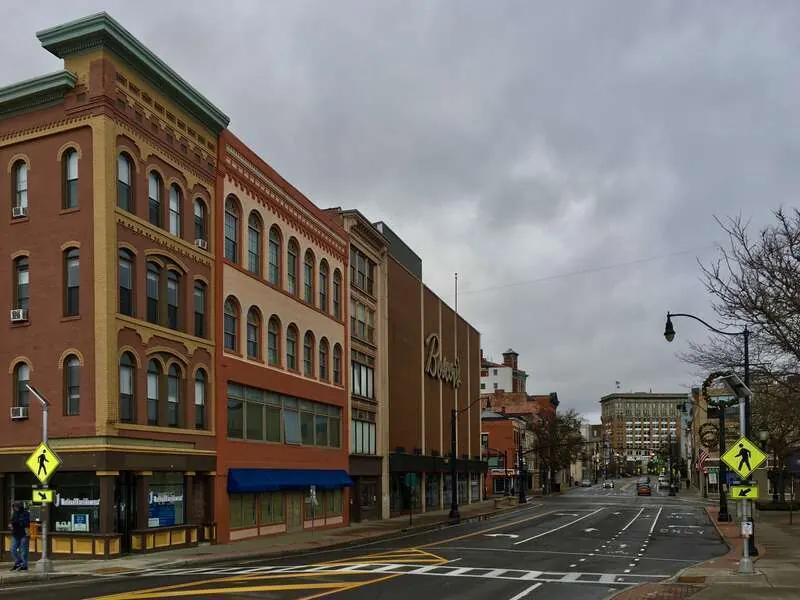
Court Street in downtown Binghamton, New York, with historic brick commercial buildings under a grey sky
Court Street, the main street of 13901: nineteenth century commercial blocks, the Broome County Courthouse a short walk away, and basements underneath that predate the floodwall. Half the downtown water damage restoration binghamton story is under those sidewalks.

The downtown building stock is the oldest commercial stock in the county: brick blocks along Court Street, the Broome County Courthouse and Government Plaza at the civic centre, and basements built for coal, storage and a river city tolerance of damp. Downtown sits close to the confluence, protected by the flood works and exposed when the works are overtopped, and its ground floors hold the restaurants, shops and offices whose losses are measured in closed days as much as in wet drywall. That is the arithmetic downtown water damage restoration binghamton crews quote first.

A downtown water loss runs on a different clock from a house. Tenants, landlords, insurers and the city can all hold a piece of the same wet floor. Health rules decide when a kitchen reopens. A soaked electrical room idles a whole building. The water damage restoration binghamton work itself, extraction, drying, cleaning, is the same craft as in a First Ward basement, but it is wrapped in scheduling, documentation and communication that a homeowner job never needs, and the commercial section of this page takes it up in full.

Downtown also holds the North Side across the Chenango, the residential half of 13901, where older homes stand between the river and the rail lines and take the same water the First Ward takes. When this page says Binghamton floods as one city, downtown is the proof: one storm closes Court Street shops, fills North Side basements and puts the county offices of Government Plaza on a flood footing in the same afternoon.

Next door

Conklin Next Door: The Town the 2006 Flood Hit Hardest

Cross the city line south and you are in Conklin, which shares Binghamton river, Binghamton forecast and, in June 2006, the worst of the valley water damage restoration binghamton flood history.

The Conklin gage tells the town story in numbers: in 2006 it recorded 25.02 feet with a peak discharge of 76,800 cubic feet per second, passing the March 1936 record on that reach, according to the United States Geological Survey. The town geography did the rest. Conklin spreads along the Susquehanna on low ground south of the city, with neighbourhoods that sit close to the river and a main road, Route 7, that the National Weather Service impact statements name directly: at 17 feet at the Binghamton gage, flood water crosses Route 7 in Conklin near the city line. When the road goes, the town is cut into pieces at the moment it most needs to move.

In 2006 Conklin was the worst hit community in the valley: hundreds of homes damaged or destroyed, and National Guard helicopter rescues in the night for people the water had surrounded. A water damage restoration binghamton crew list that stops at the city line would be a fiction; Conklin is inside the same working map, the same gage forecast and the same storm, and it appears in the coverage list at the end of this page for that reason.

Conklin also teaches the buyout and rebuilding lesson of the valley. After two record floods, some of the lowest lots in the floodplain changed use for good, and the homes that remain near the river are owned by people who have made a clear eyed decision about the water. If you are buying in Conklin, or anywhere along this reach, the water damage restoration binghamton questions to ask are the ones the ZIP and insurance sections of this page set out: what did this house take in 2006, what did it take in 2011, and is there a flood policy priced for this address, not for the town average.

The Triple Cities

The Triple Cities: Johnson City, Endicott and Vestal on One Working Map

Binghamton, Johnson City and Endicott grew up as the Triple Cities, one urban fabric of a quarter million people across the metro, and the river treats them as one address.

Johnson City begins where Binghamton west side ends, with no river and no hill between them, and its older housing takes the same groundwater and creek water as the First Ward a mile away. Endicott, downriver to the west, built its own factory era streets along the Susquehanna and flooded in the same two events. Vestal, across the river, holds the Binghamton University main campus on its hill and the Fuller Hollow and Choconut Creek corridors in its valleys, which is why a Vestal address can mean a hilltop that never floods or a creek lot that floods first.

The working point is simple: a storm over this metro does not respect village lines, and neither does a serious crew. The coverage list for water damage restoration binghamton work runs Binghamton, Johnson City, Endicott, Endwell, Vestal, Conklin, Kirkwood, Chenango, Port Dickinson, Dickinson, Maine, Union, Owego, Windsor, Whitney Point and Greene, because that is the map the water itself uses. When you call, the dispatcher asks for the town because the town changes the route and the likely source, not because the town changes whether help comes.

One caution belongs here, because the Triple Cities confuse address hunters. A business can sit in Johnson City and advertise as a water damage restoration binghamton company, and at least one company ranking for this city keeps its real address across the line in Johnson City. That is not a scandal; Johnson City is a genuine part of this metro. But a homeowner comparing crews should know which town a crew actually works from, because in a valley wide flood the difference between a crew two miles away and a crew twenty miles away is measured in hours, the currency of a wet house.

Winter losses

Frozen Pipes in the Southern Tier: Why January Breaks Fill February Ceilings

The river owns the Binghamton flood headlines, but the most common winter water damage restoration binghamton call in the 607 area code is a pipe that froze in a cold snap and announced itself in the thaw.

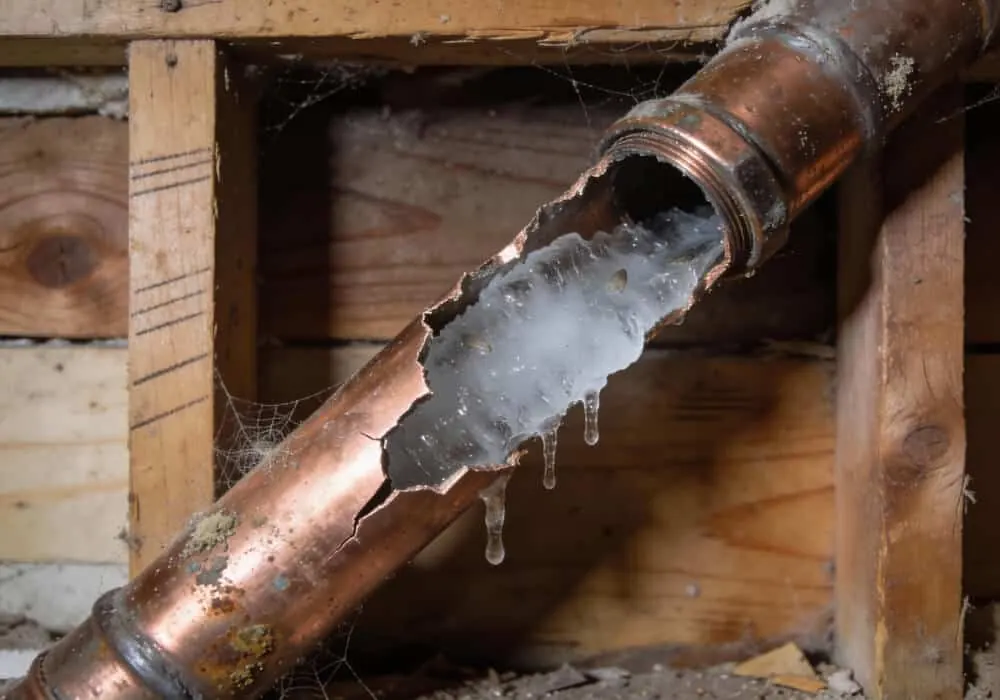
A copper water pipe split open by ice, with frozen water pushing out of the break
What a frozen pipe does to copper: the ice expands, the pipe splits along its length, and the damage stays silent until the thaw lets the water run.

The mechanics are unforgiving. Water expands as it freezes, a pipe in an outside wall, a crawl space or an unheated addition fills with ice, and the pressure splits the copper or pushes a fitting apart. The cruel part is the timing: the break often does not leak while the pipe is frozen solid, because the ice plugs its own hole. The flood starts when the weather breaks or the heat reaches the pipe, which is why Binghamton crews brace for the first mild day after every hard freeze, and why so many February ceilings fall in houses that survived January without a drip.

The houses at risk are the houses this city is made of. Older West Side and First Ward homes carry plumbing in exterior walls that were fine before additions put pipes in cold corners. Vacant houses and houses between tenants are the highest risk of all, because a pipe break with nobody home runs until a neighbour sees water under a door. A water damage restoration binghamton crew would rather meet you in January with a frozen pipe still frozen than in February with three floors wet.

Prevention of the commonest water damage restoration binghamton winter loss is cheap and specific. Keep heat on in every part of the house in a cold snap, open cabinet doors under sinks on outside walls, let a pencil thin stream run on the coldest nights, insulate the pipes you can reach, and know where your main shutoff is before you need it at midnight. If you leave a Binghamton house empty in winter, drain the system or pay for heat and a water alarm; the arithmetic is not close.

When a pipe does split, the first moves are the first hour moves: shutoff, power safety, photographs, and a call that says pipe, not flood. A pipe loss is clean water at the source, which means more of the house can be saved by prompt water damage restoration binghamton drying than in a river loss of the same depth, if the drying starts while the water is still clean and the cavities are opened or dried before the 24 to 48 hour mold clock runs out.

Basement systems

Sump Pump Failure in a Bowl Shaped Valley: The Quiet Basement Flood

No siren, no river forecast, no storm headline: the sump pump failure is the flood that happens to careful people in dry weather, and the Binghamton bowl makes it a standing water damage restoration binghamton risk.

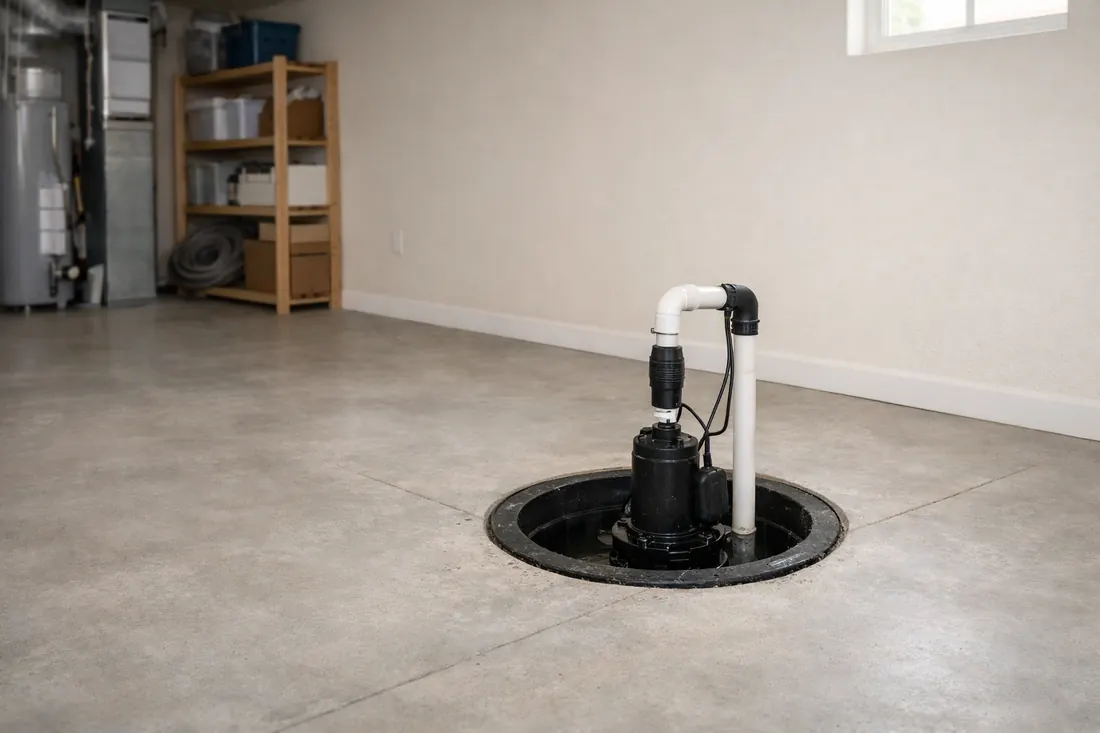
A sump pump sitting in its pit in a basement floor, with discharge pipe rising to the wall and water standing in the basin
The hardest working appliance in a Binghamton basement: a sump pump in its pit. When this one stops, the water table writes the rest of the story, and the water damage restoration binghamton call writes the ending.

Understand what the pump is holding back, because it is the source of half the quiet water damage restoration binghamton basement calls. Binghamton sits in a bowl with a water table that rises when the rivers rise and stays high through wet springs, and a great many city basements sit at or below that table for part of the year. The sump pit is a hole the water is invited into, and the pump is the only thing that escorts it out. When the pump dies, the float sticks, the discharge line freezes, or the power fails in the storm that filled the pit, the basement floods from below, evenly and quietly, often discovered by a wet sock on the way to the laundry.

The failure modes are worth listing because each one has a cheap answer. Pumps die of age, usually between seven and ten years in, and they die under load, which means during the storm: replace on a schedule, not on a failure. Floats stick on debris: keep the pit clean and test the float by hand twice a year. Discharge lines freeze where they leave the house: route and insulate them with the freeze in mind. Power fails exactly when the pit is fullest: a battery backup pump is not a luxury in this valley, it is the difference between a wet floor and a finished basement claim. A water damage restoration binghamton technician can recite this list from memory because every item on it is a basement they have dried.

The loss pattern is groundwater: clean at the source, dirty by the time it has crossed a basement floor, and worst where it reaches stored cardboard, paneling and the bottom plates of finished walls. Because the water rises slowly, sump losses are often discovered late, and late discovery is what turns a pump swap and a day of water damage restoration binghamton drying into a gut job. A water alarm on the floor beside the pit is the highest value sentence in this section.

Sewage

Sewage Backups in Older Binghamton Lines and How They Are Cleaned

The worst water in any water damage restoration binghamton house is the water that comes up through its own drains, and older Binghamton lines, heavy river storms and high groundwater make it a regular call.

A backup happens when the sewer cannot take what it is given: a main surcharged by storm inflow when the rivers are high, a house lateral choked by roots or age, or a basement fixture below the level of the next upstream manhole when the system is full. The result arrives through the lowest opening it can find, a floor drain, a basement toilet, a shower base, and it arrives as black water, category three, carrying whatever the sewer carries. It changes every rule of the water damage restoration binghamton job that follows.

The cleaning rules for black water in water damage restoration binghamton work are strict because the hazard is biological, not cosmetic. Porous materials the water touched, carpet, pad, drywall to the flood line, upholstered furniture, are removed, not dried. Hard surfaces are cleaned and disinfected. The crew works in protective gear, the occupants stay out of the affected area, and children and pets stay out until clearance, full stop. Anyone who offers to dry sewage soaked carpet in place is telling you who they are; believe them and call someone else.

Insurance treats sewage as its own water damage restoration binghamton question. A standard homeowners policy often excludes sewer backup unless a specific backup endorsement was added, and that endorsement is one of the cheapest and most refused pieces of paper in New York home insurance. Check your policy for the words sewer and drain backup before the storm, not after, and if the endorsement is missing, the prevention section of this page, backwater valve at the top of the list, becomes your policy instead.

For landlords and two family houses, a backup adds the habitability duty to the water damage restoration binghamton job, as the rental section further down this page covers: a unit with sewage in it is not a unit a tenant can be asked to live around, and the cleanup clock and the legal clock start at the same hour.

How water gets in

The Five Ways Water Gets Into a Binghamton House

Every wet house in water damage restoration binghamton work got wet one of five ways, and naming the way correctly at the door is what separates a drying plan from a guessing game.

First, over the top of the defences: river water over the levee or creek water over its banks, the 2006 and 2011 pattern, arriving as a neighbourhood event with silt, debris and a waterline that matches the house next door. Second, up from below: groundwater rising through the floor and the sump pit as the valley water table climbs, the quiet pattern that floods streets the river never touches. Third, back through the drains: sewer surcharge pushing black water up through the lowest fixtures, worst in the same storms that fill the rivers and the water damage restoration binghamton call board.

Fourth, out of the house own plumbing: burst pipes, split hoses, failed water heaters and leaking supply lines, the year round pattern that spikes in every cold snap and accounts for most single house losses in the city. Fifth, down from the sky and the slope: roof leaks, ice dams, failed gutters and hillside runoff entering through the uphill wall, the pattern of the South Side and Ely Park hill streets.

The reason the list matters is that each way in carries its own water category, its own insurance answer and its own first move. Overland river water is a flood claim; plumbing water is a homeowners claim; sewer water may be an endorsement claim or no claim at all. A water damage restoration binghamton crew writes the source at the top of the moisture map for exactly this reason: by the time the adjuster reads the file, the source is the argument, and the argument should have been settled on day one with photographs.

Finished basements

Finished Basements From the First Ward to the West Side: Where Two Inches Becomes Two Rooms

Two inches of water in an unfinished cellar is a weekend. Two inches in a finished basement is a water damage restoration binghamton renovation, and Binghamton has been finishing basements in a flood valley for forty years.

The arithmetic is in the materials. A finished basement wraps the lowest, wettest part of the house in the most water sensitive materials in the building trade: carpet and pad that hold water like a sponge, drywall that wicks it a foot above the waterline, wood paneling and laminate that swell, and insulation inside the wall that stays wet after the room looks dry. The water also finds what basements collect: the couch, the television, the stored photographs, the childhood archive in cardboard. Two inches across six hundred square feet is roughly seven hundred and fifty gallons standing in the room, and every gallon of it has to be extracted by a water damage restoration binghamton crew, then dried out of the materials it soaked into.

The decisions that decide the final size of the job are made in the first two days. Carpet over pad in river or sewer water comes out; there is no honest drying of it. Carpet wet with clean pipe water in the first hours can sometimes be dried in place, with the pad removed. Baseboards come off so the wall base can be reached. Drywall is metered, and where the insulation is wet or the water was dirty, a flood cut at a clean line above the damage turns a guessing wall into a drying wall. Each of those water damage restoration binghamton calls is a judgement with money on both sides of it, which is why the meters section of this page exists.

If you are finishing a Binghamton basement now, build the next water damage restoration binghamton flood into the design. Vinyl plank instead of carpet, no cardboard storage on the floor, a floor drain that drains, a sump pit with a backup pump, and mechanicals raised where they can be. The First Ward families who rebuilt after 2011 with those rules are the families whose next flood is a cleaning bill instead of a gutting.

The housing stock

Drying Binghamton Housing: Brick Doubles, Victorians and Valley Ranch Homes

Binghamton does not have one housing stock; it has four generations of it sharing the same streets, and each one gives water damage restoration binghamton crews its own rules.

The brick and frame doubles of the First Ward and the North Side were built in the factory decades: balloon or early platform framing, plaster and lath inside, and party walls that make one flood a two household event. Plaster dries slowly and meters honestly only with the right water damage restoration binghamton probes, and it rewards patience: plaster that is cut in panic on day one is plaster that did not need cutting. The frame ranch homes and split levels of the postwar streets, out toward the edges of 13903, 13904 and 13905 and into Vestal and Endwell, dry faster and more predictably, with drywall, fiberglass and plywood that follow the standard playbooks.

The Victorians of the West Side are the conservation cases of water damage restoration binghamton work, covered in their own section above: hardwood, plaster and trim that carry the value of the house and justify slower, gentler drying. The brick commercial blocks of downtown are the fourth stock: masonry walls that can hold astonishing amounts of water and give it back over weeks, thick floors, and basements under basements. A masonry wall that reads dry at the face can still be feeding moisture into a ground floor in week three, which is why commercial drying in 13901 is verified over time, not declared at the first good reading.

Across all four stocks, the constant is measurement. A water damage restoration binghamton crew should be able to tell you, for your house specifically, what the dry standard is, where it was measured from, and what today readings are against it. If the answer is a hand on the wall and the word dry, you are not being served by a drying company; you are being served by a mopping company with better trucks.

Hidden water

Water Behind Binghamton Walls: Cavities, Plaster and Flood Cuts

The water you can see is the easy half of every Binghamton loss. The half that decides the outcome is inside the walls, where it cannot evaporate and where mold keeps its own calendar.

A wall cavity is a closed box lined with materials that drink. Water enters at the base from a flooded floor, or from above from a pipe break or roof leak, and the cavity holds it against the back of the drywall, the insulation and the bottom plate. The room side can feel dry while the cavity is still wet, which is why a house can pass a hand test and fail a meter test, and why the week three smell so often traces to a wall everyone believed was dry in week one.

The tools for the hidden half are specific: pin and pinless moisture meters, probes that read inside the cavity through a small hole behind the baseboard line, thermal imaging to find the cold wet patches, and cavity drying systems that push dry air into the wall. The judgement calls are just as specific. Clean water, caught early, in a wall without insulation: dry in place. River or sewer water, or wet fiberglass insulation, or a cavity that will not move on the meter after two days: open the wall with a flood cut, remove what cannot be cleaned, and dry what remains with the cavity exposed.

Binghamton plaster deserves its own sentence here, because half the city older walls are lath and plaster and they break the drywall rules. Plaster holds more water, releases it slower, and can often be saved where board would be cut, but it hides a wet cavity behind a face that reads deceptively. The honest method is the same as everywhere on this page: meter the cavity, not the face, and let the readings, not the calendar and not the guess, decide when the wall is closed again.

Proof of dry

Moisture Meters, Dry Standards and Proof a Binghamton Wall Is Dry

Dry is a number, not an opinion, and the number is different in every house: it is the reading of the same material in a part of your house the water never reached.

Here is how a professional drying file is built. On the first visit the crew takes dry standard readings from unaffected framing, drywall and flooring in a dry part of the building. Every wet reading afterwards is compared against that standard, on a moisture map that shrinks as the drying works. Air movers and dehumidifiers are placed against the map, the equipment count is justified by the size and class of the loss, and daily readings are logged until every point on the map reaches the standard. That log is not paperwork for its own sake; it is the document your insurer uses to accept that the drying was necessary, sufficient and finished.

Homeowners can audit this with three questions. What is my dry standard and where did you take it? May I see yesterday readings against today on the map? What reading will you accept as done? A water damage restoration binghamton crew that dries for a living answers all three without blinking, because it records them anyway. A crew that cannot answer them is asking you to pay for time and machinery on faith.

The same readings protect you at resale and refinance. A documented dry, with a dated final log, answers the disclosure question a Binghamton buyer will absolutely ask in a city with this flood history: was this house dried properly after its flood? The file you keep from the job is the answer, and the paper trail section further down explains how to keep it.

Extraction day

Extraction Day on the Susquehanna: Pumps, Wands and the First Truckload Out

Before anything can dry, the water and everything the water ruined has to leave, and extraction day is the loudest, wettest, most physical day of the whole job.

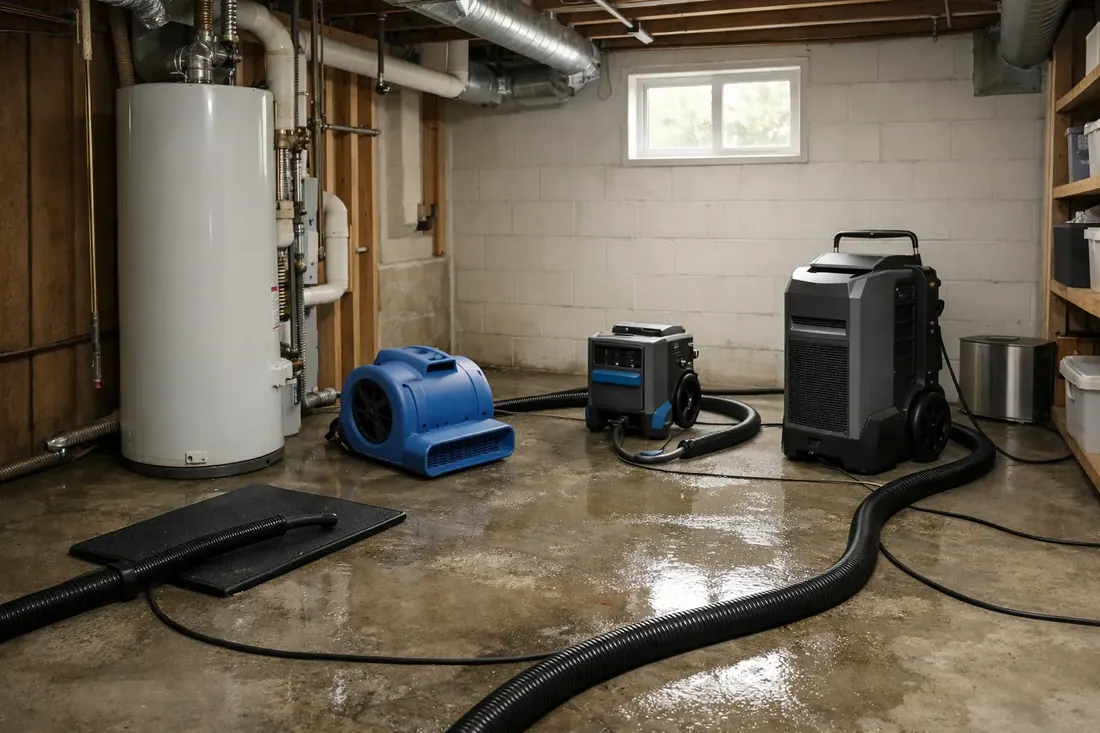
Air movers and a dehumidifier running on a wet basement floor next to a water heater during structural drying
After the water leaves, the machines stay: air movers across the floor and a dehumidifier pulling moisture out of the air and the structure, checked daily against the dry standard.

Deep water leaves by pump first, through discharge lines run to a point where the water can go without flooding the next yard or refilling the same basement. Then extraction wands and weighted tools take over, pulling water out of carpet, pad and hard floors pass by pass; a good extraction removes most of the water weight in the room, and every gallon extracted mechanically is a gallon the dehumidifiers do not have to pull out of the air over days. In a river loss there is a step a pipe loss does not need: the silt. Susquehanna and Chenango floodwater lays down river mud on every surface it touched, and the mud has to be shovelled, washed and disinfected out before drying equipment goes in, because drying silt into a floor is not restoration.

The first truckload out tells you what the water decided. Swollen furniture, soaked cardboard and soft goods, carpet and pad from dirty water, the bottom of the drywall where the flood cut goes: a water damage restoration binghamton crew sorts at the curb into what is documented for the claim, what is cleaned, and what is gone, and photographs the sort, because contents are where claims are argued longest. Keep your own list as the truck loads.

By the end of extraction day the house should look worse and be better: water gone, ruined material out, equipment humming, a moisture map on the record and a drying plan you have heard out loud. If the day ends with the water gone but no map, no readings and no plan, the job has done the easy half and skipped the half you are actually paying for.

The mold clock

The 24 to 48 Hour Mold Clock in a Binghamton Basement and New York Article 32 Licensing

Mold does not wait for the insurance company to call back. On wet drywall and wood in a warm house, growth can start within 24 to 48 hours, and that clock is the real deadline inside every drying job.

The clock explains the urgency that surprises people. Extraction and drying are not scheduled for crew convenience; they are raced against biology. Materials dried inside the first day or two usually come through clean. The same materials left wet for a week in a closed Binghamton house in September become a mold job on top of a water job, with containment, removal and clearance steps the original loss never needed. This is also why a crew will start drying before the claim is fully approved: the insurer knows the mold clock too, and mitigation first, argue later is written into the way New York claims are expected to be handled.

When mold is already present, or the wet area is large, New York law takes over. Since 1 January 2016, Labor Law Article 32 has required licensing for mold work statewide: a licensed assessor writes the work plan, a licensed remediator does the removal, and for jobs over 10 square feet the two must be separate, so the company that profits from the removal is not the company that decided it was needed. Homeowners may handle truly small areas themselves; anything bigger, anything inside walls, and anything in a rental belongs to licensed hands.

Two practical rules follow. First, never let a water crew talk you out of drying speed with the promise that mold can be handled later; later is a different licence, a different scope and a different bill. Second, if a company offers to assess and remediate a large mold job under one roof and one signature, it is offering to break Article 32, and a company casual about that law will be casual about your walls.

Commercial

Shops, Offices and Restaurants: Commercial Water Losses in the 13901 Core

A flooded store on Court Street loses money every hour it is closed, so commercial drying in downtown Binghamton is the same craft run at a different tempo with a longer paper trail.

The differences start with who is in the room. A commercial loss can involve the building owner, the tenant, two insurers, a property manager and the city, and the plan has to serve all of them: extraction and drying, yes, but also a reopening sequence that gets the business trading in its driest rooms first, documentation that separates building damage from contents, and work hours arranged around customers, patients or diners. Restaurants and food businesses add the health department to the list, and any space serving the public adds a duty to keep wet work and dry customers firmly apart.

The building stock writes the technical plan. Downtown masonry holds water for weeks and returns it slowly; a ground floor that meters dry at the wall face can still be feeding a floor from a saturated brick wythe behind it, so commercial drying downtown is verified over a longer window than a frame house. Upper floor plumbing losses in the old blocks run down through chases and appear three rooms from the pipe that caused them, which makes the moisture map, not the visible stain, the plan of record.

For a Binghamton business owner the standing preparations mirror the homeowner ones, with one addition: know your business interruption paperwork before the water, not after. Photograph the space in its dry, trading state once a year, keep the equipment list and the lease in the same file as the policy, and save the number of a water damage restoration binghamton crew in the phone of whoever opens up in the morning. The first call in a commercial loss is worth more than the first day of argument with an adjuster.

Water standing in a Binghamton home or business?

Extraction first, drying second, paperwork all the way through. One call starts all three, and the dispatcher will ask the four questions that decide the first truck: where, how deep, what source, and is the power safe.

Call (607) 555-0147 (placeholder)

Rentals

Renters, Landlords and the Warranty of Habitability in Broome County

A flooded rental is two emergencies in one address: a wet building for the owner and an unliveable home for the tenant, and New York law has something to say to both of them.

The law is the warranty of habitability, Real Property Law 235-b, and it is not optional or negotiable in the lease: a landlord must keep a rented home fit to live in, with working heat, water and sanitation, and free of conditions dangerous to health. A unit standing in river water or sewage, or dried so slowly that mold takes the walls, is not a unit a tenant can be told to live around while everyone waits. The landlord duty in a flood is to move fast on the building: extract, dry, repair, and document, and where the unit genuinely cannot be lived in, to deal honestly with the tenant about the interruption rather than letting the lease pretend nothing happened.

The tenant side of the duty is communication and care: report the water at once, do not run electrical risks to save belongings, allow the crews access, and keep your own photographs and a contents list, because your belongings are your claim, usually against your own renters policy. Renters insurance is the cheapest policy on this entire page for a First Ward or student tenant to hold. Binghamton large student rental stock, around the university and the West Side, makes this a young tenant issue as much as a family one: the lease does not cover your laptop, your clothes or your hotel.

Both sides should write things down from the first day: when the water was reported, when the crew arrived, what the drying log says, when the unit was certified dry and fit again. In a city where one flood can wet forty rental units in a week, the landlords who come out of it with tenants and insurers still speaking to them are the ones who treated the habitability duty as a schedule, not an argument. And a note for owners of two family houses in the First Ward and the North Side: your own unit and your tenant unit are one building to the water and two legal relationships to the law, and a good crew will document them as both.

Insurance

Insurance Clocks After a Binghamton Loss: 2601, Regulation 64, 2618 and the 3404 Suit Limit

New York writes its claim deadlines into statute, and a Binghamton homeowner who knows the clocks is in a different negotiation from one who only knows the hold music.

The main clock is Insurance Law 2601, the unfair claim settlement practices law, worked out in Regulation 64, 11 NYCRR 216. Under those rules your insurer must acknowledge your claim and begin investigating within 15 business days of notice. Once you have completed your proof of loss, the insurer must accept or reject the claim, in whole or in part, within 15 business days. And once the claim is settled, payment must follow within 5 business days. These are not service goals. They are the standards the New York State Department of Financial Services (DFS) enforces, and a claim diary that records the date of each step is the tool that makes them real.

Disasters get their own faster clock. Insurance Law 2618 sets a pay deadline of 4 business days in the disaster setting it covers, a number worth stating exactly because it is often quoted wrong, as 3 business days. And at the far end sits the limit that outranks the others: under Insurance Law 3404, a suit against your insurer over a property loss must be started within 24 months of the date of loss. Miss the small clocks and you have a complaint. Miss the 24 months and you have no claim at all, whatever the merits.

Two confusions to clear away. First, Insurance Law 3420(d), the late notice rule people find online, is a liability insurance provision; it does not govern your property damage claim, and advice built on it is advice for a different case. Second, if the insurer will not move, the DFS is the escalation built for this: the Department of Financial Services consumer line is (800) 342-3736 and its disaster hotline is (800) 339-1759. A water damage restoration binghamton claim file that arrives at the DFS with dates, photographs and a drying log is a file that gets read. The sections that follow take the flood insurance track and the public adjuster question one at a time.

Flood insurance

Flood Insurance and the National Flood Insurance Program: The 30 Day Wait and the 60 Day Proof of Loss

River water is not a homeowners claim. It belongs to flood insurance, and flood insurance in the United States mostly means one program with a strict set of dates.

The National Flood Insurance Program (NFIP), run by the Federal Emergency Management Agency (FEMA), is the policy most Binghamton riverfront and valley floor homes carry, because standard homeowners policies exclude flood: water that rises from the ground, over the banks or over the levee is flood by definition, whatever it does to your basement afterwards. The first date is the one that cannot be fixed after the fact: a new NFIP policy waits 30 days before it takes effect, with narrow exceptions, so the time to buy flood insurance for a First Ward or Conklin home is during a dry month, not during a wet forecast. As of this page update in November 2026, the program authorization runs through 11 December 2026, a date worth rechecking before relying on it at renewal time.

After a flood, the NFIP runs on three clocks a Binghamton claimant should write on the kitchen wall. The Proof of Loss, the sworn statement of the amount claimed, is due within 60 days of the loss, and the whole claim stands on it. If the claim is denied in whole or part, an appeal is due within 60 days of the denial. And a suit on the claim must be filed within 1 year of the first written denial. Sixty days sounds generous in week one and arrives very fast in a house that is still drying, which is why the drying documentation and the contents list should be built from day one with the Proof of Loss already in mind.

What NFIP pays for follows its own definitions: the building and its systems, and contents only if contents coverage was bought. It does not pay for the hotel, the meals or the finished basement extras many owners assume are inside the word flood. None of that makes the policy a bad buy; in this valley it is often the only one that answers the river at all. It makes the policy a document to read in the dry season, with the map of your own street in the 2006 and 2011 floods open beside it.

Adjusters

Public Adjusters, the 12.5 Percent Cap and When Binghamton Homeowners Hire One

After a big loss, a public adjuster will offer to take the claim off your hands for a percentage. New York caps that percentage, and the decision deserves the same clear eyes as any other contract signed in a wet kitchen.

A public adjuster is a licensed professional you hire to prepare, present and negotiate your claim with your insurer. The company adjuster works for the insurer; the public adjuster works for you, and is paid from the settlement. In New York the fee is capped by regulation, 11 NYCRR 25.7, at 12.5 percent of the recovery. Anyone quoting more than that cap is quoting outside the rules, and anyone who will not put the fee in writing is telling you how the relationship will go.

When does hiring one make sense in Broome County? The strongest case is the large, complicated loss: a 2011 style whole house flood, a commercial loss with business interruption, a claim stalled or underpaid against a documented file. The weakest case is the small, clean, single room plumbing loss that a good restoration file and a polite insistence on the Regulation 64 clocks will settle on their own, where a percentage of a small number buys little. Between the two sits the commonest Binghamton case, the flooded finished basement, and there the answer is: get the drying file built first, see the insurer first offer, and hire help only if the gap between file and offer is bigger than the fee.

Whoever handles the claim, keep the roles straight. The crew documents and dries; it does not negotiate your settlement. The public adjuster negotiates; it does not dry your house. And you, the policyholder, own the deadlines, the 60 day Proof of Loss on a flood claim and the 24 month suit limit on a property claim, whoever you hire, because the clocks do not move when the paperwork changes hands.

Documentation

The Paper Trail That Wins Broome County Claims: Photos, Logs and Drying Records

Claims are not won by the size of the loss. They are won by the quality of the file, and the file is built in the first week by people who may not realise they are building it.

The file has five parts. First, the first hour photographs: wide shots of every affected room before anything moves, the waterline, the source, the street. Second, the contents record: a room by room list with photographs of items as found, not as thrown, with model and serial numbers where they exist. Third, the professional record: the moisture map, the dry standard, the daily drying readings and the equipment log, which together prove the drying was measured rather than theatrical. Fourth, the money record: every invoice, every receipt for emergency work, every hotel and meal receipt if you had to leave, kept in one folder. Fifth, the claim diary: dates of the notice, the adjuster visit, the proof of loss, every promise and its date, because the Regulation 64 clocks are enforced from dates, not from impressions.

Two habits separate strong files from weak ones in this county. The first is that the homeowner list and the crew list are made independently and then compared, so nothing is carried out of the house undocumented by either side. The second is that everything is kept after the claim closes: the final drying log is a document you will want at resale, at refinance, and if a wall ever smells wrong in a later summer.

None of this requires legal training. It requires a phone camera, a folder and the decision, made on the worst day, to spend ten minutes documenting before spending ten hours cleaning. A water damage restoration binghamton crew builds its half of this file on every job. The homeowners who build their half are the ones whose claims read like evidence instead of argument.

Choosing carefully

The Sacramento Phone Trap: Telling a Real 607 Crew From a Lead Generation Site

One of the sites ranking for this city today answers its phones in Sacramento, California, and says so in its own footer. Learning to spot that pattern is a Binghamton homeowner skill now.

Here is the pattern, documented from the live search results for this keyword in November 2026. A site with a Binghamton name and Binghamton pages takes calls on a 916 number, a Sacramento area code, lists no Binghamton street address anywhere, and carries a footer line stating that the site is a lead generation service. What that means in practice: the site sells your call. You describe your flooded basement to a marketer, and your number is passed to whoever buys leads in the territory, whenever they choose to call back. In a trade where the first hour decides the size of the loss, that business model is the delay.

The neighbouring traps are worth naming too. A statewide operator can rank for Binghamton with no Binghamton location at all, listing Buffalo, Rochester, Syracuse, Albany and Poughkeepsie on its own site and no address here. A genuine Triple Cities company can sit in Johnson City while its page says Binghamton, which is honest geography but worth knowing when you are comparing response times. And directory pages will happily show you ninety odd results for this area, most of them businesses in Pennsylvania and New Jersey. None of these is a crew standing in Broome County with a truck.

The checks take ninety seconds. Ask for the street address and look for a real one in the city or its towns. Look at the phone: a Binghamton crew answers on 607. Ask the dispatcher to name the gage street or the First Ward; a local operation answers without breathing hard. Ask who exactly is coming, an employee crew or a subcontractor who bought the lead. This page prints its own number as a placeholder and says so every time, which is the least you should expect: a real business can afford to be honest about what it is.

ZIP by ZIP

ZIP by ZIP: 13901, 13902, 13903, 13904 and 13905 Water Risks

Five ZIP codes divide Binghamton, and each one has its own water personality, from the downtown core to the hill streets.

ZIPGround it coversIts water risk
13901Downtown and the North Side, Court Street, Government Plaza and the Broome County CourthouseConfluence flooding when the works are overtopped, old commercial plumbing, deep masonry basements
13902Post office boxes onlyNo streets and no houses; if your address is 13902, your building stands in one of the other four
13903The South Side, hillier and more residential, Ross Park Zoo and the hospital systems on the south endRiver flats at the bottom, hillside runoff and groundwater at the top, two different losses in one code
13904The East Side, industrial and residential mix, the Castle on the Hill above it, the highway gatewayRiver streets low, commercial roof and plumbing losses, slope runoff on the hill streets
13905The West Side and the First Ward, grand Victorian streets, Recreation Park, Ely Park aboveFirst Ward flats flood with the river; West Side heights take plumbing, ice dam and groundwater losses

One warning belongs with this table, because the internet will offer you the wrong numbers for it. Websites publish populations for these ZIP codes that add up to far more than the city itself: the tabulation areas reach into Chenango, Kirkwood, Vestal and Dickinson, so a ZIP figure counts town neighbourhoods outside the city line. The city of Binghamton held 47,969 people at the 2020 Census. When a page quotes you a much larger Binghamton population built from ZIP codes, it is counting other people towns, and it will be just as careless with the facts about your house.

For choosing where to live, read the table with the flood sections open. The question is never whether a ZIP code floods; every Binghamton ZIP code contains dry ground. The question is the specific street, its height against the 2011 waterline, and whether the house history includes the two floods everyone here is dated by.

Mistakes

Six Binghamton Mistakes That Turn a Small Leak Into a Gutted Basement

The losses that end in gutting rarely start big. They start as small water and six ordinary mistakes, every one of them made weekly in this city.

Waiting for the adjuster before drying. The mold clock runs 24 to 48 hours; the adjuster calendar does not. Mitigation first is expected by insurers and required by biology. Trusting the face of the wall. A dry feeling wall with a wet cavity is the most common expensive surprise in Binghamton housing; meter the cavity or do not call it dry. Saving the carpet from dirty water. River and sewer water end the argument: porous materials that took category two or three water are removed, and money spent drying them is spent twice.

Storing the archive on the basement floor. Cardboard at floor level in a valley city is a decision, not an accident, and 2011 audited it street by street. Plastic bins, shelves, and the good photographs upstairs. Ignoring the sump pump birthday. Pumps die under load in the storm; a pump older than its design life, with no battery backup and no water alarm beside the pit, is a flood with a fuse already lit. Signing the first contract in the driveway. In a valley wide event, the crews worth hiring are busy and the crews worth avoiding are available, and the Sacramento phone trap section of this page exists because disaster weeks are when lead generation does its best business.

Every one of these mistakes is cheap on the day it is avoided and expensive on the day it is not: the whole economics of water in this city in one sentence.

Prevention

A Binghamton Prevention Walk: Roofs, Gutters, Pipes and Pumps Before the Rivers Rise

An hour with a ladder and a torch in a dry month is worth a week with an extractor in a wet one.

None of this stops the Susquehanna, and it is not meant to. It decides which side of the line your house lands on when the water comes: the side that cleans up, or the side that guts. In a city with this gage record, that decision is made in the dry months or for you in the wet ones.

By season

Binghamton Water Damage by Season: Freeze, Thaw, Storm and River Ice

Every season in the Southern Tier has its own way of putting water in a house, and the Binghamton calendar below is the one the crews actually work.

Winter is the pipe and ice season: frozen pipes in outside walls, ice dams on complicated rooflines, river ice building on the Susquehanna with the jam risk that the January 2022 ice statement described at Sayre, Owego, Sidney and Ouaquaga, and sump discharge lines frozen at the wall. Spring is the thaw: snowmelt and rain together, the combination behind the great March floods of 1846, 1865, 1913 and 1936, high groundwater across the valley floor, and basements that weep for weeks through foundations as the bowl drains.

Summer is the storm season: stalled fronts like June 2006, tropical remnants like September 2011 arriving early in autumn, creek flash floods off the hillsides, and sewer surcharge in the heaviest rain. Autumn is the quiet season that sets the others up: it is when gutters fill with leaves, when the prevention walk should happen, when flood insurance bought in October is in force by November, and when the first hard freeze finds every uninsulated pipe the summer forgot.

The point of the calendar is not worry; it is scheduling. Each season asks for one or two small chores, and a household that does them is a household whose water stories stay small. The river will do what the river does. The house gets a say in the bill.

Field notes

Field Notes From the First Ward, the South Side and Conklin

Composite notes from the kind of calls this valley produces, written the way crews compare them over coffee: street by street, decision by decision.

First Ward, river loss, whole street. The water came over the levee in the night and stood at one even depth across the block, which made the work a street project as much as a house project: pumps passing from yard to yard, silt shovelled to the curb in a grey line the length of the block, and every house on the same drying schedule. The houses that finished first were not the ones with the most equipment. They were the ones whose owners had first hour photographs and a contents list written before the first truckload left, because their claims never stopped moving while the drying did.

South Side hill house, groundwater loss. No river within half a mile, and the basement still took two inches, up through the floor and the pit after three days of rain, because the bowl fills from below as faithfully as it fills from the banks. The furnace survived on its raised pad by an inch. The lesson the owner repeats now is the sump lesson: the pump had come with the house, nobody knew its age, and it chose the wettest week of the year to retire.

Conklin, the second flood in the same house. A family that dried out in 2006 and rebuilt with vinyl plank, raised mechanicals and plastic storage took the 2011 water in the same rooms and was cleaned, dried and documented in a fraction of the first time. Nothing about the second flood was smaller. Everything about the house answer to it was bigger. That is the whole argument of the prevention section, proven on one Conklin street.

Field notes

More Field Notes: Court Street Shops, West Side Victorians and Winter Calls

Three more patterns from the Binghamton book, each one a different building stock and a different clock.

Court Street, ground floor shop, plumbing loss from above. The pipe that failed was two floors up, and the water arrived in the shop through light fittings and a chase, three rooms from the pipe itself. The shop loss was a day of extraction and a week of verified drying in masonry that kept giving moisture back; the argument of the job was never the floor, it was the brick. The owner reopened in the dry half of the store on day three because the plan sequenced the rooms, which is the whole difference between a commercial plan and a residential one.

West Side Victorian, February ceiling. A pipe froze during the cold snap and waited for the thaw, exactly as the frozen pipe section describes, and the first sign was a ceiling stain over a dining room with a century of plaster in it. Because the call came the day the stain appeared, the hardwood below never cupped, the plaster dried in place on cavity air, and the only demolition was a hand sized piece of lath where the pipe itself was opened for the plumber. The same break found a week later would have been a different invoice and a different room.

Winter river ice call, Vestal side. The jam raised the river on a clear cold day and put a foot of near freezing water into two riverside homes while the neighbours stayed dry. The water was cleaner than a summer flood and the houses were colder than any summer loss, and the drying plan had to defend the buildings against their own heating systems drying the air unevenly. Both homes dried clean. The owners both said the same sentence afterwards: nobody believes ice can flood you until it does.

Field notes

Closing Field Notes From a Season of Binghamton Water Calls

Last notes, on the calls that never make the flood histories: the small ones, decided by small things.

The water alarm basement. A ten dollar alarm beside a sump pit woke a Johnson City homeowner at two in the morning with the water at a quarter inch, and the whole loss was a pump swap and a mop. The same failure on the same street, discovered at six in the evening after a workday, was a finished basement. There is no cheaper sentence in the water business than the alarm, and crews repeat it because they keep meeting the two versions of that night.

The photograph album on the shelf. After 2011, a First Ward grandmother moved the family photographs from a basement box to a shelf upstairs, in a plastic bin, labelled. When the creek behind the house rose two summers later and took the basement again, the bin was carried out dry in one trip while the crew set pumps. She considers the flood a non event. Restoration can replace a floor; it cannot replace 1962. Storage is restoration done in advance.

The shutoff that turned. A North Side landlord walks his doubles every autumn and turns every main shutoff a quarter turn and back, so the valves never seize. When a tenant supply line split in January, the tenant closed the water in four minutes, and the loss stayed in one bathroom. The landlord calls it his cheapest insurance, and it costs him one Saturday a year.

Case studies

Watch Real Drying Work From the Valley: Two Case Study Videos Worth Your Time

Reading about drying is one thing; watching a real crew map moisture, extract and verify a dry standard is another, and these two case studies show the craft honestly.

The first case study follows a flooded home from the first walk through to the final readings, and it is worth watching for the order of operations alone: source control, mapping, extraction, controlled removal, then drying that is checked daily rather than assumed. Notice how much of the running time is measurement. That ratio, minutes of metering against minutes of pumping, is roughly the ratio on a real job, and it is the part homeowners never see in an advertisement. Watch it here: case study video one, a full home drying job from first call to final readings.

The second case study concentrates on the hidden half of the trade, water inside wall cavities and under floors, and how panel drying and cavity drying bring a structure back to standard with the least possible demolition. It is the right preparation for the conversation every Binghamton homeowner eventually has about flood cuts and plaster, because it shows what the crew is trying to save before it shows what has to go. Watch it here: case study video two, cavity drying and hidden water, from first probe to dry standard.

Both videos are text linked only, never embedded, so the page stays fast and the choice to watch stays yours. What to carry back from them is a standard for judging any crew, including the one behind this page: if the work at your house does not look like the work in these films, measured, sequenced and verified, ask why before the equipment leaves.

Decision guide

Remediation or Restoration, Clean or Black: The Binghamton Decision Tables

Two tables settle most of the arguments in a wet Binghamton house: what the water was, and which half of the trade the job is in.

Water categoryWhat it isBinghamton examplesWhat it means for the job
Category 1, clean waterWater from a sanitary source that has not picked up contaminationA burst supply pipe, a split washing machine hose, a failed water heaterThe most saveable loss: many materials dry in place if work starts inside the first day or two
Category 2, grey waterWater carrying significant contamination that can cause sickness or discomfortSusquehanna and Chenango river water, creek flood water, groundwater that has crossed a basement floor, sump overflowExtraction, silt removal and disinfection; soaked carpet and pad come out; porous materials are judged one by one
Category 3, black waterGrossly contaminated water that can contain pathogens and chemicalsSewage backup through a floor drain or basement toilet, river water mixed with sewer surchargePorous materials touched are removed, hard surfaces are cleaned and disinfected, occupants stay out of the area until the work is done

Categories follow the standard used across the restoration industry for classifying water by contamination. Water left standing degrades: clean water in a warm house does not stay category one, which is the mold clock argument in another form.

TermWhat it coversWhere it ends
Water remediationStopping the damage: extraction, drying, cleaning, disinfection and removing material that cannot be savedA dry, clean, safe structure, ready to be repaired
Water restorationEverything remediation covers, plus the repair that returns the building to its pre loss condition: drywall, flooring, trim, paint and finishesA finished home or business, back in use

The distinction matters when you compare quotes. A remediation quote that looks cheaper may simply end earlier, leaving the repair to a second contract and a second wait. Ask every crew which side of the line its number covers, and ask the insurer the same question, because a settlement that pays remediation in full can still leave the restoration half of your house unfunded.

Services

Binghamton Water Damage Services, Listed Plainly

Fifteen services cover nearly every water loss this valley produces, from midnight extraction to final verification.

Emergency Water Extraction

Structural Drying and Dehumidification

River Flood Cleanup

Sewage and Black Water Cleanup

Burst and Frozen Pipe Cleanup

Basement Flood Drying

Sump Pump Failure Cleanup

Creek Flash Flood Cleanup

Ice Jam Flood Cleanup

Commercial Water Damage Restoration

Contents Packout and Cleaning

Hardwood Floor Drying

Wall Cavity Drying

Mold Prevention and Drying Verification

Flooded Rental and Landlord Services

How it works

Six Steps From Flooded to Dry, the Binghamton Way

The order never changes with the size of the loss: call, map, extract, remove, dry, verify, with the claim file growing at every step.

  1. Call and dispatch

    You call (607) 555-0147 (placeholder), describe where the water is and where it came from, river, creek, sewer or pipe, and a stocked crew is dispatched to your Binghamton address with pumps, extraction tools and drying equipment matched to the loss you described.

  2. Inspect and map the moisture

    The crew meters walls, floors and cavities, photographs the waterline and the source, and draws the moisture map that will guide drying and anchor the insurance file from the first hour.

  3. Extract the water

    Pumps take the deep water, extraction tools pull water from carpet and hard floors, and river silt is washed out and disinfected before any drying equipment is placed.

  4. Remove what cannot be saved

    Soaked porous material from dirty water, swollen contents and wet insulation are documented, photographed and removed, so what stays in the house is only what can honestly be dried and cleaned.

  5. Dry and dehumidify

    Air movers and dehumidifiers are placed against the moisture map, cavity drying runs where walls are wet inside, and readings are logged daily against the dry standard taken from an unaffected part of the building.

  6. Verify and document

    When every point on the map reaches the dry standard, the crew records the final readings, closes the drying log and hands you the file your insurer, your buyer or your own memory may need years from now.

Coverage

Where Binghamton Crews Roll: Broome County and the Triple Cities Towns

The home city is Binghamton itself, and the working map runs the way the water runs: Johnson City and Endicott down the Susquehanna, Endwell between them, Vestal and Conklin to the south, Kirkwood and Windsor up the valley, Chenango, Port Dickinson and Dickinson to the north, Maine and Whitney Point up the Tioughnioga side, Union around Endicott, Greene up the Chenango River, and Owego down the main stem.

BinghamtonJohnson CityEndicottEndwellVestalConklinKirkwoodChenangoPort DickinsonDickinsonMaineUnionOwegoWindsorWhitney PointGreene

Site map

The Rest of This Site: Southern Tier Pages and Topic Pages

This Binghamton page is the twenty-sixth of thirty three planned pages. Every city gets its own page, written for its own rivers, creeks, housing and history, and the topic pages carry the insurance and hidden water guides for the whole state.

Water Damage Restoration New York

The state hub page: city and region guides for water losses across New York.

Visit the page

Water Damage Restoration Brooklyn

Brownstone basements, burst pipes and flood cleanup across Brooklyn.

Visit the page

Water Damage Restoration Queens

Basement floods, sewer backups and drying across Queens.

Visit the page

Water Damage Restoration Bronx

River flooding, pipe breaks and basement drying across the Bronx.

Visit the page

Water Damage Restoration Staten Island

Coastal flooding, sump failures and storm water cleanup on Staten Island.

Visit the page

Water Damage Restoration Long Island

Storm surge, basement floods and drying across Long Island.

Visit the page

Water Damage Restoration Manhattan

High rise leaks, burst pipes and commercial water losses in Manhattan.

Visit the page

Water Damage Insurance Claim New York

New York claim clocks, proofs of loss and the paperwork that wins claims.

Visit the page

Water Damage Behind Walls NYC

Hidden leaks, wet cavities and the drying that happens inside walls.

Visit the page

Fire Damage Restoration NYC

Fire, smoke and water cleanup after a fire in New York City.

Visit the page

Flood Cleanup NYC

Flood water removal, cleaning and drying for New York City homes.

Visit the page

Water Damage Remediation NYC

Full remediation: extraction, drying, cleaning and repair in NYC.

Visit the page

Fire Damage Cleanup NYC

Soot, smoke and water cleanup after fires, handled in the right order.

Visit the page

Water Damage Restoration Rochester

Lake Ontario storms, frozen pipes and basement floods in Rochester.

Visit the page

Water Damage Restoration Albany

Hudson River flooding and winter pipe breaks in the Capital Region.

Visit the page

Water Damage Restoration Buffalo

Lake effect snow, ice and basement water across Buffalo and Erie County.

Visit the page

Water Damage Restoration Syracuse

Snowmelt, frozen pipes and sump failures across Syracuse.

Visit the page

Water Damage Restoration Yonkers

Hudson and Bronx River flooding and hillside drainage in Yonkers.

Visit the page

Water Damage Restoration New Rochelle

Sound shore flooding and basement water in New Rochelle.

Visit the page

Water Damage Restoration Mount Vernon

Sewer history, storm flooding and drying in Mount Vernon.

Visit the page

Water Damage Restoration Schenectady

Mohawk River ice jams and Stockade flooding in Schenectady.

Visit the page

Water Damage Restoration Utica

Mohawk Valley floods, snow load and frozen pipes in Utica.

Visit the page

Water Damage Restoration White Plains

Bronx River and Mamaroneck River flooding in White Plains.

Visit the page

Water Damage Restoration Troy

Hudson River crests and Poesten Kill flooding in the Collar City.

Visit the page

Water Damage Restoration Niagara Falls

Niagara River ice jams, Cayuga Creek floods and frozen pipes across Niagara County.

Visit the page

Water Damage Restoration Westchester County

Mamaroneck River floods, Bronx River and Saw Mill River flash floods, frozen pipes across Westchester County.

Visit the page

Water Damage Restoration Hudson Valley

Hudson River and creek floods, tidal surge, frozen pipes across the Hudson Valley.

Visit the page

Water Damage Restoration Capital Region

Hudson and Mohawk floods, burst pipes, ice jams across the Capital Region.

Visit the page

Water Damage Restoration Western New York

Lake effect snowmelt, ice jams and creek floods across the eight county region.

Visit the page

Water Damage Restoration Finger Lakes

Eleven lakes, Genesee River floods and canal towns across the fourteen county region.

Visit the page

Water Damage Restoration Central New York

Syracuse and Utica, Oneida Lake and the Mohawk River, across two state regions.

Visit the page

Water Damage Restoration Southern Tier

Binghamton and Elmira, Susquehanna and Chemung rivers, across eight counties.

Visit the page

Water Damage Restoration NYC

All five boroughs, the Hudson and East rivers, one fast response.

Visit the page

How Long Does Mold Take to Grow After Water Damage?

The 24 to 48 hour mold timeline, warning signs, and what stops it.

How Long Does Mold Take to Grow After Water Damage?

Mold Removal NYC

Safe mold removal, containment and drying for every NYC home.

Mold Removal NYC

Water Damage Restoration Process

The full restoration process, step by step, from first call to dry home.

Water Damage Restoration Process

What Is Water Damage Restoration

What restoration really is, what it includes, and when to call.

What Is Water Damage Restoration

Mold Remediation New York

New York's licensed remediation system, from assessment to clearance.

Mold Remediation New York

Water Removal NYC

Standing water pumped out fast, then dried safe, for every NYC home.

Water Removal NYC

Water Damage NYC

Water damage in NYC explained plainly, with fast help for every home.

Water Damage NYC

Water Damage Cleanup Nyack NY

Water damage cleanup in Nyack explained plainly, with fast help for every home.

Water Damage Cleanup Nyack NY

How to Choose a Water Damage Restoration Company in New York

How to choose a water damage restoration company in New York, with every check that protects your home.

How to Choose a Water Damage Restoration Company in New York

Commercial Water Damage Restoration NYC | 24/7 Emergency Help

Commercial water damage in NYC explained plainly, with fast help for every business.

Commercial Water Damage Restoration NYC | 24/7 Emergency Help

Basement Water Damage Restoration NYC

Basement water damage in NYC explained plainly, with fast help for every basement.

Basement Water Damage Restoration NYC

Water Damage Repair New York

Water damage repair in New York explained plainly, with fast help for every home.

Water Damage Repair New York

Water Damage Restoration Poughkeepsie New York

Water damage restoration in Poughkeepsie explained plainly, with fast help for every home.

Water Damage Restoration Poughkeepsie New York

Emergency Water Damage NYC

Emergency water damage in NYC explained plainly, with fast help when every minute counts.

Emergency Water Damage NYC

Water Damage Cleanup in NYC

Water damage cleanup in NYC explained plainly, from torn-out materials to dry rooms again.

Water Damage Cleanup in NYC

Flood Damage Restoration NYC

Flood damage restoration NYC explained plainly, from flood events and NFIP claims to dry rooms and a flood-resistant rebuild.

Flood Damage Restoration NYC

How Long Does Water Damage Restoration Take

How long water damage restoration takes, stage by stage, from the first extraction hour to the final dry standard reading.

How Long Does Water Damage Restoration Take

Flood Damage Cleanup Washington Heights

Flood damage cleanup in Washington Heights explained plainly, from flood water removal and cleaning to drying and repair.

Flood Damage Cleanup Washington Heights

Does Insurance Cover Water Damage Restoration

Whether insurance covers water damage restoration, explained plainly, by cause and New York rule.

Does Insurance Cover Water Damage Restoration

Water Damage Mold Remediation

Mold that grew after a leak or flood, remediated the New York way, by licensed assessor and remediator.

Water Damage Mold Remediation

Water Damage Restoration Companies New York

Compare the companies serving New York: national franchises, regional firms and local independents, and how to verify licences and certification before you hire.

Water Damage Restoration Companies New York

Water Damage From Upstairs Neighbor

Water damage from an upstairs neighbor in New York City: who pays, what to do in the first hour, and how to document, report and claim.

Water Damage From Upstairs Neighbor

FAQs

Binghamton Water Damage Questions, Answered Straight

Thirty questions Binghamton homeowners, renters and landlords actually ask, answered with the law, the clocks and the local facts attached.

What should I do first when the Susquehanna floods my Binghamton basement?

Move people and pets to dry ground first, and keep clear of any water that has reached outlets, appliances or a breaker panel. Do not wade in to save belongings while the power question is open. Then call for water damage restoration binghamton help and take wide photographs of every room before anything is moved, because those first photos anchor the insurance record of where the river reached, how deep it stood and what it touched.

How fast can a crew reach a flooded home in Binghamton, New York?

Crews based in the 607 area code work the city and the Triple Cities around the clock, and the first questions on the call are where the water came from, how deep it is and whether the power is safe. A river or creek flood gets pumps and extraction gear on the first truck, while a burst pipe call gets shutoff guidance before anyone rolls, so the water stops rising while help is on the way.

Who is the best water restoration company?

The honest answer is the company that can prove four things at your door: it is really based here and answers on a local number, it meters and maps moisture instead of guessing, it documents the job for your insurer as it goes, and it can explain the drying plan for your house in plain words. Any company can call itself the best. Ask for the dry standard it will dry your walls to, and judge the answer. That question separates water damage restoration binghamton crews from mopping services faster than any advertisement.

Can water damage be restored?

Most of it, yes, if the work starts in time. Clean water losses caught in the first day or two usually dry in place with floors, walls and trim saved. River water and sewage narrow the options, because soaked porous materials have to come out, but the structure itself, framing, masonry, subfloors, can almost always be dried, cleaned and rebuilt. What cannot be restored is time: the same loss left wet for a week grows mold, swells hardwood past saving and turns a drying job into a demolition.

What is the difference between water remediation and restoration?

Remediation is the stopping half of the trade: extraction, drying, cleaning, disinfection and removing material that cannot be saved, ending with a dry, clean and safe structure. Restoration is the whole job, remediation plus the repair that returns the building to the condition it was in before the loss, with drywall, floors, trim and paint finished. When you compare quotes or an insurance offer, ask which side of that line the number covers, because a cheaper remediation figure may simply end earlier.

How to tell if water damage is permanent?

Look for the signs that drying cannot reverse: hardwood that has cupped and stayed cupped after full drying, drywall that has gone soft and crumbly, plaster that has lost its key and sounds hollow in sheets, particleboard and laminate that have swollen, and framing that meters dry but has stained and weakened at the joints. A crew should test rather than guess, with meters, probes and a hammer tap on plaster. Some damage that looks permanent in week one is cosmetic; some that looks minor is structural. Measurement, not the photograph, decides.

Does homeowners insurance cover Susquehanna River flood water in Binghamton?

Almost never. A standard homeowners policy covers sudden water from inside the house, a burst pipe or a failed appliance, and excludes flood, which means water that rises from the ground or over the riverbanks. River water in your basement is a flood claim, and flood claims are paid by flood insurance, usually a National Flood Insurance Program policy, not by the homeowners policy. If you do not carry flood insurance and the river reaches you, the water damage restoration binghamton work is still urgent, but it is paid from your pocket or disaster assistance, not from the policy.

How long does my insurance company have to respond to a claim in New York?

New York sets the clocks by law. Under Insurance Law 2601 and Regulation 64, the insurer must acknowledge your claim and begin investigating within 15 business days of notice, must accept or reject the claim within 15 business days after you complete your proof of loss, and must pay within 5 business days once the claim is settled. In the disaster setting covered by Insurance Law 2618, the pay clock is 4 business days. Keep a dated claim diary, and if the clocks slip, the Department of Financial Services consumer line is (800) 342-3736 and the disaster hotline is (800) 339-1759.

What is a Proof of Loss, and how long do I have to file one?

A Proof of Loss is the sworn, itemised statement of what you are claiming: what was damaged, what it was worth and what you are asking the insurer to pay. On a National Flood Insurance Program claim it is due within 60 days of the loss, and the claim stands or falls on it, so it should be built from the first hour photographs, the contents list and the drying file rather than written from memory in week eight. Homeowners claims carry their own proof requirements in the policy; either way, treat 60 days as the outer wall and file early.

How long do I have to sue my insurance company after a water loss in New York?

Twenty four months from the date of loss, under Insurance Law 3404, for a suit on a New York property insurance policy. That limit is shorter than most people expect and it runs while you are still negotiating, so a claim that is dragging near the end of its second year needs legal advice, not another phone call. Flood claims under the National Flood Insurance Program run on a different rule: suit must be filed within 1 year of the first written denial. Write both dates down on the day of the loss.

What happened in Binghamton during the 2011 flood?

On 8 September 2011 the remnants of Tropical Storm Lee stalled over a basin already soaked by Hurricane Irene, dropped 10 to 15 inches of rain, and drove the Susquehanna River at Binghamton to a crest of 25.73 feet, the record for a gage history that begins in 1846, according to the National Weather Service. Roughly 20,000 people were forced from their homes, the levee was overtopped without failing, creeks like Fuller Hollow and Choconut Creek destroyed roads in minutes, and damage across the upper Susquehanna basin came close to one billion dollars.

What happened in Binghamton during the 2006 flood?

On 28 June 2006 a stalled front dropped 8 to 15 inches of rain in two days and the Susquehanna crested at 25 feet in Binghamton. About 15,000 people were evacuated in the Binghamton area alone, four lives were lost in New York across the three basins, twelve counties were declared federal disaster areas, and more than 15,500 residents applied for assistance, with recovery assistance passing 227 million dollars, according to the United States Geological Survey. Conklin was the worst hit town in the valley, and at some stations the flood exceeded a 500 year recurrence interval.

Which flood was worse in Binghamton, 2006 or 2011?

By the gage, 2011: 25.73 feet against 25 feet, the two highest crests since records began in 1846, five years apart. By spread, 2011 again, with roughly 20,000 people forced out against about 15,000 in 2006, and main stem crests from Binghamton to Waverly running 1 to 4 feet above the 2006 marks. By local suffering the argument never ends, because Conklin took its worst blow in 2006. Combined, the two events caused over two billion dollars in damage, and both are covered in full in the case study sections of this page.

Does the levee protect my Binghamton home from the Susquehanna?

Up to its design limit, yes, and beyond it, no. The floodwall and levee works completed in 1943 were designed against the largest floods then on record, the July 1935 Chenango River flood and the March 1936 Susquehanna flood, according to the United States Army Corps of Engineers. For the common floods, the 14 to 19 foot events, the system keeps whole neighbourhoods dry. In 2006 and 2011 the river brought more water than the design flood, and the system was overtopped. A home behind the levee is protected from most floods, not from the river itself.

What does it mean when the levee is overtopped?

It means the river rose higher than the top of the floodwall or levee and spilled over it, while the structure itself stayed standing and kept holding back the full force of the river. Overtopping is not a failure or a breach: there is no wall of water and no collapse, just river water pouring over the crest and filling the protected streets from the top down. Binghamton Northeast system was overtopped in both 2006 and 2011 and performed with no failures, which is why so many flooded houses behind it were dried and reoccupied rather than demolished.

Why does my sump pump keep failing during Binghamton storms?

Because a storm is when the pump works hardest and when everything it depends on is stressed at once: the water table in this bowl shaped valley rises with the rivers, the pit fills faster, the pump runs near continuously, and the power often fails in the same weather. Pumps also die of age, usually under load, and floats stick on debris. The fixes are a pump replaced on schedule rather than on failure, a clean pit with a free float, a discharge line that cannot freeze shut, and a battery backup for the outage hours. A water alarm beside the pit catches what all of that misses.

Is sewage backup covered by my homeowners policy?

Usually only if you bought the specific sewer and drain backup endorsement, which many policies offer and many homeowners decline without realising what it is. Without the endorsement, a standard policy commonly excludes water that backs up through sewers and drains, even when everything else about the loss is covered. Check the policy wording in a dry month. If the endorsement is missing, a backwater valve on the house lateral is the mechanical version of the same protection, and it works on the night the sewer surcharges whether an adjuster agrees or not.

How long before mold starts growing after a basement flood?

On wet drywall, wood and paper faced materials in a warm house, mold growth can begin within 24 to 48 hours of the water arriving. That clock is why extraction and drying are raced rather than scheduled, and why a flooded Binghamton basement should never be closed up wet to wait for an adjuster. Materials dried inside the first day or two usually come through clean. The same materials left wet for a week become a mold job on top of the water job, with licensed assessment, containment and removal added to the bill.

Do I need a licensed mold assessor in New York?

For mold work beyond a small area, yes. Since 1 January 2016, New York Labor Law Article 32 has required licensing for mold assessment and mold remediation statewide. A licensed assessor inspects and writes the work plan, a licensed remediator performs the removal, and on jobs over 10 square feet the two must be different licensees, so the company paid for the removal is not the company that decided it was necessary. A homeowner can handle a truly small patch personally; anything inside walls, anything widespread and anything in a rental property belongs to licensed hands.

What should a Binghamton landlord do after a rental floods?

Act on the building and the law at the same time. Under Real Property Law 235-b, the warranty of habitability, a landlord must keep a rental fit to live in, so the duties are immediate: extract and dry the unit with a documented crew, repair what the water damaged, and deal honestly with the tenant about any period the unit cannot be lived in. Keep dated records of the report, the crew arrival and the drying log. The tenant belongings are the tenant claim, usually on a renters policy, but the building, the systems and the habitability are the owner side of the line.

Which ZIP codes does Binghamton use, and which neighbourhoods do they cover?

Five codes, 13901 to 13905. 13901 is Downtown and the North Side, including Court Street and Government Plaza. 13902 is post office boxes only, with no streets or houses. 13903 is the South Side, hillier and more residential, with Ross Park Zoo. 13904 is the East Side, a mix of industry and homes below the Castle on the Hill. 13905 is the West Side and the First Ward, the Victorian streets and the river flats in one code. The ZIP by ZIP table on this page matches each code to its water risk.

What is the population of Binghamton, New York?

47,969 at the 2020 Census, according to the United States Census Bureau, with a metropolitan area of 247,138. Be careful with larger numbers attached to this city online: ZIP code tabulation areas for 13901 to 13905 reach into the towns of Chenango, Kirkwood, Vestal and Dickinson, so population figures built from ZIP codes count thousands of people who do not live in Binghamton at all. The city itself is 11.13 square miles, the Broome County seat, and one of the Triple Cities with Johnson City and Endicott.

How do I spot a lead generation site pretending to be a Binghamton restorer?

Run four checks that take ninety seconds. First, the phone: one site ranking for this city today takes calls on a 916 number, which is Sacramento, California, not the 607 area code of Broome County. Second, the address: it lists no Binghamton street address anywhere. Third, its own footer states that the site is a lead generation service, which means your call is sold on, not answered by a crew. Fourth, ask the dispatcher a local question, like which street the river gage sits on. A real water damage restoration binghamton company passes all four without effort.

Can hardwood floors be saved after a flood?

Often, yes, when the water was clean and the call came early. Hardwood can be dried in place with mat extraction systems that pull moisture through the boards, and cupping that looks alarming while the floor is wet often settles as it dries to standard. The odds fall with time, with dirty water and with every day the floor stays wet underneath. River water that sat for days, or sewage at any depth, usually ends the argument. The deciding instrument is the moisture meter, not optimism: a floor is saved when its readings reach the dry standard of the same floor in a dry room.

Who pays for a hotel if I have to leave my flooded home?

On a homeowners claim, additional living expense coverage usually pays the reasonable extra cost of living out, hotel included, when a covered loss makes the home unliveable, and it is one of the most useful parts of the policy in a bad week. Keep every receipt. Two cautions: the coverage follows the claim, so a river flood excluded from the homeowners policy usually means no living expense from that policy either, and National Flood Insurance Program policies do not pay living expenses at all. Disaster assistance after a declared flood is the backstop, not the plan.

How do I document a flood claim so it gets paid?

Build the file in the first week, in five parts: photographs of every room before anything moves, with the waterline and the source in frame; a room by room contents list with photographs of items as found; the professional record, meaning the moisture map, the dry standard and the daily drying log from your crew; every invoice and receipt, including hotel and meals if you left; and a claim diary with the date of every call, visit and promise. Insurers pay claims they can verify. A complete file converts an argument about your loss into an audit of your evidence.

What should I do when river ice jams the Susquehanna in January?

Treat a January thaw after a hard freeze the way you treat a summer storm warning. In January 2022 the National Weather Service reported the Susquehanna partially frozen at Sayre, Owego, Sidney and Ouaquaga, with sheet ice and frazil slush in the channel; that is the setup for a jam, where broken ice catches on a pier or bend and backs water up behind it within hours. Watch the river statements, move basement belongings up if your street is riverfront, and keep the house heated, because an ice jam flood in a house that loses heat becomes a frozen pipe claim by the second night.

Is a house in Conklin covered by the same crews as Binghamton?

Yes. Conklin sits directly south of the city line on the same reach of the Susquehanna, reads the same Binghamton gage forecast, and appears by name in the National Weather Service impact statements for that gage: at 17 feet, water crosses Route 7 in Conklin near the city line. Conklin was the worst hit town in the valley in 2006, with hundreds of homes damaged or destroyed. The coverage list on this page includes Conklin, Kirkwood, Vestal and the rest of the valley towns for exactly that reason: the water does not stop at the city line, and neither does the work.

How long does drying a flooded Binghamton home usually take?

Once the water is out, most homes reach their dry standard in three to five days of active drying. River losses run longer: silt has to be washed out first, plaster and masonry give their water back slowly, and hardwood can need a week or more of mat drying to settle. The honest answer is never a number of days promised at the door; it is a dry standard measured in your own house and a daily log of readings moving toward it. The job is done when the meters say the structure matches the dry parts of the building, and not before.

Can I stay in my home while it is being dried?

Usually, yes, for clean water losses: the equipment is loud and the affected rooms are out of use, but the rest of the house stays liveable, and most Binghamton families stay through a pipe loss with air movers running down the hall. River water and sewage change the answer: contaminated areas stay closed until they are cleaned and cleared, and a home without safe power, heat or a working bathroom is not a home anyone should sleep in. Your crew should give you a straight answer for your house on day one, and if the answer is leave, your homeowners living expense coverage is the next call.
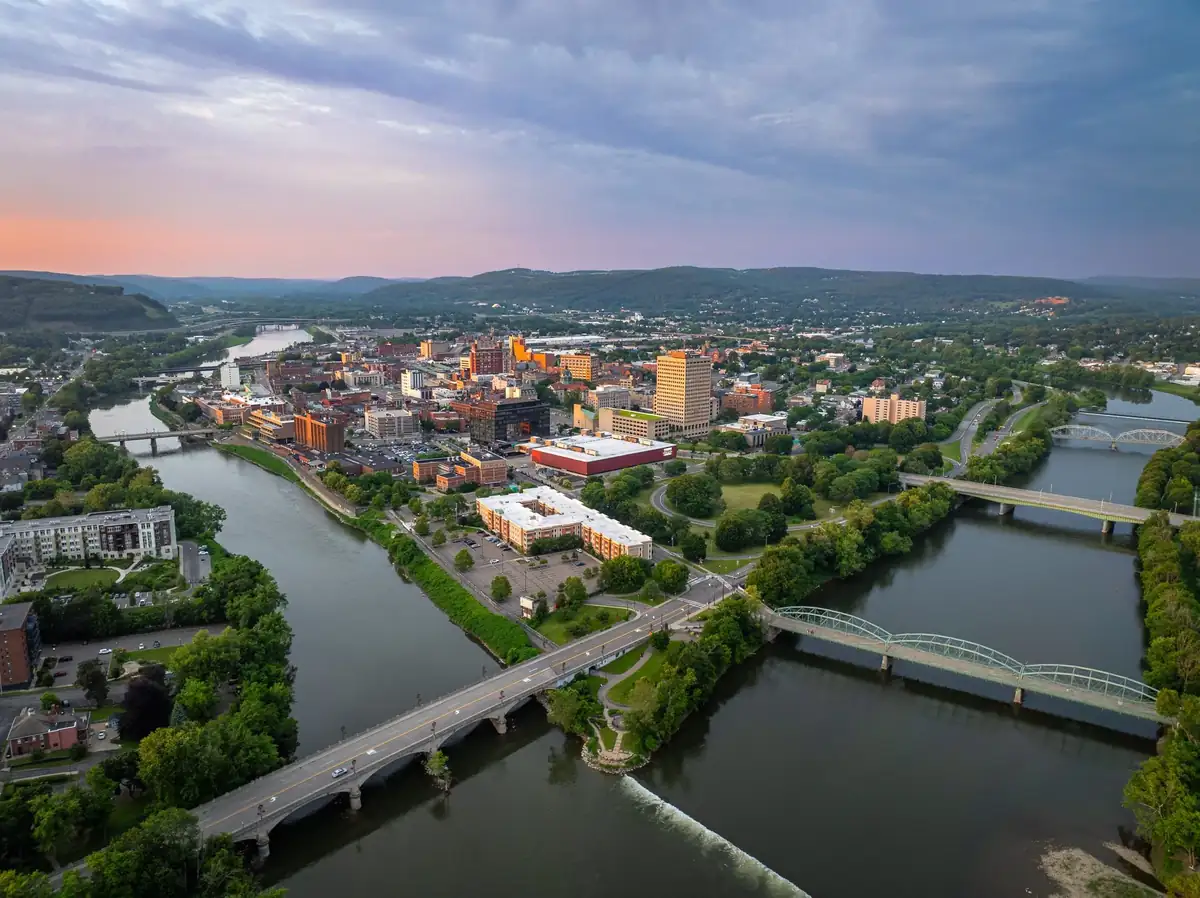
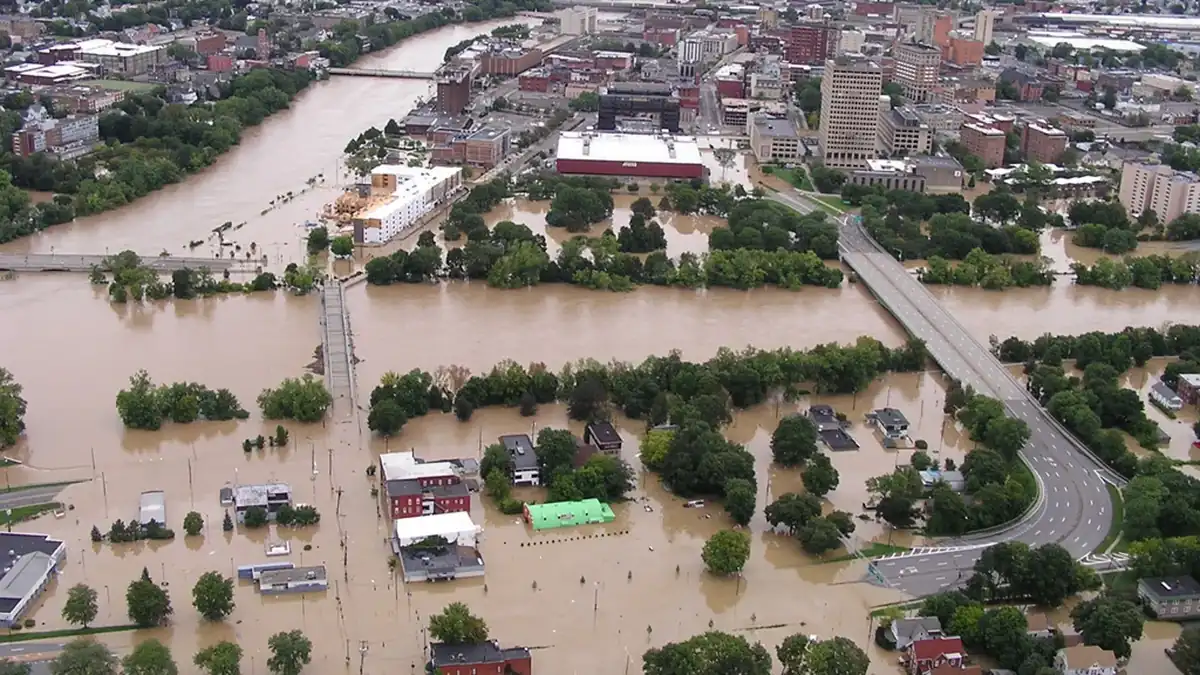
Call (607) 555-0147 (placeholder)