Quick answers
The Short Version: Ten Checks, in the Order to Make Them
Most people arrive on this page standing in water, phone in hand, with a search engine open and a decision to make inside the hour. So here is the short version first. The company you hire will extract the water, dry the building, handle your belongings and write the paper your insurer will judge. Choosing that company is not a detail of the job; it is the job, decided in advance. Ten checks, made in the right order, will carry almost every New York homeowner to a sound hire: response, licences, certification, insurance, scope, contract, claim help, reputation, crew and local knowledge. Each check on this page gets its own section, its own law or standard where one exists, and its own way of verifying what you are told.
The order matters as much as the list. Response comes first because water does not wait: the Environmental Protection Agency advises drying water damaged areas within twenty four to forty eight hours to prevent mold growth, and that clock starts when the water arrives, not when you start reading. Licences and certification come next because they can be checked from your kitchen table, on official searches, before anyone crosses your threshold. The written scope and the contract come before the heavy work because paper agreed in calm is worth ten arguments in a dried and closed wall. Reputation and crew come last in the sequence only because they take the longest to test; on a slow leak, with no emergency running, you may well start there.
- One: a phone answered by a person, and a crew that can start today.
- Two: licences that match the work, verified on the official searches.
- Three: IICRC certification you can look up by name on the Global Locator.
- Four: the company's own insurance, proven with certificates, not adjectives.
- Five: a written scope with a moisture map and daily drying logs promised in writing.
- Six: a complete contract that meets New York's section 771 list.
- Seven: real help with your claim, inside the deadlines Regulation 64 sets.
- Eight: reviews and references you test yourself, including the bad ones.
- Nine: the actual crew and equipment that will attend your home, named in advance.
- Ten: local knowledge of New York buildings, New York water and New York rules.
Notice what is not on the list. Price talk appears nowhere in the ten checks, and that is deliberate, for two reasons. The first is that this site is built for readers who will act by phone, and the honest comparison between companies is made on written scopes for identical work, not on numbers quoted blind. The second is that a figure given before inspection is not information; it is bait or a guess, and the Attorney General's guidance to New York homeowners points the same way, toward written contracts, escrowed deposits and payments that follow completed work. Compare the work. Compare the paper. The ten checks will do the rest.
One more quick answer belongs here, because it is the one callers ask with the most embarrassment: is it normal to check a company this carefully while your floor is wet? It is not only normal; it is what the careful companies expect. A firm that answers around the clock, carries its licences proudly and writes its scopes before it works will recognise the questions on this page as the questions of a serious customer. The firm that sighs, hurries you or tells you the checks can wait until after the signature has told you, in that sigh, most of what the checks would have found. Learning how to choose a water damage restoration company begins with permission to take the hour the decision deserves.
In one line: how to choose a water damage restoration company is to check ten things, in order, on paper, before the first fan is plugged in.
Speed matters, but only inside the method: how to choose a water damage restoration company is to be quick and careful in the same hour.
Keep this short version open on your phone while the calls are made, because how to choose a water damage restoration company is a sequence, and sequences are easy to lose under stress.
Ten checks, ten short searches and calls at most: that is the real arithmetic of how to choose a water damage restoration company.
Plain meaning
What Choosing Well Actually Means When a Home Is Wet
Choosing sounds like a small word for what is actually happening. When you hire a restoration company, you are handing a stranger the keys to your home at its most vulnerable moment, authority over your belongings, a vote in what gets saved and what gets thrown away, and authorship of the documents your insurer will use to decide your claim. You are also hiring under time pressure, often at night, often frightened, and almost always without the knowledge to judge the technical work you are buying. That combination, urgency plus trust plus ignorance, is exactly the combination that consumer law, licensing systems and industry certification exist to protect. Choosing well means using those protections instead of admiring them.
It helps to separate the three decisions hiding inside the one phone call. The first decision is about competence: can this firm actually dry a building, with trained people, the right equipment and measurements that prove the result? The second is about legality: is this firm licensed for the work it proposes, insured against the accidents its work can cause, and willing to contract on the terms New York law sets? The third is about character: will this firm tell you the truth when the truth is unwelcome, about a wall that must open, a rug that cannot be saved, a claim the insurer may resist? A company can pass the first test and fail the third. The ten checks on this page are arranged so that each decision gets its own evidence.
There is also a New York shape to this decision, and it is why a generic national guide will not do. Mold work in this state is licensed under Article 32 of the Labor Law, with a separation rule that forbids the same licensee from assessing and remediating the same property. Home improvement contracting in the city runs through a licensing system you can search from your phone, complete with a published list of contractors caught working without a licence. Insurance claims here run on clocks written into Regulation 64 and, after a declared disaster, into section 2618 of the Insurance Law. A homeowner choosing anywhere else in the country faces a simpler map. A New Yorker who learns this state's map chooses with the law standing behind the chair.
Choosing well also has a time structure, and it is kinder than the emergency suggests. The first hour is for safety, for stopping the water and for the first calls. The first day is for scopes, checks and the contract. The days of drying are for watching the logs arrive and the readings fall. Nothing in the ten checks requires a week of research; every one of them can be done between the first call and the first signature, most of them from the same chair, on the same phone that found this page. The homeowners who regret their hire rarely regret a lack of time. They regret a signature given before the questions were asked.
Finally, choosing well means knowing what the decision is not. It is not finding the biggest company, because networks send local crews and local crews are what you get. It is not finding the cheapest promise, because a promise is not a scope. It is not finding the firm with the most stars, because stars are easy to gather and hard to audit. It is the slower, duller, stronger thing: a firm whose licences verify, whose technicians are certified, whose scope is written, whose contract is complete and whose drying is proven in numbers. That is how to choose a water damage restoration company in a way that still looks wise in six months, when the floors are dry and the claim is closed.
Keep the three decisions separate, competence, legality and character, and how to choose a water damage restoration company becomes a method instead of a gamble.
Competence can be measured, legality can be searched and character can be watched: how to choose a water damage restoration company uses all three kinds of evidence.
The decision feels like one phone call and behaves like a small investigation, and treating it as an investigation is how to choose a water damage restoration company well.
Make the three decisions separately and how to choose a water damage restoration company stops depending on luck.
The research
What the Search Data Says About This Decision
This page was researched before it was written, and the research holds a surprise worth knowing before you hire anyone: for all the searching New Yorkers do on this question, almost nobody has answered it properly. Two research tools were used, SEMrush and Moz, and they disagree with each other in ways this page will report honestly rather than smooth over. SEMrush, checking United States desktop results, found the search behind this page carrying a volume of one hundred and ten searches a month and a keyword difficulty of seven percent, which it classes as very easy. Moz found a volume of forty, in a range of eleven to fifty, and a difficulty of fourteen, which it classes as low. The older figure in our own planning sheet, one hundred and forty at six percent, is out of date, and this page does not use it.
The disagreement goes deeper than volume. SEMrush reads the intent behind the search as informational: people want to learn how to choose. Moz reads the same search as transactional: people want to hire. Both readings are half right, and the halves explain the shape of this page. A reader in a wet kitchen is learning and hiring in the same hour, which is why the page teaches the checks in full and still puts a phone number at the top. The two tools also disagree about what a searcher sees. SEMrush reports an AI Overview, reviews and video among the results features. Moz reports People Also Ask and related searches. Report both, this page says, and trust neither completely.
| Measure | SEMrush (US, desktop) | Moz (US) |
|---|---|---|
| Monthly volume | 110 | 40 (range 11 to 50) |
| Difficulty | 7 percent, very easy | 14, low |
| Intent | Informational | Transactional |
| Click through rate | Not reported | 92 percent |
| Minimum domain authority | Not reported | 9 |
The most useful finding is about the results themselves. In SEMrush's top ten for this search, there is not one dedicated guide to choosing a company. The list is filled with general water damage pages from the national networks, led by SERVPRO and Paul Davis, answering a choosing question with a services page. Moz's top eight, last updated on November 24, 2026, contains exactly one dedicated choosing guide, published by a PuroClean franchise in Jacksonville, Florida. A keyword gap check between the two largest networks sharpened the picture: the exact search behind this page is missing from SERVPRO's rankings entirely, while Paul Davis ranks for it. In plain terms, the biggest name in the industry does not answer this question, and the homeowner asking it is met mostly by pages that were written to sell, not to teach choosing.
The questions real searchers ask were collected too, from Moz's People Also Ask data, and all four appear word for word in this page's thirty questions: whether water remediation is expensive, whether SERVPRO is a good restoration company, who the biggest restoration company is, and what a water damage restoration technician is. A neighbouring search also matters: the phrase built around the word best carries three hundred and twenty searches a month in SEMrush with a commercial intent and a difficulty of twenty seven percent. This page answers that search as a question about judgement, how best is recognised, and never as a ranked list of New York companies, because no honest ranking exists and inventing one would fail every check this page teaches.
One gap in the research should be stated as plainly as the findings. Domain level figures and backlink data for the two big networks could not be obtained in this research round; the tools placed them behind an upgrade wall, and this page does not recycle older numbers in their place. What the research does establish is enough: the question is real, the existing answers are thin, the two measuring tools disagree, and the homeowner is left to choose with better method than the search results currently offer. That gap is the reason this page runs to the length it does.
When the tools disagree, report both and choose on method: that is the research lesson, and it is also how to choose a water damage restoration company.
Thin results are an opportunity for the reader, not a verdict on the question, and reading them honestly is part of how to choose a water damage restoration company.
Two tools, two answers, one method: the research behind how to choose a water damage restoration company models the honesty the page asks of firms.
A question the biggest network does not answer deserves a full answer, and giving it one is the purpose of how to choose a water damage restoration company as this page teaches it.
Check one
Check One: How Fast They Answer, and What the First Call Reveals
The first check is the simplest to make and the hardest to fake: call, and watch the clock and the manner. Water damage is a trade that runs on response, because the science of the work runs on a clock. The Environmental Protection Agency advises drying water damaged areas and items within twenty four to forty eight hours to prevent mold growth. A firm that cannot be reached, that promises a callback in the morning, or that books an emergency visit for Thursday has failed the first check before any other question is asked. Around the clock answering is not a courtesy in this trade. It is the entry requirement, and every serious firm on your list should meet it without being asked twice.
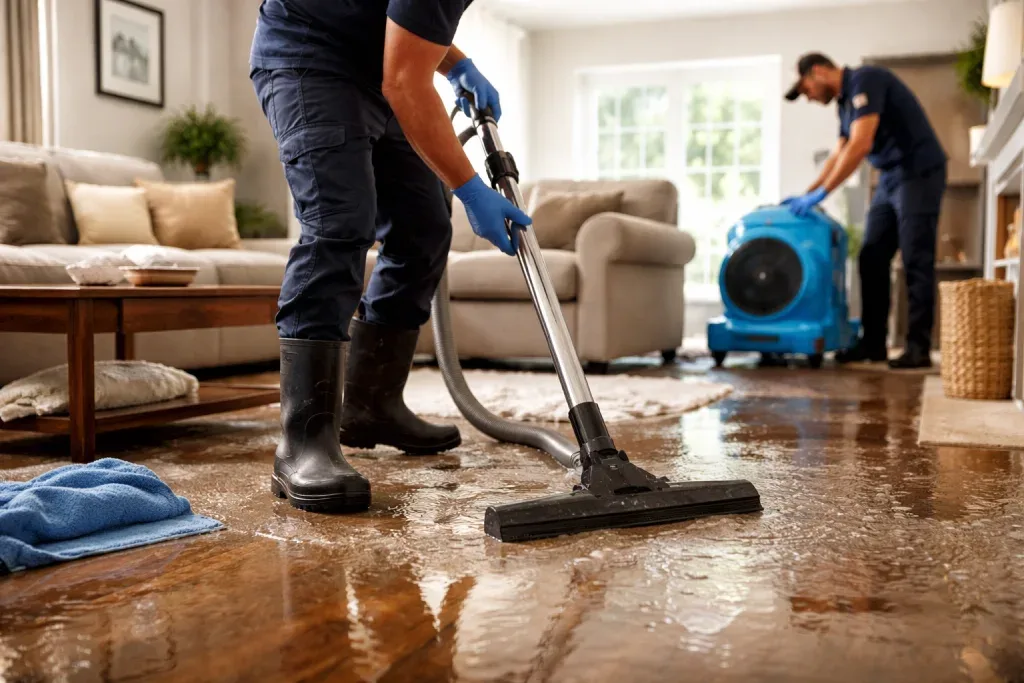
Listen, on that first call, for what the person at the other end asks you. A good first call is an interview in both directions. Expect to be asked which rooms have water, how deep it is, where it came from, when you found it and whether the source is stopped. Expect safety questions too: is the water near anything electrical, does it smell of sewage, is anyone in the home unwell or unable to move easily? Those questions tell you the firm is already planning the job, sorting clean water from dirty, extraction from drying, tonight from tomorrow. A bad first call asks only for your address and your insurer's name. That firm is planning its paperwork, not your drying.
Speed has a second meaning beyond the first visit: the speed of the whole response chain. Ask when a crew can be at your door, what the first visit will accomplish, and what happens the following morning. On a real emergency the honest answer has a shape: extraction and safety tonight, a moisture map and a written scope fast behind it, drying equipment placed against the map rather than against a guess. Ask also who will call you, and when, with the first readings. A firm that schedules its own communication is a firm that expects to have something to report. A firm that goes quiet after the fans start has told you how the rest of the job will feel.
There is a trap inside this check, and it catches people every week: speed offered as a substitute for everything else. The fastest answer in New York is often a storm chaser with a mobile phone and no address, and the second fastest is a call centre selling your job to whoever bids for it. That is why response is check one of ten and not the only check. A fast answer earns a firm the next nine questions; it does not excuse it from them. The licences, the certification and the written scope can all be checked in the same hour as the first call, from the same chair, while the crew is on the road. Urgency and diligence are not enemies. In a well run hire, they happen at the same time.
Judge the first call by its questions as much as its speed: that is check one of how to choose a water damage restoration company.
A person answering at midnight is the first piece of evidence you will ever collect about how to choose a water damage restoration company.
Write down what each firm asked you; the questions reveal the planning, and the planning reveals how to choose a water damage restoration company on evidence.
Response earns the interview, never the job: that is the discipline inside how to choose a water damage restoration company.
Check two
Check Two: The Licences a New York Company Should Be Able to Show
The second check is licences, and New York makes it more interesting than most states, because the licences here come in layers and the layers map exactly onto the work in your home. There is no single card that makes a restoration company legal for everything. There is a state licence for mold work, local licences for home improvement work, and an industry certification, IICRC, that sits beside the licences as evidence of training. A firm that understands its own position will explain the layers calmly and tell you which of them it holds. A firm that waves one document as proof of everything, or that treats the question as an insult, has failed the check in the act of answering it.
Start with the layer that touches the most flooded homes: home improvement licensing. The Attorney General's guidance states that home improvement contractors must be licensed in New York City, Suffolk, Nassau, Westchester, Putnam, Rockland and the City of Buffalo. Inside the city, the licence is the Home Improvement Contractor licence issued through the consumer protection department, DCWP, and it can be searched online in minutes. The contract law that stands behind this licensing, section 771 of the General Business Law, requires contracts in writing, signed by all parties, with the contractor's licence number included if applicable. When a firm tells you licensing does not apply to its work, ask it to put that sentence in writing. The request alone sorts firms quickly.
The second layer is mold, and it is stricter, because mold is where water damage goes when it is mishandled. Under Article 32 of the Labor Law, assessing or remediating mold is licensed work in New York, and the licence system has run since January 1, 2016. If your job involves mold growth on an area greater than ten square feet, the people assessing it and the people remediating it need Department of Labor licences, of the right types, and the same licensee cannot lawfully do both jobs on your property. The next section of this page is given to Article 32 in full, because it is the part of New York law that most protects a homeowner and the part most often skipped in a hurry.
The third layer is the one firms advertise loudest and homeowners understand least: IICRC certification. It is real, it is valuable, and it is not a licence. The IICRC is a private non profit body; its certifications are the trade's training credentials, earned by examination. A firm can be fully licensed and uncertified, certified and missing a local licence it needs, or, as you want, both licensed and certified. Check three of this page is devoted to it. For the licence check itself, hold the line at a simple standard: every licence the work requires, named, numbered and verifiable on an official search, with the name on the licence matching the name on the contract.
Practical habits make this check take ten minutes. Ask for licence details on the first call and note exactly what you are told. Run the searches while the crew travels: the Department of Labor search for mold licences, the DCWP search for a city home improvement licence, the IICRC locator for certification. Photograph or save what the searches show. If a search finds nothing, say so on the next call and listen to the explanation; databases lag, names are misspelled, and honest firms survive a query. What an honest firm never does is ask you to skip the search. That request, whenever it comes, is the loudest answer the licence check can give.
Licences are the floor of the hire, not the ceiling: check two of how to choose a water damage restoration company is passed on official searches, never on a logo.
Ten minutes of searching now is worth a month of arguing later, which is why the searches sit so early in how to choose a water damage restoration company.
Names must match across licence, contract and van, every time, and checking the match is basic to how to choose a water damage restoration company.
The licence check is where how to choose a water damage restoration company becomes a habit rather than a hope.
Mold law
Article 32: The Mold Licence Rules Behind the Second Check
Article 32 of the New York Labor Law is the statute that licenses mold work, and a homeowner choosing after water damage should know its shape, because water and mold are separated by about two days and one bad decision. The law's core is section 931: no one may perform mold assessment or mold remediation without a licence, apart from a narrow exemption in section 933 for work on property you own yourself. Licensing has applied since January 1, 2016. The Department of Labor licenses five kinds of professional under the article: assessor, remediation contractor, abatement worker, remediation supervisor and project designer. When a firm speaks of being licensed for mold, the useful follow up question is: licensed as which of the five, and in whose name?
The licence itself has a life cycle worth knowing, because an expired licence presented confidently is a New York tradition. Under section 932, a licence is issued after application and fee, with insurance certificates filed, and the licence must be displayed; it is not transferable, which means it belongs to the named holder and cannot be lent by a partner firm. Under section 934, a licence is valid for two years. Renewal requires a department approved refresher course taken within one year before the renewal, and the law allows a grace period of one hundred and twenty days after expiry. When you check a licence on the department's Find a Licensee search, you are checking all of this at once: the name, the type and the currency of the credential.
Then comes the rule that makes Article 32 famous among people who read statutes, and it deserves its own paragraph and its exact words. Section 936 states: "No licensee shall perform both mold assessment and mold remediation on the same property." Notice the precision. The statute speaks of the licensee and the same property. The Department of Labor's own summary of the same rule speaks of the same individual. This page preserves that difference rather than smoothing it, because the difference is where arguments live. Around the central sentence, sections 936.2 to 936.4 add bars on ownership and financial interests between the assessing and remediating sides, with a duty to disclose interests that exist. The design is unmistakable: the person who measures your mold problem must have no financial interest in the size of the answer.
Two more provisions shape real jobs. Section 945(1) limits a mold assessment, as a rule, to surfaces greater than ten square feet, unless the client requests otherwise, and the department's guidance defines a Mold Project in the same terms: areas greater than ten square feet, excluding routine cleaning and construction work that is not about mold. The department is also plain that the mere presence of mold triggers nothing by itself; the licensing duties arise when you hire someone to assess or remediate it. And the enforcement path is public: the department directs consumers to its licensee search and its What to Expect guidance, and reports of fraud go to the Attorney General. A homeowner who knows these five facts, the licence duty, the five types, the two year life, the separation rule and the ten square foot line, knows more mold law than most of the firms that will knock on the door.
Use Article 32 as a conversation, not an ambush. Ask the firm in front of you how the separation rule will work on your job: who assesses, who remediates, and what paper connects them. A firm working lawfully inside the article answers fluently, because it arranges this separation on every mold job it touches. A firm that has never heard of the rule, or that offers to assess and remediate your home itself with one signature, has given you the most valuable information the licence check can produce. Walk away from that offer even if every other check was passed, because a firm casual with this statute will be casual with your drying logs too.
Article 32 is the state's own answer to half of how to choose a water damage restoration company: licensed people, separated duties, verified names.
The separation rule is the homeowner's friend disguised as a regulation, and knowing it changes how to choose a water damage restoration company whenever mold is present.
Ask who assesses and who remediates before anyone mentions your walls: the answer sorts firms faster than any advertisement, in the Article 32 part of how to choose a water damage restoration company.
Article 32 rewards the reader: how to choose a water damage restoration company in mold country starts with this statute.
Check three
Check Three: IICRC Certification, and How to Verify It Yourself
The third check is certification, and its centre is one organisation: the IICRC, the Institute of Inspection, Cleaning and Restoration Certification. Understand first what it is. The IICRC is a private non profit industry body, founded in 1972 by Ed York, originally under the initials IICUC. It is not a government agency and it issues no licences. What it does is arguably more useful to a homeowner: it writes the standards the trade works to, and it examines and certifies the people and firms who do the work. By its own count it has more than forty nine thousand active certified technicians and more than six thousand five hundred certified firms. When a company calls itself IICRC certified, it is claiming a place inside that system, and the claim can be checked.
The certifications form a ladder, and knowing the rungs lets you ask precise questions. The foundation is WRT, Water Restoration Technician: no prerequisites, an examination of sixty questions with a pass mark of seventy percent, sat in sixty minutes, and continuing education required to keep the credential alive. Above it sits ASD, Applied Structural Drying, which requires WRT first and covers the deeper craft of drying a structure: moisture meters, drying equipment and the judgement of what can be saved. AMRT, Applied Microbial Remediation Technician, also requires WRT, and covers microbial remediation, the discipline your job needs the moment mold enters it. A sensible hiring standard follows: WRT as the floor for anyone touching your home, ASD behind a serious drying job, AMRT where mold is involved, and Article 32 licensing standing on top of all of it where New York requires it.
Verification is the heart of this check, and the IICRC has built the tool for it: the Global Locator, with its Find a Certified Professional search. You can search by name, company, ZIP code, city, state or country. Use it before the crew arrives, and check two things: that the firm appears, and that the name in the locator matches the name on your contract, the same discipline as a licence check. The locator also marks the higher business tier, Certified Firm, which the IICRC holds out as its highest standard for ethics, business practices and insurance coverage. One honesty note from the IICRC itself deserves repeating: the locator is not a referral service. It confirms certification. It does not recommend the firm, and a listing is evidence of training, not a character reference.
Read certification claims with the same care as licence claims, because the failure modes rhyme. A logo on a van is not a certification. A technician who was once certified, and let the continuing education lapse, is not certified now. A firm whose owner holds a credential while the attending crew holds none has told you something about its standards. Ask who, by name, will attend your home, and which certifications those people hold. Then look them up. Serious firms answer this without blinking, because they pay for the training and sit the examinations precisely so that a careful customer can find them. The firms that blur the answer are usually blurring it on purpose.
Set the bar plainly: certification verified by name, on the locator, for the people who will actually enter your home. That is check three of how to choose a water damage restoration company.
A logo is a claim and the locator is the evidence, and preferring evidence is the habit at the centre of how to choose a water damage restoration company.
Check the people, not only the firm, because people do the drying, and people are who how to choose a water damage restoration company finally hires.
Certification you verify yourself is the only kind worth paying for, and that is central to how to choose a water damage restoration company.
Check four
Check Four: The Company's Own Insurance, Proven on Paper
The fourth check is the one homeowners most often confuse, so let this section separate two different subjects that share a word. Your insurance, your homeowners policy and your claim, gets its own sections later on this page. This check is about the company's insurance: the cover that stands behind the firm while its people, its equipment and its decisions are inside your home. Restoration work is physical work in a damaged building. Ladders, demolition, electrical drying equipment running for days, water and power in the same rooms. If something goes wrong, the question of who pays is answered by the firm's insurance, or by you. Checking it is not suspicion. It is arithmetic.
Ask for certificates, and expect them to exist. A certificate of insurance is the standard document that names the insurer, the kinds of cover and the period they run for, and legitimate firms produce them routinely because landlords, building managers and insurers ask for them constantly. New York law builds the same expectation into its systems: an Article 32 mold licence is issued with insurance certificates filed under section 932, and section 771 requires a home improvement contractor to disclose its insurance position before work begins. A firm inside those systems is surrounded by paper. When the firm in your kitchen cannot produce a certificate, or promises to send it next week, you are not looking at an administrative delay. You are looking at the firm's relationship with documentation, which is the same relationship it will have with your drying logs.
Know what to look at when the certificate arrives. The name on it should be the name on your contract. The dates should cover the days the work will happen. The cover should be real cover for this kind of work, held by a real insurer whose name you recognise or can look up. You are not expected to audit the policy; you are expected to confirm that the document exists, is current and belongs to the firm in front of you. Keep a copy in your file, beside the licence copies. If your building has a management office, expect it to ask for exactly this document before it lets a crew through the lobby, which is one more reason a professional firm carries it ready.
There is a second, quieter insurance question inside this check: how the firm behaves around your policy. A company confident in its own cover talks about your claim calmly and factually. A company shaky about its own position sometimes compensates with theatre about yours, offering to handle everything, sign everything and bill everything, in ways the later sections of this page examine under claim help and assignment of benefits. Hold the two subjects apart in your mind and in your questions. Their insurance protects you from their accidents. Your insurance pays for your loss. A firm that keeps the two straight in conversation will usually keep them straight in paperwork.
Make the standard absolute and simple: no certificate, no contract. It is check four of how to choose a water damage restoration company, and it takes one email to pass.
Certificates exist to be shown; reluctance to show one is information, and information is what how to choose a water damage restoration company runs on.
Their cover protects you from their accidents, and the paper proves it exists, which is why the certificate check belongs in how to choose a water damage restoration company.
No certificate, no contract: a hard line that makes how to choose a water damage restoration company simpler, not harder.
Check five
Check Five: A Written Scope With Moisture Mapping and Drying Logs
The fifth check is where a hire stops being a conversation and becomes a document: the written scope of work. A scope says, room by room, what the firm will do: what will be extracted, what will be dried in place, what will be cleaned, what will be removed and what will be left alone, together with the documentation the firm will produce as it works. It is the single most protective piece of paper in the whole job. With it, you can compare three firms on identical work. With it, your insurer can see a plan instead of a story. With it, a disagreement on day four has a text to return to. Without it, you have bought a performance and your only record is memory.
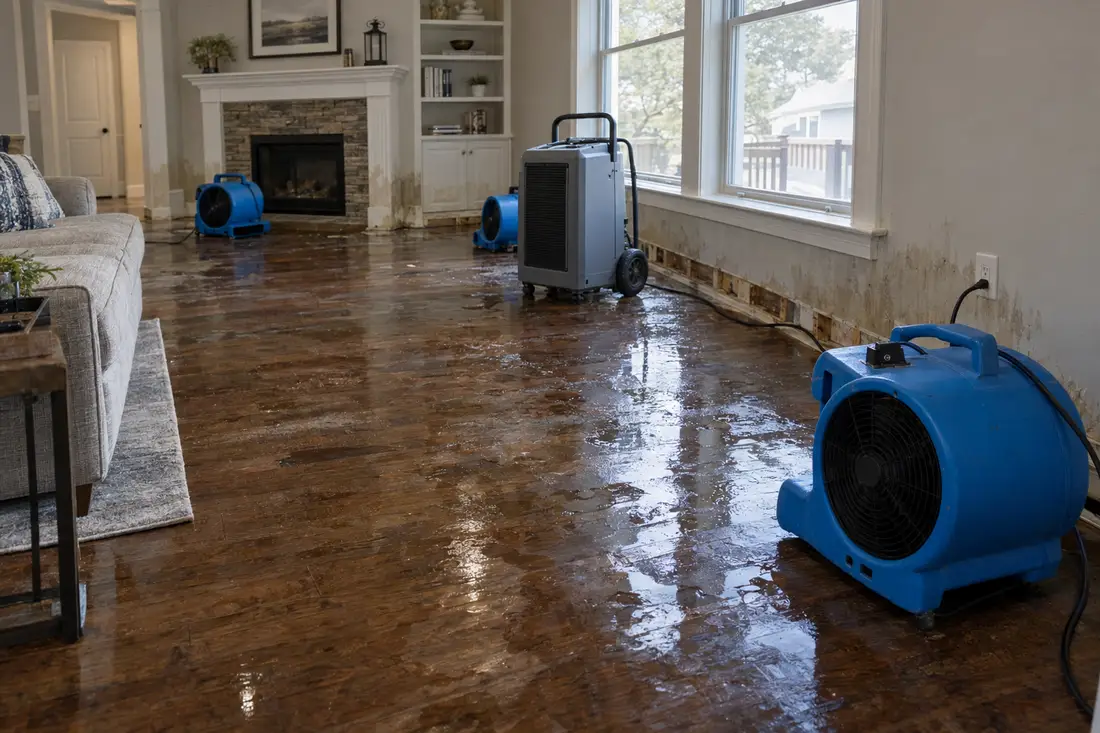
Two instruments give the scope its spine, and both should be named in it. The first is the moisture map: the record, drawn at the start of the job, of where the water travelled and how wet each point is. Water travels further than eyes follow: under flooring, along the bottom of a wall into the next room, up inside wallboard by wicking, down through a ceiling into a light fitting. The map is drawn wide on purpose, and its dry readings at the edges matter as much as its wet readings at the centre, because the edge is the proof of where the water stopped. The second instrument is the drying log: readings taken at the same mapped points, every day, until each material reaches its dry standard. The map is the promise. The log is the proof the promise was kept.
Learn the phrase dry standard, because it is the target the whole log aims at. A dry standard is the moisture level of a known dry area of the same material in your own home, a reading taken from an unaffected wall or floor and used as the goal for the wet areas nearby. It is an honest target because it belongs to your building, not to a sales brochure. This is also why you should be wary of any firm, or any web page, quoting one universal moisture figure or one fixed number of drying days for every home. Drying is governed by the materials in your rooms, the water they hold and the conditions the equipment can maintain. The standard that matters is measured in your house, against your house.
Ask the scope question in its sharpest form before you sign: if I call you on day three and ask how dry the bedroom wall is, what exactly will you show me? The right answer is a log with dates, points and numbers, and a map that shows where the points are. The wrong answers are all adjectives: fine, good, nearly there, looking dry. Adjectives cannot be filed with an insurer. Numbers can. Also ask what would make the firm open a wall or lift a floor, and listen for readings as the trigger: a cavity that stays wet on the meter earns demolition; a surface that merely looks damp does not. Judgement driven by instruments is the whole craft. The scope is where the firm promises, in advance, to practise it.
A scope also protects the firm, and you should let it. It records what was agreed before anyone knew how the week would go, and it gives a good crew a defence against the moving target of a frightened household's changing mind. Sign it, keep it, and judge the job against it. That is check five of how to choose a water damage restoration company: nothing important agreed only out loud.
The map is drawn before the fans, or the fans are guessing, and guessing is what how to choose a water damage restoration company is designed to eliminate.
A scope you can hold beats a promise you can only remember, a sentence worth repeating inside any account of how to choose a water damage restoration company.
Paper first, work second: the sequence at the core of how to choose a water damage restoration company.
The drying standard
How You Will Know the Drying Was Done Properly
Every choosing guide eventually owes its reader an answer to the simplest question in the trade: how will I know it worked? Drying is invisible while it happens and expensive when it fails, showing up weeks later as smell, swelling, lifted flooring or mold in a wall you paid to save. The answer is that proper drying announces itself in documents while it is still happening. You will know because the firm mapped the water at the start, because it read the same points daily, because the readings fell in a line that makes sense, and because the equipment came out when the numbers, and not the calendar, said the materials had reached their dry standard.
The industry's reference for all of this is the IICRC S500, the standard for professional water damage restoration. The current edition is the Fifth Edition, published in 2021, and a revision is under way; the editions before it appeared in 2015, 2006, 1999 and 1994. A firm that works to the S500 approach will speak the language of this section naturally: categories of water, classes of loss, mapping, monitoring, dry standards. One limit must be stated honestly, because this page states its limits: the S500 is a paid professional text, and its internal tables are not reproduced here. Anyone, firm or website, who quotes you a precise universal moisture percentage or a fixed drying period and attributes it to the standard should be asked to show the passage. Expect the approach, verify the readings, and let invented figures disqualify the person quoting them.
Know the supporting instruments by sight so you can follow a job in your own home. A pin meter pushes two small probes into a material and reads its moisture directly; it is the referee for wood and wallboard. A pinless meter scans a wider area without leaving marks; it is the scout that finds the wet region the pins then confirm. A hygrometer reads the air, because drying is a negotiation between the material and the room. Thermal imaging can show the cool signature of wet material behind a finished surface. None of this is theatre. Each instrument exists because water hides, and the homeowner who understands the toolkit can read a drying log the way a patient reads a temperature chart: not expertly, but well enough to know whether the line is falling.
Your part in proof is presence. Be there, or have someone there, when readings are taken in the first days, and ask the technician to show you one wet point and one dry point on the meter. Keep the logs as they arrive rather than collecting them at the end. If a reading stalls, ask what changes: more equipment, a different placement, an opened cavity. A good crew welcomes the questions because the log is its best advertisement. A crew that shields the numbers, forgets the log twice running, or declares the job dry while its own meter disagrees has failed the only test that cannot be argued with, and your contract and your file are what you will stand on when you say so.
Dry is a number, reached point by point and written down daily. Insist on seeing it. That insistence is the working heart of how to choose a water damage restoration company.
Yesterday's reading and today's reading, side by side, are the whole story of a drying job, and reading them is a skill inside how to choose a water damage restoration company.
Ask to see one wet point and one dry point on the meter, because a homeowner who can read a meter understands how to choose a water damage restoration company.
Proof offered daily is what separates drying from waiting, in how to choose a water damage restoration company and in the work itself.
Check six
Check Six: The Written Contract New York Law Expects
The sixth check takes you from the firm's documents to the state's: the contract itself. New York's General Business Law, section 771, is unusually specific about home improvement contracts, and a homeowner who knows its list can read any offered contract the way an editor reads a draft, pen in hand, looking for what is missing. The foundation rule is simple: every home improvement contract must be in writing and signed by all parties. A handshake with a van outside is not a contract in this state. Neither is a work order with a signature line and nothing above it. If the document you are offered would embarrass its own author read aloud, it is not ready for your signature.

The contents list in section 771 is the checklist to read against. The contract should carry the contractor's name, address and phone number, and its licence number if applicable. It should give approximate start and completion dates. It should describe the work to be done and the materials to be used. It must include the lien law notice, which warns you about the rights a contractor can acquire over your property, and the notice about escrow or bond protection for payments you make before completion, under section 71-a(4) of the Lien Law. The contractor must disclose its insurance position before work begins. And under section 771.2, the contract must be written in plain English, a requirement worth savouring: the state has legislated against the fog. Read for each item. Ask for any missing one to be added. A firm that contracts lawfully every week will treat your list as routine.
Two money rules inside the section deserve their own light. The first concerns progress payments: they must bear a reasonable relationship to the work actually done. Money follows work, in proportion; that is the statutory shape, and your payment schedule should mirror it, with the deposit small, negotiated and held in escrow with notice of where it is held, as the Attorney General advises. The second is a warning about a rule that does not exist: section 771 sets no maximum deposit. If a firm justifies a large deposit by citing a legal percentage, or a salesman warns you the law requires half up front, you are hearing invention, and invention about the law is a serious tell. What the law gives you instead of a cap is structure: writing, escrow, proportion and disclosure.
The cancellation right completes the picture, and it is the clause to locate before you sign anything. You may cancel a home improvement contract until midnight of the third business day after signing. The emergency exception is narrow and formal: where work is a genuine emergency, the right can be waived only by a handwritten waiver, signed by you, describing the emergency. Flooded homes are exactly where this clause earns its keep, because they are where midnight signatures happen. If you are asked to waive, ask what the emergency is, watch it being written by hand, and keep a copy. And whether or not a waiver is involved, use the three days as the law intends: read the contract again in daylight, check the licence searches once more, and let calm finish what urgency began.
Never sign a blank or partly blank document, never sign what you have not read, and always leave with your own copy. That is check six of how to choose a water damage restoration company, and the Attorney General's page says nearly the same in nearly the same words.
Read for the missing items; absence is the loudest part of a bad contract, and noticing absence is a trained part of how to choose a water damage restoration company.
Plain English is the law's own requirement, so insist on understanding every line, as anyone learning how to choose a water damage restoration company should.
The contract is the hire, written down: how to choose a water damage restoration company is mostly the art of getting it complete.
Check seven
Check Seven: Real Help With Your Insurance Claim, Within the Clocks
The seventh check concerns the second job every restoration firm quietly performs: feeding your insurance claim. The drying will be judged twice, once by your nose and once by an adjuster reading a file, and the second judgement decides who pays. Real claim help has a recognisable shape. The firm photographs the damage before anything moves, and keeps photographing. It writes a scope an adjuster can price. It maps moisture and logs readings daily. It keeps invoices, equipment records and notes in a file it will hand you whole. It talks to the adjuster with documents in hand. None of this requires the firm to be your advocate, your lawyer or your public adjuster. It requires the firm to be a good witness, and good witnesses are made of paper.
Know the difference between claim help and claim theatre. Theatre sounds like this: leave everything to us, sign here, we will handle your insurer, no need for you to call them. The Attorney General's guidance points the other way: contact your insurer before non emergency work where you can, take no permanent work before the adjuster has approved it where approval is required, and expect the contractor to work with the adjuster rather than around them. A firm offering help will welcome your insurer's involvement early, because its documentation survives scrutiny. A firm offering theatre prefers a head start and a signed assignment, and the section of this page on assignment of benefits explains why that preference should slow your pen.
Your own duties inside the claim deserve a paragraph, because choosing a company does not outsource them. Tell your insurer promptly. Photograph everything before anything is moved, and keep photographing as work proceeds. Keep every receipt, including the small ones for buckets, fans and hotel nights. Write down the claim number and the name of every person you speak to. Start mitigation, the work that stops a loss growing, without waiting for permission, because policies expect reasonable steps and because water does not wait for offices. The firm you hire should make each of these easier: feeding you photographs, copies and readings for your file as a matter of routine. Judge claim help by what lands in your hands each day, not by what was promised on the first call.
Finally, measure claim help against the clocks in the next section. New York gives your insurer deadlines, and deadlines reward the documented. A claim file that arrives complete, scoped, mapped and logged is a file an adjuster can accept inside fifteen business days. A file assembled afterwards, from memory and fragments, invites the written request for more time that Regulation 64 allows. The firm you choose is, whether it knows it or not, choosing which of those two files your claim will be. Ask on the first call what the firm will give you, in writing, for your insurer, and when. The specificity of the answer is the check.
Hire the witness, not the theatre: check seven of how to choose a water damage restoration company is passed in documents, delivered daily.
Your insurer will meet the file before it meets you, so hire the firm that writes a good one; that is the claim help test inside how to choose a water damage restoration company.
Photographs before anything moves: the cheapest claim help ever offered, and a first hour habit in how to choose a water damage restoration company.
Judge help by what lands in your hands each day, which is the practical test inside how to choose a water damage restoration company.
The clocks
The Claim Clocks: Fifteen Business Days, Five Business Days, and the Disaster Rules
New York insurance claims run on statutory clocks, and a homeowner who knows them holds a quiet advantage in every conversation with an insurer and with a restoration firm. The main clock lives in Regulation 64, section 216.6(c): after proof of loss, or notice of claim where that is the trigger, your insurer has fifteen business days to accept or reject your claim. If it needs longer, it must say so in writing, with reasons. Once a claim has been unresolved for ninety days, the insurer must update you at least every ninety days thereafter. These are not courtesies. They are duties, and they are the reason the documentation habits taught on this page matter: a complete file is one an insurer can decide on inside its clock.
Three companion rules in the same regulation complete the homeowner's hand. Section 216.6(a) requires a fair and reasonable offer where coverage is undisputed. Section 216.6(e) requires the undisputed elements of a claim to be paid even while other elements remain in dispute, which means an argument about one room should not freeze payment for the whole house. And section 216.6(f) requires payment within five business days once an amount is agreed. Read those three together and a strategy appears: document everything, separate the undisputed from the disputed, agree what can be agreed, and let the clocks run on the rest. A restoration firm that understands Regulation 64 will build your file in exactly that shape without being asked.
| Rule | What it requires | Where it lives |
|---|---|---|
| Accept or reject | 15 business days after proof of loss, written reasons if more time is needed | Regulation 64, 216.6(c) |
| Updates | At least every 90 days once a claim is unresolved past 90 days | Regulation 64, 216.6(c) |
| Payment after agreement | Within 5 business days | Regulation 64, 216.6(f) |
| Disaster investigation | Begin within 15 business days, with a written estimate | Insurance Law 2618(c) |
| Disaster payment | Within 4 business days of acceptance | Insurance Law 2618(d) |
After a declared disaster, a second statute tightens the frame. Section 2618 of the Insurance Law applies where the governor has declared a disaster or the president has declared a state of emergency, and it adds duties for claims arising from that disaster. Under section 2618(c), the insurer must begin investigating within fifteen business days, provide a written estimate, and inform you of your right to complain to the Department of Financial Services. Under section 2618(d), payment follows within four business days of your acceptance. One correction matters here, and this page makes it deliberately: summaries sometimes describe section 2618 as allowing an insurer a single extension of time. The statute in fact contains more than one route by which an insurer may obtain more time, including a request for fifteen business days, a further period for commercial claims, and more time where access is prohibited by law or authority order, with requests made in writing. Any account that flattens that into one extension is incomplete, including older habits of speech on sites like this one.
The Department of Financial Services is the referee behind both statutes, and its numbers belong in your file from the first day: the department can be reached at (800) 342-3736, and its disaster hotline is (800) 339-1759. Call them when a clock is missed, when an explanation is refused, or when you simply want the rules read back to you by the office that enforces them. And notice what all of this means for choosing a company. After a storm, when section 2618 is running, the firm you hire is working inside a legal timetable whether it knows it or not. Ask if it knows. The answer separates the firms that do claim work from the firms that merely say they do.
Clocks reward the documented and expose the vague: knowing them is part of how to choose a water damage restoration company, because your hire should be building for them from hour one.
Deadlines are a homeowner's quiet leverage; write them in the file on day one, as the clocks section of how to choose a water damage restoration company advises.
An insurer's written request for more time is a sign your file needs strengthening, a signal worth heeding in how to choose a water damage restoration company.
Clocks turn documentation into money, and that is why they belong in how to choose a water damage restoration company.
Check eight
Check Eight: Reviews, References and a Reputation You Can Test
The eighth check is reputation, and it is the check most often done badly, because the internet has made reputation easy to display and hard to verify. Star ratings are the weakest evidence in the pile: they compress hundreds of unlike jobs into one number, they can be gathered selectively, and they say nothing about documentation, licensing or drying proof. Read reviews the way an adjuster reads a file, for content. A useful review names the problem, the rooms, the days the work took and the behaviour of the crew. A useless review, glowing or furious, names nothing but a feeling. Ten detailed reviews teach more than four hundred stars, and the detailed ones are where a firm's true habits show: whether it communicated daily, whether the final readings were shared, whether the bill matched the scope.
The national brands illustrate the right way to hold big numbers. SERVPRO's own materials claim a very large body of reviews at a high average, built since 1967 under its well known promise. Paul Davis claims hundreds of offices, decades in business and thousands of Google reviews at a high average, with an on time guarantee behind them. This page repeats those as what they are: the companies' own claims, useful as a measure of scale, useless as a substitute for checking the local franchise or office that would serve your address. The crew that dries your home is local or it is nothing. Ask the local operation for local references, and then do the unfashionable thing: actually call them.
References are the older technology and still the stronger one. The Attorney General's advice is to ask for references and follow up on them, and the follow up is where the value lives. Ask a reference three questions: did the crew arrive when promised, did you receive readings and paperwork without chasing, and would you hire them again for a bigger job? Listen less to the verdicts than to the details; a reference who describes daily calls and a shared final log is describing a system, and systems repeat. Also check the quiet public records: the Better Business Bureau listing the Attorney General suggests consulting, complaint histories, and the Wall of Shame for city licence trouble. Reputation that survives cross examination from three directions is probably real.
Two cautions complete the check. The first comes from the competitor guides read during research for this page, one of which warns plainly about fake reviews: clusters of perfect, detail free praise posted in a rush are a marketing product, not a reputation. The second is about negative reviews, which deserve reading rather than counting. Every busy firm collects some. What matters is the pattern inside them: complaints about communication and paperwork predict your experience far better than complaints about price, and a firm that answers its critics with facts and invitations is showing you its character in public. Reputation, tested this way, stops being weather and becomes evidence.
Read for detail, call the references, check the public lists: check eight of how to choose a water damage restoration company treats reputation as proof, not applause.
Detail is the difference between a reputation and a decoration, and telling them apart is a review skill inside how to choose a water damage restoration company.
Call the references; the unfashionable step is the one that works, in reputation checking and in how to choose a water damage restoration company generally.
Reputation cross examined from three directions becomes evidence, and evidence is the currency of how to choose a water damage restoration company.
Check nine
Check Nine: The Crew, the Equipment and the Technician Who Arrives
The ninth check brings the decision down to the people who will actually stand in your kitchen. Companies are abstractions; crews are real. The person who will extract your water, place your equipment and take your daily readings is a water damage restoration technician, and the quality of your job is bounded by that person's training and habits. So ask, before you sign, who is coming. How many people, with what certifications, supervised by whom? Will the same technician return each day to read the same points, or will your log be a relay of strangers? Continuity is not a luxury in drying; the reader who took yesterday's readings knows where the meter pins went, and that knowledge is accuracy.
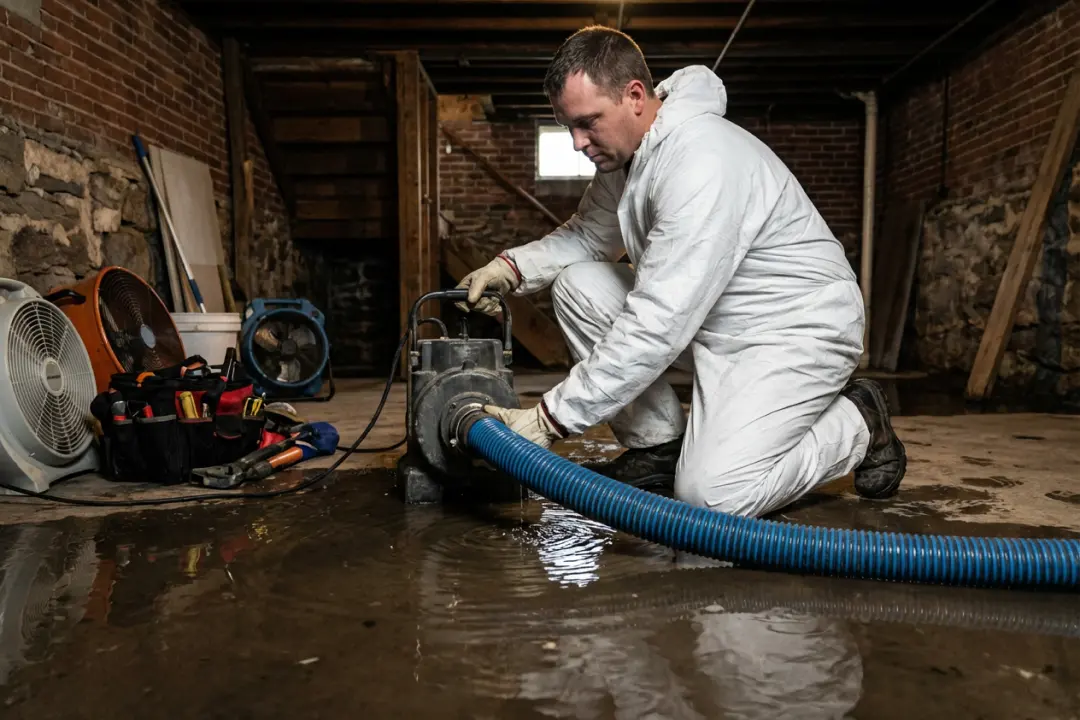
Equipment is the second half of the check, and it can be judged by a layperson with three questions. What will you extract with: pumps for depth, vacuum extraction for shallow water and carpet, weighted wands where pad and carpet hold water? What will you dry with: air movers to move air across wet surfaces, dehumidifiers to pull the moisture out of that air, and enough of both to match the size of the loss? And what will you measure with: pin and pinless meters, and a hygrometer for the air? A firm that answers with an inventory is describing a system. A firm that answers with reassurance is describing a hope. In older New York buildings, add a fourth question about access: portable equipment earns its keep where stairs are narrow, basements are tight and lifts are small, and a crew that knows the building stock will say so.
Protective habits are the third half of the check, and they are visible in the first ten minutes. Dirty water, from sewers, rivers or storm drains, changes the job: protective clothing and gloves, stricter decisions about what porous material can be cleaned and what must be removed, and care about what is carried through clean rooms. Watch whether the crew protects the parts of your home that are not damaged: floor coverings on the path, belongings moved or wrapped before demolition, dust controlled where walls open. A crew careless with the dry half of your house will be careless with the wet half's documentation. Craft shows at the edges first.
There is a human test inside this check that no certificate replaces: does the technician explain? The person reading your wall should be able to tell you what the number means, what it was yesterday and what it needs to become. Teaching is the sign of mastery in every trade, and its absence is the sign of a script. Ask your questions on day one, while the answers are cheap. The crew that will dry your home properly is already visible in how it talks about the work before the work begins.
Names, certifications, equipment and explanations: check nine of how to choose a water damage restoration company is passed by the people, not the brand.
The technician's explanations on day one predict the log's quality on day five, a prediction at the heart of how to choose a water damage restoration company.
Equipment lists are easy to give and hard to fake in person, which is why the crew visit matters in how to choose a water damage restoration company.
Judge the people at your door, not the brand above it: check nine states the personal rule of how to choose a water damage restoration company.
Check ten
Check Ten: Local Knowledge of New York Buildings and New York Rules
The tenth check is local knowledge, and it is the check that separates a firm that works in New York from a firm that merely works. This city's buildings are a curriculum of their own. Pre war apartment houses with plaster walls and layered floors dry differently from post war brick. Brownstones hide joists, pockets and party walls that carry water sideways into a neighbour's rooms. Garden level flats sit at the exact height where street water, groundwater and sewer surcharge arrive together. A crew that has dried your building type before carries a map of its habits in its head, and that map is worth days. Ask what the firm has dried on your street, in your building type, in your borough, and listen for specifics.
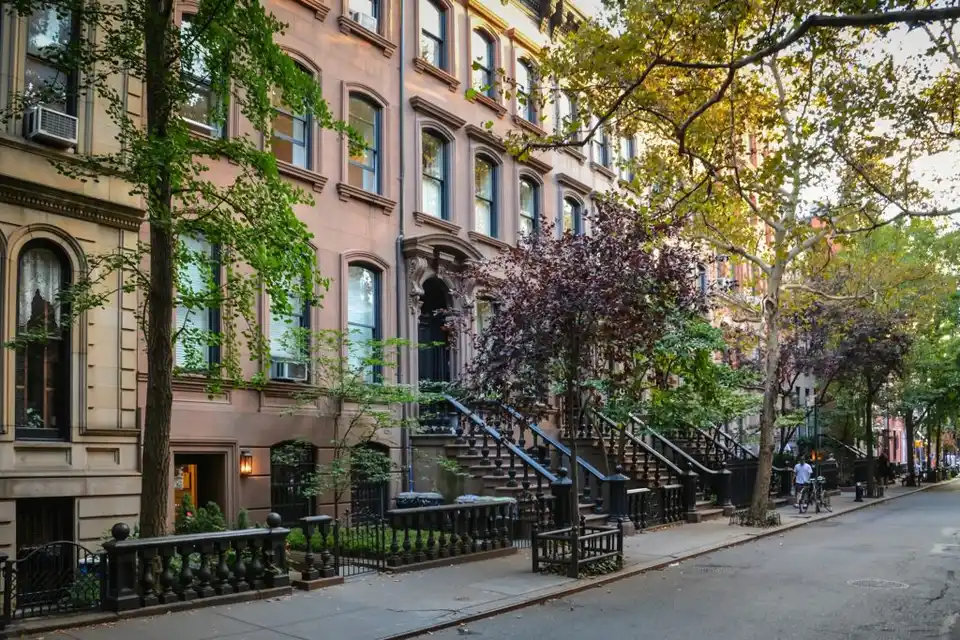
Local knowledge is also knowledge of the city's systems, and those systems will touch your job whether your firm knows them or not. The home improvement licence is a city licence, searchable through DCWP. The housing route for tenants runs through 311 and HPD, with violation classes and correction deadlines. Most repair construction needs the Department of Buildings, and genuine emergency work has its own recognised route in the Administrative Code. The water service line in front of your house is your property, with its own kind of licensed plumber. A local firm navigates these as routine. An imported firm discovers them at your expense, one confused phone call at a time, while your drying clock runs.
There is a simpler, older test of localness, and the Attorney General's guidance implies it: can you find them again? A local firm has an address you can visit, a name that appears in the city's searches, references on streets you can walk to, and a reputation it must protect in the place it lives. Storm economics punish the opposite. The operator who arrives from three states away after a flood has no tomorrow in your neighbourhood, and behaves accordingly. Localness is not sentiment; it is accountability with a geography. When two firms pass the other nine checks equally, hire the one whose tomorrow is in your borough.
End the ten checks by combining them into one question you can ask aloud, because it summarises the whole method: show me, on paper, that you are licensed, certified, insured, scoped and local, and tell me who is coming and how they will prove the drying. A firm that can answer that sentence fully, calmly and with documents has earned the job. A firm that cannot has used your last question to save you from its first week. Either way, the checks have done their work.
Ten checks, one standard: paper over promises, proof over adjectives, local over loud. That is how to choose a water damage restoration company in New York.
Localness is accountability with an address attached, and the address is checkable, like everything else in how to choose a water damage restoration company.
Ask what the firm dried on your street, then listen for street level detail, because detail is the accent of genuine local knowledge in how to choose a water damage restoration company.
The best question
What Best Means, and Why No Honest Page Ranks It for You
Sooner or later every reader of this page types the other search, the one built around the word best, and the research behind this page measured it: three hundred and twenty searches a month in the United States, a difficulty of twenty seven percent, and a commercial intent, with reviews, video, a local pack and forum discussions among its results features. It is a natural search and a dangerous one, because it invites an answer nobody can honestly give. There is no official ranking of restoration companies in New York. No regulator scores them, no table exists, and any page that presents a numbered list of the best companies in the city is presenting its advertising as a league table. This page will not do it, and distrust of pages that do is a choosing skill in itself.
Best is not meaningless, though; it is just personal in a way rankings cannot capture. Best for a flooded brownstone with a finished garden level is a firm fluent in old buildings, party walls and the city licence system. Best for a landlord with forty units is a firm whose documentation feeds a portfolio's insurer without friction. Best for a family with a newborn and a sewer backup is the firm whose dirty water discipline is beyond argument. The word only becomes useful when it is followed by the words for this job, in this building, on this week. The ten checks are how that sentence gets answered: the best company is the one that passes them for your circumstances, and a company can be best for your neighbour's leak and wrong for your flood without anyone lying.
Notice, too, what the two most asked questions about size and fame are really asking. Whether SERVPRO is good, and who the biggest company is, are both attempts to borrow someone else's judgement: the market's, the franchise system's, the crowd's. Borrowed judgement feels safe and is not. The biggest network still sends one local crew. The famous name still has to show you a licence, a scope and a log. The questions in this page's thirty answers treat those searches respectfully and answer them factually, then hand the decision back where it belongs: to the checks you can run yourself, on the firm that will actually attend your home.
A word about guarantees, since the best pages of the internet are paved with them. One national network advertises an on time guarantee under which a late service call is free. A video discussed later on this page mentions warranties in the range of one to five years as typical in the trade. Guarantees are worth having and worth reading: what exactly is promised, what voids it, who honours it if the local office changes hands? A guarantee about arrival time says nothing about drying quality. A warranty on workmanship is only as strong as the firm behind it next year. File guarantees under reputation, test them like reviews, and never let one substitute for a scope, a contract or a log.
Best is a verdict you reach after the checks, not a label you borrow before them. Reach it yourself: that is the honest core of how to choose a water damage restoration company.
Rankings you cannot audit are advertising in a medal's clothing, and learning to spot them is part of how to choose a water damage restoration company.
Best follows the words for this job, in this building, on this week, and filling in those words is how to choose a water damage restoration company honestly.
Reach the verdict yourself after the checks: borrowed judgement is the shortcut that how to choose a water damage restoration company exists to replace.
Red flags
Red Flags: Storm Chasers, Cash Demands and Pressure to Sign
Every protection on this page exists because of a behaviour, and this section collects the behaviours in one place, drawn largely from the Attorney General's own guidance to New York homeowners. Read it before you need it, because red flags are easiest to see in daylight and hardest to act on at midnight in a wet kitchen. The first flag is the unsolicited arrival: the knock after the storm, the leaflet crew working a flooded street, the offer that found you before you searched for anyone. The Attorney General tells New Yorkers to beware unsolicited door to door offers, and to remember that non local storm chasers are hard to track down afterwards. Help you summon can be checked. Help that summons itself has chosen its moment precisely because checking is hard then.
The second flag is cash, early. Never give a contractor a cash deposit before you sign a contract; the sentence is the Attorney General's and this page repeats it without improvement. Beside it stands its twin: never pay the full price up front. The lawful shape of money in this trade is a written contract, a small negotiated deposit held in escrow with notice of where, progress payments in reasonable relationship to work done, and the balance when the readings say the job is finished. Any firm whose money shape differs, money first and large, paper later and vague, is showing you the exact point in the story where homeowners lose their leverage. Leverage, once handed over, does not return.
- Beware unsolicited door to door offers after a storm, and verify the name, address and contact details of anyone you consider.
- Never give a cash deposit before a signed contract, and never pay the full price up front.
- Refuse high pressure tactics: a deadline invented by a salesman is not an emergency.
- Ask for references and follow up on them; ask for proof of insurance and keep a copy.
- Check the Better Business Bureau and search online for evidence of disreputable dealing.
- Never sign a document you have not read, and never sign one that is blank or partly blank.
- Ask about permits, and verify the answer with local building and code officials.
- Compare more than one written quote before you commit to non emergency work.
The third flag is pressure itself, in its many costumes: the price that expires tonight, the crew that is in the area only today, the warning that your insurer will refuse everything unless you sign now. Real emergencies exist, and this page has taught the first hour carefully, but notice the difference. A genuine emergency pressures you toward safety and mitigation: stop the water, extract, start drying. Sales pressure pushes you toward a signature and a deposit. The first kind comes from the water. The second kind comes from the seller, and it dissolves on contact with one calm sentence: I will sign after I have read it and checked the licence, and a firm that respects the sentence has passed a test no document can fake.
The fourth flag is fog: no written scope, no licence number, no insurance certificate, no local address, a company name that changes between the van, the card and the contract. Fog is not disorganisation; at scale, fog is a business model, because a firm that cannot be identified cannot be complained about, sued or reviewed with effect. Your defence is the file habit this page teaches from its first section: names in full, searches run, copies kept. Fog cannot survive a customer who writes things down. When you meet it, do not argue with it. Thank the person, close the door, and call the next firm on your list, because the list, and the willingness to use it, is the whole protection.
Red flags are the negative image of the ten checks: every flag is a check failing in public. Learn to see them early, and how to choose a water damage restoration company becomes partly a matter of knowing when to stop choosing one.
Fog around a name is a business model, not an accident, and recognising fog is a defensive skill in how to choose a water damage restoration company.
Pressure points at a signature while emergencies point at safety, and telling the two apart is basic to how to choose a water damage restoration company.
Every flag in this section is a check failing in public, which is why how to choose a water damage restoration company teaches the checks first.
One signature
The Assignment of Benefits: One Signature to Read Twice
Among the papers a restoration job generates, one deserves a section of its own because it changes who owns your claim: the assignment of benefits, shortened everywhere to AOB. An assignment transfers the benefits of your insurance policy, for the claim in question, to the contractor. The contractor then stands in your shoes with the insurer: presenting the claim, negotiating it and receiving payment. There are honest uses for such an instrument and dishonest presentations of it, and the difference is rarely visible in the moment it is offered, which is usually the worst moment of your week, with water on the floor and a clipboard in your face.
Begin with the source discipline this page applies everywhere. The clearest public guidance on AOBs in this industry comes from the Restoration Industry Association, and the association is a trade body, not a New York regulator; this page attributes its words to it and to no one else. The association's answer to the obvious question is plain: no, an AOB is not mandatory. Whether an assignment, once signed, can be revoked depends on state law and on the terms of the contract itself. And the association takes no position on whether using one is advisable. Hold those three facts together and the sales pitch you may hear, that the form is required, routine and meaningless, fails on all three counts: it is not required, its revocability is a legal question, and the industry's own association will not call it harmless.
So handle the document the way this page teaches you to handle every document. Ask why it is needed for your job, and what changes if you decline it. Ask whether the work can proceed on the contract and scope alone, with the insurer paying as the policy provides. Read the assignment itself, all of it, and note whether it covers this claim only or reaches further. Take the time the question deserves, in daylight if the emergency allows, and remember that a flooded floor is an argument for fast extraction, not for fast signatures on legal transfers. The two clocks are different, and a firm that respects you will respect the difference.
None of this makes an AOB a red flag by itself; firms use them inside ordinary claim practice, and direct billing arrangements are a normal feature of the trade, listed among the services on this very page. The flag is the manner of the asking: bundled silently into a work order, presented as a formality, pressed on you before the scope exists. Manner is information. A firm careful with a powerful document is likely careful with your walls and your logs. A firm casual with it has shown you its standards at the exact moment those standards matter most.
Read twice, sign once, or not at all: the assignment of benefits is the signature where how to choose a water damage restoration company stops being about drying and becomes about judgement.
A legal transfer deserves daylight, a chair and a second reading, a rule that sits comfortably inside how to choose a water damage restoration company.
Not mandatory: three words from the industry's own association worth remembering whenever the AOB appears during how to choose a water damage restoration company.
The manner of the asking is the message, in the AOB and in how to choose a water damage restoration company alike.
Comparing
Three Written Scopes, Side by Side: How to Compare Them Fairly
The Attorney General advises homeowners to compare multiple quotes, and the HowTo at the heart of this page builds the whole method on three calls. But comparison is a skill, because three documents that all call themselves scopes can describe three different jobs. Fair comparison starts by making the jobs identical. Give each firm the same facts: the same rooms, the same source of water, the same time it was found, the same belongings at risk. Then compare what each proposes to do about those identical facts. The firm that found more water with its meters is not more expensive; it is more thorough, and the difference will show in the moisture maps if you ask each firm to leave one.
Compare in columns, and let the columns be the checks. One column for the work itself: extraction method, rooms included, materials to be removed, materials to be dried in place. One for proof: moisture map promised, daily readings, dry standard, final log handed over. One for paper: licence numbers, insurance certificate attached, contract completeness against section 771, deposit and escrow terms. One for people: certifications of the attending crew, supervision, who calls you and when. A scope that wins its column on work and loses on paper has told you a story about its author's priorities. The columns together are the comparison; no single line, and certainly no single total, decides fairly.
Expect the scopes to disagree, and mine the disagreements, because they are where the information lives. If two firms would dry a wall in place and the third would open it, ask all three what reading drives the decision. If one scope includes the room under the stairs and the others omit it, ask whether the meters found water there or whether nobody looked. Disagreement between honest professionals is normal in a trade governed by instruments and judgement. What you are listening for is whether a firm can explain its position in readings and reasons. The firm that explains wins the argument even when you hire a different one, because it has taught you how to supervise whoever you choose.
One more comparison habit protects the whole exercise: compare in writing, afterwards, away from the doorsteps. A scope explained aloud in a wet kitchen acquires a glow that fades by morning. The same scope read at a table, beside two others, with the section 771 list and the ten checks beside it, is just a document, and documents can be judged. Take the hour. The water that is already out is not coming back, the drying will not start worse for a morning's diligence on non emergency work, and the signature you give after comparison is the one you will still respect when the claim is argued.
Three scopes, four columns, one table: fair comparison is the machinery inside how to choose a water damage restoration company.
Compare documents, not doorstep performances, because documents can be reread and performances cannot, as the comparison method of how to choose a water damage restoration company insists.
Disagreement between scopes is information; mine it with questions, the way how to choose a water damage restoration company teaches you to mine every disagreement.
Four columns on one table will do what a dozen phone calls cannot, inside how to choose a water damage restoration company.
The call script
Questions to Ask on the Call, Word for Word
Knowing the checks is one thing; saying them aloud, in a wet kitchen, to a stranger with a clipboard, is another. This section is a script, written to be read off the page or the phone screen, in order, without apology. Every question is short, polite and answerable by a legitimate firm in one breath. The answers matter less than the manner of them: a good firm hears this list as a serious customer introducing themselves. Ask the questions in this order and note the answers in the file you started in the first hour.
- What is your full legal company name, and the address of the office serving my home?
- Which licences do you hold for this work, and what are the numbers?
- Are you licensed for home improvement work in this city, and may I confirm it on the DCWP search?
- If mold is found over ten square feet, who assesses it, and who remediates it?
- Which of your technicians are IICRC certified, and at what level: WRT, ASD or AMRT?
- May I have your certificate of insurance before work begins?
- Will I receive a written scope before the heavy work starts, and what will it list?
- Will you draw a moisture map, take readings daily, and give me the logs?
- What reading would make you open a wall or lift a floor in my home?
- Does your contract include start and completion dates, the lien notice and the escrow notice?
- What deposit do you ask for, where is it held, and how do payments follow the work?
- How many business days do I have to cancel, and will anything ask me to waive that?
- Will you ask me to sign an assignment of benefits, and if so, why?
- Who will call me each day, and when will I see the first readings?
- Which permits will the repair need, and who confirms them with the building department?
- May I have two references from jobs in my borough that I can call today?
Two follow up questions deserve memorising, because they convert answers into evidence. The first is: where can I check that? Asked after a licence claim, a certification claim or an insurance claim, it moves the conversation from assertion to search, and it is unanswerable by fog. The second is: will you put that in the scope? Asked after any promise about readings, callbacks, contents care or claim help, it moves the promise into the document where your insurer and your future self can find it. A firm that welcomes both questions is a firm whose business survives daylight. A firm that resents either has located itself for you, at no charge.
End every call the same way, with the sentence that keeps you in charge of the process: thank you, I am comparing written scopes today, and I will confirm by phone before any work beyond emergency mitigation begins. That sentence is not a rejection; serious firms hear it from serious customers every week. It buys you the comparison hour the law and this page both assume you will take, and it sets the term that protects you through the whole job: nothing beyond stopping the water is authorised until the paper is agreed. Say it to all three firms, in the same words, and the comparison that follows will be fair because the rules were stated before the game began.
A script is not rudeness; it is how a careful person sounds under pressure. Keep this one with the file, and how to choose a water damage restoration company becomes something you can do on your worst day, not just your best.
Polite, short and answerable: a serious firm recognises this list as a serious customer, and that recognition is itself a finding in how to choose a water damage restoration company.
Where can I check that, and will you put that in the scope: the two follow ups that turn talk into evidence throughout how to choose a water damage restoration company.
The method
Six Steps to a Hiring Decision You Can Defend
Everything on this page compresses into six steps, and they are printed here as the method in its shortest form, the same six steps this page carries in its structured data. They assume the emergency basics are handled: people safe, water stopped where it safely can be, photographs taken. From there, the steps run in order, and each one produces a piece of paper. A decision built this way can be defended afterwards, to an insurer, to a spouse, to a landlord or to yourself at three in the morning, because every stage of it left evidence.
1Write down what happened and which rooms are wet
Before any call, make the note your whole decision will stand on: when you found the water, where you believe it came from, which rooms are wet and whether the source is stopped. Photograph the water in place. This note is the first page of your claim file and the script for every call that follows.
2Call three companies and ask for licences and insurance proof
Three calls, made in the same hour, teach you more than thirty web pages. Ask each firm for its full legal name and address, the licences it holds for your kind of work, the certifications of its technicians, and proof of its own insurance. Note who answers plainly and who changes the subject.
3Check each licence on the DOL and DCWP searches
Verify, do not admire. Mold licences are checked on the Department of Labor's Find a Licensee search. City home improvement licences are checked on the DCWP Search Business lookup, and the same department's Wall of Shame names contractors caught working without one. IICRC certification is checked on the Global Locator.
4Ask for a written scope with drying logs before work starts
The scope should list what will be extracted, dried, cleaned and removed, room by room, and it should promise the paper that proves the drying: a moisture map at the start and readings at the same points every day. A firm that will not write its scope down is asking you to buy the job twice.
5Compare the written scopes, not the promises
Lay the scopes side by side and compare the work, line by line: the same rooms, the same materials, the same documentation. Promises cannot be compared; paper can. Where one scope is silent about a room the others include, ask why, and get the answer added in writing before you decide.
6Sign only a complete contract and keep a copy of everything
The contract should meet New York's section 771 list: names, address, phone and licence number if applicable, approximate start and completion dates, a description of the work and materials, the lien law notice and the escrow notice. Sign nothing blank, keep your copy, and file it with the scopes, the logs and the photographs.
Notice what the six steps never ask you to do. They never ask you to judge drying science beyond asking for readings. They never ask you to negotiate like a contractor or read a statute like a lawyer, though this page has given you the statutes in plain words where they protect you. They ask only for sequence and paper: note, call, verify, scope, compare, sign. The expertise is the firm's job. The method is yours. A homeowner with the method and no expertise will out choose a homeowner with expertise and no method, because the method forces the evidence into the open where expertise, including borrowed expertise from pages like this one, can actually be applied.
Keep the steps with the file, and run them again for the repair stage, because choosing does not end when drying does: the reconstruction that follows is a second hire wearing the first one's clothes, with its own contract, its own dates and its own permits. The six steps work there unchanged, which is the sign of a method rather than a tip. Print them, screenshot them, or copy them into the notes application on your phone. The next water event in your home, whenever it comes, will find you with a procedure instead of a panic.
Six steps, six pieces of paper: the method is the shortest complete answer to how to choose a water damage restoration company.
Note, call, verify, scope, compare, sign: six verbs that fit on an index card, and the card is the pocket edition of how to choose a water damage restoration company.
The steps ask for sequence and paper, never for expertise you do not have, which is why the method of how to choose a water damage restoration company works on a first flood.
Renting
Choosing From the Tenant Side: Landlords, 311 and Violation Clocks
A third of this city rents, and for a tenant the choosing question wears different clothes. You do not hire the restoration company for a landlord's building; the owner does. Your version of choosing is choosing your moves: how fast you report, how well you document, which city systems you set in motion, and how you protect your own belongings and your own claim while the building's fate is argued by others. Done well, a tenant's paper trail is often the thing that gets a building dried at all, because it converts a private complaint into an official record with deadlines attached.
The sequence is set by the city's housing department, HPD, and it begins at home: notify the owner or landlord first, in writing, and keep a copy with the date on it. Photograph the water and the damage before anything moves, and keep photographing. If the condition is not corrected, file through 311: by phone, online through 311ONLINE or through the 311MOBILE application, and keep the Service Request number you receive, because that number is the handle by which the whole case is pulled. If the condition remains uncorrected, an inspector can be sent, and the department can issue a Notice of Violation against the owner. Your written notice, your photographs and your Service Request number are the three exhibits that carry the case from step to step.
Violations carry classes, and the classes carry clocks, which every tenant in a wet apartment should know by heart. Class A violations allow ninety days for correction. Class B allows thirty days. Class C is the urgent class: twenty one days for lead paint and for conditions including window guards, mold, mice, cockroaches and rats; fourteen days for a self closing door; immediate correction for failures of heat and hot water; and twenty four hours for other Class C conditions. Read those numbers as what they are: the city's own grading of how fast a condition can harm you. Mold sits in the urgent class at twenty one days, which tells you how seriously the city takes the growth that follows water. Keep the clocks beside your Service Request number, and quote them, politely and in writing, when a deadline passes.
Your own property runs on a separate track. Your belongings are yours, your renters insurance, if you carry it, is yours, and your right to a habitable home does not depend on your landlord's choice of contractor. Where a landlord does hire, you may still use this page: ask who is coming, ask to see the scope for your rooms, keep your own photographs of your own possessions, and keep every reading you are shown. Tenants cannot choose the firm, but they can choose to be witnesses, and buildings dry faster, and claims settle fairer, in front of witnesses. If the water came from another apartment, the same file serves: dates, photographs, notices, numbers.
The tenant's checks are notice, photographs and the Service Request number, kept without gaps: that is the renting household's form of how to choose a water damage restoration company, played from the other side of the lease.
Your Service Request number is a handle; keep it where you can quote it, because the renter's file is the renter's leverage in how to choose a water damage restoration company from the tenant side.
Deadlines turn a complaint into a case, so learn the classes and their clocks, as the renting section of how to choose a water damage restoration company sets them out.
A tenant's photographs and notices dry buildings more often than tenants are told, and they are the renter's share of how to choose a water damage restoration company.
The pipes outside
Whose Pipe Is It Anyway: The Service Line in Front of Your House
Some choosing decisions are really boundary decisions: before you can pick the right professional, you have to know whose problem the water is. The service line is the classic case in New York City. The pipe that brings water from the main under the street into your house feels like the city's pipe. It is not. The city's own 311 guidance states the rule in one sentence: "If you own a home, you are responsible for the water pipes connecting your house or apartment to the water mains under the street." The same guidance adds that the owner must hire a licensed outdoor plumber for the work, and licensed outdoor plumber is the city's own wording, worth using exactly when you search for one.
Draw the boundary clearly, because three professions meet at it. The licensed outdoor plumber owns the service line itself: its leaks, its breaks, its replacement. The restoration company owns the consequences inside the house: extraction, drying, cleaning and documentation. Your insurer owns the argument about which parts of the bill belong to the claim. A leak in the service line can flood a basement for days while looking exactly like groundwater, and the homeowner who hires drying before diagnosis pays to dry a house that is still being fed. This is why the first hour on this page begins with the source, and why a good restoration firm asks about the line, the meter and the shutoff before it talks about fans.
Two practical tests help locate the boundary before anyone is hired. If water arrives with no rain falling, no appliance running and no pipe inside the house accounted broken, suspect the line or the ground, and say so on the first call. If your meter moves while every tap in the house is closed, water is leaving your system somewhere, and finding where is a plumber's diagnosis before it is a drying job. Neither test is proof; both are the kind of observation that turns a confused week into a sequenced one: plumber first to stop the feed, restoration alongside to save the rooms, insurer informed of both with the photographs that show the order events happened.
The boundary lesson generalises, and it is worth stating once, plainly: half of choosing well is choosing the right trade. Mold assessment belongs to a licensed assessor, separated by law from remediation. Service lines belong to licensed outdoor plumbers. Electrical hazards belong to electricians and, in danger, to 911. Restoration belongs to the firm that passes the ten checks. The homeowner's craft is not doing any of these jobs; it is routing each part of the disaster to the professional the law and the craft assign to it, and keeping the file that proves the routing was right.
Know whose pipe it is before you hire anyone to dry its water: boundaries are the quiet half of how to choose a water damage restoration company.
Suspect the line when water arrives with no rain and no broken pipe inside, and say so on the first call, as the boundary thinking in how to choose a water damage restoration company recommends.
A moving meter with every tap closed is a diagnosis waiting for a plumber, and routing it correctly is part of how to choose a water damage restoration company.
Routing each problem to its own trade is the boundary skill inside how to choose a water damage restoration company.
Permits
Permits and Paper: What Repair Work in the City Needs
Drying is emergency work; rebuilding is construction, and construction in New York City runs on permits. Most construction work in the city needs approval and permits from the Department of Buildings, and the repair stage of a water job, wallboard, flooring, electrical work, plumbing changes, structural repair, is construction by any definition. The choosing connection is direct: a firm that plans your repair should be able to tell you, before the contract is signed, which permits the work needs, who files for them and who inspects. The Attorney General's advice to homeowners is to ask about permits and verify the answer with local building and code officials. Ask, and then verify; the two step rhythm of this entire page applies to permits exactly as it applies to licences.
Emergency work has its own recognised shape in the city's Administrative Code, at section 28-105.4.1: genuine emergency work may be done before a permit is in place, because a burst pipe at midnight cannot wait for an office to open. This page states that shape and then deliberately stops, because the published accounts of the filing deadline that follows emergency work conflict with each other, and an unverified deadline printed confidently would be exactly the kind of fact this page exists to protect you from. What you should do is simpler than the law: ask the firm you hire how it handles the emergency route and the filings that follow it, and confirm the answer with the Department of Buildings for your job. A firm that works in the city answers this from routine. A firm that has never heard the question is telling you where its experience lives.
Permits also protect you in a way homeowners rarely appreciate until a sale or a refinance: they create the public record that the repair happened lawfully. Unpermitted repair work surfaces years later in inspections, in buyers' questions and in insurers' arguments, priced at the worst possible moment. The permit conversation at the start of a job feels like bureaucracy. It is actually the cheapest insurance on the page, and it costs one question: which permits, filed by whom, inspected when? Add the answers to the scope, in writing, beside the dates section 771 already requires the contract to carry.
Renters and owners meet different sides of this. A tenant does not pull permits for a landlord's building, but a tenant's 311 record and the violation clocks in the previous section are the levers that make owners act, permits included. An owner hiring directly owns the question outright. Either way, the standard is the same: repair work whose paper cannot be produced is repair work whose quality cannot be proven, and a firm that treats permits as optional is rehearsing, in miniature, how it will treat your drying logs.
Ask which permits, filed by whom, inspected when: permits are the repair stage's version of how to choose a water damage restoration company, proof before plaster.
One question, asked early, is the cheapest insurance on this page, and asking early is the permit habit inside how to choose a water damage restoration company.
Unpermitted work surfaces years later, priced at the worst moment, which is why permits earn their place in how to choose a water damage restoration company.
Permits are proof before plaster, and proof is the theme of how to choose a water damage restoration company from its first line.
Mold and policies
Mold in the Policy: What the State Says Coverage Turns On
When water has been sitting long enough to grow mold, a second question joins the choosing problem: will the policy pay for any of this? The Department of Financial Services answers the general question in its own words, and this page quotes them exactly rather than improving them: "Mold damage is covered if it is due to a covered event. Many policies have a mold limitation for the payment of remediation services. Your policy has to be reviewed for the specific language." Three ideas live in those three sentences. Coverage turns on the event that caused the mold. Many policies limit what they pay for remediation. And the answer for your home sits in your own policy's language, nowhere else.
Notice what the department does not say: it states no sum, no universal rule and no promise. Neither does this page, and any firm or website that quotes you a standard mold limit as if it were law is inventing a number, the same species of invention as the deposit cap that section 771 does not contain. What you can do is more useful than any figure. Read your own policy's mold language, or have it read to you by your insurer, early, while the drying decisions are still being made. The limitation in your policy, whatever it is, is a fact about your contract, and facts about your contract belong in your file beside the claim number.
The choosing consequence follows directly, and it is the reason this section sits inside a hiring guide. If coverage turns on the covered event, then the documentation of the event is the coverage. The firm you hire writes that documentation: the source of the water, the time it was found, the photographs before anything moved, the map of where it travelled, the daily readings as it dried. A firm that documents the chain from event to growth, link by link, is building your coverage argument as a by product of its craft. A firm that arrives late, photographs nothing and logs less has weakened your position before the adjuster ever sees the file, whatever its fans achieved. When you compare scopes, compare this: which firm writes the better chain?
And keep the two mold systems separate in your mind, because they run in parallel and answer to different authorities. Coverage is a question between you and your insurer, governed by your policy and supervised by the Department of Financial Services, reachable at (800) 342-3736. Licensing is a question between the state and the professionals, governed by Article 32, with its separation of assessment from remediation. A firm can be perfect on one track and lost on the other. The homeowner's job is to hold both tracks in view at once, which is less hard than it sounds: it is the same file, the same photographs and the same habit of asking for everything in writing.
Coverage turns on the event and the language; documentation carries both. Choose the firm that writes the chain: that is how to choose a water damage restoration company when mold has joined the job.
Your policy's own language is the only figure that matters; read it early, as the coverage section of how to choose a water damage restoration company urges.
The firm that documents the event is writing your coverage argument as it dries, and that double duty is worth weighing in how to choose a water damage restoration company.
Coverage and licensing run on parallel tracks, and holding both in view is part of how to choose a water damage restoration company.
Across the city
The Same Ten Checks in Five Boroughs of Different Buildings
The ten checks do not change across the city, but the buildings do, and a page about choosing in New York owes its readers a short tour of what the checks meet in each borough. The licence layer is constant: the city home improvement licence, the DCWP searches and Article 32 apply from the Battery to Riverdale. What varies is the housing stock, the water that threatens it and the local knowledge the tenth check is hunting for. Read this section as a set of questions to aim at any firm: not whether it knows the city in general, but whether it knows your borough's buildings in particular.
Brooklyn and Queens hold the city's great stock of houses: brownstones and limestone rows in one, detached and semi detached homes in the other, with basements everywhere and garden levels at exactly the height where street water and groundwater meet. The choosing emphasis here falls on basement craft: sump behaviour, floor joint entry, wall base readings and the discipline of opening a finished basement wall where the meter demands it. Manhattan is the vertical problem: co operative and condominium buildings where your leak is your neighbour's ceiling, where building management will demand the firm's insurance certificate before the lift is booked, and where the crew's paperwork must satisfy a board as well as a homeowner. Ask a Manhattan firm about building paperwork first; its answer predicts your week.
The Bronx mixes grand apartment houses along its old boulevards with detached homes in its north and east, and its choosing emphasis falls on scale and tenancy: large buildings where a single riser failure wets a column of homes, and rented homes where the 311 and HPD route runs beside the owner's own response. Staten Island is the city's most suburban borough, detached houses on larger lots, storm water and coastal edges in its weather, and choosing emphasis on response distance: a firm is only local if its crews can reach the island's far shore inside the first hour's discipline. Long Island and the counties beyond the city line change the licence map itself, since home improvement licensing there runs through the counties the Attorney General names, Suffolk, Nassau, Westchester, Putnam and Rockland among them, and the firm that works both sides of the line should be able to say which licence covers your side of it.
Westchester and the Hudson Valley towns north of the city, Yonkers, New Rochelle, Mount Vernon and White Plains among them, add hillside water and older suburban stock to the pattern, while the upstate cities this site covers, from Albany and Troy to Syracuse, Rochester and Buffalo, answer to their own local licensing within the same state frame: Article 32 everywhere, Regulation 64 everywhere, the local licence layer varying by city and county. The method does not travel badly. It is the answers that change, and a firm worth hiring knows its own answers by locality rather than by slogan.
Same checks, different buildings: ask every firm what it knows about yours. Local proof, borough by borough, completes how to choose a water damage restoration company.
The licence layer is constant; the buildings are the variable, and adjusting for the variable is the borough craft inside how to choose a water damage restoration company.
Ask for your borough, your building type and your street, in that order, when testing local knowledge under how to choose a water damage restoration company.
Local proof, asked for specifically, is what the tenth check hunts, and it closes the borough tour of how to choose a water damage restoration company.
At work
Choosing for a Shop, Office or Restaurant: What Changes
A business choosing after water damage runs the same ten checks with three weights changed, and this short section names the changes. The first is time. A home can be dried around a family's displacement; a business bleeds for every day its doors stay shut, so response and crew size matter even more, and the scope should say plainly how the work is phased: what reopens first, what trades follow, and what the firm will do at night or at weekends to shorten the closure. Ask for the phasing in writing, in the scope, beside the dates.
The second change is paper at scale. Commercial claims run through brokers, landlords, franchisors and sometimes several insurers at once, and section 2618 itself treats commercial claims differently inside its disaster timetable, allowing a further period where the statute gives one. The firm's documentation must satisfy readers who will never visit the site, which raises the value of everything this page teaches: maps, logs, photographs, certificates and a contract that names dates and materials. A firm fluent in commercial files will show you a sample of its reporting before you ask twice. The third change is people: customers, staff and inspectors share the space with the drying, so containment, noise, odour control and honest signage stop being courtesies and become part of the work itself.
What does not change is the floor of the hire. Licences still verify, and where food, health or the public are involved, other regulators join the audience the work must satisfy. Insurance certificates still precede the contract. Mold still separates assessment from remediation under Article 32, on a commercial property exactly as on a home, because the statute speaks of properties, not of house types. And the red flags are identical, with one addition: after a storm, commercial streets are worked by the same travelling crews as residential ones, with larger numbers on the clipboard and the same fog around the names. The checks were built for exactly that clipboard.
Choose for a business as you would for a home, with the phasing written down and the file built for strangers: commerce raises the stakes on how to choose a water damage restoration company without changing its method.
Phasing in writing is the commercial form of the written scope, and it belongs in how to choose a water damage restoration company for any business address.
A file built for strangers is a file that survives a claim, which is why commercial choosing leans so hard on the documentation habits of how to choose a water damage restoration company.
Storms bring the same travelling clipboards to commercial streets, so the checks travel too, unchanged, into how to choose a water damage restoration company for a business.
Mistakes
The Choosing Mistakes New York Homeowners Make Most Often
Failure teaches in patterns, and the patterns behind bad restoration hires repeat so reliably that they can be listed. Read this section as the ten checks read backwards: each mistake is a check skipped, and each has the same ending, a homeowner discovering in week three what an hour of diligence in day one would have shown. The first mistake is hiring the search result instead of the company: clicking the loudest advertisement, assuming the ranking is a judgement, and never learning that the biggest network in the industry does not even rank for the choosing question this page answers. Position is bought or inherited. Licences are earned and verifiable. Choose on the second.
The second mistake is the signature in the flooded kitchen: a contract signed at midnight, unread, sometimes blank in places, with a waiver of the cancellation right folded inside it. The third is money out of sequence: a cash deposit before a contract, or the full price up front, handing away the only leverage a homeowner ever holds. The fourth is the unwritten scope, the job bought as a conversation and argued about as a memory. The fifth is the unopened wall: a crew allowed to dry by appearance, close the surface and leave the cavity wet, because nobody asked what reading would trigger demolition. Each mistake is small at the moment it is made. They compound like interest.
The sixth mistake is the borrowed credential: a licence admired on a van and never searched, a certification logo never checked on the locator, an insurance promise never reduced to a certificate. The seventh is the single quote, accepted because the hour was late, where three written scopes would have cost one morning. The eighth is the ignored separation: one firm allowed to assess and remediate the same mold on the same property, marking its own homework in defiance of section 936. The ninth is the empty file: no photographs before the furniture moved, no logs collected, no claim number written down, discovered when the insurer asks its first question. The tenth is the quietest: choosing a firm with no tomorrow in your neighbourhood, and learning what that means when something smells wrong in a month and the number no longer answers.
Notice the mercy hidden in the list: every mistake is made before or during the first day, which means every one of them is preventable on the first day, with the method on this page and no expertise beyond asking, searching and writing down. Nobody on this list lacked intelligence. They lacked an hour and a checklist. You now have both, and the hour, in a real event, is the one you are standing in.
Every mistake here is a skipped check with a date on it. Run the checks, and how to choose a water damage restoration company stops being a story other people tell about their worst month.
Every mistake on this list was made on day one, which means every one was preventable on day one, with the method of how to choose a water damage restoration company and one careful hour.
Nobody here lacked intelligence; they lacked an hour and a checklist, and the checklist is the one this page gives to how to choose a water damage restoration company.
Read the list once now and you will recognise each pattern if it ever stands at your door, which is the cheapest lesson in how to choose a water damage restoration company.
Case studies
Two Videos About Choosing, Labelled for Exactly What They Are
This page links to two videos, and it labels them with the same care it applies to licences, because honesty about evidence is the whole subject here. Both videos are short pieces of advice about choosing a restoration company. Neither is a film of a real job. Neither was made in New York. Neither shows this site's crews, and no video is embedded on this page; both are linked as text, to be watched on YouTube in a new tab. What they offer is narrower and still useful: a look at how the choosing question is answered in short form elsewhere, and a chance to watch the advice of others tested against the ten checks you now know.
The first video is by H2O Restoration, titled How to Choose a Water Damage Restoration Company?, published on October 13, 2025, running twenty seven seconds and viewed about one thousand six hundred and twenty five times at the time of research. It is a Cincinnati company's quick advice clip, and it makes five points in its short life: respond quickly, verify credentials, watch for hidden moisture, research reputation and evaluate communication. Read against this page, those five points are checks one, two, eight and nine in miniature, plus the moisture warning that runs through the scope section. Its limits are its length and its place: twenty seven seconds cannot carry a statute, and Cincinnati's licensing is not New York's. Watch it as a summary card, not as guidance.
The second video is by The Disaster Company, titled How to Choose the Right Restoration Company, published on October 29, 2026, running three minutes and twenty six seconds, with about one hundred and thirty two views at the time of research. It has more room and uses it on substance this page also teaches: IICRC certification, insurance documentation, Google reviews read as evidence, and warranties, which it describes as typically running from one to five years. That warranty range is the video's claim, reported here as its claim, and the section of this page on the best question explains how to read any guarantee: what is promised, what voids it and who stands behind it next year. The video is an advice piece, not a job walkthrough, and it is not specific to New York.
- Watch: How to Choose a Water Damage Restoration Company?, H2O Restoration, October 13 2025, 0:27 (linked below).
- Watch: How to Choose the Right Restoration Company, The Disaster Company, October 29 2026, 3:26 (linked below).
- How to Choose a Water Damage Restoration Company? (H2O Restoration, YouTube)
- How to Choose the Right Restoration Company (The Disaster Company, YouTube)
A third video was verified during research and deliberately not used: a thirty nine second clip by EcoClean Restoration of Towson and Baltimore, published in July 2026, whose narration warns against storm chasers demanding cash up front and advises choosing a local firm that answers around the clock and will bill your insurance directly. The advice is sound and matches this page, but the clip is a brief company promotion with a handful of views, and two case studies are the limit this page sets itself. Naming the unused video matters for the same reason the labels matter: a page about verifying claims should show its own working, including the evidence it set aside and why.
Watch both videos with the ten checks open beside them. Advice that survives the checks earns your time; the rest is advertising. That discipline, applied to video as to vans, is how to choose a water damage restoration company.
Twenty seven seconds can summarise the checks; it cannot replace them, and knowing the difference is media literacy inside how to choose a water damage restoration company.
Labels are evidence discipline applied to pictures, the same discipline that runs through how to choose a water damage restoration company from its first check.
Two videos, honestly labelled, teach the same lesson as the searches: verify the claim, including the ones inside how to choose a water damage restoration company.
After hiring
The File You Keep After You Hire: Records That Protect You Twice
The last choosing skill is keeping, and it outlasts the job. When the equipment leaves and the rooms are dry, what remains of the whole event is a file, and the file will be read by people who were not there: an adjuster deciding the claim, a buyer reading your home's history, a landlord or a tenant in a dispute, a future crew facing the next leak in the same wall. Build the file as deliberately as you built the hire. It should hold the signed contract and the written scope, the moisture map and the daily drying logs, photographs from before, during and after the work, copies of the licences and insurance certificates you verified, your claim number and every letter your insurer sends, receipts for everything you paid for, and the names and dates of the technicians who attended.
Add your own layer to the firm's paper, because memory is the only record that argues back. Keep a simple log of your own: every call, who you spoke to, what was promised and when it happened. Note the day the readings reached the dry standard in each room, and who showed you the meter. If anything was waived, varied or added, keep the paper that says so, signed. None of this takes more than minutes a day during the job, and it converts the most stressful week of your year into the best documented one. Insurers can tell the difference at a glance, and so, in time, will you.
Keep the file after the claim closes, in the place where your home's other papers live. A water history is an asset in this city: it answers a buyer's question before it becomes a suspicion, it tells the next crew where the water has been and how the building dried, and it gives a future you, facing a new leak in an old wall, the one thing the first event never gives anyone, which is a precedent. The homes that come through water best are not the ones that were lucky. They are the ones whose owners can prove what happened, what was done and what it dried to.
The file is the tenth check's twin and the method's memory: how to choose a water damage restoration company ends, as it began, on paper.
Minutes a day during the job buys the best documented week of your year, and the file habit completes how to choose a water damage restoration company.
A water history is an asset when the home is sold, refinanced or flooded again, which is the long reason the records section closes how to choose a water damage restoration company.
Help on offer
Fifteen Kinds of Help, and What Each One Should Come With
The service list below is the whole trade in fifteen lines, and on this page it does double duty. It is a menu of what a complete response includes, and it is a choosing instrument: read each line and ask whether the firm in front of you can explain what the service involves, what it produces and what proof it leaves behind. A service that cannot be explained in plain words, with its document named, is a line on a van, not a service. The same fifteen services are carried in this page's structured data as its catalogue of offers.
Emergency water damage response
The whole response started at any hour: safety first, the source found and stopped, and the sequence of extraction, drying and documentation set in motion on the first visit.
Water extraction and removal
Standing water pumped and vacuumed out of rooms, basements and cavities, because every gallon removed as liquid is a gallon the drying equipment never has to chase.
Structural drying and dehumidification
Air movers and dehumidifiers placed against a moisture map and run until readings, not appearances, say the building fabric is dry.
Moisture mapping with daily readings
The map that shows where the water travelled, with readings taken at the same points each day and logged, so progress is a record rather than an opinion.
Contents drying and cleaning
Furniture, rugs, papers and belongings assessed piece by piece: what can be dried and cleaned, what must be stored, and what the water has already taken.
Mold prevention after water damage
Drying started inside the window the Environmental Protection Agency describes, wet materials removed where they cannot be saved, and the conditions mold needs taken away early.
Insurance claim documentation
The photographs, scope, moisture map and drying logs assembled into the file your insurer will judge, kept in step with New York's claim clocks.
24/7 emergency response
A phone answered by a person at any hour, every day, because water does not keep office hours and the first hour decides the size of the job.
Written scope of work
The job described in writing before the heavy work starts: rooms, materials, methods and the documentation promised, so two companies can be compared on paper.
Daily drying logs
The running record of each day's readings and equipment, signed off point by point, that proves when each material reached its dry standard.
Direct insurance billing
Billing arranged with your insurer where the policy and the firm allow it, explained in writing before it is agreed, and never used as a reason to skip the scope.
IICRC-certified technicians
Technicians whose training you can verify on the IICRC Global Locator, from the WRT foundation to ASD drying and AMRT microbial work.
Licensed mold assessment referral
Where mold is found, a referral to a separately licensed assessor, because New York law forbids the same licensee from assessing and remediating the same property.
Reconstruction and repairs
The rebuilding stage after drying is proven: wallboard, flooring, paint and trim put back under a written contract with dates and materials named.
Free inspection and assessment
A first visit that measures before it sells: the rooms read with meters, the findings explained in plain words, and the written scope left with you to compare.
Read the list once more with a chooser's eye and notice its skeleton: response at the top, measurement in the middle, paper throughout, and rebuilding last, where it belongs. Any firm's own list that skips the measurement and the paper, extraction to invoice with nothing between, is describing the version of this trade that the ten checks exist to filter out. The list is also a fair test to set on the first call: pick the two services your job most needs, ask how they will be done and documented in your home, and judge the answers against this page. Fifteen lines, honestly explained, are worth more than fifty lines of fog.
Services are promises with equipment attached. Choose the firm whose promises come with readings, logs and a file: that, in the end, is how to choose a water damage restoration company.
Fifteen lines, each with its document named, describe a firm that can be supervised, and supervisability is a fair summary of how to choose a water damage restoration company.
Pick the two services your job needs most and ask how each will be proven, a small exercise that applies the whole method of how to choose a water damage restoration company.
Water in the House Right Now? Start With the Calls in This Order
Make the house safe first: people and pets out of deep or dirty water, hands off wet electrics, and 911 if anyone is in danger. Stop the water where you safely can. Photograph everything before anything moves. Then make three calls, ask the questions in the script section, and let each firm know you are comparing written scopes today. That sequence is the whole method in one breath, and it is available to you in the worst hour of your year exactly as it is on a quiet afternoon.
Choosing under pressure is a skill, and like every skill on this page it runs on paper: the note you wrote, the searches you ran, the scopes you compared. An hour of it now is worth a month of regret later, and the firms worth hiring will recognise the hour as the sign of a customer worth serving well.
Keep the number with the file. Knowing how to choose a water damage restoration company is, in the end, knowing what to do before the number is dialled, and this page has given you the whole of it.
The sequence is safety, source, photographs, then the three calls: say it once and it is yours for every future leak, as the closing band of how to choose a water damage restoration company repeats.
Questions and answers
Thirty Questions About Choosing a Company, Answered in Full
These thirty questions are the ones New York homeowners ask when a hire has to be made under pressure: what the words mean, which licences exist, how certification is verified, what the contract must carry, how the claim clocks run, and which signatures deserve a second reading. Four of them come word for word from the questions searchers ask alongside this topic in Moz's People Also Ask data. Each answer stands on its own, and the same thirty questions and answers are carried in this page's structured data, word for word.
What does it mean to choose a water damage restoration company?
It means making the hiring decision on evidence instead of on panic. Water is in your home, the clock that governs mold and swollen timber is already running, and the firm you pick in the next hour will decide how the drying is done, how the claim is documented and how much of your home survives intact. Choosing well means checking licences, certifications, insurance, reviews, response time and the written scope before anyone starts work, and keeping proof of every check. Choosing badly usually means hiring the first voice that answered, signing whatever was put in front of you, and discovering the gaps weeks later, when the wall is closed and the paperwork is thin. This page exists so that the decision takes an hour of reading instead of a month of regret.
Is water remediation expensive?
This page gives no figures, and there is a reason for that: nobody honest can price your job from a web page. What decides the size of a remediation job is knowable, though. How much water came in, how long it sat before anyone found it, which materials it soaked, how many rooms it reached and what category of water it was all change the work. Clean water found in an hour is one job. Water that sat in a wall cavity for a week is another. The way to protect yourself is not a number found online; it is a written scope, agreed before the heavy work starts, that lists what will be extracted, dried, cleaned or removed, so that two or three companies are quoting on the same work and you can compare them fairly. Your insurer will judge the job by its documentation, not by anyone's verbal estimate, and so should you.
Is Servpro a good restoration company?
SERVPRO is the largest restoration franchise network in the United States, and its own pages carry its own claims: in business since 1967, IICRC certified, answering around the clock, with a very large body of customer reviews behind the brand. Treat those as claims to verify, not as a verdict. A franchise is only ever as good as the local crew that serves your address, on your street, on the night you call. The checks on this page apply to a national name exactly as they apply to a two truck local firm: ask for the licence position, the certifications of the technicians who will actually attend, proof of insurance, a written scope and drying logs. A good local franchise will pass every check without hesitation. A famous name is a starting point for your questions, never a substitute for them.
Who is the biggest restoration company?
By network size, SERVPRO is generally described as the biggest restoration company in the United States, with a franchise system built since 1967. Paul Davis is another very large network, and its own pages claim more than three hundred offices across North America. Size, though, is a fact about a head office, not about your home. The biggest network still sends one local crew to your door, and that crew's licences, certifications, equipment and habits are what will dry your walls. New Yorkers are better served by a smaller question: who is accountable within reach of my building, whose paperwork can I verify this week, and who will still be answering the phone if something smells wrong in a month? Answer that question well and the size of the network behind the crew becomes a detail, not the decision.
What is a water damage restoration technician?
A water damage restoration technician is the trained person who does the physical work of a restoration job: extracting standing water, setting and moving drying equipment, taking moisture readings, cleaning affected materials and recording what was done each day. The foundation credential for the role is the IICRC Water Restoration Technician certification, known as WRT, which covers water extraction, structural drying principles and safety, and is earned by passing a sixty question examination. Technicians then build on it: ASD covers advanced structural drying, and AMRT covers microbial remediation for jobs where mold is involved. When you hire a company, you are really hiring its technicians. Ask who will attend your home, what certifications they hold, and whether the person taking your daily readings is the person trained to take them.
What is the first thing to check before hiring a water damage restoration company in New York?
Check that the firm is real, reachable and willing to prove itself. You want a full legal name, a physical address you can find, a phone number answered by a person who can answer questions, and licence and insurance information offered without argument. That sounds basic, and it eliminates a surprising share of bad hires, because the operators who cause the worst stories, the storm chasers and the cash up front crews, fail exactly here: a first name only, a mobile number, no address, and irritation when you ask for paper. Do this check on the first call, while the water is still being described. A firm that passes it calmly has told you something true about how it will behave on day three of drying, when the questions are harder and the cameras are off.
Does a water damage restoration company in New York need a licence?
Licensing in New York comes in layers, and the honest answer names the layers instead of pretending there is one card for everything. Mold work is licensed by the state: under Article 32 of the Labor Law, anyone paid to assess or remediate mold on an area greater than ten square feet needs a Department of Labor licence, with a narrow exemption for work on your own property. Home improvement work is licensed locally: the Attorney General states that home improvement contractors must be licensed in New York City, Suffolk, Nassau, Westchester, Putnam, Rockland and the City of Buffalo. IICRC certification sits beside licensing as the industry's training credential; it is not a government licence. So the right question to ask any firm is specific: which licences do you hold for the work in my home, and where can I verify each one? Then verify them.
How do I check a mold assessor or remediator licence in New York?
Use the Department of Labor's own search, called Find a Licensee, on the department's website. New York licenses five kinds of mold professional: assessor, remediation contractor, abatement worker, remediation supervisor and project designer. A licence is valid for two years, renewal requires a department approved refresher course taken within one year before renewal, and there is a grace period of one hundred and twenty days after expiry. A licence must be displayed, and it is not transferable, so the licence belongs to the person or firm named on it and cannot be borrowed from a partner company. Check the name on the licence against the name on the contract you are offered. If the names differ, ask why, in writing. The department directs reports of unlicensed mold work and fraud to the Attorney General.
Can the same company do both the mold assessment and the mold remediation on my home?
No, and New York law says so in one sentence. Article 32, section 936, states: "No licensee shall perform both mold assessment and mold remediation on the same property." Read the wording with care, because summaries soften it: the statute speaks of the licensee and the same property, while the Department of Labor's own summary speaks of the same individual. The same part of the law also bars certain ownership and financial interests between the assessing and remediating sides, and it requires disclosure where an interest exists. The reason is plain: the person who measures the problem should have no financial reason to make it bigger or smaller. If one firm offers to assess your mold and then to remediate it on the same property, that offer is itself the answer to whether you should hire them.
What is IICRC certification and why does it matter when choosing a company?
The IICRC is the Institute of Inspection, Cleaning and Restoration Certification, a private non profit industry body founded in 1972. It writes the standards the trade works to, including the S500 standard for professional water damage restoration, and it certifies the people and firms who do the work: more than forty nine thousand active certified technicians and more than six thousand five hundred certified firms, by its own count. Certification matters because it is verifiable training. It tells you a technician has studied extraction, drying and safety and passed an examination, and that a certified firm has committed to the body's standards, ethics and insurance expectations. It is not a government licence, and it does not replace one. Treat it as the trade's own evidence of competence, and check it the same way you check a licence: by looking it up, not by admiring a logo on a van.
What is the difference between WRT, ASD and AMRT certification?
The three letters describe a ladder. WRT, Water Restoration Technician, is the foundation: no prerequisites, a sixty question examination with a pass mark of seventy percent, taken in sixty minutes, covering extraction, drying principles and safety, with continuing education required to stay certified. ASD, Applied Structural Drying, requires WRT first and goes deeper into the craft of drying a building: moisture meters, drying equipment and the decisions that decide whether a wall is saved or opened. AMRT, Applied Microbial Remediation Technician, also requires WRT first and covers microbial remediation: the work that begins when water damage has become a mold problem. For a straightforward flood, a WRT led crew is the baseline. For a large or complicated drying job, ask about ASD. Where mold is present, ask who on the job holds AMRT, and remember that New York mold licensing under Article 32 applies on top of any IICRC letters.
How do I verify a company is IICRC certified?
Verify it yourself, on the IICRC's own Global Locator, using its Find a Certified Professional search. You can search by name, company, ZIP code, city, state or country, which means you can check the exact firm and the exact technician class before anyone arrives. A Certified Firm is the IICRC's higher tier for businesses, held out as meeting its highest standards for ethics, business practices and insurance coverage. Two cautions keep the check honest. First, the IICRC itself says the locator is not a referral service: it confirms certification, it does not recommend anyone. Second, certification belongs to people and firms by name, so check that the name in the locator matches the name on your contract, the same discipline as with a state licence. A firm that is genuinely certified will be pleased you looked. A firm that discourages the search has answered a different question.
What should a written contract with a water damage restoration company include in New York?
New York's General Business Law, section 771, answers this directly: every home improvement contract must be in writing and signed by all parties. The contract should carry the contractor's name, address and phone number and licence number if applicable, approximate start and completion dates, and a description of the work and the materials to be used. It must include the lien law notice and the notice about escrow or bond protection for payments made before completion, under section 71-a(4) of the Lien Law. The contractor must also disclose its insurance position before work begins, and section 771.2 requires the contract to be in plain English. Read what you are given against that list. A contract missing its dates, its work description or its notices is not a small oversight; it is the document your whole claim and complaint will stand on, and it should be complete before the first fan is plugged in.
How many business days do I have to cancel a home improvement contract in New York?
Until midnight of the third business day after signing. That cancellation right is written into section 771 of the General Business Law, and it exists because home improvement contracts are so often signed under pressure, at a kitchen table, with water on the floor. There is an emergency exception: where work is needed as a genuine emergency, the cancellation right can be waived, but only by a handwritten waiver, signed by you, that describes the emergency. Know the shape of that rule before you need it. A firm that asks you to waive cancellation should be able to explain, in plain words, what the emergency is and why the waiver is handwritten. And a signature given in a flooded room at midnight deserves a second reading in daylight, which is exactly what the three business days are for.
Should I pay a deposit before the work starts?
Carefully, in writing, and never in cash before a contract exists. The Attorney General's guidance to New York homeowners is blunt: never give a contractor a cash deposit before you sign a contract, and never pay the full price up front. The pattern the Attorney General recommends is a small negotiated deposit, a payment schedule written into the contract, and the deposit held in escrow, with notice of where it is held. Section 771 adds that progress payments must bear a reasonable relationship to the work actually done. One honest caution: section 771 sets no maximum deposit figure, so anyone who quotes you a legal deposit cap is inventing it. What protects you is not a cap; it is the sequence. Contract first, small deposit into escrow second, payments that follow completed work third, and the final payment only when the drying readings say the job is done.
What is a storm chaser and how do I spot one?
A storm chaser is an operator who follows bad weather from town to town, selling repair work to frightened homeowners and leaving before the problems appear. The Attorney General warns New Yorkers to beware unsolicited door to door offers after storms, and notes that non local storm chasers are hard to track down when the work fails. The spots are consistent: no local address you can visit, a first name and a mobile number instead of a firm, urgency applied like a tool, a cash deposit demanded before any contract, and prices or promises that change once work begins. Two habits defeat them. Verify the name, address and contact details of anyone you consider, and take the time to check licences and insurance even when the water makes you want to skip it. A local firm with paper in order will still be local next month. That is the whole difference.
Should I sign an assignment of benefits?
Read it twice and sign it slowly, if at all. An assignment of benefits, often shortened to AOB, transfers your insurance policy benefits to the contractor, who then deals with the insurer in your place. The Restoration Industry Association, which is the trade association for this industry and not a New York regulator, answers the common question plainly: no, an AOB is not mandatory. Whether an assignment can be revoked depends on state law and on the terms of the contract itself, and the association takes no position on whether you should sign one. What that means at your kitchen table is simple. An AOB is a legal transfer of your claim rights, offered at the most stressed moment of the job. Ask why it is needed, ask what happens without it, get the answer in writing, and never treat it as routine paperwork bundled with the work order.
How do I check if a contractor is licensed in New York City?
Through the city's own consumer protection department, DCWP, using its Search Business lookup online, which needs no login. Residential home improvement work in the city requires a Home Improvement Contractor licence. The licence runs for two years and expires on February 28 in odd numbered years. To earn it, an applicant sits an examination of thirty questions, of which twenty one must be answered correctly to pass, gives fingerprints, and must either contribute to the department's trust fund or carry a surety bond. All of that is checkable, which is the point. Before you hire, search the business name exactly as it appears on the contract you are offered. If the name on the licence and the name on the contract do not match, stop and ask why, and get the answer in writing before any work begins.
What is the DCWP Wall of Shame?
It is the New York City consumer protection department's published list of unlicensed home improvement contractors, and its full name tells you exactly what it is: the Wall of Shame: Unlicensed Home Improvement Contractors. The department maintains it so that a homeowner can check, in minutes, whether a firm being considered has already been caught working without the licence the city requires. Use it as one of two searches, not the only one. The first search confirms a licence exists, through the department's Search Business lookup. The second checks the Wall of Shame for the same name. A firm can fail you either way: by never having been licensed, or by appearing on the list of those caught without one. Both searches are free, both are public, and together they take less time than the first phone call.
What should I do if my landlord will not fix water damage in my New York City apartment?
Start with the owner or landlord, in writing, and keep a copy. If the problem is not corrected, the city's housing department, HPD, directs tenants to file through 311, by phone, online through 311ONLINE or through the 311MOBILE app, and to keep the Service Request number you are given. If the condition stays uncorrected, an inspector can be sent, and the department can issue a Notice of Violation. Violations carry classes with correction deadlines: Class A allows ninety days, Class B thirty days, and Class C is the urgent class, with twenty one days for conditions including mold, fourteen days for a self closing door, immediate correction for heat and hot water failures, and twenty four hours for other Class C conditions. Keep your own file throughout: dates, photographs, the Service Request number and copies of everything you sent. Tenants do not hire the restoration company for a landlord's building, but a tenant's paper trail is often what gets the building dried.
Who owns the water service line to my house in New York City?
You do, if you own the home. The city's own 311 guidance states it in one sentence: "If you own a home, you are responsible for the water pipes connecting your house or apartment to the water mains under the street." The same guidance says the owner must hire a licensed outdoor plumber for that work; licensed outdoor plumber is the city's own wording, and it is worth using exactly when you search for one. This matters when you are choosing help after a leak, because it draws the boundary of the job. The restoration company dries your home. The service line between your home and the main is your property and your plumber's work. Knowing which side of that boundary your water came from tells you which professional to call first, and it prevents the expensive mistake of drying a home while its own supply line is still feeding the problem.
Do I need a permit for flood repair work in New York City?
Often, yes, and the safe assumption is that repair work needs the city's building department in the picture. Most construction work in New York City needs approval and permits from the Department of Buildings before it proceeds, and the Attorney General's advice to homeowners is to ask about permits and verify the answer with local building and code officials rather than taking a contractor's word for it. Emergency work is the recognised exception in shape: the city's Administrative Code, at section 28-105.4.1, allows genuine emergency work to be done before a permit is in place, because a burst pipe cannot wait for an office to open. What this page will not do is quote you a filing deadline for that emergency route, because the published wordings conflict and an unverified deadline helps nobody. Ask the firm you hire which permits your repair needs, then confirm the answer with the department.
How long does my insurer have to accept or reject my claim in New York?
New York's Regulation 64, at section 216.6(c), gives your insurer fifteen business days to accept or reject your claim after proof of loss, or after notice of claim where that is the trigger in your case. If the insurer needs more time, it must tell you so in writing, with reasons, and once a claim has been unresolved for ninety days, it must update you at least every ninety days after that. Two companion rules complete the picture. Under section 216.6(a), where coverage is undisputed the insurer must make a fair and reasonable offer. Under section 216.6(e), elements of a claim that are not in dispute must be paid even while other elements are argued. And when agreement is reached, section 216.6(f) requires payment within five business days. Keep these clocks in your file from the first call; a documented job and a known deadline are the two things that move a claim.
What does Insurance Law 2618 add after a declared disaster?
Section 2618 of the Insurance Law applies only after a disaster declared by the governor, or a presidential declaration of a state of emergency, and it tightens the rules for claims arising from that disaster. Under section 2618(c), the insurer must begin its investigation within fifteen business days, provide a written estimate, and tell you of your right to complain to the Department of Financial Services. Under section 2618(d), once you accept, payment must follow within four business days. Be careful with summaries of this law, including older ones on this site: the statute contains more than one route by which an insurer may obtain more time, so any account that speaks of a single extension is incomplete. What matters for a homeowner choosing a restoration company is the practical side: after a declared disaster, your claim runs on shorter clocks, and the company you hire should know them and document the job as if those clocks were ticking, because they are.
Is mold damage covered by homeowners insurance in New York?
The Department of Financial Services answers this in its own words: "Mold damage is covered if it is due to a covered event. Many policies have a mold limitation for the payment of remediation services. Your policy has to be reviewed for the specific language." Hold on to what that answer does and does not say. It makes coverage turn on the event that caused the mold and on the exact language of your own policy. It states no sum and no universal rule, and neither will this page. The practical consequence for choosing a company is this: hire a firm that documents the cause of the water and the chain from event to growth, because your coverage question will be decided on exactly that chain. A crew that records where the water came from, when it arrived and how the drying proceeded is, without knowing it, writing the first draft of your coverage answer.
How do I know if a company will dry my home properly?
Ask how they will prove it, and listen for instruments, not adjectives. Proper drying is measured: a moisture map drawn at the start showing where the water travelled, readings taken at the same points each day, and a dry standard to aim at, meaning the moisture level of a known dry area of the same material in your home. The crew should be able to explain which materials they expect to save, which they expect to remove, and what reading would change their mind. The industry's reference for this work is the IICRC S500 standard, and a serious firm will name it and work to it. Be wary of fixed promises. No honest page, and no honest crew, can tell you a set number of days or a set moisture figure for every material in every home, because the standard itself works from the conditions in your rooms. Proof, offered daily, is the answer. Anything else is a promise.
What is the IICRC S500 standard?
The S500 is the IICRC's standard for professional water damage restoration: the reference document the industry uses for how water losses are assessed, extracted, dried and documented. The current edition is the Fifth Edition, published in 2021, and a revision is under way. The editions before it appeared in 2015, 2006, 1999 and 1994, which gives you a sense of how long the trade has been writing this craft down. One honest limit belongs in this answer: the S500 is a paid professional text, and this page has not reproduced its internal tables or figures. When a company quotes you a precise moisture percentage or a fixed number of drying days and attributes it to the standard, ask to see the passage. What you can fairly expect from any firm is simpler: that it knows the standard exists, works to its approach of mapping, measuring and logging, and shows you your own readings.
What does 'best water damage restoration company' actually mean?
It means whatever the person using the word has checked, and too often that is nothing at all. The phrase is searched for heavily; research for this page found it carrying three hundred and twenty searches a month in the United States with a commercial intent, which is why so many pages claim the word and so few define it. Judge it the way this page judges everything: by evidence you can test. Licences that verify. Certifications you can look up. A written scope. Drying logs. References you actually call. Reviews read for their detail, not their star count. There is no official ranking of restoration companies in New York, and this page will not invent one. The best company for your home is the one that passes the ten checks on this page, in your borough, on your job, with paperwork you hold in your hand. Anything shorter than that is advertising wearing a medal.
What are the red flags when choosing a water damage restoration company?
They gather into a short list, and every item on it has been earned by somebody's bad week. A cash deposit demanded before a contract exists. The full price asked up front. Pressure to sign now, tonight, before a spouse or an insurer can be consulted. Blank or partly blank documents offered for signature. No licence details, no insurance proof, and irritation when either is requested. No written scope, only verbal promises. A promise that mold will never grow, which no honest firm can make. An assignment of benefits pressed on you at the door. A crew that arrived by knocking after a storm and cannot give you a local address. And the quietest flag of all: a firm that cannot explain, in plain words, how it will prove your home is dry. One flag is a question to ask. Three flags together are your answer, and the answer is to call the next company on your list.
What records should I keep after hiring a water damage restoration company?
Keep the whole file, because it protects you twice: once with your insurer, and once if anything is questioned later. The file should hold your signed contract and the written scope, the moisture map and the daily drying logs, photographs from before, during and after the work, copies of the licences and insurance certificates you verified, your insurance claim number and every letter the insurer sends, receipts for anything you paid for or replaced, and the names of the technicians who attended with the dates they came. Add your own notes from each call: who you spoke to, what was promised, and when. Keep the file after the claim closes. It becomes your home's water history, and the next adjuster, buyer, landlord or crew who reads it will start from facts instead of from memory. A well kept file is the last of the choosing skills, and the one that keeps paying.
All pages on this site
All Fifty-Six Pages, in One Place
This page is the forty-third page of this site. The forty-two pages that came before it, together with this one, are the whole of it: the home page, the borough and city pages, the region pages, and the topic pages on process, claims, hidden water, fire, flood, mold and extraction. Each was researched and built on its own, with its own keyword, its own headings and its own Schema.
Water Damage Restoration New York
The home page of this site: the full guide for the main New York search, with the boroughs, the services and the claim help gathered in one place.
Water Damage Restoration Brooklyn
Borough coverage for Brooklyn homes, brownstones and basements, from Park Slope to Williamsburg.
Water Damage Restoration Queens
Borough coverage for Queens, from Astoria and Long Island City to Flushing and Jamaica.
Water Damage Restoration Bronx
Borough coverage for the Bronx, including Riverdale and the Grand Concourse apartment stock.
Water Damage Restoration Staten Island
Borough coverage for Staten Island homes, where detached houses and storm water shape the work.
Water Damage Restoration Long Island
Coverage for Long Island homes and the commuter belt east of the city line.
Water Damage Restoration Manhattan
Borough coverage for Manhattan towers, co-ops and pre war apartments, Harlem to the Upper West and Upper East Sides.
Water Damage Insurance Claim New York
The claim page: how New York water claims are documented, filed and defended, event by event.
Water Damage Behind Walls NYC
The hidden water page: finding moisture inside walls and floors before it turns into mold and rot.
Fire Damage Restoration NYC
Fire recovery in the city: smoke, soot, water from the hoses, and the order the work must follow.
Flood Cleanup NYC
City flooding explained: storm water, sewer backups and the cleanup sequence for flooded homes.
Water Damage Remediation NYC
The remediation page: removing damaged material safely and returning rooms to a clean, dry state.
Fire Damage Cleanup NYC
Fire cleanup in the city: debris, soot and odour removal after the fire is out.
Water Damage Restoration Rochester
City coverage for Rochester homes, lake effect snow, thaw and the Genesee River.
Water Damage Restoration Albany
City coverage for Albany, the capital district's older housing stock and Hudson River weather.
Water Damage Restoration Buffalo
City coverage for Buffalo, lake effect winters, frozen pipes and spring thaw.
Water Damage Restoration Syracuse
City coverage for Syracuse homes, snow load, thaw and basement water in central New York.
Water Damage Restoration Yonkers
City coverage for Yonkers, hillside homes and Hudson waterfront neighbourhoods.
Water Damage Restoration New Rochelle
City coverage for New Rochelle homes along the Long Island Sound shore.
Water Damage Restoration Mount Vernon
City coverage for Mount Vernon, dense housing and the Bronx River corridor.
Water Damage Restoration Schenectady
City coverage for Schenectady, Mohawk River weather and older mill era housing.
Water Damage Restoration Utica
City coverage for Utica homes in the Mohawk Valley, snow, thaw and heavy rain.
Water Damage Restoration White Plains
City coverage for White Plains, the Westchester county seat and its mixed housing stock.
Water Damage Restoration Troy
City coverage for Troy, Hudson River hillsides and nineteenth century housing.
Water Damage Restoration Niagara Falls
City coverage for Niagara Falls homes, river weather and hard winters.
Water Damage Restoration Binghamton
City coverage for Binghamton, where two rivers meet and flood history runs deep.
Water Damage Restoration Westchester County
County coverage for Westchester: suburbs, Sound shore towns and commuter villages.
Water Damage Restoration Hudson Valley
Region coverage for the Hudson Valley, river towns from Westchester to Albany.
Water Damage Restoration Capital Region
Region coverage for the Capital Region around Albany, Troy and Schenectady.
Water Damage Restoration Western New York
Region coverage for Western New York, lake effect country from Buffalo to Rochester.
Water Damage Restoration Finger Lakes
Region coverage for the Finger Lakes, lakeside homes and wine country towns.
Water Damage Restoration Central New York
Region coverage for Central New York around Syracuse and Utica.
Water Damage Restoration Southern Tier
Region coverage for the Southern Tier along the Pennsylvania line.
Water Damage Restoration NYC
The city hub page joining the five boroughs and Manhattan coverage in one place.
How Long Does Mold Take to Grow After Water Damage
The mold timeline page: the 24 to 48 hour window, what grows where, and how drying prevents it.
Mold Removal NYC
The city mold page: finding growth, licensed assessment and safe removal, explained plainly.
Water Damage Restoration Process
The step by step page: inspection, extraction, drying, cleaning and repair in order.
What Is Water Damage Restoration
The definition page: what the work is, what it is not, and when each stage applies.
Mold Remediation New York
The state mold page: Article 32 licensing, assessment and remediation across New York.
Water Removal NYC
The extraction page: pumps, vacuums and standing water removal across the city.
Water Damage NYC
The citywide explainer: what water damage means in New York, borough by borough.
Water Damage Cleanup Nyack NY
Water damage cleanup in Nyack explained plainly, with fast help for every home.
Commercial Water Damage Restoration NYC | 24/7 Emergency Help
Commercial water damage in NYC explained plainly, with fast help for every business.
Commercial Water Damage Restoration NYC | 24/7 Emergency Help
Basement Water Damage Restoration NYC
Basement water damage in NYC explained plainly, with fast help for every basement.
Water Damage Repair New York
Water damage repair in New York explained plainly, with fast help for every home.
Water Damage Restoration Poughkeepsie New York
Water damage restoration in Poughkeepsie explained plainly, with fast help for every home.
Emergency Water Damage NYC
Emergency water damage in NYC explained plainly, with fast help when every minute counts.
Water Damage Cleanup in NYC
Water damage cleanup in NYC explained plainly, from torn-out materials to dry rooms again.
Flood Damage Restoration NYC
Flood damage restoration NYC explained plainly, from flood events and NFIP claims to dry rooms and a flood-resistant rebuild.
How Long Does Water Damage Restoration Take
How long water damage restoration takes explained plainly, from drying days to full repair timelines.
Flood Damage Cleanup Washington Heights
Flood damage cleanup in Washington Heights explained plainly, with fast help for every home.
Does Insurance Cover Water Damage Restoration
Whether insurance covers water damage restoration, explained plainly, by cause and New York rule.
Water Damage Mold Remediation
Mold that grew after a leak or flood, remediated the New York way, by licensed assessor and remediator.
Water Damage Restoration Companies New York
Compare the companies serving New York: national franchises, regional firms and local independents, and how to verify licences and certification before you hire.
Water Damage From Upstairs Neighbor
Water damage from an upstairs neighbor in New York City: who pays, what to do in the first hour, and how to document, report and claim.
How to Choose a Water Damage Restoration Company
How to choose a water damage restoration company in New York, with every check that protects your home.