A New York repair guide: ceilings, floors, walls, cabinets and the order the rebuild must follow

Water Damage Repair New York, From Wet Ceilings to Solid Walls Again

This is the forty-sixth page of this site, and it is the one written for the last stage of a water loss: the rebuild. The forty-five pages before it cover the boroughs, the cities, the regions, the claims, the mold law and the drying. This page covers what happens when the machines leave: the ceilings, floors, walls and cabinets that have to be made whole again. Water damage repair New York is patient work with a strict order. The source is fixed first, the structure is dried by readings, and only then is anything rebuilt. If your ceiling is wet right now, start with the quick answers. If the water is already out and you are facing the rebuild, read the whole page once: it will tell you what good work looks like, what the city rules require, and which questions separate a careful crew from a fast one.

Water damage repair, defined

Water damage repair New York is the service that fixes ceilings, floors, walls and cabinets across all five boroughs after leaks, burst pipes, floods and storms, replacing drywall and flooring, patching and painting, only once moisture readings prove every surface is dry and safe to rebuild.

Call now: (212) 555-0147

Answered around the clock, every day. Last updated: November 2026.

Two restoration workers fitting a new drywall panel into an opened water damaged ceiling in a New York apartment, with exposed joists, a repaired copper pipe and a work light

Quick answers

The Short Version: Reading a Wet Room Like a Repairer

Most people arrive on this page with a bucket under a drip and a stain spreading over their heads, so the short version comes first. Stop the water. Photograph everything. Dry the structure by numbers, not by feel. Then, and only then, rebuild what the water broke. That order is the whole trade in four sentences, and every section of this page exists to defend it. Water damage repair New York is the last of the four steps, and it fails whenever it is asked to go first.

The bucket matters less than the source. A drip you can see has a cause you can find: a pipe, a valve, a shower pan, a radiator joint, a roof seam. Until that cause is closed and tested, the ceiling below it is still being written on by the water. Repair crews see the result every week, a fresh patch blistering over a live leak, paint bubbling in the same outline as the old stain. The first hour of water damage repair New York is therefore plumbing and photography, not plaster.

Photographs are the second move because they are the only move that cannot be repeated. Once a crew opens a ceiling, the evidence of how far the water travelled is gone. Film the stain, the bulge, the cupped floorboards, the swollen baseboard, the source itself if it is visible. The insurer will ask for exactly this set, and your own memory of the room will fade faster than you expect. In water damage repair New York, the camera does as much work as the trowel.

Drying is the third move, and it is the one most often skipped by people in a hurry to see a finished room. Wet structure hides behind dry surfaces. A wall can feel dry to the palm while the cavity behind it holds enough moisture to grow mold and rot the new work from inside. Meters settle the question. A repair crew that dries by readings, and writes the readings down, is doing water damage repair New York the way the trade's own standards describe it.

The rebuild is the fourth move, and on a dry structure it is ordinary good building work: board, plaster, boards, trim, paint, in the order the room was first built. Nothing in it is mysterious. What makes it repair rather than renovation is the discipline before it, and the records after it. Hold the order, and the room comes back as if the water had never visited. Break the order, and you will meet the same stain again, wearing new paint.

If you are standing in the wet room right now, the calls come before the reading. Call the plumber for the source, call the repair crew for the drying and the rebuild, call your insurer to open the claim, and if you rent, put the notice to your landlord or management in writing today. The rest of this page, all of it, is the long version of those four moves, written for the moment after the bucket is placed.

One rule before any other: water near electrics is not a repair problem, it is a safety problem. Keep people away from wet ceilings with light fittings, wet outlets and wet appliances until the circuit is off and the area has been checked. No ceiling is worth a shock.

First steps

The Six Moves, in Order: From Leak to Rebuild

Every repair on this page, from a single ceiling patch to a whole floor, runs through the same six moves. They are printed here as the page's working guide, and the same six steps, word for word, are what the structured data on this page carries, so the guide a reader follows and the guide a search engine reads cannot drift apart. Take them in order. Each one protects the next: the photographs protect the claim, the drying protects the rebuild, and the records protect everything.

The steps are written for the owner standing in the wet room, not for the crew. Your part is safety, sequence and evidence. Their part is the machines, the readings and the rebuild itself.

1Stop the leak before any repair starts

No repair survives a live leak. Find the source first: a split pipe, a failed valve, a cracked pan under a shower, a radiator joint, a roof gap above the ceiling. Close the nearest shutoff you can reach safely, or the main if the room shutoff is buried or seized. If the source sits in another unit or in a shared riser, call building management and ask for the riser to be closed, then call a plumber for the pipe itself. Repair trades fix surfaces. Plumbers fix causes. Until the cause is closed and proven closed, every other step on this list is provisional.

2Photograph the damage before anything is moved

Walk the wet rooms slowly with a phone camera before furniture moves and before any material comes out. Film the source if you can see it, the stain lines on the ceiling, the cupped boards, the swollen baseboards, the readings on any meter you are shown. Photograph wide, then close. Date and time ride inside the files themselves. Send the set to your insurer when the claim opens and keep your own copy off the phone. Photographs taken in the first hour are the evidence every later argument leans on, and they cannot be retaken once the room is opened up.

3Dry the structure before rebuilding

Drying is measured, not guessed. A repair crew maps the moisture with meters, places air movers and dehumidifiers, and returns to take readings until the wood, the subfloor and the wall cavities reach dry targets. The log of those readings is the proof that rebuilding was safe. Closing a wall or laying a floor over damp structure traps the water inside the repair, where it feeds mold and rots the new work from behind. If a crew wants to rebuild on a schedule instead of on readings, stop the job and ask for the numbers.

4Get a written scope with drying logs before work starts

Before the first board is cut, you should hold a written scope that names the rooms, the materials coming out, the materials going back, the drying equipment and the readings that will end the drying. In New York City the home improvement contract itself is a legal document with required contents, and the scope belongs inside it or attached to it. Keep the drying logs with the contract. Together they are the record that the repair was needed, that it was done in the right order, and that the insurer is looking at a finished, documented job.

5Repair ceilings, floors and walls only once dry

Once the readings say dry, the rebuild runs in the order the building was built: structure first, then surfaces, then finish. Subfloor before floor boards. Drywall and plaster before paint. Trim after the walls are true. Each layer gets checked before the next one hides it. This is the stage the whole page is about, and it is the stage most often rushed. A repair that follows the readings and the order will look like nothing ever happened, which is the entire point of the trade.

6Keep every record for the insurance claim

Keep the contract, the scope, the drying logs, the photographs, the meter readings, the invoices and every letter or email from the insurer in one file, paper or digital. New York claim clocks run from dates, and dates live in records. If the claim is questioned months later, the file answers. If a repaired surface fails later, the file shows what was done and when. Records are the cheapest part of any repair and the part people most often throw away. Keep them for years, not weeks.

What the words mean

What Repair Means, and How It Differs From Removal and Drying

A water loss in a home runs in stages, and the stages have names because they are different trades wearing one coat. First comes mitigation: stopping the source and limiting the harm. Then extraction and drying: taking the water out of the structure and proving, with meters, that it is out. Then cleaning. Then repair: putting back the material that could not be saved. Water damage repair New York names that last stage, and this page keeps the word to that meaning from here to the footer.

The distinction matters because each stage is judged differently. Drying is judged by readings. Cleaning is judged by what the water carried. Repair is judged by whether the room works and looks as it did, on a structure that will stay sound. A firm can be excellent at extraction and careless at finishing, or the other way round. When you read a scope for water damage repair New York, read it stage by stage and ask who answers for each one.

People also meet the word reconstruction on scopes and claim papers. It means the same rebuild stage: the carpentry, board work, plastering and finishing that follow the drying. Restoration is the umbrella word for the whole job from first call to final paint. Repair sits inside it, at the end, where the home is handed back. Holding the words apart keeps contracts honest, because a price for drying is not a price for rebuilding, and a promise to restore is empty unless it names both.

What gets repaired is decided by the material, not by hope. The crew sorts every wet surface into saved and lost. Saved: solid timber that dried to target, masonry, sound plaster, metal, most tile on sound backing. Lost: drywall gone soft, insulation that stayed wet, swollen particleboard, lifted laminate, delaminated plywood. The sort is written into the scope, and in honest water damage repair New York the homeowner can ask for the reading or the squeeze test behind every line of it.

Repair also differs from the work on the topic pages elsewhere on this site. The extraction page is about pumps and vacuums. The mold pages are about licensed assessment and removal under state law. The claim page is about the insurer. This page is about the rebuild: the ceiling that goes back up, the floor that lies flat again, the wall that takes paint and holds it. It is the stage neighbours see, and the stage that decides whether the loss becomes a story or a scar.

One more distinction, because it causes real arguments. Repair restores what was there. It does not upgrade it. Insurance and contracts both work on the like for like principle: the same kind and quality of material, returned to the condition before the loss. Owners are free to upgrade while the room is open, and many do, but the upgrade is a separate agreement with separate money. A clean scope for water damage repair New York keeps the two apart on paper, so nobody argues later about which boards the claim paid for.

Underneath all of it sits one physical fact. Water moves through a building along paths the eye cannot follow: down wall cavities, along joists, under floors, through the screed and the subfloor. The visible damage is the end of the path, not the whole of it. That is why water damage repair New York begins with mapping and ends with readings, and why a repair that only treats what can be seen is a repair half done.

The research behind this page

What the Search Data Says About This Service in This City

This page was built the way every page on this site is built: the keyword research first, the writing second. Two research tools were run on the exact phrase on 24 November 2026, and as usual they disagreed with each other, so both sets of figures are reported here and neither is averaged away. SEMrush lists the phrase at 50 searches a month in the United States with a difficulty score of 30 percent, which it classes as possible to rank for, and commercial intent. Moz lists 40 searches a month in its range of 11 to 50, a difficulty of 36, which it classes as low, and transactional intent.

The disagreement is itself the honest finding. A phrase searched a few dozen times a month is a phrase typed by people in the middle of an event, not by browsers. Nobody searches water damage repair New York for pleasure. They search it standing in a wet kitchen. Small volume, high intent: the reader of this page does not need to be entertained, they need the order of work, the rules and the phone number, and the page is shaped accordingly.

The results pages explain the competition. On SEMrush, the first result is ATI Restoration's Manhattan page, a national firm whose entire repair wording on that page is one short phrase about necessary cleaning and repairs. Yelp and SERVPRO follow. On Moz, Yelp's Manhattan listing leads, with a directory, a referral service and a questions page filling much of the list. In other words, almost nobody ranking for water damage repair New York has written a real repair guide. Directories list firms. Firms list services. The rebuild itself, explained end to end for a New York homeowner, is the gap this page fills.

The neighbouring phrases confirm the shape of the demand. The city variant of the phrase draws 20 searches a month. The storm variant draws 10. There is no separate variant with the city's short name in it at all, and no near me variant in the data, which is why this page carries the full phrase and lets the borough sections do the local work. The variant about a water damaged luxury watch, which shares words with the phrase and nothing else, is left to the watchmakers.

People Also Ask gave this page four of its thirty questions word for word, and they are the four a frightened homeowner asks first: what the work is called, whether restoration is worth it, what the city water situation is, and the cost question, which this site answers with the scope method rather than figures, because the site is built for calls, not price lists. The related questions tools suggested added the permanence question and the Bronx question. All thirty are answered in the FAQ section, in the order the research produced them.

One more piece of the research deserves daylight. The strongest single service page found in the Schema comparison carried a real FAQ block and video markup, and the weakest carried no structured data at all. The page you are reading carries the full standard this site applies everywhere: a single graph of eight nodes, thirty questions matching the visible FAQ word for word, a six step guide with full text, and a fifteen item service catalogue. The research said the bar was low. The page was built as if it were high.

The repair order

The Repair Order: Why Nothing Gets Rebuilt on a Wet Structure

Every experienced repairer carries the same sentence: the structure reads dry, or the rebuild does not start. It sounds like stubbornness until you have seen the alternative, which every crew in this trade has. A ceiling closed over a damp cavity blisters within weeks. A floor laid over a wet subfloor cups within a season. Paint over damp plaster blooms and peels in the exact shape of the old stain. Water damage repair New York is mostly the discipline of refusing to hide water.

The order has a logic borrowed from building itself. You cannot judge a surface until the structure behind it is stable, and structure is not stable while its moisture content is still moving. Drying ends when readings hold at target across consecutive checks, not when a set number of days has passed. Wood, subfloor, joist ends and the bottom plates of walls each carry their own target, and the log shows them separately. In water damage repair New York, the log is not paperwork for its own sake. It is the permit the rebuild gives itself.

A technician pressing a pinless moisture meter against a wall above the cut line where wet drywall was removed, checking the reading before rebuilding, with a clipboard drying log in the other hand
Readings before rebuild: the meter, not the calendar, releases the repair.

Moisture mapping is where the order begins. The crew tests the wet area and keeps testing outward until the readings come back normal, because water travels further than stains do. The map decides what opens and what stays. Without it, demolition is guesswork: too little, and wet material stays hidden; too much, and sound rooms are torn apart for nothing. Good water damage repair New York opens the smallest area that the readings condemn, and can show you the numbers that drew the line.

Then comes the controlled opening. Wet drywall is cut at a clean line, often at a set height, so the cavity can dry and the patch can be fitted neatly afterwards. Insulation that stayed wet comes out. Baseboards come off so the wall bottom can dry and be checked. Floors are lifted only where the boards or the subfloor beneath them have failed or trap moisture. Every opening is photographed before and after, because the claim file and the rebuild both need to know exactly what the water reached.

Drying equipment follows the map: air movers across the surfaces, dehumidifiers pulling the moisture out of the air, sometimes heat, sometimes containment to shrink the space being dried. The crew returns, takes readings, moves machines, takes readings again. A quiet site is not a finished site. The readings decide when the machines leave, and in water damage repair New York the homeowner should see the final set with their own eyes or hold them in the log.

Only then does the rebuild sequence start, and it runs backwards through the demolition. Structure first: any joist, plate or subfloor section that lost strength is repaired or replaced. Then the hidden layer: insulation back in, vapour considerations handled as the building requires. Then the surfaces: board, plaster, floor. Then the finish: trim, paint, fittings. Each layer is checked before the next one hides it, because after the paint, nobody can see the joist again.

The order also protects the money. Insurers pay for a loss repaired in the recognised sequence, documented as it went. A rebuild done before drying, which then fails, is a second loss with an argument attached: the first claim is closed, the second damage is arguably the repairer's fault, and the homeowner stands between them. Following the order keeps one loss, one claim and one file. That is worth more than the few days the shortcut saves.

There is a human reason too. A wet home is a stressful place, and the pressure to see one finished room is enormous. Crews feel it and owners feel it. The order gives both sides something firmer than feelings to stand on: the readings. When the numbers say dry, the room gets rebuilt with confidence. When they do not, everyone can see why the machines stay another day. Water damage repair New York done in order is slower by days and faster by months.

Water in the home now? The order starts with a call.

Stop the source, photograph the damage, and get the drying started by readings. The rebuild follows when the structure says it is ready.

Call (212) 555-0147

Ceilings

Ceilings: The Surface That Announces the Leak

More repairs begin with a ceiling than with any other surface, because gravity delivers the news there. The water from a bathroom, a radiator or a roof announces itself as a stain, a bubble in the paint, a hairline crack that darkens, or in the serious cases a bulge that grows while you watch it. The ceiling sections of the homeowner forums are full of the same photograph and the same question: how bad is this. The honest answer is that the stain is the smallest part of the story, and water damage repair New York treats the ceiling as a door into the cavity above it.

The first judgement is touch and sound, after the source is fixed and the power question settled. Sound ceiling material is hard and rings when knocked. Water damaged material is soft, crumbles at the edges, or drums hollow where plaster has lost its key to the lath. A sagging section is condemned by its shape alone. WikiHow's widely read guide to fixing a leaking ceiling draws the homeowner line at damage larger than about six inches by six inches, and sends anything bigger to a professional. Crews would draw the line by softness rather than size, but the instinct is the same.

Opening a ceiling is dusty, decisive work. The damaged area is cut back to sound material, ideally to a line that lands on joists so the patch has something solid to meet. What the opening reveals decides the rest: the state of the joists, whether insulation is wet, whether the source left staining or growth on the hidden faces, and how far the water ran along the structure before it showed below. Photographs of the open ceiling are among the most valuable in the whole claim file.

Drying a ceiling cavity is slower than drying a room, because the air has to be persuaded into a closed space. Crews vent the cavity, direct air movers at the opening, and dehumidify the room until the joists and the remaining board read dry. Rushing this stage is how a repaired ceiling grows a shadow at the patch line a month later. In water damage repair New York, the ceiling goes back when the cavity says so, and not a day before.

The patch itself is honest carpentry. New board of the same thickness, fixed to the joists, joints taped, compound built in thin coats and feathered wide so the repair disappears under raking light. Older New York ceilings are often plaster rather than board, and plaster asks for its own method: backing, scratch and finish coats, or a board patch skimmed to match. The test of either is the same. Stand at the door in daylight and try to find the repair. In good water damage repair New York, you cannot.

Stain blocking is the step amateurs skip and regret. Water leaves minerals and tannins in the surface, and ordinary paint lets them bleed through as a ghost of the old mark, sometimes weeks later. A stain blocking primer seals the line before the finish coats go on, and the whole ceiling gets painted, not just the patch, because new paint beside old paint shows its edge in every light except the one in the shop.

Ceiling repairs also carry the building's rules with them. In New York apartment buildings, the ceiling of your home is the floor of someone else's, and the cavity between belongs to an argument as old as the city: whose pipe, whose ceiling, whose bill. The apartment section of this page takes that up in full. The practical point for the ceiling itself is access and notice. Management usually needs to know before a ceiling opens, and the neighbour above needs the source fixed before your patch goes up, or you will be painting the same ceiling twice.

A finished ceiling repair should come with its readings and photographs, the name of the primer and paint used, and a straight answer to one question: what was done about the source. If the answer to that last one is vague, the repair is a countdown. The stain always knows the way back.

Floors

Floors and Subfloors: Boards, Buckling and the Layer Below

Floors fail in more ways than any other surface, because a floor is a sandwich: finish boards on a subfloor on joists, with the water free to attack any layer. The finish shows the famous symptoms first. Boards cup, each one curling at its edges. Whole fields buckle and lift where the expansion has nowhere to go. Laminate swells at the seams and stays swollen. Tile itself survives, but the board beneath it rots quietly until the floor feels soft underfoot. Water damage repair New York reads a floor layer by layer, because repairing the layer you can see while the layer below stays wet is the classic wasted job.

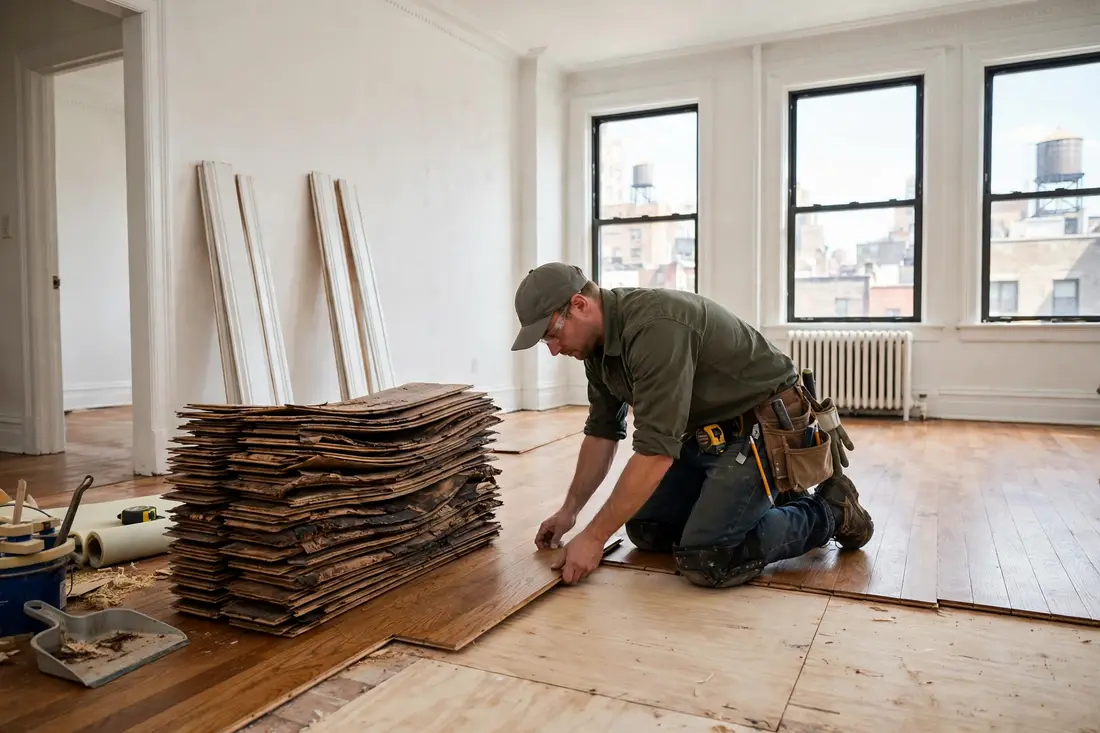
A flooring worker kneeling and fitting a new oak plank over clean subfloor in a New York apartment, with a stack of warped water damaged boards beside him and baseboards leaning against the wall
Layer by layer: warped boards out, subfloor checked and dried, new boards fitted to the dry structure.

The first question is whether the finish floor can be saved, and the answer comes after drying, not before. Solid hardwood that cupped under a short, clean water event often flattens as it dries, given air movement and time. Engineered boards with damaged cores and laminate with swollen seams do not recover. A patient crew dries first and judges second, because lifting a floor that would have settled is money torn up, and leaving one that will not is money buried. Readings and a flat straightedge settle the argument.

The subfloor is the layer that decides the room. Plywood delaminates when it stays wet, its layers separating like wet pages. Board subfloors in older New York homes rot at the joints and around radiator pipes. A soft spot is not a cosmetic issue: it is the structure of the floor losing its grip. Subfloor sections are cut out and replaced where they have failed, and the joists beneath them are checked while the floor is open, because that chance does not come again once the new boards are down.

Lifting a floor is also the moment of truth for the whole loss. Under the boards, crews find how far the water really ran, which walls it reached, and whether an earlier loss was repaired over or repaired properly. It is common, in the city's older housing, to find two generations of repair in one floor. Good water damage repair New York documents what it finds before covering it, because the next person to open that floor, and the insurer reading the file, both deserve the true picture.

Relaying is patient work. New boards are matched for species, width and grade, acclimatised in the room before they are fitted, and woven into the old field where the damage stopped, so the repair has no straight line to confess itself. Sanding and finishing then run across the whole room, not the patch, for the same reason a ceiling is painted whole: finish shows its edges. A floor repaired in sections, finished in sections, looks like a map of the flood forever.

Radiator leaks deserve their own paragraph in any New York floor section, because the city's steam and hot water heat has been quietly feeding floor damage for a century. The boards around radiator pipes darken, soften and crumble in a pattern every local crew recognises. The repair is rarely large, but the source is a valve or a joint that will leak again next heating season unless the plumber's part of the job is done with the floor open. Floors and heating get repaired together or the floor gets repaired twice.

Bathroom and kitchen floors add the wet room problem: the water often arrives from above the floor, through failed grout, a cracked pan or a leaking supply line, and the damage concentrates where nobody walks. The corners behind toilets and under cabinets are the first places a meter should go and the last places a homeowner looks. In water damage repair New York, the wet rooms get probed at their edges even when the visible damage is in the room below.

The finished test of a floor repair is boring, which is the point. The floor is flat, quiet and dry. It does not spring, creak in a new place, or smell of the week it spent wet. Your feet should learn nothing from it. Every other outcome is a repair still in progress, whatever the invoice says.

Walls

Walls: Drywall, Plaster and the Cavity Between

A wall is two faces and a secret. The secret is the cavity, and water's favourite trick is to fill the secret while the faces still look respectable. By the time a wall shows a tide line, soft paint or a skirting board swollen off its fixings, the cavity has usually been wet for a while. That is why water damage repair New York treats walls as structures to be tested, not surfaces to be painted, and why the meter goes to the wall base first, where gravity delivers everything.

Drywall and plaster fail differently, and New York has both in quantity. Drywall is gypsum between paper faces: it wicks water upward from a wet floor, softens, loses its fixings, and once it has gone soft it does not recover its strength when it dries. Plaster on lath, the wall of the pre war city, resists longer but loses its key where water sits behind it, drumming hollow and eventually letting go in sheets. The repair methods differ, the verdict method does not: probe, read, and judge the material by what it has become, not by what it was.

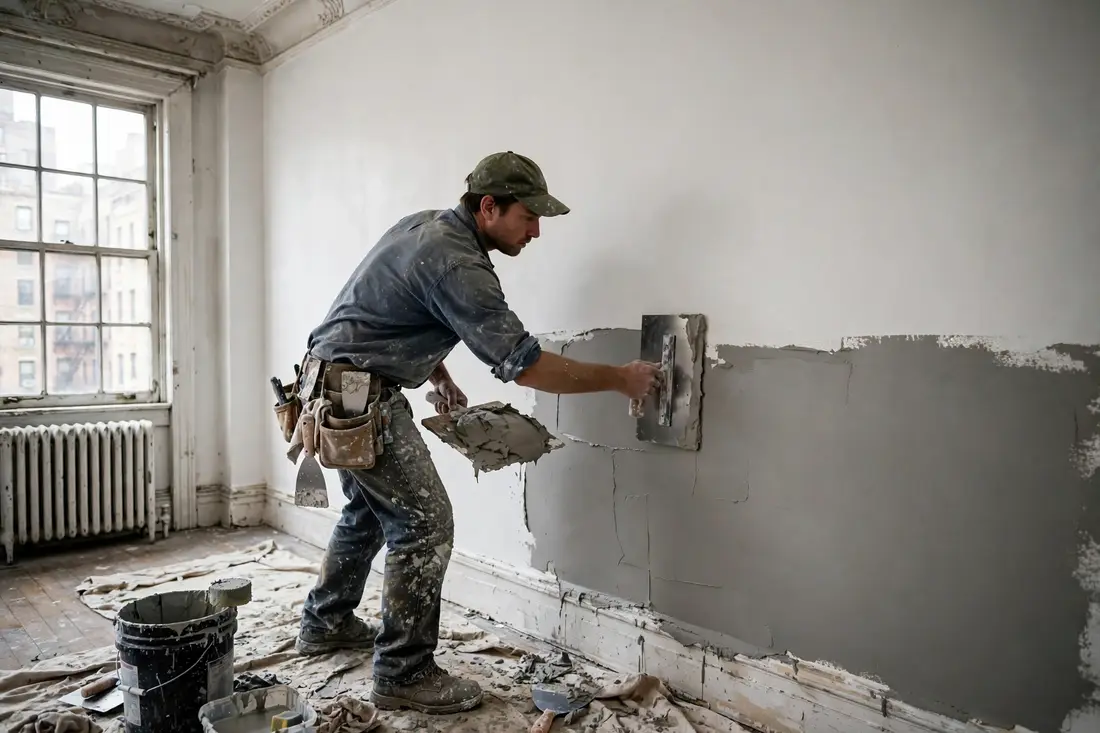
A plasterer applying a smooth skim coat of joint compound to a repaired wall, the lower half fresh grey compound and the upper half finished white, with a hawk of compound in the other hand
Skim coating a repaired plaster wall: the finish that makes the repair disappear.

The flood cut is the wall repair everyone recognises. Where water stood against a wall, the damaged board comes off at a clean horizontal line, high enough to clear the wet material with a margin, so the cavity can be dried and inspected. The cut looks drastic and is actually the conservative move: it saves the sound upper wall, exposes the hidden damage while there is still time to treat it, and gives the patch a straight, supported edge to meet. Insulation inside the cut zone is judged separately and usually replaced, because wet insulation dries slowly and badly inside a closed wall.

Cavities hold the surprises. Inside an opened New York wall, crews find the plumbing of three eras, wiring that predates modern code, the nests of old repairs, and occasionally the real source of a leak that was blamed on the roof for years. They also find growth where water sat unnoticed. Where mold is present past the small scale, New York law separates assessment from remediation and licenses both, and the wall does not close until that process has run. The mold section of this page covers the rule. The wall section just insists on it: a cavity is inspected before it is closed, every time.

Rebuilding a wall runs in the building's own order. Studs and plates checked and treated. Insulation back. Board fixed and taped, or plaster rebuilt in coats. Skim, sand, seal, paint. In rooms where one wall was opened and the others were not, the finish has to marry new work to old at the corners, which is where skill shows. A corner that stays straight and a paint line that disappears are the signature of water damage repair New York done by people who finish as carefully as they demolish.

Exterior walls add their own chapter. In the city's masonry buildings, water often arrives through the facade: failed pointing, cracked lintels, parapets that pour inward. The inside wall then gets repaired again and again while the outside keeps feeding it. Any wall that stains in the same place after two honest repairs is telling you the source is the building envelope, and the repair belongs to the facade, with the interior patch last. Buildings carry that cost where the envelope is theirs, which in most New York housing it is.

Baseboards and trim are the wall's telltales. They swell, split at the mitres and come away from the wall when the bottom of the wall has been wet, and they are cheap witnesses: a crew reads them the way a doctor reads a chart. They come off for drying as a matter of routine, because the wall base behind them is the wettest part of the room and the last to dry. Sound trim goes back. Swollen trim is replaced and matched, and in older apartments the matching itself, to profiles no longer sold, is a small craft of its own.

Water in the home now? The order starts with a call.

Stop the source, photograph the damage, and get the drying started by readings. The rebuild follows when the structure says it is ready.

Call (212) 555-0147

Cabinets and woodwork

Cabinets, Trim and the Woodwork Water Finds

Kitchens and bathrooms concentrate a home's water in small wooden boxes, and cabinets are usually the first furniture the water eats. The enemy is the material of modern cabinetry: particleboard and fibreboard cores drink water, swell, and lose every screw that holds them. A cabinet carcass that has swollen is not dried back into shape by any machine. Solid wood doors and face frames, by contrast, often survive a clean, short wetting and can be cleaned, dried and refinished. Water damage repair New York in a kitchen is mostly this sort, made honestly: what is wood, what is board, what can be saved, what must be rebuilt.

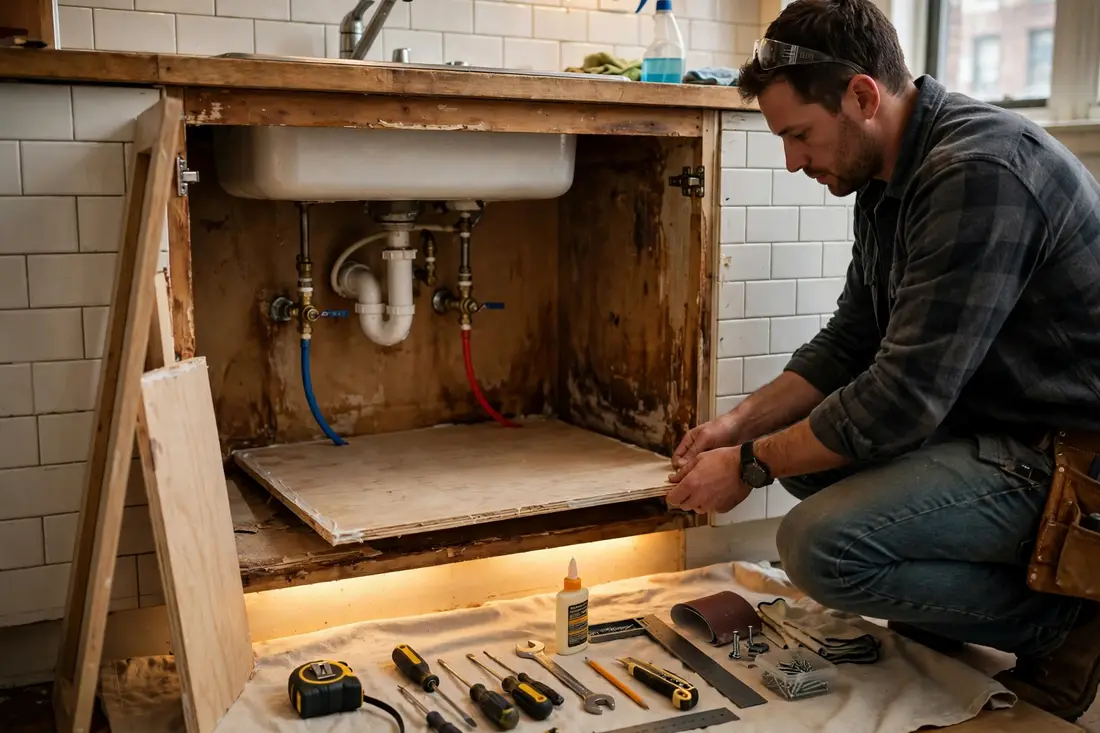
A carpenter fitting a new cabinet floor panel under a kitchen sink, with the cabinet doors removed, a repaired supply line and shutoff valve visible and tools laid out on a cloth
Under the sink: the cabinet floor is the first casualty of a slow leak and the first repair.

The sink base is the classic case. A supply line or trap weeps for weeks inside a closed cabinet, and the first sign is a smell, or a warped cabinet floor, or in the bad version the floor of the cabinet on the floor of the kitchen. The repair runs: plumber first, then the cabinet floor and any swollen sides replaced, the carcass checked for spread, the doors judged, and the whole unit dried and treated before it closes again. It is a small job with the whole philosophy of this page inside it, which is why it is the repair most often shown to homeowners as an example.

Vanities carry the same story into the bathroom, with one addition: the floor beneath them. A vanity hides the floor it stands on, and slow leaks rot that floor in the dark. When a vanity comes out for repair, the subfloor under it gets probed and read as a matter of course. More than one bathroom floor in this city has been saved by a vanity repair that looked, from the doorway, like a one cabinet job.

Doors that close badly are water's quietest symptom. A door that suddenly sticks in a frame it has fitted for years is often reporting swollen timber or a wall that has moved with moisture. Interior doors of solid construction can be dried, planed and rehung. Hollow doors that have taken water into the core usually cannot. In water damage repair New York, a sticking door is investigated, not just planed, because the door is the messenger and the message is usually a leak nearby.

Built in woodwork, the wardrobes, bookcases and window seats of older New York apartments, sits between furniture and structure and is judged as structure. Where it is fixed to a wet wall, the wall decides its fate. Crews photograph and number pieces that must come away for drying, because built ins reassemble in one order only. Owners should ask, before demolition day, what comes off, what stays, and who is responsible for putting the room's woodwork back to its lines.

The finish question runs through all woodwork repair: match what was there. Like for like is the contract principle, and in practice it means species, profile and finish matched closely enough that the repair does not announce itself across the room. In pre war apartments with original trim, that matching is the difference between a repair and a visible scar, and it is a fair thing to ask a crew about before signing: show me a match you have done. Good finishers expect the question.

Paint and finish

Paint and Finish: The Last Ten Percent That Shows

Paint is where a repair is judged by everyone who did not live through it. The structure can be perfect, the readings impeccable, the boards true, and one visible patch line will still tell every visitor that something happened here. Finishing is therefore not decoration added to water damage repair New York. It is the stage the whole job is remembered by, and it has rules as strict as the drying stage.

The first rule is sealing. Water stains carry minerals and tannins that migrate through ordinary paint, sometimes weeks after the finish looked perfect. Stain blocking primer goes over every water mark, every patch edge and every area where the old surface was exposed to the water, before any finish coat. Skipping it to save an hour is the most reliable way to schedule a second repair visit, and crews that seal as routine are telling you they have been called back before and learned.

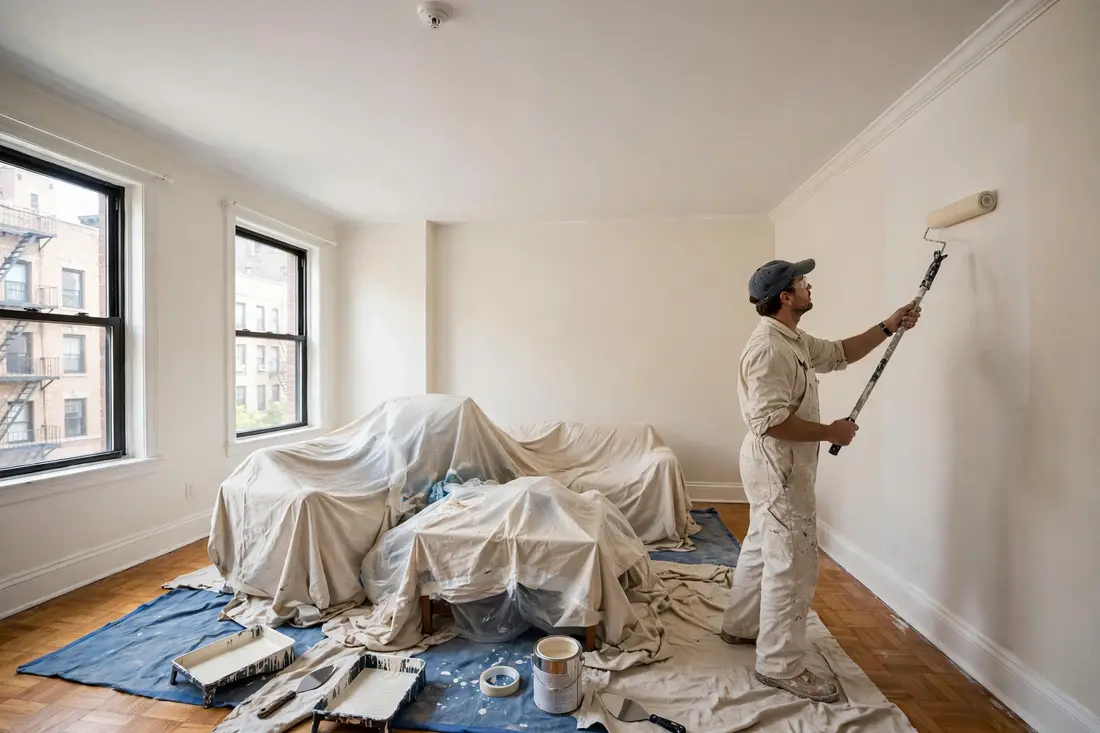
A painter rolling a final coat of warm white paint onto a fully repaired living room wall, the ceiling above freshly patched and seamless, new baseboards fitted and furniture covered in the centre of the room
The handover stage: whole surfaces painted, so the repair has no edge to confess.

The second rule is wholeness. Finish coats run across the whole surface: the whole ceiling, the whole wall, the whole room's floor finish. A patch painted alone shows its border in raking light, in lamplight, in the photograph taken to sell the home. Owners sometimes resist the extra area as upselling. It is the opposite. It is the difference between a repair and a reminder, and in water damage repair New York it is priced into honest scopes from the start.

Sheen is the third rule, and the subtle one. Paint of the same colour in a different sheen reads as a different colour on a repaired wall. Flat ceilings, washable walls in kitchens and baths, satin on trim: the repair has to match the room's existing logic or redo it whole. In older apartments, decades of paint layers also mean the new finish sits on a surface with its own texture, and a skim and sand before painting is often what makes new work belong to an old room.

Colour matching deserves a plain word. A repair crew can match a colour closely, and a paint shop can match it closer, but light changes everything and metamerism is real: two paints that match at noon part company at dusk. The whole surface rule exists partly for this reason. Where an owner has the original paint or its code, the file should hold it. The records section of this page lists paint codes among the small things worth keeping, because the next repair, in ten years, will be grateful.

The handover is the last act of finishing. The crew walks the room with the owner, in daylight if it can be arranged, and the owner looks for the repair and fails to find it. The readings, the photographs, the product names and the paint codes change hands. A repair that survives that walk, and leaves its paper behind, is finished. Everything else is a promise, and this page has tried to be strict about the difference.

Materials

The Materials of Repair: What Goes Back Into a New York Home

A repair is only as honest as its materials, and materials are where quiet substitutions happen. The contract principle is like for like: the same kind and quality that the water took. In practice that means the board thickness matches, the floor species matches, the plaster system matches the wall it joins. When a scope for water damage repair New York lists materials by name and grade, the owner can check the delivery against the paper. When it lists them as sundries, nobody can check anything.

Drywall comes in thicknesses and types, and the differences matter after water. Standard board serves most rooms. Moisture resistant board serves bathrooms and kitchens, where the next small leak is a matter of time. Ceiling board is made to resist sag across joists. A repair that puts the thinnest board everywhere saves a little money and spends it again in wavy ceilings. Ask which board goes where, and write the answer into the scope, because water damage repair New York is a materials promise before it is a labour promise.

Plaster materials divide the old city from the new. Traditional plaster is a system of coats over lath, each with its own mix and its own drying time, and repairing it with modern shortcuts shows at the edges. Veneer plaster and skim coats over board serve most patches well when the backing is sound. The material question in a pre war apartment is never just what fills the hole. It is what the wall was, and what will move, shrink and age at the same rate as the wall around it. Good water damage repair New York answers that question room by room.

Flooring materials carry the longest memories. Solid oak, the floor of half the city, can be matched in species and grade and woven into an old field so the repair disappears. Engineered boards must match in construction and finish, which is harder when the original line has been discontinued, one reason a few spare boards from the first installation are worth storing. Laminate matches by product or not at all. A scope for water damage repair New York that names the flooring product, or admits it cannot be matched and prices the whole room, is being straight with you.

Insulation is the invisible material, and the one most often quietly downgraded. What comes out wet should go back at the same performance: the same type, the same thickness, fitted without gaps. In exterior walls the insulation is part of the building's weather system, and a thin patch in it becomes the cold spot where condensation forms next winter. Nobody photographs insulation for the family album, but the claim file should record it, because water damage repair New York is judged in winter as well as at handover.

Timber for structure is graded, and the grade is not a detail. A replaced joist section or bottom plate has to carry what the original carried. Crews sister new timber alongside damaged sections more often than they replace whole members, and the method is sound when the remaining wood is sound and the fixing is right. What the owner should hear is the reasoning said aloud: what stays, what is sistered, what is replaced, and what reading or probe supports each call. That conversation is water damage repair New York thinking out loud.

Paint and primer are materials too, with specifications that belong in the file. Stain blocking primer is a product class, not a brand preference, and the scope should name the class wherever water marked a surface. Finish paints should be recorded by maker, line, colour and sheen, so the room can be touched up in five years without repainting a wall to hide a patch. Keep the codes with the contract. Future you, holding a sample pot, will be grateful, and so will the next crew to practise water damage repair New York in that room.

Cabinets and millwork close the materials list, because they are where like for like is hardest. A discontinued cabinet door profile, a trim section no mill stocks, a vanity size that changed by an inch: these are the small frictions that stretch repair schedules. Honest scopes flag them early and offer the real choices: millwork matched by a shop, the whole run refinished to hide the difference, or a documented substitution agreed in writing. All three are legitimate. The illegitimate one is silence, and water damage repair New York has no use for it.

Room by room

Room by Room: Kitchens, Bathrooms, Bedrooms and the Rooms Between

Kitchens take water from more directions than any other room: supply lines, dishwashers, ice makers, sinks and the fridge that nobody pulls out for a decade. The damage pattern is low and hidden, under cabinets and behind appliances, and it is usually old by the time it is found. Kitchen water damage repair New York therefore starts with appliances pulled and cabinet bases opened, and its signature repair is the floor and cabinet work described earlier on this page, done in a room the household cannot spare for long.

Bathrooms are the source room and the victim room in one. They generate the leaks that ruin ceilings below, and they suffer their own: failed pans, tired grout, seals that gave up quietly. Bathroom repair has one rule the others do not: the waterproofing is the repair. Tile over a failed pan is decoration on a leak. The pan, the drain connection and the wet wall backing are rebuilt as a system, or the room will be opened again. In water damage repair New York, a bathroom is finished when water stays where water belongs, tested, not when it merely looks dry.

Bedrooms suffer quietly and are repaired simply, which is their mercy. The usual story is the ceiling stain from the bathroom or roof above, or the wall shared with a wet room. The work is the ceiling and wall work of this page, with one addition: contents. Beds, wardrobes and stored clothes sit under the repair zone, and a good crew's first act in a bedroom is protection and removal, agreed with the owner, photographed like everything else. Water damage repair New York counts a room's contents among its responsibilities, not its obstacles.

Living rooms carry the finishes a household shows the world, and their repairs are judged hardest. The floors are wider, the ceilings are the ones guests look at, the trim is the best in the home. A living room repair is where the whole surface rule for paint and floor finish earns its keep, and where matching original materials matters most. Owners should expect the scope for this room to be the most detailed in the house, and should be suspicious when it is the vaguest. In water damage repair New York, detail follows value.

Hallways and the rooms between are the water's highways. Leaks travel along them, drying equipment lives in them, and every other room's repair passes through them. They are repaired last and used first, which is why their floors and walls show the scuffs of the whole job. A thoughtful crew protects hallway finishes at the start rather than repairing them at the end, with the protection listed in the scope. It is a small line that separates firms that have run long jobs from firms that have only quoted them.

Children's rooms and nurseries add one consideration that outranks schedule: the room must be not only repaired but clean, with dust controlled during the work and the surfaces finished and cured before small lungs return to it. Containment during demolition, cleaning after, and honest conversation about timing are the whole of it. Crews who work in family homes understand without being asked. The same applies, with different details, to rooms where anyone's health is fragile. Water damage repair New York in an occupied home is a guest in that home, and behaves like one.

Home offices have joined the list of rooms with their own repair logic, because the city's work moved into them and stayed. The wiring, the equipment, the records and the simple fact that the room earns money all raise the cost of disorder. Photograph the desk setup before it moves, agree where the work of the household will happen during the repair, and sequence the noisy stages honestly. None of this is building work. All of it is the difference between a repair that a household survives calmly and one it remembers with heat.

Closets, pantries and the small forgotten rooms deserve a sentence, because water loves them. They are unvisited, unventilated and usually built against the wet walls of bathrooms and kitchens. They grow the mold that the main rooms are blamed for. Every repair survey on this page's model walks the small rooms with the meter too, and every owner should insist on it. The cheapest room to repair is the one found early, and in water damage repair New York the small rooms are where early is still possible.

Insurance and records

Insurance and the Repair: Clocks, Proof and the Paper Trail

A repair and a claim are the same event read by two different trades, and the homeowner stands at the counter between them. The insurer does not pay for water. It pays for a documented loss, repaired in the recognised order, at a scope it can read. Everything in this section exists to keep those two readings aligned, because most claim pain in water damage repair New York is not refusal. It is mismatch: work done before it was documented, documents that do not match the work, clocks that ran while nobody watched them.

New York sets the clocks, and they are shorter than people expect. Under Regulation 64, section 216.6, once your proof of loss is received, the insurer has fifteen business days to accept or reject the claim, and once the amount is agreed, five business days to pay it. For claims that fall under the disaster provisions of section 2618 of the Insurance Law, the decision window is likewise fifteen business days and the payment window four. These clocks are quoted in the FAQ with their sources, and they are the reason this page keeps repeating one instruction: date everything, keep everything.

Proof of loss is a formal step, not a summary of phone calls. It is the sworn statement of what was damaged and what is claimed, and the decision clock runs from its receipt. Homeowners who treat the first phone call as the filing discover, weeks later, that the clock they were counting never started. Ask the insurer, in writing, what form the proof must take and where it goes. Keep the proof of sending with the proof itself.

Flood insurance runs on its own rails, and its basement limits are the famous ones, but its repair limits matter everywhere in the home. The National Flood Insurance Program pays to repair flood damage to the building and the systems that serve it, and its own fact sheet draws careful lines around finishes and contents. Two of its clocks belong in every homeowner's diary: a new policy generally waits thirty days before it covers a loss, and the proof of loss must be submitted within sixty days of the date of loss. The program's current authorisation runs to 11 December 2026, a date worth knowing if your renewal sits near it.

The scope is where claim and repair shake hands. A written scope that separates removal, drying and rebuild, names materials, and carries the drying logs behind it is a document an adjuster can price without a second visit. A single line total is an invitation to argue. Owners sometimes fear that detail invites cuts. In practice the opposite holds: detail is what gets a repair paid in full, because every line answers the question the adjuster was about to ask.

Direct billing, where the insurer pays the repair firm directly, appears in this page's service catalogue because it is commonly offered and commonly misunderstood. It changes who receives the money, not what the money must cover or what records you should hold. Even where the firm bills directly, keep your own complete file. Claims are reopened, properties are sold, surfaces occasionally fail, and in every one of those moments the owner's file is the owner's protection.

Disagreements have a ladder, and it is worth climbing it in order. First, a dated letter to the insurer setting out the scope, the readings and the point of difference. Then the Department of Financial Services, whose consumer line and disaster hotline are both in this page's footer, and whose involvement has a way of concentrating a claim file wonderfully. The department cannot rewrite your policy, but it can insist the policy you bought is honoured on time. For large or denied claims, a New York insurance lawyer reads the same file with different eyes.

One honest limit belongs in this section. This page explains clocks, documents and order. It does not price repairs, and it cannot read your policy. Coverage turns on the exact wording of the exact policy in the exact event. What water damage repair New York can promise is narrower and more useful: if the work was needed, done in order and documented as it went, your claim stands on the strongest ground the facts allow.

Water in the home now? The order starts with a call.

Stop the source, photograph the damage, and get the drying started by readings. The rebuild follows when the structure says it is ready.

Call (212) 555-0147

The written scope

The Written Scope: How a Repair Is Priced Without a Price List

This site publishes no prices, and this page has twice refused to invent figures for the cost questions. What it offers instead is more useful: the document that makes any price honest. The written scope is the repair written down before it is performed: rooms, materials out, materials in, drying method, readings that end the drying, stages, and the order they run in. With a scope, two firms can be compared line by line. Without one, a homeowner is comparing two totals and two smiles. Water damage repair New York begins, as a purchase, with this document.

A scope's first virtue is separation. Removal, drying and rebuild are different stages with different crews, different equipment and different risks, and a scope that prices them as one lump hides every interesting question inside the lump. Separated, the owner can see what the drying costs against what the rebuilding costs, can hold the rebuild lines against the like for like principle, and can tell where the money would go if the cavity, once opened, turns out worse than the meter promised. Separation is not pedantry. It is how water damage repair New York stays honest when the wall surprises everyone.

The second virtue is the contingency, named in advance. Every honest scope carries a sentence about what happens if hidden damage appears: who is told, how it is photographed, how the extra work is priced and approved before it is done. The dishonest version of that moment is the phone call from an opened wall with a total attached and the job held hostage to it. Agree the rule while everyone is calm and the wall is still closed. In water damage repair New York, surprises are expected; ambushes are not.

The third virtue is the finish line. A scope should say what finished means: surfaces painted whole or patched, floors finished across the room, trim matched, readings delivered, photographs delivered, the room cleaned. Owners and crews carry different pictures of finished, and the gap between the pictures is where final payments go to argue. Write the picture down. The handover walk described on this page is simply the scope, read aloud in the room it describes.

Comparing scopes is a skill this page can teach in one paragraph. Lay two side by side and mark what one includes that the other omits. The cheaper scope is usually the shorter one, and the missing lines do not vanish; they return as extras. Ask each firm about the other's lines. The answers, more than the totals, tell you which firm has actually walked your rooms in its mind. That is the firm whose water damage repair New York you are buying, whichever total you choose.

The scope also has a legal shadow, and it should be deliberate. In New York the home improvement contract must carry its statutory contents, and the scope belongs inside that contract or attached to it, initialled, so the promise and the paper are the same document. A scope on a separate cheerful printout, contradicted by a thin contract, protects the firm. A scope inside the contract protects the owner. Ask for the second arrangement by name.

Finally, keep the scope after the job, with the readings and the photographs stapled to it in fact or in folder. It becomes the home's memory of what was done and why. Insurers ask for it. Buyers ask for it. The next repair, in another room in another year, starts from it. Paper that good deserves a drawer, and water damage repair New York is, in the end, a trade that runs on paper as much as on plaster.

Apartments and neighbours

Apartments: Who Repairs What When the Leak Is Not Yours

In a New York apartment, water rarely respects the boundaries of ownership, and neither can the repair. The leak starts in one home, the damage flowers in another, and the ceiling between them belongs to a legal argument that has been running in this city for a hundred years. This section is the practical map: who does what, in what order, while the lawyers' version settles itself in the background. The short version is that drying never waits for liability, and paperwork always does the heavy lifting.

Start with notice, in writing, the day you find the damage. Management, the landlord, the neighbour above: all three get the same short message with the date, the time and the rooms affected, and you keep the copies. In the renter threads this page was researched from, the saddest stories share one shape: weeks of verbal reports to a super, a ceiling that worsens, and then a dispute in which nobody can prove when anyone was told. Written notice is the difference between a repair and a saga.

The building's side of the work is usually the source and the structure. Risers, shared stacks, roofs, facades and the pipes inside walls belong, in most New York housing, to the owner or the co-op or condo corporation. The unit's side is usually the finishes inside it. The exact line lives in your lease, proprietary lease or bylaws, and it is worth reading before the argument, because the line moves from building to building: in some, the corporation owns everything behind the paint; in others, the shareholder owns the board inward.

Access is the second practical battle. Your repair crew may need to read moisture in the unit above. The plumber fixing the source needs your ceiling open, or their floor. Buildings coordinate this, sometimes well. Keep your own requests written and reasonable, offer wide windows of time, and record refusals calmly. If access is refused while damage spreads, that record is what a housing complaint or a lawyer's letter stands on. The city's route runs owner first, then 311 and the Department of Housing Preservation and Development, whose violation classes carry their own repair deadlines.

Those deadlines deserve a paragraph of their own. Housing violations in the city are classed by seriousness: class A items carry ninety days, class B thirty days, and the immediately hazardous class C items carry the shortest windows, twenty one days for mold conditions, fourteen for self closing doors, and for heat and hot water the table allows no time at all while the complaint guidance says repairs must be made immediately. This page reports both wordings as the city publishes them, because owners and tenants quote both. A filed complaint does not dry your ceiling, but it does start a clock the building can see.

Payment follows fault, usually through insurers. The neighbour's liability cover, the building's policy, your own policy paying first and recovering later: the money has several roads to the same repair, and the FAQ answers the who pays questions directly. What the tenant or owner in the wet unit controls is the evidence. Photographs, the written notices, the drying logs and the scope are the currency every one of those roads runs on.

There is a special case worth naming: the leak nobody can find. Intermittent water, a stain that grows only on certain days, often traces to a source that only runs sometimes: a shower used by one household member, an overflow drain, a condensate line in summer. Repair crews and plumbers hunt these with dye, pressure tests and patience. Do not let anyone rebuild the ceiling until the intermittent source is caught, or the ceiling becomes a very expensive diary of the leak's schedule.

Through all of it, one principle protects the person in the wet home: mitigate first, argue second. Drying your rooms promptly is your duty under most policies and your interest under all of them. A repair delayed for a liability argument is a bigger repair, a mold risk and a weaker claim, all three at once. Water damage repair New York in an apartment building is a team event whether the team likes it or not, and the homeowner who keeps the paper and starts the drying wins it.

Permits, licences and contracts

Permits, Licences and the Contract: The City Rules Around a Repair

A repair in New York City sits inside three sets of rules that have nothing to do with water and everything to do with whether the job was legal. The Department of Buildings decides what work needs a permit. The Department of Consumer and Worker Protection licenses the firms that do home improvement work. The General Business Law dictates what the contract must say. None of this is decoration. When a repair is disputed, these are the rules the dispute is settled by, and water damage repair New York done inside them is the version that survives.

Permits first. The Department of Buildings states plainly that most construction in the city needs a permit, and then lists the work that does not: painting, plastering, installing new cabinets, replacing plumbing fixtures and resurfacing floors are on the no permit list, along with non structural roof repairs. Most like for like water repair lives inside that list, which surprises people. The line is crossed when the scope changes structure, moves partitions, alters plumbing runs or touches building systems. Permitted work, the department adds, may not start until the permit is in hand.

One permit point is stated carefully on this page, because the sources state it two ways. City material describes the timing for emergency work filings differently in different places: one account runs the clock from when the work is completed, another from when it begins. Rather than choose, this page quotes no filing deadline for emergency work at all, and neither should your contractor without checking the current department guidance for your exact scope. It is a small honesty, but repair paperwork is built out of small honesties.

Licences second. Residential repair and remodeling work in the five boroughs requires a Home Improvement Contractor licence, issued by the Department of Consumer and Worker Protection on a two year term expiring on February 28 in odd numbered years. The check is public and quick, through the DCWP License Search, and it should be as routine as reading the reviews. A licence does not make a crew careful, but an absent licence, where one is required, makes a statement about how the firm regards the rules you cannot watch it follow.

Contracts third, and here the law is generous to homeowners who read. Section 771 of the General Business Law lists what a home improvement contract must contain, from the contractor's name, address, phone and licence number, through the work and materials description, the start and completion dates and the progress payment schedule, to the lien notice, the deposit protection notice and the insurance disclosure required since April 2022. The contract must be written, signed, legible and in plain English, and your copy must be in your hands before work starts.

The same section carries the cancellation right: you may cancel until midnight of the third business day after signing, with one exception for genuine emergencies, and that exception requires your own handwritten waiver. Read that sentence again at the kitchen table, because the kitchen table at midnight, with water dripping into a bucket, is exactly where these contracts get signed. A firm that explains the right to you is following the law in front of a witness. A firm that hides it has told you what the rest of the job will be like.

Deposits deserve their own warning, because folklore is strong here. Section 771 requires the contract to carry the notice about deposits being held in escrow or bonded under the Lien Law. What it does not contain is a maximum deposit figure, and any source that quotes you a legal cap on deposits is inventing it. Judge a deposit by the schedule instead: money tied to progress, in writing, against work you can see. That is the protection the law actually built.

Mold work has its own legal frame, and it touches repair because repairs close walls that mold may be inside. Under Article 32 of the Labor Law, mold assessment and mold remediation on the same project must be done by separate parties, containment stays in place until the clearance notice is given, and the project ends with a post remediation assessment and a written clearance report that says the work passed. A repair crew that wants to close a moldy wall and skip that sequence is asking you to break the law with them. Decline.

The repair calendar

The Repair Calendar: Winter Pipes, Spring Thaw, Summer Storms

New York water keeps a calendar, and repair crews can read the month from the damage. Winter is the season of the burst pipe and the radiator: frozen lines in unheated voids, splits that announce themselves at the thaw, valves that have wept since the heating started. The repair signature of winter is urgency inside occupied, heated homes, where the drying competes with the cold at the windows. Water damage repair New York in January is a race run in a warm room against a cold wall.

Spring is the season of revelation. The thaw shows what winter broke, roofs leak where ice sat, and the first heavy rains test every repair the cold delayed. Spring scopes carry a particular honesty test: separating this year's damage from the winter's, and both from the slow leak that was there before either. Photographs and readings date the water's work better than memory does, which is why spring water damage repair New York leans so hard on the survey.

Summer is the season of storms and systems. Thunderstorms drive water through facades and into ground floors, sewer backups follow the worst of them, and air conditioning condensate lines, quietly dripping all season, rot ceilings in buildings that have no other water problem at all. Summer is also mold's fastest season: the twenty four to forty eight hour window shrinks in the heat, and drying delayed by a holiday weekend becomes a licensed mold job by the following one. In summer, water damage repair New York starts fastest or costs most.

Autumn is the season of preparation, and the cheapest repairs of the year are the ones done then to prevent winter's. Radiator valves serviced, hoses replaced, roof drains cleared, the ceiling below the terrace checked after the equinox rains. This page's prevention advice is autumn advice. Owners who walk their homes with a meter and a torch in October meet fewer crews in January, and the crews they do meet are doing smaller, calmer work.

The calendar has a second hand that is not weather: the building's own year. Heating seasons start and stop, roofs are replaced on cycles, facades are inspected and repaired on the city's timetable, and each of those events sends its own water into the units below. A repair history that notes the building's events alongside the home's damage reads, after a few years, like a diagnosis. Keep the file, note the dates, and the pattern will eventually introduce itself. That, too, is water damage repair New York: the long memory applied to one address.

None of the seasons changes the order. Source, evidence, drying, rebuild, records: the sequence is weatherproof. What the calendar changes is the emphasis, the likely source and the speed the mold clock runs at. A page like this one is read differently in January and in July, and both readings are correct. The water does not care which month it is. The repair, done properly, does not either, and that indifference, backed by readings, is the closest thing the trade has to a promise.

Mold and the rebuild

Mold and Repair: Why the Short Window Governs the Rebuild

Mold is the reason drying has a deadline, and the deadline is the reason repair has an order. The Environmental Protection Agency's guidance is the sentence this whole site is built around: in most cases, mold will not grow if wet or damp items are dried within twenty four to forty eight hours. Read it as a repair instruction. Every hour of drying inside that window is mold prevention done cheaply, with fans. Every week of delay is mold work done later, with licences, containment and clearance reports.

The connection to repair is direct. Mold grows on the same materials repair replaces: the paper face of drywall, the backing of flooring, the dust inside a wall cavity. A rebuild that closes a cavity where growth has started does not hide the problem. It houses it, feeds it the new material, and guarantees a second, larger opening of the same wall. This is why water damage repair New York refuses to close a wall on a smell or a hope, and why the inspection of the open cavity is a stage in its own right.

New York regulates the larger end of this work. Article 32 of the Labor Law licenses mold assessors and remediators, separates the two roles on any one project so that the party who judges the work is never the party who profits from it, and requires the written clearance described in the permits section before the job is called done. Small areas in a home sit below the licensing threshold, and homeowners clean those themselves every week. The line matters most inside walls, where the area cannot be seen to be small.

For the homeowner, the practical rules are few and firm. Dry fast, inside the window, by readings. Open what stayed wet past it and look. Treat any growth found as a reason to slow the rebuild, not to speed the paint. Keep the assessment and clearance papers with the claim file when the licensed route is used. And be suspicious of any plan whose mold strategy is a spray and a promise: the state's whole framework exists because that strategy failed often enough to need a law.

There is a quieter point to end on. Mold fear sells a great deal of unnecessary demolition, and mold denial sells a great deal of paint. The readings and the open cavity tell the truth between those two sales pitches. A repair crew that shows you both, and prices what they show, is the crew this page has been describing from the first section.

Doing it yourself

Doing It Yourself: Where the Line Sits in a New York Home

Some of this work is genuinely yours to do, and this page would be dishonest if it pretended otherwise. A small ceiling stain from a fixed source, dried and sound, can be sealed and painted by the person who lives under it. A cabinet floor can be replaced by a careful hand. The homeowner guides agree: the most read of them, WikiHow's guide to fixing a leaking ceiling, walks through patch, compound, sanding, priming and painting in exactly the order this page teaches, and draws its own line for calling a professional at damage bigger than about six inches by six inches.

The line is not really about size, though. It is about certainty. Do it yourself when the source is certainly fixed, the structure is certainly dry, the material is certainly sound, and the water was certainly clean. Each certainly is a load bearing wall. Remove one, and the job changes trades. A stain you cannot source, a cavity you cannot read, a softness you cannot explain: those are not challenges to your skill, they are information that the job is bigger than its surface.

The Reddit threads behind this page are a museum of the line being crossed in both directions. Homeowners who patched over live leaks, sometimes twice. Homeowners quoted for full rebuilds of ceilings that needed a plumber and a paintbrush. The pattern in the happy endings is always the same: the source was proven, the drying was verified, and then the size of the repair, whoever did it, turned out to be exactly the size of the damage, no bigger and no smaller.

Tools draw part of the line too. A moisture meter is the one instrument that turns opinion into evidence, and it is the instrument homeowners do not own. Borrowing readings is possible: a repair crew's first visit usually includes them, and a scope written from readings can still be partly executed by the owner. What cannot be borrowed is the drying plant. A room dried by a bathroom fan and hope is a room whose cavity moisture is unknown, and unknown is the one state water damage repair New York cannot build on.

Buildings draw the rest of the line. Many New York buildings require insured, licensed trades for work inside units, require notice before walls or ceilings open, and book freight elevators for material. A homeowner repair that ignores the building's rules can be stopped mid job by the building, which is the worst of all outcomes. Read the alteration rules before the toolbox, and where the building requires a firm, the do it yourself portion of the job becomes the photography, the records and the supervision, which are worth more than the plastering anyway.

Water in the home now? The order starts with a call.

Stop the source, photograph the damage, and get the drying started by readings. The rebuild follows when the structure says it is ready.

Call (212) 555-0147

Repairs that fail

The Repairs That Fail: A Short Museum of Shortcuts

Every crew in this trade keeps a private museum of other people's shortcuts, visited whenever a wall is opened. This section is the public version. None of the exhibits required bad intentions. All of them required only hurry, optimism and paint. Read them as the negative of everything this page teaches, because each failed repair began as a reasonable sounding decision. The museum's lesson is that water damage repair New York fails in predictable ways, and predictable failures can be refused in advance.

Exhibit one: the patch over the live leak. The stain is patched and painted while the source, a weeping joint or a cracked pan, is still wetting the cavity a little every day. The repair looks perfect for a season. Then the outline of the old stain returns, drawn by the new water in the old shape, and the second repair costs the first repair plus the argument about whose fault it is. The refusal is simple: no patch is scheduled until the source is fixed and tested under use, with showers run and valves opened, not merely tightened.

Exhibit two: the floor over the wet subfloor. The boards were the visible damage, so the boards were replaced, quickly and beautifully, over a subfloor that still read wet at its centre. By the next season the new field has cupped in the same pattern as the old, and the museum gains another floor. The refusal is the reading: the subfloor's numbers, written down, are the floor's permission to exist. Water damage repair New York that cannot produce the numbers has not earned the boards.

Exhibit three: the painted mold. A closet wall, a bathroom ceiling, a basement corner: growth cleaned from the surface, sealed with ordinary paint, and declared cured. The growth returns through the paint because its food and its moisture were never removed, only decorated. The refusal is the framework the state built: dry the structure, remove what is ruined, and where the area is past the small scale, let the licensed assessment and clearance process run before any wall closes.

Exhibit four: the ceiling that was never opened. A stain, dry to the touch, sealed and painted without anyone looking into the cavity. Sometimes the gamble wins. Sometimes the cavity holds wet insulation and a joist end quietly rotting, and the ceiling announces the truth a year later by sagging. The refusal is proportionate: the bigger the event and the longer the water sat, the less a surface reading can be trusted, and the more the cavity has to be seen to be believed.

Exhibit five: the repair with no file. The work itself was competent, even good, but nothing was written: no scope, no readings, no photographs, a contract that would embarrass a lemonade stand. When the insurer asked questions, and when a surface failed in the second year, there was nothing to answer with. The repair failed on paper after succeeding in plaster. The refusal costs almost nothing: the file, kept as this page describes, is the cheapest exhibit insurance in the museum.

The museum has a gift shop, and it sells one item: the order, printed plainly. Stop the source. Photograph everything. Dry by readings. Rebuild in sequence. Keep the record. Every exhibit in this section is a place where one of those five steps was skipped by someone who knew better and was in a hurry. The reader who holds the order holds the whole of water damage repair New York, and the museum stays, for their home, a place to visit rather than a place to be displayed.

Choosing a crew

Choosing a Repair Crew in New York: Tests That Work on Paper

Everything on this page doubles as a test you can apply to the firm standing in your wet kitchen, and this section gathers the tests in one place. None of them requires you to know building. All of them can be applied from paper, over the phone, or in the first visit, before money moves. A firm that passes them is not guaranteed to be excellent. A firm that fails them has told you, early and cheaply, what the expensive lesson would have been.

The order test: ask the firm to describe the job in sequence. The answer should begin with the source, pass through drying by readings, and arrive at the rebuild last. A sequence that starts with demolition prices or finish dates has the trade backwards. The readings test: ask what readings will release the rebuild and whether you will hold the log. The scope test: ask whether removal, drying and rebuild are priced as separate named stages. Three questions, and water damage repair New York either has a spine or it does not.

The licence test: ask for the Home Improvement Contractor licence number and check it in the DCWP License Search while the kettle boils. The contract test: ask whether the contract carries the full contents section 771 requires, including the cancellation notice, and whether your copy arrives before work starts. The insurance test: ask who documents the claim, and whether drying logs and photographs come to you as a matter of course or have to be begged for.

The video test comes from this page's research. Homeowners now learn the trade from repair videos before they ever meet a crew, and the two case studies in the next section are a fair sample of the best of them. A crew that welcomes an informed owner, who has watched a ceiling patch done properly and asks why this joist is treated differently, is a crew comfortable being watched. Crews who dislike questions in the first visit dislike them more in the fifth week.

The reference test is the oldest and still works: two recent jobs, similar to yours, that you may call. Ask those owners one question each: what did the firm do when something unexpected appeared inside the wall. Every repair has that moment. The answer tells you whether you are hiring a sequence of trades or a firm that thinks. Surprises are the job. Character is how they are priced and told.

And the last test is this page itself. A firm doing water damage repair New York in this city should recognise every rule in it: the readings, the clocks, the licence, the contract, the separation of mold assessment from mold work. Where a firm corrects the page from its own deeper knowledge, listen with respect. Where a firm waves the rules away as paperwork, you have learned the only thing you needed to know.

Case studies on video

Two Case Studies on Video, Labelled for Exactly What They Are

This site does not embed videos, here or anywhere. What it does, on every service page, is read the best repair footage closely and tell you what it proves, what it does not, and where to watch it. The two films below are the ceiling repair pair the research verified on their own pages: real water damaged ceilings, real methods, watched by millions between them. One honest label before either is described: neither film is set in New York. The ceilings are British and American, the buildings are houses rather than apartment towers, and the rules around the work are not New York rules. The plaster does not care. The permits do, and this page's permit section outranks anything a film suggests.

The first film is Ryan Seeley's ceiling repair, published in June 2021 and watched more than three quarters of a million times. In under five minutes it shows the whole grammar of a ceiling patch after a leak: a water damaged ceiling with the plasterboard torn and failing, the joists and pipes exposed above it, the damaged material taken back, and the new surface made good. Watch it for the order. Nothing is painted that has not been opened, dried and judged first, which is the entire argument of this page compressed into one short film. Watch it on YouTube: How To Repair a Water Damaged Ceiling After a Leak, Ryan Seeley Plastering.

The second film is Paul Peck's step by step drywall ceiling repair on DrywallTube, published in February 2021 and watched more than three and a half million times. At twenty four minutes, with chapters, it is the patient version: measuring and cutting the patch, fixing it home, taping, and building the compound coats that make a ceiling repair vanish. Watch it for the coats. Every beginner believes one thick coat will do, and this film is the standing refutation. Watch it on YouTube: How To Repair Water Damaged Drywall Ceiling, Step by Step, DrywallTube.

Read together, the pair teaches the two halves of ceiling repair: the judgement and the finish. Seeley's film is about what must happen before the patch, Peck's about what must happen after it is cut. Between them they also show what neither can show you: the moisture readings that should precede both, because a film can show a dry looking joist but not a number. Bring the films' craft and this page's numbers together and you have the complete picture of water damage repair New York at ceiling scale.

A word on how to use films like these when a crew is in your home. Do not direct the crew from a video. Do use the video to ask better questions: where will you cut back to, how many coats, what primer seals the stain, what were the last readings in the cavity. Owners who ask those questions get the careful version of every trade, because the questions announce that the work will be looked at by someone who knows what it should look like.

Questions from real threads

What New Yorkers Actually Ask: Questions From the Forums

This page was researched where homeowners actually talk: the housing and do it yourself forums, the question sites and the how to guides. Their questions shaped the thirty in the FAQ, and a few deserve their own section, because they arrive with a story attached and the story is the useful part. The most common is the ceiling thread: a leak, a stain, and the poster asking whether to call a plumber or just patch it. The answer this page gives, in the FAQ and here, is that the question contains its own error. It is not either or. It is the plumber first, the repair second, and the order is the answer.

The second common thread is the management thread, usually from this city's renters: the ceiling leak reported, the silence that follows, the stain that grows. Posters ask what their rights are, and the useful answer is procedural before it is legal: the report in writing, the photographs dated, the 311 complaint when the building's clock runs out, the violation classes with their deadlines behind it. Renters who arrive at that thread early, before the ceiling sags, get repairs. Renters who arrive late get sympathy. Water damage repair New York cannot change that arithmetic, but it can publish it, which is what this page is for.

The third thread is the patch thread, from the question sites: how do I patch the hole the water left. The answers there are good on method and silent on sequence, full of compound technique and empty of readings. This page has tried to supply the missing half. Patch craft matters, and the films in the video section teach it better than text can. But craft applied to a wet cavity is decoration on a problem, and the forums are full of the sequels: the patch that blistered, the seam that cracked, the stain that came back wearing new paint.

The fourth thread is the urgency thread: a photograph of a ceiling, taken from a bed, asking how serious this is. The honest answer, the one this page gives in the FAQ, sorts by source, spread and sag, and treats a bulge as the one true emergency of the set. Posters in those threads often report that the ceiling came down in the night, in one piece, onto the room below the leak. A bulging ceiling is not a repair question. It is a move the furniture, keep people out from under it, and call today question.

Read as a whole, the forums teach one lesson that no textbook states as plainly: homeowners rarely fail at effort. They fail at order. They patch before they source, paint before they dry, argue before they photograph, and pay before they scope. Every section of this page is that lesson expanded, and every rule in it can be traced to a thread where the rule was learned the expensive way. Water damage repair New York, as the forums teach it, is not a mystery. It is a sequence, and the sequence is free.

Borough by borough

Repair Across the Five Boroughs: Same Water, Different Housing

The water is the same in all five boroughs. The housing is not, and housing decides the repair. Manhattan's towers put the work inside co-op rules, alteration agreements and elevator bookings, with riser leaks travelling ten floors through chases before they show. Brooklyn's brownstones put it inside plaster, original trim and garden level floors that flood from the street side. The repair trade is one trade, but it wears five sets of clothes, and water damage repair New York means knowing which set your building is wearing.

Queens carries the city's widest mix: detached houses in the east with basements and roofs of their own, apartment blocks in the west with the full riser problem, and everything between. Its repair signature is the upstairs bathroom, the leak that travels one floor and announces itself in the kitchen below, in housing where the owner often lives in the building and carries both sides of the argument. The Bronx repair signature is plaster and radiators: the great pre war stock along the Grand Concourse and in Riverdale, steam heat, and walls that reward the plasterer's method over the boarder's.

Staten Island is the city's house borough, and its repairs are house repairs: roofs, gutters, basements, sump pumps, and storm water that arrives from the sky and the street rather than from a neighbour. Its exposure to coastal storms gives its repair calendar a season the tower boroughs do not feel in the same way. Long Island, served by this site as part of the same metro housing stock, shares that pattern at larger scale: detached homes, private systems, and repairs that begin at the roof and the grading rather than at a management office.

Beyond the city line, the same repair order serves the commuter counties this site covers, Westchester, Nassau, Suffolk and Rockland, where the housing is houses and the water questions are wells, septic systems, sump pumps and storm runoff. The rules change at the city border: the licence and contract regime described on this page is a city regime, and state law beyond it has its own versions. The readings, the order and the records travel without translation. Water damage repair in New York, the state as much as the city, is one discipline with local paperwork.

Storm repair deserves its sentence in this section, because the research found New Yorkers searching for it by name after every big weather event. Storm damage repair follows the same order with one addition: the building envelope joins the list of sources, and it must be made weather tight before the interior rebuild, or the next storm reopens the claim and the ceiling together. Roof, flashing, pointing and drainage first, plaster last. The sequence is the whole story, in every borough, in every weather.

One repair, told whole

One Repair, Start to Finish: A Ceiling in Queens Tells the Story

End with a single job, told whole, because a page of rules deserves one worked example. The ceiling is in a two family house in Queens, the leak is the bathroom above it, and every rule on this page appears in it at least once. The names are changed and the house is a composite of a hundred real jobs, but nothing in the sequence is invented. This is what water damage repair New York looks like when it is done in order, from the first drip to the final walk through.

It begins, as it usually begins, with a stain that was watched for a week before it was believed. By the time the call is made, the stain has a tide line and the paint inside it has begun to bubble. The owner's first acts are the unglamorous ones this page insists on: bucket, photographs, the circuit to the ceiling light off, and a written note to the tenant above, whose bathroom it is. The plumber comes first, and finds what plumbers find: a shower pan cracked at the drain, leaking a little with every shower, for months.

The repair crew's first visit produces the map. The ceiling reads wet well beyond the stain, the wall beside the bathroom door reads wet at its base, and the bathroom floor above, probed at its edges, is wet in the subfloor around the pan. The scope is written from those numbers in three stages: the pan and the damaged bathroom floor section, the drying of both rooms, and the rebuild of the ceiling below. The tenant above gets a bathroom schedule. The owner gets a contract with every section 771 item in it, a licence number already checked, and a copy in hand before a single tool is lifted.

Demolition day is the honest day. The ceiling opens to its cut lines, and the cavity tells the truth: joists sound, insulation wet and discarded, one joist end dark with old staining from a leak years before, repaired then with paint alone. That old repair is photographed with particular care, because it is the lesson of the whole job in one image. Paint is not a repair. The new work will not repeat it.

Drying takes four days of machines and two sets of readings a day, logged. The bathroom floor section is rebuilt first, the pan replaced, the new floor laid on a subfloor that reads dry. The ceiling cavity reaches its targets a day later. Only then does the board go up below: patch fitted to the joists, taped, three thin coats across three days, sanded, sealed with stain blocker, and the whole ceiling painted, because the room's other half would have shown the edge forever.

The claim file, assembled as the job went, is almost dull to read, and that is its virtue: first hour photographs, the plumber's invoice naming the pan, the scope, the drying log, the licence check, the contract, the readings that released the rebuild, the final photographs. The insurer's questions all have answers that were written before they were asked. The claim settles inside the regulation's clocks, because there was nothing left to argue about except the arithmetic.

The last scene is the walk through. The owner stands in the doorway in the late light, the hour when patches confess, and tries to find the repair. The ceiling is a ceiling again. Somewhere above it a shower runs and nothing comes through. That ordinariness is the entire product this page has been describing: not a beautiful repair, not a cheap repair, a finished one, built on dry structure, with its paper in a drawer. When the next stain appears in some other room, as in an old house it will, the file from this job is where the owner will start, and the order on this page is the order they will follow.

Water in the home now? The order starts with a call.

Stop the source, photograph the damage, and get the drying started by readings. The rebuild follows when the structure says it is ready.

Call (212) 555-0147

The checklist

Before You Sign: The Whole Page on One Checklist

Everything on this page reduces to a short list of things to have in hand before repair work starts, and this closing section states them plainly, in the order they should be gathered. First, the source: fixed by the right trade, tested under use, and named in writing. A repair signed before the source is proven is a wager, and water damage repair New York is not in the wagering business.

Second, the evidence: the first hour photographs, the readings that mapped the damage, and the written notices to everyone the water touched. Evidence gathered late is evidence argued about. Third, the drying plan: the equipment, the targets, and the log you will hold when the machines leave. In water damage repair New York, the log is not a courtesy. It is the document the rebuild stands on.

Fourth, the scope: rooms, materials out, materials in, stages separated, the hidden damage rule agreed, and the meaning of finished written down. Fifth, the contract: every item section 771 requires, the licence number checked in the city's search, the cancellation right understood, and your copy in your hand before the first tool is lifted. Water damage repair New York under a full contract is the only version this page recommends signing.

Sixth, the claim: the insurer told early, the proof of loss in the form the insurer requires, the clocks noted where you can see them, fifteen business days to a decision and five to payment under the regulation, sixty days for a flood proof of loss where flood cover applies. Seventh, the finish: whole surfaces, sealed stains, matched materials, and a walk through in daylight with the scope in your hand.

Keep the list where the bucket lives. Water does not make appointments, and the household that has read its checklist in a dry week will work it calmly in a wet one. That calm, more than any single skill, is what this page has been trying to hand over: the order, the paper and the patience to let readings, not hope, say when a home is ready to be made whole again.

Questions and answers

Thirty Questions Homeowners Ask, Answered From the Verified Facts

Every answer below is drawn from the sources this page was researched against: the Department of Buildings on permits, the Department of Consumer and Worker Protection on licensing, section 771 of the General Business Law on contracts, Regulation 64 and section 2618 on claim clocks, the National Flood Insurance Program on flood coverage, Article 32 of the Labor Law on mold, the Environmental Protection Agency on drying time, and the homeowner guides and forums where these questions are actually asked. Where the sources disagree, the answer says so instead of picking one. Where a figure would be a price, there is none, because this site gives no prices and judges repairs on written scopes instead. Search the thirty questions with the box, or read them in order.

What does water damage repair New York mean?

It means the rebuild stage of a water loss in a New York home: fixing what the water broke after the leak is stopped and the structure is dry. The phrase covers ceilings patched or replaced, drywall cut out and renewed, plaster skimmed, floors lifted and relaid, subfloors rebuilt, cabinets repaired, trim replaced and paint finished, across Manhattan, Brooklyn, Queens, the Bronx and Staten Island. It does not mean the pumping or the drying, though the same firm often does all three stages in order. Repair is the stage that hands the room back. When people search water damage repair New York, they are usually past the emergency and asking who puts the home back together, in what order, and how they will know it was done on a dry structure rather than over trapped moisture.

What is water damage repair called?

The trade uses a few names for the same work, and knowing them helps you read scopes and contracts. The rebuild stage is often called reconstruction, build back or repairs and reconstruction on a restoration scope. The whole job, from extraction to final paint, is called restoration or mitigation followed by reconstruction, and the fixing stage inside it is the repair. On insurance papers you may see it listed as repairs to real property or as the reconstruction portion of a claim. None of these labels changes the work itself: remove what water ruined beyond saving, keep and dry what can be saved, then rebuild the surfaces in the order they were built. If a document uses a name you do not recognise, ask the writer to point at the room and the material it refers to. When a scope lands on your table, that rebuild stage is the part that water damage repair New York names in plain words.

Can water damage be repaired?

Yes, in almost every case, and the honest question underneath is what can be saved and what must come out. Solid wood, masonry, plaster in good condition and many finishes dry out and survive when the water was clean and the drying started fast. Drywall that has gone soft, insulation that stayed wet, particleboard cabinets that have swollen and laminate floors that have lifted usually cannot be saved, because the material itself has changed shape or lost strength. A good repair crew sorts the room into those two piles in the first visit and writes the sort into the scope. What decides the split is the material, the water category, the time wet and the readings, not opinion. Repaired properly, on a dry structure, a room gives no sign the water was ever there. Judged that way, water damage repair New York is less a single job than a verdict on every wet material in the room.

How to tell if water damage is permanent?

Permanent damage shows itself in the material, not in the stain. Drywall that crumbles or stays soft after drying is finished as a material. Hardwood that stays cupped or crowned weeks after the readings reached dry targets has taken a set it will not leave. Plaster that has lost its key and drums hollow across a wide area will keep failing under new paint. Particleboard that swelled does not shrink back. Stains alone are not permanent damage: a clean, dry, sound surface can be sealed and painted. The test is always the same. Dry the structure fully, by numbers, then judge what is left. Anything judged before the drying finished is a guess, and acting on the guess either throws away sound material or rebuilds over ruined material. Crews who practise water damage repair New York make that judgement from readings and touch, in that order.

How much can it cost to fix water damage?

This page gives no figures, by design, because a figure quoted without seeing your rooms would mislead you. What can be said plainly is what the size of a repair turns on. It turns on how much material the water ruined, how many rooms and surfaces are involved, whether the structure dried fast or stayed wet, what has to come out before anything goes back, and how the finishes in your home compare with standard replacements. A written scope from a crew that has stood in the room, taken readings and listed the work line by line is the only honest way to learn what your repair will run. Get the scope in writing, compare scopes rather than totals, and judge any firm that names a figure over the phone before seeing the damage with real caution. No figure in water damage repair New York means anything until it is attached to a scope like that.

How much would it cost to fix water damage?

The same answer holds here, because the question is the same one wearing different words: no honest figure exists until the room has been seen. Two ceilings with the same stain can hide completely different repairs, one a patch and paint, the other a full replacement with joists dried and insulation renewed. What you can control is the quality of the answer you accept. Ask for a written scope that separates removal, drying and rebuild. Ask which materials the firm counts as ruined and which it counts as saved, and what readings support the split. Ask what the scope leaves out. A repair priced from a photograph or a phone description is a guess dressed as a quote, and the difference always surfaces later, usually as an argument. The scope is the price, stated honestly. That discipline, scope before figure, is the house rule of honest water damage repair New York.

Is water damage restoration worth it?

For a home you live in or rent out, yes, and the reason is what happens when the work is skipped or half done. Water left in a structure does not stay still. It feeds mold inside walls, rots wood slowly, rusts fixings, lifts floors and spreads damage into rooms the original leak never touched. A repair done in the right order, on a dry structure, with records kept, stops that spread and protects both the building and the claim. The worth is clearest in the rooms people delay: the ceiling that sags a year later, the floor that softens underfoot, the wall that smells every summer. Restoration earns its keep by ending the loss, not by improving the home. Owners who treat the repair as optional usually pay for the same water twice. The crews who do water damage repair New York properly can show you the rooms where the alternative was tried.

What are the current water issues in NYC?

Answered honestly: on the day this page was researched, the live pages of the city water authority showed no single citywide crisis behind this question. The standing issues in New York are the ordinary ones, and they are enough. Old pipes and risers in pre war buildings fail with age. Heavy rain overwhelms drains and pushes water into basements and ground floors. Sewer backups follow the biggest storms. Roof and facade leaks work down through ceilings. Those are the water issues that fill repair schedules in every borough, in every season. If you arrived here looking for news of a specific event, check the city pages and your building notices for today. If you arrived because your own ceiling is wet, your issue is local, and the steps on this page are written for it. On the live city pages checked for this page, the standing risks behind water damage repair New York were the ordinary ones: old pipes, heavy rain and tired roofs.

Who is liable for water damage in an apartment?

Liability follows the source and the duty to maintain, and in New York apartments that usually splits three ways. The owner of the unit or the building carries the structure and the shared pipes. A neighbour whose appliance, pipe or overflow sent the water carries the damage their water caused. A tenant carries damage from their own neglect, such as a known leak left running. Building documents, the lease and the proprietary lease in a co-op all speak to the split, and they do not all say the same thing. Start by reporting the leak to management in writing, photograph everything, and keep the report. If the parties disagree, the paper decides more often than the argument does. For a legal answer on your own facts, a New York housing lawyer or your insurer's claim handler is the right reader, not a web page. In practice, most apartment water damage repair New York starts with that written report, not with a trowel.

How do I repair water damage in the Bronx?

The same order as everywhere in the city, shaped by the Bronx housing stock. Stop the source, which in Bronx apartment buildings is often a riser, a radiator line or the unit above. Photograph the damage. Dry by readings, not by days. Then rebuild: the borough carries a great deal of plaster in its older buildings along the Grand Concourse and in Riverdale, and plaster repairs differ from drywall repairs in both method and drying time. Check whether your building requires its own alteration paperwork before a crew opens walls or ceilings, because many do. If you rent, the repair duty usually sits with the owner, and your job is fast written notice and access. The phrase water damage repair New York covers the borough fully; the local difference is the building, not the water. In the Bronx as everywhere else, water damage repair New York is the order first and the borough second.

How long does water damage repair take in NYC?

The rebuild stage is usually the shorter half of a water loss, and the drying stage sets its start date. A single ceiling patch, once the structure above it reads dry, is days of work spread over drying compound and paint. A room with floors, walls and cabinets involved runs longer, because each layer waits on the one beneath it and on inspections your building may require. What stretches a repair is rarely the repair itself. It is late drying, materials on order, building access rules, elevator bookings and claim approvals landing mid job. A crew that gives you a schedule tied to readings and named stages is giving you something checkable. A crew that promises a finished date before the first meter reading is guessing, and the guess will move. A schedule for water damage repair New York that is tied to stages can be checked; one tied only to a date cannot.

How can I tell whether the damage is my responsibility?

Work from the source outward. If the water came from a pipe, fixture or appliance inside your unit that you own and maintain, the damage is usually yours to repair and your insurer's to consider. If it came from a shared riser, a roof, a facade or another unit, responsibility usually sits with the building or the other owner. Your lease, co-op documents or condo bylaws draw the exact line, and the line differs by building: in some, the unit owner owns the drywall inward; in others, the building owns everything behind the paint. Report first, photograph everything, and read the documents before accepting or refusing a repair bill. When the line is disputed, insurers and building managers settle it from the paper, so keep yours complete. In shared buildings, water damage repair New York responsibility is read from documents, not from who shouts loudest.

What happens if the source of the leak is in another apartment?

The work splits into two jobs that run side by side. In the other apartment, the source gets fixed: the valve, the hose, the cracked pan, the failed seal. In yours, the damage gets dried and repaired. Your first moves are notice and evidence. Tell management and the neighbour in writing, with the date and time, and photograph your rooms before anything changes. Management usually coordinates access, because your repair crew may need to check moisture on both sides of the shared wall or ceiling. Do not wait for the liability question to settle before drying your own rooms. Water does not wait, and drying promptly is both good practice and, on most policies, a duty. The argument about payment runs on paper afterwards, and your records are your side of it. This is the part of water damage repair New York that runs on telephones and paper while the rooms dry.

Who pays for repairs when the leak is from another unit?

In the usual run of things, the party whose water caused the damage, or their insurer, pays for the repairs it caused, and your own insurer may pay first and recover from theirs afterwards. That process is called subrogation, and it is one reason your records matter so much: photographs, the written notice, the drying logs and the scope are what your insurer hands across. Buildings sometimes step in where shared systems failed. What you should not do is delay your own drying and repair while the payment question is argued. Get the work scoped, keep every document, tell your insurer early, and let the insurers and managers settle the account between themselves. If the sums are large or the fault is denied, a lawyer's letter often moves what phone calls did not. Insurers settle water damage repair New York accounts between themselves far better than neighbours settle them across a ceiling.

Should I file an insurance claim?

File when the loss is real damage to the structure or finishes, and tell the insurer early either way, because policies carry notice duties and New York claim clocks run from the paperwork. Sudden events, a burst pipe, a failed hose, a storm that drove water in, are the losses home policies are built around. Slow leaks that ran for months are harder, because the damage grew while it could have been stopped. Before you decide, read your deductible against the scope of the repair, and remember a claim is a record as well as a payment. Photograph first, mitigate always: stopping the water and starting the drying is expected of you whether or not you claim. If you are unsure, a call to the Department of Financial Services consumer line, listed in the footer of this page, gives neutral guidance. Either way, the drying and the first stage of water damage repair New York should not wait for the answer.

How can I prevent future leaks?

Prevention is a short list done regularly. Know where your main shutoff is and turn it once a year so it does not seize. Replace washing machine hoses on a schedule, not after they bulge. Look under sinks and around toilets and tubs every few months for the first soft spots and stains, because most big repairs begin as small wet patches nobody checked. Keep radiators and their valves watched through the heating season. Clear roof drains and check the ceiling below any roof or terrace after heavy rain. In a building, report stains early: a ceiling stain reported when it is the size of a plate is a patch; reported when it sags, it is a rebuild. The cheapest water damage repair New York is the one that never has to happen. Every item on that list is cheaper than the smallest job in water damage repair New York.

What should I do if a ceiling is damaged?

Start below it and above it at the same time. Below: move what the water can ruin, put a bucket under any drip, and do not stand under a ceiling that bulges, because a bulging ceiling is holding water and can come down in one piece. Poke no holes yourself in a ceiling that may sit under a neighbour's floor without telling management first. Above: find the source, which is usually a bathroom, a radiator or a roof, and stop it. Then photograph the stain, the bulge and the room, and call for drying and repair. A stained ceiling that is dry and sound can be sealed and painted. A soft or sagging one comes out. The reading and the touch decide, not the look of the stain. Most ceiling calls in water damage repair New York begin exactly this way, with a bucket and a phone camera.

Who do I call for a ceiling leak, a plumber or a handyman?

Both, in that order, for different jobs. The plumber finds and fixes the source: the pipe, the valve, the trap, the seal above your ceiling. No repair should start until that work is done and tested. The repair crew, which is what a good handyman or a restoration firm provides, then dries the cavity and rebuilds the ceiling. Calling the repair side first is the classic mistake in the Reddit threads this page was researched from: the ceiling gets patched beautifully over a pipe that is still weeping, and the stain returns within the season. If you rent, your first call is management, in writing, because the source and the ceiling are usually the building's to fix. One call rarely covers a ceiling leak. Two trades, in order, do. Two trades, in that order, is the standing answer in water damage repair New York to almost every ceiling leak.

How serious is water damage on my ceiling?

Take it seriously in proportion to three things: the source, the spread and the sag. A small stain from a single event, now dry, with the source fixed, is mostly a cosmetic repair. A growing stain means the source is still live. A bulge means water is pooled above the plaster or drywall, and that is the version that falls. Water near light fittings adds an electrical edge: keep the circuit off until it is checked. The other seriousness is time. A wet ceiling cavity is hidden, warm and dark, which is what mold asks for, and the window before growth starts is short. Serious or not, the first steps do not change: stop the source, photograph, dry by readings, then judge the surface. The ceiling will tell you the truth once it is dry. In water damage repair New York, a ceiling is never judged by the stain alone.

How do I fix water damage on my ceiling?

In order: fix the source, dry the cavity, then judge the surface. Open the ceiling where it is soft or sagging and let the structure dry with air movement and dehumidification, checking with a meter until the joists and the remaining board read dry. Cut out what stayed soft or crumbled, back to sound material and to the middle of a joist where a patch needs support. Fit the new board, tape and compound the joints, sand, seal the stain line with a stain blocking primer, and paint the whole ceiling so the patch disappears. The widely read WikiHow guide on fixing a leaking ceiling gives the same shape of job for the homeowner scale of it. What no version of the job allows is painting over a ceiling that still reads wet. That sequence, source then drying then surface, is water damage repair New York in a single sentence.

How do I patch up drywall ceiling water damage holes and cracks?

Once the source is fixed and the cavity reads dry, cut the damaged area back to a clean rectangle that ends on sound board and, where you can, on a joist. Fit a patch of the same thickness, or back a floating patch with a strip of wood fixed inside the opening. Screw the patch home, tape the seams, and build the compound up in thin coats, feathering each one wider than the last and sanding between coats when they are fully dry. Cracks that came from the water rather than from movement get the same treatment: open them slightly, tape, compound, sand. Prime with a stain blocker so the old water line does not ghost through, then paint the full ceiling. Thin coats and patience are the whole secret; thick compound shrinks, cracks and announces the patch. Thin coats, dried fully, are the difference between a patch and a repair in water damage repair New York.

When should I call a professional instead of repairing it myself?

Call a professional when any of these are true. The damaged area is large; the WikiHow guide draws its line at damage bigger than about six inches by six inches for seeking professional guidance on ceilings, and anything sagging is past the line by itself. The source is not found or not certainly fixed. The water came from a toilet, a drain or the street, which changes the cleaning rules. The ceiling or wall sits in a building that requires licensed or insured trades. Readings are not available to you, so dry cannot be proven. Or the job touches electrics, structure or a neighbour's property. Small, dry, sound and certainly sourced is the do it yourself corner. Everything outside it is what water damage repair New York crews exist for. Past that line, the job belongs to water damage repair New York professionals with meters and drying plant.

Do I need a permit to repair water damage in NYC?

Often not, and sometimes yes, and the city's own guidance draws the line by the kind of work. The Department of Buildings lists work that does not need a permit, and the list includes painting, plastering, installing new cabinets, replacing plumbing fixtures and resurfacing floors, along with non structural roof repairs. Most like for like repair after water damage sits inside that list. Work that changes structure, moves walls, alters plumbing runs or touches building systems moves outside it, and the department's rule is that permitted work may not start until the permit is in hand. One point this page states carefully: city sources describe the emergency work filing timing in two different ways, so no filing deadline is quoted here. Ask the department or your contractor which side of the line your exact scope sits on, before work starts.

Does the contractor need a licence to repair water damage in NYC?

For home repair work in the five boroughs, yes: New York City requires a Home Improvement Contractor licence from the Department of Consumer and Worker Protection for residential construction, repair and remodeling work. The licence runs on a two year term and expires on February 28 in odd numbered years. You can check any firm's standing yourself in the city's DCWP License Search before you sign anything, and you should, because the check takes minutes and the answer is plain. A licence does not prove a crew dries by readings or writes a clean scope, but working without one, where one is required, tells you how the firm treats rules it cannot see you checking. Ask for the licence number, verify it, and write it into the contract. Checking the licence is the cheapest due diligence in all of water damage repair New York.

What should a home improvement contract include before repair work starts?

New York's General Business Law, section 771, sets the contents, and a proper contract carries them all: the contractor's name, address, phone number and licence number; the dates work starts and finishes; a description of the work and the materials; the payment schedule tied to progress; the notice about liens and the rule on deposits being held or bonded; the cancellation right explained below; and, since April 2022, a disclosure about insurance before work begins. The law also requires the contract to be written, signed, legible and in plain English, with a copy in your hands before work starts. If a firm asks you to sign something thinner than that, the missing parts are not a favour to you. The contract is the scope's legal twin, and water damage repair New York done under a full contract is the version that survives a dispute.

Can I cancel a home improvement contract after signing it?

In most cases yes, within a short window the law sets: you may cancel a home improvement contract until midnight of the third business day after you signed it, following the cancellation notice the contract itself must explain. There is an exception for genuine emergencies, where work must start at once to protect the home, and the exception needs your own handwritten, signed waiver of the cancellation right. Read any paper you are handed at a wet kitchen table with that in mind. A firm that explains the window calmly is behaving as the law expects. A firm that pressures you to waive it, or that starts demolition before the window closes on a job that is not an emergency, is showing you its character at the exact moment you can still walk away. A cancellation right explained calmly is a small, reliable sign of honest water damage repair New York.

How long does the insurer have to decide my water damage claim?

New York's insurance regulation, Regulation 64, section 216.6, gives the insurer fifteen business days to accept or reject your claim after receiving your proof of loss. That clock is one reason the paperwork in this page matters: proof of loss is a formal step, not a phone call, and the decision window runs from it. Where a declared disaster is involved, a separate section of the Insurance Law, section 2618, sets its own fifteen business day decision window for disaster claims. Keep copies of everything you send, with dates, so the clock can be proven rather than argued about. If a deadline passes in silence, the Department of Financial Services consumer line in this page's footer is the next call, and it is a call insurers take seriously. Those clocks are the reason water damage repair New York paperwork is dated so carefully.

How fast must the insurer pay once we agree?

Under the same Regulation 64 rule, once the amount is agreed, the insurer must pay within five business days. For claims under the disaster section, section 2618, the standing figure verified for this site is payment within four business days of agreement. Those are short windows, and they exist because a home mid repair cannot wait on a slow cheque. Help them run: agree the amount in writing, confirm the payee and the address or account details, and keep the agreement with your claim file. If payment does not land inside the window, put the delay in writing to the insurer first, then raise it with the Department of Financial Services. Most late payments are process errors that a dated letter fixes. The ones that are not are exactly what the regulator is for. In water damage repair New York, an agreed figure with a slow payment behind it is only half a settlement.

Does flood insurance cover water damage repair?

Partly, and the limits surprise people. A standard flood policy through the National Flood Insurance Program covers the building systems that serve the home, and in a basement its contents coverage is narrow: items like a furnace, a water heater, a sump pump, breaker boxes and appliances that serve the building, with contents covered only where they are connected to a power source. Finished walls, floors and ceilings, furniture and stored belongings sit outside basement coverage in the program's own fact sheet. Two clocks matter as much as the coverage: a new policy usually waits thirty days before it covers, and your proof of loss must be submitted within sixty days of the date of loss. Read the fact sheet for your own space before assuming a repair is covered, and keep the claim file either way. Flood cover and water damage repair New York overlap less than most owners expect, and the fact sheet is the place to check before the water, not after it.

What records should I keep after water damage repair in New York?

Keep one file, and keep it for years. In it: the photographs from the first hour and from each stage; the signed contract with its section 771 contents; the written scope; the drying logs and the final meter readings that released the rebuild; invoices and proof of payment; the insurer's letters, the proof of loss and the settlement; permits or the note of why none were needed; and the licence check on your contractor. That file does four jobs. It defends the claim if it is reopened. It proves the repair was done on a dry structure if a surface fails later. It answers the next buyer's or insurer's questions about the home's history. And it turns water damage repair New York from a memory into a record, which is the only form in which a repair keeps its value.
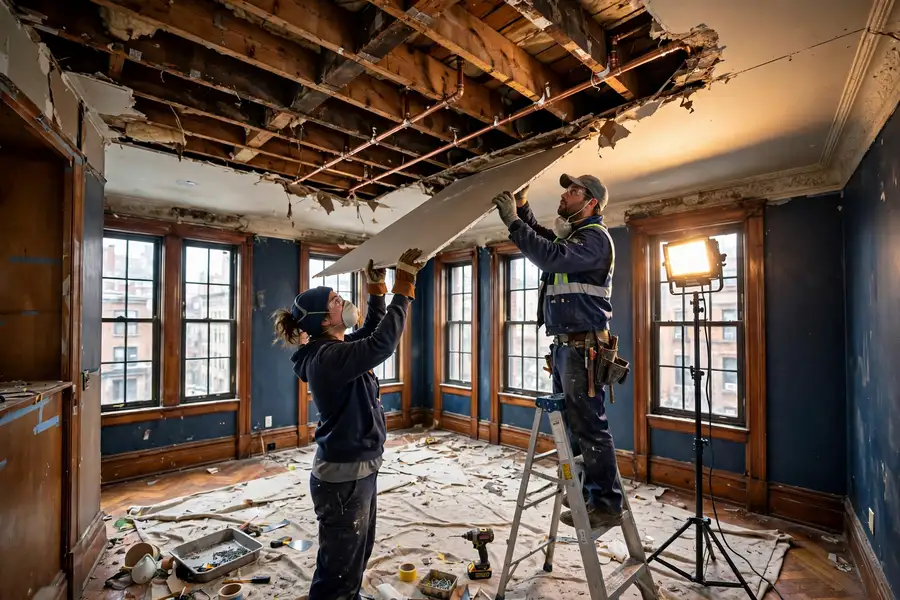
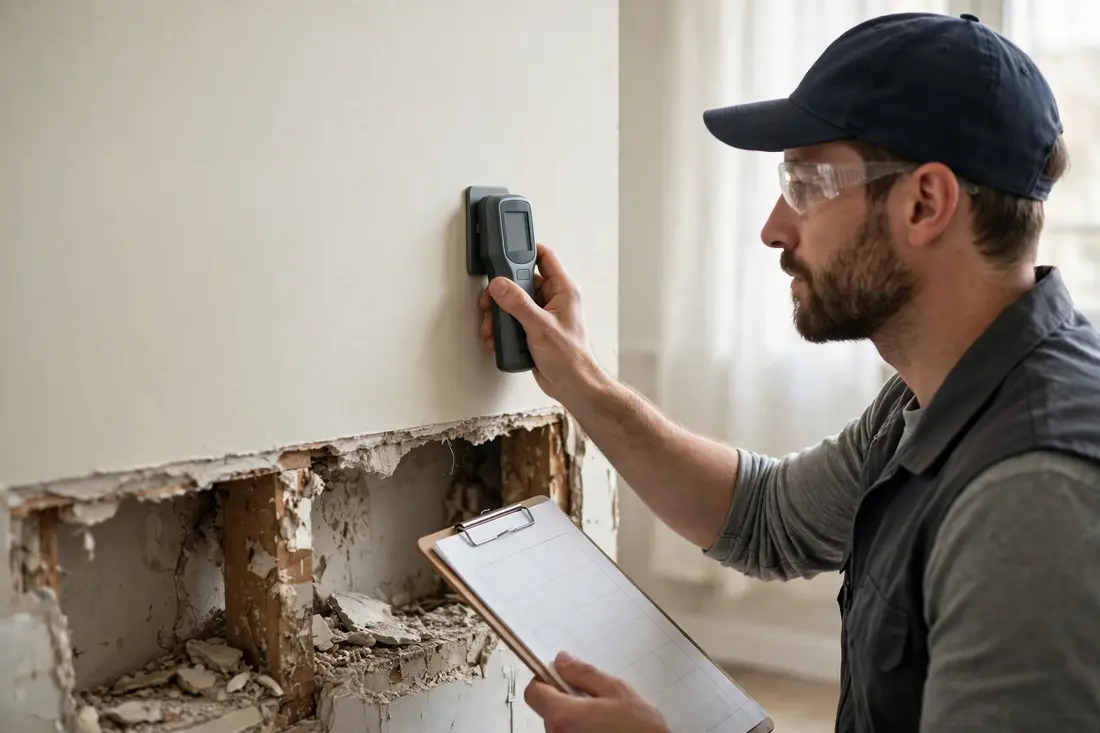
All pages on this site

All Fifty-Six Pages, in One Place

This page is the forty-sixth page of this site. The forty-five pages that came before it, together with this one, are the whole of it: the home page, the borough and city pages, the region pages, and the topic pages on process, claims, hidden water, fire, flood, mold and extraction. Each was researched and built on its own, with its own keyword, its own headings and its own Schema.

Water Damage Restoration New York

The home page of this site: the full guide for the main New York search, with the boroughs, the services and the claim help gathered in one place.

Water Damage Restoration Brooklyn

Borough coverage for Brooklyn homes, brownstones and basements, from Park Slope to Williamsburg.

Water Damage Restoration Queens

Borough coverage for Queens, from Astoria and Long Island City to Flushing and Jamaica.

Water Damage Restoration Bronx

Borough coverage for the Bronx, including Riverdale and the Grand Concourse apartment stock.

Water Damage Restoration Staten Island

Borough coverage for Staten Island homes, where detached houses and storm water shape the work.

Water Damage Restoration Long Island

Coverage for Long Island homes and the commuter belt east of the city line.

Water Damage Restoration Manhattan

Borough coverage for Manhattan towers, co-ops and pre war apartments, Harlem to the Upper West and Upper East Sides.

Water Damage Insurance Claim New York

The claim page: how New York water claims are documented, filed and defended, event by event.

Water Damage Behind Walls NYC

The hidden water page: finding moisture inside walls and floors before it turns into mold and rot.

Fire Damage Restoration NYC

Fire recovery in the city: smoke, soot, water from the hoses, and the order the work must follow.

Flood Cleanup NYC

City flooding explained: storm water, sewer backups and the cleanup sequence for flooded homes.

Water Damage Remediation NYC

The remediation page: removing damaged material safely and returning rooms to a clean, dry state.

Fire Damage Cleanup NYC

Fire cleanup in the city: debris, soot and odour removal after the fire is out.

Water Damage Restoration Rochester

City coverage for Rochester homes, lake effect snow, thaw and the Genesee River.

Water Damage Restoration Albany

City coverage for Albany, the capital district's older housing stock and Hudson River weather.

Water Damage Restoration Buffalo

City coverage for Buffalo, lake effect winters, frozen pipes and spring thaw.

Water Damage Restoration Syracuse

City coverage for Syracuse homes, snow load, thaw and basement water in central New York.

Water Damage Restoration Yonkers

City coverage for Yonkers, hillside homes and Hudson waterfront neighbourhoods.

Water Damage Restoration New Rochelle

City coverage for New Rochelle homes along the Long Island Sound shore.

Water Damage Restoration Mount Vernon

City coverage for Mount Vernon, dense housing and the Bronx River corridor.

Water Damage Restoration Schenectady

City coverage for Schenectady, Mohawk River weather and older mill era housing.

Water Damage Restoration Utica

City coverage for Utica homes in the Mohawk Valley, snow, thaw and heavy rain.

Water Damage Restoration White Plains

City coverage for White Plains, the Westchester county seat and its mixed housing stock.

Water Damage Restoration Troy

City coverage for Troy, Hudson River hillsides and nineteenth century housing.

Water Damage Restoration Niagara Falls

City coverage for Niagara Falls homes, river weather and hard winters.

Water Damage Restoration Binghamton

City coverage for Binghamton, where two rivers meet and flood history runs deep.

Water Damage Restoration Westchester County

County coverage for Westchester: suburbs, Sound shore towns and commuter villages.

Water Damage Restoration Hudson Valley

Region coverage for the Hudson Valley, river towns from Westchester to Albany.

Water Damage Restoration Capital Region

Region coverage for the Capital Region around Albany, Troy and Schenectady.

Water Damage Restoration Western New York

Region coverage for Western New York, lake effect country from Buffalo to Rochester.

Water Damage Restoration Finger Lakes

Region coverage for the Finger Lakes, lakeside homes and wine country towns.

Water Damage Restoration Central New York

Region coverage for Central New York around Syracuse and Utica.

Water Damage Restoration Southern Tier

Region coverage for the Southern Tier along the Pennsylvania line.

Water Damage Restoration NYC

The city hub page joining the five boroughs and Manhattan coverage in one place.

How Long Does Mold Take to Grow After Water Damage

The mold timeline page: the 24 to 48 hour window, what grows where, and how drying prevents it.

Mold Removal NYC

The city mold page: finding growth, licensed assessment and safe removal, explained plainly.

Water Damage Restoration Process

The step by step page: inspection, extraction, drying, cleaning and repair in order.

What Is Water Damage Restoration

The definition page: what the work is, what it is not, and when each stage applies.

Mold Remediation New York

The state mold page: Article 32 licensing, assessment and remediation across New York.

Water Removal NYC

The extraction page: pumps, vacuums and standing water removal across the city.

Water Damage NYC

The citywide explainer: what water damage means in New York, borough by borough.

Water Damage Cleanup Nyack NY

Water damage cleanup in Nyack explained plainly, with fast help for every home.

How to Choose a Water Damage Restoration Company in New York

How to choose a water damage restoration company in New York, with every check that protects your home.

Commercial Water Damage Restoration NYC

Commercial water damage in NYC explained plainly, with fast help for every business.

Basement Water Damage Restoration NYC

Basement water damage in NYC explained plainly, with fast help for every basement.

Water Damage Restoration Poughkeepsie New York

Water damage restoration in Poughkeepsie explained plainly, with fast help for every home.

Emergency Water Damage NYC

Emergency water damage in NYC explained plainly, with fast help when every minute counts.

Water Damage Cleanup in NYC

Water damage cleanup in NYC explained plainly, from torn-out materials to dry rooms again.

Flood Damage Restoration NYC

Flood damage restoration NYC explained plainly, from flood events and NFIP claims to dry rooms and a flood-resistant rebuild.

How Long Does Water Damage Restoration Take

How long does water damage restoration take explained plainly, from the first drying day to the final repair, stage by stage.

Flood Damage Cleanup Washington Heights

Flood damage cleanup in Washington Heights explained plainly, with fast help for every home.

Does Insurance Cover Water Damage Restoration

Whether insurance covers water damage restoration, explained plainly, by cause and New York rule.

Water Damage Mold Remediation

Mold that grew after a leak or flood, remediated the New York way, by licensed assessor and remediator.

Water Damage Restoration Companies New York

Compare the companies serving New York: national franchises, regional firms and local independents, and how to verify licences and certification before you hire.

Water Damage From Upstairs Neighbor

Water damage from an upstairs neighbor in New York City: who pays, what to do in the first hour, and how to document, report and claim.