Water emergency in the Capital Region? Call (518) 555-0147 (placeholder) any hour, any day.
Water Damage Restoration New York Call (518) 555-0147 (placeholder)

Water Damage Restoration Capital Region, Where the Hudson Meets the Mohawk

Water in your Capital Region home right now? Keep clear of water near outlets or panels, shut off the source if it is a pipe, move what you can lift to dry ground, and call a Capital Region restoration crew at (518) 555-0147 (placeholder). River water carries silt and worse, and every hour it sits, the loss grows. Extraction first, drying second, paperwork from the first hour.
24/7 emergency crewsHudson flood cleanupMohawk flood cleanupStructural dryingSewage cleanupInsurance documentation
Call (518) 555-0147 (placeholder)Read the Capital Region FAQsThe phone number on this page is a placeholder while the business line is being set up. It is marked as a placeholder everywhere it appears.
The Albany, New York skyline across the Hudson River at sunset, Capital Region
The Albany skyline at sunset, seen across the Hudson River from the Rensselaer shore, at the northern end of the tidal river.
5Counties in the Albany Schenectady Troy metro
899,262People in the metro area, 2020 Census
149Miles of Mohawk River, the Hudson's longest tributary

Start here

Three Cities, Two Rivers, One Capital Region

The Capital Region sits where the Mohawk River runs into the Hudson at Cohoes and Waterford, and its water damage follows both rivers, their creeks, its canal locks and its old brick housing.

What this page covers. Water damage restoration capital region means extraction, drying and repair for homes and businesses across Albany, Schenectady and Troy, New York, after Hudson and Mohawk floods, burst pipes, sewage backups or appliance leaks, with drying logs and insurance documentation from the first hour, day and night.Definition: 46 words.

This is the twenty-ninth page of this site, and it is the regional hub for the Capital District. The city pages go deep on one place at a time: Albany with its brick rowhouses and combined sewers, Schenectady with its Stockade streets on the Mohawk, and Troy at the Federal Dam where the Hudson tides stop. This page does the job none of the city pages can. It covers the region as one working map: two rivers meeting at one confluence, the suburbs and mill towns strung along both banks, the dated storms that soaked the whole district at once, and the region wide questions about water damage restoration capital region work that belong to no single city. If your town has its own page on this site, read that too. If it does not, this page is written for you.

The region is not one place, and honest water damage restoration capital region work starts by admitting that. A brick rowhouse in Albany's Center Square, a timber house in the Schenectady Stockade, a student rental near RPI in Troy and a raised ranch in Clifton Park all take water differently, dry differently and argue with an insurance adjuster differently. What they share is the same pair of rivers, the same storm systems rolling up the coast or breaking over the Helderbergs and the Schoharie Valley, and the same New York insurance law. This page is organized around that shared ground first, and the local differences second.

Two cautions belong at the top. First, the region south of here already has its own hub: the Hudson Valley page covers the river corridor down to Yonkers, and the Westchester County page covers the Lower Hudson towns in depth, so this page links to them rather than repeating them. Second, this region has more than one official boundary, and the definitions section below names which one each figure on this page uses. A page about water damage restoration capital region that cannot say where the Capital Region is would not be worth your trust on the harder questions.

Everything on this page is written to be used during a bad week, not just read on a calm one. The first hour guide is near the top. The dated flood cases are here so you can compare your street to a storm that already happened. The insurance sections carry the real New York clocks, because a claim won or lost on paperwork is still won or lost. And the questions at the bottom are the ones Capital District residents actually ask about water damage restoration capital region work, answered without sales talk.

Read the page in the order the water would. Start with the first hour if your loss is live, the cases if you are comparing your street to history, and the insurance sections if the water is out and the argument has begun. That is how water damage restoration capital region work itself is sequenced, and the page is built to match it.

One promise about scope before the details begin. This page will not borrow another region's floods to make this one sound worse, will not quote a search volume the tools never found, and will not print a business fact it cannot stand behind. The Capital Region's own record, two rivers, a state record rainfall, a 1913 crest that still stands and a flood in July 2026 that closed three highways at once, needs no help from anywhere else. Water damage restoration capital region readers deserve the local record straight, and the sections below keep to it, source by source.

Key takeaways

Seven Facts That Shape Capital Region Water Work

Seven facts worth quoting, each with its source named in the same sentence, because water damage restoration capital region decisions run on real numbers, not slogans.

Takeaway 1

The Albany Schenectady Troy metropolitan area held 899,262 people at the 2020 Census across five counties, according to the United States Census Bureau.

Takeaway 2

The Mohawk River runs 149 miles and is the longest tributary of the Hudson, entering the Hudson at Cohoes, a few miles north of Albany, according to the New York State Department of Environmental Conservation.

Takeaway 3

A New York State 24 hour precipitation record of 11.60 inches was set at Tannersville in Greene County on 28 August 2011 during Tropical Storm Irene, according to the National Weather Service.

Takeaway 4

The Hudson River at Troy crested at 27.05 feet during Irene on 28 to 29 August 2011, below the March 1913 crest of 29.7 feet and the March 1936 crest of 29.5 feet, according to the Troy city page research drawn from river gage records.

Takeaway 5

The Waterford Flight of locks, E2 to E6, raises boats 169 feet in just over 1.5 miles, the highest lift over the shortest distance of any canal lock system in the world, according to the Erie Canalway National Heritage Corridor.

Takeaway 6

More than half of the homes in Albany were built before 1960, and 77 percent before 1980, according to the Albany city page research drawn from Census housing data.

Takeaway 7

New York Insurance Law and Regulation 64 give an insurer 15 business days after proof of loss to accept or reject a claim, according to 11 NYCRR 216, the state regulation that sets the claims clocks.

Each takeaway is stated the way a water damage restoration capital region crew would need it on a work order: a number, a place and a source, with nothing rounded into a slogan.

Quick answers

Quick Answers for a Capital Region Water Emergency

Five direct answers, written to be read aloud by a tired homeowner standing in a wet hallway at two in the morning, anywhere from Amsterdam to Saratoga Springs.

What do I do first when my Capital Region home floods?

Get people and pets to dry ground and keep clear of water near outlets, panels or appliances. Stop the source if it is a pipe. Photograph every room before anything else moves. Then call for extraction, because water damage restoration capital region work goes faster and claims go better when the first hour is documented.

How fast can a crew reach a flooded home in the Capital District?

For a single home emergency, the aim in water damage restoration capital region work is extraction running the same day, usually within hours. In a region wide storm, when I 90 or I 787 is under water, calls are triaged by safety and by how fast water is still rising, and an honest crew will tell you your place in the queue.

How long does drying take in an old Capital Region house?

Most pipe and appliance losses dry in three to five days once the water is out. River and creek flood losses take longer, because silt, saturated soil and wet brick or plaster hold moisture. In water damage restoration capital region jobs, drying ends when meters show materials at a dry standard, not when a fixed number of days passes.

Does homeowners insurance cover Hudson or Mohawk River flooding?

No. A standard homeowners policy excludes rising water from outside, which is what river flooding is. That loss belongs to a flood policy, usually through the National Flood Insurance Program (NFIP). A burst pipe is the opposite case: it belongs to the homeowners policy. In water damage restoration capital region claims, photographs from the first hour prove which one you had.

How fast does mold start after a Capital Region basement flood?

Mold can begin growing on wet materials within 24 to 48 hours in warm conditions, which is why water damage restoration capital region drying starts the same day the water is found. In New York, mold work over 10 square feet needs licensed assessors and remediators under Labor Law Article 32, and the two roles must stay separate.

Standing in water right now?

One call starts extraction, drying and the claim paperwork together. Crews cover both rivers, from the Stockade to the Saratoga County suburbs.

Call (518) 555-0147 (placeholder)

These five answers are the short version of this entire page. The long version, with the cases, the tables and the law, follows below for anyone whose water damage restoration capital region questions outlast the first night.

Key facts

Capital Region Water Damage Key Facts, With Sources

The water damage restoration capital region numbers a homeowner, landlord or adjuster actually needs, each tied to the source that published it.

FactFigureSource
Metro population, 2020 Census899,262 people, five county Albany Schenectady Troy MSAUnited States Census Bureau
Largest county by population, 2025 estimateAlbany County, 321,225 peopleUnited States Census Bureau estimates
City populations, 2020 CensusAlbany 99,224; Schenectady 67,047; Troy 51,401United States Census Bureau
Length of the Mohawk River149 miles, the longest tributary of the HudsonNew York State Department of Environmental Conservation
Northern limit of the Hudson tidesFederal Dam at Troy, about 153 miles from the BatteryUnited States Geological Survey
Cohoes FallsAbout 1,000 feet across and up to 90 feet high, second largest waterfall in New York StateRiverSpark and City of Cohoes sources
Waterford Flight lift169 feet in just over 1.5 miles, locks E2 to E6Erie Canalway National Heritage Corridor
New York 24 hour rain record11.60 inches, Tannersville, 28 August 2011National Weather Service
Hudson crest at Troy, Irene 201127.05 feet, against 29.7 feet in March 1913River gage records, Troy page research
Albany snowfall, 1991 to 2020 normals59.2 inches in an average seasonNational Weather Service normals
Insurer accept or reject clock15 business days after proof of loss11 NYCRR 216, Regulation 64
Standard flood policy waiting period30 days before cover beginsNational Flood Insurance Program
Suit limit on a fire or homeowners policy24 months from the date of lossNew York Insurance Law 3404
Mold licensing thresholdMore than 10 square feet needs licensed assessor and remediatorNew York Labor Law Article 32

Population figures are 2020 Census counts and 2025 Census estimates as compiled in the research for this page, with the definition named wherever a figure depends on one. Storm figures are from the National Weather Service and the river gage records named in the case sections below.

Print this table if your household keeps a storm folder. It is the one page of water damage restoration capital region numbers a homeowner, a landlord and an adjuster can all argue from without arguing about the numbers themselves.

Voice answers

Ask Out Loud in the Capital District: Voice Answers for Wet Homes

Short spoken answers to the questions people ask a phone or a speaker while the water is still coming in.

Where is the Capital Region?

The Capital Region is the metropolitan area around Albany, the capital of New York State, where the Mohawk River meets the Hudson. The Census metro counts five counties: Albany, Rensselaer, Saratoga, Schenectady and Schoharie. The three core cities are Albany, Schenectady and Troy, and those three cities plus the towns around them are the ground this water damage restoration capital region page covers.

What should I say to get help fast?

Say your town, your street, where the water is coming from, and how deep it is. A crew hearing Schenectady, Mohawk River water, Stockade basement, eight inches, can stage pumps and the right extraction unit before leaving. A crew hearing only water damage has to guess, and in water damage restoration capital region work guessing wastes the first hour.

Is the Hudson River tidal where I live?

If you live on the river between New York City and Troy, yes. The lower Hudson is a tidal estuary, the flow reverses with the tide all the way to the Federal Dam at Troy, and storm surge can push river levels up far inland. North of the dam, at Waterford and Mechanicville, the river is a canal river, held by locks and dams instead.

Who do I call first, my insurer or a restoration crew?

Call the crew first if water is still moving, because stopping the loss protects both the house and the claim. Then call the insurer the same day to open the claim and start the New York clocks. Photograph everything before anything is thrown out, and keep every receipt from the first day onward.

Voice answers are kept short on purpose. A spoken question usually means wet hands and a worse problem, so each answer gives the action first and leaves the history of water damage restoration capital region to the written sections below.

First hour

The First Hour After Water Reaches a Capital Region Floor

The first hour decides more than any later day of drying: how much of the house is saved, whether mold gets a foothold, and how strong the insurance file will be.

Minutes 0 to 10Make it safe. Keep people and pets out of water near outlets, panels and appliances. If water is rising from a river or creek, move up, not out through the water. If the source is a pipe, close the nearest valve or the main.
Minutes 10 to 25Stop what you can. Shut off the water main for plumbing losses. Move documents, photographs, medicines and electronics to dry ground. Lift furniture onto blocks or foil wrapped feet if the water is shallow and clean.
Minutes 25 to 40Record everything. Walk the house with a phone camera before anything else moves. Shoot the water line on walls, the source, every room and the street or creek outside. These photographs anchor the claim.
Minutes 40 to 60Call in order. First the restoration crew, so extraction starts. Then the insurer, to open the claim and note the claim number. Then, for river or sewage water, your city or county health guidance before anyone sleeps in the house.

There is a Capital Region reason the first hour matters here more than in a suburb on high ground. So much of this district drains to two rivers through short, steep creeks, which means water that arrives fast also tends to carry things: silt from the Normans Kill, gravel from Poesten Kill side streets, heating oil from an old tank in a Schoharie Valley basement, sewage from a combined line in Albany or Troy. Clean water from a burst pipe is a drying problem. Dirty water is a health problem first and a drying problem second, and the sorting has to happen before anyone starts tearing out drywall. Good water damage restoration capital region practice starts with that sorting, not with a fan.

The second local point is the age of the housing. A large share of homes in the three cities were built before modern drainage, many of them brick rows or timber houses with shared plumbing, cast iron drains, steam heat and pipes run in exterior walls. Those old walls forgive a flood in ways new materials do not, and punish delay in ways old materials never did. The first hour is when a crew decides what is genuinely old fabric worth drying in place, and what is modern finish that has to come out before it feeds mold. That judgement, made early and written down, is worth more than any machine on the truck.

Finally, write down the time. The time the water was found, the time the valve was closed, the time the crew was called, the time the insurer was called. New York claim practice runs on dated records, and the homeowner who can say exactly when things happened starts every later conversation from strength. A simple notebook by the phone beats a perfect memory three weeks later.

One more first hour habit separates calm recoveries from chaotic ones: assign the jobs. One adult watches children, pets and the door; one photographs; one makes the calls. In a Stockade house with the Mohawk rising outside, that small division of labor is water damage restoration capital region practice at its most practical.

And if the water is river or creek water, treat the first hour as a health hour as well as a paperwork hour. Boots and gloves before wading, no food from a flooded kitchen, and no sleeping in a room that sewage or river water has entered until it is cleaned. Water damage restoration capital region crews carry that rule into every flooded building, and homeowners should borrow it.

Flood case one

28 to 29 August 2011: Irene Hits the Capital Region

Tropical Storm Irene tracked north northeast across eastern New York on 28 and 29 August 2011, and the Capital Region learned that its creeks and its smaller river could hurt it as badly as the Hudson.

Rainfall generally ran 4 to 8 inches across the region, with 8 to 12 inches common across the higher ground of the eastern Catskills and the Schoharie Valley, and localized amounts of 12 to 18 inches, according to the National Weather Service. At Tannersville in Greene County, a National Weather Service gage recorded 11.60 inches in 24 hours, a new New York State record. Record flooding occurred at river gages across east central New York, with record flood stages along the entire length of Schoharie Creek, on Canajoharie Creek, and on Catskill Creek. The Schoharie Reservoir stood at 1,137.95 feet, a record, about 1.5 feet above the January 1996 record.

In the Schoharie Valley, about 5,000 people were evacuated across Esperance, Central Bridge, Schoharie, Middleburgh, Blenheim, Gilboa and Fulton. The river gage at Prattsville was itself washed away by the flood wave, 11 houses collapsed in Prattsville, 15 were condemned and more than 100 were damaged, with no deaths in the town. The Old Blenheim covered bridge, built in 1855 and the longest single span covered bridge in the country, was destroyed. On the Mohawk, flooding ran severe from Fonda through Amsterdam, Rotterdam Junction and Schenectady, though it was not the record flood on that river. Tidal flooding reached along the Hudson as far north as Albany, and nearly one million people lost power in the Albany forecast area. Statewide, the combined damage from Irene and Tropical Storm Lee, which followed days later, exceeded one billion dollars, spelled out in words on this page.

The lesson Irene left for water damage restoration capital region work is about where the water comes from. The worst Capital Region losses were not only on the Hudson itself. They were on the creeks and the tributary valleys: the Schoharie above all, the Canajoharie, and a hundred smaller runs dropping off the escarpments. Creek water arrives with almost no warning, carries debris and soil, and drops silt into every wall cavity it touches. A crew that only plans for the two big rivers will be caught out by the creek behind the house, which is where Irene did much of its worst work in this district.

Irene also reset what local homeowners expect from a basement. Thousands of homes that had taken a wet corner in spring storms took feet of water in August 2011. The pattern to copy from the Irene recovery is the order of work: pump out only when outside water has dropped, remove silt before it dries into dust, cut wet gypsum early, and dry the structure to meter readings rather than to a calendar. Homes dried that way after Irene mostly stayed dry and clean. Homes that were closed up wet grew mold that made the second loss worse than the first.

Crews who worked the Schoharie Valley in 2011 still talk about the silt line. River and creek silt is fine as flour and it gets everywhere water reached, including inside wall cavities, under floorboards and through heating ducts. Water damage restoration capital region veterans check for it with a borescope before they promise a drying plan, because a wall that looks dry on the surface can hold wet silt against its studs for weeks.

Flood case two

29 to 30 July 2026: The Capital Region Floods Again

Fifteen years after Irene, a slow moving storm in the last days of July 2026 gave the Capital Region its worst flooding since 2011, and proved the pattern had not retired.

A slow moving low pressure system fed by Atlantic and Gulf moisture dropped rainfall approaching 10 inches in some areas over about 24 hours, far above the 2 to 4 inches that had been forecast, according to reporting at the time. The National Weather Service office in Albany issued a Flood Watch for the Greater Capital Region on the afternoon of 29 July 2026, noting rainfall rates up to 1 inch per hour. Officials described the flooding as the worst in the region since Tropical Storm Irene in 2011, and this page reports that as their description, not as a measurement of our own.

In Albany, vehicles were submerged near Clara Barton Drive and Hackett Boulevard, and flooding closed stretches of Western Avenue at the Guilderland line and Van Buren Avenue in Ravena. The Woodville Avenue wastewater pump station was affected, and residents were asked to reduce water use while crews worked. In Schodack, in Rensselaer County, fast moving water ran over the bridge at Schodack Town Park. In Coxsackie, a wheelchair user was rescued from a basement. Rensselaer County and Columbia County declared countywide states of emergency, with municipal declarations in Coxsackie, Germantown, Cairo, Hunter and Amsterdam, evacuations near Sixth Street in the city of Rensselaer, and Red Cross shelters opened at the Albany School of Humanities and Greenville Central School.

The roads told the same story as the rivers. I 90, I 787 and Route 9J all flooded. Stranded motorists were rescued at the Route 20 underpasses in Guilderland. Amtrak service between New York City and Albany was suspended with high water and debris on the tracks, and racing at Saratoga Race Course was cancelled for a day. None of that is decoration for a restoration page. Closed highways decide how fast a crew can reach a flooded house, and a region wide event is exactly when water damage restoration capital region work has to be staged by county, with trucks pre positioned on both banks before the rain peaks.

The July 2026 lesson is about forecast humility. A storm billed at 2 to 4 inches delivered close to 10 in the wettest spots. Homeowners who waited for the official worst case before moving cars, documents and basement contents lost the dry hours when moving was easy. The habit this page recommends is simple: when a Flood Watch names the Greater Capital Region and rates near 1 inch per hour are in the text, treat your own street as if the high end of the forecast is yours, and do the first hour jobs early.

It is also worth keeping the two 2026 events apart. The parkway flooding of 21 July 2026 belonged to the Lower Hudson and Westchester, a different storm in a different part of the state, covered on the Westchester County page. The 29 to 30 July flooding was this region's own event, on this region's own rivers, and it is the one Capital District claim files should cite.

Flood case three

The Stockade and the Mohawk: Schenectady's Oldest Flood Story

The Stockade, Schenectady's oldest neighbourhood, sits on low ground inside a bend of the Mohawk, and it has been negotiating with that river for more than three centuries.

Aerial view of Schenectady, New York and the Stockade district beside the Mohawk River
Schenectady from above: the Stockade streets in the foreground, the Mohawk bending past the city, and the canal era grid beyond.

Schenectady was founded on the south side of the Mohawk by Dutch colonists in the 17th century, and the Stockade Historic District is the oldest neighbourhood in the city. Its worst recorded flood came in March 1914, when the river reached 23.5 feet, according to the Schenectady city page research. The Stockade was evacuated again during Irene in 2011, and about 200 people were rescued across the wider region during that storm, a regional figure this page is careful not to pin on one neighbourhood. In the winter of 2017 to 2018, an ice jam on the Mohawk pushed water into the same low streets by a completely different mechanism: not rain, but river ice piling up until the channel could not carry its own flow.

The city's answer has been slow, physical work. In October 2018, FEMA funding of about nine million dollars, stated in words, went to Stockade flood mitigation, according to the Schenectady page research. Mitigation in a historic district is a negotiation of its own: the houses are the heritage, so the work leans toward raising utilities, sealing and venting foundations correctly, and planning evacuations, rather than raising or moving the buildings themselves.

For water damage restoration capital region crews, the Stockade teaches a specific discipline. Timber framed houses from the 1700s and 1800s dry differently from brick rows and differently again from modern ranches. Plaster on lath, wide board floors and hand hewn beams can often be dried in place if the work starts fast and the readings are honest, while the modern finishes added over two centuries, gypsum, laminate, fitted carpet, are usually the parts that have to come out. A crew that treats a Stockade house like a Clifton Park ranch will damage the very fabric the owner most wants to keep.

The ice jam lesson matters beyond Schenectady. Any Mohawk or upper Hudson home near a bend, a bridge or a shallow reach can flood in deep winter with no rain at all, and winter flood water arrives near freezing, which slows drying and punishes pipes in exterior walls for days after the river drops. The seasons section below returns to that pattern, because in this region the flood calendar has a winter page that most of the country never reads.

The two rivers

Where the Mohawk Meets the Hudson: The Two River Region

Most American metro areas have one river to blame. This one has two, meeting at Cohoes and Waterford, and the meeting point is where the region's flood map gets complicated.

The Hudson at Albany and Troy is a tidal river. Its lower half is an estuary, the flow reverses with the tide, and the tide runs all the way north to the Federal Dam at Troy, about 153 miles from the Battery in New York City, according to the United States Geological Survey. That means a coastal storm can push water up the Hudson into downtown Albany on a day when it barely rains here, and a heavy inland rain can meet a high tide coming the other way. Troy's own crest record shows what the river can do at the top of the tide: 29.7 feet in March 1913, 29.5 feet in March 1936, 27.10 feet in September 1938, 26.53 feet in March 1977, and 27.05 feet during Irene in August 2011, according to the Troy page research drawn from gage records.

The Mohawk is a different animal. It runs 149 miles from the confluence of its West Branch and East Branch in Oneida County, through Rome, Utica, Little Falls, Canajoharie, Amsterdam and Schenectady, and enters the Hudson at Cohoes, a few miles north of Albany, according to the state canal and environmental records. It is the longest tributary of the Hudson. The lower Mohawk is a working canal river, held by 5 permanent dams and 9 movable or seasonal dams, with 5 hydropower plants, so its levels answer to dam operations and lock schedules as well as to rain. Its tributaries in this region include Schoharie Creek, the Normans Kill, Patroon Creek, the Binne Kill, the Poesten Kill, Canajoharie Creek and the Alplaus Kill, and several of those creeks have their own flood histories inside the region's cities.

The practical point for water damage restoration capital region work is that the source river changes the job. Hudson tidal water can carry salt far inland in a surge, and salt changes the cleaning and the corrosion watch. Mohawk water in spring carries ice, silt and whatever the Schoharie Valley creeks picked up on the way down. Creek water from the Normans Kill or the Poesten Kill arrives fastest of all and drops out of the hills with debris in it. A good first question on any Capital District call is therefore not how deep, but which water, and the answer shapes the extraction order, the cleaning chemistry and the claim category from the first hour.

The confluence itself deserves a sentence of respect. At Cohoes and Waterford, a few miles north of Albany, the state's largest tributary hands its water to the tidal river within sight of the canal locks that made both rivers navigable. When both rivers run high at once, the low ground at the meeting, parts of Cohoes, Waterford, Green Island and the Troy waterfront, has nowhere for its water to go. That is why the smallest cities on this page get their own section below: at the confluence, small does not mean safe.

Two rivers also means two forecasts, two gage networks and two sets of dam and tide notices to read before a storm weekend. Water damage restoration capital region planning that watches only the Hudson misses the Mohawk crest coming down from the Schoharie, and planning that watches only the Mohawk misses the tide pushing up from the sea. The region's crews read both, every time, because its houses sit in the overlap.

The falls

Cohoes Falls and the Power of the Lower Mohawk

Just above the confluence, the whole Mohawk drops over one ledge. Cohoes Falls explains why the canal, the mills and half the region's flood story are where they are.

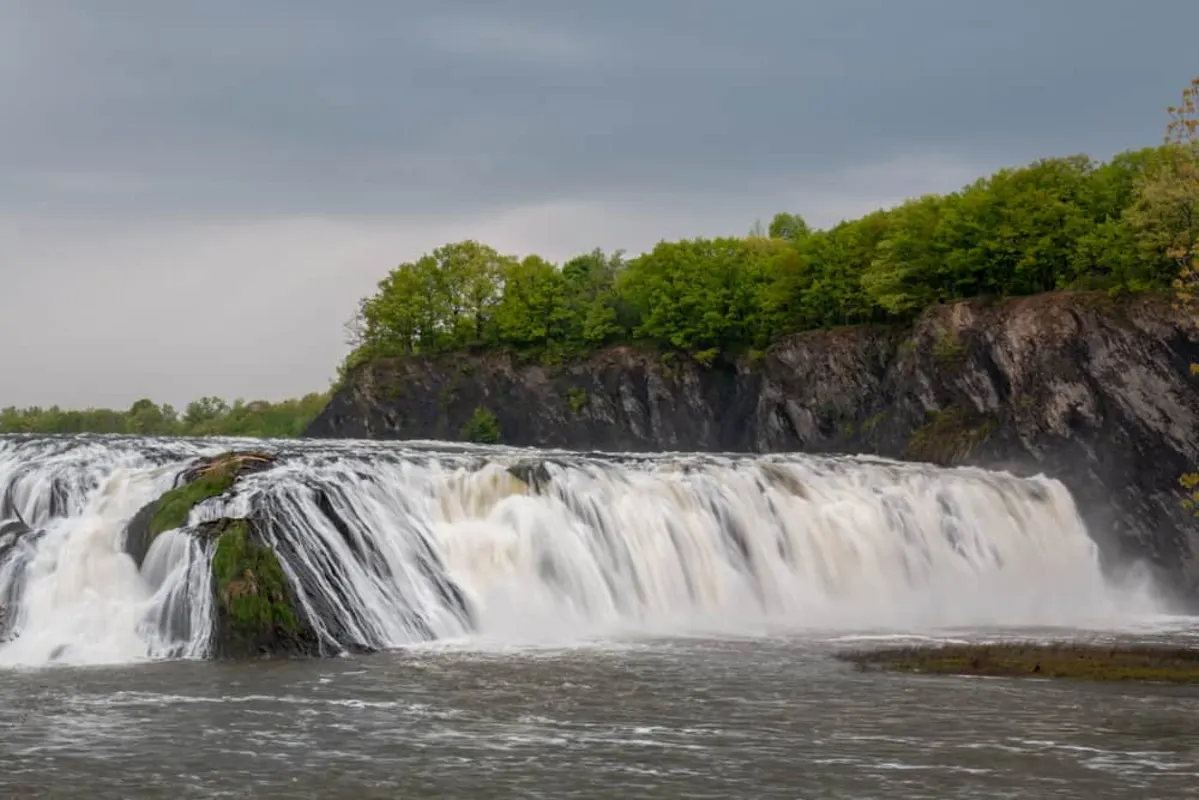
Cohoes Falls on the Mohawk River, New York, water pouring over a wide rock ledge
Cohoes Falls, where the Mohawk drops toward the Hudson between Cohoes and Waterford.

Cohoes Falls is shared by the cities of Cohoes and Waterford, stretches approximately 1,000 feet across and stands up to 90 feet high, and it is the second largest waterfall in New York State, according to RiverSpark and City of Cohoes sources. Heights vary a little between sources, so this page uses up to 90 feet and says so. The falls are one of the largest waterfalls east of the Rocky Mountains, and for two centuries they were the region's engine: mills lined the Cohoes bank to use the drop, and the canal builders had to find a way around it, which is why the Erie Canal's eastern end climbs where it climbs.

For a water page, the falls matter for a plainer reason. Everything the Mohawk carries out of the Schoharie Valley, out of Amsterdam and Schenectady, passes this ledge on its way to the Hudson. In flood, the volume over the falls is the region's flood made visible, and photographers have used it as an unofficial gage for generations. When the falls run brown and full width, the low streets of Cohoes, Waterford and Green Island should already be doing their first hour jobs.

The falls also mark a change in the river's behaviour that water damage restoration capital region crews plan around. Above the ledge, the Mohawk is a canal river of dams and pools. Below it, the river falls to meet a tidal Hudson, and in a short distance the water answers to both dam releases and the tide. Homes near that junction can see river levels move for reasons that have nothing to do with the weather over their own roofs, which is why the warning section below teaches residents to read gages and dam notices, not just the sky.

The canal

The Erie Canal at Waterford: Mile Zero and the Flight of Locks

The Erie Canal was completed in 1825 as the first navigable waterway joining the Atlantic to the upper Great Lakes, and its eastern end is a Capital Region address.

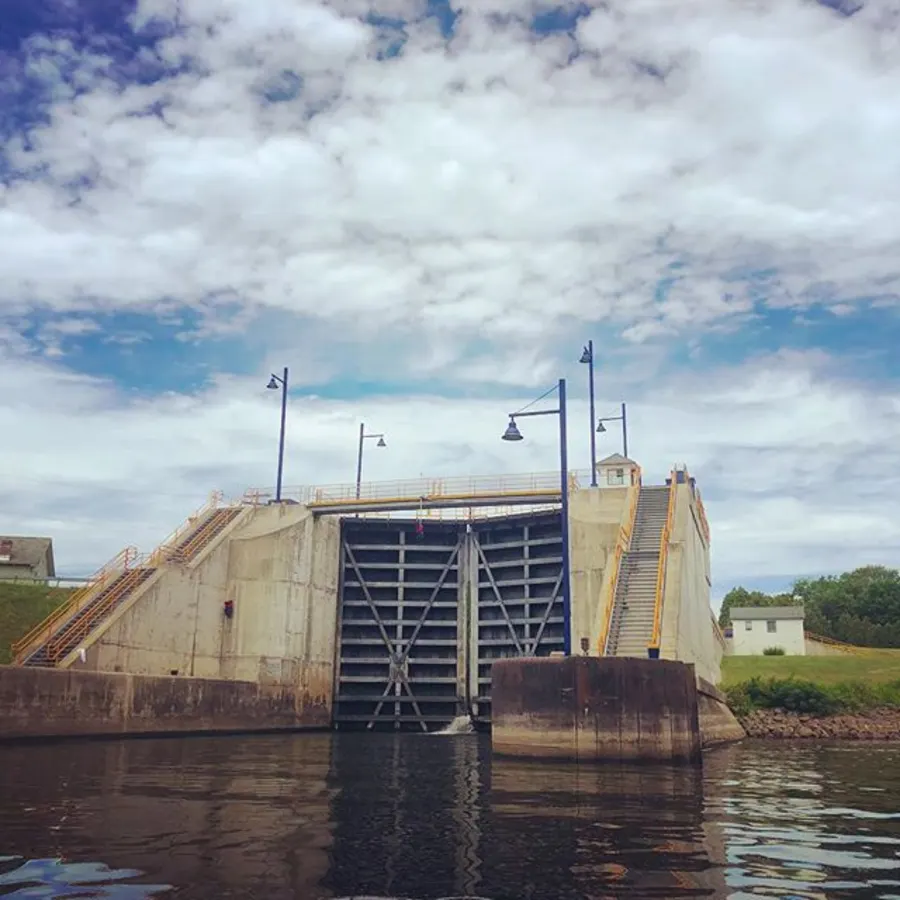
A lock gate of the Waterford Flight on the Erie Canal, Waterford, New York, seen from the water
A Waterford Flight lock gate from the water, one of the five locks that lift boats 169 feet beside the Mohawk.

The canal's eastern terminus sits at the Hudson near Albany and Waterford, at Mile 0 opposite 122nd Street in Troy and Peebles Island in Waterford, according to the Erie Canalway National Heritage Corridor. The Waterford Flight, locks E2 to E6, raises boats 169 feet in just over 1.5 miles, the highest lift over the shortest distance of any lock flight in the world. The modern canal runs 351 miles with 35 locks, and the whole corridor is the Erie Canalway National Heritage Corridor.

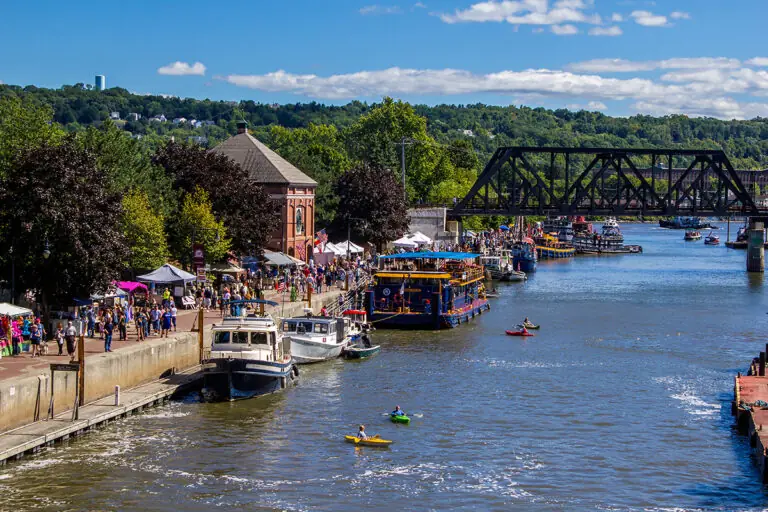
Boats and crowds at the Waterford harbor on the Erie Canal at the Hudson and Mohawk confluence
Waterford harbor at festival time, where the canal meets the two rivers and the town's waterfront does its summer work.

A canal is controlled water, and controlled water shapes flood behaviour in ways residents feel without always naming. Lock pools hold reaches of the Mohawk at set levels. Dam gates and seasonal boards change how fast a rising river can pass. Canal side neighbourhoods in Waterford, Cohoes, Schenectady and Amsterdam live beside water that is managed daily, which is a gift in a normal summer and a complication in a flood, when every gate movement upstream arrives downstream as a level change. Water damage restoration capital region dispatchers who know the canal calendar, opening dates, drawdowns and winter closures, read a Mohawk flood more accurately than those who only watch the rain radar.

The canal also built the region's housing pattern. Mill towns grew where the canal and the falls gave power and transport together, and their worker housing, brick doubles, timber cottages and early apartment blocks, still stands in the same low streets the canal chose. Those streets are where a large share of this region's water calls begin, two centuries after the ditch was dug.

Definitions

Which Capital Region? Four Definitions, One Page

Ask four honest sources where the Capital Region ends and you will get four maps. This page names the one it is using every time a figure depends on it.

The widest common version is the Times Union's 11 counties: Albany, Columbia, Fulton, Greene, Montgomery, Rensselaer, Saratoga, Schenectady, Schoharie, Warren and Washington. The federal version is narrower: the Albany Schenectady Troy metropolitan statistical area, set by the Office of Management and Budget, counts 5 counties, Albany, Rensselaer, Saratoga, Schenectady and Schoharie, and held 899,262 people at the 2020 Census, with a 2025 estimate of 915,835, according to the Census Bureau. The Albany Schenectady combined statistical area counts 10 of the 11 counties, leaving out Greene, and held 1,190,727 people in 2020, with a 2025 estimate of 1,202,638; adding Greene County's 47,931 brings the full Capital District to 1,238,658 in 2020. The Capital Region Chamber works with an 8 county version of about 1.1 million people across 5,336 square miles, about the size of Connecticut, with a 2020 population of 1,078,491 in its definition.

This page anchors on the 5 county metro for population figures, because it is the definition a Census table can defend, and it says so wherever the number appears. For service ground, the page covers the three core cities and the towns named in the area section, which sit inside every one of the four definitions. County populations by the 2025 estimates run Albany 321,225, Saratoga 241,343, Schenectady 162,581, Rensselaer 160,510 and Schoharie 30,176, according to the Census Bureau. The three core cities at the 2020 Census were Albany 99,224, Schenectady 67,047, the ninth largest city in New York State, and Troy 51,401.

Why spend a section on boundaries on a water page? Because flood help, insurance rating and even which restoration crew calls itself local all shift with the map. A homeowner in Saratoga Springs and a homeowner in Schoharie are both Capital Region on the Chamber's map and strangers on the metro map. Water damage restoration capital region work does not care which map a brochure prefers. It cares which river your street drains to, and that answer never changes with a definition.

The boundary question also decides smaller things that matter on the day: which county's emergency alerts reach your phone, which city's combined sewer rules govern your drain, and which mutual aid map your town sits on when the rivers rise together. A water damage restoration capital region crew that works the whole district carries all four maps in its head and quotes the right one for the job in front of it, because a Schoharie Valley creek call and a Troy tide call are both local work here, under different definitions of local.

The panels above are the short version. The three sections that follow give each city its full water story, and each city also has its own page on this site, linked from its panel and from the site map near the bottom.

Core city one

Albany: Rowhouses, Combined Sewers and a Tidal River

The state capital is the region's biggest city and its oldest water problem: brick rows on a river bluff, served by drains older than the cars parked above them.

Albany held 99,224 people at the 2020 Census, and its housing is old by national standards: more than half of its homes were built before 1960 and 77 percent before 1980, according to the Albany page research. Many are brick rowhouses and multi family buildings with shared plumbing and shared walls, old cast iron drains, steam heating and pipes run in exterior walls. Shared walls mean a neighbour's burst pipe can be your water loss, and shared drains mean a combined sewer surcharge in a hard rain can arrive through your basement floor drain rather than your door. The Albany page carries the street by street version, including the combined sewer pattern and the Patroon Creek and Normans Kill corridors.

The claim history underlines the exposure. There have been 85 flood claims in Albany ZIP codes since 2000, 19 of them from Hurricane Irene in 2011 and 12 filed in 2026, according to the Albany page research drawn from NFIP records. Yet only about 0.6 percent of Albany County homes carry an NFIP flood policy, 591 policies in the research figures, which works out to roughly 99 in 100 homes without flood cover. Albany County has seen 6 federal flood and storm disasters since 2000, the most recent the 2017 Severe Winter Storm, DR 4322, after Irene's DR 4020 in 2011, the 2008 Severe Winter Storm, DR 1827, and the 2007 Severe Storms, DR 1692. For water damage restoration capital region planning, Albany is the standing proof that flood risk and flood insurance ownership are two very different numbers in this district.

The July 2026 flood wrote the newest Albany chapter: submerged vehicles near Clara Barton Drive and Hackett Boulevard, water on Western Avenue, and a wastewater pump station on Woodville Avenue asking a whole neighbourhood to use less water at the exact moment it needed to wash. That combination, street flooding plus a sewer system at its limit, is the classic Albany loss pattern, and it is why the Albany section of any honest regional page talks about drains before it talks about rivers.

Read the full city treatment on the Albany page, where the neighbourhoods, the ZIP codes and the city's own cases are covered street by street.

Core city two

Schenectady: The City That Lights and Hauls, Drying on the Mohawk

Schenectady earned its nickname from General Electric and the American Locomotive Company, and its water story from the river that made both companies possible.

The city held 67,047 people at the 2020 Census, making it the ninth largest city in New York State, with ZIP codes 12301 to 12309, plus 12325 and 12345, the famous General Electric ZIP. City Hall stands at 105 Jay Street. The Stockade section above covers the city's oldest flood ground. The rest of the city adds its own patterns: the Binne Kill running through the Vale, hillside streets draining hard toward the river flats, and a housing stock that mixes GE era doubles and brick apartment blocks with postwar ranches in the town of Rotterdam and Niskayuna suburbs.

Schenectady's three flood mechanisms are worth naming as a set, because water damage restoration capital region crews meet all three here and nowhere else in quite this combination. River flooding on the Mohawk flats, worst in March 1914 at 23.5 feet. Ice jam flooding in deep winter, as in 2017 to 2018, when the river rose without a drop of rain. And creek and storm drain flooding in summer downpours, when the Binne Kill and the hillside streets move water faster than the drains under them were built to take. Each mechanism wants a different first hour: river water waits for the crest, ice jam water waits for the jam to move, and drain water wants the surcharge documented before the city pumps clear it.

The full city treatment, including the Third Street sewer history shared with its neighbour Mount Vernon in a different county context and the Stockade mitigation story, lives on the Schenectady page.

Core city three

Troy: Collar City Streets Above a Tidal Hudson

Troy is the Rensselaer County seat, the Collar City of the shirt collar trade, and the city where the Hudson stops being tidal and starts being a canal.

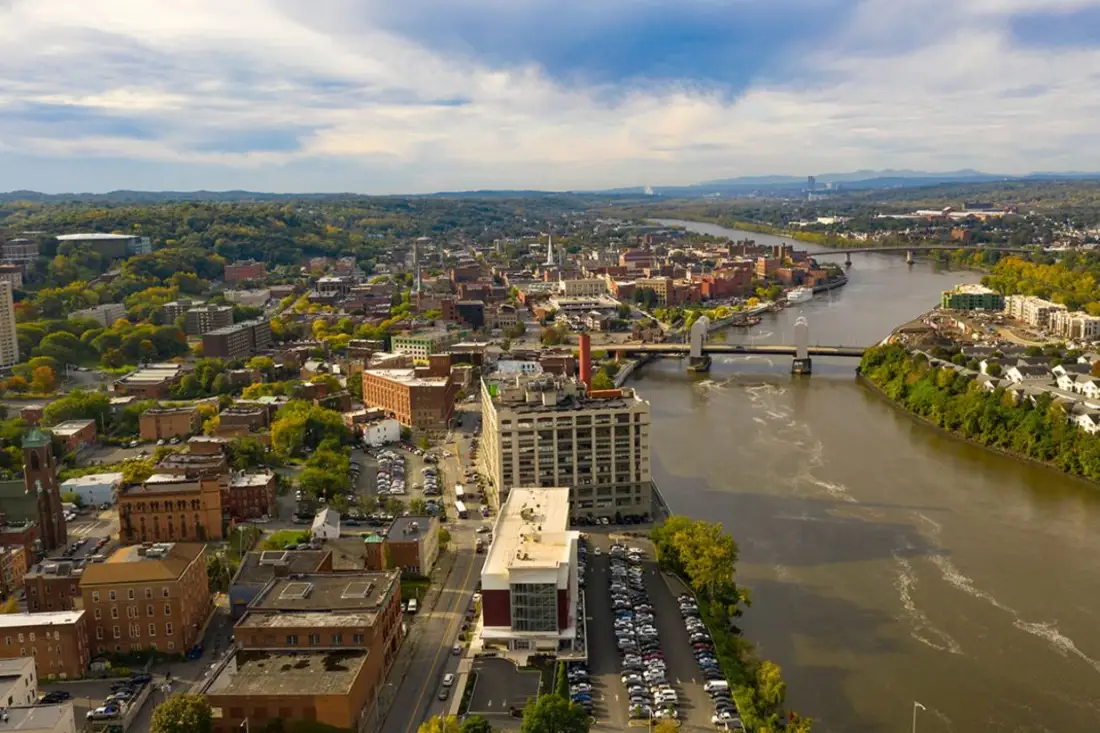
Downtown Troy, New York and its bridges across the Hudson River, seen from above
Downtown Troy from above, its brick blocks and bridges on the Hudson at the head of the tide.

Troy held 51,401 people at the 2020 Census, with ZIP codes 12180 to 12183, and its ground runs from the river flats of downtown and Lansingburgh up steep streets to Rensselaer Polytechnic Institute and Russell Sage College on the hill. The Federal Dam at the city's north end is the head of tide for the whole Hudson: below it, the river breathes with the ocean; above it, locks and dams set the level. Troy's crest record, 29.7 feet in March 1913, 29.5 feet in March 1936, 27.10 feet in September 1938, 26.53 feet in March 1977 and 27.05 feet in Irene, is the region's clearest proof that the biggest Hudson water here has historically arrived in March, on snowmelt and ice, not in hurricane season.

The city's water losses follow its slope. Downtown and River Street take river water. The hillside streets take run off that gathers speed on the slope and enters basements from the uphill wall, a pattern students in RPI and Sage rentals meet in their first Troy storm. Wynantskill and Brunswick, on the city's edge, drain through the Wynantskill Creek and the Poesten Kill, which cuts its gorge through the city on its way to the Hudson. A Troy drying job therefore starts with a slope question before it starts with a meter: which way does this street fall, and which wall did the water choose?

Student housing adds a claim wrinkle the Troy page covers in depth: leases, landlords and contents owned by people whose permanent address is in another state. Water damage restoration capital region crews working Troy learn to photograph student contents room by room and to keep the landlord file and the tenant file separate from the first hour, because mixing them is how small losses become long arguments.

The full city treatment lives on the Troy page, with the crest table, the neighbourhoods and the student housing guidance in full.

The suburbs

Clifton Park, Latham and the Suburban Basement Belt

Between and around the three cities sits the region's growth: Clifton Park, Latham, Colonie, Guilderland, Delmar and Menands, where the water losses are younger houses with older problems.

The suburban belt floods differently from the old cities. The houses are mostly postwar: ranches, raised ranches and colonials with finished basements, sump pits and municipal water. Their losses come from sump pump failures in a power cut, water heaters letting go at year ten, washing machine hoses, frozen pipes in January cold snaps, and storm drains that surcharge when a summer cell parks over one subdivision. Clifton Park, ZIP 12065, and Latham, ZIP 12110, also host many of the region's restoration businesses and warehouses, a fact the call center section below uses carefully: a Latham address on a website is a starting point for questions, not an answer by itself.

Finished basements are the belt's defining risk. A Stockade timber house can often be dried back to its 1800s self. A finished basement in Guilderland or Delmar, ZIPs 12084 and 12054, is a sandwich of gypsum, insulation, laminate and carpet over a slab, and river clean water and dirty drain water alike turn that sandwich into a mold farm within two days if it is closed up wet. Water damage restoration capital region practice in the suburbs is therefore faster to open walls and slower to promise that finishes can be saved, and the honest crews say so on the first visit rather than the fourth.

The belt also teaches the power cut lesson better than any city street. When a storm drops power across Clifton Park, sumps stop across whole subdivisions at the same hour, and basements that have never been wet take water together. Battery back up pumps and water powered back ups are cheap insurance in the mechanical sense, and the prevention section below treats them as standard kit for any finished basement in the 518 area code.

There is a dispatch gift hidden in the belt's sameness. A hundred near identical basements in one subdivision means a crew can stage the same kit a hundred times, and water damage restoration capital region work in the suburbs runs faster per house than anywhere else in the district once the trucks arrive. The bottleneck is never the drying; it is the queue. That is why belt homeowners who call in the first hour, while their neighbours are still deciding whether the water will stop on its own, are usually the ones whose finishes survive.

The north county

Saratoga Springs and Ballston Spa: Springs, Stone and Sumps

Saratoga County is the region's fastest growing county, and its water story runs from mineral springs and a famous race course to new subdivisions on old farm drainage.

Saratoga County held 241,343 people by the 2025 estimate, second only to Albany County in the metro, according to the Census Bureau. Saratoga Springs, ZIP 12866, mixes grand Victorian housing near the track, stone and timber houses around the springs, and fast building growth toward Ballston Spa, ZIP 12020, and Malta. The July 2026 storm cancelled racing at Saratoga Race Course for a day, a small fact that tells a larger one: when the region floods, even its high ground summer economy stops.

The county's water losses split by era. In the older Springs streets, the pattern is stone foundations, spring fed ground water that never fully leaves some basements, and sump systems that run in April whether it rains or not. In the new subdivisions, the pattern is construction drainage meeting clay soils: water that the site grading was supposed to carry away instead ponds against foundation walls after the second or third owner regrades a yard. Water damage restoration capital region crews working Saratoga County carry both playbooks, and the first visit includes a walk around the outside of the house, because in the new streets the cause is usually visible from the lawn.

Second homes and seasonal rentals near the track add a timing risk: a slow leak in an empty house in February can run for weeks. The resident questions section below covers the shut off and monitoring habits that keep a Saratoga seasonal house from becoming a Saratoga drying job.

The Mohawk towns

Amsterdam and Mechanicville: Mohawk Mill Towns

West and north of the core, two smaller cities carry the Mohawk's working history, and its flood history, in their street plans.

Amsterdam, ZIP 12010, climbs the north bank of the Mohawk on steep streets above its old carpet mills. Irene put severe flooding through Amsterdam in 2011, and the city declared a municipal state of emergency again in the July 2026 flood. Steep street run off is Amsterdam's everyday pattern: water gathers speed on the hills, crosses the flat mill streets at the bottom, and enters the oldest housing first. Mechanicville, ZIP 12118, sits on the Hudson above the Federal Dam, where the river is a canal river, and adds paper mill history and Anthony Kill drainage to the same slope problem in miniature.

Mill town housing is its own drying category. Brick mill blocks were built to shed industrial wear, not residential floods, and their ground floors often sit at street level with timber joists over crawl spaces that hold river silt beautifully. Water damage restoration capital region jobs in the mill towns budget time for crawl space silt removal that a slab house never needs, and they photograph the joist pockets before cleaning, because silt lines in a crawl space are claim evidence that disappears the moment the shovels start.

Both towns also sit on the region's mutual aid map. When the Mohawk rises, Amsterdam calls come in the same hours as Schenectady calls, and Mechanicville calls arrive with Waterford and Cohoes calls, which is why the dispatch section below stages trucks by river reach rather than by whoever shouted first.

The confluence

Cohoes and Watervliet: Two Small Cities at the Confluence

Cohoes and Watervliet are small cities with an outsized share of the region's water: one sits under the falls, the other across from Troy at the meeting of the rivers.

Cohoes, ZIP 12047, grew on the falls' power, and its mill housing stands on streets that step down toward the Mohawk's last drop. Watervliet, ZIP 12189, faces Troy across the Hudson and carries arsenal history, tight residential streets and low ground along the river's west bank. Rensselaer city, ZIP 12144, down the east bank below Albany, declared evacuations near Sixth Street in July 2026, and Menands, ZIP 12204, between Albany and Troy, floods where its creeks cross the river flats. Green Island, between them all, is an island in the full sense during a two river flood.

The confluence towns teach the two river lesson at household scale. A Cohoes basement can take Mohawk water released by dam operations on a clear day, Hudson tide water pushed up past Troy on a storm day, or both in the same week. Water damage restoration capital region crews working the confluence ask for the gage readings on both rivers before they write the drying plan, and they keep the two claim stories separate in the file, because a flood policy and a sewer endorsement answer to different water.

Small cities also mean short mutual aid distances. A crew staged in Latham is minutes from Cohoes, Watervliet, Menands and the Troy flats at once, which is why this cluster of towns, small on the Census table, is large on the region's dispatch map.

Causes

The Six Ways Water Gets Into a Capital Region House

Every wet building in this district arrived by one of six roads. Naming the road correctly in the first hour decides the cleaning, the drying and the claim.

1. River water

Hudson or Mohawk water over the bank or through a floor drain at high river. Dirty by definition, silt bearing, and a flood policy question rather than a homeowners question.

2. Creek water

Normans Kill, Poesten Kill, Patroon Creek, Schoharie Creek and their kin, rising fast after heavy rain. The Irene mechanism, and the fastest arriving water in the region.

3. Sewer and drain backup

Combined sewers in Albany and Troy, storm drains in the suburbs, pushing water up through basement fixtures. The dirtiest indoor water, and a health job before it is a drying job.

4. Burst and frozen pipes

The winter loss. Albany averages 59.2 inches of snow a season and the region's pipes sit in exterior walls of houses built before modern insulation. Clean water, fast damage, homeowners policy ground.

5. Appliances and supply lines

Water heaters, washing machines, dishwashers and refrigerator lines. Slow or sudden, usually clean at the start, and the most preventable loss on this list.

6. Ground water and sumps

Spring melt and high water tables pushing through slabs and stone foundations, made sudden when a sump pump dies in a power cut. The Saratoga and suburban pattern.

The six roads matter because they are also six different insurance stories and three different water categories. Clean supply water can often be dried with finishes saved. River and creek water carries silt into cavities. Sewer water changes the rules for what can be kept at all. Water damage restoration capital region work begins by writing the road, the category and the source on the first page of the job file, and every later decision, from cutting drywall to talking to the adjuster, follows from those three lines.

Drying the housing

Drying Capital District Housing: Brick Rows, Stockade Timber and Ranch Basements

One region, three building traditions, three drying playbooks. The meter does not care about architecture, but the plan has to.

Albany's brick rowhouses dry from the inside out and argue about shared walls. A wet party wall can be fed by a neighbour's loss, and drying one side while the other side stays wet is a recipe for a second call in a month. Good practice meters both sides where access allows, photographs the shared plumbing, and writes the neighbour's source into the file when there is one, because the claim may travel across the wall even when the water did.

Schenectady's Stockade timber and the region's other early houses dry slowly and forgive more. Plaster on lath, solid timber and wide board floors hold water in their mass and give it back over days, and they can usually be dried in place if extraction was fast and the silt stayed out of the cavities. The risk is impatience: sealing or repainting old plaster before its core readings fall is how a saved wall becomes a mold wall by spring.

The suburban ranch basement is the opposite problem: modern, layered and unforgiving. Gypsum, insulation, laminate and pad over slab dry as a system or fail as a system, and the honest call is often to open the lower wall early, dry the cavity and slab edge properly, and rebuild once, rather than dry the surface twice. Water damage restoration capital region crews earn their trust in the suburbs by making that call on day one and showing the meter readings that forced it.

Across all three traditions, the dry standard is the same idea: materials are dry when their readings match unaffected materials of the same kind in the same building, not when a calendar page turns. Daily readings at marked points, written into a drying log, are what separate a dried house from a house that merely feels dry, and that log becomes part of the claim file described in the insurance sections below.

Mold

Mold on the Capital Clock: Two Days to Growth, One State Law

Mold is the second loss hiding inside the first one, and in New York it is also a licensed trade with rules that surprise homeowners mid claim.

Mold can begin growing on wet materials within 24 to 48 hours in warm conditions, which is why extraction and drying start the same day the water is found. The growth clock runs fastest on the modern sandwich of the suburban basement and slowest on old plaster and solid timber, but it runs everywhere, and river silt gives it food as well as moisture. Drying to readings, not to the eye, is the only reliable way to stop it, because a wall cavity can stay wet and growing for weeks behind a dry feeling surface. Every water damage restoration capital region drying log is, among its other jobs, a mold prevention record.

New York law then takes a hand. Under Labor Law Article 32, in force statewide since 1 January 2016, mold assessment and mold remediation on areas over 10 square feet are licensed work, and the assessor and the remediator on the same job must be separate: the firm that tests cannot be the firm that cleans. Homeowners meeting this rule for the first time mid claim often read it as a delay. It is the opposite. The split keeps the person who profits from finding mold from being the person who measures it, and a water damage restoration capital region crew that explains the split on day one is telling you it plans to work inside the law rather than around it.

One boundary matters on this page: the New York City local laws that tenants and landlords quote online, LL55, LL61 and the HPD and DEP rules, are city rules. They do not run in Albany, Schenectady or Troy. Capital Region rentals answer to state law, including the warranty of habitability in Real Property Law 235-b, and to the surrender rule in Real Property Law 227 when a flooded home is genuinely untenantable. The claim examples section below works through what that means in practice.

Water at work

Offices, Campuses and Landlords: Water at Work in the Capital District

The region runs on government, universities, hospitals and landlords, and each of them floods in its own way and answers for it in its own paperwork.

State office buildings and agency floors in Albany, university buildings at UAlbany, RPI, Russell Sage, Union College and Siena, and hospital and clinic space across the three cities share one trait: a water loss is also a records loss and a continuity problem. The first hour for a commercial loss adds two jobs to the household list: protect documents and equipment before furniture, and get the facilities and insurer calls running in parallel, because a campus or agency claim file starts with its own forms. Drying in these buildings is also a scheduling art, working around classes, clinics and public counters that cannot simply close for a week.

Landlords carry a different duty. Under Real Property Law 235-b, a rented home in New York carries a warranty of habitability, and a flooded rental that cannot be lived in safely engages Real Property Law 227 as well. For a Capital Region landlord, fast extraction and honest drying are not just claim protection; they are the legal substance of the tenancy. Tenants, in turn, should photograph everything, keep the landlord's promises in writing, and keep their own contents file separate, the same discipline the Troy section recommends for student housing. In rental work, water damage restoration capital region documentation serves two households at once, and it is written that way from the first photograph.

Small shops on Central Avenue, Jay Street and River Street face the simplest version of the problem: stock, water and time. A flooded shop loses money every closed day, which tempts owners to reopen on wet floors. Water damage restoration capital region commercial work is built around the honest version of speed: extract and dry in zones, reopen the dry half under a written plan, and never let a reopening date outrun the meter readings, because a mold finding in a reopened shop takes more days than the drying would have.

Insurance clocks

Insurance Clocks After a Capital Region Loss: The New York Rules That Run Your Claim

New York writes its claim deadlines into law. Knowing the clocks turns a flooded homeowner from a caller waiting on hold into a party with dates on their side.

Under Regulation 64 and Insurance Law 2601, an insurer must acknowledge your claim, begin investigating and accept or reject within 15 business days on the Regulation 64 clocks, and once a claim is settled, payment follows within 5 business days of settlement, according to 11 NYCRR 216. In a declared disaster, Insurance Law 2618 tightens the payment clock to 4 business days after settlement. These are the clocks the Department of Financial Services enforces, and the DFS can be reached at (800) 342 3736, with a disaster hotline at (800) 339 1759, according to the Department's published numbers.

Two longer clocks matter just as much. The standard policy condition in Insurance Law 3404 gives you 24 months from the date of loss to bring suit on a fire or homeowners policy, a deadline that arrives quietly while a slow claim is still being argued. Every water damage restoration capital region job file carries these dates on its first page, where nobody has to dig for them. And if you hire a public adjuster, New York caps the fee at 12.5 percent under 11 NYCRR 25.7, a figure worth knowing before anyone asks you to sign a percentage in a wet kitchen.

The clocks only help the homeowner whose file is ready. Dated photographs from the first hour, the drying log, the moisture maps, receipts for every emergency purchase and lodging, and a written record of every call with the insurer: that file is what the clocks act on. Water damage restoration capital region crews build that file as they work, and the final FAQ on this page lists exactly what to keep. A claim is an argument made of paper, and in this state the paper has deadlines.

Flood insurance

Flood Insurance in the Capital Region: The 30 Day Wait and the 60 Day Proof

River water belongs to flood insurance, and flood insurance runs on its own federal clocks, which are stricter than the state ones.

A standard NFIP flood policy carries a 30 day waiting period before cover begins, which means the time to buy one is any calm week of the year, not the week the Mohawk is rising. After a flood, the NFIP requires a Proof of Loss within 60 days, gives 60 days to appeal a denial, and allows suit within 1 year of the first written denial, according to the program's published rules. Miss the Proof of Loss deadline and the strongest flood claim in the Schoharie Valley can fail on a calendar page.

The Albany figures show how exposed this region runs: 85 flood claims in Albany ZIP codes since 2000, 19 of them from Irene alone, while only about 0.6 percent of Albany County homes, 591 policies in the research figures, carry NFIP cover, according to the Albany page research. Six federal flood and storm disasters in Albany County since 2000 underline that the risk is not theoretical. Water damage restoration capital region advice on flood cover is therefore blunt: if your street has ever taken river, creek or drain water, ask for a flood quote in a dry month and keep the policy with the storm folder.

One date belongs in every 2026 storm folder. NFIP authorization runs through 11 December 2026 at 11:59 p.m. on the last check for this page, with no extension found at that check. That date is the program's authorization deadline, not the expiry of your policy: a policy in force stays in force to its own term. If this site is not live before that date, the authorization should be checked again close to 11 December before go live, and any reader making a buying decision should confirm the program's current status with their agent. Flood cover is the one part of water damage restoration capital region planning that cannot be improvised after the rain starts, because the 30 day wait is written into the program itself.

Decision tables

River Flood, Burst Pipe or Sewage: The Capital Region Decision Tables

Three common losses, three different first hours, three different claim files. The tables below are the ones crews wish every homeowner had read before the water arrived.

QuestionRiver or creek floodBurst pipeSewage backup
First moveSafety and height: get up, photograph from dry ground, wait for the crest to pass before pumping.Close the valve or the main first, then photograph. Every minute of flow is damage you chose.Keep people and pets out of the water entirely. Nothing in it is worth rescuing by hand.
Which policyFlood policy, usually NFIP. Homeowners excludes rising water from outside.Homeowners policy, sudden and accidental discharge. Open the claim the same day.Homeowners with the sewer backup endorsement, if you bought it. Check the endorsement first.
What can be savedStructure and hard goods, with silt removed early. Soft goods that drank river water rarely stay.The most of any loss, if extraction is same day: floors, walls and contents usually dry in place.The least. Porous materials the water touched are removed, not dried, on health grounds.
Drying shapeLongest: silt, saturated ground and wet masonry give moisture back for days.Three to five days is typical once the water is out and cavities are open.Cleaning and sanitizing first, drying second, clearance thinking throughout.

Read your own loss down the correct column before you make the second phone call. The single most common Capital Region claim mistake is describing river water as a plumbing loss or a sewer backup as a flood, and each wrong description sends the file to the wrong desk with the wrong clock running. Water damage restoration capital region paperwork starts with the right column, and the photographs from the first hour are what prove the column was right.

Choosing carefully

The Call Center Trap: Telling a Real Capital Region Crew From a Lead Seller

In a region this size, some of the loudest water damage websites are not restoration companies at all. They are lead sellers with a borrowed map.

The pattern is easy to test once you know it. The site names every town in the 518 area code and no street anywhere. The phone number answers somewhere far away, with a promise that a local partner will call back. The page carries reviews that never name a neighbourhood you can check, and no drying log, no meter and no licence conversation ever happens until a stranger arrives to sell the job onward. One lead generation site found in this region's own research used a Sacramento area code phone number on a page claiming a New York service area, which is the trap in its purest form.

A real water damage restoration capital region crew survives harder questions. Ask which river your street drains to and listen for the Normans Kill, the Poesten Kill or the Binne Kill by name. Ask who writes the drying log and whether you keep a copy. Ask how mold over 10 square feet is handled and listen for the Article 32 split between assessor and remediator. Ask for the claim file format. Local knowledge, paperwork and the state licensing answer, given plainly and fast, are worth more than any star rating, because ratings can be bought by the page and knowledge cannot.

This page holds itself to the same test. The business name, street address and reviews for this service are still placeholders, marked as placeholders in the site map section below, because inventing them would be the same trick in better clothes. Judge this page by whether its facts check out: the gages, the dates, the law and the towns are all here to be verified.

ZIP by ZIP

ZIP by ZIP: Sixteen Postal Areas From 12010 to 12866

The sixteen postal areas this page serves, each with the water it is known for. Find yours, then read the section above that matches its pattern.

PlaceZIPKnown water
Albany12201Tidal Hudson flats, combined sewers, Patroon Creek and Normans Kill edges.
Schenectady12301Mohawk river flats, Stockade ground, Binne Kill and ice jams.
Troy12180Head of tide crests, hillside run off, Poesten Kill gorge.
Clifton Park12065Finished basements, sump failures, subdivision storm drains.
Latham12110Colonie basements, creek edges and commercial strips on Route 9.
Cohoes12047Mohawk below the falls, mill housing, confluence ground water.
Watervliet12189Hudson west bank low ground, tight streets, drain backups.
Rensselaer12144East bank river flats, Sixth Street ground, creek crossings.
Saratoga Springs12866Spring fed ground water, stone foundations, seasonal houses.
Ballston Spa12020Kayaderosseras Creek, village basements, county fair ground drainage.
Amsterdam12010Steep street run off to the Mohawk flats, mill block ground floors.
Mechanicville12118Canal river Hudson, Anthony Kill, mill housing crawl spaces.
Menands12204River flats between Albany and Troy, creek crossings under the rail line.
Waterford12188The confluence itself, canal locks, Peebles Island ground.
Delmar12054Bethlehem basements, Normans Kill valley edges, sump country.
Guilderland12084Western Avenue corridor, Hungerkill and Bozen Kill drainage, finished basements.

ZIP codes are the primary postal area for each place as listed in the research for this page. Albany and Schenectady each hold further ZIP codes of their own, covered on their city pages.

Sixteen postal areas, one area code, two rivers. If your ZIP is on this table, the water damage restoration capital region guidance on this page was written with your street's pattern in mind, and the city pages linked below go deeper where a city page exists.

Mistakes

Six Capital Region Mistakes That Turn a Wet Basement Into a Gutted One

None of these mistakes needs a storm. Each one is a quiet decision, usually made in the first two days, that doubles the size of the loss.

1. Waiting for the adjuster before extracting

The adjuster photographs what the water did while it waited. Extraction is mitigation, your policy expects it, and every day of waiting is mold time.

2. Pumping against a high river

Pumping a basement while the Mohawk or Hudson still presses on the foundation can pull soil and crack floors. Pump when outside water falls, in stages.

3. Throwing things out unphotographed

A flooded sofa in a dumpster is a story. The same sofa photographed in place, with the water line visible, is evidence. Photograph first, always.

4. Closing wet walls to keep a schedule

Paint and new gypsum over a wet cavity do not pause the mold clock. They hide it until the smell files its own claim in the spring.

5. Describing the wrong water

Calling river water a pipe leak, or a sewer backup a flood, sends the claim to the wrong desk and can end it there. Name the source exactly.

6. Trusting a sump with no back up

The storm that floods the basement is the storm that cuts the power. A sump without a battery or water powered back up is a plan for dry weather only.

Every mistake on this list has the same shape: a small saving of time or money in week one, bought with a much larger loss in week six. Water damage restoration capital region veterans are not smarter than new homeowners; they have just watched all six mistakes happen to other people's houses, usually on the same streets, after the same storms.

Prevention

A Capital District Prevention Walk: Sumps, Slopes, Sewers and Snow

One slow walk around your own house, done on a dry Saturday, covers most of what decides whether the next storm becomes a claim.

Prevention in this region is seasonal work, and the walk changes with the calendar: sumps and slopes before the spring thaw, drains and hoses before the summer storm season, pipes and heat before the first freeze, and gages and ice awareness all winter on the Mohawk. Water damage restoration capital region crews can tell, walking in, which houses did the walk. They are the ones where the crew's job is a drying job instead of a demolition.

Seasons

Capital Region Water Damage by Season: Freeze, Thaw, Storm and Ice Jam

The Capital District runs a four act flood calendar, and each act opens with a different kind of water.

Winter belongs to frozen pipes and ice jams. Albany averages 59.2 inches of snow in a season on the 1991 to 2020 normals, and the cold that comes with it finds every pipe in an exterior wall in the region's old housing. On the Mohawk, ice does the flooding: the 2017 to 2018 Stockade ice jam is the modern example of a river rising in January with no rain at all. Winter losses arrive slowly and are found late, in empty seasonal houses and quiet rentals, which is why winter water often does the most damage per gallon.

Spring is the thaw. Snowmelt plus rain on frozen ground runs off instead of soaking in, creeks rise on meltwater, sumps run for weeks, and the Hudson at Troy writes its biggest crests in March, as the 1913 and 1936 records show. Spring is the sump pump's examination season, and the prevention walk above is built for it.

Summer is the storm season: slow moving cells that park over one county and drop inches in hours, the July 2026 pattern, plus the tropical remnants that arrive in August and September, the Irene pattern. Summer water is warm, which starts the mold clock at its fastest, and summer storms cut power, which stops the sumps, in the same hour.

Autumn is the quiet season and therefore the working season: the months to raise the furnace, fit the backwater valve, replace the hoses, buy the flood policy inside its 30 day wait, and do the drying and rebuilding left over from summer. Water damage restoration capital region planning is mostly autumn work, done by people who have decided that one flooded basement was enough.

Read the four acts together and a pattern emerges that no single storm teaches: this region can flood in every month of the year, by four different mechanisms, and the only months with no mechanism are the ones a given house invents by neglect. A water damage restoration capital region calendar on the refrigerator, sump test in March, hoses in June, policy check in October, pipe insulation in November, does more for a Capital District house than any single machine in the basement.

Field notes

Field Notes From the Normans Kill, the Poesten Kill and the Schoharie

Three creeks, three lessons, written the way crews pass them to each other between jobs.

The Normans Kill slides through Delmar and the south end of Albany in a deep, pretty gorge, and in a hard rain it stops being pretty at remarkable speed. Its lesson is respect for small watersheds: a creek you can step across in August can carry a street's worth of water in September, and the homes along its valley edges flood from the side, through walk out basement doors that face the slope.

The Poesten Kill drops through Troy in a gorge of its own, past mills and under bridges, and its lesson is about walls. Troy hillside houses take Poesten water and street run off through the uphill foundation wall, so the wettest wall in the house is often the one furthest from the street. Metering only the low wall misses the loss; the whole perimeter gets read, every time.

The Schoharie is the region's great teacher. Schoharie Creek drains the northern Catskills, joins the Mohawk at Fort Hunter, and in Irene it ran at record stage along its whole length while its valley towns evacuated about 5,000 people. Its lesson is scale: some Capital Region water is not a household event but a valley event, and the right response starts with evacuation and mutual aid, with drying as the second week's work. Water damage restoration capital region crews who worked the Schoharie in 2011 measure every later creek job against it.

Case studies on video

Real Jobs on Camera: Two Drying Case Studies Worth Your Evening

Two recorded restoration jobs, linked as text only, that show what honest extraction and drying look like before you ever have to hire them.

Reading about drying is one thing; watching a real crew work a flooded building is another. The first study follows a full water damage job from the first walk through to the final readings, and it is worth your time for its paperwork alone: notice how the crew photographs before it moves anything, how the moisture map goes on the wall where the homeowner can see it, and how the drying log fills in day by day rather than appearing at the end. Watch the first case study on YouTube.

The second study shows the slower half of the trade, the daily readings and equipment adjustments that decide whether a job ends in four days or nine. Watch for the moment a reading refuses to fall and the crew opens a cavity instead of adding another fan: that decision, made on evidence, is the whole difference between drying and theatre. Watch the second case study on YouTube.

Both studies are linked, not embedded, on purpose: this page loads fast and respects your data, and the videos live on YouTube where they belong. They are the same two recordings this site uses on its other regional pages, kept because Capital Region readers ask for them by name. What matters for a Capital Region reader is the standard they set. When your own crew arrives, compare their first hour to the first hour on these recordings: photographs, source, map, log. Water damage restoration capital region work that matches that standard is work you can defend to an adjuster, a landlord or a buyer, because it was documented like it mattered from the start.

Choosing a crew

How to Choose a Water Damage Restoration Company in the Capital Region

Five questions, asked in order, will sort this region's real crews from its call centers in one phone call.

Ask about the water first. Describe your loss and listen for the source questions back: which river or creek, pipe or drain, clean or dirty. A company that quotes before it classifies is selling, not restoring. Ask about the log. Who takes daily readings, at what marked points, and do you receive the drying log and moisture maps at the end. If the answer is vague, the drying will be too. Ask about mold. The Article 32 answer, assessor and remediator separate over 10 square feet, should arrive without hesitation anywhere in New York State.

Ask about the claim file. Photographs from the first hour, dated records, receipts and correspondence: a crew that builds the file as it works is worth more than a crew that dries fast and documents never, because the New York clocks in the insurance section reward paper. Ask where the trucks sleep. Not the website's map pin, the yard. In a two river region, staging decides arrival times in a flood, and a Capital Region crew should be able to name its ground the way it names its rivers.

Then apply the trap test from the call center section: local street knowledge, the licensing answer, the paperwork answer. Water damage restoration capital region hiring is a ten minute conversation done well, and it is cheapest in the dry weeks, when you can save the number of the crew that passed before your basement ever tests them.

Services

The Full Capital Region Service List, Written Plainly

Fifteen services, the same fifteen carried in this page's structured data, each described the way it is actually done.

Emergency Water Extraction

Pumps and truck mounted or portable extraction that take standing water out fast, staged by source and depth.

Structural Drying and Dehumidification

Air movers and dehumidifiers placed against a moisture map, adjusted daily until readings meet the dry standard.

Hudson River Flood Cleanup

Tidal river losses from Albany to Troy: silt removal, cleaning and drying for surge and crest water.

Mohawk River Flood Cleanup

River and ice jam losses from Amsterdam to Cohoes, including crawl space silt work in the mill towns.

Creek Flood Cleanup

Normans Kill, Poesten Kill, Patroon Creek and Schoharie Creek losses, the fastest arriving water in the region.

Sewage Cleanup and Sanitizing

Combined sewer and drain backups cleaned as a health job first, with porous materials removed, not dried.

Burst Pipe Water Damage Repair

The winter loss: source repair support, extraction and drying for split and frozen pipe water.

Basement Flood Drying

Finished and unfinished basements across the suburban belt, dried as a system with cavity readings.

Mold Prevention and Remediation Support

Drying that stops growth before it starts, and licensed Article 32 pathways when growth is already there.

Water Removal and Pumping

Staged pumping for deep basements and commercial floors, timed against outside water levels.

Moisture Mapping and Drying Logs

Pin and pinless readings at marked points, mapped and logged daily, delivered as part of the claim file.

Hardwood Floor Drying

Panel and mat drying systems that pull moisture from board floors, common in the region's older housing.

Historic Fabric Drying

Plaster on lath, solid timber and brick party walls dried in place where readings allow, the Stockade discipline.

Commercial Water Damage Restoration

Offices, campuses, clinics and shops dried in zones, with continuity and records protection built in.

Insurance Claim Documentation

Photographs, logs, maps and receipts assembled from the first hour into the file the New York clocks act on.

One honest note on this list, because this page checks its competitors as carefully as it asks to be checked: the strongest local competitor's structured data carries a service catalog of 18 offers, larger than the 15 here. This page answers that gap where it counts more: 30 structured answers to real questions against a local best of 10, a six step method in structured data where the local field carries none, and a search action in the site data where the field carries none. Water damage restoration capital region readers comparing companies should compare the paperwork standard, not just the length of the menu.

The method

Six Steps From Flooded to Dry, the Capital Region Way

The same six steps carried in this page's structured data, in the order the work actually happens.

  1. Call and dispatch

    You call (518) 555-0147 (placeholder), describe your town, where the water is and where it came from, river, creek, sewer, sump or pipe, and a stocked crew is dispatched with pumps, extraction tools and drying equipment matched to that source.

  2. Stop the source and make safe

    The crew checks electrics and fuel systems before wading in, confirms the water source is stopped or the river has peaked, and photographs the whole loss before anything is moved.

  3. Extract the water

    Standing water is pumped or extracted in stages where outside water is still high, silt is removed before it dries, and contaminated materials are separated from clean ones.

  4. Open, map and dry

    Wet gypsum and pad come out where the water category requires it, moisture is mapped with pin and pinless meters, and air movers and dehumidifiers are placed against the map, not by habit.

  5. Daily readings and mold watch

    Readings are taken at the same marked points each day, equipment is adjusted or removed as materials dry, and antimicrobial treatment is applied where the water category calls for it.

  6. Final readings and the claim file

    The job ends when readings meet the dry standard everywhere, including inside cavities. You receive the drying log, the moisture maps and the photo record for your insurer, and the rebuild conversation starts from documents, not memory.

The steps look simple written down. Their value is in the order and the records: no drying before the source is stopped, no closing before the readings fall, no claim argument that the file cannot support. That is water damage restoration capital region work done as a method rather than a scramble.

Service area

Where Capital Region Crews Roll: Sixteen Places on One Map

The Capital Region area served by this page: the region itself, and fifteen places across its five metro counties.

Albany, Schenectady and Troy anchor the map. Around them: Clifton Park and Latham in the suburban belt, Cohoes, Watervliet, Rensselaer and Menands at the confluence and along the flats, Saratoga Springs and Ballston Spa in the north county, Amsterdam on the Mohawk, Mechanicville on the canal river, Waterford at Mile Zero, and Delmar and Guilderland in the creek valleys south and west of Albany. Every one of those places appears in the ZIP table above and in this page's structured data, because a service area should be a list a reader can check against a map, not a cloud of town names.

Calls are staged by river reach and county, as the dispatch section explains, so the sixteen places are also a routing plan: Mohawk reach, confluence, Hudson east bank, Hudson west bank, and the north county. Wherever your street sits in that plan, the water damage restoration capital region response starts with the same first hour and the same six steps.

The area statement is deliberately narrow, and that is a choice worth explaining. This page does not claim the whole state, the whole river or towns it cannot reach in a working day. Sixteen places across five counties is the ground a water damage restoration capital region crew can honestly stage, drive and stand behind in a flood, and a smaller true map beats a larger decorative one every time the water rises.

Gazetteer

A Capital Region Gazetteer: Sixteen Places and Their Water

One line of water character for every place on this page's map, the way a dispatcher would brief a new driver.

Albany

The capital: brick rows, combined sewers and a tidal waterfront, 99,224 people and the region's oldest drains.

Schenectady

The Electric City on the Mohawk: Stockade ground, GE era housing and ice jam winters.

Troy

The Collar City at the head of tide: crest history, steep streets and student rentals.

Clifton Park

The suburban engine of Saratoga County: finished basements and sump country off I 87.

Latham

Colonie's commercial heart on Route 9: basements, strips and the region's warehouse row.

Cohoes

The falls city: mill housing stepping down to the Mohawk's last drop.

Watervliet

The arsenal city facing Troy: tight streets and low Hudson bank ground.

Rensselaer

The east bank city below Albany: river flats and creek crossings, Sixth Street ground.

Saratoga Springs

The springs and the track: Victorian streets, stone foundations and seasonal houses.

Ballston Spa

The county village on the Kayaderosseras: village basements and fair season drainage.

Amsterdam

The Mohawk mill city: steep streets pouring run off onto flat mill ground.

Mechanicville

The canal river city: mill crawl spaces and Anthony Kill drainage.

Menands

The village between the capitals: river flats under the rail line.

Waterford

Mile Zero: the Flight of Locks, Peebles Island and the confluence itself.

Delmar

Bethlehem's main street: Normans Kill valley edges and deep sump country.

Guilderland

The Western Avenue corridor: Hungerkill drainage and the region's finished basement belt.

Sixteen places, and not one of them floods exactly like another. That spread is the reason this hub page exists alongside the city pages: water damage restoration capital region work is one trade practiced on sixteen different grounds, and the ground always gets a vote.

Keep the gazetteer by the storm folder. When a warning names a creek or a crest, the one line brief for your town tells you which section of this page to reread, and the city pages linked in the site map below carry the full street level version for Albany, Schenectady and Troy. Local knowledge, kept short enough to use at midnight, is the whole point of a water damage restoration capital region hub.

Dispatch

How a Capital Region Call Is Handled: Staging by County, Not by Hope

In a two river region, where the trucks start the day decides where they can be by noon, and in a flood it decides everything.

Calls are sorted first by safety, then by water behaviour. A sewage backup in a lived in home outranks a wet empty rental. A basement filling from a burst pipe outranks one draining from a storm. A river address is timed to the crest: there is no prize for arriving while the Mohawk is still rising, and there is real harm in pumping against it. The July 2026 flood, with I 90, I 787 and Route 9J under water in the same hours, is the standing lesson: crews staged on both banks and in the north county kept working while single yard operations waited at closed ramps.

The honest version of a response promise follows from that map. For a single home emergency in normal conditions, extraction the same day, usually within hours, is the working aim of water damage restoration capital region dispatch. In a region wide event, you are owed your place in a queue that is explained to you, with the safety cases named first, not a cheerful time that the closed highway has already cancelled. A crew that tells you the truth about the queue at hour one is the crew whose drying log will also tell the truth at day four.

What you can do while you wait is real work, and the first hour section lists it: safety, source, photographs, and the insurer call that starts your New York clocks. A caller who has done those four jobs has not lost the wait at all.

Dispatch also keeps a memory. Streets that flooded in 2011 and again in 2026 sit flagged on the staging map, and when a new storm names the same creeks, trucks roll toward those streets before the first calls land. That is the quiet advantage of a crew that works one district for years: water damage restoration capital region dispatch is partly a history file, and the houses on the flagged streets benefit from every storm the region has already survived.

Equipment

Pumps, Air Movers and Dehumidifiers: The Kit Behind the Readings

The machines are ordinary. What makes them a system is the map they are placed against and the log they are judged by.

Extraction comes first: submersible pumps for deep basements, truck mounted and portable extractors for floors and carpet, and weighted extraction tools that pull water from pad that a wand leaves behind. Then the opening kit: saws and pry tools for the gypsum and baseboards the water category condemns, borescopes for the cavities, and silt shovels and wet vacuums for the river jobs, because silt left in a cavity is moisture and food stored against the studs.

Drying is air and arithmetic. Air movers push dry air across wet surfaces at angles set by the moisture map, not by habit. Refrigerant and desiccant dehumidifiers pull that moisture out of the air at rates matched to the room volume and the material load. Pin meters read inside wood and studs; pinless meters scan walls and floors without holes; thermo hygrometers track the air itself. The numbers go in the log at marked points, daily, and equipment leaves when the readings say so. Water damage restoration capital region kit lists impress nobody in the trade; a complete log, produced without being asked twice, is the credential that matters.

One piece of kit deserves its own sentence in this region: the generator. Power cuts ride along with the storms that flood the suburban belt, and a drying plan that dies with the grid is no plan at all. Water damage restoration capital region trucks carry generation for the extraction and drying load of a house, so a Clifton Park basement keeps drying through the same outage that stopped its sump. Ask about it when you hire; the answer separates flood ready crews from fair weather ones.

Asked online

Questions Capital District Residents Ask Online, Answered Straight

The questions this region types into search boxes, forums and question sites at midnight, gathered from keyword research and the question lists the ranking pages leave open, and answered the way the FAQs below answer them: plainly.

What is water damage restoration? It is the full job of returning a wet building to a dry, safe, usable state: extraction, removal of what cannot be saved, structural drying to meter readings, cleaning, and the documentation that lets insurance pay for it. It is not a fan rental and it is not a mop. How do you fix water damage? By the six steps in the method section: stop the source, extract, open and map, dry to readings, watch for mold, and close with a file. The order is the answer; skipping steps is how the job gets done twice.

What are the signs of water damage? Staining and bubbling paint, warping boards, a musty smell that survives cleaning, baseboards pulling from walls, and in this region's old houses, efflorescence lines on brick and stone that mark where water has been travelling for years. What items are not covered? On most homeowners policies: the pipe repair itself, gradual leaks left running, and rising water from outside. On flood policies: belongings in basements beyond the listed essentials. The exact list lives in your policy, which is why the storm folder holds it.

Can I do it myself? For a small clean water spill caught in the first hour, a homeowner with a wet vacuum and moving air can do real good. For river water, sewage, anything over a small area, anything inside a wall, or anything an insurer will argue about, the honest answer is no: the drying has to be measured to be proven, and the mold law has to be obeyed to be legal. Do I need a professional? If the water crossed a room, entered a cavity, or came from a river, creek or drain, yes, and the choosing section above tells you how to pick one without being sold a lead.

Two questions from the research belong here because local pages dodge them. Who does flag restoration for water damage is a garbled query the tools surface; no clear local answer exists, and this page will not invent one. And the starting a restoration business question is a trade question, not a homeowner one; the honest homeowner version is the licensing answer: in New York, the mold half of this trade is licensed under Article 32, and any company you hire should talk about it fluently.

After drying

After the Crew Leaves: The Rebuild Half of a Capital Region Loss

Drying ends with readings. Rebuilding starts with decisions, and the order of those decisions is where the second half of a loss is won or lost.

Rebuild in the order the building was opened: structure first, then systems, then finishes. Joists and subfloors checked and treated before any floor goes down. Wiring and heating that sat in water inspected before walls close, with special care in salt touched riverfront buildings where corrosion keeps working after the dry. Insulation replaced, never dried in place once it has slumped. Gypsum and plaster last of the structure, paint last of all, and only on readings that say the wall behind it is finished drying.

The Capital Region adds two rebuild wrinkles. Historic fabric, in the Stockade, in Troy's Washington Park blocks and in Albany's brownstone rows, may answer to local preservation expectations, and early houses reward repair over replacement: a dried original floor is worth more, in money and in character, than a new laminate over a hidden problem. And flood aware rebuilding, raising furnaces, panels and water heaters onto stands the way the post Irene Schoharie Valley did, turns the rebuild into prevention. Water damage restoration capital region rebuilds that end with the utilities higher than the last water line are the ones that read, years later, like the loss taught the house something.

Keep the claim file open until the rebuild is done. Late found damage, a cavity that stayed wet, a floor that cups in the first heating season, belongs in the same file with the same dates, and the 24 month suit clock in Insurance Law 3404 is the outer wall around all of it.

Choose rebuild materials with the next storm in the room. In a basement that has flooded once, closed cell insulation, cement board and tile forgive a second wetting in ways that paper faced gypsum and carpet never will. Water damage restoration capital region rebuilds are the one moment when the house gets to change its answer to the river, and the owners who use that moment rarely need the full six steps twice.

Warnings

Reading a Capital Region Flood Warning Like a Local: Watch, Warning, Emergency

The National Weather Service in Albany writes for this region in a specific vocabulary. Knowing what each word commits you to do is a household skill here.

A Flood Watch means conditions favour flooding: prepare. The 29 July 2026 Watch for the Greater Capital Region, issued at 3:38 p.m. EDT with rainfall rates up to 1 inch per hour in the text, is the model: at Watch, do the first hour jobs early, move cars and basement contents, charge the phones and check the sump. A Flood Warning means flooding is happening or about to: act. Move up, not out through water, and start the photograph habit from dry ground. A Flash Flood Emergency, the wording used in this state in July 2023 down the Hudson, means a life threatening flood is under way: the only job is safety, and property waits.

Locals add two readings the alerts do not carry. The river gages: Troy's crest history tells you what a forecast crest means against 1913, 1936 and Irene, and the Mohawk and Schoharie gages tell creek and valley towns how many hours they hold. And the ground truth of your own street: if your block flooded in 2011 or 2026, your personal warning level is one step more serious than the county wording, because your street has already voted. Water damage restoration capital region households keep a one line flood diary, date, depth, source, and after two entries they read warnings better than any app.

Share the diary habit with your street. A block where six houses keep flood notes becomes its own warning system, and in the Stockade, in Lansingburgh and along the Normans Kill, those informal networks moved more cars and contents in July 2026 than any single alert did. Water damage restoration capital region readiness is a neighbourhood asset as much as a household one.

Finishing a basement

Finishing a Capital Region Basement After It Floods Once: The Honest Options

The question every flooded suburban basement asks in month two: do we finish it again, finish it differently, or stop finishing it?

Option one is to rebuild as it was, and it is the right answer only when the water was a one time plumbing event in a house whose drainage, sump and back ups have since been fixed and proven. Option two is to finish flood aware: gypsum held off the floor with a removable wainscot line, tile or sealed concrete instead of carpet, insulation that tolerates a wetting, contents on shelves and in bins rather than on the slab, and the mechanicals raised. A flood aware basement can take a foot of clean water and return in days rather than weeks. Option three is to retire the finish: a clean, dry, well lit utility basement in a Stockade or mill town house that has flooded twice is not a defeat. It is the house being honest about its river.

The deciding evidence is your own flood diary plus the street's history. One burst pipe in twenty years argues for option one. River or drain water, or two events of any kind, argues for two or three. Water damage restoration capital region crews see the aftermath of all three choices, and the pattern is plain: nobody regrets finishing flood aware, and almost everybody who rebuilt a river basement exactly as it was gets to make the decision again.

Institutions

Schools, Hospitals and City Halls: The Capital Buildings That Cannot Flood Quietly

When a house floods, a family has a bad month. When a school, a clinic or a city building floods, a whole town feels it by Friday.

The July 2026 flood made the point with shelters: the Red Cross opened at the Albany School of Humanities and Greenville Central School, which means the region's schools are part of its flood infrastructure, dry buildings with gyms, kitchens and parking that the emergency system itself depends on. A flooded school is therefore two losses at once, and school districts across the five counties hold their own drying and continuity plans for exactly that reason.

Hospitals and clinics add the records and sterility problem: water in a medical building is an infection control event before it is a construction event, and drying is sequenced around care that cannot pause. City halls and county buildings hold the paper of the region, permits, deeds, court files, and their basements are archives as often as they are boiler rooms. Water damage restoration capital region institutional work is planned accordingly: documents and systems first, public counters reopened in zones, and every reading logged for auditors as well as adjusters, because public money and public records both demand a file that can be read by strangers.

The household lesson hides in plain sight. The buildings that recover fastest are the ones with a written plan, a staged contractor relationship and a file habit, all decided in a dry month. A household can copy that plan at kitchen table scale, and the prevention section above is exactly that copy.

Claims worked slowly

Three Capital Region Claims, Worked Slowly: A Pipe, a River and a Sewer

Three ordinary losses, walked through in the order the paperwork actually moved. Details are typical of the region's work; the clocks and rules are the real ones.

The pipe. A January freeze splits a supply line in an exterior wall of a Delmar colonial. The owner closes the main within the hour, photographs every room, and opens the homeowners claim the same day. Extraction runs that evening; the wall is opened, mapped and dried in four days with readings logged daily. The Regulation 64 clocks run from the proof of loss, the settlement lands inside them, and payment follows within 5 business days of settlement under the state rule. The claim succeeds on two things: the source was stopped fast, and the file could prove it.

The river. A Cohoes home takes Mohawk water in a spring rise. The homeowners carrier denies rising water, correctly, and the NFIP policy the owner bought after the last flood carries the loss. The Proof of Loss goes in well inside the 60 day federal window, with the gage record for the crest attached to the photographs. The drying takes nine days because the crawl space holds silt, which is shovelled, photographed and logged before it is cleaned. The claim is slower than the pipe claim and lands in full, because the right policy met the right paperwork.

The sewer. An Albany rowhouse takes combined sewer water through a floor drain in a summer storm. The health rules run the job: porous materials out, cleaning and sanitizing before drying, and the sewer backup endorsement, bought for a small yearly sum, carries what the base policy would not. The landlord tenant file runs alongside under Real Property Law 235-b, with the tenant's contents photographed separately. Water damage restoration capital region claims rarely stay in one column of the decision table; this one needed all three columns in a single week, and the file kept them straight.

About the numbers

How the Figures on This Page Were Checked, and Where They Stop

Every figure on this page came out of the research done for it, and this section is where the page shows its working and admits its edges.

The population figures are Census figures with their definitions named: the 899,262 metro count is the 2020 Census for the five county Albany Schenectady Troy MSA, the county figures are 2025 Census estimates, and the wider regional totals are labelled with the definition that produced them, because the Capital Region has four honest maps and this page refuses to blend them. The storm figures are National Weather Service and gage record figures: the 11.60 inch Tannersville record, the Troy crest table, the Schoharie evacuation count of about 5,000, and the July 2026 rainfall approaching 10 inches with the officials' description of worst since Irene reported as their description. Where a source varies, the page says so: Cohoes Falls stands up to 90 feet high, with the height varying by source.

The research also checked what this region's ranking pages actually carry in their structured data, live, page by page. The honest summary: across 16 competitor pages checked, only 2 carried a structured FAQ set at all, the best of them 10 questions on a page about mold and radon rather than water; none carried a structured step by step method; none carried a site search action; and the set collected 4 structured data errors between two pages, all the same invalid type repeated. The strongest local page, a national franchise's Central Albany page, carried the largest local service catalog at 18 offers and 11 visible questions that its own structured data leaves unmarked. This page's answer is on the record in its own data: 30 structured questions matching the visible ones exactly, a six step method, a search action, and no invented rating anywhere, because this business has no reviews to quote yet and refuses to borrow any.

Where the numbers stop: keyword research for this page's exact phrase returns a volume of zero in one major tool and no results in the other, with 20 searches a month across both word orders combined. This page does not dress that up. A regional hub earns its keep by joining the Albany, Schenectady and Troy pages into one map and answering the region's questions in one place, and that is the job this page was built to do. Last updated: November 2026.

The same honesty runs the other way. Nothing on this page invents a review, a rating, an address or a licence for the service it describes, and the placeholders in the site map below are labelled as placeholders. When the business facts exist, they will replace the labels in the open. Until then, a water damage restoration capital region page that shows its sources, its methods and its limits has given the reader everything needed to judge it, which is all any page on a wet subject can honestly do.

FAQs

Capital Region Water Damage Questions, Answered Straight

Thirty questions, the ones this region actually asks, each answered in one honest paragraph. The same thirty questions and answers are carried in this page's structured data, word for word.

The Mohawk is flooding my street in Schenectady right now. What should I do first?

Get people and pets to dry, high ground and keep everyone clear of water near outlets, panels or appliances. Do not wade through moving water to save belongings. If it is safe, photograph the water line and the street from a doorway or upper window. Then call a water damage restoration capital region crew for extraction once the river peaks, and call your insurer the same day to open the claim. River water is dirty water: treat everything it touched as contaminated until it is cleaned.

How bad does the Hudson River flood in Albany and Troy?

Bad enough to hold a century of records. At Troy, the Hudson crested at 29.7 feet in March 1913 and 29.5 feet in March 1936, and at 27.05 feet during Irene in August 2011, according to gage records. Albany takes tidal flooding along its riverfront in big storms, and nearly one million people lost power in the Albany forecast area during Irene. The practical lesson for water damage restoration capital region planning is that the biggest Hudson water here has historically arrived in March, on snowmelt and ice, as often as in hurricane season.

Is my house in a flood zone if I live near the Mohawk or the Hudson?

Possibly, and the map, not the distance, decides. Homes blocks from the Stockade riverfront sit in the Mohawk floodplain, while some riverfront streets in Troy stand high enough to sit outside it. Check your address on the FEMA flood map, ask your insurer for your zone in writing, and ask the neighbours: a street that took water in 1914, 2011 or 2026 has told you its own answer. Zone or no zone, water damage restoration capital region advice is the same: if your street has ever flooded, ask about a flood policy in a dry month.

Does flood insurance cover Hudson River storm surge in the Capital Region?

Yes. A flood policy, usually through the National Flood Insurance Program, is exactly the cover for rising water from outside, including storm surge pushed up the tidal Hudson as far as Troy. A standard homeowners policy excludes that water, which is why the two policies divide Capital Region losses so sharply. Remember the federal clocks: a 30 day wait before a new policy begins, and a Proof of Loss within 60 days after a flood. Water damage restoration capital region crews photograph surge lines and tide marks in the first hour because that evidence places the loss on the flood side of the line.

How fast does mold grow after a Capital Region basement flood?

Mold can begin growing on wet materials within 24 to 48 hours in warm conditions, faster in a finished suburban basement and slower on old plaster and solid timber, but the clock runs in every building. That is why water damage restoration capital region drying starts the same day the water is found and ends on meter readings rather than on how the surface feels. If growth over 10 square feet is already present, New York Labor Law Article 32 requires a licensed assessor and a separate licensed remediator, and the two roles cannot be the same firm.

Who do I call first, my insurance company or a restoration crew?

Call the crew first if water is still moving, because stopping the loss protects both the house and the claim, and your policy expects you to mitigate. Then call the insurer the same day to open the claim and start the New York clocks under Regulation 64. Photograph everything before anything is thrown out, and note the claim number and the time of every call. In water damage restoration capital region work, the strongest files are the ones where extraction and the claim were both started on day one, in that order.

How long does it take to dry a flooded basement in an old Albany rowhouse?

Most clean water losses in an Albany rowhouse dry in three to five days once extraction is done and wet finishes are opened. Brick party walls, plaster and old timber give moisture back slowly, and a shared wall fed from a neighbour's side can add days, so the honest answer is a range with readings attached. River, creek or sewer water takes longer because silt and contamination work comes before drying. In water damage restoration capital region jobs, the job ends when pin and pinless readings at marked points match dry materials in the same building, not when a set number of days passes.

What should I do about a sewage backup in an old house in Albany or Troy?

Treat it as a health event first. Keep people and pets out of the water, do not rescue belongings by hand, and ventilate only if you can do it without entering the space. Albany and Troy both run combined sewers in their older streets, so a hard rain can push sewage up through a floor drain with little warning. Call a water damage restoration capital region crew for extraction and sanitizing: porous materials the water touched are removed rather than dried, hard surfaces are cleaned and disinfected, and the backup is documented for the sewer endorsement on your policy, which is the cover that answers this loss.

Can hardwood floors in a 100 year old Stockade house be saved after a flood?

Often, yes, if the water was clean or river water caught early and drying starts the same day. Solid wide board floors in Stockade era houses can be dried with panel and mat systems that pull moisture through the boards, then checked at the joists before anyone promises the save. Cupping that flattens as readings fall is a good sign; silt forced under the floor or sewage in the boards usually ends the argument. Water damage restoration capital region crews meter old floors daily and make the keep or lift call on readings, because a saved original floor is worth real money and a trapped wet one is a mold farm.

Why does my basement flood every time it rains in the Capital Region?

Repeat flooding has a short list of causes, and your house is on it somewhere: a sump that cannot keep up or dies with the power, grading that sends the yard toward the foundation, a combined sewer that surcharges in your Albany or Troy street, a creek or drain at the bottom of a Schenectady or Troy slope, or a water table that rises through the slab each spring in Saratoga and Bethlehem. The fix follows the cause, which is why a water damage restoration capital region crew walks the outside of the house before it talks about the inside. Dry the basement once; diagnose it the same week.

What is the difference between river flooding and a burst pipe for insurance?

They are opposite claims. A burst pipe is sudden water from inside the plumbing, and it belongs to your homeowners policy. River flooding is rising water from outside, and a homeowners policy excludes it; that loss belongs to a flood policy, usually NFIP. The same wet basement can therefore be fully covered or not covered at all depending on which water it was. Photographs of the source, the water line and the street in the first hour are what prove the difference, and water damage restoration capital region crews build that proof into the job file from the first visit.

How do I spot a lead generation site pretending to be a Capital Region restorer?

Look for a map with no yard on it. Lead sellers name every town in the 518 area code and no street anywhere, answer the phone far away, promise a local partner will call back, and show reviews that never name a checkable neighbourhood. One such site found in this region's research carried a Sacramento area code number on a New York page. A real water damage restoration capital region crew names its rivers and creeks, explains its drying log, answers the mold licensing question without blinking, and tells you where its trucks are staged.

How is a restoration scope written before work starts in the Capital Region?

A scope is written on site, after inspection, and it follows a fixed order. The crew classifies the water by source and category, maps moisture with pin and pinless meters at marked points, lists what must be removed and what can be dried in place, and sets the equipment the map calls for. That written scope, with the photographs and the first readings attached, is what the insurer receives and what the drying log is later judged against. If a company offers firm terms over the phone for a house it has never entered, treat that as your answer about the company, and call a water damage restoration capital region crew that insists on looking first.

Who is the best water restoration company in the Capital Region?

The honest answer is a test, not a name. The best crew for your loss is the one that asks about the source before quoting, photographs before moving, dries to readings it writes in a log you keep, answers the Article 32 mold licensing question fluently, and builds your claim file as it works. National franchises, strong local firms and this page's own service all claim the title; the five questions in the choosing section above are how a homeowner checks the claim in one phone call. Judge any water damage restoration capital region company, this one included, by its paperwork standard and its local knowledge, never by its adjectives.

Can water damage be restored?

Yes, in most cases, and the limits are set by the water and the clock. Clean water caught in the first day usually dries back completely: structure, floors and most contents. River and creek water takes more of the soft goods because of silt and contamination, and sewage water condemns porous materials on health grounds whatever the clock says. What cannot be restored is time: a cavity closed up wet, or a claim filed without photographs, stays lost. Water damage restoration capital region work is therefore a race run in a fixed order, extraction, opening, drying, documentation, and run in that order it restores the great majority of what it touches.

What is the difference between water remediation and restoration?

Remediation is the removal half: extracting water, taking out materials that cannot be saved, cleaning and treating contamination so the building is safe. Restoration is the whole road back: remediation plus structural drying to readings and the repair that returns rooms to use. Companies use the words loosely, and some use remediation to sound technical while quoting only half the job. When you compare water damage restoration capital region quotes, ask which half each one covers and what the dry standard will be, because a remediation only quote next to a full restoration quote is not a saving, it is a second bill scheduled for later.

How do I choose a water damage restoration company in the Capital Region?

Ask five questions in order. What water is this and what category, asked back at you before any quote. Who takes daily readings and do you keep the drying log. How is mold over 10 square feet handled, listening for the Article 32 split between assessor and remediator. What goes into the claim file. And where the trucks are staged, because in a two river region staging decides flood day arrivals. A water damage restoration capital region crew that answers all five plainly, and can name the Normans Kill, the Poesten Kill or the Binne Kill when your street comes up, has passed the only interview that matters.

Is the Hudson River tidal where I live in the Capital Region?

If your home is on the Hudson at or below Troy, yes. The lower Hudson is a tidal estuary and the tide runs all the way north to the Federal Dam at Troy, about 153 miles from the Battery, so Albany and Troy river levels rise and fall with the ocean twice a day and storm surge can push them far higher. Above the dam, at Waterford and Mechanicville, the river is a canal river held by locks and dams instead. Knowing which side of the dam your street sits on tells you which forecasts and gages your water damage restoration capital region planning should watch.

Which Capital Region creeks flood the fastest?

The short, steep ones. The Normans Kill through Delmar and south Albany, the Poesten Kill through its Troy gorge, Patroon Creek across Albany, the Binne Kill in Schenectady and the Schoharie Creek above the Mohawk can all rise within hours of heavy rain, because their watersheds are small, steep or both. Irene set record stages along the whole Schoharie in a single day. Creek homes get the least warning of any water in this region, which is why water damage restoration capital region advice for creek streets is to do the first hour jobs at Flood Watch stage, before the water arrives, not after.

What happened in the Capital Region during Tropical Storm Irene?

On 28 and 29 August 2011, Irene dropped 4 to 8 inches of rain generally and up to 12 to 18 inches locally, set a state 24 hour record of 11.60 inches at Tannersville, and flooded the Schoharie Valley so severely that about 5,000 people evacuated across seven towns. The Mohawk flooded hard from Fonda through Schenectady, tidal flooding reached Albany, the Hudson at Troy crested at 27.05 feet, and nearly one million people in the Albany forecast area lost power. Statewide damage from Irene and Lee together exceeded one billion dollars. It remains the storm every water damage restoration capital region plan is measured against.

What happened in the Capital Region in July 2026?

On 29 and 30 July 2026, a slow moving storm dropped rainfall approaching 10 inches in places, far above the 2 to 4 inches forecast, in what officials described as the region's worst flooding since Irene. Albany saw submerged vehicles near Clara Barton Drive and Hackett Boulevard and a wastewater pump station affected; Rensselaer and Columbia counties declared emergencies; I 90, I 787 and Route 9J flooded; Amtrak suspended service and Saratoga racing was cancelled for a day. For water damage restoration capital region households, July 2026 is the recent proof that the Irene pattern is a living one, not a history lesson.

Does a homeowners policy cover a burst pipe in a Capital Region home?

Generally yes. A sudden and accidental discharge from plumbing is core homeowners cover, which is why the frozen pipe losses of a Capital Region winter, in a region averaging 59.2 inches of snow a season at Albany, are usually homeowners claims. Two limits matter: the repair of the pipe itself is normally excluded, only the water damage it caused is covered; and slow leaks left running for months can be denied as gradual damage. Stop the water, photograph the split pipe before it is replaced, and open the claim the same day, and a water damage restoration capital region pipe claim is the most straightforward claim there is.

How long do I have to file a flood insurance proof of loss?

Sixty days from the date of the flood loss under the National Flood Insurance Program. The Proof of Loss is a sworn statement of the amount you are claiming, and the deadline is strict: miss it and even a strong flood claim can fail on the calendar alone. After a denial, you have 60 days to appeal and one year from the first written denial to bring suit. Water damage restoration capital region crews hand over the drying log, maps and photographs early in that window on purpose, because the homeowner's 60 days run from the flood, not from the day the house dries.

What are the New York deadlines for my homeowners water claim?

New York sets the clocks in Regulation 64 and the Insurance Law. Your insurer must acknowledge, investigate and accept or reject on the Regulation 64 timetable of 15 business days, and once a claim is settled it must pay within 5 business days of settlement, or 4 business days in a declared disaster under Insurance Law 2618. Your own longest clock is the suit limit: 24 months from the date of loss under Insurance Law 3404. The Department of Financial Services answers at (800) 342 3736, with a disaster hotline at (800) 339 1759. A water damage restoration capital region claim file built from the first hour is what makes those clocks work for you.

Do I need a licensed mold assessor and remediator in New York?

Yes, when the mold area is over 10 square feet. Under Labor Law Article 32, in force statewide since 1 January 2016, mold assessment and mold remediation are licensed work, and the assessor and remediator on the same job must be different firms, so the party who measures the mold is never the party paid to remove it. Small areas under the threshold sit outside the licensing rule, but the drying that prevents growth in the first place has no threshold at all. Any water damage restoration capital region company should be able to explain this split unprompted; if it cannot, keep looking.

Should I pump out my basement while the river is still high?

No, not fully, and not fast. While the Hudson, the Mohawk or the ground water outside still stands high, the water in your basement is partly holding back the pressure on your walls and floor. Pumping it all out against that pressure can pull soil from under the slab, crack floors and bow walls. The safe pattern is staged: wait for outside water to start falling, then pump in steps, a portion at a time, watching the walls as you go. Water damage restoration capital region crews time river basement pumping to the gage for exactly this reason, and the wait, frustrating as it is, protects the structure the drying is meant to save.

What should I do about ice jam flooding on the Mohawk?

Treat it as river flooding that arrives without rain. Ice jams pile up at bends and bridges, the Mohawk rises behind them in deep winter, as the Stockade learned in the winter of 2017 to 2018, and the water can fall again just as suddenly when the jam releases. Move people and contents up, photograph from safety, and do not go onto the ice or into the water for any reason. Afterward, expect a double loss: flood water first, then frozen pipes in walls the cold reached while the house stood open. A water damage restoration capital region crew plans winter river jobs for both, drying the flood and checking every exterior wall pipe before the heat is trusted again.

Are the Hudson Valley and Westchester covered by this page?

They are covered by their own pages, and this page links to them rather than repeating them. The Hudson Valley page covers the river corridor from the Highlands to the upper river towns, and the Westchester County page covers the Lower Hudson towns, the parkway flooding pattern and the Sound Shore. This page owns the Capital District itself: Albany, Schenectady, Troy and the towns of the five county metro. If your home sits near the seam, around Columbia or Greene County, read both hubs. Water damage restoration capital region readers lose nothing by the split, because the pages share the same law, the same method and the same site.

How fast can a crew reach my home during a region wide flood?

Honestly: it depends on the roads, and anyone who promises otherwise has not worked a Capital Region flood. In July 2026, I 90, I 787 and Route 9J were under water in the same hours, and crews staged on both banks kept working while others waited at closed ramps. In a region wide event, calls are triaged by safety and by rising water, and you are owed your true place in that queue. Do the first hour jobs while you wait: safety, source, photographs and the insurer call. A water damage restoration capital region dispatcher who explains the queue plainly is giving you the same honesty you will later read in the drying log.

What records should I keep for my insurance claim?

Keep the file you would want if you had to argue the claim from paper alone. Dated photographs and video from the first hour, before anything moved, showing the source, the water lines and every room. The drying log and moisture maps from your crew, with daily readings. Every receipt and invoice, including lodging and meals if you had to leave. The full correspondence with your insurer, with dates and names for every call. And the public record for your storm: the National Weather Service warning and the gage reading for your river or creek. Build it from hour one, and every water damage restoration capital region conversation after it gets shorter.

Site map

The Rest of This Site: Twenty Eight Pages of Cities, Regions and Topics

This Capital Region page is the twenty-ninth of thirty three planned pages. Every city gets its own page, written for its own rivers, housing and history, and the topic pages carry the insurance and hidden water guides for the whole state.

Water Damage Restoration New York

The state hub page: city and region guides for water losses across New York.

Visit the page

Water Damage Restoration Brooklyn

Brownstone basements, burst pipes and flood cleanup across Brooklyn.

Visit the page

Water Damage Restoration Queens

Basement floods, sewer backups and drying across Queens.

Visit the page

Water Damage Restoration Bronx

River flooding, pipe breaks and basement drying across the Bronx.

Visit the page

Water Damage Restoration Staten Island

Coastal flooding, sump failures and storm water cleanup on Staten Island.

Visit the page

Water Damage Restoration Long Island

Storm surge, basement floods and drying across Long Island.

Visit the page

Water Damage Restoration Manhattan

High rise leaks, burst pipes and commercial water losses in Manhattan.

Visit the page

Water Damage Behind Walls NYC

Hidden leaks, wet cavities and the drying that happens inside walls.

Visit the page

Water Damage Insurance Claim New York

New York claim clocks, proofs of loss and the paperwork that wins claims.

Visit the page

Fire Damage Restoration NYC

Fire, smoke and water cleanup after a fire in New York City.

Visit the page

Flood Cleanup NYC

Flood water removal, silt and sanitation for city homes and businesses.

Visit the page

Water Damage Remediation NYC

Removal, cleaning and mold aware remediation for city water losses.

Visit the page

Fire Damage Cleanup NYC

Soot, debris and water cleanup after fires across the five boroughs.

Visit the page

Water Damage Restoration Rochester

Lake effect, river and basement water work in the Finger Lakes city.

Visit the page

Water Damage Restoration Albany

The capital city at the top of the tidal Hudson, with its own river history.

Visit the page

Water Damage Restoration Buffalo

Lake storms, frozen pipes and basement drying in Buffalo.

Visit the page

Water Damage Restoration Syracuse

Snow belt pipes, creek floods and drying in Central New York.

Visit the page

Water Damage Restoration Yonkers

The Hudson Valley's largest Westchester city, covered street by street on its own page.

Visit the page

Water Damage Restoration New Rochelle

Sound Shore flooding, basements and drying in New Rochelle.

Visit the page

Water Damage Restoration Mount Vernon

Sewer history, basement floods and drying in Mount Vernon.

Visit the page

Water Damage Restoration Schenectady

Mohawk River flooding and Stockade drying in Schenectady.

Visit the page

Water Damage Restoration Utica

Mohawk Valley water losses, snow melt and drying in Utica.

Visit the page

Water Damage Restoration White Plains

The Westchester county seat, with its parkway and downtown water story.

Visit the page

Water Damage Restoration Troy

The city at the Federal Dam, where the Hudson tides stop.

Visit the page

Water Damage Restoration Niagara Falls

River city water work at the falls, from pipes to storm water.

Visit the page

Water Damage Restoration Binghamton

Two rivers, one city: Susquehanna and Chenango flood work in Binghamton.

Visit the page

Water Damage Restoration Westchester County

The Lower Hudson county hub: parkways, Sound Shore and river towns.

Visit the page

Water Damage Restoration Hudson Valley

The ten county river corridor hub, from the Highlands to the upper river towns.

Visit the page

Water Damage Restoration Western New York

Lake effect snowmelt, ice jams and creek floods across the eight county region.

Visit the page

Water Damage Restoration Finger Lakes

Eleven lakes, Genesee River floods and canal towns across the fourteen county region.

Visit the page

Water Damage Restoration Central New York

Syracuse and Utica, Oneida Lake and the Mohawk River, across two state regions.

Visit the page

Water Damage Restoration Southern Tier

Binghamton and Elmira, Susquehanna and Chemung rivers, across eight counties.

Visit the page

Water Damage Restoration NYC

All five boroughs, the Hudson and East rivers, one fast response.

Visit the page

How Long Does Mold Take to Grow After Water Damage?

The 24 to 48 hour mold timeline, warning signs, and what stops it.

How Long Does Mold Take to Grow After Water Damage?

Mold Removal NYC

Safe mold removal, containment and drying for every NYC home.

Mold Removal NYC

Water Damage Restoration Process

The full restoration process, step by step, from first call to dry home.

Water Damage Restoration Process

What Is Water Damage Restoration

What restoration really is, what it includes, and when to call.

What Is Water Damage Restoration

Mold Remediation New York

New York's licensed remediation system, from assessment to clearance.

Mold Remediation New York

Water Removal NYC

Standing water pumped out fast, then dried safe, for every NYC home.

Water Removal NYC

Water Damage NYC

Water damage in NYC explained plainly, with fast help for every home.

Water Damage NYC

Water Damage Cleanup Nyack NY

Water damage cleanup in Nyack explained plainly, with fast help for every home.

Water Damage Cleanup Nyack NY

How to Choose a Water Damage Restoration Company in New York

How to choose a water damage restoration company in New York, with every check that protects your home.

How to Choose a Water Damage Restoration Company in New York

Commercial Water Damage Restoration NYC | 24/7 Emergency Help

Commercial water damage in NYC explained plainly, with fast help for every business.

Commercial Water Damage Restoration NYC | 24/7 Emergency Help

Basement Water Damage Restoration NYC

Basement water damage in NYC explained plainly, with fast help for every basement.

Basement Water Damage Restoration NYC

Water Damage Repair New York

Water damage repair in New York explained plainly, with fast help for every home.

Water Damage Repair New York

Water Damage Restoration Poughkeepsie New York

Water damage restoration in Poughkeepsie explained plainly, with fast help for every home.

Water Damage Restoration Poughkeepsie New York

Emergency Water Damage NYC

Emergency water damage in NYC explained plainly, with fast help when every minute counts.

Emergency Water Damage NYC

Water Damage Cleanup in NYC

Water damage cleanup in NYC explained plainly, from torn-out materials to dry rooms again.

Water Damage Cleanup in NYC

Flood Damage Restoration NYC

Flood damage restoration NYC explained plainly, from flood events and NFIP claims to dry rooms and a flood-resistant rebuild.

Flood Damage Restoration NYC

How Long Does Water Damage Restoration Take

How long water damage restoration takes explained plainly, from first drying to a fully restored home.

How Long Does Water Damage Restoration Take

Flood Damage Cleanup Washington Heights

Flood damage cleanup in Washington Heights explained plainly, with fast help for every home.

Flood Damage Cleanup Washington Heights

Does Insurance Cover Water Damage Restoration

Whether insurance covers water damage restoration, explained plainly, by cause and New York rule.

Does Insurance Cover Water Damage Restoration

Water Damage Mold Remediation

Mold that grew after a leak or flood, remediated the New York way, by licensed assessor and remediator.

Water Damage Mold Remediation

Water Damage Restoration Companies New York

Compare the companies serving New York: national franchises, regional firms and local independents, and how to verify licences and certification before you hire.

Water Damage Restoration Companies New York

Water Damage From Upstairs Neighbor

Water damage from an upstairs neighbor in New York City: who pays, what to do in the first hour, and how to document, report and claim.

Water Damage From Upstairs Neighbor

Business name

The trading name for this regional service is being registered. Until it is final, this page carries the service and region name only.

Placeholder

Phone

(518) 555-0147 is a placeholder number while the business line is being set up. It is marked as a placeholder everywhere it appears.

Placeholder

Address

No street address is published yet, and none is claimed in the page's structured data, because inventing one would mislead the people this page serves.

Placeholder

Reviews

No reviews or ratings are quoted, here or in the structured data. When real customers review the work, they will appear with their sources.

Placeholder

Four region pages remain in the plan after this one, covering the rest of the state's water country the same way. Until they are built, the city pages above carry their regions, and this hub will link them the week they land, because a water damage restoration capital region reader should never meet a dead end on this site.

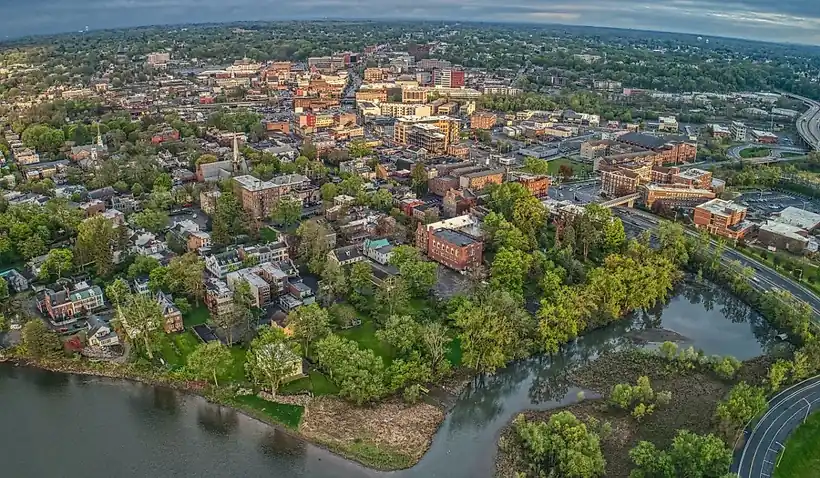
Call (518) 555-0147 (placeholder)