The Region
What Water Damage Restoration Southern Tier Means From Binghamton to Elmira
Two rivers, eight counties, three small cities that anchor the map, and a single standard of work: extraction first, measured drying second, and a claim file that starts in the first hour. That is the whole promise of water damage restoration southern tier on this page.
This is the thirty-third page of this site, and the seventh and last of its region pages. It is the hub that joins the Binghamton city page to the towns of the Chemung valley and the far counties, and it treats the whole Southern Tier as one water problem with local answers. Binghamton anchors the east in Broome County. Elmira and Corning anchor the west in Chemung and Steuben counties. Between and beyond them run the valleys this page is organised around, because water damage restoration southern tier work follows water, and water follows valleys.
The map needs one honest paragraph before anything else, and it gets its own section below. The name Southern Tier carries two county lists. The state Regional Economic Development Council, the REDC, counts Broome, Chemung, Chenango, Delaware, Schuyler, Steuben, Tioga and Tompkins. The common map used across the region swaps Tompkins out and Otsego in. This page uses the common eight county map, Broome, Chemung, Chenango, Delaware, Otsego, Schuyler, Steuben and Tioga, and says so wherever the map matters, because flood records, gauges and county files all keep their own geography.
Coverage on this page means the full sequence, not a pump and a fan. Emergency call and dispatch, stopping the source, pumping and extraction, moisture mapping, opening only what the readings condemn, structural drying with air movers and dehumidifiers, daily readings in a drying log, cleaning and sanitizing, mold prevention, and final readings with the documented claim file. Burst pipes, sewage backups, sump failures, appliance leaks, roof leaks and upstairs neighbour leaks sit inside the same sequence as river floods, because the drying science does not change with the source. That sequence, proved by readings, is what water damage restoration southern tier means in practice.
Read on for the rivers, the record and the method, because water damage restoration southern tier coverage is only as good as the facts it is built on.
Key Takeaways
Seven Southern Tier Facts That Shape Every Drying Job
Seven sourced facts explain most of the water damage between Binghamton and the Pennsylvania line hills. Each one is stated with its source, because a fact you cannot trace is just a rumour with good posture. Last updated: November 2026.
The Southern Tier is eight counties on the common map
Broome, Chemung, Chenango, Delaware, Otsego, Schuyler, Steuben and Tioga counties hold about five hundred ninety two thousand eight hundred twenty people across about six thousand six hundred eighty nine square miles, a calculated sum of the twenty twenty census county figures, labelled as calculated because no official region total is published. The standard for water damage restoration southern tier in Binghamton is set by work like this. That map is the working map of coverage across the region.
Two rivers do most of the damage
The Susquehanna River runs four hundred forty four miles and drains twenty seven thousand five hundred ten square miles, per the Susquehanna River Basin Commission, the SRBC. The Chemung River, about forty six miles long, is formed at Painted Post by the Tioga and Cohocton rivers and joins the Susquehanna in Pennsylvania. Most of the region and its flood history sits in those two watersheds. Two rivers explain why water damage restoration southern tier staging sits at Binghamton and Elmira.
Lee in 2011 beat the records of 2006 by one to four feet
The National Weather Service, the NWS, records that the Susquehanna in New York, from Binghamton to Vestal, Owego and Waverly, crested one to four feet above the previous records set in June 2006 when Tropical Storm Lee stalled over the basin in September 2011. Two record floods five years apart is the defining fact of water work in the river towns. Two record floods in five years is why water damage restoration southern tier planning starts with 2011.
The levees at Corning and Elmira were overtopped in 1972
Hurricane Agnes pushed the Chemung River to twenty five point two feet at Elmira and forty point seven one feet at Corning on the twenty third of June 1972, per the United States Geological Survey, the USGS, and levees failed or were topped in both cities. Flood stage is twelve feet at Elmira and twenty nine feet at Corning, and the two gauges use different datums, so the stages are not comparable as water depths. The levee record is the founding fact of water damage restoration southern tier work in the Chemung valley.
The 1935 flood carries two honest death tolls
The USGS Water Supply Paper 773-E records forty three dead across a farm belt two hundred miles long, from Hornell to the Catskill Mountains. The Star-Gazette figure of thirty seven lives is the Elmira area toll. Both figures are true at their own scope, and this page never blends them into one number. Scope is a professional habit, and water damage restoration southern tier figures keep theirs.
New York insurance clocks are short and written in law
Regulation 64 gives an insurer fifteen business days to acknowledge a claim and begin investigating, and fifteen business days after proof of loss to accept or reject it. The suit limit on a standard policy is twenty four months from the date of loss. Flood claims under the National Flood Insurance Program, the NFIP, need a Proof of Loss within sixty days. The clocks are short, which is why water damage restoration southern tier files are built in the first week.
The region is still flooding in this decade
The remnants of Tropical Storm Fred hit Steuben County in August 2021, the remnants of Debby hit again in August 2024, and verified flash floods struck Steuben County in June 2025 and Tioga and Broome counties that July. The flood record on this page is not history. It is the current condition of the valleys. The current decade proves water damage restoration southern tier readiness is a standing condition, not a storm week decision.
Quick Answers
Quick Answers for a Wet Southern Tier Home
Four questions arrive on the dispatch line in the first hour of almost every job in the region. Each answer below is complete on its own, in fifty five to sixty words, so it can be read aloud, copied or acted on without the rest of the page.
The river is rising. What do I do first?
Move people, pets and medicines above the water first, then documents and photographs. Keep out of water near outlets or the panel. Photograph the rising water and the high line it leaves. Call a restoration crew and your flood insurer the same day. Extraction and silt clearing start the drying, and the first photographs anchor the whole claim file.
My basement flooded from a burst pipe. Is that covered?
Usually yes. A homeowners policy in New York covers sudden water from inside the house, like a burst pipe or a failed water heater, because that water never rose from outside. Photograph the split pipe before it is repaired, keep the failed part, and start drying the same day, because the policy expects you to limit further damage.
How fast does mold start after a flood?
Mold can begin growing on wet material within twenty four to forty eight hours while the material stays wet and warm. That is why extraction and structural drying start the same day the water is found. Drying that reaches the standard quickly usually prevents a mold job entirely. Growth over ten square feet brings in New York licensing rules.
How long will drying my home take?
Most homes dry in three to five days of machine time once standing water is out. Stone and block basements in older valley homes hold water deep and take longer. The crew reads walls and floors daily against a dry standard from an unaffected room. Drying ends when readings meet the standard and hold, not when a calendar page turns.
Every one of these answers expands into a full section further down the page, and the thirty questions at the end carry the same answers the structured data carries. Short answers start the work. The long sections prove it.
The full sections below expand each of these answers, and the standard behind them is the standard of water damage restoration southern tier work on this page.
Key Facts
Southern Tier Water Facts, With Sources
The numbers a Southern Tier homeowner actually needs, each with the office that published it. Gauges, census counts, river lengths and the road the crews drive, in one table.
| Fact | Figure | Source |
|---|---|---|
| Region, common map | Eight counties: Broome, Chemung, Chenango, Delaware, Otsego, Schuyler, Steuben, Tioga | This page, from regionalcouncils.ny.gov and common usage |
| Region population | About 592,820, calculated sum of county figures, not a published total | US Census Bureau QuickFacts, 2020 county counts |
| Region land area | About 6,688.52 square miles, calculated sum | US Census Bureau QuickFacts |
| Hub city | Binghamton, 47,969 people | US Census, April 1 2020 |
| Chemung valley cities | Elmira 26,523 and Corning 10,551 people | US Census, April 1 2020 |
| Oneonta, Otsego County | 13,079 people | US Census, April 1 2020 |
| Susquehanna River | 444 miles, drains 27,510 square miles | Susquehanna River Basin Commission overview, June 2023 |
| Chemung River | About 46 miles, formed at Painted Post by the Tioga and Cohocton | NYSDEC and Chemung River Friends |
| Chenango River | About 90 miles, Morrisville to the Susquehanna at Binghamton | New York State Department of Environmental Conservation, NYSDEC |
| Elmira gauge record | Chemung River at Elmira, 25.2 feet on June 23 1972, flood stage 12 feet | USGS gauge 01530332 and NWS |
| Corning gauge record | Chemung River at Corning, 40.71 feet on June 23 1972, flood stage 29 feet | USGS gauge 01529950 and NWS |
| Area code | 607 for Binghamton, Elmira and Corning, created 1954, never overlaid | NANPA records, as reported |
| Expressway | 32 miles of Route 17 from Waverly to Endicott designated Interstate 86 on November 14 2024 | New York State Department of Transportation, NYSDOT |
One figure carries a known small dispute: Chemung River Friends gives the Susquehanna drainage as 27,500 square miles against the SRBC figure of 27,510 used above, a ten square mile difference between two honest sources. The Elmira and Corning gauges use different datums, so their stages cannot be compared as water depths.
Read the table the way a crew reads it. The gauge rows explain why Elmira and Corning plan around the Chemung the way Binghamton plans around the Susquehanna. The census rows explain the shape of the work: three small cities, a ring of villages, and long valley roads between them, which is why response across the region is staged from two ends instead of promised from one. Facts like these, sourced in the sentence that states them, are the ground water damage restoration southern tier stands on here.
A table is only useful if it can be checked, and every figure above can be, which is the habit water damage restoration southern tier work runs on.
Voice Answers
Voice Answers: Two Rivers in Four Replies
People ask phones and speakers these questions out loud, in kitchens with wet floors. Each reply below is written to be read aloud as it stands, plain and complete.
Hey, is my town in the Southern Tier?
If you live in Broome, Chemung, Chenango, Delaware, Otsego, Schuyler, Steuben or Tioga county, yes, on the common map this page uses. Binghamton, Elmira, Corning, Oneonta, Owego, Norwich and Hornell are all Southern Tier towns here. Ithaca sits on the Finger Lakes page of this site, and Olean and Jamestown belong to Western New York. That is the map water damage restoration southern tier coverage is drawn on.
Hey, the Chemung River is flooding. What happens to my house?
When the Chemung passes flood stage, twelve feet at Elmira and twenty nine at Corning, low streets near the river take water first, and basements behind the levees fill when the river outrises the wall or the storm drains back up. The work that follows is extraction, silt clearing, sanitizing and measured drying, in that order. That sequence is how water damage restoration southern tier crews work a Chemung flood.
Hey, how long do I have to file my flood claim paperwork?
Your Proof of Loss under the National Flood Insurance Program is due within sixty days of the date of loss. Your insurer must acknowledge a claim and begin investigating within fifteen business days under New York Regulation 64. The outer limit for suing on a standard New York policy is twenty four months from the date of loss. Those three clocks govern every water damage restoration southern tier claim in New York.
Hey, can I stay home while the machines run?
Often yes, when the water was clean, the wet rooms can be closed off, and the power in the rest of the house is safe. Air movers are loud and the rooms under work are out of use for several days. Sewage water, a wet furnace or panel, or a large mold area changes the answer, and your crew should say so on the first visit. That judgement call is part of water damage restoration southern tier first visit work.
Ask the question out loud in any of the eight counties and the answer begins the same way, with water damage restoration southern tier crews staged on two rivers.
First Hour
First Sixty Minutes After Water Enters a Binghamton or Elmira Home
The first hour decides the size of the job more than any machine that arrives later. Four moves, in order, protect your family, your claim and your floors at once.
Notice what is not on the list: tearing out carpet, cutting walls, or renting a fan and hoping. Home drying without meters guesses at the one thing that decides the outcome, whether the structure actually reached dry. A crew arriving in the first hours brings extraction, meters and a written plan, and the photographs you took in minute thirty become the spine of the claim file. That is the working method of water damage restoration southern tier from the first hour onward.
River water changes the order in one way only: safety moves further ahead of everything. Susquehanna and Chemung flood water carries silt, bacteria and whatever the river passed on its way down the valley, so nobody wades in it for a photograph, and children and pets stay out until the cleanup crew has cleared the rooms. The photographs still matter, taken from the doorway and the stairs. The calls still happen in the first hour. What changes is who sets foot in the water, and the answer is the crew, in boots, after the power is proven safe.
Water in the house now?
Extraction started in the first hours is the difference between drying a floor and replacing it. The dispatch line runs day and night across all eight counties.
An hour spent this way is the cheapest hour in water damage restoration southern tier work, and it is spent by the homeowner, not the crew.
The Map
Two Maps, One Region: The Eight County Southern Tier
Ask the state and ask a neighbour where the Southern Tier is, and you get two county lists that differ by exactly one swap. This page serves the common map and names the state map honestly.
The state map belongs to the Regional Economic Development Council, and it exists to organise grants and development programmes, not to describe where people feel they live. It runs from Binghamton to Ithaca, in the council and its own words, and it counts Tompkins County in and Otsego County out, because the Mohawk Valley council claims Oneonta and Cooperstown as its own communities. Neither map is a lie. They are answers to different questions, and a page about water damage restoration southern tier has to pick the map its readers live on.
The common map is the one on diner placemats and school district boundaries of the mind: eight counties along the Pennsylvania line, from Delaware County in the east to Steuben County in the west, with Binghamton the largest city and Elmira and Corning the Chemung valley anchors. Oneonta, in Otsego County, belongs to this map in everyday speech. Ithaca does not, whatever the development council says, because Ithaca looks north to Cayuga Lake and the Finger Lakes. Olean and Jamestown, far west in Cattaraugus and Chautauqua counties, belong to Western New York on every map anyone draws.
- Counties: Broome, Chemung, Chenango, Delaware, Otsego, Schuyler, Steuben, Tioga.
- Anchor towns: Binghamton, Elmira, Corning, Oneonta, Owego, Norwich, Hornell.
- This is the map this page serves, the map local people draw when they say the Southern Tier.
- Oneonta sits on this map through Otsego County, even though the state places Otsego in the Mohawk Valley region for economic development.
- Counties: Broome, Chemung, Chenango, Delaware, Schuyler, Steuben, Tioga, Tompkins.
- The Regional Economic Development Council describes this region as stretching from Binghamton to Ithaca.
- On this site, Ithaca and Tompkins County are covered by the Finger Lakes page, where they sit in geographic and tourism usage.
- Olean and Jamestown are Western New York under either map, and are covered by the Western New York page.
| County | People, 2020 | Land, sq mi |
|---|---|---|
| Broome | 198,683 | 705.64 |
| Chemung | 84,148 | 407.33 |
| Chenango | 47,220 | 893.59 |
| Delaware | 44,308 | 1,442.60 |
| Otsego | 58,524 | 1,001.74 |
| Schuyler | 17,898 | 328.34 |
| Steuben | 93,584 | 1,390.51 |
| Tioga | 48,455 | 518.77 |
County figures from US Census Bureau QuickFacts. The eight county totals, about 592,820 people and 6,688.52 square miles, are calculated sums of these rows and are labelled calculated wherever this page uses them.
Why does a restoration page spend a section on a map dispute? Because the map decides which flood record is yours. The gauges, the disaster declarations and the county emergency files all file their facts under counties. A homeowner in Oneonta reading a Mohawk Valley flood study, or a homeowner in Ithaca reading this page, is working from the wrong record. The map on this page is stated once, plainly, and then used consistently for thirty sections: eight counties, two rivers, three anchor cities.
Two maps, one region, and no excuse for confusing them: that is the geographic ground rule of water damage restoration southern tier coverage here.
The Rivers
The Susquehanna River, Four Hundred Forty Four Miles Through the Heart of the Region
The Susquehanna is the river that built the eastern half of this region and the river that floods it. Everything about water work in Broome and Tioga counties starts with its habits.
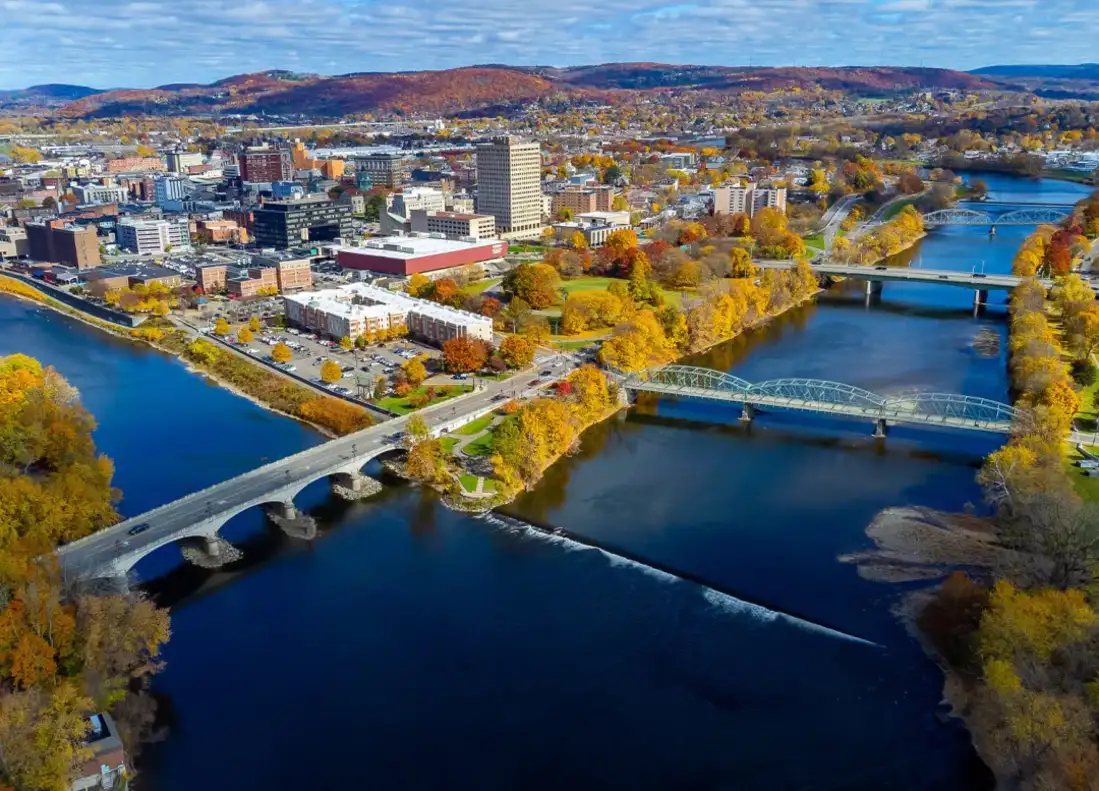
The Susquehanna River runs four hundred forty four miles from Otsego Lake near Cooperstown to Chesapeake Bay at Havre de Grace, Maryland, and drains twenty seven thousand five hundred ten square miles, per the Susquehanna River Basin Commission overview of June 2023. Chemung River Friends gives the drainage as twenty seven thousand five hundred, a ten square mile difference this page notes rather than hides. It is the sixteenth largest river in the nation and contributes about half the fresh water that enters the bay. Through this region it passes Waverly, Owego, Vestal, Binghamton and the towns between, in a wide valley that settlement filled early and flooding visits regularly.
A river that size does not flood the way a creek floods. Creek water rises in hours and falls in a day. Susquehanna water rises over a day or more as a whole basin drains toward the valley, stays high while the basin empties, and leaves silt across everything it touched. The practical meaning for a homeowner is time: time to move belongings up, time to photograph, time to call, and then a longer, dirtier cleanup than any pipe break, because river water must be cleaned out of a house before drying can begin. Crews who work the Susquehanna plan for silt first and drying second.
The river also explains the settlement pattern the crews serve. Binghamton grew where the Chenango meets the Susquehanna. Johnson City and Endicott spread along its north bank. Owego sits where Owego Creek joins it, as the Tioga County seat. Every one of those towns has a dated flood record, and the two that matter most, June 2006 and September 2011, get their own sections below. When a dispatcher stages water damage restoration southern tier work on the Susquehanna side, the gauge forecast is the first document on the clipboard.
The Rivers
The Chenango River Joins the Susquehanna at Binghamton
Binghamton is a two river city, and the second river is the one that arrives from the north through farm country, quiet for years at a time.
The Chenango River runs about ninety miles, per the New York State Department of Environmental Conservation, from Morrisville in Madison County through Chenango and Broome counties to its meeting with the Susquehanna at Binghamton. The Tioughnioga River joins it at Chenango Forks, about nine miles north of the city, which is why Chenango Forks stands on the service map at the end of this page. Norwich, the Chenango County seat, sits on its upper valley, and the river threads a chain of small towns that all know its flood moods.
Chenango water behaves like a big creek: faster to rise than the Susquehanna, quick to fall, and at its worst when rain falls on ground already soaked or on snow ready to melt. Homes along its valley floor and the low streets of the towns it passes take basement water in events that never make a headline, the sump pump overwhelmed at three in the morning kind of flood that makes up most of the region and its ordinary water work. A flooded basement in Norwich or Chenango Forks gets the same sequence as a riverfront house in Binghamton: extraction, mapping, drying to readings, and a log.
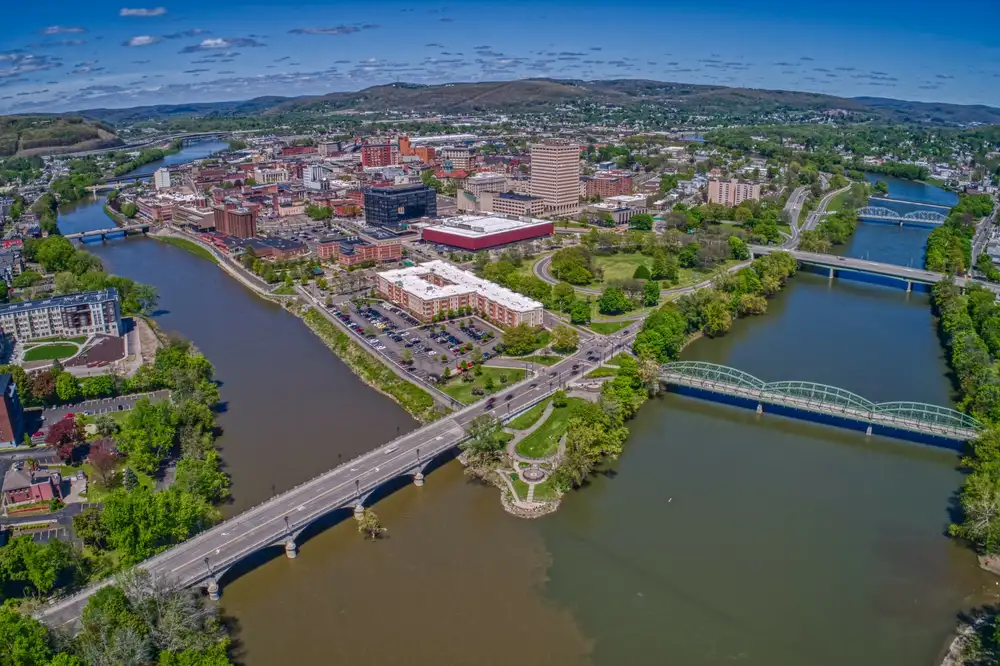
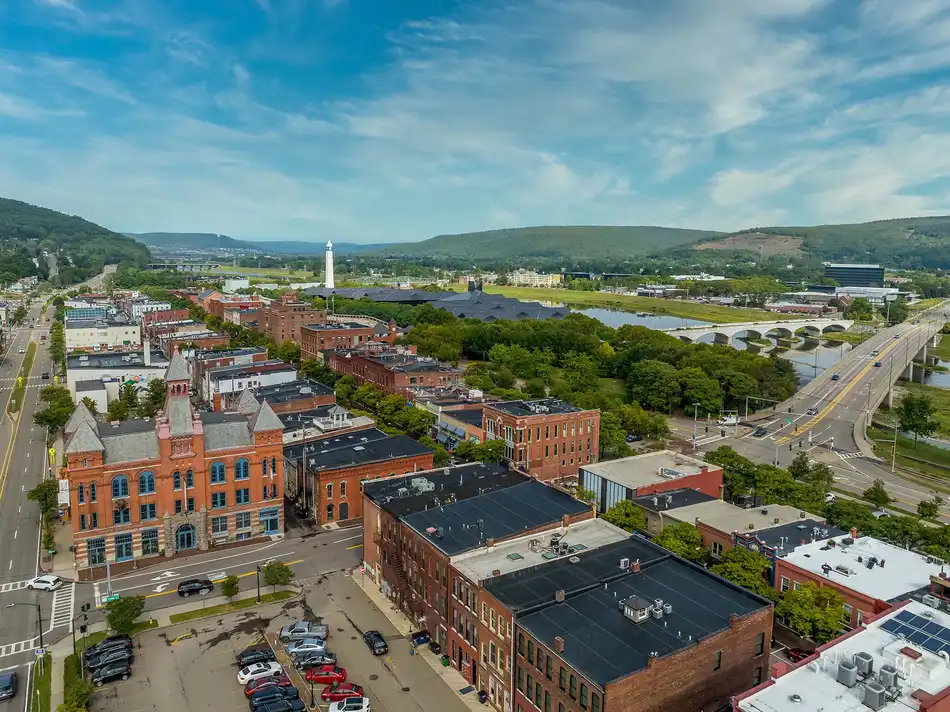
The confluence itself is the region and its emblem. Two rivers meeting made the city, carried its trade, powered its mills and flooded its streets, and the bridges in the hero photograph cross both waters within a few hundred yards. When both rivers rise together, as they did in the great basin floods, the water at the meeting point has nowhere polite to go. That is the geography a Binghamton homeowner lives on, and it is why this page treats the city page and this region page as one continuous record.
The Chenango is the quiet river of the region, and water damage restoration southern tier work along its valley is mostly the quiet work of basements and sumps.
The Rivers
The Chemung River, Formed at Painted Post
West of Corning, two rivers become one at a place named for a painted post, and the river they form runs the whole Chemung valley through Elmira to the Susquehanna.
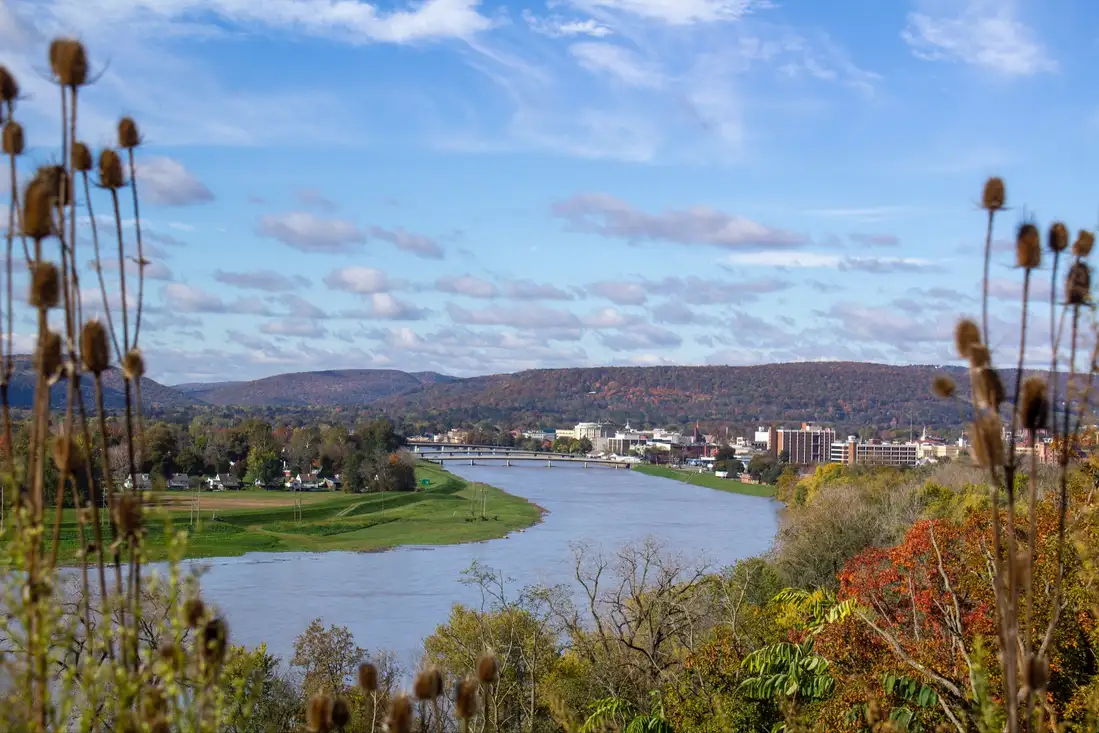
The Chemung River is about forty six miles long, with sources ranging from forty five point eight to forty six point four miles, formed at Painted Post in Steuben County, just west of Corning, by the meeting of the Tioga and Cohocton rivers. From there it flows through Corning, Big Flats, Elmira and Waverly, crosses into Pennsylvania, and joins the Susquehanna about two miles south of Sayre. Its average flow at the Chemung, New York gauge is two thousand six hundred twenty three cubic feet per second, a modest river on an ordinary day, which is exactly what makes its flood record hard to believe until you read the gauges.
The valley it carved is the western half of this region and its working corridor. The Southern Tier Expressway and the towns run together along the river: Corning with its glass works and its levee, Big Flats on the flat ground the name describes, Elmira the county seat, and Waverly at the state line. Flat valley floors beside a river are where water damage concentrates, and the Chemung valley floor is wide, built on, and served by levees that have both saved these towns many times and, once in living memory, been outrisen. The floodwall question in the FAQs at the end of this page is asked in this valley more than anywhere else in the region.
For a crew, the Chemung sets the staging map. Work on this river stages from the Elmira and Corning end, the way Susquehanna work stages from Binghamton, and the two ends meet in the middle around Waverly and Owego. A homeowner in Big Flats or Horseheads calling about water damage restoration southern tier work is calling into that western staging ground, and the dispatcher will say so plainly, with a real time for the road the truck has to drive.
The Rivers
The Tioga and Cohocton Rivers Meet Above Corning
The Chemung has two parents, and both of them have flood records of their own in the Steuben County hills.
The Tioga River runs about fifty eight miles from headwaters in western Bradford County, Pennsylvania, north into New York, where it meets the Cohocton at Painted Post. The Cohocton River, also spelled Conhocton in older records, runs fifty eight point five miles from southeastern Livingston County, about fifteen miles northeast of Dansville, through the towns of Cohocton, Avoca and Bath. Two valleys, two county seats worth of small towns, one meeting point, and the Chemung is what their combined water becomes on its way to Corning.
The Tioga gauge at Lindley, in Steuben County, holds the clearest record of what these hill rivers can do. Its flood of record is the Hurricane Agnes crest of the twenty third of June 1972: twenty six point two seven feet, one hundred twenty eight thousand cubic feet per second, against a flood stage of seventeen feet, on a drainage of seven hundred seventy one square miles, per the National Weather Service Middle Atlantic River Forecast Center. The Eloise flood of September 1975 reached twenty three point three seven feet at the same gauge, and the May 1946 flood reached twenty two point eight seven. No Tioga crest for 1935 was verified for this page, and none is printed, because a gauge record is only worth what can be sourced.
Bath, the Steuben County seat, sits on the Cohocton, and the county fairgrounds, the veterans home and the valley floor homes there all sit in the same drainage story. Hill country water arrives fast, carries gravel and mud, and punishes the ground floors of valley homes. The drying work is the same as anywhere in the region, but the cleanup before it runs heavier: mud out first, then sanitizing, then the machines. That order, cleanup before drying, is the hill country version of the rule the whole page runs on.
Two parent rivers, one record crest each worth knowing, and a shared lesson for water damage restoration southern tier planning in Steuben County.
The Rivers
The Canisteo River and the Steuben County Valleys
The third Steuben river runs south of the Cohocton, past Hornell and Canisteo, and its valley has written its own chapters of the county flood record.
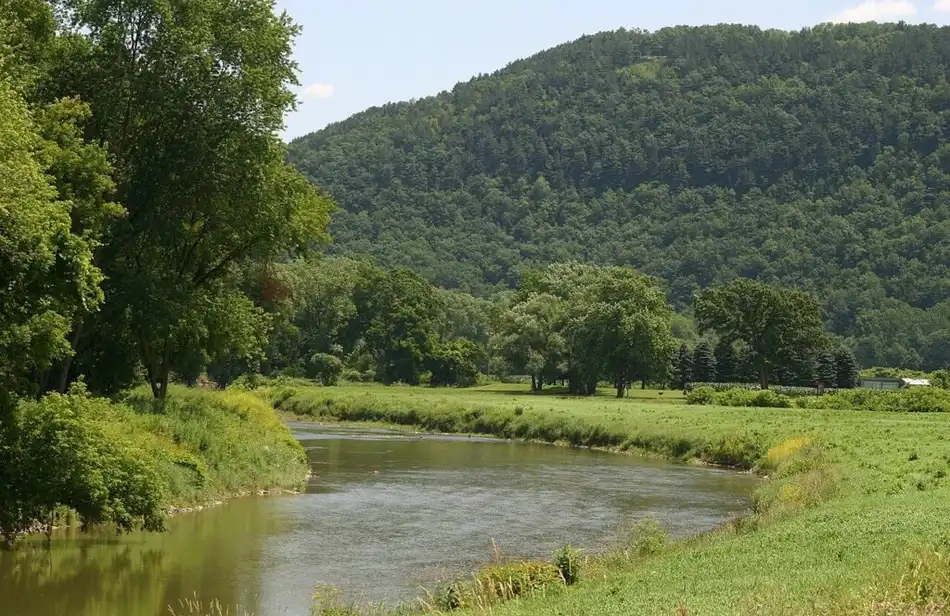
The Canisteo River runs sixty one miles from northern Allegany County near Dansville, southeasterly through Steuben County past Hornell and the town of Canisteo, and enters the Tioga River near Erwins, in the wording of the Department of Environmental Conservation. Chemung River Friends describes the mouth as about ten miles south of Corning. Hornell, eight thousand two hundred sixty three people at the twenty twenty census, is the valley and its city, a railroad town built on the flat where the river bends, and its low streets know the pattern of valley flooding as well as any town in the region.
Steuben County is the most flood tested county in the region in this decade, and the Canisteo valley shares that record with the Cohocton valley towns of Woodhull, Jasper and Addison, which the Fred flood of 2021 and the Debby flood of 2024 both struck. The June 2025 flash flood closed roads and drew a state of emergency around Bath, Canisteo and Cameron, with crews answering more than twenty emergency calls in six hours. Small valley towns flood from creeks and hillside runoff as much as from their named river, and the first hour advice on this page was written with exactly those calls in mind.
One river is deliberately almost absent from this page. The Allegheny River, three hundred twenty five miles long, drains the Olean area, and Olean is Western New York, not the Southern Tier, on every map. It is named here once, as the western neighbour, so no reader mistakes its record for this region and its own. Geography kept straight is the beginning of honest water work, and water damage restoration southern tier coverage ends where the maps say it ends.
Flood Cases
Tropical Storm Lee in September 2011, the Flood That Broke the Records
Five years after the region set its flood records, a stalled tropical storm broke them. Lee is the modern measure of Susquehanna flooding, and this section keeps to the region wide record.
The remnants of Tropical Storm Lee moved north on the sixth of September 2011 and stalled on the eighth, and in about forty eight hours, the sixth to the eighth, six to twelve inches of rain fell over most of the upper Susquehanna basin in New York and northeast Pennsylvania, per the National Weather Service office at Binghamton. The Susquehanna in New York, from Binghamton to Vestal, Owego and Waverly, crested one to four feet above the previous records set in June 2006. In Pennsylvania, record crests at Meshoppen and Wilkes-Barre passed even the Hurricane Agnes marks of 1972 by about a foot.
Damages across the upper Susquehanna basin in New York and Pennsylvania were close to one billion dollars, and the storm took one life and injured one person across central New York and northeast Pennsylvania. Those are basin figures, and this page keeps them at basin scope. The Binghamton specific record, the crest in the city, the evacuations and the city damage figures, lives on the Binghamton page of this site, where it belongs, and is not repeated here. A region page that steals its hub city and its record teaches readers nothing and search engines less.
What Lee changed in practice is the planning line. A homeowner in Vestal or Owego who flooded in 2006 and rebuilt to the 2006 line flooded again in 2011, higher. Flood insurance maps, sump capacity, furnace placement and the decision to keep irreplaceable things in a basement all read differently after two record floods in five years. When a crew talks about water damage restoration southern tier work on the Susquehanna side today, Lee is the storm in the background of the conversation, the proof that the record book is still being written.
Flooded before? The next one plans differently.
Crews who dried homes after Lee plan furnaces, panels and storage around the 2011 line. Ask for that planning on any visit.
Flood Cases
June 2006, the Record Flood Lee Had to Beat
Before Lee, there was the flood of June 2006, the event that set the records the whole basin measured itself against for five years.
In the last days of June 2006, tropical moisture meeting a stalled cold front produced record or near record flooding across the Mohawk, Delaware and Susquehanna basins. The fullest verified account this page relies on is the National Weather Service record written after Lee: the June 2006 crests on the Susquehanna in New York stood as the records until September 2011, when Lee beat them by one to four feet from Binghamton to Waverly. That single sourced fact, records set in 2006 and broken in 2011, is the spine of the 2006 story, and this page builds on it without dressing it in figures that could not be verified to the same standard.
That restraint deserves one plain sentence of explanation, because readers will find bigger numbers elsewhere. Some figures attached to the 2006 flood in summaries and abstracts could not be opened and checked at their source during the research for this page, and a page that prints only what it can source leaves them out, even when they are dramatic. What is certain, and sourced, is enough: the 2006 flood was the record event of its generation across three river basins, it is the flood long time residents of the valley towns name first, and its records fell five years later.
Two record floods in five years rewired the region and its expectations. Towns rebuilt bridges and raised roads. Homeowners who had never carried flood insurance bought it. Restoration work itself changed: drying logs, moisture maps and claim files became the expected standard rather than the exception, because two basin wide claims in five years taught insurers and homeowners alike to argue from documents. The comparison table in the gauges section below puts 2006 and 2011 side by side in the only terms this page can fully source: the records, and the margin by which they fell.
The 2006 flood is the hinge of the modern record, the event that taught the basin to document water damage restoration southern tier work properly.
Flood Cases
Hurricane Agnes in June 1972 and the Levees at Corning and Elmira
Agnes is the flood the Chemung valley measures everything against, the week the river outrose the walls built to hold it.
Agnes formed over the Yucatan on the fourteenth of June 1972, made landfall in Florida on the nineteenth as a Category 1 hurricane, and came ashore again near New York City on the twenty second as a strong tropical storm, affecting the region through the twenty fifth. Up to nineteen inches of rain fell in places. On the twenty third of June the Chemung River crested at twenty five point two feet at Elmira, two hundred thirty five thousand cubic feet per second, and at forty point seven one feet at Corning, two hundred twenty eight thousand cubic feet per second, per the USGS gauges. Levees failed or were topped at Wilkes-Barre, Corning and Elmira.
Twenty four people died in New York, per the Northeast Regional Climate Center at Cornell, and the name Agnes was retired from the storm lists. Two larger figures follow Agnes in many accounts and need their scope stated every time: one hundred seventeen lives and three point one billion dollars are the totals for the whole twelve state disaster, not Southern Tier figures. A number without its scope is a rumour in a suit, and flood history is full of them.
The living legacy of Agnes in the Chemung valley is concrete: the levee and floodwall systems at Elmira and Corning as residents know them, the flood insurance maps drawn after the disaster, and a local memory that still uses 1972 as a unit of measure. When an Elmira homeowner asks whether the floodwall protects their street, the honest answer in the FAQs below starts here, with the week the river reached more than double flood stage at the Elmira gauge. Water damage restoration southern tier work in the Chemung valley is done in the shadow of that week, and the crews who do it best can tell you the crest figures from memory.
Flood Cases
Two Gauges, Two Datums: Elmira and Corning Crest Records
The Chemung keeps its records at two gauges twenty miles apart. Read them carefully, because the numbers look comparable and are not.
| Gauge | Flood stage | Record crest | Other top crests |
|---|---|---|---|
| Chemung River at Elmira, USGS 01530332 | 12 feet | 25.2 feet, June 23 1972, at 235,000 cubic feet per second | 21.2 feet, May 28 1946. 19.7 feet, September 26 1975, Hurricane Eloise. 18.51 feet, January 20 1996 |
| Chemung River at Corning, USGS 01529950 | 29 feet | 40.71 feet, June 23 1972, at 228,000 cubic feet per second | 37.74 feet, May 28 1946. 32.46 feet, September 26 1975, at 127,000 cubic feet per second |
| Tioga River at Lindley, Steuben County | 17 feet | 26.27 feet, June 23 1972, at 128,000 cubic feet per second | 23.37 feet, September 26 1975. 22.87 feet, May 28 1946 |
Gauge records from the USGS and the National Weather Service Middle Atlantic River Forecast Center. The Elmira gauge datum is 833.65 feet above mean sea level and the Corning gauge datum is 900 feet, so a Corning stage and an Elmira stage are heights above two different zero points. Never compare 25.2 and 40.71 as water depths.
The datum warning is the most useful sentence in this section. Stage is the height of the water above an arbitrary zero fixed at each gauge, chosen for the local channel, and the two Chemung gauges chose zeros sixty six feet apart in elevation. A reader who subtracts the two record crests and concludes Corning flooded fifteen feet deeper than Elmira has been misled by arithmetic. What the records do say, plainly, is how far each river rose above its own flood stage: about thirteen feet over at Elmira, about eleven feet over at Corning, in the same storm, on the same day.
Set the two modern Susquehanna floods beside these gauges and the region and its whole record fits on one line of reasoning. The Chemung record is old, 1972, and stands untouched. The Susquehanna records are young, set in 2006 and broken in 2011. A homeowner on either river is living under a record that is either fifty years old or fifteen, and neither fact argues for calm. It argues for insurance, for a sump pump with a backup, and for knowing the first hour moves before the water makes them for you.
Gauges do not argue, and a water damage restoration southern tier crew that stages on them starts every river job a step ahead of the water.
Flood Cases
July 1935, the Flood With Two Death Tolls
The oldest great flood in the valley record comes with two death tolls that disagree, and both of them are right. The difference is scope, and scope is the whole lesson.
Rain began on Sunday the seventh of July 1935, in what the United States Geological Survey called the most intense precipitation in the history of the state. Ten inches of rain fell at Cortland in forty eight hours. The Chemung at Corning crested at thirty three point four nine feet on the seventh, its third highest on record, and at Elmira at eighteen point three feet on the ninth, its fifth highest. The flood ran across a farm belt two hundred miles long, from Hornell to the Catskill Mountains, and fifty to seventy five miles wide, from the Pennsylvania border to the Mohawk Valley.
The USGS Water Supply Paper 773-E, written by Hollister Johnson in 1936, quotes the report of Governor Lehman and his tour of the flood: forty three dead, hundreds homeless, and damage estimated at twenty five million dollars. That is the statewide toll. The Star-Gazette, writing in May 2024, gives thirty seven lives, and that is the Elmira area toll. Forty three for the state, thirty seven for the Elmira area: two true numbers at two scopes, and any account that merges them into one figure has made an error this page refuses to repeat.
Why spend a section of a restoration page on a ninety year old flood and its bookkeeping? Because the same scope error runs through modern flood talk: basin damage quoted as a town figure, state totals quoted as a street figure, a gauge stage quoted as a depth. Homeowners make insurance and rebuilding decisions on those numbers. Reading 1935 carefully, with its sources named and its scopes kept separate, is training for reading every flood figure that will ever be quoted to you, including the ones on this page.
Ninety years on, the 1935 flood still teaches the region how to read a figure, which is a core skill in water damage restoration southern tier country.
Flood Cases
Fred in 2021, Debby in 2024 and the Flash Floods of 2025
The current decade has already given Steuben County two federal disaster declarations and the region two verified flash floods in a single summer month of 2025.
The verified Southern Tier flood of 2021 was the remnants of Tropical Storm Fred, on the eighteenth and nineteenth of August, declared as federal disaster DR-4625 on the eighth of October. Individual Assistance went to Steuben County and Public Assistance to eight counties. Steuben was hardest hit, with more than five hundred homes and businesses affected, dozens of people rescued or evacuated, a state of emergency, and damage in the millions, with Woodhull, Jasper and Addison among the towns struck. One correction belongs in this paragraph every time 2021 is discussed: the remnants of Hurricane Ida, days later, struck downstate and New York City. No Southern Tier flood is attributed to Ida, and accounts that give Ida to this region are wrong.
In August 2024 the remnants of Tropical Storm Debby crossed the region on the eighth to the tenth, and disaster DR-4825 followed on the twenty fourth of September, covering counties including Allegany, Steuben, Broome and Delaware in this area. Steuben County faced an estimated fifty million dollars in damage, and at least twenty five homes were destroyed. Debby rainfall totals and crest figures for the Southern Tier were not verified during the research for this page, so none are printed here. The pattern, though, is verified and plain: Steuben County, again, took the worst of a tropical remnant in August.
Then came 2025. On the ninth of June, a flash flood struck Steuben County around Bath, Canisteo and Cameron, drawing a state of emergency while crews answered more than twenty emergency calls in six hours. On the twelfth and thirteenth of July, flash flooding hit Tioga and Broome counties, with Newark Valley worst hit, at least twenty five homes damaged, and no one hurt or killed. No federal disaster declaration for a 2025 Southern Tier flood was found. Flash floods of this size are the ordinary future of water damage restoration southern tier work: local, fast, creek driven, and handled home by home rather than basin by basin.
Fred, Debby and the flash floods of 2025 are the current workload of water damage restoration southern tier crews, not a history lesson.
Flood Cases
August 2018 and the Long List of Disaster Declarations
Read the declaration list for this region in order and a pattern emerges that no single flood story shows: the Southern Tier floods often, officially, and across all eight counties.
Severe storms and flooding from the thirteenth to the fifteenth of August 2018 brought federal disaster declaration DR-4397, declared on the first of October 2018, covering Broome, Chemung, Chenango, Delaware, Schuyler and Tioga counties in this region, per the New York Division of Homeland Security and Emergency Services. The declaration also named Seneca County, which is Finger Lakes country, a reminder that storm systems do not read the region maps this page argues about, even when declarations file their paperwork by county.
Lay the declarations in a row: DR-4397 in 2018, DR-4625 in 2021, DR-4825 in 2024, with the basin floods of 2006 and 2011 before them and the undeclared flash floods of 2025 after. Five federal or basin scale events in under twenty years, plus the ordinary run of burst pipes, sump failures and creek rises that never earn a number. That is the statistical weather of the Southern Tier, and it is why this page treats preparation as a standing condition rather than a storm week activity: the pump tested in spring, the policy read before the river rises, the claim file habit formed before it is needed.
A declaration also changes the practical landscape after a flood. It can open assistance programmes, bring state and federal teams into a county, and lengthen the paper tail of a claim. It does not change the first week at all. Extraction, cleaning, drying and documentation run on the same clocks whether or not a declaration exists, and the New York insurance deadlines in the sections below apply in declared and undeclared floods alike. Paper at the state level moves slowly. Water in a basement does not, and the work order on this page follows the water.
Declarations come and go, but the standing pattern they reveal is the planning basis for water damage restoration southern tier readiness.
The Road
The Southern Tier Expressway, Route 17 Becoming Interstate 86
The road that stitches this region together is itself a work in progress, a state route turning into an interstate one designated stretch at a time.
Interstate 86, across Pennsylvania and New York, runs two hundred fifty four point zero two miles. New York State Route 17 runs three hundred ninety seven miles, the longest state highway in New York, and its freeway sections are the Southern Tier Expressway in this region and the Quickway further east. For decades the expressway has been converting to Interstate 86 in pieces: by 2004 the first one hundred seventy seven miles from the Pennsylvania line to East Corning were already designated, with the designation reaching through Corning toward Horseheads and Elmira in the years after.
The most recent piece fell into place on the fourteenth of November 2024, when the New York State Department of Transportation designated a thirty two mile stretch of Route 17 in Broome and Tioga counties, from Exit 60 in Waverly to Exit 67 in Endicott, as Interstate 86. The conversion work on that stretch began in 2008 and cost more than twenty nine point seven million dollars. A forty seven million dollar rehabilitation of five point seven miles from Apalachin, in the town of Owego, to the Broome County line was scheduled for completion by the end of 2025. Where the interstate and its eastern end stands today beyond Endicott was not fully verified for this page, and this page does not assert that I-86 reaches Interstate 81 or Binghamton.
A restoration page cares about this road for a practical reason: it is the response corridor. The same expressway that carries commuters between Binghamton, Owego, Waverly, Elmira and Corning carries the trucks, and its exits are the mental map every dispatcher in the region uses. When a crew says it is staging from the Elmira corridor or rolling east from Binghamton, this is the road under the sentence. Geography, rivers and one long road: that is the whole physical plant of water damage restoration southern tier coverage, and the service map at the end of this page is drawn on exactly those three things.
One road, two staging grounds, eight counties: the logistics of water damage restoration southern tier response in a single sentence.
In the Home
Burst Pipes in Southern Tier Winters
River floods own the headlines, but the most common water in Southern Tier homes arrives in January, out of a pipe that froze in an outside wall.
The valleys sit in a cold pocket of the state, and the housing stock is old: farmhouses with plumbing in uninsulated walls, city homes in Binghamton and Elmira with runs through crawl spaces and over unheated cellars, lake of insulation in exactly the wrong places. A hard cold snap after a mild spell is the classic setup. The pipe freezes, the ice splits the copper or the joint, and the break announces itself only when the thaw comes and full pressure returns to a line that is no longer whole. By then the water has a head start measured in hours.
The work follows the standard sequence with one addition: the path of the water matters as much as its amount. Water from a second floor break runs down inside walls, across ceilings and into rooms that look untouched, and a crew that dries only the room with the visible puddle leaves wet cavities above and below. Moisture mapping exists for exactly this case. The map, not the puddle, decides what opens. Homeowners can cut the loss sharply with three habits: know where the main shutoff is, insulate or heat trace the known cold runs, and keep the house warm enough in a cold snap that the walls stay above freezing.
Insurance treats this water kindly compared with river water, because a burst pipe is sudden water from inside the house, the class a homeowners policy is built around. The claim still runs on documents: photographs of the split, the failed section of pipe kept for the adjuster, the drying log, and dates that line up. A burst pipe in a Southern Tier winter is the most ordinary job in water damage restoration southern tier work, and ordinary is no excuse for doing it without proof.
In the Home
Sump Pump Failure When River Towns Get Rain on Snow
The sump pump is the hardest working appliance in a valley floor home, and it fails at the exact moment the water table peaks.
A sump pit collects the groundwater that presses against a foundation, and in the flat streets of Binghamton, Vestal, Big Flats and the Chemung valley floor, that pressure is a standing condition for much of the year. The pump that answers it fails for reasons that are all ordinary: a float switch stuck or tangled, a motor worn out by a long storm, a discharge line frozen or clogged, and above all a power cut in the same storm that filled the pit. Rain falling on snow, the classic late winter event in this region, delivers melt water and storm water together, and it finds every tired pump in the valley on the same night.
The defences are cheap compared with one flooded basement. Test the pump twice a year by pouring water into the pit and watching it cycle. Fit a battery backup pump, because the outage case is the common case. Keep the discharge line clear and long enough to move water away from the foundation, and check the pit for the silt and grit that valley groundwater carries. If the pump cycles constantly in wet weather, that is information: the water table is telling you the pit is doing structural work, and a backup is not a luxury.
When a pump fails and the basement fills, the water is groundwater, cleaner than river water but not clean, and it has usually been rising slowly enough to soak everything stored at floor level. Extraction, drying and a hard look at what sat in the water follow, and the failed pump is replaced or backed up before the job closes, because drying a basement and leaving the cause in the pit is half a job. The sump question in the FAQs carries the short version of this section, and it is one of the most asked questions on the dispatch line every spring.
A tested pump and a battery backup are the smallest investment in water damage restoration southern tier prevention a valley homeowner can make.
In the Home
Sewage Backups in Older Binghamton and Elmira Housing
The worst water in a house is the water that arrives from the sewer, and the older combined systems of the river cities produce it in every big storm.
Parts of Binghamton and Elmira drain through old lines where storm water and sewage share capacity. When a river storm loads the system, the water looks for the lowest opening it can find, and in a valley floor home that opening is a basement floor drain, a toilet or a laundry tub. The result is a backup: contaminated water rising inside the house at the same moment the river rises outside it. Tree roots in old clay laterals, grease and wipes in the line, and a town main running at capacity each cause their share of backups in dry weather too.
Sewage water is handled as contaminated from the first minute, under a stricter order than any other work on this page. People and pets stay out. Porous material the water touched, carpet, padding, cardboard, soft furnishings, is removed rather than cleaned, because it cannot be sanitised to a safe standard. Hard surfaces are cleaned and sanitised, then the structure is dried, and the drying log records the whole sequence for the claim. Nobody should attempt this cleanup with a mop and a household cleaner; the bacteria load in sewage water is the real hazard, not the smell.
Coverage for backups is the endorsement question in the FAQs: a standard homeowners policy usually excludes sewer backup unless a water backup endorsement was bought, and the limit on that endorsement is the ceiling of the claim. In a region where backups ride in on river storms, that endorsement is the cheapest important line in the policy. Read yours before the next storm, and if the line is missing, price it. It is the rare case where a paragraph on a restoration page can save a reader a whole loss.
Sewage is the one water class where water damage restoration southern tier work slows down on purpose, because safety outranks speed.
In the Home
Basement Flooding in the Valley Floor Homes of Two River Cities
The Southern Tier basement is a stone or block room under an old house on flat ground near a river. It floods in characteristic ways, and it dries in characteristic ways.
Walk the low streets of Binghamton, Johnson City, Endicott, Elmira or Corning and the housing tells one story: homes built before modern drainage, on foundations of stone, brick or concrete block, with furnaces, water heaters, panels and a lifetime of stored belongings sharing the basement. Water enters these basements through the floor when the water table rises, through the walls at the cove joint, up the drains in a surcharge, and over the sill in a true river flood. Four doors, one room. A crew diagnosing a wet basement starts by naming which door the water used, because the drying plan and the prevention plan both hang on the answer.
Drying a stone or block basement is slower craft than drying a framed room. Masonry holds water deep and releases it over days, and a basement read only at the surface will pass a touch test while the wall is still wet at its core. Readings are taken at several heights and in several places, the log tracks them daily, and the machines run until the masonry itself meets the standard. Furnaces and panels that got wet are electrical and mechanical questions before they are drying questions, and they are checked by the right trades before they are run again.
The stored life of the house is the third part of every basement job. Cardboard boxes wick water a foot above the line. Photographs, books and papers are the losses people name years later. The habits that help are unglamorous: plastic bins instead of cardboard, shelves that start six inches off the floor, nothing irreplaceable below the known high water line of the street. After Lee, many Susquehanna side families moved the memory boxes upstairs for good. It remains the cheapest flood measure in this entire page.
Every basement in the valley towns is a small archive of the region and its floods, and water damage restoration southern tier drying treats it that way.
In the Home
Hardwood Floors After a Chemung Valley Flood
The older homes of Elmira, Corning and Binghamton carry oak and maple floors worth saving, and saving them is a race run in the first two days.
Solid hardwood can often be dried in place after a flood. Crews lay drying mats that draw moisture up through the boards, read the floor daily with meters, and manage the air so the floor dries evenly rather than fast. Cupping, the raised edges that make a wet floor feel washboarded, is the wood swelling with water, and it often settles back as the floor returns to the dry standard. The floor that was caught in the first day or two, with the water extracted and the mats down, is usually the floor that survives.
The verdicts that go the other way are just as consistent. A floor that sat in river water for a week, a floor over a subfloor that has rotted, and any laminate floor at all, which is a photograph of wood over fibreboard and swells at every seam, cannot be brought back. Sanding and refinishing are sometimes offered as a rescue for a cupped floor, and they are a mistake before full drying: sand a cupped floor flat while it is wet and it will crown, humps upward, when it finally dries. Readings first, patience second, sanding last if at all.
Homeowners ask about floors more emotionally than about any other material, because the floors are the house they remember. The honest answer a good crew gives is a meter reading and a timeline, not a promise. This page states the rule the same way the FAQs do: what returns to the dry standard and lies flat was saved, and what cannot reach the standard gets named plainly, with the readings shown. Sentiment deserves evidence, and evidence is what a drying log is.
Floors are where water damage restoration southern tier patience pays best, in boards saved rather than replaced.
In the Home
Mold After Flooding and the New York Licensing Line
Mold is the second disaster inside every flood, and New York is one of the states that regulates its cleanup by law. The line is ten square feet, and it matters.
Mold grows on wet material that stays wet, and it can begin within twenty four to forty eight hours in warm conditions. A flooded home that is extracted and dried to standard in the first days usually never grows a mold problem worth the name, which is why the speed of drying is a health measure and not just a property measure. Where growth does take hold, in a home that sat wet, behind walls that hid the water, or in a basement dried by hope and a box fan, the work changes category, and in New York it changes legal category too.
Since the first of January 2016, Labor Law Article 32 has required that mold assessment and mold remediation in New York be done by licensed practitioners, and that the assessor and the remediator on a job be separate and independent, so the company that finds and measures the mold is never the company paid to remove it. The rule applies where the mold area is larger than ten square feet. The assessor writes the remediation plan. The remediator works to that plan. The arrangement exists to remove the obvious conflict of interest in a single company grading its own homework.
For a Southern Tier homeowner the practical sequence after a flood is simple. Dry fast and document the drying, so the licensing question never arises. If you find growth, measure the area honestly. Under ten square feet is ordinary cleaning territory. Over it, hire a licensed assessor first, get the written plan, and let remediation follow it. A restoration crew that dries with readings can also tell you, from the log, exactly how long each material stayed wet, which is the fact an assessor will ask for first.
Dry fast, document the drying, and the licensing line stays academic: that is water damage restoration southern tier mold policy in one line.
The Method
Moisture Mapping and the Drying Log, Proof a House Is Dry
Two documents separate professional drying from confident guessing: the moisture map drawn on the first visit, and the drying log written every day after.
The map comes first. A crew reads the building with pin meters, which measure inside a material through two small probes, and pinless meters, which scan a surface without marking it, and marks where the water went: which walls, which cavities, how far up, how far along. The map is compared against a dry standard, readings taken from an unaffected part of the same house, because dry is a relative condition and a century old stone wall and a new framed wall hold different normal moisture. What the map condemns gets opened. What it clears stays shut. That discipline, open only what the readings condemn, is the difference between drying and demolition.
The log is the map kept daily. Every visit records the readings at the same points, the equipment running, and the changes made, until the numbers reach the dry standard and hold there. The log is what an insurer reads to pay a drying claim without argument. It is what a mold assessor reads to judge how long materials stayed wet. It is what a buyer and their inspector will want if the house is sold within a few years of a flood. A crew that will not show you a log is asking to be trusted on the one point where trust is not the right instrument.
Keep your copy. The log belongs in the claim file beside the photographs and the Proof of Loss, and it should be handed over complete at the end of the job as a matter of course. On this page the log is mentioned in section after section, on purpose: it is the single habit that makes every other promise in water damage restoration southern tier work checkable, and checkable is what a homeowner is actually buying.
The Method
How We Dry a Flooded Basement in Broome County
A worked example, start to finish: a valley floor basement in Broome County after the sump failed in a three day rain.
The call comes in the morning after the rain stops, which is when sump failures announce themselves. The dispatcher asks the staging questions: what water, how deep, what is in it, is the power safe. The crew arrives to four inches of groundwater over a concrete floor, a dead pump, cardboard storage soaked, and a furnace that stayed dry by two inches of luck. Photographs first, including the pit and the failed pump. The high water line is marked on the foundation wall. Extraction takes the standing water out, the ruined cardboard is bagged for the claim record, and salvageable storage goes up to the dry garage.
Then the basement is read like a document. Moisture readings at the base of each wall and up the blockwork, the sill plates probed, the one finished corner, a small office the owner built years ago, opened at the baseboard because the readings condemned it and found wet to eleven inches. Air movers are set to push air across the wet surfaces, a low grain refrigerant dehumidifier is sized to the volume, and the drying plan is written with the dry standard taken from the dry end of the same basement. A new pump and a battery backup go into the pit before the machines start, because the cause is fixed before the symptom is dried.
Readings on day two fall by a third. Day three, the blockwork at the base reaches the standard while the finished corner lags, and one air mover moves to serve it. Day four, every point holds at standard, the final readings are entered, and the file closes: photographs, map, log, invoices, the old pump kept for the adjuster. Four days, no walls gutted beyond one condemned corner, and a claim the insurer can read in ten minutes. That is the shape of a good basement job anywhere in the region, and the standard this page holds every service on it to.
One Broome County basement, dried on readings in four days, is the template water damage restoration southern tier work is judged against.
The Method
How We Dry Homes Behind the Elmira Floodwall
Behind a levee, flood water arrives one way and leaves another, and the drying plan has to respect how the water got in.
When the Chemung outrises its banks or its walls, the streets behind the Elmira and Corning levees fill, and when the river falls, the same walls that protect the town slow the water and its departure. Basements behind the floodwall can hold river water and silt after the street outside looks normal. The first job is therefore drainage and silt: pumps where the water cannot run, silt shovelled and washed from floors and the bases of walls, and everything the river touched treated as contaminated, because Chemung water in a basement has passed the whole valley on its way there.
The drying that follows is the standard sequence with two local notes. Block and stone foundations behind the levees are old and thick, and they read wet deep for days after the surface dries, so the log runs longer and the readings are taken deeper. And the finished basements of the levee streets, family rooms and bedrooms built in the confidence of the wall, hold the usual framed wall problem: cavities wet behind intact faces, found by meters, opened only where condemned. The wall earns trust over years. The meter earns it in an afternoon, and after 1972 this valley knows which record is longer.
Behind the floodwall, water damage restoration southern tier work runs silt first, sanitising second and drying third, every time.
Workplaces
Commercial Water Damage From Market Street to the Gaffer District
A flooded shop, office or warehouse is a drying job with a clock attached: every closed day is revenue gone, and the paperwork has two audiences.
Commercial water work in the region runs from the Market Street and Gaffer District storefronts of Corning to the offices and light industry of Binghamton, Vestal and Elmira, and the small warehouses along the valley floors. The drying science is identical to a home. The differences are scale, hours and documentation. Work is staged around trading hours where it can be, with extraction and the loud work done overnight, and areas are dried and returned to use in sequence so a business can trade from part of its floor while the rest is still on the log.
The file matters twice over. The property insurer reads it for the building claim, and the business may claim for interruption under its own cover, which runs on dates: when the water arrived, when each area closed, when each area reopened. A drying log with daily readings and a written sequence of areas is exactly the evidence that claim needs. Contents complicate commercial jobs in ways homes rarely match: stock, records, machinery and food premises each carry their own rules, and a crew working a restaurant or a food store coordinates with the county health department rather than improvising.
Landlord and tenant lines run through commercial water damage as well, and the lease, not habit, decides who calls and who pays for what. The practical advice is the same as the residential advice on this page, only faster: photograph before anything moves, call in the first hours, and get the scope in writing. A business that dries on a log reopens on evidence. A business that dries on memory argues about it for a season.
For a flooded business, water damage restoration southern tier documentation is not paperwork after the job. It is half the job.
Rentals
Rentals After a Flood: Landlords, Tenants and Habitability
A large share of Binghamton and Elmira housing is rented, much of it by students and young workers, and flood law treats a rental differently from an owned home.
New York Real Property Law section 235-b implies a warranty of habitability in every residential lease: the home must be fit to live in, and a flooded, undried rental is not. The duty lands on the landlord to restore the condition, which in practice means extraction, drying and repair done promptly and documented. The tenant and their duties are the mirror image: report water at once, allow access for the work, and do not let a unit sit wet while a dispute warms up, because mold does not wait for paperwork and the health cost lands on the people sleeping there.
The student districts near the university in Binghamton and the college in Elmira add a timing cruelty: leases turn over in summer, floods arrive on their own schedule, and a unit flooded in May can sit closed and wet through a tenancy change if nobody owns the problem. Landlords who dry on a log, with photographs before and after, settle deposit and condition arguments before they start. Tenants who report in writing, with dates and photographs of their own, hold the strongest position the law gives them, which is a clear record.
City code enforcement is the third party in hard cases, and both Binghamton and Elmira run housing inspection systems that can be asked to look at a unit that stays wet and uninhabitable. This page is not legal advice, and rent questions after a flood turn on facts no web page can hold. It is a pointer: the warranty exists, the record decides, and the drying should never wait for the argument. Get the water out, get it dry, and let the paper argue afterward.
In rental housing, water damage restoration southern tier work protects two households at once: the tenant living there and the owner responsible for it.
Insurance
Insurance Claims After a Southern Tier Flood
Two different policies answer two different waters in this region, and most claim trouble starts with filing river water under the wrong one.
The line is the source of the water. Water that rose from the ground outside, river, creek, surface runoff, belongs to flood insurance: a National Flood Insurance Program policy or a private flood policy. Water that escaped inside the house, a burst pipe, a failed heater, an appliance line, belongs to the homeowners policy. Sewage backup sits between them and belongs to whichever policy carries the backup endorsement. Naming the source correctly, in the first call and in the crew and its source diagnosis, is the first skilled act of any claim, and it is free.
The file that carries the claim is built in the first week: photographs and video before cleanup, the high water line, an inventory of damaged property with dates and values where they can be proved, the drying log and final readings, every invoice, and a call record with dates, times and names. New York adds its own discipline to the process through the clocks in the next section, and the Department of Financial Services answers questions and takes complaints at (800) 342-3736, with a disaster hotline at (800) 339-1759 after declared events. An organised file does not just speed a claim. It changes the negotiation, because every fact in it is dated.
The region and its flood history adds one more instruction: buy the flood policy before the river is in the news. The NFIP waiting period in the next section means a policy bought during a flood watch answers nothing for that flood. Homes outside the mapped high risk zones flood in this region with some regularity, in the creek valleys and behind the levees, and zone based confidence is one of the expensive habits Lee and Agnes both punished. The claim page of this site carries the statewide method in full, and this section is its Southern Tier application.
Name the water correctly and the claim follows: that rule runs through every water damage restoration southern tier file on this page.
Insurance
What New York Insurance Law Says About Clocks and Deadlines
New York regulates the pace of a property claim in writing. These are the clocks, stated as the statutes and regulations state them.
Insurance Law section 2601 and Regulation 64, at 11 NYCRR Part 216, set the working pace. An insurer must acknowledge a claim and begin investigating within fifteen business days. After a completed proof of loss, the insurer has fifteen business days to accept or reject the claim. Once a claim is settled, payment is due within five business days. For losses in a declared natural disaster, Insurance Law section 2618 shortens the payment clock to four business days. One boundary matters: Insurance Law section 3420(d), the late disclaimer rule many people quote, applies to liability claims, not to property damage claims like a flooded home, and quoting it in a water claim starts the argument on the wrong foot.
The long clock is the suit limit. The standard New York policy form, under Insurance Law section 3404, requires any suit on the policy to be brought within twenty four months of the date of loss. Flood claims under the NFIP run on federal rules instead: a Proof of Loss within sixty days of the loss, an appeal within sixty days of a denial, and suit within one year of the first written denial. A public adjuster, if you hire one, may charge no more than twelve point five percent of the recovery, capped by 11 NYCRR section 25.7. Every one of these numbers belongs on a calendar in the first week after a flood.
None of this is legal advice, and a denied or underpaid claim of any size earns a consultation with a New York insurance attorney or a licensed public adjuster. It is, though, the frame the claim runs inside, and a homeowner who knows the clocks reads an insurer and its letters differently: a slow acknowledgement is not a personality trait, it is a deadline being missed, and the Department of Financial Services exists to hear about exactly that. The disaster hotline is (800) 339-1759 and the general line is (800) 342-3736.
The clocks are public, written and short, and knowing them is part of water damage restoration southern tier claim craft.
Insurance
NFIP Flood Insurance From the Susquehanna to the Canisteo
The National Flood Insurance Program is the flood insurer of the river towns, and its rules differ from a homeowners policy in ways that surprise people mid claim.
Three NFIP facts belong in every river town kitchen drawer. First, a new NFIP policy usually waits thirty days before it covers a flood, so the time to buy is a quiet month, not a flood watch. Second, the program pays for direct flood damage to the building and its contents under separate covers, and it does not pay for temporary housing or living expenses while you are out of the home. Third, the claim runs on the Proof of Loss: a sworn statement of the loss due within sixty days of the date of loss, with an appeal window of sixty days after a denial and a suit deadline of one year from the first written denial.
The program and its authorisation is itself on a clock as this page is published: NFIP authorisation runs through 11 December 2026 at 11:59 p.m., and existing policies remain in force to their own terms regardless. Readers going live with a purchase or renewal near that date should check the current authorisation first, because flood cover is the one purchase on this page with a legislature in the middle of it. The maps that price the policies are drawn from the same flood record this page recounts, and a home behind a levee or in a creek valley should read its map the way it reads a gauge: as information, not as a promise.
Private flood insurance exists beside the NFIP and sometimes prices valley risk differently. Either way, the restoration side of a flood claim is the same work: documented source, extraction, cleaning, drying to readings, and a file that proves each step. Insurers argue about paper. Crews that produce good paper make the argument short, which is one more reason the drying log appears on this page as often as the rivers do.
Flood cover bought in a quiet month is the foundation under every water damage restoration southern tier river claim.
Insurance
Hiring a Public Adjuster: the Fee Cap in New York Law
When a claim is large or disputed, a licensed public adjuster can carry the negotiation for a capped share of the recovery. Know the cap before you sign.
A public adjuster works for the policyholder, not the insurer: documenting the loss, preparing the claim and negotiating the settlement. New York licenses them and caps their fee at twelve point five percent of the amount recovered, under 11 NYCRR section 25.7. The cap is the first fact to check in any adjuster contract, and the second is the scope: what the adjuster will document, how the claim file will be built, and how the fee applies if the claim was partly paid before they were hired. Reputable adjusters answer those questions in writing before a signature.
The cases that justify the fee share a shape: a large loss, a denial or a low offer, a building with complicated damage, or a homeowner with no time to run a claim as a second job during a disaster. Small, clean claims with a good drying file rarely need one. The order of hiring also matters: the restoration documentation comes first either way, because an adjuster argues from the same photographs, inventory and drying log the crew produced. A claim file built well in the first week is worth money under any negotiation, with or without an adjuster carrying it.
One warning from the region and its disaster history: after declared floods, unlicensed operators appear in flooded towns offering claim help. New York requires the licence, and the Department of Financial Services can verify one. Check the licence, check the cap, and never sign a contract that assigns your whole claim away in the first conversation on a wet doorstep.
A capped fee, a licence and a good file: the three checks before any water damage restoration southern tier claim changes hands.
Insurance
Photograph Everything: the Claim Record Before Cleanup
The claim is won or lost in the photographs taken before the cleanup, and they cost nothing but ten unhurried minutes.
- The street and the house from outside, showing the water level against the building.
- The high water line inside, on walls, appliances and furniture legs, before anything is washed.
- Every room in a slow video walk through, then stills of each damaged item.
- The source: the split pipe, the failed pump in its pit, the drain the sewage came from.
- Serial plates and model labels on ruined appliances and equipment.
- Belongings grouped before disposal, and one damaged item kept back for the adjuster.
- The drying equipment in place and the final dry rooms when the job closes.
Two habits make the set worth twice as much. Shoot with the date and time function on, or hold a dated newspaper or a phone lock screen in the first frame, so the sequence proves its own timing. And back the set up the same day, to a cloud account or a family member, because the phone that took the photographs is itself living in a damp house. Photographs taken after the cleanup are decoration. Photographs taken before it are evidence, and evidence is the currency every later section of the insurance process trades in.
Ten minutes with a phone camera is the highest value ten minutes in water damage restoration southern tier claim work.
The Method
How Long Drying Takes in a Southern Tier Home
Three to five days is the honest centre of the range, and everything that moves a job out of it has a name.
A typical flooded room, extracted the day the water is found, dries in three to five days of machine time. The factors that stretch the job are consistent: masonry and stone that hold water deep, as in the older basements of the river cities; cavities wet behind finished walls; cold weather, which slows evaporation in unheated spaces; river silt, which adds a cleaning stage before drying can start; and late starts, because a room that sat wet for a week dries slower and opens wider than a room caught on day one. The factors that shorten it are the mirror image: fast extraction, warm dry air, and materials caught before they saturated.
Beware any promise that quotes the finish before the first readings. A crew can estimate a range on the first visit and should, but the job ends on numbers: each material at the dry standard, holding there across a final check. Equipment counts are not progress reports. A room full of machines drying nothing is a photograph, not a result, and the daily log is what separates the two. Ask on day one what the standard is for your house and where it was measured. Ask on the last day to see the readings that met it.
Days are estimated, dryness is measured, and water damage restoration southern tier jobs close on the measurement.
The Method
Opening Walls on Readings, Not on Habit
Opening walls is the decision homeowners fear most, and it is made by meters, not by habit, in both directions.
A wall opens when the readings say the cavity behind it is wet and cannot be dried through the face: insulation saturated, moisture climbing the studs, numbers that stall across two daily checks. The opening is surgical, a flood cut at a measured height or the removal of a baseboard and a drilled drying port, sized by the map rather than by the swing of a hammer. A wall stays shut when the cavity reads dry, or when the water never reached it, or when in place drying through ports is moving the numbers day by day. Both decisions are documented on the same log.
The two errors mirror each other. Crews that open everything bill for demolition and rebuild that the readings never ordered, and they destroy plaster and trim in older Elmira and Binghamton homes that can never be matched again. Crews that open nothing leave wet cavities to grow mold behind clean paint, converting a drying job into a licensed mold job a season later. The homeowner and their protection is the map: ask to see the readings for each wall, ask which standard they were compared with, and keep the map in the claim file. A decision you can read is a decision you can defend, to an insurer or to yourself.
Meters decide, habit does not: the wall rule of water damage restoration southern tier work protects old houses in both directions.
In the Home
Hidden Water Behind the Walls of Older Valley Homes
The water you cannot see does the expensive damage in the region and its old housing, travelling inside walls far from the puddle that announced it.
Water moves through a wall assembly by gravity and by wicking, and it is patient. A slow leak at a second floor bathroom in a Johnson City two family can wet a wall cavity for months before a stain shows. A river flood that barely touched a finished basement can leave the cavities wet for weeks after the floor reads dry. The signs are subtle: a musty smell that survives cleaning, paint that bubbles in a straight line, baseboards that swell or separate, a floor that feels soft near a wall. Any one of them earns a meter reading, and a meter reading is cheap compared with the alternative.
Finding hidden water is a method, not a talent: pinless scans across suspect walls, pin readings at the base, inspection through small ports or from the unfinished side where one exists, and thermal imaging as a guide to where to measure, never as the measurement itself. The site carries a whole page on water behind walls in the city context, linked in the site section below, and the method transfers to valley housing unchanged. What changes is the housing: balloon framed walls in the region and its oldest homes let water and air travel the full height of the building, so a ground floor flood can register in a second floor wall plate, and the map has to check.
The wall cavity is where water damage restoration southern tier thoroughness earns its fee, months after the visible water is gone.
In the Home
Appliance Leaks in Binghamton and Elmira Homes
Water heaters, washing machines and ice maker lines cause more quiet water damage in the region than any river, one slow drip at a time.
The appliance leak is the opposite of the flood: small, clean, warm and hidden. A water heater in a basement corner weeps into the floor for weeks. A washing machine hose, the braided kind that ages invisibly, lets go at two in the morning and runs until someone wakes. A refrigerator line pinholes behind the unit and wets the floor and the wall together. Because the water is clean and the amounts look small, these leaks are mopped and forgotten, while the subfloor and the wall cavity keep the real record. The stain on the ceiling below is usually the first honest report.
The response is scaled but not skipped: source off, the failed part photographed and kept, the wet area mapped with meters rather than guessed from the visible spot, and drying aimed at the cavity and the floor system, not the puddle. Prevention is a short list of habits: replace rubber washer hoses on a schedule, put a pan and a water alarm under the heater and the washer, and shut the ice maker line off at its valve when it is serviced. Insurers see appliance claims constantly and pay them as the sudden internal water they are, provided the file shows the failure and the drying.
Small, clean and hidden is still water damage, and water damage restoration southern tier mapping treats an appliance leak with the same respect as a flood.
In the Home
Upstairs Neighbour Leaks in Southern Tier Apartments
In the two and three family homes of Binghamton and Elmira, the most common flood arrives vertically, from the flat above.
A neighbour and their overflowing bath, burst washer hose or failed toilet seal sends water through your ceiling, down your walls and into your light fittings, and the first moves are safety and evidence: power off to wet fittings, buckets and photographs, and a call to the neighbour and the landlord at once, because the source is in a home you cannot enter and shut off yourself. The drying that follows is the landlord and their building problem under the warranty of habitability, while your belongings and your claim run against your own renters policy if you carry one, which this region and its tenants should treat as essential equipment.
Documentation decides these cases, because three parties and two insurers will reconstruct the event from paper. Photograph the ceiling before it is opened, keep the dates and times of every call, and get the drying log for your unit even when someone else hired the crew. Repeated leaks from the same flat are a building fact, not bad luck, and a written record across incidents is what moves a landlord or a court. The water is the same as any other on this page. Only the door it came through is locked, and the record is the key.
When the water falls from the flat above, water damage restoration southern tier documentation is what turns a dispute into a schedule.
In the Home
Roof Leaks and Ice Dams in Southern Tier Winters
Winter water in the valley towns comes off the roof as often as out of a pipe, backing up under shingles at the eaves.
An ice dam forms when heat escaping from the house melts snow on the upper roof, the melt runs down to the cold eave, and refreezes into a ridge that ponds the next melt behind it. The ponded water works under shingles and into the wall top and ceiling below, in rooms whose occupants reasonably blame the roof. The region and its cold winters, old housing and steep roofed streets in Binghamton, Elmira and the hill towns are textbook ice dam country, and the damage pattern is recognisable: stains at outside walls, wet insulation, and a leak that appears in a thaw and vanishes in a freeze.
Drying an ice dam loss means reading the wall tops and ceilings the water actually reached and drying the insulation where the readings condemn it, while the cause is a building science problem: air sealing and insulation at the attic floor, ventilation, and in the short term, careful removal of the dam itself. Insurance generally treats the resulting water damage as a covered event while excluding the roof repair that let it happen, a distinction that surprises homeowners every winter. Photograph the dam from the ground before it is touched. The photograph of ice a foot thick at the eave is the claim and its first exhibit.
Ice dam water is roof water with a delayed fuse, and water damage restoration southern tier readings trace it to the wall top every time.
In the Home
Gutters, Downspouts and Grading on Sloped Valley Lots
Half the basement water in the hill towns is roof water delivered to the foundation by a failed gutter or a short downspout.
A roof sheds a startling amount of water: an inch of rain on a modest roof is hundreds of gallons, and the gutter system exists to deliver all of it away from the house. A clogged gutter overflows at the foundation line. A downspout that ends at the corner pours its load into the soil beside the wall, exactly where a stone or block foundation is weakest. On the sloped lots of the valley towns, grading that has settled toward the house over decades aims the whole hillside at the basement in a storm. The resulting wet basement looks like a groundwater problem and is, in fact, a plumbing problem at roof height.
The fixes are the cheapest on this page: clean gutters, downspout extensions that discharge well away from the foundation and downhill of it, soil graded to fall away from the walls, and window wells drained and covered. A crew drying a basement should always walk the outside of the house and read it, because drying a room while the downspout still pours into its corner is work billed twice. Homeowners can audit their own defences in one rainy afternoon: stand outside in a storm and watch where the water goes. It will tell you the truth faster than any inspection in dry weather.
Walk your own gutters in one storm and you will understand half of water damage restoration southern tier basement work.
Choosing
Choosing a Restoration Crew Between Binghamton and Corning
The region has national franchises, regional firms and one truck operators. The questions that separate them are the same at every size.
Ask five questions and listen for documents in the answers. Will you map the moisture before opening anything, and show me the map? Will you keep a daily drying log and hand me the complete file? What dry standard will you dry to, and where in my house was it measured? Who answers the phone at night, and where do the trucks stage from? What will you do if you find mold over ten square feet, given the New York licensing rule? A company that answers with process and paper is describing professional work. A company that answers with adjectives is describing a brochure.
Local facts can be checked the same way. A crew that works this region knows the Elmira flood stage, knows which Binghamton streets took Lee water, knows the difference between the two maps of the Southern Tier, and can tell you honestly how long the road to your town takes from its staging ground. The strongest national competitor in the research behind this page carries no FAQ page and no drying guide in its structured data at all, and the best known local name in the field has a website that no longer loads. The field, in plain terms, rewards the homeowner who asks the five questions. Ask them.
Five questions, answered with documents, separate the professional water damage restoration southern tier crews from the brochures.
Choosing
Why Local Knowledge Matters on a Two River Map
Water damage is local in its causes even when it is national in its methods, and this region punishes imported assumptions.
A crew from outside the valley brings the same machines and a different map of the world. It does not know that the Chemung gauges use different datums, that the Susquehanna records fell in 2011, that half the basements in Endicott are block and half the ones in the Elmira heights are stone, or which roads close first when the rivers rise and cut the county in two. Each of those facts changes a decision in the first day of a job: where to stage, what to read, how deep to read it, and which houses to reach before the water closes the road.
Local knowledge also means local memory. The region and its homeowners remember who showed up in 2011, whose drying held and whose grew mold by Thanksgiving, and whose claim file an insurer accepted without a fight. That memory is the real licensing system of a small region, and it is why this page is written the way it is: sourced facts, honest scopes, and a standard of proof stated in public where it can be checked. Water damage restoration southern tier work is a reputation business conducted in wet basements, and the reputation is built one log at a time.
The Towns
Binghamton, the Hub City Where Two Rivers Meet
Binghamton is the region and its largest city and its eastern anchor, and this page treats it as the hub while leaving its own record to its own page.
Forty seven thousand nine hundred sixty nine people live in Binghamton at the twenty twenty census, in Broome County, where the Chenango River joins the Susquehanna. The city anchors the eastern half of this region the way Elmira and Corning anchor the west: the staging ground for crews, the seat of the county, and the place the expressway, the rail lines and the two rivers all cross. Johnson City and Endicott continue the city westward along the river, and Vestal spreads across the south bank, and the four of them together are the metro the dispatch line serves first and fastest.
The city and its full flood record, its streets, its 2011 crest and its neighbourhoods, are carried on the Binghamton page of this site, linked in the site section below and written to the same standard as this page. The region page deliberately does not repeat that record. What this page adds is the frame around the city: the counties it serves as a hub, the rivers above and below it, and the corridor west to Elmira that makes the Southern Tier one region rather than two small ones. Readers who start here and live in the city should read both pages, the hub first and the city record second.
The hub city anchors the east, and water damage restoration southern tier staging for five counties starts at its river junction.
The Towns
Elmira, the Chemung River City
Elmira is the Chemung County seat, twenty six thousand five hundred twenty three people, and the city the Chemung River record is written about.
Elmira grew on the Chemung valley floor where the river bends, and its downtown, its brick blocks and its neighbourhoods sit in the relationship with the river that the gauge record describes: flood stage twelve feet, record crest twenty five point two. The city is the western staging ground of this region, the base for work in Chemung County and the corridor towns, and the place whose name is attached to the 1935 area death toll, the 1972 crest and the floodwall question. A crew staging from Elmira reads the Chemung the way a Binghamton crew reads the Susquehanna: first, every time, before the trucks roll.
Horseheads and Big Flats continue the valley northwest from Elmira toward Corning, on the flat ground the river built, and they share the valley floor pattern: sump country, surcharge country, and in the big events, river country. The Elmira section of this page is deliberately a frame rather than a full city record, because the region page serves fifteen towns and owes each of them the same honesty about scope that it owes the flood figures. What Elmira gets here is its role stated plainly: second anchor of the region, first city of the Chemung, and co author of the hardest flood record in New York outside the coast.
The Chemung city anchors the west, and water damage restoration southern tier staging for three counties starts at its gauge.
The Towns
Corning, the City Behind the Levee
Corning is ten thousand five hundred fifty one people, a glass city on the Chemung, and the place where the river record and the levee story meet.
Corning sits where the Chemung is young, just below the meeting of the Tioga and Cohocton at Painted Post, and its downtown, the Market Street blocks and the Gaffer District, stands behind the levee system that 1972 tested to destruction. The Corning gauge record, forty point seven one feet against a flood stage of twenty nine, is the largest stage figure in this region and its record, and the datum warning in the gauges section applies to it in full: it is a height above the Corning zero, not a depth of water in the streets. The city rebuilt after Agnes with the wall between itself and the river as a permanent fact of life.
For restoration work, Corning is the far end of the western corridor and the door to the Steuben County valleys: the Canisteo country through Addison, the Cohocton valley through Bath, and the hill towns that Fred and Debby struck. A call from Corning reaches the Elmira staging ground up the same valley the river flows down. The city also anchors the commercial section of this page, because its storefronts and workshops are the region and its clearest example of water work done around trading hours. Small city, large record, and a levee that every resident can point to: that is Corning on this map.
Corning closes the western corridor, and its levee record is required reading for water damage restoration southern tier crews.
Towns Served
Broome and Chemung County Towns on the Service Map
The two staging grounds of the region serve their home counties first. These are the Broome and Chemung towns, in the order a truck meets them.
Binghamton
Broome County seat and the regional hub, at the meeting of the Chenango and Susquehanna rivers. A water damage restoration southern tier staging ground.
Johnson City
Across the river road from Binghamton, with the hospital hill above its valley floor streets.
Endicott
West along the Susquehanna from Johnson City, a village built on the flat north bank. Served by water damage restoration southern tier crews from Binghamton.
Vestal
The town across the south bank from Binghamton, twenty nine thousand three hundred thirteen people, hills above and river below. Served by water damage restoration southern tier crews from Binghamton.
Elmira
Chemung County seat on the Chemung River, western anchor of the region. A water damage restoration southern tier staging ground.
Horseheads
North of Elmira on the valley road to Corning, in the flat ground of the Chemung valley.
Big Flats
West of Elmira on the flats the river built, sump and surcharge country.
Corning
At the head of the Chemung valley, behind its levee, door to the Steuben valleys.
Every town on this map gets the same sequence and the same standard of proof, whether the job is a riverfront street in Binghamton or a single basement in Big Flats. The staging grounds decide the road time, never the quality of the work.
Two counties, eight towns, one standard: the home ground of water damage restoration southern tier staging.
Towns Served
Chenango, Delaware, Otsego, Schuyler, Steuben and Tioga Towns on the Service Map
Beyond the two home counties, the service map follows the rivers outward: up the Chenango, down the Susquehanna, and into the Steuben valleys.
Norwich
Chenango County seat on the Chenango River, seven thousand fifty one people. Served by water damage restoration southern tier crews from Binghamton.
Chenango Forks
Where the Tioughnioga joins the Chenango, nine miles north of Binghamton.
Deposit
On the Delaware River headwaters at the eastern edge of the region, in Broome and Delaware counties.
Oneonta
Otsego County city on the upper Susquehanna, thirteen thousand seventy nine people, on the common map of this region.
Owego
Tioga County seat where Owego Creek meets the Susquehanna, ZIP code 13827.
Waverly
At the state line where the Chemung leaves New York, between the two staging grounds.
Hornell
Steuben County city on the Canisteo River, eight thousand two hundred sixty three people. Served by water damage restoration southern tier crews from the Elmira corridor.
Bath and the Steuben valleys
County seat on the Cohocton, standing for the valley towns of Steuben County on this map.
Schuyler County, the smallest county on the map at seventeen thousand eight hundred ninety eight people, sits at the region and its northern edge along the Chemung headwaters country, served from the Elmira corridor. Distance is stated honestly on this page wherever it affects a promise, and the response section below takes up the subject in full.
The outer counties get the same readings and the same log, because water damage restoration southern tier proof does not dilute with distance.
Response
Response Across Eight Counties, Staged on Two Rivers
Six thousand six hundred eighty nine square miles cannot be served honestly from one address. This region is served from two staging grounds, and the page says what that means.
Crews stage from Binghamton for the eastern counties, Broome, Chenango, Delaware, Otsego and Tioga, and from the Elmira and Corning corridor for the western counties, Chemung, Steuben and Schuyler. The expressway joins the two grounds, and the rivers divide the work between them. A caller in Norwich or Oneonta is a Binghamton side job. A caller in Bath or Hornell is an Elmira side job. A caller in Waverly or Owego sits between the grounds, and the dispatcher sends whichever truck is truly closer that night, not whichever one the map flatters.
Honesty about time is part of the service. In a quiet week, most of the region is reachable within the hour and the far valleys take longer. In a river flood, when a whole valley calls at once and roads close at the usual crossings, the queue is worked by safety and severity, and the dispatcher says where a home stands in it. Any company that promises the whole eight counties in the same time, in a flood, is promising arithmetic it cannot do. This page promises the staging map, the real time for your town when you call, and the standard of the work whenever the truck arrives.
Two staging grounds and an honest clock beat one address and a slogan, in water damage restoration southern tier response as in everything else.
Response
What the Dispatch Line Asks Before a Truck Rolls
Five questions on the first call decide which truck, which equipment and which order of work. Knowing them speeds your own call.
Where is the water coming from?
A pipe, an appliance, the ground, a drain, or the river. The source names the water class and the insurance line at once.
How much of the home is wet?
Rooms, floors and depth, as best you can tell from dry ground. The answer sizes the crew and the extraction equipment.
Is the power safe?
Water near panels, outlets or the furnace changes the order of everything, and the crew needs to know before it steps in.
Who is in the home?
Children, elderly residents, pets, anyone with breathing trouble. The answer shapes the safety plan and the stay or go advice.
Where exactly is the house?
Town, street, and the nearest river or creek. In a flood, the answer decides which staging ground rolls and which road it takes.
The call takes minutes, and every answer is used. Callers who have walked the first hour list on this page arrive at the call with photographs already taken and the source already shut off where it can be, which is the fastest start a crew can be given. The number is (607) 555-0147 (placeholder), answered day and night, and the area code itself is a small piece of regional truth: 607 has served Binghamton, Elmira and Corning since 1954 and is one of only three New York area codes never overlaid.
Five questions, honestly answered, put the right water damage restoration southern tier truck on the right road the first time.
Response
From the First Call to the Written Drying Plan
What a homeowner should hold in their hand by the end of the first visit: a map, a plan, a standard and a schedule of readings.
The first visit runs in a fixed order. Safety first, the panel, the furnace, the water class. Then the source, found and stopped or confirmed as a river event. Then the map, readings across every suspect surface and cavity, with the dry standard measured in an unaffected room of the same house. Then the plan, written: what will be extracted, what will be opened and why, what equipment will run, how many days the first estimate runs to, and when the readings will be taken. The plan is a document, not a conversation, and the homeowner keeps a copy.
That document discipline is the through line of this whole page, from the claim file to the drying log, and it exists because water damage is one of the few home emergencies where the quality of the work is invisible at the moment it is done. A dry looking room can be a wet wall. A log cannot lie about a reading taken on a dated visit. Judge every crew that enters your home, including the one this page speaks for, by the paper it is willing to sign its name to.
A written plan on the first visit is the promise water damage restoration southern tier work is audited against on the last visit.
Local Questions
Questions Binghamton Homeowners Ask After a Flood
Four questions come up in Binghamton kitchens after every Susquehanna event, asked in almost the same words.
The river is falling. Can I start cleaning?
Photograph first, including the high water line, then yes: silt and ruined porous material come out before drying can work. Keep one damaged item for the adjuster and keep out of the water until power is proven safe.
Lee flooded me in 2011. Is my home weaker now?
A home dried to standard and repaired properly carries no hidden weakness from a past flood. A home dried by guesswork may carry wet cavities and growth to this day. A meter survey answers the question for your house specifically.
Should I raise my furnace and panel?
After a flood takes them, replacement equipment placed above the known high water line is the cheapest future loss prevention in the city. Crews and the trades coordinate it during the repair, not after.
Do I need flood insurance outside the mapped zone?
The creek valleys and the streets behind the defences flood outside the high risk zones in this region with some regularity. Zone confidence is a habit Lee punished. Price the policy in a quiet month.
Binghamton asks from experience, and water damage restoration southern tier answers there are written from the 2011 record.
Local Questions
Questions Elmira and Corning Homeowners Ask After a Flood
West of the region, the questions carry the Chemung in them, and the levee is never far from the conversation.
The levee held. Why is my basement wet?
Because levees stop the river, not the water table, the storm drains or your own sump load. Groundwater and surcharge fill more levee side basements than the river ever reaches. The source diagnosis names which door your water used.
Is the Chemung gauge the number I should watch?
Yes, with its flood stage in mind: twelve feet at Elmira, twenty nine at Corning. Watch the forecast crest, not just the current reading, and remember the two gauges cannot be compared as depths.
How long does silt cleanup take before drying?
Most homes clear silt in a day of the crew and its work, and drying starts the moment the surfaces are clean. Deep silt in a stone basement takes longer and is documented as its own stage in the file.
Can my brick foundation be dried, or must it be opened?
Masonry dries in place, slowly, and is read at depth rather than opened. It is the finished walls built against it that sometimes open, and only where the readings condemn them.
Elmira and Corning ask from the gauge record, and water damage restoration southern tier answers there start with the Chemung.
Insurance
The Paper Trail: Records From First Photo to Final Reading
One file, built from the first hour, carries a Southern Tier claim from the first call to the last deadline.
- Photographs and video from before the cleanup, with the high water line visible.
- The crew and its source diagnosis, moisture map and written drying plan.
- The daily drying log and the final readings against the dry standard.
- An inventory of damaged property, with dates and values where they can be proved.
- Every invoice and receipt, including hotel and food receipts where living expense cover applies.
- A call record for the insurer: dates, times, names and what was promised.
- The Proof of Loss for a flood claim, with proof of the date it was sent.
- The calendar of deadlines: fifteen business days, sixty days, twenty four months.
- 4 business days to pay after a declared natural disaster (Insurance Law 2618).
The file has a second life after the claim closes. It answers the mold assessor, the future buyer, the next insurer and your own memory, years later, with the same dated facts. Build it in a single folder, paper or digital, from the first hour, and keep it when the machines leave. Records kept this way are the quiet difference between the households that argue about a flood for a year and the households that settle it in a season.
Build the file from the first hour and the claim argues itself: the records rule of water damage restoration southern tier work.
Services
Fifteen Restoration Services, One Standard of Proof
Every service below is delivered inside the same sequence: dispatch, safety, extraction, mapping, drying to readings, and a complete claim file.
Emergency Water Extraction
Pumps and extraction wands on the first truck, staged from Binghamton or the Elmira corridor, until standing water is a wet surface. First response work in water damage restoration southern tier emergencies.
Structural Drying and Dehumidification
Air movers and dehumidifiers set to a written plan, read daily, and closed on final readings. The measured core of water damage restoration southern tier drying.
Susquehanna River Flood Cleanup
River street work staged on the gauge, silt cleared, structures dried and the high water line recorded. River work is a founding discipline of water damage restoration southern tier crews.
Chemung River Flood Cleanup
Levee town flooding answered from the crest through the final readings of the log. Levee town flooding is core water damage restoration southern tier work.
Canisteo River Flood Cleanup
Steuben County valley homes dried from the floor up after creek and river rises. Valley flooding answered as water damage restoration southern tier work.
Basement Flood Drying
Stone, brick and block basements read at several heights and dried as a system, not a surface. Basement systems are daily water damage restoration southern tier work.
Sewage Cleanup and Sanitizing
Contaminated water handled under strict rules: removal, cleaning, sanitizing, then drying. Contaminated water handled to water damage restoration southern tier safety rules.
Burst Pipe Water Damage Repair
The split found, the path of the water mapped down every level, and each level dried on the log. Winter pipe work is steady water damage restoration southern tier work.
Mold Prevention and Remediation Support
Drying fast enough to stay below the licensing line, and honest referral when a job crosses it. Mold prevention built into water damage restoration southern tier drying.
Water Removal and Pumping
Standing water out of basements, crawl spaces and ground floors, with the high water line recorded. Pumping is the opening move of water damage restoration southern tier flood work.
Moisture Mapping and Drying Logs
The map and the daily log: the documented proof that every material reached the dry standard. The proof documents of water damage restoration southern tier work.
Hardwood Floor Drying
Drying mats and daily readings for the oak and maple floors of the region and its older homes. Floor craft within water damage restoration southern tier drying.
Commercial Water Damage Restoration
Shops, offices and warehouses dried around trading hours, with a file every reader can use. Workplace drying under water damage restoration southern tier documentation.
Insurance Claim Documentation
Source diagnosis, photographs and readings assembled into the claim file from the first hour. The claim file service inside water damage restoration southern tier work.
Sump Pump Failure Cleanup
The failed pump replaced or backed up, the pit and floor extracted, and the basement dried to readings. Pump failure cleanup is spring water damage restoration southern tier work.
Fifteen services, one sequence, one log: the offer of water damage restoration southern tier work on this page, in full.
The Method
How the Work Runs in the Southern Tier: Six Steps in Order
The six steps below are the same six carried in this page and its structured data, in the order the work actually happens.
Call now and get a crew rolling
Call (607) 555-0147 (placeholder) day or night. The dispatcher records the water source, the rooms involved and the safety picture, and stages the nearest water damage restoration southern tier crew from the Binghamton end or the Elmira and Corning corridor.
Stop the source and make the home safe
Shut off the water at the main for pipe failures, keep people clear of water near panels, outlets or furnaces, and move people and pets upstairs when river water is rising outside.
Pump out standing water and extract what soaks in
Standing water is pumped out, river silt is cleared where a flood left it, and extraction pulls water from floors, carpets and cavities while the high water line is photographed for the claim file.
Open wet walls, map the moisture and dry the structure
Moisture is mapped with meters, only the cavities the readings condemn are opened, and air movers and dehumidifiers are set to a written drying plan for the building.
Take daily readings and watch for mold
Readings are taken daily and entered in the drying log, equipment is adjusted as the numbers move, and wet material is watched for the first signs of mold growth.
Verify dry readings and assemble the claim file
Drying ends when final readings meet the dry standard and hold. The complete log, photographs and records are handed over as the insurance claim file.
Six steps in order, no shortcuts, is the whole method of water damage restoration southern tier drying and documentation.
Gazetteer
A Southern Tier Gazetteer: Fifteen Places and Their Water
Fifteen places, the fifteen named in this page and its service data, each with the water that defines it.
Binghamton, 13901
Broome County seat at the meeting of the Chenango and Susquehanna, the hub of the region. A water damage restoration southern tier staging ground.
Elmira, 14901
Chemung County seat on the Chemung River, flood stage twelve feet at its gauge. Covered by water damage restoration southern tier crews from the western ground.
Corning, 14830
Behind its levee below Painted Post, with the largest gauge record in the region. Covered by water damage restoration southern tier crews from the western ground.
Oneonta, 13820
Otsego County city on the upper Susquehanna, on the common map of the region. Covered by water damage restoration southern tier crews from Binghamton.
Owego, 13827
Tioga County seat where Owego Creek joins the Susquehanna. Covered by water damage restoration southern tier crews from Binghamton.
Johnson City, 13790
Beside Binghamton on the north bank, hospital hill above the valley floor.
Endicott, 13760
West along the river from Johnson City, built on the flat north bank.
Vestal, 13850
Across the Susquehanna from Binghamton, the largest town on this map by population.
Norwich, 13815
Chenango County seat on the Chenango River, up the valley from Binghamton. Covered by water damage restoration southern tier crews from Binghamton.
Hornell, 14843
Steuben County city in the Canisteo valley, a railroad town on the flat. Covered by water damage restoration southern tier crews from the western ground.
Waverly, 14892
At the state line on the Chemung, between the two staging grounds. Covered by water damage restoration southern tier crews from Binghamton.
Horseheads, 14845
On the valley road between Elmira and Corning. Covered by water damage restoration southern tier crews from the western ground.
Big Flats, 14814
On the river built flats west of Elmira.
Chenango Forks, 13746
Where the Tioughnioga joins the Chenango, north of Binghamton.
Deposit, 13754
At the eastern edge of the region, on the Delaware headwaters.
Fifteen places, fifteen waters, one map: the gazetteer is the service promise of water damage restoration southern tier coverage.
Case Studies on Video
Watch Two Drying Case Studies Before Your Crew Arrives
Video belongs on the platform that hosts it, so this page describes two case studies and links out rather than embedding players.
The first case study walks a flooded home from the first call to the final readings, and its value is the order of operations: source stopped, water extracted, cavities opened on readings, and a drying log that any viewer can pause and compare with the six steps on this page. Watch it at youtube.com/watch?v=Ouqk4b54oBo.
The second follows the drying days themselves, the part of the work that looks like nothing happening, and shows the daily readings falling toward the dry standard. It is the best short education in why a crew asks for days after the water is gone. Watch it at youtube.com/watch?v=MMqjBUTEVJI.
Watch the readings fall in the second study and you will know what to ask any water damage restoration southern tier crew on day three.
The Whole Site
The Rest of This Site: Thirty Two Pages of Cities, Regions and Topics
This hub page is one of thirty three, and the last one built. Every other page of the site is listed here, because a region page that hides its neighbours is a dead end wearing a map.
Start with the city this hub serves first: the Binghamton page carries the hub city record in full, and this page deliberately does not repeat it. The other region pages, Finger Lakes, Central New York, Western New York, Westchester County, Hudson Valley and Capital Region, are built to this same pattern, so a reader crossing the state can navigate by water the whole way. The topic pages carry the statewide method in full. With this page, the map is complete: thirty three pages, every region of the state, built one by one to the same standard.
Water Damage Restoration New York
The state hub: the home page for the whole of New York, its research and its full service map.
Water Damage Restoration NYC
All five boroughs, the Hudson and East rivers, one fast response.
Water Damage Restoration Brooklyn
The Brooklyn page: brownstones, basements and the borough and its own flood record.
Water Damage Restoration Queens
The Queens page: the borough and its neighbourhoods, housing and water risks, street by street.
Water Damage Restoration Bronx
The Bronx page: river ground, old housing stock and the borough and its dated flood cases.
Water Damage Restoration Staten Island
The Staten Island page: an island borough and its storm, surge and basement record.
Water Damage Restoration Long Island
The Long Island page: Nassau and Suffolk, coast, creeks and sump country.
Water Damage Restoration Manhattan
The Manhattan page: high rise water, old pipes and vertical drying.
Water Damage Behind Walls NYC
The hidden water page: leaks inside walls, the signs, the meters and the fix.
Water Damage Insurance Claim New York
The claim page: New York insurance clocks, documents and deadlines in full.
Fire Damage Restoration NYC
The fire restoration page: fire, smoke and the water that follows the hoses.
Flood Cleanup NYC
The flood cleanup page: city flood water, cleanup order and drying proof.
Water Damage Remediation NYC
The remediation page: the drying half of the work, named and explained.
Fire Damage Cleanup NYC
The fire cleanup page: debris, soot and the cleanup order after a fire.
Water Damage Restoration Rochester
The Rochester page: Lake Ontario shore, the Genesee River and Monroe County.
Water Damage Restoration Albany
The Albany page: the capital, the Hudson and the Mohawk at its door.
Water Damage Restoration Buffalo
The Buffalo page: lake effect snow, the Niagara River and Erie County.
Water Damage Restoration Syracuse
The Syracuse page: Onondaga Lake, lake effect winters and the salt city record.
Water Damage Restoration Yonkers
The Yonkers page: the Hudson shore and the Saw Mill River in Westchester.
Water Damage Restoration New Rochelle
The New Rochelle page: Long Island Sound shore and Westchester creeks.
Water Damage Restoration Mount Vernon
The Mount Vernon page: the Bronx River edge of Westchester County.
Water Damage Restoration Schenectady
The Schenectady page: the Mohawk River and the old stock of the Electric City.
Water Damage Restoration Utica
The Utica page: the Mohawk Valley city across the regional line from Syracuse.
Water Damage Restoration White Plains
The White Plains page: the Westchester county seat and its creek valleys.
Water Damage Restoration Troy
The Troy page: the Hudson at the head of navigation, under its hills.
Water Damage Restoration Niagara Falls
The Niagara Falls page: the river, the gorge and the city beside them.
Water Damage Restoration Binghamton
The Binghamton page: the hub city record in full, its crest, its streets and its floods.
Water Damage Restoration Westchester County
The Westchester County page: the first region page of this site, Hudson to Sound.
Water Damage Restoration Hudson Valley
The Hudson Valley page: the long river valley from Westchester to Albany.
Water Damage Restoration Capital Region
The Capital Region page: Albany, Troy, Schenectady and Saratoga in one hub.
Water Damage Restoration Western New York
The Western New York page: Buffalo, Niagara and the lake plains, including Olean and Jamestown.
Water Damage Restoration Finger Lakes
The Finger Lakes page: eleven lakes and their towns, including Ithaca on Cayuga Lake.
Water Damage Restoration Central New York
The Central New York page: Syracuse and Utica across two state regions, the hub built just before this one.
How Long Does Mold Take to Grow After Water Damage?
The 24 to 48 hour mold timeline, warning signs, and what stops it.
Water Damage Restoration Process
The full restoration process, step by step, from first call to dry home.
What Is Water Damage Restoration?
What restoration really is, what it includes, and when to call.
Mold Remediation New York
New York's licensed remediation system, from assessment to clearance.
Water Removal NYC
Standing water pumped out fast, then dried safe, for every NYC home.
Water Damage NYC
Water damage in NYC explained plainly, with fast help for every home.
Water Damage Cleanup Nyack NY
Water damage cleanup in Nyack explained plainly, with fast help for every home.
How to Choose a Water Damage Restoration Company in New York
How to choose a water damage restoration company in New York, with every check that protects your home.
How to Choose a Water Damage Restoration Company in New York
Commercial Water Damage Restoration NYC | 24/7 Emergency Help
Commercial water damage in NYC explained plainly, with fast help for every business.
Commercial Water Damage Restoration NYC | 24/7 Emergency Help
Basement Water Damage Restoration NYC
Basement water damage in NYC explained plainly, with fast help for every basement.
Water Damage Repair New York
Water damage repair in New York explained plainly, with fast help for every home.
Water Damage Restoration Poughkeepsie New York
Water damage restoration in Poughkeepsie explained plainly, with fast help for every home.
Emergency Water Damage NYC
Emergency water damage in NYC explained plainly, with fast help when every minute counts.
Water Damage Cleanup in NYC
Water damage cleanup in NYC explained plainly, from torn-out materials to dry rooms again.
Flood Damage Restoration NYC
Flood damage restoration NYC explained plainly, from flood events and NFIP claims to dry rooms and a flood-resistant rebuild.
How Long Does Water Damage Restoration Take
How long does water damage restoration take explained plainly, from the first hours of drying to fully dry rooms and rebuild.
Flood Damage Cleanup Washington Heights
Flood damage cleanup Washington Heights explained plainly, from extraction and silt clearing to dry rooms and a clean rebuild.
Does Insurance Cover Water Damage Restoration
Whether insurance covers water damage restoration, explained plainly, by cause and New York rule.
Water Damage Mold Remediation
Mold that grew after a leak or flood, remediated the New York way, by licensed assessor and remediator.
Water Damage Restoration Companies New York
Compare the companies serving New York: national franchises, regional firms and local independents, and how to verify licences and certification before you hire.
Water Damage From Upstairs Neighbor
Water damage from an upstairs neighbor in New York City: who pays, what to do in the first hour, and how to document, report and claim.
Thirty three pages, one standard, and this hub joining them: the site is complete, and water damage restoration southern tier is its final page.
FAQs
Southern Tier Water Damage Questions, Answered Straight
Thirty questions, the ones this region actually asks, answered in the same words the structured data on this page carries.
Water is coming into my Southern Tier home right now. What do I do first?
Stay out of any water that touches outlets, a power panel or plugged in appliances, and never wade through flood water when you cannot see the bottom. If the source is a pipe or an appliance, shut the water off at the main valve. If the water is rising outside, from the Susquehanna, the Chemung or a creek on your street, move people, pets and medicines upstairs first, then documents and photographs. Photograph every room before you move anything else. Then call a water damage restoration southern tier crew at (607) 555-0147 (placeholder). Extraction in the first hours is what keeps a wet floor from becoming a gutted room, and those first photographs anchor your claim.
Who is the best water restoration company?
The best company is the one that answers at two in the morning, stages a crew from inside the region, and proves its work with readings instead of opinions. Ask any company three questions before you hire. Will you map the moisture before you open a wall? Will you keep a daily drying log I can hand to my insurer? Will you read the house again at the end against a dry standard? A crew that does those three things, documents the source, and photographs the high water line is doing the job the way it should be done, in Binghamton, Elmira, Corning or any town between them. That standard, proved on paper, is what separates professional water damage restoration southern tier work from confident talk.
Can water damage be restored?
Most of it can, if the work starts fast. Water damage restoration southern tier work restores what drying can save: solid wood framing, masonry, concrete, and hardwood floors caught early all dry back to sound. What cannot be restored is material that has lost its structure, drywall that crumbles at a touch, laminate swollen at every seam, insulation matted flat, or anything mold has grown through. The line between the two is not a guess. A crew maps the moisture, dries to a written standard, then reads the materials again. What returns to the standard was restorable. What cannot reach it is honestly named and replaced.
What is the difference between water remediation and restoration?
Remediation is the first half of the work and restoration is the whole road. Remediation stops the damage from spreading: the source is shut off, standing water is extracted, wet material is removed or opened, and the structure is dried and cleaned. Restoration takes the dried building the rest of the way, repairing and rebuilding what the water ruined so the rooms are whole again. People use the words loosely, and some companies sell only the first half under the second name. When you hire, ask which half the written plan covers, and get the drying log either way, because the log is the proof both halves rest on.
How to tell if water damage is permanent?
Some water damage reverses with drying and some does not, and the difference shows in the materials. Hardwood that has cupped and stayed cupped after full drying, laminate that has swollen at every seam, drywall that crumbles at a touch, and insulation that has matted down have usually crossed the line. Solid wood framing, concrete and masonry almost always dry back to sound. The honest test is a meter, not an opinion: a crew maps moisture, dries to a written standard, then reads again. What returns to the dry standard was temporary. What cannot reach it, or what has lost strength or grown mold through its depth, is the permanent part.
How long before mold starts after a basement flood in the Southern Tier?
Mold can start growing on wet material within twenty four to forty eight hours when the material stays wet and the air is warm, and a flooded basement in a Southern Tier summer gives it both. That clock is why extraction and drying begin the same day the water is found, not the same week. Drying that reaches the standard quickly usually keeps a flood from becoming a mold job at all. If growth is already visible, or the wet area is larger than ten square feet, New York law puts a licensed mold assessor between you and any remediation, and the assessor and the remediator must be separate companies.
Does homeowners insurance cover river flood water in New York?
A standard homeowners policy in New York does not cover water that rises from outside the home, and river water is the clearest case. When the Susquehanna or the Chemung comes over its banks and into your basement, that loss belongs to flood insurance, which means a National Flood Insurance Program policy or a private flood policy, bought before the water rose. The same homeowners policy usually does cover sudden water from inside the house, a burst pipe or a failed water heater, because that water never touched the ground outside. Read your policy for the exact line, and ask the Department of Financial Services at (800) 342-3736 when the answer is not plain.
What should I do when the Susquehanna floods my basement?
Keep people and pets out of the water, because river water carries whatever the river picked up on its way through farms, roads and septic systems. Do not touch anything electrical in or near the water. Photograph the high water line on the walls and the state of every room before anything is moved. Save one item of damaged property for the adjuster to see. Then call a water damage restoration southern tier crew for extraction and drying, and call your flood insurer the same day. River silt has to be cleaned out before drying can work, and the claim clock starts at the date of loss, not at the date you felt ready.
Can I stay in my home while it dries?
Often yes, and sometimes no, and the deciding facts are the water and the wiring. If the water was clean, the wet area is contained, and the power in the dry part of the house is safe, most families stay while air movers and dehumidifiers run for several days. The machines are loud and the rooms under work are out of use. If the water carried sewage, if the panel or furnace got wet, if mold is growing across a large area, or if the only bathroom is in the wet zone, staying stops being sensible. Your crew should tell you plainly which case yours is on the first visit.
Who pays for a hotel after a flood?
It depends on which policy answers the loss. A homeowners policy that covers the water event usually carries additional living expense coverage, which pays for a hotel and extra food costs while the home cannot be lived in, up to the limit in the policy. A National Flood Insurance Program policy does not pay for temporary housing at all, which surprises many river town families after a flood. Keep every receipt from the first night, because living expense claims are paid from paper. If a government disaster declaration opens assistance after a major flood, that is a separate door, and it opens slowly.
How do I document a flood claim?
Start before the cleanup does. Photograph and film every room, the high water line, the source if you can see it, and the serial plates on ruined appliances. List damaged items with the date you bought them and what they cost when you can prove it. Keep the drying log your crew writes, every invoice, and one physical sample of damaged material the adjuster may want to see. Write down every call with your insurer, the date, the time and the name you spoke to. In New York your insurer must acknowledge your claim and begin investigating within fifteen business days, and that paper trail is what holds the clock honest.
What is a Proof of Loss?
A Proof of Loss is the sworn statement of your loss that a flood insurance claim runs on: what was damaged, what it was worth, and how the water took it, signed by you and sent to the insurer. Under the National Flood Insurance Program it must be filed within sixty days of the date of loss, and claims filed late or short can be denied on that ground alone. Your adjuster usually prepares the form with you, but the signature and the deadline are yours. Keep a copy of everything you send, with proof of the date you sent it, and never let the sixty days drift while you wait on paperwork from anyone else.
How long do I have to sue my insurer in New York?
New York fire insurance law, which governs the standard policy form, sets the suit limit at twenty four months from the date of loss. Miss that date and a court will usually refuse the case, however strong the claim was. Flood claims under the National Flood Insurance Program run on a shorter federal clock: suit must be filed within one year of the first written denial. Between the loss and any suit sit shorter working clocks, fifteen business days for your insurer to acknowledge and begin, sixty days for a flood Proof of Loss. Put every date on a calendar the week of the flood, not the month you start worrying.
Why does my sump pump keep failing?
Pumps fail for ordinary reasons that all arrive at the worst hour. The float switch sticks or tangles. The motor burns out after running for hours against a high water table, which is normal work in a valley floor basement during a long rain. The power goes out in the same storm that fills the pit. The discharge line freezes, clogs or was never long enough to move water away from the foundation. Test the pump twice a year by pouring water into the pit, fit a battery backup for storm outages, and keep the discharge clear. When a pump fails and the basement fills, extraction and drying start the same day.
Is sewage backup covered?
Sometimes, and the answer lives in an endorsement many homeowners never knew they had or lacked. A standard homeowners policy usually excludes water that backs up through sewers and drains unless you bought the water backup endorsement, which adds that cover back with its own limit. Town sewer surcharges during river floods are a known Southern Tier event, and the endorsement is the difference between a covered cleanup and a private bill. Sewage water is also the most dangerous water in a house: it is handled as contaminated from the first minute, with removal, cleaning and sanitizing before any drying starts. Check your policy this week, not during the next storm.
Can hardwood floors be saved after a flood?
Often yes, when the drying starts fast and the floor is solid wood. Crews dry hardwood with floor mats that pull moisture through the boards, daily meter readings, and patience, because a floor dried too hot or too fast can crack. Cupping, where the edges of each board rise, often flattens back as the floor reaches the dry standard. What cannot be saved is a floor that stayed soaked for days, a laminate floor of any age, or boards that have lifted off a rotten subfloor. The readings decide. A floor that returns to the standard and lies flat was saved. A floor that stays cupped after full drying gets an honest verdict.
Do I need a licensed mold assessor in New York?
If the mold area is larger than ten square feet, yes. New York Labor Law Article 32 has required licensed mold assessment and licensed mold remediation since the first of January 2016, and the assessor and the remediator on the same job must be separate and independent, so the company that tests is never the company paid to clean. The assessor writes the remediation plan, and the remediator works to it and clears against it. Small areas under ten square feet sit outside the licensing rule. After a flood, fast drying is what keeps most homes from ever reaching the size where the law steps in.
What should a landlord do after a flood?
A landlord in New York owes tenants a habitable home under the warranty of habitability in Real Property Law section 235-b, and a flooded rental tests that duty at once. The landlord should get the water extracted and the structure dried fast, keep tenants informed in writing, and document the condition of the unit before and after the work. Tenants should report water at once and let crews in to dry, because a unit left wet grows mold that harms everyone in it. Rent questions after a home becomes unlivable are fact specific, and both sides do better with photographs, dates and the drying log than with memory.
What happens when the levee is overtopped in Elmira or Corning?
A levee holds a river back until the river rises past the top of it, and then the water comes over the crest and into the streets behind the wall, which is what happened at Corning and Elmira in June 1972 when Hurricane Agnes pushed the Chemung past every defence. Overtopping is different from a levee failing: the structure can stand whole while the water simply outrises it. Behind the wall, the flood arrives fast and drains slowly, because the same wall that kept the river out now keeps the flood in until pumps and gates move it back. Homes behind levees still need flood insurance, and 1972 is the reason.
Does the floodwall protect my street?
It protects your street up to the height it was built for, and no honest person can promise past that height. The levees and floodwalls at Elmira and Corning have turned back many high waters since they were raised, and the gauges tell the story in numbers: flood stage on the Chemung at Elmira is twelve feet, and the river reached twenty five point two feet in 1972, more than double. A wall changes the odds, not the physics. Ask which side of the wall your house stands on, read the gauge forecast when the river rises, and carry flood insurance either way, because the homes hurt worst in 1972 were the ones that believed the wall was a guarantee.
How long does it take to dry a flooded basement?
Most flooded basements dry in three to five days of machine time once the standing water is out, and stubborn ones take longer. Stone and block walls in older Southern Tier homes hold water deep and give it back slowly, and a basement that took river silt needs cleaning before drying can even start. The crew sets air movers and dehumidifiers to a written plan, reads the walls and floor daily, and moves or removes machines as the numbers fall. Drying ends on readings, not on the calendar: when the materials meet the dry standard and hold it, the job is done, and the log shows the proof day by day.
What does water damage restoration include?
It includes the full sequence, in order: emergency call and dispatch, stopping the source and making the building safe, pumping and extraction, moisture mapping, opening only the cavities the readings condemn, structural drying with air movers and dehumidifiers, daily readings in a drying log, cleaning and sanitizing, mold prevention, and final readings with a documented claim file. Repair of what drying could not save follows the same file. A service that offers only a pump and a fan is offering the middle of the sequence. The measure of water damage restoration southern tier work is the log: dated readings that prove each material reached the dry standard.
When should I call water restoration?
Call as soon as you find standing water, a soaked floor, a ceiling stain that is growing, or a basement that smells wet after a storm, and call before you start tearing anything out yourself. The first hours decide the size of the job: water extracted the same day usually means drying only, while water left for two days can mean opened walls and mold work. Call also when the source is unclear, because a crew with meters finds leaks that eyes miss. If water is near anything electrical, keep out of it and make the call the first thing you do, from dry ground.
What is water damage restoration called?
The trade uses several names for the same road. The drying half is called water mitigation or water remediation: stopping the source, extracting, opening what the readings condemn and drying to a standard. The whole job, drying plus the repair that makes rooms whole again, is water damage restoration. You will also hear flood cleanup, which usually means the removal and cleaning stage after river water. The names matter less than the scope in writing. Ask any company what its plan covers, step by step, and whether a drying log comes with it, because the log is the document your insurer will ask for by whatever name the work went under.
How do I know if my walls are dry after a flood?
You know by readings, not by touch. A wall can feel dry on its face while the cavity behind it is still wet, and that hidden water is what grows mold in the weeks after a flood. A crew reads the wall with pin and pinless moisture meters, checks the cavity through small inspection points when the numbers call for it, and compares every reading with the dry standard taken from an unaffected part of the same house. The drying log records the numbers daily until they meet the standard and hold. If a company tells you the walls are dry without showing you numbers, ask for the numbers.
Is flood water in my basement dangerous?
Yes, and river flood water is the most dangerous water that enters a home. By the time the Susquehanna or the Chemung reaches your basement it has passed farms, roads, fuel tanks and septic systems, and it carries bacteria and chemicals you cannot see. Treat every inch of it as contaminated: keep children and pets out, wear boots and gloves if you must enter, and never let it near anything electrical. Porous things it soaked, carpet, padding, soft furniture, usually cannot be cleaned to a safe standard and are removed. The cleanup order matters: removal first, then cleaning and sanitizing, then drying, and the photographs for your claim come before all of it.
What areas does Southern Tier water damage restoration cover?
This page covers the eight counties of the common Southern Tier map: Broome, Chemung, Chenango, Delaware, Otsego, Schuyler, Steuben and Tioga, about five hundred ninety two thousand eight hundred twenty people across about six thousand six hundred eighty nine square miles, by a calculated sum of the county census figures. The towns on the service map run from Binghamton, Elmira and Corning to Oneonta, Owego, Johnson City, Endicott, Vestal, Norwich, Hornell, Waverly, Horseheads, Big Flats, Chenango Forks and Deposit. The state economic development map draws the region slightly differently, with Tompkins County in and Otsego County out, and this page says so plainly where the map is explained.
How fast can a crew reach my home in the Southern Tier?
Crews staged inside the region reach Binghamton, Johnson City, Endicott and Vestal fastest, because the trucks start there, and the Elmira and Corning corridor is the second staging ground along the Chemung. The far valleys, Delaware County, Otsego County and the Canisteo country of Steuben County, take longer on the road, and an honest dispatcher tells you the real time for your town when you call, not a slogan. During a river flood, when every street in a valley calls at once, the order of work follows safety and severity. Call early, describe the water plainly, and the dispatch line will tell you where your home stands in the queue. Honest times are part of water damage restoration southern tier service, especially in a flood.
What should I do with wet furniture and belongings after a flood?
Photograph everything before you move it, because the claim runs on that record. Solid wood furniture often dries and survives. Upholstered furniture, mattresses and soft toys that sat in river water usually cannot be cleaned to a safe standard and are documented, then let go. Paper, photographs and documents can be frozen to stop further damage while you decide on drying help. Move what you can save to a dry room or a rented storage unit, and keep one damaged item back for the adjuster to inspect. Sentiment is real and so is contamination: when the two fight over river soaked soft goods, safety wins.
What records should I keep for my insurance claim?
Keep one file, paper or digital, and put everything in it from the first hour. Photographs and video of every room and the high water line. The name and date of every call with your insurer. The drying log and final readings from your crew. Every invoice and receipt, including hotel and food receipts if living expense cover applies. The Proof of Loss for a flood claim, with proof of the date you sent it. The dates that govern your claim in New York: acknowledgement within fifteen business days, flood Proof of Loss within sixty days, suit within twenty four months of the loss on a standard policy. The file is the claim, so build it like you mean it.
Still standing in water?
The dispatch line answers day and night. Photograph first, then call, and the first hour list at the top of this page will carry you until the truck arrives.
Thirty questions are the short course. The sections above are the full one, and both end at the same dispatch line for water damage restoration southern tier help.