Water Damage Restoration Staten Island: Fast Help When Your Home Floods
Water in a Staten Island home rarely stays small. A failed sump pump in Eltingville, a burst pipe in a Westerleigh colonial, or surge water pushing into a Midland Beach bungalow can soak floors, walls and everything you store downstairs in a single night. This page walks you through what to do first, how a crew dries a house properly, who pays for what, and how to protect the home before the next storm.
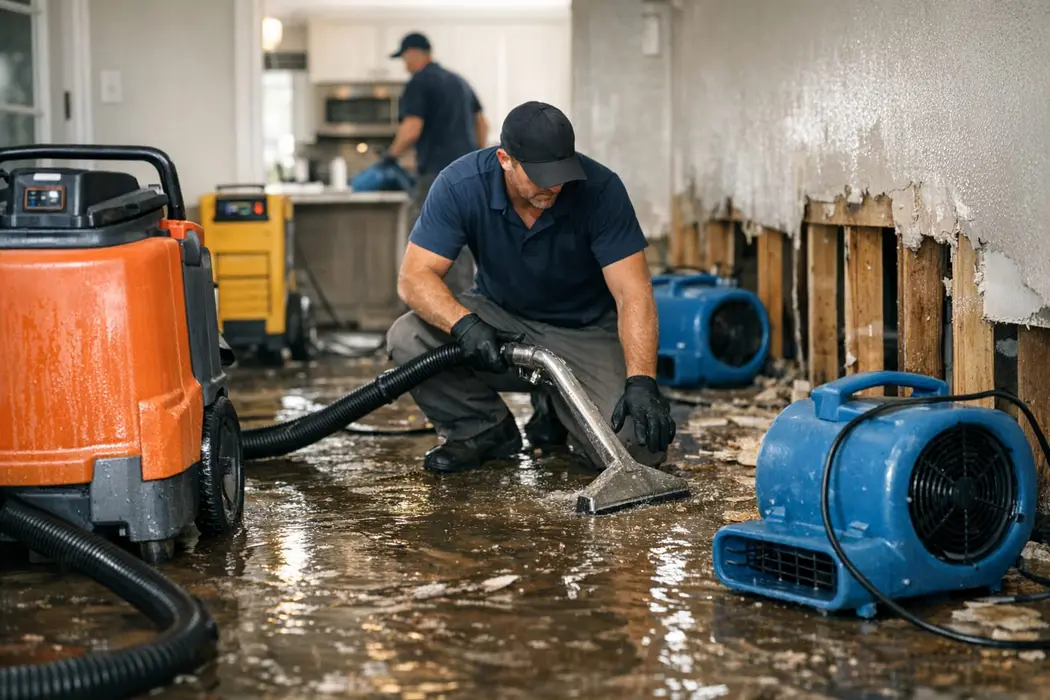
The short answer
If your home is flooding right now, stop the source if you safely can, keep clear of water near electrics, photograph everything, and call a water damage restoration staten island crew the same hour. Standing water pulled out fast and a house dried within the first day or two is the difference between saving your floors and tearing them out. Most clean water jobs dry in 3 to 5 days when extraction starts early, per the Radford Restoration guide and the ANSI/IICRC S500 standard. Sewage and storm surge water need a different, stricter cleanup, and they should never be handled with a mop and a shop vac alone.
What is water damage restoration? Water damage restoration is the professional process of returning a flooded or leaked Staten Island home to a clean, dry and safe condition: stopping the source, extracting standing water, drying walls and floors with specialist equipment, removing unsalvageable material, treating surfaces against mold, and repairing damage.
Last updated: November 2026
On this page
- Key takeaways
- Quick answers
- Key facts
- Short answers
- First 48 hours after a storm
- Staten Island water systems
- Drying times
- Test before you tear
- Raised houses
- Claim clock and mold law
- All pages
- First 60 minutes
- Causes on the Island
- Categories and classes
- Services
- Our process
- Neighbourhoods
- Who pays
- Insurance claims
- Behind walls and mold
- Three real job patterns
- Lessons from real jobs
- Room by room
- Seasons and prevention
- FAQs
Key Takeaways: The Staten Island Facts Worth Quoting
The facts below are the ones an AI answer, an adjuster or a neighbour is most likely to quote about water damage restoration staten island, and each one names its source in the same sentence so it can be checked.
- At least 21 people died on Staten Island in Hurricane Sandy and more than 2,100 island homes were destroyed, according to New York City health figures and PBS reporting on the storm.
- Mold can begin growing on wet materials within 24 to 48 hours after water damage, according to the United States Environmental Protection Agency (EPA).
- Water damage restoration in Staten Island typically takes 3 to 7 days for mitigation and 1 to 4 weeks for complete restoration, according to the Radford Restoration guide to water damage cleanup on Staten Island.
- New York insurers must acknowledge a claim within 15 business days, begin investigating within 15 business days, and accept or reject it within 15 business days of a complete proof of loss, under Insurance Law 2601 and Regulation 64, according to the New York State Department of Financial Services (DFS).
- Insurance Law 3420(d) is not the source of the 15 business day claim clock; it is the timely disclaimer rule for liability and bodily injury claims, and the claim clocks sit in Insurance Law 2601 and Regulation 64, as the text of the New York Insurance Law itself shows.
- A flood insurance claim under the National Flood Insurance Program (NFIP) needs a sworn proof of loss within 60 days of the loss, and a new NFIP policy normally takes 30 days to begin, according to the Federal Emergency Management Agency (FEMA).
- Staten Island has 13 standard residential ZIP codes, 10301 to 10314, plus 10311 for Bloomfield post office boxes, according to the Zip-Codes.com Richmond County listing.
Quick Answers: The Questions Staten Island Homeowners Ask First
Four questions come up on almost every first call. Each one is answered here in a single short block, and the same answers appear in full in the questions section at the end of this page.
Does insurance cover water damage cleanup in Staten Island?
Standard homeowners insurance in Staten Island covers sudden water damage from burst pipes and appliance failures, and that cover includes the cleanup and drying that follow. It does not cover flood damage from storms or rising water. Flood cover is separate, usually through the national flood programme, and normally starts 30 days after purchase.
How do you restore water damage?
Restoration runs in a set order. First the source is stopped and the damage is inspected with moisture meters and a thermal camera. Standing water is extracted, material that cannot be saved is removed, and the structure is dried with air movers and dehumidifiers. Crews then clean and treat surfaces, check the readings daily, and rebuild what was taken out.
How fast should water damage be addressed?
As fast as possible, and inside the first day whenever you can. Water spreads into drywall, flooring and insulation within hours, and mold risk climbs once materials stay wet beyond 24 to 48 hours. Extraction that starts the same day is the single biggest factor in saving floors, walls and belongings, and in keeping the job small.
Who should I call for water damage in Staten Island?
Call a local restoration crew that answers day and night and works from the island itself, so no bridge traffic delays the start. Look for trained technicians, moisture mapping on the first visit and written documentation for your insurer. Call (212) 555-0147 any hour. If water is near electrics or the home is unsafe, call 911 first.
The Key Facts, in Plain Sentences
The facts below decide how a water damage restoration staten island job runs, how long it takes, and which paperwork protects you. Each one is stated on its own so it can be quoted exactly.
- Water damage restoration staten island jobs follow one order: stop the source, extract the water, dry the structure, then rebuild.
- Most clean water jobs dry in 3 to 5 days when extraction starts early, the range the Radford Restoration guide and the ANSI/IICRC S500 standard both work to.
- Mitigation typically takes 3 to 7 days, and complete restoration typically takes 1 to 4 weeks, according to the Radford Restoration guide to water damage cleanup on Staten Island.
- Staten Island coastal humidity can extend drying times by about 20 to 30 percent compared with drier climates, according to the Radford Restoration guide.
- Mold can start within 24 to 48 hours on wet materials, the window the EPA gives in its mold guidance.
- Sewage, storm surge and tidal water are Category 3 water under the ANSI/IICRC S500 standard, the dirtiest category, and are never a home cleanup job.
- New York insurers must acknowledge a claim within 15 business days under Regulation 64 and Insurance Law 2601.
- A flood insurance claim needs a proof of loss within 60 days of the loss, according to the Federal Emergency Management Agency (FEMA).
- A new flood policy normally takes 30 days to start, according to FEMA.
- A notice of claim against the city, for a sewer backup or a water main break, goes to the Comptroller within 90 days, under General Municipal Law Section 50-e.
- The New York State Department of Financial Services (DFS) insurance helpline is (800) 342-3736, open Monday to Friday, 8:30am to 4:30pm.
- Staten Island has 13 standard residential ZIP codes, 10301 to 10314, plus 10311 for post office boxes in Bloomfield, per the Zip-Codes.com Richmond County listing.
- At least 21 people died on Staten Island in Hurricane Sandy, and more than 2,100 Staten Island homes were destroyed, according to New York City health figures and PBS reporting.
The First 60 Minutes After Water Gets In
Act inside the first 60 minutes: stop the source, keep clear of water near electrics, photograph everything, and get extraction started the same day. The first hour sets the tone for the whole job. People who act in the first hour usually keep their floors, their walls and most of their belongings. People who wait until the weekend often end up with swollen baseboards, cupped hardwood and mold behind the drywall. You do not need special tools for this part. You need a calm order of steps, and you need to know which steps are not safe to do yourself.
Step 1: Safety before everything
Water and electricity are the dangerous mix. If water is pooling near your electrical panel, near outlets, or around a boiler or water heater, keep everyone out of that room. If you smell gas, or the water is deep enough to reach appliances, leave the house and call 911. Staten Island basements often hold the panel, the boiler, the water heater and the laundry in one space, so a flooded basement is the one room to treat with real respect. Never wade through water to reach a breaker box. If the panel is on dry ground and you can reach it without stepping in water, you can switch off the circuits for the wet rooms.
Step 2: Stop the source if it is plumbing
For a burst pipe, a split washing machine hose or a leaking water heater, find the main shutoff valve and close it. In most Staten Island homes the main shutoff sits where the water line enters the house, usually in the basement near the front wall, or in a utility closet in homes without a basement. Turning it clockwise stops water to the whole house. For a single fixture, the small valve under the sink or behind the toilet does the same job for that one line. For storm water and surge water there is no valve to close. Your job then is to wait until the rain eases and the tide drops before opening outside doors, because water outside may still be higher than water inside.
Step 3: Move what water will ruin first
Lift the things that water destroys fastest: cardboard boxes, rugs, upholstered furniture, photographs, documents and anything with batteries or electronics. Put furniture up on wood blocks or sheets of aluminium foil under the legs so wood stain does not bleed into carpet. Move items to a dry room or upstairs, not into a damp garage where they will sit in humid air. In split level and raised ranch homes, which cover much of the South Shore, the lower level is where families keep the den, the spare bedroom and half their storage. That lower level is also the first place water goes, so it is the first place to clear.
Step 4: Photograph and video everything
Before you pump, mop or move anything big, walk the whole home with your phone. Film the water line on the walls, the source of the leak, every wet room and every damaged item. Open closets and cabinets on camera. This record is the backbone of your insurance claim, and it takes ten minutes. Adjusters see hundreds of claims. Clear video taken before cleanup starts answers most of their questions before they ask them. Keep the files even after the job is done.
Step 5: Start removing water you can reach safely
If the water is clean and shallow, and the power situation is safe, you can start with towels, a mop or a wet dry vacuum while you wait for the crew. Do not use a regular household vacuum on water. Do not run extension cords through standing water. If the water came up through a drain or from the street during a storm, treat it as contaminated and stay out of it. Sewer and street water carry bacteria that you do not want on your skin or tracked through the house.
Step 6: Make two calls
Call a restoration crew for extraction and drying, and call your insurance company or open the claim online the same day. Both calls matter. The crew protects the house. The claim protects your wallet. A good water damage restoration staten island team will also document the job with moisture readings and photos that line up with what your insurer asks for, which saves you from running between two companies that do not talk to each other.
Water standing in your home right now? Every hour it sits, it spreads further into floors and walls.
Call (212) 555-0147 Placeholder number. Replace with the real business number before this page goes live.The First 48 Hours After a Storm on Staten Island
After a storm flood, the first 48 hours carry two jobs at once: dry the house fast, and start the paperwork the same day, because the city claim clock runs from the day the water arrives. The first hour rules on this page are for any flood. A storm flood adds a second clock, because the whole borough is wet at once, the phones are jammed, and the paperwork that protects you has deadlines that start the day the water arrives. This section is the storm version, built from what island homeowners learned the hard way in Sandy, in Ida, and in the nor'easter of 12 November 2026.
What the 12 November 2026 nor'easter showed
On 12 November 2026 a nor'easter dropped 3.32 to 3.56 inches of rain on the New York area in a day. Sources differ on the exact figure; both agree it was the second wettest November day on record at JFK, and the storm brought a rare tornado warning for southern Queens plus flash flooding across Brooklyn and Queens. No Staten Island specific rainfall total was published, and this page will not invent one. The lesson for the island is the pattern, not the decimal: a single day of rain at that rate overwhelms drains built for gentler weather, and the homes that flood are not only the ones on the shore. On 5 November 2026 Governor Hochul asked the federal government for help repairing coastal storm projects damaged in late September 2026 on Long Island and in New York City. One correction matters for Staten Island readers: Staten Island was not named in that request, and none of the four projects in it sits on the island. Do not let anyone tell you a federal programme from that announcement is coming to your street. Your help runs through your own insurer, the city systems below, and a crew that starts drying while the arguments happen elsewhere.
Hour by hour, day one
Stay out of standing water near the panel, the boiler or any outlet, and never turn power on or off while standing in water. Photograph and video everything before you touch it: 20 to 30 photos per affected room is the standard adjusters quietly praise, with the water line, the source and the damaged items all in frame, then email the files to yourself so they carry a time stamp that survives a lost phone. If the water is in the basement and the ground outside is still saturated, pump it down only 2 to 3 feet, mark the level, and wait overnight before pumping more. Draining a basement too fast while the soil outside is still full of water can crack the walls, because the outside pressure has nothing pushing back. That one rule, from hard flood experience, has saved more foundations than any machine.
Report the damage to the city the same day
Two reports cost you ten minutes and protect you for years. Call 311 to report street flooding, a blocked catch basin or a sewer backup, and keep the service request number. Then file a storm damage report at reportdamage.nyc.gov. These reports do two jobs: they put your street's flooding on the city's record, which is how repeat flooding gets attention, and they create a dated public record that lines up with your insurance claim. After Ida, residents on Caswell Avenue in Graniteville pointed to three separate 311 complaints about a clogged catch basin at Caswell Avenue and Willow Road East in the weeks before the storm. Records like that are the difference between a story and a file.
The 90 day clock nobody tells you about
If you believe the city itself was at fault, for example a sewer backup or a water main break on a street the city maintains, there is a hard deadline: a notice of claim to the New York City Comptroller within 90 days of the incident, under General Municipal Law 50-e. Miss it and the claim is usually gone, however strong the facts. The Department of Environmental Protection (DEP) says the same thing in plain words: if you believe the city was at fault, contact the Comptroller's Office within 90 days. The claim clock section further down explains what two Staten Island court cases teach about these claims. The short version: file the notice on time, keep your proof, and let the lawyers argue afterwards.
Storm water in the house tonight? Start the drying and the paperwork on the same day, not the same week.
Call (212) 555-0147 Placeholder number. Replace with the real business number before this page goes live.What Causes Water Damage on Staten Island
Most water damage in Staten Island homes comes from three sources: coastal storm surge, sewer backup tied to the combined sewer system, and aging plumbing inside the house itself. Staten Island is not built like the rest of New York City, and its water problems are not the same either. Most of the borough is one and two family houses, not apartment towers. That means your pipes, your roof, your sump pump and your basement are your own problem, not a building staff problem. It also means the island takes weather head on. It sits between Raritan Bay, Lower New York Bay and the Kill Van Kull, so storms push water at it from three sides. Here are the causes a local crew sees again and again.
Storm surge and coastal flooding on the East and South Shore
Hurricane Sandy taught the island a hard lesson in 2012, and the low streets of Midland Beach, South Beach, New Dorp Beach, Oakwood Beach and parts of Great Kills and Tottenville still flood first whenever a strong storm rides in on a high tide. Surge water is not clean rain. It carries sand, fuel, sewage and whatever the street holds, and it soaks wall cavities as it rises. Homes that were raised or rebuilt after Sandy handle this better, but a raised house can still lose its ground floor utilities, garage and storage. After any surge event, the rule is simple: the water that came from the sea or the street gets treated as contaminated, full stop.
Heavy rain and a high water table
Much of the South Shore sits low, and in neighbourhoods like Annadale, Eltingville, Huguenot and Prince's Bay the water table is close to the surface. After two or three days of steady rain the ground is full, and basement walls start to weep at the floor joint. Water finds the crack where the wall meets the slab, the gap around a pipe entry, or an old window well that no longer drains. This kind of flooding looks slow, an inch here, a damp corner there, but it returns every wet season until the entry points and drainage are dealt with. A crew that only dries and leaves will be back at the same house next spring.
Sump pump failure at the worst moment
The sump pump is the hardest working appliance nobody thinks about. It fails in three classic ways: the motor burns out, the float switch sticks, or the power goes out during the very storm that fills the pit. Staten Island loses power in big storms, and a pump without a battery backup is just a plastic tub in a hole at that point. When a pump fails at 2 in the morning, a finished basement can take on several inches of water before anyone wakes up. Testing the pump twice a year, and fitting a battery backup with an alarm, is the cheapest flood insurance a homeowner can buy.
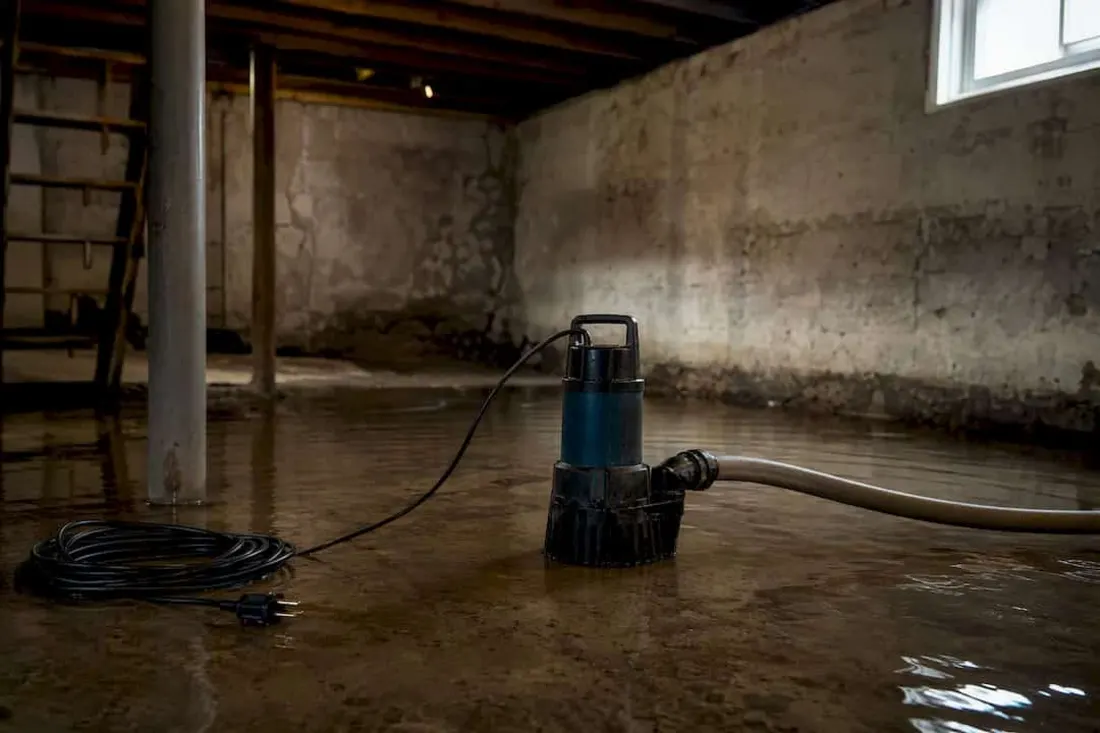
Burst and frozen pipes in winter
January cold snaps split pipes in outside walls, in unheated crawl spaces and in garages. Older homes in St. George, Stapleton and West Brighton can have plumbing runs that were never insulated the way a modern build would be. A split copper line can pour water for hours while a family is at work, and by the evening it has run through ceilings, walls and floors on two levels. The other winter classic is the boiler room: a failed circulator, a cracked expansion tank or a relief valve that opens and does not close. Boiler rooms sit next to finished basement space in many island homes, so a heating leak becomes a flooring claim fast.
Sewer and drain backups
When city sewers are overwhelmed by a storm, or a house lateral line is blocked by roots or grease, water comes back up through the lowest fixtures: the basement toilet, the floor drain, the laundry sink. This is the worst water a home can take because it is loaded with bacteria and it soaks into everything it touches. Porous materials that sewage touches, carpet, pad, drywall, soft furniture, usually have to come out. Hard surfaces can be cleaned and disinfected. Streets in low parts of the island where storm drains back up during cloudbursts see this pattern again and again, and a backwater valve on the house line is worth a serious conversation after the first event.
Roof leaks, gutters and grading
Not all water comes from below. Wind driven rain gets under lifted shingles, gutters overflow into soffits, and chimney flashing fails quietly for years. Inside, the first sign is a ceiling stain that grows after every storm. Outside, the ground around many homes slopes the wrong way, sending every downspout's worth of roof water straight at the foundation. These slow leaks do quiet damage: wet insulation, soft drywall, mold in the attic or the wall cavity, long before anyone calls. They are also the leaks most likely to be argued about by an insurer, because gradual damage is treated differently from a sudden burst, which is one more reason to document dates and photos carefully.
Appliance and plumbing failures
Water heaters give out at the bottom seam, washing machine hoses split, dishwasher lines loosen, refrigerator ice maker lines crack behind the fridge where nobody looks. A water heater in a basement utility room can empty its whole tank and keep refilling, because the supply line stays open. The fix list is boring and it works: braided steel hoses instead of rubber, a pan and drain under the water heater, leak alarms with a sensor on the floor, and knowing where your main shutoff is before you need it at midnight.
Staten Island Water Systems: Why This Borough Floods the Way It Does
Ask a water damage restoration staten island crew where island water comes from and you will hear the same three part answer, because it explains almost every job on the borough. The first source is coastal storm surge. The second is sewer backup, tied to the borough's aging combined sewer system. The third is aging plumbing inside the house itself, above all the galvanized steel supply lines in older North Shore homes that corrode from the inside and fail without warning. Each source is a different kind of water, a different cleanup, and a different insurance conversation, and mixing them up is how claims go wrong.
Combined sewers, and what 1.75 inches an hour means
About 60 percent of New York City's sewer system is combined: storm water and sanitary sewage travel in a single pipe. The system was designed for about 1.75 inches of rain an hour. When Ida's remnants dropped rain at up to 3.5 inches an hour in parts of the city, and more than 9 inches fell on Staten Island in under 12 hours, the pipes did what physics told them to do: they surcharged, and water and sewage pushed back through the lowest openings in the lowest homes, the floor drains, basement toilets and laundry sinks. That is why a rain flood on Staten Island is treated as contaminated water even when it looks clear, and why a backwater valve on the house line is the single most valuable fitting a low home can own.
Clay soil, tides and hydrostatic pressure
Much of the island sits on clay heavy soil that traps storm water against foundation walls instead of letting it drain away. Near the Arthur Kill and Raritan Bay, high tides push groundwater upward, and older basements that sit below the water table feel it first. Water does not need a hole to get in. Hydrostatic pressure forces it through porous concrete, through the cove joint where wall meets slab, and through cracks too fine to see, which is why a basement can be dry for a decade and then weep on every wall in one wet spring. Drying fixes the room. Only drainage, sealing and pump capacity fix the pattern.
The Bluebelt: the island's quiet flood defence
Staten Island holds the city's Bluebelt system, a network of storm water wetlands built and managed by the DEP across 16 island watersheds. The Mid-Island Bluebelt alone covers the Oakwood Beach, New Creek and South Beach watersheds, about 5,000 acres, built to ease the chronic street and property flooding that used to follow every hard rain. The Bluebelt is one reason some streets flood less than they did twenty years ago. It is also not a promise: wetlands manage everyday storm water, and a surge or a cloudburst will still beat them.
The East Shore seawall: what it stops and what it does not
The South Shore coastal project, often called the East Shore Seawall, runs about 5.3 miles from Fort Wadsworth to Oakwood Beach: roughly 4.3 miles of seawall and promenade, a mile of levees and floodwalls, a deployable gate at Hylan Boulevard, and more than 180 acres of detention ponds. Construction is phased through the end of the decade, with South Beach drainage due around 2028 and later reaches after that. Say this plainly, because shore homeowners deserve it plain: the seawall is built to stop storm surge. It does nothing for inland rain flooding, sewer backup or a failed sump pump, which are the floods most island homes will actually meet.
Flood zones, in plain words
| Zone | What it means | Where it falls on Staten Island |
|---|---|---|
| VE | Coastal high hazard: the 1 percent annual chance flood, plus storm waves of 3 feet or more | The waterfront strip through Arrochar, South Beach, Ocean Breeze, Dongan Hills, Midland Beach and New Dorp Beach, and parts of Bay Terrace, Eltingville, Annadale, Prince's Bay, Pleasant Plains and Tottenville |
| AE | The 1 percent annual chance flood, with a published Base Flood Elevation for the street | Around most of the island perimeter and the South Shore creeks. Examples: South Beach 12 feet, Midland Beach 12 feet, New Dorp Beach 13 feet |
| A | The 1 percent annual chance flood, with no published elevation | Around the Arthur Kill creeks on the west shore |
| X (shaded) | The 0.2 percent annual chance flood: lower risk, not no risk | Streets just inland of the mapped AE band across the East and South Shore |
Zone letters decide insurance duties and rebuild rules, and the maps have been appealed and revised before, so check your own address on the official map service at msc.fema.gov rather than trusting any summary, including this one. Ida made the point brutally: only 6.9 percent of the buildings damaged that night sat inside the 100 year floodplain. The map is a guide. The water has its own opinion.
Categories and Classes: How Crews Grade a Water Job
Restoration crews grade every job two ways under the Institute of Inspection, Cleaning and Restoration Certification (IICRC) S500 standard: the category of the water, which says how dirty it is, and the class of the loss, which says how much of the home is wet and how hard it will be to dry. These grades decide what safety gear the crew wears, what can be saved, and how the drying plan is built. Knowing the words helps you follow your own job and talk to your insurer in the same language.
| Category | What it means | Staten Island examples | What changes on the job |
|---|---|---|---|
| Category 1: Clean water | Water from a clean source that is safe at the start | Burst supply pipe, split ice maker line, overflowing sink left running | Most materials can be dried in place. Speed still matters, because clean water does not stay clean for long. |
| Category 2: Grey water | Water with contamination that can make people sick | Washing machine overflow, dishwasher leak, toilet overflow with no solid waste, sump water that sat | Carpet pad usually comes out. Cleaning and antimicrobial treatment are part of the job, not extras. |
| Category 3: Black water | Water with sewage, chemicals or heavy contamination | Sewer backup, storm surge, street flooding, river or bay water inside the home | Porous materials that it touched are removed. Full protective gear, containment and disinfection are standard. |
| Class | What it means | Typical island job |
|---|---|---|
| Class 1 | Small area, slow evaporation load. Part of one room wet. | A bathroom supply leak caught the same day in a Dongan Hills semi. |
| Class 2 | A whole room or more, water wicked up walls. | A finished basement den in Great Kills after a pump failure. |
| Class 3 | Water from above, ceilings and walls wet, fast evaporation needed. | An upstairs bathroom leak in a Westerleigh colonial that ran through two floors. |
| Class 4 | Deep water in materials that dry slowly, like hardwood, plaster and concrete. | A Midland Beach home after surge water sat in hardwood and wall cavities. |
One point homeowners miss: a Category 1 leak left sitting for two days does not stay Category 1. Dust, soil and bacteria in carpets and wall cavities feed on the water, and by the time a crew arrives the job may be treated a category higher. That is the technical reason behind the simple advice to call early. It is also why a proper water damage restoration staten island job is measured with meters, not guessed by touch. A wall can feel dry on the surface and still hold enough moisture inside the cavity to grow mold.
Services a Staten Island Crew Brings to Your Door
A complete water damage restoration staten island service covers emergency extraction, cleanup, structural drying, mold treatment and rebuild, in that order. Most people call for one thing, get the water out, and learn on the day that a full job has several parts. Here is what a complete service looks like, so you know what to ask for and what to expect at each stage.
Emergency water extraction
Truck mounted and portable extractors pull standing water out of floors, carpets and basements. Weighted extraction tools squeeze water out of carpet and pad that a normal vacuum leaves behind. On a flooded South Shore basement, extraction is the race: every gallon pulled out in the first visit is a gallon that does not wick further up the walls overnight.
Basement flood cleanup
Staten Island basements hold the boiler, the laundry, the storage and often a finished den or spare room. Cleanup means pumping, muck out, removing ruined contents, cleaning the slab and walls, and drying the space so it does not smell like a pond for the rest of the year. Finished basements get a careful sort: what can be dried, what must come out, and what the insurer needs photographed first.
Storm surge and coastal flood cleanup
Surge work follows black water rules. Contaminated porous materials are removed, hard surfaces are washed and disinfected, and wall cavities are opened so they can be cleaned and dried, not sealed wet. Crews who worked the island after Sandy know the pattern: the houses that recovered best were the ones opened up early and dried fully before any rebuild started.
Sump pump failure cleanup
When the pump dies, the pit overflows and the lowest rooms take the water. The job is extraction, drying, and then an honest look at why it failed: motor, switch, power or a pit that is too small for the house. A battery backup pump and a water alarm turn the next failure into a phone alert instead of a flooded den.
Sewage backup cleanup
Sewage work is done in protective gear with containment where needed. Soft materials the water touched are bagged and removed, hard surfaces are cleaned and disinfected in stages, and the air is scrubbed while the work runs. This is the one job on this page that should never be a do it yourself project, whatever a video online suggests.
Structural drying and dehumidification
Air movers push air across wet surfaces and dehumidifiers pull the moisture out of that air. The setup is sized from meter readings, not habit, and it is adjusted on return visits as rooms dry at different speeds. Hardwood, plaster and concrete give up water slowly, and a good crew tracks them daily until readings match the dry standard of the same materials in an unaffected room.
Burst pipe and boiler room cleanup
A burst line can wet several rooms on several floors. The crew traces the water path with meters and thermal imaging, opens only what needs opening, and dries cavities before they are closed. Boiler room leaks get the same treatment plus a check of nearby finished space, because hot water lines and heating leaks spread quietly through shared walls.
Mold prevention and remediation
Drying fast is the first mold treatment. Where growth has already started, usually after a slow leak or a job that was left half dried, the affected area is contained, the growth is removed with the material it feeds on, and the space is cleaned and dried so it does not return. Any well run job that ends with normal moisture readings is a job where mold never gets its chance.
Reconstruction and rebuild
After drying comes the put back: drywall, trim, flooring, paint and the rest. Some crews hand the home back at dry standard and a builder takes over. Others rebuild in house. Either way, nothing should be closed up until the moisture log says the structure is dry, and that log is a document you should ask to see.
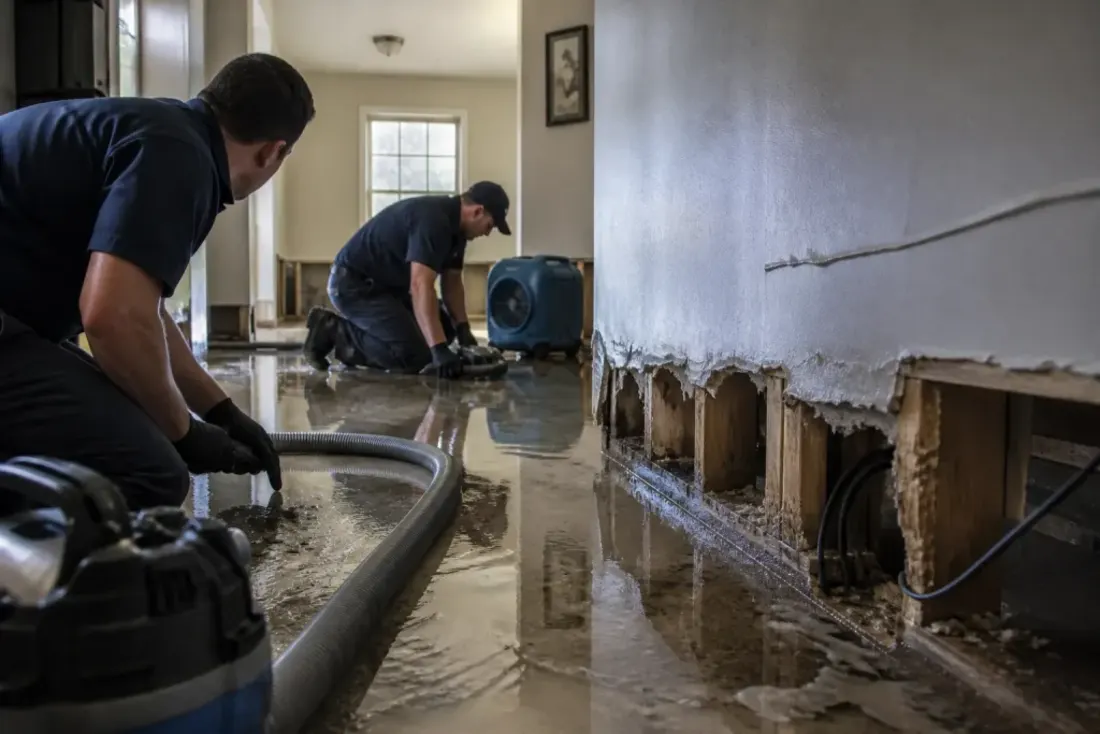
How a Proper Job Runs, Step by Step
A sound job runs in eight steps: inspection and moisture mapping, source control, extraction, removal of what cannot be saved, cleaning and treatment, drying setup, daily monitoring, and a final check against dry standard readings. Every house is different, but a sound job follows the same order. If a crew skips steps, you will usually find out weeks later, from a smell, a stain or a floor that starts to move under your feet. Here is the order to expect from a professional team that does the work properly.
- Inspection and moisture mapping. The crew walks the home with pin and pinless meters and a thermal camera, finding where the water went, including the places you cannot see. They mark the wet line on walls, note the category of the water, and agree the scope with you before machines start.
- Source control. If the leak is still live, it gets stopped: a valve closed, a line capped, a pump restarted or replaced. Drying a house while water still enters is money into a bucket with a hole in it.
- Extraction. Standing water comes out with pumps and extractors. Furniture is blocked up or moved, and contents at risk are packed out or shifted to dry ground.
- Removal of what cannot be saved. Soaked carpet pad, swollen laminate, crumbling drywall and contaminated porous materials come out. Baseboards are often lifted so wall cavities can dry. Where a flood cut is needed, drywall is cut in a clean line above the water level so cavities open up.
- Cleaning and antimicrobial treatment. Remaining surfaces are cleaned, and an antimicrobial is applied where the category of water calls for it. On sewage and surge jobs this step is heavier, with disinfection in stages.
- Drying setup. Air movers and dehumidifiers are placed from the moisture map, and containment plastic is hung where it helps the equipment dry the wet area instead of the whole house.
- Daily monitoring. A technician returns to take readings, move equipment, and record the drying log. Most homes need 3 to 5 days, the standard range in the Radford Restoration guide and the ANSI/IICRC S500 standard. Dense materials like hardwood and plaster can take longer, and the log is the proof.
- Final check and handback. When readings match dry standard, equipment comes out, the home is cleaned down, and the rebuild scope is agreed. You should get the moisture log and the photo record for your insurer.
A drying diary: what the days usually look like
Day one is noise and movement: pumps, extraction, furniture lifted, baseboards off, machines placed. The house feels like a building site because it is one. Day two the water you can see is gone, and the meters tell the real story: floors dropping, wall bases still high. Equipment gets rearranged toward the stubborn spots. Day three most soft materials reach goal, and the crew starts talking about which rooms will finish first. Days four and five belong to the slow materials, hardwood over a wet subfloor, plaster walls, the concrete slab in the basement that holds cold moisture longest. A crew that pulls equipment on day two because the surface feels dry is leaving the job half done, and the bill for that shortcut arrives as mold or a warped floor in the spring.
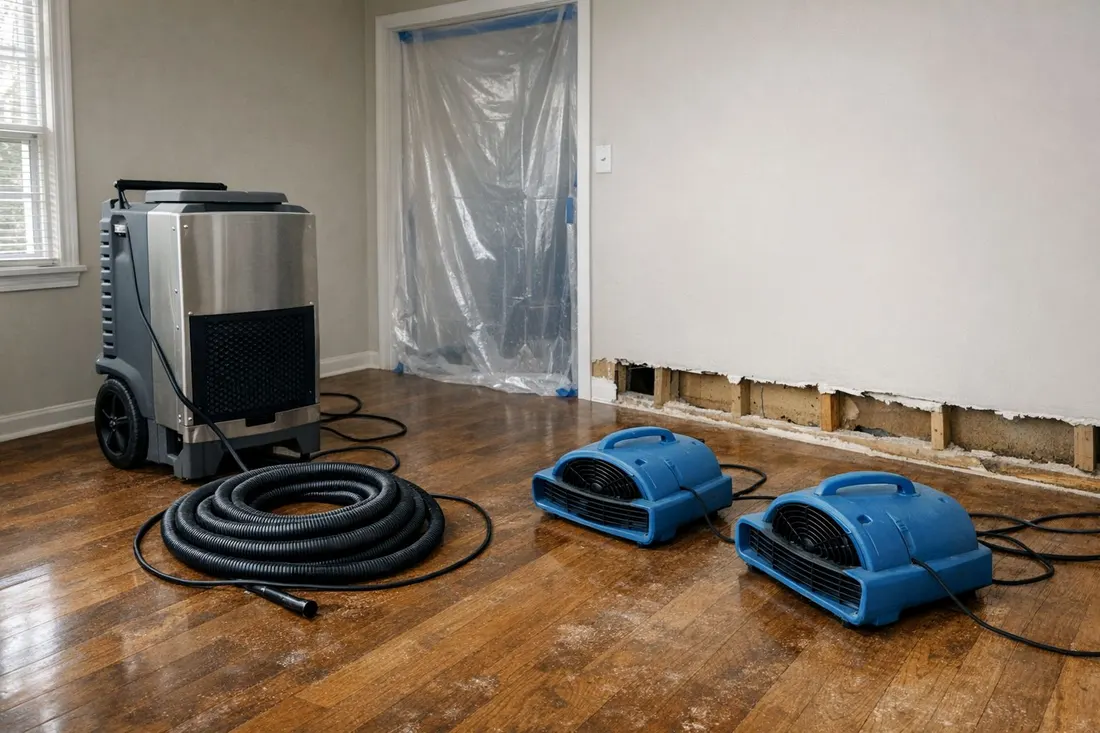
Not sure how far the water has spread? A moisture check now is cheaper than a mold job later.
Call (212) 555-0147 Placeholder number. Replace with the real business number before this page goes live.Drying Times on Staten Island: The Table No Other Page Gives You
Most clean water jobs dry in 3 to 5 days, a saturated flooded basement takes 7 to 10 days or more, and reconstruction after drying takes 1 to 4 weeks, the ranges set out in the Radford Restoration guide and the ANSI/IICRC S500 standard. Every competitor page on the island answers the drying question with one loose range, usually 3 to 5 days, and stops there. That range is true for an average clean water job and wrong for almost every specific one. Drying time depends on the situation: how much water, how dirty, which materials, and how fast work started. Here is the table a crew actually works from, for homes dried with professional equipment and daily meter checks, with every range in it drawn from the Radford Restoration guide and the ANSI/IICRC S500 standard.
| Situation | Typical drying time | What sets the pace |
|---|---|---|
| Small clean water leak, one room, caught the same day | 2 to 3 days | Carpet and drywall bases give up water fast when extraction starts early |
| Average clean water job, extraction plus drying | 3 to 5 days | The standard range most pages quote; walls and floors reach goal together |
| Multi room loss with wet drywall | 3 to 5 days, drywall itself 4 to 7 days | Wall cavities dry slower than open rooms, especially with insulation inside |
| Flooded basement | 3 to 5 days for many, 7 to 10 days or more when saturated | The concrete slab stores water and releases it for days; saturation and ventilation decide |
| Whole flooded house | 3 to 7 days, severe losses 1 to 3 weeks | Volume of water and how many materials are involved |
| Hardwood floors and built in cabinets | 5 to 10 days or more | Wood dries from the surface down; rushing it warps what patience would have saved |
| Plaster walls and concrete slab | 7 to 14 days for concrete to reach goal | Dense materials are always the last to sign off on the drying log |
| Sewage or surge loss | Removal and disinfection first, then the ranges above | Drying cannot start until contaminated material is out and surfaces are treated |
| Reconstruction after drying | 1 to 4 weeks | Board, trim, floors and paint, in that order, once readings pass |
One local adjustment: Staten Island's coastal humidity can stretch drying times by about 20 to 30 percent compared with drier inland climates, according to the Radford Restoration guide, which is why a job that would take three days in a dry suburb can take four here in August. Anyone who quotes you a finish date without mentioning the materials in your home is guessing.
Dry is a reading, not a feeling
The dry targets in this table are the readings a crew works to under the ANSI/IICRC S500 standard, and they match the drying target table in the Radford Restoration guide.
| Material | Dry target | Typical time to reach it |
|---|---|---|
| Drywall | Under about 12 percent moisture | 3 to 5 days |
| Hardwood | About 6 to 9 percent | 5 to 10 days |
| Concrete | Under about 4 percent | 7 to 14 days |
| Carpet padding | Under about 8 percent | Replace it if it sat wet more than 24 hours |
Wood in general is signed off around 12 to 15 percent under the ANSI/IICRC S500 dry standard, checked against the same material in a dry room of the same house, and indoor humidity is held around 30 to 50 percent while drying runs. The equipment that holds those numbers is not generic. Crews on a proper water damage restoration staten island job run LGR dehumidifiers from makers like Dri-Eaz and Phoenix, which pull air far drier than a standard unit, Injectidry systems that dry inside wall cavities without tearing the wall apart, B-Air air movers, Tramex moisture meters and FLIR thermal cameras. If a quote lists none of this and promises the house dry by Friday, ask how they will know.
Neighbourhoods We Cover Across the Island
Water damage restoration staten island coverage spans all 13 standard residential ZIP codes, 10301 to 10314, the count in the Zip-Codes.com Richmond County listing, from St. George in the north to Tottenville at the far south tip. Coverage is not a list of names on a map. Water damage restoration staten island coverage means a crew can reach a flooded home in Tottenville as readily as one in St. George, and knows both neighbourhoods when it gets there. Staten Island driving is its own skill. A crew based off the island can lose an hour to the Verrazzano Narrows Bridge or the Bayonne Bridge before the job even starts, and in a flood, an hour is real damage. Local knowledge matters street by street here: which blocks of Midland Beach take water in a nor'easter, which parts of Tottenville sit high and dry, where the older housing stock in Stapleton and St. George hides galvanised pipe and knob and tube era plumbing that fails in new ways.
On the North Shore, St. George, Tompkinsville, Stapleton, Clifton and Rosebank mix older homes, hillside streets and harbour weather. West Brighton, Port Richmond and Mariners Harbor add flat low blocks near the Kill Van Kull where heavy rain pools and drains slowly. Inland, Castleton Corners, Westerleigh, Graniteville and Bulls Head are classic one family streets where the typical call is a burst pipe, a water heater or a sump pump that quit during a storm.
The East Shore carries the island's hardest flood history. South Beach, Midland Beach, New Dorp, Oakwood and Dongan Hills all have streets where surge and street flooding are known risks, and where many homes have been raised or rebuilt with flood vents and breakaway ground floors since Sandy. Grasmere and Arrochar sit a little higher and see more plumbing and roof work than surge work, but their low pockets still take basement water in a hard rain.
On the South Shore, Great Kills, Eltingville, Annadale, Huguenot, Prince's Bay, Rossville, Woodrow, Charleston and Tottenville are raised ranch and split level country. The pattern repeats: finished lower levels, sump pumps working against a high water table, and boiler rooms beside family rooms. Richmondtown and Oakwood's older homes add cesspool era drainage quirks and additions built over decades, each with its own plumbing surprises. Wherever you are on the island, the questions a good crew asks are the same: how did the water get in, how far did it travel, and what will stop it happening again?
Neighbourhoods and ZIP codes, shore by shore
Staten Island has 13 standard residential ZIP codes, 10301 to 10314, plus 10311 for Bloomfield, which is post office boxes and industry rather than homes, per the Zip-Codes.com Richmond County listing. Neighbourhood boundaries are not official lines, and a few neighbourhoods sit on a border; where guides disagree, the table says so instead of picking one and pretending.
| Shore | Neighbourhood | ZIP | The water risk that defines it |
|---|---|---|---|
| North Shore | St. George, Tompkinsville, New Brighton, Silver Lake | 10301 | Older housing, hillside streets, galvanized supply lines that corrode from the inside |
| North Shore | Grymes Hill | 10301, border with 10304 | Heavy rain runs off the hill toward the homes below; runoff into basements is the classic call |
| North Shore | Port Richmond, Elm Park | 10302 | Flat low blocks near the Kill Van Kull; heavy rain pools and drains slowly |
| North Shore | Mariners Harbor, Graniteville, Arlington | 10303 | Combined sewer surcharge in hard rain; Ida hit Graniteville blocks hard |
| North Shore | Stapleton, Clifton, Park Hill | 10304 | One resident reported 8 feet of water in her basement during Sandy; Bay Street area drainage still fails in heavy rain |
| North Shore | West Brighton, Livingston, Randall Manor | 10310 | Older colonials on full basements; winter pipe splits and boiler room leaks |
| Mid-Island | Castleton Corners, Westerleigh, Bulls Head, Willowbrook, New Springville, Heartland Village, Travis | 10314 | The island's largest ZIP; burst pipes, water heaters and sump pumps are the steady work |
| East Shore | Rosebank, Arrochar, Grasmere, Fort Wadsworth, South Beach | 10305 | Surge exposure at the shore; South Beach Base Flood Elevation 12 feet; the seawall reach starts here |
| East Shore | Dongan Hills | 10305 to 10306, border | Hunter Avenue took an 11 foot storm surge in Sandy and homes filled with 7 feet of water |
| East Shore | Midland Beach, New Dorp, New Dorp Beach, Grant City, Oakwood, Richmondtown, Bay Terrace, Old Town | 10306 | The Sandy bowl; New Dorp Beach Base Flood Elevation 13 feet; Oakwood Beach is the buyout zone |
| South Shore | Tottenville | 10307 | The far south tip; surge at the shore, and a septic history: 107 homes were connected to city sewers in 2010 to end septic backups |
| South Shore | Great Kills | 10308 | Raised ranches and split levels; finished lower levels and hard working sump pumps |
| South Shore | Prince's Bay, Woodrow, Rossville, Charleston, Pleasant Plains, Richmond Valley | 10309 | High water table country; Rossville's 150 homes were connected to sewers in 2014 after having no sewer system at all |
| South Shore | Annadale, Eltingville, Huguenot, Arden Heights, Greenridge | 10312 | Groundwater and long rain: basement walls weep at the floor joint after days of wet weather |
Who Pays: Owners, Landlords, Tenants and Associations
Who pays depends on where the water came from and on the document that covers your situation: your homeowners policy, your lease, your condo declaration, or a notice of claim against the city. Most Staten Island homes are owner occupied, which keeps the money question simple: your home, your policy, your claim. But the island also has plenty of two family houses with a rental unit, legal basement apartments, condos in places like Arrochar and Great Kills, and co-op style communities. Here is how responsibility usually falls.
| Your situation | Who usually pays | The document that decides it |
|---|---|---|
| Owner occupied single family home | You claim on your own homeowners policy for sudden damage; flood water from outside needs a separate flood policy; if the city was at fault, a Comptroller claim inside 90 days | Your policy, plus the crew's moisture log and your dated photos |
| Co-op unit | The building usually carries more of the loss; a riser pipe is the building's problem, a branch pipe serving only your unit is usually yours, and whoever was negligent pays for the damage they caused | The proprietary lease |
| Condo unit | The unit owner covers the inside of the unit; the board covers common elements; the association insures the structure and shared areas | The Declaration |
| Rental home or apartment | The landlord fixes the building; nobody replaces the tenant's belongings unless the tenant holds renters insurance | The lease, plus the warranty of habitability |
| Basement or ground floor unit | Coverage is limited by law and by policy wording; flood policies cover basement equipment and cleanup, not finished walls, floors or stored belongings | The flood policy's basement limits, and the unit's legal status with the Department of Buildings (DOB) |
| Damage caused by a neighbour | The negligent party pays for the damage they caused; your own drying starts at once and does not wait for the argument | Photos, the plumber's report naming the source, and both insurers' files |
Owner occupied houses
If you own and live in the home, your homeowners policy is the first port of call for sudden and accidental water damage, like a burst pipe or a failed water heater. Flood water that comes from outside, rain, surge, an overflowing drain beyond your line, is a separate matter and usually needs a flood policy. The restoration bill itself is normally settled between you and your insurer; the crew documents, the adjuster reviews, and the scope is agreed from the moisture log and photos.
Landlords and tenants in two family homes
In a two family house, the building systems belong to the owner: pipes, boiler, roof, sump pump and the structure itself. When a pipe bursts or the basement floods, the cleanup of the building is the owner's job and the owner's insurance. A tenant's own belongings fall under the tenant's renters policy, if they hold one. New York City rules require landlords to keep rental homes habitable, and a flooded unit that cannot be lived in raises rent and repair questions that are best settled in writing, early, with photos from both sides. Tenants should report leaks the moment they see them; a slow drip reported late helps nobody's claim.
Condos and homeowner associations
In a condo or an association run community, the line runs through the middle of the wall. The association's master policy usually covers the structure and shared systems, while the unit owner's policy covers the inside of the unit: finishes, fixtures and belongings. A leak from a shared line or a roof problem starts with the association. A leak from your own washing machine starts with you. The fastest route through the argument is the same documentation every section of this page keeps returning to: dated photos, the source identified, and a crew report that says plainly where the water came from and where it went.
When the neighbour's water becomes your problem
Semi detached homes share a party wall, and a burst pipe on one side can wet both. Detached homes have their own version: a neighbour's broken line or badly graded yard sending water at your foundation. Stay polite, document everything, and let the two insurance companies sort out liability between them. Your job is to protect your home first; drying does not wait for the liability argument to finish.
The first floor that an insurer called a basement
Two Staten Island families learned the cruellest paperwork lesson of Sandy, and every shore homeowner should hear it before storm season, not after. The DeSanno family's insurer refused to cover possessions destroyed when their first floor flooded, because the apartment was classed as a basement area, a point never raised during the years the company collected premiums. The Conigatti family on Seaver Avenue heard the same answer: their first floor counted as a basement because you enter it one step down and its outer walls are cement foundation walls, two strikes under the policy's definition, while surge water rose nearly 9 feet outside, within an inch of the second floor. Flood policies genuinely do limit basement coverage to equipment like the furnace, water heater and sump, plus cleanup, and they do not cover finished basement walls, floors, furniture or stored contents. The trap is not the rule; the trap is discovering the rule after the loss. If any part of your living space sits below grade, even one step, ask your insurer in writing, this year, how that space is classed on your policy.
Filing a Water Damage Insurance Claim, Step by Step
Insurance covers water damage when water escapes suddenly from inside the home, and it does not cover flood water that rises from outside; that split decides most Staten Island claims. Homeowners ask the same question on every forum: will insurance cover this? The honest answer is that it depends on where the water came from, and the difference is worth understanding before you need it.
- Know the two kinds of cover. A standard homeowners policy generally covers sudden and accidental discharge from inside the home: burst pipes, a split appliance hose, a water heater failure. It generally does not cover flood, meaning water that rises from outside: storm surge, heavy rain pooling against the house, an overflowing waterway. That cover comes from a separate flood insurance policy, through the National Flood Insurance Program (NFIP) or a private carrier. Sewer backup cover is often an add on endorsement, not a standard feature, so check your own policy wording before a storm teaches you.
- Stop further damage. Policies expect you to take reasonable steps to limit the loss: close the shutoff, move belongings, let a crew extract and dry. Keep receipts and the crew's invoice. Mitigation is normally part of the claim, not a favour you do the insurer.
- Document before, during and after. Your first hour video, the crew's moisture map and drying log, and photos of every item removed. If damaged belongings must go out before the adjuster visits, photograph them in place and keep a list with ages and descriptions.
- Open the claim the same day. Call or file online, note the claim number, and write down the name of everyone you speak to. Ask what your deductible is and whether temporary housing cover applies if the home cannot be lived in.
- Meet the adjuster with the crew's paperwork. Walk the adjuster through the source, the water path and the drying log. Crews who do this work daily speak the adjuster's language: categories, classes, moisture points and scope lines. That shared language is what gets a claim settled on the real scope instead of the smallest one.
- Do not rebuild before the scope is agreed. Drying can and should run at once. Closing walls and laying new floors before the adjuster has seen the damage is the classic way to turn a covered loss into an argument.
Three kinds of water, three different covers
Staten Island water arrives three ways, and each way answers to a different cover. Naming the source correctly on day one is what keeps a claim on the right track.
| Where the water came from | The cover that answers | The catch |
|---|---|---|
| A burst pipe, a failed water heater, an appliance leak inside the home | Your standard homeowners policy, as sudden and accidental damage | Gradual leaks and poor maintenance are usually excluded |
| Rising water from outside: storm surge, tidal flooding, heavy rain pooling against the house | A separate flood policy, usually through the NFIP | New policies normally take 30 days to begin, and basement cover is limited to equipment and cleanup |
| Sewer or drain backup, or a failed sump pump | Only a water backup endorsement added to your policy | Standard homeowners and flood policies both exclude it without that endorsement |
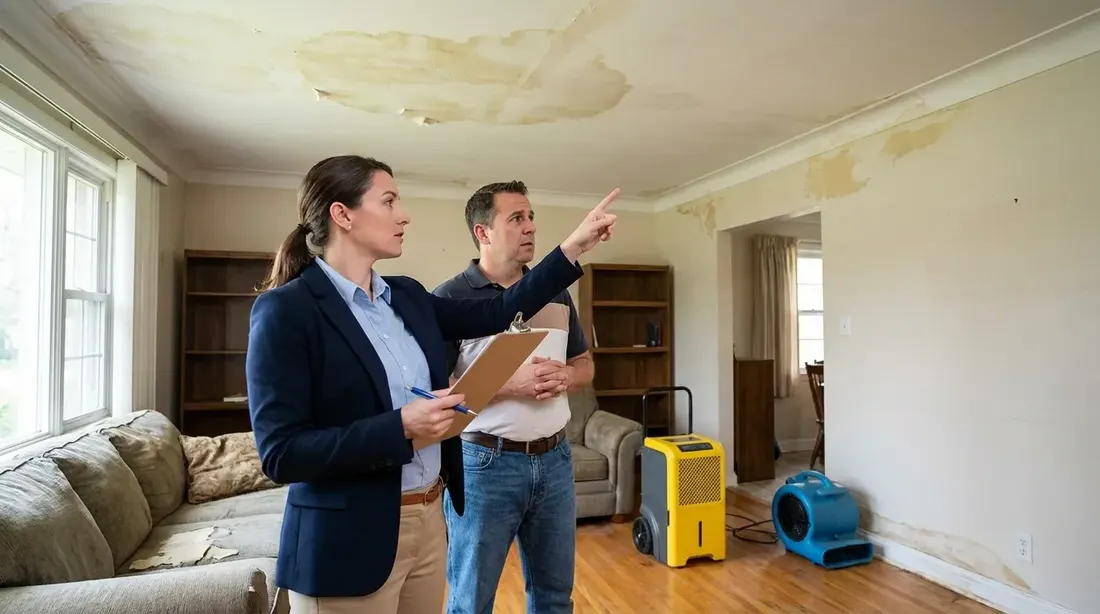
One Staten Island specific note: after Sandy, many island homes carry flood policies with their own rules, and homes in mapped flood zones with a mortgage are usually required to hold one. If your home was raised or substantially improved after a flood, tell your insurer, because elevation and flood vents can change both your risk and your paperwork. And if a claim is denied on the grounds that the damage was gradual, a dated photo history and maintenance records are the strongest answer you can give.
The Claim Clock, and the Mold Law That Runs Beside It
Insurance claims in New York run on clocks set by law, and a water damage restoration staten island claim can involve three of them at once. Earlier versions of advice online often cite the wrong section of law for these deadlines, so here they are stated carefully. One correction is worth making in the open, because it is repeated all over the web: Insurance Law 3420(d) is not the source of the 15 business day claim clock. Section 3420(d)(2) is the timely disclaimer rule for liability and bodily injury claims. The 15 business day clocks sit in Insurance Law 2601 and Regulation 64, and Insurance Law 2618 carries the same accept or reject rule for natural disaster claims.
The 15 business day rules: Regulation 64
Under Insurance Law 2601 and Regulation 64 (11 NYCRR Part 216), your insurer must acknowledge your claim within 15 business days, start its investigation within 15 business days, and accept or reject the claim within 15 business days of receiving a complete proof of loss, with one possible 15 business day extension. Insurance Law 2618 applies the same accept or reject rule to natural disaster claims. If an insurer stalls past these clocks, the state regulator is the Department of Financial Services (DFS), whose insurance helpline is (800) 342-3736, Monday to Friday, 8:30am to 4:30pm. Keep the claim number, the dates and the names, because the hotline works from records, not stories.
Flood claims: the 30 day wait and the 60 day proof
A flood policy, usually a National Flood Insurance Program (NFIP) policy, is a separate contract with its own traps. New flood policies usually carry a 30 day waiting period before cover begins, according to the Federal Emergency Management Agency (FEMA), with narrow exceptions, so cover arranged during storm week protects you from next season, not this one. After a flood loss, the sworn Proof of Loss is due within 60 days of the loss, again per FEMA, and only a federal waiver, not your insurer's goodwill, can extend that. Flood cover also pays no additional living expenses, however unliveable the home, which surprises families every storm. And the sewer backup point bears repeating: standard flood insurance does not cover sewer backup, and most homeowners policies exclude it too, unless you added a specific water backup endorsement. That one endorsement is the difference between a covered basement and an uncovered one on the most common island flood of all.
Local Law 55 and Local Law 61: the mold rules for bigger buildings
Most island homes are one or two family houses, but the island has plenty of larger buildings, garden complexes and co-op communities where two city laws set the mold timetable. Local Law 55 of 2018, the Asthma Free Housing Act, requires owners of buildings with 3 or more units to inspect for mold and pests every year and to fix the moisture source, not just the stain. The Department of Housing Preservation and Development (HPD) grades mold by area, and the correction clocks are these:
| HPD mold class | Area of mold | Time to correct |
|---|---|---|
| Class A | Under 10 square feet | 90 days |
| Class B | 10 to 29 square feet | 30 days |
| Class C (mold) | 30 square feet or more | 21 days |
Note the exception, because it is widely misstated: a general Class C violation means correct within 24 hours, but mold is the exception, and a Class C mold violation carries 21 days. Local Law 61 of 2018 adds the licensing rule for buildings with 10 or more units: mold over 10 square feet must be assessed by a licensed assessor and remediated by a separate licensed remediator, under the state licensing law in force since 1 January 2016. The assessor writes the protocol; a different licensee does the work. That separation is deliberate, and it protects the building.
Complaining the right way: landlord first, then 311
If you rent and the landlord will not fix a leak or mold, the order is: landlord or managing agent in writing first, then 311 or 311 Online (TTY 212-504-4115), keeping the service request number. The housing agency contacts the agent, then inspects. For storm damage to report to the city, use reportdamage.nyc.gov. Paper trails win these arguments; phone calls alone rarely do.
When the sewer was the city's: two Staten Island cases
Two Richmond County cases show why the 90 day Comptroller clock matters and why it is not a promise of payment. In Wohl v City of New York (2014), a couple at 647 College Avenue had six feet of sewer water flood their basement during Hurricane Irene in August 2011. The city answered that it had no notice of a particular defective condition and that Staten Island's sewers lacked capacity for such an extreme storm, and the court dismissed the claim. A generation earlier, in Pickersgill v City of New York (1996), two feet of sewer water backed up through the trap at 183 Hart Boulevard and destroyed a furnace; there the court held the city must use reasonable care to inspect and repair its sewers and let the claim stand. Same borough, same kind of water, opposite outcomes, decided by notice and facts. The lesson is not that the city always pays or never pays. It is that the notice must be filed within 90 days, the evidence kept, and the argument made properly.
Water Behind Walls, and the Mold That Follows
The water you can see is rarely the whole job. Water runs downhill inside wall cavities, pools on the bottom plate, soaks insulation and wicks into the studs. A wall can look untouched, paint smooth, no stain, while the cavity behind it stays wet for weeks. That hidden water is where mold builds its home, and it is the reason a water damage restoration staten island inspection starts with meters and a thermal camera rather than a glance.
Signs that water is hiding behind a wall
- A musty smell in one room that cleaning does not shift.
- Paint bubbling, peeling or showing a faint tide line.
- Baseboards swelling, separating from the wall, or going soft at the bottom.
- Flooring near the wall cupping, lifting or feeling spongy.
- A cold or damp patch that a thermal camera shows clearly even when the surface looks dry.
How mold actually starts
Mold spores are in every home already. They need two things to grow: food and water. Wet drywall paper, dust inside a cavity and damp wood give them both. The United States Environmental Protection Agency (EPA) gives the window every crew works to: growth can begin within 24 to 48 hours on warm wet materials, which is why the drying clock matters more than any spray. Killing visible mold without drying the cavity is painting over a leak; it returns, because the conditions that fed it are still there. The correct order is always the same: find the water, dry the structure, then remove growth that has taken hold, with containment so spores are not spread through the house on the way out.
What proper remediation looks like
For a small patch from a known, fixed leak, a homeowner may clean hard surfaces themselves with care. For growth inside walls, in HVAC runs, or across a wide area, the job belongs to a crew: containment plastic sealed around the work area, negative air with filtration, removal of the affected material, HEPA vacuuming and wiping of the surfaces that stay, and a final dry to standard. Mold remediation follows the IICRC S520 standard, the companion document to the S500 standard used for water damage. New York City health guidance is plain about the principle: fix the moisture problem first, or the mold problem is never fixed at all.

Health questions come up on every mold job, and they deserve a straight answer. People with asthma, allergies or weak immune systems react more strongly to mold exposure, and children and older adults should stay out of a work area until it is cleaned and cleared. If anyone in the home is unwell and you suspect the house, talk to your doctor and get the moisture problem fixed; both halves matter.
Three Job Patterns Every Island Homeowner Recognises
Three patterns cover most water damage restoration staten island calls: a sump pump that dies in the night, street water entering a low shore bungalow, and a slow leak hiding inside a wall for months.
1. The Eltingville sump pump that died in the night
A raised ranch, a March storm, and a power flicker at 2 in the morning. The pump stopped, the pit filled, and by breakfast the finished lower level held two inches of water across the den, the spare bedroom and the storage room. The crew extracted through the morning, lifted the carpet and removed the pad, cut the drywall in a clean line where readings showed wicking, and set drying for the slab and the wall bases. The fix list at the end mattered as much as the cleanup: a new pump, a battery backup, and a water alarm that now texts the owner if the pit rises. The same storm will come again. The house will hear about it first next time.
2. The Midland Beach bungalow and the nor'easter
Street water rose with the tide and came under the doors of a low bungalow two blocks from the beach. Because the water came from the street, the job ran on black water rules: furniture that had soaked it up went out, the lower walls were opened, everything hard was washed and disinfected, and the cavities were dried before a single sheet of new board went up. The owners used the rebuild to make changes they had talked about for years: flood vents checked, utilities raised, tile where carpet used to be, and belongings stored in sealed bins on shelving instead of cardboard on the floor. The house floods less willingly now, and if it ever takes water again, it will give it back faster.
3. The Westerleigh colonial with the quiet upstairs leak
No storm, no flood, just a ceiling stain in the dining room that grew a little after every shower upstairs. A supply line to the bathroom had been weeping inside the wall for months. By the time the wall was opened, the cavity held mold across the studs and the subfloor edge was soft. This is the job that teaches the other lesson: slow water does deep damage. The crew contained the area, removed the affected material, dried the frame, and the plumber replaced the line and its twin on the other side of the wall, because lines of the same age tend to fail together. The family's takeaway, and the one worth borrowing, is that a stain that grows is a leak that is still running.
Test Before You Tear: Lessons From Real Flood Jobs on Video
Test before you tear is the working rule: moisture readings decide what comes out and what can be dried in place, never guesswork. No prominent Staten Island case study video exists; the island's restoration footage is Sandy news and documentary material, not job walkthroughs. The teaching that transfers comes from full job videos filmed elsewhere, and two of them carry the lessons a water damage restoration staten island crew uses every week. They are linked here as reading, not embedded, and their lessons are written out below so the page works without pressing play.
The wet test: a screwdriver tells the truth
In the Home RenoVision DIY walkthrough of a flooded basement, filmed after sewer water and heavy rain overwhelmed a city system and left a 6 to 7 inch water line, the host does the simplest test in the trade: he pushes a screwdriver at the wet drywall, and it pops through easily, the way a child could punch it through. Sound drywall resists. Wet drywall does not. His moisture readings run 90, 80, 70, 60 percent down the wall, which teaches the second lesson: the visible stain line is not the save line, because water wicks above what the eye can see. Baseboards that touched sewer water come off and go in the garbage, not back on the wall. Watch the walkthrough here: Home RenoVision DIY, Water Damage? Do This BEFORE Mold Takes Over.
The flood cut at doorknob height
The same job shows the flood cut done properly: score the drywall twice at a measured height, around doorknob height, and pop the sheet off its screws with a hammer, so the cavity opens cleanly and the repair later is one straight line. His reasoning matches every professional crew: the insurer will cut the wet wall out anyway, so cut it once, cut it straight, and dry the frame behind it. On wood that stays, his rule is patience: treat it, then wait days, and trust your nose at the end. If it still smells sour, bacteria are still there.
Test for asbestos and lead before the demo starts
The second video, from Certified Restoration with Vert Environmental, adds the step too many jobs skip: testing before tearing. Their order is extraction and drying, testing, mitigation, clearance testing, then rebuild. The line worth memorising: you do not know if it has asbestos unless you test it. Asbestos hides in drywall joint compound, vinyl floor tile and black mastic, and the working rule is that if a material is not raw wood, metal or glass, it may contain it. That video was filmed under California rules; on Staten Island the equivalents are the state rules above: a licensed assessor writes the protocol and a separate licensed remediator does the work on larger mold jobs, and clearance testing at the end gives you documentation that stands up. Watch it here: Certified Restoration, Test Before You Tear. And hold onto the sentence both videos agree on: just because everything looks dry does not mean it is. The meter decides.
Pump down slowly, and other rules from hard experience
How to guides for flooded basements add rules that match island practice: wait until the water outside is lower than the water inside before pumping hard, because pumping too fast can damage the walls; treat the 48 hour mark as the mold deadline and work backwards from it; and take carpet out promptly after a flood rather than trying to dry a soaked pad in place. None of this is glamorous. All of it is the difference between a house that dries and a house that gets torn apart twice.
Lessons From Real Jobs, Videos and Homeowner Questions
Meter first, cut second, and never trust a surface that only feels dry: those are the lessons that hold up on Staten Island jobs. The best restoration teaching does not come from brochures. It comes from watching real jobs and from the questions homeowners ask each other online at midnight. Crews who follow restoration case study videos, and the questions neighbours trade in local groups and how to guides, hear the same lessons repeated. Here are the ones that hold up on Staten Island jobs.
Test before you tear
Case study walkthroughs of flooded homes return to one habit: meter first, cut second. A technician in those videos checks the wall with a moisture meter at several heights, checks the floor, checks an unaffected room for a dry baseline, and only then marks the flood cut line. Homes dried this way lose the material that is truly wet and keep the rest. Homes cut by guesswork lose whole walls that were dry two feet up, or worse, keep a wet section because it looked fine.
The wet test for floors
A simple lesson from flooring focused videos: tape a square of clear plastic tightly to a concrete slab or subfloor, leave it a day, and look for condensation under it. Moisture still rising from below shows itself. Laying new flooring over a slab that is still giving up water is how new floors fail in their first season, and it is one of the most common questions in homeowner forums after a basement flood: how long do I really have to wait? The answer is not a number of days. It is a reading. When the meter says dry, it is dry.
Questions homeowners actually ask
- "My basement flooded for the third time. Do I just give up on finishing it?" A fair question from low South Shore streets. The honest answer from both crews and long threads of neighbours: either fix the water entry properly, drainage, grading, backwater valve, pump capacity, or rebuild the lower level as a space that can get wet and dry without ruin. Tile, sealed concrete, raised storage and no drywall wainscot beats a third rebuild of the same den.
- "Can I dry it myself with fans from a rental shop?" For a small clean water spill caught fast, sometimes. For a whole room, a basement, or any dirty water, rental fans without dehumidification mostly move damp air around. The gap between a surface that feels dry and a structure that meters dry is where mold lives.
- "The smell came back a month later. What happened?" Almost always, something stayed wet: a wall cavity, the space under a cabinet toe kick, carpet pad that was left down, or the bottom of a water heater closet nobody opened. Odour is information. A crew with meters can find the pocket that was missed.
- "Insurance says it was gradual. Now what?" Ask for the decision in writing, send your dated photos and any plumber's report showing a sudden failure, and keep the crew's documentation. Sudden and gradual are fought over on many claims; records are how the argument is won.
For readers who want to watch the methods themselves, the Test Before You Tear section above links the two walkthroughs this page relies on: the Home RenoVision wet test and flood cut job, and the Certified Restoration testing walkthrough. Compare what you see there with the steps on this page. A crew that works the way the good videos show, meters out, readings logged, cuts measured, is a crew worth hiring.
Room by Room: Where Water Does Its Damage
Water does its worst damage in the lowest room and in the rooms built around water: the basement, the kitchen, the bathrooms and the attic above them.
The basement and lower level
The lowest room takes the most water and hides the most damage. Check the bottom of the water heater, the boiler connections, the laundry hookups, the floor drain and the sump pit. Cardboard storage on a basement floor is a loss waiting for a date; sealed plastic bins on shelving is the fix every crew recommends and every flooded homeowner wishes they had done in October.
The kitchen
The quiet leaks live here: the ice maker line, the dishwasher hose, the sink trap. Water runs under cabinets and into the toe kick space, where it can sit for weeks. If the floor in front of the sink feels soft or the cabinet base smells musty, pull the toe kick and look. Catching a kitchen leak at the cabinet stage saves the floor, the cabinets and the ceiling of the room below.
Bathrooms
Wax rings fail, supply lines weep, tubs overflow and shower pans crack. A bathroom leak usually announces itself one floor down, as a ceiling stain. Because bathrooms are wet rooms by design, small leaks get ignored the longest, which is why bathroom jobs so often include a section of subfloor.
The attic and roof space
Roof leaks and ice dams wet insulation and ceiling board from above. Wet insulation holds water against the ceiling and feeds mold in a space nobody enters. After any roof repair, the attic should be checked and wet insulation removed or dried, not left to settle.
Seasons on the Island, and How to Stay Ahead of Them
Every season brings Staten Island a different water risk, from spring rain and a high water table to winter pipe bursts, and the prevention work that matters changes with it.
| Season | Main risks | What to do |
|---|---|---|
| Spring | Heavy rain, high water table, sump pumps running nonstop | Test the pump and backup, clear window wells, check grading as the ground thaws |
| Summer | Thunderstorms, humidity, air conditioning condensate leaks | Clear condensate lines, run a basement dehumidifier, check appliance hoses |
| Autumn | Hurricane season peak, nor'easters begin, leaves clog drains | Clean gutters and street facing drains, raise storage off basement floors, review flood cover |
| Winter | Frozen and burst pipes, boiler failures, ice dams | Insulate exposed pipes, keep heat on in empty homes, know the main shutoff |
One more seasonal habit deserves its own line, because it is free and almost nobody does it: walk your own home with a phone twice a year and film the quiet corners. The top of the water heater, the lines behind the washing machine, the sump pit, the boiler connections, the ceilings under every bathroom. Two minutes of video in April and October gives you a dated before picture of exactly the places water starts, and it gives a future claim a backbone. Homeowners who have that footage settle arguments about timing in a single email. Homeowners who do not are left describing a stain from memory while an adjuster decides what to believe. The seasons will keep bringing the island its rain, its tides and its cold snaps. A home that is watched dries faster than a home that is only lived in, and the watching takes less time than one flooded weekend.
A prevention list that actually gets done
- Pour water into the sump pit twice a year and watch the pump run. Fit a battery backup and a high water alarm.
- Swap rubber washing machine hoses for braided steel, and turn the valves off when you travel.
- Put a leak alarm on the floor beside the water heater, the boiler and under the kitchen sink.
- Store basement belongings in sealed bins on shelves, never cardboard on concrete.
- Keep gutters clear and downspouts discharging well away from the foundation.
- Photograph your home and belongings once a year for your records. Claims go faster with a before picture.
- If your street has flooded before, talk to an insurer about flood cover during the quiet months, not during storm week, when new policies carry a waiting period.
Storm damage, a burst pipe, or a basement under water tonight? Talk to a local crew before you start tearing anything out.
Call (212) 555-0147 Placeholder number. Replace with the real business number before this page goes live.After Drying: The Rebuild, Done in the Right Order
Rebuild starts when the moisture log says the structure is dry, and not a day before. New drywall over a damp cavity is next season's mold job with fresh paint on it. The order runs: framing repairs where wood was damaged, insulation replaced where it was removed, board hung and finished, trim and doors refitted, flooring laid over a floor that meters dry, and paint last. Flood prone lower levels deserve the smarter material choices discussed earlier in this page: tile or sealed concrete instead of carpet, removable baseboards, storage that can be carried upstairs in twenty minutes when a storm warning lands.
Permits are the other rebuild question. Ordinary repairs to your own home are usually straightforward, but homes in mapped flood zones that were substantially damaged can fall under New York City rules that tie the rebuild to current flood standards, including elevation requirements. If your home took major storm damage, a call to the NYC Department of Buildings or a licensed design professional before the rebuild is money well spent. Keep every document: the crew's log, the permits, the invoices. Together they are the proof, for insurers and for a future buyer, that the home was dried and rebuilt properly.
Words worth knowing
- Mitigation: the emergency work that stops damage growing: extraction, removal of ruined material, drying.
- Dry standard: the moisture level of the same material in an unaffected part of the home, used as the target for drying.
- Flood cut: a clean cut in drywall above the water line so a wet wall cavity can be cleaned and dried.
- Backwater valve: a valve on the house drain line that stops city sewer water flowing back into the home.
- Containment: sealed plastic barriers that keep dust and spores inside a work area during removal.
Water problems elsewhere in the city look different from house to house flooding here. If you are comparing boroughs, see how the work runs in apartment buildings on our water damage restoration New York page, in brownstones on the Brooklyn page, across garden apartments and co-ops on the Queens page, and in pre-war buildings on the Bronx page. The methods match. The buildings, and the water, do not.
House Types on the Island, and Where Each One Leaks
Ask any water damage restoration staten island technician what kind of house they are driving to and they can guess half the job before they arrive. The island's housing stock falls into a handful of shapes, and each shape has its own weak points.
Raised ranches
The raised ranch is the South Shore's signature home: garage and lower level at ground floor, living space above. That lower level is part den, part spare room, part storage, and it sits exactly where water wants to be. Sump pits, laundry hookups and the boiler usually share the level, so one failure wets the rooms the family actually uses. The good news is that lower levels in raised ranches are often simpler to dry than deep basements, with better access and shorter wall runs. The bad news is how much of family life sits down there. Crews on these jobs spend as much time on contents, lifting, sorting and packing out, as they do on the structure.
Split levels
Split levels in places like Great Kills and Dongan Hills put a half flight between the garage level and the main floor, and the lowest slab sits below grade on one side only. Water enters at the low side, spreads across the lower rooms, and stops at the steps, which gives these jobs a sharp wet line through the middle of the house. The crawl spaces and half height voids under the upper section are the trap: water and damp air get in, nobody can see in, and odours appear months later. A proper inspection on a split level includes those voids, every time.
Colonials and Cape Cods
Older colonials in Westerleigh, Castleton Corners and West Brighton often stand on full basements with stone or block foundations that breathe moisture in wet seasons. Their plumbing may be a mix of eras: original cast iron drains, copper supplies added later, a bathroom or two added in a dormer. Leaks in these homes travel through old plaster and lath that dries slowly and hides water well. Cape Cods add low attic knees and eaves storage where roof leaks soak quietly. In both, the rule is patience with drying and suspicion of any wall that reads even slightly high.
Bungalows and shore cottages
The small homes of Midland Beach, South Beach and New Dorp Beach were many of them built as summer places and winterised over the years. Shallow foundations, low floor heights and ground that sits close to sea level mean these houses meet flood water early and personally. Many have been raised since Sandy, which changes the job completely: the living space stays dry and the work is at ground level, utilities, enclosures and storage. The ones that were not raised need the full black water approach after any surge, and owners there tend to know the drill better than anyone.
Semi detached and two family homes
Semis share a party wall and often a drainage history. Water from one side can and does wet the other, and two family homes add a tenant's life into the middle of the job. These are the homes where documentation earns its keep: who owns the pipe that burst, whose unit is wet, which policy responds. A crew that writes clear reports, with the source named and the water path mapped, saves both households a long argument.
Condos and townhouse communities
Townhouse style communities in Arrochar, Great Kills and along the South Shore run on shared systems and association rules. A leak may start in a shared line, show up in your unit, and need the association's plumber, your insurer and a restoration crew all moving at once. Start with the management office as well as your own calls, and keep every email. The work itself is the same; the paperwork has one extra chair at the table.
Raised Houses: The Shore Homes That Stand a Storey Above Their Lots
A raised house keeps its living space above the flood line, but its ground level enclosure, utilities and under floor plumbing still take water and still need proper restoration after a storm. Drive the East and South Shore today and you will see the island's most distinctive flood answer: houses standing a full storey above their own lots, set on piers and columns after the tide came across the yard one time too many. Raising a house changes the water damage job completely, and no other borough's page needs this section, because no other borough rebuilt this way at this scale.
What moves upstairs, and what stays in harm's way
In a raised home the living space, and usually the furnace, water heater, laundry and electrical panel, move up out of the flood's reach. What remains at ground level is the garage, storage and the enclosure walls, often breakaway panels designed to give way so surge passes under the house instead of pushing it off its piers. After a storm, the restoration job on a raised house is mostly at ground level: muck out, wash and disinfect what the tide touched, check the enclosure and the utilities that stayed low, and dry the structure. The family upstairs may never take a drop indoors. That is the design working as intended.
The raised house's own weak points
Raised does not mean immune. Supply lines running through the unconditioned space under the floor are exposed to winter cold and split in a freeze. Tidal water under the building is Category 3 from the first minute, carrying sewage and street contamination, so anything it soaked at ground level follows black water rules even when the living space stayed dry. And the assessment still starts the same way as every other job on this page: with the meter and the thermal camera, not with the room somebody noticed first, because water under a raised floor travels to places the eye skips.
If you are thinking of raising
Elevation is a major project with permits, engineering and grant history, far beyond a restoration crew's scope, and this page will not pretend otherwise. What a local crew can tell you honestly is whether your street's history makes the conversation worth having, and what the homes on your block that already raised actually gained: dry living space, changed flood insurance paperwork, and ground floors rebuilt to get wet and give the water back. On the lowest shore blocks, that trade has been worth it since Sandy.
What the Island Learned From Sandy, Ida and Every Storm Since
Staten Island's water damage history was written by two storms: Hurricane Sandy in October 2012, a surge flood, and the remnants of Hurricane Ida in September 2021, a rain flood. No page about water damage restoration staten island can skip that history: it explains the raised houses, the flood vents and the buyout blocks along the shore today.
Hurricane Sandy in October 2012 pushed the bay into the East and South Shore streets. Midland Beach, South Beach, Oakwood Beach, New Dorp Beach and parts of Great Kills and Tottenville took the worst of it. Homes were filled to the ceiling on the ground floor, some were knocked off their foundations, and whole blocks spent months in cleanup. The lessons that came out of that winter are now standard practice: open wet walls early, treat surge water as contaminated without debate, dry fully before rebuilding, and rebuild smarter, with utilities raised, flood vents fitted and breakaway walls at ground level where the rules call for them. Buyout programs in Oakwood Beach returned some of the most flooded land to open space, and raised homes on high foundations are now a normal sight along the shore.
The second teacher was rain, not surge. The remnants of Hurricane Ida in September 2021 dropped water faster than drains anywhere in the city could carry it, and the flooding that night was mostly inland: basements in homes that had never flooded, streets turned to rivers in minutes, sump pumps overwhelmed by volume rather than failure. Ida's lesson was different. You do not need to live near the water to flood. You need a low basement, a hard enough rain and one blocked drain. That is why this page talks as much about pumps, grading and backwater valves as it does about the shoreline.
Between the big names there is the steady drumbeat of nor'easters, spring rain weeks and summer cloudbursts. Staten Island crews plan their year around them, and homeowners who have been through one event plan their homes around them too: storage up, shutoffs known, documents photographed, and a crew's number saved in the phone before it is needed at midnight.
Sandy on Staten Island, in the detail the island remembers
The numbers first, stated the way the sources give them, because they disagree and the disagreement is part of the record. At least 21 people died on Staten Island from Sandy's surge, according to New York City health figures and PBS reporting; some official counts put the borough toll at 23 to 24, out of 43 deaths in New York City and 53 in New York State. More than 2,100 Staten Island homes were destroyed, on those same New York City health figures and PBS reporting. The storm tide at the island's shore peaked at about 16 feet, against 11.1 feet at the Battery, and inside the worst streets the water stood about 8 to more than 10 feet above the ground. Those are two different measures, tide height at the shore and depth above the floor inside a neighbourhood, and pages that merge them into one number are not helping you.
Midland Beach was the most dangerous square mile in the city that night: the streets between Midland Avenue, Father Capodanno Boulevard, Seaview Avenue and Hylan Boulevard form a bowl several feet below the boulevard, the water overtopped it at about 6:30 in the evening, and 6 to 8 feet of water filled the bowl in tens of minutes. In Oakwood Beach, 13 of the 17 homes on Kissam Avenue were ripped off their foundations. The state buyout that followed bought about 300 homes and lots there, the first demolition came in October 2013 at 85 Fox Beach Avenue, and the land is to remain open space. Ocean Breeze lost 20 houses outright, and of 109 homes left standing, only 30 were occupied a year later. In Stapleton, far from the open shore, one resident reported 8 feet of water in her basement. Named losses mark the scale better than totals: David Haggerty, 74, and Charlotte Brewster, 65, drowned when surge forced its way into their Midland Beach bungalow; John Filipowicz, 51, and his son John Jr., 20, were found in their basement on Fox Beach Avenue.
Ida on Staten Island: the rain flood that spared nobody's map
Ida's remnants, on 1 September 2021, were a different teacher. Staten Island took more than 9 inches of rain in under 12 hours, about 12.7 percent of the roughly 33,500 buildings damaged citywide were on the island, and most of them sat outside the mapped floodplain. On Caswell Avenue in Graniteville, Carol Johnston and Enid Earles watched storm water climb their driveway at 462 Caswell Avenue, break into the garage, and push nearly four feet of water through the home, buckling a glass door. Their neighbour Patrick Leuschner lost everything in his basement and three vehicles to the water. Near Canterbury Avenue, Maria Andrew Lobianco's family had to be rescued from their flooded basement by firefighters using boats. The detail that should stay with every island homeowner is the paper trail: 311 records showed three separate complaints about a clogged catch basin at Caswell Avenue and Willow Road East in the weeks before Ida. Report the drain. Every time. The record you make in a dry month is the evidence that matters in a wet one.
Choosing a Crew: Questions Worth Asking Before You Say Yes
Choose a crew on evidence, not on speed alone: meters and a written drying log, documentation your insurer can use, an island base, and straight answers on what comes out and who decides. In the middle of a flood, most people hire the first company that answers the phone. That is understandable, and sometimes it works out. But ten minutes of questions can be the difference between a dry house and a callback job. Here is what to ask any company you call, including the ones you find at 2 in the morning.
- "Do you measure, or do you guess?" The answer should mention meters, a moisture map and a drying log. A company that dries by feel will leave water behind somewhere, and you will meet it later as mold.
- "Will you work with my insurer?" You want a crew that documents in the format adjusters use: photos, readings, scope lines and categories. It speeds your claim and stops arguments about what was wet.
- "What comes out, and who decides?" On dirty water jobs, porous materials that were soaked have to go. A good crew explains the line between what can be dried and what must be removed, and photographs everything before it leaves.
- "How many visits does drying include?" Drying is monitored work, not set and forget. Daily or near daily checks, with readings recorded, are the standard to expect.
- "Are you based on the island?" Local crews know the streets that flood, the housing stock, and they are not an hour away over a bridge when the equipment alarm goes off at night.
- "What happens after drying?" Some companies rebuild, some hand over. Either is fine, as long as you know which you are getting and the dry standard paperwork comes with the handover.
Mistakes that make a bad job worse
Crews and adjusters see the same homeowner mistakes on repeat. Waiting a few days to see if it dries on its own. Running a heater to speed drying, which feeds mold instead. Throwing away damaged belongings before photographing them. Painting over a stain that is still wet behind. Signing a rebuild contract before the claim scope is agreed. And the quiet one: not asking where the water came from, so the same pipe, pump or drain delivers the same flood next season. Every one of these is easy to avoid once you have seen the list, which is the whole point of writing it down here.
What decides the size of a job
Homeowners often ask why one neighbour's flood was a three day job and theirs ran two weeks. The honest factors are plain: how much water, how dirty it was, how far it travelled, what it soaked, and how quickly work started. A clean water leak caught in an hour in one room is a small job. The same pipe left running all weekend through two floors is a different job entirely. Surge and sewage work runs longer because removal and disinfection come before drying can even start. Your crew should be able to walk you through these factors for your own home in plain words, and show you the readings that back them up.
The Other Trades You May Meet on a Water Job
A restoration crew is one of several trades a flooded home needs, and the visits have to happen in the right order. A restoration crew dries and cleans, but a flooded home often needs its neighbours in the trades too. A plumber finds and fixes the failed line, and on older island homes may recommend replacing the matching line beside it before it fails the same way. An electrician checks water damaged panels, outlets and circuits, and nothing that sat under water should be trusted until it has been looked at. A heating technician inspects boilers and water heaters that got wet, because controls and safety devices do not forgive flooding. When these visits happen in the right order, source fixed first, electrics cleared, then drying and rebuild, the job moves once instead of circling back. A good team will tell you plainly which of these you need and which you do not, and will time its own work around theirs.
Health and safety while the work runs
Keep children and pets out of work areas, and let the crew's containment do its job even when it is in the way. Run the drying equipment as instructed; switching dehumidifiers off at night because they hum slows the job and stretches the rental of every machine in the house. If anyone at home has asthma or a weak immune system, tell the crew at the start, because it changes how they stage the work and how careful the final clean needs to be. And if water ever smells of fuel oil, which can happen where tanks and lines are damaged in a flood, stop and call it in: fuel in flood water is a hazard handled by specialists, not a cleanup detail.
The Basement, in Depth: Keeping the Lowest Room Dry
More water damage restoration staten island jobs start in the basement than in every other room combined, so the room deserves a closer look. A Staten Island basement usually holds the boiler, the water heater, the laundry, the electrical panel, the sump pit and a large share of the family's storage, and in many homes a finished den or guest room as well. It is the hardest working room in the house and the one with the most ways to get wet.
Know your basement's water map
Every basement has a pattern. Water enters at the same low corner, follows the same path along the wall, and pools in the same dip in the slab. After your first event, draw it: where it came in, how deep it got, what it touched. That little map, kept with your insurance papers, tells the next crew where to look first and tells you where never to store anything you care about. Homes on the South Shore with high water tables often seep at the joint where the floor meets the wall, a line called the cove joint. Homes with older block foundations can weep through the wall itself after days of rain. Homes near the shore take water over the top, through doors and window wells, when the street floods.
The systems that guard the room
A dry basement is not luck. It is a set of small systems each doing one job. The sump pump and its backup move ground water out. The gutters and downspouts keep roof water away from the walls. The grading sheds surface water toward the street. The backwater valve keeps the city's worst day out of your floor drain. Interior drainage channels, where they are fitted, collect wall and floor joint seepage and lead it to the pit. When a crew finishes a basement job, the conversation should turn to which of these systems failed, which were missing, and which are worth adding, because drying the same basement twice is a bill nobody should pay.
Finishing a basement that wants to be wet
Some basements can be made reliably dry. Some, on the lowest streets, cannot promise it. For the second kind, the smart finish is the one described earlier in this page: hard floors that shrug off water, walls built to be opened and dried, storage on shelves in sealed bins, and nothing irreplaceable below the known water line. It is not giving up. It is the difference between a bad night and a ruined season, and neighbours on the shore blocks have been finishing basements this way since Sandy taught the whole island how.
Septic history and the finished basement trap
Parts of the far South Shore drained to septic systems within living memory, and their conversion explains some of the island's oddest backup histories. Tottenville's 107 homes were connected to city sewers in 2010 specifically to end septic backups, and Rossville's 150 homes followed in 2014, in an area that previously had no sewer system at all. If your South Shore home still runs on an older arrangement, or a neighbour's does, say so when you call: it changes what the crew expects to find in the water.
The other basement trap is legal, not mechanical. Staten Island leads the city in finished lower levels, and a share of them were never legal living space. The DOB's usual sign of an illegal conversion is a second stove in a home whose certificate of occupancy says one family. A cellar, meaning a storey more than half below curb level, generally cannot be legal living space at all; a basement, at least half above curb, sometimes can. Staten Island is not part of the city's recent basement legalisation pilot under Local Laws 126 and 127, which covers districts in other boroughs only. Why does a restoration page raise this? Because after a flood, the unit's legal status shapes the insurance answer, the rebuild permits and the who pays argument all at once, and the worst day to discover it is the day the adjuster does.
Your Claim File: The Paperwork That Protects You
Insurers settle claims from documents, not from memory. A restoration job generates a paper trail, and the homeowners who keep it in one place, a folder or a single album on the phone, settle faster and argue less. Here is the file worth building from day one.
- Your first hour record: the videos and photos taken before cleanup, with the source of the water clearly shown.
- The crew's documents: the moisture map, daily drying log, scope of work, and invoices for mitigation and any rebuild.
- The contents list: every item removed or ruined, with a photo, a rough age and a description. Memory fades in a week; the list does not.
- Trade reports: the plumber's note naming the failed part, the electrician's clearance, the heating technician's inspection. A named cause is the strongest sentence in any claim.
- The call log: claim number, dates, and the names of everyone you spoke to at the insurer, with a line on what was agreed.
- Receipts for everything: hotel nights if you had to leave, meals out while the kitchen was down, replacement essentials. Additional living expense cover runs on receipts.
Two habits help more than any form. First, get promises in writing, by email where you can. Second, never throw away a damaged item before it has been photographed and, where the adjuster wants to see it, inspected. A crew that has done this a thousand times will prompt you on both, but the file belongs to you, and keeping it is your job.
When a claim is partly denied
Partial denials are common and they are not always the end of the road. The usual ground is that part of the damage was gradual rather than sudden. The answer is evidence: dated photos showing a sound room before the event, a plumber's report identifying a sudden failure, maintenance records showing the home was cared for. Send them, ask for the decision to be reviewed, and keep the tone factual. Crews see claims reopened on good paperwork often enough that the drying log alone is worth the paper it is printed on.
More Questions Homeowners Ask Each Other
The forums where Staten Island homeowners trade flood stories, neighbourhood groups, Reddit threads and Quora answers, run on a second set of questions that the first list did not cover. They are worth answering here, in the open, the way a good technician would answer them at your kitchen table.
"The water is gone. Why are there still machines in my house?"
Because extraction removes the water you can see, and drying removes the water you cannot. Floors, wall cavities and concrete hold moisture long after the surface looks normal. The machines stay until the meters, not the calendar, say the structure matches the dry parts of the home. Pulling them early is the most common cause of the musty smell that shows up a month later.
"My neighbour's tree roots blocked my sewer line. Whose problem is it?"
The cleanup inside your home starts as your problem and your claim, whatever caused it. Liability for the blocked line is a separate argument between insurers, and sometimes the city, depending on where the blockage sits. Document the plumber's finding, keep the camera inspection footage if a line camera was run, and let the companies argue it out while your home gets dried.
"We are selling next year. Do we have to tell buyers about the flood?"
New York sellers fill in a property condition disclosure, and water history is part of an honest answer. This is one more reason the paperwork in the section above matters: a flood that was dried, documented and rebuilt properly, with the cause fixed, is a story a buyer can accept. A flood with no records is a question mark that follows the house.
"Can I stay with relatives and still claim living expenses?"
Policies differ. Some pay set amounts, some pay receipts only, and staying with family may not generate receipts. Ask the adjuster at the start, in writing, what your policy covers while the home is unliveable. It is a fair question and a common one, and the answer should not be guessed at.
"Is it worth raising my house?"
On the lowest shore blocks, owners who raised after Sandy sleep differently during storm season, and elevation can change flood insurance paperwork as well as risk. It is a major project with permits, grants history and engineering involved, far beyond a restoration crew's scope, but a local team can tell you honestly whether your street's history makes the conversation worth having with the city and a design professional.
Winter, in Depth: Frozen Pipes and Heating Failures
January and February bring the island a different flood: the indoor kind. A cold snap drops temperatures for three nights running, and the calls start. Pipes in outside walls freeze first, especially where wind strips the heat out of a wall cavity. The pipe does not always burst while frozen. It splits, and the flood starts when it thaws, sometimes while the family is out for the day. Homes that stand empty between owners, or while a family winters elsewhere, are at the highest risk of all, because nobody hears the water running.
Prevention is plain work. Insulate pipes in outside walls, crawl spaces and garages. Keep the heat at a sensible level in every part of the home, including rooms you barely use, because the pipes in their walls do not know the room is spare. Open cabinet doors under sinks on outside walls during the coldest nights so warm air reaches the lines. Know the main shutoff, and if a home will stand empty in winter, consider having the water shut off and the lines drained by a plumber. If a pipe does freeze, with no water flowing from a tap, close the shutoff and call a plumber rather than attacking the pipe with a flame or a heater.
Heating plant failures share the season. A boiler that loses water through a failed valve can empty into a basement for hours. Expansion tanks waterlog and fail. Circulator pumps seize. The rooms beside the boiler room, so often the finished lower level, take the water. A crew working a heating flood will dry the same rooms as a storm job, and the fix list will end with the heating technician, not the mop.
The Final Walkthrough: What to Check Before the Crew Leaves
The end of a job deserves the same care as the start. Walk the home with the crew lead and check the work the way they do. Ask to see the final moisture readings and how they compare with the dry standard from an unaffected room. Run your hand along baseboards and wall bases in the rooms that were wet. Check that removed materials were taken away, that the work areas are left clean, and that any holes cut for drying are listed clearly for the rebuild stage, so nothing is forgotten behind new board. Collect the documents for your claim file: the drying log, the scope, the invoices and the photo record. Ask the two questions that close every good job: what caused this, and what have we changed so it does not happen again? A water damage restoration staten island crew that has done the work properly will answer both without hesitation, and will leave you with a drier house and a shorter list of things to worry about when the next storm warning scrolls across the television.
Ready to get your home dry and keep it that way? One call starts the inspection, the extraction and the paperwork your insurer will ask for.
Call (212) 555-0147 Placeholder number. Replace with the real business number before this page goes live.How Different Materials Dry, and Why Some Cannot Be Saved
Homeowners often ask why the crew saved the hardwood in one room and tore out the laminate in the next, or why the plaster wall stayed and the drywall went. The answer sits in how each material holds water, and it is worth understanding before you judge a scope that looks uneven. It is also the part of water damage restoration staten island work that separates a measured job from a rushed one: the materials make the decisions, and a good crew just listens to them carefully.
Hardwood and engineered floors
Solid hardwood takes water into the grain slowly and gives it back slowly. Given fast extraction and patient, controlled drying, boards that cupped in the first days often settle flat again. Specialty mats that pull air through the floor speed the job and save floors that a generation ago would have been ripped out on sight. Engineered and laminate floors are less forgiving. Their cores swell, their layers separate, and once the shape is gone it does not come back. Crews test them early and are honest about the odds, because drying a floor for five days only to condemn it helps nobody.
Drywall, plaster and insulation
Drywall drinks water by wicking, sometimes a foot or more above the visible line, and wet drywall loses its strength and feeds mold on its paper face. That is why flood cuts exist. Plaster on lath, found in the island's older homes, is tougher and dries slower; it can often be dried in place after clean water if readings are watched, but it hides water in the lath and keys behind it, so it earns extra days of monitoring. Insulation decides many scopes by itself. Fibreglass batts that get wet slump and hold water against the framing, and they usually come out. Blown in material settles when wet. Rigid foam shrugs water off and can often stay. Opening a wall and finding dry insulation above a clear line is the moment a big tear out turns back into a small one.
Concrete, tile and stone
Concrete does not rot and does not feed mold, but it stores water like a sponge and releases it for weeks, which is why basement slabs set the pace on so many jobs. Tile over concrete is the shore homeowner's friend: it can be cleaned, disinfected and dried in place after dirty water in most cases, where carpet in the same room would be gone. Grout lines and the setting bed still need drying time and readings, because a dry tile face over a wet bed will push moisture into the rooms around it.
Cabinets, doors and trim
Particleboard cabinets swell at the base and rarely come back; solid wood cabinets often dry and survive. Hollow core doors warp, solid doors usually do not. Baseboards are cheap, hold water against the wall, and block drying, which is why they come off early on so many jobs and why nobody should read anything ominous into it. The pattern across all of it is the same: the crew is not choosing favourites. The materials are telling them what can be saved, and the meters confirm it.
During a Big Storm: How the Island Itself Responds
During a big storm, aim your calls in this order: 911 for danger, 311 for street flooding, blocked catch basins and sewer backups, your insurer for the claim, and a restoration crew for the house. A homeowner's flood does not happen in a vacuum. While your basement fills, the whole island is dealing with the same water, and knowing who does what helps you aim your calls. New York City's 311 system takes reports of street flooding, blocked catch basins and sewer backups, and those reports matter beyond your own street: they are how the DEP finds the blockages and how a neighbourhood's repeat flooding gets on the record. If your street floods in every hard rain, report it every time, and encourage the neighbours to do the same. A street with forty reports gets attention that a street with two does not.
Catch basins are the grates at the curb, and a mat of leaves and litter over one can flood a corner that would otherwise drain. Clearing the top of a grate on your own street, when it is safe and the water is shallow, is a small act that genuinely helps. Digging at a blocked drain in deep or fast water is not; leave that to city crews. Downed wires and gas smells belong to 911 and the utility, never to a homeowner with a torch.
After the storm, the order of help runs like this: safety first, then the source, then your own documentation, then the calls. City crews clear streets and drains. Utility crews restore power, and a sump pump on a battery backup bridges the gap until they do. Your insurer opens the claim. Your restoration crew protects the house. When each does its part in that order, an island street that looked like a lake on Saturday is a row of drying houses by Wednesday, and that rhythm, learned the hard way over a decade of storms, is one of the things that makes this borough stubborn in the best way.
A note for small landlords and two family owners
If you rent out part of your home, a flood is also a relationship test. Tenants who are told what is happening, when the crew is coming and what happens next are patient. Tenants who hear silence are not. Share the plan in writing, keep the claim file described earlier in this page, and remember that a dried, documented repair protects the owner's position as much as the tenant's comfort. Most disputes after a flood are not about water at all. They are about who heard what, and when.
Empty Houses, Winter Trips and Houses Between Owners
The worst water jobs are rarely the ones that happen while a family is home. They are the ones that run for days in an empty house: the snowbird's place in Great Kills with a split pipe in February, the home between owners in Dongan Hills where a water heater lets go a week before closing, the estate property in Richmondtown that sits quiet while a slow leak works through a ceiling. Water does its damage on a clock, and an empty house gives it unlimited time.
If your home will stand empty, treat water like you treat locks. Shut the main supply off at the valve and open a tap to drain the pressure. Have a plumber drain the lines fully if the house will be cold and empty for weeks. Set the heat to a level that protects the coldest room, not just the one with the thermostat. Fit a water alarm or, better, a whole home leak detector with an automatic shutoff, and give a neighbour a key and your number. A weekly walk through by a trusted person is the oldest technology on this list and still one of the best: most empty house disasters are found by a person, not a sensor, and found early because someone was looking.
What to tell the crew when you call
A short, clear phone call gets the right truck to your door faster. Say where the water is, where you think it came from, whether it is still running, whether the power is on, and whether anyone at home has health concerns the crew should know about. Mention the house type, because a raised ranch in Eltingville and a colonial in Westerleigh load different equipment. If you have already taken photos, say so; if the insurer has given you a claim number, have it ready. None of this is paperwork for its own sake. It is how a water damage restoration staten island dispatcher decides what to load, how many hands to send, and what to tell you to do in the hour before they arrive.
And if you are reading this page at a dry kitchen table on a quiet day, the best time to save a crew's number is now. Floods do not book appointments. The homeowners who come through them best are the ones who made three small decisions in advance: they knew their shutoff, they had tested their pump, and they knew who to call.
All Pages on This Site
This page is the Staten Island part of a New York wide set of guides, one per borough and one per service, all written to the same standard. Start with water damage restoration New York for the citywide picture, then the borough pages: Brooklyn, Queens, Bronx, Long Island, Manhattan, Rochester and Albany. The service and problem guides are water damage insurance claim, water damage behind walls, fire damage restoration, flood cleanup, water damage remediation and fire damage cleanup.
Buffalo
Lake-effect snow, frozen pipes and basement floods across Erie County.
Water Damage Restoration Syracuse
Lake-effect snow, frozen pipes and creek floods across Onondaga County.
Water Damage Restoration Yonkers
Saw Mill River floods, burst pipes and pre-war buildings across Westchester County.
Water Damage Restoration New Rochelle
Long Island Sound storms, Hutchinson River floods and pre-1980 homes across Westchester County.
Water Damage Restoration Mount Vernon
Hutchinson River floods, century-old sewers and basement backups in Westchester's most densely packed city.
Water Damage Restoration Schenectady
Mohawk River floods, Stockade ice jams and frozen pipes across the Capital Region.
Water Damage Restoration Utica
Mohawk River floods, Sauquoit Creek overflows and frozen pipes across Oneida County.
Water Damage Restoration White Plains
Bronx River floods, Mamaroneck River overflows and frozen pipes across Westchester County.
Water Damage Restoration Troy
Hudson River floods, Poesten Kill overflows and frozen pipes across Rensselaer County.
Water Damage Restoration Niagara Falls
Niagara River ice jams, Cayuga Creek floods and frozen pipes across Niagara County.
Water Damage Restoration Binghamton
Susquehanna and Chenango River floods, burst pipes and frozen pipes across Broome County.
Water Damage Restoration Westchester County
Mamaroneck River floods, Bronx River and Saw Mill River flash floods, frozen pipes across Westchester County.
Water Damage Restoration Hudson Valley
Hudson River and creek floods, tidal surge, frozen pipes across the Hudson Valley.
Water Damage Restoration Capital Region
Hudson and Mohawk floods, burst pipes, ice jams across the Capital Region.
Water Damage Restoration Western New York
Lake effect snowmelt, ice jams and creek floods across the eight county region.
Water Damage Restoration Finger Lakes
Eleven lakes, Genesee River floods and canal towns across the fourteen county region.
Water Damage Restoration Central New York
Syracuse and Utica, Oneida Lake and the Mohawk River, across two state regions.
Water Damage Restoration Southern Tier
Binghamton and Elmira, Susquehanna and Chemung rivers, across eight counties.
Water Damage Restoration NYC
All five boroughs, the Hudson and East rivers, one fast response.
How Long Does Mold Take to Grow After Water Damage?
The 24 to 48 hour mold timeline, warning signs, and what stops it.
Water Damage Restoration Process
The full restoration process, step by step, from first call to dry home.
What Is Water Damage Restoration
What restoration really is, what it includes, and when to call.
Mold Remediation New York
New York's licensed remediation system, from assessment to clearance.
Water Removal NYC
Standing water pumped out fast, then dried safe, for every NYC home.
Water Damage NYC
Water damage in NYC explained plainly, with fast help for every home.
Water Damage Cleanup Nyack NY
Water damage cleanup in Nyack explained plainly, with fast help for every home.
How to Choose a Water Damage Restoration Company in New York
How to choose a water damage restoration company in New York, with every check that protects your home.
How to Choose a Water Damage Restoration Company in New York
Commercial Water Damage Restoration NYC | 24/7 Emergency Help
Commercial water damage in NYC explained plainly, with fast help for every business.
Commercial Water Damage Restoration NYC | 24/7 Emergency Help
Basement Water Damage Restoration NYC
Basement water damage in NYC explained plainly, with fast help for every basement.
Water Damage Repair New York
Water damage repair in New York explained plainly, with fast help for every home.
Water Damage Restoration Poughkeepsie New York
Water damage restoration in Poughkeepsie explained plainly, with fast help for every home.
Emergency Water Damage NYC
Emergency water damage in NYC explained plainly, with fast help when every minute counts.
Water Damage Cleanup in NYC
Water damage cleanup in NYC explained plainly, from torn-out materials to dry rooms again.
Flood Damage Restoration NYC
Flood damage restoration NYC explained plainly, from flood events and NFIP claims to dry rooms and a flood-resistant rebuild.
How Long Does Water Damage Restoration Take
How long water damage restoration takes explained plainly, from drying timelines and material times to the signs a room is truly dry.
Flood Damage Cleanup Washington Heights
Flood damage cleanup in Washington Heights explained plainly, with fast help for every home.
Does Insurance Cover Water Damage Restoration
Whether insurance covers water damage restoration, explained plainly, by cause and New York rule.
Water Damage Mold Remediation
Mold that grew after a leak or flood, remediated the New York way, by licensed assessor and remediator.
Water Damage Restoration Companies New York
Compare the companies serving New York: national franchises, regional firms and local independents, and how to verify licences and certification before you hire.
Water Damage From Upstairs Neighbor
Water damage from an upstairs neighbor in New York City: who pays, what to do in the first hour, and how to document, report and claim.
Short Answers
The same questions, asked the way people ask them out loud, with the shortest honest answer each one allows. The full answers sit in the questions section below.
How long does water damage restoration take on Staten Island? Drying takes 3 to 5 days on a clean water job, and the full restoration usually finishes within 1 to 4 weeks, per the Radford Restoration guide.
What should I do first when water gets in? Stop the source if you safely can, keep clear of water near electrics, photograph everything, and call a crew the same day.
Does homeowners insurance cover water damage? It covers sudden damage from inside the home, like a burst pipe. Rising flood water from outside needs a separate flood policy.
How fast does mold grow after water damage? Mold can start within 24 to 48 hours on wet drywall, carpet pad and insulation, the window the EPA gives, which is why drying starts the same day.
Is it safe to stay in a flooded home? Stay only if the water is clean, shallow and away from electrics. Sewage and surge water mean stay out until a crew makes the rooms safe.
Who do I call for water damage on Staten Island? Call a local crew that answers day and night, on (212) 555-0147. If the home is unsafe, call 911 first.
Frequently Asked Questions
What should I do right after water damage in my Staten Island home?
Keep people away from water near electrics, stop the source if it is a plumbing leak by closing the main shutoff, move belongings off wet floors, and photograph and video everything before cleanup starts. Then call a restoration crew and open your insurance claim the same day. Fast extraction and drying in the first day or two is what saves floors and walls.
How fast can a crew reach my home on Staten Island?
A local crew works from the island itself, so it does not lose time on the Verrazzano or Bayonne bridges. Emergency calls are answered day and night, and the goal is always the same: get extraction started the same day the water is found, because every hour of standing water spreads the damage further into floors and wall cavities.
Does homeowners insurance cover water damage in New York?
A standard homeowners policy generally covers sudden and accidental water damage from inside the home, such as a burst pipe, a split appliance hose or a failed water heater. It generally does not cover flood water that rises from outside the home. That needs a separate flood insurance policy. Check your own policy wording, because sewer backup cover is often an add on rather than a standard feature.
Is storm surge or tidal flooding covered by my normal policy?
Usually not. Storm surge, tidal water and heavy rain that pools and enters from outside are classed as flood, and flood is excluded from standard homeowners policies. Homes in mapped flood zones on the East and South Shore are normally required by mortgage lenders to carry a separate flood policy. If you are unsure which cover you hold, ask your insurer before storm season, not during it.
What is the difference between flood insurance and water damage cover?
Water damage cover in a homeowners policy deals with water that escapes from inside the home: pipes, appliances and heating systems. Flood insurance deals with water that comes from outside and rises: surge, overflowing drains, heavy rain accumulation. The same wet basement can fall under either one depending on where the water came from, which is why identifying and documenting the source matters so much.
How long does it take to dry out water damage?
Most clean water jobs reach dry standard in 3 to 5 days of monitored drying. Hardwood floors, plaster walls and concrete slabs give up moisture slowly and can take longer. The drying log, taken with meters on daily visits, decides when equipment comes out. A surface that feels dry is not the test; a reading that matches the dry parts of the home is.
Can mold develop after water damage, and how fast does mold grow?
Yes, and it can start within 24 to 48 hours on warm, wet materials like drywall paper, carpet pad and dust inside wall cavities. Fast extraction and full structural drying are the real prevention. If a basement smells musty weeks after a flood, something stayed wet, usually a wall cavity or the space under cabinets, and it should be found with meters rather than masked with scent.
What happens if my sump pump fails during a storm?
The pit fills and overflows, and the lowest rooms take water until the pump runs again. Crews extract the water, dry the structure, and then look at why it failed: a burnt motor, a stuck float switch, or a power cut with no battery backup. Fitting a backup pump with a high water alarm turns the next failure into a phone alert instead of a flooded lower level.
My boiler room flooded. What should I do?
Keep out of the water if it is near the electrical panel or the boiler controls, and do not try to relight or restart heating equipment that has been under water. Photograph the room, call a restoration crew for extraction and drying, and have a heating technician inspect the boiler before it runs again. Water damaged controls and burners are a safety issue, not just a repair bill.
Should I turn off the power in a flooded basement?
Only if you can reach the breaker panel without stepping in water. Never wade through standing water to reach electrics. If the panel itself is in or near the water, leave the house and call 911 or your utility. This is the one safety rule that outranks everything else on a flood job, for homeowners and crews alike.
Can wet hardwood floors be saved?
Often, yes, if drying starts quickly. Hardwood that is cupping can flatten again as it dries under controlled conditions with air movement and dehumidification, and specialty floor drying mats can pull moisture through the boards. Floors that sat in water for days, or took sewage or surge water, are harder to save. The meter readings over the first days tell the story, not the look of the surface.
What is a flood cut and when is it needed?
A flood cut is a clean, straight cut in drywall, usually just above the height the water reached, made so the wall cavity can be opened, cleaned and dried. It is needed when water has wicked into the wall or the water was dirty. It looks drastic, but a neat cut at a measured height is far cheaper to repair than a whole wall, and it stops a wet cavity being sealed in to grow mold.
Do I need a permit to repair flood damage in New York City?
Like for like repairs inside your own home are usually simple, but homes in mapped flood zones that were substantially damaged can fall under city rules that tie rebuilding to current flood standards, including elevation. If your home took major storm damage, check with the NYC Department of Buildings or a licensed professional before rebuilding. Keep permits with your claim paperwork either way.
Who pays when a rental home floods on Staten Island, the landlord or the tenant?
The building and its systems belong to the landlord, so cleanup of the structure after a pipe burst, boiler failure or basement flood is normally the owner's job and the owner's insurance. A tenant's own belongings fall under the tenant's renters policy if they hold one. New York City law requires landlords to keep homes habitable, so report leaks in writing as soon as you spot them and keep photos.
What does a crew do on the first visit?
The first visit covers inspection and moisture mapping with meters and a thermal camera, stopping any live source, extracting standing water, protecting or moving contents, and agreeing the scope with you. Removal of unsalvageable material and the drying setup usually start the same visit. You should be told the category of the water, the areas affected and the drying plan before machines are left running.
Can you save furniture and belongings after a flood?
Solid wood furniture lifted early often dries and survives. Upholstered items, mattresses and soft furnishings that soaked up sewage or surge water usually cannot be cleaned to a safe standard and are documented for the claim instead. Photographs, documents and electronics should be moved first and handled quickly. When in doubt, photograph everything before anything is thrown away.
How do I document damage for my insurance claim?
Film a slow walkthrough of every affected room before cleanup, showing the water line, the source and the damaged items. Keep the crew's moisture map, drying log and invoices, plus a written list of removed belongings with rough ages. Note your claim number and the name of everyone you speak to at the insurer. Good records are the single biggest factor in a smooth claim.
What if water came up through the sewer or a drain?
Treat it as black water. Keep skin contact to a minimum, keep children and pets out of the area, and do not try to clean it with household products alone. Porous materials it touched, carpet, pad and drywall, normally come out, while hard surfaces are cleaned and disinfected in stages by a crew in protective gear. Ask about a backwater valve afterwards so it does not happen again.
Is sewage cleanup dangerous to do myself?
Yes. Sewage carries bacteria and viruses that can make you seriously ill, and it soaks into materials in ways a surface clean cannot fix. This is the one job on this page that should always be done by a trained crew with protective equipment, containment and proper disinfection. The money saved doing it yourself is small next to the health risk and the chance of leaving contamination behind.
Why does my basement smell musty weeks after drying?
A lingering musty smell almost always means a pocket of moisture was missed: inside a wall cavity, under a cabinet toe kick, beneath flooring, or in carpet pad that stayed down. Odour is information, not just a nuisance. A technician with moisture meters can trace the wet spot. Masking the smell without drying the source lets mold keep growing out of sight.
Which areas of Staten Island flood the most?
The lowest coastal streets flood first: Midland Beach, South Beach, New Dorp Beach, Oakwood Beach and parts of Great Kills and Tottenville on the East and South Shore, plus low blocks near the Kill Van Kull on the North Shore. Inland, the risk is different: a high water table, overwhelmed drains and sump pump failures in neighbourhoods like Eltingville, Annadale and Huguenot during long spells of rain.
Should I buy flood insurance if I am not in a flood zone?
It is worth a serious conversation with your insurer. A large share of flood claims nationally come from homes outside the high risk mapped zones, and Staten Island rain flooding does not respect map lines. New flood policies usually carry a waiting period before they take effect, so the time to arrange cover is during a quiet month, not when a storm is already named.
How can I protect my South Shore home before hurricane season?
Test the sump pump and its battery backup, clear gutters and drains, raise storage off the basement floor into sealed bins on shelving, check flood vents if your home has them, and photograph the house and its contents for your records. Know where your main water shutoff is, and keep your insurer's claim number in your phone. Small jobs done in May decide how a home fares in September.
What is the difference between mitigation and reconstruction?
Mitigation is the emergency phase: stopping the source, extracting water, removing material that cannot be saved, and drying the structure to standard. Reconstruction is the put back: drywall, trim, flooring, paint and finishes. Mitigation should start at once, even before an adjuster visits. Reconstruction should wait until the moisture log confirms the structure is dry and the claim scope is agreed.
Can a crew work while my family stays in the home?
Often, yes. Many jobs affect one level or a few rooms, and containment keeps dust and noise in the work area while the rest of the home stays liveable. Drying equipment is loud, and some families prefer a few nights elsewhere during the worst of it. Sewage and surge jobs, or work affecting the only bathroom or kitchen, are the cases where temporary housing is more likely to be needed.
What should I move out of the basement first?
Move the things water ruins fastest and that matter most: photographs, documents, electronics, cardboard boxes of keepsakes, rugs and upholstered items. Take them to a dry room upstairs, not a damp garage. If water is already present and it is safe, lift furniture onto blocks or foil under the legs. Anything that has soaked up sewage water should be photographed and left for the crew to assess.
How do you check for water behind walls?
Technicians use pin meters pushed into the material, pinless meters scanned across the surface, and thermal cameras that show cool damp areas as clear shapes on the wall. Readings are compared with the same materials in a dry room to set the baseline. That combination finds wet cavities that look and feel dry, which is exactly where mold would otherwise start unseen.
Will my insurance pay for temporary housing after a flood?
Many homeowners policies include additional living expense cover, which can pay for temporary housing and extra costs when a covered loss makes the home unliveable. It applies to covered causes, so a burst pipe claim and a flood claim can be treated differently. Ask your insurer directly at the start of the claim, keep every receipt, and get the answer in writing.
What happens to a finished basement that floods again and again?
Repeated flooding is a sign the water entry needs fixing, not just the finishes: drainage, grading, a backwater valve, or proper pump capacity. If a lower level cannot be kept dry, rebuild it to get wet safely: tile or sealed concrete floors, no carpet, removable trim, raised storage and utilities lifted above the known water line. It is a hard change to make, and cheaper than a third full rebuild.
How often should I test my sump pump and backup?
Test twice a year, ideally before the spring rains and before hurricane season peaks. Pour water into the pit and watch the pump kick on, clear the pit and switch off. Check that the discharge line is clear, test the battery backup under load, and make sure the high water alarm works. A pump is a ten minute test twice a year, or a flooded basement once. Pick the test.
How long does water damage restoration take in Staten Island?
From first call to a rebuilt room, plan on two clocks. Mitigation, meaning extraction, removal of ruined material and drying, typically takes 3 to 7 days. Complete restoration, with reconstruction finished, typically takes 1 to 4 weeks, depending on the extent of damage and the materials affected. The drying times section of this page breaks it down by situation. One local factor: Staten Island's coastal humidity can extend drying times by about 20 to 30 percent compared with drier climates.
Why do basements flood in Staten Island?
Four causes account for most island basements. Clay heavy soil traps storm water against foundation walls. High tides near the Arthur Kill and Raritan Bay push groundwater upward into basements that sit below the water table. Sump pumps fail during the power cuts that arrive with the very storms that fill the pit. And hydrostatic pressure forces water through porous concrete and the joint where the wall meets the floor. Heavy summer rain, coastal surges and clogged drains complete the list.
What causes most water damage in Staten Island homes?
Crews on the island group the causes three ways. First, coastal storm surge: Sandy brought the highest surge in the city to this shoreline, and Ida flooded thousands of basements more recently. Second, sewer backup, a separate problem tied to the borough's aging combined sewer system. Third, aging plumbing: the galvanized steel supply lines in many North Shore homes corrode from the inside and can fail without warning. Add burst pipes in winter freezes, appliance failures and tree roots in old clay sewer laterals, and you have nearly every call on the island.
Can I clean up water damage myself in my Staten Island home?
Sometimes, for the smallest jobs. A clean water spill under about 10 square feet, caught within 24 to 48 hours, can be a do it yourself job if you can dry it fully and fast. Turn the water off, mop up, move artwork and valuables out of the wet area, and call a crew immediately if the area is bigger than you think. Never use a household vacuum on standing water, never operate electrical appliances in a wet room, and do not turn the heat up to speed drying, because mold grows in heat and moisture. Sewage, surge and tidal water are never a home cleanup job.
Is it safe to stay in a flooded home?
It may not be safe, and the honest answer depends on the water. Standing water inside a home that was lived in carries an electrocution risk, because appliances and outlets can stay live and energised under water. Flood water that you touch or swallow can make you sick if it is contaminated, and surge and sewer water always are. If the water is clean, shallow, away from electrics and confined to rooms you can close off, many families stay while drying runs. If it is deep, dirty, or near the panel, get out and let the crew make it safe first.
Does renters insurance cover flooding in Staten Island?
Usually not, and the surprise catches basement and ground floor tenants every storm. Standard renters insurance does not cover flood damage. It usually covers sudden and accidental water damage from inside the building, like a burst pipe or an upstairs leak, and it usually does not cover water that comes in from outside, rising groundwater or storm surge. A flood policy is separate, usually carries a 30 day waiting period, and belongings kept in a basement have very limited cover under it. If you rent a lower level on the island, ask these questions before storm season, in writing.
Why did my insurer call my first floor a basement after Sandy?
Because under flood policy definitions, a floor can count as a basement even when a family lives on it. Two Staten Island families met this after Sandy: one was refused cover for possessions destroyed on a first floor classed as a basement area, and another, on Seaver Avenue, was told their first floor was a basement because entry is one step down and the outer walls are cement foundation walls. Flood policies limit basement cover to equipment such as the furnace, water heater and sump, plus cleanup, and exclude finished walls, floors, furniture and stored belongings. If any living space in your home sits below grade, ask your insurer how it is classed before a loss, not after.
How much does water damage restoration cost on Staten Island?
No honest figure exists without seeing the home, which is why this page carries no price list. The size of a job is set by how much water, how dirty it was, how far it travelled, what it soaked and how quickly work started, and two houses on the same street can land far apart. What we can promise is the order of events: call, and a crew inspects the damage, maps the moisture and explains the scope before machines are left running. The inspection is free. Beware any page that quotes a firm figure for a flooded home it has never seen.
What is water damage restoration?
Water damage restoration is the professional process of returning a flooded or leaked Staten Island home to a clean, dry and safe condition: stopping the source, extracting standing water, drying walls and floors with specialist equipment, removing unsalvageable material, treating surfaces against mold, and repairing damage.
Does insurance cover water damage cleanup in Staten Island?
Standard homeowners insurance in Staten Island covers sudden water damage from burst pipes and appliance failures, and that cover includes the cleanup and drying that follow. It does not cover flood damage from storms or rising water. Flood cover is separate, usually through the national flood programme, and normally starts 30 days after purchase.
How do you restore water damage?
Restoration runs in a set order. First the source is stopped and the damage is inspected with moisture meters and a thermal camera. Standing water is extracted, material that cannot be saved is removed, and the structure is dried with air movers and dehumidifiers. Crews then clean and treat surfaces, check the readings daily, and rebuild what was taken out.
Do you clean flooded basements in Staten Island?
Yes. Flooded basement cleanup is one of the most common emergency calls on the island. Crews pump out or extract the standing water, remove soaked material that cannot be saved, dry the structure with monitored equipment, and treat surfaces against mold. Great Kills, Eltingville and Tottenville basements flood often because they sit low, near the water table.
What is the difference between water damage repair and restoration?
Repair fixes one damaged item or surface, such as a section of drywall or a run of flooring. Restoration is the whole job of returning the property to the condition it was in before the loss: extraction, drying, cleaning, repairs and documentation for the claim. One service on this island covers both, in that order.
Who should I call for water damage in Staten Island?
Call a local restoration crew that answers day and night and works from the island itself, so no bridge traffic delays the start. Look for trained technicians, moisture mapping on the first visit and written documentation for your insurer. Call (212) 555-0147 any hour. If water is near electrics or the home is unsafe, call 911 first.
How fast should water damage be addressed?
As fast as possible, and inside the first day whenever you can. Water spreads into drywall, flooring and insulation within hours, and mold risk climbs once materials stay wet beyond 24 to 48 hours. Extraction that starts the same day is the single biggest factor in saving floors, walls and belongings, and in keeping the job small.
Can a flooded property be saved?
Usually, yes. What decides it is how much water came in and, even more, how long the water sat in and around the property before work started. A home dried within the first days normally keeps its structure, floors and most contents. Properties left wet for weeks face mold, rot and warped framing that turn saving into rebuilding.
What are the dangers of water damage?
The dangers are structural weakness as wet framing and floors soften, electrical hazards from water around outlets and appliances, mold growth that affects health, and contamination when the water carries sewage or chemicals. Weakened stairs, ceilings and floors can fail without warning. That is why flooded rooms are checked for safety before cleanup begins, not after.