Fire Damage Restoration NYC: After the Fire Trucks Leave, This Is Who Puts Your Home Back
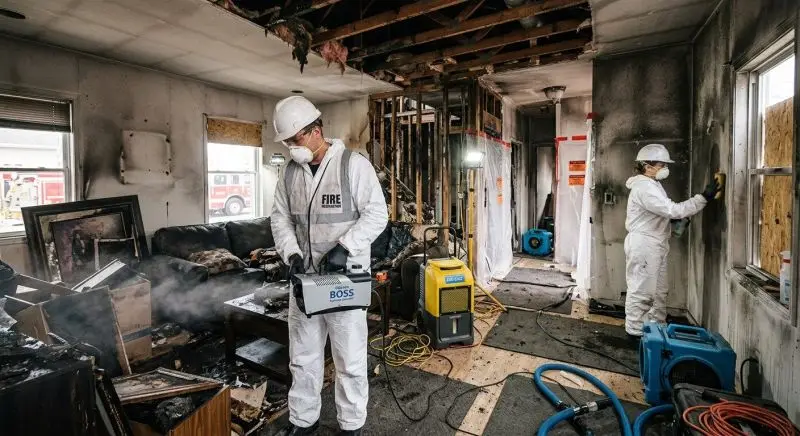
Key takeaways
Fire Damage Restoration New York: The Facts Worth Quoting
Last updated: November 2026
- The Fire Department of New York (FDNY) Bureau of Fire Investigation counted 77 fire deaths in the city in 2024, and its 2024 Annual Report names smoke inhalation as the leading cause of death.
- By early November 2026, 86 people had died in New York City fires, compared with 44 at the same point in 2025, according to the FDNY as reported by the New York Times.
- ANSI/IICRC S700, the Standard for Professional Fire and Smoke Damage Restoration, was published in a first edition on 2 January 2025, and it is the governing fire standard that no other New York City competitor fire page names.
- Soot turns acidic within 24 to 72 hours and can permanently etch painted surfaces, metal fixtures and glass, according to Home Pride Restoration and Cleaning in its step by step soot cleaning guide.
- Mold can begin growing in wet wall cavities within 24 to 48 hours after firefighting water soaks a building, according to the United States Environmental Protection Agency (EPA).
- Under Regulation 64, 11 NYCRR Part 216, issued under New York Insurance Law 2601, an insurer must acknowledge a claim, begin investigating it and reply to communications within 15 business days.
- A New York standard fire policy gives the policyholder 24 months from the date of loss to bring suit against the insurer, under Insurance Law 3404.
Why homeowners call us after a fire
Standards You Can Check, Not Slogans You Have to Trust
Fire damage restoration in New York runs on a published standard, ANSI/IICRC S700, and on written documentation from the first hour, and both can be checked before you hire anyone. A fire is the worst day most families ever have in their home. The company you hire walks through your burned rooms, handles your belongings and speaks to your insurer on your behalf. That takes more than a fast truck. It takes a method you can read, check and hold us to.
Trained to the standard
Our fire work follows the ANSI/IICRC S700 standard for professional fire and smoke damage restoration, published in 2025, the same framework insurers and adjusters work from, so our scope and your claim speak the same language.
Add your certification hereDocumented from hour one
Photos, video, residue tests and a room by room scope, written before cleaning starts. That file is what your adjuster prices, and it is yours to keep.
Sample report on requestLicensed for NYC buildings
Co-op boards, condo management, New York City Department of Buildings (DOB) filings and building access rules are part of the job in this city, and we handle that paperwork with you.
Add your licence number hereOne crew, start to finish
Board-up, cleanup, drying, odor removal and rebuild under one roof, so nothing gets lost between a cleaning company and a separate builder.
Add your review profile hereOne fire, four problems
What a Fire Actually Leaves Behind in a New York Home
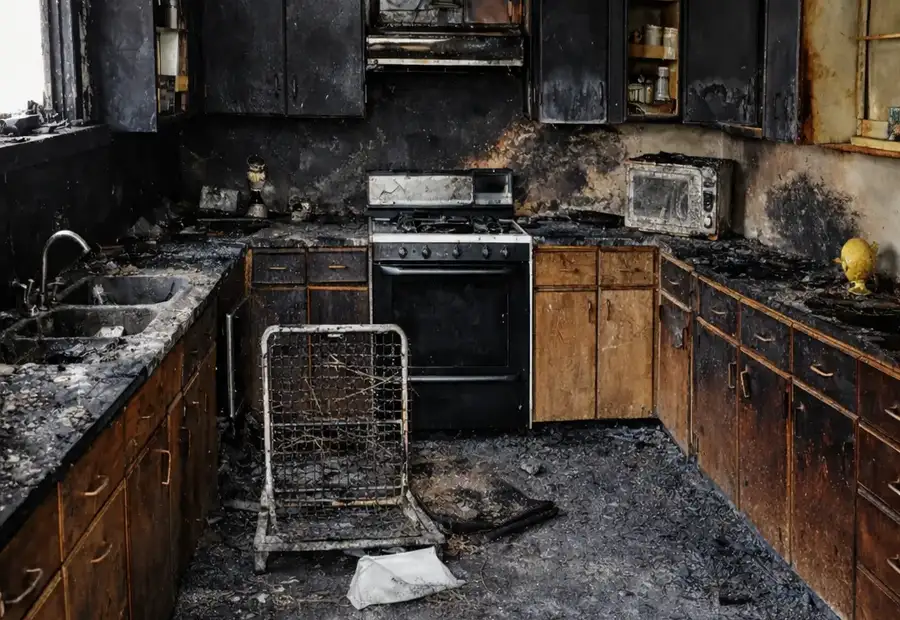
One fire leaves four kinds of damage at once: flame and heat damage, smoke and soot damage, water damage from firefighting, and structural damage. People picture the burned room. Crews picture four separate problems stacked on top of each other, each with its own clock running.
Flame and heat damage is the part you can see: charred framing, melted plastics, blistered paint, warped doors, a stove or a mattress reduced to a frame. Heat alone, without direct flame, cracks tile, delaminates cabinet doors, ruins electronics two rooms away and bakes soot onto ceilings in a hard glaze that plain washing will not shift.
Smoke and soot damage is the part that travels. Smoke rises, pushes through gaps around pipes and wires, rides the building stack effect in apartment houses, and settles in rooms that never saw a flame. In a New York apartment building, a kitchen fire on the third floor can leave soot in the fifth floor hallway closets. Soot is acidic. On metal it starts pitting within hours. On painted walls and plastic it yellows and sets. On fabric it carries an odor that normal laundry does not remove.
Water damage arrives with the rescue. Firefighters use a great deal of water, and steam from that water drives soot deeper into plaster and wood. The water runs down inside walls, soaks floors and ceilings below, and starts the same clock as any flood: mold can begin growing on wet material within 24 to 48 hours. Many fire jobs are quietly water jobs too, which is why our water damage restoration crews and drying equipment are part of every fire response.
Structural and safety damage is the part you cannot judge by eye. Char depth on a joist decides whether it still carries its load. A floor that feels solid can be weakened where fire burned from below. Stair stringers, roof rafters and the framing around a chimney all need a trained look before anyone sleeps in the building again. Where structure is in question, a licensed engineer gives the final word, and the city can require filings before rebuild work starts.
Fire damage restoration NYC work has to handle all four at once, in sequence: secure and make safe, dry the water, clean the soot, kill the odor, then rebuild. Skip the order and you seal smoke smell under new paint, or close a wall over wet framing, and the job fails months later when the smell or the mold comes back.
There is one more layer that separates fire work from every other kind of restoration: evidence. A fire scene is also a claim scene, and sometimes an investigation scene. The fire marshal may need the room of origin left undisturbed until the cause is recorded. Your insurer needs the damaged contents in place until they are documented. A landlord, a board or a neighbouring unit owner may each hold a policy that touches the same burned room. A good crew works inside that reality without complaint: nothing is disturbed before it is photographed, nothing is discarded before it is listed, and every party who needs the file gets it. The cleaning matters. The record of the cleaning, on a fire job, matters almost as much.
Direct answers, up front
Fire Damage Restoration New York: The Direct Answers
After a fire in New York, the first call to a restoration company should happen the same day, because soot begins corroding metal within hours, smoke odor sinks deeper into porous materials every day, and firefighting water can start mold growth within 24 to 48 hours. Five questions come up on almost every first call after a fire in New York. Each has a short answer that holds up, and here it is, before the long detail.
How soon after a fire should I call a restoration company?
Call the same day, ideally before you call your insurance company, so documentation starts immediately. Soot begins corroding metal and etching glass within hours, smoke odor sinks deeper into porous materials every day, and firefighting water can start mold growth within 24 to 48 hours.
Does fire damage restoration include the water damage from firefighting?
Yes. Firefighting leaves large volumes of water soaking floors, walls and structural framing, and that water is part of the same job, not an add on. Crews extract it and dry the structure as a core step, because wet cavities can start growing mold within 24 to 48 hours.
What is thermal fogging and why is it used?
Thermal fogging heats a deodorizer into a fine fog that travels into the same porous surfaces smoke reached, including walls, insulation, upholstery and structural cavities. Smoke odor is absorbed at a molecular level, so surface cleaning alone cannot remove it. Fogging neutralizes the odor where it actually sits.
What should I do first after a fire?
Stay out until the fire department says the building is safe to enter. Then contact a disaster relief agency and your insurance company, photograph all damage before anything is moved, and notify building management at once, because co-op and condo boards may need to approve work before restoration begins.
Do I need a permit from the NYC Department of Buildings for fire damage repairs?
Yes, in most cases. Structural repair work after a fire in New York City falls under the NYC Department of Buildings and typically needs a permit, an ALT-1 filing for major structural work or ALT-2 for smaller alterations. Emergency work can start under an Emergency Work Notice in defined cases.
The facts behind the answers
| Fact | The number or rule behind it |
|---|---|
| Soot turns acidic fast | It etches metal and glass within hours and can permanently stain paint and plastic within 24 to 72 hours, the clock taught in the Home Pride Restoration soot cleaning guide. |
| Mold follows firefighting water | Wet wall cavities can start growing mold within 24 to 48 hours, so extraction and drying begin on day one. |
| Smoke travels beyond the burned room | It moves through HVAC ducts, wall cavities, electrical conduits, elevator shafts and party walls, reaching units two or three floors away. |
| Fine smoke particles are a health risk | The US EPA treats indoor PM2.5 above 35 micrograms per cubic meter over 24 hours as unhealthy. |
| Timelines run by damage level | A single room fire takes 1 to 2 weeks. Moderate damage takes 3 to 8 weeks. Major structural work takes 6 to 12 weeks or longer. |
| New York claim clock | Under Regulation 64, 11 NYCRR Part 216, issued under Insurance Law 2601, an insurer must acknowledge a claim and begin investigating within 15 business days. |
| Deadline to sue on a fire policy | The New York standard fire policy gives 24 months from the date of loss to bring suit, under Insurance Law 3404. |
| The governing standard | ANSI/IICRC S700, first edition published 2 January 2025, sets the process for professional fire and smoke damage restoration. |
The same answers, the way people ask out loud
What do I do first after a house fire in New York City?
Stay out until the FDNY clears the building, then call a restoration company the same day and photograph everything before anything is moved or cleaned.
How long does fire damage restoration take in NYC?
A single room fire usually takes one to two weeks. Moderate damage takes three to eight weeks. A major structural fire takes six to twelve weeks or longer, plus permits and approvals.
Does homeowners insurance cover fire damage in New York?
Yes, in most cases. Fire and smoke are covered perils on standard homeowners, co-op and condo policies, covering structure, belongings, cleanup and loss of use, up to your policy limits.
Can I stay in my home after a fire?
Not until fire officials say it is safe and the air is checked. Smoke residue carries fine particles that reach deep into the lungs, so most families stay elsewhere during restoration.
The first hour after a fire
What to Do After a House Fire in NYC: The First Hours, in Order
After a house fire in New York City, the first hour runs in a fixed order: stay out until the FDNY clears the building, open the claim, notify the building, photograph everything, and secure the property. You will not think clearly in the first hour, and you do not have to. Work this list in order. Everything on it protects either your family, your claim, or your home, and most of it takes minutes.
- Stay out until you are cleared to enter. The FDNY or fire marshal decides when a building is safe. Fire weakens floors and stairs, gas lines and wiring can be damaged, and hot spots smoulder inside walls and flare again. If a vacate order is posted, it is the law, not a suggestion.
- Get the incident details. Ask the responding company or the fire marshal how to get the fire report. Note the date, the time and the address exactly as they record it. Your insurer and your landlord or board will both ask for it.
- Call your insurer the same day. Open the claim, write down the claim number and the adjuster name, and ask two questions: what emergency work is approved right now, and where can you stay tonight under your policy. Fire policies usually carry loss of use cover for exactly this.
- Tell your landlord, super or management company. In a rental, co-op or condo, the building needs to know at once. They control the risers, the roof access, the freight elevator and the insurance certificate your crew will need to enter and work.
- Secure medicines, documents and one set of essentials. Once entry is allowed and only if it is safe, take passports, medication, chargers, glasses and pet supplies. Leave everything else exactly where it is until it has been photographed.
- Photograph and video before anything moves. Film every room slowly, open every cabinet and closet, and read serial numbers aloud on appliances and electronics. Soot covered items look identical in a pile. On camera, in place, they are proof.
- Do not clean anything yet. Wiping soot with a wet cloth smears it into paint and grout. Vacuuming with a home vacuum blows fine soot back into the air and into other rooms. Laundering smoked clothes in a home machine can set the odor. Wait for the residue test.
- Do not throw burned items away. A melted appliance is evidence of value and of cause. Keep damaged goods, or photograph them thoroughly, until your adjuster releases them in writing.
- Get the building secured today. Broken windows, a burned door or a hole in the roof invites rain, animals and theft. Board-up and tarping the same day is standard emergency work, and insurers expect it as part of your duty to limit further loss.
- Keep every receipt. Hotel, food, boarding for pets, a change of clothes. Loss of use claims are paid from receipts, not from memory.
The building needs securing tonight, not tomorrow
Board-up, tarping and a first assessment can start the same day you call, in any borough. The inspection is free and the written quote comes before work begins.
How NYC fires start
The Fires We See Most in New York Homes, and What Each One Does
The cause of a fire decides the kind of soot, the cleaning method and often the insurance story. These are the patterns that come up again and again in this city.
Kitchen and cooking fires
The most common house fire in the city starts on a stove: oil overheated in a pan, a towel too close to a burner, a pot left while someone answers the door. Cooking fires burn protein and grease, and protein soot is the nastiest residue of all: yellowish, sticky, nearly invisible on some surfaces, and carrying a rancid smell that clings to cabinets and walls. A kitchen fire that burns for five minutes can need soot cleaning through the whole apartment, because the smoke is greasy and travels on warm air.
Space heaters and heating equipment
Every winter, space heaters placed too close to bedding, curtains or furniture start fires across the city, and the FDNY warns about them every cold snap. Furnaces and boilers add their own version: the puff back, where unburned fuel oil ignites late and blows soot through the heating system and out of every register in the home. A puff back may leave no flame damage at all and still coat every room in oily soot.
Electrical fires in older buildings
Pre-war wiring, overloaded outlets, space heaters and window air conditioners on tired circuits, damaged cords under rugs: electrical fires often start inside a wall, which means the first sign is smoke or a smell, not flame. They burn plastics and wire insulation, leaving a sharp chemical odor and a fine, clingy soot that coats electronics. Any electrical fire needs the circuit isolated and checked before the home is re-energized.
Lithium-ion battery fires
E-bike and scooter batteries have become a real New York fire cause, and the FDNY has warned about them for several years running. A battery fire burns extremely hot, extremely fast, and can reignite. These fires often happen in hallways and by front doors, blocking the way out, and they leave heavy chemical soot. Never charge a damaged battery indoors, and if a battery was in a fire, tell the crew: it changes how the room is handled.
Candles, smoking and fireplaces
A candle near curtains, smoking in bed, a fireplace with a blocked flue or a chimney that has not been cleaned: these are slow starters that often ignite furniture or bedding and burn for a while before anyone notices. Upholstery and mattress fires produce thick, wet, smearing soot and some of the strongest odor of any fire type.
Dryers, appliances and the unit next door
Lint in a dryer vent, a failing appliance, a neighbor fire that breaks through a shared wall or sends smoke through a party wall and shared shafts: in attached New York housing, your fire damage may start in someone else unit. Smoke entering through wall penetrations and duct runs is common in rowhouses and apartment buildings, and it is still real damage that needs real cleaning, even where no flame crossed into your home.
Whatever started it, the first professional question is the same: what burned? Wood, food, plastic, fuel oil and fabric each leave a different residue, and the residue picks the cleaning chemistry. That is why fire damage restoration NYC crews test soot before they touch a wall, and why the test result goes into the written scope your insurer sees. Testing takes minutes and decides everything that follows on the job.
Soot is not one thing
Four Kinds of Soot, Four Different Cleaning Jobs
Soot comes in four types, dry, wet, protein and fuel oil, and each type needs a different cleaning method, because the wrong cleaner on the wrong residue smears it, sets it or drives it deeper into the surface. Homeowners call it all smoke damage. Crews separate soot into types, because the wrong cleaner on the wrong residue smears it, sets it or drives it deeper into the surface.
| Soot type | Comes from | What it looks and feels like | How it is cleaned |
|---|---|---|---|
| Dry soot | Fast, hot fires burning wood, paper and natural materials | Fine, powdery, grey to black. Sits on surfaces rather than bonding to them | Dry methods first: HEPA vacuuming and dry chemical sponges. Wet washing a dry soot wall first smears it into the paint |
| Wet soot | Slow, smouldering, low oxygen fires: upholstery, rubber, plastics | Thick, sticky, smeary, with a strong acrid smell. Clings to everything | Careful wet cleaning with the right agents, often after dry removal of loose residue. Easy to spread, so containment and method matter |
| Protein soot | Kitchen fires: burned food, grease, oils, meat | Yellow to amber, greasy, sometimes barely visible, with a rancid odor that outlasts the visible soil | Degreasing cleaners and full deodorization. Painted surfaces often need sealing before repaint, or the smell returns in warm weather |
| Fuel oil soot | Furnace and boiler puff backs | Oily black film blown through ducts and out of registers, heaviest near vents | Surface cleaning through the home plus duct and system cleaning, or the furnace re-soots the rooms at the next heating cycle |
Residue identification follows the IICRC fire and smoke restoration standard: test first, then choose the method. A crew that starts washing walls before testing is guessing with your home.
The corrosion clock: why the first two days decide the bill
Soot is acidic, and it keeps working after the fire is out. The timeline below is the one restoration trainers teach, and it is the honest reason crews push for a fast start. It is not a sales trick. It is chemistry.
What we do
Fire Damage Restoration Services, From Board-Up to Rebuild
Nine services make up a complete fire job. Some fires need all nine. A small kitchen fire might need four. The assessment tells you which, in writing, before you commit to anything.
Emergency board-up and roof tarping
Broken windows and doors boarded, roof openings tarped, the building made weather tight and secure against entry. This is the first physical work on most fire jobs and it usually happens the same day you call.
Fire damage assessment and documentation
A room by room walk with photos, video, residue testing, smoke travel mapping and a structural look. The output is a written scope: what cleans, what comes out, what gets rebuilt, and in what order.
Smoke and soot cleanup
HEPA vacuuming, dry sponging and wet cleaning matched to the soot type, on walls, ceilings, cabinets, floors and fixtures, working from the fire room outward until test wipes come back clean.
Smoke odor removal
Odor treated at the source with thermal fogging, hydroxyl or ozone treatment, sealing of porous framing where needed, and HVAC cleaning so the smell does not recirculate. Covered in depth below.
Contents packout and cleaning
Furniture, clothing, electronics, books and keepsakes inventoried, packed, moved to cleaning or storage, and returned. What cannot be saved is documented for your claim, item by item.
Water extraction and drying
Firefighting water extracted, wet structure dried with air movers and dehumidifiers, moisture readings logged daily until the building reaches its dry standard. The same discipline as our flood work.
HVAC and duct cleaning
Soot pulled into a heating or cooling system will re-soot clean rooms and carry odor through the home. Ducts, coils and registers are cleaned as part of the fire scope where the system was exposed.
Charred material removal
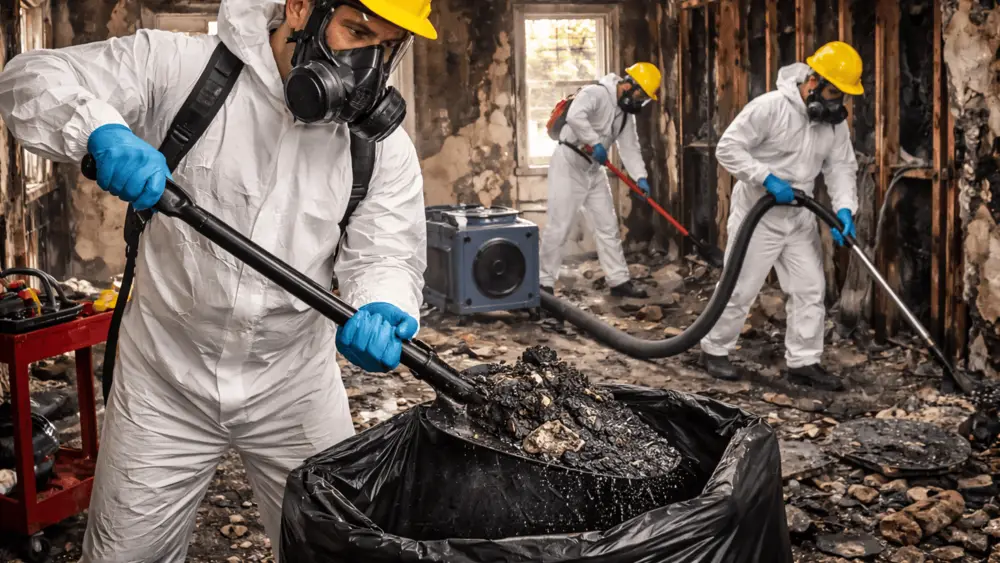
Burned drywall, insulation, flooring and unsalvageable framing removed under containment with HEPA air scrubbing, so soot and ash do not migrate into clean areas during demolition.
Reconstruction and rebuild
Framing, drywall, plaster, floors, cabinets, paint and trim put back, with DOB filings where the work requires them and building board approvals handled for co-ops and condos.
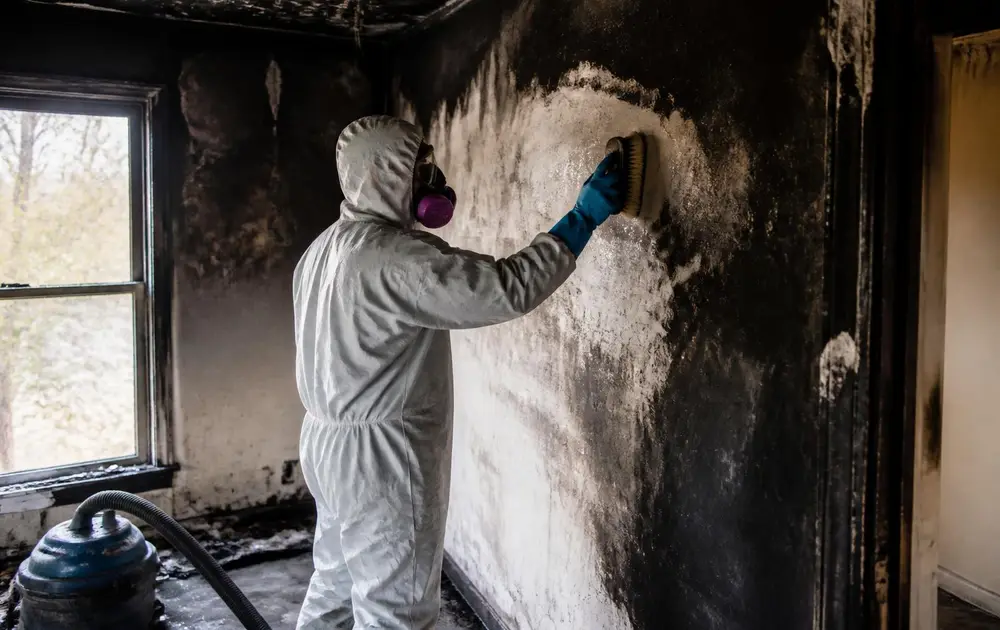
How the work runs
Fixing Fire Damage: Our 9 Step Process
Fire damage restoration runs in nine steps in a fixed order: emergency call and safety check, board-up, tarping and securing, assessment, testing and written scope, water extraction and structural drying, contents packout, demolition of unsalvageable material, soot and smoke cleaning, odor removal and sealing, and rebuild with a final walkthrough. Every fire is different, but the order of the work is not. This sequence is how fire damage restoration NYC jobs run from the first call to the final walkthrough.
Emergency call and safety check
You call, we ask what burned, whether the FDNY has cleared the building, and whether anyone is displaced. If the building is open to the weather or to entry, securing it jumps the queue.
Board-up, tarping and securing
Openings closed, roof covered, utilities checked with the building. The property is left locked, dry and safe at the end of day one, even if the main scope starts later.
Assessment, testing and written scope
Residue tests, smoke mapping, moisture readings and a structural look, turned into a written quote and a documentation file your adjuster can price from.
Water extraction and structural drying
Firefighting water comes out and drying equipment goes in early, because wet structure starts growing mold within 24 to 48 hours and wet soot corrodes faster than dry soot.
Contents packout or protect in place
Belongings are inventoried and either cleaned on site, packed out to our facility, or sealed and protected in an unaffected room. You approve the inventory before anything leaves.
Demolition of unsalvageable material
Charred and ruined material comes out under containment. What can be cleaned stays. The line between the two was set at assessment, not guessed during demolition.
Soot and smoke cleaning, top to bottom
Ceilings, walls, floors, cabinets, fixtures and ductwork, cleaned with methods matched to each soot type, verified with test wipes as the crew moves room to room.
Odor removal and sealing
Thermal fogging, hydroxyl or ozone treatment as the case calls for, and odor sealing on porous framing and subfloor where cleaning alone cannot reach the smell.
Rebuild and final walkthrough
Structure and finishes restored, a final clean, and a walkthrough with you room by room. You sign off on the finished work, and the full documentation file closes out your claim.
Not sure how bad your fire damage is?
That is what the free inspection is for. We test, we map, we write it down, and you decide with the full picture in front of you.
The smell is the job
Smoke Odor Removal: Why the Smell Outlives the Fire, and How It Actually Goes
Smoke odor outlives a fire because odor molecules bind inside porous materials, and it is removed only by taking out the source, cleaning every surface and treating the molecules themselves, never by masking them. Ask anyone who has lived through a house fire what they remember a year later and most say the smell. Smoke odor is not dirt you can see. It is chemistry lodged in porous material, and it needs chemistry to remove it.
When materials burn, they release tiny particles and gases that behave like a vapor. Hot smoke rises and expands, pushing into wall cavities, closet interiors, drawers, duct runs and the pores of wood, plaster, fabric and paper. As the smoke cools, those odor molecules settle and bind. That is why a room can look clean and still smell like a campfire, and why the smell gets stronger on warm days and in humid weather: heat and moisture release the odor back into the air.
It is also why painting over smoke damage fails. Paint covers the stain. The odor molecules sit in the plaster, the framing and the subfloor behind the paint, and they work their way back out. Homeowners who repaint a smoked room without treatment usually smell the fire again within weeks, strongest in summer. The fix at that point is to strip back and do the odor work that should have come first.
Real odor removal works in layers. First the source goes: charred material and heavily loaded porous items are removed, because no treatment fixes odor that is still sitting in burned debris. Then every surface is cleaned, because soot itself carries odor. Then the air and the hidden spaces are treated. Only then, where odor is locked in framing or subfloor, is a sealing coat applied, as a last step over clean, dry material.
Thermal fogging turns a deodorizing agent into a hot fog of particles about the same size as smoke particles. The fog follows the same paths the smoke took, into cracks, cavities and fabrics, and neutralizes odor where it settled. It works best after cleaning, in a sealed space, with the building empty during treatment.
Hydroxyl generators produce molecules that break down odor compounds in the air and on surfaces. They run safely while people and pets are present, which makes them the choice for homes that are partly occupied during the work, and for lighter, widespread odor.
Ozone treatment is the heavy tool. Ozone oxidizes odor molecules at a deep level and can rescue heavily smoked rooms and contents. It is used in empty, sealed spaces only, with the area aired out before anyone returns, because ozone is not safe to breathe at treatment levels.
HEPA air scrubbing runs through the whole job, pulling soot particles out of the air so they do not resettle on cleaned surfaces. And the HVAC system gets cleaned where smoke entered it, because a dirty duct system will re-deliver the smell to every clean room each time the heat or air conditioning runs.
The test at the end is simple and it is not a machine reading. It is a nose, in a closed room, on a warm day, after the equipment is off. If the fire smell is gone then, it is gone. If it is only masked, it comes back, and any crew that stands behind its work will come back with it until the room passes that test.
Thermal fogging, hydroxyl or ozone: which treatment, and when
The three treatments are not interchangeable. Choosing between them is a decision about how deep the odor sits and whether anyone can stay in the home while the work runs.
| Treatment | How it removes odor | People and pets during treatment | Best used for |
|---|---|---|---|
| Thermal fogging | A heated deodorizer fog with particles about the size of smoke particles follows the paths smoke took into cavities and fabrics and neutralizes odor where it settled | Building empty and sealed during treatment, after cleaning | Deep odor locked in wall cavities, insulation and upholstery |
| Hydroxyl generators | The generator produces molecules that break down odor compounds in the air and on surfaces while it runs | Safe to run while people and pets are present | Lighter, widespread odor, and homes partly occupied during the work |
| Ozone treatment | Ozone oxidizes odor molecules at a deep level throughout a sealed space | Empty, sealed spaces only, aired out before anyone returns, because ozone is not safe to breathe at treatment levels | Heavily smoked rooms and contents that cleaning and fogging alone cannot rescue |
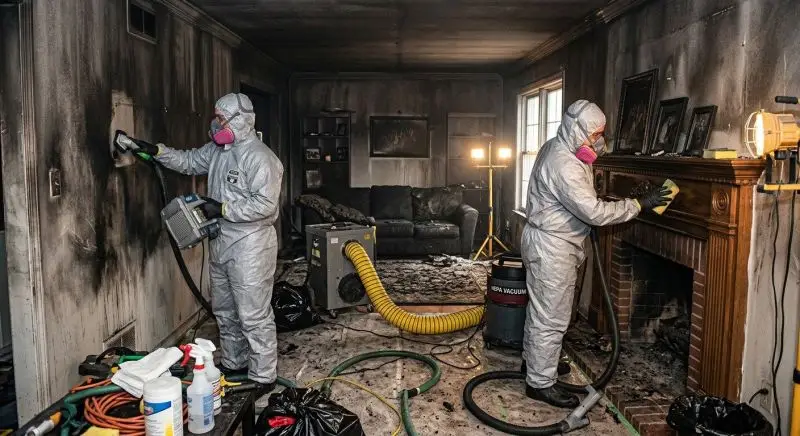
Your belongings
Contents Packout: Saving What the Fire Tried to Take
A contents packout inventories and photographs every belonging in place before anything moves, cleans what can be saved on site or off site, and documents item by item what cannot be saved, because a fire claim for belongings is only ever as good as its inventory. The building is only half the loss. The other half is everything inside it: furniture, clothes, electronics, photographs, documents, the contents of every drawer. Contents work is where a good crew earns its fee twice, once in what it saves and once in what it documents.
It starts with an inventory, taken in place, with photos. Every item is listed, its condition noted, and its location recorded before it moves. That inventory does three jobs at once. It tells the cleaning team what they hold. It tells you exactly what left your home and what will come back. And it becomes the contents list your insurer works from, which matters because a fire claim for belongings is only ever as good as its documentation.
Items then split three ways. Some clean on site: hard furniture, metal, glass and many appliances respond well to soot cleaning and deodorizing where they stand. Some pack out: clothing and soft goods go for specialist cleaning and ozone treatment, electronics go for corrosion inspection and cleaning, upholstered furniture and rugs go for deep extraction and odor work. And some, honestly, cannot be saved: melted plastics, charred upholstery, food and medicine exposed to smoke and heat. Those are photographed, listed and held for your adjuster release before disposal, because a thrown away item with no record is an item the claim may not pay for.
A few rules protect you here. Food, medicine and cosmetics that were exposed to smoke, heat or firefighting water should be discarded, even if they look fine: smoke carries compounds you do not want in a pantry. Baby items and anything that goes in a mouth get the same treatment. Sentimental items deserve a conversation before a decision: a smoked photograph album, a child blanket, a wedding dress. Specialist cleaning rescues more of these than people expect, and the attempt is usually worth it. Ask what can be tried before anything irreplaceable is written off.
While your home is being rebuilt, packed out contents sit in secure storage, cleaned and wrapped. They come back when the rooms are ready, not before, because clean belongings returned to a dusty rebuild just get dirty again. The pack back is the last step of the job, and for most families it is the moment the house feels like theirs again.
Board-up, vacate orders and permits
Securing a Burned Building in New York: Boards, Tarps and City Paperwork
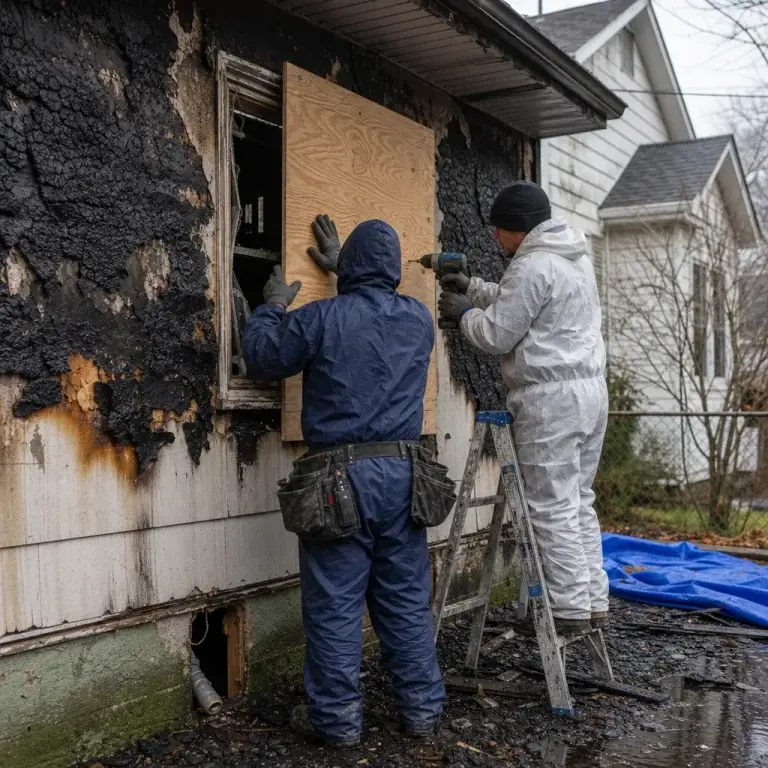
Securing a burned building in New York means closing every broken window, door and roof opening to weather and entry on the day the building is released, while FDNY orders, Department of Buildings filings and the rules of the building are handled at the same time. In a suburb, board-up is plywood and screws. In New York it is that, plus fire department orders, building department filings and the rules of your building, all running at the same time.
Board-up and tarping, done right
Every broken window, burned door and roof opening gets closed the day the building is released. Boards are cut to the opening and fixed to sound framing, not to damaged trim that will pull away in the first storm. Roof tarps are anchored so wind cannot lift them and weighted so water sheds off the roof rather than pooling into the opening. A badly tarped roof turns one fire into a fire plus a series of ceiling leaks over the following weeks.
Security matters as much as weather. A burned home with an open door is an invitation, and insurers treat a failure to secure as a failure to protect the property. Locks are changed or openings are barred where a door is gone. In apartment buildings, the fire unit is sealed and the hallway and neighbouring units are checked for smoke migration before the building reopens its corridors.
FDNY and vacate orders
After a serious fire, the city may post a vacate order on the building or on individual units. That order means nobody stays there until the conditions named in it are corrected and it is lifted. It is not a comment on you or your home. It is the city recording that structure, wiring, gas or egress is not safe yet. Restoration work inside a vacated unit is planned around the order: make safe, correct the listed conditions, and document the corrections so the order can be cleared.
DOB filings and rebuild permits
Cleaning, drying and like for like repairs generally need no filing. Rebuild work that touches structure, moves walls, or changes plumbing or electrical systems can require Department of Buildings filings and licensed trades, and fire jobs regularly cross that line: a replaced joist, a rebuilt bathroom, a new electrical panel. We flag the filing side at assessment, before it can slow the job, and the rebuild scope is written so the permit path is clear from the start.
Co-op and condo building rules
Most boards and management companies require an alteration agreement, a certificate of insurance from every contractor, elevator reservations and set work hours before a crew can start. After a fire, management also needs its own documentation, because the building master policy may share the loss. Expect our team to coordinate with your super and management from day one. That coordination is not red tape for its own sake: a crew turned away at the door for a missing certificate loses you the days the corrosion clock is counting.
Lead and asbestos in older buildings
Pre-war buildings can hold lead paint and asbestos containing materials in plaster, pipe insulation, floor tile and roofing. Fire and demolition disturb exactly those materials. Where they are present or suspected, the work follows the city and state rules for handling them, with testing where needed. It is one more reason a New York fire job is not a generic cleanup, and one more question to ask any company you interview: how do you handle suspect materials in a 1920s building?
The second disaster inside the first
Water Damage After a Fire: The Part Nobody Warns You About
Firefighting water is part of almost every fire loss: it runs down inside wall cavities, soaks floors and the unit below, and it must be extracted and the structure dried at once, because wet drywall and wood can start growing mold within 24 to 48 hours. Firefighters save the building with water, and then the water starts its own damage. On many fire jobs, the drying work is as urgent as the soot work.
Think about where suppression water goes. It runs down inside wall cavities, through light fixtures and pipe chases, across floors and into the unit below. Steam from the fire drives moisture and soot deep into plaster. Pipes and radiators damaged by heat can leak for days after the fire itself is out. The result is a building that is burned in one room, smoked in five, and wet in places nobody has looked yet.
Wet changes the soot problem too. Moisture makes soot more corrosive, and it binds odor into materials faster. And wet structure starts the mold clock: growth can begin on wet drywall and wood within 24 to 48 hours, which is how a fire job becomes a mold job by the end of the first week. New York adds its own layer here, since mold work in covered buildings runs under Local Law 55, the city mold law for buildings with three or more apartments, and New York State Labor Law Article 32 licensing, the same rules covered on our water damage behind walls page.
So drying starts early on a fire job, in parallel with the soot work, not after it. Extraction first, then air movers and dehumidifiers placed by moisture readings, with the readings logged daily until walls, floors and framing reach the dry standard. If you want the full picture of how hidden moisture behaves inside New York walls, that behind walls page goes deep on it. And if the water side of your fire turns into a dispute with your insurer, our water damage insurance claim guide walks through the filing, the documentation and the appeal ladder in plain language. Fire claims and water claims run on the same principles: document early, photograph everything, and keep the paper trail.
Real fire patterns
Three Fire Jobs, and the Lessons Video Case Studies Teach
The fire restoration cases that teach the most are small fires, because small fires are where smoke travel, suppression water and odor scopes are most often underestimated, and where the real damage hides outside the burned room. The fire jobs that teach the most are rarely the biggest fires. They are the small ones whose smoke, water and odor scopes were underestimated. We study fire restoration case studies on video the way other trades study game film. The jobs below are the patterns those case studies return to again and again, and they match what we walk into across the five boroughs.
The small kitchen fire that smoked the whole home
A pan fire, out in minutes, no structural damage, and a family sure the job was one room. The case study lesson, shown in kitchen fire rebuild videos again and again, is that smoke does not respect the size of the flame. Grease laden smoke rode the warm air through the whole unit, into closets, drawers and the ductwork. The rebuild was small. The soot and odor scope was the entire home, and the claim turned on documenting smoke travel room by room rather than arguing about the size of the fire.
The fire that became a water job
Video walkthroughs of board-up work make a point homeowners miss: once a roof or window line is open, the next rainstorm is a second disaster scheduled in advance. In this pattern, suppression water plus one week of rain through an untarped opening soaked ceilings two floors down, and the water side of the claim grew larger than the fire side. Lesson: securing the building is not housekeeping. It is the step that decides whether the loss stays one loss.
The smell that came back in summer
A recurring case study theme is the repainted room that smelled fine in spring and reeked by July. The fire smell had been painted over, not removed, and warm humid air released it from the plaster and framing. The fix meant stripping back to the structure, cleaning, treating and sealing in the right order. Lesson: odor work comes before paint, always, and any quote that jumps from cleaning straight to repainting is skipping the step that decides whether the job lasts.
Video case studies of kitchen fire rebuilds teach the same three lessons written out above: smoke keeps moving inside walls after the flames are out, a small fire becomes a large insurance job when the soot scope is the whole home, and the professional order is always secure, dry, clean, deodorize, then rebuild. We do not embed videos on this page, so the page stays fast. The two video lessons we rely on most, soot cleaning in the right order and testing before any tear out, are written out in full in the Test Before You Tear section below, with links for anyone who wants to watch them.
Asked online, answered plainly
Questions Real New Yorkers Ask After a Fire
The questions New Yorkers ask most after a fire are whether they can stay in the home, how to get the smoke smell out of everything, who pays for the cleanup, and how long until they can move back in. These are the questions people type into Reddit, Quora and WikiHow style threads in the first days after a fire, usually at 2 in the morning. Short answers here. The long answers fill the rest of this page.
Can I stay in my home after a small fire?
Only if the building has been cleared and the fire was truly contained. Even a small fire fills a home with soot and odor, and damaged wiring or gas lines are not visible problems. If a vacate order is posted, the answer is no until it is lifted. If there is no order, ask the responding firefighters directly before you sleep there, and trust your nose less than their answer.
How do I get the smoke smell out of everything?
Not with air freshener, and not with paint. The smell lives in porous material and in soot itself. Surfaces get cleaned with methods matched to the soot type, the air and cavities get fogged or treated with hydroxyl or ozone, and loaded porous items get specialist cleaning or honest disposal. The full method is in the smoke and odor section above.
My landlord says the cleanup is my problem. Is that right?
Almost never for the building itself. In New York, the landlord owns the structure, the systems and the duty to keep the home habitable. Your own belongings and your own policy are your side. If the fire started from your negligence the landlord insurer may come after your policy, which is a different question from who arranges the cleanup. Get the demand in writing and send it to your insurer before you agree to anything.
Should I hire a public adjuster?
On a large or disputed loss, a licensed public adjuster can earn their fee by building the claim properly. On a small, straightforward loss, most homeowners manage with a good restoration scope and their insurer adjuster. Either way, the documentation decides the outcome, which is why our assessment file is written to adjuster standard from day one.
Can I clean soot myself to save money?
You can handle small, contained smoke staining on hard surfaces with care, and the how-to guides online describe dry sponging for exactly that. What goes wrong is scale and method: wet wiping dry soot, home vacuums spreading fine particles, and laundry setting protein odor into clothes. If soot reached more than one room, or anything fabric or electronic is involved, the savings usually evaporate into replacements.
The fire was in my neighbor unit. Why does my home smell?
Because smoke travels through shared shafts, pipe chases, party wall gaps and hallway air, especially in older New York buildings with a strong stack effect. Your unit can carry real soot and odor damage with no flame at all. Document it the same way, photograph, test, scope, because your claim is for your unit damage, whoever fire it was.
How long until we can move back in?
A contained kitchen fire with smoke only: often one to three weeks of cleaning and odor work. A fire with structural damage and rebuild: several weeks to several months, driven by filings, board approvals and the rebuild scope more than by the cleaning. The timeline table below breaks the phases down honestly.
What should I grab before the crew starts?
Once entry is cleared: documents, medication, chargers, glasses, work essentials, pet supplies, and anything irreplaceable that is undamaged and easy to carry. Everything else is safer photographed in place and left for the inventory than carried out in armfuls the first night.
Who pays for fire damage
Owner, Renter, Landlord, Co-op or Condo: Who Pays for What After a Fire
Fire damage restoration NYC jobs usually involve two or three insurance policies at once. Knowing which one carries which part stops the worst delays.
| Your situation | Your policy covers | Someone else policy usually covers | Your first move |
|---|---|---|---|
| Homeowner (house) | Structure, finishes, belongings, and loss of use while you cannot live there, under one homeowners policy | A liable third party insurer, if the fire started from someone else negligence or a faulty product | Open the claim the same day and get the emergency work approved |
| Renter | Your belongings and your loss of use, under renters insurance if you carry it | The landlord policy covers the building, the systems and the unit structure | Notify the landlord in writing at once, and photograph your belongings in place |
| Landlord | The building and your duty to restore a habitable unit | The tenant policy covers their belongings. If the fire was tenant negligence, your insurer may pursue their liability cover | Secure the building, then coordinate both claims so the scopes do not collide |
| Co-op shareholder | Your unit interior, improvements and belongings, per your policy and the proprietary lease | The co-op master policy covers the building structure and shared systems | Notify management in writing the same day and ask what the master policy carries |
| Condo owner | Everything inside your unit walls as your bylaws define it, plus your belongings | The association master policy covers common elements and structure | Get the bylaws definition of your unit in writing before the scope is priced |
| Fire started next door | Your unit damage and belongings, and your insurer can pursue the responsible party | The neighbour liability cover or their property policy, through subrogation | Open your own claim anyway. Your policy pays you first and argues later |
Coverage follows your actual policy wording, and the table above is the usual pattern, not a promise. The habit that protects every row of this table is the same: same day notice, dated photos, and a written scope.
Two policies, one burned home, and no one agreeing?
Our documentation file is written so each insurer can see exactly which part of the scope belongs to them. That clarity settles most of these arguments.
The fire claim, step by step
Filing a Fire Damage Insurance Claim in New York Without Losing Your Shirt
Fire claims are usually covered events. What gets claims reduced is rarely the fire. It is missing documentation, late notice and items thrown away before anyone recorded them.
Step one: notice, the same day. Call your insurer or broker, open the claim, and write down the claim number, the adjuster name and what emergency work is approved. Ask about loss of use cover and its limits, because that is the part that pays for your hotel and meals while the work runs.
Step two: protect the property. Your policy expects you to limit further loss: board-up, tarping, water extraction. Keep the invoices. Emergency mitigation is normally claimable, and an unsecured building that takes rain damage can hand your insurer an argument you do not want to have.
Step three: document like you mean it. Video every room before cleanup. Photograph serial numbers. Build the contents list while items are still in place. Keep the fire report, the restoration scope, the residue tests and the drying log in one file. This is the same discipline our insurance claim guide teaches for water losses, and fire claims reward it even more, because so much of a fire loss is belongings.
Step four: meet the adjuster with the scope in hand. Walk the property with your restoration scope open. Adjusters price from line items: rooms, surfaces, soot types, contents. A tested, written scope turns the meeting from an argument about impressions into a check of numbers.
Step five: mind the two traps. Depreciation: many policies pay replacement cost in two parts, a first payment at actual cash value and the balance when the work is done and invoiced, so do not panic at the first cheque and do not skip the paperwork that releases the rest. And deadlines: proof of loss and contents lists have time limits in most policies. Ask your adjuster for yours in writing on day one.
Step six: if the claim goes wrong. Ask for the denial or reduction in writing with the policy wording cited. Then climb the ladder: a supervisor review, a complaint to the New York State Department of Financial Services, the appraisal clause if your policy has one, and a licensed public adjuster or attorney for large disputes. Most fire claims never need the ladder. Knowing it exists changes how the first conversation goes.
Fire work, borough by borough
Fire Damage Restoration Across the Five Boroughs and Long Island
Fire damage restoration covers all five boroughs and Long Island, and the building stock in each area decides the access, the paperwork and the smoke patterns the crew plans around. Fire behaves the same everywhere. Buildings do not. Pick your borough for the patterns we plan around there, and for the page that covers your water damage side in depth.
Fire and water travel together in this city, so each borough also has its own water page: Manhattan, Brooklyn, Queens, Bronx, Staten Island and Long Island. The full service overview lives on our New York home page.
Health and safety
Is It Safe to Be in a Home After a Fire? Soot, Air and Common Sense
A home is not safe to stay in after a fire until fire officials clear it and the air is checked, because soot is an acidic residue made of fine particles that reach deep into the lungs when breathed. The flames are the danger everyone respects. The residue is the one people underestimate, because it looks like dust and behaves like a chemical.
Soot is made of extremely fine particles carrying acids and the leftovers of whatever burned: wood, fabric, food, plastic, wiring, cleaning products, all of it mixed. Fine particles are the concern because they stay airborne when disturbed and reach deep into lungs when breathed. Children, older people, anyone with asthma or breathing trouble, and pets feel it first and worst. That is why crews work in respirators and why the honest advice for the first days is simple: if you do not need to be in the burned rooms, do not be in them, and keep children and pets out until cleaning is done and the air has been scrubbed.
A few practical rules while the work runs. Run no heating or cooling system that pulls air through smoked ductwork until it has been checked, or you will distribute soot to clean rooms. Do not sleep in a home with a heavy smoke odor: odor you can smell is residue you are breathing. Wash hands after handling smoked items, and keep soot covered skin contact short. Food, medicine and cosmetics exposed to smoke or heat get discarded, full stop. And if anyone in the home has persistent coughing, headaches or breathing trouble after a fire, that is a conversation for a doctor, with the fire mentioned by name.
Older New York buildings add two more entries to the safety list. Lead paint and asbestos containing materials, common in pre-war plaster, pipe insulation, floor tile and roofing, are disturbed by fire and by demolition. Where they are suspected, testing and the city rules for handling them come before the tear out, not after. And structure itself is a safety question: charred framing, a fire weakened stair, a ceiling that took both heat and water weight. Nobody should be sleeping under a ceiling that has not been looked at by someone trained to judge it.
How long it takes
Fire Restoration Timelines: Phase by Phase, Honestly
A contained kitchen fire with smoke only often completes in one to three weeks end to end, while a structural fire runs on a building project clock of weeks to months, and the waiting usually sits in approvals, filings and materials rather than in the cleaning itself. No crew can give you a finish date on the first phone call, and you should be wary of one that does. What an honest crew can give you is the phases, what drives each one, and where the waiting usually hides.
| Phase | Typical range | What stretches it |
|---|---|---|
| Emergency response and board-up | Same day | Waiting for the building to be released by the FDNY or fire marshal |
| Assessment and scope | 1 to 3 days | Building access, board approvals, adjuster scheduling |
| Water extraction and drying | 3 to 7 days | How much suppression water entered walls and floors, and how late drying started |
| Contents packout and cleaning | 1 to 4 weeks, overlapping | Volume of belongings, electronics and textile specialist queues |
| Soot and smoke cleaning | 1 to 3 weeks | How far smoke traveled, protein and wet soot, building size |
| Odor treatment | Several days to 2 weeks, overlapping | Odor locked in framing, subfloor and ductwork, repeat treatments |
| Reconstruction | A few weeks to several months | Structural scope, DOB filings, board approvals, material lead times |
Ranges reflect typical residential jobs. A contained kitchen fire with smoke only often completes in one to three weeks end to end. A structural fire is a building project and runs on a building project clock.
Notice where the delays live. The cleaning phases are the fast part. The calendar is eaten by approvals: insurance scope approval, city filings, co-op and condo board paperwork, and materials. A crew that starts the paperwork on day one, in parallel with the emergency work, is the crew that finishes weeks earlier on the same physical job. When you interview companies, ask them what they file and schedule in the first 72 hours. The answer tells you how they run the whole job.
Before the next fire
Fire Prevention That Actually Fits New York Homes
- Smoke alarms on every level and in every bedroom, tested monthly. Most fatal home fires happen in homes with no working alarm. This one item outweighs everything else on this list.
- Never leave a stove unattended, keep towels and paper away from burners, and keep a lid beside the stove: a lid slid over a pan fire starves it. Never put water on a grease fire.
- Space heaters get three feet of clear space on every side, sit on the floor and not on furniture, and are never left running in an empty room or overnight.
- Charge e-bike and scooter batteries with respect: never overnight, never by the exit door, never with a damaged battery or a cheap replacement charger, and ideally outside the home where the building allows it.
- Candles get holders, distance and a witness. Battery powered candles near curtains and bedding give the same light with none of the risk.
- Clean the dryer lint path and the vent run, not just the screen. Lint in the vent is a fire waiting for a hot afternoon.
- Have the boiler and furnace serviced yearly. A serviced burner is far less likely to puff back soot through your home, and the visit catches cracked parts before they matter.
- Know your shutoffs and your exits. Gas, water and the electrical panel, plus two ways out of every room. In an apartment, know the stairwell, not just the elevator.
Hiring after a fire
How to Choose a Fire Damage Company in NYC
Choose a fire damage company in New York by asking what it tests before it cleans, whether its scope is written room by room, who does the rebuild, and how it handles co-op certificates, Department of Buildings filings and building access rules. You will likely hire under stress, possibly within hours of the worst day of your year. These questions slow the decision down just enough to protect you.
Ask what they test before they clean. A company that talks about residue types and test wipes knows the trade. A company that quotes a wash over the phone does not.
Ask for the scope in writing. Room by room, surface by surface, with the packout and the rebuild either included or clearly marked as separate. Vague scopes are where claims and jobs both go wrong.
Ask who does the rebuild. One company start to finish, or a handoff? Handoffs are where documentation dies and calendars stretch.
Ask about your building. Co-op certificates, DOB filings, freight elevator booking, work hour rules. A company that works in New York buildings answers these without blinking.
Ask what happens tonight. Board-up, tarping, water extraction: the emergency answer tells you how the rest will run.
Be wary of door knockers. After fires, uninvited contractors and public adjusters sometimes appear at the curb. Some are legitimate. Take cards, make calls, and hire on your own timing, even if that timing is the same evening.
Plain language
Fire Restoration Terms, in Plain Language
Every term below is one a New York fire claim, a restoration scope or a city filing actually uses, defined the way crews and adjusters use it.
Board-up
Closing broken windows, doors and openings with plywood or panels to secure the building and keep weather out until permanent repairs happen.
Packout
The inventoried removal of your belongings for cleaning and storage off site, and their return when the home is ready. Pack back is the return trip.
Puff back
A furnace or boiler misfire that blows soot through the heating system and out of registers across the home. No flame damage, plenty of soot damage.
Thermal fogging
A deodorizing treatment that turns the agent into a hot fog fine enough to follow the paths smoke took into cracks, cavities and fabric.
HEPA air scrubber
A machine that pulls room air through high efficiency filters to capture soot particles during cleaning and demolition, often under negative pressure.
Char depth
How deep fire has burned into wood. It is the measurement that decides whether framing can be cleaned and sealed or must be replaced.
Loss of use
The part of a property policy that pays for living elsewhere while your home is uninhabitable: hotel, meals, pet boarding, extra travel.
Vacate order
A city order that a building or unit must stay empty until named unsafe conditions are corrected and the order is lifted.
Subrogation
When your insurer pays your claim and then pursues the party whose fault the fire was, or their insurer, to recover what it paid.
Fire Damage: Six Myths That Make the Job Bigger
Myth one: if it did not burn, it is fine. Smoke and soot damage rooms the flames never entered, and suppression water damages rooms below the fire. The unburned rooms are most of the scope on many jobs.
Myth two: the smell fades on its own. Odor lightens as the most volatile compounds leave, then settles in for years, returning every warm humid day. Removal is a process, not a wait.
Myth three: paint covers smoke damage. Paint covers the stain and traps the odor behind a film it slowly penetrates. Sealers belong at the end of odor work, on clean and treated surfaces.
Myth four: soot is just dirt. Soot is acidic, corrosive and made of particles fine enough to reach deep into lungs. It is cleaned as a chemical residue, not swept as dust.
Myth five: throw everything burned away fast. Damaged items are claim evidence. Photograph, list, and hold them for the adjuster release, or argue about their value later with no proof.
Myth six: any cleaning company can do fire work. Fire restoration is its own trade with its own standard, testing and equipment. The wrong first cleaning is the most common way cleanable surfaces become permanent losses.
Different buildings, different fires
Fire Damage Restoration NYC for Apartments, Brownstones, Houses and Businesses
Fire damage restoration follows the same method in apartments, brownstones, houses and businesses, and what changes with the building is the access, the paperwork, the neighbours affected and where the smoke travels. The restoration method stays the same. The building changes everything around it: access, paperwork, neighbours and where the smoke goes.
Apartments and high-rises
In an apartment building, a fire is never only one home. Smoke moves through the stack effect, shared shafts and hallway air, and water moves down through every unit below the fire floor. Fire damage restoration NYC crews working in high-rises plan for the building as much as the unit: management notified the same day, insurance certificates filed before the first truck rolls, freight elevator time booked for debris and equipment, and neighbouring units tested for soot rather than assumed clean. A unit that smells of smoke two floors up is part of the loss, and documenting it early protects both the resident and the building.
Brownstones and rowhouses
Brooklyn and Harlem brownstones, and the rowhouses of Queens and the Bronx, burn in their own pattern. Joist pockets and party walls carry fire and smoke sideways into the attached house. Plaster and lath walls hold soot and water differently from drywall. Original woodwork, mantels and staircases are often the most valuable finishes in the home, and they are exactly what protein and wet soot attack first. The scope in a brownstone separates irreplaceable fabric from ordinary finishes and cleans in that order, and the neighbour house gets a smoke check as a matter of routine.
Single family houses
In the houses of Staten Island, eastern Queens and Long Island, the fire questions are roof, attic and garage. Attic fires and garage fires spread into the roof structure, and roof openings make same day tarping the decision the rest of the job hangs on. Larger homes also mean larger packouts: more furniture, more clothing, more contents cleaning volume, and a contents inventory that has to be methodical or the claim turns into an argument. Oil heat is common in these homes, so the boiler and its ductwork join the inspection list on every job.
Restaurants, shops and commercial spaces
A commercial fire is a business interruption claim wearing a restoration job as a coat. Every closed day is lost revenue, so the scope is built around reopening: what must be cleaned, what the health and buildings departments must sign off, and what can be phased so part of the business runs while the rest is rebuilt. Restaurant fires add grease laden duct systems, which are both a cause and a cleaning problem of their own. Retail fires add stock and inventory documentation, where the contents list is measured in shelving units rather than rooms. Offices add electronics volume: servers, workstations and records, each with its own salvage clock.
Whatever the building, fire damage restoration NYC work starts with the same four questions. What burned, where did the smoke go, where did the water go, and what does the paperwork path look like for this building? The answers differ. The order of the work does not.
Room by room
Fire and Smoke Damage, Room by Room: What Crews Check in Each Space
A fire scope is written room by room because each space holds different materials, different soot behaviour and different traps for the unwary.
The kitchen
The fire room on most residential jobs. Cabinets take heat damage that is not always visible: delaminated doors, softened adhesives, grease soot baked onto every surface including the tops of wall cabinets nobody ever sees. Appliances are documented by serial number whether they look burned or not, because heat and soot kill electronics on a delay. The range hood and its duct carry grease soot deep into the wall or cabinet run and get opened and cleaned, not wiped at the surface.
Living rooms and bedrooms
Upholstery, mattresses, curtains and clothing are the odor reservoirs of the home. Soft goods from these rooms make up most of the packout, and mattresses and heavily loaded upholstery are the items most often honestly written off. Closets and drawers are opened and checked individually: smoke enters closed drawers and settles on folded clothes, which is why a room can test clean on its walls and still smell from its wardrobe.
Bathrooms
Tile and porcelain look easy and hide two problems: soot etches grout and unglazed surfaces, and acid residue attacks chrome and fixture finishes within hours. Medicine and cosmetics are discarded. Exhaust fans and their ducts pull smoke through and are cleaned or replaced. A bathroom below the fire floor is also where firefighting water announces itself first, at the ceiling and the light fixture.
Hallways, stairs and entries
The smoke highway of every home. Heat and smoke rise through stairwells, so halls and stairs often carry heavier soot than the rooms off them, and in battery fires the entry is the fire room itself. Handrails, doors and trim in the path are cleaned and tested as their own line items, and in apartment buildings the shared corridor belongs to the building scope, not the unit scope.
Basements and utility rooms
Where the boiler, the panel and the storage live. Puff backs start here. Electrical fires start here. And after any fire, the basement collects the water. Stored belongings in basements take smoke through the floor above and water from below at the same time, and the inventory here is often the longest of the job because basements hold what families forget they own until it is gone.
Attics and roofs
Heat collects at the top of the building. Attic insulation loads with soot and odor and usually comes out rather than cleaning in place. Roof structure gets the char depth check, and every opening gets tarped before the first night. In attached housing, the shared attic or cockloft is checked into the neighbouring property line, because that is the path rowhouse fires use to travel.
Writing the scope this way is not pedantry. It is how fire damage restoration NYC claims get paid in full: an adjuster prices rooms, surfaces and contents, and a scope that speaks that language leaves nothing to argue about.
Day by day
The First Week After a Fire: What Happens on Each Day
The first week after a fire runs in a set rhythm: the building is secured and the claim opened on day one, residue testing and smoke mapping become the written scope on days two and three, demolition and packout run on days four and five, and cleaning and odor treatment are under way by days six and seven. Families ask what the days after a fire actually look like. Every job bends around access and approvals, but the rhythm of a well run fire damage restoration NYC job is steady enough to describe.
Two honest warnings about that rhythm. First, discovery is real: opening a wall or a ceiling in week one sometimes finds char, water or soot travel the surface never showed, and the scope grows in writing, with photos, before the extra work starts. Second, the building and the insurer set parts of the pace. A management company that takes three days to approve a certificate costs three days no crew can recover. The jobs that finish fastest are the ones where the paperwork started on day one, which is why our office treats filings and approvals as part of the emergency work, not as an afterthought.
By the end of the first week you should hold three things: a written scope with a price, a contents inventory you have approved, and a drying and cleaning log that shows the building improving on paper as well as to the eye. If a crew cannot show you those three, ask why before week two begins.
The city fire calendar
Seasonal Fire Risks in New York, Season by Season
Winter is the city big fire season. Space heaters come out, boilers run hard and puff backs peak, fireplaces and chimneys see their heaviest use, and holiday decorations add candles, lights and dry trees to homes already running extra electrical load. Heating fires and heater fires lead the winter call list.
Spring brings renovation season, and with it contractor fires: torches, solvents and temporary wiring in buildings under work. Spring is also when winter soot damage that was never cleaned announces itself, as warming rooms release odor from plaster and fabric.
Summer loads the electrical system. Window air conditioners on old circuits, overloaded power strips and fans running for weeks are the summer pattern, joined by grill fires on decks and balconies and, in recent years, battery fires as e-bike use climbs. Summer heat also makes odor in a smoked home far worse, which is why a spring fire left half cleaned becomes a July emergency.
Autumn is first heat season: boilers fire up after months idle, puff backs cluster in the first cold weeks, and chimney fires start where a summer of creosote meets the first real fire of the year. A boiler service in early autumn is the cheapest fire prevention a New York homeowner can buy.
For landlords and managers
Landlords and Property Managers: Your Fire Duties in NYC
A fire in a rental building hands the owner a set of duties that start immediately. Secure the building. Keep it weather tight. Restore habitability, which in practice means driving the restoration rather than waiting on it. Tenants displaced by fire have rights around rent and rehousing that depend on the lease and the damage, and the conversations go better when the owner moves first and documents everything.
The insurance picture on a rental fire usually involves your property policy for the building and each affected tenant own policy for their belongings. Coordinating the scopes early, so the building work and the unit contents work do not collide, saves the worst delays. Where a tenant negligence caused the fire, that is a matter between insurers after the building is safe and the work is running, not a reason to delay either.
Vacate orders, DOB filings and, where water from the fire grows mold in a covered building, Local Law 55 duties all sit on the owner side of the table. A restoration partner who knows that paperwork is worth as much to a landlord as the cleaning itself. Our fire damage restoration NYC team works with supers and management companies across the boroughs, and the coordination starts with the first call, not the first invoice.
One more duty that is easy to forget: communication. Tenants who hear from their landlord on day one, with a plan and a timeline, behave very differently from tenants who hear nothing. A short written update at each phase costs little and prevents most disputes before they form.
The cost of waiting, without prices
If You Wait: How Fire Damage Grows Week by Week
Fire damage keeps growing after the flames are out: within weeks, soot etches glass and metal beyond cleaning, odor binds deeper into fabric and wood, and water that was never dried becomes mold that adds licensed remediation work to the job. This page publishes no prices, by design. But delay has a cost that can be described without a single figure, because it is paid in scope, not just money.
In the first week, delay is still cheap to forgive. Soot has begun its etching but most surfaces still clean. The water is drying or growing mold depending on whether equipment arrived. A crew starting in week one works with the fire the flames left.
By the second and third week, the job has changed shape. Yellowing has set into paint and plastic. Metal has pitted. Odor has bound deeper into fabric and wood, moving items from the cleaning list to the replacement list. Wet areas that were never dried are now mold areas, with the extra rules and licensed processes that mold work in this city carries. The scope your insurer sees is measurably larger than the scope of week one, for the same fire.
After a month or more, a fire job is a different project. Etched glass and fixtures do not come back. Corroded electronics fail. An unsecured building may have taken rain, animals or entry, each adding its own loss, and insurers ask hard questions about the duty to protect the property. Rebuild filings and board approvals that could have run in parallel with cleaning now run in series, stretching the calendar by months.
None of this is said to rush you into a signature. It is said because fire damage restoration NYC homeowners consistently tell us the same thing afterwards: they wish someone had explained on day one that the fire was still damaging their home after the flames were out. Now someone has. The inspection is free, the quote is written, and the decision stays yours. The clock, unfortunately, does not wait for the decision.
Your fire was days ago and nothing has started?
It is not too late to limit the damage. The assessment will separate what still cleans from what does not, in writing, and the claim file starts from there.
The meeting that prices your claim
The Adjuster Meeting: How Fire Damage Restoration NYC Scopes Get Agreed
The adjuster meeting in the first week decides the size of a fire claim, because the adjuster prices a documented scope room by room, and damage that is never tested, metered or photographed rarely gets paid for. Somewhere in the first week, your insurer adjuster walks your home. That meeting quietly decides the size of your claim, and it goes better when you understand what is actually happening in the room.
The adjuster is building a scope: a list of rooms, surfaces, materials and contents with a price attached to each line. They work from what they can see and what they are shown. Soot inside a closed closet that nobody opens is soot that never enters the scope. Wet framing behind a wall that nobody meters is drying that never gets priced. Char depth that nobody measures becomes a guess, and guesses in a scope tend to land low. This is not dishonesty. It is how a visual inspection works, and it is exactly why a tested restoration scope matters.
Our assessment runs before that meeting on purpose. By the time the adjuster arrives, the residue tests are done, the smoke map is drawn, the moisture readings are logged and the contents inventory is photographed. The walkthrough then becomes a comparison of two documents rather than a tour of impressions. Where the scopes agree, the claim moves. Where they differ, the difference is argued from test results and photographs, which is the kind of argument homeowners win.
A few practical notes for the meeting itself. Be there, or have your representative there. Walk every room, including closets, the basement and the attic. Point out the items that matter to you by name: the piano, the photographs, the custom cabinets. Adjusters price what is in front of them, and a home described by the person who lives in it scopes fuller than a home walked in silence. Ask what happens next, what the payment stages are, and what deadlines your policy sets for contents lists and proof of loss, and get the answers in writing.
If the first scope comes back light, the ladder from our insurance section applies: written reasons, supervisor review, the state regulator complaint, appraisal where the policy allows. Most fire damage restoration NYC claims settle without the ladder. The ones that climb it successfully are the ones with the documentation file built from day one. That file is not paperwork for its own sake. It is the claim.
Old buildings, careful work
Fire Damage in Pre-War and Historic New York Homes: What Needs a Gentler Hand
A large share of this city housing stock was built before the Second World War, and fire work in those buildings has rules the newer stock does not.
Plaster and lath behaves nothing like drywall. It holds soot in its texture, dries slowly, and can sometimes be cleaned and saved where drywall would be replaced, which matters when the plaster is original and moulded. It can also hide fire and water damage behind a sound looking face, so it gets metered and sounded, not judged by eye. Where plaster has lost its keys and bulges from the lath, it comes down under containment and is replaced in kind.
Original woodwork is the soul of these homes: mantels, panelled doors, built-in cabinetry, staircases with a century of polish. Smoke and protein soot attack finishes, and heat blisters varnish, but solid old growth wood cleans and refinishes far better than modern substitutes. The scope in a pre-war home lists these pieces individually and cleans them as furniture, not as wall area.
Hardwood and parquet floors take both soot and firefighting water. Soot cleans. Water is the harder problem: boards cup and gaps open as floors dry, and rushed drying splits what patient drying saves. Floors are dried under mats with readings taken through the process, and refinishing waits until the moisture numbers say the floor is finished moving.
Cast iron and steam systems run through every pre-war building. Radiators survive fires that destroy rooms, but their valves, traps and connected piping take heat damage that shows up at the first heating cycle. The system is checked before it is trusted, and soot inside radiator fins is cleaned out, or the first cold week perfumes the restored home with the fire all over again.
Landmarked and board protected details add a paperwork layer. Some interiors and most landmarked exteriors carry rules about what can be removed and how it must be replaced. Fire damage restoration NYC crews who work in these buildings raise the question at assessment, because discovering a protected detail mid demolition helps nobody.
Hidden hazards complete the picture. Lead paint on that beautiful original trim, asbestos in pipe insulation and old floor tile: fire disturbs all of it. Testing where the building age says to test, and handling what the tests find under the city rules, is part of the job in a pre-war home, not an optional extra. Ask the question of every company you interview. In this city, it is the question that separates experienced crews from hopeful ones.
None of this makes a pre-war fire job impossible. It makes it a job for a crew that knows the building stock. These homes have survived a century of New York life. With the fire damage restoration NYC work done in the right order and with the right patience, they survive the fire too.
The last mile
Moving Back In After Fire Restoration: The Final Walkthrough and Sign-Off
A fire restoration job ends with a final walkthrough, room by room against the written scope, and the completed documentation file that closes with the sign off is what releases the final insurance payment stages. The job ends the way it began, room by room, with a checklist. Here is what a proper finish looks like, and what to check before you sign anything.
The final walkthrough happens after the rebuild and the final clean, with the scope open in hand. Walk every room against its scope lines. Surfaces listed as cleaned should be clean to a white wipe in the corners and on top of door frames, the places dust and soot hide. Rooms listed as odor treated get the closed door test: shut the room for an hour, then walk in and breathe. Your nose, in a closed warm room, is the instrument the whole odor scope was written for. Finishes listed as rebuilt get looked at in daylight, not lamplight, because paint and plaster tell the truth in daylight.
Contents come back last, after the rooms pass. Check the pack back against the inventory you approved at packout: every box and piece accounted for, cleaned items actually clean, and anything that was written off during cleaning listed in writing, because that list feeds the final contents settlement with your insurer. Electronics get powered on and tested in front of you where that is practical. Textiles get the same nose test as the rooms.
The paperwork closes with the walkthrough. You should hold the complete file: the fire report, the scope, the residue tests, the drying log, the contents inventory, the rebuild invoices and the sign-off itself. That file is what releases the final insurance payment stages, including any replacement cost balance held back against completion. Keep it with your policy documents. If you sell the home one day, a documented, professionally closed fire restoration is a far better story for a buyer than an unexplained one.
And then there is the part no scope covers. Moving back into a restored home after a fire feels strange for a while, even when the work is perfect. Rooms smell new rather than familiar. Replaced pieces sit next to saved ones. Most families tell us the feeling fades within weeks, as the home fills again with cooking, noise and ordinary life. The goal of fire damage restoration NYC work, under all the testing and paperwork, is exactly that ordinariness: a home that no longer tells the story of its worst day every time you walk through the door.
If anything on the walkthrough falls short, say it there, in the room, before the sign-off. A crew that stands behind its work would rather hear it then than read it later. That is the standard this page has described from the first section, and it is the standard we are happy to be held to on every fire damage restoration NYC job we run.
The first 48 hours after a fire
After the Fire: Your First 48 Hours in New York, Do This and Not That
In the first 48 hours after a fire in New York, wait for the official all clear before entering, photograph and video every room before anything moves, shut the HVAC system off, notify building management the same day, and keep damaged items until the adjuster has seen them. The first hour list above gets you through the night. The first 48 hours decide the claim, the scope and how much of your home can be cleaned instead of replaced. Fire damage restoration moves fast in this window for a chemical reason: soot turns acidic within 24 to 72 hours, and firefighting water starts growing mold in the same span.
Do these things
- Wait for the official all clear. Do not re-enter until FDNY or fire officials say the building is safe, and do not turn water, power or gas back on yourself. Damaged wiring and gas lines are invisible hazards.
- Call a certified restoration company early, ideally before the insurer. Documentation starts immediately, soot begins corroding metal within hours, and smoke odor sinks deeper into porous material with every passing day.
- Photograph and video everything before anything moves. Every room, every cabinet, serial numbers read aloud. This record is the spine of your fire damage restoration claim.
- Shut the HVAC system off and change its filters. A running system circulates smoke into clean rooms and loads ductwork with soot. Open windows and run fans blowing outward only where officials say it is safe and the weather allows.
- Notify building management the same day. Co-op boards and condo associations may require approval before restoration begins, and management controls elevator time, roof access and the building master policy.
- Keep damaged items until the adjuster has seen them. The insurer has the right to inspect property in its damaged condition. Photograph anything that must go for health reasons and note why it was discarded.
Do not do these things
- Do not wipe soot with a wet cloth or a regular sponge. It smears and sets the stain. Do not use an upright vacuum or beater bar on sooty fabric, and do not dry sweep ash: mist first, then wet mop.
- Do not eat food that sat in smoke. The USDA Food Safety and Inspection Service warns that toxic fumes contaminate food. Throw out anything in cardboard or plastic wrap, fruit and vegetables that sat out, and food in a refrigerator that stood in smoke, because the door seal is not airtight. Cans and jars close to heat may also be unsafe, since heat can activate spoilage bacteria.
- Do not run an ozone generator in an occupied home, do not use furniture or carpet the fire touched, do not switch on the television or other appliances until they are assessed, and do not use ceiling fixtures where the ceiling is wet.
- Do not paint over soot before cleaning and a shellac based primer. Odor bleeds back through within weeks.
- Never put a burned or swollen lithium-ion battery in the trash or recycling. It is dangerous and illegal in New York. Start at nyc.gov/batteries, and use Call2Recycle kits for damaged batteries.
- Wear protection when you must be inside: gloves, long sleeves, long pants and an N95 respirator. Children, older adults and anyone with heart or lung disease should stay out entirely.
If your family cannot sleep at home, two doors open fast. The American Red Cross responds to home fires and can provide temporary lodging, meals and recovery connections. HPD Emergency Housing Services helps households displaced by fires in this city. Your own policy loss of use cover is the third door, and it pays from receipts, so keep every one from the first night onward. Fire damage restoration in New York is partly a logistics problem, and the families who document from hour one are the ones whose logistics get solved.
New York fire numbers
What FDNY Data Says About Fire in New York City Right Now
FDNY records count 77 fire deaths in New York City in 2024, with smoke inhalation the leading cause of death, and 86 deaths by early November 2026, against 44 at the same point in 2025. No competitor fire page in this city publishes the fire data. Here it is, with its sources and dates attached, because a running total means nothing without the date it was counted.
The FDNY Bureau of Fire Investigation 2024 Annual Report records 5,706 cases received in 2024, 4,118 full investigations, 1,588 preliminary investigations and 951 incendiary fires. Its fatal fires table lists 77 fire deaths in 2024, with smoke inhalation as the leading cause of death. In March 2025, Mayor Adams and FDNY Commissioner Tucker announced that fire deaths in 2024 were down 25 percent compared with 2023, and deaths from lithium-ion battery fires were down 67 percent. The FDNY answered more than 2.3 million calls for service that year, and the city declared 2025 Fire Prevention Year, the 100th anniversary of National Fire Prevention Week.
Then 2026 reversed the trend. By early November 2026, 86 people had died in New York City fires, compared with 44 at the same point the year before, according to the FDNY as reported by the New York Times on 7 November 2026. The City Council scheduled an emergency oversight hearing for 20 November 2026 on fire safety laws, enforcement and public education. For anyone planning fire damage restoration in New York this year, that reversal is the context: more fires, more smoke damaged homes, and more claims moving through the same adjusters and the same Department of Buildings.
Lithium-ion battery fires, year by year
| Year | Battery fires in NYC | What the count shows |
|---|---|---|
| 2019 | 13 fires | A rare event, before the delivery bike boom reached full size |
| 2020 | 44 fires | The climb begins as e-bike and scooter use spreads |
| 2023 | 268 fires, 18 deaths | The deadliest battery year, and the year the city legislated |
| 2024 | 277 fires, 6 deaths | Fires still rising, deaths down sharply on enforcement and education |
| 2025 | 292 fires, 51 injuries, 1 death | The safest year of the battery era, and it did not hold |
| 2026 | 401 fires by early November, 74 injuries, 12 deaths by mid November | A sharp reversal. Always cite the date with a 2026 figure, because the total changed week to week |
FDNY counts by year. Since 2022, New York City has recorded more than 800 lithium-ion battery fires, more than 30 deaths and more than 400 injuries (NFPA, August 2025). Batteries are the third leading cause of accidental fires in the city in each of the past two years, behind only electrical wiring and smoking, and e-bikes and e-scooters account for about 70 percent of the battery fires.
Named New York fires
Twin Parks, Patterson Houses and Sunset Park: Lessons Written in Smoke
The Twin Parks fire of 9 January 2022 killed 17 people, every death by smoke inhalation, after failed self-closing doors let smoke travel through the whole building, and it led New York to cut the correction window for a self-closing door violation from 21 days to 14 days under Local Law 63 of 2022. Fire damage restoration is a trade learned from other people worst days. These are the New York fires that changed how this city thinks about smoke, doors and batteries, and every one of them teaches something a restoration crew uses weekly.
Twin Parks North West, the Bronx, 9 January 2022
A malfunctioning electric space heater in a third floor duplex of the 19 story building at 333 East 181st Street in Fordham Heights started a five alarm fire. Seventeen people died, including 8 children according to the Mayor and FDNY (Shelterforce reports 9 children; the figures differ by source and are not merged here). More than 200 firefighters responded and at least 60 people were injured. Every death was caused by smoke inhalation. The fire itself stayed in the apartment and the adjacent hallway, but failed self-closing doors let smoke travel through the whole building, and victims were found on every floor. It was the city deadliest fire since the 1990 Happy Land fire, also in the Bronx. Tenants had complained in December 2021 about lack of heat and self-closing doors that did not work. Between 2017 and 2021 there were more than 100 fires in city residential buildings caused by portable heaters, according to the NYC Comptroller report Turn Up the Heat. In May and June 2022 the Council passed laws cutting the time a landlord has to fix self-closing door violations, raising penalties, creating a door inspection program, banning the sale of certain electric heaters and expanding fire education. The sharpest of them, Local Law 63 of 2022, cut the correction window for a self-closing door violation from 21 days to 14 days and clarified that a compliant door must close and latch by itself, because a door that swings shut without latching still leaks smoke, according to the Department of Housing Preservation and Development rules on self-closing doors.
The lessons run through every fire damage restoration job in this city. Smoke kills more people than flame does. A door that closes by itself is a life safety device, not a convenience. And a heat complaint is a fire warning: the heater comes out because the radiator failed. When our crews walk a pre-war building after a fire, the self-closing doors and the heating system are on the checklist for exactly this reason.
Patterson Houses, the Bronx, 28 October 2026
An e-bike lithium-ion battery fire broke out at around 1 in the morning in an 11th floor apartment of the Patterson Houses in Mott Haven and killed 4 family members, including an 11 year old boy, a 16 year old boy and a 33 year old woman, with one more person critically injured. The battery sat in the pathway to the exit. At that date the fire brought the city lithium-ion battery death toll to 9 for 2026. NYCHA battery fires rose from 13 in 2024 to 22 in 2026 by October, with 53 since the NYCHA charging rule took effect, according to THE CITY.
Sunset Park, Brooklyn, 5 November 2026
A fire at 653 58th Street, a two story wood frame rowhouse in Sunset Park, killed 6 people. A charred e-scooter was found at the scene, and the cause remained under investigation at the time of reporting, so no cause is claimed here. Two separate earlier incidents opened the 2026 battery toll and should not be merged: the first lithium-ion death of the year followed a 26 June 2026 basement apartment fire in Queens where a battery had been charging in the kitchen, and a 76 year old woman died on 4 July 2026 in a Queens restaurant fire that started when a charging e-bike exploded. The Council hearing on 20 November 2026 took up fire safety bills that had waited months, with these fires as the reason.
For restoration work the pattern is practical. Battery fires burn in hallways and at front doors, the exact spaces every escape route and every crew entry depends on. They leave heavy chemical soot, and a battery that went through a fire is a hazardous item, never a piece of household trash. That handling is covered in the battery section below.
Method, in the right order
Clean Soot in the Right Order, and Test Before You Tear
Two disciplines separate professional fire damage restoration from enthusiastic cleaning. The first is the cleaning order for soot. The second is testing old building materials before anyone cuts into them.
The soot cleaning order
The clearest short teaching on this comes from Home Pride Restoration and Cleaning, whose step by step soot video walks through a fire damaged wall in the order a professional works it. Soot is oily and fine, and wiping it wet smears it, so before anything is touched the room is ventilated, with windows open and fans running. Step one is a HEPA vacuum, held slightly above the surface, lifting loose soot without grinding it in. Step two is a chemical dry sponge, the vulcanized rubber sponge the trade calls a dry cleaning sponge, which pulls residue off paint and plaster dry. Step three, only after dry sponging, is a wipe with a TSP solution for what remains. Before repainting, a shellac based primer goes on: Zinsser BIN is the industry standard the guides name, with Kilz Original also named. The video makes the urgency plain: soot turns acidic within 24 to 72 hours and can permanently etch painted surfaces, metal fixtures and glass. Its DIY line is honest too: small contained incidents can be handled by a careful homeowner, but where synthetic materials burned, where soot spread through multiple rooms, or where the odor will not quit, call a professional. Watch it here: How to Clean Soot Off Walls After a Fire, Home Pride Restoration (YouTube). We link out instead of embedding, so this page stays fast.
WikiHow soot guides, read for this page through a mirror, teach the same order from the homeowner side: dry cleaning sponge first, wipe rather than scrub, work from the top edge downward, never rinse the sponge with water, and use a degreaser or TSP only for the residue that survives dry cleaning. Where the guides and the trade agree this completely, the method is settled.
Test before you tear
Fire demolition in an older New York building disturbs exactly the materials the city regulates. Buildings constructed before 1980 may hold asbestos in pipe insulation, floor tiles, ceiling plaster and fireproofing compounds, and buildings built before 1978 may hold lead paint. Under NYC DEP protocol, an asbestos survey is required before demolition or significant renovation in buildings constructed before 1987. Abatement is done by a licensed contractor under NYC DEP Rule 56 and NYS DEC procedures, with ACP-5 and ACP-7 filings. Mold that grows from firefighting water in covered buildings runs under Local Law 55, and mold work over 10 square feet in larger buildings runs under Local Law 61 and New York State Labor Law Article 32, which licenses mold assessors and remediators separately.
The testing order itself is taught well in two videos carried across our guides. Home RenoVision DIY shows the wet test, tapping a suspect wall with a screwdriver to judge whether material is sound or soaked and soft, and the flood cut at doorknob height that opens a wall cleanly where water has won. One caution matters in this city: the wet test and flood cut are drywall techniques, and pre-war plaster on lath is judged and opened differently, with board approval first in a co-op. Certified Restoration teaches the wider order: extraction and drying, testing, mitigation, clearance, rebuild, with asbestos and lead tested before cutting, because looks dry does not mean is dry. Watch that order here: Test Before You Tear, Certified Restoration (YouTube). After abatement or mold work, clearance testing comes before rebuilding, so nobody closes a wall over a problem the tests were meant to catch.
The governing standard
The S700 Standard: The Rulebook No Other NYC Fire Page Cites
On 2 January 2025 the IICRC published the first edition of ANSI/IICRC S700, the Standard for Professional Fire and Smoke Damage Restoration. It is the document professional fire damage restoration now runs on, and no other New York competitor fire page mentions it.
S700 describes the principles, processes and procedures for assessing the presence, the intensity of impact and the boundaries of fire residues and odors affecting a building, its systems including HVAC, and its contents after a fire. It covers restoration cleaning and fire odor management, contractor qualifications, administrative requirements, the Restoration Work Plan every job should run from, documentation of project related events, and compliance with the Authorities Having Jurisdiction, which in this city means the FDNY, the Department of Buildings and the DEP rules covered on this page. A revision was already under way by September 2026, which tells you the standard is a living document, not a certificate for a wall.
Know its limits too, because the standard states them itself. S700 does not comprehensively address reconstruction, wildfires, chemical or industrial fires that pose environmental hazards, or buildings with special requirements such as healthcare facilities and laboratories, and it does not address every safety concern. Restorers must still be alert for regulated hazardous materials on site. Its sister standards complete the kit our crews work from: ANSI/IICRC S500, the Standard for Professional Water Damage Restoration, S520 for mold, and S590 for assessing HVAC systems after a water, fire or mold event. The technician certifications behind the work are FSRT, Fire and Smoke Damage Restoration Technician, covering scoping, mitigation, cleaning, deodorization and documentation, and OCT, Odor Control Technician. Any company claim to either can be checked on the IICRC Global Locator. When you interview a fire damage restoration company in New York, ask which standard its scope follows. Since January 2025 there is a correct answer, and it is S700.
Timelines by damage level
How Long Fire Damage Restoration Takes, by Damage Level
Fire damage restoration takes one to two weeks for a contained single room fire, three to eight weeks for moderate damage with smoke and water, and six to twelve weeks or several months for a major structural fire, before permits and approvals add their time. National guides agree on the shape of a fire timeline even where their numbers differ, because the phases are the same everywhere. New York adds permits, board approvals and adjuster calendars on top. These ranges are the consensus, stated by damage level so you can place your own fire honestly.
| Damage level | Typical total time | What the job looks like |
|---|---|---|
| Contained single room fire | 1 to 2 weeks | Flames stayed in one room. Soot and odor cleaning through the home, contents work, minor finishes, no structural repair |
| Moderate fire, smoke and water | 3 to 8 weeks | Several rooms affected, firefighting water dried, some demolition and rebuild, odor treatment in depth |
| Whole structure fire | 4 to 8 weeks of restoration, rebuild beyond | Every system involved: structure, HVAC, contents pack out, phased cleaning and reconstruction |
| Major structural fire | 6 to 12 weeks or several months | Framing and roof work, DOB filings, board approvals and a building project calendar |
Phase ranges inside those totals: assessment and board up on day 1; debris removal and demolition 3 to 7 days; water extraction and drying 3 to 7 days; smoke and soot cleaning 1 to 3 weeks; odor removal several days to 2 weeks; reconstruction a few weeks to several months. Insurance approvals, permits and material availability add time on top of every phase.
One figure needs its label. Angi 2026 planning material puts the average fire restoration near 4 months, with a range of 2 weeks to 12 months, counting permits, approvals and full reconstruction. Treat that as a planning benchmark for the whole recovery, not a promise about the cleaning phases, and not a number any crew can quote for your home before walking it. A second video timeline, from IntensaDry complete guide material, breaks the same work into day 1 assessment and securing, days 2 to 4 debris removal, soot cleanup and pack out, days 5 to 10 deep cleaning, sanitizing and deodorization, and weeks 2 to 6 and beyond for structural repairs and the final walkthrough. Note for the record: that guide cites the IICRC S500 water standard for fire work. The correct fire standard since 2025 is S700, and this page follows S700.
The neighbour fire
Smoke Migration: When the Fire Was Not Yours and Your Home Still Smells
Smoke from a fire in a neighbouring unit migrates through wall cavities, HVAC ductwork, electrical conduits, elevator shafts and party walls, and the smell persists for weeks because the source is residue settled into walls, fabrics and cabinets, not the air in the room. One of the most common fire questions in this city comes from someone whose home never burned at all. A verified Quora post puts it plainly: after a residential fire in an adjacent apartment weeks earlier, the smoke smell in the writer own unit survived open windows, fans blowing outward, an air purifier and the air conditioning, and the writer asked whether it was necessarily harmful and what else could be done.
The smell survives ventilation because the source is not the air. It is residue settled into walls, fabrics, cabinets and ductwork, and airing a room does not remove residue. Smoke travels through wall cavities, HVAC ductwork, electrical conduits, gaps in floor assemblies, elevator shafts, party walls and common corridors, and in New York attached buildings it can reach units two or three floors away and neighbours on the same floor. Pre-war construction is particularly prone, because original plaster walls and older floor systems carry gaps that modern construction does not. That is why fire damage restoration assessments check every potentially affected unit, and why missed smoke damage is a common cause of odor complaints and disputes weeks later.
The forum answer under that Quora post suggested renting an ozone machine and running it for 3 hours, then repainting with a stain killer and a top coat, and claiming against the responsible party. Two parts of that need a professional warning. Ozone must never run in an occupied space: no people, no pets, no plants in the room during treatment, and the room is aired before anyone returns. And paint belongs at the end of the work, over cleaned and treated surfaces with a shellac based primer, not over live residue. The claim advice, though, is right: smoke damage from a neighbour fire is a real claim, against the responsible party or under your own policy, and it should be documented before cleanup, with residue testing and a written scope for your unit.
Who pays follows the building versus belongings split in the table above, with one addition. If the fire started through a tenant negligence, the landlord insurer may pay to repair the building and then seek reimbursement from the responsible tenant, which is subrogation. If the fire traces to something the landlord failed to maintain, faulty wiring or broken smoke detectors, the landlord can be liable for the tenant losses too. Who pays and who must act are not always the same party, so secure and document first, and let the insurers argue from the file.
New York claim clocks, corrected
The Deadlines That Actually Apply to a New York Fire Claim
Fire and smoke are named perils on every standard homeowners policy form, listed by the Insurance Information Institute alongside fire or lightning on forms from the most basic to the broadest. What decides a New York claim is rarely coverage. It is clocks, and some widely repeated clock advice is wrong. This section states the clocks from the statute and regulation text. It is general information, not legal or financial advice.
Coverage first, in buckets. Dwelling cover repairs or rebuilds the structure up to its limit. Other structures cover a detached garage, shed or fencing, generally about 10 percent of the dwelling limit. Personal property generally runs 50 to 70 percent of the dwelling limit. Additional living expenses pay while the home cannot be occupied, and debris removal and code required upgrades sit in their own lines, with code upgrades needing the right rider. Replacement cost pays to repair or replace with materials of like kind and quality; actual cash value pays after depreciation and often does not pay enough to fully replace. Watch the vacancy clause, which can limit or exclude cover if the property sits unoccupied for typically 30 to 60 consecutive days, and know that intentional fires and long ignored electrical problems are commonly excluded, while high value items such as jewelry and fine art need separate scheduling. Smoke claims get downplayed more than flame claims: light smoke may be disputed without strong documentation, odor removal by ozone, fogging and HEPA filtration needs proof to be reimbursed, and lingering odor is treated as its own loss line. One caution from experienced adjusters: a general question to your agent about how cover works is different from reporting a loss, and reporting a small loss that lands under your deductible can still enter your claims history whether or not the carrier pays.
Regulation 64: the everyday clocks
| Insurer duty | Clock | Source |
|---|---|---|
| Acknowledge your claim | 15 business days | Regulation 64, 11 NYCRR Part 216, under Insurance Law 2601 |
| Reply to communications | 15 business days | Regulation 64 |
| Begin the investigation | 15 business days | Regulation 64 |
| Accept or reject in writing | 15 business days after proof of loss plus requested items, with a status letter every 90 days while undecided | Regulation 64 |
| Pay after settlement | 5 business days | Regulation 64 |
| Respond to the Department of Financial Services | 10 business days | Regulation 64 |
Regulation 64 carries no private right of action: enforcement runs through the Department of Financial Services. DFS Circular Letter No. 13 of 2011 confirms it applies fully to National Flood Insurance Program (NFIP) Write Your Own insurers as well.
Disaster clocks are faster. Under Insurance Law 2618, for claims from a natural disaster, the insurer has 15 business days to accept or reject a non-commercial claim after proof of loss plus items, or 30 days where arson is suspected, with one extension of 15 business days, one further 15 days where access is prohibited, written updates every 15 business days, and payment within 4 business days of settlement. The 3 business day figure sometimes quoted for this payment clock came from the 2021 bill draft S6595 and is not the figure in the current statute.
Now the correction, because other guides get this wrong. Insurance Law 3420(d)(2) says a disclaimer must come, verbatim, "as soon as is reasonably possible". It is the timely disclaimer rule for death or bodily injury claims under liability policies. It does not apply to property damage claims at all, and it contains no 15 day figure. Any guide that attributes a 15 business day acknowledgement clock to 3420(d) is repeating an error. The 15 business day clocks live in Regulation 64 and Insurance Law 2618, as tabled above.
The long clocks matter too. The suit limit on a standard fire policy is 24 months from the date of loss, under Insurance Law 3404. Under Bi-Economy v Harleysville and Panasia v Hudson, decided by the New York Court of Appeals on 19 February 2008, consequential damages can be recovered for wrongful delay or denial, even beyond policy limits. A licensed public adjuster fee is capped at 12.5 percent of the recovery. For a dispute about amount only, the appraisal route is binding and typically runs 4 to 8 weeks; a DFS complaint is the conduct route, and the two answer different questions. The DFS hotline is (800) 342-3736, Monday to Friday, 8:30 AM to 4:30 PM, with complaints also taken online at dfs.ny.gov. The separate disaster hotline is (800) 339-1759. A proposed law named FISPA, bill S166, is sometimes described as if it were in force: as of mid 2026 it is proposed, not law. Our full insurance claim guide walks the filing, the documentation and the denial ladder step by step.
Permits and landmarks
DOB Permits and Landmarks Review for Fire Repairs in NYC
Structural fire repairs in New York City need a Department of Buildings permit, an ALT-1 filing for major structural work or an ALT-2 for smaller alterations, and buildings in designated historic districts add Landmarks Preservation Commission review on top. Only one competitor fire page in this city answers the permit question at all, and it answers it in a single FAQ. Fire damage restoration in New York deserves the full version, because the filing path decides the rebuild calendar.
In most cases, yes, a permit is needed. Any structural repair work following fire damage in New York City falls under the NYC Department of Buildings and typically requires a permit: an Alteration Application ALT-1 for major structural work, or ALT-2 for less extensive alterations. Cleaning, drying, soot removal and like for like repairs sit below that line, which is why mitigation can start while filings are prepared. In an emergency, work can sometimes begin under an Emergency Work Notice, but a Limited Alteration Application must then be filed within a defined window after the emergency notice expires. Miss that window and the emergency work itself becomes a compliance problem.
Historic districts add a second reviewer. Where a building sits in a designated historic district, and large parts of the Upper West Side, the Upper East Side, Greenwich Village, SoHo and Tribeca qualify, exterior work may also need Landmarks Preservation Commission review before it proceeds. Interior fire repair in a landmarked building still runs through the DOB path, and co-op and condo boards add their own alteration agreement on top of both. The practical order on a New York fire job is therefore set on day one: mitigation immediately, filings in parallel, board paperwork in the same week. A crew that treats permits as an afterthought will hand you a clean, dry, empty home that cannot legally be rebuilt yet, and the calendar loss lands on your claim, not on theirs.
Battery fires
E-Bike and Lithium-Ion Battery Fires: The Rules, the Speed and the Cleanup
A lithium ion battery fire moves far faster than an ordinary fire: in UL Fire Safety Research Institute testing, a failing e-scooter battery in a closed bedroom broke the windows about 12 seconds after it first showed smoke, and the room reached flashover within about 30 seconds of that. No fire service page in this city carries a battery section, yet battery fires are now the defining New York fire story. Fire damage restoration after a battery fire starts with understanding how fast these fires move.
In a 2022 UL Fire Safety Research Institute test, an e-scooter battery forced into failure in the open reached peak heat output in 13 seconds, where an upholstered chair typically takes 2 to 3 minutes. In a closed bedroom, pressure broke the windows about 12 seconds after the scooter first showed smoke, and the room reached flashover within about 30 seconds of that. There is no version of that timeline where a hallway battery is a minor risk. FDNY advice follows from it: where possible, charge and store batteries and devices outside; do not charge them overnight; and never let a device block an exit. The Patterson Houses fire above is what a blocked exit costs.
The law moved in 2023. Under Local Law 39 of 2023, in effect since September 2023, no one may sell, lease or rent an e-bike whose electrical system is not certified to UL 2849, an e-scooter not certified to UL 2272, or a battery for either not certified to UL 2271. The law covers sales and rentals, not batteries people already own, which is why uncertified batteries remain in buildings across the city. The FDNY Lithium-Ion Task Force, created in 2023, inspected nearly 600 e-bike shops in 2024 and issued 426 summons, 138 violation orders and 32 criminal summons.
Cleanup after a battery fire has its own rules. Tell the crew a battery was involved before anyone enters: it changes how the room of origin is handled. Photograph the device and its position before anything moves, because cause and position both matter to the claim and to any investigation. A burned or swollen battery never goes in the trash or the recycling, where it is dangerous and illegal in New York: start at nyc.gov/batteries and use Call2Recycle kits made for damaged batteries. Expect heavy chemical soot well beyond the device, expect the hallway and entry to be the worst rooms rather than the least, and expect neighbouring units to need the smoke migration check described above, because a fire that reaches flashover in half a minute pushes smoke through every gap the building offers.
Contents and systems in depth
Electronics, Art, Documents and the HVAC System After a Fire
Electronics keep corroding on a delay after a fire until they are unplugged, photographed and sent for specialist inspection, paper and art are salvageable only when they are dried and cleaned early, and an HVAC system loaded with soot will re-deliver odor to cleaned rooms until the ductwork is assessed under ANSI/IICRC S590. The packout section above covers the system. This section covers the items and systems where fire damage restoration is won or lost quietly: the things with salvage clocks and the ductwork that can undo a finished job.
Electronics die on a delay. Acidic soot on circuit boards keeps corroding after the room is clean, so televisions, computers and appliances are unplugged, photographed with serial numbers, and sent for specialist inspection rather than wiped and switched on. Documentation practice from professional fire videos is blunt about this: record visible fire damage, smoke and soot conditions, water exposure from firefighting, affected materials and contents concerns, and note how residue moved through the property, including through HVAC, insulation and finished materials. Photos and scope notes written that way are what an insurance review can actually price.
Art, heirlooms and documents get a concierge standard: digital inventory, individual handling, climate controlled storage, and a conversation before any write off. Paper is more salvageable than families fear when it is dried and cleaned early, and less salvageable with every week it sits in soot. The HVAC system gets its own assessment under ANSI/IICRC S590, the Standard for Assessing HVAC Systems Following a Water, Fire or Mold Event: soot inside ductwork will re-deliver odor to clean rooms at the first heating cycle, ducts may need sealing during mitigation so contamination does not spread, and carriers can reduce a payout where a homeowner lets cleanup sit while ducts keep circulating residue. Mitigation is a policy duty as well as good practice: mold within 48 hours, soot corroding metal and electronics almost immediately, and board ups preventing weather damage are the reasons the claim clocks in the section above start at the fire, not at the first convenient weekend.
Displaced, and the human side
Living Somewhere Else While Your Home Is Restored
A family displaced by a fire is housed through three doors: the American Red Cross, which responds to home fires with temporary lodging and meals, HPD Emergency Housing Services, and the additional living expenses cover in their own insurance policy, which pays for hotels and rentals against receipts. Fire damage cleanup is not just physical. The best claims writing on this subject in the city says it plainly: displacement brings anxiety, lingering odor stress, and real worry for children and older adults, and a restoration plan that ignores that side is incomplete.
Start with the practical map. The American Red Cross responds to home fires with temporary lodging, meals and recovery connections. HPD Emergency Housing Services helps households displaced by fires. Your own policy additional living expenses cover is the funding line behind most hotel and rental stays, and it pays against receipts and within limits your adjuster should state in writing on day one. Renters without renters insurance carry their own displacement costs, which is the hardest version of this conversation: roughly half of renters carry no renters insurance at all, according to renter guides that track the figure. If you are reading this page before any fire, that sentence is the cheapest advice on it.
While you are out, the restoration file keeps growing in your favour: the scope, the drying log, the contents inventory and the claim clocks all run whether you are home or not. Ask for a written update at each phase. Families who know which phase their home is in, and what unlocks the next one, get through displacement measurably better than families waiting on silence, and a crew that communicates in writing is telling you, early, how it will behave at the walkthrough.
Displaced tonight and not sure what happens next?
One call opens the practical side: securing, documentation, the claim file and a written scope, in that order, starting today.
Answers before you call
Fire Damage Restoration NYC: FAQs
What is fire damage restoration?
It is the full process of returning a property to its pre-fire condition: securing the building, removing charred material, cleaning smoke and soot, removing odor at the source, drying firefighting water, cleaning or packing out belongings, and rebuilding damaged structure and finishes. It covers far more than the burned room, because smoke, soot and water reach rooms the flames never touched.
What should I do first after a house fire?
Stay out until the FDNY or fire marshal clears the building. Then, in order: get the incident details, open your insurance claim the same day, notify your landlord or building management, photograph and video every room before anything moves, and get the building boarded and tarped the same day. Do not clean soot and do not throw damaged items away until they are documented.
How soon should fire restoration start?
The same day for securing and assessment, and within 24 to 48 hours for the main mitigation. Soot is acidic and keeps damaging surfaces after the fire is out: it etches metal within hours and yellows paint and plastic within days. Wet structure from firefighting water can start growing mold in the same window. Speed is the difference between cleaning a surface and replacing it.
Can I stay in my home during fire restoration?
Sometimes, on small smoke only jobs where part of the home is unaffected and sealed off. After any fire with structural damage, heavy soot or a posted vacate order, no. Your policy usually carries loss of use cover that pays for a hotel or rental while the work runs, which is one more reason to open the claim on day one.
How long does fire damage restoration take?
A contained kitchen fire with smoke damage only often completes in one to three weeks. A moderate fire with water damage and some rebuild runs three to eight weeks. A structural fire takes several months, and most of that calendar is rebuild, filings and approvals rather than cleaning. Any honest timeline is given phase by phase after the assessment, not as a single date on the first call.
Does homeowners insurance cover fire damage restoration?
Fire is one of the core covered perils in standard homeowners, renters, co-op and condo policies, covering structure, belongings and loss of use, subject to your limits and deductible. What decides how smoothly it pays is documentation: same day notice, dated photos, a tested written scope and a contents inventory. Smoke damage to a neighbouring unit is also claimable, usually under your own policy first.
Why do you not publish prices for fire restoration?
Because the scope is set by facts nobody knows before the walkthrough: how far smoke traveled, which soot types are present, how much water is inside the walls, what structure is charred and how much contents work there is. A price published before those facts would be a guess dressed as a promise. The inspection is free, and the exact written quote is given on site before any work starts.
What is the difference between fire damage repair and restoration?
Repair is fixing what burned: framing, drywall, finishes. Restoration is the whole recovery: emergency securing, soot and smoke cleaning, odor removal, water drying, contents work and then the repair. Most of a fire loss, measured in rooms affected, is smoke, soot and water, so a repair only quote usually misses most of the job.
Can smoke damage be cleaned, or does everything need replacing?
Most smoke damage cleans. Hard surfaces, cabinets, tile, metal and many fabrics respond to the right method for the soot type. What gets replaced is what is charred, melted, or so loaded with odor that treatment cannot reach it, like burned upholstery and some insulation. The residue test and a test clean on a sample area decide the line, room by room.
How do you get the smoke smell out of a house?
In layers: remove charred and loaded material, clean every surface so soot stops feeding the odor, treat the air and cavities with thermal fogging, hydroxyl or ozone as the case calls for, clean the HVAC system if smoke entered it, and seal porous framing or subfloor only after cleaning, where odor is locked in. Painting over untreated smoke damage is the classic failure: the smell returns within weeks, strongest in warm weather.
Is soot dangerous to breathe?
Soot is made of very fine particles carrying acids and residue from everything that burned, including plastics and treated materials. Fine particles stay airborne when disturbed and are a real irritant, especially for children, older people and anyone with asthma. Keep people and pets out of burned rooms until cleaning is complete, and do not run heating or cooling systems that pull air through smoked ductwork.
What is a puff back, and is it covered?
A puff back is a furnace or boiler misfire: unburned fuel ignites late and blows soot through the heating system and out of every register. There is no flame damage, but the whole home can be coated in oily soot. It is generally treated as a covered sudden event under property policies, and the cleanup includes the duct system, or the soot returns at the next heating cycle.
What happens to my belongings after a fire?
They are inventoried and photographed in place, then split three ways: cleaned on site, packed out for specialist cleaning and storage, or documented as unsalvageable and held for your adjuster release before disposal. Food, medicine and cosmetics exposed to smoke or heat are discarded. The inventory doubles as your contents claim list, which is why nothing should be thrown away before it is recorded.
Can electronics survive a fire?
Often, if they are handled fast and correctly. Soot is corrosive to circuit boards, so electronics need specialist inspection and cleaning rather than a wipe down, and they should not be powered on while coated, which can short residue damaged boards. Unplug them, photograph serial numbers for the claim, and let the contents team decide item by item.
Do I need a permit to rebuild after a fire in NYC?
Cleaning, drying and like for like repairs generally need no filing. Structural replacement, moved walls, and plumbing or electrical changes can require Department of Buildings filings and licensed trades. Co-ops and condos add their own layer: an alteration agreement, contractor insurance certificates and board or management approval. We flag all of it at assessment so paperwork never becomes the reason a job stalls.
What is a vacate order and what do I do about it?
It is a city order that a building or unit must remain empty until named unsafe conditions are corrected. After a serious fire it is common and it is not a judgement on you. The path out is to correct the listed conditions, structure, wiring, gas, egress, with the work documented, so the order can be lifted. Restoration planning starts from the order conditions.
My neighbour fire smoked my apartment. Who pays?
Open your own claim first: your policy covers your unit damage and belongings and can pursue the responsible party afterwards through subrogation. The building master policy may also be involved for shared structure. Document your damage exactly as if the fire had been yours: photos, residue testing and a written scope for your unit.
Will fire restoration remove the water damage too?
Yes, and it has to. Firefighting water is extracted and the structure is dried as an early phase of every fire job, with moisture readings logged daily. Left alone, that water grows mold within days and makes soot more corrosive. Our fire crews carry the same drying discipline as our water crews, and the two scopes are written as one job.
Can I clean soot myself?
For very light smoke staining on a small hard surface area, careful dry sponging can work. Beyond that, DIY cleaning causes real losses: wet wiping smears dry soot into paint, home vacuums spread fine soot through the air, and home laundry can set protein fire odor into clothes for good. If soot reached more than one room, or fabric and electronics are involved, professional cleaning usually saves more than it costs in avoided replacements.
What should I not throw away after a fire?
Everything damaged, until it is photographed, listed and released by your adjuster. A melted appliance, a burned sofa, ruined clothing: each is evidence of value on your contents claim. Items thrown away without records are the items claims most often refuse or reduce. If something is a health hazard, photograph it thoroughly and note why it was discarded.
How is fire damage assessed?
Room by room, with photos and video, residue tests that identify the soot types present, a smoke travel map that checks closets, drawers, cavities and ductwork, moisture readings where firefighting water went, and a structural look at framing, floors and stairs. The output is a written scope separating what cleans, what comes out and what gets rebuilt, priced before work starts.
What is protein soot and why is it worse?
It is the residue from burned food, grease and oils, the signature of kitchen fires. It is yellowish, greasy, sometimes hard to see, and it carries a rancid odor that clings to cabinets, walls and fabrics long after surfaces look clean. It needs degreasing cleaners and full deodorization, and painted surfaces often need sealing before repaint or the smell returns in warm weather.
Does the fire department report matter for my claim?
Yes. The fire report records the date, address, cause as far as it is known, and the responding units. Insurers ask for it, landlords and boards ask for it, and it anchors the timeline of your claim. Ask the responding company or the fire marshal how to obtain it while you are still on site, and keep it with your claim file.
Can a fire damaged home be fully restored?
In most cases, yes, to its pre-fire condition, including odor. The exceptions are where structure is so compromised that parts must be rebuilt rather than restored, which is still a full recovery by a different route. The honest answer for your home comes from the assessment: char depth, smoke travel and water readings decide what cleans and what is rebuilt.
What if the fire damaged the roof?
The roof opening is tarped the same day the building is released, because rain through a burned roof turns one loss into many. Permanent roof repair or replacement then runs inside the rebuild scope, with filings where the work requires them. Photograph the roof damage early for the claim, from the ground or through the crew, never by climbing up yourself.
How do co-op and condo fire jobs differ?
Three ways. The loss is split between your unit policy and the building master policy, and the split follows your proprietary lease or bylaws. The building requires contractor insurance certificates, an alteration agreement and elevator and work hour coordination before crews start. And smoke usually involves neighbouring units and shared shafts, so management is part of the job from day one.
Should I get my own scope or trust the insurer adjuster?
Get your own. The adjuster scope prices the loss from the insurer side. A restoration scope built from residue tests, smoke mapping and moisture readings is the document that makes sure nothing is missed: hidden smoke, wet walls, duct contamination, contents. Where the two scopes differ, the tested one is the stronger argument. Ours is written to adjuster standard for exactly that meeting.
What about lead and asbestos in an older building?
Pre-war buildings can hold lead paint and asbestos in plaster, pipe insulation, floor tile and roofing, and fire plus demolition disturbs those materials. Where they are present or suspected, testing and the city and state handling rules come before tear out. Ask any company you interview how they handle suspect materials in an older building. The answer separates New York crews from generic ones.
How fast can you get to my building?
We dispatch 24 hours a day, every day, across all five boroughs and Long Island, and emergency securing work starts the same day you call wherever the building has been released. Call (212) 555-0147 (placeholder number) and tell us what burned, whether the FDNY has cleared the building, and whether the roof or windows are open. That information lets us send the right first crew.
What happens during the free inspection?
We walk every affected room with you or your representative, test residues, map smoke travel, take moisture readings where firefighting water went, check structure, and photograph everything. You get a written scope and an exact quote before any work starts, plus the documentation file your insurer needs. If part of the home is unaffected, we tell you that too, in the same writing.
Can smoke smell be removed permanently?
Yes, when the source is actually treated rather than masked. That means cleaning or removing every surface the smoke touched, including inside HVAC ducts and wall cavities, then thermal fogging or hydroxyl treatment to neutralize the odor molecules themselves. Air fresheners and ozone alone usually only cover the smell for a while. It returns with heat or humidity unless the residue feeding it has been removed.
Is it safe to stay in a home after a fire or smoke damage?
Short answer: no, not without proper restoration. Smoke residue carries fine particulate matter, PM2.5, that penetrates deep into the lungs, and the US EPA treats indoor PM2.5 above 35 micrograms per cubic meter over 24 hours as unhealthy. Smoke also infiltrates HVAC systems, insulation and electrical components. Do not re-enter at all until fire officials say the building is safe, and do not sleep in a heavily smoked home.
Who pays for fire damage in an apartment, the landlord or the tenant?
The split is building against belongings. The landlord or building owner insures and repairs the structure and common areas. The tenant insures personal property and displacement costs through renters insurance. If the fire started through a tenant negligence, the landlord insurer may pay for the building repair and then seek reimbursement from that tenant. If the fire traces to something the landlord failed to maintain, such as faulty wiring or broken smoke detectors, the landlord can be liable for the tenant losses too.
Can smoke damage spread to units in my building that were not directly involved in the fire?
Yes, extensively. In New York attached buildings, smoke travels through wall cavities, HVAC ductwork, electrical conduits, gaps in floor assemblies, elevator shafts and party walls, sometimes reaching units two or three floors away. Pre-war construction is particularly prone because original plaster walls and older floor systems have gaps modern construction does not. That is why a proper assessment tests every potentially affected unit instead of assuming the fire unit is the whole loss.
What is thermal fogging and why is it used in fire damage restoration?
A petroleum based deodorizer is heated into a fog fine enough to penetrate the same porous surfaces smoke odors infiltrated: walls, insulation, upholstery and structural cavities. Smoke odor is absorbed at a molecular level into porous materials, so surface cleaning alone cannot eliminate it. Fogging runs after cleaning, in a sealed and empty space, and it is paired with ozone treatment where odor is persistent.
What does fire damage restoration include?
It includes securing the property with board up and roof tarping, water extraction and drying for the firefighting water, removal of charred material, smoke and soot cleaning, odor removal, contents pack out and cleaning, and reconstruction. Those blocks, in that order, are the whole job: the burned room is only the first of them, because smoke, soot and water reach rooms the flames never touched.
What is the ANSI/IICRC S700 standard, and why does it matter after a fire?
S700 is the Standard for Professional Fire and Smoke Damage Restoration, published in a first edition on 2 January 2025. It sets out how fire residues and odors are assessed, how restoration cleaning and odor management are done, what the Restoration Work Plan and project documentation should contain, and how HVAC systems and contents are handled after a fire. It matters because it is the shared rulebook a scope, an adjuster and a clearance decision can all be checked against. The technician certifications behind it are FSRT and OCT, verifiable on the IICRC Global Locator.
What can I do if my fire claim is denied or underpaid?
Start by getting the denial or reduction in writing, with the policy wording cited. For a dispute about amount only, the appraisal route is binding and typically runs 4 to 8 weeks. For insurer conduct, complain to the New York State Department of Financial Services on (800) 342-3736. A licensed public adjuster can build a large disputed claim, with fees capped at 12.5 percent of the recovery, and an attorney is the step for the largest disputes. Mind the long clock throughout: the suit limit on a standard fire policy is 24 months from the date of loss.
How soon after a fire should I call a restoration company?
Call the same day, ideally before you call your insurance company, so documentation starts immediately. Soot begins corroding metal and etching glass within hours, smoke odor sinks deeper into porous materials every day, and firefighting water can start mold growth within 24 to 48 hours.
Does fire damage restoration include the water damage from firefighting?
Yes. Firefighting leaves large volumes of water soaking floors, walls and structural framing, and that water is part of the same job, not an add on. Crews extract it and dry the structure as a core step, because wet cavities can start growing mold within 24 to 48 hours.
What is thermal fogging and why is it used?
Thermal fogging heats a deodorizer into a fine fog that travels into the same porous surfaces smoke reached, including walls, insulation, upholstery and structural cavities. Smoke odor is absorbed at a molecular level, so surface cleaning alone cannot remove it. Fogging neutralizes the odor where it actually sits.
What should I do first after a fire?
Stay out until the fire department says the building is safe to enter. Then contact a disaster relief agency and your insurance company, photograph all damage before anything is moved, and notify building management at once, because co-op and condo boards may need to approve work before restoration begins.
Do I need a permit from the NYC Department of Buildings for fire damage repairs?
Yes, in most cases. Structural repair work after a fire in New York City falls under the NYC Department of Buildings and typically needs a permit, an ALT-1 filing for major structural work or ALT-2 for smaller alterations. Emergency work can start under an Emergency Work Notice in defined cases.
The full New York library
All Pages: Fire, Water and Claim Guides for New York
This fire page is one of sixteen guides built on the same research standard. The others cover the water side borough by borough and the claim, wall, flood and cleanup work in depth.
Water Damage Restoration New York
The home page and state hub: the full New York water damage guide, costs removed by design, with the first 60 minutes checklist.
Water Damage Restoration NYC
All five boroughs, the Hudson and East rivers, one fast response.
Manhattan
High-rise and pre-war water damage, stack leaks, co-op and condo rules and board paperwork.
Brooklyn
Brownstone pipes, sewer backups, garden apartment flooding and coastal surge zones.
Queens
Flushing Creek, Jamaica groundwater, Ida lessons and attached home water damage.
Bronx
Pre-war risers, steam leaks, Co-op City and the borough with the oldest housing stock.
Staten Island
Sandy surge, the seawall, raised houses and three source flooding on clay soil.
Long Island
Nassau sewers against Suffolk cesspools, Sandy damage and split level basement traps.
Rochester
Lake Ontario shoreline, Genesee River flooding and frozen pipes across Monroe County.
Albany
Hudson River flooding, frozen pipes and historic homes across the Capital Region.
Buffalo
Lake-effect snow, frozen pipes and basement floods across Erie County.
Water Damage Restoration Syracuse
Lake-effect snow, frozen pipes and creek floods across Onondaga County.
Water Damage Restoration Yonkers
Saw Mill River floods, burst pipes and pre-war buildings across Westchester County.
Water Damage Restoration New Rochelle
Long Island Sound storms, Hutchinson River floods and pre-1980 homes across Westchester County.
Water Damage Restoration Mount Vernon
Hutchinson River floods, century-old sewers and basement backups in Westchester's most densely packed city.
Water Damage Restoration Schenectady
Mohawk River floods, Stockade ice jams and frozen pipes across the Capital Region.
Water Damage Restoration Utica
Mohawk River floods, Sauquoit Creek overflows and frozen pipes across Oneida County.
Water Damage Restoration White Plains
Bronx River floods, Mamaroneck River overflows and frozen pipes across Westchester County.
Water Damage Restoration Troy
Hudson River floods, Poesten Kill overflows and frozen pipes across Rensselaer County.
Water Damage Restoration Niagara Falls
Niagara River ice jams, Cayuga Creek floods and frozen pipes across Niagara County.
Water Damage Restoration Binghamton
Susquehanna and Chenango River floods, burst pipes and frozen pipes across Broome County.
Water Damage Restoration Westchester County
Mamaroneck River floods, Bronx River and Saw Mill River flash floods, frozen pipes across Westchester County.
Water Damage Restoration Hudson Valley
Hudson River and creek floods, tidal surge, frozen pipes across the Hudson Valley.
Water Damage Restoration Capital Region
Hudson and Mohawk floods, burst pipes, ice jams across the Capital Region.
Water Damage Restoration Western New York
Lake effect snowmelt, ice jams and creek floods across the eight county region.
Water Damage Restoration Finger Lakes
Eleven lakes, Genesee River floods and canal towns across the fourteen county region.
Water Damage Restoration Central New York
Syracuse and Utica, Oneida Lake and the Mohawk River, across two state regions.
Water Damage Restoration Southern Tier
Binghamton and Elmira, Susquehanna and Chemung rivers, across eight counties.
Water Damage Insurance Claim
Filing step by step, the corrected New York claim clocks, NFIP rules and the denial ladder.
Water Damage Behind Walls
Hidden moisture, meter readings, mold behind paint and the test before you tear method.
Flood Cleanup
Extraction, sanitation and drying after storm, sewer and coastal flooding in the city.
Water Damage Remediation
The full remediation process, from mitigation and drying to mold clearance and rebuild.
Fire Damage Cleanup
The cleanup side of this page in depth: soot, smoke, odor and contents cleaning.
How Long Does Mold Take to Grow After Water Damage?
The 24 to 48 hour mold timeline, warning signs, and what stops it.
Water Damage Restoration Process
The full restoration process, step by step, from first call to dry home.
What Is Water Damage Restoration
What restoration really is, what it includes, and when to call.
Mold Remediation New York
New York's licensed remediation system, from assessment to clearance.
Water Removal NYC
Standing water pumped out fast, then dried safe, for every NYC home.
Water Damage NYC
Water damage in NYC explained plainly, with fast help for every home.
Water Damage Cleanup Nyack NY
Water damage cleanup in Nyack explained plainly, with fast help for every home.
How to Choose a Water Damage Restoration Company in New York
How to choose a water damage restoration company in New York, with every check that protects your home.
How to Choose a Water Damage Restoration Company in New York
Commercial Water Damage Restoration NYC | 24/7 Emergency Help
Commercial water damage in NYC explained plainly, with fast help for every business.
Commercial Water Damage Restoration NYC | 24/7 Emergency Help
Basement Water Damage Restoration NYC
Basement water damage in NYC explained plainly, with fast help for every basement.
Water Damage Repair New York
Water damage repair in New York explained plainly, with fast help for every home.
Water Damage Restoration Poughkeepsie New York
Water damage restoration in Poughkeepsie explained plainly, with fast help for every home.
Emergency Water Damage NYC
Emergency water damage in NYC explained plainly, with fast help when every minute counts.
Water Damage Cleanup in NYC
Water damage cleanup in NYC explained plainly, from torn-out materials to dry rooms again.
Flood Damage Restoration NYC
Flood damage restoration NYC explained plainly, from flood events and NFIP claims to dry rooms and a flood-resistant rebuild.
How Long Does Water Damage Restoration Take
How long does water damage restoration take explained plainly, from extraction and drying days to dry rooms and rebuild.
Flood Damage Cleanup Washington Heights
Flood damage cleanup in Washington Heights explained plainly, with fast help for every home.
Does Insurance Cover Water Damage Restoration
Whether insurance covers water damage restoration, explained plainly, by cause and New York rule.
Water Damage Mold Remediation
Mold that grew after a leak or flood, remediated the New York way, by licensed assessor and remediator.
Water Damage Restoration Companies New York
Compare the companies serving New York: national franchises, regional firms and local independents, and how to verify licences and certification before you hire.
Water Damage From Upstairs Neighbor
Water damage from an upstairs neighbor in New York City: who pays, what to do in the first hour, and how to document, report and claim.
One call starts the recovery
What Happens When You Call About Fire Damage
You call (212) 555-0147 (placeholder number, replace with the live business number before this page goes to ads). A person answers, day or night. You will be asked what burned, whether the FDNY has released the building, whether anyone is displaced, and whether the building is open to the weather. Those four answers shape the first dispatch.
If the building needs securing, board-up and tarping come first, the same day. The assessment follows as soon as entry is allowed: testing, mapping, readings and photographs, turned into a written scope and an exact quote. Nothing starts beyond the emergency work until you have seen that quote and approved it.
From there the job runs in the order this page describes, with one point of contact, a documentation file that grows with the work, and your belongings inventoried before they move. Whether your fire was a stove top flare in a Queens apartment or a structural fire in a Brooklyn brownstone, the first step is the same phone call.
Before you call, if you can:
1. Confirm the building has been released for entry.
2. Have your insurance claim number handy if you opened one.
3. Note whether windows, doors or the roof are open.
4. Keep everyone, including pets, out of the burned rooms.
Phone number shown is a placeholder. Inspection and written quote are free. No price is quoted for fire work before the property is walked and tested.