Water Damage Restoration in Yonkers: Saw Mill River Floods, Burst Pipes and Flooded Basements in the City of Seven Hills

The short version, with sources
Yonkers Water Damage: The Seven Facts That Decide the Job
Seven facts decide most water damage restoration yonkers jobs, and each one below is stated with the source it comes from, so it can be checked and quoted exactly as it stands.
Last updated: November 2026
- The United States Geological Survey (USGS) gage on the Saw Mill River at Yonkers recorded its highest recent annual peak of 9.61 feet on 28 August 2011, during Hurricane Irene.
- Hurricane Ida dropped 4 to 9 inches of rain on Westchester County ground already soaked by Hurricane Henri on 1 and 2 September 2021, and five people died in the county, as the Ida storm record for Westchester County shows.
- The New York State Department of Environmental Conservation (DEC) Saw Mill River flood report of 8 July 2025 names War Memorial Field, Nepperhan Heights and Nepera Park as high risk flood areas in Yonkers.
- Mold can begin growing within 24 to 48 hours on material that stays wet, according to the U.S. Environmental Protection Agency (EPA), which is why extraction starts the day the water is found.
- Yonkers counted 211,569 residents in the 2020 census, the highest decennial count in the city history, according to the U.S. Census Bureau, and it is the most populous city in Westchester County.
- Professional drying follows ANSI/IICRC S500, the standard published by the Institute of Inspection, Cleaning and Restoration Certification (IICRC), and a job ends when meter readings reach the dry standard for each material, not when surfaces feel dry to a hand.
- Under New York Insurance Law section 2618, an insurer must pay a settled disaster claim within 4 business days, according to the text of the statute, and that clock is separate from the 15 business day claim clock in Regulation 64.
Water in your Yonkers home right now?
Extraction and drying started today is a smaller job than the same water started tomorrow. The mold clock and the river do not wait.
How this page works
Proof Before Promises: The Standards Behind Every Yonkers Job
Any crew can promise fast. What separates a real water damage restoration yonkers job from a fan and a hope is paperwork: readings, logs, photographs and standards that a second crew, an adjuster or a court could check later.
Drying to a standard
Work follows ANSI/IICRC S500 for water damage and, where mold is involved, the mold standard and New York Labor Law Article 32 licensing. Equipment leaves when readings reach the dry standard.
Standard named on the job sheetMoisture mapping first
Every job starts with a moisture map: pin and pinless meter readings, thermal imaging where it helps, and the wet boundary marked before extraction, so nothing wet is left hiding behind a dry looking wall.
Readings logged dailyInsurance documentation
Photographs before and during work, a written log with times, drying charts and an itemised scope, built for the claim file from the first visit, not reconstructed from memory weeks later.
Built for the claimHonest placeholders
The business name, phone, address, licence details and reviews for this service are placeholders until the real details are supplied. Nothing on this page invents a rating, a review count or a licence number.
Nothing inventedThat honesty matters in Yonkers more than most places. The loudest local website in this trade carries a California area code and no street address, and one national template shows a Florida case study on its Yonkers page. A homeowner comparing water damage restoration yonkers companies deserves better signals than that: a named standard, a moisture map, a drying log and a written scope. Those four things are checkable on day one, before any money moves, and they are what this page is built to promise and to show.
The river under downtown
The Saw Mill River: The Buried River That Runs Under Getty Square
Yonkers buried its river to build its downtown, and the valley the river drains still collects the city water first, which is why so many water damage restoration yonkers calls begin within a few blocks of the Saw Mill corridor.
In the 1920s, the Saw Mill River was culverted under Getty Square, sent through a flume beneath the downtown streets so the city could pave and build over its own riverbed. The river did not leave. It still runs under the square today, and the low ground around it, the blocks along Nepperhan Avenue, Warburton Avenue and the streets feeding the old valley floor, remains the lowest ground in the city. Water obeys the valley whether the river is visible or not.
In 2011, Yonkers daylighted the river at Getty Square, opening the culvert and bringing the Saw Mill back to the surface in Van der Donck Park, in the middle of downtown. Two more downtown sections have been daylighted since, and one more is planned. Daylighting gave the city a park and a landmark. It did not change the drainage: the corridor is still the path storm water takes, and the basements along it are still the first to know when the river rises. Every water damage restoration yonkers crew working downtown builds its plan around that single fact.
That is the local fact that shapes water damage restoration yonkers work downtown. A flooded basement near Getty Square is rarely a plumbing story. It is a river story: groundwater pushing through a stone foundation, a floor drain backing up as the corridor fills, a sump pit overwhelmed in an hour of hard rain. Crews who treat it as a simple leak, extract once and leave, meet the same basement again at the next storm.

The practical lesson for homeowners along the corridor is simple. Know your floor drain, know your sump pump, and keep anything that matters off the basement floor all year, not just in storm season. When water does come in, the first call should say where the house sits: a crew told the home is two blocks from the Saw Mill corridor arrives expecting river water, groundwater pressure and a possible sewer surcharge, and brings extraction capacity to match. A crew told nothing arrives expecting a puddle.
It also changes the drying plan. River corridor basements often sit on stone foundations that wick moisture for days after the slab looks dry, and the wall and floor joint can keep weeping while the water table stays high. Drying here is measured at the foundation, not just the floor, and the job is not finished until the stone reads dry, which can take a day or two longer than the same flood in a newer home on high ground. That is why water damage restoration yonkers estimates on the corridor carry a foundation line of their own.
The storm Yonkers still measures against
Hurricane Ida in Yonkers: The Night of 1 and 2 September 2021
Every water damage restoration yonkers crew working today was shaped by one night: the remnants of Hurricane Ida, which dropped 4 to 9 inches of rain on ground already soaked by Hurricane Henri and killed five people in Westchester County.
Rain rates reached 3 to 4 inches an hour at the peak. That number matters more than the total. A drainage system, a sump pump, a culvert or a catch basin is built for a rate, not a total, and at 3 to 4 inches an hour nearly every system in the city was beaten at once. Water that could not enter a drain entered a basement instead, through floor drains, window wells, wall joints and door thresholds, on hill streets and valley floors alike. It is the night every water damage restoration yonkers veteran in this county still uses as the measuring stick.
In northwest Yonkers, cars were left bobbing along Warburton Avenue as water and mud ran downhill. The Metro-North Hudson Line took the worst damage on the railroad. Across the Northeast the storm did 24 billion dollars in flood damage, and 13 people died in New York State. The five Westchester County deaths included two Iona College professors and a rabbi from Mount Kisco, a reminder that flood water in this county kills in cars and in basements, not only on riverbanks. Any honest water damage restoration yonkers page for this city has to start from that night, and this one does.
The Saw Mill River gage at Yonkers tells the same story in one line of data. The United States Geological Survey (USGS) recorded an annual peak of 9.07 feet on 1 September 2021, close to the highest in the recent record. Ten weeks later, a storm most people have forgotten, on 26 October 2021, pushed the same gage to 9.31 feet, higher than Ida. Yonkers does not need a named hurricane to flood. It needs a wet autumn and one hard night of rain.
And it is still happening. In October 2026, reporting on Yonkers flooding described up to 8 feet of water in a basement, a co-op parking lot closed, and a catch basin judged too small for the water the Warburton Avenue and Roberts Avenue area funnels toward it, with the Old Croton Aqueduct crossing the same northwest ground. The lesson a water damage restoration yonkers homeowner should take from Ida is not fear. It is that the map of that night is a map of next time, and preparation belongs to the streets that flooded then.
Ida flooded your street once. It can again.
Sump checks, a battery backup and storage off the floor are weekend jobs. A flooded basement is a month of disruption.
What the instruments say
The Gage at Yonkers: 9.61 Feet, and the DEC Map of High Risk Ground
Opinions about Yonkers flooding are easy to find. Instruments are better, and two of them, the USGS river gage and the 2025 DEC flood report, tell a water damage restoration yonkers homeowner exactly where the risk sits.
The United States Geological Survey (USGS) gage 01376500 on the Saw Mill River at Yonkers drains 25.6 square miles, and its annual peak record reads like a diary of the city worst nights. The highest annual peak in the recent record is 9.61 feet, with a flow of 1,740 cubic feet per second, on 28 August 2011 during Hurricane Irene. Hurricane Ida reached 9.07 feet and 1,490 cubic feet per second on 1 September 2021. The unnamed storm of 26 October 2021 reached 9.31 feet and 1,580 cubic feet per second, and the storm of 30 September 2023 reached 8.18 feet and 1,190 cubic feet per second.
Read that list the way a drying crew reads it. Three of the four highest peaks came in the last fifteen years, and two came ten weeks apart in a single autumn. The Saw Mill is not a river that floods once a generation. It is a river that floods on a schedule set by the weather, and the homes along its corridor should be maintained as if the next peak is a normal year away, because the record says it may be closer than that. Planning a water damage restoration yonkers defence from the gage record is simply planning from the facts.
The second instrument is a document. The New York State Department of Environmental Conservation (DEC) Saw Mill River Flood Mitigation and Resilience Report, dated 8 July 2025, names the high risk areas in Yonkers plainly: War Memorial Field, Nepperhan Heights and Nepera Park. The same report traces the flood history of the corridor back to Hurricane Doria in August 1971, which dropped 8 to 10 inches of rain, and Hurricane Agnes in 1972. Nepperhan Heights and Nepera Park are not valley floor addresses. They are neighbourhoods, with homes and basements, sitting in ground the state now formally maps as high risk. If your address sits in one of those areas, your water damage restoration yonkers preparation should already be done, not planned.
For a homeowner, the use of all this is practical. If your home is in or near the named areas, or along the Saw Mill, Bronx River or Sprain Brook corridors, flood preparation is not pessimism, it is maintenance. If your home is on the hills, your risk is different, runoff, roof water and plumbing, and the next sections take those in turn. Either way, water damage restoration yonkers work starts long before the water: it starts with knowing which Yonkers you live in.
Four ways water arrives
Four Waterways, Four Ways In: Saw Mill, Bronx River, Sprain Brook and the Hudson
Yonkers is drained by four waterways, and each one produces a different kind of water damage restoration yonkers job, with different water, different warnings and different drying problems.
The Saw Mill River: the fast one
The Saw Mill drains a built up valley and rises fast. Its floods arrive with the storm, push groundwater through foundations along the corridor, back up floor drains and recede within hours, leaving silt, soaked stone and a water table that stays high for days. Speed is its danger: there is rarely time to move a basement once the rain is falling.
The Bronx River and Sprain Brook: the east side pair
The Bronx River forms part of the city eastern edge, and Sprain Brook runs through the northeast, and both flood their low banks in heavy rain. Roto-Rooter Yonkers builds its local page around Bronx River and Sprain Brook flooding, and the pattern is real: low inland pockets with poor outlets fill like sinks, and basements near the brook take water that has travelled through streets and yards, which makes it dirty water by the time it arrives.
The Hudson River: the slow edge
The Hudson is tidal at Yonkers, and its risk is different again: high water at the western edge, storm surge in the biggest coastal storms, and drainage outfalls that cannot discharge against a high river. Hudson Park and the Ludlow streets sit closest to this water. Jobs here are rarer, but the water can be brackish and the buildings are old, which makes the drying slower and the cleaning more thorough. Hudson edge water damage restoration yonkers jobs are the slowest drying jobs in the city, and the crews plan them that way.
The waterway nobody names: the hillside
The fourth waterway is the city itself. Yonkers is the City of Seven Hills, Park, Nodine, Ridge, Cross, Locust, Glen and Church, and every storm sends sheet water down those slopes toward the valleys. A home halfway up Nodine Hill can take water through a retaining wall, a driveway trench drain or a basement window that faces uphill, on a street no flood map colours at all. Hillside water is the most underestimated source in water damage restoration yonkers work, because the homeowner is sure, wrongly, that flooding is something that happens at the bottom.
Knowing which waterway owns your street changes the first questions on the phone call: is the river up, is the drain backing up, is the water still rising, is it clean or dirty. Four different answers produce four different first hours, and the next sections follow the water from the street into the house.
The room that floods first
Basements on Seven Hills: Why Low Ground Floods and High Ground Leaks
Ask any water damage restoration yonkers crew where the job is and the answer is usually one word: basement. Yonkers basements flood by at least five different mechanisms, and the fix for each is different.
- Hydrostatic pressure. Saturated soil pushes groundwater through the wall and floor joint, through mortar joints in stone foundations and through cracks that are dry all year. The water is often clear, which fools homeowners into calling it minor while it runs for days.
- Sewer surcharge. In a hard storm, sewers fill and push back through the lowest opening in the house, usually the basement floor drain. This is contaminated water and a different job entirely, covered in the sewage section below.
- Sump failure. A pump that trips, clogs, loses power or simply cannot keep up with the inflow rate. The pit fills quietly, often at night, and the basement takes inches before anyone wakes.
- Surface runoff. Hillside water arriving through window wells, outside stairwells, garage slabs and doors that face uphill. Common on the seven hills, rare on flood maps.
- Plumbing from above. The basement is also where the building plumbing ends: water heaters, laundry machines, main stacks and cleanouts. A failed water heater in a Yonkers basement can release its whole tank, then keep refilling.
Drying a Yonkers basement has its own traps. Many are dug into the hillside, so one wall is fully below grade and stays cold and damp long after the others read dry. Stone foundations, common in the older stock, hold moisture deep in the mortar and release it slowly, which is why readings at the foundation, not the air, decide when equipment leaves. Finished basements in Crestwood and Dunwoodie add carpet, padding, drywall and insulation to the same problem, and each layer dries at its own speed.
The most useful thing a homeowner can do before any of this happens is a ten minute basement audit: find the floor drain and keep it clear, lift the sump float by hand to hear the pump run, move storage onto shelving, and photograph the room as it normally looks. That photograph, taken on a dry day, becomes claim evidence later, and the audit itself is the cheapest water damage restoration yonkers preparation there is.

Act in this order
The First Hour in a Yonkers Home: Six Steps While the Water Is Still Moving
The first hour decides how big a water damage restoration yonkers job becomes. These six steps match the HowTo schema on this page, and they are written for the person standing in the water, not the person reading later.
Call and shut off the water
Call (914) 555-0147 (placeholder) and, for any plumbing source, close the main shutoff valve. In older Yonkers buildings the main is usually in the basement near the front wall. If the source is one fixture, close its own valve and open a faucet on that line to drain the pressure.
Safety check
Keep clear of water that has reached outlets, panels, furnaces or appliances. If you can switch off power to the wet area without standing in water, do it. If water is coming through a ceiling, stay out from under a bulging ceiling, and if the water smells of sewage, treat the room as contaminated and keep children and pets out.
Inspection and moisture mapping
Walk the home once, phone in hand, and note where the water is, where it came from and how far it has travelled, including the rooms below and beside the source. Photograph everything before moving anything. This first map is what the crew builds on, and what the insurer will ask for.
Water extraction
Start removing water with what is safe to use: a wet vacuum on clean water, mops, buckets. Move documents, electronics, rugs and furniture out of the water or up on blocks, and lift curtains clear of wet floors. Do not run a household fan over sewage or river water.
Drying and daily monitoring
Once the crew sets equipment, the job runs on daily readings. Keep doors and windows as the crew directs, do not switch off air movers or dehumidifiers to save power, and expect a visit each day to move equipment and record moisture until readings reach the dry standard.
Cleaning and rebuild
After drying verifies, wet damaged material that cannot be saved is removed, surfaces are cleaned and treated, and the rebuild puts back drywall, flooring and trim. Keep every invoice, photograph and log until the claim is fully closed.
Two Yonkers notes on that list. First, in an apartment or co-op, step one includes telling the super and the neighbours below immediately, because their ceilings are part of your leak whether anyone likes it or not, and early notice is what keeps a repair from becoming a dispute. Second, on a storm night, when the water is the river and not a pipe, skip the shutoff, protect people first, and do not enter a basement where water is rising around electrical equipment. No possession in the room is worth that, and every water damage restoration yonkers crew would rather extract a worse flood than read about a worse outcome.
Not all water is equal
Water Categories in Yonkers: Clean, Gray and Black, and Why the Label Runs the Job
The industry sorts water into three categories, and the category decides what can be dried, what must be removed and how a water damage restoration yonkers crew is allowed to work in your home.
| Category | What it is | Typical Yonkers sources | What it means for the job |
|---|---|---|---|
| Category 1, clean | Water from a sanitary source, not yet contaminated | Supply line bursts, water heater failures, rain through a roof | Most material can be dried in place if work starts fast; the category rises the longer water sits |
| Category 2, gray | Water with significant contamination that can cause illness | Washing machine and dishwasher overflows, toilet bowl water, sump water that sat | Protective equipment, disinfection, carpet padding usually removed, closer monitoring |
| Category 3, black | Grossly contaminated water, treated as a health hazard | Sewer surcharge through floor drains, river flood water, standing water left for days | Porous material it soaked is removed, not dried; containment, protective gear and full disinfection |
Categories follow ANSI/IICRC S500, the Standard for Professional Water Damage Restoration published by the Institute of Inspection, Cleaning and Restoration Certification (IICRC).
Sewage deserves its own paragraph because Yonkers basements meet it so often. When a storm fills the sewers, the lowest opening in the house, the floor drain, becomes an inlet. The water that comes up carries everything the street carried. Keep people and pets out of the room, touch nothing barehanded, do not track it through the house on shoes, and do not try to save carpet, padding, upholstered furniture or drywall it soaked. Those materials are removed under controlled conditions, the structure is cleaned and disinfected, and only then does drying begin. Homeowners sometimes resist losing a finished basement floor to a few inches of drain water. The category is not a sales device. It is a health standard, and it protects the crew making the decision as much as the family living above the room. On sewage calls, water damage restoration yonkers work is health work first and building work second.
One more rule links this section to the calendar: category is not fixed at the source. Clean water left standing warms, feeds bacteria and degrades, which is one more reason the first hour and the first day matter more than any later decision on the job.
Not sure what kind of water you have?
Describe it honestly on the call: where it came from, how long it has been there, what it smells like. The crew arrives dressed for the right category.
The older stock
Pre-War Yonkers: Plaster, Lath and Stone Foundations Dry on Their Own Schedule
A large share of Yonkers was built before the Second World War, and those buildings hold water longer, hide it better and punish rushed drying, which is why water damage restoration yonkers work in the older stock follows a slower, more careful rhythm.
Start with the walls. Pre-war Yonkers homes and apartment buildings carry plaster over wood lath, sometimes over masonry, with tile bathrooms set on wood subfloors and stone foundations below. Plaster drinks water and releases it slowly. Lath swells. The cavity behind a plaster wall can stay wet for days after the face of the wall reads dry, and a meter that only checks the surface will call the job finished while the wall is still wet inside.
Stone foundations behave the same way at larger scale. The stones themselves shed water, but the mortar joints wick it, store it and hand it to the air of the basement for a week after a flood. Drying stone means measuring the mortar, running air along the wall base, and accepting that the foundation sets the end date of the job, not the carpet that dried on day two.

The plumbing inside these buildings is the second half of the story. Roto-Rooter Yonkers describes the pattern plainly: pre-war multi-family buildings run on galvanized steel supply lines and cast iron drains, both at or past the end of their service life. Galvanized pipe corrodes from the inside, narrows, and lets go at a joint. Cast iron stacks crack, and a cracked stack leaks a little water into a wall every day for months before the stain shows, which is why so many pre-war jobs turn out to be old leaks wearing the disguise of new ones. Finding those old leaks early is the quiet half of water damage restoration yonkers work in the older stock.
For the homeowner or the co-op board, the working rules are these. Expect the moisture map to take longer and to find more. Expect some plaster to be opened at the base so cavities can dry, and expect the drying to run a day or two past the estimate for a drywall house. And when a crew proposes to dry a plaster wall from the face alone, with no cavity check, ask for the readings. In this stock, water damage restoration yonkers done properly is a measurement exercise first and a demolition exercise only where the numbers demand it.
The cold months
Frozen Pipes on the Hills: Yonkers Winter Work, From First Frost to Thaw
Winter sends a different kind of water damage restoration yonkers call: the frozen pipe that splits quietly in the cold and announces itself, loudly, on the thaw.
Water expands as it freezes, and a pipe does not usually burst where the ice is. It bursts where the ice plug traps water against a closed faucet and pressure builds until the wall of the pipe gives way, often at a joint. While the pipe stays frozen, nothing leaks, which is the cruel part. The damage is discovered when the thaw comes, the plug melts, and the split line runs at full pressure into a wall, a ceiling or a basement, sometimes for hours in an empty house or a closed business.
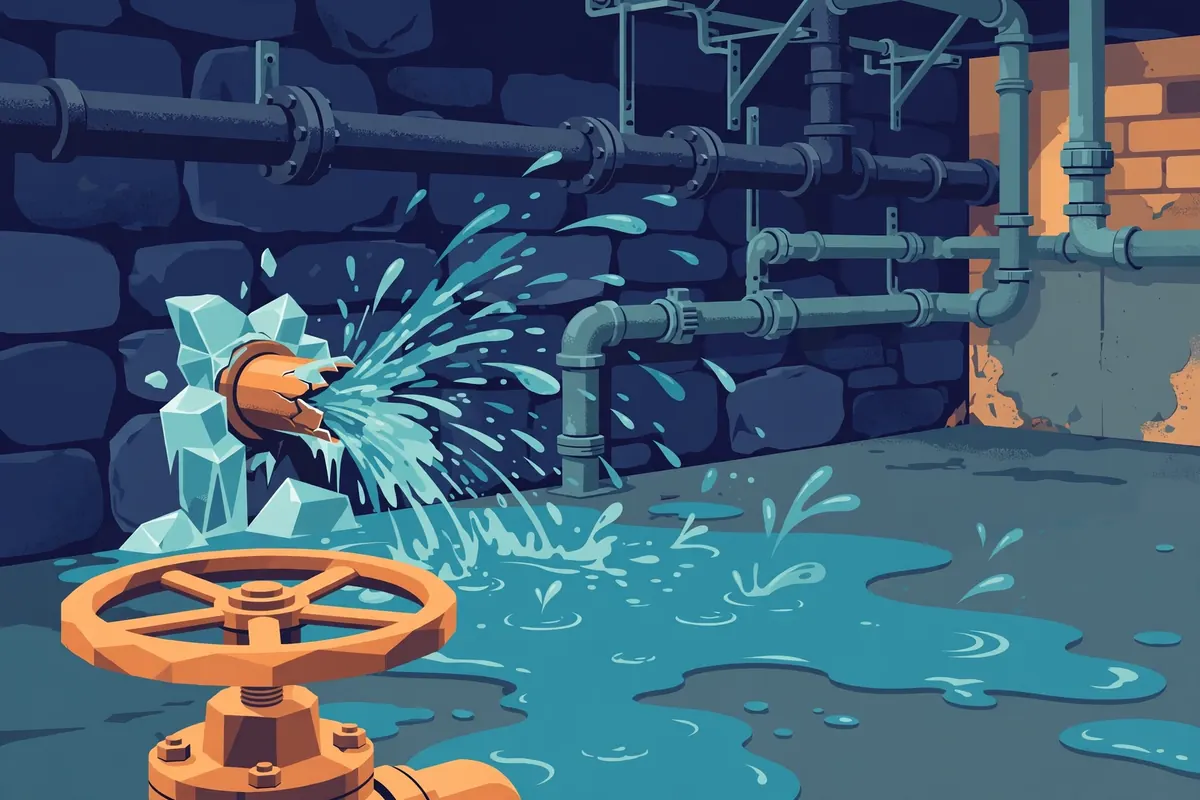
Yonkers geography loads the risk. Hillside homes have pipes in outside walls that face the wind off the Hudson, crawl spaces under additions, and lines running through unheated garages and porches. Vacant units in multi-family buildings, and homes empty during a winter trip, are the classic losses: the heat drops, the pipe freezes, the thaw arrives before the owner does. The prevention list is short and worth taping inside a cabinet door. Keep heat at a steady level even when away, open cabinet doors on outside walls during hard cold, let a faucet on a vulnerable line drip on the coldest nights, insulate exposed lines, and know, before you need it, exactly where your main shutoff is and whether it turns. A five minute check of that valve each autumn is the cheapest water damage restoration yonkers insurance a homeowner can buy.
If a pipe is frozen but not yet split, do not reach for a torch. Gentle heat, a hair dryer, warm towels, the room heater turned up, works, and open the faucet so pressure can escape as the plug melts. If the pipe has split, the first hour steps at the top of this page apply in full: shutoff, safety, photographs, extraction, drying. A winter burst in a plaster building combines the two hardest jobs on this page, a large clean water release and a slow drying structure, and it is exactly the job where daily moisture readings earn their keep.
Buildings with many front doors
Flat Roofs, Masonry Walls and the Apartment Above: Water in Yonkers Multi-Family Buildings
Much of Yonkers lives in multi-family buildings, and water in those buildings obeys building rules, not house rules, so water damage restoration yonkers work here runs through supers, boards and neighbours as much as through pipes.
Begin at the top. Flat roofs on multi-family buildings pond water when drains clog or pitch fails, and ponded water finds the seams, the parapet joints and the old repairs. The leak rarely appears under the failure. It travels along the deck and shows two rooms away, which is why roof jobs begin with a map of stains across several top floor units, not a bucket under one drip. Masonry facades add their own path: wind driven rain enters cracked mortar and failed lintels, soaks the wall, and presents as a damp patch that everyone blames on plumbing until a meter and a dry week separate the two causes. Roof and facade water damage restoration yonkers jobs reward patience, because the wrong diagnosis dries the wrong room.
Then there is the failure every city dweller knows. An appliance or a pipe lets go in an upper floor unit, a washing machine hose, a toilet supply line, a radiator valve, and gravity takes the water through every unit below on that line. Roto-Rooter Yonkers lists it as a standard local scenario: an upper floor failure damages multiple units beneath it. One leak can mean four ceilings, three insurance claims and two arguments, unless the response is coordinated from the first hour: source stopped, super informed, every affected unit photographed and metered, and one moisture map for the stack instead of four crews guessing at quarters of the same wet wall.
Co-op boards and landlords should know their part cold. Who pays turns on where the water started and what the proprietary lease or the lease says, and the claim clocks in the insurance section of this page run from the day of loss for everyone involved. The board practical duties are access, shutoff knowledge and documentation: a building that can put a crew at the right valve in ten minutes, and hand over a floor plan of the risers, will dry faster and argue less. Tenants have duties too: report small leaks early, allow access for readings, and never let a super talk you out of photographing your own ceiling. In multi-family water damage restoration yonkers work, the paper trail is a shared asset, and the buildings that keep one come out of these events with their friendships mostly intact.
Water coming through your ceiling right now?
Tell the super, photograph the ceiling, move what is under the drip, then call. The unit above may not know yet, and minutes matter.
Where the risk sits
Yonkers by ZIP Code: Seven Postal Areas and the Water Each One Knows
Yonkers runs on seven main ZIP codes for homes and businesses, and a water damage restoration yonkers crew reads them the way a sailor reads a chart: each one carries its own water, its own building stock and its own first problem.
| ZIP | Ground it covers | Building stock | The water it knows best |
|---|---|---|---|
| 10701 | Getty Square, downtown, Nodine Hill and the Saw Mill corridor; the largest ZIP in the city, with 70,676 residents in the census count used by the research behind this page | Pre-war apartment buildings, older houses, downtown commercial stock | Saw Mill River flooding, floor drain surcharge, old galvanized and cast iron plumbing |
| 10703 | Northwest Yonkers, including the Warburton Avenue corridor and Nepperhan Avenue ground; 22,586 residents | Co-ops, garden apartments and hillside houses | Hillside runoff, the Warburton and Roberts Avenue funnel, aqueduct ground water |
| 10704 | Northeast Yonkers toward the Bronx River; 31,921 residents | Single family homes and smaller multi-family buildings | Bronx River and Sprain Brook low ground, basement seepage, roof leaks |
| 10705 | Southwest Yonkers, Park Hill and Ludlow Park toward the Hudson; 38,887 residents | Large older houses, apartment buildings, Hudson edge stock | Hillside runoff into below grade rooms, old plumbing, Hudson edge storm water |
| 10707 | The city northeast edge, shared with Tuckahoe | Suburban houses near the Bronx River Parkway corridor | Creek low ground, sump failure, finished basement losses |
| 10708 | Crestwood and the Bronxville border, shared with Bronxville | Detached houses, many with finished basements | Sump and seepage losses in finished basements, frozen pipes in outside walls |
| 10710 | Southeast Yonkers, Dunwoodie and the golf course ground; 25,855 residents | Detached and semi detached houses | Basement seepage, appliance failures, storm runoff on sloped lots |
ZIP populations are the census figures gathered in the research behind this page. ZIP 10702 is a post office ZIP, and 10583 is shared with Scarsdale, so neither is listed as a Yonkers home ZIP here. The DEC high risk areas named on 8 July 2025, War Memorial Field, Nepperhan Heights and Nepera Park, sit inside the 10701 and 10703 ground above.
The DEC report deserves a second look in this table, because Nepperhan Heights and Nepera Park surprise people. They are not on the river. They sit up the Nepperhan corridor, where the Saw Mill tributary ground, old drainage lines and steep contributing slopes combine. A homeowner there reading a flood story about Getty Square may feel safely distant from it. The state report says otherwise, and the practical response is the same basement audit described earlier on this page: drains clear, sump tested, storage raised, photographs taken on a dry day. That audit is the first page of every water damage restoration yonkers file on this ground.
Neighbourhood by neighbourhood
Six Yonkers Areas, Up Close
Pick an area to see its stock, its water and its first moves. The same six areas are written out in the tab script at the foot of this page, so the panel works the same on a phone as on a desk.
The full scope
Water Damage Restoration Yonkers Services, Job by Job
Fifteen services make up the offer catalog in this page schema, and each one below is a real line of work a Yonkers job can need, described the way it happens in a house, not the way it reads in a brochure.
Water Extraction
Standing water comes out first, with truck mounted and portable extractors, weighted tools for carpet and hard surface wands for tile and wood. Every hour water stands, it wicks higher into walls and deeper into floors, so extraction is the service that buys all the others time.
Structural Drying
Air movers, dehumidifiers and directed heat, placed from the moisture map and adjusted daily. Drying is verified with meter readings against the dry standard for each material, and equipment leaves when the numbers say so, which is the only honest finish line in water damage restoration yonkers work.
Flood Cleanup
Storm and river water jobs: silt and debris out, contaminated material removed, structure washed and disinfected, then dried. Saw Mill corridor and Bronx River low ground jobs start here, with safety and category decisions made before extraction.
Sewage Cleanup
Floor drain surcharge and sewer backup work under Category 3 rules: containment, protective equipment, removal of soaked porous material, cleaning and disinfection of what stays, and no fans blowing over contaminated surfaces.
Burst Pipe Repair
The split line is isolated and made safe, the release is extracted, and the wall or ceiling the pipe lived in is mapped and dried. In pre-war Yonkers buildings the crew also checks the neighbouring joints, because galvanized and cast iron rarely fail in just one place.
Mold Remediation
Where mold has started, work follows New York Labor Law Article 32: a licensed mold assessor sets the plan and a licensed remediation contractor does the work, as separate companies, with containment and clearance as the law requires.
Contents Cleaning
Furniture, rugs, documents and belongings are inventoried, moved out of the wet zone, cleaned where they can be saved and stored dry while the structure dries. An itemised contents list doubles as claim evidence, which is why it is written on day one.
Dehumidification
Refrigerant and desiccant dehumidifiers sized to the space and the material load, emptied or drained and logged daily. Dehumidification is what turns air movement into actual drying instead of a warm, damp wind moving water from one wall to another.
Moisture Detection
Pin meters, pinless scanners and thermal imaging used to find the true edge of the water, including water behind plaster, under tile and inside wall cavities that look dry. Detection is a service in its own right on leak jobs with no clear source.
Basement Drying
The Yonkers speciality: below grade drying against hydrostatic pressure, stone foundation wicking and cold hillside walls, with readings taken at the foundation and a plan for the water that may still be arriving while the room dries.
Storm Damage Repair
After the water work: roof and facade openings made weather tight, damaged material removed, and the repairs that return a storm hit home to use. Storm jobs often run alongside flood cleanup and share one documentation file.
Roof Leak Repair
Flat roof ponding, seam failures, parapet and flashing leaks on Yonkers multi-family and house roofs. The stain inside is mapped back to the failure above, which is often rooms away from where the water shows.
Odor Removal
Musty and sewage odors are treated at the source: wet material fully dried or removed, surfaces cleaned, and air scrubbing where needed. Odor that survives proper drying is a moisture reading trying to be heard, and it sends the crew back to the map.
Reconstruction
Drywall, plaster repair, flooring, trim and paint that put the rooms back after drying verifies. Rebuild starts only on dry readings, because closing a wet wall is how a water job becomes a mold job two months later.
Insurance Claim Documentation
Photographs, moisture maps, daily drying logs, itemised scopes and contents lists, assembled for the insurer from the first visit. In New York the claim clocks are short and written, and this file is what meets them.
A real job rarely needs all fifteen. A burst pipe may need five, a Saw Mill flood may need twelve. What matters is that the scope is written from the moisture map of your home, and that every line in it can be explained in plain words while standing in the room it describes. If a line cannot be explained that way, it does not belong in a water damage restoration yonkers scope.
How dry is dry
Drying a Yonkers Home: Moisture Mapping, Daily Readings and the Dry Standard
Drying is the centre of water damage restoration yonkers work, and it is a measurement discipline: a map at the start, readings every day, and a finish line set by the material, not by the calendar or the rental clock on the equipment.
It begins with the map. The technician works outward from the source with pin and pinless meters, checking floors, baseboards, wall faces and, where the stock demands it, wall cavities and plaster depth, marking the wet boundary in pencil on the wall and on a sketch of the room. Thermal imaging helps find cool, wet areas behind finished surfaces. The map decides everything after it: what is extracted, what is opened, where air movers point, and which materials get a drying goal of their own. Everything in water damage restoration yonkers drying is downstream of this hour of measurement.
Then the equipment is set to the map, not to habit. Air movers create evaporation at wet surfaces, dehumidifiers pull that moisture out of the air before it condenses somewhere else, and containment keeps the drying effort inside the wet rooms instead of humidifying the whole house. In plaster and stone Yonkers buildings, baseboards come off and small openings at the wall base let air into cavities, because a wall that cannot breathe cannot dry, and a wall dried only on its face will fail a cavity reading on the last day and add two more.
Every day, the crew returns, takes the same readings at the same marked points, and writes them down. That log is the job. Falling numbers in a straight line mean the plan is right. A number that stalls means something is still feeding the wall, a hidden cavity, a slow leak, a foundation still wicking river ground water, and the plan changes that day, not at the end of the week. Homeowners can ask to see the log at any visit, and should: a water damage restoration yonkers company that cannot show you yesterday numbers is asking you to trust a feeling.
The finish is equally plain. Each material has a dry standard, the moisture level of the same material in an unaffected part of the home, and the job is done when the wet points reach it. Most Yonkers homes get there in 3 to 5 days after extraction. Plaster, hardwood, stone and finished basements can run longer. Equipment that leaves a day early saves a little money and risks a mold claim; equipment that stays a day late costs a little money and risks nothing but patience. Crews are paid to choose the second error. That patience is what water damage restoration yonkers homeowners are actually buying when they buy drying by the day.
What can be saved
Hardwood, Carpet and the Things You Own: What Survives a Yonkers Flood
After the water stops, the next question in every water damage restoration yonkers home is the same: what can be saved? The honest answers run material by material.
Hardwood floors
Real hardwood can often be saved if drying starts fast. Water enters at the seams, boards cup as they take on moisture unevenly, and the cure is extraction, drying mats or directed air, and time for the boards to release moisture and settle. Floors that stay wet buckle, and buckled floors are a replacement conversation. Tile set on wood subfloors in pre-war Yonkers bathrooms is a trap of the same kind: the tile reads dry while the wood beneath it stays wet, which is why tile floors get a subfloor reading, not a surface one.
Carpet and padding
Carpet itself can often be cleaned and dried after clean water. Padding is cheap, absorbent and slow to dry, and after gray or black water it is removed as a rule. In a finished Crestwood or Dunwoodie basement, expect the padding to go and the carpet to be lifted, dried and relaid if the water category allows it.
Drywall, plaster and insulation
Drywall that stays wet loses strength and feeds mold on its paper face; where flood water has soaked it, a flood cut at a clean line above the water is standard, and the wet insulation behind it comes out. Plaster is tougher and can often be dried in place with cavity air, which is one of the few advantages the older Yonkers stock holds. Either way, the decision is made from readings inside the wall, and closing a wall that has not verified dry is the one unforgivable shortcut in this trade.
Contents and keepsakes
Documents, photographs and electronics come out of the water first, in the first hour, because they are the least replaceable and the fastest ruined. Furniture on legs survives what furniture on a slab does not. Rugs are rolled, taken out and cleaned off site. Everything removed is listed, and the list matters twice: once for the cleaning decision, and once for the claim, where a dated inventory with photographs is the difference between a paid contents loss and an argued one.
One rule covers every material above: speed is a saving decision. The same hardwood floor is a drying job on day one and a replacement job on day five. That is not a sales line, it is the physics of water in wood, and it is why this page keeps returning to the first hour. Materials forgive fast water damage restoration yonkers work and punish slow work, every single time.
The clock after the clock
Mold in Yonkers: The 24 to 48 Hour Clock and New York Article 32 Licensing
Mold is the reason water damage restoration yonkers work is urgent, and New York regulates mold work more strictly than most states, so Yonkers homeowners should know both the biology and the law before they need either.
The biology is short. Mold spores are everywhere, indoors and out, and they need only moisture and a food source, both of which a wet wall provides. The U.S. Environmental Protection Agency (EPA) puts the start of growth at 24 to 48 hours on material that stays wet. That window is why extraction and drying begin the day water is found, and why a slow leak inside a wall, running for weeks before it shows, so often arrives with mold already established behind the plaster. Visible mold is handled as a finding, not a panic: the area is contained, the moisture source is fixed first, and growth without drying is treated as a job half done, because mold on a still wet wall is coming back. Mold is the reason water damage restoration yonkers crews treat the first two days as a deadline, not a target.
The law is Labor Law Article 32, in force statewide since 1 January 2016, and it applies in Yonkers exactly as it applies in the city. For mold projects above the smallest scale, New York requires a licensed mold assessor to inspect and write the remediation plan, and a separately licensed mold remediation contractor to carry the plan out. The assessor and the remediator cannot be the same company on the same project. The point of the split is honesty: the firm that profits from the size of the job does not get to decide its size. A water damage restoration yonkers company working in New York should be able to explain this structure on the phone, arrange the assessment, and show the licence for the role it is playing.
What Article 32 is not is a New York City rule. Yonkers readers comparing pages across this site will find Local Law 55 and Local Law 61 discussed on the New York City pages; those are city laws about city housing, and they do not govern a Yonkers home. Westchester County homes answer to the state framework: Article 32 for mold, the state insurance rules in the next section for claims, and the building and health codes of the city of Yonkers and the county for the rest. Keeping those lines straight is part of giving Yonkers its own page instead of a copied one.
The clocks that protect you
Your Insurance Claim in New York: Regulation 64, Section 2618 and the 24 Month Suit Limit
New York writes its claim rules down, with numbers, and a water damage restoration yonkers homeowner who knows the numbers holds real leverage. These are the four that matter most, stated as the law states them.
| The rule | What it requires | Where it lives |
|---|---|---|
| Claim handling clock | Your insurer must acknowledge your claim, begin investigating and accept or reject it within 15 business days, and pay within 5 business days once a settlement is reached | Regulation 64, 11 NYCRR Part 216, under Insurance Law section 2601 |
| Disaster pay clock | After a disaster, a settled claim must be paid within 4 business days, not 3, and a non-commercial claim must be accepted or rejected within 15 business days after proof of loss and the required items are in | Insurance Law section 2618 |
| Disclaimer rule | An insurer denying a claim under a liability policy must say so as soon as is reasonably possible. Section 3420(d) covers liability policies only, does not apply to property damage, and contains no 15 day figure of its own | Insurance Law section 3420(d) |
| Suit limit | A lawsuit on the policy must be started within 24 months of the date of loss | Insurance Law section 3404, the standard fire policy |
Regulation 64 is enforced by the New York State Department of Financial Services (DFS). It gives homeowners a regulator to complain to, not a private right to sue on the regulation itself, which is a distinction worth knowing before anyone promises otherwise.
What counts as covered comes first, before any clock. Homeowners policies generally cover sudden and accidental water damage: a burst pipe, a failed water heater, a supply line that lets go. Flooding that comes from outside the home, river water, surface water, groundwater rising through the foundation, is generally excluded unless you carry separate flood insurance, which the next section covers. Sewer backup is often an added endorsement with its own limit, so a Yonkers homeowner with a floor drain should read the declarations page for that line specifically, on a dry day, before the drain ever matters.
The working habits that protect a claim are unglamorous. Report the loss promptly, photograph and video everything before cleanup, keep a written log with dates and times, keep every invoice and every drying log, and do not throw away damaged material until the adjuster has had the chance to see it or photograph it with you. When a leak comes from the apartment above, the same habits apply, and the building paperwork, the super report, the board notice, joins the file. Water damage restoration yonkers crews who document as they go are not doing the insurer a favour. They are building the only version of the loss that will exist when the claim is read, weeks later, by someone who never stood in the room.
The clocks start on the day of loss.
Extraction, photographs and a written log today are worth more than a perfect memory next month. Start both clocks, the drying and the claim, on the same call.
The water your policy excludes
Flood Insurance and the NFIP: Cover for the Saw Mill Corridor
For homes along the Saw Mill, the Bronx River and the Sprain Brook, the flood policy is the policy that matters, and water damage restoration yonkers homeowners should understand what the National Flood Insurance Program (NFIP) does and does not do before the river teaches them.
The NFIP is the federal flood insurance program, sold through insurers and agents, and it exists because ordinary homeowners policies exclude flood. A flood policy covers direct physical loss from flooding as the program defines it, generally water covering ground that is normally dry, and it treats basements carefully: building systems and certain appliances are covered, while finished basement improvements and most contents stored below grade are limited or excluded. That basement limitation surprises Yonkers families with finished basements in Crestwood and Dunwoodie every flood season, and it is better learned from this page than from a claim denial.
Two practical points follow. First, flood policies normally carry a waiting period before they take effect, so a policy bought with a storm already forecast is usually a policy bought for the next storm. Second, authorisation is not expiry. The NFIP authorisation currently runs through 11 December 2026 at 11:59 p.m.; that date is the deadline for the program authorisation, not the day existing policies stop. A policy in force keeps its own term. Homeowners should still note the date, confirm their cover with their agent well before it, and treat flood cover as a standing part of owning low ground in Yonkers, not a reaction to a forecast. Flood cover is part of water damage restoration yonkers planning on low ground, not an extra.
And when flood water does come in, remember the category rules from earlier on this page: river water is Category 3 by the time it has crossed streets and yards, whatever it looked like in the channel at Getty Square. Extraction, removal of soaked porous material, cleaning, disinfection and verified drying is the sequence, and the flood policy file needs the same photographs, logs and itemised scope as any other claim.
Short answers
Yonkers Quick Answers: Six Questions From a Wet Kitchen Floor
Six questions Yonkers homeowners type into a phone with wet hands, answered in one breath each. The full 30 question set, with longer answers, is in the FAQ section near the foot of this page.
A pipe just burst. What first?
Close the main shutoff, open a faucet on that line to drain pressure, keep power away from wet areas, and photograph everything before you move it. Then call (914) 555-0147 (placeholder). In a Yonkers winter, check the pipes beside the split one, because frozen lines often fail in pairs on the thaw.
How fast should I call?
The same day, within the first hours if you can. Water keeps wicking into plaster, drywall and wood long after the puddle stops spreading, and mold can begin within 24 to 48 hours, according to the EPA. A call made tonight is a drying job. A call made Thursday is often a mold job too.
How long will drying take?
Most Yonkers homes dry in 3 to 5 days after extraction. Plaster walls, hardwood floors, stone foundations and finished basements hold water longer and can push a job past a week. Daily moisture readings set the end date, and equipment leaves only when the readings reach the dry standard for each material.
My basement is flooding. What do I do?
Protect people first: stay out of water that has reached outlets or appliances, and never enter a basement where water is rising around electrical equipment. If a pipe is the source, close the main shutoff. Photograph the room, move what you can to dry ground, and call (914) 555-0147 (placeholder) for same day extraction.
Will insurance cover it?
Usually, when the water is sudden and accidental: a burst pipe or a failed water heater is the classic covered loss. Flooding from outside the home needs separate flood insurance, and sewer backup is often an added endorsement with its own limit. Report the loss promptly and keep photographs, because coverage turns on the source.
Can I dry it myself?
A small, clean spill caught in the first hour, yes: mop it, ventilate it and meter it if you can. Anything bigger, dirtier or older than a day needs a crew, because the water you cannot see, inside walls and under floors, is the water that grows mold and rots structure quietly.
One page of numbers
Yonkers Key Facts: The Numbers Every Homeowner Asks For
Every water damage restoration yonkers job runs on the same short list of numbers: how high the river gets, how fast mold starts, how long drying takes, and the New York claim clocks that start the day the water does. Here they are in one place.
| Fact | The number | Where it comes from |
|---|---|---|
| People living in Yonkers | 211,569 in the 2020 census, the highest count in city history | U.S. Census Bureau |
| Highest recent Saw Mill River peak | 9.61 feet on 28 August 2011, during Hurricane Irene | USGS gage 01376500 at Yonkers |
| Hurricane Ida on the same gage | 9.07 feet on 1 September 2021 | USGS gage 01376500 at Yonkers |
| Ida rainfall on the county | 4 to 9 inches, at rates of 3 to 4 inches an hour | The Ida storm record, 1 and 2 September 2021 |
| DEC high risk areas in Yonkers | War Memorial Field, Nepperhan Heights and Nepera Park | DEC Saw Mill River report, 8 July 2025 |
| Mold can begin | 24 to 48 hours on material that stays wet | U.S. Environmental Protection Agency (EPA) |
| Typical structural drying | 3 to 5 days once extraction is done | Daily moisture readings set the real end date |
| Insurer claim clock | 15 business days to acknowledge, investigate and accept or reject | Regulation 64, 11 NYCRR Part 216 |
| Disaster pay clock | 4 business days after a claim is settled | Insurance Law section 2618 |
| Suit limit | 24 months from the date of loss | Insurance Law section 3404 |
| Homeowners searching for this service | 40 searches a month in SEMrush, 41 in Moz | SEMrush and Moz, United States, November 2026 |
Two of those numbers deserve a second thought. The search volume is small, 40 or 41 people a month typing the exact words, because most Yonkers homeowners in trouble search for a plumber, a basement, or the word emergency instead. And the river numbers are annual peaks, which means the gage has recorded a serious test of the corridor in most recent years, not once in a lifetime. Plan for the river you have, not the one in the brochure.
Asked out loud
Voice Answers: What Yonkers Homeowners Ask Out Loud
Most water emergencies begin as a question shouted at a phone with wet hands. These are the questions Yonkers homeowners ask out loud, answered the way a person would say them: short enough to hear, complete enough to act on.
Hey, my basement is flooding right now. What do I do?
First, protect yourself: stay out of the water if outlets or appliances are standing in it. If a pipe is the source, turn off the main shutoff. Then call (914) 555-0147 (placeholder) for same day help, photograph everything while you wait, move what you can to dry ground, and do not throw anything away yet.
How fast can someone actually get here?
A local crew should be starting the same day, and in this work same day is not a slogan. Water keeps spreading and mold can begin within 24 to 48 hours, so the first visit is extraction and drying setup, not an estimate appointment. Ask for the arrival window when you call, and hold the company to it.
Water came up through my floor drain. Is it dangerous?
Treat it as dangerous, yes. In a storm that usually means the sewer surcharged, and that water is Category 3, contaminated by definition. Keep children and pets out of the basement, touch nothing barehanded, do not run a fan over it, and let a crew in protective equipment extract it and disinfect the room.
The Saw Mill River is up. Should I worry?
If you live along the corridor, take it seriously. The USGS gage at Yonkers has peaked above 9 feet in three recent storms, including 9.61 feet during Irene in 2011. Move cars off low streets, lift what you can off the basement floor, check the sump pump, and be ready for the floor drain if the sewers fill.
How long until my house is back to normal?
Drying usually takes 3 to 5 days after the water is out, longer for plaster, hardwood and stone. Rebuild follows once readings verify dry. The honest answer comes from the moisture log, not the calendar, and a good crew will show you the numbers each day so you can watch your own home dry.
Watch a real job first
YouTube Case Studies: Two Drying Jobs Worth Watching Before You Sign Anything
No Yonkers specific restoration case video exists that this page can stand behind, so instead here are two transcript backed videos from working restoration channels that teach the two judgements a water damage restoration yonkers homeowner needs most: what to do before mold starts, and why testing comes before tearing out.
Home RenoVision DIY: Water Damage? Do This BEFORE Mold Takes Over
A working renovator walks through the first moves after water damage, in the order they matter, with the mold clock as the reason for the hurry. Watch it for the sequence: stop the source, get the water out, get air moving, and do not let wet material sit while you decide. Watch on YouTube
Certified Restoration: Test Before You Tear
A restoration firm makes the case for testing and metering before demolition, showing how readings decide what actually has to come out. Watch it before any crew quotes you a wall removal: the difference between a tested scope and a guessed one is measured in rooms. Watch on YouTube
Both videos are linked, not embedded, so this page stays fast and nothing tracks you for pressing play. The lesson they share is the lesson of this whole page: the first day is for stopping, extracting and measuring, and every later decision gets cheaper and safer when those three are done properly.
Hire with your eyes open
Choosing a Crew in Yonkers: Questions That Separate the Real Ones From the Templates
Yonkers is served by national templates, franchise pages and at least one lead generation site with a California phone number, so choosing a water damage restoration yonkers company takes a few pointed questions. Ask these on the first call.
- Will you show me moisture readings? A real crew maps moisture on arrival and logs it daily. If the answer is about fans and experience instead of numbers, keep calling.
- What standard do you dry to? The answer should name ANSI/IICRC S500 without hesitation, and explain the dry standard for your materials in plain words.
- Where is your business, exactly? Ask for a street address and a local phone number. One prominent Yonkers restoration website answers with a 650 area code, which is the San Francisco Bay Area, and no address at all. Draw your own conclusion.
- How do you handle mold under New York law? The answer should describe Labor Law Article 32: licensed assessment, licensed remediation, separate companies. Confusion here is a warning.
- What will the insurance file contain? Photographs, moisture maps, daily logs and an itemised scope, built from day one. A company that documents badly costs you money at claim time, long after the fans are gone.
- Are you open when I need you? Water does not keep office hours. One Yonkers franchise lists weekday hours of 8 to 5 in its own footer. A burst pipe at midnight deserves a better answer than a voicemail.
Notice what is not on that list: a star rating. Ratings matter when they are real, and this page carries none, because the business behind it has not yet supplied its details, and inventing a rating is exactly the trick the questions above are designed to catch in others. Judge the answers, the paperwork and the readings. Those are hard to fake, and they are what your home will actually live with after the water is gone. Hold every water damage restoration yonkers company, including this one, to exactly that test.
Before the next storm
Before the Next Storm: A Yonkers Prevention Walkthrough, Room by Room and System by System
The cheapest water damage restoration yonkers job is the one that never happens, and most prevention is a Saturday of small tasks. Walk the house in this order.
The basement systems
Test the sump pump by lifting its float, and fit a battery backup, because storms take power and water together. Clear the floor drain and consider a backwater valve if your street has ever surcharged. Raise storage off the slab on shelving, keep the bottom shelf for things water cannot ruin, and photograph the room dry. Check the water heater age and pan, the laundry hoses, and the main shutoff: find it, turn it, and teach one more person in the house where it is.
The walls and pipes
Insulate exposed pipes in outside walls, crawl spaces and garages before the first hard frost. Know which lines run through unheated additions. In multi-family buildings, ask the super where the riser shutoffs are and whether the building keeps a list. A leak found by a neighbour report in ten minutes is a drying job; the same leak found after a weekend is a rebuild.
The roof and the ground outside
On flat roofs, clear the drains twice a year and after big leaf falls; ponding water is a leak looking for a seam. On houses, clean gutters, extend downspouts away from the foundation, and check that soil and paving slope away from the walls. On the hills, look at where uphill water goes in a storm: a trench drain or a swale that is blocked with leaves is a basement flood with an appointment.
The storm routine
When a serious storm is forecast for the Saw Mill or Bronx River corridors, the routine is short: cars off the lowest streets, valuables up in the basement, sump checked, phone charged, and this number saved: (914) 555-0147 (placeholder). Ida gave Yonkers a few hours of warning and still filled basements across the northwest. A routine you have rehearsed once is worth more than a plan you invent in the rain. Storm preparation is water damage restoration yonkers work done at the only time it is cheap: before.

The Yonkers water year
Month by Month in Yonkers: River Water, Freeze Water and Thaw Water
Buffalo has a snow calendar and Syracuse has a thaw calendar. Yonkers, close to the coast and cut by rivers, has a rain calendar, and a water damage restoration yonkers homeowner can read the year in it.
| Season | The water that comes | The jobs it brings | The preparation that pays |
|---|---|---|---|
| Winter, December to February | Frozen pipes in outside walls and empty units; ice at roof edges on shaded slopes | Burst lines on the thaw, ceiling leaks, plaster buildings drying slowly in cold air | Steady heat, insulated lines, cabinet doors open on the coldest nights, shutoff known |
| Spring, March to May | Heavy rain on saturated ground; the Saw Mill and Bronx River running high | Basement seepage, sump overloads, floor drain surcharges in the hardest storms | Sump test, drain cleared, gutters cleaned, downspouts extended away from the foundation |
| Summer, June to August | Short, violent thunderstorms; tropical remnants arriving some years | Flash flooding on the corridors, hillside runoff, window well and stairwell entries | Storm routine rehearsed, basement storage raised, battery backup fitted before the season |
| Autumn, September to November | The Ida season: tropical systems and long rain on wet ground; the 26 October 2021 storm peaked higher than Ida | The biggest river floods of the year, sewer surcharge, multi street events | Full basement audit, flood policy confirmed in force, cars moved off low streets on warnings |
The dates on the gage record make the autumn point without any help. Irene peaked on 28 August 2011. Ida peaked on 1 September 2021. The forgotten storm peaked on 26 October 2021. Three of the four highest readings in the recent record of the Saw Mill at Yonkers fall between late August and late October. Winter owns the pipes, spring owns the seepage, and autumn owns the river. A Yonkers maintenance calendar that respects that order will prevent more damage than any single device you can buy.
Shops, offices and institutions
Commercial and Institutional Water Damage in Yonkers: Getty Square to the Medical Mile
A flooded shop on Getty Square, a school basement, a medical office near the hospitals: commercial water damage restoration yonkers work runs on the same physics as a house and a completely different set of pressures.
The first pressure is time. A home can be uncomfortable for a week; a business bleeds money every closed day, and a school or a clinic carries duties to people who did not choose to be there. Commercial jobs are planned backwards from reopening: extraction and drying run around the clock, work areas are contained so clean parts of the building stay open, and the drying log doubles as the document that lets a manager prove to an insurer, a landlord or a regulator that the space was dried to a standard before people came back.
The second pressure is coordination. Downtown Yonkers buildings stack tenants over shared risers and shared roofs, so one tenant leak is a building event, as the multi-family section of this page describes at residential scale. Add sprinklers, alarm systems, server rooms, stock, medical records and food stock, and the contents side of a commercial job can outweigh the structure side. The contents inventory discipline from the services section applies with interest: photograph everything, list everything, and decide save or dispose with the insurer file open on the table, not from memory after the dumpster leaves.
The third pressure is the paper. Commercial policies carry their own clocks and their own proof requirements, business interruption cover turns on dates that must be documented to the day, and landlords and tenants each hold pieces of the loss. A water damage restoration yonkers crew that works commercially should be able to run one clean file for all of them: one moisture map, one log, one scope, shared with every party at the same time. Buildings that get that file reopen faster and argue less, and in a downtown where the same names own, manage and insure half the square, that reputation is the whole business.
Where water hides
Room by Room in a Yonkers Home: Where the Water Goes and What to Watch
Water reads a house differently from the people who live in it. This room by room pass through a typical Yonkers home shows where a water damage restoration yonkers crew looks first, and what a homeowner can watch between visits.
Kitchen
The kitchen concentrates supply lines, a dishwasher, a refrigerator line and a sink trap in one run of cabinets, often against an outside wall. Leaks here hide under cabinets and travel along the subfloor into the next room before a stain shows. Open the cabinet doors after any leak, feel the floor at the toe kick for softness, and treat a warped board at the sink as a meter reading asking to happen.
Bathrooms
Toilet supply lines and wax rings fail slowly; tub and shower valves fail inside the wall. In pre-war Yonkers bathrooms, tile on wood subfloors hides the damage longest: the tile stays handsome while the wood under it softens. A spongy step near the tub is never a small thing. Bathrooms above bathrooms, stacked on one riser, are where multi-family leaks announce themselves one floor down.
Laundry
Washing machine hoses are among the most common burst sources in the trade, and they fail at full pressure. Braided steel hoses, a shutoff you can reach, and a drain pan are cheap insurance. A laundry on an upper floor multiplies the stakes by every ceiling below it.
Basement and utility rooms
The water heater, the furnace, the main stack, the cleanout and the sump share this room in most Yonkers homes, which is why it is both the most useful room in the house and the most flooded. Water heaters fail by leaking slowly, then all at once. Keep the floor drain clear, the area around the heater visible rather than boxed in with storage, and a light you can actually see by.
Bedrooms and living rooms
These rooms rarely start a leak; they receive them, from radiators, from the bathroom next door, from the unit above. Radiator valves in older Yonkers buildings weep for months into carpet padding. The signs are humble: a musty smell that survives cleaning, baseboards swelling, paint bubbling low on a shared wall. Each one is a moisture map waiting to be drawn, and catching them at the smell stage is the difference between drying a wall and rebuilding it.
Attics and roofs from inside
A brown ceiling stain is a roof or plumbing story already in progress. Note whether it grows when it rains, which points to the roof, or when a fixture runs, which points to a pipe. Photograph it with a coin for scale and date the photograph. That small habit turns an argument about when a leak began into a fact, and facts are what claims and warranties run on. Small habits like that make every later water damage restoration yonkers conversation shorter.
After the first hour
The Rest of the First Day: Hours 2 to 24 on a Yonkers Job
The first hour stops the loss. The rest of the first day decides the size of the claim, the length of the drying and how much of the home a water damage restoration yonkers crew can save.
Hours 2 to 6 belong to extraction and the map. The crew removes standing water, lifts carpet where the category allows, checks cavities and subfloors, and draws the moisture map that the rest of the job follows. Contents come out of the wet rooms in this window too, listed and photographed as they move. By the end of it, the homeowner should know three things in plain words: what got wet, what the plan is, and what the next visit will measure. If any of the three is missing, ask, because this is the cheapest moment of the whole job to correct a misunderstanding.
Hours 6 to 24 belong to the drying setup and the claim. Equipment is placed to the map, containment is built where categories demand it, and the first readings go into the log with times attached. The insurer is notified, the claim number joins the file, and the homeowner log, started in the first hour, gains the names and times of everyone who has entered the house. In a co-op or a rental, the building paperwork joins the same file on the same day, while memories and goodwill are both fresh.
What should the homeowner do during those hours? Stay reachable, keep children and pets out of the work rooms, resist switching equipment off, and write down questions as they occur instead of relying on the next visit to remember them. Sleep, if the house allows it, matters too: a flooded home is a marathon of small decisions over the following week, and the families who pace the first day handle the fifth day best. The crew job is the water. Your job is the record, the decisions and the people, and day one is when all three are set. Day one discipline is the difference between a water damage restoration yonkers job and a water damage story.
Whose rules apply here
Yonkers Is Westchester: Why This Page Follows State Law and County Ground, Not City Hall Rules From New York City
Yonkers touches the Bronx and is often called the Sixth Borough, but for water, mold and insurance it is a Westchester County city under New York State law, and a water damage restoration yonkers page that copies New York City rules into Yonkers would be wrong in ways that cost people money.
So, plainly: the New York City agencies and laws that fill the city pages of this site do not govern here. The city Department of Environmental Protection does not run Yonkers water. The city housing agencies and their repair rules stop at the city line. Local Law 55 and Local Law 61, the city mold and housing laws discussed on the borough pages, do not apply to a Yonkers address. Claims against New York City, with their own forms and deadlines, are for losses the city itself causes inside the city, not for a flooded basement on Warburton Avenue.
What governs here instead is the state framework this page has used throughout: Regulation 64 and Insurance Law sections 2618, 3420(d) and 3404 for claims, Labor Law Article 32 for mold work, the building and health codes of the City of Yonkers and Westchester County for the property itself, and federal flood insurance through the NFIP for the river water your homeowners policy excludes. Yonkers also runs its own city services and its own emergency response, and in a flood the city and county warnings, not a borough page, are the ones to follow.
This is more than a legal nicety. Every page on this site is built to own its own ground, with its own rivers, its own dates and its own rules, because a homeowner in trouble does not need the largest answer. They need the answer for their street. Yonkers has the Saw Mill, the seven hills, the Ida record and the DEC map. That is the Yonkers this page serves, and it is enough.
Water in your Yonkers home right now?
One call starts the extraction, the drying log and the claim file together, under the rules that actually apply to your address.
The first visit, honestly described
The First Visit, Minute by Minute: What a Yonkers Inspection Actually Looks Like
Homeowners often meet a water damage restoration yonkers crew for the first time on the worst day of their year, so here is the first visit as it should run, minute by minute, with nothing hidden.
Minutes 1 to 5 are introductions and safety. The crew confirms the source is stopped, checks for electrical hazards in the wet area, and asks where the water started and when. On a water damage restoration yonkers call, these five minutes decide whether the visit is a drying job or a safety job first, and a good crew will say so plainly if the room is not safe to enter yet.
Minutes 5 to 20 are the walk. The technician moves through every affected room and the rooms beside and below them, meter in hand, looking at baseboards, thresholds and ceilings, and opening the cabinet doors nobody thinks of. Water damage restoration yonkers inspections find the second wet room in this window: the closet behind the bathroom, the ceiling under the laundry, the basement corner below the kitchen stack.
Minutes 20 to 40 are the map. Readings are taken at marked points, the wet boundary is drawn in pencil, and photographs are shot for the file. This is the slow, quiet part of a water damage restoration yonkers visit, and it is the part that saves the money, because every later decision, what opens, what dries, what goes, traces back to these numbers.
Minutes 40 to 55 are the plan, given out loud. The crew states what got wet, what category the water is, what will be extracted today, what material cannot be saved and why, and how many days the drying is expected to run. A water damage restoration yonkers plan you cannot repeat back in your own words is not a plan yet, so ask until you can.
Minutes 55 to 60 are the paper. The scope is written, the claim conversation happens, and the next visit is booked before the crew leaves. Water damage restoration yonkers work that starts with a signature on a clear scope, and a photograph set both sides hold, rarely turns into an argument later, and that is worth five minutes of anybody day.
What should not happen in the first visit is pressure. A crew that demands a decision before the map exists is selling, not restoring. The water justifies urgency; it does not justify blindness. Take the hour, watch the meter, read the scope, and let the readings make the decisions they are there to make. Watch for that calm, measured pace: it is the visible signature of real water damage restoration yonkers work.
One machine, whole basement
The Sump Pump: The Hardest Working Machine in a Yonkers Basement
More water damage restoration yonkers jobs begin at a sump pit than at any other single point in the house, because the pump is the one defence that must work perfectly on the worst night of the year.
A sump pump has a simple life. Groundwater collects in a pit below the slab, a float rises with the water, the pump wakes and pushes the water out through a discharge line, and the pit empties until the next rise. Every water damage restoration yonkers crew knows the corollary: the system has four parts that can fail, the pump, the float, the power and the discharge line, and storms attack all four at once.
The float is the quiet traitor. It sticks on the pit wall, tangles in its own cord, or jams under a fallen object, and the pump sits healthy and silent while the pit overflows. Testing a water damage restoration yonkers defence starts here: pour water into the pit or lift the float by hand twice a year and watch a full cycle run, not just a hum.
Power is the second traitor, because the storms that fill pits also drop trees on lines. A pump without power is a hole in the floor with a lid. Battery backup pumps exist for exactly this pairing of failures, and on low Yonkers ground they are not an upgrade. They are the difference between a wet pit and a water damage restoration yonkers job with your name on it.
The discharge line fails in winter, when its outside end freezes, and in autumn, when leaves and silt narrow it. A pump can run perfectly against a blocked line and move no water at all. Walk the line once a season, know where it ends, and keep the end clear and pointed away from the foundation it just rescued the water from.
Sizing matters too. A small pump in a big inflow is a bucket brigade of one. If your pit fills fast in moderate rain, the spring storms will beat the pump you have, and the time to learn that is during a test with a hose, not during the night the Saw Mill corridor takes four inches of rain in three hours. Sump capacity is a water damage restoration yonkers decision made in peacetime, and it should be made like one.
Finally, respect the pit as evidence. After any flood, the pit tells the story: how high the water rose, whether the pump ran, what the inflow carried in. Photograph it before it is cleaned. More than one insurance argument has been settled by a waterline inside a sump pit, the humblest witness in the house.
When did you last hear your sump pump run?
If you cannot remember, test it this week. Ten minutes with a bucket of water is the cheapest insurance in Yonkers.
One job, told straight
A Drying Diary: Five Days in a Flooded Park Hill Basement
Composite, but true to the work: a water damage restoration yonkers drying job in a Park Hill basement, day by day, with the numbers doing the talking. Details are blended from the patterns this trade sees weekly; no single real household is described.
Day zero, the call. A supply line to a basement laundry sink lets go in the early morning and runs for hours before anyone is awake. The water is clean, Category 1, and it has spread across a finished basement: carpet, padding, two drywall partitions and a bathroom. On this water damage restoration yonkers job, the shutoff is found in four minutes because the owner knew where it was, which is the single luckiest fact of the week.
Day zero, the visit. Extraction takes the afternoon. The map shows the carpet wet wall to wall, the padding soaked, the drywall wet to eight inches, and the bathroom tile reading dry on its face and wet in the subfloor beneath. Padding comes out, baseboards come off, and flood cuts are marked but not yet made, pending the first drying readings.
Day one. The equipment goes in: air movers along both partitions, a dehumidifier sized for the volume, drying mats on the worst of the floor area. The first full log is written. A water damage restoration yonkers diary lives or dies on this page of numbers, because day three decisions are made from day one readings, and memory is not a measuring instrument.
Day two. The carpet is releasing moisture well and the room air readings fall on schedule. One partition dries on plan; the other stalls at the corner nearest the bathroom, which is the map quietly pointing at the tile subfloor. The crew opens the marked flood cut there and finds the cavity wet, exactly as the readings suspected.
Day three. With the cavity open and air moving through it, the stalled corner starts to fall. The bathroom subfloor, dried from below through a small access opening, reaches its goal by evening. This is the day a rushed job would already have closed the wall, and the reason water damage restoration yonkers work is sold by readings rather than by days.
Day four. Every point but the stone foundation wall is at the dry standard. The foundation, old Park Hill stone, is still handing moisture to the room, so the equipment stays one more day with air aimed at the wall base. Nobody on the job calls this a delay. The stone was wet before the carpet was, and it will be dry after it, on its own schedule.
Day five. The foundation reads at standard, the equipment comes out, and the file is closed with five days of logs, the photograph set and the scope, ready for the claim and for the rebuild crew. The basement is not finished; it is dry, which is a different and more important thing. Rebuild begins the following week, on walls that will not grow anything behind the new paint.
The moral of the diary is not that every job takes five days. It is that every day of this one was decided by the day before readings, including the day the wall was opened and the day the fans stayed. That is the whole method, and it fits in a notebook.
The belongings half of the job
Pack Out Day in Yonkers: Where Your Belongings Go While the House Dries
On bigger jobs, a water damage restoration yonkers crew does not dry around your life. Your belongings are packed out: inventoried, moved, cleaned and stored while the structure dries. Here is how that day should run.
It starts with the list. Every item leaving a wet room is photographed, described and numbered before it is wrapped, and the list is shared with the homeowner the same day. On water damage restoration yonkers pack outs, that list is not clerical decoration. It is the claim record for your contents, the cleaning plan and the return ticket, all in one document.
Sorting happens at the door of the wet room, in three honest piles. What water never touched moves to a dry room and stays in the house. What got wet and can be cleaned goes out for cleaning: rugs, furniture, clothing, documents that need specialist care. What got wet and cannot be saved, soaked upholstered pieces after black water, swollen particle board, is photographed, listed and disposed of only with the owner agreement and the insurer file in mind.
The argument every crew has learned to have early is about paper. Photographs, letters, files and books are the least replaceable things in most homes and the fastest ruined by water. On a water damage restoration yonkers job they come out first, ahead of furniture worth ten times their price, because money replaces a sofa and nothing replaces a wedding album.
Storage is plain and important: dry, secure, and listed against the inventory, so that what went out in fourteen boxes comes back as the same fourteen boxes. Ask where your things will sleep while the house dries, and get the answer in writing on the scope. Vague storage is where belongings go to become a dispute.
Cleaning decisions follow the water category, as everything on this page does. Clean water contents are cleaned and dried and returned. Gray water contents are cleaned with disinfection in the process. Black water contents face the hard rule from the categories section: porous items that soaked are generally not returned to a home, however loved, because no cleaning standard can certify them safe.
Pack in day mirrors pack out day. Items return against the same list, are checked off in the rooms they belong in, and any shortage or damage is visible immediately, on paper both sides already hold. It is an unglamorous system, and that is the point: in the middle of the worst month of a home life, boring paperwork that works is a form of care.
When the walls belong to someone else
Renters in Yonkers: Drying, Duties and Paperwork When You Do Not Own the Walls
A large share of Yonkers rents, and a renter facing water damage has different rights, different duties and the same wet carpet as an owner. This section is the renter half of water damage restoration yonkers work.
Your first duty is speed of notice. Tell the landlord or the super the moment you find water, in writing as well as by phone, and keep the message. In water damage restoration yonkers disputes, the timestamp of that notice settles more arguments than any other single fact, because a landlord cannot fix a leak nobody reported, and a tenant who reported one promptly has done their part.
Your second duty is access. Drying needs daily visits, readings inside rooms and sometimes openings in walls, and the crew cannot work around a locked door for a week. Agree the visit windows early, in writing, and keep your own note of each visit. Reasonable access, arranged reasonably, is how a rented home dries on the same schedule as an owned one.
Your belongings are your own claim. The building policy covers the building; your furniture, clothing and electronics ride on your own renters policy, if you carry one, and on your documentation either way. Photograph everything wet, list it, and do not throw pieces away before they are recorded. The contents discipline in the pack out section of this page was written for owners, but it protects renters twice as hard.
Habitability is the hard conversation. A home with sewage in the basement, no working bathroom or mold growing in a bedroom may not be a home you can be asked to live in while it dries, and Westchester tenants have protections under state law for exactly this. Take advice early if a landlord shrugs at a serious loss: tenant organisations and legal aid in the county answer these questions daily, and the drying log from the job is evidence in that conversation too.
What you should not do is withhold cooperation as leverage, or stop paying rent on your own legal theory, or hire your own crew to open the landlord walls. Each of those moves feels strong and lands badly. Document, communicate, allow the work, and keep every paper. In a dispute, the tenant with the tidy file wins the argument they should win.
And a word for landlords reading this section from the other side: the fastest drying, the cleanest claim and the happiest tenant all come from the same behaviour. Answer the notice the same day, put the crew in fast, share the log, and treat the tenant home as a home. Buildings are assets; the people inside them are the reason the asset has value. Landlords who learn that lesson need water damage restoration yonkers crews less often, and like them more.
Small machines, large savings
Hardware That Earns Its Shelf Space: Pumps, Valves, Alarms and Sensors in Yonkers Homes
After the sump pump itself, a short shelf of hardware decides whether a Yonkers home meets water as a warning or as a water damage restoration yonkers job. Each item below earns its place by the loss it prevents.
The battery backup sump pump comes first, for the reason the sump section gave: storms cut power and send water in the same hour. A backup that runs for hours on its battery, with an alarm when it takes over, converts the worst night of the year into a story about a beeping box. Test it when you test the main pump, because a backup with a dead battery is a decoration.
The backwater valve is the floor drain answer. Fitted in the sewer line, it lets your water out and refuses the street water in, which is precisely the direction problem in a surcharge. On streets where drains have backed up before, a water damage restoration yonkers crew will ask about a valve before they ask about anything else in the basement, and a licensed plumber fits it as a planned job, not an emergency one.
Water alarms are the cheapest item on the shelf and the most ignored. A small sensor behind the water heater, under the laundry machine and beside the sump pit, sounding off at the first puddle, turns an eight hour leak into a twenty minute one. The losses alarms prevent are not dramatic floods. They are the slow, hidden, mold friendly leaks that this page keeps warning about.
Automatic shutoff valves go one step further: a sensor or a flow monitor that closes the main when water runs where or when it should not. In multi-family Yonkers buildings and in homes that stand empty for stretches, these systems are the difference between a wet room and a wet building. They cost real money, and against one burst line in an empty house they pay for themselves in a night.
Braided steel supply hoses belong on the list because their rubber predecessors are a leading cast member in burst stories. Washing machines, toilets, dishwashers and refrigerator lines all wear hoses, and hoses age. Replacing them on a schedule, before they bulge or rust at the crimp, is a ten minute job that deletes a whole category of 2 a.m. phone calls.
None of this hardware replaces the basics: a known shutoff, a tested pump, a clear drain, storage off the floor. Think of the shelf as layers. Each layer catches what the last one missed, and the homes that come through Yonkers storm season dry are, almost without exception, the homes with layers.
Read the market closely
Reading the Other Yonkers Pages Closely: Templates, a Florida Case Study and a California Phone Number
The research behind this page read six competing water damage restoration yonkers pages in full and checked six competitor Schemas one by one. What it found explains both why Yonkers homeowners are underserved and what to watch for when hiring.
The strongest local content came from an unexpected address: a cleaning company based in Monroe, around fifty minutes away, whose Yonkers page tells the daylighting story, names the Saw Mill corridor as the call centre of the city, and answers nine real questions, including that it closes on Saturdays. Its Schema is the only one of the six with errors, two of them, and warnings besides. Good local writing and sloppy technical work, in one firm.
The biggest national template on the keyword carries eleven tidy frequently asked questions and a case study from Coral Springs, Florida, on its Yonkers page. Florida. The questions are the same eleven its sister pages carry in other cities, and not one of them mentions the Saw Mill, the hills or a Westchester winter. A homeowner reading it learns the company process and nothing about their own street.
The local exact match website is the cautionary tale. It claims years of work, thousands of projects and a rating, shows no street address, and answers its phone in the 650 area code, which is the San Francisco Bay Area. Its own footer describes the site as a lead generation service. Its backlink profile, checked in the same research, is thousands of low authority checker and spam domains, with organic traffic of one visit. Everything about it is a lesson in reading past the headline claims.
The franchise page with a real Nepperhan Avenue address lists its hours in its own footer as 8 to 5 on weekdays. For a trade whose emergencies arrive at night and on weekends, that single line tells a Yonkers homeowner more than the rest of the page combined. Read footers. The truth of a business usually lives in the small print it did not think you would check.
The plumbing giant page is genuinely good on Yonkers: Bronx River and Sprain Brook flooding, pre-war pipes, named neighbourhoods, a named manager. It also has no frequently asked questions at all, and its Schema, while clean, carries no FAQ and no rating. Even the best competitor leaves the two things homeowners use most, answers and evidence, on the table.
And the search tools themselves underline the opening. SEMrush returns no organic results at all for the exact keyword this page is built on; Moz returns a list headed by templates and an aggregator, with a minimum domain authority of 3. Yonkers does not lack water. It lacks a deep, local, honest page about its water. That gap is the reason this page exists, and the standard it has to meet is written all over this section: local facts, real answers, clean Schema, no invented proof.
Judge every crew by the same list.
Local address, named standard, moisture readings, Article 32 fluency and a written scope. The questions are in the choosing a crew section above.
Life after the fans
After the Fans Leave: The Thirty Days After a Yonkers Drying Job
The end of drying is the middle of the event, not the end of it. The thirty days after a water damage restoration yonkers job have their own tasks, and handling them well is what turns a bad month into a closed file.
Week one belongs to the rebuild decisions. With readings verified dry, the scope for putting back drywall, flooring and trim is priced and scheduled, and the order matters: walls close only on dry numbers, floors go down on a dry subfloor, and paint waits for both. A water damage restoration yonkers homeowner who rushes this week to feel normal again is the one most likely to meet the same crew in the autumn, in the same room, with a worse problem.
Week two belongs to the claim. The drying file, photographs, logs, scopes and invoices, goes to the insurer complete if it has not already, and the Regulation 64 clock from the insurance section is now visibly running. Answer adjuster questions from the file, not from memory, and keep every exchange in writing. Claims are marathons run on paper, and your paper is good.
Week three belongs to the house systems. The plumber who fixed the burst line walks the neighbouring joints. The sump gets its test and, if the flood taught the lesson, its battery backup. The floor drain is checked, the hoses are looked at with new eyes, and the prevention walkthrough earlier on this page stops being an article and becomes a list on the refrigerator.
Week four belongs to the people. Rooms come back into use, belongings return against the pack out list if there was one, and the household does the small rituals of normality: the rug back down, the photographs back up. It is worth saying out loud, at least in this section, that a flooded home is a genuinely hard month in a family life, and that being organised about it is not coldness. It is how people get their home back.
Keep the file. Years later, when you sell the house, when a stain is questioned, when an insurer asks about prior losses, the folder with the map, the logs and the paid invoices answers everything in ten minutes. A closed water damage restoration yonkers file is a small asset. Store it with the deed, not with the recycling.
And if the water comes back, as it does on river ground and hillside streets alike, the file makes the second job faster than the first: the crew starts from a map they trust, the insurer starts from a history they can read, and you start from experience instead of shock. That is the real product of a well run first job. Not just a dry house, but a household that knows its water. That knowledge is the one souvenir worth keeping from a water damage restoration yonkers job.
How the money conversation works
Scoped on Site, in Writing: How a Yonkers Job Is Quoted Without a Price List
This page publishes no prices, and neither does any honest water damage restoration yonkers company, because no one can price a job they have not metered. Here is how the quote actually happens, so you know what to expect and what to refuse.
It starts with the map, not a menu. Two basements with the same square footage can differ by a factor of three in work: one is clean water on concrete, the other is sewage in a finished room with plaster walls and a stone foundation. A water damage restoration yonkers quote built before the moisture map exists is a guess wearing a tie, and guesses are how homeowners end up paying twice.
The scope is written line by line, and every line names work that a room needs: extraction, a flood cut here, cavity drying there, contents listed and moved, equipment days counted from the readings the crew expects to chase. When you read a water damage restoration yonkers scope, you should be able to walk the house with it in your hand and point at the thing each line describes. If a line points at nothing, strike it and watch the reaction.
Equipment days are the line homeowners question most, and fairly. The honest answer is that the count is an estimate with a governor on it: the daily log. If the readings fall faster than expected, the equipment leaves early and the days come off. If a wall stalls, the log shows why the days went on. A water damage restoration yonkers company confident in its readings will happily be paid by the evidence.
Insurance changes the shape of the quote, not its honesty. Most of these jobs run through a claim, and the scope the crew writes is the same document the adjuster reads. That is a reason to demand more detail, not less: an itemised scope with photographs and readings is the version of your loss that survives, and vague scopes are where covered work goes to be argued about. An itemised water damage restoration yonkers scope is the version of your loss that survives.
What you should never accept is a price for the whole job given over the phone, sight unseen, or a demand to sign before the map exists, or a scope that cannot separate the emergency work from the rebuild. The emergency phase, extraction, drying, making safe, is one decision. The rebuild is another, taken later, on dry readings, with time to think. Companies that weld the two together at midnight are selling the panic, not the work. Separating the phases is standard practice in honest water damage restoration yonkers quoting.
There is also a fair question to ask in the other direction: what will this cost me if I wait? Waiting is the one option with a guaranteed price, paid in kind. Water spreads, categories degrade, mold starts its clock, hardwood passes the point of saving, and plaster drinks deeper. The cheapest version of every water damage restoration yonkers job is the one scoped on the day the water arrived, and that is not a sales line. It is the physics the whole page keeps returning to.
So the money conversation, done properly, is short. The crew maps, the scope is written, the price follows the scope, the log governs the days, and the claim file carries the same numbers to the insurer. Anything more theatrical than that, in either direction, is a sign to make one more phone call before you sign. That calm sequence is what water damage restoration yonkers work looks like when nobody is performing.
Answers, in full
Yonkers Water Damage Restoration: Common Questions
Thirty questions, drawn from the Yonkers competitor pages read for this page, from SERVPRO, Rainbow, Roto-Rooter and Strauss Cleaners among them, and from the calls this trade takes every week, answered the way we would answer them standing in your kitchen.
How fast should I call after water damage in Yonkers?
Call the same day, within the first hours if you can. Standing water keeps wicking into plaster, drywall, hardwood and insulation long after the visible spill stops spreading, and mold can begin within 24 to 48 hours on material that stays wet, according to the U.S. Environmental Protection Agency (EPA). In Yonkers there is a second reason for speed: on river ground, a second storm can arrive while the first flood is still drying. A fast call turns most jobs into extraction and drying. A slow one adds demolition and mold work.
Does homeowners insurance cover water damage in Yonkers?
Most homeowners policies cover sudden and accidental water damage, such as a burst pipe, a failed water heater or a supply line that lets go. Most exclude flooding that comes from outside the home, river water, surface water and groundwater, unless you carry separate flood insurance. Sewer backup is often an added endorsement with its own limit, so check your declarations page for that line. Report the loss promptly, photograph everything before cleanup, and keep a written log, because coverage turns on the source of the water and the paper you can show for it.
How long does it take to dry a Yonkers home after a flood?
Most Yonkers homes dry in 3 to 5 days once extraction is complete, and complex jobs take longer. Plaster walls, hardwood floors, stone foundations and finished basements hold moisture longer than drywall and carpet, and a basement still receiving groundwater dries on the river schedule, not the equipment schedule. A crew should give you daily moisture readings rather than a guess, and the job is done when the readings reach the dry standard for each material, not when the surfaces feel dry to your hand. Ask to see the log at any visit: a water damage restoration yonkers crew should show it without hesitation.
What should I do first when I discover water damage?
First, protect people: keep clear of water that has reached outlets, panels or appliances, and switch off power to the wet area only if you can do it without standing in water. Second, stop the source: close the main shutoff for a plumbing leak, or the fixture valve if only one fixture is involved. Third, photograph and video every affected room and the source before moving anything, and start a written log with the time you found the water. Then move what you can to dry ground and call (914) 555-0147 (placeholder) for extraction and drying.
Is it safe to stay in a flooded home in Yonkers?
It depends on the water and on what it has reached. A clean water leak in one room, with power safely off in that area, is usually a stay and dry situation. Sewage or river water in living space, water in electrical systems, a sagging ceiling, or a basement where water is still rising are leave situations, at least for the affected floors. Children, older people and anyone with breathing problems should be kept away from contaminated water and from rooms where mold is visible. When in doubt, ask the crew on arrival and follow the cautious answer.
What causes basement flooding in Yonkers?
Five causes account for most of it. Groundwater pushes through the wall and floor joint and through stone foundation mortar when the soil is saturated. Sewers surcharge in hard storms and push back through floor drains. Sump pumps fail, clog or lose power at the worst moment. Hillside runoff enters through window wells, outside stairwells and doors that face uphill. And the building own plumbing, water heaters, laundry machines and main stacks, lets go inside the room itself. Each cause has a different fix, which is why the first visit identifies the mechanism before the drying plan is drawn. Naming the mechanism is the first skilled act in any water damage restoration yonkers basement job.
Why does the Saw Mill River flood Yonkers homes?
Because the river drains a built up valley, rises fast, and runs through the lowest ground in the city, including a stretch that was culverted under Getty Square in the 1920s and daylighted again in 2011. In a hard storm the channel fills, the water table along the corridor rises, and groundwater pushes into basements through foundations while floor drains back up. The United States Geological Survey (USGS) gage at Yonkers peaked at 9.61 feet during Hurricane Irene in 2011 and 9.07 feet during Ida in 2021, which shows how little warning the corridor gets and how often it is tested.
What happened in Yonkers during Hurricane Ida?
On 1 and 2 September 2021, the remnants of Hurricane Ida dropped 4 to 9 inches of rain on Westchester County ground already soaked by Hurricane Henri, at rates of 3 to 4 inches an hour. Five people died in the county. In northwest Yonkers, cars were left bobbing along Warburton Avenue as water and mud ran downhill, and the Metro-North Hudson Line took the worst rail damage in the region. The Saw Mill River gage at Yonkers peaked at 9.07 feet. Basements flooded across the city, on river ground and on the hills alike, and some of the same streets flooded again in later storms.
How do I stop a burst pipe in a Yonkers winter?
Close the main shutoff valve first; in older Yonkers buildings it is usually in the basement near the front wall. Open a faucet on the affected line to drain pressure, and keep power away from the wet area. If the pipe is frozen but not split, gentle heat from a hair dryer or warm towels can thaw it, with the faucet open, but never use a torch. Once the water is stopped, photograph the damage, start extraction, and call (914) 555-0147 (placeholder). Check the pipes beside the split one, because lines in the same cold wall often fail together on the thaw.
What is the difference between clean, gray and black water?
The categories follow ANSI/IICRC S500. Category 1, clean water, comes from a sanitary source such as a supply line or a water heater, and most material it touches can be dried in place if work starts fast. Category 2, gray water, carries significant contamination: washing machine and dishwasher overflows, toilet bowl water, sump water that has sat. It needs protective equipment and disinfection, and padding usually comes out. Category 3, black water, is grossly contaminated: sewage, river flood water, water left standing for days. Porous material it soaked is removed, not dried, and the work runs under containment.
Can sewage backup in a Yonkers basement be cleaned safely?
Yes, by a crew working to Category 3 rules, and no, not as a weekend project with a mop. Sewage that surcharges through a floor drain carries bacteria and everything the street washed into the sewer. Keep people and pets out of the room, touch nothing barehanded, and do not run a fan over it. The crew works in protective equipment, extracts the water, removes porous material that cannot be disinfected, including soaked carpet, padding and drywall, then cleans and disinfects the structure before drying begins. The room is safe again when that sequence is finished and verified, not when it stops smelling.
When does mold start after water damage in Yonkers?
Mold can begin growing within 24 to 48 hours on material that stays wet, according to the U.S. Environmental Protection Agency (EPA). Spores are already present in every home; moisture is the only ingredient a flood adds. That window is why extraction and drying start the day water is found, and why a slow leak inside a wall is so often discovered with mold already behind the plaster. If your water event is older than two days, tell the crew on the phone, because the first visit then includes a mold check as well as a moisture map.
Do I need a mold assessment in New York?
For mold work above the smallest scale, yes. Labor Law Article 32, in force statewide since 1 January 2016, requires a licensed mold assessor to inspect the property and write the remediation plan, and a separately licensed mold remediation contractor to carry the plan out. The assessor and the remediator may not be the same company on the same project, so the firm that profits from the size of the job does not decide its size. This is state law and it applies in Yonkers exactly as written. A restoration company should explain the split clearly and arrange the assessment for you.
How does the drying process work?
It runs in a fixed order. The crew maps moisture with pin and pinless meters to find the true edge of the water, extracts standing water, and removes material that cannot be saved. Air movers then drive evaporation from wet surfaces while dehumidifiers pull that moisture out of the air, inside containment where the water category requires it. Every day the crew returns, takes readings at the same marked points, adjusts the equipment and writes the numbers into a drying log. The job ends when readings reach the dry standard for each material, the moisture level of the same material in an unaffected room. That finish line is the same one every water damage restoration yonkers drying job on this page is measured against.
Will my walls need to be cut open to dry?
Sometimes, and the readings decide. Drywall soaked by flood water is usually cut at a clean line above the water, a flood cut, so wet insulation can come out and the cavity can dry. Plaster walls, common in pre-war Yonkers buildings, can often be dried without demolition by removing baseboards and moving air through small openings at the wall base. What should never happen is a wall closed up again on a guess. Ask for the cavity readings before any wall is rebuilt, and expect the crew to show them without being asked twice.
What happens to wet hardwood floors in a Yonkers home?
Hardwood takes water in at the seams, and boards cup as they swell unevenly. If drying starts fast, most real hardwood can be saved: extraction, drying mats or directed air, and time for the boards to release moisture and settle back. Floors that stay wet buckle, and buckled boards are usually a replacement conversation. Tile set on a wood subfloor, common in older Yonkers bathrooms, needs a subfloor reading rather than a surface one, because the tile can read dry while the wood beneath it is still wet and softening.
Can wet carpet and padding be saved?
Carpet itself can often be cleaned, dried and relaid after clean water, if the work starts quickly. Padding is different: it is inexpensive, holds water like a sponge and dries slowly, so it is usually removed and replaced even on clean water jobs. After gray water, padding comes out as a rule. After sewage or river water, Category 3, both carpet and padding that were soaked are removed and disposed of, because they cannot be disinfected reliably. The crew will tell you which case you are in from the water source, before anything is lifted.
Who pays when a leak comes from the apartment above?
Usually the claim starts with the unit where the water started, under that owner or tenant liability cover and policy, but the lease or the co-op proprietary lease and the facts of the failure all matter, and buildings handle these events by their own documents. What protects you is the record: notify the super and the upstairs neighbour immediately, photograph your ceiling and belongings, and keep the building report with your own log. Each affected unit normally documents its own loss, and one coordinated moisture map for the stack keeps the insurers from arguing about where the water went.
What should a Yonkers co-op board know after a leak?
Four things. Access is the board first tool: crews need the source unit, every unit below it and the riser shutoffs, fast. Documentation is the second: one building file with the super report, photographs and the drying log serves every claim that follows. The claim clocks are the third: New York rules run from the date of loss for shareholders and the corporation alike. And communication is the fourth: residents who are told what is happening, and when the next reading visit is, stay cooperative. Boards that run leaks this way dry buildings faster and argue with insurers less.
How do I document water damage for an insurance claim?
Start before cleanup: photograph and video every affected room, the source of the water and any high water line, with something in frame for scale. Keep a written log with the date and time you found the water, when you called, who came and what was done. Save damaged material, or photograph it thoroughly with the adjuster agreement, until the claim is settled. Keep every invoice, the crew moisture map and daily drying logs, and an itemised list of damaged contents with photographs. Report the loss promptly. That file, built from day one, is what the adjuster reads, and it decides how the claim goes. Claims reward households that treat documentation as part of water damage restoration yonkers work, not as homework after it.
What are the New York insurance claim deadlines?
The main ones are these. Under Regulation 64, 11 NYCRR Part 216, your insurer must acknowledge your claim, begin investigating and accept or reject it within 15 business days, and pay within 5 business days after a settlement is reached. Under Insurance Law section 2618, for disaster claims, a settled claim must be paid within 4 business days, and a non-commercial claim must be accepted or rejected within 15 business days after proof of loss and the required items are submitted. Separately, section 3420(d) requires a liability insurer to disclaim as soon as is reasonably possible; it sets no 15 day figure and does not cover property damage.
What is the 24-month suit limit in New York?
It is the deadline for suing your insurer on the policy. The standard fire policy written into Insurance Law section 3404 requires that a lawsuit over a loss be started within 24 months of the date of loss, not the date of the denial or the date the claim went wrong. Homeowners learn this late surprisingly often, because a claim can drift through estimates and appeals while the two years run. If your claim is disputed and growing old, count the months from the day of the flood, and get legal advice while time remains rather than after it has run out.
Does flood damage need separate insurance in Yonkers?
Yes. Homeowners policies generally exclude flooding from outside the home: river water, surface water and groundwater rising through the foundation. That cover comes from a separate flood policy, most often through the National Flood Insurance Program (NFIP), sold by insurers and agents. If your home sits along the Saw Mill River, the Bronx River or Sprain Brook, or in the high risk areas the DEC named in July 2025, treat flood cover as a standing part of owning the house. Remember that new flood policies normally have a waiting period, so buy for the next storm, not the one on the news tonight.
What is NFIP and does it cover Yonkers basements?
The NFIP is the National Flood Insurance Program, the federal flood insurance scheme that stands behind most flood policies in the United States. It covers direct physical loss from flooding as the program defines it, and it treats basements narrowly: building systems such as furnaces, water heaters and electrical equipment are covered, along with certain appliances, while finished basement improvements and most contents kept below grade are limited or excluded. That surprises owners of finished basements every flood season. The program authorisation currently runs through 11 December 2026; that is an authorisation deadline, not the day existing policies expire.
Which Yonkers neighbourhoods flood most often?
The ground along the Saw Mill River corridor floods most: Getty Square and the low downtown blocks, and the streets feeding the old valley floor. The New York State Department of Environmental Conservation (DEC) report of 8 July 2025 names War Memorial Field, Nepperhan Heights and Nepera Park as high risk areas. Northwest Yonkers around Warburton Avenue floods by runoff, as Ida showed in 2021 and as storms have shown since. The Bronx River and Sprain Brook low ground in the east and northeast, and the Hudson edge streets around Ludlow Park, complete the map. Hillside homes flood less often, but by runoff and plumbing rather than by river.
Do Yonkers pre-war buildings dry differently?
Yes, and slower. Pre-war Yonkers homes and apartment buildings carry plaster over wood lath, tile bathrooms on wood subfloors and stone foundations. Plaster drinks water and releases it slowly, wall cavities stay wet after the surface reads dry, and stone mortar wicks moisture for days after a flood. The plumbing is older too: galvanized supply lines and cast iron stacks that leak small amounts for months before a stain appears. Drying these buildings means cavity checks, baseboard removal for airflow, readings at the foundation, and a schedule set by the slowest material in the room, which is usually the plaster or the stone. Patience with the slowest material is a defining habit of water damage restoration yonkers work in the older stock.
What should I do before the next storm in Yonkers?
Work the short list. Test the sump pump by lifting its float and fit a battery backup, because storms cut power and send water together. Clear the floor drain and keep storage in the basement raised on shelving. Clean gutters, extend downspouts away from the foundation and check that ground slopes away from the walls. Photograph every room as it normally looks, for the claim file you hope never to use. When a serious storm is forecast for the river corridors, move cars off the lowest streets, lift what you can off the basement floor, and save this number: (914) 555-0147 (placeholder).
How do I prevent frozen pipes in a Yonkers home?
Keep the heat at a steady level, including when you travel, and never let an empty unit go cold. Insulate exposed pipes in outside walls, crawl spaces, garages and porches before the first hard frost. On the coldest nights, open cabinet doors on outside walls so warm room air reaches the lines, and let a faucet on a vulnerable line drip. Know where your main shutoff is and check that it turns. In multi-family buildings, ask the super which units stand empty in winter, because the classic Yonkers burst is an empty flat, a cold snap and a thaw that arrives before the owner does.
Can I clean up water damage myself?
A small clean water spill caught in the first hour, yes: stop the source, mop and extract what you can, ventilate, and check with a meter if you have one. Beyond that, be careful. Water travels into wall cavities, under floors and into insulation where you cannot see it, and what stays wet grows mold within 24 to 48 hours. Sewage, river water and anything that has stood for more than a day are crew work, not home work, for health reasons as much as drying ones. If you start yourself and find the water has gone further than the room shows, that is the moment to call (914) 555-0147 (placeholder).
What areas around Yonkers do you serve?
All of Yonkers, across the ZIP codes 10701, 10703, 10704, 10705, 10707, 10708 and 10710, including Getty Square, Nodine Hill, Park Hill, Dunwoodie, Crestwood, Ludlow Park, Nepperhan Heights and Nepera Park, and the Southwest, Northwest, Northeast and Southeast quarters of the city. Service extends across Westchester County and into Bronxville and Tuckahoe at the city edge. If your street sits on the Saw Mill, Bronx River or Sprain Brook corridors, or on any of the seven hills between them, it is inside the working area of the crews this page describes. If you are unsure whether your street counts, one call to (914) 555-0147 (placeholder) settles it.
Words and receipts
Glossary: Yonkers Water Words in Plain English
Moisture map. The marked sketch and meter readings that show exactly where the water went, drawn on the first visit and updated daily.
Dry standard. The moisture level of the same material in an unaffected part of the home. Drying ends when wet points reach it.
Flood cut. A clean horizontal cut in drywall above the water line, made to remove wet material and dry the cavity.
Category 1, 2 and 3. The S500 classes of water, from clean supply water to grossly contaminated sewage and river water.
Hydrostatic pressure. The push of saturated soil against a foundation, which drives groundwater through joints and mortar.
Surcharge. What happens when a full sewer pushes back through the lowest opening in the house, usually the floor drain.
Daylighting. Bringing a buried river back to the surface, as Yonkers did with the Saw Mill at Getty Square in 2011.
Gage height. The river level an instrument records, in feet. The Saw Mill at Yonkers peaked at 9.61 feet on 28 August 2011.
Proof of loss. The sworn statement and itemised evidence a policyholder submits to support a claim.
Endorsement. An addition to a policy that changes its cover, such as the sewer backup endorsement with its own limit.
Article 32. The part of New York Labor Law that licenses mold assessors and mold remediation contractors, as separate roles.
Extraction. The physical removal of standing water, the first and most time sensitive step of every job.
Sources: Where the Yonkers Numbers Come From
Every dated fact on this page comes from the research pack assembled for it on 20 November 2026. River peaks and flows are from the United States Geological Survey (USGS) gage 01376500 on the Saw Mill River at Yonkers, drainage area 25.6 square miles. The high risk areas, and the flood history back to Hurricane Doria in 1971, are from the New York State Department of Environmental Conservation (DEC) Saw Mill River Flood Mitigation and Resilience Report dated 8 July 2025. The Ida figures, 4 to 9 inches of rain at 3 to 4 inches an hour, five deaths in Westchester County, the Warburton Avenue flooding and the Metro-North Hudson Line damage, are from the storm record of 1 and 2 September 2021 gathered in that research. The population figure, 211,569, is the 2020 census count for the City of Yonkers.
The mold timing, 24 to 48 hours, is the U.S. Environmental Protection Agency (EPA) figure used across this site. The drying framework is ANSI/IICRC S500, published by the Institute of Inspection, Cleaning and Restoration Certification (IICRC). The claim rules are the texts of Regulation 64 (11 NYCRR Part 216) and Insurance Law sections 2601, 2618, 3420(d) and 3404, and the mold licensing rules are Labor Law Article 32. The keyword figures, 40 searches a month in SEMrush with no organic results returned at all, and 41 in Moz at Difficulty 29 Low, were read from those tools on 20 November 2026, and the competitor picture, six Yonkers pages read in full and six competitor Schemas checked one by one in the live Google Rich Results validator tradition of this site series, comes from the same research. Where a fact could not be verified, this page says so or leaves it out, and the October 2026 Yonkers flooding is described from the reporting gathered in the pack, not from a visit.
The whole site
All Pages: Every City and Guide on This Site
Yonkers is the eighteenth page on this site. Every page below owns its own city or topic, with no shared headings and no shared keywords, so each one can rank for its own search.
Water Damage Restoration New York
The state hub page: the main keyword, the whole service area and the map of every local page.
Water Damage Restoration NYC
All five boroughs, the Hudson and East rivers, one fast response.
How Long Does Mold Take to Grow After Water Damage?
The 24 to 48 hour mold timeline, warning signs, and what stops it.
Water Damage Restoration Brooklyn
Brownstones, basements and burst pipes across Brooklyn.
Water Damage Restoration Queens
Queens homes, co ops and flood prone low ground.
Water Damage Restoration Bronx
Bronx apartment buildings, houses and winter pipe work.
Water Damage Restoration Staten Island
Staten Island homes, coastal water and basement flooding.
Water Damage Restoration Long Island
Nassau and Suffolk: coastal storms, basements and second homes.
Water Damage Restoration Manhattan
High rise water damage, upstairs leaks and building rules in Manhattan.
Water Damage Restoration Rochester
Rochester and the Finger Lakes edge: lake snow, old stock and frozen pipes.
Water Damage Restoration Albany
Albany and the Capital Region: the Hudson, freeze and thaw, and state claim clocks.
Water Damage Restoration Buffalo
Lake effect snow, frozen pipes and flooded basements across Erie County.
Water Damage Restoration Syracuse
Lake effect snow, creek floods and the thaw across Onondaga County.
Water Damage Restoration New Rochelle
Long Island Sound storms, Hutchinson River floods and pre-1980 homes across Westchester County.
Water Damage Restoration Mount Vernon
Hutchinson River floods, century-old sewers and basement backups in Westchester's most densely packed city.
Water Damage Restoration Schenectady
Mohawk River floods, Stockade ice jams and frozen pipes across the Capital Region.
Water Damage Restoration Utica
Mohawk River floods, Sauquoit Creek overflows and frozen pipes across Oneida County.
Water Damage Restoration White Plains
Bronx River floods, Mamaroneck River overflows and frozen pipes across Westchester County.
Water Damage Restoration Troy
Hudson River floods, Poesten Kill overflows and frozen pipes across Rensselaer County.
Water Damage Restoration Niagara Falls
Niagara River ice jams, Cayuga Creek floods and frozen pipes across Niagara County.
Water Damage Restoration Binghamton
Susquehanna and Chenango River floods, burst pipes and frozen pipes across Broome County.
Water Damage Restoration Westchester County
Mamaroneck River floods, Bronx River and Saw Mill River flash floods, frozen pipes across Westchester County.
Water Damage Restoration Hudson Valley
Hudson River and creek floods, tidal surge, frozen pipes across the Hudson Valley.
Water Damage Restoration Capital Region
Hudson and Mohawk floods, burst pipes, ice jams across the Capital Region.
Water Damage Restoration Western New York
Lake effect snowmelt, ice jams and creek floods across the eight county region.
Water Damage Restoration Finger Lakes
Eleven lakes, Genesee River floods and canal towns across the fourteen county region.
Water Damage Restoration Central New York
Syracuse and Utica, Oneida Lake and the Mohawk River, across two state regions.
Water Damage Restoration Southern Tier
Binghamton and Elmira, Susquehanna and Chemung rivers, across eight counties.
Water Damage Remediation NYC
Remediation in depth: mold, contaminated water and IICRC S520 work.
Water Damage Insurance Claim New York
The full claim guide: Regulation 64, section 2618 and the 24 month suit limit.
Water Damage Behind Walls NYC
Hidden water: finding, mapping and drying what you cannot see.
Flood Cleanup NYC
Flood cleanup step by step, from extraction to disinfection.
Fire Damage Restoration NYC
Fire and smoke restoration, including the water every fire leaves behind.
Fire Damage Cleanup NYC
Soot, odor and cleanup order after a fire, room by room.
Water Damage Restoration Yonkers
This page: the Saw Mill River, the seven hills, Ida and the Westchester claim clocks. You are reading it.
Water Damage Restoration Process
The full restoration process, step by step, from first call to dry home.
What Is Water Damage Restoration
What restoration really is, what it includes, and when to call.
Mold Remediation New York
New York's licensed remediation system, from assessment to clearance.
Water Removal NYC
Standing water pumped out fast, then dried safe, for every NYC home.
Water Damage NYC
Water damage in NYC explained plainly, with fast help for every home.
Water Damage Cleanup Nyack NY
Water damage cleanup in Nyack explained plainly, with fast help for every home.
How to Choose a Water Damage Restoration Company in New York
How to choose a water damage restoration company in New York, with every check that protects your home.
How to Choose a Water Damage Restoration Company in New York
Commercial Water Damage Restoration NYC | 24/7 Emergency Help
Commercial water damage in NYC explained plainly, with fast help for every business.
Commercial Water Damage Restoration NYC | 24/7 Emergency Help
Basement Water Damage Restoration NYC
Basement water damage in NYC explained plainly, with fast help for every basement.
Water Damage Repair New York
Water damage repair in New York explained plainly, with fast help for every home.
Water Damage Restoration Poughkeepsie New York
Water damage restoration in Poughkeepsie explained plainly, with fast help for every home.
Emergency Water Damage NYC
Emergency water damage in NYC explained plainly, with fast help when every minute counts.
Water Damage Cleanup in NYC
Water damage cleanup in NYC explained plainly, from torn-out materials to dry rooms again.
Flood Damage Restoration NYC
Flood damage restoration NYC explained plainly, from flood events and NFIP claims to dry rooms and a flood-resistant rebuild.
How Long Does Water Damage Restoration Take
How long water damage restoration takes explained plainly, from the first call to a dry, rebuilt home.
Flood Damage Cleanup Washington Heights
Flood damage cleanup in Washington Heights explained plainly, with fast help for every home.
Does Insurance Cover Water Damage Restoration
Whether insurance covers water damage restoration, explained plainly, by cause and New York rule.
Water Damage Mold Remediation
Mold that grew after a leak or flood, remediated the New York way, by licensed assessor and remediator.
Water Damage Restoration Companies New York
Compare the companies serving New York: national franchises, regional firms and local independents, and how to verify licences and certification before you hire.
Water Damage From Upstairs Neighbor
Water damage from an upstairs neighbor in New York City: who pays, what to do in the first hour, and how to document, report and claim.
Water in Your Yonkers Home Right Now?
Call (914) 555-0147 (placeholder) any hour, day or night. Say where in Yonkers you are, where the water is coming from and how long it has been running, and the crew will tell you what to do while they travel and arrive ready for the right category of water. The first hour is the cheapest hour of the whole job. Spend it well.